Donald Trump’s bullying personality adds danger to his future role as Commander In Chief
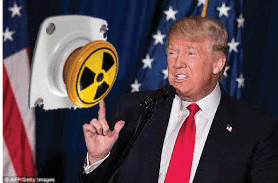 Nuclear weapons: how foreign hotspots could test Trump’s finger on the trigger
From North Korea to Iran to Russia, a president-elect with civilisation-ending weaponry at his fingertips will face an in-tray of potential international crises, Guardian, Julian Borger , 13 Nov 16 On Donald Trump’s first day in office he will be handed the “nuclear biscuit” – a small card with the codes he would need to talk to the Pentagon war room to verify his identity in the event of a national security crisis.
The British nuclear lobby’s sick weapons experiments with chickens
During the Cold War, the UK designed nuclear land mines that were reliant on chickens http://www.businessinsider.com.au/uk-developed-chicken-warmed-nuclear-landmines-2016-11 JEREMY BENDER NOV 14, 2016 The Cold War spawned decades’ worth of bizarre weapon ideas as the West and the Soviet Union strove towards gaining the strategic upper hand over their superpower rival.
Danger of World War III closer, with election of Donald Trump
 WW3 News: Trump Win to Send World to Even Greater Danger of Conflict http://www.techplz.com/alec-baldwin-leave-us-promised-trump-wins-else-leaving/174389/ 12 Nov 16, – Trump is the new president of the United States. The question in everybody’s mind is, will the new leader of the most powerful country in the world bring peace? Or is a new age of political tension upon us?
The whole world awoke to the shocking (for some) news that Donald J. Trump has won the US presidential elections. The Republican candidate shocked the whole world with his victory. Trump is a vocal supporter of Russian President Vladimir Putin; the new president has proclaimed his admiration for the Russian president many times. Trump is by no means a skilful diplomat. He recently criticized his country’s own wars in Iraq and Afghanistan and demanded that US’s own allies share in the defense expense accrued by the US military. Recently, Trump called the issue on climate change a “chinese hoax.”
Will Trump bring about war and destruction to the world? Questions are now asked on when Trump will get the Nuclear launch codes of the US military.
WW3 NEWS WHEN WILL TRUMP GET THE NUCLEAR CODES?
With Trump’s obvious tendency to make enemies in every turn, the obvious question is: How easy is it for President Trump to push the button to launch Nuclear Missiles and jumpstart World War 3? The answer is: pretty simple actually.
According to Bruce Blair, who is a research scholar at Princeton, the US president has the sole authority to authorize the use of nuclear weapons. “The commander-in-chief’s power is pretty clear.” He told Bloomberg. Blair continued to explain that the US president always has a continuous line with his military officials. The US president has the power to authorize a nuclear counterstrike as well.
Kingston Reif of the Arms Control Association recently said that the US president has the “supreme authority” to decide what to do with America’s nuclear weapons.
America currently has 900 nuclear missiles, all of them 30 times more powerful than the bombs dropped in Nagasaki and Hiroshima.
WW3 NEWS: MORE TENSE RELATIONSHIP WITH BEIJING
According to a report by The New York Time, Beijing is exceedingly worried about Trump’s unpredictability. Territorial issues in the South China Sea has made tensions between US and China very tense in the past few years. With a Trump presidency now at hand, will the US – China relationship decline further? And how will the new US president handle his country’s powerful nuclear arsenal? The times are very frightening indeed.
With Trump as USA President Asia’s Nuclear Crisis Expands
Next to North Korea and fearing U.S. abandonment, South Korea and Japan weigh their own options, WSJ, By DAVID FEITH Nov. 11, 2016 Seoul
The nuclear crisis in Northeast Asia was bound to be one of the most dangerous challenges facing the next U.S. president, no matter who won on Tuesday. With Donald Trump’s surprise victory, though, it could metastasize in dramatic ways: If you thought North Korea’s nuclear march was disconcerting, consider that South Korea and Japan may now pursue nuclear programs of their own, raising the risks and stakes of war not only with North Korea but China too…….
It’s possible Mr. Trump will drop his enthusiasm for South Korean and Japanese nuclearization upon entering the Oval Office. His campaign advisers tended to ignore the subject in public statements, likely a reflection of the decades-old bipartisan consensus against nuclear proliferation in Washington. But as with other issues, the approach of President Trump will depend on who he brings into the White House for advice, and whether he listens to them……..
South Korea’s civilian nuclear infrastructure—24 plants providing 30% of the country’s energy—could be used to produce 5,000 bombs worth of fissile material, Mr. Cheong says, dwarfing Pyongyang’s capability. Embracing the necessary technologies, including plutonium reprocessing, could be “the game-changer that will enable South Korea to manage North Korean problems.”………
Several potential candidates in South Korea’s looming presidential election back nuclearization, including former National Assembly floor leader Won Yoo-cheol and Nam Kyung-pil, governor of the country’s most populous province. Mr. Cheong, who acknowledges that “experts and technocrats have tended to be against going nuclear,” says that officials have privately expressed greater interest since Pyongyang’s latest nuclear test in September. Once Pyongyang completes a hydrogen bomb, he says, “many experts will switch their views.”
Then there’s Donald Trump. If he sticks to supporting South Korean and Japanese nuclearization, he might as well hold a bonfire of traditional U.S. nonproliferation dogmas on the White House lawn. http://www.wsj.com/articles/with-trump-asias-nuclear-crisis-expands-1478797800
Donald Trump’s defence policies may spark a nuclear arms race
 President Trump’s defence deals may spark a nuclear arms race https://www.newscientist.com/article/2112461-president-trumps-defence-deals-may-spark-a-nuclear-arms-race/By
“A man you can bait with a tweet is not a man we can trust with nuclear weapons.” The words of his vanquished opponent, Hillary Clinton, are perhaps the biggest anxiety hanging over the shock election of Donald Trump to the US presidency: can he be trusted with the power to launch Armageddon?
Every US president has constant access to a nuclear launch device only he can activate. Born in the Cold War, it is designed for when Russian nuclear missiles are detected making their 30-minute flight to the US, allowing 10-15 minutes to decide to order a counter-strike which would not be countermanded. But it could be used in other scenarios. “There is nothing to prevent a launch for very little reason,” says Paul Ingram of the British American Security Information Council, an arms control think-tank in London.
Would Trump hit the button? He has said he would be “very, very slow on the draw” but has refused to rule out using nukes, asking several times during the campaign, if they are never used, “why do we make them?”
“The very fact that one person, whoever it is, can decide to launch a nuclear strike is very worrying,” says Ingram.
Hair-trigger alert The president’s ability to respond rapidly is to allow the launch of 450 US land-based missiles before they are destroyed in an attack – for which reason they are kept on hair-trigger alert.
One way to reduce the risk of a rash launch would be for President Obama to take US missiles off hair-trigger alert before he leaves, which would be politically delicate to reverse. Or Trump, who wants better relations with Russia, might do it himself.
The use of existing nukes is one thing; proliferation is another. Trump has said he will “renegotiate” last year’s agreement with Iran to limit its uranium enrichment. Arms control experts say we are never likely to get a better deal, so Trump’s plan could see Iran resume its efforts.
And as North Korea approaches nuclear capability, Trump has suggested its neighbours might develop their own nuclear weapons. In April he said that US allies should pay more for the nuclear protection offered by the US umbrella – or defend themselves, “including with nukes”.
Japan and South Korea, under threat from North Korea, are already under pressure to do that. But both are non-nuclear states in the Non-Proliferation Treaty, and have sworn never to develop their own weapons. Their abandonment of that pledge could well be the death-knell of the treaty. While it has failed to disarm the major nuclear powers, it has kept other countries, such as Egypt and Saudi Arabia, from trying to develop the bomb.
Anti-nuclear norms Its failures in disarmament led a large majority of UN members to vote in October to start work on a new treaty that simply bans nuclear weapons for everyone. Existing nuclear nations rejected the idea (apart from North Korea, which voted for it), as, ominously, did Japan and South Korea. Non-nuclear NATO members backed it in the hope of strengthening global anti-nuclear norms.
Those may not last long in the Trump era. He has long called NATO “obsolete” and questions US commitments to Europe. The threat of losing reliable US defence could lead to military build-up in Europe, handing nuclear deterrence to the small UK and French nuclear arsenals, which would then be more likely to go ahead with expensive upgrades.
Thomas Homer-Dixon at the Balsillie School of International Affairs in Waterloo, Canada, sees a more insidious threat. He believes Trump could pick fights abroad and incite attacks on alleged enemies at home to generate a constant “emergency” to bolster his support. Russia’s Vladimir Putin, whom Trump has long admired, uses such tactics.
“The risk of a slide into war which ultimately involves nuclear weapons is very real,” he says. “Trump has an insatiable need to dominate, and he seems incapable of ignoring a slight.” The deadly nuclear winter predicted to follow even a limited nuclear exchange could one day answer the president-elect’s question: if we have these weapons, why don’t we use them?
Mr Trump will soon control America’s nuclear codes
Donald Trump and the nuclear codes Mr Trump will soon control America’s nuclear codes http://www.economist.com/news/briefing/21709999-mr-trump-will-soon-control-americas-nuclear-codes-donald-trump-and-nuclear-codesNov 12th 2016 IN A ritual out of sight of the cameras on Inauguration Day in January, America’s “nuclear briefcase” will change hands and President Donald Trump will receive a card, sometimes known as the “biscuit”. The card, which identifies him as commander-in-chief, has on it the nuclear codes that are used to authenticate an order to launch a nuclear attack. At that point, should he wish, Mr Trump can launch any or all of America’s 2,000 strategic nuclear missiles.
There are no constitutional restraints on his power to do so. Even if all his advisers have counselled against it, as long it is clearly the president giving the command, the order must be carried out. There are no checks and balances in the system. Moreover, once the order is given there is likely to be only a matter of minutes in which it could be rescinded. Once the missiles are flying, they cannot be called back or disarmed. Mr Trump, from what he has said, does not take this responsibility lightly. Indeed, he has often stated that he believes nuclear weapons to represent the greatest threat to humanity and that he will not be trigger-happy, “like some people might think”. But in common with his predecessors, he does not rule out their use.
With little more than ten minutes to take a decision that could kill hundreds of millions of people, even the calmest individual would be under intolerable stress if informed that America was under imminent attack. It is not Mr Trump’s fault that the system, in which the vulnerable land-based missile force is kept on hair-trigger alert, is widely held to be inherently dangerous. Yet no former president, including Barack Obama, has done anything to change it.
Of greater concern would be how Mr Trump might behave in an escalating confrontation if Russia were to rattle its nuclear sabre even more loudly. It is possible that his apparent desire to be buddies with Vladimir Putin might help defuse a dangerous situation. He is, however, notoriously thin-skinned and unable to stop himself responding to any perceived slight with vicious (verbal) attacks of his own. He also revels in braggadocio and is known to be reluctant to take advice. Marco Rubio, a rival for the Republican nomination, questioned whether he had the temperament to be put in charge of the nuclear codes. So did Hillary Clinton. They were right to do so. But it is now Mr Trump, not them, who takes the biscuit.
India’s Defence Minister Manohar Parrikar makes bizarre nuclear statement
Manohar Parrikar makes bizarre nuclear statement, his ministry says personal opinion Defence Minister Manohar Parrikar today wondered why India cannot say “we are a responsible nuclear power and I will not use it irresponsibly” instead of affirming a “no first use policy”, remarks he said were personal in nature. IndiaToday.in New Delhi, November 10, 2016 Defence Minister Manohar Parrikar today spoke about India’s no first use nuclear policy at the book launch of (Retd.) Brig Gurmeet Kanwal’s ‘The New Arthashastra: A security strategy for India’.
Nuclear weapons industry is such a job provider – but there’s down side

Robert Dodge: A ‘jobs program’ to end humanity Nuclear weapons present the greatest public health and existential threat to our survival every moment of every day. Yet the United States and other nuclear nations stand in breach of the 1968 Nuclear Non-Proliferation Treaty, which commits them to work in good faith to end the arms race and achieve nuclear disarmament.
When a nuclear bomb was tested in Mississippi
October 1964 Nuclear testing in Mississippi http://mashable.com/2016/11/06/mississippi-nuclear-test/#QAtiwfQCDiqT [many photographs] Waiting on the big bang
by Alex Q. Arbuckle, 6 Nov 16 At 10 a.m. on Oct. 22, 1964, a five-kiloton nuclear device was detonated in Lamar County, Mississippi.
The previous year, as a response to rising public anxiety over the potential fallout of bigger and bigger test explosions, the United States, Great Britain and the Soviet Union had signed the Partial Test Ban Treaty, which prohibited all nuclear testing in the atmosphere, underwater and in outer space. Underground detonations were not banned in the treaty because it was still technically unclear how they could be detected to ensure compliance.
After signing the treaty, the United States government created Project Dribble, an effort to study how underground nuclear tests could be detected — or hidden.
The site of Project Dribble’s first detonation was 28 miles southwest of Hattiesburg in the Tatum Salt Dome, a massive Mesozoic salt deposit 1,000 feet below the ground.
The plan called for two detonations. The first, code-named Project Salmon, would be an explosion 2,700 feet down in solid salt. The second detonation, Project Sterling, would use a smaller bomb in the cavity left behind by the first blast.
Scientists hypothesized that the shockwaves of the second detonation would be muffled by the cavity, effectively concealing it from seismographic detection. The first blast was scheduled for Sept. 22, but was postponed repeatedly because the wind direction was not ideal.
Finally, on Oct. 22, the conditions were right.
Four-hundred residents were evacuated from the area around and downwind of the blast site. For their trouble, adults were paid $10 and children $5.
At 10 a.m., the Project Salmon device detonated with approximately one-third of the power of the bomb that destroyed Hiroshima.
The earth rose and roiled in waves, pecans fell from trees, dogs howled in fear, creeks ran black with disturbed sediment, and buildings thirty miles away swayed for minutes on end.
Within a week, hundreds of residents had filed damage claims with the government, citing burst pipes, cracked masonry and suddenly dry wells. The test was a success, however. The blast vaporized a spherical void in the salt 110 feet in diameter. When sensors were lowered into the cavity more than three months later, temperatures still measured over 400 degrees Fahrenheit.
Two years after Project Salmon, the second part of the test, Project Sterling, was carried out. A much smaller bomb — equal to 350 tons of TNT versus the first bomb’s 5,000 tons — was detonated in the cavity.
As the scientists hypothesized, the cavity absorbed nearly all of the blast’s seismic force. People on the surface barely felt a bump.
The blasts, which gave the government plenty of data on how underground nuclear tests could be hidden and detected, were declared a success — the only nuclear detonations to ever occur in the eastern United States.
Canada’s navy to investigate object found off B.C. coast -Lost Cold War nuclear weapon?
UFO? Lost Cold War nuclear weapon? Canada’s navy to investigate object found off B.C. coast http://www.cbc.ca/news/canada/british-columbia/ufo-lost-cold-war-nuclear-weapon-canada-s-navy-to-investigate-object-found-off-b-c-coast-1.3835542 Army records indicate diver may have found bomb lost by the U.S. Air Force in 1950
Lost Nuke: The Last Flight of Bomber 075 book trailer
By George Baker, Andrew Kurjata, CBC News Posted: Nov 04, 2016 The Royal Canadian Navy is sending a ship to determine if a diver has discovered “the lost nuke” — a Mark IV bomb that went missing after a U.S. bomber crashed off B.C.’s North Coast in the early days of the Cold War.
Sean Smyrichinsky found the mystery object during a recent diving trip near Banks Island. “I got a little far from my boat and I found something that I’d never ever seen before,” he recalled. “It resembled, like, a bagel cut in half, and then around the bagel these bolts molded into it.”
When he got back to the ship he tried to describe the object to his crew.
“I came out from the dive and I came up and I started telling my crew, ‘My god, I found a UFO. I found the strangest thing I’d ever seen!'”
The ‘lost nuke’
Smyrichinsky started asking around and was told the story of Convair B-36B, a U.S. Air Force bomber that crashed off B.C. in 1950. In a book published earlier this year, historian Dirk Septer traces the story of that flight, summarizing it in publicity documents as a Cold War drama:
“Just before midnight on February 13, 1950, three engines of a US Air Force B-36 intercontinental bomber caught fire over Canada’s northwest coast. The crew jumped, and the plane ditched somewhere in the Pacific Ocean. Almost four years later, the wreck of the bomber was found accidentally in a remote location in the coastal mountains of British Columbia, three hours’ flying time in the opposite direction of where it was supposed to have crashed.
“After years of silence, the United States finally admitted to losing its very first nuclear bomb; the incident was its first Broken Arrow, the code name for accidents involving nuclear weapons. But was the bomb dropped and exploded over the Inside Passage, or was it blown up at the aircraft’s resting place in the mountains?”
The lost bomb was a Mark IV. As soon as Smyrichinsky looked it up on Google Images, he recognized it as the object he had found.
“It was a piece that looked very much like what I saw,” he said. “The plane that was carrying the bomb, it crashed 50 miles south of where I found that object.”
“What else could it possibly be? I was thinking UFO, but probably not a UFO, right?”
Probably not nuclear
Major Steve Neta of the Canadian Armed Forces confirmed the location of Snyrichinsky’s find does coincide with the site of the 1950 crash.
Neta also said records indicate the lost bomb was a dummy capsule, and so there is little risk of the object being a nuclear weapon.
“Nonetheless, we do want to be sure and we do want to investigate it further,” he said. To hear Sean Smyrichinsky describe finding the object, click on the audio labeled ‘A discovery off B.C.’s north coast possible missing relic of Cold War‘.
6th depleted uranium resolution passed by UN General Assembly’s First Committee

 UN General Assembly’s First Committee passes 6th depleted uranium resolution http://www.bandepleteduranium.org/en/unga-first-l63-depleted-uranium-results
The resolution also took note of the ongoing concerns from states such as Iraq, and from health experts and civil society over the effects of the weapons on civilians. With the vote coming a week since the US admitted firing DU in Syria in 2015, concern over the health and environmental consequences of the use of the weapons is once again on the international agenda.
“With attention increasingly focused on the lack of obligations for the post-conflict management of DU contamination, the resolution’s reference to the difficulties affected states face is welcome,” said ICBUW Coordinator Doug Weir. “Without clear standards for clearance, and a mechanism for international assistance, civilians will continue to face avoidable exposure risks.”
True to form, just four states voted against the text, which will be voted on again by the General Assembly in early December. The US, UK, France and Israel remain the only four governments to continuously oppose the resolutions. In spite of repeated appeals from the European Parliament for progress on the topic, EU member states remained split on the resolution, with many among the 26 states still abstaining.
Germany, who up until 2014 had supported the resolutions, once again abstained, angering campaigners from ICBUW-Germany. Their position is all the more frustrating given that they elected not to develop DU weapons on the grounds of acceptability in the 1970s; and needless to say they warn their own military personnel of the dangers of battlefield exposure. Many abstainers used language in paragraph seven of the text to justify their political decision to abstain.
Last month Germany’s Foreign Minister Michael Roth claimed that the government took the debate on DU “very seriously” in a response to a parliamentary question from Green MP Agnieszka Brugger. However, in the run up to the vote Germany repeatedly sought to weaken the text of the resolution even though it seems apparent that Berlin had no intention of voting in favour.
“PAX is deeply disturbed that states abstaining on the resolution refused to recognise civilian concerns over exposure to depleted uranium, civilians who are rightly concerned that low-level radioactive waste in their environment could impact the lives of their families,” said PAX’s Wim Zwijnenburg. “Those states abstaining should look to their own guidelines on radiation protection and then consult their consciences on what would be the right thing do when it comes to protecting civilians in armed conflict.”
Prior to the 2015 election that saw Justin Trudeau sweep to power in Canada, his Liberal Party had been polled on their views on DU by Mines Action Canada. Their response couldn’t have been clearer: “The Liberal Party of Canada opposes the use of depleted uranium munitions.” Sadly Canada failed to live up to this ideal and abstained once again.
In spite of championing work on DU for many years, Norway joined the Netherlands in submitting an explanation of vote that cautioned against the use of language on the “potential health risks from DU”. While both nevertheless voted in favour, they argued that the term “possible health effects” would have been preferable.
ICBUW was pleased that Sweden and Bulgaria, who first voted in favour of the resolution in 2014 supported the text again this year. Sweden joined Switzerland in calling for harm reduction measures, such as risk awareness work for affected communities. Palau voted in favour for the first time, continuing the trend that has seen the number of abstentions decreasing in recent years.
Japan’s nuclear hypocrisy
 Japan’s hypocritical nuclear stance, Japan Times, NOV 3, 2016 Japan’s vote at the United Nations last week to oppose a resolution to start talks on a treaty outlawing nuclear weapons is regrettable. It contradicts the nation’s long-standing call for the elimination of such weapons as the sole country to have suffered nuclear attacks. Tokyo’s latest move — which reflects the government’s reliance on the U.S. nuclear umbrella for the nation’s security — not only runs counter to the wishes of survivors of the 1945 Hiroshima and Nagasaki atomic bombings but will weaken its voice in international efforts to rid the world of nuclear arms.
On Oct. 27, the First Committee of the U.N. General Assembly, which deals with disarmament and international security, adopted the resolution, with 123 nations voting in favor, 38 against it and 16 abstaining. Six nuclear powers — the United States, Russia, Britain, France and Israel — voted against it, backed by U.S. allies such as Japan, South Korea, Germany and Australia. Three nuclear powers — China, India and Pakistan — abstained. Surprisingly, North Korea, which recently carried out a fifth nuclear weapons test, voted in favor…..
It is clear, however, that the U.S. put pressure on its allies, including Japan, to oppose the resolution. The U.S. government reportedly sent a letter dated Oct. 17 to NATO member nations urging them to “vote against negotiations on a nuclear treaty ban, not to merely abstain” and “to refrain from” joining talks on such a treaty. The letter said such a treaty, if enforced, “could have a direct impact on the U.S. ability to meet its NATO and Asia/Pacific extended deterrence commitments and the ability of our allies and partners to engage in joint defense operations with the United States and other nuclear weapons states.” A government official has disclosed that Washington made similar representations to Japan.
It would be logical to assume that Japanese officials believed they cannot resist such pressures given Japan’s dependence on the U.S. nuclear umbrella. But did it not occur to them that opposing the resolution would deprive Japan of moral credibility in its repeated calls for creating a nuclear weapons-free world, or could they not at least have considered abstaining from the vote — just like the Netherlands, a NATO member, did — even merely as a gesture? It is absurd to think that the U.S. would not care about Japan’s unique and special position as the only country to have experienced nuclear attacks.
Japan submitted a resolution calling for the abolition of nuclear weapons for the 23rd time in a row this year and it was adopted the same day as the one to begin talks on the nuclear weapons ban treaty cleared the same U.N. committee — with 167 nations in favor, four countries — China, North Korea, Russia and Syria — voting against and 17 abstaining. The U.S., which abstained from the vote last year, joined in co-sponsoring the resolution. The development raises suspicions that Tokyo opposed the resolution for the nuclear weapons ban treaty as a quid pro quo for Washington’s support of Japan’s resolution.
Given its contradictory behavior, it will be extremely difficult for Japan to regain the trust of other nations in U.N. efforts to seek the elimination of nuclear weapons. http://www.japantimes.co.jp/opinion/2016/11/03/editorials/japans-hypocritical-nuclear-stance/#.WBuiAtJ97Gg
Warning that a USA strike on North Korea would spark war with China
 US strike on North Korea would spark world war with China, think-tank warns https://www.thesun.co.uk/news/2090813/crushing-crazy-kims-nuke-bid-will-spark-war-with-china/
U.S. warned against nuking nutty North Korea because it risked war with neighbouring China BY PATRICK KNOX 1st November 2016,
Humans, wildlife threatened by Navy’s Use of Depleted Uranium in USA Coastal Waters
The Navy’s Use of Depleted Uranium in Our Coastal Waters Threatens Humans, Wildlife Monday, 31 October 2016 By Dahr Jamail, Truthout | ReportSheila Murray with the Navy Region Northwest’s public affairs office, when asked what the Navy was doing to mitigate environmental contamination from the large numbers of Depleted Uranium (DU) rounds it left on the seabed off the Pacific Northwest Coast claimed current research “does not suggest short- or long-term effects” from the release of DU to the environment that could result in its uptake by marine organisms.”
She also said that DU rounds “are extremely stable in sea water and pose no greater threat than any other metal.”
In response to this, Mozhgan Savabieasfahani, an environmental toxicologist and winner of the 2015 Rachel Carson Prize environmental award for her work on DU and heavy metal contamination, told Truthout, “The US Navy representative’s views exhibit an alarming level of amnesia.”
She said this because Murray’s statement has been one that has been recycled by the Navy for years. Reuters reported in January 2003 that the Navy confirmed its use of DU shells in arms tests off the Washington State coast, at which time the Navy claimed, “The DU rounds dissolve so slowly that they would not contribute to naturally occurring (radiation) levels … and do not pose a significant risk.”
Meanwhile, ample scientific reports — including Savabieasfahani’s own research — demonstrate the deleterious health impacts caused by DU.
“When those bullets and bombs explode, dangerous nanoparticles of metals, including uranium nanoparticles, are released into the environment,” she explained to Truthout. “Laboratory research has already established that exposure to environmentally relevant concentrations of uranium has negative impacts on fish embryogenesis, and on the reproductive success of fish.”
Naval documents show that as much as 34 tons of DU could be present on the seabed just 12 miles from the outer coast of Washington State.
Even more distressing, the Navy’s own documents reveal that the extent of its use of DU off the coast of the US is far more pervasive than it admits to the public.
And results of a Freedom of Information Act filing provided to Truthout show that the Navy, which claims in its environmental impact statements it has not used DU since 2008, has actually shipped it from a Puget Sound munitions area as recently as 2011.
A Bogus Study
The Navy’s public affairs officer, Murray, also told Truthout that a “recent study” of an area off the south coast of England that was used for test firing DU rounds “did not show presence of DU in sample of intertidal and ocean bottom sediments, seaweed, mussels, and locally caught lobster and scallops. (Toque, 2006).”
However, the study Murray cites — and which the Navy consistently cites when arguing that DU is not harmful — is heavily disputed.
Carol Van Strum, an Oregon-based environmental advocate who has researched DU for years, told Truthout that Murray’s statement is “an out-and-out lie.”
Van Strum, who has read the Toque study closely and knows it well, pointed out that, for starters, the study’s author works for a British military contractor. She went on to point out two very serious flaws in the study.
“While the study relied on ‘locally caught’ lobster and scallops as samples for testing for depleted uranium, the samples were never ‘caught’ but rather bought in a local market, and thus could have come from anywhere,” Van Strum explained. “Second, and most worrisome … the actual study reports depleted uranium contamination in nearly all of the samples.”
The Navy’s Environmental Impact Statement (EIS) on the matter claims “the survey results show no evidence of DU being present in any marine environmental sample collected in the year 2004.”
But Van Strum called their claim “incontrovertibly false” because the study itself stated it had found DU contamination in the soil in many areas where the military was operating cannons, in the soil where ordnance had been fired, and in the soil, sea water and marine life where the ordnance they had fired had landed.
“The study’s methodology would not pass muster for even a high school science project,” Van Strum said. Karen Sullivan, a retired endangered species biologist who co-founded the website West Coast Action Alliance that acts as a watchdog of Naval activities in the Pacific Northwest, questioned why the Navy would open itself up to accusations of bias by relying on only a single study done by someone who works for a group affiliated with the British military.
“Why would the Navy rely on such a flawed and obviously biased study to ‘prove’ that DU in seawater poses no threat greater than any other metal?” Sullivan, who worked at the US Fish and Wildlife Service for more than 15 years and who is an expert in the bureaucratic procedures the Navy is supposed to be following, asked in an interview with Truthout. “Probably because the enormous body of properly conducted and unbiased science completely refutes it.”
Van Strum went on to point out additional significant problems with the study, including the almost laughable procurement and use of the samples……..
Human Health Impacts of DU “Quite Relevant” to Naval Exercises
“Navy exercises in the waters of the Pacific Northwest will release contaminants into the marine environment, with an undeniable potential to harm human health,” Savabieasfahani said, noting that this would apply even to low-level amounts of DU being introduced into the oceans. “It is long established that explosives can contaminate soil, sediment and water and thereby impact environmental and human health.”
She explained that the human and environmental impacts of the Navy’s use of DU in past exercises is “quite relevant,” and cited a report that showed how DU exposure has been linked to lower cognitive ability in adults.
“This leads us to expect much worse impacts on growing children, newborns and infants — to say nothing of unborn babies,” Savabieasfahani added. “Furthermore, epidemiological evidence is also consistent with an increased risk of birth defects in the children of people exposed to DU.”
She also heavily emphasized the fact that the internalization of uranium in any form will result in both chemical and radiation exposure. “Once inside a living body, DU and uranium’s effects are virtually the same,” Savabieasfahani explained. “This is a point worth repeating.”
Moreover, Savabieasfahani emphasized that it’s dangerous to guesstimate “safe” levels of DU, whether or not it reaches levels determined to be “toxic.”
“Our knowledge of the human health impacts of DU is consistent with laboratory studies of other mammals,” she said. “DU exposure affects neurogenesis during prenatal and postnatal brain development by disrupting patterns of cell proliferation and cell death. Even sub-toxic levels of DU have been shown to alter brain function.”
She also took issue with Murray’s argument, which Savabieasfahani described as, essentially, “the solution to pollution is dilution.” This is the nuclear industry’s default argument about radiation and other forms of pollution, and has been for decades, despite the fact that this logic was “decisively rejected” more than 40 years ago. Savabieasfahani pointed out that even Richard Nixon’s EPA administrator, William Ruckelshaus, rejected the dilution argument in a 1972 Congressional testimony regarding the Clean Water Act.
Savabieasfahani noted that any upcoming Naval exercises that introduce heavy metals and other pollutants, regardless of whether they use DU, will increase the environmental “background burden” of DU and other pollutants.
“Increasing that burden is simply irresponsible,” Savabieasfahani said. “Seabed pollutants have already found their way into our bodies. Those pollutants will continue to impact the most vulnerable populations — infants, newborns and growing children — most profoundly, and their imprint will be found in the baby teeth of our children.”
Other Instances of DU
Problems with DU in the Pacific Northwest are not limited to the Navy……. http://www.truth-out.org/news/item/38185-the-navy-s-use-of-depleted-uranium-in-our-coastal-waters-threatens-humans-wildlife
Call for negotiations on a new treaty outlawing nuclear weapons – UN resolution
UN Resolution Calls for Ban on Nuclear Weapons http://www.voanews.com/a/un-resolution-calls-for-a-ban-on-nuclear-weapons/3569764.html U.N. member states have voted overwhelmingly on a measure that could lead to a ban on nuclear weapons.
On Thursday, the U.N. Disarmament and International Security Committee voted to approve a resolution that calls for negotiations on a new treaty outlawing nuclear weapons, despite opposition from nuclear-armed nations.
“This treaty won’t eliminate nuclear weapons overnight. But it will establish a powerful, new international legal standard, stigmatizing nuclear weapons and compelling nations to take urgent action on disarmament,” Beatriz Fihn, executive director of the International Campaign to Abolish Nuclear Weapons, said.
Fihn said the vote was a “historic moment” even though convincing countries to eliminate their nuclear weapons will be very difficult.
The non-binding resolution, presented by Austria, Brazil, Ireland, Nigeria, Mexico and South Africa was approved by a vote of 123 to 38, with 16 abstentions. Nuclear powers had lobbied for “no” votes.
Who voted against it The United States, Israel, France, Russia and Britain were among the nations voting against the measure. China, India and Pakistan abstained.
U.N. members will meet in December to vote on the resolution during a full general assembly.
The resolution also aims to set up a conference next March to negotiate a “legally binding instrument to prohibit nuclear weapons, leading toward their total elimination.”
Humanitarian consequences Countries in favor of the resolution cited deep concerns about the “catastrophic humanitarian consequences of any use of nuclear weapons.”
Nations against the measure say nuclear disarmament should be discussed during negotiations on the Nuclear Non-Proliferation Treaty.
This resolution came after three international conferences that took place in 2013 and discussions by a working group on nuclear disarmament in 2016 that recognized the humanitarian effects of nuclear weapons.
1 This Month
23-25 October – on Zoom – World BEYOND War’s annual global conferenc


Shut down the radiation-damaged Heysham nuclear reactors now
To see nuclear-related stories in greater depth and intensity – go to https://nuclearinformation.wordpress.com

Say No to NASA’s Reckless Nuclear Reactor on the Moon
Say No to NASA’s Reckless Nuclear Reactor on the Moon
-
Archives
- October 2026 (180)
- September 2026 (339)
- August 2026 (330)
- July 2026 (355)
- June 2026 (287)
- May 2026 (306)
- April 2026 (356)
- March 2026 (251)
- February 2026 (267)
- January 2026 (308)
- December 2025 (358)
- November 2025 (359)
-
Categories
- 1
- 1 NUCLEAR ISSUES
- business and costs
- climate change
- culture and arts
- ENERGY
- environment
- health
- history
- indigenous issues
- Legal
- marketing of nuclear
- media
- opposition to nuclear
- PERSONAL STORIES
- politics
- politics international
- Religion and ethics
- safety
- secrets,lies and civil liberties
- spinbuster
- technology
- Uranium
- wastes
- weapons and war
- Women
- 2 WORLD
- ACTION
- AFRICA
- Atrocities
- AUSTRALIA
- Christina's notes
- Christina's themes
- culture and arts
- Events
- Fuk 2022
- Fuk 2023
- Fukushima 2017
- Fukushima 2018
- fukushima 2019
- Fukushima 2020
- Fukushima 2021
- general
- global warming
- Humour (God we need it)
- Nuclear
- RARE EARTHS
- Reference
- resources – print
- Resources -audiovicual
- Weekly Newsletter
- World
- World Nuclear
- YouTube
-
RSS
Entries RSS
Comments RSS

