Russia eager to salvage nuclear weapons treaty, once Biden is USA president
 For Russia, nuclear arms curbs with Biden are a ‘no brainer’ https://www.thejakartapost.com/news/2021/01/15/for-russia-nuclear-arms-curbs-with-biden-are-a-no-brainer-.html Jonathan Brown Agence France-Presse Moscow / Fri, January 15, 2021 Russian President Vladimir Putin holds a video conference call with Mikhail Degtyarev, an LDPR party lawmaker, in Kerch, Crimea, on July 20, 2020. (Sputnik/AFP/Alexey Druzhinin ) For Russia, nuclear arms curbs with Biden are a ‘no brainer’ https://www.thejakartapost.com/news/2021/01/15/for-russia-nuclear-arms-curbs-with-biden-are-a-no-brainer-.html Jonathan Brown Agence France-Presse Moscow / Fri, January 15, 2021 Russian President Vladimir Putin holds a video conference call with Mikhail Degtyarev, an LDPR party lawmaker, in Kerch, Crimea, on July 20, 2020. (Sputnik/AFP/Alexey Druzhinin )
When US President-elect Joe Biden enters the White House next week his administration will be in a race against time to salvage a landmark nuclear arms accord with Russia. The New START treaty, which expires just 16 days after Biden’s inauguration, is the last major arms reduction pact between old foes whose bulging nuclear stockpiles dominated fears for global security during the Cold War.
But the fast-approaching deadline to find compromise comes as tensions between Moscow and Washington are at fever pitch over recent hacking allegations, and after Biden vowed to take a firm stand against Russia. The stakes of reaching an agreement are high, says Elena Chernenko, a foreign editor at Russia’s Kommersant newspaper who has closely followed negotiations. “The treaty limits the chances of one side miscalculating the intentions or plans of the other, which we saw happen several times leading to very dangerous moments during the Cold War,” she told AFP.
Any agreement is also likely to define spending priorities for both governments, said Russian political columnist Vladimir Frolov. Extending New START could determine both in Moscow and Washington whether “more money than necessary would have to be spent on nuclear toys as opposed to health care,” he told AFP.
New START was signed in 2010 between then-US president Barack Obama and former Russian leader Dmitry Medvedev, curbing warheads to 1,550 each and restricting numbers of launchers and bombers.
Biden will be eager to score a big diplomatic win early in his term, but he is also under pressure to tread a fine line and make good on a campaign promise to be tough on Russia. Lawmakers in the US demanded punishment for Russia last year after concluding that Kremlin-backed hackers were behind a sweeping cyber intrusion into government institutions.
That standoff is just the latest in a litany of disagreements over conflicts in Ukraine and Syria and allegations of Russian election meddling. Still, rhetoric from Moscow and Washington as the New START expiration deadline approaches has raised hopes that arms control could offer a rare area of compromise. Biden’s incoming national security advisory Jake Sullivan said this month that the president-elect had tasked officials with looking at extending New START “right out of the gates”.
In Moscow, Putin recently proposed a one-year extension without preconditions and tasked Foreign Minister Sergei Lavrov with getting a “coherent” US response to the offer. Former Soviet leader Mikhail Gorbachev, a champion of Soviet-era arms accords with the United States, said this week he expects Biden to prolong the accord and urged both sides “to negotiate further reductions”.
“Russia is on record at the highest level that it wants to extend the treaty for five years without any preconditions,” said Frolov, the columnist. Moscow is in favor of an extension, he said, because it would allow Russia to modernize its own nuclear forces at an affordable and measured pace, without rushing into an arms race. Frolov added that Russia was unlikely to sabotage negotiations just to make Biden appear weak at the onset of his tenure, saying the Kremlin “does not care about Biden’s wins”.
For Putin, extending New START is “a no brainer,” Frolov said. Negotiations under US President Donald Trump stumbled over an American demand that China become party to the agreement – Beijing having shown no interest in joining. That demand was highlighted in an embarrassing episode last June, when a US negotiator at arms control talks in Vienna tweeted a picture of China’s flag next to empty chair. “China is a no-show,” US Special Presidential Envoy for Arms Control Marshall Billingslea wrote, even though Beijing was never expected to attend.
With the dawn of the Biden era, that tone of negotiation has likely come to an end, analysts believe. “There are now adults in the room in the United States, so even with these areas of confrontation, maybe this is the one avenue where Moscow and Washington will be able to compromise to make the world a little bit safer,” Chernenko said.
While both Washington and Moscow have signaled a positive outcome for Feb. 5 – the New START expiration date – what comes next is a different question. “That’s the moment when Russia will come to the table with a big portfolio of grievances and demands,” Chernenko cautioned.
|
|
Church leaders call on UK to sign nuclear weapons ban treaty
 UK is urged to sign UN nuclear-weapons treaty https://www.churchtimes.co.uk/articles/2021/15-january/news/uk/uk-is-urged-to-sign-un-nuclear-weapons-treaty by PAT ASHWORTH, 15 JANUARY 2021 But there is resistance to change, say peace campaigners.
CAMPAIGNERS are urging the UK to sign the United Nations Treaty on the Prohibition of Nuclear Weapons, which will come into effect on 22 January.
The Archbishops of Canterbury and York, with more than 30 Church of England bishops, called on the Government in November to accept the treaty, which, they said, would “give hope to all people of goodwill who seek a peaceful future” (News, 20 November 2020).
It has been signed by 51 states. They will now be required to stop producing, developing, testing, or stationing nuclear weapons, and will be required to help any victims of their testing and use. Their financial institutions will be expected to stop investing in companies that produce nuclear weapons.
The UK, the United States, France, and Russia have not signed the treaty. Clergy and church leaders were reminded in a briefing by the Network of Christian Peace Organisations (NCPO), on Tuesday, of the overwhelming support given to a Lambeth Conference resolution in 1998, which called on the Government and the UN to press for an international mandate for all member states to prohibit nuclear warfare.
Now was the time to fulfil that, Rebecca Johnson, one of the architects of the treaty and a founder member of the International Campaign to Abolish Nuclear Weapons (ICAN), said. Nuclear weapons must be known for what they really were — weapons of mass destruction — and the phrase “nuclear powers” must be replaced with “nuclear-armed states”.
The treaty was a legal one, but it would work by persuasion and not by coercion; it was normative in taking away any status attached to hanging on to nuclear weapons, and in labelling as pariahs those who did. “We all need to think about what we can do to bring this treaty into force in our own countries. There is an important job here for faith leaders to do,” she said.
Although the C of E had a blanket policy of not investing in companies with an interest in nuclear weapons, everyone should examine investment practice in their churches, the policy adviser on international affairs for the ecumenical Joint Public Issues Team, Steve Hucklesby, said.
The treaty brought “a very real possibility of a new norm on nuclear weapons across the whole finance and business sectors; but be clear: there is resistance to change,” he continued. Pressure could be applied to banks and pension providers if individuals saw this as something relating to their own lives. “The issue now becomes compliance with an international treaty, to be applied across the whole of an institution’s business.”
An international meeting to be held in Vienna later this year will establish mechanisms for compliance. It will be open to observers from nuclear-armed states, who will not be able to vote but who should be urged to “attend, listen, and learn,” Ms Johnson said. “It is so important for the UK to join sooner rather than later . . . to be at the table.”
Russell Whiting, who chairs Christian CND, described a world in which President Trump, or even Joe Biden, had their finger on the nuclear button, as “an incredibly dangerous place”. The treaty has been declared dangerous by the Prime Minister, and by the former Foreign Secretary Philip Hammond. These governments had “misrepresented” the treaty wherever they went, saying that it would undermine the existing non-proliferation treaty, Ms Johnson said.
The General Synod called for the elimination of nuclear weapons in July 2018, but it stopped short of urging the Government to sign the treaty. The Government’s refusal to do so was described by the Archbishop of York, the Most Revd Stephen Cotrrell, then Bishop of Chelmsford, as “hugely disappointing” and “a decision that looks like complacency”. He questioned the billions of pounds spent on Trident (News, 13 July 2018).
The general secretary of the Roman Catholic peace movement Pax Christi, Pat Gaffney, said on Tuesday that RC bishops had issued a statement asking the Government to support the treaty — a move that she described as “a huge step forward, because they have habitually said it undermined the existing non-proliferation treaty. Catholics need to write to their bishops affirming what they are doing.”
The NCPO is holding a service online at 11.30 a.m. on 22 January, to mark the treaty. It will conclude with the ringing of the peace bell at Coventry Cathedral.
Global nuclear policy is stuck in colonialist thinking. The ban treaty offers a way out.
|
Global nuclear policy is stuck in colonialist thinking. The ban treaty offers a way out.
 Bulletin of the Atomic Scientists By Molly Hurley | January 15, 2021 The world recently reached a significant milestone on international nuclear weapons policy: The Treaty on the Prohibition of Nuclear Weapons—commonly called the nuclear ban treaty—hit 50 ratifications, triggering its entry in force on January 22, 2021. None of the 50 ratifications comes from a country with an actual nuclear arsenal. Nevertheless, as the name suggests, the ban treaty prohibits states party to it from developing, testing, producing, manufacturing, otherwise acquiring, possessing, or stockpiling nuclear weapons or other nuclear explosive devices. The treaty is a step in the right direction for those in the disarmament camp, but it is much more than that. While the current system regulating nuclear weapons is unstable, dangerous, and unfair to much of the world because it grew out of a colonial system, the ban treaty can help the world move in a less dangerous, post-colonial direction. Bulletin of the Atomic Scientists By Molly Hurley | January 15, 2021 The world recently reached a significant milestone on international nuclear weapons policy: The Treaty on the Prohibition of Nuclear Weapons—commonly called the nuclear ban treaty—hit 50 ratifications, triggering its entry in force on January 22, 2021. None of the 50 ratifications comes from a country with an actual nuclear arsenal. Nevertheless, as the name suggests, the ban treaty prohibits states party to it from developing, testing, producing, manufacturing, otherwise acquiring, possessing, or stockpiling nuclear weapons or other nuclear explosive devices. The treaty is a step in the right direction for those in the disarmament camp, but it is much more than that. While the current system regulating nuclear weapons is unstable, dangerous, and unfair to much of the world because it grew out of a colonial system, the ban treaty can help the world move in a less dangerous, post-colonial direction.
A post-colonial perspective on national security begins by overturning a number of currently held assumptions within the mainstream nuclear policy regime—one that is solely dedicated to nonproliferation and deterrence and lacks a genuine commitment to eventual disarmament. These assumptions are that exporting a Western values system, especially through military intervention, builds democracy and brings “civility” to Global South countries; that “might makes right,” and one country can impose its arms control demands on the rest of the world; that the West rightfully serves as the primary guardian and custodian of arms control and disarmament; and that nuclear weapons make the world safer, but only when certain countries possess them. One of the principal benefits of the ban treaty is that it can help subvert these assumptions, opening a pathway toward a new, post-colonial conception of security. “Civilizing” the Global South. The current system implicitly gives the United States the right to determine the validity of Global South countries’ form of government. For example, when the United States invaded Iraq in 2003, the George W. Bush administration posited that the necessity of this action stemmed not only from a concern for Iraq’s development of weapons of mass destruction, including nuclear weapons development, but also a concern for overthrowing Saddam Hussein and bringing democracy to the country. Intelligence on the accusation of a nuclear weapons program was revealed to be murky at best and a complete lie at worst. As for the democracy pursuit, deeper analysis shows this to also be a cover. In reality, a primary motivator for the US invasion of Iraq was to demonstrate superiority as a world power. Secretary of Defense Donald Rumsfeld said in 2001 that taking down Saddam would “enhance US credibility and influence through the region” and “demonstrate what US policy is all about.” The sentiment grew particularly strong after 9/11, an event that President Bush felt was a humiliation on the part of US power and security. Although the claim for this underlying motivation is contested by some, Under Secretary of Defense for Policy Douglas Feith admitted in 2006 that “the rationale for the war didn’t hinge on the details of this intelligence, even though the details of the intelligence at times became elements of the public presentation.” The misleading of the public aside, the very premise of the United States holding a responsibility to lead in the development of spreading “democracy” around the world is inherently racist……….. Bringing it back to the ban treaty, the treaty shows that Global South does not need “civilizing,” since it was Global South countries that led the way in its negotiation and adoption. If anything, it’s the opposite: Article 12 of the treaty obligates state parties encourage other countries to join on, with the goal of universal adherence. So leaders like Nigeria, Mexico, and Bangladesh will now be working diplomatically to “civilize” the nuclear powers. Might makes right. The second assumption of the current nuclear policy regime is that military aggression or interference is a critical centerpiece in bringing about peace and stability. Just look at deterrence theory at its essence. Nuclear-armed countries have built the foundations of their security policies around nuclear arsenals and the principle of deterrence. Mutual assured destruction dominated the Cold War understanding of nuclear weapons and still underpins the concept of deterrence today. It’s a game of Russian roulette, but with all guns loaded and fingers on the trigger. Deterrence is built on the idea that with enough nuclear weapons no one will dare attack. Yet this belief is deeply flawed because it ignores the potential for misperception, accidents, and leaders who follow different decision-making calculuses. Deterrence theory is also a belief in the right of the five officially recognized nuclear weapon states under the Nuclear Non-Proliferation Treaty (China, France, Russia, the United States, and the United Kingdom) to have the power to threaten nuclear annihilation to force “peace” on the rest of the world. How is the Treaty on the Prohibition of Nuclear Weapons different? Simply look at the course of the ban treaty from its early stages of development, to its adoption in 2017, and up to today. The ban treaty came about from the Humanitarian Initiative, a series of discussions held by non-nuclear weapons states about the humanitarian consequences of nuclear possession and nuclear war. Participants also included members of civil society. All nuclear weapons states, most NATO members, and many military allies of nuclear weapon states boycotted the negotiations, which were chaired by Costa Rican Ambassador Elayne Whyte Gomez. Even in the lead up the treaty’s creation and adoption, the severe humanitarian consequences of nuclear weapons and their possible use was the focus, rather than their strategic capabilities as tools of war, and the discussions were led not by the UN Security Council but by those historically overlooked or ignored in nuclear policy discussions. Currently, 50 countries have ratified (and 86 countries have signed) the treaty. Its entry into force in this month will signal a large shift in the international dialogue on the path to disarmament, giving a voice to the countries who have become party to the treaty and who would otherwise have been given small, if any, roles to play in the global affairs of nuclear policy. The custodians of arms control. Following this, should the United States and other recognized nuclear weapons states just by virtue of possessing nuclear weapons get to be the sole decision makers in international nuclear policy and disarmament and nonproliferation efforts?…….. Movement toward dedicated, deliberative diplomacy, negotiation, and multilateralism not only runs counter to the current assumption of “might equals right” and US primacy but also leads to the creation of more nuanced, culturally-appropriate, and indigenous decision-making processes, in line with a post-colonial approach to national and international security. A return to multilateralism is a return to confidence-building and international cooperation toward a safer world. Instead of the few nuclear “haves” dictating nonproliferation and disarmament policy to the rest of the world as they tried to do in their boycott of the meetings leading up the treaty’s adoption, the rest of the world can be the arbiters of our nuclear future. Adoption of the treaty by each country is an independent decision under each country’s sovereignty and right to freedom from nuclear threat and devastation. The treaty de-centers the historically Eurocentric idea of security by instead focusing on the development and defense of the “weak,” and not of Western great powers………….. If Western policy makers can acknowledge the destabilizing effects of nuclear weapons possession by the East, then surely they can realize the destabilizing effects of their own arsenals. The ban treaty does this. It doesn’t call out just the Eastern countries for the role they play in nuclear hegemony and the oppression the world’s population faces, but all nuclear powers, both recognized and unrecognized. A step in a post-colonial direction. Given this fallacy in the safety of nuclear weapons possession, whose security do these weapons actually prioritize? Whatever the answer, they certainly do not prioritize global security. A post-colonial security, by contrast, would do just that. It would focus on the humanitarian consequences of such policies and be sensitive to the multiplicity of different cultural conceptualizations of “humanity” and “security.” It would protect all humans, natures, and cultures from destruction………https://thebulletin.org/2021/01/global-nuclear-policy-is-stuck-in-colonialist-thinking-the-ban-treaty-offers-a-way-out/ |
|
How will Entry Into Force of the Nuclear Weapons Ban Treaty impact non weapons states parties, including Australia?
 How will EIF impact non states parties, including Australia? https://icanw.org.au/wp-content/uploads/Australia-EIF-of-the-TPNW.pdf How will EIF impact non states parties, including Australia? https://icanw.org.au/wp-content/uploads/Australia-EIF-of-the-TPNW.pdf16 Jan 21, While non states parties are not legally bound to the terms of the treaty, the norms set out and strengthened by the treaty can shape their behaviour and build pressure for them to join. The entry into force of the treaty puts Australia out of step with international law. While Australia has joined every other treaty that prohibits indiscriminate or inhumane weapons, the Nuclear Non-Proliferation Treaty and the South Pacific Nuclear Free Zone Treaty, it has not yet signed or ratified the ban on nuclear weapons. This position is contested by a growing nationwide movement and at all levels of government. The treaty reveals Australia’s complicity in the problem by including nuclear weapons in its defence posture.
***
As a country with a devastating history of nuclear testing, Australia will be obliged to take action as a state party to assist survivors of nuclear testing and take steps towards remediating contaminated environments. These obligations should be informed by and developed in collaboration with impacted First Nations people, nuclear test veterans, civil society, public health and other experts.
***
Entry into force of previous ban treaties has led to a substantial decrease in the production and deployment of prohibited weapons such as cluster munitions and landmines, both by states parties and non states parties. EIF will also impact the flow of funds to nuclear arms producing companies. Financial institutions often choose not to invest in “controversial weapons,” which are typically weapons prohibited by international law. The entry into force of the TPNW clearly puts nuclear weapons in this category and will likely trigger additional divestment, including by Australian banks and superannuation funds.
***
EIF of the treaty will further stigmatise nuclear weapons, including in Australia, by: Prompting further debate: more than 250 federal, state and territory parliamentarians have declared their support for the treaty and the federal Opposition, the Australian Labor Party, has committed to sign and ratify the treaty in government. Decision-makers will continue to be asked to engage with this new piece of international law.
***
Institutionalisation: entry into force will entrench the treaty’s place in the international legal architecture for nuclear weapons. It is already referenced in international fora as signatories and states parties proudly declare their commitment to nuclear disarmament.
***
Impacting alliances: all states parties in alliances with nuclear-armed states will be required to renounce the use of nuclear weapons on their behalf, and ensure they are not assisting with the use or threat of use of the weapons. Once a state party, Australia will need to cease any policy that countenances and supports the use of nuclear weapons. Other US allies, including New Zealand and Thailand, have already joined the treaty.
***
It will take years to build the necessary political will for some states to join the nuclear weapon ban treaty. Shifting nuclear weapons from a symbol of status to a liability of shame is slow, yet crucial, work. As the signatures and ratifications of the treaty continue beyond entry into force, non states parties will face increasing criticism from their citizens, international organisations and other states. Almost all of Australia’s neighbours in the Pacific and Southeast Asia support the treaty. It is only a matter of time before Australia joins the treaty and thereby becomes part of the solution to these abhorrent weapons.
|
|
Leeds and Brighton cities pass resolutions supportint the Treaty on Prohibition of Nuclear Weapons
NFLA 14th Jan 2021, With just 9 days to go before the entry into force of the Treaty on theProhibition of Nuclear Weapons, Leeds and Brighton pass resolutions
supporting the Treaty.
Iran tests missiles under apparent watch of US nuclear sub
Iran tests missiles under apparent watch of US nuclear sub
State media says Iran has fired cruise missiles as part of a naval drill in the Gulf of Oman, abc news, ByThe Associated Press 15 January 2021 DUBAI, United Arab Emirates — Iran fired cruise missiles Thursday as part of a naval drill in the Gulf of Oman, state media reported, under surveillance of what appeared to be a U.S. nuclear submarine dispatched to the region amid heightened tensions between the countries.
Helicopter footage of the exercise released by Iran’s navy showed what resembled an Ohio-class guided-missile submarine, the USS Georgia, which the U.S. Navy last month said had been sent to the Persian Gulf — a rare announcement aimed at underscoring American military might in the region.
Iran’s navy did not identify the submarine, but warned the boat to steer clear of the area, where missiles were being launched from land units and ships in the gulf and the northern part of the Indian Ocean. When asked for comment on the reported submarine sighting, Cmdr. Rebecca Rebarich, a spokeswoman for the U.S. Navy’s Bahrain-based 5th Fleet, responded: “We don’t talk about submarine operations.”
Later Thursday, Iran‘s state-run media claimed that a “foreign” vessel had “intended to approach the naval drill” and departed soon after the Iranian Navy’s warning, without elaborating……..https://abcnews.go.com/International/wireStory/iran-tests-missiles-apparent-watch-us-nuclear-75251087
What could Biden’s nuclear policy look like?
 What could Biden’s nuclear policy look like? What could Biden’s nuclear policy look like?
King County sits only miles away from one-third of the deployed U.S. nuclear arsenal. Courier Herald By Aaron January 12, 2021 For Leonard Eiger, having the U.S. Navy’s entire Pacific fleet of nuclear-armed submarines only a short excursion away doesn’t sit well with him. The longtime anti-nuclear weapons activist and former North Bend resident has for decades worked to educate Puget Sound residents about Naval Base Kitsap Bangor, which houses around one-third of the nuclear weapons that are actively deployed. Eight of the 14 Ohio-class submarines, which carry powerful nuclear weapons, are stationed out of the base in Kitsap County. “For me there’s a real futility in thinking of, and preparing to fight, a nuclear war,” Eiger said. “Because any nuclear war, any nuclear exchange between the U.S. and Russia, is game over.” Eiger lived in North Bend for 26 years, before recently moving to the San Juan Islands. He’s been involved with the Ground Zero Center for Nonviolent Action, which stages demonstrations against — and education campaigns about — nuclear weapons. As the Donald Trump administration winds down, he’s hoping that a Joe Biden presidency will mark a turning point in the way the U.S. approaches nuclear weapons. The Trump administration didn’t make significant progress toward renewing the New START Treaty, which expires on Feb. 5 and began deploying “low-yield” nuclear weapons on submarines, he said. The administration also did not subscribe to a “no first use” policy. It also pulled out of the Iran nuclear deal. The Trump administration didn’t make significant progress toward renewing the New START Treaty, which expires on Feb. 5 and began deploying “low-yield” nuclear weapons on submarines, he said. The administration also did not subscribe to a “no first use” policy. It also pulled out of the Iran nuclear deal. And if a nuclear weapon was fired at one country, other nuclear powers wouldn’t know where it was destined, and could launch their own nukes, fearing an attack, he said. These missiles are something that Hans Kristensen, director of the Nuclear Information Project at the Federation of American Scientists, is thinking about. He said that this could make military leaders more comfortable using them from technical and humanitarian points of view because there could be less collateral damage and fallout …….. On the first use of nuclear weapons, Biden’s policy platform states that he believes the sole purpose of the U.S. nuclear arsenal is to deter other countries from attacking the U.S. with nuclear weapons. If he holds to this statement, then he would enact a no first use policy, according to Kristensen………. Treaties Biden is also hoping to resurrect two important nuclear treaties. The first is the Iran nuclear deal, which was negotiated by the Obama administration while he served as vice president. Trump withdrew from the treaty and put additional sanctions on Iran……. The second significant nuclear agreement is the New START Treaty between Russia and the U.S. The treaty limits the number of nuclear weapons that the countries can own, and have deployed, at any given time. It includes all three legs of the U.S. nuclear triad, including submarine, bomber and land-based missiles. Biden’s policy platform states he will try to renew and extend the New START Treaty. The treaty could be extended up to five years, but Kristensen said the administration could choose a shorter term. If Biden chose to go with a longer five year renewal, it would likely have a calming effect on nuclear competition between the U.S. and Russia. However, a shorter term would send signals that the two countries need to address the problems with the treaty and create something stronger, Kristensen said….. ………… For activist Leonard Eiger, the world of today is only here because of a series of fortunate events. He cited the Cuban Missile Crisis, where the U.S. and Russia came close to nuclear war in 1962. “We still live under the threat of either accidental or intentional nuclear war,” he said. “So long as nuclear weapons exist, that threat will continue to exist.”……… https://www.courierherald.com/news/what-could-bidens-nuclear-policy-look-like/ |
|
Trump chaos highlights risks of sole nuclear launch authority
Trump chaos highlights risks of sole nuclear launch authority, https://www.aspistrategist.org.au/trump-chaos-highlights-risks-of-sole-nuclear-launch-authority/, 12 Jan 2021, |Ramesh Thakur, Critics of nuclear weapons have long pointed to two sets of risks. First, deterrence stability depends on all fail-safe mechanisms working every single time in every bomb-possessing country. That is an impossibly high bar for nuclear peace to hold indefinitely. Second, it also requires that rational decision-makers be in office in all the world’s nine nuclear-armed states.
In the past four years the latter risk has intensified in particular because of the personality traits of two of the nine leaders concerned, which is why US President Donald Trump and North Korean leader Kim Jong-un were described as the godfathers of the UN nuclear ban treaty. The late Bruce Blair, a former nuclear launch officer and respected anti-nuclear campaigner, said in 2016: ‘The thought of Donald Trump with nuclear weapons scares me to death.’
The issue acquired unexpected urgency amid ugly scenes outside and inside Congress after it duly certified Joe Biden as the winner of the 2020 presidential election. On 8 January, House Speaker Nancy Pelosi discussed with General Mark Milley, chairman of the Joint Chiefs of Staff, precautions for ‘preventing an unstable president from initiating military hostilities or accessing the launch codes and ordering a nuclear strike’. Milley’s office confirmed to the New York Times that he had answered her questions about the nuclear command authority.
The US has no extant legal mechanism for addressing Pelosi’s concern. On 22 December 2008, in the final days of the George W. Bush presidency, Vice President Dick Cheney confirmed the unchecked presidential authority.
” For 50 years, he said, ”the US president has been ‘followed at all times, 24 hours a day, by a military aide carrying a football [so-called because the code word for the first set of nuclear war plans was ‘Dropkick’] that contains the nuclear codes that he would use and be authorized to use … He doesn’t have to check with anybody. He doesn’t have to call the Congress. He doesn’t have to check with the courts. He has that authority because of the nature of the world we live in.’
Because of the launch-on-warning posture of nuclear weapons on high-alert status, the US nuclear system is designed to respond to a commander-in-chief’s launch order instantaneously. Missiles would leave their silos just four minutes after the president’s command authorising a strike, so that they launch before they’re destroyed by enemy missiles and hit their targets within 30 minutes of launch.
The one historical occasion on which the president’s unchecked power was an issue was in the dying days of Richard Nixon’s presidency amid the Watergate crisis. Writing in Politico in 2017, Garett Graff recalled how Defense Secretary James Schlesinger had issued an unprecedented set of orders, directing that if Nixon gave any nuclear launch order, military commanders were to check either with him or with Secretary of State Henry Kissinger before executing them. This was after Senator Alan Cranston had phoned Schlesinger to warn him about ‘the need for keeping a berserk president from plunging us into a holocaust’. Apparently Nixon had alarmed congressmen by telling them during a meeting: ‘I can go in my office and pick up a telephone, and in 25 minutes, millions of people will be dead’.
In 1973, Harold Hering, a US Air Force major on training to command nuclear missile silos, asked: ‘How can I know that an order I receive to launch my missiles came from a sane president?’ Good question. Instead of receiving an answer, Hering was eased out of the military, lost his final appeal in 1975 and changed careers to take up long-haul trucking. Recalling Hering’s ‘forbidden question’, Ron Rosenbaum comments in How the end begins: the road to a nuclear World War III:
You might think such a question—the sanity of a president who gives a nuclear launch order—would require some extra scrutiny, but Major Hering’s inconvenient query put a spotlight on the fact that the most horrific decision in history could be executed in less than fifteen minutes by one person with no time for second-guessing.
According to law professor Anthony Colangelo, military officers have ‘a legal duty to disobey illegal nuclear strike orders’ and the use of nuclear weapons wouldn’t satisfy the tests of legality under international humanitarian and human rights laws. However, a Congressional Research Service note on 3 December restated the prevailing consensus: ‘The US President has sole authority to authorize the use of US nuclear weapons.’
A former head of US Strategic Command, General Robert Kehler, notes that military officers are bound by the Uniform Code of Military Justice ‘to follow orders provided they are legal and have come from competent authority’. In a statement on 7 January, even the International Crisis Group, whose primary field of interest is the conflict-riven regions of the world, highlighted the president’s ‘unfettered power to launch nuclear weapons’ among the perils of the chaotic transition from Trump to Biden.
An angry and vengeful president in denial about the election outcome but with his finger still on the nuclear button—the same one that he’d boasted was ‘bigger and more powerful’ than Kim’s—has helped to reconcentrate minds. In the Cuban missile crisis of 1962, President John F. Kennedy kept his head while the military advisers around him, led by the notorious General Curtis LeMay, wanted to deploy nuclear weapons and invade Cuba.
Since Trump’s inauguration in January 2017, the world has desperately hoped that, given the strategically challenged president’s unpredictability and unreliability, former generals in his cabinet would act as the adults in the room in any crisis situation. It was in the context of Trump’s failure to grasp core nuclear realities that his first secretary of state, Rex Tillerson, famously remarked that Trump was a ‘fucking moron’.
The sole launch authority is so powerful and so unchecked that it’s truly scary. Bruce Blair’s two-step recommendation was adoption of a no-first-use policy in the short term and total elimination of all nuclear weapons through ‘global zero’ in the medium term. Biden can and should change the nuclear command structure once he’s in office and require the agreement of at least one other senior official for authorisation of a nuclear strike to be legal.
If this can be of more than theoretical concern with respect to the US, we surely are justified in having even graver concerns about the potential for nuclear weapons being used irresponsibly by some of the other leaders with their fingers on nuclear triggers. Having put ‘guardrails around the sole authority of the US president … to launch nuclear weapons’, Biden could then focus on the urgent need to reduce nuclear risks globally.
Ramesh Thakur, a former UN assistant secretary-general, is emeritus professor at the Australian National University and director of its Centre for Nuclear Non-Proliferation and Disarmament.
USA will be bound by nuclear weapons ban treaty, and should join it.
 U.S. should join nuclear weapons ban treaty https://www.syracuse.com/opinion/2021/01/us-should-join-nuclear-weapons-ban-treaty-your-letters.html– Michaela Czerkies Jan 13, 2021
On Jan. 22, the United Nations Treaty on the Prohibition of Nuclear Weapons (TPNW) will enter into force. This treaty is a historic achievement in the global movement to abolish nuclear weapons, making it illegal under international law for participating nations to “develop, test, produce, manufacture, otherwise acquire, possess, or stockpile nuclear weapons or other nuclear explosive devices.” The treaty also acknowledges the suffering that nuclear weapons testing and use have inflicted around the world, and includes provisions for environmental remediation and assistance to people affected.
It is fitting that the TPNW enters into force just after Martin Luther King Jr. Day. King clearly stated that nuclear disarmament was deeply linked to racial justice and essential to our survival. He called for a ban on nuclear weapons, understanding that, “a full-scale nuclear war would be utterly catastrophic.”
Quakers welcome nuclear weapons ban treaty
|
Richmondshire Quakers welcome nuclear weapon treaty http://www.richmondshiretoday.co.uk/richmondshire-quakers-welcome-nuclear-weapon-treaty/January 13, 2021 Joe Willis Quakers in the district have welcomed an international treating prohibiting the use of nuclear weapons.
On January 22, the United Nation’s Treaty on the Prohibition of Nuclear Weapons passes into international law. Over 50 nations have now signed the treaty to eliminate the weapons and the threat opponents say they pose to the environment and human survival. Members of Wensleydale and Swaledale Area Quaker Meeting have joined Quakers around the world to call for the weapons to be banned and the treaty to be adopted. A spokesperson said: “Practically, their use is becoming obsolete as warfare moves towards cyber crime and drone warfare. “Our government wants to spend over £200 billion on upgrading our nuclear weapons and Trident submarines when the threat to us all is Covid-19 and climate change. “We welcome this moment of light in these dark times and urge our government to join others working for a more peaceful solution to our problems.” |
|
Could Trump start a nuclear war?- a satchel, a biscuit and a football
A satchel, a biscuit and a football, https://wordpress.com/read/feeds/72759838/posts/3119714732 , Could Trump start a nuclear war? By Linda Pentz Gunter, 10 Jan 21,
All that’s involved is a satchel, a biscuit, and a football.
It sounds so benign, doesn’t it? Like schoolboy games. It’s anything but. If the President of the United States opens that satchel with his biscuit to access the football, that simple action could propel us into Armageddon.
The satchel, which goes everywhere the president does, contains the nuclear “football.” Only the president can open the satchel, using an ID card known as the “biscuit”.
As Time magazine explained it — the first time alarm bells rang around the possibility that an unhinged Donald Trump might “press the nuclear button” — the “biscuit enables him to identify himself to officials at the Pentagon with unique codes letting them know he is authorizing a nuclear strike. He would also need to specify the type of attack he wanted to carry out; the different options are delineated in the nuclear football.
“Once Trump has successfully conveyed his orders, Strategic Command, which has operational control over U.S. nuclear forces, would implement them.”
So while there is no actual nuclear button — Trump’s boasts to North Korea about his big one notwithstanding — it would be all too easy for a petulant madman to start a nuclear war. And we have one in the White House.
No one here needs to be reminded of the eye-stretching scenes of mob violence that unfolded at the Capitol on January 6, egged on by Trump on the day itself, and fueled by the reckless rhetoric and actions of the White House and its Republican lackeys over the past four years.
The events of January 6 in part prompted House Speaker Nancy Pelosi to speak to the “Chairman of the Joint Chiefs of Staff Mark Milley to discuss available precautions for preventing an unstable president from initiating military hostilities or accessing the launch codes and ordering a nuclear strike.
“The situation of this unhinged President could not be more dangerous, and we must do everything that we can to protect the American people from his unbalanced assault on our country and our democracy,” Politico reported Pelosi as saying on Friday.
In a statement issued on January 7, Physicians for Social Responsibility wrote that the scenes of mayhem at the Capitol, brought on by Trump’s “increasingly irresponsible and reckless behavior” should finally “put to rest any doubt about the danger posed by giving any president sole authority for the decision to launch a nuclear weapon. While the incident yesterday did not directly involve that power, President Trump’s alarming conduct demonstrated incontrovertibly why providing a president with the sole authority to launch a nuclear weapon needs to be changed—right now.”
How easy would it be for Trump to launch a nuclear strike? Global Zero explains it, chillingly, in this video, which suggests that starting a nuclear war would be “as easy as ordering a pizza.”
In a January 24, 2018 article in The Straits Times, Mark Fitzpatrick, a nuclear non-proliferation expert at the International Institute for Strategic Studies in Washington, was quoted in an interview he gave to the BBC.
“There are no checks and balances on the president’s authority to launch a nuclear strike,” he said. “But between the time he authorizes one and the time it’s carried out there are other people involved.”
We’ve been saved more than once from nuclear disaster, most notably by Stanislav Petrov, a lieutenant colonel in the Soviet Union’s Air Defense Forces who, on the night of September 26, 1983 just happened to be in charge of monitoring his country’s satellite system that watched for a potential launch of nuclear weapons by the United States. In the early hours, such a launch appeared to have happened.
Petrov had only minutes to decide if the launch was genuine. He was supposed to report the alert up the chain of command. Doing so would almost certainly have led to a counterstrike, triggering a full-on nuclear exchange between the Soviet Union and the U.S. Instead, Petrov decided to check if there was a computer malfunction, later discovered to have been the case. Petrov became known as “the man who saved the world.”
But back at the White House, with only conspiracy-theory believing acolytes left around a man who doesn’t in any case listen to anyone’s advice, we cannot count on there being any Petrovs to save us this time.
Of course, as the PSR statement concluded: “the best way to protect ourselves and the rest of the world from the danger posed by the dysfunctional leadership of a nuclear-armed nation is to eliminate nuclear weapons altogether.
“The incoming Biden administration should embrace the principles of the Treaty on the Prohibition of Nuclear Weapons and lead negotiations that move us toward a nuclear-weapons free world.”
That Treaty will become international law on January 22. Not a moment too soon.
According to experts, the U.S. military cannot legally prevent Trump’s accessto nuclear codes
 The Military Can’t Legally Curb a President’s Access to Nuclear Codes, Experts Say https://www.military.com/daily-news/2021/01/08/military-cant-legally-curb-presidents-access-nuclear-codes-experts-say.html 8 Jan 2021 By Gina Harkins and Oriana Pawlyk The Military Can’t Legally Curb a President’s Access to Nuclear Codes, Experts Say https://www.military.com/daily-news/2021/01/08/military-cant-legally-curb-presidents-access-nuclear-codes-experts-say.html 8 Jan 2021 By Gina Harkins and Oriana Pawlyk
House Speaker Nancy Pelosi called Joint Chiefs Chairman Army Gen. Mark Milley Friday morning to discuss what she described as necessary precautions to prevent an “unhinged” president from accessing nuclear codes. But experts and officials said there’s no place in the system for the military — or Congress — to intervene in a sitting president’s access to the nuclear arsenal. The situation of this unhinged president could not be more dangerous, and we must do everything that we can to protect the American people from his unbalanced assault on our country and our democracy,” Pelosi, a California Democrat, said Friday in a circulated letter. She and dozens of other lawmakers — mostly Democrats — have called for President Donald Trump’s removal from office following Wednesday’s violent takeover of the U.S. Capitol by the commander in chief’s supporters. Milley’s office confirmed that the call took place. “Speaker Pelosi initiated a call with the Chairman,” said Army Col. Dave Butler, Milley’s spokesman. “He answered her questions regarding the process of nuclear command authority.” Pelosi said Friday that Trump should not be allowed to initiate “military hostilities or [access] the launch codes [to order] a nuclear strike.” CNN reported that, after her call with Milley, Pelosi told her caucus she received assurances about safeguards should Trump decide to launch a nuclear weapon. It’s unclear what those assurances would have been since, as the Congressional Research Service wrote last month, “The President does not need the concurrence of either his military advisors or the U.S. Congress to order the launch of nuclear weapons. “In addition, neither the military nor Congress can overrule these orders,” a December report titled “Defense Primer: Command and Control of Nuclear Forces” states. Ankit Panda, a senior fellow with the Carnegie Endowment for International Peace’s nuclear policy program, also noted that, short of removing Trump from office, there’s no legal remedy that Milley or Pelosi can take to prevent the president from issuing a valid and legal order to use nuclear weapons. “It’s how we designed the system,” he wrote Friday. “We could change it, of course. … If there’s a way in which the American presidency is effectively monarchical and absolute, it’s this one.” Officials with U.S. Strategic Command, or STRATCOM, which oversees nuclear weapons, referred questions from Military.com about Pelosi’s call to Milley back to the Pentagon. Adm. Charles “Chas” Richard, the head of STRATCOM, told reporters this week that he would not recommend changes to the system the U.S. has had in place for decades. He would, however, decline to follow illegal orders to deploy a nuclear weapon, Richard added. “I will follow any legal order that I’m given — I will not follow any illegal orders,” he said. “And if you go much further, if I were to say anything else, we’re starting to call in civilian control of the military, which I think is a prized American attribute.” Ultimately, he said, who has the authority to carry out a nuclear strike is “a political question.” “I’m prepared to execute whatever the political leadership of this nation would like to do,” he said. In the event of preparing for a nuclear strike, the president consults with military and civilian advisers. Advisers have the ability to push back on an order they believe does not meet stipulations outlined under the laws of armed conflict, or LOAC, according to the Congressional Research Service. During a Senate hearing in 2017, Robert Kehler, a retired Air Force general who previously served as the commander of STRATCOM, testified before lawmakers that military members can refuse what they deem to be an “illegal” order, but added, “Only the president of the United States can order the employment of U.S. nuclear weapons.” Kehler pointed out that the process is not automatic. “This is a system controlled by human beings,” he said, according to a report from CNN. The process “includes assessment, review and consultation between the president and key civilian and military leaders, followed by transmission and implementation of any presidential decision by the forces themselves.” Aside from nuclear weapon authorities, Milley’s role as chairman of the Joint Chiefs also, by law, falls outside of the chain of command. The role of the chairman is to serve as the president’s top military adviser. Several experts on civilian-military relations also noted Friday that if Pelosi and other politicians are concerned about Trump posing a security risk, they should find a political solution — not a military one. Pelosi and other lawmakers have said they will move ahead with impeachment proceedings if the vice president and Cabinet members do not invoke the 25th Amendment to remove the president from office. Richard Sisk contributed to this report. — Gina Harkins can be reached at gina.harkins@military.com. Follow her on Twitter @ginaaharkins. |
|
Nancy Pelosi urged Pentagon on safeguards against Donald Trump launching nuclear war
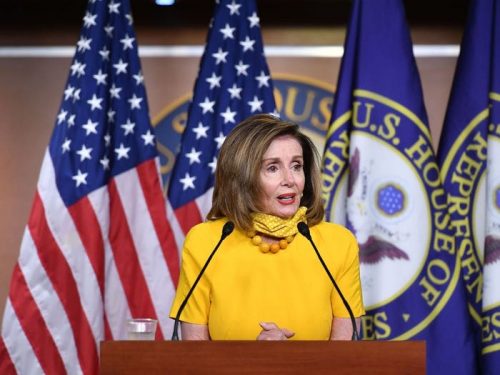 Pelosi Pressed Pentagon on Safeguards to Prevent Trump From Ordering Military Action
But short of the cabinet invoking the 25th Amendment or impeaching and convicting the president, it would be unconstitutional to defy legal orders from the commander in chief, experts note. NYT, By David E. Sanger and Eric Schmitt, Jan. 8, 2021
Speaker Nancy Pelosi of California on Friday took the unprecedented step of asking the chairman of the Joint Chiefs of Staff about “available precautions” to prevent President Trump from initiating military action abroad or using his sole authority to launch nuclear weapons in the last days of his term.
In a phone call to the chairman, Gen. Mark A. Milley, Ms. Pelosi appeared to be seeking to have the Pentagon leadership essentially remove Mr. Trump from his authorities as the commander in chief. That could be accomplished by ignoring the president’s orders or slowing them by questioning whether they were issued legally.
But General Milley appears to have made no commitments. Short of the cabinet invoking the 25th Amendment or removing Mr. Trump through impeachment in the House and conviction in the Senate, it is unconstitutional to defy legal orders from the commander in chief.
Ms. Pelosi’s request, which she announced to the Democratic caucus as an effort to prevent “an unhinged president” from using the nuclear codes, was wrapped in the politics of seeking a second impeachment of Mr. Trump.
Col. Dave Butler, a spokesman for General Milley, confirmed that the phone call with the speaker had taken place but described it as informational. “He answered her questions regarding the process of nuclear command authority,” he said. …….
This was not the first time the issue has come up in American history, or in regard to Mr. Trump.
In the last days of Richard M. Nixon’s presidency, the defense secretary, James R. Schlesinger, quietly issued a set of orders that if Mr. Nixon sought to move or use nuclear weapons, commanders should route the request to him or Secretary of State Henry A. Kissinger. Mr. Schlesinger, describing his actions only after Mr. Nixon left office, said he was concerned that the president was drinking, or that he might lash out.
Michael Beschloss, the presidential historian, said Mr. Schlesinger had told him a number of years ago that “he was worried about Mr. Nixon’s physical and emotional state and wanted to make sure there was no danger the nuclear arsenal would be abused.”……
In the 2016 presidential campaign, Hillary Clinton also raised the issue of Mr. Trump’s suitability to command the nuclear arsenal. “Imagine him in the Oval Office facing a real crisis,” she said in her address at the Democratic National Convention. “A man you can bait with a tweet is not a man we can trust with nuclear weapons.”
……….legally the military cannot deny the president access to the codes unless the 25th Amendment has been activated…….. https://www.nytimes.com/2021/01/08/us/politics/trump-pelosi-nuclear-military.html
Trump Still Has His Finger on the Nuclear Button. This Must Change.
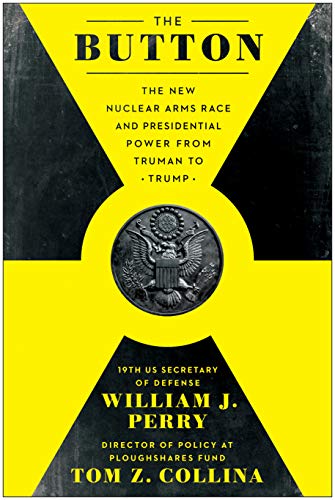 Trump Still Has His Finger on the Nuclear Button. This Must Change.
The time has come to take the nuclear football away from this president—and all the presidents that come after him. Politico, By WILLIAM J. PERRY and TOM Z. COLLINA 01/08/2021
William J. Perry was secretary of defense from 1994 to 1997. Tom Z. Collina is director of policy at Ploughshares Fund. They are co-authors of the book The Button: The New Nuclear Arms Race and Presidential Power from Truman to Trump.
Anyone who watched the disturbing events on Capitol Hill and President Donald Trump’s outrageous role as ringleader of the riot, must comprehend a crucial and terrifying fact: The president of the United States is unhinged and a threat not only to democracy, but to our survival. The danger is so acute that House Speaker Nancy Pelosi is actively looking for ways to prevent the “unstable president from … accessing the launch codes and ordering a nuclear strike.”
Unfortunately, under existing policy the only sure way to safeguard the nuclear arsenal from an unstable president is not to elect one. Once in office, a president gains the absolute authority to start a nuclear war. Within minutes, Trump can unleash hundreds of atomic bombs, or just one. He does not need a second opinion. The Defense secretary has no say. Congress has no role.
As a nation, we need to ask ourselves: Why are we taking this risk? Do we really think that Trump is responsible enough to trust him with the power to end the world?
|
But here’s the even bigger question: Do we really think any president should have the godlike power to deliver global destruction in an instant? By now, it should be clear that no one person should have the unilateral power to end our civilization. Such unchecked authority is undemocratic, outdated, unnecessary and extremely dangerous. It’s time to get rid of the nuclear football. It’s no longer necessary, and its very existence is a danger to our national security………. Luckily, we don’t need to take such risks. It’s no longer necessary to make a nuclear use decision quickly, and here’s how President-elect Joe Biden can get there. First, once in office, Biden should announce he would share authority to use nuclear weapons with a select group in Congress. He should also declare that the United States will never start a nuclear war and would use the bomb only in retaliation. Second, to make that pledge more credible, Biden should retire the land-based ballistic missiles that are stationary and more vulnerable to be taken out in a first strike—which could force a president into a quick “use-them-or-lose-them” decision. These missiles are not needed for deterrence, which is ensured by survivable submarine-based weapons. We can and should get out of the “use-them-or-lose-them” mindset. On Jan. 20, if all goes well, the nation and the world can breathe a giant sigh of relief. Once Biden is sworn in as president, the nuclear football will be his. It will then be up to Biden to retire the football and ensure that we never again entrust the most powerful killing machine ever created to just one fallible human. https://www.politico.com/news/magazine/2021/01/08/trump-still-has-his-finger-on-the-nuclear-button-this-must-change-456667 |
|
Deceitful nuclear propaganda exposed in ”The Wretched Atom”
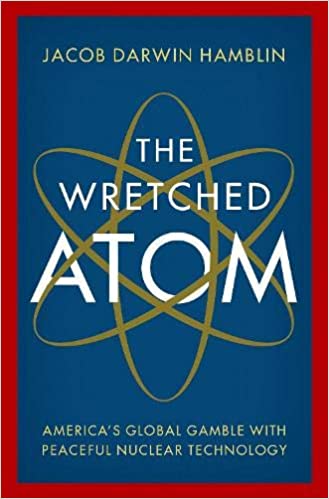
The Wretched Atom https://jacobdarwinhamblin.com/books/the-wretched-atom/
Coming in June 2021 from Oxford University Press
A groundbreaking narrative of how the United States offered the promise of nuclear technology to the developing world and its gamble that other nations would use it for peaceful purposes.
After the Second World War, the United States offered a new kind of atom that differed from the bombs that destroyed Hiroshima and Nagasaki. This atom would cure diseases, produce new foods, make deserts bloom, and provide abundant energy for all. It was an atom destined for the formerly colonized, recently occupied, and mostly non-white parts of the world that were dubbed the “wretched of the earth” by Frantz Fanon.
The “peaceful atom” had so much propaganda potential that President Dwight Eisenhower used it to distract the world from his plan to test even bigger thermonuclear weapons. His scientists said the peaceful atom would quicken the pulse of nature, speeding nations along the path of economic development and helping them to escape the clutches of disease, famine, and energy shortfalls. That promise became one of the most misunderstood political weapons of the twentieth century. It was adopted by every subsequent US president to exert leverage over other nations’ weapons programs, to corner world markets of uranium and thorium, and to secure petroleum supplies. Other countries embraced it, building reactors and training experts. Atomic promises were embedded in Japan’s postwar recovery, Ghana’s pan-Africanism, Israel’s quest for survival, Pakistan’s brinksmanship with India, and Iran’s pursuit of nuclear independence.
As The Wretched Atom shows, promoting civilian atomic energy was an immense gamble, and it was never truly peaceful. American promises ended up exporting violence and peace in equal measure. While the United States promised peace and plenty, it planted the seeds of dependency and set in motion the creation of today’s expanded nuclear club.
1 This Month





PLEASE OPPOSE HR 8255 AND S.3639 – bills would accelerate satellite deployment, with no environmental review or safeguards – https://ncstd5li.quorum.us/campaign/169331/
To see nuclear-related stories in greater depth and intensity – go to https://nuclearinformation.wordpress.com
-
Archives
- October 2026 (74)
- September 2026 (339)
- August 2026 (330)
- July 2026 (355)
- June 2026 (287)
- May 2026 (306)
- April 2026 (356)
- March 2026 (251)
- February 2026 (267)
- January 2026 (308)
- December 2025 (358)
- November 2025 (359)
-
Categories
- 1
- 1 NUCLEAR ISSUES
- business and costs
- climate change
- culture and arts
- ENERGY
- environment
- health
- history
- indigenous issues
- Legal
- marketing of nuclear
- media
- opposition to nuclear
- PERSONAL STORIES
- politics
- politics international
- Religion and ethics
- safety
- secrets,lies and civil liberties
- spinbuster
- technology
- Uranium
- wastes
- weapons and war
- Women
- 2 WORLD
- ACTION
- AFRICA
- Atrocities
- AUSTRALIA
- Christina's notes
- Christina's themes
- culture and arts
- Events
- Fuk 2022
- Fuk 2023
- Fukushima 2017
- Fukushima 2018
- fukushima 2019
- Fukushima 2020
- Fukushima 2021
- general
- global warming
- Humour (God we need it)
- Nuclear
- RARE EARTHS
- Reference
- resources – print
- Resources -audiovicual
- Weekly Newsletter
- World
- World Nuclear
- YouTube
-
RSS
Entries RSS
Comments RSS

