A view from the law: The Danger Of Sole Presidential Authority Over Nuclear Weapons
|
The Gold Code Standard Revisited: The Danger Of Sole Presidential Authority Over Nuclear Weapons Jurist, Kevin Govern, JANUARY 19, 2021
Kevin Govern, a Professor of Law at Ave Maria School of Law, analyses the sole Presidential authority over nuclear weapons vis-a-vis the Trump administration and military intervention…
On January 8, 2021, Speaker of the House Nancy Pelosi (D-CA) took the extraordinary step of publicly revealing she had talked with Chairman of the Joint Chiefs of Staff, Gen. Mark A. Milley, about “available precautions for preventing an unstable President from initiating military hostilities or accessing the launch codes and ordering a nuclear strike.” Milley reportedly issued a statement saying he “answered [Speaker Pelosi’s] questions regarding the process of nuclear command authority.” Four days later, The House of Representatives voted 223-205 to formally call on Vice President Mike Pence to use the 25th Amendment to strip President Trump of his powers after he incited a mob that attacked the Capitol. With the Vice President’s refusal, impeachment proceedings went forward in the House on January 13, 2021, with a vote of 232-197, to impeach President Trump for “incitement of insurrection” in only the fourth presidential impeachment in US history, and the first time a President has been impeached twice. Continue reading |
Trump’s worst move – gambling on nuclear war with North Korea

He didn’t merely threaten to attack North Korea if it possessed the ability to strike the U.S. He ordered the Pentagon to develop new plans, over the resistance of then-Secretary of Defense James Mattis, to do so. As Slate columnist Fred Kaplan reports in his book “The Bomb,” the Joint Chiefs of Staff created new war plans “that assumed the United States would strike the first blow.”
|
By Far the Worst Thing Trump Did Was Flirt With Nuclear War With North Korea
Trump’s actions on this one issue outweigh everything else, yet it’s received less attention than many of his tweets. The Intercept Jon Schwarz, January 21 2021, JUST BEFORE NOON Wednesday, when President Joe Biden took the oath of office, the nuclear codes in the briefcase carried by a military aide to Donald Trump became invalid. The United States and the world survived the four years of Trump’s presidency without him starting a nuclear war.
This was a genuine possibility during 2017 and early 2018, Trump’s first year in office, when he brought the U.S. far closer to a nuclear conflict with North Korea than most Americans realize. Incredibly, the American foreign policy establishment seemed to look upon this risk with equanimity at the time and by now seems to have completely forgotten it.
The significance of Trump’s actions on this one issue outweighs every other aspect of the Trump years, including his response to the coronavirus pandemic. A conflict with North Korea could have led to the deaths of millions, tens of millions, or even more. Yet it’s received less attention than many of his tweets. Here’s what happened and why Trump’s behavior was extraordinarily dangerous. Continue reading
|
Investigation of Algerians affected by France’s nuclear bomb tests
Le Monde 20th Jan 2021, At the heart of Franco-Algerian memory: the fight against those irradiated from the Sahara. This January 20, historian Benjamin Stora submits to the
President of the Republic, Emmanuel Macron, his report on Franco-Algerian memory. The nuclear tests carried out until 1966 in the Sahara are one of the disputes between the two countries. Investigation.
Pakistan test-fires nuclear-capable surface-to-surface ballistic missile
The missile is capable of carrying nuclear and conventional warheads to a range of 2,750 kms, the statement said.
ISLAMABAD: Pakistan said on Wednesday that it successfully test-fired a nuclear-capable surface-to-surface ballistic missile which can strike targets up to 2,750 kilometres. …… https://www.newindianexpress.com/world/2021/jan/20/pakistan-test-fires-nuclear-capable-surface-to-surface-ballistic-missile-2252773.html
Hiroshima ‘peace clock’ reset to 49 days following US nuclear test
|
Hiroshima ‘peace clock’ reset to 49 days following US nuclear test https://mainichi.jp/english/articles/20210119/p2a/00m/0na/004000c January 19, 2021 (Mainichi Japan) HIROSHIMA –– A clock located in the Hiroshima Peace Memorial Museum in this western Japan city was reset from 705 to 49, indicating the number of days that have passed since the latest nuclear test took place — a subcritical one carried out by the United States in November 2020. The adjustment was made on Jan. 18, after it was revealed in a U.S. national laboratory document that a subcritical nuclear experiment was held in November under the administration of U.S. President Donald Trump. The “Chikyu Heiwa Kanshi Dokei (Peace Watch Tower)” had previously displayed the number “705” to mark the number of days that had passed since the subcritical nuclear experiment conducted by the U.S. in February 2019. As the exact date of the latest test in November is unknown, the clock is currently set at “49 days,” under the assumption that the nuclear test was held on the last day of the month. On Jan. 17, the Hiroshima Municipal Government sent a letter of protest addressed to President Trump to the U.S. Embassy in Japan. On the following day, some 35 people, including hibakusha, or A-bomb survivors, gathered at the Hiroshima Peace Memorial Park in the city’s Naka Ward, which includes the peace memorial museum, and staged a sit-in protest. President-elect Joe Biden, who will be inaugurated on Jan. 20, issued a statement vowing to “work to bring us closer to a world without nuclear weapons,” on Aug. 6, 2020, which marked the 75th anniversary of the U.S. atomic bombing of Hiroshima. (Japanese original by Isamu Gari, Hiroshima Bureau) |
|
South Africa the only country to have nuclear weapons, then abandon them
|
The Story Of The Jet That Would Have Delivered South Africa’s Nuclear Bomb, The British-made Buccaneer strike aircraft was adapted to carry apartheid-era South Africa’s guided nuclear bomb. The War Zone, BY THOMAS NEWDICK JANUARY 18, 2021
“………South Africa, an international pariah for much of the Cold War due to its apartheid policy, remains the only country to have developed nuclear weapons and then voluntarily given them up. Before it did so, the main focus of these developments was an air-launched weapon that was intended to be delivered by a Hawker Siddeley Buccaneer strike aircraft. This combination could potentially have struck targets in other countries in sub-Saharan Africa, as partof South Africa’s long-running campaign against regional rebel groups, or even hostile revolutionary governments.
……..The final death knell for South Africa’s nuclear weapons program was the presidency of F. W. de Klerk, who came to power in 1989, deciding to do away with it. There was apparently no significant opposition from the military, whose experience in years cross-border campaigns had not revealed any requirement for a weapon of this type. Ultimately, the actual utility of a nuclear weapon in the conflict in Angola was always negligible, and its use would represent an unprecedented escalation while further ostracizing the South African regime. Moreover, the end of apartheid now seemed to be in sight, and possession of weapons of mass destruction would do nothing to enhance South Africa’s international position then, or in the future. While a veil of secrecy remained over the program, de Klerk oversaw the removal of enriched uranium from the weapons that had been completed. In 1991, South Africa finally signed the 1968 Non-Proliferation Treaty and, two years later, de Klerk acknowledged the existence of the nuclear weapons program. Survivors of the SAAF Buccaneer fleet were withdrawn in the same year, by which time only five examples were reportedly still airworthy. …
|
|
|
International Physicians for the Prevention of Nuclear War comment on “The great evasion”

Two related events—the 75th anniversary of the January 24, 1946 UN General Assembly Resolution 1 (which established a commission to plan for the abolition of nuclear weapons) and the January 22, 2021 entry into force of the UN Treaty on the Prohibition of Nuclear Weapons (designed to finally implement that goal)—should be a cause for worldwide celebration.
In fact, however, they are a cause for shame. The nine nuclear powers have refused to sign the treaty and, instead, today continue to engage in a nuclear arms race and to threaten nuclear war—a war capable of destroying virtually all life on earth.
A similarly reckless pattern characterized the nuclear arms race that emerged out of World War II. But an upsurge of popular protest and wise diplomacy led to nuclear arms control and disarmament treaties, as well as unilateral actions, that dramatically reduced nuclear arsenals. It also made nuclear war increasingly unthinkable.
Unfortunately, however, as the nuclear danger receded, the nuclear disarmament campaign ebbed. As a result, government officials, no longer constrained by popular pressure, began to revert to their traditional ways, based on the assumption that nuclear weapons promoted national “strength.” India and Pakistan became nuclear powers. North Korea developed nuclear weapons. In the United States, the administration of George W. Bush withdrew from the ABM Treaty and pressed hard to begin building “mini-nukes.”
Ascending to the presidency, Barack Obama made a dramatic attempt to rally the planet behind the goal of building a nuclear-free world. But neither Republican nor Russian leaders liked the idea, and the best he could deliver was the last of the major nuclear disarmament agreements, the New START Treaty. And even that came at a heavy price—an agreement with Senate Republicans, whose support was necessary for treaty ratification, to back a major U.S. nuclear weapons “modernization” program.
After Donald Trump entered the White House, nuclear arms control and disarmament were no longer on the agenda—for the United States or for the world. Trump not only failed to generate any new international constraints on nuclear weapons, but withdrew the United States from the Intermediate Range Nuclear Forces (INF) Treaty, the Iran nuclear agreement, and the Open Skies Treaty and allowed the New START Treaty to lapse without renewal. Nor did the other nuclear powers show much interest in retaining these agreements. Indeed, the Russian government, after a brief, perfunctory protest at Trump’s destruction of the INF Treaty—a treaty that it had long privately deplored—immediately ordered the development of the once-prohibited missiles. The Chinese government said that, although it favored maintaining the treaty for the United States and Russia, it would not accept treaty limits on its own weapons.
Meanwhile, all nine nuclear powers, instead of reducing the existential danger to the world from their possession of 13,400 nuclear weapons (91 percent of which are held by Russia and the United States), are busily “modernizing” their nuclear forces and planning to retain them into the indefinite future. In December 2019, the Russian governmentannounced the deployment of the world’s first hypersonic nuclear-capable missiles, which President Vladimir Putin boasted could bypass missile defense systems and hit almost any point on the planet. Indeed, the Russian president touted several new Russian nuclear weapons systems as ahead of their time. “Our equipment must be better than the world’s best if we want to come out as the winners,” he explained.
Trump, always determined to emerge a “winner,” had publicly stated in December 2016: “Let it be an arms race. We will outmatch them at every pass and outlast them all.” Consequently, expanding the earlier U.S. nuclear “modernization” plan to a $2 trillion extravaganza, he set the course for the upgrading of older U.S. nuclear weapons and the development and deployment of a vast array of new ones. These include the development of a new intercontinental ballistic missile (at a cost of $264 billion) and the production and deployment of a new submarine-launched ballistic missile warhead that will make starting a nuclear war easier.
The new nuclear weapons are designed to not only win the arms race, but to intimidate other nations and even “win” a nuclear war. Early in his administration, Trump publicly threatened to obliterate both North Korea and Iran through a nuclear onslaught. Similarly, North Korea’s Kim Jong-un has repeatedly threatened a nuclear attack upon the United States. Furthermore, the U.S. government has been engaging recently in a game of “nuclear chicken” with China and Russia, dispatching fleets of nuclear bombers and nuclear warships dangerously close to their borders. Such provocative action is in line with the Trump administration’s 2018 Nuclear Posture Review, which expanded possibilities for displays of nuclear “resolve” and the first use of nuclear weapons. Subsequently, the Russian government also lowered its threshold for initiating a nuclear war.
The incoming Biden administration has the opportunity and, apparently, the inclination to challenge this irresponsible behavior. As a long-time supporter of nuclear arms control and disarmament agreements—as well as a sharp critic of the Trump administration’s nuclear policies during the 2020 presidential campaign—the new president will probably advance measures dealing with nuclear issues that differ significantly from those of his predecessor. Although his ability to secure U.S. ratification of new treaties will be severely limited by Senate Republicans, he can (and probably will) use executive action to rejoin the Iran nuclear agreement, re-sign the Open Skies Treaty, block the U.S. production and deployment of particularly destabilizing nuclear weapons, and reduce the budget for nuclear “modernization.” He might even declare a no first use policy, unilaterally reduce the U.S. nuclear arsenal, and show some respect for the Treaty on the Prohibition of Nuclear Weapons.
Of course, this won’t be enough. But it would provide a start toward terminating the nuclear powers’ disgraceful evasion of their responsibility to safeguard human survival.
[Dr. Lawrence Wittner (https://www.lawrenceswittner.com/ ) is Professor of History Emeritus at SUNY/Albany and the author of Confronting the Bomb (Stanford University Press).]
First a comment on military smrs – then the enthusiastic article about them
 spikedpsycho169, 18 Jan 21, Small reactors on a battlefield where the enemy now has suicide drones, rpg’s and homemade rockets. What could possibly go wrong.? Other than electricity, reactors have little use on a field of combat. Some advocate the production of liquid fuels using in situ resources like ammonia, methanol, etc made using ambient materials like air/water. That requires temperatures above 600-800 degrees celsius, Which no reactor currently operates.
White House Accelerates Development Of Mini Nuclear Reactors For Space And The Battlefield
The order looks to accelerate and integrate the development of highly mobile nuclear reactors for space and the terrestrial battlefield. BY BRETT TINGLEY JANUARY 16, 2021
President Trump issued an Executive Order on January 12 that aims to promote small, modular nuclear reactors for defense and space exploration applications. According to a press statement issued by the White House, the order will “further revitalize the United States nuclear energy sector, reinvigorate America’s space exploration program, and produce diverse energy options for national defense needs.”
The order instructs NASA’s administrator to prepare a report within 180 days that will define NASA’s requirements and foreseeable issues for developing a nuclear energy system for human and robotic exploratory missions through 2040. The order also calls for a “Common Technology Roadmap” between NASA and the Departments of Energy, Defense, Commerce, and State for implementing new reactor technologies. The full text of the Executive Order can be read at WhiteHouse.gov ………
Section 4 of the Executive Order goes into further detail about the DoD’s energy needs, and outlines the role the Department of Defense will play in this new initiative to develop mobile nuclear reactors …….
The Executive Order also outlines a Common Technology Roadmap that “describes potential development programs and that coordinates, to the extent practicable, terrestrial-based advanced nuclear reactor and space-based nuclear power and propulsion efforts” between the Departments of Energy, Defense, Commerce, State, and NASA. This roadmap will also require “assessments of foreign nations’ space nuclear power and propulsion technological capabilities.” Naturally, one of the most pressing concerns with any nuclear technology is national security, and thus the order also instructs the DoD to work together with NASA and other agencies to identify security issues associated with any potential space-based nuclear systems.
With this new Executive Order, the White House seeks to propel the United States to the forefront of all of the work being conducted in compact reactor research. While the wording in the statement focuses more on space exploration, the Department of Defense’s involvement is highly important. Since space environments are similar in that resupply is a tricky, if not impossible, endeavor, NASA could help jump-start the DoD’s mobile nuclear program even further if both are really working on it collaboratively, although the requirements will be somewhat different. “There’s sometimes a risk of forcing too much commonality,” a White House official told SpaceNews.com. “What this executive order does is ensure that there is a deliberate look at what those opportunities may be.”
If realized, the Executive Order’s accompanying statement reads, this initiative could lead to a “transportable small modular reactor for a mission other than naval propulsion for the first time in half a century.”
Contact the author: Brett@TheDrive.com https://www.thedrive.com/the-war-zone/38687/white-house-accelerates-development-of-mini-nuclear-reactors-for-space-and-the-battlefield
Russia to withdraw form Open Skies Treaty, EU concerned
How the Treaty on the Prohibition of Nuclear Weapons Impacts the United States
 How the Treaty on the Prohibition of Nuclear Weapons Impacts the
 United States, and Why the United States Must Embrace its Entry into Force, Columbia SIPA Journal of International Affairs, ALICIA SANDERS-ZAKRE AND SETH SHELDEN, JAN 15, 2021 The United Nations Treaty on the Prohibition of Nuclear Weapons (TPNW) will enter into force on January 22, 2021, two days following the inauguration of Joseph Biden as the 46th president of the United States. Despite the TPNW’s widespread support throughout the world, the United States has attempted to thwart the treaty’s progress at every step, boycotting the negotiations from the start and urging other countries to withdraw as the treaty neared its entry into force. These efforts have proven unsuccessful. This article explores the implications of the entry into force of the TPNW, with special attention to the United States and how the new Biden administration can play a more constructive role in the international treaty regime.
With the TPNW, nuclear weapons will be subject to a global ban treaty for the first time, at last aligning nuclear weapons with other weapons of mass destruction, all already the subject of treaty-based prohibitions. The TPNW provides a framework to verifiably eliminate nuclear weapons and requires its States Parties, i.e., states that have ratified or acceded to the treaty, to assist victims and remediate environments affected by nuclear weapons use and testing. The treaty was negotiated in recognition of the increasing likelihood of use of nuclear weapons, whether intentionally or accidentally, and the catastrophic humanitarian consequences that would result from any such use.
The United States has aggressively attempted to thwart the TPNW despite support for the treaty from more than two-thirds of the world’s states. These efforts have been unsuccessful. If President-elect Biden truly intends “to prove to the world that the United States is prepared to lead again—not just with the example of our power but also with the power of our example,” his administration must reverse the U.S. position on the TPNW.
Past United States Approach to TPNW
Before treaty negotiations had begun, in a 2016 nonpaper the United States urged NATO members to vote against proceeding with the initiative, claiming that such a treaty would “undermine…long-standing strategic stability.” Despite U.S. urging, the resolution to proceed with negotiations was adopted in December 2016 with clear global support. After Donald Trump assumed the presidency, the United States intensified its opposition, publicly dismissing and ridiculing the TPNW while privately pressuring countries not to support it. On the first day of treaty negotiations, U.S. Ambassador to the UN, Nikki Haley, hosted a press conference outside the room where negotiations were to take place, criticizing the pursuit of a prohibition treaty and questioning if nations participating were “looking out for their people.”
In October 2020, as the treaty approached the threshold of 50 ratifications for its entry into force, the United States sent a letter to countries that had joined the TPNW, restating its “opposition to the potential repercussions” of the treaty and encouraging states to withdraw their instruments of ratification. Once the treaty reached 50 States Parties, U.S. Assistant Secretary of State Christopher Ford retweeted his remarks from 2018 in which he had called the treaty “harmful to international peace and security.” China, France, Russia, the United Kingdom, and the United States have consistently issued joint statements disparaging the treaty at various international fora, including the International Atomic Energy Agency (IAEA) General Conference, the United Nations General Assembly, and Nuclear Non-Proliferation Treaty (NPT) meetings.
U.S. opposition to the TPNW is predicated on the falsehood that nuclear weapons provide security, as well as mischaracterizations about the treaty itself. Despite legal obligations and decades of commitments to bring about a world without nuclear weapons, in truth the United States relies steadfastly upon deterrence doctrines that are incompatible with these obligations and commitments, and it views any threat to the legitimacy of nuclear weapons as a threat to its national security. In clutching to deterrence doctrines, despite recognition—even from conservatives and libertarians—that nuclear weapons offer no military or practical value, U.S. policymakers undoubtedly are influenced also by the trillion dollar industry supporting its nuclear weapon arsenal. They thus have advanced spurious claims about the TPNW’s failings, arguing that the treaty will undermine the NPT, weaken IAEA safeguards, and only impact democracies, all of which are untrue.
These false assertions have been debunked in numerous more thorough examinations, so it suffices to say that the majority of countries do not share U.S. and like-minded states’ concerns about the TPNW
…………Nuclear-armed states aggressively denouncing an initiative with global support impairs unity in other international fora needed to advance other nuclear disarmament, nonproliferation, and risk reduction measures.
Implications of Entry Into Force
U.S. denouncements of the TPNW also ignore the significant impact of this treaty internationally, and on the United States itself. When the TPNW enters into force, States Parties will immediately need to adhere to the treaty’s Article 1 prohibitions, prohibiting them from developing, testing, producing, manufacturing, acquiring, transferring, possessing, stockpiling, using, or threatening to use nuclear weapons, or allowing nuclear weapons to be stationed in their territories. It also prohibits States Parties from assisting, encouraging, or inducing anyone to engage in these activities.
Under Articles 6 and 7 of the TPNW, States Parties also are obligated to assist victims of and remediate environments contaminated by nuclear weapon use and testing. These “positive obligations” break new ground in international nuclear weapons law. States with affected victims and contaminated lands under their jurisdiction have the primary responsibility for providing assistance, in a nod to state sovereignty and practical facilitation. However, Article 7 requires all States Parties to cooperate in implementing the treaty and, particularly for those in a position to do so, to assist affected states. ………..more https://jia.sipa.columbia.edu/online-articles/how-treaty-prohibition-nuclear-weapons-impacts-united-states-and-why-united-states
Donald Trump and the ”nuclear football” on January 20
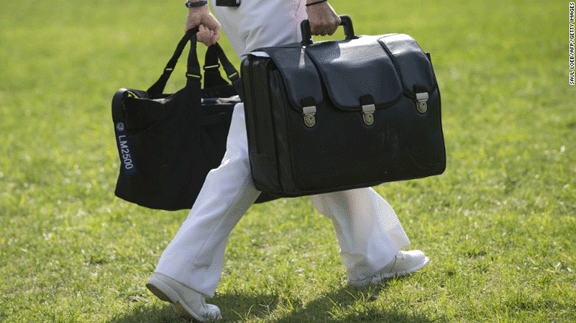 Independent 16th Jan 2021, Donald Trump will get to take the nuclear football with him when he leaves Washington DC on his final day in office – but the codes will be deactivated at the stroke of noon.
Mr Trump will be accompanied by the 45-pound briefcase when he flies to Florida on the morning of Joe Biden’s inauguration, as he is reportedly expected to do. But the nuclear codes that accompany it will stop working as soon as Mr Biden is sworn in as his successor 1,000 miles away on Wednesday.
Catholics welcome Treaty on Prohibition of Nuclear Weapons
 Catholic advocates welcome treaty banning nuclear weapons coming into force, Crux, Dennis SadowskiJan 17, 2021, CATHOLIC NEWS SERVICE
CLEVELAND — A Holy See-supported treaty banning the possession of nuclear weapons that is coming into force is buoying efforts by nations and nonprofit and church organizations working to abolish such armaments.
The Treaty on the Prohibition of Nuclear Weapons comes into force Jan. 22, three months after the 50th nation ratified the historic document.
Nuclear abolition supporters said the treaty puts the world’s nine nuclear powers on notice that momentum to dismantle arsenals of the world’s most destructive weapons is building.
We have an opportunity to move in a different direction now. We have to convince the nuclear states to take this seriously, to take this as an opportunity to move to a new conversation in the nuclear age,” said Marie Dennis, the Washington-based senior adviser to Pax Christi International’s secretary general.
The treaty resulted from months of negotiations at the United Nations in 2017 led by non-nuclear countries. Dennis described the effort as an example of the Catholic social teaching principle of participation.
“People around the world who live in countries that are not part of the nuclear weapons countries or under the nuclear umbrella have realized more and more clearly that the whole world would be devastated by an exchange of nuclear weapons and the people of the world decided to do something about it,” she explained.
The Holy See was a key participant in the process that led to drafting the treaty, providing encouragement and advice to negotiators, said Jesuit Father Drew Christiansen, a nuclear weapons expert who is professor of ethics and global development at Georgetown University.
He credited Pope Francis for the Vatican’s work on the pact. “I think it’s part of Francis’s agenda to get this out there,” he said. “As Francis begins to elaborate more about this teaching on arms and warfare, he’ll speak out more on this issue.”
The Holy See was the among the first to ratify the treaty, which was approved by 122 U.N. members. Netherlands was the only country to vote against it while Singapore abstained.
The nuclear nations and those under the U.S. nuclear umbrella opposed the measure and played little if any role in negotiations. In addition to the U.S., the countries possessing nuclear weapons are Russia, China, United Kingdom, France, Israel, India, Pakistan and North Korea.
Data from various sources, including the U.S. Department of State and the Stockholm International Peace Research Institute, show that the nine countries hold an estimated 13,440 nuclear weapons. …….. https://cruxnow.com/church-in-the-usa/2021/01/catholic-advocates-welcome-treaty-banning-nuclear-weapons-coming-into-force/
Why Won’t Canada Back a Nuclear Weapons Ban?

Government uses NATO as an excuse not to sign treaty
Why Won’t Canada Back a Nuclear Weapons Ban? — Beyond Nuclear International
Why Won’t Canada Back a Nuclear Weapons Ban?The UN nuclear ban treaty becomes international law on January 22, but the Trudeau government won’t sign, January 17, 2021 by beyondnuclearinternational By Bianca Mugyenyi 17 Jan 21, In a win for the long-term survival of humanity, the United Nations’ treaty banning nuclear weapons was ratified by the 50th country, Honduras, allowing the pact to pass.But any celebration in Canada should be muted by embarrassment at our government’s indifference to the threat nukes pose to humankind.
The Treaty on the Prohibition of Nuclear Weapons was negotiated at a 2017 UN conference, creating a legally binding agreement that would ban nuclear weapons and lead toward their total elimination.
Rather than showing support for this important meeting, Canada was in a minority of countries that voted against even holding this conference at a General Assembly vote in autumn 2016. (More than 120 countries were in favour of holding the conference; just 38 were opposed.)
Additionally, Prime Minister Justin Trudeau refused to send a representative to the 2017 conference, where two-thirds of the world’s countries were represented.
Trudeau was dismissive of the conference: “There can be all sorts of people talking about nuclear disarmament, but if they do not actually have nuclear arms, it is sort of useless to have them around, talking.”
Around the same time, Trudeau made no effort to congratulate Canadian activist Setsuko Thurlow, a survivor of the atomic bombing of Hiroshima, who co-accepted the 2017 Nobel Peace Prize on behalf of the International Campaign to Abolish Nuclear Weapons.
The Trudeau government has failed to join the 86 countries that have already signed the nuclear weapons treaty, described by UN Secretary-General Antonio Guterres as “a very welcome initiative.”
Mexico and New Zealand, an ally with Canada in the Five Eyes security network, as well as European Union members Ireland and Austria have ratified the treaty. With Honduras becoming the 50th nation to ratify it, the treaty will enter into force on January 22, 2021.
In a last-ditch attempt to block the accord from reaching the required 50 member states, the Trump administration delivered a letter calling on countries that had signed to withdraw their support.
According to an Associated Press report, the letter claimed U.S. NATO allies — like Canada — “stand unified in our opposition to the potential repercussions” of the treaty…….
Canada’s defence policy, “Strong, Secure, Engaged,” makes two dozen references to Canada’s commitment to the nuclear-armed NATO alliance. According to NATO, “nuclear weapons are a core component of the Alliance’s overall capabilities.” Canada contributes personnel and funds to NATO’s Nuclear Policy Directorate and Nuclear Planning Group.
The Liberal government says it cannot ratify the UN nuclear ban treaty because of Canada’s membership in NATO.
Rather than offer this excuse to avoid signing a treaty opposed by powerful allies and Canada’s military, it could instead be used as a moment to consider re-evaluating Canada’s involvement in NATO.
The Canadian Foreign Policy Institute initiated an open letter to Trudeau after Canada’s second consecutive defeat for a seat on the UN Security Council.
The letter asked: “Should Canada continue to be part of NATO or instead pursue non-military paths to peace in the world?” It has been signed by Greenpeace Canada, 350.org, Idle No More, Vancouver and District Labour Council and 50 other groups, as well as four sitting MPs and David Suzuki, Naomi Klein, Stephen Lewis and more than 2,000 others.
The NDP, Greens and Bloc Québécois have all called for Canada to adopt the UN nuclear ban treaty. Thousands of Canadians have also signed petitions calling on the government to join the initiative.
Nuclear weapons will soon be banned under international law. The government needs to be challenged to get on the right side of history and sign the Treaty on the Prohibition of Nuclear Weapons.
Only then can Canadians proudly celebrate the critical effort under way to protect the future of humanity.
Bianca Mugyenyi is an author and former co-executive director of The Leap. She currently directs the Canadian Foreign Policy Institute.https://beyondnuclearinternational.org/2021/01/17/why-wont-canada-back-a-nuclear-weapons-ban/
13.7 million sign petition urging all nations to ban nuclear weapons

 13 million sign petition urging all nations to ban nuclear weapons, http://www.asahi.com/ajw/articles/14106594, By RYO SASAKI/ Staff Writer, January 14, 2021 A petition by an organization of survivors of the 1945 atomic bombings of Hiroshima and Nagasaki urging all nations to sign the U.N. treaty banning nuclear weapons has garnered a whopping 13.7 million signatures.
The Appeal of the Hibakusha association made the announcement during an online news conference on Jan. 13 after submitting the petition to the United Nations on Jan. 8.
The treaty goes into effect on Jan. 22.
The association collected the signatures on the streets, internet and elsewhere before finishing the effort at the end of December.
A total of 1,497 incumbent and former prefectural governors and mayors in Japan added their names to the petition. The petition also drew support from numerous people in countries other than Japan.
The campaign association, comprised of members of Nihon Hidankyo (Japan Confederation of A- and H-Bomb Sufferers Organizations) and other organizations, began their activities to achieve a nuclear-free world “while we still live” in April 2016.
The Treaty on the Prohibition of Nuclear Weapons was adopted in July 2017. Since then, the campaign has been asking all nations to join the treaty and advocating for it to take effect as early as possible.
The campaign to collect signatures was initially to end by September 2020, but was extended after it appeared that the treaty was likely to go into effect in the near future.
The association collected more than 1 million signatures over the additional three months, mainly online.
Trump’s behavior demonstrates that Biden must change US nuclear policy
|
Trump’s behavior demonstrates that Biden must change US nuclear policy,
|
While this arrangement appears especially risky now, giving any one person the authority to order the use of nuclear weapons is inherently risky and completely unnecessary. Any use of nuclear weapons would be devastating and should require both a presidential order and the agreement of two other officials.
Unlike decades ago, when sole authority was first established, there is a straightforward way to include other officials in a launch decision. President-elect Joe Biden should make this long-overdue change once in office by limiting his own authority to order a nuclear attack……………….
President Biden should move quickly to implement these two policy changes — requiring the assent of two other officials to any nuclear launch order and eliminating the option of using nuclear weapons first. Doing so would make the world safer and demonstrate that the United States is committed to reducing the risk of nuclear use and to moving away from its reliance on nuclear weapons. https://www.defensenews.com/opinion/commentary/2021/01/14/trumps-behavior-demonstrates-that-biden-must-change-us-nuclear-policy/
1 This Month





PLEASE OPPOSE HR 8255 AND S.3639 – bills would accelerate satellite deployment, with no environmental review or safeguards – https://ncstd5li.quorum.us/campaign/169331/
To see nuclear-related stories in greater depth and intensity – go to https://nuclearinformation.wordpress.com
-
Archives
- October 2026 (74)
- September 2026 (339)
- August 2026 (330)
- July 2026 (355)
- June 2026 (287)
- May 2026 (306)
- April 2026 (356)
- March 2026 (251)
- February 2026 (267)
- January 2026 (308)
- December 2025 (358)
- November 2025 (359)
-
Categories
- 1
- 1 NUCLEAR ISSUES
- business and costs
- climate change
- culture and arts
- ENERGY
- environment
- health
- history
- indigenous issues
- Legal
- marketing of nuclear
- media
- opposition to nuclear
- PERSONAL STORIES
- politics
- politics international
- Religion and ethics
- safety
- secrets,lies and civil liberties
- spinbuster
- technology
- Uranium
- wastes
- weapons and war
- Women
- 2 WORLD
- ACTION
- AFRICA
- Atrocities
- AUSTRALIA
- Christina's notes
- Christina's themes
- culture and arts
- Events
- Fuk 2022
- Fuk 2023
- Fukushima 2017
- Fukushima 2018
- fukushima 2019
- Fukushima 2020
- Fukushima 2021
- general
- global warming
- Humour (God we need it)
- Nuclear
- RARE EARTHS
- Reference
- resources – print
- Resources -audiovicual
- Weekly Newsletter
- World
- World Nuclear
- YouTube
-
RSS
Entries RSS
Comments RSS

