Global military spending increase: Militarism will cost us the earth

The five largest military spenders in 2022 were the US (39% of the global total), China (13%), Russia (3.9%), India (3.6%) and Saudi Arabia (3.3%),
Aotearoa New Zealand Campaign on Military Spending
24 April 2023
Links to share: Facebook, https://www.facebook.com/PeaceMovementAotearoa/posts/6107093852671266 Twitter, https://twitter.com/PeaceMovementA/status/1650264027988365312
Despite the rapidly escalating climate emergency and humanitarian crises around the world, global military spending increased to its highest ever recorded level last year according to new figures released by the Stockholm International Peace Research Institute (SIPRI) today – the Global Day of Action on Military Spending.SIPRI has estimated global military expenditure last year was at least $2,240 billion (US) – a spending increase of 3.7% in real terms in 2022 (a 6.5% nominal increase in current prices without adjusting for inflation) – which averages out to more than $6.1 billion (US) spent every day. [1]
By way of contrast, on average more than 13,600 children under the age of five died every day last year from mainly preventable causes – lack of access to adequate food, clean water and basic medicines – a figure UNICEF describes as an “immense, intolerable” loss of life. [2] This is one of the prices paid, the collateral damage that is seldom talked about, for maintaining armed forces in a state of combat readiness around the world.
It is inexcusable that many states – including New Zealand – continue to prioritise spending on combat-ready armed forces over human health and wellbeing, and care for the planet…………………………………..
Every dollar of military expenditure is a dollar taken away from socially useful spending – a dollar that could be used to take real action on climate change, to ensure a decent standard of living for all, and to ensure health and social welfare systems can function well in national, regional or global emergencies: it is a dollar that could be used to save lives, to promote climate justice, flourishing communities and care for the planet, rather than being spent on endless preparations for war.
Now more than ever, with the future of life on earth at stake, states must work together to find sustainable solutions, instead of continuing to pour public money into wasteful destructive military activity – the ultimate in unsustainability, with military emissions estimated to be at least 5.5% of the global total.
The five largest military spenders in 2022 were the US (39% of the global total), China (13%), Russia (3.9%), India (3.6%) and Saudi Arabia (3.3%), which together accounted for 63% of world military spending. [1] Military expenditure decreased in Africa (-5.3%) last year, but increased in four of the five geographical regions, with the highest increase in Europe (+13%), followed by the Middle East (+3.2%), then Asia and Oceania (+2.7%) and the Americas (+0.3). Overall in 2022, the military burden (military spending as a share of gross domestic product) globally was 2.2%. [1]New Zealand’s military spendingWhile New Zealand does not feature in the SIPRI table ranking the highest increases in military spending around the world this year as it did in 2020 [3], that is simply because other states increased their spending by more, not because there has been any reduction in New Zealand’s military spending.
The US Has No Plans to Give Up Nuclear Weapons. The Public Needs to Change That.

While the U.S. nuclear enterprise has widespread support by both Democrat and Republican members of Congress, one of the boldest shows of opposition to nuclear weapons was voiced by Michigan congresswoman Rep. Rashida Tlaib, who has expressed her support for the Treaty for the Prohibition of Nuclear Weapons (TPNW). Additional support for the prohibition of TPNW (also called the “ban treaty”) came from Massachusetts Rep. James McGovern and Oregon Rep. Earl Blumenauer, who introduced a resolution in 2019 calling for “the American people to work towards reducing and ultimately eliminating nuclear weapons.” Furthermore, in 2022, more than 200 U.S. mayors collectively called for the adoption of a timebound plan for the total elimination of nuclear weapons.

A first step toward anti-nuclear advocacy is becoming aware of the current sprawling state of the U.S. nuclear arsenal.
By Jon Letman , TRUTHOUT April 24, 2023
hen Russian President Vladimir Putin announced his intention to deploy short-range nuclear missiles to Belarus in March, he pointed to U.S. nuclear weapons housed in five NATO nations as justification. Putin said the construction of a “special repository” for an Iskander missile complex in Belarus would not violate obligations under the Nuclear Nonproliferation Treaty.
But by accepting the deployment of Russian nuclear weapons, Belarus President Alexander Lukashenko would be reversing more than three decades free of nuclear weapons after it pledged to abandon them in 1991. Like Ukraine and Kazakhstan, Belarus gave up Soviet nuclear weapons shortly after the USSR broke apart.
In a statement, Daniel Högsta, acting executive director of the International Campaign to Abolish Nuclear Weapons (ICAN) said, “As long as Putin has nuclear weapons, Europe cannot be safe.” He also warned that decades of “nuclear sharing” with NATO nations “helps give Putin cover,” posing a grave risk far beyond Europe.
ICAN has played a central role in advocating for the UN Treaty on the Prohibition of Nuclear Weapons which entered into force in 2021. Although 68 countries have ratified the treaty which prohibits all aspects of developing, possessing or threatening to use nuclear weapons, none of the nine nuclear-armed nations — Russia, the United States, China, France, the United Kingdom, Pakistan, India, Israel and North Korea — recognizes the treaty.
According to the Federation of American Scientists’ Nuclear Information Project, the U.S. houses an estimated 100 B61 gravity bombs on air bases in five NATO nations (Belgium, Germany, Italy, the Netherlands and Turkey). Usually described as “tactical” or nonstrategic nuclear weapons, the new B61-12, which will replace older versions of the B61, has a selectable yield (energy released in a nuclear explosion) that can be adjusted from 0.3 to 50 kilotons. The atomic bombs which destroyed Hiroshima and Nagasaki were 15 and 21 kilotons respectively.
Daryl Kimball, executive director of the Arms Control Association, said that describing a nuclear weapon as “tactical” may lead people to wrongly assume that such weapons are necessarily “smaller,” less destructive, and would be confined to a battlefield or limited geographic area.
That, he said, is a dangerous assumption. ……………………………………………………
According to research by the Federation of American Scientists’ Nuclear Information Project, the United States maintains an estimated total inventory of 5,244 nuclear weapons, including reserve warheads and retired warheads awaiting dismantlement. Currently, 3,708 nuclear warheads make up the military stockpile (those weapons which could potentially be used in war).
Within the stockpile, the U.S. has 1,770 deployed nuclear warheads that make up the nuclear triad of air, land and sea-based bombs…………………………………….
Under the Sea
Widely considered to be least vulnerable to attack are long-range submarine-launched ballistic missiles (SLBM). The United States has two Strategic Weapons Facilities, one for the Pacific beside Naval Base Kitsap in Bangor, Washington, 20 miles west of Seattle, and a second facility for the Atlantic at Naval Submarine Base Kings Bay, Georgia…………………………………………………………………………
The U.S.’s Nuclear Sponge
The third leg of the nuclear triad is its intercontinental ballistic missiles (ICBMs), which are housed in fortified underground silos in five states (Montana, Colorado, Nebraska, Wyoming and North Dakota). The ICBM force is made up of aging Minuteman III missiles which are slated to be replaced with a new $96 billion system called Sentinel (formerly called Ground Based Strategic Deterrent).
Plagued by scheduling delays and cost overruns, there is growing public support for phasing out ICBMs. Despite this, the bipartisan congressional ICBM Coalition’s support is all but unshakable. But the idea of creating what has been called a “nuclear sponge” (referring to the idea that ICBM silos would attract enemy missiles and, like a sponge, soak up an incoming attack), raises serious questions about why rural communities only began receiving greater government support for improved communications and transportation infrastructure after they started hosting nuclear weapons. “I think it’s important to interrogate that and ask why the needs of the missiles have so often come before the needs of the people who actually live there,” Korda said.
In addition to the SLBM, ICBMs and bombers, Korda and his colleague Hans M. Kristensen have documented additional nuclear warheads (many awaiting dismantlement) at a storage complex in New Mexico and, Korda noted, California has “very important nuclear weapons infrastructure” which could potentially host a small number of nuclear weapons for design purposes.
Finally, there is the Pantex Plant near Amarillo, Texas, which describes itself as “the nation’s primary assembly, disassembly, retrofit, and life-extension center for nuclear weapons.” The dismantlement of retired nuclear warheads is ongoing but, Korda said, the pace has slowed in recent years……………………………………….
In recent years, arms control treaties such as the Intermediate-Range Nuclear Forces Treaty, the Open Skies Treaty and the Joint Comprehensive Plan of Action (“Iran Nuclear Deal”) have been abandoned by the U.S., Russia, or both. The last remaining nuclear arms control treaty between the U.S. and Russia, the New Strategic Arms Reduction Treaty (New START), was extended for five years just two days before it expired in 2021 but in February, Russia announced it was suspending participation, leaving the last U.S.-Russia arms control treaty hanging by a thread.
With the end of inspections, data exchanges, and much-needed communication between Washington and Moscow, as well as Beijing, Kimball worries mistrust can lead to the assumption of worst-case scenarios. He says there is a great need for increased public awareness and engagement on nuclear issues.
While the U.S. nuclear enterprise has widespread support by both Democrat and Republican members of Congress, one of the boldest shows of opposition to nuclear weapons was voiced by Michigan congresswoman Rep. Rashida Tlaib, who has expressed her support for the Treaty for the Prohibition of Nuclear Weapons (TPNW). Additional support for the prohibition of TPNW (also called the “ban treaty”) came from Massachusetts Rep. James McGovern and Oregon Rep. Earl Blumenauer, who introduced a resolution in 2019 calling for “the American people to work towards reducing and ultimately eliminating nuclear weapons.” Furthermore, in 2022, more than 200 U.S. mayors collectively called for the adoption of a timebound plan for the total elimination of nuclear weapons.
“This is an existential threat that demands engagement even with our worst adversaries and even with a bona fide war criminal like Vladimir Putin because our survival ultimately depends on it.”
Without dialogue and diplomatic engagement, the result, Kimball warned, could be an unconstrained three-way arms race between Russia, China and the U.S. “If we didn’t have enough problems already,” Kimball said, “it still can get worse.”
The public has a vital role in all this, Kimball said. “Over the long course of the nuclear age, concerned U.S. citizens have stood up and demanded that their leaders take action to reduce the number and the risks posed by nuclear weapons by engaging in arms control and disarmament diplomacy with our adversaries. That effort has to be renewed again.” https://truthout.org/articles/the-us-has-no-plans-to-give-up-nuclear-weapons-the-public-needs-to-change-that/
—
Russia is deploying nuclear weapons in Belarus. NATO shouldn’t take the bait
By Nikolai N. Sokov Bulletin of the Atomic Scientists
Nikolai N. Sokov, a senior fellow at the Vienna Center for Disarmament and Non-Proliferation, previously worked at the Soviet and Russian Ministry. April 24, 2023
In June 2022, Russian President Vladimir Putin announced a new policy of Russia deploying some of its nuclear weapons in Belarus. The nuclear sharing arrangements between Russia and Belarus represent a fundamental change in Russian nuclear policy and the European security landscape. But as is usual with changes in Russian defense policy, the story developed slowly and has been full of unnecessary intrigue with important information revealed in small portions.
More than nine months after the initial announcement, the Russia-Belarus nuclear sharing is still very much incomplete; further developments may depend on the still uncertain evolution of the ongoing Russian war against Ukraine as well as any future changes in the scope and scale of Western assistance to Ukraine. But despite the many uncertainties, some key implications of Russia’s new policy of nuclear sharing can already be anticipated—especially as regard to its consequences for strategic stability.
Slow developments, false intrigue………………………………………………………………………….
Uncertainties. Unlike NATO’s nuclear sharing, which is built around nearly 100 B-61 gravity bombs, the Russia-Belarus one will involve a mix of gravity bombs and ground-launched missiles……………………………………………………………………………………………………….
The location of the storage site(s) for the nuclear warheads is perhaps the greatest of all uncertainties surrounding the Russia-Belarus nuclear sharing……………………………
Strategic consequences. The impact of Russia’s decision to institute nuclear sharing with Belarus will have wide-ranging consequences.
For the first time since the end of the Cold War, short-range, tactical nuclear weapons have acquired a distinct military mission…………………………………………………………………………..
the Russia-Belarus nuclear sharing—which involves preparation for deployment of nuclear weapons and may eventually entail the actual transfer of Russian nuclear weapons to Belarus—is by far the boldest move by Russia because it comes supported with new capability. Moreover, if the delivery systems and warheads under these arrangements are deployed near the western border of Belarus where they are highly vulnerable, the only conceivable mode for them is to strike first. The number of nuclear weapons involved may be relatively small—perhaps only about one-third of the entire inventory of B-61 bombs—but ready to use
The message is undoubtedly addressed to the West; nuclear use against Ukraine has never even indirectly featured in any Russian statements.
……………………………………………. The seriousness of the new signal does not mean that nuclear use in Europe is an immediate threat. First, it is reserved for extreme circumstances, such as a major defeat of Russia, which would put the regime at risk. Second, it would only result from a relatively lengthy process of escalation. ………………………….
Do not respond in kind. Recent nuclear signaling and actions by Russia are clearly a step on the escalation ladder. ………………………………. The wisdom of a symmetrical, tit-for-tat response to Russia’s escalatory steps is questionable
……………………….. NATO would be better off to continue the current policy and rally international opinion against Russia’s possible nuclear use. As Allies’ defense production continues to ramp up, assistance to Ukraine will become more efficient and consequential. Escalation may be tempting, but it is both unnecessary and potentially dangerous. https://thebulletin.org/2023/04/russia-is-deploying-nuclear-weapons-in-belarus-nato-shouldnt-take-the-bait/
S.Korea’s Yoon to meet Biden as doubts grow over nuclear umbrella
By Hyonhee Shin, SEOUL, April 24 (Reuters) – South Korean President Yoon Suk Yeol set off on Monday for the for the United States and a summit with President Joe Biden at a time of rare questioning in South Korea of an alliance that has guaranteed its security for decades.
………….. as North Korea races ahead with the development of nuclear weapons and missiles to carry them, there are growing questions in South Korea about the relying on “extended deterrence”, in essence the American nuclear umbrella, and calls, even from some senior members of Yoon’s party, for South Korea to develop its own nuclear weapons.
A recent poll by the Asan Institute for Policy Studies showed that more than 54% of respondents believed the U.S. would not risk its safety to protect its Asian ally.
More than 64% supported South Korea developing its own nuclear weapons, with about 33% opposed.
Yoon has been pushing to boost South Korea’s say in operating the U.S. extended deterrence but exactly what that might entail has not been spelt out…………… https://www.reuters.com/world/skoreas-yoon-meet-biden-doubts-grow-over-nuclear-umbrella-2023-04-24/
‘It Is Skynet’: Pentagon Envisions Robot Armies in a Decade

Blitzkrieg 2040
Nazi Germany, overran Europe in a very, very short period of time … because they were able to take those technologies and put them together in a doctrine which we now know as Blitzkrieg,” he said.

Milley, and the Pentagon with him, hopes to do the same now by bringing together emergent capabilities like robotics, AI, cyber and space platforms, and precision munitions into a cohesive doctrine of war.
By being the first to integrate these technologies into a new concept, Milley says, the United States can rule the future battlefield.
The Pentagon’s quest for an AI-dominated battlefield is becoming a reality
Epoch Times, By Andrew Thornebrooke, April 20, 2023
WASHINGTON—Robotic killing machines prowl the land, the skies, and the seas. They are fully automated, seeking out and engaging with adversarial robots across every domain of war. Their human handlers are relegated to the rearguard, overseeing the action at a distance while conflicts are fought and won by machines.
Far from science fiction, this is the vision of Joint Chiefs of Staff Chairman Gen. Mark Milley.
The United States, according to Milley, is in the throes of one of the myriad revolutions in military affairs that have spanned history.
Such revolutions have spanned from the invention of the stirrup to the adoption of the firearm to the deployment of mechanized maneuver warfare and, now, to the mass fielding of robotics and artificial intelligence (AI).
It is a shift in the character of war, Milley believes, greater than any to have come before.
“Today we are in … probably the biggest change in military history,” Milley said during a March 31 discussion with Defense One.
“We’re at a pivotal moment in history from a military standpoint. We’re at what amounts to a fundamental change in the very character of war.”
Robotic Armies in 10 Years
Many would no doubt be more comfortable with the idea of robots battling for the control of Earth if it were in a science-fiction novel or on a movie screen rather than on the list of priorities of the military’s highest-ranking officer.
Milley believes, however, that the world’s most powerful armies will be predominantly robotic within the next decade, and he means for the United States to be the first across that cybernetic Rubicon.
“Over the next ten to fifteen years, you’ll see large portions of advanced countries’ militaries become robotic,” Milley said. “If you add robotics with artificial intelligence and precision munitions and the ability to see at range, you’ve got the mix of a real fundamental change.”
“That’s coming. Those changes, that technology … we are looking at inside of 10 years.”
That means that the United States has “five to seven years to make some fundamental modifications to our military,” Milley says, because the nation’s adversaries are seeking to deploy robotics and AI in the same manner, but with Americans in their sights.
The nation that gets there first, that deploys robotics and AI together in a cohesive way, he says, will dominate the next war.
“I would submit that the country, the nation-state, that takes those technologies and adapts them most effectively and optimizes them for military operations, that country is probably going to have a decisive advantage at the beginning of the next conflict,” Milley said.
The global consequences of such a shift in the character of war are difficult to overstate.
Milley compared the ongoing struggle to form a new way of war to the competition that occurred between the world wars
In that era, Milley says, all the nations of Europe had access to new technologies ranging from mechanized vehicles to radio to chemical weapons. All of them could have developed the unified concept of maneuver warfare that replaced the attrition warfare which had defined World War I.
But only one, he said, first integrated their use into a bona fide new way of war.
“That country, Nazi Germany, overran Europe in a very, very short period of time … because they were able to take those technologies and put them together in a doctrine which we now know as Blitzkrieg,” he said.
Blitzkrieg 2040
Milley, and the Pentagon with him, hopes to do the same now by bringing together emergent capabilities like robotics, AI, cyber and space platforms, and precision munitions into a cohesive doctrine of war.
By being the first to integrate these technologies into a new concept, Milley says, the United States can rule the future battlefield.
To that end, the Pentagon is experimenting with new unmanned aerial, ground, and undersea vehicles, as well as seeking to exploit the pervasiveness of non-military smart technologies from watches to fitness trackers.
Though the effort is just gaining traction, Milley has in fact claimed since 2016 that the U.S. military would field substantial robotic ground forces and AI capabilities by 2030.
Just weeks from now, that idea will begin to truly culminate, when invitations from the Defense Department (DoD) go out to leaders across the defense, tech, and academic spheres for the Pentagon’s first-ever conference on building “trusted AI and autonomy” for future wars.
The Pentagon is on a correlating hiring spree, seeking to pay six figures annually for experts willing and able to develop and integrate technologies including “augmented reality, artificial intelligence, human state monitoring, and autonomous unmanned systems.”
Likewise, the U.S. Army Futures Command, created in 2018, maintains as a critical goal the designing of what it calls “Army 2040.” In other words, the AI-dependent, robotic military of the future.
Though slightly further out than Milley’s assumption of 10 to 15 years, Futures Command deputy commanding general Lt. Gen. Ross Coffman believes that 2040 will mark the United States’ true entry into an age characterized by artificially intelligent killing machines.
…………………….. Everything Spins Out of Control’
Remaking the American military and forming a new, cohesive way of war is a tall order. It is nevertheless one that the Pentagon appears prepared to pay for.
The DoD is requesting a record $1.8 billion in funding for AI projects for the next year alone. That amount will exceed the estimated $1.6 billion in AI investments being made by China’s military.
……………….. John Mills, former director of cybersecurity policy, strategy, and international affairs at the Office of the U.S. Secretary of Defense, believes that this path is rife with the potential for unintended consequences.
“It is Skynet,” Mills told the Epoch Times, referencing the fictional AI that conquers the world in “The Terminator” movie franchise. “It is the realization of a Skynet-like environment.”
“The question is, what could possibly go wrong with this situation? Well, a lot.”
…………… “The integration of AI with autonomous vehicles, and letting them action independently without human decision-making, that’s where everything spins out of control.”
To that end, Mills expressed concern about what a future conflict might look like between the United States and its allies, and China in the Indo-Pacific.
Imagine, he said, an undersea battlespace in which autonomous submarines and other weapons systems littered the seas.
Fielded by Chinese, American, Korean, Australian, Indian, and Japanese forces, the resulting chaos would likely end with autonomous systems engaging in war throughout the region, while manned vessels held back and sought to best launch the next group of robotic war machines. Anything else would risk putting real lives in the way of the automated killers.
“How do you plan for engagement scenarios with autonomous undersea vehicles?” Mills said
“This is going to be absolute chaos in subsurface warfare.”
……………………… There is just one caveat to that ethical, trustworthy, governable, deployment of lethal AI systems: The Pentagon does not have any hard and fast rules to prohibit autonomous systems from killing…………………………………………………………….
more https://www.theepochtimes.com/in-depth-it-is-skynet-pentagon-envisions-robot-armies-in-a-decade_5207504.html?utm_source=China&src_src=China&utm_campaign=uschina-2023-04-20&src_cmp=uschina-2023-04-20&utm_medium=email&est=vibelq5SAFOai0xZ2IdvvJe4uwKWVBE7hfxTKp%2FcR9S0a9BSSEoQCAfiSObFUg%3D%3D
Three nuclear superpowers, rather than two, usher in a new strategic era
Beijing and Moscow point to the overhaul as a motivating factor for their own upgrades. Arms controllers see a spiral of moves and countermoves that threatens to raise the risk of miscalculation and war.
BY DAVID E. SANGER, WILLIAM J. BROAD AND CHRIS BUCKLEY, THE NEW YORK TIMES Apr 23, 2023
WASHINGTON – On the Chinese coast, just 215 kilometers (135 miles) from Taiwan, Beijing is preparing to start a new reactor the Pentagon sees as delivering fuel for a vast expansion of China’s nuclear arsenal, potentially making it an atomic peer of the United States and Russia. The reactor, known as a fast breeder, excels at making plutonium, a top fuel of atom bombs.
The nuclear material for the reactor is being supplied by Russia, whose Rosatom nuclear giant has in the past few months completed the delivery of 25 tons of highly enriched uranium to get production started. That deal means that Russia and China are now cooperating on a project that will aid their own nuclear modernizations and, by the Pentagon’s estimates, produce arsenals whose combined size could dwarf that of the United States.
………………………………………………………………“By the 2030s the United States will, for the first time in its history, face two major nuclear powers as strategic competitors and potential adversaries,” the Pentagon said last fall in a policy document. “This will create new stresses on stability and new challenges for deterrence, assurance, arms control, and risk reduction.”
………………………………………………… The dynamic is, indeed, more complicated now — the Cold War involved only two major players, the United States and the Soviet Union; China was an afterthought. Its force of 200 or so nuclear weapons was so small that it barely figured into the discussion, and Beijing never participated in the major arms control treaties.
…………………………….Deepening tensions between Beijing and Washington appear to have hardened Xi’s judgment that China must counter “all-around containment,” including with a more robust nuclear deterrent……………………………………………………………
In Russia and the U.S., rolling out new weapons
…………………………… The Pentagon sees at least one of the emerging weapons as potentially threatening, in part because it could, if perfected, outwit the United States’ anti-missile defenses. The weapon is a long-range nuclear-powered undersea torpedo that, once unleashed, could move autonomously toward one of the nation’s coasts. Its warhead, as described by Russia, would create “areas of wide radioactive contamination that would be unsuitable for military, economic, or other activity for long periods of time.” Kristensen said the torpedo was close to operational.
For its part, the Biden administration has announced plans to make the first new warhead for the nation’s nuclear arsenal since the Cold War — an update that the White House says is long overdue for safety reasons. The weapon, for submarine missiles, is a small part of a gargantuan overhaul of the nation’s complex of atomic bases, plants, bombers, submarines and land-based missiles. Its 30-year cost could reach $2 trillion.
Beijing and Moscow point to the overhaul as a motivating factor for their own upgrades. Arms controllers see a spiral of moves and countermoves that threatens to raise the risk of miscalculation and war.
Like all top nuclear arms, the new warhead, known as the W93, is thermonuclear. That means a small atom bomb at its core acts as a match to ignite the weapon’s hydrogen fuel, which can produce blasts a thousand times stronger than the Hiroshima bomb. The atomic triggers are usually made of plutonium. Experts say that is true of Beijing’s arsenal and explains its building of breeder reactors.
The United States has about 40 tons of plutonium left over from the Cold War that is available for weapons and needs no more. It is, however, building two new plants that can fashion the old plutonium into triggers for refurbished and new thermonuclear arms, such as the W93. Recently, the agency that does investigations for Congress estimated the new plants could cost up to $24 billion.
Many arms-controllers decry the new facilities. They say Washington has in storage at least 20,000 plutonium triggers from retired hydrogen bombs and that some of them, if needed, could be recycled.
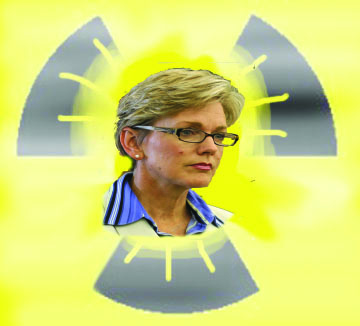
Despite such criticism, the Biden administration is pushing ahead, insisting that trigger recycling is risky. Jennifer M. Granholm, the energy secretary, has declared the new plants essential for “a safe, secure and effective nuclear deterrent.”
………………………….. “We don’t know what to do,” said Henry D. Sokolski, a former Pentagon official who now leads the Nonproliferation Policy Education Center. “What’s the response to this — do we just build more, and are we going to be able to build many more than they are?” https://www.japantimes.co.jp/news/2023/04/23/world/china-russia-us-nuclear-arsenal-buildup/
Complex safety problems in overhauling USA’s nuclear weapons stockpile, especially plutonium pits

TRUST BUT VERIFY. U.S. labs are overhauling the nuclear stockpile. Can they validate the weapons without bomb tests?
20 APR 2023, BY SARAH SCOLES Science.org
LOS ALAMOS, NEW MEXICO—Behind a guard shack and warning signs on the sprawling campus of Los Alamos National Laboratory is a forested spot where scientists mimic the first moments of a nuclear detonation. Here, in the Dual-Axis Radiographic Hydrodynamic Test (DARHT) facility, they blow up models of the bowling ball–size spheres of plutonium, or “pits,” at the heart of bombs—and take x-ray pictures of the results.
In a real weapon, conventional explosives ringing an actual pit would implode the plutonium to a critical density, triggering an explosive fissile chain reaction. Its energy would drive the fusion of hydrogen isotopes in the weapon’s second stage, generating yet more neutrons that would split additional fission fuel………………………………………………………..
Facilities like DARHT have been important since 1992, when the Department of Energy’s (DOE’s) three weapons labs—Los Alamos, Lawrence Livermore National Laboratory, and Sandia National Laboratory—stopped full-fledged tests of nuclear weapons. By 1996, the United States had signed the Comprehensive Nuclear-Test-Ban Treaty—credited not only with stopping the environmental damage of nuclear testing, but also with disincentivizing new weapons designs.
Without tests, however, the only things ensuring that warheads work are facilities like DARHT, computer simulations from “weapons codes,” and a cache of data from the old days of nuclear testing. For relatively minor changes to old weapons—new fuses, fresh top-ups of the hydrogen isotope tritium—that has been enough. Every year, DOE’s National Nuclear Security Administration (NNSA) and the Department of Defense have certified the stockpile, an assessment that means they are convinced the weapons will work when they’re supposed to, as they’re supposed to—and not do anything when they’re not supposed to. “Because we’ve blown up so many of them, these things are incredibly reliable,” says Geoff Wilson, director of the Center for Defense Information at the Project on Government Oversight, which argues nuclear weapons spending should be reduced.
But now the stockpile is getting an overhaul, the biggest in decades. This fiscal year, NNSA has a record $22.2 billion budget. Much of the money will go to producing new plutonium pits to replace those in the arsenal and to modernizing four warheads. A fifth weapon, dubbed the W93—a submarine-launched warhead—is a new design program. “It’s really the first warhead program we’ve had since the end of the Cold War” that isn’t a life extension or modernization of an existing weapon, says Marvin Adams, NNSA’s deputy administrator for defense programs………………………………
Wilson worries that the international dynamics and the U.S. overhaul could ultimately lead to a revival of bomb tests, bringing back their hazards and stoking a new arms race. “It is not unfathomable to me, which is scary to say.” It’s one thing to tweak weapons with a deep heritage. It’s another to infer functionality for modified weapons that have never been fully tested, he says………………………………….
SIMPLY REPLACING the bombs’ plutonium pits poses a science challenge: understanding how subtle changes affect their behavior. They aren’t easy to make, in part because plutonium, a metal only in existence since 1940, is mysterious and hard to handle. The last time anyone made pits at scale—in the 1980s at Colorado’s Rocky Flats plant—DOE’s contractor was shut down for environmental violations and forced to pay an $18.5 million fine.
This time, NNSA is splitting production between Los Alamos and the Savannah River Site in South Carolina. It has tasked them with making 80 new pits per year by 2030, a deadline NNSA admits it will not meet.
Los Alamos’s pits will be made at a facility called PF-4, a set of high-security buildings surrounded by cyclone fences with razor wire. Inside PF-4 are glovebox enclosures—radiation-shielded workstations where workers use thick gloves and peer through glass windows to manipulate the exotic metal. The lab is hiring thousands of workers, and its first pit is likely to be ready for the stockpile next year.
The gargantuan effort is motivated by a simple fact: many current pits are more than 40 years old, and plutonium behaves in confounding ways as it ages and radioactively decays. A green, fuzzy coating grows on it as its surface oxidizes. Atoms in its metallic lattice are knocked out of place as it spits out uranium isotopes. Its dimensions shift when it slips between six different solid phases. And the pits do not necessarily degrade smoothly. “We know at some point there will be a nonlinear piece,” says David Clark, director of Los Alamos’s National Security Education Center and editor of the Plutonium Handbook. “We just haven’t seen it.”…………….
One might think the new pits would make it easier to certify the stockpile, by avoiding the uncertainties of aging plutonium. But they come with uncertainties of their own. The new pits won’t be twins of their predecessors, so weapons scientists will have to understand how the alterations change pit behavior. They are being manufactured using recycled and purified plutonium from old pits, not fresh material, unlike the originals. Moreover, they will be made with different processes, and in some cases designed to slightly different specifications. “If you look at a new requirement,” Adams says, “you often will find that the old pits we have available to us are really, really suboptimal.”………………………………………. https://www.science.org/content/article/trust-verify-can-u-s-certify-new-nuclear-weapons-without-detonating-them
Germany okays Ukrainian strikes on Russian soil
21 Apr 23, https://www.rt.com/news/575139-german-defense-minister-ukraine-strikes-russia/—
Defense Minister Boris Pistorius has argued that such attacks are “fully normal” as long as the civilian population is not affected.
Ukraine has every right to conduct strikes and other military operations on Russian territory, German Defense Minister Boris Pistorius has argued. He noted, however, that civilians should not be hurt in the process.
Ukraine has regularly shelled several Russian border regions ever since Moscow launched its military campaign last February. Dozens of civilians have lost their lives as a result, with many more injured.
Appearing on Germany’s ZDF TV channel on Thursday, Pistorius said that it is “fully normal” that the “attacked [party] also moves into enemy territory, for instance to cut supply routes.”
“So long as cities, civilians, civilian areas are not attacked, you will unavoidably have to accept this,” the minister clarified.
However, Pistorius said that the West should not simply automatically rubber-stamp any weapons request by Kiev.
“If Ukraine asks for certain types of bombs that are outlawed globally, then we must say no,” the minister stressed.
Speaking about Kiev’s chances of joining NATO, the German official said that “this is now not the time to decide this.” Ukraine and NATO should for the time being prioritize “repelling this attack,” Pistorius insisted. Should these efforts prove successful, the US-led military bloc will have to “carefully weigh” this step, the minister said.
Pistorius went on to point out that NATO cannot admit Ukraine into its ranks purely “out of solidarity,” but should rather “decide with a cold head and hot heart, and not the other way round.”
Russian border regions – particularly those of Belgorod, Kursk and Bryansk – have repeatedly come under Ukrainian attacks over the past year. Kiev’s forces have used explosive-laden drones, mortars, artillery, and missiles in these strikes.
The toll taken on Belgorod Region in particular has been significant. Earlier this week, the region’s governor, Vyacheslav Gladkov, revealed that a total of thirty civilians in his region have been killed in Ukrainian attacks since February 2022, with 123 more people sustaining injuries. More than 3,000 homes have also been either destroyed or damaged, the official said. Dozens of schools and power facilities have also been hit.
Furthermore, the Donetsk People’s Republic, which joined Russia after a referendum last fall, has been subjected to regular shelling by the Ukrainian military since 2014. The attacks appear to be largely indiscriminate, with scores of civilians having lost their lives as result.
Six war mongering think tanks and the military contractors that fund them.

Center for Strategic and International Studies
Center for a New American Security
Hudson Institute
Atlantic Council
International Institute for Strategic Studies
Australian Strategic Policy Institute
Amanda Yee, March 7, 2023 https://www.liberationnews.org/six-war-mongering-think-tanks-and-the-military-contractors-that-fund-them/
From producing reports and analysis for U.S. policy-makers, to enlisting representatives to write op-eds in corporate media, to providing talking heads for corporate media to interview and give quotes, think tanks play a fundamental role in shaping both U.S. foreign policy and public perception around that foreign policy. Leaders at top think tanks like the Atlantic Council and Hudson Institute have even been called upon to set focus priorities for the House Intelligence Committee. However, one look at the funding sources of the most influential think tanks reveals whose interests they really serve: that of the U.S. military and its defense contractors.
This ecosystem of overlapping networks of government institutions, think tanks, and defense contractors is where U.S. foreign policy is derived, and a revolving door exists among these three sectors. For example, before Biden-appointed head of the Pentagon Lloyd Austin took his current position, he sat on the Board of Directors at Raytheon. Before Austin’s appointment, current defense policy advisor Michèle Flournoy was also in the running for the position. Flournoy sat on the board of Booz Allen Hamilton, another major Pentagon defense contractor. These same defense contractors also work together with think tanks like the Center for Strategic and International Studies to organize conferences attended by national security officials. On top of all this, since the end of the Cold War, intelligence analysis by the CIA and NSA has increasingly been contracted out to these same defense companies like BAE Systems and Lockheed Martin, among others — a major conflict of interest. In other words, these corporations are in the position to produce intelligence reports which raise the alarm on U.S. “enemy” nations so they can sell more military equipment!
And of course these are the same defense companies that donate hundreds of thousands of dollars each year to think tanks. Given all this, is it any wonder the U.S. government is simultaneously flooding billions of dollars of weaponry into an unwinnable proxy war in Ukraine while escalating a Cold War into a potential military confrontation with China?
The funding to these policy institutes steers the U.S. foreign policy agenda. To give you a scope of how these contributions determine national security priorities, listed below are six of some of the most influential foreign policy think tanks, along with how much in contributions they’ve received from “defense” companies in the last year.
All funding information for these policy institutes was gathered from the most recent annual report that was available online. Also note that this list is compiled from those that make this information publicly available — many think tanks, such as the hawkish American Enterprise Institute, do not release donation sources publicly.
1 – Center for Strategic and International Studies
According to their 2020 annual report
$500,000+: Northrop Grumman Corporation
$200,000-$499,999: General Atomics (energy and defense corporation that manufactures Predator drones for the CIA), Lockheed Martin, SAIC (provides information technology services to U.S. military)
$100,000-$199,999: Bechtel, Boeing, Cummins (provides engines and generators for military equipment), General Dynamics, Hitachi (provides defense technology), Hanwha Group (South Korean aerospace and defense company), Huntington Ingalls Industries, Inc. (largest military shipbuilding company in the United States), Mitsubishi Corporation, Nippon Telegraph and Telephone Corporation (provides intelligence and information technology services to U.S. military), Qualcomm, Inc. (semiconductor company that produces microchips for the U.S. military), Raytheon, Samsung (provides security technology to the U.S. military), SK Group (defense technology company)
$65,000-$99,999: Hyundai Motor (produces weapons systems), Oracle
$35,000-$64,999: BAE Systems
2 – Center for a New American Security
$500,000+: Northrop Grumman Corporation
$250,000-$499,999: Lockheed Martin
$100,000-$249,000: Huntington Ingalls Industries, Neal Blue (Chairman and CEO of General Atomics), Qualcomm, Inc., Raytheon, Boeing
$50,000-$99,000: BAE Systems, Booz Allen Hamilton, Intel Corporation (provides aerospace and defense technology), Elbit Systems of America (aerospace and defense company), General Dynamics, Palantir Technologies
3 – Hudson Institute
According to their 2021 annual report
$100,000+: General Atomics, Linden Blue (co-owner and Vice Chairman of General Atomics), Neal Blue, Lockheed Martin, Northrop Grumman
$50,000-$99,000: BAE Systems, Boeing, Mitsubishi Heavy Industries
4 – Atlantic Council
According to their 2021 annual report
$250,000-$499,000: Airbus, Neal Blue, SAAB (provides defense equipment)
$100,000-$249,000: Lockheed Martin, Raytheon
$50,000-$99,000: SAIC
5 – International Institute for Strategic Studies
Based in London. From fiscal year 2021-2022
£100,000+: Airbus, BAE Systems, Boeing, General Atomics, Lockheed Martin, Raytheon, Rolls Royce (provides military airplane engines)
£25,000-£99,999: Northrop Grumman Aerospace Systems, Northrop Grumman Corporation
6 – Australian Strategic Policy Institute
Note: ASPI has been one of the primary purveyors of the “Uyghur genocide” narrative
From their 2021-2022 annual report
$186,800: Thales Australia (aerospace and defense corporation)
$100,181: Boeing Australia
$75,927: Lockheed Martin
$20,000: Omni Executive (aerospace and defense corporation)
$27,272: SAAB Australia
NATO to surge troops to Russian border
As the deteriorating military situation for the Ukrainian armed forces becomes increasingly apparent, NATO is making open plans to massively intensify its conflict with Russia.
Andre Damon@Andre__Damon, 17 April 2023 m\ https://www.wsws.org/en/articles/2023/04/18/tzhv-a18.html
NATO plans to surge troops to Russia’s border as part of an effort to become a “war-fighting alliance,” the New York Times reported Monday.
The Times wrote that “NATO now has deployed a battalion of multinational troops to eight countries along the eastern border with Russia. It is detailing how to enlarge those forces to brigade strength in those frontline states.”
A battalion can include up to 1,000 troops, while a brigade can include up to 5,000 troops, meaning that NATO could potentially plan to increase the number of troops on Russia’s borders fivefold, to up to 40,000 troops.
The Times reports that NATO “is also tasking thousands more forces, in case of war, to move quickly in support, with newly detailed plans for mobility and logistics and stiffer requirements for readiness.”
Politico, meanwhile, has cited even larger numbers. On March 18, it reported, “In the coming months, the alliance will accelerate efforts to stockpile equipment along the alliance’s eastern edge and designate tens of thousands of forces that can rush to allies’ aid on short notice… The numbers will be large, with officials floating the idea of up to 300,000 NATO forces.”
“The North Atlantic Treaty Organization,” wrote the Times, has launched “a full-throttled effort” to prepare for military operations all along its eastern flank.
As the Times put it, this “means a revolution in practical terms: more troops based permanently along the Russian border,” It also means “more integration of American and allied war plans, more military spending and more detailed requirements for allies to have specific kinds of forces and equipment to fight, if necessary, in pre-assigned places.”
The alliance has “shed remaining inhibitions about increased numbers of Western troops all along NATO’s border with Russia,” the Times stated. The aim is “to make NATO’s forces not only more robust and more capable but also more visible to Russia.”
Additional troops will be placed under the direct authority of Gen. Christopher G. Cavoli, NATO’s Supreme Allied Commander Europe, who also commands American forces in Europe, as part of the NATO alliance’s decision.
The Times reports that General Cavoli is integrating American and allied war-fighting plans for the first time since the Cold War. Citing a NATO official, the newspaper wrote, “Americans are back at the heart of Europe’s defense … deciding with NATO precisely how America will defend Europe.”
This will entail a massive military buildup, involving enormous increases in military spending. “Now the demands will be tougher and more rigorous to bring the alliance back to a war-fighting capacity in Europe and make deterrence credible—to ensure that NATO can fight a high-intensity war against a rival, Russia, from the first day of conflict,” the Times wrote.
Instead of meeting the previous goal of 2 percent of gross domestic product devoted to the military, NATO members will be expected to spend between 2.5 and 3 percent, the Times reported.
In perhaps the most ominous passage in the article, the Times wrote, “Previously, the annual exercises of NATO’s nuclear forces, known as Steadfast Noon, were kept quiet. But last year, after Russia’s invasion, the exercise went ahead openly. It was important, a NATO official said, to show Moscow that the alliance wasn’t deterred by nuclear threats.”
NATO’s headquarters is likewise “being transformed into a major strategic and war-fighting command, charged with drawing up the alliance’s plans to integrate and deploy allied troops.”
The accession of Finland to NATO, which doubled the length of NATO’s land border with Russia, will be a key component of these plans, with Russia’s entire border with NATO becoming a militarized zone.
Just weeks after its accession to NATO, Finland has begun building a fence on the Russian border, with the initial section to be completed in June.
In June of last year, NATO published a strategy document declaring that the alliance must prepare for “high-intensity, multi-domain warfighting against nuclear-armed peer-competitors.” The document declared that “the Euro-Atlantic area is not at peace”—all but declaring that the alliance is at war.
In January, Rob Bauer, NATO’s top military spokesperson, declared that the US-led NATO alliance is prepared for a “direct clash with Russia.” Asked by Portugal’s RTP News, “You don’t believe that it’s only about Ukraine?” Bauer replied, “No, it’s about turning back to the old Soviet Union.”
The interviewer continued, “So the entire Eastern Flank is at risk somehow?” Bauer replied, “Yeah.” The interviewer asked, “We are ready to [sic] a direct confrontation with Russia?” To this Bauer replied, “We are.”
In this supercharged environment, NATO will begin Defender 23, the alliance’s annual war game, on April 22.
The exercise will involve 9,000 US troops and 17,000 soldiers from other NATO members. The “nearly two-month-long exercise is focused on the strategic deployment of U.S.-based forces, employment of Army pre-positioned stocks and interoperability with European allies and partners,” a Pentagon spokesperson said April 5.
A key goal of the exercise will be to “increase lethality of the NATO Alliance through long-distance fires” according to U.S. Army’s Europe and Africa commands.
This will be followed by Air Defender 2023, the largest NATO air exercise since its founding. A US Air National Guard official told the War Zone that Russian officials can “take away whatever message they want” from the drill.
Against this background, a group of former top officials from France, Germany, the United States and Spain have written an op-ed in the Guardian Sunday encouraging more direct NATO military intervention against Russia, declaring “We have to go ‘all in’ in our support for Ukraine.” They declare that “Ukraine needs the combined force of tanks, longer-range missiles and aircraft to conduct a successful counterattack, paving the way to Ukrainian victory.”
The press is full of such declarations. David Ignatius, writing in the Washington Post, argued, “President Biden doesn’t want to start World War III, but he will look back with regret if the United States and its allies leave any weapons or ammunition on the sidelines that could responsibly be used in this conflict. Whatever Biden might wish later he had done if things go badly, he should do now.”
As the deteriorating military situation for the Ukrainian armed forces becomes increasingly apparent, NATO is making open plans to massively intensify its conflict with Russia.
Scrapping could be next for Russia’s nuclear-powered battle cruiser
It is likely not cost-efficient to do the highly needed upgrade of the Northern Fleet’s 25-year old flagship “Pyotr Velikiy”.
Read in Russian | Читать по-русски
By Thomas Nilsen, 20 Apr 23 https://thebarentsobserver.com/en/security/2023/04/scrapping-could-be-next-russias-nuclear-powered-battle-cruiser
“Currently, the question about withdrawing “Pyotr Velikiy” from the Navy is under consideration. Based on the experience of repairing and modernizing the “Admiral Nakhimov” of the same class has shown that this is very costly,” a navy source said to state-owned news agency TASS.
Like in many speculations on the fate of older navy vessels, Russian state media send mixed information. Shortly after the TASS report came on Thursday, RIA Novosti quoted an unnamed source saying there are no plans to retire the huge warship.
The “Pyotr Velikiy” and “Admiral Nakhimov” are of sister ships, both of the Kirov-class, the only nuclear-powered surface warships in the Russian Navy.
The “Admiral Nakhimov” has not been in operation since the early 1990ties, and has since 1999 been at the yard in Severodvinsk undergoing repair, change of uranium fuel elements in the reactors and a refit to receive new weaponry, including modern cruise-missiles.
However, as repeatedly reported by the Barents Observer over the last decade, the re-commissioning of the warship has seen one postponement following the other. Current plans to set sail in 2024 today seem unlikely.
The “Pyotr Velikiy” was supposed to be docked in Severodvinsk as soon as “Admiral Nakhimov” joins the Northern Fleet.
The warship is armed with several types of cruise missiles, surface-to-air missiles, rocket launchers, torpedos and artillery. The hangar can house three helicopters.
April 18 marked the 25-years anniversary since “Pyotr Velikye” was commissioned. The ship has a crew of more than 700.
US military-industrial complex is main beneficiary of fighting Russia in Ukraine – Moscow
21 Apr 23, https://www.rt.com/russia/575116-galuzin-rt-interview-ukraine/
The American arms industry will now have contracts for years to come, Deputy Foreign Minister Mikhail Galuzin has insisted.
US policy on Ukraine is inherently cynical and ignores the interests of the Ukrainian people, Russian Deputy Foreign Minister Mikhail Galuzin claimed in an interview with RT. Washington is the biggest beneficiary from the hostilities, he added.
The US and its NATO allies “consider Ukraine as just raw material for [fulfilling] their aggressive purposes against Russia,” the senior diplomat said in an interview. Washington has declared the “strategic defeat” of Russia in Ukraine as its goal, he noted, with the US and its allies delivering weapons to Kiev on an unprecedented scale.
“The main beneficiary of [arming Ukraine] is the USA. [Its] military industrial complex… is now ensured orders for years to come. They are making profit on the war they conduct in Ukraine against us,” Galuzin said.
The deputy minister also commented on the Chinese peace plan for Ukraine, which Beijing presented earlier this year, affirming it could serve as the basis of a future peace agreement. However, it is up to Kiev to resume negotiations, he said, as it was the party that pulled out in the first place.
“In March 2022, it was Russia that responded positively to a Ukrainian proposal to hold peace talks. And the two sides were close to an agreement. We even formulated a draft treaty with Ukraine,” he said, referring to talks mediated by Türkiye.
Kiev has not responded to a document that Moscow put forward in April based on what Ukraine suggested in Istanbul, Galuzin said.
“The Kiev regime was stopped by its Western mentors,” he claimed, reiterating the view previously expressed by other senior Russian officials. The US “and its satellites” want to weaken Russia and are using Ukraine as a tool to do that, the diplomat stated.
They seem to be ready to continue this fighting to the last Ukrainian, unfortunately,” he remarked.
In the interview with RT, Galuzin also discussed Russian relations with Belarus and Moldova and the escalating religious conflict in Ukraine.
US nuclear taxes — the true costs

Fortunately, there is a rapidly growing movement in our nation called, “Back from the Brink,” supported by 333 elected officials across the country, that supports the elimination of all nuclear weapons while laying out four precautionary steps necessary in the process. Rep. James McGovern (D-Mass.) has demonstrated the courage to support this effort with the recent introduction of H. Res 77.
Ultimately, “Budgets are moral documents,” as theologian Rev. Jim Wallis has noted. What role do nuclear weapons play in that morality?
We find ourselves as a nation grappling with economic, environmental, social and racial justice issues, seemingly oblivious to the fact that the very existence of nuclear weapons — and all that they entail, from mining, production, testing, stockpiling, dismantling and potential for their use — are among the greatest perpetrators of these injustices.
Nuclear weapons threaten us every moment of every day.
BY ROBERT DODGE, – 04/19/23
Every April we fund our nation’s budget and economic priorities on Tax Day. This year finds our nation emerging from the global COVID-19 pandemic and still struggling with years of infrastructure neglect.
This neglect has impacted the health and wellbeing of our communities, resulting in water shortages, contamination, and toxic legacies
…………………………………… We continue to face the growing existential challenges, economic burden, and impact of climate change nationally and globally.
And then there is the ongoing war in Ukraine, which potentially threatens the entire world.
This year the increased risk of nuclear war hangs over us more than at any time since the Cuban missile crisis
The Bulletin of Atomic Scientists moved their Nuclear Doomsday Clock to 90 seconds till midnight earlier this year, the closest to global catastrophe it has ever been.
Russian President Putin’s preparations to place tactical nuclear weapons in neighboring Belarus would lower the threshold of nuclear war, further heightening the risk.
It’s fair to ask, ‘Who determines our priorities and how do we fund them?’
Ultimately, “Budgets are moral documents,” as theologian Rev. Jim Wallis has noted. What role do nuclear weapons play in that morality?
We find ourselves as a nation grappling with economic, environmental, social and racial justice issues, seemingly oblivious to the fact that the very existence of nuclear weapons — and all that they entail, from mining, production, testing, stockpiling, dismantling and potential for their use — are among the greatest perpetrators of these injustices.
Nuclear weapons threaten us every moment of every day.
While most reasonable people recognize that these weapons cannot and must not ever be used, approximately 12,512 weapons remain in the nuclear arsenals of the world. We also know that the use of even a tiny fraction (less than half a percent) of these weapons over a single populated region would cause catastrophic climate change resulting in a global famine putting potentially 2 billion people at risk.
These weapons also threaten us by robbing precious resources that could be redirected to the many needs that our communities cry out for. The Nuclear Weapons Cost Program of the Nobel Prize winning Physicians for Social Responsibility Los Angeles, now in its 34th year, attempts to determine the full cost of nuclear weapons programs to our communities. There have been many excellent calculations of portions of our nuclear weapons costs including the ICAN report on global costs. These reports deal primarily with the cost of warheads, delivery systems and development alone, in an attempt to compare one nation to another.
In our report, we include verifiable costs of all nuclear programs that would not be spent if nuclear weapons did not exist. These include funding of the nuclear missile defense system, environmental cleanup and legacy programs dealing with communities that have been contaminated by the mining, development, testing and stockpiling of these weapons. Also included is nuclear nonproliferation funding and funding to safeguard and sequester nuclear weapons in Russia and former Soviet Union States.
Determining the full cost of U.S. nuclear weapons programs is a tedious process, as the United States is not fully transparent in these figures.
We have chosen to list only figures that we can provide reference to. There are other reports that estimate the forecast to be much higher, including Dr. Timmon Wallis in “Warheads to Windmills: How to Pay for a Green New Deal.” In 2013, with the release of the “Black Budget” by Edward Snowden, it was estimated that there were some $9 billion in “top secret” nuclear operations that were never publicly released. While likely still being funded, it has become impossible to track those expenditures and thus they are not included in our report.
The total costs of all U.S. nuclear weapons programs for the 2022 Tax Year which funds our Fiscal Year 2023 budget is $90.34 Billion.
What does this mean to our communities? In Jackson, Miss., with its 148,761 residents earning a per capita income 62 percent of the national average, their tax dollar contribution to nuclear weapons programs is about $25 million. For Flint, Mich., with its 80,628 residents earning a per capita income of 50 percent of the national average, their nuclear contribution is over $10.8 million. The Navajo Nation — whose 143,435 residents have experienced the health legacy of nuclear weapons, having been victims of significant radiation exposure from nuclear weapons testing and development for decades, and whose per capita income is 40 percent of the national average — will spend over $15.6 million on nuclear weapons programs.
The nation’s poorest county of Buffalo County, S.D., with its 1,923 largely indigenous Crow Creek Sioux Tribe residents, earning on average 32 percent of the national average, will spend about $167,000 dollars as their contribution to nuclear weapons programs. Is this their priority? Does it add in any way to their security, health or wellbeing? In reality, these weapons are among the greatest threats to their security.
In a participatory democracy, is this how they would choose to spend their treasure? Polls show that a 66 percent majority of Americans favor the abolition of nuclear weapons and that 58 percent are also fearful of nuclear war.
…………. Fortunately, there is a rapidly growing movement in our nation called, “Back from the Brink,” supported by 333 elected officials across the country, that supports the elimination of all nuclear weapons while laying out four precautionary steps necessary in the process. Rep. James McGovern (D-Mass.) has demonstrated the courage to support this effort with the recent introduction of H. Res 77.
Civil Society Wants Deeds, Not Words, on Nuclear Disarmament: The G7 Should Listen
The Civil 7 (C7) is a non-governmental organization that brings together thousands of highly-skilled individuals from around the world who work to improve government responses to global environmental, economic, and social problems. The C7 held its annual summit in Tokyo last week to discuss its current recommendations and to present them to emissaries of the Group of 7 (G7) nations—Canada, France, Germany, Italy, Japan, the United Kingdom, and the United States, which will be holding their annual summit in Hiroshima next month.
For the first time in the history of the C7, it also presented recommendations on nuclear disarmament. I participated in the newly formed C7 Nuclear Disarmament Working Group and spoke about the need for it at the summit in Tokyo. The G7 decision to meet in Hiroshima this year acknowledges growing international concern about the growing risk of nuclear war and the costs of the new nuclear arms race. When US President Barack Obama visited Hiroshima in 2016, he considered, but then decided against, announcing specific steps to reduce the risk of nuclear use. The G7 has given no indication it is willing to halt the arms race that’s developed in the wake of Obama’s failure to act.
Symbolism is important but it can be misleading. Japanese Prime Minister Fumio Kishida claims credit for getting the powerful group of seven wealthy nations to Hiroshima to make a public statement supporting the ultimate elimination of nuclear weapons. But his government encourages the United States to develop new tactical nuclear weapons and to deploy them in East Asia. President Biden supports expensive and unnecessary upgrades to the US nuclear arsenal. The United Kingdom plans to increase its nuclear stockpile by forty percent and France is building a new generation of nuclear-armed ballistic missile submarines. Germany and Italy recently received upgraded US tactical nuclear weapons and both support US and NATO threats to use them first.
The C7 recommended the G7 “unequivocally condemn any and all threats to use nuclear weapons and disavow all options to resort to nuclear weapons in conflict.” The G7 already agreed in its 2022 communique that “a nuclear war cannot be won and must never be fought.” Nevertheless, as noted in the 2023 C7 communique, the three nuclear armed members of the G7 are currently spending over $100,000 a minute preparing for such a war.
The C7 also recommended the G7 “begin urgent negotiations to achieve the complete elimination, of nuclear weapons before 2045,” the year of the 100th anniversary of the atomic bombings of Hiroshima and Nagasaki…………………………………… more https://blog.ucsusa.org/gregory-kulacki/civil-society-wants-deeds-not-words-on-nuclear-disarmament-the-g7-should-listen/
 |
83 Hiroshimas — New nuclear bombs coming to Europe and UK

US ships powerful new nuke to Europe, heightening tensions
83 Hiroshimas — Beyond Nuclear International
American B61-12 nuclear bombs head to Europe
Since last December, the United States has begun to replace its nuclear weapons on European soil with more modern ones. It is replacing the B61-3, B61-4 and B61-7 thermonuclear bombs with the B61-12, which has become the main US and NATO air-launched nuclear weapon.
Boeing designed the bomb’s new guided-tailkit, giving it additional maneuverability and the appearance of more precision. But, it’s a nuclear weapon, and has different yields, from 0.3kt to 50kt. These bombs can detonate beneath the Earth’s surface, increasing their destructiveness against underground targets to the equivalent of a surface-burst weapon with a yield of 1,250 kilotons––the equivalent of 83 Hiroshima bombs.
These nuclear weapons are coming to Europe in a time of heightened nuclear tension on the continent, and even as the majority of people in European host countries want to remove nuclear weapons and join the Treaty on the Prohibition of Nuclear Weapons.
Combined with the lack of transparency around nuclear sharing, this moment raises questions about whether citizens in the host states would agree to be complicit if these weapons are ever used. Even if the bombs are American and the US retains launch authority, they would most likely be dropped by Europeans. If the US decides to use its nuclear weapons located in Germany, the warheads are loaded onto German planes and a German pilot drops them.
ICAN is a broad, inclusive campaign, focused on mobilizing civil society around the world to support the specific objective of prohibiting and eliminating nuclear weapons.
Share this video to spread the word about these new nuclear weapons and join the movement to eliminate them.
And from: Tica Font, member of Centre Delàs and WILPF Spain, published by Pressenza
It is a free-fall bomb equipped with state-of-the-art navigation systems and a versatile warhead that can be configured in four strengths, 0.3 kiloton (kt), 1.5 kt, 10 kt and 50 kt depending on the target, making it a low to medium-yield weapon. This type of weapon is referred to as a ‘first-strike’ weapon. Having a tactical nuclear weapon with higher precision and lower yield could make politicians less reluctant to use them in conventional operations and puts us on an increasingly dangerous front line of confrontation between NATO and Russia.
These new nuclear weapons will replace existing ones on the soil of Belgium, the Netherlands, Italy, Germany and Turkey. But Washington has announced that it will also deploy them on UK soil; this time it is not a replacement for more outdated ones, as it reported in 2008 that its nuclear weapons had been withdrawn from the RAF; now it appears that it wants to put new nuclear weapons in the empty bunkers at Lakenheath again.
All this deployment of nuclear weapons represents a violation of the Non-Proliferation Treaty (NPT). The NPT prohibits nuclear-weapon States Parties from transferring nuclear weapons to any other State and prohibits non-nuclear-weapon States Parties from receiving nuclear weapons or from manufacturing or acquiring them.
53 years after the entry into force of the NPT, we see that it has not served to achieve nuclear disarmament. Just two years ago, in January 2021, the Treaty on the Prohibition of Nuclear Weapons (TPNW) entered into force. The TPNW outlaws nuclear weapons and makes it illegal for states that sign the TPNW to possess, develop, deploy, test, use or threaten to use nuclear weapons.
However, for the Spanish government the NPT remains the “cornerstone of the international nuclear non-proliferation and disarmament regime”, considering that this treaty is an adequate and sufficient instrument for nuclear non-proliferation and disarmament. They therefore consider that the TPNW is not necessary, as the NPT already exists.
But the facts do not support the Spanish government’s position. In addition to the deployment of new weapons in Europe, the new NATO Strategic Concept 2022, approved in Madrid last summer, states that “NATO’s deterrence and defence posture is based on an appropriate mix of nuclear, conventional and missile defence assets (…) and that it will take all necessary steps to ensure the credibility, effectiveness, integrity and security of the nuclear deterrence mission”.
In short, it seems that the NPT is only defended when it comes to imposing nuclear weapons restrictions on countries outside the NATO orbit (the “others”), that compliance with the NPT is not applicable to either the US or NATO, while both re-emphasise deterrence and the nuclear threat. On the contrary, the safest position, the position that would best reflect citizens’ aspirations to completely destroy nuclear weapons, is for Spain to decide to join the TPNW, and for the Spanish government to attend meetings of TPNW states parties, to show genuine support for denuclearisation.
Tica Font is a member of Centre Delàs and WILPF Spain.
1 This Month




PLEASE OPPOSE HR 8255 AND S.3639 – bills would accelerate satellite deployment, with no environmental review or safeguards – https://ncstd5li.quorum.us/campaign/169331/
To see nuclear-related stories in greater depth and intensity – go to https://nuclearinformation.wordpress.com
-
Archives
- September 2026 (330)
- August 2026 (330)
- July 2026 (355)
- June 2026 (287)
- May 2026 (306)
- April 2026 (356)
- March 2026 (251)
- February 2026 (267)
- January 2026 (308)
- December 2025 (358)
- November 2025 (359)
- October 2025 (375)
-
Categories
- 1
- 1 NUCLEAR ISSUES
- business and costs
- climate change
- culture and arts
- ENERGY
- environment
- health
- history
- indigenous issues
- Legal
- marketing of nuclear
- media
- opposition to nuclear
- PERSONAL STORIES
- politics
- politics international
- Religion and ethics
- safety
- secrets,lies and civil liberties
- spinbuster
- technology
- Uranium
- wastes
- weapons and war
- Women
- 2 WORLD
- ACTION
- AFRICA
- Atrocities
- AUSTRALIA
- Christina's notes
- Christina's themes
- culture and arts
- Events
- Fuk 2022
- Fuk 2023
- Fukushima 2017
- Fukushima 2018
- fukushima 2019
- Fukushima 2020
- Fukushima 2021
- general
- global warming
- Humour (God we need it)
- Nuclear
- RARE EARTHS
- Reference
- resources – print
- Resources -audiovicual
- Weekly Newsletter
- World
- World Nuclear
- YouTube
-
RSS
Entries RSS
Comments RSS

