83 Hiroshimas — New nuclear bombs coming to Europe and UK

US ships powerful new nuke to Europe, heightening tensions
83 Hiroshimas — Beyond Nuclear International
American B61-12 nuclear bombs head to Europe
Since last December, the United States has begun to replace its nuclear weapons on European soil with more modern ones. It is replacing the B61-3, B61-4 and B61-7 thermonuclear bombs with the B61-12, which has become the main US and NATO air-launched nuclear weapon.
Boeing designed the bomb’s new guided-tailkit, giving it additional maneuverability and the appearance of more precision. But, it’s a nuclear weapon, and has different yields, from 0.3kt to 50kt. These bombs can detonate beneath the Earth’s surface, increasing their destructiveness against underground targets to the equivalent of a surface-burst weapon with a yield of 1,250 kilotons––the equivalent of 83 Hiroshima bombs.
These nuclear weapons are coming to Europe in a time of heightened nuclear tension on the continent, and even as the majority of people in European host countries want to remove nuclear weapons and join the Treaty on the Prohibition of Nuclear Weapons.
Combined with the lack of transparency around nuclear sharing, this moment raises questions about whether citizens in the host states would agree to be complicit if these weapons are ever used. Even if the bombs are American and the US retains launch authority, they would most likely be dropped by Europeans. If the US decides to use its nuclear weapons located in Germany, the warheads are loaded onto German planes and a German pilot drops them.
ICAN is a broad, inclusive campaign, focused on mobilizing civil society around the world to support the specific objective of prohibiting and eliminating nuclear weapons.
Share this video to spread the word about these new nuclear weapons and join the movement to eliminate them.
And from: Tica Font, member of Centre Delàs and WILPF Spain, published by Pressenza
It is a free-fall bomb equipped with state-of-the-art navigation systems and a versatile warhead that can be configured in four strengths, 0.3 kiloton (kt), 1.5 kt, 10 kt and 50 kt depending on the target, making it a low to medium-yield weapon. This type of weapon is referred to as a ‘first-strike’ weapon. Having a tactical nuclear weapon with higher precision and lower yield could make politicians less reluctant to use them in conventional operations and puts us on an increasingly dangerous front line of confrontation between NATO and Russia.
These new nuclear weapons will replace existing ones on the soil of Belgium, the Netherlands, Italy, Germany and Turkey. But Washington has announced that it will also deploy them on UK soil; this time it is not a replacement for more outdated ones, as it reported in 2008 that its nuclear weapons had been withdrawn from the RAF; now it appears that it wants to put new nuclear weapons in the empty bunkers at Lakenheath again.
All this deployment of nuclear weapons represents a violation of the Non-Proliferation Treaty (NPT). The NPT prohibits nuclear-weapon States Parties from transferring nuclear weapons to any other State and prohibits non-nuclear-weapon States Parties from receiving nuclear weapons or from manufacturing or acquiring them.
53 years after the entry into force of the NPT, we see that it has not served to achieve nuclear disarmament. Just two years ago, in January 2021, the Treaty on the Prohibition of Nuclear Weapons (TPNW) entered into force. The TPNW outlaws nuclear weapons and makes it illegal for states that sign the TPNW to possess, develop, deploy, test, use or threaten to use nuclear weapons.
However, for the Spanish government the NPT remains the “cornerstone of the international nuclear non-proliferation and disarmament regime”, considering that this treaty is an adequate and sufficient instrument for nuclear non-proliferation and disarmament. They therefore consider that the TPNW is not necessary, as the NPT already exists.
But the facts do not support the Spanish government’s position. In addition to the deployment of new weapons in Europe, the new NATO Strategic Concept 2022, approved in Madrid last summer, states that “NATO’s deterrence and defence posture is based on an appropriate mix of nuclear, conventional and missile defence assets (…) and that it will take all necessary steps to ensure the credibility, effectiveness, integrity and security of the nuclear deterrence mission”.
In short, it seems that the NPT is only defended when it comes to imposing nuclear weapons restrictions on countries outside the NATO orbit (the “others”), that compliance with the NPT is not applicable to either the US or NATO, while both re-emphasise deterrence and the nuclear threat. On the contrary, the safest position, the position that would best reflect citizens’ aspirations to completely destroy nuclear weapons, is for Spain to decide to join the TPNW, and for the Spanish government to attend meetings of TPNW states parties, to show genuine support for denuclearisation.
Tica Font is a member of Centre Delàs and WILPF Spain.
US Special Forces in Ukraine at embassy, official confirms, as Pentagon document leak probe heats up
By Peter Doocy , Greg Norman | Fox News, 16 Apr 23,
White House National Security Council spokesman John Kirby speaks to Fox News about leaked classified documents, says Special Forces ‘are not fighting on the battlefield’
White House National Security Council spokesman John Kirby has revealed to Fox News on Wednesday that there is a “small U.S. military presence” at the American embassy in Ukraine.
Kirby was asked about leaked Pentagon documents suggesting there are U.S. Special Forces operating inside the war-torn country. ………..
Kirby, who was speaking on the sidelines of President Biden’s trip to Northern Ireland, added that those troops “are not fighting on the battlefield.” In addition, Fox News is told that the U.S. forces in Kyiv also provide security services. …………….. https://www.foxnews.com/politics/us-special-forces-ukraine-embassy-official-confirms-pentagon-document-leak-probe-heats-up
Russian news reports NATO to open base in Moldova near Transnistria
Подробнее https://tverskaya13.ru/politika/nato-postoit-v-moldove-novuyu-voennuyu-bazu/
NATO to build new military base in Moldova According to Defense Minister Anatoly Nosaty, a new military base will be built in Chisinau, where the Moldovan army will be trained. It is important to note that the facility will be built according to NATO standards
NATO will provide the necessary funds. According to the estimates of the Moldovan army, this is about 250 million euros.
“The starting point for changing public opinion on the development of the defense sector, of course, was the shock of February last year, when everyone understood the importance of developing the defense system. In other words, the period of romanticism with the dream of “eternal peace” has ended, and a different approach is needed, ” said State Secretary of the Ministry of Defense of the Republic of Moldova Valery Mizha.
Also, the Prime Minister of the Republic of Moldova, Dorin Rechan, said that the reason for the decision to strengthen the country’s defense was precisely Russia, because only it ” poses an immediate threat to Moldova’s security.”
“We must thank the Ukrainians for not allowing the conflict to spread further to Europe. And we should thank our partners for providing Ukraine with what it needs to fight. Russia is an open threat to Moldova’s security. Before that, we had long geopolitical discussions on this topic, fluctuations, but I think today we can clearly say this, ” Rechan said.
Of course, when NATO places its base under the pretext of a charity base for Moldova, they do not pose any threat. Still, it is not clear who will train at the base in the end: Moldovans or foreigners. In any case, as Russian Foreign Minister Sergey Lavrov said, it is immediately clear that NATO is preparing a second Ukraine from the country, since its president Maia Sandu is ready for almost anything.
The coming war on China: the real target is the American people
“If tyranny and oppression come to this land, it will be in the guise of fighting a foreign enemy.” – James Madison
ALEX KRAINER, Substack, APR 15, 2023
Empire’s proxy war on Russia is rapidly coming to a head in Ukraine and the imperial guard might urgently need a new war. Their next target is China and once more we witness a relentless escalation of provocations and hostility. In his Wall Street Journal column this week, former National Security Advisor John Bolton laid out his “grand strategy” to confront Russia and China. His genius idea is to give Taiwan “much more military aid” from western nations and “embed Taipei into collective-defense structures.”
Preparations for war
Bolton’s warmongering is only the last in the long sequence of proclamations by US officials indicating the direction of their foreign policy. Last month, U.S. Secretary of the Army Christine Wormuth told an audience at the American Enterprise Institute (AEI) that the United States has “to prepare, to be prepared to fight and win that war” against China. This is not just idle talk: they really are preparing.
On Sunday, 10 January, Lieutenant General James Bierman, the commanding general of the Third Marine Expeditionary Force gave an interview to the Financial Times in which he said that his command is working hard to replicate the empire’s military success (!) in Ukraine. Bierman explained that the US and its allies in Asia were recreating the groundwork that had enabled western countries to support Ukraine’s resistance to Russia in preparing for scenarios such as Chinese invasion of Taiwan:
“Why have we achieved the level of success we’ve achieved in Ukraine? … because after Russian aggression in 2014 and 2015, we earnestly got after preparing for future conflict: training for the Ukrainians, pre-positioning of supplies, identification of sites from which we could operate support, sustain operations. We call that setting the theatre. And we are setting the theatre in Japan, in the Philippines, in other locations.”
In other words, the US is creating the same conditions to draw China into a war over Taiwan in order to replicate the success they’ve had in Ukraine. Truly, whom gods would destroy, they first make them mad.
The war addiction
Jest aside, why is the US establishment ever so keen on waging wars? Consider the finding that, “Since the end of World War II, there have been 248 armed conflicts in 153 locations around the world. The United States launched 201 overseas military operations between the end of World War II and 2001, and since then, others, including Afghanistan and Iraq.”
Stated otherwise, one nation has launched more than 80% of all overseas military operations since WWII. Is this because the American people are so consistently belligerent? That’s clearly not the case: for as long as I’d observed American politics, the people always vote for anti-war candidates. Somehow however, they always get more war. How can that be? In fact, causes of war are systemic and they emanate from the fraudulent money system that’s been foisted on us all. This can’t be explained in just a few paragraphs, but for all who are inclined to explore this relationship further, I summarized it in this article: “Deflationary gap and the west’s war addiction.”
China, China, China!
Alongside military preparations, the imperial guard is also working hard to create consent for war with relentless anti-China propaganda. The unsubtle messaging is that the CCP is coming for our freedoms and has evil designs to dominate the world. Much of the commentariat blames the Chinese for all the dark globalist agendas to enslave humanity.
The relentless fearmongering often resorts to propagating outright fabrications which are then replicated ad nauseum as hard facts. Repetition turns these fabrications into culturally accepted truths. The most dismaying example of this is the western invention of the “Chinese Social Credit System.”……………………………………………………………………………………
China is not the enemy and consenting to a war against China would be the greatest possible gift we could give to the occult oligarchy that rules in the west and has been in charge for over a century. It is they who have given us a century of perpetual wars. The reason why the American people are under such relentless attacks is because they are still one of the most important bulwarks of freedom https://alexkrainer.substack.com/p/the-coming-war-on-china-the-real
 | |||
| |||
Russia warns of Ukraine weapons spillover
Western arms meant for Kiev are also falling into the hands of organized crime and terrorists, Moscow’s UN envoy has said. https://www.rt.com/russia/574516-ukraine-west-weapons-spillover-criminals/ 12 Apr 23
Weapons being sent to Ukraine by its Western backers often end up benefitting malicious actors across the globe, Moscow’s permanent representative to the UN, Vassily Nebenzia, said on Monday.
Speaking at a UN Security Council meeting on risks associated with weapons exports, Moscow’s envoy claimed that while Western countries had been trying to promote “responsible behavior” over arms trafficking, the Ukraine conflict proved “how insincere their claims” on the matter actually were.
Nebenzia recalled that Russia has “long been stressing that pumping up of the Kiev regime with weapons would bring those weapons in black markets and also in the hands of organized crime and terrorists.”
He said that it “can be confirmed by facts,” noting that law enforcement agencies across Europe had already observed the arms in question starting to surface in various countries.
Such weapons also spread throughout the world, in particular, [they find their] way to the militants in Africa. All of us heard African leaders say so,” he added.
Last November, Nigerian President Muhammadu Buhari said that “weapons being used for the war in Ukraine and Russia are equally beginning to filter” to the Sahel region in Northern Africa and the Lake Chad Region, where they bolster local terrorists.
In autumn 2022, a similar alarm was sounded by Finnish law enforcement. Christer Ahlgren, a senior police official, said at the time that arms originally sent to Ukraine, including assault rifles, grenades, and combat drones, had been found in multiple European countries, such as Sweden, Denmark, the Netherlands and Finland itself.
Earlier this month, NATO Secretary General Jens Stoltenberg said that Ukraine’s Western allies had sent Kiev military aid to the tune of €65 billion ($71 billion). Russia has repeatedly warned that such actions make the West a direct participant to the conflict.
Moreover, in February, Russian President Vladimir Putin stated that NATO security assistance to Kiev makes the bloc an accomplice to “the crimes committed by the Kiev regime,” which he said consistently targeted civilians with artillery and missile strikes.
Two American brigades close to the Ukrainian border, but no plan, no leadership towards ending the war!

“The problem is Biden and his principal lieutenants—Blinken and Sullivan and their court of worshippers—who see those who criticize Zelensky as being pro-Putin.
the juniors are running the show here,” the official added. “There’s no NSC coordination and the US army is getting ready to go to war. There’s no idea whether the White House knows what’s going on.
| If worse comes to worst for the undermanned and outgunned Ukraine army in the next few months, will the two American brigades join forces with NATO troops and face off with the Russian army inside Ukraine? Is this the plan, or hope, of the American president? TRADING WITH THE ENEMY Amid rampant corruption in Kiev and as US troops gather at the Ukrainian border, does the Biden administration have an endgame to the conflict? Seymour Hersh, Substack, Apr 12 ∙ |
“CIA Director William Burns is not the problem,” the official said. “The problem is Biden and his principal lieutenants—Blinken and Sullivan and their court of worshippers—who see those who criticize Zelensky as being pro-Putin. ‘We are against evil. Ukraine will fight ’til the last military shell is gone, and still fight.’ And here’s Biden who is telling America that we’re going to fight as long as it takes.”
The official cited the little-known and rarely discussed deployment, authorized by Biden, of two brigades with thousands of America’s best army combat units to the region. A brigade of the 82nd Airborne Division has been intensively training and exercising from its base inside Poland within a few miles of the Ukrainian border. It was reinforced late last year by a brigade from the 101st Airborne Division that was deployed in Romania. The actual manpower of the two brigades, when administrative and support units—with the trucks and drivers who haul the constant stream of arms and military equipment flowing by sea to keep the units combat ready—could total more than 20,000.
The intelligence officials told me that “there is no evidence that any senior official in the White House really knows what’s going on in the 82nd and 101st. Are they there as part of a NATO exercise or to serve with NATO combat units if the West decides to engage Russians units inside Ukraine? Are they there to train or to be a trigger? The rules of engagement say they can’t attack Russians unless our boys are getting attacked.”
But the juniors are running the show here,” the official added. “There’s no NSC coordination and the US army is getting ready to go to war. There’s no idea whether the White House knows what’s going on. Has the president gone to the American people with an informative broadcast about what is going on? The only briefings the press and the public get today are from White House spokespeople.
“This is not just bad leadership. There is none. Zero.” The official added that a team of Ukrainian combat pilots are now getting trained here in America to fly US-built F-16 fighter jets, with the goal, if needed, of flying in combat against Russian troops and other targets inside Ukraine.” No decision about such deployment has been made.
The clearest statements of American policy have come not from the White House, but from the Pentagon. Army General Mark A. Milley, who is chairman of the Joint Chiefs of Staff, said of the war last March 15: “Russia remains isolated. Their military stocks are rapidly depleting. Their soldiers are demoralized, untrained, unmotivated conscripts and convicts, and their leadership is failing them. Having already failed in their strategic objectives, Russia is increasingly relying on other countries, such as Iran and North Korea. . . . This relationship is built on the cruel bonds of repressing freedom, subverting liberty and maintaining their tyranny. . . . Ukraine remains strong. They are capable and trained. Ukrainian soldiers are . . . strong in their combat units. Their tanks, infantry fighting vehicles and armored vehicles are only going to bolster the front line..”
There is evidence that Milley is as optimistic as he sounds. I was told that two months ago the Joint Chiefs had ordered members of the staff—the military phrase is “tasked”—to draft an end-of-war treaty to present to the Russians after their defeat on the Ukraine battlefield.
If worse comes to worst for the undermanned and outgunned Ukraine army in the next few months, will the two American brigades join forces with NATO troops and face off with the Russian army inside Ukraine? Is this the plan, or hope, of the American president? Is this the fireside chat he wants to give? If Biden decides to share his thoughts with the American people, he might want to explain what two army brigades, fully staffed and supplied, are doing so close to the war zone.
CONTAINING THE BOMB: AN ASSESSMENT OF NUCLEAR WEAPONS FREE ZONES

Center for International Maritime Security, By LtCol Brent Stricker
This article is part of a series that will explore the use and legal issues surrounding military zones employed during peace and war to control the entry, exit, and activities of forces operating in these zones. These works build on the previous Maritime Operational Zones Manual published by the predecessor of the Stockton Center for International Law, the International Law Department, of the U.S. Naval War College. A new Maritime Operational Zones Manual is forthcoming.
Nuclear Weapons Free Zones (NWFZ) are an attempt to prohibit the use or deployment of nuclear weapons within a nation’s territory. None of the signatories to these treaties possess nuclear weapons, where NFWZs stand as a pledge not to develop these weapons. The established nuclear powers of the world have similarly pledged to respect some NFWZs.1 It remains to be seen whether such pledges will be observed or dismissed as a simple “scrap of paper.”2
Background
The legality of the use of nuclear weapons is an unsettled issue. The International Court of Justice issued an advisory opinion stating the threat or use of nuclear weapons must be examined under the United Nations Charter Article 2(4) prohibition on the use of force and Article 51’s right of self-defense.3 The Court could not “conclude definitively whether the threat or use of nuclear weapons would be lawful or unlawful in an extreme circumstance of self-defense in which the very survival of the state was at stake.”4
The Nuclear Non-Proliferation Treaty (NPT) was an early attempt to limit and eventually eliminate nuclear weapons. Article 1 of the NPT prohibits Nuclear Weapons States (NWS) from transferring nuclear weapons to a Non-Nuclear Weapon State (NNWS) or encouraging a NNWS to develop nuclear weapons. Article 6 of the NPT requires states to “pursue negotiations in good faith on effective measures relating to cessation of the nuclear arms race at an early date and to nuclear disarmament, and on a treaty on general and complete disarmament under strict and effective international control.”
Since the signing of NPT, the number of NWS has expanded. Two of the newly acknowledged nuclear powers, India and Pakistan, never signed the treaty. North Korea signed and subsequently withdrew. Finally, Israel, a suspected and unacknowledged nuclear power, never signed the treaty.5……………………………………………………………………..
Current Nuclear Weapons Free Zones
There are currently nine NWFZs in existence. Five of these were created by regional agreements. Three of them were created by international treaty but only occur in unpopulated areas: Outer Space, the Moon, and the seabed. The last NWFZ was created unilaterally by Mongolia. NWFZs cover more than two billion people and 111 countries.13
African NWFZ (ANWFZ)
The Treaty of Pelindaba established the African NWFZ. It was opened for signature on April 11, 1996, and came into effect on July 15, 1990.[14] Article 3 of the treaty renounces nuclear weapons, and the signatories pledge “not to conduct research on, develop, manufacture, stockpile or otherwise acquire, possess or have control over any nuclear explosive device by any means anywhere” and “not to seek or receive any assistance in the research on, development, manufacture, stockpiling or acquisition, or possession of any nuclear explosive device.” Article 4 is a prohibition on stationing nuclear weapons on their territory, but it allows individual nations the ability to allow foreign aircraft and ships to visit or exercise innocent passage without reference to whether such aircraft and ships may be armed with nuclear weapons. This thereby creates a loophole allowing nuclear weapons within the NWFZ…………………………………………….
South Pacific NWFZ (SPNFZ)
The Treaty of Rarotonga established the South Pacific Nuclear Free Zone. It was signed on August 6, 1985, and came into effect on December 11, 1985. All five acknowledged NWS have signed onto its Protocols. Annex 1 to the treaty describes the South Pacific Nuclear Free Zone, which includes both territorial land, waters, and the high seas. Article 3 of the treaty pledges signatories “not to manufacture or otherwise acquire, possess or have control over any nuclear explosive device by any means anywhere inside or outside the South Pacific Nuclear Free Zone” and “not to seek or receive any assistance in the manufacture or acquisition of any nuclear explosive device.” Article 5 prohibits stationing nuclear weapons on the territory of signatory states.
Article 5 also includes a loophole allowing signatory states to allow visits and transit by foreign aircraft and ships that may be armed with nuclear weapons. Article 7 includes a prohibition on dumping radioactive matter within the SPNFZ.”16
A second loophole appears in Article 3(c) of the treaty. There is no prohibition on the research of nuclear weapons. This leaves signatories the option to research nuclear weapons. The most likely being Australia if it needs to rapidly develop such weapons for nuclear deterrence.17
Australia poses a unique challenge to the SPNFZ due to its defensive alliance with the United States. The Australia, New Zealand, and the United States Security Treaty (ANZUS) was signed in 1951, joining the three nations in a collective security arrangement.18 New Zealand banned nuclear-powered vessels in 1984 and later created its own nuclear-free zone with the passage of the New Zealand Nuclear Free Zone, Disarmament, and Arms Control Act 1987. In response, the Reagan Administration suspended New Zealand’s obligations under the ANZUS Treaty.19 Australia remains a party.
Australia has publicly stated in its 2017 Foreign Policy White Paper it would rely on the deterrence power of the United States’ nuclear weapons.20 Australia also hosts US military installations that are vital to worldwide command and control.21 Undoubtedly, these facilities would be part of the Communication, Command, Control, and Intelligence (C3I) the United States would rely on during a nuclear crisis. Australia is in a dilemma then of being a party to the SPNFZ and an ally of an NWS poised to potentially assist in a nuclear attack. The treaty does not address this issue of C3I by a signatory state, with Article 3(c) only prohibiting the manufacture or acquisition of nuclear weapons.22…………………
Southeast Asian NWFZ (SEANWFZ)
The Bangkok Treaty established the Southeast Asian Nuclear Weapon Free Zone. The treaty was signed on December 15, 1995, and went into effect on March 28, 1997. The ten members of the Association of South East Asian Nations (ASEAN) agreed not to “develop, manufacture or otherwise acquire, possess or have control over nuclear weapons; station or transport nuclear weapons by any means; test or use nuclear weapons.”23 The Treaty also prohibited control, stationing, or testing of nuclear weapons in the SEANWFZ.24 The Bangkok Treaty thus closed the visit, transit, research, and control loopholes for vessels and aircraft with nuclear weapons.
Finally, the Bangkok Treaty prohibited dumping or discharging into the atmosphere of radioactive material or waste.25
The SEANWFZ is striking due to the size of the zone defined in the treaty. The zone is expanded to include the continental shelf and exclusive economic zones of the signatory nations.26 The Zone embraces an area of strategic importance to maritime shipping. The treaty would prevent the 5 NWS from transporting nuclear weapons through this zone. This is likely why no NWS has signed onto the treaty’s protocols and provides a negative security assurance to the ASEAN signatories.27
Central Asian NWFZ (CANWFZ)
The Central Asian Nuclear Weapons Free Zone was created by the Treaty of Semipalatinsk. The treaty was signed on September 8, 2006, and went into effect on Mar 21, 2009. The CANWFZ is defined as the land, internal waters, and airspace of the signatories.28 Kazakhstan, Kyrgyzstan, Tajikistan, Turkmenistan, and Uzbekistan, all former Soviet Republics, agreed to prohibit research, development, manufacture, stockpiling, acquisition, possession, or control over any nuclear weapon. The treaty also prohibited the location of such weapons in the zone. ………………………
Kazakhstan, Kyrgyzstan, and Tajikistan have a similar problem to Australia noted above. They are members of the 1992 Tashkent Collective Security Treaty, which includes the Russian Federation, one of the five acknowledged NWS. Article 4 of the treaty requires the Member States to provide all assistance, including military assistance, if one member is attacked.29 It remains to be seen how this will affect the CANWFZ.
Mongolian NWFZ
The Mongolian Nuclear Weapons Free Zone is unique as a unilateral action by domestic law similar to the New Zealand Nuclear Free Zone noted above. Mongolia made this declaration in 1992 and called for a regional NWFZ.30 This seemed improbable as Mongolia is surrounded by the Russian and Chinese NWS. The Mongolian NWFZ was recognized with UN General Assembly Resolution 53/77 D.31
Mongolia’s history makes its NWFZ unique, considering it was caught between the two struggling NWS for most of its existence…………………………………………
Latin American and the Caribbean NWFZ
The Treaty of Tlatelolco created the Latin American NWFZ. It was signed on February 1967 and went into effect on April 25, 1969. Article 1 of the treaty prohibits “the testing, use, manufacture, production or acquisition, by any means, of any nuclear weapon [signatory states] by order of third parties or in any other way,” and “the receipt, storage, installation, location or any form of possession of any nuclear weapon, directly or indirectly, by [signatory states], by mandate to third parties or in any other way.”
The Latin American and Caribbean NWFZ has a similar problem shared by Australia and the CANWFZ due to the mutual defense obligations imposed by the Inter-American Treaty of Reciprocal Assistance. This treaty was signed in 1947 by all of the states in North and South America, including the nuclear-armed United States. While it may be in decline with the withdrawal of member states and attempts to replace this treaty with sub-regional treaties, it remains valid international law.
Antarctica, the Moon, and Seabed NWFZ
It is interesting to note that the first NWFZs were created in places that humans normally do not inhabit: Antarctica, Outer Space, and the deep seabed. Article V of the Antarctic Treaty prohibits nuclear explosions or the dumping of radioactive material on the continent. Article IV of the Outer Space Treaty prohibits the stationing of nuclear weapons or weapons of mass destruction in space or on celestial bodies. This prohibition also prohibits the militarization of celestial bodies. The Outer Space Treaty does not address military activities in orbit, though. Article I of the Seabed Arms Control Treaty prohibits the emplacement of nuclear weapons and other weapons of mass destruction including structures to test, launch, or store such devices on the deep seabed.
It has been speculated that support for these NWFZs by the five acknowledged NWS was to limit the area to deploy nuclear weapons and the increased pressure on the arms race this would impose.36 The strategic value of making Antarctica off-limits for nuclear weapons seems to belie this argument since all NWS, acknowledged or not, are located in the Northern Hemisphere. The future possibilities for weaponizing outer space may render the Space NWFZ irrelevant.
2017 United Nations Nuclear Prohibition Treaty
The Treaty on the Prohibition of Nuclear Weapons could create the largest NWFZ in the world. It was proposed on 23 December 2016 with UN General Assembly Resolution 71/258. It was open for signature on September 20, 2017, and in effect on January 22, 2021.37 The NWS acknowledged and unacknowledged, do not support the treaty.38
Under Article 1 of the treaty: “Each State Party undertakes never under any circumstances to:
(a) Develop, test, produce, manufacture, otherwise acquire, possess or stockpile nuclear weapons or other nuclear explosive devices;
(b) Transfer to any recipient whatsoever nuclear weapons or other nuclear explosive devices or control over such weapons or explosive devices directly or indirectly;
(c) Receive the transfer of or control over nuclear weapons or other nuclear explosive devices directly or indirectly;
(d) Use or threaten to use nuclear weapons or other nuclear explosive devices;
(e) Assist, encourage or induce, in any way, anyone to engage in any activity prohibited to a State Party under this Treaty;
(f) Seek or receive any assistance, in any way, from anyone to engage in any activity prohibited to a State Party under this Treaty;
(g) Allow any stationing, installation, or deployment of any nuclear weapons or other nuclear explosive devices in its territory or at any place under its jurisdiction or control.”
………………………………… more https://cimsec.org/containing-the-bomb-an-assessment-of-nuclear-weapons-free-zones/
An operational domain’: Fear UK nuclear power plan for moon may lead to militarisation of space
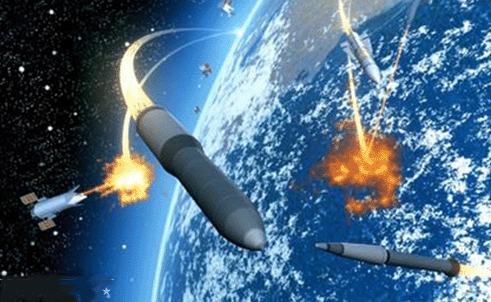
Rolls-Royce’s director of future programmes Abi Clayton tellingly said: ‘The technology will deliver the capability to support commercial and defence use cases.’
These activities are all completely contrary to the legal commitments the UK made a half century ago to preserve space for peace.
It may mirror the plot of classic ‘70s British sci-fi series, Space 1999, which also features a moon base and the threat posed by radioactive waste, but the UK/Ireland Nuclear Free Local Authorities also have real concerns that the development of a future British moon base powered by nuclear fission could represent a further unwanted development along the road to the militarisation of space.
Today is the UN International Day of Human Space Flight. On April 12, 2011, the UN General Assembly established the day on the 40th anniversary of Major Yuri Gagarin becoming the first human being to circle the Earth in his spacecraft ‘Vostok’. UN delegates reaffirmed ‘the important contribution of space science and technology in achieving sustainable development goals and increasing the well-being of States and peoples, as well as ensuring the realization of their aspiration to maintain outer space for peaceful purposes’.
Last week, the UK Space Agency announced a £2.9 million grant is to be awarded to Rolls-Royce SMR to collaborate with academic institutions to develop mini-reactors for deployment in space, with most media reports focusing on its potential to power a future moon base as part of the UK’s commitment to an international project to colonise the Earth’s near neighbour (Project Artemis). However, in welcoming the new funding, Rolls-Royce’s director of future programmes Abi Clayton tellingly said: ‘The technology will deliver the capability to support commercial and defence use cases.’
Whilst projects in outer space can be both benign and beneficial, the UK Space Strategy and UK Space Defence Strategy both identify that ‘NATO has made space one of five operational domains’,[1] and the UK Space Defence Strategy is subtitled ‘Operationalising the Space Domain’.[2] To make this a reality, the UK Government is intent upon investing £6.4 billion in a ‘Defence Space Portfolio’[3] for defence ‘in and through space’.[4]
For these purposes, the UK has joined the US and France in developing its own Space Command, and a nuclear moon base could in time become a part of the ‘portfolio’ from which UK Space Command operates,[5] in line with the government and military’s desire to ‘assure our access to, and operational independence in, space’.[6]
These activities are all completely contrary to the legal commitments the UK made a half century ago to preserve space for peace.
“Ironically the UK was in 1967 one of the first three co-signatories of the Outer Space Treaty which pledged the sponsors to ensure ‘that the Moon and other celestial bodies shall be used exclusively for peaceful purposes’”,[7] said Councillor Lawrence O’Neill, Chair of the NFLA Steering Committee.
“Our fear is that any future nuclear-powered moon-base could be ultimately crewed by military personnel from Space Command conducting operations that would be far from benign and beneficial, whether this be the permanent surveillance of perceived hostile states on Earth or more sinisterly as a platform for offensive weapons systems to project military power ‘through space’.
“And of course, once one major power establishes such a base, then the others, all not wishing to be outdone, will seek to do the same.”
The NFLA also has real practical concerns about the environmental impact of such a nuclear-powered base.
Councillor O’Neill added: “We have worries about the transfer of nuclear materials into space. It is not unknown for rockets to malfunction and explode on take-off or in early flight, indeed sadly this has led to the loss of human life, nor for radioactive material to be distributed across the surface of the Earth by exploding space vehicles, witness the accident involving Soviet satellite Kosmos 954.[8] And the UK Government’s own Committee on Radioactive Waste Management dismissed the idea of blasting radioactive waste into space on the grounds of both risk and cost.
“And in turn, a nuclear-powered moon base would generate radioactive waste. Where would this be put? If it came back to Earth, there would remain the risk of an accident on re-entry and states parties to the Outer Space Treaty also pledge to ‘avoid harmful contamination of space and celestial bodies’ so burial in situ below the lunar surface or blasting it into space would be unlawful”.
Lastly there is also a latent threat posed from outer space itself to the facility.
n 2016, NASA announced the findings of their Lunar Reconnaissance Orbiter (LRO) mission. Observing the lunar surface since launch in 2009, NASA scientists reported that ‘200 impact craters (had) formed during the LRO mission, ranging in size from about 10 to 140 feet (approximately 3 to 43 meters) in diameter’. Consequently, NASA recommended that ‘equipment placed on the moon for long durations – such as a lunar base – may have to be made sturdier. While a direct hit from a meteoroid is still unlikely, a more intense rain of secondary debris thrown out by nearby impacts may pose a risk to surface assets.’
In concluding Councillor O’Neill said: “We have all been concerned recently with the potential damage that could be caused on Earth to Ukrainian nuclear facilities from shelling and missile strikes so what happens if a meteoroid, or a fragment thereof, with massive kinetic energy hits a nuclear reactor based on the surface of the moon?[9]
The (South) Korean Nuclear Threat
13 APR 2023, By Dr Jeffrey Robertson, Australian Institute of International Affairs
South Korea is in the midst of a debate to secure nuclear weapons and few outside realise the seriousness and level of the debate. Few inside realise the question is much bigger than just South Korea, with great implications for the region, including Australia.
Debate on securing an independent nuclear weapons capacity once sat on the fringe of mainstream politics in Seoul. The extreme left and right, ex-military, religionists, and mavericks seeking attention were its champions. This is no longer the case. Today it is widely accepted, even common. Polls taken over the last year put public support in the 70-80 percent range. Securing nuclear weapons is now mainstream, viable, and if trends continue, even likely.
What makes South Korea want nuclear weapons? There’s a ready response from those pushing the agenda. North Korea’s missile and nuclear tests, Russia’s invasion of Ukraine, and concerns regarding a rising China. Each can readily be used to justify the pursuit of nuclear weapons. Yet, each are just squalls on the surface of the sea. Underneath, more powerful currents are pushing the pursuit of nuclear weapons: national pride, the desire to be more independent, and a healthy dose of domestic political opportunism.
National pride is a core contributor to the decision to pursue nuclear weapons. For both Koreas, there’s a keen sense of historical injustice marked by invasions from all sides, including occupation, and division. For South Koreans, there’s also a competitive streak that stretches from the individual to the national desire to be number one. There’s even speculation that the U.S. would be willing to allow Seoul to secure nuclear weapons in order for it to play a larger role in balancing China, placing South Korea at a new level of partnership with Washington. Among many, securing a nuclear weapons capacity provokes a certain element of national pride: more than just a middle power – a member of the nuclear weapons club.
The desire to be more independent is also an important contributing factor……………………………..
Domestic political opportunism is the icing on the cake…………………………… The current president, Yoon Suk-yeol, has made remarks supporting the acquisition of nuclear weapons, and the Mayor of Seoul – a position that is a stepping stone to the presidency – has also stated his support. Nuclear weapons will see multiple candidates jump on the bandwagon in the lead-up to the April 2024 legislative elections, and likely more than one candidate in the 2027 presidential elections.
Proliferation, from France to North Korea, is a story of national pride, independence, and political opportunism. South Korea is no different.
t is likely the consequences of this momentous decision to pursue an independent nuclear weapons capacity have not been fully thought through. ………………………………..
n the 1960s, Australia made the decision to forego nuclear weapons in the context of a global diplomatic and strategic understanding that proliferation could be controlled. Since that time, debates about Australia securing nuclear weapons have arisen, but they’ve never been mainstream. Debates in recent years have been more brain-storming and speculation than serious policy-specific programming. A South Korean decision to pursue nuclear weapons would substantially transform strategic outlooks across the region and lead to a more serious debate in Australia. The current nuclear submarine debate would look like a Sunday School picnic.
Jeffrey Robertson is an Associate Professor of Diplomatic Studies at Yonsei University and a Visiting Fellow at the Asia Institute, University of Melbourne. He researches the diplomatic practice and foreign policy of middle powers with a focus on the Korean Peninsula. He writes and updates research at https://junotane.com and on Twitter @junotane. https://www.internationalaffairs.org.au/australianoutlook/the-south-korean-nuclear-threat/
From the Manhattan Project to the Bronx Project: the toxic legacy of the nuclear age

by Alice Slater Spring 2023 Edition
Recent alarming reports state that the UK is prepared to supply Ukraine with depleted uranium ammunition in the ongoing slaughter in Ukraine. These lethally toxic carcinogens are known to cause illness and death, not only for the victims of war but for the perpetrators as well. Victims who have suffered genetic damage pass it on to their children who are often born with terrible malformations and illnesses.
In Metal of Dishonor–Depleted Uranium: How the Pentagon Radiates Soldiers and Civilians with DU Weapons, published in 1997 by Ramsay Clark and the International Action Center, essays reveal the horrors caused by depleted uranium in the first Gulf War. Although the figures on the nuclear budgets have risen astronomically, with the United States now budgeting over $1 trillion for new bombs, bomb factories and delivery systems, sadly, nothing else has changed much since that time, although civil society did succeed in establishing the International Renewable Energy Agency to promote benign life affirming energy from the sun, wind, and tides. Below is a chapter written for that book in 1996, when the author was president of GRACE, the Global Resource Action Center for the Environment.
he world is awash in radioactive waste. We simply haven’t a clue where to put it. The best we have come up with in the United States is a harebrained scheme to ship the lethal carcinogenic garbage from nuclear weapons and civilian nuclear power plants, by rail and by truck, from the four corners of the continent, and bury it in a hole in the ground in Nevada at Yucca Mountain. Citizens groups, like the proverbial boy with his finger in the dike, have been holding off the onslaught of this devastating disposal solution, preventing the legislation from passing in the Congress. Deadly plutonium remains toxic for 250,000 years and there is no way of guaranteeing that the Yucca site could prevent radioactive seepage into the ground water over this unimaginable period of time. Remember that all of recorded history is only 5000 years old!
The National Academy of Sciences reported last August that most of the contaminated nuclear weapons sites across our land can not be adequately cleaned up because of “insufficient money, technical skill or political will to do the job.” reflecting the skewed priorities of our national leadership. Congress approved Clinton’s last request for $5.1 billion to the Department of Energy’s weapons labs which will fund the design of new nuclear weapons ……………………………………….
We’ve Wasted Precious Resources………….
We’ve Polluted Our Own Environment
We’ve created more than 4,500 contaminated sites, covering tens of thousands of acres that may take 75 years and cost as high as one trillion dollars to ‘clean up.’ ‘Clean up’ of toxic plutonium, which remains lethal for over 250,000 years, is the wrong word. At best, we can only attempt to manage and contain the poisons from seeping into the air and groundwater and visiting further destruction on our people.
We’ve Experimented on Our Own People
Nuclear weapons drove us to the unspeakable act of secretly testing radiation on our own population. 23,000 American civilians were subjected to radiation research in about 1,400 projects over 30 years. The government tested on children with mental disabilities, mental patients, poor women, and US soldiers. More than 200,000 troops were ordered to observe nuclear test detonations and were exposed to radiation.
We’ve Abused Indigenous Peoples
Every nuclear test site in the world is on indigenous land. ……………………
Worst of All—We’re Still Doing It…………………………….
Enchanted by the “hardness” of depleted uranium which can penetrate tank armor, some evil genius in the pay of the Pentagon thought to make bullets from it in a bizarre recycling program which enabled the government to make a dent in the 500,000 tons of depleted uranium waste amassed since the Manhattan Project. Don’t be misled by the term “depleted uranium.” Like “spent fuel” from civilian reactors, depleted uranium is highly toxic and carcinogenic and has a half-life of some 4.4 billion years.
“Half life” is another euphemism that distances us through our language from grasping the deadly seriousness of what we are doing to our planet. For example, while the half-life of plutonium is 26,000 years, this lethal poison has a fully toxic life of about 250,000 years until all the radioactivity decays. So you can imagine — or can you — the life span of toxic depleted uranium with its “half life” of over 4 billion years!
While our brilliant military was dreaming up its scheme of penetrating Saddam’s tanks with “hard” depleted uranium (DU), they neglected to calculate the impact this material would have on our own soldiers. “Friendly fire” killed 35 U.S. soldiers and wounded 72 others during the Gulf War while disabling more US tanks than the Iraqis did. Spewing 300 tons of DU ammunition over Iraq, the U.S. left a growing legacy of respiratory problems, liver and kidney dysfunction, and birth defects among the newborn children of U.S. vets (A Veterans Administration study of 251 Gulf War veterans families in Mississippi found that 67 percent of the children born to the vets since the war have severe illnesses, with effects ranging from missing eyes and ears to fused fingers.) And similar medical reports are coming from Iraq with an increase of leukemia and congenital birth defects from 8% before the war to 28% today. Undeterred, similar environmental havoc and dangers to health were created by the use of depleted uranium ammunition in the bombing of Bosnia.
This callous disregard for human well being is sadly typical of government policy during the nuclear age………………………………………………………..
Trying to get our government to admit that radioactive bomb factories and power plants are harmful to living things is like the long battle waged against the tobacco companies who continued to claim that there is no connection between smoking, cancer, and other life threatening diseases. There are current assaults on the permissible level of radiation exposure. Don’t protect the people. Just change the standards…………………………………………………………………..
We need to tell the boys to put away the toys of war and clean up the mess they made. ………………………
Our ability to govern ourselves has been eroding as a result of the unprecedented secrecy and cover-up engendered by the nuclear age…………………………….
A sane informed citizenry would call for an immediate cessation of the production of any new nuclear material, leaving all existing nuclear waste as close to the point where it is generated, as safely as possible, under international guard…………………………….more https://peaceandplanetnews.org/toxic-legacy-of-the-nuclear-age/
Why a nuclear-weapons-free zone in the Middle East is more needed than ever
Why a WMD-free zone in the Middle East is more needed than ever., By Almuntaser Albalawi | April 10, 2023
Recent news reports suggesting Saudi Arabia is seeking US aid for a peaceful nuclear program are bringing attention to the distressing potential for nuclear weapons proliferation in the Middle East. Yet conversations about averting such a doomed future for the region might be heading once again in the wrong direction. History suggests that power politics—in which self-interest is prioritized over global interests—may not be the best lens for looking at issues of arms control.
During the 10th review conference of the Nuclear Non-Proliferation Treaty last year, Arab states reiterated their call for establishing a Middle East zone free of weapons of mass destruction (WMD). This has been a long-standing position, but it should not be taken for granted.
A growing interest in nuclear technology in the Middle East—combined with ambiguity over nuclear activities in Iran and Israel—raises concerns about potential proliferation in the region. A robust and inclusive WMD-free zone remains the best solution for addressing these concerns…………………………………………………………………………………………. more https://thebulletin.org/2023/04/why-a-wmd-free-zone-in-the-middle-east-is-more-needed-than-ever/?utm_source=Newsletter&utm_medium=Email&utm_campaign=MondayNewsletter04102023&utm_content=NuclearRisk_WMDFreeZone_04102023
US troops to China? Not a good idea, really
Some pertinent comments to New York Post’s rather war-mongering article.
bob bob. 8 April, 2023
No, “Sending Troops” is not on the table. Taiwan is part of China as Puerto Rico is to the US. Imagine China intervening with our island and threatening us. Taiwan recently held elections, based on pro and anti China issues. Voters overwhelming support China regardless of what our own press and politicians say. Any country deciding to put their fate in US hands should take a long look at Afghanistan.
Cronkyte, 8 April, 2023
China has no desire to “invade” Taiwan, which would require a massive military operation and likely destroy the goose that lays the golden egg. China will do everything it can to persuade Taiwan to agree to reunification, most likely by offering semi-autonomous governance as they promised Hong Kong (and just like Hong Kong, they will then renege on those promises).
There is a growing push for reunification on the island, and after former Taiwan President Ma Ying-jeou’s speech upon returning from China, that will likely grow. He describes the choice as “peace or war,” and no one on either side of the Taiwan Strait want to see the island razed. https://nypost.com/2023/04/07/rep-michael-mccaul-us-troops-to-taiwan-on-the-table-if-china-invades/
Ex-PM Ehud Barak Confirms Israel Has Nuclear Weapons: Why it Matters
Israel has maintained a strict policy of never confirming or denying it possesses nuclear weapons.
By Pesach Benson | Apr 9, 23, https://www.israeltoday.co.il/read/ex-pm-ehud-barak-confirms-israel-has-nuclear-weapons-why-it-matters/
(TPS) Former Prime Minister Ehud Barak broke Israel’s policy of ambiguity and tweeted his confirmation that Israel possesses nuclear weapons last Tuesday.
While commenting on the fallout from the governing coalition’s judicial reform initiative, Barak tweeted:
“It sounds weird to us. But in Israelis’ conversations with political parties in the West, their deep concern emerges about the possibility that, if the coup d’état in Israel succeeds, a messianic dictatorship will be established in the heart of the Middle East, possessing nuclear weapons, and fanatically wishing for a confrontation with Islam centered on the Temple Mount. In their eyes – it’s really scary. not going to happen. Happy holiday”
Israel has maintained a strict policy of never confirming or denying it possesses nuclear weapons. Nevertheless, it has been widely believed that Israel possesses them, with foreign reports estimating the nuclear arsenal’s size from dozens to hundreds of bombs.
Barak, a former Defense Minister and Israel Defense Forces Chief of Staff, argued in a Sept. 2021 op-ed that Israel should review its policy of nuclear ambiguity, suggesting disclosure could be a better deterrent against Iran’s nuclear program.
Proponents of ambiguity say it protects Israel from being forced to sign the Non-Proliferation Treaty or possibly facing international sanctions. Signing the NPT would require Israel to open its nuclear facilities to international inspection.
Meanwhile, the US reportedly floated a proposal with Israel and other allies in February to resume nuclear talks with Iran in which Tehran would not enrich uranium above 60 percent purity in exchange for sanctions relief. The White House has neither confirmed nor denied those reports.
The International Atomic Energy Agency reported in March that Iran has enriched uranium to 83.7 percent purity, far higher than the 3.67% necessary for a civilian nuclear program. Nuclear weapons require uranium enriched to 90% purity.
It is widely believed that Iran could finish enriching enough uranium to produce an atomic bomb in about four weeks.
Iran and the US agreed to the Joint Comprehensive Plan of Action in 2015 along with France, Germany, Britain, Russia and China. Under the terms of the JCPOA, Iran was supposed to limit its uranium enrichment under UN supervision in exchange for the US lifting economic sanctions. Israel opposed the agreement, saying it wasn’t strong enough.
In 2018, President Donald Trump withdrew the US from the agreement. Restoring the JCPOA has been a key foreign policy goal of the Biden administration.
Israel and its Gulf allies oppose a resumption of the nuclear talks.
US deploys nuclear submarine to West Asia as influence plummets
As China and Russia expand their influence in West Asia, and Arab nations move to reconcile with Iran and Syria, Washington has seen its grip on the region weaken significantly
The Cradle – April 08 2023
The Pentagon announced on 8 April that it deployed the USS Florida — a nuclear-powered, guided-missile submarine — to the Red Sea in support of the Bahrain-based US Fifth Fleet…………………………….
“It is capable of carrying up to 154 Tomahawk land-attack cruise missiles and is deployed to US 5th Fleet to help ensure regional maritime security and stability,” US Commander Timothy Hawkins said in a statement.
In a rare move, the Pentagon released a picture of the Ohio-class submarine as it transited the Suez Canal to the Persian Gulf. Washington usually keeps the locations of its submarines private while they are at sea.
Experts see the public show of force by the Pentagon as an attempt to beef up its forces in the region and deter resistance groups from targeting the US occupation army and its allies………………………………. more https://thecradle.co/article-view/23448/us-deploys-nuclear-submarine-to-west-asia-as-influence-plummets
Northampton nuclear weapons activist Ira Helfand wins peace award
Helfand said the two biggest threats to the planet are climate change and nuclear weapons, which has a much simpler solution.
“I think we can absolutely do it in 10 years,” he said. “It will take two to three years of talks and six to seven years to dismantle the weapons.”
Apr. 09, 2023,
By Jeanette DeForge | jdeforge@repub.com
NORTHAMPTON — After 45 years of fighting for the worldwide elimination of nuclear weapons, a local physician believes the solution could be no more than 10 years away.
Dr. Ira Helfand, a retired doctor who most recently worked at the Family Care Medical Center in Springfield, is the recipient of Morehouse College’s Gandhi-King-Ikeda Community Builder’s Award for his creation and activist work with the Back from the Brink.
While honored by the award, which is designed to recognize someone who promotes peace and social transformation in a positive and non-violent way, Helfand said he is hoping the prize will help call attention to the effort to end nuclear weapons. He will be the keynote speaker at the April 13 awards ceremony at the college in Atlanta.
“Nuclear weapons don’t make us safe. They are the greatest threat to security and we have to get rid of them,” he said. “Our message is the problem never went away after the Cold War.”
The issue has returned to the forefront this year with the Russian invasion of Ukraine. A week ago, President Vladimir Putin announced he would move nuclear weapons close to the border of Belarus and in February he delivered a warning to the West over Ukraine by suspending a landmark nuclear arms control treaty.
“The Russian invasion of Ukraine has made it clear that we can no longer afford to deny the danger of nuclear war,” Helfand said. “We have a very short window of opportunity to eliminate these weapons—before they eliminate us. But we can do that. We made these weapons with our own hands. We know how to take them apart. We just need to create the political will to do that.”
A precedent has already been set. Negotiations over nuclear weapon disarmament, even among hostile countries, have had successes in the past, he said.
The threat of nuclear war in the 1980s initiated Russian President Mikhail Gorbachev to propose talks with U.S. President Ronald Regan. More than two years of negotiations and ups and downs led to the historic 1987 Intermediate-Range Nuclear Forces Treaty that had both countries reduce nuclear arms.
The 2017 International Treaty on the Prohibition of Nuclear Weapons was signed, bringing the world another step toward eliminating nuclear weapons.
The world has about 13,000 warheads across nine countries. Leaders have already destroyed 50,000 over different treaties, he said.
But that simply isn’t enough. There have been at least six different real threats to nuclear war in the past that are known and the consequences of one will be horrific and felt worldwide, he said.
Helfand said the two biggest threats to the planet are climate change and nuclear weapons, which has a much simpler solution.
“I think we can absolutely do it in 10 years,” he said. “It will take two to three years of talks and six to seven years to dismantle the weapons.”……………………………………………… https://www.masslive.com/news/2023/04/northampton-nuclear-weapons-activist-ira-helfand-wins-peace-award.html
1 This Month




PLEASE OPPOSE HR 8255 AND S.3639 – bills would accelerate satellite deployment, with no environmental review or safeguards – https://ncstd5li.quorum.us/campaign/169331/
To see nuclear-related stories in greater depth and intensity – go to https://nuclearinformation.wordpress.com
-
Archives
- September 2026 (330)
- August 2026 (330)
- July 2026 (355)
- June 2026 (287)
- May 2026 (306)
- April 2026 (356)
- March 2026 (251)
- February 2026 (267)
- January 2026 (308)
- December 2025 (358)
- November 2025 (359)
- October 2025 (375)
-
Categories
- 1
- 1 NUCLEAR ISSUES
- business and costs
- climate change
- culture and arts
- ENERGY
- environment
- health
- history
- indigenous issues
- Legal
- marketing of nuclear
- media
- opposition to nuclear
- PERSONAL STORIES
- politics
- politics international
- Religion and ethics
- safety
- secrets,lies and civil liberties
- spinbuster
- technology
- Uranium
- wastes
- weapons and war
- Women
- 2 WORLD
- ACTION
- AFRICA
- Atrocities
- AUSTRALIA
- Christina's notes
- Christina's themes
- culture and arts
- Events
- Fuk 2022
- Fuk 2023
- Fukushima 2017
- Fukushima 2018
- fukushima 2019
- Fukushima 2020
- Fukushima 2021
- general
- global warming
- Humour (God we need it)
- Nuclear
- RARE EARTHS
- Reference
- resources – print
- Resources -audiovicual
- Weekly Newsletter
- World
- World Nuclear
- YouTube
-
RSS
Entries RSS
Comments RSS

