Feds push plan to dispose plutonium using nuclear waste repository near Carlsbad
Adrian Hedden, Carlsbad Current-Argus https://www.currentargus.com/story/news/2023/01/05/feds-push-plan-dispose-plutonium-nuke-waste-site-near-carlsbad-waste-isolation-pilot-plant-nuclear/69747932007/
Federal nuclear waste managers said they planned to dispose of 34 metric tons of surplus, weapons-grade plutonium at a nuclear repository in New Mexico after the waste is diluted to a lower level of radioactivity.
The National Nuclear Security Administration (NNSA) proposed in 2020 a “dilute and dispose” method of eliminating the plutonium from the environment, ultimately via emplacement at the Waste Isolation Pilot Plant repository near Carlsbad.
Before that can happen, the NNSA said the waste can be “downblended” to meet requirements at WIPP, which is designed to dispose of transuranic (TRU) waste that can only be of a certain level of radioactivity.
In an environmental impact statement (EIS) released last month, the NNSA said it preferred a plan that would see the plutonium shipped from the Pantex Plant near Amarillo, Texas to Los Alamos National Laboratory in northern New Mexico for processing, then to the Savannah River Site in South Carolina where it would be prepared for final disposal at WIPP.
That means the waste would travel through New Mexico at least twice which drew the ire of watchdog groups in the northern portion of the state, and concern from New Mexico Gov. Michelle Lujan Grisham.
Public comments were being accepted on the proposal until Feb. 14, and four hearings were scheduled: Jan. 19 in North Augusta, South Carolina, Jan. 24 in Carlsbad, Jan. 26 in Los Alamos and a virtual meeting on Jan. 30.
Information on the meetings and how to comment were posted in the Federal Register under citation 87 FR 77096.
New Mexico the nation’s ‘nuclear waste dump?’
Cindy Weehler, co-chair of Santa Fe-based activist group 285 ALL said the EIS called for the federal government to divert from WIPP’s original mission, potentially putting more New Mexicans at risk of exposure to radiation and for longer.
“Surplus plutonium is not the kind of waste that was agreed to when WIPP was defined,” she said. “We insist on an end to the emplacement of waste in New Mexico. We want an end to the weapons-based radioactive waste coming through our neighborhoods.”
The EIS did list alternatives to the preferred plan, potentially seeing the waste processed completely for disposal at either Savanna River or Los Alamos before shipment to WIPP.
This could cut down on transportation, but Weehler said the NNSA’s overall plan was symptomatic of a broader effort to keep WIPP open beyond its previously defined closure date of 2024 and expand the kinds of wastes that can be disposed of at the facility.
“We want an end to the situation where New Mexico is the only nuclear waste dump for all 50 states,” Weehler said. “The concern is that if you increase the number of shipments, the number of years, and you increase the dangerousness of the waste, at some point, somewhere an accident is inevitable.
“That would be catastrophic for the community where it occurs.”
Don Hancock, nuclear waste program manager at Albuquerque-based government watchdog group Southwest Research and Information Center said the plutonium waste was never intended for disposal at WIPP.
He said the federal government should prioritize legacy TRU waste sitting at DOE sites like Los Alamos as was the repository’s original intention.
“Dilute and dispose waste shouldn’t go to WIPP in the first place,” Hancock said. “NNSA wants to prioritize waste that WIPP was not designed for.”
New Mexico, Carlsbad leaders clash over plutonium disposal
In April 2022, Lujan Grisham echoed the concerns in a letter to U.S. Energy Secretary Jennifer Granholm, sharing a petition from 285 ALL that gathered 1,165 signatures in opposition from across the 10 states Weehler said were impacted by the transportation route.
Lujan Grisham wrote that many New Mexicans had “ongoing frustrations” with the federal government not involving New Mexicans in nuclear waste disposal plans that involved the state’s repository – the only such facility in the U.S.
“Specifically, the New Mexicans who signed the petition raised concerns about the transportation of the surplus plutonium waste stream between the DOE’s Savannah River Site in South Carolina and the WIPP,” read the letter to Granholm.
“As Governor, I take these concerns seriously and request that the Department of Energy take action to address the issues raised by New Mexicans.”
But the project was supported by local leaders in Carlsbad, about 30 miles west of the WIPP site, and the city’s Mayor Dale Janway, a frequent supporter of operations at WIPP who argued the program would be conducted safely.
“The proposed action is to dilute surplus plutonium to prevent use and disposing of the resulting CH-TRU waste at WIPP. I support this proposal as a safe, cost-effective solution,” Janway said in a statement.
Editorial: New Mexico right to ask for accounting of nuclear waste
https://www.abqjournal.com/2561734/nm-right-to-ask-for-accounting-of-nuclear-waste.html BY ALBUQUERQUE JOURNAL EDITORIAL BOARD, JANUARY 4TH, 2023
“I think there’s this mentality that New Mexico can just be the forever home for all the nation’s waste. It’s an exploitative mentality regarding our state.”
— Sen. Jeff Steinborn, D-Las Cruces
It is more than fair, when you house a radioactive waste facility like the Waste Isolation Pilot Plant, to ask how much waste from the nation’s nuclear weapons program still needs a home.
Especially when the nation keeps making more.
In the proposed permit for the federal government to continue storing nuclear waste at WIPP in southeastern New Mexico, the New Mexico Environment Department is seeking a full accounting from the U.S. Energy Department of materials still needing to be cleaned up and shipped to WIPP from laboratories and defense-related sites around the country. It also suggests developing another storage site (Hint: How about the $13.5 billion already spent on Yucca Mountain?). And it puts Congress — the same Congress that just approved spending more to make key plutonium components for the nation’s nuclear arsenal, which will also make more radioactive waste — on notice that if lawmakers expand the type of waste accepted at WIPP, the permit will be revoked.
WIPP currently takes transuranic waste from the weapons program contaminated with radioactive elements heavier than uranium — lab coats, rubber gloves, tools and other contaminated debris.
State Sen. Jeff Steinborn, D-Las Cruces and head of the Legislature’s radioactive and hazardous materials committee, points out our state has been left to deal with contamination from uranium mining, oil and gas development and the use of toxic firefighting chemicals known as PFAS at Air Force bases. With the proposed permit “it’s good to see our state setting boundaries.”
New Mexico has a long history when it comes to dealing with nuclear weapons and radioactive waste — from the Trinity site at White Sands to Urenco in Eunice, Los Alamos National Laboratory to the Holtec storage project with Hobbs and Carlsbad.
We have smart, capable, highly trained individuals who are experts in these fields.
But they are only as good as the information they are provided, and they deserve a full accounting of what they will ultimately have to deal with.
As Steinborn implies, too often our state has been left to deal with the federal government’s mess (we would add a gold mine spill, an Air Force fuel leak and catastrophic prescribed burns to his list).
The permit is now in a 60-day comment period, and the DOE says it is eager to participate. Here’s hoping they are just as eager to be forthright with what they plan to send to the Land of Enchantment.
This editorial first appeared in the Albuquerque Journal. It was written by members of the editorial board and is unsigned as it represents the opinion of the newspaper rather than the writers.
Fukushima, Our ongoing accident.
Dec 19, 2022
What happens to the damaged reactors? The territories evacuated by 160 000 people? What are the new conditions for their return to the contaminated area since the lifting of the governmental aid procedures? Are lessons still being learned by our national operator for its own nuclear plants? We must not forget that a disaster is still unfolding in Japan and that EDF was supposed to upgrade its fleet on the basis of this feedback, which has still not been finalized.
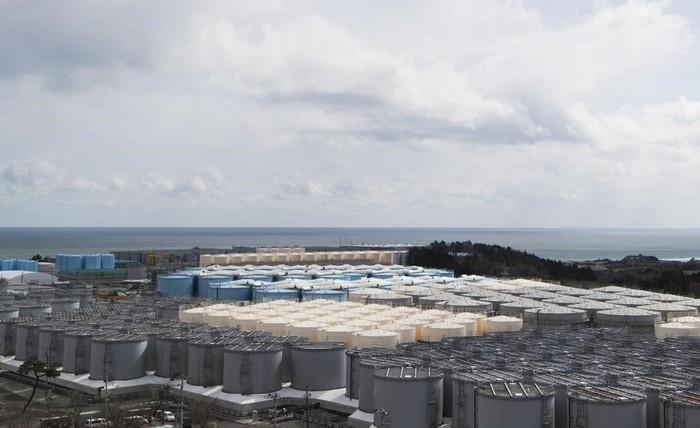
Almost twelve years after the Fukushima disaster, Japan is still in the process of dismantling and ‘decontaminating’ the nuclear power plant, probably for the next thirty to forty years as well. In the very short term, the challenges are posed by the management of contaminated water.
- All the contaminated water will be evacuated into the sea, by dilution over decades
- Each intervention in the accident reactors brings out new elements
- This has an impact on the schedule and the efficiency of the means used
- At the same time, the Japanese government’s objective is to rehabilitate the contaminated areas at any cost
- None of the French reactors is up to date with its safety level according to the post-Fukushima measures promulgated
- Japan will resume its nuclear policy, time having done its work on memories
The great water cycle
Although Japanese politicians claim that they have finally mastered the monster, the colossal task of cleaning up the site is still far from being completed to allow for the ultimate dismantling, with the length of time competing with the endless financing.
After so many years of effort, from decontamination to the management of radioactive materials and maneuvers within the dismantled plant, the actions on site require more and more exceptional means, exclusive procedures, and unprecedented engineering feats (such as robotic probes), while the nuclear fuel inside continues to be cooled permanently by water (not without generating, to repeat, millions of liters of radioactive water).
But the hardest part is yet to come: containing the corium, an estimated 880 tons of molten radioactive waste created during this meltdown of the reactor cores, and managing the thousands of fuel rods. So much so that the complete cleanup and dismantling of the plant could take a generation or more for a total estimated cost of more than 200 billion dollars (according to an assessment published by the German insurer Munich Re, Japan is 150 billion euros), a low range since other estimates raise the bill between 470 and 660 billion dollars, which is not in contradiction with the costs of an accident projected by the IRSN in France.
The removal of this corium will remain the most essential unresolved issue for a long time. Without it, the contamination of this area will continue. In February 2022, the operator Tepco (Tokyo Electric Power Company Holdings Inc.) tried again to approach the molten fuel in the containment of a reactor after a few more or less unsuccessful attempts, the radioactivity of 2 sieverts/hour being the end of everything, including electronic robots. This withdrawal seems quite hypothetical, even the Chernobyl reactor has never been removed and remains contained in a sarcophagus.
(source: Fukushima blog and Japan’s Nuclear Safety Authority NRA)
Until that distant prospect arrives, the 1.37 million tons of water will have filled the maximum storage capacity. This water was used to cool the molten fuel in the reactor and then mixed with rainwater and groundwater. The treatment via an Advanced Liquid Processing System (ALPS) is touted as efficient, but does not remove tritium. Relative performance: Tepco has been repeatedly criticized for concealing and belatedly disclosing problems with filters designed to prevent particles from escaping into the air from the contaminated water treatment system: 24 of the 25 filters attached to the water treatment equipment were found to be damaged in 2021, an already known defect that resulted in no investigation of the cause of the problem and no preventive measures after the filters were replaced.
The management of this type of liquid waste is a problem shared by the Americans. On site, experts say that the tanks would present flooding and radiation hazards and would hamper the plant’s decontamination efforts. So much so that nuclear scientists, including members of the International Atomic Energy Agency (IAEA) and the Japanese Nuclear Regulatory Authority, have recommended controlled release of the water into the sea as the only scientifically and financially realistic option.
In the end, contaminated water would have to be released into the sea through an underwater tunnel about a kilometer offshore, after diluting it to bring the concentration of tritium well below the percentage allowed by regulation (the concentration would be below the maximum limit of tritium recommended by the World Health Organization for drinking water). Scientists say that the effects of long-term, low-dose exposure to tritium on the environment and humans are still unknown, but that tritium would affect humans more when consumed in fish. The health impact will therefore be monitored, which the government already assures us it is anticipating by analyzing 90,000 samples of treated water each year.
Assessment studies on the potential impact that the release of stored contaminated water into the ocean could have therefore seem insufficient. For tritium, in the form of tritiated water or bound to organic matter, in addition to its diverse behavior according to these configurations, is only part of the problem. Some data show great variability in the concentrations of contaminants between the thousand reservoirs, as well as differences in their relative quantities: some reservoirs that are poor in tritium are rich in strontium 90 and vice versa, suggesting a high variability in the concentrations of other radionuclides and a dilution rate that is not so constant. All the ignorance currently resides on the still unknown interactions of the long-lived radioactive isotopes contained in the contaminated water with the marine biology. It is in order to remove all questions that a complete and independent evaluation of the sixty or so radioisotopes is required by many organizations.
As it stands, with the support of the IAEA so that dilution meets expectations, depending on currents, flows …, the release of contaminated materials would take at least forty years. Opponents of such releases persist in proposing an alternative solution of storage in earthquake-resistant tanks in and around the Fukushima facility. For them, “given the 12.3-year half-life of tritium for radioactive decay, in 40 to 60 years, more than 90% of the tritium will have disappeared and the risks will be considerably reduced,” reducing the direct nuisance that could affect the marine environment and even the food chain.
Modelling of marine movements could lead the waste to Korea, then to China, and finally to the Federated States of Micronesia and Palau. As such, each of the impacted countries could bring an action against Japan before the International Tribunal for the Law of the Sea to demand an injunction or provisional measures under international law.
Faced with these unresolved health issues, China, South Korea, Taiwan, local fishing communities continue to oppose this management plan, but the work is far from being completed and the problem of storage remains. Just like the ice wall built into the floor of the power plant, the release of contaminated water requires huge new works: the underwater pipe starts at about 16 meters underground and is drilled at a rate of five to six meters per day.
Time is of the essence. The tanks should reach their maximum capacity by the fall of 2023 (the volume of radioactive water is growing at a rate of about 130 to 140 tons per day). But above all, it is necessary to act quickly because the area is likely to suffer another earthquake, a fear noted by all stakeholders. With the major concern of managing the uranium fuel rods stored in the reactors, the risks that radioactivity will be less contained increase with the years.In France, releases to the sea are not as much of a problem: the La Hague waste reprocessing site in France releases more than 11,000 terabecquerels per year, whereas here we are talking about 22 terabecquerels that would be released each year, which is much less than most of the power plants in the world. But we will come back to this atypical French case…
Giant Mikado
The operator Tepco has successfully removed more than 1500 fuel bundles from the reactor No. 4 of the plant since late 2014, but the hundreds still in place in the other three units must undergo the same type of sensitive operation. To do this, again and again, undertake in detail the clearing of rubble, the installation of shields, the dismantling of the roofs of buildings and the installation of platforms and special equipment to remove the rods… And ultimately decide where all the fuel and other solid radioactive debris will have to be stored or disposed of in the long term. A challenge.
The fuel is the biggest obstacle to dismantling. The solution could lie, according to some engineers, in the construction of a huge water-filled concrete tank around one of the damaged reactors and to carry out the dismantling work in an underwater manner. Objectives and benefits? To prevent radiation from proliferating in the environment and exposing workers (water is a radiation insulator, we use this technique in our cooling pools in France) and to maximize the space to operate the heavy dismantling equipment being made. An immersion solution made illusory for the moment: the steel structure enveloping the building before being filled with water is not feasible as long as radiation levels are so high in the reactor building, preventing access by human teams. In short, all this requires a multitude of refinements, the complexity of the reactors adding to the situations made difficult by the disaster.
Experience, which is exceptional in this field, is in any case lacking. What would guarantee the resistance of the concrete of the tanks over such long periods of time, under such hydraulic pressures? The stability of the soils supporting such structures? How can the concrete be made the least vulnerable possible to future earthquakes? How to replace them in the future?

All these difficulties begin to explain largely the delays of 30 to 40 to dismantle. The reactors are indeed severely damaged. And lethal radiation levels equivalent to melted nuclear fuel have been detected near one of the reactor covers, beyond simulations and well above previously assumed levels. Each of the reactors consists of three 150-ton covers, 12 meters in diameter and 60 centimeters thick: the radiation of 1.2 sieverts per hour is prohibitive, especially in this highly technical context. There is also no doubt that other hotspots will be revealed as investigations are carried out at the respective sites. The Nuclear Damage Compensation and Decommissioning Facilitation Corporation (NDF), created in 2014, has the very objective of trying to formulate strategic and technical plans in order to proceed with the dismantling of said reactors. Given the physical and radiological conditions, the technical and logistical high-wire act.
Also, each plan is revised as information is discovered, as investigations are conducted when they are operable. For example, the reinforcing bars of the pedestal, which are normally covered with concrete, are exposed inside Reactor No. 1. The concrete support foundation of a reactor whose core has melted has deteriorated so badly that rebar is now exposed.
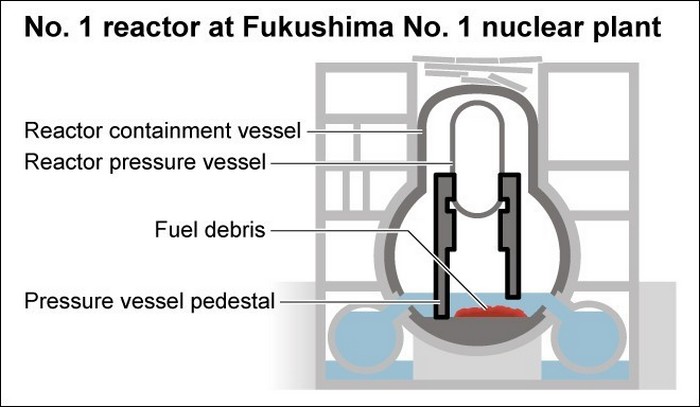
The cylindrical base, whose wall is 1.2 meters thick, is 6 meters in diameter. It supports the 440-ton reactor pressure vessel. The reinforcing rods normally covered with concrete are now bare and the upper parts are covered with sediment that could be nuclear fuel debris. The concrete probably melted under the high temperature of the debris. The strength of the pedestal is a major concern, as any defect could prove critical in terms of earthquake resistance.
Nothing is simple. The management of human material appears less complex.
Bringing back to life, whatever it takes
In the mountains of eastern Fukushima Prefecture, one of the main traditional shiitake mushroom industries is now almost always shut down. The reason? Radioactive caesium exceeding the government’s maximum of 50 becquerels per kilogram, largely absorbed by the trees during their growth. More than ten years after the nuclear disaster, tests have revealed caesium levels between 100 and 540 becquerels per kilogram. While cesium C134 has a radioactive half-life of about two years and has almost disappeared by now, the half-life of cesium C137 is about 30 years and thus retains 30% of its radioactivity 50 years after the disaster, and 10% after a century.
As more than two thirds of Fukushima prefecture is covered by forests, nothing seems favorable in the short term to get rid of all or part of the deposited radioactivity, as forests are not part of the areas eligible for ‘decontamination’, unlike residential areas and their immediate surroundings.
On the side of the contaminated residential and agricultural areas, ‘decontamination’ measures have been undertaken. But soil erosion and the transfer of contaminants into waterways, frequent due to typhoons and other intense rain events, are causing the radioactive elements to return, moving them incessantly. Scientists are trying to track radioactive substances to better anticipate geographical fluctuations in doses, but nothing is simple: the phenomena of redistribution of the initial contamination deposits from the mountains to the inhabited low-lying areas are eternal.
The Ministry of the Environment is considering the reuse of decontaminated soils (official threshold of 8,000 becquerels per kilogram), with tests to be conducted. For now, a law requires the final disposal of contaminated soil outside Fukushima Prefecture by 2045, which represents about 14 million cubic meters (excluding areas where radiation levels remain high). This reuse would reduce the total volume before legal disposal.
More generally, Japan has for some years now opted for the strategy of holding radiological contamination as zero and/or harmless. This is illustrated by the representative example of the financial compensation given to farmers, designed so that the difference between pre- and post-accident sales is paid to them as compensation for “image damage”, verbatim.
Finally, in the midst of these piles of scrap metal and debris, it is necessary to make what can be made invisible. Concerning radioactive waste for example, it must be stored in time. On the west coast of the island of Hokkaidō, the villages of Suttsu and Kamoenai have been selected for a burial project. Stainless steel containers would be stored in a vitrified state. But consultation with the residents has not yet been carried out. This is not insignificant, because no less than 19,000 tons of waste are accumulating in the accidental, saturated power plants, and must find a place to rest for hundreds of years to come.
In this sparsely populated and isolated rural area, as in other designated sites, to help with acceptance, 15 million euros are being paid to each of the two municipalities to start the studies from 2020. 53 million are planned for the second phase, and much more in the final stages. This burial solution seems inevitable for Japan, as the waste cannot remain at the level of the surface power plants and is subject at all times to the earthquakes that are bound to occur over such long periods (strong earthquakes have struck off the prefecture in 2021 and 2022). The degrees of dangerousness thus allow the government to impose a default choice, for lack of anything better.
On December 6, 2022, the Director General of the IRSN met with the President of Fukushima University and with a manager of the Institute of Environmental Radioactivity (IER). What was the objective? To show the willingness of both parties to continue ongoing projects on the effects of radioactive contamination on biodiversity and environmental resilience.
But France will not have waited for the health results of a disaster to learn and commit itself to take into account any improvement likely to improve the nuclear safety of its reactors. No ?
Experience feedback
After a few reactor restarts that marked a major change in its nuclear energy policy (ten nuclear reactors from six plants out of a total of fifty-four were restarted by June 2022), the Japanese government is nonetheless planning to build new generation nuclear power plants to support its carbon emission reduction targets. (A memorandum of understanding was signed by the Japan Atomic Energy Agency, Mitsubishi Heavy Industries and Mitsubishi FBR Systems with the American start-up TerraPower to share data for the Natrium fast neutron reactor project; the American company NuScale Power presented its modular reactor technology). But above all, the government is considering extending the maximum service life of existing nuclear reactors beyond 60 years. Following the disaster, Japan had introduced stricter safety standards limiting the operation of nuclear reactors to 40 years, but there is now talk of modernizing the reactors with safety features presented as “the strictest in the world”, necessarily, to meet safety expectations. Their program is worthy of a major refurbishment (GK).
But in France, where are we with our supplementary safety assessments?
The steps taken after the Fukushima disaster to reassess the safety of French nuclear facilities were designed to integrate this feedback in ten years. More than ten years after the start of this process of carrying out complementary safety assessments (CSA), this integration remains limited and the program has been largely delayed in its implementation.
Apparently, ten years to learn all the lessons of this unthinkable accident was not enough. Fear of the probable occurrence of the impossible was not the best motivation to protect the French nuclear fleet from this type of catastrophic scenario, based solely on these new standards. Concerning in detail the reality of the 23 measures identified to be implemented (reinforcement of resistance to earthquake and flooding, automatic shutdown in the event of an earthquake, ultimate water top-up for the reactor and cooling pool, detection of corium in the reactor vessel, etc.), the observation is even distressing: not a single reactor in operation is completely up to standard.
According to NegaWatt’s calculations, at the current rate of progress and assuming that funding and skills are never lacking, it would take until 2040 for the post-Fukushima standards to be finally respected in all French reactors. And even then, some of the measures reported as being in place are not the most efficient and functional (we will come back to the Diesels d’ultime secours, the DUS of such a sensitive model).
Even for the ASN, the reception of the public in the context of post-accident management could appear more important than the effectiveness of the implementation of the measures urgently imposed.
Then, let us complete by confirming that France and Japan have a great and long common history which does not stop in nuclear matters. Among this history, let us recall that Japan lacks facilities to treat the waste from its own nuclear reactors and sends most of it abroad, especially to France. The previous transport of highly radioactive Mox (a mixture of highly toxic plutonium oxide and reprocessed uranium oxide) to Japan dates back to September 2021, not without risk even for the British company specialized in this field, a subsidiary of Orano. The final request for approval for the completion of the Rokkasho reprocessing plant, an important partnership and technology transfer project, is expected in December 2022, although the last shipments to Japan suffered from defective products from Orano’s Melox plant, a frequent occurrence because of a lack of good technical homogenization of the products.
No one is immortal
In the meantime, the ex-managers of the nuclear power plant have been sentenced to pay 95 billion euros for having caused the disaster of the entire eastern region of Japan. They were found guilty, above all, of not having sufficiently taken into account the risk of a tsunami at the Fukushima-Daiichi site, despite studies showing that waves of up to 15 meters could hit the reactor cores. Precisely the scenario that took place.
Worse, Tepco will be able to regret for a long time to have made plan the cliff which, naturally high of 35 meters, formed a natural dam against the ocean and the relatively frequent tsunamis in this seismic zone. This action was validated by the Japanese nuclear safety authorities, no less culpable, on the basis of the work of seismologists and according to economic considerations that once again prevailed (among other things, it was a question of minimizing the costs of cooling the reactors, which would have been operated with seawater pumps).
The world’s fourth largest public utility, familiar with scandals in the sector for half a century, Tepco must take charge of all the work of nuclear dismantling and treatment of contaminated water. With confidence. The final total estimates are constantly being revised upwards, from 11,000 billion to 21,500 billion yen, future budgets that are borrowed from financial institutions, among others, with the commitments to be repaid via the future revenues of the electricity companies. A whole financial package that will rely on which final payer?
Because Tepco’s financial situation and technical difficulties are deteriorating to such an extent that such forty-year timetable projections remain very hypothetical, and the intervention of the State as a last resort is becoming more and more obvious. For example, the Japanese government has stated that the repayment of more than $68 billion in government funding (interest-free loans, currently financed by government bonds) for cleanup and compensation for the Fukushima Daiichi nuclear power plant disaster, owed by Tepco, has been delayed. Tepco’s mandatory repayments have been reduced to $270 million per year from the previous $470 million per year. It is as much to say that the envisaged repayment periods are as spread out as the Japanese debt is abysmal.
Despite this chaotic long-term management, the Japanese government has stated that it is considering the construction of the next generation of nuclear power plants, given the international energy supply environment and Japan’s dependence on imported natural resources. Once the shock is over, business and realpolitik resume.
On a human scale, only radioactivity is immortal.
In the Pacific, Outcry Over Japan’s Plan to Release FukushimaWastewater.
The proposal has angered many of Japan’s neighbors,
particularly those with the most direct experience of unexpected exposure
to dangerous levels of radiation. Tanks are storing radioactive water at the
Fukushima Daiichi nuclear power plant in Japan.
The government plans to
release the water, treated, but still slightly radioactive, into the
Pacific starting in spring 2023. Every day at the Fukushima Daiichi nuclear
plant in Japan, officials flush over a hundred tons of water through its
corroded reactors to keep them cool after the calamitous meltdown of 2011.
Then the highly radioactive water is pumped into hundreds of white and blue
storage tanks that form a mazelike array around the plant. For the last
decade, that’s where the water has stayed.
But with more than 1.3 million
tons in the tanks, Japan is running out of room. So next year in spring, it
plans to begin releasing the water into the Pacific after treatment for
most radioactive particles, as has been done elsewhere.
New York Times 30th Dec 2022
Getting rid of plutonium pits — so many questions
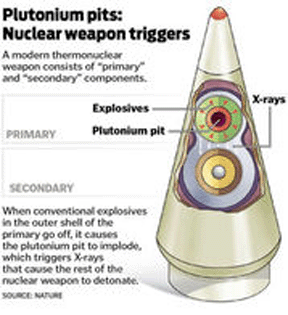
https://www.santafenewmexican.com/opinion/editorials/getting-rid-of-plutonium-pits-so-many-questions/article_4178b6d4-824e-11ed-aaa7-775a96e0dc9f.html 25 Dec 22. A Department of Energy proposal to dilute and dispose of plutonium waste at the Waste Isolation Pilot Plant in Carlsbad is ready for public comment — the draft environmental impact statement, all 412 pages of it, has been released.
The public can weigh in, whether in writing or by showing up for public hearings that will take place early next year.
Buckle up. This is going to be a contentious discussion.
The U.S. wants to be rid of 34 metric tons of plutonium bomb cores, or pits, stored at the Pantex Plant in Amarillo. The pits are Cold War legacies; because WIPP is restricted in the type of waste it can take, before disposing of it, the material must be diluted. Thus, the term, dilute and dispose. The Department of Energy’s decision about the waste was announced two years ago, but with no details.
At one point the Energy Department wanted to turn Cold War plutonium into a mixed oxide fuel for use in commercial nuclear plants. That would have happened at the Savannah River Site in South Carolina, but billions in cost overruns and delays hamstrung the effort, and the Trump administration killed the project in 2018.
It chose the dilute-and-disposal plan.
The draft statement fleshes out just what would happen to prepare the pits for disposal — in a facility, we might point out, that currently is seeking a renewal of its hazardous waste permit from the state of New Mexico. WIPP is open, but state Environment Department Secretary James Kenney and Gov. Michelle Lujan Grisham want more oversight of waste disposal at the plant.
That back and forth is separate from the Energy Department dilute-and-disposal proposal, but the permit discussion provides context for the coming fierce debate.
Here’s what community members already are questioning. The Energy Department plan includes considerable time on highways carrying radioactive material, including trucking the stuff at least twice through New Mexico. That would include trips on congested corridors inside the southern edge of Santa Fe. First, the material would be shipped to LANL, where workers would convert it to oxidized powder. From Los Alamos, the powder would be transported to Savannah River
There, crews would add an adulterant to make the powder unusable in weapons. The dilution portion taken care of, the material would be taken to WIPP, the underground disposal site.
That’s a lot of time on the highway for radioactive material, especially considering conditions on Interstate 40. It seems an expensive and inefficient way of disposing of plutonium — a 3,300-mile trip, ending with the materials deep beneath the ground at WIPP.
That’s a site, by the way, that only was supposed to store low-level transuranic waste — the contaminated gloves, equipment, clothing, soil and other materials that need to be disposed of safely. The WIPP mission continues to be expanded, another reason the state must increase its oversight. We expect elected officials — whether the governor or members of New Mexico’s congressional delegation — to speak up further about possible plutonium pit disposal, too.
There are questions about whether the pits need to be removed from Pantex at all, or whether work to make them inoperable in weapons could take place where they currently are being held. That would mean improving storage facilities, but eliminate a lot of highway traffic. Barring keeping the pits in place, all waste roads lead to New Mexico, That why residents here have a huge stake in determining what happens to these pits.
Stay alert for notices of meetings and time for public comment. There’s no guarantee informed opposition will change plans by agencies intent on certain action, but speaking up beats staying quiet. Oh, and think about this: before rushing full speed ahead to produce even more plutonium pits, it’s time to at least try to find a way to dispose of the waste we’ve already created.
Maybe, just maybe, not all the waste has to be buried in New Mexico. Or driven across New Mexico highways. It’s a big country.
Trawsfynydd as a nuclear waste dump?
Low levels of radioactive waste could be buried at the site of a former
nuclear power station, under new plans. Magnox, owner of the Trawsfynydd
site in Gwynedd, said it was considering burying some of the waste below
ground and capping it with concrete. The company described the proposal as
“unordinary” and said it was one of two options being looked at.
Anti-nuclear group Cadno said it would cause “serious safety issues” and
wants the waste stored safely above ground. Trawsfynydd stopped generating
electricity in 1991 after operating for 25 years and is in the long process
of being decommissioned.
BBC 23rd Dec 2022
Exposing the dishonest spiel that nuclear waste is “manageable”

Tom Smith, Chair, Nuclear Decommissioning Authority, 2017-20.
Samanth Subramanian captures perfectly the vast scale and longevity of the
effort needed to clean up Sellafield (The long read, 15 December).
As Britain and other states with nuclear power industries grapple with how to
go about an effective, safe and economical nuclear clean-up, it might be
better to explain the challenges with less reliance on suggestions that in
its early days the nuclear industry never thought about decommissioning
(though the point has validity).
Instead, we need more honesty about the fact that nuclear power inescapably generates large quantities of hazardous human-made waste, the worst of which will remain hazardous probably beyond
Homo sapiens’ time on the planet.
The industry’s solution to this is a network of deep disposal facilities. But none have yet been created, their
cost is enormous and there is no certainty that they will perform the
long-term task required of them. These are considerations that sadly
receive little attention in current debates about the need for new
nuclear-generation capacity.
Coincidentally, you published a letter (14 December) suggesting that nuclear radiation is less dangerous than
emissions from a wood-burning stove, a curious comparison to make.
Wood-burning stoves are pollutants, no question, but they could never lead
to a Windscale, Three Mile Island, Chornobyl or Fukushima. Nor will
decommissioning them cost billions and take decades.
Guardian 22nd Dec 2022
Campaign groups want answers on increase in radioactive particles found onDounreay foreshore.
Highlands Against Nuclear Transport (HANT) and the
Nuclear Free Local Authorities Scottish Forum have written to site managing
director Mark Rouse and Nicole Paterson, the chief executive of the
Scottish Environment Protection Agency (Sepa). The campaigners claim the
information about the particles is “sketchy, incomplete and out-of-date”
and want the Dounreay Stakeholder Group (DSG) and the local and national
press to receive regular reports about their detection and retrieval.
John O’Groat Journal 22nd Dec 2022
America’s complicated problem of disposing of tons of plutonium bomb cores, as the government to spend $1.7 billion on more plutonium bomb cores

The nuclear security agency’s draft statement comes as the Senate approved a military spending bill that seeks to funnel $1.7 billion to the lab’s pit operations, an unprecedented funding amount.
Weehler said the government should hold off on producing pits, which will generate more waste, until it has figured out a safe and effective way to dispose of the radioactive material it already has.
LANL would aid in diluting plutonium in controversial disposal plan
https://www.santafenewmexican.com/news/local_news/lanl-would-aid-in-diluting-plutonium-in-controversial-disposal-plan/article_e6cb6380-6d26-11ed-9a6c-731a070c9235.html By Scott Wyland swyland@sfnewmexican.com, Dec 17, 2022
The federal government has released a draft environmental impact statement on its plans to dilute and dispose of surplus plutonium, plans that worry some activists, residents and state officials because the radioactive material would be trucked at least twice through New Mexico, including the southern edge of Santa Fe.
The U.S. Energy Department’s nuclear security agency placed a notice of the 412-page draft in the Federal Register on Friday, providing details on the plutonium disposal it first announced two years ago but had kept mostly silent about.
Agencies want to get rid of 34 metric tons of plutonium bomb cores, or pits, that are left over from the Cold War and being kept at the Pantex Plant in Amarillo, Texas.
Plans call for shipping the material to Los Alamos National Laboratory, where it would be converted to oxidized powder, then transported to Savannah River Site in South Carolina so crews can add an adulterant to make it unusable for weapons.
From there, it would go to the Waste Isolation Pilot Plant, an underground disposal site in Carlsbad. This “downblending” is required because WIPP only takes waste below a certain radioactive level.
The public will have a chance to weigh in, both with written comments and at several public hearings scheduled for early next year.
Critics have spoke out against the plan for more than a year, arguing it puts communities along the trucking routes at risk and should be reconsidered.
Cindy Weehler, who co-chairs the watchdog group 285 ALL, said the environmental review confirms her concerns about the region becoming a hub for material that is more radioactive than the transuranic waste — contaminated gloves, equipment, clothing, soil and other materials — the lab now ships to WIPP.
“The preferred option is still to do this 3,300-hundred-mile road trip and have the two operations occur at two different labs,” Weehler said.
The impact statement offers possible alternatives, such as doing all the downblending at the lab or Savannah River to reduce transportation, but it makes clear the original plan is the preferred method.
The National Nuclear Security Administration has been quiet about the dilute-and-dispose plans, other than to acknowledge an environmental impact statement was underway.
This silence has frustrated residents, state and local officials and community advocates like Weehler.
If all the downblending is done at the lab, it would keep the plutonium from being hauled through a dozen states, so that would be better for many neighborhoods across the country, Weehler said.
However, dangerous radioactive substances would still go through Los Alamos and Santa Fe counties twice, she said.
Whether the oxidized powder leaves the lab in pure form or is adulterated, it would be hazardous to breathe in if the containers were breached in an accident, she said.
The draft statement said the powder would go into a steel canister, which would be placed into a reinforced 55-gallon drum known as a “criticality control container.” As many as 14 control containers can be put into a heavily fortified Trupact shipping container.
The lab has an operation known as ARIES for oxidizing plutonium on a small scale. Boosting the quantity would require installing more glove boxes — the sealed compartments that allow workers to handle radioactive materials — and other equipment to the plutonium facility, the statement said. The additions would expand the facility to 6,800 feet from 5,200 feet.
Structures would have to be built to accommodate the work, including a logistical support center, an office building, a warehouse, a security portal and a weather enclosure for the plutonium facility’s loading dock, the statement says.
The idea of doing away with surplus plutonium began after the Cold War. In 2000, the U.S. and Russia agreed to each eliminate 34 metric tons of the plutonium so it could no longer be used in nuclear weapons.
Russia reportedly withdrew from the pact later, but the U.S. decided to stick with its commitment.
The Energy Department originally sought to build a Savannah River facility that could turn Cold War plutonium into a mixed oxide fuel for commercial nuclear plants. But after billions of dollars in cost overruns and years of delays, the Trump administration scrapped the project in 2018 and decided to go with diluting and disposing of the waste.
One nuclear waste watchdog questioned why the leftover pits must be removed from Pantex at all.
That facility should be able to continue storing the plutonium safely, just as it has since the 1990s, said Don Hancock, director of nuclear waste safety for the nonprofit Southwest Research and Information Center.
“If it’s not safe to be at Pantex, then that raises some severe questions about the safety of the Pantex plant for its assembly and disassembly mission” for nuclear weapons, Hancock said.
Hancock said he opposes the government using WIPP as the sole disposal site for the diluted plutonium and other nuclear waste.
The nuclear security agency’s draft statement comes as the Senate approved a military spending bill that seeks to funnel $1.7 billion to the lab’s pit operations, an unprecedented funding amount.
Weehler said the government should hold off on producing pits, which will generate more waste, until it has figured out a safe and effective way to dispose of the radioactive material it already has.
“This is just a commonsense thing,” she said. “We have the weaponry we need.”
Alliance of Pacific organisations condemns Japan’s decision to discharge nuclear wastewater into the Pacific Ocean
NZ and Pacific urged to ‘step up’ against Japan’s nuclear plan, Stuff NZ, Christine Rovoil, Dec 17 2022,
Japan’s decision to discharge nuclear wastewater into the Pacific Ocean for the next 30 years has been condemned by a Pacific alliance.
And the group of community members, academics, legal experts, NGOs and activists is calling on New Zealand and the Pacific to act to stop Japan.
Three reactors at the Fukushima Daiichi nuclear power plant had meltdowns after the earthquake and tsunami on March 11, 2011 which left more than 15,000 people dead.
The Japanese government said work to clean up the radioactive contamination would take up to 40 years.
Following the Nuclear Connections Across Oceania Conference at the University of Otago last month, a working group was formed to address the planned discharge.
Dr Karly Burch at the OU’s Centre for Sustainability said many people might be surprised to hear that the Japanese government has instructed Tokyo Electric Power Company (Tepco) to discharge more than 1.3 million tonnes of radioactive wastewater into the ocean from next year.
Burch said they had called on Tepco to halt its discharge plans, and the New Zealand Government to “step up against Japan”.

In June, Prime Minister Jacinda Ardern called for nuclear disarmament during her speech at the Nato Leaders’ Summit in Madrid.
“New Zealand is a Pacific nation and our region bears the scars of decades of nuclear testing. It was because of these lessons that New Zealand has long declared itself proudly nuclear-free,” Ardern said.
Burch said the Government must “stay true to its dedication to a nuclear-free Pacific” by taking a case to the International Tribunal for the Law of the Sea against Japan.
“This issue is complex and relates to nuclear safety rather than nuclear weapons or nuclear disarmament,” the Ministry of Foreign Affairs and Trade said in a statement on Friday.
“Japan is talking to Pacific partners in light of their concerns about the release of treated water from Fukushima and Aotearoa New Zealand supports the continuation of this dialogue.
…………….. In Onahama, 60km from the power station, fish stocks have dwindled, said Nozaki Tetsu, of the Fukushima Fisheries Co-operative Associations.
“From 25,000 tonnes per year before 2011, only 5000 tonnes of fish are now caught,” he said. “We are against the release of radioactive materials into our waters. What worries us is the negative reputation this creates.”
………………………. Burch said predictive models showed radioactive particles released would spread to the northern Pacific.
“To ensure they do not cause biological or ecological harm, these uranium-derived radionuclides need to be stored securely for the amount of time it takes for them to decay to a more stable state. For a radionuclide such as Iodine-129, this could be 160 million years.”
………… Burch said the Japanese government was aware in August 2018 that the treated wastewater contained long-lasting radionuclides such as Iodine-129 in quantities exceeding government regulations.
She has called for clarity from Tokyo, the International Atomic Energy Agency, the Pacific Islands Forum Secretariat, Pacific Oceans Commission, and a Pacific panel of independent global experts on nuclear issues on the outcome of numerous meetings they have had about the discharge.
“We want a transparent and accountable consultation process which would include Japanese civil society groups, Pacific leaders and regional organisations.
“These processes must be directed by impacted communities within Japan and throughout the Pacific to facilitate fair and open public deliberations and rigorous scientific debate,” Burch said.
The Pacific Islands Forum secretary-general, Henry Puna, has been approached for comment.
https://www.stuff.co.nz/pou-tiaki/130784783/nz-and-pacific-urged-to-step-up-against-japans-nuclear-plan
Exposed: The Most Polluted Place in the United States

A new book investigates the toxic legacy of Hanford, the Washington state facility that produced plutonium for nuclear weapons.
The Revelator The Ask, December 14, 2022 – by Tara Lohan, The most polluted place in the United States — perhaps the world — is one most people don’t even know. Hanford Nuclear Site sits in the flat lands of eastern Washington. The facility — one of three sites that made up the government’s covert Manhattan Project — produced plutonium for Fat Man, the atomic bomb dropped on Nagasaki during World War II. And it continued producing plutonium for weapons for decades after the war, helping to fuel the Cold War nuclear arms race.
Today Hanford — home to 56 million gallons of nuclear waste, leaking storage tanks, and contaminated soil — is an environmental disaster and a catastrophe-in-waiting.
It’s the costliest environmental remediation project the world has ever seen and, arguably, the most contaminated place on the entire planet,” writes journalist Joshua Frank in the new book, Atomic Days: The Untold Story of the Most Toxic Place in America.
It’s also shrouded in secrecy.
Frank has worked to change that, beginning with a series of blockbuster investigations published in Seattle Weekly a decade ago. Atomic Days offers an even fuller picture of the ecological threats posed by Hanford and its failed remediation.
The Revelator spoke with him about the environmental consequences, the botched cleanup operation, and what comes next.
Why is the most polluted place in the country so little known?
We have to understand what it was born out of, which was the Manhattan Project. There were three locations picked — Los Alamos [N.M.], Oak Ridge [Tenn.] and Hanford — to build the nuclear program.
Hanford was picked to produce plutonium and it ran for four decades, from World War II through the Cold War in the late 80s. For decades people that lived in and around Hanford didn’t know what was really going on there. It was run as a covert military operation. Even now, it’s still very much run like a covert operation because of the dangers that exist with the potential for an attack on one of the nuclear waste tanks……………….
What are the known environmental dangers?
There are 177 underground tanks that hold 56 million gallons of nuclear waste. We know that 67 of those tanks have leaked in the past into the groundwater that feeds the Columbia River.
We know that during its operation in the 50s and 60s the government was monitoring the water in the Columbia River, and even at the mouth of the Columbia they were finding radioactive fish. So we know that there have been leaks that made it to the river.
Right now, we know that there are two tanks currently leaking. The Washington Department of Ecology and the U.S. Department of Energy know about these leaks, but they can’t do anything about them because there’s no other place to safely put the waste…………………………
What has the cleanup process been like?
The big thing right now is trying to get all this waste vitrified, which is turning it into glass so it can be stored safely and permanently. The government thought that could be done in four years, but that was 30 years ago now……………………………………….
Bechtel is a privately owned corporation and we’re spending billions of dollars paying this company to not get the job done. It’s a big mess……………………………………………….. more https://therevelator.org/hanford-nuclear-book/
Dismantling Sellafield: the epic task of shutting down a nuclear site

Nothing is produced at Sellafield anymore. But making safe what is left behind is an almost unimaginably expensive and complex task that requires us to think not on a human timescale, but a planetary one
Guardian, by Samanth Subramanian 15 Dec 22,
“……………………………………………………………………….. Laid out over six square kilometres, Sellafield is like a small town, with nearly a thousand buildings, its own roads and even a rail siding – all owned by the government, and requiring security clearance to visit………. having driven through a high-security gate, you’re surrounded by towering chimneys, pipework, chugging cooling plants, everything dressed in steampunk. The sun bounces off metal everywhere. In some spots, the air shakes with the noise of machinery. It feels like the most manmade place in the world.
Since it began operating in 1950, Sellafield has had different duties. First it manufactured plutonium for nuclear weapons. Then it generated electricity for the National Grid, until 2003. It also carried out years of fuel reprocessing: extracting uranium and plutonium from nuclear fuel rods after they’d ended their life cycles. The very day before I visited Sellafield, in mid-July, the reprocessing came to an end as well. It was a historic occasion. From an operational nuclear facility, Sellafield turned into a full-time storage depot – but an uncanny, precarious one, filled with toxic nuclear waste that has to be kept contained at any cost.
Nothing is produced at Sellafield any more. Which was just as well, because I’d gone to Sellafield not to observe how it lived but to understand how it is preparing for its end. Sellafield’s waste – spent fuel rods, scraps of metal, radioactive liquids, a miscellany of other debris – is parked in concrete silos, artificial ponds and sealed buildings. Some of these structures are growing, in the industry’s parlance, “intolerable”, atrophied by the sea air, radiation and time itself. If they degrade too much, waste will seep out of them, poisoning the Cumbrian soil and water.
To prevent that disaster, the waste must be hauled out, the silos destroyed and the ponds filled in with soil and paved over. The salvaged waste will then be transferred to more secure buildings that will be erected on site. But even that will be only a provisional arrangement, lasting a few decades. Nuclear waste has no respect for human timespans. The best way to neutralise its threat is to move it into a subterranean vault, of the kind the UK plans to build later this century.
Once interred, the waste will be left alone for tens of thousands of years, while its radioactivity cools. Dealing with all the radioactive waste left on site is a slow-motion race against time, which will last so long that even the grandchildren of those working on site will not see its end. The process will cost at least £121bn.
Compared to the longevity of nuclear waste, Sellafield has only been around for roughly the span of a single lunch break within a human life. Still, it has lasted almost the entirety of the atomic age, witnessing both its earliest follies and its continuing confusions. In 1954, Lewis Strauss, the chair of the US Atomic Energy Commission, predicted that nuclear energy would make electricity “too cheap to meter”. That forecast has aged poorly. The main reason power companies and governments aren’t keener on nuclear power is not that activists are holding them back or that uranium is difficult to find, but that producing it safely is just proving too expensive.
… The short-termism of policymaking neglected any plans that had to be made for the abominably lengthy, costly life of radioactive waste. I kept being told, at Sellafield, that science is still trying to rectify the decisions made in undue haste three-quarters of a century ago. Many of the earliest structures here, said Dan Bowman, the head of operations at one of Sellafield’s two waste storage ponds, “weren’t even built with decommissioning in mind”.
As a result, Bowman admitted, Sellafield’s scientists are having to invent, mid-marathon, the process of winding the site down – and they’re finding that they still don’t know enough about it. They don’t know exactly what they’ll find in the silos and ponds. They don’t know how much time they’ll need to mop up all the waste, or how long they’ll have to store it, or what Sellafield will look like afterwards. The decommissioning programme is laden “with assumptions and best guesses”, Bowman told me. It will be finished a century or so from now. Until then, Bowman and others will bend their ingenuity to a seemingly self-contradictory exercise: dismantling Sellafield while keeping it from falling apart along the way.
To take apart an ageing nuclear facility, you have to put a lot of other things together first. New technologies, for instance, and new buildings to replace the intolerable ones, and new reserves of money. (That £121bn price tag may swell further.) All of Sellafield is in a holding pattern, trying to keep waste safe until it can be consigned to the ultimate strongroom: the geological disposal facility (GDF), bored hundreds of metres into the Earth’s rock, a project that could cost another £53bn. Even if a GDF receives its first deposit in the 2040s, the waste has to be delivered and put away with such exacting caution that it can be filled and closed only by the middle of the 22nd century.
Anywhere else, this state of temporariness might induce a mood of lax detachment, like a transit lounge to a frequent flyer. But at Sellafield, with all its caches of radioactivity, the thought of catastrophe is so ever-present that you feel your surroundings with a heightened keenness. At one point, when we were walking through the site, a member of the Sellafield team pointed out three different waste storage facilities within a 500-metre radius. The spot where we stood on the road, he said, “is probably the most hazardous place in Europe”.
Sellafield’s waste comes in different forms and potencies. Spent fuel rods and radioactive pieces of metal rest in skips, which in turn are submerged in open, rectangular ponds, where water cools them and absorbs their radiation. The skips have held radioactive material for so long that they themselves count as waste. The pond beds are layered with nuclear sludge: degraded metal wisps, radioactive dust and debris. Discarded cladding, peeled off fuel rods like banana-skins, fills a cluster of 16-metre-deep concrete silos partially sunk into the earth.
More dangerous still are the 20 tonnes of melted fuel inside a reactor that caught fire in 1957 and has been sealed off and left alone ever since. Somewhere on the premises, Sellafield has also stored the 140 tonnes of plutonium it has purified over the decades. It’s the largest such hoard of plutonium in the world, but it, too, is a kind of waste, simply because nobody wants it for weapons any more, or knows what else to do with it.
…………………………………
………………………………… I only ever saw a dummy of a spent fuel rod; the real thing would have been a metre long, weighed 10-12kg, and, when it emerged from a reactor, run to temperatures of 2,800C, half as hot as the surface of the sun. In a reactor, hundreds of rods of fresh uranium fuel slide into a pile of graphite blocks. Then a stream of neutrons, usually emitted by an even more radioactive metal such as californium, is directed into the pile. Those neutrons generate more neutrons out of uranium atoms, which generate still more neutrons out of other uranium atoms, and so on, the whole process begetting vast quantities of heat that can turn water into steam and drive turbines.
During this process, some of the uranium atoms, randomly but very usefully, absorb darting neutrons, yielding heavier atoms of plutonium: the stuff of nuclear weapons. The UK’s earliest reactors – a type called Magnox – were set up to harvest plutonium for bombs; the electricity was a happy byproduct. The government built 26 such reactors across the country. They’re all being decommissioned now, or awaiting demolition. It turned out that if you weren’t looking to make plutonium nukes to blow up cities, Magnox was a pretty inefficient way to light up homes and power factories.
For most of the latter half of the 20th century, one of Sellafield’s chief tasks was reprocessing. Once uranium and plutonium were extracted from used fuel rods, it was thought, they could be stored safely – and perhaps eventually resold, to make money on the side. Beginning in 1956, spent rods came to Cumbria from plants across the UK, but also by sea from customers in Italy and Japan. Sellafield has taken in nearly 60,000 tonnes of spent fuel, more than half of all such fuel reprocessed anywhere in the world. The rods arrived at Sellafield by train, stored in cuboid “flasks” with corrugated sides, each weighing about 50 tonnes and standing 1.5 metres tall.
………….. at last, the reprocessing plant will be placed on “fire watch”, visited periodically to ensure nothing in the building is going up in flames, but otherwise left alone for decades for its radioactivity to dwindle, particle by particle.
ike malign glitter, radioactivity gets everywhere, turning much of what it touches into nuclear waste. The humblest items – a paper towel or a shoe cover used for just a second in a nuclear environment – can absorb radioactivity, but this stuff is graded as low-level waste; it can be encased in a block of cement and left outdoors. (Cement is an excellent shield against radiation. A popular phrase in the nuclear waste industry goes: “When in doubt, grout.”) Even the paper towel needs a couple of hundred years to shed its radioactivity and become safe, though. A moment of use, centuries of quarantine: radiation tends to twist time all out of proportion.
On the other hand, high-level waste – the byproduct of reprocessing – is so radioactive that its containers will give off heat for thousands of years. …………………………….
Waste can travel incognito, to fatal effect: radioactive atoms carried by the wind or water, entering living bodies, riddling them with cancer, ruining them inside out. During the 1957 reactor fire at Sellafield, a radioactive plume of particles poured from the top of a 400-foot chimney. A few days later, some of these particles were detected as far away as Germany and Norway. Near Sellafield, radioactive iodine found its way into the grass of the meadows where dairy cows grazed, so that samples of milk taken in the weeks after the fire showed 10 times the permissible level. The government had to buy up milk from farmers living in 500 sq km around Sellafield and dump it in the Irish Sea.
From the outset, authorities hedged and fibbed. For three days, no one living in the area was told about the gravity of the accident, or even advised to stay indoors and shut their windows. Workers at Sellafield, reporting their alarming radiation exposure to their managers, were persuaded that they’d “walk [it] off on the way home”, the Daily Mirror reported at the time. A government inquiry was then held, but its report was not released in full until 1988. For nearly 30 years, few people knew that the fire dispersed not just radioactive iodine but also polonium, far more deadly. The estimated toll of cancer deaths has been revised upwards continuously, from 33 to 200 to 240. Sellafield took its present name only in 1981, in part to erase the old name, Windscale, and the associated memories of the fire.
The invisibility of radiation and the opacity of governments make for a bad combination. Sellafield hasn’t suffered an accident of equivalent scale since the 1957 fire, but the niggling fear that some radioactivity is leaking out of the facility in some fashion has never entirely vanished. In 1983, a Sellafield pipeline discharged half a tonne of radioactive solvent into the sea. British Nuclear Fuels Limited, the government firm then running Sellafield, was fined £10,000. Around the same time, a documentary crew found higher incidences than expected of leukaemia among children in some surrounding areas. A government study concluded that radiation from Sellafield wasn’t to blame. Perhaps, the study suggested, the leukaemia had an undetected, infectious cause.
It was no secret that Sellafield kept on site huge stashes of spent fuel rods, waiting to be reprocessed. This was lucrative work. An older reprocessing plant on site earned £9bn over its lifetime, half of it from customers overseas. But the pursuit of commercial reprocessing turned Sellafield and a similar French site into “de facto waste dumps”, the journalist Stephanie Cooke found in her book In Mortal Hands. Sellafield now requires £2bn a year to maintain. What looked like a smart line of business back in the 1950s has now turned out to be anything but. With every passing year, maintaining the world’s costliest rubbish dump becomes more and more commercially calamitous.
The expenditure rises because structures age, growing more rickety, more prone to mishap. In 2005, in an older reprocessing plant at Sellafield, 83,000 litres of radioactive acid – enough to fill a few hundred bathtubs – dripped out of a ruptured pipe. The plant had to be shut down for two years; the cleanup cost at least £300m. …………………………………………………………………………….
Waste disposal is a completely solved problem,” Edward Teller, the father of the hydrogen bomb, declared in 1979. He was right, but only in theory. The nuclear industry certainly knew about the utility of water, steel and concrete as shields against radioactivity, and by the 1970s, the US government had begun considering burying reactor waste in a GDF. But Teller was glossing over the details, namely: the expense of keeping waste safe, the duration over which it has to be maintained, the accidents that could befall it, the fallout of those accidents. Four decades on, not a single GDF has begun to operate anywhere in the world. Teller’s complete solution is still a hypothesis.
Instead, there have been only interim solutions, although to a layperson, even these seem to have been conceived in some scientist’s intricate delirium. High-level waste, like the syrupy liquor formed during reprocessing, has to be cooled first, in giant tanks. Then it is vitrified: mixed with three parts glass beads and a little sugar, until it turns into a hot block of dirty-brown glass. (The sugar reduces the waste’s volatility. “We like to get ours from Tate & Lyle,” Eva Watson-Graham, a Sellafield information officer, said.) Since 1991, stainless steel containers full of vitrified waste, each as tall as a human, have been stacked 10-high in a warehouse. If you stand on the floor above them, Watson-Graham said, you can still sense a murmuring warmth on the soles of your shoes.
Even this elaborate vitrification is insufficient in the long, long, long run. Fire or flood could destroy Sellafield’s infrastructure. Terrorists could try to get at the nuclear material. Governments change, companies fold, money runs out. Nations dissolve. Glass degrades. The ground sinks and rises, so that land becomes sea and sea becomes land. The contingency planning that scientists do today – the kind that wasn’t done when the industry was in its infancy – contends with yawning stretches of time. Hence the GDF: a terrestrial cavity to hold waste until its dangers have dried up and it becomes as benign as the surrounding rock.
A glimpse of such an endeavour is available already, beneath Finland. From Helsinki, if you drive 250km west, then head another half-km down, you will come to a warren of tunnels called Onkalo…………. If Onkalo begins operating on schedule, in 2025, it will be the world’s first GDF for spent fuel and high-level reactor waste – 6,500 tonnes of the stuff, all from Finnish nuclear stations. It will cost €5.5bn and is designed to be safe for a million years. The species that is building it, Homo sapiens, has only been around for a third of that time.
………. In the 2120s, once it has been filled, Onkalo will be sealed and turned over to the state. Other countries also plan to banish their nuclear waste into GDFs…. more https://www.theguardian.com/environment/2022/dec/15/dismantling-sellafield-epic-task-shutting-down-decomissioned-nuclear-site
The ‘Demon Core,’ The 14-Pound Plutonium Sphere That Killed Two Scientists
By Kaleena Fraga | Checked By Erik Hawkins https://allthatsinteresting.com/demon-core December 10, 2022
Physicists Harry Daghlian and Louis Slotin both suffered agonizing deaths after making minor slips of the hand while working on the plutonium orb known as the “demon core” at Los Alamos Laboratory in New Mexico.
To survivors of the nuclear attacks in Hiroshima and Nagasaki during World War II, the nuclear explosions seemed like hell on earth. And though a third plutonium core — meant for use if Japan didn’t surrender — was never dropped, it still managed to kill two scientists. The odd circumstances of their deaths led the core to be nicknamed “demon core.”
Retired to the Los Alamos National Laboratory in New Mexico following the bombings of Hiroshima and Nagaski, demon core killed two scientists exactly nine months apart. Both were conducting similar experiments on the core, and both made eerily similar mistakes that proved fatal.
Before the experiments, scientists had called the core “Rufus.” After the deaths of their colleagues, the core was nicknamed “demon core.” So what exactly happened to the two scientists who died while handling it?
The Heart Of A Nuclear Bomb
In the waning days of World War II, the United States dropped two nuclear bombs on Japan. One fell on Hiroshima on Aug. 6, 1945, and one fell on Nagasaki on August 9. In case Japan didn’t surrender, the U.S. was prepared to drop a third bomb, powered by the plutonium core later called “demon core.”
The core was codenamed “Rufus.” It weighed almost 14 pounds and stretched about 3.5 inches in diameter. And when Japan announced its intention to surrender on August 15, scientists at the Los Alamos National Laboratory were allowed to keep the core for experiments.
As Atlas Obscura explains, the scientists wanted to test the limits of nuclear material. They knew that a nuclear bomb’s core went critical during a nuclear explosion, and wanted to better understand the limit between subcritical material and the much more dangerous radioactive critical state.
But such criticality experiments were dangerous — so dangerous that a physicist named Richard Feynman compared them to provoking a dangerous beast. He quipped in 1944 that the experiments were “like tickling the tail of a sleeping dragon.”
And like an angry dragon roused from slumber, demon core would soon kill two scientists at the Los Alamos National Laboratory when they got too close.
How Demon Core Killed Two Scientists
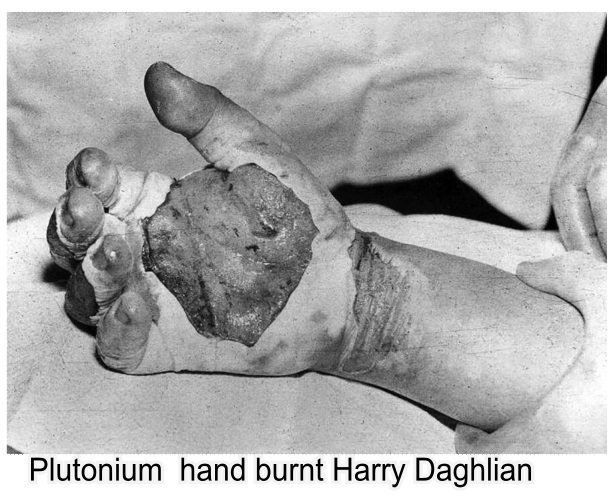
On Aug. 21, 1945, about a week after Japan expressed its intention to surrender, Los Alamos physicist Harry Daghlian conducted a criticality experiment on demon core that would cost him his life. According to Science Alert, he ignored safety protocols and entered the lab alone — accompanied only by a security guard — and got to work.
Daghlian’s experiment involved surrounding the demon core with bricks made of tungsten carbide, which created a sort of boomerang effect for the neutrons shed by the core itself. Daghlian brought the demon core right to the edge of supercriticality but as he tried to remove one of the bricks, he accidentally dropped it on the plutonium sphere. It went supercritical and blasted him with neutron radiation.
Daghlian died 25 days later. Before his death, the physicist suffered from a burnt and blistered hand, nausea, and pain. He eventually fell into a coma and passed away at the age of 24.
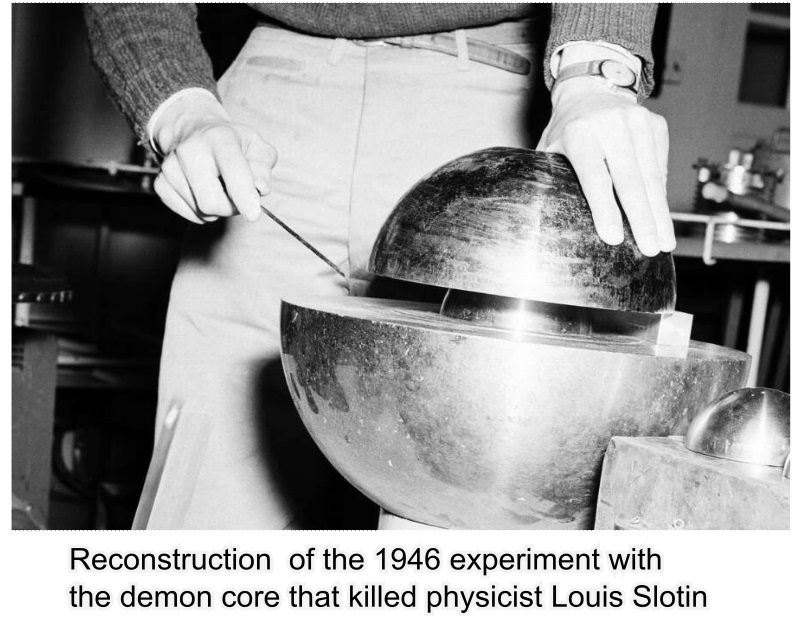
Exactly nine months later, on May 21, 1946, demon core struck again. This time, Canadian physicist Louis Slotin was conducting a similar experiment in which he lowered a beryllium dome over the core to push it toward supercriticality. To ensure that the dome never entirely covered the core, Slotin used a screwdriver to maintain a small opening though, Slotin had been warned about his method before.
But just like the tungsten carbide brick that had slipped out of Daghlian’s hand, Slotin’s screwdriver slipped out of his grip. The dome dropped and as the neutrons bounced back and forth, demon core went supercritical. Blue light and heat consumed Slotin and the seven other people in the lab.
“The blue flash was clearly visible in the room although it (the room) was well illuminated from the windows and possibly the overhead lights,” one of Slotin colleagues, Raemer Schreiber, recalled to the New Yorker. “The total duration of the flash could not have been more than a few tenths of a second. Slotin reacted very quickly in flipping the tamper piece off.”
Slotin may have reacted quickly, but he’d seen what happened to Daghlian. “Well,” he said, according to Schreiber, “that does it.”
Though the other people in the lab survived, Slotin had been doused with a fatal dose of radiation. The physicist’s hand turned blue and blistered, his white blood count plummeted, he suffered from nausea and abdominal pain, and internal radiation burns, and gradually become mentally confused. Nine days later, Slotin died at the age of 35.
Eerily, the core had killed both Daghlian and Slotin in similar ways. Both fatal incidences took place on a Tuesday, on the 21st of a month. Daghlian and Slotin even died in the same hospital room. Thus the core, previously codenamed “Rufus,” was nicknamed “demon core.”
What Happened To Demon Core?
Harry Daghlian and Louis Slotin’s deaths would forever change how scientists interacted with radioactive material. “Hands-on” experiments like the physicists had conducted were promptly banned. From that point on, researchers would handle radioactive material from a distance with remote controls.
So what happened to demon core, the unused heart of the third atomic bomb?
Researchers at Los Alamos National Laboratory had planned to send it to Bikini Atoll, in the Marshall Islands, where it would have been publicly detonated. But the core needed time to cool off after Slotin’s experiment, and when the third test at Bikini Atoll was canceled, plans for demon core changed.
After that, in the summer of 1946, the plutonium core was melted down to be used in the U.S. nuclear stockpile. Since the United States hasn’t, to date, dropped any more nuclear weapons, demon core remains unused.
But it retains a harrowing legacy. Not only was demon core meant to power a third nuclear weapon — a weapon destined to rain destruction and death on Japan — but it also killed two scientists who handled it in similar ways.
Nuclear waste permit ‘more stringent’ New Mexico says as feds look to renew for 10 years
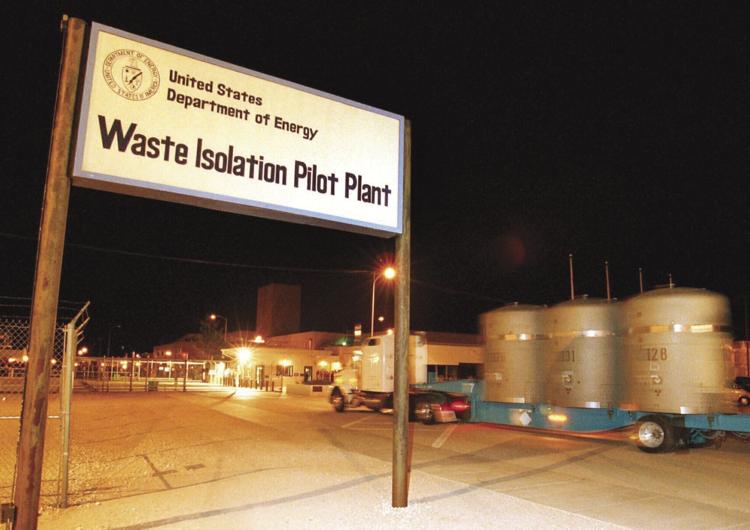
Adrian Hedden, Carlsbad Current-Argus, 12 Dec 22
Tougher rules for a nuclear waste repository near Carlsbad could be on the way as New Mexico officials sought “more stringent” regulations as the federal government sought to renew its permit with the state for the facility.
The State sought new requirements to prioritize nuclear waste from within New Mexico for disposal, called for an accounting of all of the waste planned for disposal in the next decade and regular updates on federal efforts to find the location for a new repository as conditions of the permit.
The Waste Isolation Pilot Plant is owned by the U.S. Department of Energy which holds a permit with the New Mexico Environment Department (NMED) that must be updated every 10 years.
The facility sees transuranic (TRU) nuclear waste from DOE facilities around the country disposed of via burial in an underground salt formation about 2,000 feet beneath the surface.
The upcoming renewal, expected by the end of next year, involved negotiations between NMED and the DOE, months of public comments and hearings and multiple expected revisions.
A draft permit was scheduled for public release Dec. 20, and the NMED released on Dec. 8 several conditions it proposed to add to the permit.
The release of the draft will be followed by a 60-day period when NMED will accept comments from the public, and the agency intended to hold a public hearing next summer.
NMED Cabinet Secretary James Kenney said the State wanted a permit with stronger regulations moving forward, to better protect people and the environment from the impacts of nuclear waste disposal.
“It will be more stringent, full stop,” Kenney said. “The conditions were adding to it are designed to add more accountability to the whole complex that are sending waste to WIPP.”………………………………..
State of New Mexico says priority should go to New Mexico nuclear waste
Key among the revisions was prioritizing nuclear waste held at Los Alamos National Laboratory in northern New Mexico, where the DOE develops nuclear weapons.
More:Nuclear waste from Tennessee filling new disposal area at repository near Carlsbad
The facility was recently planned by the DOE to increase production of plutonium pits, used as the triggers for nuclear bombs, as part of efforts to modernize the U.S.’ weapons arsenal.
Kenney said space should be saved at WIPP for New Mexico waste, as the state hosts the repository and he said should receive the most benefit. He said agreements between the DOE and the State of Idaho to prioritize waste from Idaho National Laboratory and another prioritizing waste from Savannah River Site in South Carolina – a facility also set to ramp up pit production – unfairly “leap-frogged” New Mexico for waste disposal.
More:Gov. Lujan Grisham demands President Biden block nuclear waste site in southeast New Mexico
The waste Kenney hoped to target in this provision, he said, was “legacy waste” held at Los Alamos for decades, posing environmental risks in the area and in need of permanent disposal at WIPP.
“We want to make sure we preserve enough space at WIPP for the entirety of New Mexico’s legacy waste,” Kenney said. “I’m significantly concerned that the notion of cap and cover and leaving things around Los Alamos while continuing to emplace waste at WIPP around the country will squeeze out and leave behind waste that should have been there from legacy issues.”
New Mexico aims to hold feds ‘accountable’ for nuclear waste disposal
Another significant change proposed by NMED in the permit would require a full accounting of waste planned to be disposed of at WIPP for the decade following the permit to justify keeping the facility open after the permit expires.
This would better hold the federal government accountable, Kenney said, for future planning at WIPP.
In past proposal for the upcoming permit renewal, the DOE removed a 2024 closure date, opting to leave WIPP’s lifetime open-ended as worked to its statutorily maximum capacity of 6.2 million cubic feet of nuclear waste specified by the federal Land Withdrawal Act (LWA).
The DOE estimated the site could be open until 2085 based on the potential future availability of nuclear waste.
That ambiguity was unacceptable, Kenney said in proposing the added condition.
“We’re not satisfied. That is a completely unacceptable answer. There’s a presumption that if they’re going to continue to operate the underground in New Mexico, they’re going to have to inventory all of the waste that could come to WIPP,” he said.
“They are going to be accountable to every state where they do business including ours. Full accounting, no switching numbers.”
He said he believed WIPP will stay open past the next 10-year permit term, but that the DOE must do a better job at planning future waste streams.
“We know there’s going to be a need for this kind of facility. I don’t think WIPP will reach the LWA limits in 10 years,” Kenney said. “We can’t blindly go down the path of not knowing what they’re doing in every state regarding clean up.”
Nuclear waste facility will ‘run out of volume one day’ state says
As for finding a location for a new nuclear repository to continue disposal of the nation’s nuclear waste, Kenney said he has not seen “anything substantive” from the DOE, but that he did not believe WIPP could be the only repository in the nation for an unlimited amount of time.
But to do that, or to increase WIPP’s capacity, would take an act of Congress, and Kenney said the State of New Mexico should be kept updated on such activities as it held the only deep geological repository for nuclear waste in the U.S.
“There’s an irony with it being called a pilot plant and extending it out to 2080,” Kenney said. “We believe there is a need for this kind of facility. We have legacy waste and we have pit production that has waste that needs a place to go.
“(WIPP) will run out of volume one day. Someone, somewhere in (Washington), D.C. needs to be thinking about where that repository will be.”
Should Congress choose to increase the capacity at WIPP beyond the LWA limit, NMED’s proposal would automatically revoke WIPP’s permit.
This would protect New Mexico, Kenney said, from the being the sole resting place for U.S. nuclear waste.
“That’s a deal breaker for us,” he said. “We’re reclaiming our authority to not let the federal government pull the rug out from under New Mexicans.”
Ricardo Maestas, WIPP program manager at NMED’s Hazardous Waste Bureau also pointed out that the WIPP facility’s proximity to nearby oil and gas operations in the growing Permian Basin region, was so far unaddressed in the permit, and the state should be kept update on fossil fuel operations as they grow around the site. https://www.currentargus.com/story/news/2022/12/10/new-mexico-proposes-tougher-rules-for-nuclear-waste-site-near-carlsbad/69711594007/
The world’s deepest nuclear clean-up – the Dounreay shaft
A £20m contract has been awarded as part of work to clean-up one of the
most challenging features of the Dounreay nuclear power site.
Called the shaft, it plunges 65.4m (214.5ft) below ground and was used for disposing
of radioactive waste. The practice, which started in 1959, ended in 1977
following an explosion inside the structure.
Cavendish Nuclear has been
awarded the contract to build a container handling facility. Waste from the
shaft, and another part of Dounreay called the silo, will be placed in 500
litre drums for storage. Tackling the shaft has been dubbed the world’s
deepest nuclear clean-up by Dounreay’s operators.
BBC 7th Dec 2022
-
Archives
- October 2026 (129)
- September 2026 (339)
- August 2026 (330)
- July 2026 (355)
- June 2026 (287)
- May 2026 (306)
- April 2026 (356)
- March 2026 (251)
- February 2026 (267)
- January 2026 (308)
- December 2025 (358)
- November 2025 (359)
-
Categories
- 1
- 1 NUCLEAR ISSUES
- business and costs
- climate change
- culture and arts
- ENERGY
- environment
- health
- history
- indigenous issues
- Legal
- marketing of nuclear
- media
- opposition to nuclear
- PERSONAL STORIES
- politics
- politics international
- Religion and ethics
- safety
- secrets,lies and civil liberties
- spinbuster
- technology
- Uranium
- wastes
- weapons and war
- Women
- 2 WORLD
- ACTION
- AFRICA
- Atrocities
- AUSTRALIA
- Christina's notes
- Christina's themes
- culture and arts
- Events
- Fuk 2022
- Fuk 2023
- Fukushima 2017
- Fukushima 2018
- fukushima 2019
- Fukushima 2020
- Fukushima 2021
- general
- global warming
- Humour (God we need it)
- Nuclear
- RARE EARTHS
- Reference
- resources – print
- Resources -audiovicual
- Weekly Newsletter
- World
- World Nuclear
- YouTube
-
RSS
Entries RSS
Comments RSS

