Toxic nuclear waste dumps in the Arctic Kara Sea
Russia explores old nuclear waste dumps in Arctic By Laurence Peter BBC News, 24 Jan 13, The toxic legacy of the Cold War lives on in Russia’s Arctic, where the Soviet military dumped many tonnes of radioactive hardware at sea.
For more than a decade, Western governments have been helping Russia to remove nuclear fuel from decommissioned submarines docked in the Kola Peninsula – the region closest to Scandinavia.
But further east lies an intact nuclear submarine at the bottom of the Kara Sea, and its highly enriched uranium fuel is a potential time bomb.
This year the Russian authorities want to see if the K-27 sub can be safely raised, so that the uranium – sealed inside the reactors – can be removed.
They also plan to survey numerous other nuclear dumps in the Kara Sea, where Russia’s energy giant Rosneft and its US partner Exxon Mobil are now exploring for oil and gas.Seismic tests have been done and drilling of exploratory wells is likely to begin next year, so Russia does not want any radiation hazard to overshadow that. Rosneft estimates the offshore fossil fuel reserves to be about 21.5bn tonnes.
‘Strategic imperative’
The Kara Sea region is remote, sparsely populated and bitterly cold, frozen over for much of the year. The hostile climate would make cleaning up a big oil spill hugely challenging, environmentalists say.

Those fears were heightened recently by the Kulluk accident – a Shell oil rig that ran aground in Alaska…….. “In the US the Arctic gets great public scrutiny and it’s highly political, but in Russia there is less public pressure.” Continue reading
EU lacks funds for decommissioning nuclear reactors
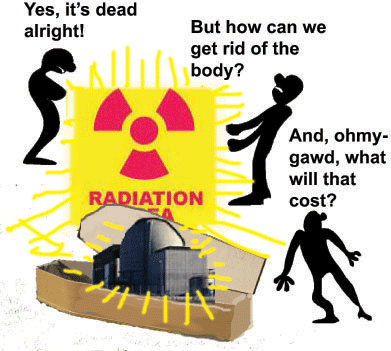
Funding gap for nuclear decommissioning in Bulgaria, Lithuania and Slovakia
Defects in the EU’s nuclear decommissioning programmes in Bulgaria, Lithuania and Slovakia include cost overruns, delays, lack of coordination and supervision, diffused responsibilities, too much money going to unrelated energy projects and ill-informed priority setting, say Budgetary Control Committee MEPs in a resolution voted on Monday. Continue reading
20,000 Tons of nuclear waste coming from Italy to Utah
Plan to Import 20,000 Tons of Italian Nuclear Waste into Utah Approved by US Gov Tree Hugger, Brian Merchant 21 Jan 13, Here’s a troubling plan—the ironically named US company EnergySolutions is seeking approval to import 20,000 tons of radioactive waste from Italy. The waste would be processed in Tennessee, then shipped on over to Utah, where it would be buried in the desert. Given that Yucca Mountain is such a controversial issue, it’s surprising that this plan—which the US Nuclear Regulatory Commission says it won’t halt—isn’t more hotly debated. Can this caravan of nuclear waste be stopped?Two US Representatives are attempting to do exactly that—they’re sponsoring a bill that would ban foreign radioactive waste from being imported into the US unless it was for a “strategic national purpose,” according to the AP.
They argue that the US should restrict its nuclear storage space to waste created domestically. But their bill has yet to even have a hearing, and it looks like the foreign waste plan is set to go ahead: the NRC says that it doesn’t have the authority to restrict foreign radioactive materials from being imported. They don’t “distinguish between domestic and foreign waste.” Furthermore, the agency has determined that
“as long as the material can be imported safely and someone is willing to accept it, the commission can’t keep the waste out.” EnergySolutions has agreed to limit 5% of their storage space to foreign radioactive waste—but the company’s storage site is already responsible for 36 states’ waste. And it seems a case like this could set a precedent, and maybe even open up a floodgate of tricky, potentially dangerous situations. If importing nuclear waste becomes legally recognized—and profitable—as a sound business practice, it could become a nightmare (not to mention a huge environmental concern) to regulate.
What’s more, it’s widely known that EnergySolutions is a major contributor to the Republican Party in Utah (the vast political majority in the state), and there are allegations that the company has promised to donate 50% of the revenue generated to the state. This certainly muddies up the issue…. http://www.treehugger.com/corporate-responsibility/plan-to-import-20000-tons-of-italian-nuclear-waste-into-utah-approved-by-us-gov.html
Corporations circle around for lucrative nuclear waste cleanup
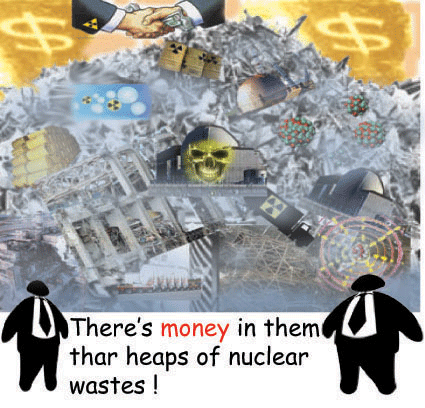 UK firms to bid for Japan’s nuclear clean-up
http://www.independent.co.uk/news/business/news/uk-firms-to-bid-for-japans-nuclear-cleanup-8458524.html
MARK LEFTLY, 20 JANUARY 2013 British engineers Amec, Babcock
International, and Atkins are believed to be circling nuclear
decommissioning work estimated to be worth at least $5bn (£3.2bn) in
Japan as a result of the Fukushima disaster.
The new Japanese government is thought to be preparing decommissioning
contracts that will include Fukushima’s Daiichi plant, which was
overwhelmed by a tsunami in 2011, and other reactors in seismically
endangered areas.
A nuclear source said bids could be invited for the clean-up work
before the end of the year, with British groups in a strong position
due to all the decommissioning work that has been undertaken in the
UK.
US-owned Energy Solutions will also be interested.
“This is a huge opportunity,” claimed the source. “Japan should start
making some real progress on decommissioning now.”
Video: Cumbrians want Sellafield nuclear facility, just not the wastes
 VIDEO Protests spread on Cumbria nuclear waste dump plan, guardian UK 17 Jan 13, As Cumbria Tourism joins the Lake District national park inwarning against research in Ennerdale and Eskdale, local meetings and rallies are spreading Here’s more on the growing concern that nuclear waste burial could be considered within the borders of the Lake District national park, followingCumbria Tourism’s stand against the prospect earlier this week.
A meeting in Keswick saw all but three of 500 present vote against the idea of pursuing research in Ennerdale and Eskdale, one of the few areas of stable geology in West Cumbria, the home of the Sellafield nuclear complex.
As well as being in the national park, the lonely valley is the subject of an experiment called Wild Ennerdale which has barred all traffic apart from a few forestry trucks and the Land Rover which services remote Black Sail youth hostel. Even the latter has been limited to the minimum possible number of journeys to sustain the many walkers to whom it is a shrine.
You can read about the Guardian Northerner‘s weekend there last November, here, and a post from its recent wardens Suzanna Brett and Martin Lyne here.…… http://www.guardian.co.uk/uk/the-northerner/2013/jan/17/ennerdale-nuclear-waste
Nuclear weapons components “scattered” across America
Strategy Lacking for Disposal of Nuclear Weapons Components Secrecy News, January 17th, 2013 by Steven Aftergood There is a “large inventory” of classified nuclear weapons components “scattered across” the nation’s nuclear weapons complex and awaiting disposal, according to an internal Department of Energy contractor reportlast year.
But “there is no complex-wide cost-effective classified weapon disposition strategy.” And as a result, “Only a small portion of the inventory has been dispositioned and it has not always been in a cost-effective manner.”.. http://www.fas.org/blog/secrecy/2013/01/disposal_strategy.html
USA’s Dept of Energy announces goals for nuclear waste management
 DOE touts interim storage option for spent nuclear fuel, Augusta Chronicle, By Rob Pavey Jan. 16, 2013 “……….Read the complete report:
 http://energy.gov/downloads/strategy-management-and-disposal-used-nuclear-fuel-and-high-level-radioactive-waste
Legislative goals for next 10 years:
• Active engagement in a broad, national, consent-based process to site pilot and full-scale interim storage facilities, and site and characterize a geologic repository;
• Siting, design, licensing, and commencement of operations at a pilot-scale storage facility with an initial focus on accepting used nuclear fuel from shut-down reactor sites.;
• Significant progress on siting and licensing of a larger consolidated interim storage facility capable of providing system flexibility and an opportunity for more substantial progress in reducing government liabilities;
• Development of transportation capabilities (personnel, processes, equipment) to begin movement of fuel from shut-down reactors;
• Reformation of the funding approach in ways that preserve the necessary role for ongoing discretionary appropriations and also provide additional funds as necessary, whether from reclassified fees or from mandatory appropriation from the NWF or both; and
• Establishment of a new organization to run the program, the structure and positioning of which balance greater autonomy with the need for continued Executive and Legislative branch oversight.
Source: U.S. Energy Department http://chronicle.augusta.com/news/metro/2013-01-16/doe-touts-interim-storage-option-spent-nuclear-fuel?v=1358336852
AUDIO USA Dept of Energy plans to put radioactive materials into products
 Gundersen: U.S. gov’t to allow highly radioactive material from nuclear plants into silverware, other items? (AUDIO)http://enenews.com/gundersen-u-s-govt-to-allow-highly-radioactive-material-from-nuclear-plants-into-silverware-other-items-audio 15 Jan 13
Source: Fairewinds Energy Education
Date: January 13, 2013 Arnie examines a new proposal by the Department of Energy to melt radioactive scrap metal and reuse it in consumer goods like knives and forks.
- 14:15 Radioactive material from inside a nuclear plant
- 14:20 Turn radioactive vessels from liability to asset
- 15:30 Pots, pans, forks, knives, spoons
- 16:30 Highly radioactive steam generators to be used?
- 17:15 Reused material can remain in radioactive lumps
- 19:45 It’s not helping the consumer here to get any radioactive material in their baby spoons
Full program here http://www.fairewinds.com/content/fairewinds-podcast
No nuclear waste dump until 2046, but USA will still keep making the stuff
UK to get new interim nuclear waste store – so they can make more wastes?
Sizewell B builds new radioactive nuclear waste store, BBC News 15 Jan 13, All the spent radioactive waste from Sizewell B is stored on site An energy firm has begun work on a new store for radioactive waste at Sizewell B nuclear power station.
EDF Energy said the dry fuel store at its site on the Suffolk coast would provide capacity for all the spent fuel created until the plant shuts in 2035.
The store for uranium oxide waste should by completed by 2015…… All the nuclear waste created since Sizewell B started generating electricity in 1995 is currently stored on site under water in storage ponds.
EDF said the new project meant spent fuel would be put in welded metal canisters, cleaned and placed in large concrete casks.
‘Safely and securely’
The energy firm said it would continue to store waste on site until a deep geological disposal facility was made available – similar to the storages created in underground rock caverns in Finland.
Jim Crawford, Sizewell B’s station director, said: “This is an important development for Sizewell B which will ensure we have the ability to continue to store our spent fuel, safely and securely on site for many years to come…..http://www.bbc.co.uk/news/uk-england-suffolk-21032888
There’s money in them thar nuclear wastes
Veolia Draws Upon Fukushima to Move Into Nuclear Dismantling, Bloomberg, By Tara Patel – Jan 15, 2013 Veolia Environnement SA (VIE), which treated radioactive water from Japan’s nuclear meltdown at Fukushima, plans to use the experience to move into decontamination and power plant dismantling.
The water utility and the nuclear research group known as CEA plan to earn as much as 400 million euros ($534 million) in revenue within about four years by cleaning radioactive sites and taking apart installations, they said today.
“The market is developing very quickly,” Veolia Chief Executive Officer Antoine Frerot told a press conference today in Paris. About 300 nuclear reactors will have to be halted worldwide within two decades including in France, Germany, Japan and the U.S., he said.
The shift into the atomic market comes after President Francois Hollande pledged to lower France’s dependence on the energy and shut the country’s oldest plant at Fessenheim. It’s also the first new market Veolia has publicly announced it will enter into since Frerot pledged to pull out of some countries and businesses in a bid to boost profit…… http://www.bloomberg.com/news/2013-01-15/veolia-draws-upon-fukushima-to-move-into-nuclear-dismantling-1-.html
Opposition growing to nuclear waste plan for Cumbria’s Lake District
 ‘Nuclear waste? No thanks,’ say Lake District national park tourism
chiefs, Martin Wainwright guardian.co.uk, 16 January 2013
Board joins clamour against idea of digging repository to hold power
station waste under landscape much loved by visitors Cumbria’s tourism
board has joined the growing clamour against any further research into
the burying of nuclear power station waste within the borders of the
Lake District national park.
The board – which oversees the park, the county’s largest earner and
one of the most-visited group of attractions in the UK – has also
stated its strong opposition to investigations in the Solway Coast
area of outstanding natural beauty on the West Cumbrian side of the
famous lakes and fells…..
A crucial meeting of the three councils potentially affected – Cumbria
county and Allerdale and Copeland districts – will decide on 30
January whether to agree to full-scale preliminary planning for a
repository whose underground facilities would cover an area larger
than the nearby town of Workington.
The three councils are the only ones in the UK still considering a
government request to provide underground nuclear storage, but
Cumbria’s fractured geology has already narrowed potential areas to
limited parts of the western coast, including the Ennerdale valley in
the national park.
There were gasps at public meetings in November when mock-ups of the
possible construction project were shown.
The projections, based on a French scheme, showed how construction and
surface maintenance buildings might irrevocably scar the beautiful
foothills of legendary fells such as Great Gable and Pillar…….
Time to move nuclear wastes to dry cask storage
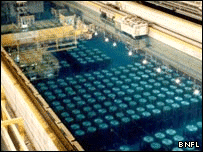 as the second anniversary of the Fukushima Daiichi nuclear accident in Japan draws near, some members of Congress say it is time to reduce the risk posed by spent fuel by moving some of it to dry casks.
Ron Wyden, an Oregon Democrat, will take over as the committee’s chairmanwhen Congress begins its new session next month. In an interview on Monday, he pointed out that the department collects about $750 million a year in waste disposal fees at the rate of one-tenth of a cent per kilowatt-hour generated by the reactors that feed those utilities. Yet the government is spending nearly nothing, he noted……
Mr. Wyden said the committee would have to take a broad look at the issue of the Energy Department’s nuclear waste fund. “The utilities are obviously unhappy they’re paying the money,’’ which is being “hijacked” for other purposes, he said — namely, deficit reduction. The fund now has a balance of $25 billion. “There is a lot of frustration” about the money and the lack of progress, he said. Continue reading
Nuclear wastes problem: let’s not forget MILITARY nuclear wastes
Come January, Another Try on Nuclear Waste, By MATTHEW L. WALD, NYT, December 18, 2012, “……..As for the search for a permanent burial site, Mr. Wyden said the government should be looking for volunteers but that the site would have to be technically suitable. He also said he would like to explore separating the military wastes from the civilian wastes, and perhaps sending them to the Waste Isolation Pilot Project, which is in a salt deposit near Carlsbad, N.M. The repository is now used for plutonium-contaminated materials but not high-level waste.
The military wastes have been dear to Mr. Wyden’s heart for 30 years: many of them are in leaking tanks at the Hanford nuclear reservation in Washington, across the Columbia River from his home state, Oregon. But those wastes would have to be solidified before they could be buried, and the Energy Department has had great difficulty doing that.
Senator Jeff Bingaman of New Mexico, a Democrat who is head of the committee until the end of the lame duck session, has already introduced a bill to reform the process of picking a site, but action is unlikely this year. The lame duck session has failed so far to deal with its central task, a budget and tax compromise. http://green.blogs.nytimes.com/2012/12/18/come-january-another-try-on-nuclear-waste/?smid=fb-share
New EU law permits export of nuclear waste, but Germany won’t do that
Merkel confirms Germany won’t export nuclear waste, DW, 6 Jan 13, The
German chancellor has said the country is to dispose of its nuclear
waste within its own borders. The announcement came after her
environment minister denied a report that the government planned to
export it.
Chancellor Angela Merkel delivered her message on her government’s
nuclear waste disposal policy on Saturday at her Christian Democrat
Party’s (CDU) convention in the north western state of Lower Saxony.
It’s clear “that we’ll dispose our own [radioactive] waste here,” she
said, adding that this position had been “well-established.”
Merkel’s confirmation of her party’s position served to back her
environment minister, Peter Altmaier, who had spoken out on the issue
on Friday….. The current scheduled date for a complete German
shutdown is 2022. http://www.dw.de/merkel-confirms-germany-wont-export-nuclear-waste/a-16500965
Possible export of nuclear waste draws criticism, DW 5 Jan 13,
“…..A new law would allow Germany and other EU countries to export
radioactive material….., a new draft law has emerged in the midst of
the waste site debate. Changes to the existing law would allow the
possible export of spent nuclear fuel to storage facilities abroad.
The law is required because of EU guidelines from 2011 that must be
enshrined in national law by all member states by August 2013.
EU guideline
The draft, which Deutsche Welle has seen, allows the “permanent
storage” of nuclear waste abroad when “at the time of delivery there
is a valid accord between the Federal Republic of Germany and the
third-party country.” In other words, German nuclear waste may be
stored outside of Germany, provided certain conditions are met: for
example, that the storage facility in which the German waste is to be
stored was already operational prior to the export of the waste.
In response to criticism from environmental groups, the German
government has denied that plans are afoot to send German nuclear
waste abroad. However, Berlin emphasized that Germany is obliged under
European law to insert the criticized paragraph into existing German
law…… http://www.dw.de/possible-export-of-nuclear-waste-draws-criticism/a-16500605
1 This Month
23-25 October – on Zoom – World BEYOND War’s annual global conferenc


Shut down the radiation-damaged Heysham nuclear reactors now
To see nuclear-related stories in greater depth and intensity – go to https://nuclearinformation.wordpress.com

Say No to NASA’s Reckless Nuclear Reactor on the Moon
Say No to NASA’s Reckless Nuclear Reactor on the Moon

-
Archives
- October 2026 (231)
- September 2026 (339)
- August 2026 (330)
- July 2026 (355)
- June 2026 (287)
- May 2026 (306)
- April 2026 (356)
- March 2026 (251)
- February 2026 (267)
- January 2026 (308)
- December 2025 (358)
- November 2025 (359)
-
Categories
- 1
- 1 NUCLEAR ISSUES
- business and costs
- climate change
- culture and arts
- ENERGY
- environment
- health
- history
- indigenous issues
- Legal
- marketing of nuclear
- media
- opposition to nuclear
- PERSONAL STORIES
- politics
- politics international
- Religion and ethics
- safety
- secrets,lies and civil liberties
- spinbuster
- technology
- Uranium
- wastes
- weapons and war
- Women
- 2 WORLD
- ACTION
- AFRICA
- Atrocities
- AUSTRALIA
- Christina's notes
- Christina's themes
- culture and arts
- Events
- Fuk 2022
- Fuk 2023
- Fukushima 2017
- Fukushima 2018
- fukushima 2019
- Fukushima 2020
- Fukushima 2021
- general
- global warming
- Humour (God we need it)
- Nuclear
- RARE EARTHS
- Reference
- resources – print
- Resources -audiovicual
- Weekly Newsletter
- World
- World Nuclear
- YouTube
-
RSS
Entries RSS
Comments RSS

