Illegal dumping of radioactive material in Fukushima
 Contaminated soil might have been illegally dumped in Fukushima
http://mainichi.jp/english/english/newsselect/news/20130104p2g00m0dm068000c.html
TOKYO (Kyodo), 4 Jan 13, — Some Japanese contractors are suspected of  having
illegally dumped radioactively contaminated soil, vegetation and water
into rivers or other places close to the tsunami-hit Fukushima Daiichi
nuclear power plant, the Environment Ministry said Friday. Continue reading
America’s big con job – the Nuclear “Waste Confidence Rule”
The only reasonable and logical solution is to stop making more. But this “Waste Confidence” decision isn’t based on reason or logic. It’s based on keeping the reactors OPERATING for the next hundred years.
So why are we burdening our future generations with an ever-growing, unsolvable problem?
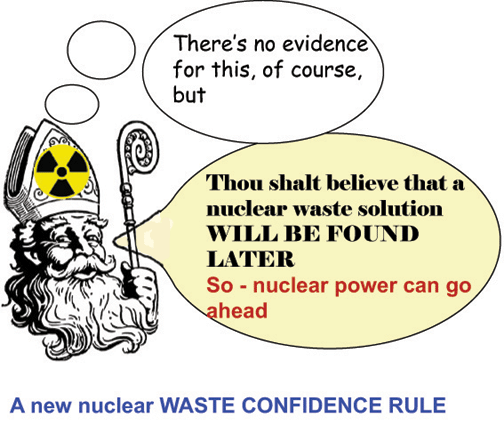
The Eternal Problem – Nuclear Waste Confidence, Counter Punch by RUSSELL D. HOFFMAN, JANUARY 03, 2013“………The pro-nuker preferred to call it “spent fuel confidence.” I, on the other hand, didn’t like the word “confidence” since there’s nothing that warrants ANY confidence in this discussion, whatsoever. ”Waste Failure” would be more appropriate. Or “Waste Impasse” might be even better. Or better yet: ”The Intractable, Unsolvable, Filthy, Disgusting Mess We’ve Made” but I guess that would just be too accurate to a group where a “rapid disassembly” is the term for a core explosion that spews radioactive crud for miles around.
But one way or another, it’s obvious that “Waste Confidence” is a misnomer from start to finish…… …… Nuclear waste storage is a huge unsolved problem in every nuclear country. Continue reading
24 organisations warn Nuclear Regulatory Commission not to rush a new “Waste Confidence Rule”
24 Groups: NRC Rushing Nuclear “Waste Confidence” Process, Not Satisfying Court-Ordered Requirements By Physicians for Social Responsibility, Washington, D.C., Jan. 3, 2013 — Incomplete Process Should Trigger Continued Suspension of All Reactor Licensing, Re-Licensing
In documents filed Wednesday with the Nuclear Regulatory Commission (NRC), a wide range of national and grassroots environmental groups said it would be impossible for the NRC to adequately conduct a court-ordered assessment of the environmental implications of long-term storage of spent nuclear reactor fuel in the two short years the federal agency envisions for the process.
In their filings, the 24 groups said a full review of the three issues outlined in June 2012 by the U.S. Court of Appeals for the D.C. Circuit – long-term storage risks for spent nuclear fuel, spent fuel pool fire risks, and spent fuel pool leakage risks – would take at least the seven years originally projected by the NRC staff, and likely considerably longer. Current federal law requires that the NRC conduct a comprehensive environmental impact statement (EIS) study before issuing a revised Waste Confidence Decision; the 24 groups submitted their comments about the appropriate “scoping” of the EIS.

In the absence of an adequate EIS review, the NRC has “no choice but to continue to suspend all licensing and re-licensing actions” for U.S. nuclear reactors, according to the 24 organizations. All licensing and re-licensing actions were previously suspended by the NRC until an EIS and revised Waste Confidence Decision have been issued…..
Highlights of the 24-group filings include the following: Continue reading
Critically dangerous state of Vermont Yankee’s accumulated nuclear waste
 Vermont, New York regulators urge review of storage of spent nuclear fuel, VT Digger, by Andrew Stein | January 3, 2013 “……Vermont Yankee has 1,507 fuel rod assemblies submerged in a spent fuel pool, which was originally designed to hold about 350. Spent fuel rods must be kept under water in order to prevent the Zirconium cladding (the metal tubes that contain the fuel pellets) from igniting. The rods can remain hot for several years.
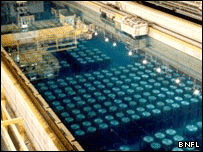 Vermont Yankee’s spent fuel pool, located in a metal warehouse structure, has more than five full reactor cores worth of radioactive material. In the event of an accident, the impact would be five times greater than a single reactor meltdown.
The dry cask storage containers on the site are hundreds of times safer than the spent fuel pool, Shadis said.
At this point, the site has 13 loaded casks, four of which were filled last year, according to Neil Sheehan, NRC public affairs officer for Region 1.
Each cask, which can hold 72 assemblies, costs $1 million. It would cost roughly $11 million to move all of the assemblies into dry cask storage……. http://vtdigger.org/2013/01/03/vermont-new-york-regulators-urge-review-of-spent-nuclear-fuel-storage/
New York and Vermont regulators demand review of nuclear waste spent fuel pools
Vermont, New York regulators urge review of storage of spent nuclear fuel, VT Digger, by Andrew Stein | January 3, 2013 Leading Vermont and New York regulators on Tuesday called on the Nuclear Regulator Commission to conduct a comprehensive environmental review of spent nuclear fuel storage.
Vermont Attorney General Bill Sorrell, the Vermont Department of Public Service and the New York Attorney General’s office issued a formal letter to the federal commission on Tuesday regarding the “scope of consideration of environmental impacts of temporary spent fuel after cessation of reactor operation.” The states’ plea comes roughly eight months after the U.S. Appellate Court struck down the commission’s so-called “waste confidence rule,” which authorized the storage of spent fuel at a reactor. The court called for more extensive environmental assessments of this practice, and in August 2012, the NRC suspended all licensing decisions for nuclear power plants until it can address concerns regarding long-term storage of nuclear waste.
“The NRC owes a legal obligation to the public to engage in a full and thorough review of the environmental impacts of storing spent nuclear fuel at reactors that were never designed to be long-term storage facilities,” Sorrell said in a public statement.
The letter from Vermont and New York politicians says it is time to begin exploring new ways to store high-level nuclear waste other than spent fuel pools at reactor sites across the country.
“After more than three decades of failing to address the very real and widespread concern with the continued production of nuclear wastes without a permanent, safe, and secure nuclear waste repository NRC now has the opportunity, albeit mandated by a Federal Court, to apply its considerable expertise to address these concerns,” the letter says…… http://vtdigger.org/2013/01/03/vermont-new-york-regulators-urge-review-of-spent-nuclear-fuel-storage/
Early start for secret shipments of radioactive weapons fuel to Nevada
DOE: Uranium shipments to Nevada could start soon, knoxnews.com, Associated Press December 31, 2012 OAK RIDGE, Tenn. (AP) — A U.S. Department of Energy official says stocks of radioactive uranium could start shipping from the Oak Ridge National Laboratory to Nevada in 2013.
However, The Knoxville News Sentinel reports (http://bit.ly/WVktTK ) that agency officials will not discuss exact dates of the shipments because of safety and security reasons because of the fissionable material’s potential use in nuclear weapons. DOE’s Environmental Manager Mark Whitney said in an interview with the newspaper this fall that the DOE wanted to start the shipments to the Nevada National Security site in early 2013 pending approvals to ship. Continue reading
UK nuclear lobby desperate to keep the industry alive, therefore needs waste dump quickly
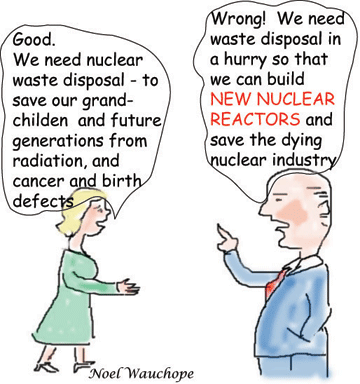 without a positive decision, new nuclear development could be put
at risk.
Ministers are thought to be working on plans to try to ensure the
new-build programme is not derailed. Final investment decisions and
approvals for EDF’s proposed nuclear plant in Somerset are expected
next year.
a “no” vote in Cumbria in January would be likely to
deter a consortium that is at the early stage of planning a new plant
in the county, as it would have to invest hundreds of millions of
pounds before seeking planning permission….
Nuclear sector pushes for green light on waste dump. Telegraph By
Emily Gosden 30 Dec 2012
Britain’s nuclear industry has warned that a “no” vote by local
councils on crucial plans to assess sites for a major radioactive
waste dump would be “an injustice to future generations”. Continue reading
$2 billion to shut down Quebec’s nuclear plant, but $4 billion to keep it open
The Parti Quebecois also announced it will set aside another $200 million in a
“diversification fund” to help the surrounding communities retrain
their workforces and spur alternative development opportunities.
Shutdown of Que. nuclear plant to cost $2B, Ifp
QMI Agency
December 28, 2012 MONTREAL – The licence for Quebec’s only
operational nuclear power plant expired Friday, and the provincial
government said it will spend hundreds of millions of dollars over the
next 50 years to dismantle the reactor.
The Parti Quebecois campaigned against refurbishing the plant,
claiming that the $4-billion price tag was financially unjustifiable, Continue reading
USA’s nuclear waste problem more acute, with probable reactor close-downs
 with the current glut of natural gas, more [nuclear reactor] closings seem possible, which means leaving the wastes behind — “stranded,” as Mr. Wyden put it — at the sites of defunct reactors………...
Come January, Another Try on Nuclear Waste By MATTHEW L. WALD , NYT, 18 Dec 12, The incoming chairman of the Senate Energy Committee suggests that the Energy Department should stop billing utilities more in waste disposal fees than the department is actually spending on addressing nuclear wastes. And he wants the department to pay for moving some of the wastes out of spent fuel pools at the
nation’s highest-risk reactors and into dry casks. Continue reading
Contradictory information about Lynas rare earths project in Malaysia
Lynas will be in court in Malaysia on 19 December. The Save Malaysia Stop Lynas (SMSL) campaignerswill be appealing against the Kuantan High Court decision to lift its stay on the company being able to exercise its rights to proceed under the temporary licence.
The toxic waste that’s not in Australia’s backyard http://aliran.com/11005.html 18 Dec 12, Australian-owned company Lynas is quietly shipping rare earth to a processing plant in Malaysia – without a firm plan in place to dispose of dangerous radioactive waste. Wendy Bacon reports.
If a manufacturing plant involving radioactive materials moved into your community, one of the first things you would ask is, “what’s going to happen to the waste?”
This is exactly how residents of Kuantan on Malaysia’s east coast reacted when the Australian company Lynas announced plans to build Lamp, the world’s biggest rare earth processing plant in their area.
Several years later, they have no clear answer. Indeed last week, while the plant that will use concentrate imported from Lynas’s rare earth mine at Mount Weld in Western Australia was finally ramping up for production, the Malaysian government and the company were in direct conflict about what would happen to the waste. Continue reading
Plutonium now called “material” as it travels from Scotland to Wales
 Breeder is classed as material and not as fuel or waste, by NDA.
Nuclear material moved by train from Scotland to England , BBC News, 17 December 2012 The first of 90 rail shipments of nuclear material from Dounreay in Caithness to Sellafield in Cumbria was made overnight.
The journey was understood to have been made under armed escort. Forty-four tonnes of breeder material in total will be transported by train to Sellafield for reprocessing. Continue reading
Lithuanian nuclear plant: decommissioning stalled due to company disputes
EU freezes Lithuanian nuclear plant decommissioning funds, EurActive 14 Dec 12 The European Commission announced yesterday (13 December) that international donors, among which the largest is the EU, have decided to suspend the funding of one specific decommissioning project in the Ignalina Nuclear Power Plant in Lithuania. The project covers the construction of the storage area for the leftover spent fuel and the supply of storage casks for defueling the central’s two reactors.
The decision was taken on the grounds that the operator of the power plant (INPP) and the consortium delivering the project (GNS/NUKEM) have not managed to settle their dispute, now on-going for more than two years, on how to implement the project concretely. Nukem is a “dual national” company based in Germany (NUKEM GmbH) and the United States (NUKEM, Inc.) focused on the civil nuclear fuel market. Continue reading
Britain’s taxpayers up for more than 100 billion pounds in nuclear cleanup
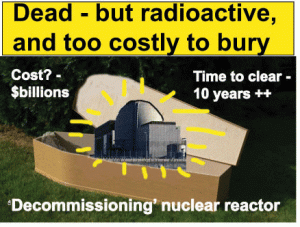 Nuclear clean-up to cost £100bn and take 120 years. Decommissioning, no2nuclearpower, 9 December 2012 BRITAIN’S taxpayers will be landed with a bill of more than £100bn for cleaning up radioactive waste from sites such as Sellafield and Dounreay, according to the chief executive of the Nuclear Decommissioning Authority (NDA).
The amount represents a near-doubling of the £56bn cleanup cost announced when the NDA began operating in 2005, and could rise still more. The warning comes as NDA  engineers start work on some of the biggest and most expensive engineering projects seen in Britain — building giant robotic grabs to lift deadly nuclear waste from Sellafield’s decaying 1950s repositories.
The buildings being targeted include Sellafield’s B29 and B30 cooling ponds, where decaying 1950s fuel rods are stored. This weekend John Clarke, chief executive of the NDA, said he was spending £3bn a year on the cleanup, with about £1.6bn of that going on Sellafield alone. Such sums are similar to those spent on the London Olympic site at the peak of construction.
Figures released by the Department of Energy and Climate Change show that, since Britain’s first nuclear power station opened in 1956, they have generated 2.5 billion megawatt hours of electricity — worth £125 billion at today’s prices. If the cost of building Britain’s 20-odd nuclear power stations (around £10bn-£12bn each in today’s money), is included, it would far exceed the value of the power produced, say experts.
Such figures show why power companies, which would be responsible for the waste, are refusing to build new nuclear power stations without government guarantees of a consumer subsidy that will almost double the market price for their power.
Sunday Times 9th Dec 2012 more >> http://www.no2nuclearpower.org.uk/news/daily12/daily.php?dailynewsid=343
America’s latest nuclear bomb test – an act of hypocrisy
 American Nuclear Hypocrisy , 09 December 2012 By Elias Akleh“…….The American nuclear hypocrisy was lately demonstrated when the US National Nuclear Security Administration had detonated plutonium in a deep shaft in Nevada National Security Site on Wednesday 12/5/2012, allegedly to test the safety and effectiveness of the American nuclear weapons. The test, known as Pollux, was conducted jointly by the Nevada National Security Site, the Los Alamos National Laboratory, and Sandia National Laboratories. International inspectors were not allowed to witness the test since the US had prevented access to its test sites since late 1990s.
Let us not forget that the US is the only country that used nuclear bombs against civilians in 1945. The US dropped an atomic bomb on the Japanese city of Hiroshima incinerating at least 140 thousand civilians in seconds. Three days later the US dropped another nuclear bomb on Nagazaki incinerating further 70 thousand civilians. Hundreds of thousands others died later due to radiation. http://mwcnews.net/focus/editorial/23374-eliasakleh-nuclear-hypocrisy.html
Despite the hype, the nuclear industry is nervous about its future
 Nuclear industry faces up to reality of ‘interesting times’ The
  Engineer, 7 December 2012 | ByStuart Nathan ”………Part of the problem is that the nuclear landscape is so complicated, especially in the UK, with its history as a nuclear
pioneer and the legagcy of experiment that has left behind. John Clarke of the Nuclear Decommissioning Authority, again reflecting the mood of realism, put it in a way which pretty much everyone would understand. ‘It’s like telling children to put their toys away before getting out new ones. Clearing up the mess is a key enabler to new build.’
…… .it’s relatively easy to put toys away. Nuclear is different. ‘At Sellafield, we’re dealing with structures which were put up in the 1940s in great haste to support military programmes, where the only concern was “is it safe for today”,’ he said. ‘They were neverdesigned to have waste taken out of them, and the waste is poorly categorised — we often don’t really know what it is.’
The situation isn’t much better even at industrial-scale power stations, said Peter Walkden, commercial director of Magnox. ‘It was never going to be easy to decommission a 50 year old plant that was never designed to be decommissioned, under a regime that was designed for operation,’ he said. Decommissioning a Magnox plant takes the best part of a century — three years to defuel, then ten years of preparation for care and maintenance while radioactivity subsides (the stage that current decommissioning projects are in), followed by 85 years of care and maintenance, then about ten years to clear the site.
A bit more than just putting the toys away, and something that can’t be done before building new plants’. ….”
1 This Month
23-25 October – on Zoom – World BEYOND War’s annual global conferenc


Shut down the radiation-damaged Heysham nuclear reactors now
To see nuclear-related stories in greater depth and intensity – go to https://nuclearinformation.wordpress.com

Say No to NASA’s Reckless Nuclear Reactor on the Moon
Say No to NASA’s Reckless Nuclear Reactor on the Moon

-
Archives
- October 2026 (231)
- September 2026 (339)
- August 2026 (330)
- July 2026 (355)
- June 2026 (287)
- May 2026 (306)
- April 2026 (356)
- March 2026 (251)
- February 2026 (267)
- January 2026 (308)
- December 2025 (358)
- November 2025 (359)
-
Categories
- 1
- 1 NUCLEAR ISSUES
- business and costs
- climate change
- culture and arts
- ENERGY
- environment
- health
- history
- indigenous issues
- Legal
- marketing of nuclear
- media
- opposition to nuclear
- PERSONAL STORIES
- politics
- politics international
- Religion and ethics
- safety
- secrets,lies and civil liberties
- spinbuster
- technology
- Uranium
- wastes
- weapons and war
- Women
- 2 WORLD
- ACTION
- AFRICA
- Atrocities
- AUSTRALIA
- Christina's notes
- Christina's themes
- culture and arts
- Events
- Fuk 2022
- Fuk 2023
- Fukushima 2017
- Fukushima 2018
- fukushima 2019
- Fukushima 2020
- Fukushima 2021
- general
- global warming
- Humour (God we need it)
- Nuclear
- RARE EARTHS
- Reference
- resources – print
- Resources -audiovicual
- Weekly Newsletter
- World
- World Nuclear
- YouTube
-
RSS
Entries RSS
Comments RSS

