Radioactive liquid leaking from Hanford nuclear waste tank
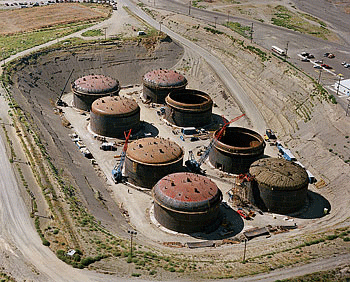 Hanford Nuclear Tank in Wash. Is Leaking Liquids
http://abcnews.go.com/US/wireStory/tank-hanford-nuclear-site-wash-leaking-18515755
By SHANNON DININNY and MIKE BAKER Associated Press
OLYMPIA, Wash. February 16, 2013 A waste tank is leaking
radioactive liquids at the nation’s most contaminated nuclear site,
raising new concerns about delays and budget overruns in a plan to
treat material at the federal Hanford site.
The U.S. Department of Energy said Friday that liquid levels are
decreasing in one of 177 underground tanks at the nuclear reservation.
Washington Gov. Jay Inslee said the tank is leaking liquids in the
range of 150 to 300 gallons annually. Continue reading
Savannah Rivers Site’s aging cracked spent nuclear fuel containers
KEY FINDINGS
Here are some key findings from the Defense Nuclear Facilities Safety Board’s report on older spent nuclear fuel assemblies:
• Oxide formation can cause handling problems due to sludge formation.
• Hydrogen gas accumulation can form “hydrides” that can spontaneously ignite in air.
 • Cladding has ruptured, is missing, or was breached – allowing direct contact with water.
• Sealed cans that hold fuel initially packaged dry have leaked, allowing water inside.
• Fuel is stored in cans whose designs are vulnerable to developing leaks.
UK, USA, paralysed, but need permanent deep burial of nuclear wastes
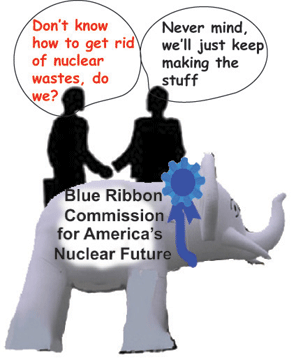 In the United States, efforts to build a repository are in the doldrums
At the Fukushima Daiichi nuclear plant in Japan, spent fuel stored above ground at reactors is likely to have been a major source of contamination following the earthquake and tsunami in 2011. At the last count, the clean-up there is expected to cost trillions of yen, or hundreds of billions of dollars.
In a hole It is in Britain’s best interests to keep looking for a site for a deep nuclear-waste repository. Nature, 05 February 2013 The best way to dispose of nuclear waste is to bury it deep underground. With the right mixture of geology and engineering, researchers think, it should be possible to contain highly radioactive material safely for the many thousands of years that it will take to decay.
Scientists agree on this. The industry thinks the same way, and so do regulators, politicians and most environmental groups. Yet despite the expert endorsement, plans for a deep geological repository in Britain effectively ground to a halt last week, after a local council voted against plans to look for a suitable site…….
why has the process come up empty again? The answer is a lack of political will at almost every level of government. Critics say that the Nuclear Decommissioning Authority, the body responsible for the repository, never did much to try to sell the facility to local residents or to address their concerns about what it might do to property prices or tourism. At a national level, politicians offered only the vaguest promise of ‘economic development’ in exchange for taking the waste. Meanwhile, local politicians advocated an alternative plan: to build more short-term storage at Sellafield, thereby creating jobs in the near-term without making long-term commitments.
“There are moral, financial and environmental reasons to make deep geological disposal work.” Continue reading
USA’s Energy Dept plan to sell nuclear wastes into consumer products
 This approach ignores the current scientific consensus that there is
NO safe level of radiation exposure.
the fundamental safety question is whether any additional radiation
exposure is safe in any meaningful sense.
This approach also fails to deal with the reality that once the
department has released radioactive materials for commercial use, it
loses almost all control over how and where they’re used, and in what
concentrations.
Multimillion Dollar Bonanza: Nuclear Waste from US Weapons Industry To
Be Sold for Profit? By William Boardman Global Research, February 05,
2013
An Energy Department plan to allow the
recycling of scrap metals emitting very low levels of radiation is
drawing opposition because of concerns about potential health hazards.
But the upside for U.S. atomic bomb-makers is that waste now requiring
costly storage could be sold for a profit.
In something of a stealth maneuver during the 2012 holiday season, the
U.S. Department of Energy set about to give every American a little
more radiation exposure, and for some a lot, by allowing manufacturers
to use radioactive metals in their consumer products – such as
zippers, spoons, jewelry, belt buckles, toys, pots, pans, furnishings,
bicycles, jungle gyms, medical implants, or any other metal or
partly-metal product. Continue reading
No One in Charge of Risk – USA’s plan to put nuclear waste materials into consumer “goods”
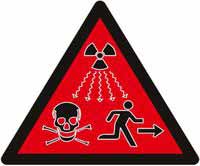 “Nothing has changed since 2000 that would justify lifting its current
ban. Rather, just the opposite: since then the National Academy of
Sciences has acknowledged that there is no safe level of radiation
exposure, and we’ve learned that women are even more vulnerable to
radiation than men (while children have long been known to be more
vulnerable than adults).”
NIRS and other advocacy organizations are currently engaged in a
campaign to submit comments before the Feb. 11 deadline to ask the
Energy Department to withdraw this proposal.
Multimillion Dollar Bonanza: Nuclear Waste from US Weapons Industry To
Be Sold for Profit? By William Boardman Global Research, February 05,
2013
Consortiumnews 4 February 2013 “……No One in Charge of Risk
There is no federal agency with responsibility for such oversight or
enforcement [of radioactive materials in consumer products] . This regulatory vacuum was illuminated by the discovery
in 2009 of thousands of contaminated consumer products from China,
Brazil, France, Sweden and other countries, as reported by Mother
Nature Network:
“The risk of radiation poisoning is the furthest thing from our minds
as we shop for everyday items like handbags, furniture, buttons, chain
link fences and cheese graters. Unfortunately, it turns out that our
trust is misplaced thanks to sketchy government oversight of recycled
materials.
“The discovery of a radioactive cheese grater led to an investigation
that found thousands of additional consumer products to be
contaminated. The source is recycled metals tainted with Cobalt-60, a
radioactive isotope that can cause cancer with prolonged exposure.” Continue reading
USA’s Blue Ribbon Commission has no idea what to do with 70,000 tons of nuclear waste
The Blue Ribbon Commission on America’s Nuclear Future reported that “no currently available or reasonably foreseeable reactor and fuel cycle technology developments — including advances in reprocessing and recycling technologies — have the potential to fundamentally alter the waste management challenges the nation confronts over at least the next several decades, if not longer.”
Report: US will have to bury 70,000 tons of nuclear waste. http://dailycaller.com/2013/02/01/report-u-s-will-have-to-bury-70000-tons-of-nuclear-waste/ A report by a government research lab found that the U.S. will have to bury nearly 70,000 tons of nuclear waste after the Obama administration cut funding for the Yucca Mountain repository in 2011, reports the Moscow-based news service RT.
A 2012 report by the Oak Ridge National Laboratory, which does research for the Department of Energy, said that “about 68,450 [metric tons] or about 98 percent of the total current inventory by mass, can proceed to permanent disposal without the need to ensure retrievability for reuse or research purposes. The report also found that the rest of the nuclear waste can be used for research on fuel reprocessing and storage.
The Oak Ridge report also notes that the stock of spent nuclear fuel being held at 79 temporary locations in 34 US states “is massive, diverse, dispersed, and increasing.” Continue reading
Poor UK new nuclear industry !- stalled by Cumbria’s rejection of waste dump
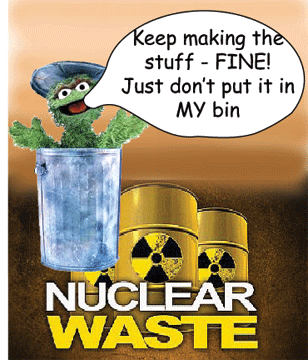 Much of the UK’s high level nuclear waste is stored above ground at SellafieldNo other community had come forward as a potential site, and no other community looks likely to. And given West Cumbria’s nuclear history it always seemed the best bet.
The government also has to find a solution. It will be harder to justify new nuclear power stations if the country can’t find a long term way of dealing with its existing waste problem.
Is it all over for Cumbrian nuclear waste store plans?, BBC News 1 Feb 13, The long term plan could have seen nuclear waste buried underground in Cumbria For the second time in 14 years the hunt for a long-term solution to Britain’s nuclear waste stockpile seems to have foundered in Cumbria.
 In 1999 Cumbria County Council rejected plans for a rock laboratory that could have paved the way for an underground nuclear waste store. And now the same council has again withdrawn as a potential site for a repository. Cumbria’s decision The majority of the council’s executive decided the county wasn’t suitable. The government has also said it accepts Cumbria’s decision and will look elsewhere.
So is it all over? Continue reading
Cumbrians (UK) suggest that underground nuclear waste storage should be ruled out forever
Is it all over for Cumbrian nuclear waste store plans, BBC News 1 Feb 13,”…….Above ground storage ..some say it’s time to rule out underground storage forever.
Martin Forwood, from Cumbrians Opposed to a Radioactive Environment, has accused Jamie Reed of petulance by insisting Copeland could plough on. He says improved above ground storage is the only way forward.

He said: “We will continue to oppose underground dumping anywhere in the UK.
“With significant blight from at least one major nuclear proposal now averted, Cumbria can now look forward to attracting non-nuclear inward investment and diversifying its local economy towards a safer and clean future for all its communities.”
But despite that wish it does appear this story is far from over, and this week’s “no” may not prove to be the end of a Cumbrian nuclear waste saga that’s dragged on for more than 20 years. http://www.bbc.co.uk/news/uk-england-21295465
Lots of government incentives fail to win Cumbrians: nuclear waste dump rejected
Cumbria sticks it to the nuclear dump lobby – despite all the carrots on offer Guardian UK, Terry Macalister, 31 Jan 13, Council’s decision to turn down the hosting of huge underground nuclear waste depository is a body blow for government Cumbria county council’s decision to “dump the dump” by voting against a nuclear waste repository close to the Lake District has drilled a nasty great hole in the middle of the government’s wider nuclear strategy.
Ministers had made clear that part of the agreement with the public over a new generation of atomic power stations would involve finding a safe and permanent home for the high-level waste created by the old ones.
Cumbria’s decision is a body blow for government because though it may not necessarily have been the most geologically suitable spot, it certainly was the most politically suitable.
The “energy coast”, as the region calls itself, is home to Sellafield, formerly Windscale, the largest nuclear complex in Europe with more than 5,000 well-paid jobs, as well as the nuclear submarine-building base at Barrow-in-Furness.
Even a secretarial job there can pay £10 an hour, and to win votes in the local constituency you need to pin your nuclear colour – yellow – to the mast, as the MP for Copeland, Jamie Reed, and his predecessor, “Neutron Jack” Cunningham, have done.
The Unite union, representing many Sellafield workers, can also be relied upon to bang the nuclear drum on a national level, and was quick to condemn the county council’s decision on Wednesday.
The government had dangled all kinds of carrots in front of Cumbria’s local and regional councils, including the prospect that up to 1,000 jobs could be created from the proposed £12bn underground project. It made some headway when Copeland and Allerdale councils voted in favour of further dialogue, but that was not enough without the county council.
Now, if an area steeped in a nuclear culture is not prepared to countenance a waste dump, then who will?…… Continue reading
USA’s nuclear waste dumpsters need high level guarding
 America’s Nuclear Dumpsters After Yucca Mountain, the Nuclear Regulatory Commission is stocking up on guns and ammo. Slate, By Geoffrey Brumfiel| , Jan. 30, 2013, While the rest of America spent January debating new gun control laws, one government agency announced its plans to expand the use of high-capacity magazines, assault weapons, and even fully automatic machine guns. The Nuclear Regulatory Commission, which oversees the nation’s nuclear plants, is seeking the firepower not for securing the plants themselves, but to defend their nuclear waste.
Since America’s commercial reactors started opening in the 1960s and ’70s, nuclear waste has been piling up. At first, it was stored in spent fuel pools—swimming pools you’d never, ever want to swim in. That was fine for a time, but by the 1980s, the pools started to get crowded. So the utilities began putting old fuel rods in something they call dry cask storage, and I’ll call nuclear dumpsters.
They’re big, they’re white, and they’re literally kept out back like the rest of the trash. Continue reading
Britain’s new nuclear power plans stalled, ad Cumbria refuses to host waste dump
Nuclear plans in disarray after Cumbria votes ‘no’ to radioactive dump The future of new nuclear power stations in Britain has been dealt a serious blow, after a council threw out plans for a giant radioactive waste dump near the Lake District.Telegraph UK, By Rowena Mason, and Emily Gosden 30 Jan 2013
Eddie Martin, Conservative leader of the council, told a public meeting he did not feel ministers had offered enough reassurances to Cumbria.
The Coalition wants to see several nuclear power stations built over the next decade, but the plans cannot go ahead unless there are “effective arrangements” for storing the future waste.
Cumbria was the only county council that came forward offering to explore the possibility of a “geological disposal facility” on its land but it has now ruled itself out of contention. Continue reading
New Nuclear Waste Confidence Decision” (NWCD) designed to let nuclear power continue?
the fact that their best scenario now projects a repository to be ready by about 2050 is a story in itself.
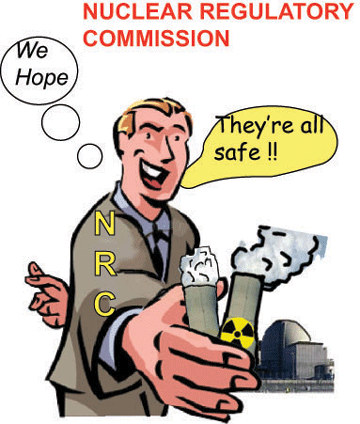 Seventy Years of Nuclear Fission, Thousands of Centuries of Nuclear Waste ,25 January 2013 By Gregg Levine, Truthout “…….Confidence Game
Two months after the Appeals Court found fault with the NRC’s imaginary waste mitigation scenario, the agency announced it would suspend the issuing of new reactor operating licenses, license renewals and construction licenses until the agency could craft a new plan for dealing with the nation’s growing spent nuclear fuel crisis. In drafting its new nuclear “Waste Confidence Decision” (NWCD) – the methodology used to assess the hazards of nuclear waste storage – the Commission said it would evaluate all possible options for resolving the issue.
At first, the NRC said this could include both generic and site-specific actions (remember, the court criticized the NRC’s generic appraisals of pool safety), but as the prescribed process now progresses, it appears any new rule will be designed to give the agency, and so, the industry, as much wiggle room as possible. Continue reading
Dangers of nuclear spent fuel cooling ponds, and of dry cask storage
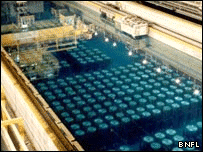 Seventy Years of Nuclear Fission, Thousands of Centuries of Nuclear Waste ,25 January 2013 By Gregg Levine, Truthout “…….Everyone Out of the Pool
As disasters as far afield as the 2011 Tohoku earthquake and last October’s Hurricane Sandy have demonstrated, the storage of spent nuclear fuel in pools requires steady supplies of power and cool water. Any problem that prevents the active circulation of liquid through the spent fuel pools – be it a loss of electricity, the failure of a back-up pump, the clogging of a valve or a leak in the system – means the temperature in the pools will start to rise. If the cooling circuit is out long enough, the water in the pools will start to boil. If the water level dips (due to boiling or a leak) enough to expose hot fuel rods to the air, the metal cladding on the rods will start to burn, in turn heating the fuel even more, resulting in plumes of smoke carrying radioactive isotopes into the atmosphere.
And because these spent fuel pools are so full – containing as much as five times more fuel than they were originally designed to hold, and at densities that come close to those in reactor cores – they both heat stagnant water more quickly and reach volatile temperatures faster when exposed to air. Continue reading
Atoms for Peace, Problems Forever
 leaves America today with what amounts to over five dozen nominally temporary repositories for high-level radioactive waste – and no defined plan to change that situation anytime soon.
Seventy Years of Nuclear Fission, Thousands of Centuries of Nuclear Waste ,25 January 2013 By Gregg Levine, Truthout “……The Manhattan Project’s goal was a bomb, but soon after the end of the war, scientists, politicians, the military and private industry looked for ways to harness the power of the atom for civilian use, or, perhaps more to the point, for commercial profit. Fifteen years to the day after CP-1 achieved criticality, President Dwight Eisenhower threw a ceremonial switch to start the reactor at Shippingport, Pennsylvania, which was billed as the first full-scale nuclear power plant built expressly for civilian electrical generation.
Shippingport was, in reality, little more than a submarine engine on blocks, but the nuclear industry and its acolytes will say that it was the beginning of billions of kilowatts of power, promoted (without a hint of irony) as “clean, safe and too cheap to meter.” It was also, however, the beginning of what is now a weightier legacy: 72,000 tons of nuclear waste.
Atoms for Peace, Problems Forever
News of Fermi’s initial success was communicated by physicist Arthur Compton to the head of the National Defense Research Committee, James Conant, with artistically coded flair:
Compton: The Italian navigator has landed in the New World.
Conant: How were the natives?
Compton: Very friendly.
But soon after that initial success, CP-1 was disassembled and reassembled a short drive away, in Red Gate Woods. The optimism of the physicists notwithstanding, it was thought best to continue the experiments with better radiation shielding – and slightly removed from the center of a heavily populated campus. The move was perhaps the first necessitated by the uneasy relationship between fissile material and the health and safety of those around it, but if it was understood as a broader cautionary tale, no one let that get in the way of “progress.” Continue reading
Radioactive water to be dumped into Pacific Ocean by TEPCO
 TEPCO plans to dump water stored at Fukushima Daiichi into
 Pacific http://enformable.com/2013/01/tepco-plans-to-dump-water-stored-at-fukushima-daiichi-into-pacific/ TEPCO has announced that it plans to dump contaminated water into the Pacific Ocean after processing it to reduce radioactive materials to legally permissible levels. By “processing”, TEPCO means once-high radioactive content has been reduced considerably, but not completely.
The plant has already released enormous amounts of highly contaminated water directly into the ocean from a plethora of leaks from the reactor buildings. Outside experts are seriously concerned about the contaminated water that is released, and have warned there may well be lasting impact on the environment.
The utility says the operation is necessary due to concerns that they will run out of capacity to store highly contaminated water which continues to accumulate. After the water has passed through the crippled units, it is processed through the SARRY system to remove cesium, but other systems designed to remove other radioactive materials have been overwhelmed by the complexity and concentration of contamination found at Fukushima Daiichi.
TEPCO estimates show that the volume of contaminated water required to be stored on site will likely triple over the next three years.
Questions have been raised if TEPCO would be able to gain the necessary approval from local municipalities and other parties who have raised concerns about plans to dump the water into the ocean.
In December 2011, the utility was forced to scrap a previous plan to dump water into the sea following fierce protests from fishing groups.
1 This Month
23-25 October – on Zoom – World BEYOND War’s annual global conferenc


Shut down the radiation-damaged Heysham nuclear reactors now
To see nuclear-related stories in greater depth and intensity – go to https://nuclearinformation.wordpress.com

Say No to NASA’s Reckless Nuclear Reactor on the Moon
Say No to NASA’s Reckless Nuclear Reactor on the Moon

-
Archives
- October 2026 (231)
- September 2026 (339)
- August 2026 (330)
- July 2026 (355)
- June 2026 (287)
- May 2026 (306)
- April 2026 (356)
- March 2026 (251)
- February 2026 (267)
- January 2026 (308)
- December 2025 (358)
- November 2025 (359)
-
Categories
- 1
- 1 NUCLEAR ISSUES
- business and costs
- climate change
- culture and arts
- ENERGY
- environment
- health
- history
- indigenous issues
- Legal
- marketing of nuclear
- media
- opposition to nuclear
- PERSONAL STORIES
- politics
- politics international
- Religion and ethics
- safety
- secrets,lies and civil liberties
- spinbuster
- technology
- Uranium
- wastes
- weapons and war
- Women
- 2 WORLD
- ACTION
- AFRICA
- Atrocities
- AUSTRALIA
- Christina's notes
- Christina's themes
- culture and arts
- Events
- Fuk 2022
- Fuk 2023
- Fukushima 2017
- Fukushima 2018
- fukushima 2019
- Fukushima 2020
- Fukushima 2021
- general
- global warming
- Humour (God we need it)
- Nuclear
- RARE EARTHS
- Reference
- resources – print
- Resources -audiovicual
- Weekly Newsletter
- World
- World Nuclear
- YouTube
-
RSS
Entries RSS
Comments RSS

