According to the update, the Energy Department has a town hall meeting planned for Oct. 13 in Carlsbad, New Mexico, to discuss recent ground control issues……..http://www.aikenstandard.com/article/20161008/AIK0101/161009624
Advocates Protest In their letter, the plan’s opponents argue that the Nuclear Waste Policy Act of 1982 bars the federal government from taking responsibility for interim waste in the absence of a federal repository.
the concept of interim storage came out of the Obama Administration’s Blue Ribbon Commission on nuclear waste.
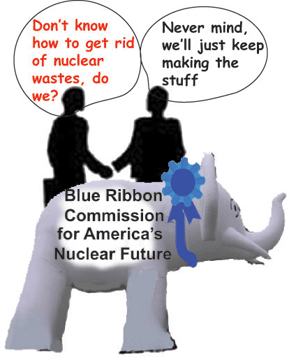
Meanwhile, the Energy Department remains decades away from developing a permanent repository.
 .At nearly every meeting of the San Onofre Community Engagement Panel, residents line up to ask whether sea air might cause corrosion in the casks, what the chance of leakage is, and who’s responsible if the casks degrade
As the amount of waste grows, so does the government’s liability……….The government’s estimated total liability is $29 billion.”That’s probably low, because it’s getting more expensive to store this stuff,”
Nuclear Plants Closing Early Leave Decades of Toxic Waste Stranded http://www.bloomberg.com/news/articles/2016-11-03/decades-of-toxic-waste-stranded-as-nuclear-plants-close-early Catherine Traywick ctraywick Mark Chediak markchediak November 4, 2016 —
-
U.S. government has no permanent repository for spent fuel
-
76,000 metric tons of waste stored at commercial sites Continue reading
Ukraine (over) confident of its nuclear waste storage plans
Nuclear Regulation Inspectorate approves preliminary spent nuclear fuel storage facility safety report http://en.interfax.com.ua/news/economic/381495.html, 4 Nov 16, A panel of Ukraine’s State Nuclear Regulation Inspectorate at a Thursday meeting approved a conclusion of the public examination of nuclear and radiation security under a preliminary safety analysis report for the centralized spent nuclear fuel storage facility.
“Thus, the panel confirmed that the spent nuclear fuel storage facility project meets the nuclear and radiation safety requirements. According to a resolution of the panel, some project safety solutions shortly described in the project will be presented in details at the next designing stage,” the press service of national nuclear generating company Energoatom said.
The conclusion will be sent to the State Architectural and Construction Inspectorate of Ukraine.
Energoatom President Yuriy Nedashkovsky said at the meeting of the panel, the discussion of the issues linked to construction of the centralized spent nuclear fuel storage facility should be accelerated.
“Technologies and project solutions selected for construction of the facility meet international spent nuclear treatment requirements and ensure reliable and safe storage of spent nuclear fuel from Ukrainian nuclear power plants (NPPs). The feasibility study of the centralized spent nuclear fuel storage facility passed public environmental examination and obtained a positive conclusion. Today all organization and legal issues related to construction of the storage facility have been settled. A delay with the start of construction would entail further financial losses for Ukraine, while the launch of the facility would considerably increase the country’s energy security,” he said.
Head of State Nuclear Regulation Inspectorate Serhiy Bozhko said that construction of spent nuclear fuel storage facilities is permanent global practice, but today this solution is only an intermediate link in settling the issue of treading spent nuclear fuel in a long-term outlook.
Japan’s danger: spent nuclear fuel pools
“Reprocessing of spent nuclear fuel is something only about one-fifth of countries operating nuclear power plants are paying any attention to, as most places like the UK and France are either halting operation or considering it,” said von Hippel.
“Declining international prices for low-enriched uranium, the fuel for light-water reactors, mean there is no economic value,” he explained.
If there’s a fire at spent nuclear fuel pool, 24 million would need to be evacuated http://english.hani.co.kr/arti/english_edition/e_international/768290.html by Lee Keun-young, senior staff write Nov.1,2016 Analysis indicates that method of storing spent nuclear fuel presents risk, and is going mostly ignored
More than 24 million people would have to be evacuated if a fire occurred at the water pool holding spent nuclear fuel at the Kori No. 3 Nuclear Power Plant, an analysis indicates.

“Analysis with HYSPLIT (Hybrid Single Particle Lagrangian Integrated Trajectory) model, the computer recognized by the US Nuclear Regulatory Commission (NRC) for assessment of atmospheric radiation exposure from a nuclear power plant accident, showed maximum damages covering an area of 54,000 square kilometers or over 50% the national territory, and the evacuation of up 24.3 million people due to leaking of cesium-137 (Cs-137) and other radioactive materials in the event of a fire in the Kori No. 3 reactor spent nuclear fuel water pool,” said senior researcher Kang Jung-min of the US Natural Resources Defense Council in an Oct. 31 debate at the National Assembly on the topic “How dangerous is spent nuclear fuel?”
HYPSLIT code was also the analytical program applied by the US at the time of the 2011 Fukushima Nuclear Power Plant disaster in Japan.
Averages from the analysis, which involved the inputting of meteorological conditions for the first weeks of the months January to December 2015, showed large-scale damages in other countries besides South Korea. In addition to the 5.4 million people who would have to be evacuated in South Korea, another 1.1 million would require evacuation in North Korea, 7.9 million in Japan, and 700,000 in China.
“The method of storing spent nuclear fuel in dense water pools presents a serious risk of accident from the loss of cooling functions, not just from an earthquake, tsunami or other natural disaster but also potentially from a terrorist or missile attack,” Kang said.
“To reduce the damage risk, we need to move [spent fuel] into dry storage facilities five to six years after it comes out of the reactor, and to store in a regular rather than dense way,” he added.
Princeton University professor Frank von Hippel noted the same day that “the US Nuclear Regulatory Commission reported benefits equivalent to just 10% of costs in the case of dry storage, but it also reduced the costs by limiting the danger radius to 80 km and using 1995 figure to calculate life values for cancer deaths.”
“It costs far less to move spent fuel into dry containers than it does to reprocess it,” von Hippel added.
In 2003, the US Congress asked the National Academy of Sciences (NAS) to review a plan for keeping spent nuclear fuel in water pool storage for five years before transferring it to dry containers and storing it on open racks. A report was published in 2006, but the NRC did not take action. Its benefit calculations were released only recently after the Fukushima disaster.
“Reprocessing of spent nuclear fuel is something only about one-fifth of countries operating nuclear power plants are paying any attention to, as most places like the UK and France are either halting operation or considering it,” said von Hippel.
“Declining international prices for low-enriched uranium, the fuel for light-water reactors, mean there is no economic value,” he explained.
Australia’s pivotal role in the global nuclear lobby’s pitch for survival
So – the Australian public dreams on – preoccupied with the Melbourne Cup and other sporting events. And the global nuclear lobby continues its machinations. It would be such a strong selling point, to be able to tell South Asian countries that they can go ahead with nuclear power, as Australia will take out the radioactive trash.
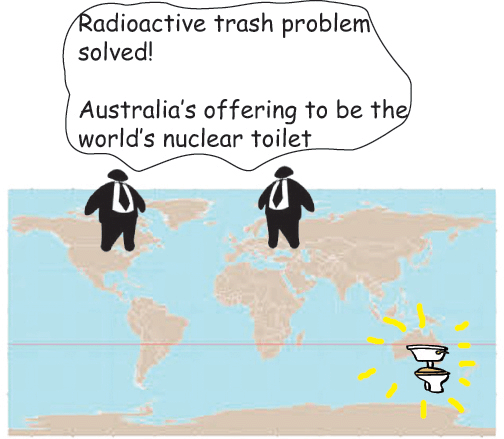
The machinations of the global nuclear lobby http://readersupportednews.org/pm-section/27-27/40006-the-machinations-of-the-global-nuclear-lobby-qdown-underq Noel Wauchope , 31 October 2016
Australia has been pretty much of a forgotten player in the global nuclear “renaissance”. Not any more. The big nuclear players – USA, Russia, Canada, France, China , Japan South Korea are busily marketing nuclear technology to every other country that they can. Strangely enough little ole non-nuclear Australia, (population 23 million) has a starring role to play in all this.
You see, the global nuclear lobby’s problem is – what to do with the radioactive wastes? I know that the new geewhiz guys and gals are pushing hard for Generation IV reactors that will “eat the wastes”. The trouble is – there is an awful lot of the stuff. World total of high level radioactive wastes was estimated at 250,000 tonnes in 2010 . There must be quite a bit more by now. The other trouble is that even the most geewhiz of the as yet non- existent Gen IV nuclear reactors still would leave a smaller but highly toxic volume of radioactive trash, which would still require disposal.
This leads to a serious marketing issue. If countries such as USA, Japan, Canada, South Korea, are still having trouble dealing with their own domestic accumulation of nuclear waste, how can they persuasively sell nuclear reactors to Asian, Middle Eastern and African countries? The waste problem must be solved!
The wizards of the global nuclear lobby have come up with what they see as the perfect answer. A far away land, with lots of space that’s owned by “unimportant” indigenous people, could import the wastes, and thus remove the problem. It’s a sort of variant on the old “toilet way down the back”. Continue reading
Secret documents reveal that British tax-payers will cop the costs of Hinkley’s nuclear wastes and any serious accident
The UK government accepts that, in setting a cap, the residual risk, of the very worst-case scenarios where actual cost might exceed the cap, is being borne by the government.”
Separate documents confirm that the cap also applies should the cost of decommissioning the reactor at the end of its life balloon.
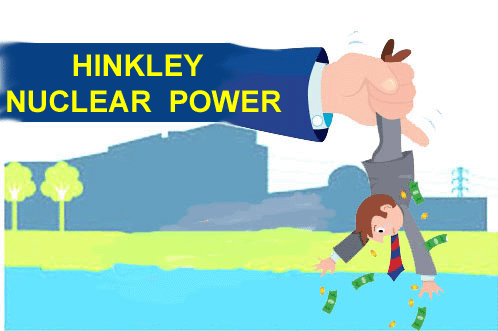 Secret government papers show taxpayers will pick up costs of Hinkley nuclear waste storagehttps://www.theguardian.com/uk-news/2016/oct/30/hinkley-point-nuclear-waste-storage-costs Documents show steps Whitehall took to reassure French energy firm EDF and Chinese investors,Guardian, Jamie Doward, 30 Oct 16, Taxpayers will pick up the bill should the cost of storing radioactive waste produced by Britain’s newest nuclear power station soar, according to confidential documents which the government has battled to keep secret for more than a year.
The papers confirm the steps the government took to reassure French energy firm EDF and Chinese investors behind the £24bn Hinkley Point C plant that the amount they would have to pay for the storage would be capped.
The Department for Business, Energy & Industrial Strategy – in its previous incarnation as the Department for Energy and Climate Change – resisted repeated requests under the Freedom of Information Act for the release of the documents which were submitted to the European commission.
“The government has attempted to keep the costs to the taxpayer of Hinkley under wraps from the start,” said Dr Doug Parr, Greenpeace chief scientist. “It’s hardly surprising as it doesn’t look good for the government’s claim that they are trying to keep costs down for hardworking families.”
But, earlier this month, on the very last day before government officials had to submit their defence against an appeal for disclosure of the information, the department released a “Nuclear Waste Transfer Pricing Methodology Notification Paper”. Marked “commercial in confidence”, it states that “unlimited exposure to risks relating to the costs of disposing of their waste in a GDF [geological disposal facility], could not be accepted by the operator as they would prevent the operator from securing the finance necessary to undertake the project”.
Instead the document explains that there will be a “cap on the liability of the operator of the nuclear power station which would apply in a worst-case scenario”. It adds: “The UK government accepts that, in setting a cap, the residual risk, of the very worst-case scenarios where actual cost might exceed the cap, is being borne by the government.”
Separate documents confirm that the cap also applies should the cost of decommissioning the reactor at the end of its life balloon. The level of the cap is unclear. But Dr David Lowry, a senior research fellow at the Institute for Resource and Security Studies in Cambridge, Massachusetts, who made the FoI request, said it was clear that the risk of footing the bill for a significant cost overrun had been transferred from Hinkley’s operator to the taxpayer.
“This shows that the government cares more about the economic future of a foreign power generator than British taxpayers,” Lowry said.
In return for the cap, the document reveals that Hinkley’s operator will pay the government a risk fee which “is expected to be relatively low, reflecting the high level of confidence that the cap will not be breached”.
But Lowry pointed out that the nuclear industry had form when it came to sizable cost over-runs. He warned that an accident that could force the closure of the reactor, either because of problems with it or at another plant, as happened in Japan, would leave the taxpayer having to pay billions of pounds for the clear-up years after it ceased generating revenues.
A government spokesman said: “All operators of new nuclear power stations in the UK are legally obliged to meet the full costs of decommissioning and their full share of waste management and disposal costs. They will also pay the UK government to dispose of the waste produced at the end of a plant’s life.”
Transport of nuclear waste – as big a problem as storage
Nuclear Waste Travels With One Heck Of An Entourage Truck Yeah, Andrew P Collins , 27 Oct 16 Do you compost? Rinse and separate your recycling? Yeah, getting rid of garbage is a pain. Unless your garbage is nuclear waste. Getting rid of that is apparently a production of epic proportions……..
National and Texas groups unite against nuclear waste “interim” storage scheme
 The groups are concerned that the “interim” storage facility may become the de facto permanent home
for the highly toxic waste……. taxpayers footing the entire bill, those that generated the waste would have no incentive to ensure its safe disposal in a permanent geologic repository.
‘storage sites’ likely would create a de facto high level national waste sacrifice zone.
 Four Groups Urge NRC To Halt Review Of License Application For High-level Nuclear Waste Dump In Texas https://www.yahoo.com/news/four-groups-urge-nrc-halt-review-license-application-143000265.html WASHINGTON and AUSTIN, Texas, Oct. 27, 2016 /PRNewswire-USNewswire/ –– Opposed to an industry scheme that risks a proposed short-term nuclear waste storage site becoming a permanent site while sticking taxpayers for the bill, four leading national and Texas groups — Beyond Nuclear, Nuclear Information and Resource Service (NIRS), Public Citizen, and the Texas-based Sustainable Energy & Economic Development (SEED) Coalition — are calling on the U.S. Nuclear Regulatory Commission (NRC) to follow the law and terminate its review of the license application for the controversial plan by Waste Control Specialists (WCS) to construct an interim high-level nuclear waste dump in Andrews County, TX.
WCS seeks a permit to build and operate the supposedly short-term storage facility for up to 40,000 metric tons of highly dangerous nuclear waste in Andrews County, but only if the U.S. government first assumes responsibility for the waste and further agrees to ship it to the Texas site by rail. The license application is for the first 5,000 metric tons but the company’s promotional materials show they are planning on expanding the site to accommodate more than half of the estimated 75,000 metric tons of commercial nuclear waste currently in the U.S.The groups are concerned that the “interim” storage facility may become the de facto permanent home for the highly toxic waste. Given the long battle over Yucca Mountain, the groups have zero confidence that Congress or federal regulators would have the stomach for fighting to move the nuclear waste a second time from WCS or any other “interim” site. And, with utilities totally off the hook and taxpayers footing the entire bill, those that generated the waste would have no incentive to ensure its safe disposal in a permanent geologic repository.
Available online at http://pubc.it/2eMSaXM, the letter from the four groups to the NRC’s top executive argues that the WCS proposal would require the NRC to break federal law, which bars the U.S. government from assuming responsibility for interim waste storage in the absence of a federal repository for permanent disposal. They contend that, until a long-term geological repository is ready, federal law forces utilities to solve their own interim storage problems, including bearing the economic burden for facility construction and operation, and liability for accidents.
The groups’ letter demands that NRC immediately drop its review of the WCS application, including its plans to embark on an environmental study.
High-level radioactive wastes are irradiated nuclear fuel rods, and short-term exposure at close range, with no shielding, can cause immediate death. Lesser exposure can cause death or cancer for over a million years. It is so dangerous that Congress required that it be buried deep underground in geologically isolated repository for millennia. This danger also prompted federal lawmakers to prohibit putting taxpayers on the hook for “interim” solutions that could become de facto permanent surface storage sites.
According to the groups, there is no safety imperative for moving the waste to a consolidated storage facility. The safety and security of our toxic nuclear waste stockpile, not financial gain for this private entity, should drive NRC waste storage activity. Rather than reviewing this premature and illegitimate proposal the NRC should focus its efforts on safeguarding the onsite storage of waste at nuclear facilities across the country.
“By requiring a permanent deep geological repository to be operating beforecentralized interim storage could be opened, Congress wanted to prevent the very real danger of a de facto permanent parking lot dump – a nuclear waste storage site that would be designed for the short-term but be there forever,” said Kevin Kamps, radioactive waste specialist, Beyond Nuclear. He added: “WCS is a cynical shell game and taxpayers are sure to lose. Congress was right that liability for the costs of storing commercial irradiated nuclear fuel belongs with the generators and should not be shifted onto the backs of the American public.”
Diane D’Arrigo, radioactive waste project director, Nuclear Information and Resource Service (NIRS), said: “Moving nuclear power waste over roads, rails and waterways to a supposedly temporary site puts us all at risk and creates only an illusion of a solution.”
Karen Hadden, executive director, SEED Coalition, added: “Due to risks of radioactive contamination from leaks or accidents or potential terrorist actions, nuclear waste should only be moved once, and only when a deep underground permanent repository is in place that could safely isolate the dangerous waste for the million years that it will remain hazardous.”
Tom “Smitty” Smith, director of the Public Citizen Texas office, said: “Texans do not consent to the risky plan to store high-level radioactive waste at private sites on an open pad above ground in Texas. Another company near Hobbs New Mexico – less than 50 miles away — is expected to file an application to open a storage site that would accept the rest of the nation’s high level nuclear waste. These twin ‘storage sites’ likely would create a de facto high level national waste sacrifice zone. This proposal invites disaster because the private owners will be cutting costs at every turn to maximize profits. If there was radioactive contamination our land, air, water, and human health could be harmed for millennia.”
USA’s Energy Secretary Moniz promoting nuclear industry for all he’s worth
 Moniz: Congress Should Authorize Interim Nuclear Fuel Storage, Morning Consult, | OCTOBER 24, 2016 Energy Secretary Ernest Moniz warned Monday that Congress and businesses need to act with more urgency to work out a medley of challenges in promoting nuclear power.
The United States is on track to experience a wave of nuclear plant retirements around 2030. …… Because raising capital and making the necessary business decisions on nuclear power is a slow process, there are only about five years left to start relicensing before many nuclear plants close. If more nuclear plants can extend their licenses to run for 80 years rather than 60, that would be “a very big deal” in terms of keeping nuclear power available, Moniz said.
This is important because the lack of a clear solution for storage of spent nuclear fuel creates a “significant headwind” for opening new nuclear facilities, Moniz said. He called on Congress to pass legislation creating an interim storage facility for spent nuclear fuel.
Moniz previously told a Senate Appropriations subcommittee the department might be allowed to store nuclear waste at a privately managed facility without congressional approval.
Even so, Moniz said Monday that it would help if Congress acted on the issue. “If Congress acted to give us the authorities — and whether public or privately held storage — we could be having a pilot facility running in not much more than five years,” he said…..
“I believe that consolidated storage, sometimes called interim storage, is absolutely essential,” Moniz said. “No matter when a geological repository is realized, interim storage should be part of the system.”……
The Different Dangerosity of Some Radioactive Elements.

One night in July 2013, Xavier Nast, a French antinuclear activist, who many years before used to work at COGEMA, presently named AREVA, took the time to explain me the diffrence between some of the radioactive elements, in terms of their dangerosity.
As Xavier Nast told me, nothing is worth practical exercises to understand what is not always obvious at the first explanation.
Since the beginning of the Fukushima accident, everyone understands the situation as he/she perceives it, and everyone is right it is very serious indeed, but still we haven’t seen almost anything yet. And what we may risk to see and understand?
When sharing the “galette des rois”in France, some king cakes in the old days were stuffed with a a small gold coin (a gold Napoleon). If a greedy one swallowed it inadvertently, he will have to wait one to two days to recover it but his health will not be affected. https://en.wikipedia.org/wiki/King_cake
Imagine the coins gold plated and filled with actinides (highly toxic alpharadio transmitters) such as they all weigh 6 grams, have a diameter of 21 mm and the same visual appearance:
A) An Uranium 238 filled gold plated coin
B) A Plutonium 239 filled gold plated coin
C) A Plutonium 238 filled gold plated coin
D) A Polonium 210 filled gold plated coin
We will not see any difference in appearance and weight.
However the threshold for the lethal dose of an inhaled monolithic dust is:
0.835gram for A (Uranium 238)
0.000 000 4 gram for B (Plutonium 239)
0.000 000 001 6 gram for C (Plutonium 238)
0.000 000 000 007 gram for D (Polonium 210)
This means that the lethal dose of these coins could destroy:
6 lives for A (Uranium 238, there is a lot)
13,475,000 lives for B, more than Paris Metropolis population (Plutonium 239,there is a lot)
3,700,000,000lives for C, more than half of mankind (Plutonium 238 is rare)
850 billion lives for D, 120 times the world population. (Polonium 210 is very rare)
Yet these coins A, B, C and D have not caused you any damage after being swallowed, not even long after.Because they were all covered with a tenth mm of gold , which prevented the huge flow of alpha particles to destroy even just a little of your digestive tract.
Conclusion:alpha emitters radionuclides must remain CONFINED.
We therefore better have no nuclear plant to explode, especially one of those nuclear plants using MOX, as MOX fuel consists of 7% plutonium 239 mixed with depleted uranium, such as the ones we have many in France.
Knowing this, are you still willing for them to continue using their deadly nuclear technology? Do you still believe that civil nuclear is safe?
Ukraine decides to cease paying Russia for nuclear waste disposal

 Ukraine to stop paying Russia for nuclear waste disposal Rt.com : 21 Oct, 2016 From next year Ukraine is not going to pay Russia $200 million annually to remove spent nuclear fuel from the country, according to Ukrainian Energy Minister IgorNasalik.
The country will build its own spent nuclear fuel storage facility, the minister announced.
The storage site chosen is in the exclusion zone of the Chernobyl nuclear power, but it is not designed to store nuclear waste for a long time.
The exclusion zone is a 30-kilometer radius from the Chernobyl nuclear power plant established by the USSR soon after the 1986 accident.
Construction of the new central used fuel storage facility is expected to start in March 2017, according to a director of a subsidiary of the Ukrainian nuclear power plant operator Energoatom.
European nuclear industry experts are concerned the Ukrainian project does not meet standards for nuclear safety and creates a risk of a radioactive accident.
In August, the former director of the Chernobyl nuclear power plant Mikhail Umanets warned of the rising number of emergency situations in Ukraine’s nuclear energy sector, stressing the country would face a “collapse” in the sector within seven years……https://www.rt.com/business/363655-ukraine-nuclear-waste-russia/
Dairyland Power gets major compensation for radioactive trash from its nuclear reactor that closed in 1987
Feds to pay Dairyland $73.5 million in nuclear settlement Dairyland Power has reached a major settlement with the U.S. Department of Energy over nuclear waste stored from its former nuclear reactor located at the La Crosse Boiling Water Reactor in Genoa.
The e-waste mountains – in pictures
 The e-waste mountains – in pictures https://www.theguardian.com/global-development-professionals-network/gallery/2016/oct/18/the-e-waste-reduce-waste-old-technology-mountains-in-pictures Sustainable development goal target 12.5 is to reduce waste. But with a planet increasingly dependent on technology, is that even possible? Kai Loeffelbein’s photographs of e-waste recycling in Guiyu, southern China show what happens to discarded computers Anna Leach @avleachy 19 October 2016
Britain’s old dead nuclear submarines – no way to dispose of them for decades
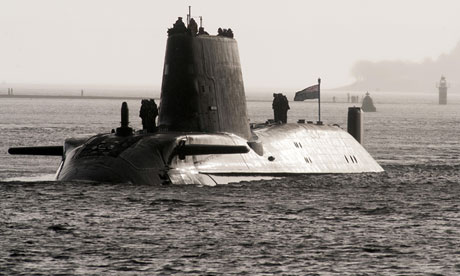 Navy’s old nuclear submarines ‘will not be finally disposed of until after 2040’, Telegraph, defence correspondent 18 OCTOBER 2016
A lack of money, expertise and disposal sites mean derelict British nuclear submarines containing radioactive material will not be fully dismantled and disposed of for 25 years, officials have admitted.
The Royal Navy has 19 old nuclear-powered submarines stored in ports waiting to be dismantled, with another eight due to retire and join them in the coming years.
HMS Dreadnought, the Navy’s first nuclear-powered submarine, has been waiting to be dismantled since it retired 36 years ago. Ministry of Defence officials told MPs that radioactive parts on board could not be finally disposed of until an underground dump for all of the UK’s nuclear waste has been chosen and built. That site is not due to be ready until 2040.
The submarines are currently stored at Devonport, near Plymouth, and at Rosyth, on the Firth of Forth.
Stephen Lovegrove, permanent secretary at the MoD, told the Commons defence committee that a lack of money and skills meant it was impossible to speed up the process……..Ministry of Defence officials told MPs that radioactive parts on board could not be finally disposed of until an underground dump for all of the UK’s nuclear waste has been chosen and built. That site is not due to be ready until 2040.
The submarines are currently stored at Devonport, near Plymouth, and at Rosyth, on the Firth of Forth.
Stephen Lovegrove, permanent secretary at the MoD, told the Commons defence committee that a lack of money and skills meant it was impossible to speed up the process…..http://www.telegraph.co.uk/news/2016/10/18/navys-old-nuclear-submarines-will-not-be-finally-disposed-of-unt/
South Australian government pushes the global nuclear lobby’s agenda
Ultimately, this dump is about helping the global nuclear industry. The current build-up of site-by-site waste acts as a brake on investment. They want somewhere to dump it forever so they can go on producing more of it.
South Australia to become global nuclear waste capital https://redflag.org.au/node/5521 Sixty years ago, Maralinga went up in a mushroom cloud. The British government had been given permission to test atomic weaponry in South Australia.
That is to say, they had been given permission by the right wing Menzies government. The local Maralinga Tjarutja people had no say in it at all. Many of them were not even forewarned of the first blast. Thunderous black clouds condemned them to radiation exposure, illness and death, the survivors being driven from their homeland during the long years of British testing and fallout.
South Australia has a dark history with the nuclear industry. Maralinga remains contaminated, despite cheap clean-up efforts. Uranium tailings have leaked from BHP’s Olympic Dam mine at Roxby Downs. Fukushima’s reactors held South Australian uranium when catastrophe struck in 2011.
Today, Jay Weatherill’s state Labor government is trying to open a new radioactive chapter. He wants South Australia to construct the world’s first international high-level nuclear waste dump. This would mean no fewer than 138,000 tonnes of waste (one-third of the world’s total) being shipped from the world’s reactors into South Australian ports, to be permanently buried in Aboriginal land.
This would be history’s largest nuclear dumping operation, and make South Australia the hazardous waste capital of the world.
Weatherill, aware of most people’s instinctive and rightful mistrust of anything nuclear, has launched a meticulous, expensive PR campaign. He is trying to fit a Hello Kitty mask onto Mr Burns.
The propaganda machine was put into motion by the Nuclear Fuel Cycle Royal Commission, at a cost of $7.2 million. Headed by Kevin Scarce, a former naval officer and South Australian governor, the commission imagines a lip-licking profit to be made by importing and burying the waste. It also recommends expanding uranium mining and laying the groundwork for nuclear power generation.
To soothe concerns, the government is periodically erecting “Know Nuclear” stalls across the state. These stalls spread misinformation. For instance, the government pamphlet “What is Radiation?” boasts that bananas contain potassium-40, a low-level radionuclide found in nature. But they make no comparison to human-made fission products such as strontium-90, which releases almost 20 million times more radiation than your friendly fruity isotope.
In August, more than 150 high school students were whisked to a secretly organised forum about the future of nuclear industry in the state. Secrecy was justified by the suggestion that violent anti-nuclear protesters might endanger the pupils.
Why does the state need to pour such big bucks into this festival of confusing roadshows, misleading science, TV ads and youth re-education sessions? Because most people who know anything about nuclear waste will recognise the danger posed by the proposed dump.
We live in a country in which black lung disease has re-emerged. Mining companies, in a world of competition, refuse to pay for basic safety measures to prevent excessive coal dust inhalation. This logic of cutting costs infuses all business under capitalism; nuclear waste dumps are no exception. As the MUA correctly stated: “Maritime workers – seafarers and wharfies – will be the first exposed to this toxic waste … Nowhere on this planet has a country designed a safe repository for nuclear waste”.
Indeed, the most technologically advanced repositories in the world, no matter how deep underground, have failed. Over many years, German radioactive waste had been disposed of in a deep facility in Lower Saxony. In 2008, it was discovered that some of the 126,000 barrels of waste had been leaking into ground water for decades. In 2014, New Mexico’s Waste Isolation Pilot Plant suffered a burst drum, contaminating the whole facility, including ventilation and surrounding air. Soon after, workers at the plant tested positive for radiation exposure.
This is the most hazardous waste ever produced by industry or the military. The royal commission explains that this stuff “requires isolation from the environment for many hundreds of thousands of years”. That makes the Roman Empire seem like yesterday; it is longer than the human race has existed.
Moreover, previous projects have involved only national waste storage; to transport waste by sea to an international dump has never been attempted and involves multiple dangers of accidental spillage.
Ultimately, this dump is about helping the global nuclear industry. The current build-up of site-by-site waste acts as a brake on investment. They want somewhere to dump it forever so they can go on producing more of it.
Third ceiling collapse at Nuclear Waste Isolation Pilot Plant
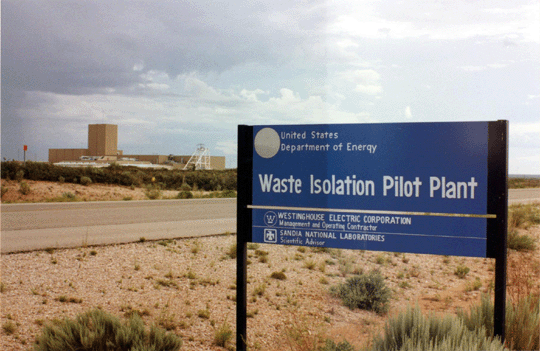 Waste Isolation Pilot Plant sees third ceiling
collapse, Aiken Standard, By Thomas Gardinert gardiner@aikenstandard.com Oct 8 2016 New Mexico’s Waste Isolation Pilot Plant has suffered its third ceiling collapse.
The first collapse was discovered Sept. 27, and the following two happened this past week. The third collapse was identified on Friday morning and was found to have followed the cave-in earlier in the week.
According to a WIPP update sent Friday evening, the area of the collapse continues to remain restricted for workers and employees. According to SRS Watch Director Tom Clements, who has been inside the facility, material regularly comes off of the walls and ceiling.
WIPP is an underground facility, cut into salt beds. Over time, groundwater and other natural forces are designed to form the salt deposits around the waste containers. He said the facility was designed to encase the nuclear waste buried there to permanently dispose of the material…
The WIPP facility was shut down in 2014 after a containment leak and an underground salt-truck fire. The facility is set to reopen in December 2016 and shipments are expected to resume in the fall of 2017.
WIPP is the intended resting place for some of the nuclear material at South Carolina’s Savannah River Site near Aiken. The Energy Department is currently disposing of plutonium through a process called dilute and dispose. That material is among those eventually intended for WIPP disposal.
According to the WIPP update, emergency evacuation routes were also out of date. The routes were still based on the facility before sections were closed, including the areas where the cave-ins occurred. The update said, “The Department of Energy identified a deficiency in the WIPP Mine Escape and Evacuation Plan, which still relied on evacuation routes established before some areas had been posted as prohibited. NWP had identified compensatory measures – immediate changes that could be made while the Evacuation Plan is formally updated.”
1 This Month


31st January – Challenging the War Machine – a DECLASSIFIED UK SUMMIT



Website of the Week
Now until to February 10, 2026 Radioactive waste storage in France: the debate is finally open! How to participate?
-
Archives
- January 2026 (220)
- December 2025 (358)
- November 2025 (359)
- October 2025 (377)
- September 2025 (258)
- August 2025 (319)
- July 2025 (230)
- June 2025 (348)
- May 2025 (261)
- April 2025 (305)
- March 2025 (319)
- February 2025 (234)
-
Categories
- 1
- 1 NUCLEAR ISSUES
- business and costs
- climate change
- culture and arts
- ENERGY
- environment
- health
- history
- indigenous issues
- Legal
- marketing of nuclear
- media
- opposition to nuclear
- PERSONAL STORIES
- politics
- politics international
- Religion and ethics
- safety
- secrets,lies and civil liberties
- spinbuster
- technology
- Uranium
- wastes
- weapons and war
- Women
- 2 WORLD
- ACTION
- AFRICA
- Atrocities
- AUSTRALIA
- Christina's notes
- Christina's themes
- culture and arts
- Events
- Fuk 2022
- Fuk 2023
- Fukushima 2017
- Fukushima 2018
- fukushima 2019
- Fukushima 2020
- Fukushima 2021
- general
- global warming
- Humour (God we need it)
- Nuclear
- RARE EARTHS
- Reference
- resources – print
- Resources -audiovicual
- Weekly Newsletter
- World
- World Nuclear
- YouTube
-
RSS
Entries RSS
Comments RSS
 nuclear-news