WIPP continues to receive shipments, June 26, 2017, By KEVIN TREVELLYAN, ktrevellyan@postregister.com
Shipments of transuranic waste continue to leave Idaho, though not nearly fast enough to meet a looming cleanup milestone.
The Waste Isolation Pilot Plant in Carlsbad, N.M., has accepted 17 waste shipments from Idaho since April, U.S. Department of Energy-Idaho Assistant Manager Jim Malmo said Thursday during an Idaho National Laboratory Citizens Advisory Board meeting in Idaho Falls.
The WIPP repository temporarily closed in 2014 after a pair of accidents resulted in a low-level release of radioactive material. The closure put into jeopardy a 1995 Settlement Agreement stipulation that DOE ship 65,000 cubic meters of stored transuranic waste from Idaho before the end of 2018.
Since reopening, WIPP has accepted shipments at a much slower pace because of ongoing facility repairs……..
Most of Idaho’s transuranic waste was generated at the Rocky Flats Plant outside Denver. The waste, buried in Idaho in the 1950s, ’60s and ’70s, includes plutonium-laced sludges, graphite materials and filters.
If DOE fails to meet the 1995 Settlement Agreement milestone, the state can block INL from receiving shipments of spent fuel for research.
Fuel shipments already have been blocked because of delays in getting the Integrated Waste Treatment Unit operating.http://www.postregister.com/articles/news-daily-email-todays-headlines/2017/06/26/wipp-continues-receive-shipments
June 28, 2017
Posted by Christina Macpherson |
USA, wastes |
Leave a comment
 Judge Rules Against WCS – EnergySolutions Merger http://www.ladailypost.com/content/judge-rules-against-wcs-energysolutions-merger, by Chris Clark June 24, 2017 , CCNS News: Federal District Judge Sue L. Robinson entered her sealed opinion Wednesday in favor of the U.S. Department of Justice and prohibited Waste Control Specialists (WCS) and EnergySolutions from moving forward with the proposed $367 million merger of the two-nuclear waste storage and disposal companies.
The judge’s decision was based on anti-trust law.
In a written statement, Andrew Finch, acting assistant attorney general of the Justice Department’s Antitrust Division, said, “Substantial evidence showed that head-to-head competition between EnergySolutions and Waste Control Specialists led to better disposal services at lower prices.”
He continued, “
Today’s decision protects competition in an industry that is incredibly difficult to enter. While EnergySolutions’ preference was to buy its main rival rather than continue to compete to win business, today’s decision ensures that customers will benefit from the competitive process.”
In anticipation of the antitrust trial and the growing expenses involved in expanding WCS’s business to include the storage of plutonium fuel from U.S. nuclear power plants, in April, WCS asked the Nuclear Regulatory Commission (NRC) to temporarily suspend review of its application.
WCS applied for a 40-year license to build and operate a consolidated interim storage facility for 44,000 tons of high-level radioactive waste. WCS planned to build the de facto parking lot dump on its 14,900 acres on the New Mexico-Texas border, five miles east of Eunice, New Mexico.
June 26, 2017
Posted by Christina Macpherson |
Legal, USA, wastes |
Leave a comment
some of the biggest dangers still lie ahead, and many of them come back to that small green train of so many years ago. An updated and safer versions of it will be hauling Andreyeva Bay’s waste south from Murmansk, but that shouldn’t belie the fact that transporting spent nuclear fuel over such distances is always dangerous.
More dangerous still is the location where the spent fuel will end up, which is one of the most radioactively contaminated spots in the world.
 Decades of piled up nuclear fuel bids farewell to Andreyeva Bay http://bellona.org/news/nuclear-issues/2017-06-decades-of-piled-up-nuclear-fuel-bids-farewell-to-andreyeva-bay Two decades ago, a green four-car train would make the rounds every few months to Russia’s snowy Kola Peninsula to cart nuclear fuel and radioactive waste more than 3000 kilometers south from the Arctic to the Ural Mountains. June 23, 2017 by Charles Digges charles@bellona.no

Two decades ago, a green four-car train would make the rounds every few months to Russia’s snowy Kola Peninsula to cart nuclear fuel and radioactive waste more than 3000 kilometers south from the Arctic to the Ural Mountains.
At the time, the lonely rail artery was the center of a logistical and financial bottleneck that made Northwest Russia, home of the once feared Soviet nuclear fleet, a toxic dumping ground shrouded in military secrecy.
More than a hundred rusted out submarines bobbed in the icy waters at dockside, their reactors still loaded with nuclear fuel, threating to sink or worse. Further from shore and under the waves laid other submarines and nuclear waste intentionally scuttled by the navy. Still more radioactive spent fuel was piling up in storage tanks and open-air bins, on military bases and in shipyards.
One of those places was Andreyeva Bay, a run down nuclear submarine maintenance yard just 55 kilometers from the Norwegian border. Since the birth of the nuclear navy in the 1960s, the yard came to be a dumping ground for 22,000 spent nuclear fuel assemblies offloaded from hundreds of submarines. Cracks in storage pools made worse by the hard Arctic freeze threatened to contaminate the Barents Sea. At one point, experts even feared the radioactive morgue might spark an uncontrolled nuclear chain reaction.
Infrastructure, technology and the Kremlin were failing to keep up with the mushrooming catastrophe. The nuclear fuel train could only bear away 588 fuel assemblies at a time three or four times a year – little more than the contents of one nuclear submarine per trip. Even if the train ran on schedule, removing broken or deformed nuclear fuel elements at Andreyeva Bay was still seen as impossible.
Yet even mentioning the environmental and security storm clouds was taboo: While the Navy begged the public to donate potatoes to feed sailors it was too broke to pay, the Kremlin prosecuted environmentalists who drew attention to the mounting desperation as spies.
In the bleak and politically chaotic late 1990s, many experts, like Bellona’s Andrei Zolotkov, thought that the carcinogenic remains of the Cold War would lie neglected at Andreyeva Bay for decades – or at least until Russia somehow woke up wealthy enough to deal with them.
Now, Russia is only slightly better off, yet the first containers of spent nuclear at Andreyeva Bay will begin to be bourn away by sea on June 27, marking the culmination of a multi-million dollar international effort sparked by Bellona in 1995.
The first container was packed last month. It and the 2999 that will follow will leave Andreyeva Bay on specially outfitted ships like the Rossita – itself a bit of expertise donated by Italy under the Northern Dimensions Environmental Partnership, an enormous Russian nuclear cleanup fund managed by the European Bank of Reconstruction and Development.
The transport ships will join a railhead at Atomflot, Murmansk’s nuclear icebreaker port, and from there, the fuel containers will go by train to the Mayak Chemical Combine, near the Urals city of Chelyabinsk, for reprocessing.
It’s a mammoth effort. A total of about 40 ship-to-train transports will have to be made before the bulk of the fuel is cleared out over the coming five years. But when it’s done, one of the most deviling radiation threats in the Arctic will be history.
Bring the waste out of the shadows
“The Andreyeva Bay project has shown that international projects aimed at liquidating nuclear and radioactive threats can be successful,” said Alexander Nikitin, the Bellona expert who was charged with espionage and later acquitted for bringing to light the embarrassing truth of Russia’s northern nuclear fleet more than 20 years ago. “This is proof that such projects must continue.”
The success hasn’t necessarily loosened the grip of the Soviet-era mindset. Russian nuclear officials have so far denied Norwegian television cameras access to film the first nuclear waste departure from Andreyeva Bay, an event that will be attended by the country’s foreign minster, Børge Brende, Russian officials and Bellona staff.
It also hasn’t eased Kremlin paranoia toward Bellona and its efforts to spur international attention and bring foreign funding to bear on Cold War nuclear relics. Zolotkov’s Bellona Murmansk, which helped dislodge Andreyeva Bay’s troubles from the shadows, was targeted by Russia’s foreign agent law in 2015 and closed down. The Environmental Rights Center Bellona, headed by Nikitin, followed this year.
But Zolotkov said the progress transcends politics.
“Even in complex political circumstances, international cooperation in nuclear and radiation safety in Russia’s North continues,” he said.
Cracks and contamination
Andreyeva Bay had been piling up spent nuclear submarine fuel for more than two decades when its troubles began in earnest in 1982. That year, a crack developed in its now-notorious Building 5, a storage pool for thousands of spent fuel assemblies. The ensuing leak threatened to dump a stew of plutonium, uranium and other fission products into Litsa Fjord, fouling the Barents Sea.
The water was drained and the fuel painstakingly moved, but that revealed other problems. The fuel elements from Building 5 needed somewhere to go, so they were rushed into hastily arranged storage facilities that were supposed to be only temporary. Technicians stuffed the fuel elements into three dry storage buildings and cemented them in. The temporary storage solution has now spanned the last 30 years. Meanwhile the leaking radioactive water contaminated much of the soil around Building 5.
It took the government years to catch up to the problem. In 1995, the Murmansk regional government paid it first visit to the secretive military site and, based on what it saw, shut down its operations. Five years later Moscow finally got involved, taking Andreyeva Bay out of the military’s hands and giving it to the mainly civilian Ministry of Atomic Energy, now Rosatom.
Rosatom helped coalesce a nuclear waste-handling agency in Murmansk, called SevRAO, to deal with the problem. Yet even in 2000, SevRAO was essentially working from scratch. Anatoly Grigoriev, a Rosatom nuclear safety official said last year that there weren’t even documents detailing what waste and fuel was stored where, much less an infrastructure to help safely get rid of it.
Bellona leads the charge
Norway, at Bellona’s urging, led the charge to pitch in.
Finally, in 2001, an enclosure was built over the three storage buildings to prevent further contamination while technicians worked to remove the spent fuel and load it into cases. Roads were built and cranes were brought in. Personnel decontamination posts went up, along with a laboratory complex and power lines.
A host of nations pumped funding into the burgeoning city whose central industry was safely packing up decades of nuclear fuel from Russia’s past nuclear soldiers. Starting in 2003, France, Germany, Japan, Italy, Canada and Great Britain, joined by Finland, Denmark, Sweden, and the European Commission pooled resources for a total contribution of $70 million over several years.
But Norway has led the pack by far, contributing some $230 million over the past 20 years toward safely removing Andreyeva Bay’s spend nuclear fuel – a national movement spawned when Bellona published its first report on Northwest Russia’s nuclear hazards in 1996.
“For Bellona, this event is a very important development,” said Zolotkov. “Bellona was the first group to speak openly about the problems of Andreyeva Bay, and Bellona stepped forward with a report on the developing situation.”
Nikitin agreed. “This is very important for the outlook of our work in Russia because all now see that we are capable of achieving a result, and not simply criticizing and protesting.”
In many ways, however, some of the biggest dangers still lie ahead, and many of them come back to that small green train of so many years ago. An updated and safer versions of it will be hauling Andreyeva Bay’s waste south from Murmansk, but that shouldn’t belie the fact that transporting spent nuclear fuel over such distances is always dangerous.
New dangers to bring to light
More dangerous still is the location where the spent fuel will end up, which is one of the most radioactively contaminated spots in the world.
The Mayak Chemical Combine, the birthplace of the first Soviet atomic Bomb, is the one facility in Russia capable of reprocessing spent fuel from submarines. It also gave the country its first nuclear disaster. In 1957, a tank holding nuclear waste exploded, sending a cloud of radioactivity from Chelyabinsk to Yekaterinburg and forced the evacuation of 17,000 people. Called the Kyshtym Disaster, the accident came to be regarded as Chernobyl’s more secretive older brother.
Since Mayak ramped up fuel reprocessing at its RT-1 facility in 1977, contamination has only intensified. Radioactive byproducts arising from the chemical separation of plutonium and uranium have been dumped into local rivers and lakes. Cancer rates among the local population continue to rise. The government has partially acknowledged the issue and has made stutter-step attempts to move a number of small villages away from the radioactively polluted Techa River. In the end though, those efforts only displaced villagers from one contaminated spot to another, solving nothing.
Some activists have noted that moving Andreyeva Bay’s legacy of Cold War reactor fuel 3,000 kilometers south to Mayak is a similar exercise in displacement.
Nadezhda Kutepova, a long time advocate for those afflicted by Mayak’s pollution, who was run out of the country on manufactured espionage suspicions, said Norway’s contribution to moving Andreyeva Bay’s fuel was a waste of money.
She and others recently told the Independent Barents Observer they thought the Norwegian government would be lessening the woes of one radioactively contaminated area in the country at the expense of another.
While Niktin acknowledged that Mayak was far from ideal, he noted that it was the only place in Russia that had the technology to handle the Andreyeva fuel.
But he said that shipping the fuel to Mayak also ratchets up Bellona’s responsibility for bringing to light yet newer stages of dealing with Russia’s radioactive legacy.
“The task of the public, and Bellona with it, is to ensure that Mayak doesn’t use any dirty technologies that end up throwing radioactive waste into the environment,” he said. “We must also step up to liquidate the injuries that have already happened to the environment as a result of Mayak’s work and the accident.”
In other words, if Andreyeva Bay is a measure of Bellona’s success, Mayak could repeat that history.
June 24, 2017
Posted by Christina Macpherson |
EUROPE, Reference, Russia, wastes |
Leave a comment

 Perry says no decision made on interim nuclear waste storage in Nevada, Las Vegas Review Journal June 21, 2017 WASHINGTON — Energy Secretary Rick Perry clarified a previous statement on interim nuclear waste storage, telling a Senate subcommittee Wednesday that no decisions have been made on temporary sites for spent fuel in Texas, New Mexico or Nevada.
Private companies in New Mexico and Texas have submitted applications to the Nuclear Regulatory Commission to store nuclear waste on an interim basis.
Perry created a firestorm Tuesday when he suggested to the House Appropriations subcommittee on energy that the Nevada National Security Site could store waste temporarily.
The suggestion brought an avalanche of criticism from Nevada Gov. Brian Sandoval and members of the state’s congressional delegation who called the proposal ill-conceived and likely illegal because of restrictions involving the former nuclear test site northwest of Las Vegas.
Before the Senate Appropriations subcommittee on energy, Perry clarified the statement to note that no decision has been made on interim storage and that any such plan would require coordination with Congress.
“I think it is appropriate to say, there are no plans at this particular time for interim storage in New Mexico, Nevada or Texas or any other site,” Perry said…..https://mail.google.com/mail/u/0/#inbox/15cd262afeb49316?compose=15cd3e0979cb83a3
June 23, 2017
Posted by Christina Macpherson |
politics, USA, wastes |
Leave a comment
 Perry repeats desire to store nuclear waste in Nevada; state officials respond, News 4 , by Tony Garcia, LAS VEGAS (KSNV News3LV) —
Nevada’s state and national elected officials reacted swiftly Tuesday after Energy Secretary Rick Perry said he wants to build interim nuclear waste facilities at the Nevada National Security Site and called constructing a long-term repository at Yucca Mountain a “moral obligation.”
“Today’s comments by Secretary Perry suggesting he would consider storage of high-level nuclear waste at the Nevada National Security Site come as a complete blindside, and I view this as a total disregard and failure to honor the historical process,” Nevada Gov. Brian Sandoval said in a statement.
“The idea of storing high-level nuclear waste at the National Security Site is ill-conceived, irresponsible, and likely illegal. This is a prime example of federal overreach, and Nevada will pursue every legal option at our disposal.”
Sandoval added that he has asked Nevada Attorney General Adam Laxalt to review the proposal and identify legal avenues to stop it.
“Let me be clear – no part of Nevada will be home to the world’s most toxic waste and we will fight every effort that puts our citizens at risk,” Sandoval said.
“Secretary Perry’s comments today are irresponsible, reckless, and show a blatant disregard for the state of Nevada,” U.S. Sen. Dean Heller (R) said in a statement. “As I have repeatedly told the Secretary, Nevada will not serve as our nation’s nuclear waste dump. The only viable solution to our country’s nuclear waste problem is one that is rooted in consent, and Nevada has said ‘no.’….
“I am appalled to see how tone-deaf this administration is in refusing to listen to the collective voice of an entire state,” said U.S. Rep. Jacky Rosen. “The only moral obligation we have is to keep Nevadans safe from nuclear waste. If Secretary Perry thinks that he alone can restart Yucca Mountain with the flip of a switch, he is mistaken. Since the 1980s, Nevada has voiced its opposition to Yucca Mountain based on legitimate safety concerns.
“Today’s comments by Secretary Perry are wrong and dangerous. Reviving Yucca Mountain as a nuclear waste dump would place Nevada and communities around the country in harm’s way by green-lighting daily regular shipments of high-level nuclear waste by train or by truck for over 50 years.” http://mynews4.com/news/local/sandoval-and-other-officials-respond-to-perrys-desire-to-store-nuclear-waste-in-nevada
June 23, 2017
Posted by Christina Macpherson |
politics, USA, wastes |
Leave a comment
 http://www.fairewinds.org/newsletter-archive//oegf127i8zwvkcg5koxzivdipspzk9, June 22, 2017, Demystifying Nuclear Power, Atomic Power and a Just Transition for ‘Host Communities’ By Maggie Gundersen &Ben Shulman-Reed, Atomic power plants are shutting down faster than they are being built. These reactors conceptualized in the 1960s are failing because they are old and they are being closed because they are not competitive with renewables and therefore economically unfeasible. People around the world understand that a Fukushima-like disaster can happen anywhere, anytime. The nuclear power industry that dreams of building a new nuke every twelve days for the next 35 years) – totaling 1000 new rectors by 2050) are facing the harsh reality that atomic energy is not needed and is no longer wanted.
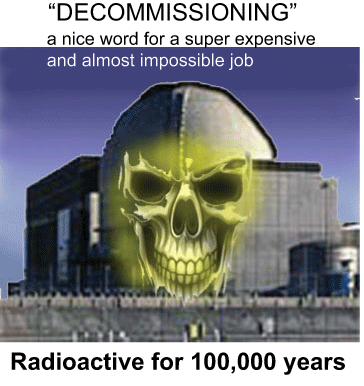
In the United States (U.S.), where largest amount of atomic power reactors in the world are located, Pilgrim in Massachusetts, Indian Point outside New York City, Oyster Creek in New Jersey, Diablo Canyon in California, and most recently Three Mile Island in Pennsylvania have recently announced their intent to close in the near future. While the shutdown of American nukes is good for our economy as well as the planet’s environment, decommissioning is a costly and complicated process that takes a toll on the local communities that hosted these giant facilities. When a nuclear power reactor shuts down, an incredible amount of work must be done to ensure a just, smooth financial transition for the local economy and also to create long-term viable storage for its toxic radioactive waste, which the U.S. Government has failed to provide. In addition to hosting the physical radioactive carcass of the power reactor for decades, the local community must restructure its economy to make it more diverse and self-sufficient as well as creating a more healthy and sustainable energy future.
Unfortunately, the usually small and economically stifled cities and towns, often referred to as ‘host communities’ to these atomic power reactors are not always given a voice at the table when it comes to deciding plans for their future – yet they are the true stakeholders. Fairewinds has continuously monitored and reported upon the challenges and defects of the Vermont Yankee atomic reactor and the lack of stakeholder respect given to its Windham County host. When it came time to close reactor in 2014, the Vermont Legislators and State Officials found themselves having to stand up to both Entergy (Vermont Yankee’s parent corporation), and the Nuclear Regulatory Commission (NRC) the alleged federal regulator for the nuclear power industry, for the Vermont’s own State’s rights and for the rights of all Vermont citizens.
Vermont is still negotiating the terms of the decommissioning process for Vermont Yankee – the state’s lone nuclear power plant and is becoming a leading example for nationwide regarding how to advocate for a smooth and just transition from atomic power operations to decommissioning and dismantlement. Vermont is seeking a just transition that will protect all the stakeholders, not only the profit interests of the power plant’s corporate owners.
The real question for all nuclear power plant host communities is: who is protecting and advocating for the rights of the ratepayers, for the level of decontamination at the site, nearby aquifers and watersheds, and an orderly economic transition for all the people in the impacted surrounding communities? The Nuclear Regulatory Commission (NRC), while the controlling interest in radiological standards and decommissioning processes on each site, does not examine or consider any of these critical human rights issues. All the environmental justice and human rights issues of assuring ongoing open access to clean air, safe water, and uncontaminated food from the remaining carcass of a shutdown atomic power reactor falls upon local and state governments throughout the US. Vermont is leading the way in creating an open and transparent process for local communities to self-advocate in creating a safer and more transparent decommissioning process and transition to a safe and permanently uncontaminated dismantlement of these highly radioactive nukes.
By opening a wide dialogue as we all advocate for an open and transparent decommissioning process, we believe the U.S. can shed its title of founding nuclear energy and instead become a global leader in cleaning up the mess we started. By following Vermont’s of paying close attention to the interests of our local governments, ratepayers and host communities, we all will begin to achieve just and safe transitions from the glut of toxic radioactive nuclear power plant carcasses coming our way as atomic power continues to become economically unviable.
It is Fairewinds’ goal to help communities work together to achieve a safer transition in their energy futures by shifting energy paradigms to an economically feasible and environmentally compatible model for the health and survival of our species and our planet.
June 23, 2017
Posted by Christina Macpherson |
decommission reactor, USA |
Leave a comment
VERNON, Vt., 22 June 17, — Vermont and three other states that host Entergy Nuclear power plants scheduled for shutdown can expect to keep spent radioactive fuel for the foreseeable future, a top Nuclear Regulatory Commission official said Tuesday.
John Lamb, project manager from the Office of Nuclear Reactor Regulation, told a gathering of officials from Vermont, Massachusetts, New York and Michigan there appears to be little interest in Congress to pay for additional studies into Yucca Mountain, the proposed national depository for highly radioactive spent nuclear fuel in the Nevada desert.
“Yucca Mountain is basically in a stall,” Lamb said in response to a series of questions from Massachusetts antinuclear activists during a conference call. He said legislation to breathe new financial life into the Yucca Mountain site, which is about 100 miles north of Las Vegas, had gone nowhere so far.
“Dry cask (storage) is going to stay until some solution,” Lamb said……http://www.recorder.com/NRC-Vermont-Yankee-waste-remaining-in-Vernon-10850130
June 23, 2017
Posted by Christina Macpherson |
USA, wastes |
Leave a comment
Proposed nuclear waste dump draws Congressional ire http://www.voicenews.com/news/proposed-nuclear-waste-dump-draws-congressional-ire/article_743d7c7d-d48f-5d35-bcaa-1ab7c08496c8.html OPG appears to sidestep Canada’s request for more details By Jim Bloch | For The Voice Jun 14, 2017
Ontario Power Generation’s latest submission to the Canadian government about its proposed nuclear waste dump on the shores of Lake Huron continues to be evasive and overly broad, according to critics of the project.
In OPG’s Dec. 28, 2016, response to the Canadian Environmental Assessment Agency, the power company chose two enormous geological formations comprising about 75 percent of the entire province: The crystalline rock of the Canadian Shield, which is about a billion years old, and the sedimentary rock formations of southern Ontario, which are 354 million to 543 million years old.
The CEAA also requested further analysis of the cumulative effects that the dump could have on the environment, especially if a high-level waste dump is built nearby, and an updated list of OPG’s commitments to reduce “each identified adverse impact” of the deep geological repository on the environment.
Despite its 144 pages, OPG’s new report did not satisfy opponents.
Congressional delegation responds
U.S. Rep. Debbie Dingell, of Michigan’s 12th District, and Rep. Dave Trott, of Michigan’s 11th District, wrote a letter to Secretary of State Rex Tillerson on June 7, urging him to enter the fray against the dump.
“We write to urge you to do everything in your power – through both diplomatic and legal channels – to protect our Great Lakes and to convince the Canadian government to require OPG to select an alternative site that will not place the health, safety, and economic security of Americans at risk,” said Dingell and Trott in the letter.
Thirty-two bipartisan Congressional representatives from the Great Lakes states co-signed the letter, including Paul Mitchell, the Republican representing the 10th District, covering Michigan’s Thumb – all of St. Clair, Huron, Lapeer and Sanilac counties and most of Macomb County. The only member of Michigan’s Congressional delegation who did not endorse the letter was Justin Amash, the Cascade Township Republican.
The lawmakers said that OPG had “doubled down” on the dump “for two inconvenient facts for the company: that they believe an alternative site would be more expensive and take longer to construct.”
In its report, OPG pegged the baseline cost of a Deep Geological Repository at the proposed site in Kincardine, Ontario, Canada, or the alternative sites in the Canadian Shield or in southern Ontario, Canada, at $2.4 billion. The company said that transporting low and intermediate nuclear waste from the province’s 20 reactors to a location in Southern Ontario would add $381 million to $493 million to cost of the project; transportation of waste to a location in the Canadian Shield would add $452 billion to $1.424 billion. Incidental costs would grow by $832 million in southern Ontario and $2.056 billion in the Canadian Shield. OPG labeled the additional transportation and incidental costs as “unacceptable.”
On April 13, Fred Kuntz, Manager of Corporate Relations and Communications for OPG in Bruce County, told Bruce County stakeholders that a shift to a new location could add 15 years to the construction timeline.
“We cannot let cost be the sole driving factor in this critical decision, as storing nuclear waste in the Great Lakes basin bears far too great a risk that would be fundamentally devastating to an entire region,” said the Congressional reps in their letter to Tillerson.
June 19, 2017
Posted by Christina Macpherson |
politics international, wastes |
Leave a comment
 Korea’s oldest nuclear reactor ceases operation, http://www.koreaherald.com/view.php?ud=20170618000190 By Kim Da-sol (ddd@heraldcorp.com), Kori No. 1, South Korea’s oldest nuclear reactor located in Busan, ceased operation Sunday at midnight after four decades.
Its operator Korea Hydro and Nuclear Power Co. said that it cut the power supply Saturday and began the cooling-down process of the reactor. It was officially decommissioned, with the temperature of the reactor gradually dropping to 90 degrees Celsius, from its normal operation at 300 degree Celsius, the KHNP said. Officials will then relocate the spent nuclear fuel stored inside the rector to a liquid sodium-cooled reactor for reprocessing.
The actual dismantling of the facilities is expected to start no later than 2022. The KHNP expects that at least 634 billion won ($559 million) is required for the dismantling. They also need to submit a dismantlement plan within five years for the NCCS’ approval.
The state-run Nuclear Safety and Security Commission, which approved earlier this month the permanent shutdown of Kori No. 1, said it will continue to check the safety management of the suspended reactor on a regular basis until the dismantlement.
Following the government’s approval in 2007, Kori No. 1’s operation was extended by 10 years after a 30-year run.
Some experts oppose the planned reprocessing of nuclear waste, saying the technology, though effective in reducing the volume of waste, could complicate waste disposal by creating different types of radioactive waste.
Under President Moon Jae-in, the South Korean government aims to close all nuclear power plants by shutting down aged facilities and eventually phasing out the rest over the next 40 years.
June 19, 2017
Posted by Christina Macpherson |
decommission reactor, South Korea |
Leave a comment
Bill to expedite Yucca Mountain licensing clears 1st hurdle, Martin Review-Journal Washington Bureau, June 15, 2017 WASHINGTON — A bill to expedite the licensing and development of Yucca Mountain nuclear waste site in Nevada was passed by a subcommittee Thursday, clearing the first hurdle for legislation expected to be taken up in the House this year.
The House Energy and Commerce subcommittee on environment approved the Nuclear Waste Policy Amendments Act on a voice vote. The bill now goes to the full committee for approval…..
Rep. Dina Titus, D-Nev., who is not on the committee, attended the hearing and spoke on the House floor later to denounce the bill as one that ignores serious challenges from Nevada, which has denied the federal government water rights to develop the site.
Titus said the bill “usurps the state’s water rights, one of our strongest legal defenses against the repository.”
During the hearing, the ranking Democrat on the panel, Rep. Paul Tonko, D-N.Y., agreed. He said the bill as written would “essentially override the state of Nevada’s objection over its water rights.”
Tonko said that would also draw opposition from lawmakers in other Western states, where water rights have been a long source of contention…..
The House bill mirrors the Trump administration call for a restart of licensing for Yucca Mountain. The president included $120 million in his budget blueprint for fiscal year 2018, which begins Oct. 1.
The Department of Energy first sought an application for a license with the Nuclear Regulatory Commission to develop and operate Yucca Mountain in 2008. The DOE tried to withdraw the application in 2010 and President Barack Obama defunded the program in 2012.
More than $15 billion has been spent studying the site and preparing for the licensing procedure, which includes adjudication of legal challenges.
200 challenges
Nevada has filed more than 200 challenges, mostly citing safety over groundwater and transportation issues.
Titus on Thursday handed lawmakers a state-produced research paper that showed moving nuclear waste to Yucca Mountain would cross through 329 congressional districts nationwide by rail or highway.
Yucca Mountain licensing also faces legal challenges in U.S. circuit courts.
Nevada Gov. Brian Sandoval this week reiterated his pledge that the state would oppose the Yucca Mountain project.
“The state of Nevada will continue to fight and defeat this dangerous project at every opportunity and in any venue,” Sandoval said in a statement……https://www.reviewjournal.com/news/politics-and-government/nevada/bill-to-expedite-yucca-mountain-licensing-clears-1st-hurdle/
June 19, 2017
Posted by Christina Macpherson |
politics, USA, wastes |
Leave a comment
Australia’s handful of self-styled ‘ecomodernists’ or ‘pro-nuclear environmentalists’ united behind a push to import spent fuel and to use some of it to fuel Generation IV fast neutron reactors. They would have expected to persuade the stridently pro-nuclear Royal Commission to endorse their ideas. But the Royal Commission completely rejected the proposal
Another dump proposal is very much alive: the federal government’s plan to establish a national nuclear waste dump in SA, either in the Flinders Ranges or on farming land near Kimba, west of Port Augusta.
 How the South Australians who dumped a nuclear dump may soon have another fight on their hands http://www.theecologist.org/News/news_analysis/2989048/how_the_south_australians_who_dumped_a_nuclear_dump_may_soon_have_another_fight_on_their_hands.html 15th June, 2017 The rejection of a plan to import vast amounts of high-level nuclear waste from around the world for profit was a significant result for campaigners but that threat is still far from over, writes JIM GREEN
Last November, two-thirds of the 350 members of a South Australian-government initiated Citizens’ Jury rejected “under any circumstances” the plan to import vast amounts of high-level nuclear waste from around the world as a money-making venture.
The following week, SA Liberal Party Opposition leader Steven Marshall said that “[Premier] Jay Weatherill’s dream of turning South Australia into a nuclear waste dump is now dead.” Business SA chief Nigel McBride said: “Between the Liberals and the citizens’ jury, the thing is dead.”
And after months of uncertainty, Premier Weatherill has said in the past fortnight that the plan is “dead”, there is “no foreseeable opportunity for this”, and it is “not something that will be progressed by the Labor Party in Government”.
So is the plan dead? The Premier left himself some wriggle room, but the plan is as dead as it ever can be. If there was some life in the plan, it would be loudly proclaimed by SA’s Murdoch tabloid, The Advertiser. But The Advertiser responded to the Premier’s recent comments, to the death of the dump, with a deafening, deathly silence.
Royal Commission
It has been quite a ride to get to this point. Continue reading →
June 16, 2017
Posted by Christina Macpherson |
AUSTRALIA, Reference, wastes |
Leave a comment
 Here’s what dismantling a nuclear reactor involves: Robots, radiation, risk IEA says about 200 nuclear reactors around the world will be shut down over the next quarter century http://www.business-standard.com/article/international/here-s-what-dismantling-a-nuclear-reactor-involves-robots-radiation-risk-117061200298_1.html Reuters | Muelheim-Kaerlich, Germany June 12, 2017 As head of the Muelheim-Kaerlich nuclear reactor, Thomas Volmar spends his days plotting how to tear down his workplace. The best way to do that, he says, is to cut out humans.
About 200 nuclear reactors around the world will be shut down over the next quarter century, mostly in Europe, according to the International Energy Agency. That means a lot of work for the half a dozen companies that specialise in the massively complex and dangerous job of dismantling plants.
Those firms — including Areva, Rosatom’s Nukem Technologies Engineering Services, and Toshiba’s Westinghouse — are increasingly turning away from humans to do this work and instead deploying robots and other new technologies.
That is transforming an industry that until now has mainly relied on electric saws, with the most rapid advances being made in the highly technical area of dismantling a reactor’s core — the super-radioactive heart of the plant where the nuclear reactions take place.
The transformation of the sector is an engineering one, but companies are also looking to the new technology to cut time and costs in a competitive sector with slim margins.
Dismantling a nuclear power plant can take decades and cost up to 1 billion euros ($1.1 billion), depending on its size and age. The cost of taking apart the plant in Muelheim-Kaerlich will be about 800 million euros, according to sources familiar with the station’s economics.
Some inroads have already been made: a programmable robot arm developed by Areva has reduced the time it takes to dismantle some of the most contaminated components of a plant by 20-30 per cent compared with conventional cutting techniques.
For Areva and rival Westinghouse, reactor dismantling is unlikely to make an impact on the dire financial straits they are mired in at present as it represents just a small part of their businesses, which are dominated by plant-building.
But it nonetheless represents a rare area of revenue growth; the global market for decommissioning services is expected to nearly double to $8.6 billion by 2021, from $4.8 billion last year, according to research firm MarketsandMarkets. Such growth could prove important for the two companies should they weather their current difficulties.
“We’re not talking about the kind of margins Apple is making on its iPhone,” said Thomas Eichhorn, head of Areva’s German dismantling activities. “But it’s a business with a long-term perspective.”
When reactors were built in the 1970s, they were designed to keep radiation contained inside at all costs, with little thought given to those who might be tearing them down more than 40 years later.
First, engineers need to remove the spent nuclear fuel rods stored in reactor buildings — but only after they’ve cooled off. At Muelheim-Kaerlich this took about two years in total. Then peripheral equipment such as turbines need to be removed, a stage Muelheim-Kaerlich has begun and which can take several years.
Finally, the reactor itself needs to be taken apart and the buildings demolished, which takes about a decade. Some of the most highly contaminated components are cocooned in concrete and placed in iron containers that will be buried deep underground at some point.
Robots under water
While the more mundane tasks, including bringing down the plants’ outer walls, are left to construction groups such as Hochtief, it’s the dismantling of the reactor’s core where more advanced skills matter — and where the use of technology has advanced most in recent years.
Enter companies such as Areva, Westinghouse, Nukem Technologies, GE Hitachi as well as GNS, owned by Germany’s four nuclear plant operators. They have all begun using robots and software to navigate their way into the reactor core, or pressure vessel.
“The most difficult task is the dismantling of the reactor pressure vessel, where the remaining radioactivity is highest,” said Volmar, who took charge of the RWE-owned Muelheim-Kaerlich plant two years ago. “We leave this to a specialised expert firm.”
The vessel — which can be as high as 13 metres and weigh up to 700 tonnes — is hidden deep inside the containment building that is shaped like a sphere to ensure its 30-centimetre thick steel wall is evenly strained in case of an explosion.
The 2011 Fukushima disaster and the Chernobyl accident of 1986 are imprinted in the world’s consciousness as examples of the catastrophic consequences of the leakage of radioactive material.
France’s Areva recently won the contract to dismantle the pressure vessel internals at Vattenfall’s 806 megawatts (Mw) Brunsbuettel nuclear plant in Germany, which includes an option for the Swedish utility’s 1,402 MW Kruemmel site.
There, the group will for the first time use its new AZURo programmable robot arm. It hopes this will help it outstrip rivals in what is the world’s largest dismantling market following Germany’s decision to close all its last nuclear plants by 2022, in response to the Fukushima disaster.
AZURo operates under water because the liquid absorbs radiation from the vessel components — reducing the risk of leakage and contamination of the surrounding area. The chamber is flooded before its work begins.
Areva’s German unit invests about 5 per cent of its annual sales, or about 40 million euros, in research and development, including in-house innovation such as AZURo. By comparison, the world’s 1,000 largest corporate R&D spenders, on average, spent 4.2 per cent last year, according to PwC.
The robot arm technology helped Areva beat Westinghouse by winning tenders to dismantle pressure vessel internals at EnBW’s Philippsburg 2 and Gundremmingen 2 blocks, industry sources familiar with the matter said.
Areva and EnBW both declined to comment. Westinghouse — whose US business filed for bankruptcy in March — did not respond to repeated requests for comment. Time and money
Britain’s OC Robotics has built the LaserSnake2, a flexible 4.5-metre snake arm, which can operate in difficult spaces and uses a laser to increase cutting speeds — thus reducing the risk of atmospheric contamination. It was tested at the Sellafield nuclear site in west Cumbria last year.
This followed France’s Alternative Energies and Atomic Energy Commission (CEA), whose laser-based dismantling technology generates fewer radioactive aerosols — a key problem during cutting — than other technologies.
The complexity of the dismantling process is also giving rise to modelling software that maps out the different levels of radiation on plant parts, making it easier to calculate the most efficient sequence of dismantling – the more contaminated parts are typically dealt with first – and gives clarity over what safety containers will be needed to store various components.
GNS, which is jointly owned by E.ON, RWE, EnBW and Vattenfall, is currently helping to dismantle the German Neckarwestheim 1 and Philippsburg 1 reactors, using its software to plan the demolition.
The company also hopes to supply its software services for the dismantling of PreussenElektra’s Isar 1 reactor, which is being tendered, and aims to expand to other European countries.
“Two things matter: time and money,” said Joerg Viermann, head of sales of waste management activities at GNS.
“The less I have to cut, the sooner I will be done and the less I will spend.”
June 14, 2017
Posted by Christina Macpherson |
2 WORLD, decommission reactor, Reference |
1 Comment
Japan struggling to decommission Fukushima nuclear reactors http://pulsenews.co.kr/view.php?sc=30800023&year=2017&no=395464 , By Hwang Hyung-gyu, 2017.06.13 It appears that much has changed at the Fukushima Daiichi Nuclear Power Plant in Japan since the worst nuclear disaster since Chernobyl six years ago. The ongoing restoration work evidently made progress, but decommissioning is still an uphill battle – posing as a lesson for South Korea as it has recently decided to retire the country’s first nuclear reactor and phase out of commercial nuclear power.
All ordinary visitors, including reporters, must wear a protective gear such as two layers of socks, gloves, a helmet, a filter mask covering the mouth and nose, a safety vest and rubber shoes before approaching a point just 80 meters away from the crippled power station. A hazmat suit which had been required just six months ago was no longer recommended as the radiation level was lowered.
The passage route to the first reactor was flanked by gigantic storage tanks that hold contaminated water.
Reactors still showing skeletal steel frames and roof debris remind a 17-meter-high tsunami which flooded the facility on March 11 in 2011 and caused a hydrogen explosion, bringing the plant to a complete standstill.
Molten fuel rods were completely retrieved from the reactor Unit 4, but progress is much slow in Unit 2, where an internal survey is not even started. The six-year clean-up work for the four nuclear reactors was only a fraction of time.
Tokyo Electric Power Co. (Tepco), the operator of the plant, has deployed 7,000 workers including its own staff to the site. Their first priority is to tackle the influx of contaminated groundwater. Workers erected a cutoff wall and pumped out upstream groundwater, but still, about 100 to 150 tons of contaminated water is generated every day, according to Tepco. The amount of the contaminated water in storage tanks reaches nearly 1 million tons. It has not yet been decided how to treat the water.
The operation for complete decommissioning is a long way to go. It will take 30 years to finish the job, including the treatment of contaminated water, said Yuichi Okamura, Tepco communication manager.
The Japanese government is going all out to develop advanced robot and drone technology to accurately grasp the internal situation of the reactors to support decommissioning.
June 14, 2017
Posted by Christina Macpherson |
decommission reactor, Japan |
Leave a comment
 For Nadezhda Kutepova, fighting for the rights of people living in the villages along the Techa river came with a price. First, the organization she founded in the 1990s, Planeta Nadezhd (Planet of Hopes), was declared «foreign agents» by the Justice Ministry in April 2015. The law labeling NGOs as «foreign agents» aims to close down activities of groups working with political questions and get funding from abroad. Recently afterwards, the federal TV channel Rossiya 1 aired the news that Planeta Nadezhd used American money to conduct industrial espionage.
Nadezhda’s group is one of 11 environmental NGOs to end up on the «foreign agents» list since the law was introduced in 2012.
Activist in exile says Norway’s nuclear waste support is irresponsible, Barents Observer, Thomas Nilsen, June 07, 2017
Nadezhda Kutepova was forced to flee Russia after fighting for the rights of the residents in radioactive contaminated villages near Mayak, the site where all spent nuclear fuel from Andreeva Bay will be sent.
On June 27, the first shipment of containers with highly radioactive spent fuel elements will leave Andreeva Bay on the Kola Peninsula. Destination: Mayak reprocessing plant in the South-Ural.
For 20 years, Norway has financed infrastructure upgrades aimed at shipping spent nuclear fuel away from Andreeva Bay. The rundown facility is located 55 kilometers from the border to Norway on the Barents Sea coast and is considered to be the worst storage facility for Cold War nuclear waste in the Russian Arctic.
When the nuclear waste shipment sails away with the first few of an estimated 3,000 containers, Norway’s Foreign Minister Børge Brende and State Secretary Marit Berger Røsland will be on site and wave farewell.
This landmark event, though, is not welcomed by activists fighting for the rights of the people effected by radioactive contamination in the vicinity of Mayak.
«I think it is a irresponsible decision by Norway,» says Nadezhda Kutepova to the Barents Observer. She says out of sight, doesn’t mean out of mind.
I’m sure the Norwegian government knows about the situation in Mayak only from officials represented by Rosatom.»
Rosatom is Russia’s state nuclear corporation in charge of operating the reprocessing plant in Mayak where all accumulated naval spent nuclear fuel from the fleet of submarines will be treated. In total, some 22.000 spent fuel elements are to be shipped from Andreeva Bay, first with boat to Murmansk, then by rail to the Mayak plant north of Chelyabinsk. Both the vessel to sail in shuttle between Andreeva Bay and Atomflot in Murmansk and the railwagons are special designed to assure best possible safety. Each container takes seven fuel assemblies. In total, 3.143 container transports will be needed before the storage tanks are empty. In other words, the containers will be shuttling back and forth between the Kola Peninsula and the Chelyabinsk region for years to come.
«Mayak’s reprocessing activities are dangerous. It is a very bad idea to send more waste. In reality, Norway can never check what happens there,» says Nadezhda Kutepova.
«Supporting the activities of Mayak, like reprocessing, Norway increases violations of human rights for the people who are living in the vicinity of the nuclear waste storages. Especially those living along the Techa river,» Kutepova explains.
Techa river became heavily contaminated by radioactive waste products from the production of plutonium for nuclear weapons that started at Mayak in 1949. Other accidents, like the 1957 Kyshtym disaster, have contaminated other areas in the neighborhood where tens of thousands of people were living.
Radioactive water from Mayak goes to a system of reservoirs. «Mayak can’t prevent leakages from the reservoirs into the Techa river. Espesially in the spring. They are lying,» Kutepova claims and says there are still some 5000 people living in four villages downstream the contaminated Techa river.
For Nadezhda Kutepova, fighting for the rights of people living in the villages along the Techa river came with a price. First, the organization she founded in the 1990s, Planeta Nadezhd (Planet of Hopes), was declared «foreign agents» by the Justice Ministry in April 2015. The law labeling NGOs as «foreign agents» aims to close down activities of groups working with political questions and get funding from abroad. Recently afterwards, the federal TV channel Rossiya 1 aired the news that Planeta Nadezhd used American money to conduct industrial espionage.
Nadezhda’s group is one of 11 environmental NGOs to end up on the «foreign agents» list since the law was introduced in 2012. Others working with nuclear safety in northern Russia are Ecodefense, Kola Eco Centre and Bellona Murmansk. The last played a key-role as whistleblower and solution seeker for radiological safety projects at Andreeva Bay. Like many other NGOs, Bellona Murmansk decided to close down the organization after being branded «foreign agents.»
When accused of treason in media Kutepova fled to France seeking asylum. She is afraid the accusations presented on federal TV were just the beginning of what could be formal prosecution.
Talking to the Barents Observer from Paris, Nadezhda Kutepova explains how people die from cancer in the area polluted by Mayak. She should know. Growing up in the closed town of Ozyorsk – formerly known as Chelyabinsk-65 – her father and grandparents were victims of the nuclear industry they worked for. They died of cancer.
She says Norwegian authorities should talk to NGOs that have worked in the area. They can tell another story than officials from Rosatom will tell.
«They should visit the villages along the Techa river where peoples should have been evacuated long ago but still live there.»
«It would be better not to waste the money. They should have supported another storage from the first moment, but I know this isn’t an easy decision. But they need to study the issue better,» Kutepova argues.
Norwegian officials are well aware of the troubles in Mayak. Ingar Amundsen is head of section for international nuclear safety with the Radiation Protection Authorities. …..
The reprocessing plant in Mayak, named RT-1, started operation in 1977 and has until now only processed spent nuclear fuel from the first and second generation of Russian designed water cooled reactors from nuclear power plants. Recent upgrades, however, now make it possible to reprocess fuel also from submarine and icebreaker reactors……
At the reprocessing plant in Mayak, the spent nuclear fuel will be chemically separated, a process where plutonium and uranium will be recovered. Reprocessing, though, does not reduce the volum of high-level waste. It creates an increased volum in liquid form. Also, radiation from the remaining isotopes is high and therefore does not eliminate the need for a highest possible technical and security storage options. At Mayak, limited information is available in public domains about technical solutions for both the reprocessing itself and storage solutions for the waste products.
Ph. D. Natalia Mironova, a former Member of the Regional Duma in Chelyabinsk, has earlier told the Barents Observer that there are better options than reprocessing.
«Alternative to reprocessing is well known; dry storage.»
«Legacy of reprocessing spent nuclear fuel at Mayak has been a heavy burden for many generations. It is a big injustice for the local people,» Mironova says.
«Reprocessing is dangerous. We have bad experience in handling liquid radioactive waste,» she argues.
Mironova also points to the risks of transport and reloading the containers with fuel.
«Transportation is a risky process. Minimization of the risk is best strategy. Safe storing with less transport and far away from Mayak would be the best strategy.»
Most other nuclear power countries in the world chose to store the waste and not reprocess it.
On June 28, the joint Norwegian-Russian commission on nuclear and radiation safety will meet in Kirkenes, Norway’s border town to the Kola Peninsula in the north. Ingar Amundsen informs that future project cooperation related to Andreeva Bay will be discussed.
With project funding from the Ministry of Foreign Affairs, some 2 billion kroner are granted by Norway to nuclear safety projects in northern Russia over the last two decades. ……..
The storage dump in Andreeva Bay was built soon after the Soviet navy got its first nuclear powered submarine in the early 1960s. A pool type storage, given the code-name Building No. 5, had a leakage in the early 80s and the lethal fuel elements were urgently transferred to the three dry storage tanks. Supposed to be temporary, the totally run-down tanks have now served for more than 30 years. The 22.000 fuel elements in the tanks are equal to around 100 reactor cores.
In addition comes thousands of cubic meters of solid and liquid radioactive waste that one day will be removed.
Speaking at a seminar in Oslo devoted to Putin’s Year of Ecology, Bellona’s Frederic Hauge said the removal of the spent nuclear fuel from Andreeva Bay likely are the most risky part in the Post Cold War history of nuclear waste clean-up in the north. https://thebarentsobserver.com/en/node/2460
June 12, 2017
Posted by Christina Macpherson |
EUROPE, Russia, wastes |
Leave a comment
 Increase in Cancer Risk for Japanese Workers Accidentally Exposed to Plutonium http://allthingsnuclear.org/elyman/cancer-risk-for-japanese-exposed-to-plutonium#.WTxxNdgMNK8.twitter, ED LYMAN, SENIOR SCIENTIST | JUNE 9, 2017,
We wish to express our sympathy for the victims of this accident.
This incident is a reminder of the extremely hazardous nature of these materials, especially when they are inhaled, and illustrates why they require such stringent procedures when they are stored and processed.
According to the earliest reports, it was estimated that one worker had inhaled 22,000 becquerels (Bq) of plutonium-239, and 220 Bq of americium-241. (One becquerel of a radioactive substance undergoes one radioactive decay per second.) The others inhaled between 2,200 and 14,000 Bq of plutonium-239 and quantities of americium-241 similar to that of the first worker.
More recent reports have stated that the amount of plutonium inhaled by the most highly exposed worker is now estimated to be 360,000 Bq, and that the 22,000 Bq measurement in the lungs was made 10 hours after the event occurred. Apparently, the plutonium that remains in the body decreases rapidly during the first hours after exposure, as a fraction of the quantity initially inhaled is expelled through respiration. But there are large uncertainties.
The mass equivalent of 360,000 Bq of Pu-239 is about 150 micrograms. It is commonly heard that plutonium is so radiotoxic that inhaling only one microgram will cause cancer with essentially one hundred percent certainty. This is not far off the mark for certain isotopes of plutonium, like Pu-238, but Pu-239 decays more slowly, so it is less toxic per gram. The actual level of harm also depends on a number of other factors. Estimating the health impacts of these exposures in the absence of more information is tricky, because those impacts depend on the exact composition of the radioactive materials, their chemical forms, and the sizes of the particles that were inhaled. Smaller particles become more deeply lodged in the lungs and are harder to clear by coughing. And more soluble compounds will dissolve more readily in the bloodstream and be transported from the lungs to other organs, resulting in exposure of more of the body to radiation. However, it is possible to make a rough estimate.
Using Department of Energy data, the inhalation of 360,000 Bq of Pu-239 would result in a whole-body radiation dose to an average adult over a 50-year period between 580 rem and nearly 4300 rem, depending on the solubility of the compounds inhaled. The material was most likely an oxide, which is relatively insoluble, corresponding to the lower bound of the estimate. But without further information on the material form, the best estimate would be around 1800 rem.
What is the health impact of such a dose? For isotopes such as plutonium-239 or americium-241, which emit relatively large, heavy charged particles known as alpha particles, there is a high likelihood that a dose of around 1000 rem will cause a fatal cancer. This is well below the radiation dose that the most highly exposed worker will receive over a 50-year period. This shows how costly a mistake can be when working with plutonium.
The workers are receiving chelation therapy to try to remove some plutonium from their bloodstream. However, the effectiveness of this therapy is limited at best, especially for insoluble forms, like oxides, that tend to be retained in the lungs.
The workers were exposed when they opened up an old storage can that held materials related to production of fuel from fast reactors. The plutonium facilities at Tokai-mura have been used to produce plutonium-uranium mixed-oxide (MOX) fuel for experimental test reactors, including the Joyo fast reactor, as well as the now-shutdown Monju fast reactor. Americium-241 was present as the result of the decay of the isotope plutonium-241.
I had the opportunity to tour some of these facilities about twenty years ago. MOX fuel fabrication at these facilities was primarily done in gloveboxes through manual means, and we were able to stand next to gloveboxes containing MOX pellets. The gloveboxes represented the only barrier between us and the plutonium they contained. In light of the incident this week, that is a sobering memory.
June 12, 2017
Posted by Christina Macpherson |
- plutonium, health, Japan, radiation, Reference |
Leave a comment