There are 10 or eleven towns in Colorado, Wyoming, Utah, Arizona, and New Mexicothat had Uranium mills, right in the middle of town. That means that Uranium dust, polonium, thorium, radium, and radon blew freely, thoughout thewe towns, 24 hours a day for years. Most of the water, drained into the Colorado ariver. Many of these towns were downwinder towns, from open air blasting of nucler bombs in Nevada from 1949 to 1962. Many, of the towns had the misfortune of having underground nuclear bombs detonated close to them as well, to try to track natural gas. Especially in New Mexico and Colorado. In the 60s Hilibutron was also tracking nuclear waste into areas in Nevada, and Wyoming. More recently there has been fracking for oil and gas in UtAh, Wyoming, Colorado, New Mexico, Arizona. This means the radioactive burden to their water tables has been increased again substantially , along with 60 years of radioactive burden on the Colorado River. There are also the 1000 or so uranium mines draining into the Colorado River and Green driver from Utah, the western slope, Shiprock New Mexico, Wyoming, The Grand Canyon Area.
I think Helen Caldicotts and Christina Macphersons estimates of a few million tons of radioactive sediment in Lake Mead and even lake Powell is wrong. https://nuclear-news.net/2017/12/22/uranium-tailings-pollution-in-lake-mead-and-lake-powell-colorado/
Consider underground nuclear destinations in Rangely Colorado and Northen New Mexico. I think it is more like a half billion or billions of ons of nuclear waste sediment in Lake Powell and lake mead..
There were Uranium Mills on the Navajo nation by Ship Rock and Halchita which is by the Colorado river. There were Uranium Mills right in the middle of town in Canyon City.Colorado, Moab.Utah, Uravan.Colorado, White Mesa.Utah, Monticello.Utah, by Grand Junction.Colorado. Many in Wyoming.
Uranium mining in Wyoming – Wikipedia https://en.m.wikipedia.org/wiki/Uranium_mining_in_Wyoming.
There are dense cancer clusters in these little towns on the Navajo Nation, in Utah, in Nevada, in Colorado, in Wyoming, in New Mexico. There are Genetic mutations that should not exist. Some people, like those in St George or Monticello Utah got the mere pittance of 50,000 dollars, after having lived in downwinder areas and surviving cancer. Generations of families wiped-out in many instances. Clarke county Nevada, by Las Vegas has one of the highest incidences of cancer in the US. Is it any wonder, with all the radiation in their primary drinking water supplies?
Many little Colorado Plateau towns, in the west are hit with quintuple curses: bomb blasts above ground, bomb blasts below ground-poisoning their head waters, uranium mills and waste in town, their river water radioacively poisoned from inderground nuclear blasts, from uranium mines, from cold war nuclear bomb detonations.
There has recently, been a great deal of cracking in these areas, releasing radioactivity into their desert rivers and water tables.
Americans live in a grand delusion, thinking how clean the western United States, and the rest of the USA is, with a hundred rickety old nuclear plants belching tritium, into the environment. The United State is the most radioactive shithole in the world. How Trump has the gall to call other countries shitholes, is beyond me.
Romandie 12th Jan 2018 [Machine Translation] Dismantling: in France, nuclear country, the task remains immense. EDF may well show international ambitions in terms of nuclear dismantling, the industry still has to prove itself in France, the world’s second largest producer of nuclear electricity, where the task remains immense and the delays numerous.
“We dismantle nine reactors in France We consider that our know-how can put us in a very good position to win real market share internationally,” assured AFP on Wednesday Sylvain Granger director of deconstruction projects at EDF. An ambition
“staggering” for Barbara Romagnan, former PS MP, author of a parliamentary report that highlighted in early 2017 the “underrated” costs and growing delays of these projects.
“None of these French reactors has yet been totally dismantled, even though they were closed between 1985 and 1997,”
she argues. Elsewhere in the world, seventeen reactor vessels (more than 100 MW) have been dismantled in the United States, Germany and Spain, according to the Institute for Radiation Protection and Safety (IRSN).
In Chooz, EDF’s most advanced site, located in the Ardennes, the dismantling of the tank, the ultimate and most delicate stage, began in 2017. But the cutting of the internal components of the tank was suspended after the contamination. in June, a Swedish employee from Westinghouse, to whom EDF subcontracted this operation, according to the French company. EDF
estimates at 79 billion euros the cost of dismantling all its reactors in France (including 18.5 billion spent fuel management), said Thursday the company that spoke in 2000 of 16 billion euros. https://www.romandie.com/news/880085.rom
Plymouth Herald 14th Jan 2018, 13 former Royal Navy subs are awaiting disposal in Plymouth – with a further seven in
Rosyth. The MoD says the submarines are “safely stored” and subject to
rigorous checks. It adds that there has been “no measurable increase in
exposure for local people”.
But the cost of storing and maintaining the laid-up vessels is vast. Over five years – between 2010 and 2015- the total
bill for storing the vessels at the two sites, both owned by Plymouth-based engineering firm Babcock, reached more than £16million.
The estimated cost of the MoD’s submarine dismantling programme, which started in December 2016 and is due to take more than 25 years to complete, have not been released. The MoD says this is due to ongoing commercial negotiations withBabcock – it’s main contractor for the programme – and other key suppliers. http://www.plymouthherald.co.uk/news/plymouth-news/nuclear-submarines-left-rot-devonport-1043977
Regulators to DOE: No more Hanford demolition until we say it’s safe http://www.tri-cityherald.com/news/local/hanford/article194318189.html, BY ANNETTE CARY, acary@tricityherald.com, January 11, 2018, Hanford regulators have ordered the Department of Energy not to restart demolition of the nuclear reservation’s highly radioactively contaminated Plutonium Finishing Plant until regulators agree the work can be done safely.
Demolition was stopped at the plant in mid December, after specks of radioactive contamination were discovered to have spread outside of a containment zone established around demolition work.
There is no estimate of when demolition of the plant may restart.The Washington State Department of Ecology and the Environmental Protection Agency notified DOE this week that they would use their authority under the legally binding Tri-Party Agreement to prevent a restart of work if they have concerns about the safety of the public or workers.
The Department of Ecology’s concerns have been growing as more is learned about the extent of the spread of radioactive contamination, said Alex Smith, manager of Ecology’s Nuclear Waste Program.
As recently as Jan. 3, more contamination was detected inside the radiological control area of the plant, indicating that the spread of contamination has not yet been controlled, EPA and Ecology officials said in a letter to DOE this week.
The contamination was found even though a pile of demolition rubble at the plant’s Plutonium Reclamation Facility was covered with fixative and soil multiple times, Ecology officials said.
Although the investigation of the contamination spread is continuing, the suspected source is the pile of rubble left from demolition of the Plutonium Reclamation Facility. The spread of contamination was found just hours after its demolition using heavy equipment was completed.
The facility was expected to be the most hazardous demolition work to be done at the Plutonium Finishing Plant. The facility, added to one end of the plant, was contaminated with plutonium that easily becomes airborne.
The halt to work covers both loading out rubble for disposal and the demolition of the remainder of the finishing plant.
Part of the plant that had the main plutonium processing lines remains standing. Plutonium came into the plant in a liquid solution and was formed into pucks and powder for shipment to the nation’s nuclear weapons production plants during the Cold War.
“We’re not going to go ahead until we are sure we can do it without another release,” Tom Teynor, DOE project director for the plant, said at a Hanford Advisory Board committee meeting Tuesday.
This week, in an abundance of caution, the control zone around the demolition project was expanded to include roughly eight times more area.
t includes not only the Plutonium Finishing Plant campus, but the U, TX and TY tank farms storing radioactive waste in underground tanks, and U Plant, one of five large processing facilities built at the Hanford nuclear reservation.
The access control area now includes several streets, including parts of 18th Street, Camden Avenue and Bridgeport Avenue, which are closed to traffic. Many specks of contamination had been found across Camden Street from the plant campus.
Access to other projects in the area must be approved by finishing plant officials, and no private vehicles are allowed. Instead, workers are driving government vehicles into work sites or are parking a mile away at the 200 West Pump and Treat facility and being shuttled to the plant in government vehicles.
By the latest figures, 16 government or contractor vehicles were found with specks of contamination, along with seven private vehicles. Surveying of government vehicles continues.
The private vehicle contamination was found in December — all on the exterior of the vehicles. No contamination was found at the homes of the seven workers.
The number of Hanford workers requesting checks to determine if they may have inhaled or ingested airborne specks of radioactive material had climbed to 269 by the end of the work week.
CH2M Plateau Remediation Co., the DOE contractor demolishing the plant, is bringing in corporate expertise as it studies the cause of the contamination spread to develop a plan to correct shortcomings before work resumes.
Doug Shoop, the manager of the DOE Hanford Richland Operations Office, is putting together a panel of independent experts to review the findings of the investigation and evaluate proposed actions to prevent another spread when demolition and load out work resumes.
The remaining demolition work is not expected to be as hazardous as the plant’s reclamation facility, but still includes some highly contaminated areas.
The Department of Ecology has asked to sit in on the expert panel discussions.
“We take this very seriously,” Teynor said. “The release was inexcusable. We are doing everything in our power to prevent it from happening again.”
Work this week has included adding soil to areas where specks of contamination were spread and applying fixative to contain any possible contamination, including to the roofs of buildings that support the demolition project.
With the plant taking longer to demolish than anticipated, more money will have to be found in the current fiscal year budget for the project.
That should not be a problem because the project is a priority, Teynor said.Annette Cary: 509-582-1533, @HanfordNews
Cumbria Trust 9th Jan 2018, Former Leader of Cumbria County Council, and current Director of Cumbria Trust, Eddie Martin was interviewed by BBC Radio Cumbria, to discuss the latest plans to find a site to bury the UK’s nuclear waste. Our members will recall that it was Eddie Martin who along with his cabinet, halted the last search process. During the interview Eddie is challenged to respond to a point from Professor Francis Livens of Manchester University, who claimed that it would be possible to engineer a Geological Disposal Facility (GDF) in West Cumbria, although he admitted that it would be quicker, easier and cheaper elsewhere.
What Professor Livens omitted to say was that it would also be safer elsewhere as well since geology forms the final barrier. That was the conclusion of the £400m Nirex investigation in the 1980s and 90s, and the government-funded geologist during the last process backed the view that the prospects of finding the right geology were so poor in Cumbria that no commercial organisation would continue.
Perhaps Professor Livens,who is a radio-chemist rather than a geologist, is unaware of the history of this project, and particularly the conclusions reached by geologists on both sides of the debate. The entire purpose of the National Geological
screening exercise is to seek volunteers from geologically suitable areas and his intervention appears to preempt the report which is due to be released in the next few months.
Aiken Standard 7th Jan 2018, South Carolina’s $1million daily penalty tally against the Department of
Energy started over Jan. 1, and state leaders said they will pursue payment of the daily penalty as well as claims for penalties accrued in 2016 and 2017.
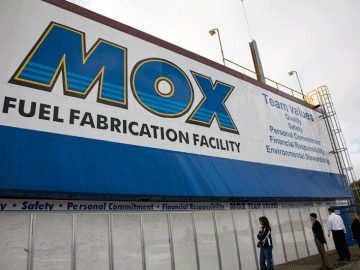
According to federal law, the DOE was required to finish the Mixed Oxide Fuel Fabrication Facility at the Savannah River Site in Aiken County by 2014, or remove at least one metric ton of plutonium from the state by Jan. 1, 2016. When the Energy Department failed to meet those deadlines, a $1 million daily penalty was instated. The penalties add up to a maximum of
$100 million annually for each of the first 100 days of the year. When the fees reach the maximum mark, state leaders said residents can expect to see a claim follow quickly thereafter. https://www.aikenstandard.com/news/clock-resets-for-m-a-day-fine-against-doe-for/article_160b5366-f258-11e7-acdd-9b750ce012c1.html
The Nuclear Decommissioning Authority (NDA) is a non-departmental public body sponsored by the Department for Business, Energy & Industrial Strategy. The NDA is responsible for the operation, decommissioning and clean-up of 17 nuclear reactor and research sites in the UK.
Of the 17 sites, Sellafield is the largest in terms of size and annual expenditure. It is also one of the most complex and hazardous nuclear sites in Europe. In 2015, the NDA announced that the management arrangements it had in place for the Sellafield site were ineffective; in April 2016, Sellafield Ltd became a wholly-owned subsidiary of the NDA. The NDA says these new arrangements will enable faster hazard and risk reduction at the site, and a more effective management of major projects. Alongside these changes, Sellafield is readying itself for the end of its reprocessing activities in 2020, meaning its operational focus will be on reducing high hazard reduction and decommissioning nuclear facilities. Sellafield has set out a transformation plan to support these changes.
This study will examine whether the new arrangements at Sellafield are effective in reducing high risk and hazard on the site, and whether the NDA is making progress with the performance of its major projects.
If you would like to provide evidence for our study please email the study team on enquiries@nao.gsi.gov.uk, putting the study title in the subject line.
The team will consider the evidence you provide; however, please note that due to the volume of information we receive we may not respond to you directly. If you need to raise a concern please use our contact form.
KEPCO studying moving spent nuclear fuel from Fukui to Aomori http://www.asahi.com/ajw/articles/AJ201801070021.html, THE ASAHI SHIMBUN, January 7, 2018 Kansai Electric Power Co. is considering transferring spent nuclear fuel stored in its three nuclear plants in Fukui Prefecture to an intermediate storage facility in Aomori Prefecture, sources said on Jan. 6.
KEPCO had promised to move the fuel outside the prefecture when the Fukui prefectural government allowed the utility to restart two reactors at its Oi nuclear power plant.
KEPCO President Shigeki Iwane has said that a facility will be secured by the end of 2018 to accept the fuel.
According to the sources, KEPCO is also considering other locations. However, the intermediate storage facility, located in Mutsu in northern Aomori Prefecture, is a promising candidate because it has already been constructed.
However, since consent from local governments is required, KEPCO could face difficulties in transferring the fuel to the facility. At present, KEPCO is storing spent nuclear fuel, which is produced in its Takahama, Oi and Mihama nuclear power plants in Fukui Prefecture, in pools in their compounds. However, about 70 percent of the capacity of those pools have been filled.
If the restarts of the reactors in the plants proceed as expected, the remaining 30 percent will also be filled in about seven years. Therefore, KEPCO is trying to secure an intermediate storage facility to temporarily store the fuel by putting it in metal containers.
The intermediate storage facility in Mutsu was jointly constructed by Tokyo Electric Power Company Holdings Inc. and Japan Atomic Power Co. at a cost of about 100 billion yen ($884.6 million) to store spent nuclear fuel produced by their nuclear plants.
However, acceptance of the fuel from those plants has yet to start because the facility is currently undergoing screenings to see if it is in compliance with new safety standards introduced after the 2011 Fukushima nuclear disaster.
The intermediate storage facility has a capacity of accepting a total of 5,000 tons of spent nuclear fuel.
KEPCO is considering securing storage space there by purchasing part of the shares of a company that will operate the facility
Connecticut lawmakers: ‘Status quo unacceptable’ on nuclear waste policy, The Day January 06. 2018 By Benjamin Kail Day staff writerb.kail@theday.comBenKail Waterford — All the nuclear fuel spent creating electricity at the Millstone Power Station since the 1970s remains on site — either in cooling pools that reduce radioactivity, or entombed in 31 massive, leak-tight concrete and steel canisters.
But that fuel is supposed to be about 2,700 miles west of Waterford, according to federal law.
The Nuclear Waste Policy Act of 1982 tasked the Department of Energy with siting, building and maintaining an underground repository for the nation’s spent nuclear fuel. In 1987, lawmakers designated Yucca Mountain, a dry, remote spot in Nevada, as the permanent home for the country’s nuclear waste.
The law set in motion an ongoing procedural, political and legal battle over where to bury tens of thousands of tons of radioactive waste from 100-plus sites across more than three dozen states.
Millstone spokesman Ken Holt said Thursday that plant owner Dominion Energy maintains the federal government is obligated “to take possession of the used fuel at all nuclear power plants, including Millstone.”
Keeping nuclear waste on site in spent fuel pools or the dry cask storage “stores the fuel safely until the government is ready to accept it,” Holt said……..
nuclear advocates and Connecticut lawmakers say it’s vital to create long-term storage solutions in the interests of national security and cost savings. And there’s a renewed push, in the Trump administration and Congress, to make that happen.
By missing its 1998 deadline to accept nuclear waste at the permanent repository site promised 30 years ago, the federal government has had to fork out more than $6 billion in settlements and judgments to energy companies for incurred storage costs.
That funding comes from the U.S. Treasury Department Judgment Fund, a permanent account to cover damage claims against the government that doesn’t hit taxpayers directly through the budget process but still racks up the deficit, according to the NRC and lawmakers.
“There’s got to be a safer, much more cost-effective way than having this stuff pile up and require expensive surveillance in well over 100 locations across the country,” Rep Joe Courtney, D-2nd District, said Friday. “There’s a strong feeling that the status quo is unacceptable. It’s not fair to the sites around the country to have to be a host community for the material. It’s time to get this national disposal system underway.”……
President Donald Trump’s initial 2018 budget hopes to breathe new life into the Yucca Mountain plan this spring, calling for investments of $110 million into the project, along with $30 million for its NRC licensing process and $10 million for interim waste storage.
Lawmakers backed those appropriations in the U.S. House in recent months, but the funding has stalled in the U.S. Senate.
Meanwhile, Rep. John Shimkus, R-Ill., introduced the Nuclear Waste Policy Amendments Act last year, picking up more than 100 co-sponsors, including Courtney.
The bill would eliminate permitting hurdles that have held up Yucca Mountain; ensure funding for the repository program isn’t subject to the annual appropriations process; and allow the DOE to contract with private companies looking to establish NRC-licensed interim storage sites while Yucca Mountain is debated.
The measure cleared the House Energy and Commerce Committee this past summer in a bipartisan 49-4 vote……..
The NRC remains in the early stages of reviewing an application from New Jersey-based Holtec International to construct and operate an interim storage repository in New Mexico.
A Texas company, Waste Control Specialists, has proposed an interim storage site in west Texas. But the company asked the NRC to put its application review on hold, citing licensing costs “significantly higher than we originally estimated.”……… http://www.theday.com/article/20180106/NWS01/180109574
‘Significant’ radioactive waste problem at Trident submarine base, The Ferret, Ferret Journalists on January 7, 2018, Scotland’s environmental watchdog has criticised nuclear waste handling at the UK Trident bomb base on the Clyde after a “significant” mix-up over the disposal of submarine waste.
During an August 2017 visit to the Royal Naval Armaments Depot at Coulport, Scottish Environment Protection Agency (Sepa) staff found untested waste from submarines, potentially containing radioactive material, had been mixed with other waste.
This meant that radioactive waste could have been taken off site and disposed of as if it were non-radioactive waste.
Sepa also said that the Royal Navy was in breach of an agreement about when and how it should tell Sepa about waste incidents, prompting the SNP to say the issue was “deeply worrying” while calling on the UK Government to investigate.
The Ministry of Defence (MOD) is supposed to tell Sepa ‘without delay’ when an environmental incident occurs. It should then provide a written report within 14 days.
Documents released under freedom of information legislation show that an internal MOD probe found that no radioactive waste left the site. But the only reason the untested material was not taken off the base is because vigilant civilian waste contractors refused to pick up the incorrectly processed waste.
A Sepa letter to the MOD said that the watchdog considered this type of incident as “significant” adding that had the Royal Navy been a civilian operator, it would have considered issuing a formal written warning.
Sepa’s chief officer, John Kenny, told The Ferret that the incident raised concerns regarding the “adequacy of arrangements for radioactive waste handling” at the Coulport site…….
“The most damning thing about this is that nothing has changed,” it said. “The MOD are still failing to follow their own operating procedures, and they’re still failing dismally when it comes to telling the regulator and protecting the environment.”
The group called for more to be done by both the MOD and Sepa to alert the public when environmental incidents occur.
“It shouldn’t be the case that this information should come to light by freedom of information, they should have a statutory public duty to disclose this information,” it said. https://theferret.scot/trident-sepa-radioactive-waste/
The dry-storage plan OK’ed by the Coastal Commission is the Holtec system: cheaper canisters with 1/2 to 5/8-inch thick stainless steel walls, wildly short of the 10 to 20-inch thick-walled ones used in other countries.
At the controversy’s core is the susceptibility of Holtec canisters to cracking, which could leak radiation into the environment.
Holtec canisters have no seismic rating, are not proven safe for transport, and there is no means to even inspect them for cracks or for existing cracks to be repaired in a safe manner. A crack can’t even be detected until after a radiation leak has occurred.
A highly disturbing report from Sandia National Laboratories states that a crack in a hot canister can penetrate the wall in under 5 years.
Mosko: Ticking Time Bomb at San Onofre Nuclear Plant,https://voiceofoc.org/2018/01/mosko-ticking-time-bomb-at-san-onofre-nuclear-plant/By SARAH “STEVE” MOSKOThe seaside nuclear reactors at the San Onofre Nuclear Generating Station in San Clemente were permanently shut down in 2013 following steam generator malfunction. What to do with the 3.6 million pounds of highly radioactive waste remains an epic problem, however, pitting concerned citizens against Southern California Edison, the California Coastal Commission and the Nuclear Regulatory Commission (NRC). Edison operates San Onofre, the Coastal Commission is charged with protecting the coastline, and the NRC is responsible for long-term storage of spent nuclear fuel and protecting the public.The Problem
A reactor’s spent nuclear fuel must be stored safely for 250,000 years to allow the radioactivity to dissipate. San Onofre’s nuclear waste has been stored in containers 20 feet under water in cooling pools for at least five years, the standard procedure for on-site temporary storage. Long-term storage necessitates transfer to fortified dry-storage canisters for eventual transportation to a permanent national storage site which, under the Nuclear Waste Policy Act of 1982, the federal government is under obligation to construct.
However, the plan to build an underground repository at Yucca Mountain in the Nevadan desert was ditched in 2011 out of concern that deep groundwater could destabilize the canisters, leaving the United States with literally no plan on the horizon for permanent storage of nuclear waste from San Onofre or any other of the country’s nuclear power plants. In fact, under the NRC’s newest plan – the so-called Generic Environmental Impact Statement – nuclear power plant waste might be stored on-site forever.
Given this, informed southern Californians are up in arms about the 2015 permit by the Coastal Commission allowing Edison to build a dry-storage bunker right at San Onofre – near major metropolitan areas and within a few hundred feet of both the I-5 Freeway and the shoreline in a known earthquake zone – using thin-wall canisters never proven safe for storage or transport (Coastal Development Permit No. 9-15-0228). Most other countries, including Germany, France, Japan, Russia and Australia, utilize thick-wall canisters with time proven safety technology.
The Current Plan
The dry-storage plan OK’ed by the Coastal Commission is the Holtec system: cheaper canisters with 1/2 to 5/8-inch thick stainless steel walls, wildly short of the 10 to 20-inch thick-walled ones used in other countries. Each of 72 remaining canisters slated to be converted from wet to dry storage will contain about 50,000 pounds of nuclear waste and as much radiation as was released from Chernobyl.
At the controversy’s core is the susceptibility of Holtec canisters to cracking, which could leak radiation into the environment, both land and sea. Seawater seepage into canisters can produce explosive substances.
Holtec canisters have no seismic rating, are not proven safe for transport, and there is no means to even inspect them for cracks or for existing cracks to be repaired in a safe manner. A crack can’t even be detected until after a radiation leak has occurred.
The Coastal Commission acknowledges these issues but is allowing Edison 20 years to hopefully come up with a solution.
In the meanwhile, loading into dry-canisters already began in December, 2017 and is scheduled to be completed by 2019. Furthermore, Edison plans to empty the cooling pools once the dry transfer is completed, eliminating the only approved method to replace a defective canister.
A highly disturbing report from Sandia National Laboratories states that a crack in a hot canister can penetrate the wall in under 5 years. Notwithstanding, Holtec’s 25-year warranty of their canisters is an absurdity given that nuclear waste radiation takes thousands of years to reach safe levels.
There is also no community evacuation plan in place in the event of radiation leakage at San Onofre. The fear is that failure of even one canister could leave Orange and San Diego counties an uninhabitable wasteland for eons, with exposed humans suffering permanent genetic damage. And, home and business insurance doesn’t cover losses due to radiation contamination.
The very real specter of radiation havoc from a terrorist bomb attack launched from an offshore boat or a truck on the I-5 Freeway looms as well.
In the minds of many, the reckless plan allowed by the NRC and endorsed by the Coastal Commission and Edison creates imminent risk of a “Fukushima” in South Orange County.
The Solution
A lawsuit filed by the San Diego watchdog organization Citizens Oversight in 2015 asserted that the Coastal Commission failed to adequately consider both the special risks of on-site storage in an earthquake zone next to the ocean and the shortcomings of the Holtec system. In a court settlementjust reached on Aug. 25, 2017, Edison agreed to hire a team of experts in hopes of locating an alternative temporary storage site. Edison also agreed to develop a plan for dealing with cracked canisters, though there is no assurance that such a plan is feasible for Holtec canisters.
Though the settlement plan appears a first step toward a saner solution to San Onofre’s nuclear waste problem, the obligations in the plan are far too vague to assuage the concerns of local residents. Their main points are threefold: There are other safer temporary storage sites inland that can be considered; maintaining the cooling pools is imperative until all nuclear waste has been moved off-site; and Holtec canisters should be abandoned in favor of thick-wall options that already have a 40-year track record of safety during both transport and storage in countries across the globe.
Case in point, the thick-wall canisters in place at Fukushima survived both the earthquake and the tsunami.
Take action to protect yourself and your family by signing on to a petition from PublicWatchdogs.orgto revoke the Coastal Commission’s permit to turn San Onofre into a nuclear waste dump.
The department says that Tank AY-102 has widespread damage and should not be repaired.
The Tri-City Herald reports that this is the oldest of the double-walled underground tanks at Hanford. The Energy Department in 2012 revealed that waste from the inner shell of the tank was slowly leaking into the space between its inner and outer shells. No waste is known to have breached the outer shell to reach the environment.
The decision means that Hanford will have 27 newer double-walled tanks to hold waste emptied from 149 leak-prone single-walled tanks.
The waste is left from World War II and Cold War production of plutonium for the nation’s nuclear weapons program.
The decommissioning process at the site, which closed in December 2015, has been hit by delays following problems with machinery.
About half of the fuel has been removed from the plant and work to remove fuel was expected to be completed by the end of 2018.
Operator Magnox has now said it will not be completed until November 2019. The site’s two reactors held 49,000 fuel elements which have to be cleared as part of the decommissioning process.
But the work has been delayed because the 50-year-old machine used to remove them needed new parts.
Wylfa is the last of Magnox’s 12 UK power stations to be switched off and, across the firm’s sites, the cost of the process has almost doubled to an estimated £6bn.
It will take more than 100 years for the site to be fully cleared.
Horizon wants to build a replacement nuclear plant, Wylfa Newydd, next to the site, which would operate for 60 years and generate electricity for around five million homes.
But the proposals have to overcome planning and cost hurdles – the “strike price” for the electricity generated – before the plant can get the go ahead.
CBO Cost Estimation of Nuclear Modernization Omits Hazardous Cleanuphttps://washingtonspectator.org/alvarez-nuclear-cleanup/ High-level radioactive waste pose threats to environment around nuclear management facilities , By Robert Alvarez, ith its $1.2 trillion price tag for the modernization of the U.S. nuclear weapons arsenal and production complex, the U.S. Congressional Budget Office has induced “sticker shock” on Capitol Hill. Yet despite this enormous projected cost for rebuilding the U.S. triad of land, submarine, and bomber nuclear forces, the CBO has in fact lowballed its estimate by excluding the costs for environmental restoration and waste management of the Energy Department’s nuclear weapons complex.
Even though the cleanup of nuclear weapons sites comes from the same congressional spending account as DOE nuclear weapons modernization, the CBO chose to exclude an additional $541 billion in legacy costs. If these costs are included, the total price tag goes to $1.74 trillion over three decades.
The largest of these cleanup costs, at $179.5 billion, is attributed to the stabilization and disposal of high-level radioactive wastes generated from the production of plutonium. The U.S. Government Accountability Office (GAO) informed Congress in 2013 that these wastes are “considered one of the most hazardous substances on earth.”
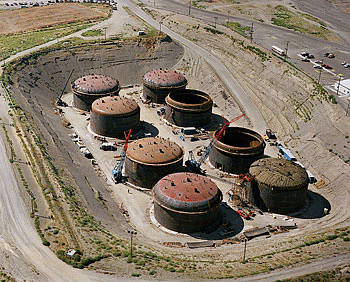
About 100 million gallons are stored in 227 underground tanks, many larger than state capitol domes and ranging in age from 43 to 73 years. Over 1 million gallons of these contaminants have leaked at the DOE’s Hanford site in Washington state, threatening the Columbia River.
The removal and stabilization of these wastes at Hanford by mixing them with molten glass, at an estimated cost of as much as $72.3 billion, represents the single largest, most expensive, and potentially riskiest nuclear cleanup project ever undertaken by the United States. It’s roughly comparable to the Apollo moon program in cost and risk, except there’s no moon.
Even without factoring in cleanup, an analysis of the DOE costs for the nuclear warheads program shows that while the U.S. nuclear weapons stockpile has shrunk by 56 percent since 2003, the annual per-warhead cost has increased by about 422 percent. This huge cost growth in the nuclear stockpile budget is largely due to ever-growing overhead expenses for abandoned and antiquated structures not formally part of the DOE cleanup program. Many of these facilities contain hazardous materials and have been ignored for several decades.
To keep the lights on, the DOE weapons complex must pay for things like collapses, flooding, fires, and preventing roofs from falling in. In 2015, the DOE Inspector General warned that, “delays in the cleanup and disposition of contaminated excess facilities expose the Department, its employees, and the public to ever-increasing levels of risk [and] lead to escalating disposition costs.”
The Y-12 National Security Complex in Oak Ridge, Tennessee, for instance, has a high-risk “footprint” of abandoned contaminated structures, mostly built in the 1940s, that is 2.5 times larger than the Pentagon building. Although Y-12 has not produced weapons for more than 25 years, its annual budgets have increased by nearly 50 percent since 1997, to more than $1 billion a year.
Over the past 20 years, there have been dozens of fires and explosions at Y-12 involving electrical equipment, glove boxes, pumps, waste containers, and nuclear and hazardous chemicals. Several of these incidents resulted in worker injuries and destruction of property.
As late as September of this year, unstable amounts of highly enriched uranium, called “material at risk” have spontaneously combusted. For more than 20 years, Y-12 has not been able to stabilize its backlog of “materials at risk.”
In a December 2016 DOE report to Congress, the unaccounted-for liability of getting rid of 2,349 of the DOE’s abandoned facilities over the next 10 years was roughly estimated at $32 billion. The DOE finds that among those are 203 unattended “high-risk” facilities and estimates a cost of $11.6 billion to close them down safely.
The most recent high-profile examples of aging-infrastructure risks include the collapse, last May, of a section of tunnel at the Plutonium and Uranium Extraction Facility, known as PUREX, a long-idle component of the sprawling Hanford nuclear site, 200 miles east of Seattle. The tunnel holds an enormous amount of radioactive wastes, and hundreds of workers were forced to seek cover.
And in June of this year, during the process of tearing down a building that was known to contain countless respirable plutonium particles, 31 workers inhaled or ingested plutonium during a work shift, after failing to take necessary precautions. It took four months for the DOE’s contractor to inform the public about the mishap and to tell the workers about their doses.
he costs for the disposition of excess plutonium from the nuclear weapons programs is pegged by GAO at $56 billion. In 2012, the U.S. Government determined that it no longer needed 43.4 metric tons of plutonium for military needs.
The majority of that plutonium is stored in facilities at the DOE’s Pantex Plant near Amarillo, Texas, that were built in the 1940s. The plutonium is densely packed in special containers that are only meant for “interim” storage.
In 2010 and 2017, unexpected 2,000-year rains flooded a major plutonium storage area with several inches of water, which shut down the plant and impacted about 1,000 containers at a cost of hundreds of millions of dollars in recovery funds.
Because plutonium weapon components can become dangerous if mishandled or improperly stored, a Pantex worker told me, while I was working for the DOE’s Secretary, that it was like “having a zoo full of wild animals.”
Because the plutonium disposition program is way over budget and is stalled without a credible path forward, tens of tons of plutonium are likely to remain in these 70-plus-year-old structures awaiting further floods and additional threats to their safety and integrity.
While an ever-growing amount of plutonium will be stored in antiquated structures at the Pantex plant, another 1,000 abandoned facilities will be added to the list of sites requiring specialized disposition over the coming decade. Costs for the disposal of large amounts of hazardous wastes in the abandoned structures are not included in the DOE’s 2016 estimate and are likely to add several billions of dollars more.
When the DOE cleanup program was created in 1990, Congress made sure that it would be paid for from the same pot of money designated for the U.S. arsenal of nuclear warheads. These legacy costs should not be isolated from estimates of the nation’s nuclear weapons budget.
The need to protect the safety and health of workers and the American public from the mess produced by the current and previous nuclear weapons stockpiles should not be ignored as we proceed to deal with the future of nuclear weapons in the 21st century. As former Senator John Glenn of Ohio, a staunch supporter of the Cold War, would often say, “What good is it to protect our nation with nuclear weapons if we poison our people in the process?”
A senior scholar at the Institute for Policy Studies, Robert Alvarez served as senior policy adviser to the Energy Department’s secretary and deputy assistant secretary for national security and the environment from 1993 to 1999. During this tenure, he coordinated the Energy Department’s nuclear material strategic planning and established the department’s first asset management program.
CORE 26th Dec 2017, There can’t be many nuclear bodies that choose to bury – just three days before Christmas – what is touted as a good news story by the industry. But this is exactly what Sellafield Ltd has contrived to do in its 22nd December announcement that the long overdue and eye-wateringly expensive Evaporator D has come on line at Sellafield.
Yet by confirming that the new Evaporator actually came on line at 0800 on the 8th December, the start-up has been kept under wraps for a fortnight until a time when public attention was focused on seasonal festivities rather than on nuclear
news. Keeping such a story under the public radar for so long is, to say the least, wholly out of character for the industry – though the Evaporator’s history is hardly something to shout about.
It is not however just about the burial of ‘good’ news itself that many will find disturbing, but rather the manner in which the burial rites have been manipulated and massaged to dupe the wider world. Designed to process the dangerous high level waste liquids produced by the site’s reprocessing operations so that they can be vitrified and canned for eventual disposal, Evaporator D is located in the site’s Highly Active Liquid Evaporation and Storage (HALES) facility.
Its tortured construction track record since its inception over a decade ago by British Nuclear Fuels (BNFL) is well
documented and gives the lie to its original costings and timescale. As reported in the industry’s Nuclear Fuel journal in 2009 ‘Sellafield operators estimated (in 2007) the cost of the proposed Evaporator D at GBP90 million and said they expected it to be operational around 2010/2011’. Now in operation over six years late, the Evaporator’s £750M cost today represents an eight-fold increase on its original costing. …..
There are few positives to be taken from the Evaporator D saga that rivals the similar squandering of public money on the ill-fated and now defunct Sellafield MOX plant and even – when its financial accounts are eventually exposed publicly for the first time – the THORP plant itself. The one positive that will bring at least some cheer to the UK taxpayer is that, then costed at £600M, plans for an Evaporator E were abandoned by Sellafield in 2012. http://corecumbria.co.uk/briefings/sellafields-delayed-evaporator-d-now-operating-and-gift-wrapped-for-christmas/