The Era of Nuclear Decommissioning
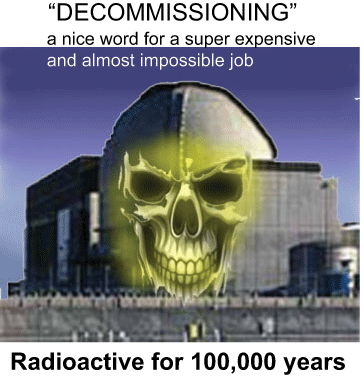
Nuclear power in crisis: we are entering the Era of Nuclear Decommissioning, Energy Post, by Jim Green “…………The Era of Nuclear Decommissioning The ageing of the global reactor fleet isn’t yet a crisis for the industry, but it is heading that way. In many countries with nuclear power, the prospects for new reactors are dim and rear-guard battles are being fought to extend the lifespans of ageing reactors that are approaching or past their design date.
Perhaps the best characterisation of the global nuclear industry is that a new era is approaching ‒ the Era of Nuclear Decommissioning ‒ following on from its growth spurt from the 1960s to the ’90s then 20 years of stagnation.
The Era of Nuclear Decommissioning will entail:
- A slow decline in the number of operating reactors.
- An increasingly unreliable and accident-prone reactor fleet as ageing sets in.
- Countless battles over lifespan extensions for ageing reactors.
- An internationalisation of anti-nuclear opposition as neighbouring countries object to the continued operation of ageing reactors (international opposition to Belgium’s ageing reactors is a case in point ‒ and there are numerous other examples).
- Battles over and problems with decommissioning projects (e.g. the UK government’s £100+ million settlement over a botched decommissioning tendering process).
- Battles over taxpayer bailout proposals for companies and utilities that haven’t set aside adequate funds for decommissioning and nuclear waste management and disposal. (According to Nuclear Energy Insider, European nuclear utilities face “significant and urgent challenges” with over a third of the continent’s nuclear plants to be shut down by 2025, and utilities facing a €118 billion shortfall in decommissioning and waste management funds.)
- Battles over proposals to impose nuclear waste repositories and stores on unwilling or divided communities.
The Era of Nuclear Decommissioning will be characterised by escalating battles (and escalating sticker shock) over lifespan extensions, decommissioning and nuclear waste management. In those circumstances, it will become even more difficult than it currently is for the industry to pursue new reactor projects. A feedback loop could take hold and then the nuclear industry will be well and truly in crisis ‒ if it isn’t already.
Editor’s Note
Dr Jim Green is the editor of the Nuclear Monitor newsletter, where a longer version of this article was originally published.
Hazards of Russia’s radioactive trash in the Arctic
Arctic Frontiers forum totes up Russia’s northern nuclear hazards, When Norway assesses potential nuclear risks in Northern Russia, it counts among them not just decades of intentionally scuttled radioactive trash – including two entire nuclear submarines – but also vessels transporting spent nuclear fuel throughout the Arctic, specifically from Andreyeva Bay. Bellona by Charles Digges,
When Norway assesses potential nuclear risks in Northern Russia, it counts among them not just decades of intentionally scuttled radioactive trash – including two entire nuclear submarines – but also vessels transporting spent nuclear fuel throughout the Arctic, specifically from Andreyeva Bay.
These considerations were part of a seminar held at the Arctic Frontiers forum last week in Tromsø, Norway, which tallied up ongoing threats of nuclear environmental contamination in Northwest Russia.
For decades, Norway, along with numerous other donor nations, has invested millions of dollars in improving the safety and security of Northwest Russia’s vast Cold War nuclear legacy sites.
According to Øyvind Selnæs, a senior adviser with the Norwegian Radiation Protection Authority, Norway expects to see a spike in the number of ships passing through the Arctic carrying nuclear fuel and materials as Russia seeks to build new nuclear icebreakers to guide traffic along the Northern Sea Route. He also forecasted an increase the number vessels carrying spent nuclear fuel.
“It took many years and huge funds of international assistance to start exporting SNF from the former naval base in the Murmansk region – Andreeva Bay,” Selnaes said.” Last year, this process began, and it will take several years. Risks associated with the maritime transportation sector will now increase. ” ……http://bellona.org/news/nuclear-issues/2018-01-arctic-frontiers-forum-totes-up-russias-northern-nuclear-hazards
British plan to provide household electricity by plutonium – in Small Modular Nuclear Reactors

Times 28th Jan 2018, Britons could be taking showers and warming homes with hot water piped
directly from a nuclear reactor, under proposals to build small atomic power stations in cities. Urban nuclear reactors, similar in size to those
in nuclear submarines, could generate not only electricity but also hot water, suggests a report by Policy Exchange, a think tank.
The paper reflects government thinking, as the National Nuclear Laboratory hasalready drawn up plans for a first “small modular reactor” at Trawsfynydd in north Wales. The Department for Business, Energy andIndustrial Strategy has also supported the idea. Such reactors could befuelled by plutonium, a waste product of Britain’s existing nuclearindustry. Stockpiles exceed 100 tons. https://www.thetimes.co.uk/edition/news/mini-nuclear-reactors-could-heat-homes-pxk3h8nkl
State of Nevada raises new concerns on plan to license Yucca Mountain as nuclear waste dump
Nevada raises new concerns about Yucca Mountain licensing plan, Las Vegas Review Journal, By Gary Martin Review-Journal Washington Bureau, January 26, 2018 – WASHINGTON — Nevada has detailed fresh concerns about plans to expedite licensing of Yucca Mountain as a nuclear repository in a report that was delivered Friday by the state’s congressional delegation to key House members.
Rep. Dina Titus, D-Nev., distributed the state’s report to lawmakers on the House Energy and Commerce and the House Appropriation committees asking that they review it before moving forward on the Nuclear Waste Policy Amendments Act.
The amendments bill passed out of the Energy Committee on a 49-4 vote last June, and is largely expected to pass in the full House, which has yet to schedule a vote.
Nevada Gov. Brian Sandoval has led the state’s opposition to storing nuclear waste at Yucca Mountain, noting that “no amount of monetary benefits can compensate for the coerced selection of an unsafe site.”
In the report, the state said the bill does not address the amount of funding that would be needed for expediting the licensing application by the Department of Energy and the participation of federal, state and local governments in the process before the Nuclear Regulatory Commission.
The state also says in its report that the bill ignores potential adverse economic impacts that could result in developing Yucca Mountain, noting the uncertainty of liability of DOE contractors……https://www.reviewjournal.com/local/local-nevada/nevada-raises-new-concerns-about-yucca-mountain-licensing-plan/
How to impose a radioactive trash dump UK style – bribe communities and bypass local authorities

 Times 26th Jan 2018, Communities will receive up to £42 million if they agree to consider
hosting an underground nuclear waste dump. They can keep the money even if
they ultimately decide against it, under government plans. The payments,
which will be spread over 20 years, are aimed at persuading communities to
engage in the process of selecting and testing a site that will store
enough radioactive waste to fill the Albert Hall six times.
The Department for Business, Energy and Industrial Strategy said more than one community
could receive the funding, with each being given up to £42 million. The
proposals appear to weaken the power of county councils, making it harder
for them to prevent a community from agreeing to host the £19 billion
“geological disposal facility” (GDF).
A consultation document states
the final decision will be subject to a “test of public support”, which
could be a local referendum. The right to vote in the referendum could be
restricted to a small area around the proposed site.
Cumbria is still viewed as the most suitable location because of the ease of transporting
waste at Sellafield and the willingness of the community. However, other
areas with ageing or decommissioned nuclear plants have been suggested,
including Dungeness, Kent, and Hartlepool, in Co Durham. Doug Parr, of
Greenpeace, said: “Having failed to find a council willing to have
nuclear waste buried under their land, ministers are resorting to the
tactics from the fracking playbook — bribing communities and bypassing
local authorities.”
https://www.thetimes.co.uk/edition/news/42m-offer-to-communities-that-take-radioactive-waste-svrjj29nb
Not easy, nor cheap, to shut down South Africa’s Koeberg nuclear plant
The Conversation 25th Jan 2018, Why decommissioning South Africa’s Koeberg nuclear plant won’t be easy.
Koeberg has two units, each generating 930 MW, which contribute about 4% of
South Africa’s power capacity. They were built by French developer
Framatome, now called Areva.
Researchers in France, Germany and the UK have
calculated widely different costs for nuclear cleanups (including waste
disposal) in their countries. The potential cost of decommissioning a site
comparable to Koeberg according to the French costing model would be R8.4
billion. Some analysts say this is unrealistically low. The German model
puts the number at around R39 billion and the UK model at R76 billion.
https://theconversation.com/why-decommissioning-south-africas-koeberg-nuclear-plant-wont-be-easy-89888
UK’s £1m a year bribes to communities to host nuclear waste
 Communities offered £1m a year to host nuclear waste dump https://www.theguardian.com/environment/2018/jan/25/communities-offered-1m-a-year-to-host-nuclear-waste-dump
New search for communities willing to host underground site for thousands of years, Guardian, Adam Vaughan, 25 Jan 18, Local communities around England, Wales and Northern Ireland will be offered £1m a year to volunteer to host an underground nuclear waste disposal facility for thousands of years, as part of a rebooted government programme.
The financial incentive is one way the government hopes to encourage communities to host the £12bn facility, after previous efforts failed in 2013 when Cumbria county council rejected the project.
Under new plans published on Thursday, a test of public support will be required for the scheme to go ahead, which could include a local referendum.
The only areas to explore the idea last time round were Copeland and Allerdale borough councils in Cumbria, and Shepway District Council in Kent.
This time, interested communities that explore hosting the facility will also receive £1m a year, which officials say could be spent on developing skills locally or apprenticeships. The payments, which could rise to £2.5m annually as a community considers whether to proceed, are expected to last for around five years.
The geological disposal facility (GDF) is seen by experts as the best long-term solution to storing the estimated 750,000 cubic metres of waste generated by half a century of nuclear power and defence, which would fill three quarters of Wembley Stadium.
It also includes the radioactive material created by potentially five new plants that the government expects to be built, including Hinkley Point C, which EDF Energy is constructing in Somerset.
The Institute of Directors said storing waste deep underground would be cheaper than storing it above ground, as it is at present at around 30 sites.Business, unions and local authority groups welcomed the renewed bid to site a GDF.
“Running costs for a geological disposal facility storing the waste 1,000 metres below the surface would be significantly lower,” the business group said.
Richard Harrington, energy minister, said: “We owe it to future generations to take action now to find a suitable permanent site for the safe disposal of our radioactive waste. And it is right that local communities have a say.”
But Greenpeace criticised the payments, calling them bribes, and said new nuclear power plants should not go ahead without a long-term solution in place for their waste.
Doug Parr, the group’s chief scientist, said: “Having failed to find a council willing to have nuclear waste stored under their land, ministers are resorting to the tactics from the fracking playbook – bribing communities and bypassing local authorities.
“With six new nuclear plants being planned, the waste problem is just going to get much worse. Since there is no permanent solution for the disposal of spent nuclear fuel, the responsible thing to do would be to stop producing more of it instead of just passing the radioactive buck to future generations.”
Nuclear waste is currently stored at about 30 sites, but predominantly at ground level at Sellafield in Cumbria. The GDF project is expected to cost £12bn, spread over a century.
Nuclear Free Local Authorities (NFLA) advise UK government to learn from Sweden’s court ruling on nuclear waste
 NFLA 24th Jan 2018, As the UK Government plans yet another attempt to deliver a deep
underground radioactive waste repository, NFLA urges them and the
regulators to look carefully at a Swedish court ruling rejecting a
repository licence around real safety concerns.
The Nuclear Free Local Authorities (NFLA) has been made aware that the UK Government imminently
plans its latest attempt, which is the sixth attempt in the past 42 years,
to start a process to find a willing community to host a deep underground
radioactive waste repository.
This process now could be, and should be, completely reconsidered after a Swedish court ruling rejecting a licence
application on the waste capsules for a similar development, after many
years of planning.
For over 4 decades, several UK bodies – UKAEA, Nirex,
RWMD and now Radioactive Waste Management Ltd (RWM) – have been
established by the UK Government to deliver a deep underground radioactive
waste repository, often referred to in the industry as a geological
disposal facility (GDF).
Three consultations are expected to be issued
imminently – one on the definition of the community that would decide on
such a repository and how engaging with the public would take place, a
second on a National Policy Statement for a deep waste repository, and the
third the publication by RWM of a national geological screening of England,
Wales and Northern Ireland (Scotland is pursuing a separate policy of
‘near site, near surface’ storage of its highly active radioactive
waste).
Throughout its 38 years of operation, NFLA has been heavily engaged
in this debate. It remains sceptical that a deep underground repository is
the most environmentally sound solution for managing the UK’s huge burden
of radioactive waste.
It notes that the Nuclear Waste Advisory Associates
have outlined over 100 key technical and scientific concerns around such
developments, and NFLA has seen no resolution to these issues from the
government or RWM.
UK new nuclear build would create an intolerable waste burden on communities into the far future
Exposing UK government folly of investment in new nuclear https://www.theguardian.com/environment/2018/jan/24/exposing-uk-government-folly-of-investment-in-new-nuclear
In 1976, Lord Flowers pronounced that there should be no further commitment to nuclear energy unless it could be demonstrated that long-lived highly radioactive wastes could be safely contained for the indefinite future. Ever since, efforts to find a suitable site for a geological disposal facility have been rejected by communities (Wanted: community willing to host a highly radioactive waste dump in their district, 22 January).
There is, therefore, little evidence to support the government’s claim that “it is satisfied that effective arrangements will exist to manage and dispose of the waste that will be produced from new nuclear power stations”. Deep disposal may be the eventual long-term solution but demonstrating a safety case, finding suitable geology and a willing community are tough challenges and likely to take a long time. The search for a disposal site diverts attention from the real solution for the foreseeable future, which is to ensure the safe and secure management of the unavoidable legacy wastes that have to be managed. It is perverse to compound the problem by a new-build programme that will result in vastly increased radioactivity from spent fuel and other highly radioactive wastes which will have to be stored indefinitely at vulnerable sites scattered around our coasts.
The fact that the UK government is still going ahead with plans to construct new power stations, generating even more toxic radioactive waste, troubles and puzzles me immensely. Here, on the beautiful isle of Anglesey, where tidal, solar and wind energy production are all highly feasible alternatives and could also provide opportunities for well-paid employment, politicians appear to be happy for an area of outstanding natural beauty to be contaminated for further than the foreseeable future, not to mention the immense eyesore that will occupy acres of fertile land. It is an eye-wateringly costly venture that many fear will expose taxpayers to huge financial risk and will also leave future generations guarding the threat to their environment and health long after it ceases to function.
Future generations will doubtless wonder, when most of Europe is shutting down its nuclear power stations and not planning any more, why in the world the local population didn’t protest harder.
Rose Heaney
Holyhead, Gwynedd
A new-build programme would create an unmanageable and intolerable burden on communities into the far future. To suggest that a repository is the solution is in the realm of fantasy.
Prof Andrew Blowers
Member of the first Committee onRadioactive Waste Management
With big plans for new nuclear stations, Britain desperately trying to get volunteers to host waste dump
 Guardian 21st Jan 2018, The government is expected this week to begin a nationwide search for a community willing to host an underground nuclear waste dump to store highly
radioactive material for thousands of years.
Britain has been trying for years to secure a site with the right geology and local communities which would volunteer to host a £12bn geological disposal facility (GDF), as a
long-term solution for the most dangerous waste from nuclear power
stations.
The last effort hit a brick wall in 2013 when Cumbria county
council, the only local authority still in the running as a host for the
dump, rejected it.
Now, ministers are to relaunch their mission to win over
a community to host the GDF. The task has taken on heightened importance
now that a nuclear power plant is under construction in Somerset, with
plans to build four others.
Radioactive Waste Management, the government
body tasked with building the facility hundreds of metres underground, said
it had made significant progress since 2014 in “developing the offer” to
interested communities. Consultations on the planning process and how the
government will work with communities will be launched this week, said two
sources close to the process. “I hope to God they get it right this time,”
said one. “The mess they made in the past can’t be repeated. It’s
outrageous it became a victim of local politics last time.”
https://www.theguardian.com/environment/2018/jan/21/search-area-willing-host-highly-radioactive-waste-uk-geology
Sweden’s Land and Environmental Court not satisfied with safety of planned nuclear waste repository.
 Swedish regulators disagree on safety of nuclear waste plan https://www.reuters.com/article/us-sweden-nuclear-regulator/swedish-regulators-disagree-on-safety-of-nuclear-waste-plan-idUSKBN1FC21P, JANUARY 24, 2018 , Lefteris Karagiannopoulos, OSLO (Reuters) JANUARY 24, 2018 – Sweden’s radiation safety authority (SSM) and an environmental court issued diverging recommendations to the government on Tuesday on whether to allow the construction of a nuclear waste repository.
While the SSM said the nuclear fuel and waste management company SKB should be allowed to go ahead with the plan, which may take 10 years to complete, the Land and Environmental court said it was not certain of the proposed repository’s safety.
“There is still uncertainty about the ability of the capsule to contain the nuclear waste in the long term,” the court said, adding that further documentation was required.
The final decision to approve or reject the facility, designed to store up to 12,000 tonnes of spent fuel from Sweden’s nuclear plants, will be in the government’s hands.
In a statement to Reuters, Environment and Energy Minister Karolina Skog said no decision would be made this year.
SKB, controlled by Sweden’s nuclear plant operators, applied in March 2011 to build the repository at Forsmark in southwest Sweden.
Eva Hallden, SKB’s director, said the firm would produce additional documentation, which it was confident would allay the safety concerns of the environmental court.
Sweden currently stores its spent nuclear fuel in an interim facility near the Oskarshamn nuclear plant. Editing by Kevin Liffey
Sea level rise, nuclear trash – Pacific islanders tragedy – only New Zealand offers help
Guano, Nuclear Testing, Chemical Weapons Another guano claim converted for U.S. military use is Johnston Atoll (Kamala), located about 800 miles southwest of Honolulu.
One phase of expansion on Johnston Island involved construction of a launch pad for high-altitude missile tests for Operation Dominic in the 1960s. Two of the tests were aborted, with radioactive contamination falling on the runway. Forty years later, in 2002, the Air Force “finished burying thousands of cubic meters of plutonium-contaminated waste in a 25-acre landfill on the atoll.”
The question, then, is not when will islands be submerged, but when will sea-level rise make life on low-lying islands impossible.
The answer to that question is close at hand for a number of Pacific islands.
Perhaps the biggest legal stride in New Zealand is Prime Minister Jacinda Ardern’s recent announcement of plans for a special refugee visa for Pacific Islanders, starting with 100 places annually. “We are anchored in the Pacific,” Ardern told reporters. “Surrounding us are a number of nations, not least ourselves, who will be dramatically impacted by the effects of climate change. I see it as a personal and national responsibility to do our part.”

American Polynesia, Rising Seas and Relocation, By Laray Polk, Global Research, January 06, 2018 The Asia-Pacific Journal: Japan Focus 22 December 2017 In the next 30 to 50 years, rising sea levels caused by global warming will subsume low-lying islands in the Pacific Ocean. Inhabitants will have to relocate, but there are few choices. Among nations (with the exception of Fiji and New Zealand) there is little preparation for the inevitable migration of Pacific Islanders. Which nations should commit to the processes of equitable relocation?
Indigenous Canadians oppose “insanity” of planned nuclear waste disposal near Ottawa River
‘Insanity’ to allow nuclear waste disposal near Ottawa River, Indigenous groups say http://www.cbc.ca/news/canada/ottawa/chalk-river-nuclear-waste-indigenous-1.4492937
Canadian Nuclear Laboratories facility in Chalk River, Ont., could be up and running in 2020, CBC News Jan 18, 2018 Indigenous groups say a plan to dispose of nuclear waste near the Ottawa River in eastern Ontario is “insanity” and want the federal government to intervene.
Canadian Nuclear Laboratories, a private company, wants a 10-year licence to keep running the Chalk River nuclear labs in eastern Ontario.
- Protest to oppose Chalk River nuclear licence renewal
- Waste disposal site in Chalk River raises concerns
In 2014, the federal government gave Canadian Nuclear Laboratories (CNL) control over nuclear operations at Chalk River. The government continues to own the nuclear assets.
CNL has plans for a permanent nuclear waste disposal site at Chalk River, plans that have been criticized by a concerned citizen’s group as being “cheap, dirty, unsafe and out of alignment with International Atomic Energy Agency guidance.”
Nuclear waste in Chalk River will cost billions to deal with and leave a legacy that will last centuries, opponents say.
“Trying to build this giant mound of radioactive waste … is insanity,” said Patrick Madahbee, grand council chief of the Anishinabek Nation, which advocates for around 40 communities representing around 65,000 people across Ontario.
He said CNL has an obligation under the United Nations Declaration on the Rights of Indigenous Peoples to consult Indigenous people about storing hazardous materials in their territory, but CNL hasn’t talked to them about it.
The waste facility could be operational by 2020.
“We understand this is a complex file, but clearly the risks here are to people’s drinking waters and traditional territories,” said Patrick Nadeau, executive director of the Ottawa Riverkeeper.
CNL’s licence to run the Chalk River labs expires on March 31 and the consortium has asked the regulator, Canadian Nuclear Safety Commission, for a 10-year licence agreement, rather than the usual five-year term.
The Canadian Nuclear Safety Commission will hold public hearings in Pembroke, Ont., from Jan. 23 to 25 to consider CNL’s licence.
Dozens of delegations have registered to comment at the hearings. But Mark Lesinski, president of Canadian Nuclear Laboratories said among those posed to present submissions at the hearings, there are a number of “misunderstandings.”
Horizon Nuclear’s Wylfa nuclear plan will increase UK’s radioactive trash by 80%
 NFLA 15th Jan 2018, NFLA submission on radioactive waste elements of the reactor design for the
Wylfa B site – it could increase the UK inventory of radioactive waste by as much as 80%. The Nuclear Free Local Authorities (NFLA) Welsh Forum has submitted its views to Natural Resources Wales (NRW) on the radioactive
waste elements of the Advanced Boiling Water Reactor (ABWR) design proposed for the Wylfa site in Anglesey.
The NFLA Welsh Forum has taken a very close eye with the proposed development of Wylfa B and has raised a number oftimes that a new nuclear reactor in Anglesey is not required. In March 2017it raised in detail concerns over the design of the Advanced Boiling Water Reactor in reference to issues arising from the Fukushima disaster.
NRW is consulting on whether it will issue an environmental permit to Horizon Nuclear, wholly owned by Hitachi, for Wylfa B. This is concentrating now on issues around the radioactive waste that would be generated from such a
reactor, how it will be managed and stored and for how long it will remain on site.
NFLA Vice-Chair Councillor David Blackburn said: “This NFLA submission on Wylfa B’s radioactive waste programme has gone into much detail about the radioactive high burn-up fuel that would be produced from such a reactor, should it ever be built. Such waste would have to remain on site for as much as 160 years and Wylfa B alone could increase the current UK radioactive waste inventory by as much as 80%.
NFLA does not see such a waste burden being beneficial to the people of Anglesey or of Wales. There are far safer, less expensive alternatives that do not produce such hazardous materials as what Wylfa will generate. Wales would be far better off then to build solar, tidal, wind, hydroelectric and geothermal energy facilities instead, with energy efficiency and energy storage solutionsadequate to deal with intermittency issues.”
http://www.nuclearpolicy.info/news/nfla-submission-radioactive-waste-elements-reactor-design-wylfa-b-increase-uk-inventory-radioactive-waste/
Managing Radioactive Waste Safely (MRWS) search processes indicate Cumbria’s unsuitability for nuclear waste dumping
Cumbria Trust 15th Jan 2018, Tim Knowles, who chaired the last search process, known as Managing Radioactive Waste Safely (MRWS) has changed his view since 2013 and no longer supports the idea of geological disposal of nuclear waste in Cumbria. He appears to share Cumbria Trust’s view that Cumbria does not have suitable geology, and that there are much better sites elsewhere in the country.
It is interesting that we have now had 2 search processes in Cumbria and both the Lead Inspector of the first Nirex process, and now the Chair of the second MRWS process have reached the same conclusion – that the search should move to an area of simple geology in the east or south of the country. Both of them want Cumbria to not volunteer again.
In a few months the national geological screening report will be published before councils are asked to volunteer for the third search process. We know that the GDF developer, Radioactive Waste Management, has decided to take
control of this report by producing the narrative itself, and our concern is that they may manipulate the output to suit their intention to return to Cumbria for a third time.
https://cumbriatrust.wordpress.com/2018/01/15/a-change-of-view-for-tim-knowles/
1 This Month
23-25 October – on Zoom – World BEYOND War’s annual global conferenc


Shut down the radiation-damaged Heysham nuclear reactors now
To see nuclear-related stories in greater depth and intensity – go to https://nuclearinformation.wordpress.com

Say No to NASA’s Reckless Nuclear Reactor on the Moon
Say No to NASA’s Reckless Nuclear Reactor on the Moon

-
Archives
- October 2026 (199)
- September 2026 (339)
- August 2026 (330)
- July 2026 (355)
- June 2026 (287)
- May 2026 (306)
- April 2026 (356)
- March 2026 (251)
- February 2026 (267)
- January 2026 (308)
- December 2025 (358)
- November 2025 (359)
-
Categories
- 1
- 1 NUCLEAR ISSUES
- business and costs
- climate change
- culture and arts
- ENERGY
- environment
- health
- history
- indigenous issues
- Legal
- marketing of nuclear
- media
- opposition to nuclear
- PERSONAL STORIES
- politics
- politics international
- Religion and ethics
- safety
- secrets,lies and civil liberties
- spinbuster
- technology
- Uranium
- wastes
- weapons and war
- Women
- 2 WORLD
- ACTION
- AFRICA
- Atrocities
- AUSTRALIA
- Christina's notes
- Christina's themes
- culture and arts
- Events
- Fuk 2022
- Fuk 2023
- Fukushima 2017
- Fukushima 2018
- fukushima 2019
- Fukushima 2020
- Fukushima 2021
- general
- global warming
- Humour (God we need it)
- Nuclear
- RARE EARTHS
- Reference
- resources – print
- Resources -audiovicual
- Weekly Newsletter
- World
- World Nuclear
- YouTube
-
RSS
Entries RSS
Comments RSS

