Scott Pruitt, head of the Environmental Protection Agency, promised this month that he would arrive at a decision in January about how to remediate the West Lake Landfill. To citizens of St. Louis who are not familiar with the situation, here’s a quick summary.
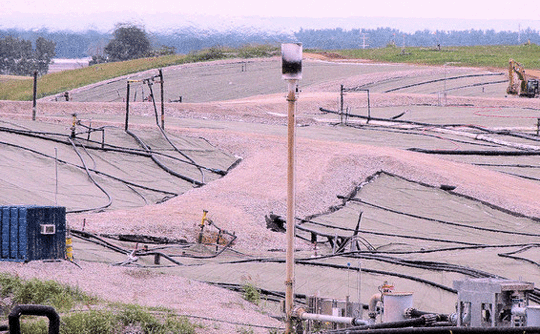
Republic Services, the second largest waste-management company in the country, owns the West Lake and Bridgeton landfills in north St. Louis County near Lambert airport. The West Lake Landfill lies in a former quarry, and huge amounts of radioactive material dating to the Manhattan Project were illegally dumped there in 1973. Much of the waste is low-level radioactive material, but evidence exists that highly toxic radionuclides such as Thorium-230 and Uranium-235 are mixed in.
The landfill is unlined, sits on a porous aquifer in a floodplain less than two miles from the Missouri River, upstream from a main water-treatment plant supplying drinking water to St. Louis. It’s located in a region prone to tornadoes and periodic devastating earthquakes, both having the potential to cause significant disruption to the landfill.
The Bridgeton Landfill lies adjacent and has a smoldering subsurface fire that’s currently 600 feet from the known radioactive portion of the West Lake Landfill. A smaller hotspot appears to be even closer. It’s uncertain what will happen if fire reaches the radioactive waste, though thankfully, an atomic explosion is highly unlikely if not impossible. Of greater concern is the possibility of a persistent low-grade fire involving the radioactive material and potentially, a toxic plume of smoke. Concern is great enough to have led St. Louis County to publish an emergency operations plan in 2014 in the event of a “catastrophic event” at the landfill.
At this point, the EPA is considering two possible interventions, and this is where Republic Services comes in. One option would be to “cap” the site — the option favored by Republic. The second would be to remove the radioactive waste, not favored by Republic because they fear they’ll be ordered to bear a good portion of the cost of this more expensive alternative.
So what is Republic doing? They’ve stepped up a disinformation campaign to deceive the public that the Russian government would be impressed by. They’ve set up a shill organization, Coalition to Keep Us Safe, posing as a grass-roots organization, to spread false information and advocate for the absurd solution of capping. Why absurd? Because the material will be radioactive for millions of years. Caps don’t last millions of years and, importantly, the landfills sit in unlined quarries over a porous aquifer. You can’t put a cap underneath the waste; by definition, it sits on top.
The phony coalition website has earnest citizens of Missouri expressing their preference for capping so that the waste won’t be hauled on Missouri highways and rails. However, radioactive waste has been and continues to be safely hauled in Missouri.
The website links to several opinion pieces published in recent months that appear suspiciously coordinated. Several are written by women, all of whom attack the JustMomsSTL group that has battled to get the dumpsite remediated. All three assert that the JustMoms group is a front for or has questionable ties to the Teamsters. All have misleading titles like “Just Moms STL Has the Right Idea.”
Two are written by women from Washington, D.C.; why would they care about this issue? One of the D.C.-based writers, Jean Card, had an opinion piece published in the Missouri Times that’s filled with untruths and attacks the JustMoms organization. Her business website www.jeancardink.com, lists “Persuasive op eds and letters to the editor” first in services she offers.
If this is what Republic Services is doing in the light of day, I worry about what it is doing behind the scenes. Lobbyists must be exerting strong pressure on Pruitt to choose capping. So what can St. Louisans do? First, recognize this problem is a threat to the entire region, not just to those who live near the landfill. Second, call Scott Pruitt at 202-564-4700. Tell him not to listen to the Republic Services lobbyists who must be knocking at his door. Let him know the only reasonable solution is to remove the waste.
Dr. Stuart Slavin is a professor of pediatrics at St. Louis University School of Medicine.
Funds sought for cleanup at UA nuclear reactor test site, The Commercial, Pine Bluff 26 Dec 17 FAYETTEVILLE — Cleanup at a nuclear reactor test site built in the late 1960s began this year after three decades of waiting. Thousands of pounds of low-level radioactive waste have since been trucked away from rural Washington County to specialized waste facilities outside the state.
Now the University of Arkansas-Fayetteville, the site owner, faces the possibility of another delay as it awaits news of federal funding to finish the cleanup of the Southwest Experimental Fast Oxide Reactor, often referred to as SEFOR.
“We need $10.1 million dollars in FY 18 appropriations,” said Mike Johnson, UA’s associate vice chancellor for facilities, referring to the federal fiscal year.
If the money comes through by mid-January, the final stage of remediation — removal of the reactor core, the radioactive heart of the site — will begin without interruption, he said. …….
Future work scheduled through March includes cutting away sections of a containment shield designed to prevent radiation from escaping into the atmosphere and also cutting down portions of a thick wall that shielded workers from radiation. The schedule calls for a temporary roof and weather shield to be affixed to what remains. The reactor, built with funding from the U.S. Atomic Energy Commission, according to UA, never was hooked up to turbine equipment so no electricity was produced, but it did work as planned.
Updating and cleaning up Dutch nuclear industry could cost state €400m http://www.dutchnews.nl/news/archives/2017/12/updating-and-cleaning-up-dutch-nuclear-industry-could-cost-state-e400m/Updating the Netherlands nuclear industry could cost the state up to €400m, according to a review by four senior civil servants and quoted in Tuesday’s Volkskrant. Officials from the economic affairs, health, environment and finance ministries were asked to assess the cost of the clean-up and update by previous health minister Edith Schippers.
They say the biggest financial hit will come from demolishing the Dodewaard nuclear power station which was shut down in 1997. The government has insisted until now that the bill is paid by the power station’s shareholders, which include Vattenfall, the Volkskrant points out. However, the report indicates civil servants now assume the shareholders will default and put the cost of that project to the state at up to €200m.
A further €100m will be needed to deal with nuclear waste created at the Petten reactor – which makes medical isotopes. That waste is currently stored above ground near the Borselle nuclear power station and the state has paid €200m towards disposing of Petten’s waste over the past 20 years, the report says. In addition, the officials say that a ‘rough estimate’ of €60m to €100m will be needed to build a new reactor at Petten – another issue which the state has always assumed will be privately funded.
Confidential The Volkskrant says the report is notable because it is virtually identical to one sent to parliament in July, although that report did not contain the financial details. At the time, a finance ministry spokesman told the paper the figures were confidential. However, the paper has now been published on the website containing all the documents used during the formation of the current government and was spotted by anti-nuclear power group Laka. Laka spokesman Dirk Bannink said the report shows that the nuclear industry cannot exist without state support. ‘The government has to step in every time,’ he said.
The Russian Villagers Living In The Shadow Of A Nuclear Tragedy, Radio Free Europe, 16 Dec 17, Ramil Mukhamedyarov looks out at the placid waters of the Techa River in Russia’s Ural Mountains.
He says for kids in Novoye Muslyumovo, a mostly ethnic Tatar village, it serves as the local swimming hole. Cattle often lap at its waters and graze near its banks.
It sounds idyllic, but there’s a problem. For decades, radioactive waste has been dumped or seeped into the Techa.
Nearby is the Mayak nuclear installation, one of the largest nuclear complexes in the world, now run by Russian state nuclear regulator and operator Rosatom to reprocess spent nuclear fuel. In 1957, a nuclear accident at Mayak contaminated 20,000 square kilometers and affected an estimated 270,000 people.
It was one of history’s worst obscure nuclear tragedies. Since Mayak was a “secret site” and nearby Chelyabinsk a “closed town,” Soviet authorities didn’t flinch. They initially released no details of what would become known as the Kyshtym disaster, named after the nearest town actually listed on maps.
It was only in the 1990s, after the collapse of the Soviet Union, that the scale of the disaster emerged. And only in 2009, more than a half-century after the incident, were residents of Muslyumovo — the village worst-hit by the spillage at Mayak — relocated.
Mukhamedyarov and his neighbors were given a choice: a new home or a 1 million-ruble (about $30,000 at the time) payout. Announced in the wake of a visit to the area by then-Russian President Dmitry Medvedev, the program was riddled with corruption, however. Many of those who opted for the cash never saw most of it, and those who picked alternative housing were relocated just 2 kilometers down the road in what would become Noveye, or New, Muslyumovo, still well within the contamination zone.
Nice On The Surface…
Compared to other Russian villages of similar size, Noveye Muslyumovo has its appeal. The roads are smooth and paved. The rows of nearly identical, red-roofed, clapboard houses are tidy and clean. There’s a new school and other facilities. A poultry-processing facility, despite the smell wafting from it, provides locals with jobs.
Plus, living in an irradiated zone means residents receive some additional benefits from the federal government. Villagers get 500 rubles a month ($8.50) a month for living there, plus another 400 rubles ($6.80) for medicines……
According to the antinuclear group Bellona, those living near the Techa River suffer cancer rates 3.6 times higher than the national average and birth defects 25 times more frequently than in other parts of the country.
Buried Accident
Eventually details of the accident in the Ural Mountains seeped out. In the early hours of September 29, 1957, a tank containing nuclear-weapons waste exploded on the grounds of the Mayak Chemical Combine, Russia’s primary spent-nuclear-fuel-reprocessing center.
The fallout affected more than 200 towns and villages and exposed more than 240,000 people, a small portion of whom were quietly evacuated over the subsequent two years, to radiation.
Rashida Fattahova, 83, lived in Muslyumovo at the time. “It was horrible. [Ethnic] Russians were resettled right away after the catastrophe, but not the Tatars,” she says of those early Soviet attempts to cope with the accident.
In 2009, Rosatom was given a leading role in relocating villagers from Muslyumovo. Heavy earth-moving equipment was used by Rosatom to raze the village, literally leaving no trace behind. Deep pits were dug. Homes and other articles were demolished and dumped into them before being covered with earth.
“All the things around the house were buried. It was horrible, [the pit] was so deep. I left many things there that were buried,” Fattahova says.
A field of fir trees was planted in its place, but never took root and died.
Not all villagers were given a choice. Lacking documents, some still live in what remains of “Old” Muslyumovo, as the largely empty tract of land is now called……….
For those “lucky” enough to be resettled in Noveye Muslyumovo, life is constantly impacted by Mayak.
Radioactive wastewater is still dumped into ponds around and connected to the Techa River.
Rosatom no longer acknowledges spewing radioactive waste into the Techa or its tributaries. It says waste is deposited in “special industrial ponds” or “objects of nuclear energy use.” Whether that waste is seeping into the Techa is something Rosatom doesn’t address.
A visit to Noveye Muslyumovo by correspondents from RFE/RL’s Idel.Reality stirs the interest of local police, who ask why they are photographing before requesting their documents.
After the encounter with police, one woman, Nailya, pursues the reporters to tell them her story.
Unlike some who may be wary of making such remarks for fear of reprisals from local officials, she speaks openly about allegedly elevated risks of cancer. “People here die, several die a week. Most from tumors. Cancer. Edik was 42. Salavat 52. Just on this street, so many young people have died,” Nailya says…https://www.rferl.org/a/russia-mayak-villagers-living-in-shadow-nuclear-tragedy/28921944.html
Donor nations backing the cleanup of Andreyeva Bay, one of Russia’s most deviling Cold War legacy projects, have agreed to put more funding toward removing damaged and broken nuclear fuel rods lurking at the site, which is located just 55 kilometers from the Norwegian border. Bellona, by Charles Digges
Donor nations backing the cleanup of Andreyeva Bay, one of Russia’s most deviling Cold War legacy projects, have agreed to put more funding toward removing damaged and broken nuclear fuel rods lurking at the site, which is located just 55 kilometers from the Norwegian border.
The removal of some 22,000 spent nuclear fuel assemblies left by Russia’s submarine fleet began earlier this year, constituting a major international victory toward securing radioactive hazards on the Kola Peninsula near Murmansk.
This is no small task. Spent fuel began building up at Andreyeva Bay, a Soviet nuclear submarine maintenance base, in the 1960s. Over the next two decades, many facilities at the site sprang radioactive leaks, and still more of the fuel was left out in the open air, where it degraded and threatened to contaminate portions of the Barents Sea.
Bellona and the Norwegian government took up the charge to clean up Andreyeva Bay in 1995. On June 27 of this year, their efforts finally met with success when a ship called the Rossita sailed away with the first of some 50 loads of spent nuclear fuel bound for storage and reprocessing at the Mayak Chemical Combine.
But complex problems of broken fuel elements, for which there are few blueprints in the annals of radioactive waste management, still remain
In 1982, a crack developed Andreyeva Bay’s now-notorious Building 5, a storage pool for thousands of spent fuel assemblies. The water was drained and the fuel painstakingly moved, but that created other problems. Some of those fuel elements broke, and remain at the bottom of storage pools within.
The fuel elements that were successfully removed were transferred to another facility at the site known as building 3A, where they were stuffed into chambers and cemented into place. This arrangement was only intended as temporary, but it lasted for 30 years. During that time, the cladding on much of the fuel has rusted, and the cement job makes it virtually impossible to remove them without risking further contamination.
A late November meeting of nations donating to the European Bank of Reconstruction and Development’s nuclear window project was aimed at solving those problems.
The funders, which are comprised of Sweden, Finland, Belgium, France, Canada, Germany, the Netherlands, Norway, Italy and the United Kingdom, have agreed to put €100,000 to prepare Building 3A for fuel removal–and another €675,000 for studies on removing broken elements from Building 5.
This funding is an addition to the $70 million these nations have already contributed toward Andreyeva Bay cleanup. Norway leads in funds contributed, however. The nation has giving $230 million toward the efforts over the last 20 years.
As unloading work continues at Andreyeva Bay’s other facilities, it is not expected that removal of the broken elements will begin before 2023.
Two loads of spent fuel assemblies have so far been removed from Andreyeva Bay since April. The fuel is first taken out by water and delivered to the Atomflot nuclear icebreaker port in Murmansk. Once there, it is loaded in railcars, and taken the remaining 3000 kilometers to the Mayak Chemical Combine.
Donor countries agree to fund an additional study on how to extract the damaged spent nuclear fuel from Tank 3A. By Thomas Nilsen, December 08, 2017
Take a closer look at this photo and you will understand the scoop of the most challenging and risky work to be done at the Cold War storage site for submarine nuclear fuel on Russia’s Kola Peninsula. For 35 years, highly radioactive fuel assemblies have been stored in these rusty, partly destroyed steel pipes where concrete of poor quality was filled in the space between. Some of the fuel assemblies are stuck in the canisters, while some of the canisters are stuck in the cells.
Message is clear: Do not try to lift any of the assemblies before you are sure nothing falls out.
The experts all agree it is necessary to conduct a whole range of work to prepare Tank 3A for unloading. Additional €100,000 was granted for the study. Another €675,000 was granted to study another messy challenge in Andreeva Bay; the smashed spent fuel assembles on the floor of the former water-pool storage in Building No. 5, the information portal Russian Atomic Community reports.
Unloading work at Tank 2A and 2B will go on until 2023 before possible work on unloading the dangerous mess at Tank 3A can start.
Andrey Zolotkov, a nuclear expert with the environmental group Bellona says YES with capitalized letters when asked by the Barents Observer via Skype whether Tank 3A poses the biggest risk in the cleanup work.
Equal to Chernobyl
The British nuclear engineering company Nuvia has calculated the total radionuclide inventory in the three tanks to be equal to the remains of Reactor No. 4 inside the Chernobyl sarcophagus. Some 22,000 spent fuel assemblies are stored in the tanks, coming from 90-100 reactor cores powering the Soviet Navy’s Cold War submarines sailing out from the Kola Peninsula from the late 1950s till 1982. Nuvia says it is some six tonnes of fissile uranium-235 in the fuel, about two times the amount of fissile material inside the exploded Chernobyl reactor in Ukraine.
Tank 3A does also pose the highest risk for radiation doses to working personell and ways to do the job with robotics has to be developed. Nobody want people to stay too long near the destroyed assemblies and get exposed.
Another deemed challenging job ahead is to locate and secure the six damaged spent fuel elements on the floor of Building No. 5 in Andreeva Bay. The building served as a storage-pool for the spent fuel assemblies before 1982, but due to a water-leak and rusty wires, many fuel assemblies fell to the floor. That was the reason why the assemblies were hastily moved over to the tanks 2A, 2B and 3A. In that process, however, six damaged fuel assemblies and some uranium powder from others were left on the floor. Today, they pose a serious radiation hazard risk.
Funding from Europe and Canada
The nuclear cleanup work in Andreeva Bay on the Barents Sea coast is financed by the so-called Northern Window of the Northern Dimension Environmental Partnership (NDEP), a cooperative program with Russia’s State Nuclear Corporation Rosatom.
Norway has over the last two decades financed infrastructure improvements in Andreeva Bay making the removal of spent nuclear fuel possible.
The NDEP’s funded work started in 2003. Additional to the European Union, nuclear legacy cleanup work in North-West Russia is funded by Sweden, Finland, Belgium, France, Canada, Germany, the Netherlands, Norway, Italy and the United Kingdom.
Andreeva Bay is located about 55 kilometers from Russia’s border to Norway in the north.
Official: WIPP deficiencies stem from lack of funds, By Rebecca Moss | The New Mexican, 7 Dec 17
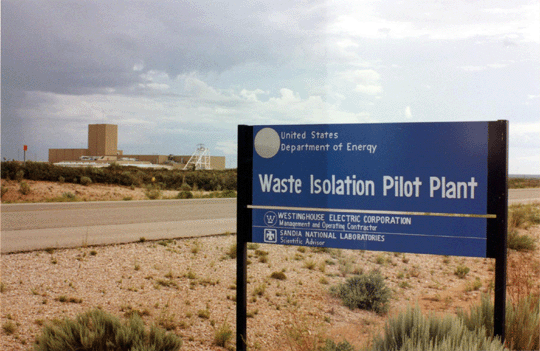
More than three years after a radiation leak forced the Waste Isolation Pilot Plant to shut down, managers are still dealing with the issues of storing waste and undertaking construction in a partly contaminated mine.
A nearly $300 million new ventilation system isn’t expected to be complete by 2022, the salt-rock ceiling of one room is expected to collapse soon, and the facility is facing problems with fire-suppression systems and other infrastructure.
But at a forum Wednesday evening in Carlsbad, officials expressed enthusiasm about the work underway at WIPP.
At least 118 shipments of transuranic waste — equipment, tools, soil and gloves contaminated by plutonium and other highly radioactive materials — have been taken into the facility, at a rate of three to five shipments per week, since WIPP reopened in January, they said. This is a far slower pace than before the shutdown. The facility has averaged 800 shipments a year, or more than 15 per week, in the 15 years that it has accepted nuclear waste for long-term storage…..
Officials have prioritized a long list of infrastructure needs, Shrader said, and are asking Nuclear Waste Partnership to find ways to save money to better fund crucial projects. They also are working with New Mexico’s congressional delegation to secure more federal funding for WIPP, he said.
In July, the Defense Nuclear Facilities Safety Board, an independent adviser to the U.S. energy secretary, wrote in a monthly report on WIPP that inspectors had found deficiencies in tornado doors, fire-suppression systems that went without water for months and a number of unstable areas in the mine that workers could not access.
S. Korea strives to build up nuclear decommissioning industry, By Kim Eun-jung SEOUL, Dec. 8 (Yonhap) —South Korea will ramp up efforts to develop technologies related to nuclear decommissioning as the country’s oldest reactor is undergoing the lengthy, costly process of being dismantled, the energy ministry said Friday.
The Ministry of Trade, Industry and Energy launched a consultative body composed of state-run utilities, construction companies and research institutes to put concerted efforts toward developing the nation’s nuclear decommissioning industry,
The ministry said it aims to develop technologies needed to dismantle nuclear reactors by 2021 that will make such sites free of radioactive hazards and establish a research institute to pave the way for entering the global market by 2030…….
A total of 11 reactors will be retired one by one by 2030 as their operational life cycles expire as the government said it won’t extend their operation.
As part of the nuclear phase-out plan, the government is also pushing for an early closure of Wolsong-1, now the nation’s oldest operating reactor, as soon as possible.
Japan Times 6th Dec 2017, The operator of the Monju prototype fast-breeder nuclear reactor submitted
a plan Wednesday to decommission the trouble-plagued facility located in
Fukui Prefecture. The most recent plan presented to the Nuclear Regulation
Authority lays out a 30-year time frame to complete the project despite a
number of problems that remain unresolved, including where to store the
spent nuclear fuel.
Radioactive Waste And The Hidden Costs Of The Cold War, Forbes, David Rainbow, Assistant Professor, Honors College, University of Houston, 4 Dec 17, Hanford,a dusty decommissioned plutonium production site in eastern Washington state, is one of the most polluted places in the country. The disaster is part of the inheritance of the Cold War.
A few months ago, a 110-meter-long tunnel collapsed at the site, exposing an old rail line and eight rail cars filled with contaminated radioactive equipment. This open wound in the landscape, which was quickly covered over again, is a tiny part of an environmental and human health catastrophe that steadily unfolded there over four decades of plutonium production. Big Cold War fears justified big risks. Big, secretive, nuclear-sized risks.
Hanford and other toxic reminders of the Cold War should serve as a cautionary tale to those who have a say in mitigating geopolitical tensions today, as well as to those who promote nuclear energy as an environmentally sustainable source of electricity. The energy debate must balance the downside – not just the risk of a nuclear meltdown but also the lack of a permanent repository for the still-dangerous spent fuel rods – with the environmental benefits of a source of electricity that produces no greenhouse gases. People on both sides of the issue have a vested interest in how the current geopolitical tussling over nuclear weapons plays out……
Nuclear refinement at Hanford began as a part of the Manhattan Project during World War II, the highly secretive plan to develop a nuclear bomb.
Initially, the drive to mobilize for war justified substantial costs, among them significant damage to human and environmental health in the U.S. resulting from the nuclear program. Hanford was integral to the program: its plutonium fell on Nagasaki. But after the end of the war, the scale of production at the site increased to a fevered pitch thanks to the ensuing competition for global influence between the U.S. and the Soviet Union that became the Cold War.
Our gargantuan stockpiles of nuclear arms demanded gargantuan quantities of plutonium. Forty-five years of work at Hanford – from 1943 to 1987 – yielded 20 million uranium metal plugs used to generate 110,000 tons of fuel. The process also generated 53 million gallons of radioactive waste, now stored in 177 underground tanks at the facility, and created 450 billion gallons of irradiated waste water that was discharged onto “soil disposal sites,” meaning it went into the ground. Some of the irradiated discharge simply ran back to where it had originally been taken from, the nearby Columbia River. The Office of Environmental Management at the Department of Energy is currently overseeing a cleanup project involving 11,000 people. It is expected to take several decades and cost around $100 billion.
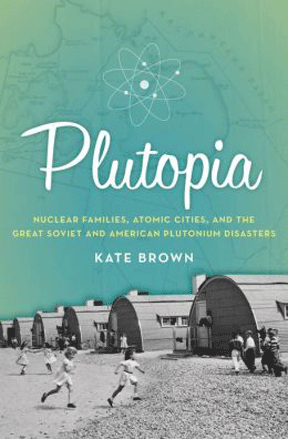
Kate Brown’s award-winning book, “Plutopia: Nuclear Families, Atomic Cities, and the Great Soviet and American Plutonium Disasters,” is a history of the Hanford plant and its Soviet doppelgänger, a plant in the Ural Mountains called Maiak. Brown points out that over the course of a few decades, the two nuclear sites spewed two times the radiation emitted in the Chernobyl explosion. Yet few Americans at the time, even those involved in plutonium production, realized this was going on or how dangerous it was.
Naturally, the hidden nature of the project meant that information was hard to come by. As Brown shows, even the experts, managers and scientists involved directly in overseeing the production process knew little about the seriousness of the risk. Doctors studying the effects of radiation on people didn’t have access to the research related to environmental pollution. Scientists studying fish die-offs had no way of connecting their findings to the deteriorating immune systems of humans in the same areas. Most poignantly, researchers measuring the effectiveness of nuclear bombs on the enemy did not communicate with researchers measuring the threat of nuclear bombs on the workers making them.
Consequences for the workers were grave. Hanford and Maiak’s hidden mega-pollution was collateral damage in the fight to win the Cold War. Russia, like the U.S., is still living with the damage, and trying to bury it, too.
Within two days of the tunnel collapse at the Hanford site this past May, workers filled the breach with 53 truckloads of dirt and narrowly avoided a radiological event. However, these eight railcars are hardly the only waste left behind in the U.S. from our cold conflict with the Soviet Union, in which our willingness to risk human and environmental health was proportionate to our fears. It’s going to be a while before it’s all cleaned up. In the meantime, hopefully our leaders will work to keep the new Cold War from getting any worse. https://www.forbes.com/sites/uhenergy/2017/12/04/the-hidden-costs-of-cold-war/#a3593c1136ff
Officials continue fight against nuclear waste dump on shores of Lake Huron, Many local leaders sign opposition letter Voice News By Jim Bloch | For The Voice, 3 Dec 17
Just say no to a nuclear waste dump anywhere near the Great Lakes.
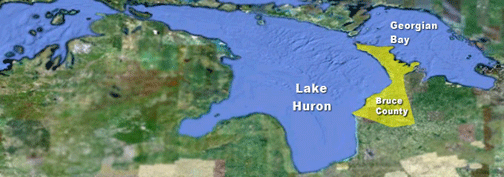
Especially the one proposed for the shores of Lake Huron in Kincardine, Ontario, Canada, about 110 miles uplake from Port Huron.
That’s the message delivered by more than 100 mayors, township supervisors and other elected officials in the region to Catherine McKenna, Canada’s minister of the Environment and Climate Change.
Of the 104 signatories, 14 hail from St. Clair County or nearby communities.
“Madame Minister, we the undersigned request that you act to protect North America’s most precious resource (the Great Lakes) and the health and safety of the millions of people who rely on your leadership by rejecting Ontario Power Generation’s application for its Deep Geological Repository in Kincardine, Ontario,” said the group.
OPG is proposing to excavate huge cavern out of a band of limestone more than 2,200 feet below the earth’s surface, framed by shale on the top and granite below, that has been stable for 450 million years, and store the nuclear waste there.
The site, next to Bruce Energy’s eight nuclear reactors, is about six-10ths of a mile from Lake Huron. The DGR is projected to hold 200,000 cubic meters of waste, some of which will remain toxic for at least 100,000 years, roughly 10 times longer than the Great Lakes have been in existence. Putting so much poisonous waste so close to the lakes amounts to madness, critics contend, especially given that all major underground burial sites for nuclear waste to date have leaked.
McKenna has asked OPG for additional information three times following the decision Joint Review Panel to recommend the project in 2015, which the company supplied — and some of which the mayors challenge in their letter.
McKenna’s delay in making a final decision on the project seems to hinge on getting feedback from the Saugeen Ojibway Nation, which is still undecided about the dump.
The chiefs and councils of SON wrote to McKenna in July reminding her of “OPG’s commitment that it will not move forward with the DGR Project until the SON communities are supportive of it…Through the process, ‘Anishnaabekiing, Anishnaabe Inwewin, Anishnaabe Naaknigewin — Our Territory, Our Voice, Our Decisions,’ members of the SON communities are becoming better acquainted with nuclear waste issues in order to be able to make a well-informed decision on whether they can support the DGR Project or not.”
In her response, McKenna suggested that her final decision may differ from the recommendation of the SON.
“I will make a decision based on science and traditional knowledge, taking into account the Joint Review Panel Report and the report by the Agency on the additional information, including the views of Indigenous Peoples, the public and other stakeholders,” McKenna said in her August response to the SON.
The signatories
Frank Fernandez, who helped organize the letter-writing drive on behalf of the Canadian-based Stop the Great Lakes Nuclear Dump, said the signees represent nearly 16 million residents hailing from Michigan, Indiana, Illinois, Wisconsin, Ohio, Minnesota, New York, Pennsylvania and Ontario, Canada.
“We are deeply concerned that Ontario Power Generation is proposing to bury nuclear waste in close proximity to the Great Lakes,” the letter states. “The Great Lakes are critically important resources to both Canada and the United States and supply drinking water to 40 million people including to the citizens we represent. The Great Lakes support fishing, boating, recreation, tourism, and agriculture and are the life-blood of a $6 trillion Great Lakes region economy.”……… Jim Bloch is a freelance writer. Contact him at bloch.jim@gmail.com. http://www.voicenews.com/news/officials-continue-fight-against-nuclear-waste-dump-on-shores-of/article_1de2f9fa-5605-5688-afdc-bc54ef98c926.html
Hanford Tank Waste Among Top Federal Challenges For 2018 http://nwpr.org/post/hanford-tank-waste-among-top-federal-challenges-2018, ByANNA KING , 2 Dec 17, Cleaning up radioactive waste contained in tanks at the Hanford nuclear reservation is one of the top challenges facing the U.S. Department of Energy, according to a new special report by the department’s Inspector General.
The independent oversight arm of the U.S. Department of Energy didn’t mince words.
It said there were about 88 million gallons of radioactive tank waste across the nation that need to be cleaned up. Most is at Hanford.
The report noted that the factory meant to treat all of Hanford’s waste isn’t going so well — it’s behind schedule and will cost billions more than planned.
The report also highlighted problems that Hanford has had with its subcontractors. Specifically, several companies have agreed to pay a $125 million settlement for using substandard materials. Hanford’s tank waste and treatment plant were ranked at the top of the Department of Energy’s concerns along with cyber security and safeguarding the nation’s nuclear stockpile.
Workers finish cleaning up nuclear burial ground, Star Tribune By NICHOLAS K. GERANIOS Associated Press, NOVEMBER 30, 2017 SPOKANE, Wash.— Workers on the Hanford Nuclear Reservation in Washington state have finished cleaning up one of the nation’s most contaminated radioactive waste sites, the U.S. Department of Energy said Thursday.
The dangerous wastes at the site known as the 618-10 Burial Ground stem from the production of plutonium for nuclear weapons and took eight years to clean up, the agency said………
The 580-square-mile site Hanford site is located in southeast Washington state.
During the cleanup, workers retrieved more than 2,200 55-gallon drums, plus other waste, some of it buried more than 20 feet underground.
In total, workers removed more than 512,000 tons of contaminated soil and waste debris, which was taken to Hanford’s hazardous-waste landfill.
The 7.5-acre burial ground contained highly radioactive waste from Hanford laboratories and fuel development facilities in the 1950s and 1960s. Poor record-keeping at the time meant many of the waste types were unknown, the department said……
Hanford was created by the Manhattan Project during World War II as the nation raced to create an atomic bomb. It produced most of the plutonium for the nation’s nuclear arsenal during the Cold War and contains the nation’s largest volume of nuclear waste.
The cleanup work costs more than $2 billion per year and is expected to take decades. The lawmakers said they will press the federal government to continue funding the work.
Decommissioning of Candu protoype moves forward, WNN, 01 December 2017
The Canadian Nuclear Safety Commission (CNSC) has extended the deadline for public comments on Canadian Nuclear Laboratories’ (CNL) draft Environmental Impact Statement (EIS) for decommissioning the country’s first ever nuclear power reactor by two weeks to 13 February. The Nuclear Power Demonstration (NPD) reactor was the prototype for the Candu reactor design……
CNL’s NPD Closure Project aims to safely carry out the decommissioning of the NPD facility and complete the closure of the site, using an in-situ approach. This would see the reactor systems and facility structure entombed in place using specially formulated grouts. The structure would then be capped with a reinforced concrete cap and covered with an engineered barrier. The decommissioned facility would be considered to be a licensed disposal facility under Canada’s Nuclear Safety and Control Act.
Canadian, American civic leaders urge feds to reject nuclear-waste proposal National Post, 30 Nov 17, TORONTO— More than 100 mayors and other elected officials on both sides of the Canada-U.S. border are urging Environment Minister Catherine McKenna to put the kibosh on a proposed nuclear-waste bunker near Lake Huron.
In an open letter to McKenna on Thursday, the officials say they speak for 16 million people who want the Ontario Power Generation proposal shelved as a potential eco hazard.
“We are deeply concerned that Ontario Power Generation (OPG) is proposing to bury nuclear waste in close proximity to the Great Lakes,” the letter states. “We find it irresponsible and deeply troubling that OPG failed, and continues to refuse, to investigate any other actual sites.”
The 104 signatories include mayors, wardens and reeves in Ontario, among them Keith Hobbs, of Thunder Bay, Maureen Cole, of South Huron, Heather Jackson, of St. Thomas, and Pat Darte, from Niagara-on-the-Lake. American signatories include mayors Ron Meer, of Michigan City, Ind., Stephen Hagerty of Evanston, Ill., and Mike Vandersteen, of Sheboygan, Wisc.
A covering note from Mayor Mike Bradley of Sarnia, Ont., says the message in the letter is clear.We oppose the risk to our precious fresh water,” Bradley writes.