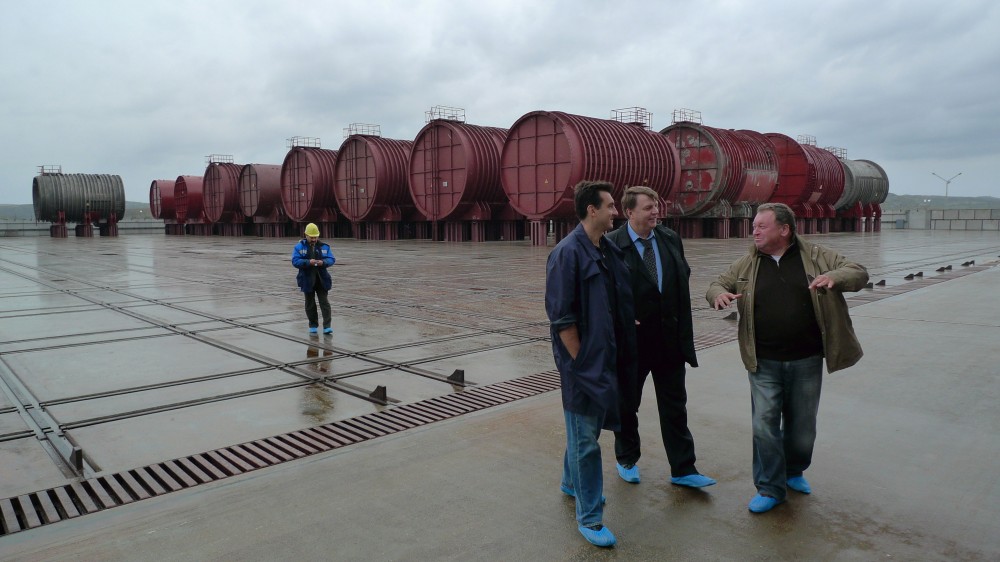
120 nuclear-powered submarines sailing in-and-out from the Kola Peninsula during the Cold War have been properly decommissioned since the early 1990s. While most of the metal could be recycled, the still-highly radioactive reactor compartments had to be secured for long-term storage.
Intermediate, that meant storing the compartments floating at piers until they could be taken onshore at the central storage complex in Saida Bay, north of Murmansk on the coast of the Barents Sea.
In 2017, the Barents Observer reported that 15 compartments were still kept afloat on the water.
Today, only three reactor compartments remain and they will be taken onshore in 2019, Izvestia reports with reference to the northwestern branch of RosRao, Russia’s state owned company for handling radioactive.
The three compartments are today stored at piers in Saida Bay, while 117 compartments are stored on the huge concrete pad.
RosRao’s Chief Engineer says the very last reactor compartment t be taken onshore is the one from the “Kursk” submarine that sant in the Barents Sea in August 2000 during a naval exercise. The submarine was lifted from the seabed two years after and the remaining parts of the hull were scrapped.
In Saida Bay, the reactor compartments will have to be stored for onshore for many decades before the radioactivity have come down to levels acceptable for cutting the reactors’ metal up and pack it for final geological disposal.
What the candidates for governor, AG say about nuclear waste in Idaho, Idaho Statesman, BY LUKE RAMSETH, the Statesman, October 14, 2018
The major-party candidates for Idaho governor and attorney general agree that a federal proposal to send nuclear waste from Washington to Idaho for treatment isn’t realistic, especially considering existing cleanup and shipment delays at the Idaho National Laboratory’s desert site.
In interviews, the candidates weighed in on several key nuclear waste and research issues related to the U.S. Department of Energy and INL, including the controversial proposal to move 7,000 cubic meters of transuranic nuclear waste to a specialized eastern Idaho facility for treatment. A recent poll found a majority of Idahoans favor accepting the waste to keep the facility going.
“To make a pipeline where waste from another area came in here, was processed, and was shipped out — I just don’t think it makes good sense,” said Republican Lt. Gov. Brad Little, who faces Democrat Paulette Jordan in the Nov. 6 general election. “There’s a lot of other things we can do at the lab.”
“My intent is to not take in any more nuclear waste until we are able to properly manage what we have already, and are able to ship [that waste] outside our state,” said Jordan, a former state representative.
Idaho politicians have for decades grappled with nuclear waste issues — how to balance pushing the federal government to clean up the toxic mess at the INL site while also maintaining a healthy research laboratory in the state. That challenge will continue for the next governor and attorney general, who will face a DOE out of compliance on several of its cleanup commitments under the 1995 Settlement Agreement, the document regulating federal radioactive waste cleanup in the Gem State.
They may also find themselves managing a renewed push to change or renegotiate the landmark cleanup agreement — a possibility that has nuclear watchdog group Snake River Alliance concerned — as well as plans to build a new type of nuclear reactor on the INL site.
“The problem is there’s a good chunk of eastern Idaho who make a living off of INL. We can’t ignore them,” said Bruce Bistline, a Democrat and Boise attorney challenging Republican Lawrence Wasden for attorney general. “But at the same time, it’s Western Idaho who drinks the water that will one day be undrinkable if we don’t get ahold of the management of that waste.”
Former Gov. Phil Batt, a Republican who negotiated the waste deal with federal officials, said the state’s next leader must be ready to learn about several complicated nuclear issues, and realize the federal government can be difficult to deal with. He added that no new waste should be accepted until DOE has met its current obligations to Idaho.
“I think we need to keep [the pressure] on them,” he said of the agency.
Accepting Hanford waste
As co-chairman of the state’s Leadership in Nuclear Energy Commission, Little said he’s studied the federal proposal to bring waste into the state for treatment. “I just don’t believe it’s going to happen,” he said.
The idea is to send Cold War-era waste from the Hanford Site in Washington, and possibly other federal facilities, to eastern Idaho for treatment and repackaging. From there, the waste would be sent on for disposal at a New Mexico facility called the Waste Isolation Pilot Plant, or WIPP…….
Nuclear station mud dumping: first phase ends, BBC, 12 Oct 18 The first phase of the dumping of mud off the coast of Cardiff as part of work to build a new nuclear power station in Somerset has been completed.EDF, the firm building Hinkley Point C, said contractors have completed the work.
Campaigners had demanded more tests on the sediment, taken from a site in the seabed near the new facility.
But EDF said the sediment was not radioactive under UK law and posed no threat to human health.
A second phase of dredging is yet to take place with work potentially taking place in 2020. Campaigners had been concerned the sediment, which was dumped at a site just over a mile out to sea from Cardiff, could have become contaminated by discharges from the old Hinkley Point A and B sites……..
What causes nuclear waste glass to dissolve? Phys Org, University of Houston October 10th, 2018
Immobilizing nuclear waste in glass logs—a process known as vitrification—is currently used in the United States to safeguard waste from sites associated with defense activities. Some other countries also use the process to capture waste from nuclear power plants.
Researchers know, however, that the glass can begin to dissolve after a long period of time, and the durability of these glass logs remains an active area of research.
Researchers from the University of Houston, the Department of Energy’s Pacific Northwest National Laboratory and the University of Pittsburgh are working on one of the most pressing issues—what causes the glass to begin to deteriorate relatively quickly at some point, potentially releasing radioactive waste at levels exceeding regulatory thresholds?……….”We have long observed from laboratory studies that zeolite formation in glass corrosion tests resulted in an increase in the glass corrosion rate,” said Neeway, a researcher at PNNL. ………
Zeolite P, the zeolite that forms from the glass, is affected by temperature—Rimer said researchers synthesize it in the lab at 100 °C—but they don’t yet know how crystallization proceeds at lower temperatures and they don’t have methods to deter its formation. But controlling temperatures in the geologic formations designated as nuclear waste repositories is not necessarily practical, thus researchers are looking for other factors that might affect crystal growth, including components of the glass. https://phys.org/wire-news/300629772/what-causes-nuclear-waste-glass-to-dissolve.html
Andrew Allison comments on this Russian claim Biological processes operate at the chemical level (electronic structure around atoms) these would be ineffective at changing anything at the nuclear level (strong and weak forces between parts of the nucleus). I would expect that the *most* that bacteria could do would be to concentrate and to isolate distributed atoms that happen to be radioactive.
Researchers from the Moscow-based Frumkin Institute of Physical Chemistry and the Russian Academy of Sciences’ Federal Research Center for Biotechnology have been able to isolate microorganisms which can be used to safeguard the surrounding environment from liquid radioactive waste.
Scientists made the discovery while conducting microbiological studies of the groundwater at the Seversky deep radiation burial site in Seversk, Tomsk region, Siberia, where liquid radioactive waste from the Siberian Chemical Combine, which supplies and reprocesses low enriched uranium for nuclear fuel, is stored.
Their research, recently published in Radioactive Waste, a Russian scientific journal, suggests that the bacteria is capable of converting radionuclide ions, including those found in uranium and plutonium, into sedentary forms, thereby preventing the spread of dangerous radiation into the surrounding environment. Through lab experimentation, the scientists were able to fine tune the conditions necessary for the bacteria to carry out its useful work.
The researchers say their findings are a first step in creation a biogeochemical barrier for radionuclides for use in deep burial sites containing liquid radioactive waste.
Research into microbiological tools to limit the effects of nuclear waste have been conducted since the 1980s, with scientists from around the world saying microbial processes must be taken into account in projects to bury and store nuclear waste which can otherwise decay over a period of millions or even billions of years.
Make nuclear waste site Ottawa Valley election issue: coalition https://www.insideottawavalley.com/news-story/8948934-make-nuclear-waste-site-ottawa-valley-election-issue-coalition/ NEWS Oct 05, 2018 by John Carter Arnprior Chronicle-Guide A group of concerned citizens is making a concerted effort to make the proposed nuclear waste disposal at Chalk River an election issue throughout Renfrew County, especially those municipalities along the Ottawa River.The informal alliance that also includes Ottawa Riverkeeper, the Coalition Against Nuclear Dumps on the Ottawa River and two cottagers groups, has sent a lengthy letter to each municipal candidate, spelling out “major concerns” about the plan. The groups stress they’re not advocating the closure of Chalk River nuclear laboratories but want changes to proposals on how and where radioactive nuclear waste is to be disposed.
It asks candidates to support efforts to petition the federal government to move the proposed radioactive nuclear disposal site “much farther away” from the Ottawa River and to use more-secure containment methods.
“Your constituents are very worried that large amounts of radioactive waste could contaminate the Ottawa River if these plans are not changed,” says the letter. That would affect the drinking water of millions of people.
The letter points out the contract includes the requirement to “seek the fastest, most cost-effective means” to dispose of all the radioactive waste that has been accumulating at Chalk River and other federal nuclear sites. The contract also includes decommissioning and entombing the nuclear reactor at Rolphton, which the coalition calls inappropriate.
The letter says the proposed 27-acre containment “mound” will contain up to one million cubic metres of radioactive nuclear waste, including materials transported in from other Canadian decommissioned nuclear sites. It is to be covered over by a combination of sand, stone, gravel and topsoil that could reach about 25 metres high.
The coalition is particularly concerned because the location is directly over an active earthquake zone, above porous and fractured rock, and less than a kilometre from the Ottawa River. It is beside a small lake that drains directly into the Ottawa River through a small creek, the letter points out.
The letter says the danger is exacerbated if the mound is left uncovered for more than 50 years, as planned. Furthermore, “climate change brings unpredictable, catastrophic weather that could cause permanent radioactive contamination of the Ottawa River,” the letter adds.
It suggests retired Atomic Energy of Canada Ltd. (AECL) senior nuclear scientists have raised serious concerns about the proposal. It quotes Dr. J.R. Walker as saying it “employs inadequate technology and is problematically located” and “does not meet regulatory requirements with respect to the health and safety of persons and the protection of the environment.”
The letter urges candidates, if elected, to introduce resolutions questioning the process and opposing the waste proposals as they currently stand, as well as the importation of nuclear waste to Chalk River from other locations “as more than 135 municipalities in Ontario and Quebec have already done.”
06.10.2018 Pregnant women in the United States could be exposed to ionizing radioactivity from nuclear waste shipped around the nation, a radioactive waste watchdog told Radio Sputnik’s Loud & Clear this week.
Given the number of shipments of nuclear waste traveling around the country, “Pregnant women and the fetus and the womb should not be exposed to any ionizing radioactivity if it can be avoided. This is going to happen. Given these kinds of shipment numbers — many thousands — there’s going to be exposures to pregnant women in this country,” says Kevin Kamps, radioactive waste specialist at Beyond Nuclear.
Nuclear waste is shipped past Americans all the time without many of us knowing it. Even waste passing by on a train is emitting radioactive particulates, and some of those can have negative consequences over time.
“It’s like an X-ray. It will cause harm,” Kamps said. Nurses often ask patients to wear protective aprons while taking X-rays to minimize exposure to the radiation, since X-rays are technically a carcinogen according to the World Health Organization. Medical News Today has reported that approximately 0.4 percent of cancers in the US are triggered by CT scans. (CT scans use X-rays and computer imagery to generate pictures of the body to help doctors with diagnoses.)
Transporting nuclear waste products is a risky business for public health outside the US, too
“If you have exterior, or external contamination, on the shipment — which has happened hundreds of times in France, 50 times in the US that we know of — those dose rates increase significantly. In France, on average, it was 500 times the permissible [amount of contamination] on one-third of the shipments. In one case it was 3,300 times [the] permissible [amount]. So if that’s one to two chest X-rays per hour, times 3,300 times permissible, that’s 6,600 chest X-rays per hour,” Kamps told Loud & Clear.
When the nuclear era ends: Struggling Zion, Ill., a lesson for Lacey Township, Press of Atlantic city, MICHELLE BRUNETTI POST Staff Writer , 7 Oct 18
More than 20 years after its nuclear plant closed, Zion, Illinois, is still dealing with the financial and community repercussions of its loss, says its mayor.
Almost all of the $19 million in annual property taxes the dual-reactor plant paid while in operation — about half the town’s tax base — disappeared.
“In five years it went down to $750,000 a year,” Zion Mayor Al Hill said of tax payments from the plant. “We are still trying to figure out how to dig out from under financial troubles created by the closing 20 years later.”
Lacey Township, where the Oyster Creek nuclear plant just closed, is similar in size to Zion — both have populations of about 25,000. Both nuclear plants were owned and operated by Exelon Generation.
But differences in how reliant the towns are on property taxes from their plants may save Lacey from a similar fate……….
Hill said the town knew when the plant was proposed it would have to live with an eyesore of a nuclear power plant. But the plant brought in tax dollars and a lot of jobs, he said, so people decided to go along with the tradeoff.
“But now we have spent fuel storage,” Zion Mayor Al Hill said, which wasn’t part of the agreement………
The spent fuel at Zion is guarded by armed guards with automatic weapons 24 hours a day, seven days a week.
“It’s behind a bunkered building,” Hill said, with the dry casks stored above ground. “You don’t need to do that if nothing can go wrong.”
Exelon officials said at a recent press conference that most of the 700 acre site in Lacey can be redeveloped after decommissioning, even with 753 metric tons of spent fuel stored there. Only the area right around the fuel would be off limits, they said.
But Hill said it won’t be a high value development, such as condos or a resort. That would require a developer to risk too much money, should an accident or attack happen.
Hill, like Lacey Township’s Juliano, is trying to get his U.S. Senators to back a bill to pay towns that host nuclear plants for acting as interim storage facilities for spent fuel rods. The rods are leftover from plant operation and must be carefully stored for hundreds of years or more.
The bill, H.R. 3053, the Nuclear Waste Policy Amendments Act of 2018, is co-sponsored by New Jersey’s Republican Congressman Tom MacArthur. The House of Representatives passed it in May, said MacArthur. But it has not come up for a vote in the Senate, and Juliano said he has not been able to get either of New Jersey’s senators to pay attention to the bill.
But the Energy and Water, Legislative Branch, and Military Construction and Veterans Affairs Appropriations Act of 2019 — H.R. 5895 — has passed and requires the Department of Energy to report on funding for municipalities hosting closed nuclear power plants. It awaits President Donald Trump’s signature.
Exelon transferred its license for the Zion plant to EnergySolutions of Salt Lake City, Utah, for the decommissioning. But Exelon will take the property back and be responsible for longterm storage of spent fuel after the cleanup of the site.
EnergySolutions got control of a $680 million decommissioning fund paid for by ratepayers.
“It’s gone, and they are not done yet,” said Hill, who said the company must come up with the funds to finish. “They are going to finish. They want to do more (cleanups).”
Exelon wants to sell the Oyster Creek plant outright to Holtec International of Camden, which would take over its $900 million decommissioning fund, keep the land and be responsible for handling the spent fuel rods until the federal government finds a storage solution for them.
The NRC said it started reviewing the potential sale this week and usually takes about a year to make a decision. But it will try to finish its review in eight months, at the request of Holtec and Exelon.
Hill cautions Lacey officials and residents not to rely on Exelon for help.
“Be careful. They are not going to do anything for you,” said Hill. “They have a responsibility to their shareholders. Your responsibility is to your constituents.”
Campaigners claim Carlingford Lough dredging proposal could bring “nuclear material” into bay, The Irish News, John Monaghan, 07 October, 2018 CAMPAIGNERS on both sides of the border are objecting to plans to deposit dredged material within Carlingford Lough, claiming it would bring nuclear substances into the bay.
Warrenpoint Port is proposing moving the placing of material collected during its regular dredging – carried out in order to maintain clear access for vessels – from 16 miles out at sea to within the lough.
The port has earmarked a site between Greencastle and Cranfield for the plans.
The Carlingford Ferry crosses close to the proposed zone, from Greencastle in Co Down to Greenore in Co Louth.
Christine Gibson, from Greencastle Keep It Green, said: “We have major concerns about the nuclear and radioactive substances in the lough and how this is going to be dredged and dumped at Greencastle – which is a designated site for its wildlife and natural assets.”
“We are concerned about coastal erosion and how it will affect our air and water quality,” she told the BBC………
Biologist Breffni Martin believes the plan is linked to Brexit.
“The thinking could be that, after Brexit, the European designations could disappear.
Hornepayne, Ont., municipal election to become debate on nuclear waste, Community one of three in northwestern Ontario to consider hosting nuclear waste Jeff Walters · CBC NewsOct 04, 2018 Voters in the small northwestern Ontario town of Hornepayne will have more to consider at the ballot box than tax rates and economic growth.
The township of 1,000 located between Highways 11 and 17 is in the running to host a nuclear waste repository. It’s one of three in northwestern Ontario, the others being Manitouwadge and Ignace.
Aison Morrison organized a walk this summer to demonstrate against hosting the toxic waste and is now running for town council.
The thought of having a burial area near her family camp, about 20 kilometres from town, caused Morrison to become more vocal in her opposition…….Nearly all of the communities in northwestern Ontario who have shown an interest in hosting the facility, including those no longer in the process, had fallen on hard economic times. Many had lost their primary industry, be it a sawmill or mine.
Morrison said she fears the Nuclear Waste Management Organization (NWMO) will use its counts of ‘engagements’ as a sign the community supports the site – which she believes the silent majority does not.
Ken Fraser, who is also running for Hornepayne town council, believes the major motivator for the site is financial.
He said the community has received about $1.3 million in funding from the NWMO, and continues to get about $300,000 annually which supports community events, including Canada Day celebrations and the local fish derby…….Morris and Fraser both hope a victory at the ballot box will mean they can change the current direction of how council feels about hosting nuclear waste. https://www.cbc.ca/news/canada/thunder-bay/hornepayne-nuclear-waste-2018-election-1.4849106
The municipal election is October 22.
Fraser said the population of the town, just under 1,000 people, should not be ‘bought’ at any cost.
“And over an eight year period, that’s what it comes out to, 49 cents. So, they divided a town, they’ve actually, you have family fighting, friends fighting friends for 49 cents a day.”
Welsh leaders urged to halt ‘nuclear mud’ dumping off Cardiff, Sediment from Hinkley Point C construction site is being disposed of at Cardiff Grounds, Guardian, Steven Morris @stevenmorris20– 2 Oct 2018 Pressure is increasing on the Labour-led Welsh government to halt the dumping of “nuclear mud” in the sea close to Cardiff after a campaign by an eclectic group of scientists, surfers and a pop star.
A motion calling on the government to suspend the licence allowing mud excavated from the construction site of the Hinkley Point C nuclear power station in Somerset to be disposed of just off the Welsh capital is to be debated next week in the national assembly for Wales.
The development prompted Cian Ciarán, the keyboard player from Super Furry Animals, to discontinue an attempt on Tuesday to obtain a court injunction to stop the dumping.
There is growing concern and anger that 300,000 tonnes of sediment from the Hinkley Point C site is being disposed of at the Cardiff Grounds sandbank.
Campaigners claim the mud has not been tested properly and could contain particles that may pose a health risk. They have described the sediment as “nuclear mud” and nicknamed the sea off Cardiff “Geiger Bay”, a play on Tiger Bay, the old slang name for the city’s docklands. One of their main concerns is that the sediment could be washed ashore in a storm.
Welcoming the assembly debate, Ciarán said: “This Labour government has taken the Welsh people for granted and has risked the health of the nation. For me the core message of the campaign remains unchanged: the absence of evidence is not the evidence of absence and therefore the precautionary principle should dictate a rethink. We will continue to seek the answers the Welsh public deserve.”
He called for the Welsh government’s patrol vessel, FPV Rhodri Morgan, to monitor the dumping that is taking place. “It is a duty for every Welsh assembly member to do right by its people and hold to account the government that granted the licence,” he said.
Nuclear Reactor Fuel Safety: The Waiting Gain, Union of Concerned Scientists,
DAVE LOCHBAUM, DIRECTOR, NUCLEAR SAFETY PROJECT | SEPTEMBER 27, 2018, Nuclear power reactors spilt atoms to release energy used to generate electricity. Many of the byproducts formed when atoms split are unstable (radioactive) and release particles or gamma rays in search of stability. These radioactive emissions produce energy. Whether in the core of an operating reactor, in the core of a shutdown reactor, in the spent fuel pool after discharge from a reactor core, or in dry storage after offloading from a spent fuel pool, the energy released from nuclear reactor fuel must be removed before it damages the fuel from overheating. This commentary describes the energy levels associated with nuclear fuel in various locations at various times to illustrate the factors that affect the associated hazard levels.
Nuclear Fuel Locations
The San Onofre nuclear plant near San Clemente, California is used to describe the nuclear reactor fuel locations and energy levels for this commentary. San Onofre has been permanently shut down, but data from when its reactors operated and for the spent fuel remaining onsite represent conditions at nuclear plants across the country…….. [excellent photos and tables]
……UCS Perspective
…… the relative hazards of nuclear fuel in reactor cores, spent fuel pools, and dry storage. Nuclear fuel in the reactor core, even in the core of a shutdown reactor, has a significantly higher energy level than when in the spent fuel pool or dry storage. The higher energy level has two associated hazard implications. First, it translates into less time to successfully intervene to prevent fuel damage when cooling is lost or impaired. Second, it provides a larger catalyst or engine to expel radioactive materials from damaged fuel. Risk is defined as the product of the probability of an accident times its consequences. The first factor affects the probability of an accident while the second factor affects its consequences. Combined, these factors can cause risk to increase.
Nuclear fuel in spent fuel pools has lower energy levels than when in reactor cores. The average fuel assembly energy levels are lower than the maximum energy level permitted in a MPC-37 canister. But the associated inventories indicate why spent fuel pools have higher risks than dry storage. The collective higher energy levels in spent fuel pools once again translate into less time to respond should cooling be lost or impaired. And the larger inventory of fuel assemblies emits a larger radioactive cloud should intervention fail.
Nuclear fuel in dry storage represents the least amount of fuel at the lowest energy level. If cooling is lost or impaired, more time is available to successfully intervene and less nasty spread gets out when efforts fail. But fuel in dry storage is far from absolutely safe. If it were even close to being so safe, the US would not be spending billions of dollars looking for, but not yet finding, a geological repository that can isolate this hazardous material from people and the environment for at least 10,000 years into the future.
Dry storage is the safest and securest way to manage nuclear fuel risks today. However, the more of the 10,000-year period we waste looking for a geological repository, the less competent and responsible we reveal ourselves to be.
The owner of what was considered to be America’s oldest nuclear power plant until its shutdown last week says it has removed the nuclear fuel from the reactor.
Chicago-based Exelon Corp. has notified the U.S. Nuclear Regulatory Commission that it removed the last of the fuel rods from the Oyster Creek Nuclear Generating Station on Tuesday.
The material was placed into a spent fuel pool where it will cool down for at least two years.
The fuel eventually will be placed into sealed concrete casks for longer-term storage on the grounds of the former plant in Lacey Township in New Jersey.
A Jupiter, Florida company, Holtec International, plans to buy the plant and move the fuel to an interim disposal site it is proposing in New Mexico.
A conversation with Dr. Gordon Edwards: contemporary issues in the Canadian nuclear industry, and a look back at the achievements of the Canadian Coalition for Nuclear Responsibility (CCNR), http://www.ccnr.org/ Montreal, August 25, 2018, Nuclear waste management: an exercise in cynical thinking. DiaNuke.org, 24 Sept 2018 “……..Proliferation of thousands of non-naturally occurring radioactive isotopes
Our organization has come to the conclusion that these wastes did not exist seventy-five years ago. It’s only in the last 70 some years that these wastes have been produced, and there are thousands of human-made radioactive materials, in addition to the couple of dozen radioactive materials that exist in nature. There are naturally occurring radioactive materials, but the difference is most of the existing radioactive materials are different chemical species from the non-radioactive materials. You can separate them chemically. Uranium, thorium, radium and so on are different chemical species than normal non-radioactive atoms.
In a nuclear power plant what you’re-creating is hundreds and hundreds of radioactive varieties of otherwise non-radioactive materials. Non-radioactive iodine is now contaminated with radioactive iodine. Non-radioactive cesium is contaminated with radioactive cesium—non-radioactive strontium and so on. And the result is that once these things are blended together, the radioactive and the non-radioactive, you can’t separate them anymore. It is an impossible task to separate out the radioactive from the non-radioactive once you have created duplicates of virtually every element in the periodic table of a radioactive variety.
15. Rolling stewardship
So we feel that for the foreseeable future, and that means for however long it takes, 100 years 200 years or more, we should not fool ourselves into thinking we have a solution. We should adopt a policy of rolling stewardship which means that we have to keep these things under constant surveillance, constant monitoring and they must be retrievable, and they must be guarded, and they must also have a built-in mechanism, a social mechanism, for ensuring that there is funding and knowledge and resources and tools available to future generations so that they can, in fact, know what these wastes are, that they can monitor them, and that they can take corrective measures when things start going wrong, and that they can improve the containment so that this is not just a status quo.
This is not an idea of just leaving it where it is and ignoring it. On the contrary, it’s an active involvement, an active engagement to continually improve the storage of these materials because we know how to do this. We know how to store the materials in such a way that they do not get out into the environment, and we can do this for periods of decades or even centuries, depending on the circumstances.
We feel that this is the policy that we should be following, not that this is an acceptable long-term solution, either, but it is something that can be managed over an intergenerational period of time indefinitely. The point here is that rather than abandoning the waste, which is what the industry now wants to do…
And by the way, it’s not only industry that wants to abandon the waste. It’s also the regulatory agency because the regulatory agency wants to also cut its liability. They don’t want to have to look after or be responsible for these wastes beyond a certain point in time. So they have a conflict of interest. Institutionally, they have an interest in abandoning the waste and saying it’s not our problem anymore. Any problems that are caused are your problem, not ours. Unfortunately, the people who are more likely to suffer the consequences of major leakage or major failure of containment will not have the resources or the knowledge. So abandonment actually presupposes amnesia. It means that you’re saying that we’re just going to forget it, and that means that when these things do come back to the surface, if they do, and do contaminate surface waters and food paths and so on, nobody knows anymore. It’s a question of rediscovering what these materials are, how we contain them, and so on.
So we feel that rolling stewardship is a more responsible approach and that entails really admitting that we don’t have a solution, and admitting that we should stop producing the waste. One of the reasons why we continue to produce this waste is because we are continually being presented with a dangled carrot, with the idea that the solution is just around the corner, and that we’re working on the solution. As long as we’re working on the solution, how can you possibly object to us just continuing?
A conversation with Dr. Gordon Edwards: contemporary issues in the Canadian nuclear industry, and a look back at the achievements of the Canadian Coalition for Nuclear Responsibility (CCNR), http://www.ccnr.org/ Montreal, August 25, 2018, Nuclear waste management: an exercise in cynical thinking. DiaNuke.org, 24 Sept 2018. “…….. The elusive “willing host community”DR: I know too there have been a lot of targeted “willing host communities” that have rejected it. Do you think they’ll succeed in finding one?
GE: Here in Canada they have gone through this process of looking for a “willing host community,” which is kind of foolish because these communities are very small. For example, I just visited two of them within the last few weeks way up above Lake Superior. In the two communities that I visited, Hornepayne and Manitouwadge, I gave presentations. These communities have less than a thousand residents in each one of them and they get $300,000 a year as basically bribe money in order to keep them on the hook, to keep them interested in learning more. It’s called the “learn more” program, and as long as they’re “learning more,” they can get $300,000 a year. Well, they are both interested in getting the money, and consequently they’re still in the running, but do they really want to be a nuclear-waste community? If this is such a good deal for them, then why aren’t other communities bidding for this—larger communities? Of course, one of the points that comes to mind immediately is that if you had a city of a million people or so, then you’d have to shell out $300 million instead of $300,000 every year, so this idea of a “willing host community” exists only because of the bribes that are given by the industry in order to keep these communities supposedly interested in receiving the waste. And in some of them, of course, there are people who see dollar signs and who see an opportunity for them to make a lot of money. In a small community, a certain small number of people can make a lot of money by capitalizing on an opportunity like that without being concerned very much about the long-term wisdom of it.
DR: Yeah, and the seventh future generation doesn’t get a voice.
I did speak to two other communities a couple of years ago in that same general area north of Lake Superior. One of them was the town of Schreiber, and one of them was White River, and both of those communities are now off the list. They’re no longer candidates, so we now have only three communities up north of Lake Superior which are still actively pursuing this program of taking money and “learning more.” I have spoken now to two of them and I haven’t yet been invited to go to the third one.
10. The great unknowable: long term care for nuclear waste. Who pays? Who cares?When I go there I try and point out to them not only the fact that this whole exercise is questionable, but also the fact that once the nuclear waste is moved up to a small remote area like this, what guarantee is there that it’s really going to be looked after properly? Because these small communities do not have a powerful voice.
They don’t have economic clout, and so they can’t really control this. If a person like Donald Trump, for example in the United States, or Doug Ford in Ontario, who many people think is a kind of a mini Donald Trump, thinks, “Why are we going to spend money on that? Forget it we’re not going to spend money on that,” then it’s going to not be pursued as originally planned. And it could become just a surface parking lot for high-level nuclear waste. Who is going to guarantee that it is actually going to be carried out? Now the nuclear plants are in danger of closing down. We’re having fewer nuclear plants every year than we had the year before now in North America, and consequently there’s not the revenue generation that there used to be. The money that’s been set aside is nowhere near adequate to carry out the grandiose project they’re talking about, which here in Canada is estimated to cost at least twenty-two billion dollars. They have maybe five or six billion, but that’s not nearly enough.
So there’s also another problem lurking in the wings, and that is that if you do want to carry out this actual full-scale program of geological excavation with all the care that was originally planned, how do you generate revenue? What company is willing to spend twenty-two billion dollars on a project which generates absolutely no revenue?
There are only two ways you can generate revenue from that, and one way is to take waste of other countries and charge a fee for storing the waste. The other thing is to sell the plutonium. If you extract the plutonium, then you could have a marketable product, but both of these ideas are extremely far from what these communities are being told. In other words, the plan that’s being presented to them does not include either one of these possibilities, and it changes the game considerably. As we all know, getting the plutonium out of the spent fuel involves huge volumes of liquid radioactive waste. It involves very great emissions, atmospheric emissions, and liquid emissions. The most radioactively polluted sites on the face of the earth are the places where they’ve done extensive reprocessing, such as Hanford in Washington, Sellafield in northern England, La Hague in France, Mayak in Russia, and so on.
DR: And Rokkasho in Japan.
GE: That’s right, and so this is a completely different picture than what they’re being presented with. Now whether or not that would actually happen is anybody’s guess, but it’s written right in their documents that this is an option, and they’ve never excluded that option. They’ve always included the option. In fact, the first sentence of the environmental impact statement written by Atomic Energy of Canada Limited many years ago says that when we say high-level nuclear waste we mean either irradiated nuclear fuel or solidified post-reprocessing waste. They have always kept that door open for reprocessing.
11. A disturbed “undisturbed” geological formation is no longer undisturbed But even under the best of circumstances we know that you can’t get waste into an undisturbed geological formation without disturbing it. As soon as you disturb it, it’s no longer the same ballgame. The other thing that people are unaware of, generally, is the nature of this waste. They really don’t realize that this waste is not inert material, that it’s active. It’s chemically active. It’s thermally active. It generates heat for fifty thousand years. They have a fifty thousand-year time period they call the thermal pulse, and the degree of radio-toxicity staggers the mind. Most people have no ability to wrap their mind around that. Take a simple example like Polonium 210 which was used to murder Alexander Litvinenko, and which will breed into the irradiated fuel as time goes on… According to the Los Alamos nuclear laboratories (it’s on their website), this material is 250 billion times more toxic than cyanide. That’s a staggering concept. In fact, nobody can wrap their mind around that, really. 250 billion times more toxic?! Theoretically that means that if you had a lethal dose of cyanide, and you had the same amount of Polonium 210, the cyanide could kill one person. The Polonium 210 could kill 250 billion persons. That’s amazing. How do you possibly wrap your mind around that?………https://www.dianuke.org/a-conversation-with-dr-gordon-edwards-contemporary-issues-in-the-canadian-nuclear-industry-and-a-look-b







 nuclear-news