nuclear-news

The News That Matters about the Nuclear Industry Fukushima Chernobyl Mayak Three Mile Island Atomic Testing Radiation Isotope

  • Home
  • 1 This Month
  • ACTION !
  • Disclaimer
  • Links
  • PAGES on NUCLEAR ISSUES

Hanford’s nuclear wastes. How do you navigate a situation where safety is impossible to promise?

What happens if we can’t clean up the mistakes of our nuclear past?At Washington’s Hanford nuclear site, failing infrastructure and make-do plans as the West prepares for a new round of radioactivity. Crosscut, by Heather Hansman, High Country News / January 7, 2019The Hanford nuclear complex in eastern Washington lies in a green-gold sagebrush steppe, so big you can’t see the edges of it and shimmery in the summer heat. The only landmarks are low-slung buildings on the horizon and ancient sand dunes scrubbed bare when the glaciers melted. There’s almost no trace that this is the biggest nuclear waste dump in the country. The scale of nuclear waste is like that: sprawling out into the metaphysical distance, too big for the human mind to hold.

That’s what John Price tells me. He’s the tri-party agreement section manager with the Washington Department of Ecology, which regulates Hanford, the site of the country’s first plutonium production plant. (The other two parties are the U.S. Department of Energy and the Environmental Protection Agency.) On a sweltering June evening, we stand on the edge of the site’s central plateau, wind buffeting our faces as we stare at the bony frame of the future vitrification plant. If you were to pull a shot glass full of liquid out of one of the tanks buried near us, it would kill everyone within 100 yards instantly. And the danger would not disappear: Plutonium, one of the components of that poisonous soup, has a half-life of 24,100 years. The plant is supposed to start processing the most toxic waste in 2036. But construction has stalled, and most of the waste sits in underground tanks, some of which have begun to fail. “Suppose all these things are starting to fall apart faster than we can clean them up,” Price says. “It becomes a really interesting moral question.”

Over the ridge north of us, the Columbia River curves around the site, appearing motionless until you get close and see how much water is pushing past the banks. Over the past year, a series of accidents has put the spotlight on Hanford, its aging infrastructure and the lack of a long-term solution. In May 2017, part of the Plutonium Uranium Extraction Facility, which holds rail cars full of solid waste, collapsed. Later that year, workers tearing down the Plutonium Finishing Plant were contaminated with plutonium and americium particles when an open-air demolition went wrong. In December, others inhaled radioactive dust at the same site, halting work indefinitely. Then, in June of this year, the Department of Energy (DOE), which is responsible for the site, released a proposal to reclassify some of the high-level waste as less toxic, with what’s called a “Waste Incidental to Reprocessing” evaluation, so they could clean it up sooner and more cheaply.

“There’s a lot more work to do than there is money to get it accomplished,” Price said. “We’ve really come to a fork in the road.”

Across the country, big energy companies are considering a move from coal to nuclear-fueled plants even as sites like Hanford remain mired in many-decades-long cleanups of radioactive landscapes. As the possibility of more waste looms, Hanford has become a flashpoint for people who fear that there’s no safe way to deal with our nuclear legacy. In this era of climate change and large-scale environmental degradation, the site raises the question: Can we ever clean up the mistakes of our past?

………  The Government Accountability Office estimates cleaning up Hanford could total more than $100 billion. Since 1989, when Hanford was first designated as a Superfund site, 889 buildings have been demolished, 18.5 million tons of debris have been put in controlled landfills, and 20 billion gallons of groundwater have been treated. With three decades of work, the scope of the problem has been greatly reduced, but the really toxic stuff is still on site.

The groundwater beneath Hanford is never going to be clean enough to drink, thanks to a cocktail of chemicals: strontium-90, which deteriorates marrow in the bones of humans and animals and takes 300 years to break down; hexavalent chromium, which mutates salmon eggs; and technetium-99, which dissolves like salt in water and has a half-life of 211,000 years.

The 586 square miles of sage still hold the 324 Building, home to highly radioactive nuclear containment chambers called hot cells, less than 1,000 feet from the Columbia and right across from the town of Richland, where many of the Hanford workers live. In the central plateau, where the ghostly vitrification plant stands, the Waste Encapsulation Storage Facility holds 1,936 radioactive cesium and strontium capsules currently kept in a glorified swimming pool. If an earthquake were to crack the pool, or the water supply were to run dry, those isotopes, physically hot and linked to bone cancer, would spread quickly.

The knotty heart of the cleanup is the tank farm, on the central plateau, where 56 million gallons of high-level waste — the official term for the long-lived radioactive material leftover from plutonium production — sit in 177 underground tanks. Each tank holds a unique mixture of sludge, solid, supernate liquid and crusty salt cake — a witch’s brew of 1,800 different chemicals that are buzzing, off-gassing and breaking down. Sixty-seven of the 149 carbon-steel single-shell tanks and one of the newer 28 double shells have leaked, but the Energy Department refuses to build new ones, and every year the time frame for cleanup gets longer.
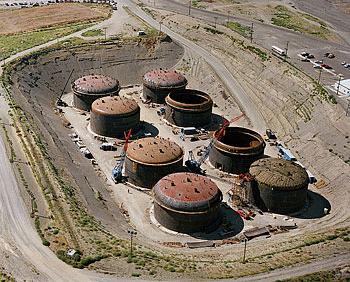
………The Department of Energy spends billions of dollars on the cleanup each year; it has a $2.4 billion budget this year. But those billions are barely enough to keep the wheels on, and the Government Accountability Office estimates that the last 15 percent of the cleanup could be as expensive as the first 85 percent, which has already taken 30 years. Maintaining the tanks alone costs $300 million a year, and the minimum amount needed to keep things safe increases as time goes on and infrastructure ages. There currently isn’t enough federal funding to meet cleanup benchmarks, and no money has been allocated for accidents like the tunnel collapse that contaminated workers.

At the current rate of funding and cleanup, the DOE’s Richland office, which manages most of the site, falls another year behind schedule every two years, and the Office of River Protection, which oversees the tank waste, slips back a year every three. Last year, President Donald Trump proposed slashing the budget for Hanford cleanup by $230 million.  …….

Cleaning up the tank farm requires moving the waste out of the single-shell tanks, which are each as wide across as a tennis court and can hold up to a million gallons of waste, and into the sturdier double-shell tanks. From there, it will — theoretically — be vitrified, or turned into glass, at the as-yet-unbuilt vitrification plant and then sent to the stalled-out proposed federal nuclear repository at Yucca Mountain in Nevada, or to another long-term storage facility. Every step is excruciatingly complex. The massive tanks were designed to hold radioactive materials, not release them, so any material in these tanks has to come out through a pipe just 12 inches around. Challenges like this have forced Hanford managers to invent every step of the cleanup process, from how to sample the contents to how to keep video cameras from burning up in the radioactive heat inside. It’s a constant guessing game, where the questions of how to store the waste and neuter its effects change endlessly. That’s why in June, the Energy Department proposed reclassifying the remaining high-level waste in the C section of the tank farm as low-activity waste, and then filling the tanks with grout to stabilize the remaining 66,000 gallons of waste, so it could be kept onsite permanently. The department thinks that it would be safe enough to close the door on the tank cleanup once the grout is in, except for long-term monitoring.

According to the tri-party agreement that governs the cleanup, the Energy Department is currently required to get 99 percent of the waste out of the tanks and vitrify it, but Sherri Ross of the department says the definition of high-level waste overlooks the fact that much of the waste is no longer very toxic. They’ve taken 1.7 million gallons of waste out of the C Farm tanks, or about 96 percent. Of the residual that’s left, the bulk of the material has less than a 30-year half-life, so it’s already become half as radioactive.  …….

High-level waste was never supposed to stay on site permanently. The waste from the tanks is intended to be vitrified, turned into glass rods, then sent to a federal repository, where it would sit, isolated, forever.

But that repository doesn’t exist yet, and it’s possible that it never will……..We’ve made stuff that will be dangerous for millennia and we deal with it in two-year congressional cycles,” said William Kinsella, a North Carolina State University professor whose research includes nuclear weapons cleanup. “We don’t want to make hasty decisions, but it’s a chokepoint for nuclear constipation.”

That has created expensive and dangerous blockages throughout the nuclear waste management system. Without a place to send waste, the cleanup at Hanford has no real endgame. Because of the long-term impossibility, the Hanford Advisory Board — a coalition of tribal members, community volunteers and government workers who advise the agencies that manage the site — is constantly worried that the funds might dry up while the tanks are still full. The fear of slashed funding, and the cleanup’s long delay, is part of what drove the Department of Energy to consider grouting.

But the proposal worries watchdog groups, who are concerned about shortsighted cost-saving measures that could put surrounding communities at lasting risk by keeping 700,000 gallons of waste that’s currently classified as high-level, and that might ultimately leak to the river on site. “What the DOE is proposing is to make the Hanford site a high-level waste repository in all but name,” said Tom Carpenter, executive director of the Hanford Challenge, an environmental advocacy group. “That does not belong in an agriculture zone in a major river system in an earthquake zone.”……

they’ll look at how the closed system is going to perform over the long term. Their model goes to 1,000 years, but they’ll also consider what might happen in 10,000 years, and model out to the half-life of plutonium, 24,000 years. They plan to use what they call “institutional controls” — signs, gates and infrastructure — to keep people away from the waste for 100 years.  ……

… low-probability but high-risk odds have created an environment that University of Washington professor Shannon Cram calls “the politics of impossibility.” How do you navigate a situation where safety is impossible to promise? The people in charge of caring for Hanford are trying to prevent unknown future problems, and fix past generations’ mistakes. But in the face of a budget crunch and an overwhelming cleanup, it’s nearly impossible to know what’s right.

Cram, who has studied the long-term public health effects of Hanford, says it’s likely that Hanford will never be completely clean, and that, if some waste is always going to remain in the ground, the real challenge is deciding what an acceptable level of exposure is.

“I think it’s really misleading to call it cleanup,” Cram says. “It’s not clean, it’s contained and monitored.” Cram remains concerned about the possibility of disaster being passed on to future generations. “The brewing threat doesn’t get enough attention, because a lot of it is looming in the future,” she says. “We basically as a country have to learn how to have the appropriate amount of fear.”

……..if we fail, this wastepile and more like it will remain our legacy, sitting in overlooked corners like the empty eastern Washington plains, for longer than humanity can comprehend — or even remember.    https://crosscut.com/2019/01/what-happens-if-we-cant-clean-mistakes-our-nuclear-past

January 8, 2019 Posted by Christina Macpherson | USA, wastes | 2 Comments

Bill Gates’ dangerous love affair with plutonium

Bill Gates’ nuclear ambitions go beyond mere ideas. He actually possesses financial holdings in one very dangerous situation indeed – a situation that is presently causing residents around St. Louis, Missouri to live under an all-out nuclear nightmare

Bill Gates’ Plutonium Pipe Dream: Convert Mountains of Depleted Uranium at Paducah to Power Earth for Centuries (Pt. 2)  EnviroNews DC News Bureau on March 14, 2016

“………Cunnings: The man considered by many to be supposedly a humanitarian trailblazer when it comes to combatting disease, has a plan to fast-breed the mountainous heaps of depleted uranium at Paducah into plutonium – one of the most dangerous and disease-causing substance on the face of the planet. Then in turn, this plutonium would be used to power what would be the so-called new fourth-generation nuclear power plants. Let’s listen to Gates articulate his plutonium scheme.

Voice of Bill Gates – Excerpt #2: The concept of this so-called “TerraPower reactor” is that you, in the same reactor, you both burn and breed. So, instead of making plutonium and then extracting it, we take uranium – the 99.3 percent that you normally don’t do anything with – we convert that, and we burn it.

[Editor’s Note: Bill Gates is the current Chairman of the Board of TerraPower — a Washington-based nuclear power technology company.]

Cunnings:Now get this, only 60 seconds after Gates acknowledges the tremendous problem of bringing more plutonium into this world, he turns around and makes a joke about it to a crowd filled with university students from nuclear programs – all this, only a few months after the catastrophic triple melt-through at Fukushima Daiichi.

Bill Gates – Excerpt #3: Our flame is taking the normal depleted uranium – the 99.3 percent that’s cheap as heck, and there’s a pile of it sitting in Paducah, Kentucky that’s enough to power the United States for hundreds and hundreds of years. You’re taking that and you are converting it to plutonium (humorously under his breath) – and then you’re burning that.

Cunnings: Oh yes, Mr. Gates seems to have a little love affair going on with plutonium – and the notion is that we need nuclear power to save ourselves from climate change. ……

Bill Gates Excerpt #8: I love nuclear. It does this radiation thing that’s tricky (laughter). But they’re good solutions. You know, it was interesting; recently, in Connecticut this natural gas plant blew up 11 guys. It just blew them up.

Bill Gates Excerpt #8: Murray: But you are personally investing in nuclear?

Gates: Right.

Cunnings: EnviroNews Editor-in-Chief Emerson Urry chatted with the esteemed nuclear industry expert and whistleblower Arnie Gundersen to explore whether Gates’ plan is a good idea or not.

Emerson Urry: Let’s go back to Bill Gates again, [and] the fourth generation nuclear power. I’ve heard him out there speaking about this, and essentially his ambition to, let’s say, convert Paducah, Kentucky [to plutonium]..

……….. the Paducah site is a very expensive cleanup that is going to take 20 or 30 years to decontaminate. You know, it’s like all of these bomb legacy sites – Hanford in Washington State…

Gundersen:   Hanford is going to take 70 years and cost 110 billion dollars to clean up. So, here we are paying over half of a century for the legacy of building bombs for five years in 1940. And so, Paducah is another one of those sites. It was built to enrich uranium. Why did we do that? Because we had a bomb program. And now we’re stuck with these huge costs that are underfunded or unfunded by Congress. That plant is going to sit there for 30 years. It will create a lot of employment for a lot of people knocking it down, but it also is highly radioactive, and it’s got to be done so cautiously, and it’s a really difficult problem.

Cunnings: There’s no known disintegration of plutonium small enough that doesn’t possess the ability to cause cancer. To be clear, there is no safe amount to be exposed to whatsoever.

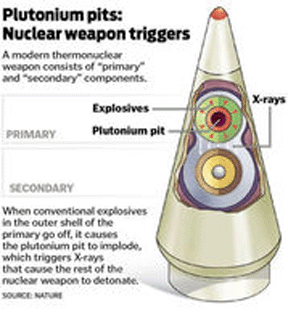
Plutonium, though a naturally occurring element was virtually non-existent on planet earth before the dawn of the nuclear age. Now, each of the roughly 400 uranium-powered nuclear reactors in the world create approximately 500 pounds of plutonium each year – or enough to create about 100 nuclear warheads each.

…….. Bill Gates’ nuclear ambitions go beyond mere ideas. He actually possesses financial holdings in one very dangerous situation indeed – a situation that is presently causing residents around St. Louis, Missouri to live under an all-out nuclear nightmare……https://www.environews.tv/031416-paducah-bill-gates-nuclear-pipedream-convert-mountains-depleted-uranium-plutonium-power-earth-centuries/

January 8, 2019 Posted by Christina Macpherson | - plutonium, secrets,lies and civil liberties, USA | 1 Comment

UK govt now prevents any one local council from pulling out of plans for a vast underground nuclear waste dump in Cumbria

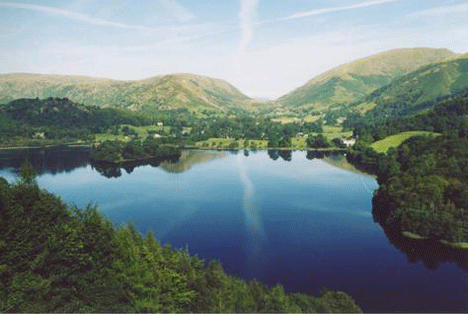
Times 5th Jan 2019 A million tonnes of nuclear waste could be buried under the Lake District after the government removed the right of county councils to veto plans for a vast underground dump.

The £19 billion “geological disposal facility” will have an underground area of up to 20 square kilometres, with radioactive waste stored in vaults at depths of between 200m and 1km.

Copeland borough council in Cumbria — the home of Sellafield, where most of Britain’s nuclear waste is stored — had wanted to be considered for the dump because it would create thousands of highly paid jobs and require local investment. But in 2013 Cumbria county council vetoed the idea.

Now the Department for Business, Energy and Industrial Strategy has published a plan for “the long-term management of higher activity radioactive waste” that prevents any one council in areas with two tiers of local government from pulling out of discussions on hosting the dump. Both councils can choose to withdraw but “no single principal local authority
will be able to unilaterally invoke the right”.
https://www.thetimes.co.uk/article/radioactive-waste-could-be-buried-under-lake-district-rqxpm9pjw

January 7, 2019 Posted by Christina Macpherson | politics, UK, wastes | Leave a comment

New Mexico could get more nuclear waste, and perhaps high level nuclear waste

More nuclear waste could come to New Mexico, Santa Fe New Mexican, By Rebecca Moss | rmoss@sfnewmexican.co, Jan 5, 2019 

       In the final days of Republican Gov. Susana Martinez’s administration, the state Environment Department approved a controversial change to how federal officials measure the amount of nuclear waste buried some 2,000 feet underground in Southern New Mexico salt beds.

Proponents of the change say it merely clarifies that the storage site will measure the actual volume of transuranic waste deposited there rather than the volume of the massive exterior waste drums, called overpack containers — and the air inside. But critics say the result will be an increase in the quantity of material stored at the U.S. Department of Energy’s Waste Isolation Pilot Plant near Carlsbad.

Several nuclear watchdog groups, which say they intend to appeal the decision, also fear the change in WIPP’s hazardous waste permit from the state could open the door to allowing high-level nuclear waste to be brought into New Mexico.

It’s unclear whether the Democratic administration of Gov. Michelle Lujan Grisham, who took office last week, will support the Environment Department’s decision in December or take any action to overturn it. The governor hasn’t yet appointed a Cabinet secretary to lead the Environment Department.

Tripp Stelnicki, a spokesman for Lujan Grisham, said the administration will be reviewing the potential impacts of the modification. But, Stelnicki said in an email, “that’s the case for all of the prior administration’s decisions.”

The governor “certainly recognizes safety at WIPP, for the public and for workers, is utterly paramount,” he added. “Safety is the expectation and that expectation will guide decision-making.”

Under the Land Withdrawal Act of 1992, Congress limited WIPP’s capacity to 6.2 million cubic feet, or just over 175,500 cubic meters. The plant, now about 52 percent full, is the only permanent repository for nuclear waste in the nation.

The 1992 law also limits the type of nuclear material that can be stored at the underground facility.

Under WIPP’s hazardous waste permit from the state, the volume of material stored at the plant has been measured based on the size of each exterior waste container.

Last year, however, the Department of Energy and Nuclear Waste Partnership LLC, a private company that operates the plant, told the New Mexico Environment Department the permit should be altered because it was forcing them to overcalculate the amount of waste at WIPP. Language in the permit required them to count empty space in large packing containers used to store smaller waste vessels — like hulking Russian nesting dolls. …….

Still, critics believe the waste measurement change — after nearly 20 years of consistent measurement procedures — is a thinly veiled effort to expand the size and mission of WIPP.

“It was the wrong way to go,” said Steve Zappe, who testified at the Carlsbad hearing. Zappe spent 17 years working on WIPP for the state Environment Department and helped craft the plant’s original waste permit.

The permit modification, he said, was allowing the Department of Energy to redefine how much nuclear waste it can dispose of at WIPP without going through Congress………. http://www.santafenewmexican.com/news/local_news/more-nuclear-waste-could-come-to-new-mexico/article_83a78c54-7579-5a43-8285-3ebe024758da.html

January 6, 2019 Posted by Christina Macpherson | USA, wastes | Leave a comment

Don’t let feds change the rules for cleaning up Hanford nuclear waste 

https://www.seattletimes.com/opinion/dont-let-feds-change-the-rules-for-cleaning-up-hanford-nuclear-waste/, January 2, 2019

The public can comment on the U.S. Department of Energy’s proposed changes to Hanford nuclear waste cleanup rules until Jan. 9, Tom Carpenter

After almost 30 years of a program to clean up dangerous defense waste at the Hanford nuclear site in southeastern Washington, the Department of Energy now wants to change the rules to make the job easier and save money. If approved, the proposal poses new dangers to the health and safety of people and the environment — not just in southeastern Washington, but at nuclear sites around the country.

In 1943, the U.S. government built the massive complex at Hanford to manufacture plutonium for nuclear weapons. When defense production ceased in 1986, its nine reactors had produced enough material for 60,000 atomic bombs. What remains is North America’s most contaminated site — more than half a billion gallons of nuclear waste and toxic chemicals stored in leaking tanks and dumped into the ground.

The most dangerous material is classified as “high-level waste.” The U.S. government has long recognized that because it poses such an extraordinary risk to human health and the environment, it requires special handling. A report prepared for the Atomic Energy Commission in 1957 called for disposal of high-level nuclear waste in a “deep underground formation, where it would remain isolated from human beings” for hundreds of thousands of years. That recommendation became law in 1982 when Congress passed the Nuclear Waste Policy Act.

Responsibility for the mess at Hanford falls to the U.S. Department of Energy. The plan includes mixing 56 million gallons of high-level waste with molten glass so it can be safely transferred to a permanent underground disposal site.

The cleanup effort began in 1989. It has not gone well. More than $45 billion has been spent, but no high-level waste has been processed. Hanford workers have received more than $1 billion in compensation for exposure to radiation and toxic chemicals. Companies working on the cleanup have pleaded guilty to criminal charges and paid hundreds of millions of dollars in fines and settlements. Radioactive waste is leaking into the groundwater and flowing toward the Columbia River.

Not to worry! The Energy Department has come up with an alternate approach for dealing with high-level nuclear waste — give it a new name and leave it where it is.

This past summer, the agency announced its intention to reclassify high-level nuclear waste in 16 partially emptied tanks as low-level waste and cover what remains with grout. Now DOE is going big, and proposing to give itself the authority to relabel waste as it sees fit anywhere in the nation.

Even under ideal conditions, the waste will slowly leach through the grout and into the surrounding soil. That assumes it doesn’t fail catastrophically due to fractures caused by changes in temperature, stress, or imperfections — all possible, even likely.

The danger extends beyond Hanford. Once the Energy Department grants itself the authority to redesignate dangerous nuclear material, it can do the same with hundreds of millions of gallons of high-level waste stored in 161 other tanks or simply dumped into the ground at Hanford. It sets a dangerous precedent that will place millions of people at risk — not just downwind and downriver from Hanford, but near facilities in South Carolina, Idaho and upstate New York, where millions more gallons of high-level waste are stored.

Why consider such an unsound plan? Money. By absolving itself of its legal obligation to handle high-level waste safely, the Energy Department expects to save $40 billion.

The proposal is not only irresponsible and dangerous, it violates the law and flies in the face of longstanding legal precedent. “High-level radioactive waste” was clearly defined by the Atomic Energy Commission in 1970 and the courts have repeatedly turned back attempts to reclassify it. In 2003, for example, the U.S. District Court in Idaho confirmed that what’s in tanks at Hanford is, in fact, high-level waste and made clear that the Energy Department cannot simply come up with an alternative way to treat it just because it is “too expensive or too difficult.”

Although it is profoundly shortsighted, deeply irresponsible and clearly illegal, this proposal isn’t surprising — it is entirely consistent with the Department of Energy’s history of cutting corners at Hanford and saddling future generations with a problem that requires our urgent attention today.

The Energy Department is taking public comments on this proposal through Jan. 9. Clearly, this plan must be rejected.


January 5, 2019 Posted by Christina Macpherson | USA, wastes | Leave a comment

UK govt offers up to £2.5million to prospective “nuclear dustbin” communities

Daily Mail 1st Jan 2019 Towns and villages are offered up to £2.5million to become Britain’s
‘nuclear dustbin’ and bury masses of radioactive waste near their homes.
Hundreds of tons of radioactive nuclear power station waste needs to be
stored a kilometre – roughly 3,000ft – deep in the ground. The facility
will need to hold 750,000 cubic metres of waste – enough to fill three
quarters of Wembley stadium – and will cost an estimated £8billion to
build. To provide an incentive to hosting the dumping ground, the selected
area will be given between £1million and £2.5million a year for community
projects, the Government said. The sweetener comes after the last attempt
to find a nuclear burial ground flopped in 2013 – following five years of
consultations – when Cumbria county council rejected the plan. It is
expected the process to find a site will take 20 years, and it will take
ten years to build. It will then need to remain safe for up to 200,000
years.
https://www.dailymail.co.uk/news/article-6543459/Towns-villages-offered-2-5million-Britains-nuclear-dustbin.html

January 5, 2019 Posted by Christina Macpherson | UK, wastes | Leave a comment

UK has no idea how to dispose of 38 nuclear submarines – saw Scotland as a “nuclear dustbin”

Revealed: UK’s secret plan to dump 22 nuclear submarines in Scotland, The Ferret , Rob Edwards on December 30, 2018  The UK government secretly planned to dump the radioactive hulks of 22 nuclear submarines in the sea off north west Scotland, documents released by the National Archives reveal.A survey for the Ministry of Defence (MoD) in 1989 identified six sites for “seabed storage” of defunct naval submarines near the islands of Skye, Mull and Barra for up to 60 years – and probably longer.

Detailed and highly confidential MoD studies concluded the plan was “feasible” and would “obviate the international problems which we would face were we to dispose of these vessels in international waters.”

According to one MoD official the aim was “to remove submarines from public view”. Another hoped that “everyone will forget about these submarines and that they will be allowed to quietly rot away indefinitely.”

The revelations have sparked anger and outrage from politicians and campaigners, who accused the MoD of seeing Scotland as a “nuclear dustbin”. The MoD stressed that current submarine disposal plans met the strictest standards of safety and security.

The 1989 sea-dumping plan ended up being quietly dropped. But the MoD has still not solved the problem of what to do with the accumulating number of nuclear submarines that have now been taken out of service.

Since the 1980s seven defunct submarines have been laid up at the Rosyth naval dockyard in Fife. Since the 1990s, thirteen have been laid up at Devonport naval dockyard in Plymouth, nine of them still containing radioactive fuel.

There are a further eight nuclear submarines in service, one in overhaul and nine due to come into service at Faslane on the Clyde, including the proposed new generation of four Trident-armed submarines. That’s a total of 38 nuclear submarines that will eventually require disposal……..https://theferret.scot/nuclear-submarines-dump-scotland/

December 31, 2018 Posted by Christina Macpherson | UK, wastes | 2 Comments

Inconvenient truths on nuclear waste ignored or buried by UK Government (again).

David Lowry’s Blog 27th Dec 2018 , Just before Christmas (19 December 2018) the Business Energy and
Industrial Strategy (BEIS) department published two important new documents dealing with the UK radioactive waste strategy.
They received no mainstream media print coverage.
One document was a new 68-page consultation policy paper on ‘Implementing geological disposal – working with communities: long term management of higher activity radioactive waste’ described as “An updated framework for the long term management of higher activity radioactive waste.”
The second was a 40-page ‘Summary of Responses to the Consultation ‘Working with Communities’: implementing GeologicalDisposal’.
http://drdavidlowry.blogspot.com/2018/12/inconvenient-truths-on-nuclear-waste.html

December 28, 2018 Posted by Christina Macpherson | politics, UK, wastes | Leave a comment

Enormous costs of shutting down Japan’s nuclear facilities

Costs for scrapping 79 nuclear facilities estimated at 1.9 tril. yen https://mainichi.jp/english/articles/20181227/p2g/00m/0na/001000c

December 27, 2018 (Mainichi Japan) TOKYO (Kyodo) — The state-backed Japan Atomic Energy Agency said Wednesday it would need to spend about 1.9 trillion yen ($17.1 billion) to close 79 facilities over 70 years, in its first such estimate.

The total costs could increase further, as the agency said the estimated figure, which would be shouldered by taxpayers, excludes expenses for maintenance and replacing aging equipment.

The JAEA plans to close more than half of the 79 facilities over the next 10 years due in part to the increased costs to operate them under stricter safety rules introduced after the 2011 Fukushima nuclear crisis. The agency, which has led nuclear energy research in Japan with its predecessors since the 1950s, owns a total of 89 facilities.

Of the estimated costs, the expense for closing the nation’s first spent-fuel reprocessing plant in the village of Tokai, Ibaraki Prefecture, northeast of Tokyo, accounts for the largest chunk of 770 billion yen. It will cost 150 billion yen to decommission the trouble-plagued Monju prototype fast-breeder nuclear reactor.

As for nuclear waste, the agency said about 100 kiloliters of high-level radioactive waste and up to 114,000 kl of low-level radioactive waste were estimated to have been produced but it has yet to decide on disposal locations.

The Japanese government aims to restart nuclear power plants after a nationwide halt following the nuclear crisis, despite persistent concern over the safety of atomic power generation.

December 27, 2018 Posted by Christina Macpherson | decommission reactor, Japan, politics | Leave a comment

USA desperate to make money from the nuclear industry – selling radioactive trash clean-up technology

US to offer ‘black box’ nuclear waste tech to other nations ChannelNews Asia 20 Dec 18 

The U.S. Department of Energy’s nuclear security office is developing a project to help other countries handle nuclear waste, an effort to keep the United States competitive against global rivals in disposal technology, according to two sources familiar with the matter.

WASHINGTON: The U.S. Department of Energy’s nuclear security office is developing a project to help other countries handle nuclear waste, an effort to keep the United States competitive against global rivals in disposal technology, according to two sources familiar with the matter.

The push comes as the United States struggles to find a solution for its own mounting nuclear waste inventories amid political opposition to a permanent dump site in Nevada, proposed decades ago, and concerns about the cost and security of recycling the waste back into fuel.

The National Nuclear Security Administration is considering helping other countries by using technologies that could involve techniques such as crushing, heating and sending a current through the waste to reduce its volume, the sources said.

The machinery would be encased in a “black box” the size of a shipping container and sent to other countries with nuclear energy programs, but be owned and operated by the United States, according to the sources, who asked not to be named because of the sensitivity of the matter.

“That way you could address a country’s concerns about spent fuel without transferring ownership of the technology to them,” said one of the sources.

The NNSA confirmed a project to help other countries with nuclear waste is underway but declined to provide details.

We are in the conceptual phase of identifying approaches that could reduce the quantity of spent nuclear fuel without creating proliferation risks – a goal with significant economic and security benefits,” NNSA spokesman Dov Schwartz said.

The effort is being led by NNSA Deputy Administrator for Defense Nuclear Nonproliferation Brent Park, a nuclear physicist and former associate lab director at the Energy Department’s Oak Ridge National Laboratory, appointed by President Donald Trump in April.

The NNSA declined a Reuters request for an interview with Park.

The sources did not name countries to which the service would be marketed, or where the waste would be stored after it is run through the equipment. But they said they were concerned the processes under consideration could increase the risk of dangerous materials reaching militant groups or nations unfriendly to the United States.

Former President Jimmy Carter banned nuclear waste reprocessing in 1977 because it chemically unlocks purer streams of uranium and plutonium, both of which could be used to make nuclear bombs.

The NNSA’s Schwartz said the plans under consideration do not involve reprocessing, but declined to say what technologies could be used.

The sources familiar with the NNSA’s deliberations said there are three basic ways that the physical volume of nuclear waste can be reduced, all of which are costly. At least one of the techniques poses a security threat, they said.

The first, called consolidation, reduces the volume of nuclear waste by taking apart spent fuel assemblies and crunching the waste down to two times smaller than the original volume – an approach that is considered costly but which doesn’t add much security risk.

A second technique involves heating radioactive pellets in spent fuel assemblies. The process, which gives off gases that must be contained, results in a waste product that has more environmental and health risks.

A third approach called pyroprocessing – developed at the Department of Energy’s Argonne National Laboratory – puts spent fuel in liquid metal and runs an electric current through it. That reduces volume, but concentrates plutonium and uranium – making it a potential proliferation risk.

The nuclear community is divided on whether pyroprocessing fits the definition of reprocessing.

The Trump administration has made promoting nuclear technology abroad a high priority, as the United States seeks to retain its edge as a leader in the industry, amid advancements by other nations like Russia, and France – both of which already offer customers services to take care of waste.

U.S. reactor builder Westinghouse, which emerged from bankruptcy in August and is owned by Brookfield Asset Management, hopes to sell nuclear power technology to countries from Saudi Arabia to India, but faces stiff competition from Russia’s state-owned Rosatom.

U.S. Energy Secretary Rick Perry visited Saudi Arabia this month for talks on a nuclear energy deal with the kingdom, despite pushback from lawmakers concerned about the killing of journalist Jamal Khashoggi in the Saudi consulate in Istanbul………… https://www.channelnewsasia.com/news/technology/exclusive–us-to-offer–black-box–nuclear-waste-tech-to-other-nations-11046762

December 20, 2018 Posted by Christina Macpherson | business and costs, politics international, wastes | 1 Comment

MOUNTING U.S. STOCKPILES of nuclear wastes – with nowhere to go


US to offer ‘black box’ nuclear waste tech to other nations ChannelNews Asia 20 Dec 18 

“…………MOUNTING U.S. STOCKPILES

The United States is also struggling to support its own nuclear industry at home, with aging reactors shuttering, new projects elusive due to soaring costs, and an ongoing political stalemate over a permanent solution for mounting nuclear waste stockpiles.

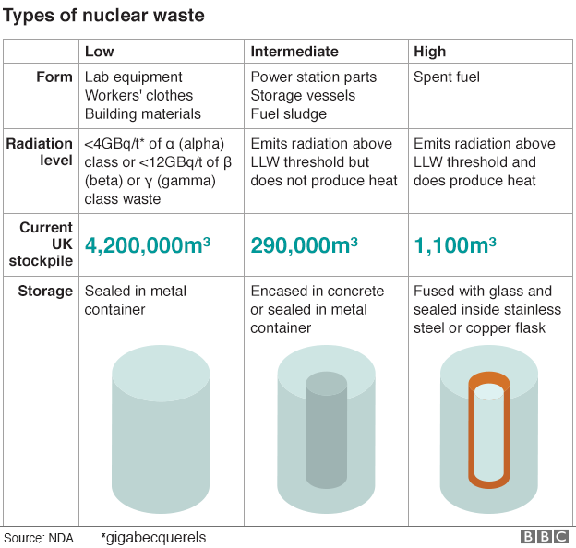
The United States produces some 2,000 metric tons of nuclear waste each year, which is currently stored in pools or in steel casks at the nation’s roughly 60 commercial nuclear power plants across 30 states.

The federal government designated Nevada’s Yucca Mountain as the sole permanent U.S. nuclear waste repository decades ago to solve the problem, spending about US$13 billion on the project, but it has never opened due to local opposition.

Thomas Countryman, the State Department’s top arms control officer during the Obama administration, said the government should make headway on the domestic problem before helping other countries.

“The primary issue on this front … is not that the U.S. can’t offer a low-volume option to potential buyers; rather it’s that the U.S. still has no option for disposing of its own spent fuel,” he said.

Edwin Lyman, a nuclear expert at the Union of Concerned Scientists, said NNSA should be less concerned about volume of waste and more concerned about the dangers that make it hard to store.

“It’s not the volume of the nuclear waste that’s the issue, but the radioactivity and heat it gives off as well as the fact that it remains dangerous for hundreds of thousands of years,” he said.

(Reporting by Timothy Gardner; Editing by Richard Valdmanis and Brian Thevenot)

Source: Reuters https://www.channelnewsasia.com/news/technology/exclusive–us-to-offer–black-box–nuclear-waste-tech-to-other-nations-11046762


December 20, 2018 Posted by Christina Macpherson | USA, wastes | Leave a comment

Britain’s nuclear nightmare -the Thermal Oxide Reprocessing Plant

UK’s dream is now its nuclear nightmare https://climatenewsnetwork.net/uks-dream-is-now-its-nuclear-nightmare/?fbclid=IwAR3CEunSXXOxdK_-N8Ka9kwpCMzvHFXNkZf23VGjd6oFuDecember 14, 2018, by Paul Brown 

Nobody knows what to do with a vast uranium and plutonium stockpile built up in the UK by reprocessing spent fuel. It is now a nuclear nightmare.

LONDON, 14 December, 2018 − Thirty years ago it seemed like a dream: now it is a nuclear nightmare. A project presented to the world in the 1990s by the UK government as a £2.85 billion triumph of British engineering, capable of recycling thousands of tons of spent nuclear fuel into reusable uranium and plutonium is shutting down – with its role still controversial.

Launched amid fears of future uranium shortages and plans to use the plutonium produced from the plant to feed a generation of fast breeder reactors, the Thermal Oxide Reprocessing Plant, known as THORP, was thought to herald a rapid expansion of the industry.

In the event there were no uranium shortages, fast breeder reactors could not be made to work, and nuclear new build of all kinds stalled. Despite this THORP continued as if nothing had happened, recycling thousands of tons of uranium and producing 56 tons of plutonium that no one wants. The plutonium, once the world’s most valuable commodity, is now classed in Britain as “an asset of zero value.” Continue reading →

December 17, 2018 Posted by Christina Macpherson | Reference, reprocessing, UK, wastes | 2 Comments

UK’s Sellafield nuclear reprocessing – a financial black hole for the Nuclear Decommissioning Authority

Sellafield boss warns on nuclear clean-up, Guardian, Adam Vaughan @adamvaughan_uk, 16 Dec 2018

Falling revenues from waste reprocessing have led to a financial black hole for the Nuclear Decommissioning Authority The government body given the job of cleaning up Britain’s old nuclear power stations has warned that taxpayers will have to help plug a looming multimillion-pound gap in its finances left by shrinking revenues.

David Peattie, chief executive of the Nuclear Decommissioning Authority, said revenues would fall more than 10% annually in coming years due to the end of an era of nuclear waste reprocessing. One plant ceased operations in November and another will stop in two years.

The group has a £3bn annual budget to clean up 17 old nuclear sites around the UK, but earns £1bn a year from services including repurposing spent nuclear fuel. “I don’t think we can fill the hole completely,” Peattie said.

He hopes to offset some of the losses by making better use of the NDA’s fleet of four ships that operate out of Barrow-in-Furness, Cumbria. The ships were used to bring spent fuel from as far afield as Japan back to the UK for reprocessing.

Peattie also hopes to secure more non-nuclear work such as the non-food cargo it handles for Tesco using its rail business, which runs around 100 locomotives. The rail unit transports waste from nuclear power stations to be stored at the NDA’s biggest and most costly site, Sellafield in Cumbria.

The final bill could also be reduced, said Peattie if the public accepted that not all old nuclear facilities would be returned to a pristine field of “buttercups and daisies”.

The legacy of the industrial revolution means people already tolerate “industrial clutter” in parts of the countryside, he said……. https://www.theguardian.com/environment/2018/dec/16/taxpayers-face-extra-nuclear-cleanup-cost

December 17, 2018 Posted by Christina Macpherson | USA, wastes | Leave a comment

The mad plan to store nuclear waste on the beach

 https://beyondnuclearinternational.org/2018/12/16/the-mad-plan-to-store-nuclear-waste-on-the-beach/, December 16, 2018 by beyondnuclearinternational 

An accident at the California storage site would leave residents nowhere to run, By Diane RayOn August 9, 2018, standing tall and looking the part of the hero, David Fritch stepped up to the lectern at a Community Engagement Panel meeting between the owner of a now shuttered nuclear power plant and local residents concerned about the beachfront disposal of nuclear waste.  “I may not have a job tomorrow,” he began, “But that’s fine. I made a promise to my daughter.”

Fritch introduced himself as an experienced nuclear power plant safety worker, sent around the country to oversee safety at various sites. He then reported what the Nuclear Regulatory Commission (NRC) called a “near miss” incident at the radioactive waste storage facility of the local nuclear power plant.

On August 3, 2018,  a 100,000 pound thin-wall cask filled with deadly irradiated nuclear fuel got caught on a flange while being lowered into the steel-lined concrete vault of  the waste storage site, known as an ISFSI (independent spent fuel storage installation). The cask got stuck on a ¼” guide ring for about an hour over an 18-foot drop.

 “It was a bad day…. And you haven’t heard about it,” said Fritch. “And that’s not right.” 

It was “a bad day” at a place where close to 3.6 million pounds of high level irradiated commercial nuclear fuel are being rushed into the sands of a fragile bluff, one and a half feet above the mean high tide, 108 feet from the sea, near an active earthquake fault, in a tsunami inundation zone, behind an inadequate sea wall.

It was another “bad day” at the long troubled and now closed San Onofre Nuclear Generating Station (SONGS) and its radioactive waste burial site on San Onofre State Beach, the iconic birthplace of California surf culture.

Coastal scientist and engineer, Rick Wilson of the Surfrider Foundation called it the worst waste site possible. Charles Langley, Director of Public Watchdogs and co-author of Radiological  Regulatory Failure, called it insane:  “Due to the danger from corrosion,” said Langley,  “you never put nuclear waste next to salt and water.”

The ISFSI opened on January 31, 2018 to public opposition from Orange County citizens groups concerned about nuclear safety, including San Onofre Safety, Public Watchdogs, and Residents Organized for a Safe Environment (ROSE).

Fritch explained to a stunned audience that the two-man loading team handling the incident did not know that this was the second serious cask loading incident. “Public safety should be first and it is not,” Fritch said. “Behind the gate, it is not.” 

Mandated by the NRC to report a nuclear incident in writing within an hour, Southern California Edison waited 42 days to issue their report, having informed the NRC three days after the incident via a “courtesy phone call.”  Forced to issue a response, the NRC subsequently concurred with Fritch’s account, admitting to the possibility of: “a load drop event,…[in which the cask] could have fallen 18 feet into the storage vault if it had slipped off the inner ring assembly.” 

How serious would the potential outcome have been had that nuclear waste cask fallen? Tom English, environmental engineer and former Presidential nuclear waste policy advisor, and local colleagues at UCSD and at the Samuel Lawrence Foundation, concluded that a cask could have “hit the concrete floor with the explosive energy larger than two sticks of dynamite.” They noted that based on the NRC’s own analysis of a similar dropped cask of slightly different dimensions, there was a 28 percent chance following a drop event that local residents would have needed to evacuate.

How can such a rate be acceptable in a highly populated area, they wondered? In a failure scenario caused by a steep drop of a cask, the air ducts could be damaged: “Water,” warned English, “would have to pour into the hole to cool the reaction and prevent or control a meltdown….As at Fukushima…the enveloping water would instantly become radioactive steam and require the evacuation of millions of people.” 

Who would coordinate evacuation? Not the Marines standing guard across the freeway from SONGS nor any part of the federal government, which has opted out of any emergency or evacuation planning now that the nuclear plant is closed. Not by the state of California which has not come through with any comprehensive plan.

But even if there were government plans in place, nuclear emergency plans on paper are unlikely to be workable in real life. A serious accident could compromise the abutting rail line and freeway, the adjacent Marine Corps Base Camp Pendleton, the Pacific Ocean, vast treasures of land and wildlife, and a state that is ranked as the world’s fifth largest economy. 

By the end of 2019, Edison plans to house 73 radioactive waste casks on the shoreline site. Along with an older ISFSI on site housing 51 thin-wall casks about 100 feet further up the beach, SONGS will become the largest commercial irradiated fuel burial site in the nation. Each thin-wall cask weighs about 100,000 pounds, bolted shut and loaded with pez like pellets of uranium. “The amount of radioactive isotope, cesium 137, contained within each cask is equivalent to one Chernobyl accident worth of escaped radiation in the event of a through leak into the atmosphere,”  English told me.

Fritch’s allegation of an earlier cover-up of a loading event at the ISFSI  was verified by Nina Babiarz of Public Watchdogs in a sworn affidavit, and confirmed by the NRC in a Webinar on November 8, 2018, according to Langley.

n the Ripley’s Believe It Or Not of the story, there was yet another near-miss at the ISFSI.  Edison disclosed at a Community Engagement Meeting on March 21, 2018 that a four-inch bolt, used to secure a shim needed to circulate cooling helium within the nuclear waste cask, had fallen off, discovered right before the cask was to be filled and buried. Loading had been halted for 10 days but was once more underway.

Local nuclear safety advocates were horrified. What about the first four casks of the same model, already in the vault? Did they share the flaw, which could lead to overheating of the irradiated waste? The NRC declared it had made its inspection and found everything in order. However, no technology presently exists to inspect the interior of this model of thin-wall cask entombed in concrete. 

Why would anyone rush to bury high-level radioactive waste on a state beach with high seismic and corrosion risks? In the opinion of Langley, there are two reasons: First, that Edison chose the old footprint of SONGS former Unit I to sidestep superfund cleanup costs and accelerate NRC approval (claiming the NRC suggested the beachfront site); Second, by dumping the waste onto public land, Edison sprints to the finish line, potentially also dumping liability for any future nuclear accident in a legal maneuver called “bona vacantia,” or legally ownerless. Public land equals public liability.

Fritch has since left the nuclear industry. SONGS’ Chief Nuclear Officer responsible for managing the ISFSI, Tom Palmisano, has stepped down. The NRC writes that it suspects that all thin-wall casks “in the storage vaults may have had metal to metal contact” between the cask being lowered and the storage vault. There is only ½” of clearance between the cask walls and the vault lining. The NRC acknowledged: The thin-wall casks “ tend to bump against the shelf while being loaded into the vault…”.    

This raises the probability that all 29 thin-wall casks in the vault sustained damage to their exteriors, potentially accelerating cracking and leaking. At the time of the near drop incident last August, a 30th filled cask turned up locked in limbo, unable to be returned to the spent fuel pool or to be buried in the damaged vault. It remains stranded in a building, stored within a transfer cask. However, transfer casks are not intended to provide an indefinite radiation barrier for thin-wall casks but are only approved by the NRC for brief usage, protecting workers during transfer operations.  

Neither Edison, the subcontractor, Holtec, nor the NRC will release information about how they can maintain a safe temperature for the stranded cask. The NRC states only that the cask is being kept sufficiently cool. Nuclear safety advocates are not reassured, particularly since the NRC is leaving it up to Edison as to whether they choose to resume loading operations into the clearly defective model of vault, the Holtec Hi-Storm UMAX.  

Safety advocates consider this example, as well as the NRC’s pervasive pattern of lax oversight in all the near miss incidents cited in this article, as the very definition of a “captured agency,” a proverbial fox minding a hen house. Donna Gilmore, Director of San Onofre Safety and frequent intercessor with the NRC, concludes: “Congress and the President should mandate the NRC enforce safety standards…and force the NRC to stop misleading them about the safety of systems they approve.” 

Public Watchdogs and San Onofre Safety advocate for immediate closure of the beachfront ISFSI.  They propose loading the irradiated fuel into thick-wall casks that are 10 to 19.75 inches thick and stored in hardened buildings. This variant of cask, most commonly used around the world and which withstood the earthquake and tsunami at Fukushima, can be inspected and repaired to prevent leaks and explosions. These two groups then propose moving the sturdier casks across the freeway onto higher and drier ground at Camp Pendleton.  Bonus: the marines stand guard.

Nuclear safety advocates recognize, however, that the plan suggested above is a “least worst” option, by no means 100% safe. At San Onofre, as elsewhere, the problem of safely, securely, and permanently storing high-level radioactive waste is yet to be solved. Without vigilant citizen oversight and advocacy, in the hands of the nuclear industry, the “least worst” option will never be achieved.

“For nuclear disaster at San Onofre,” concludes Langley, “you don’t even need an earthquake or a tsunami, you just need the nuclear industry.” And its lapdog regulator, too.

Diane Ray became an anti-nuclear activist in the late 1970s, working with Safe ‘n Sound against nuclear plant construction at Shoreham, Long Island, NY.  Shoreham never opened. Ray is a member of Public Watchdogs.       

Headline photo is a Google Earth shot of the SONGS ISFSI just steps from the shoreline.

Editor’s Note: Beyond Nuclear supports moving the SONGS radioactive waste off the shoreline and onto Camp Pendleton. We also support HOSS — Hardened On-Site Storage. HOSS mandates that: Irradiated fuel must be stored as safely as possible as close to the site of generation as possible; HOSS facilities must not be regarded as a permanent waste solution, and thus should not be constructed underground and the waste must be retrievable; The facility must have real-time radiation and heat monitoring for early detection of problems with containers; The overall objective of HOSS should be that the amount of releases projected in even severe attacks should be low enough that the storage system would be unattractive as a terrorist target; Placement of individual canisters that makes detection difficult from outside the site boundary. Read more about HOSS.

December 17, 2018 Posted by Christina Macpherson | USA, wastes | Leave a comment

USA’s absolute dilemma over radioactive trash – used nuclear fuel

What to do with used nuclear fuel, from Illinois to California https://thebulletin.org/2018/12/what-to-do-with-used-nuclear-fuel-from-illinois-to-california/ By Jeff Terry, December 14, 2018 The largest operator of nuclear power plants in the United States, Exelon, closed two nuclear reactors in the city of Zion, Illinois in 1998 because of low demand, which in turn led to poor operating economics. Ever since, these two pressurized water reactors have sat unused on the Lake Michigan shoreline just north of Chicago. Exelon contracted the company EnergySolutions to decontaminate and decommission the site, and this fall it announced it was nearly done, with demolition of the two structures almost complete.

These two closed reactors have been a thorn in Zion’s side since they shut down 20 years ago. The city lost $18 million in annual property tax revenue when the plants closed, and the shortfall had to be made up by local businesses and residents. Beyond the financial loss, the city can’t use the site for parkland, redevelopment, or anything else. But now that decontamination and decommissioning are nearly complete, Zion should be able to reclaim the land and convert it to beneficial use—right?

Not just yet. There is still spent nuclear fuel at the Zion site—bundles of rods of uranium dioxide pellets contained within Zircaloy metal claddings. These used fuel assemblies have been placed in large cylindrical concrete containers, which will be stored at the site on a 3,000 square-meter pad, an area just larger than half a football field. There they will remain in limbo due to the Nuclear Waste Policy Act of 1982. That year, in its infinite wisdom, the US Congress enacted a law saying that “the generators and owners of high-level radioactive waste and spent nuclear fuel have the primary responsibility to provide for, and the responsibility to pay the costs of, the interim storage of such waste and spent fuel until such waste and spent fuel is accepted by the Secretary of Energy in accordance with the provisions of this Act.” In other words, the power plant owner—in this case Exelon—has to hang on to the waste until the Energy Department agrees to accept it. The problem is that the Energy Department won’t accept it, because it has never arrived at an acceptable political solution for dealing with used nuclear fuel. Back in the late eighties, Congress designated Yucca Mountain in Nevada as the nation’s nuclear waste repository, but it has been the subject of political battles ever since, leaving the United States with no place for long-term disposal of nuclear waste.

Other countries have dealt with this problem. France reprocesses used nuclear fuel rods, extracting usable uranium and plutonium and immobilizing the leftover radioactive waste in hunks of glass. Finland has created the Onkalo repository for disposal in metal canisters deep underground. But since the US Energy Department doesn’t have a plan for nuclear waste, it is destined to sit at the Zion site for years, if not decades. A similar fate will likely befall the used fuel stored at other closed nuclear plants around the country, like the San Onofre Nuclear Generating Station in California. As in Zion, the San Onofre plant is located on prime waterfront real estate that local and state government would like to see available for public use as soon as possible.

n general, the US Nuclear Regulatory Commission and nuclear scientists would prefer to come up with a long-term solution to nuclear waste, meaning one that will last for thousands of years. The Yucca Mountain site was supposed to serve that purpose. But they also recognize that short-term or “interim” storage—good for up to 100 years—may be required. The Energy Department and private companies have floated proposals to use temporary sites around the country for short-term consolidated storage of waste from the current fleet of nuclear reactors. For example, Interim Storage Partners has proposed a consolidated storage site for Andrews County, Texas. Just over a decade ago, the American Physical Society released a comprehensive report, “Consolidated Interim Storage of Commercial Spent Nuclear Fuel,” saying that while it tends to prefer a long-term solution, it does recognize that “Consolidated storage could facilitate the decommissioning of sites with reactors that have been shut down.”

There are many closed nuclear plants in the United States that will undergo decontamination and decommissioning, but the Zion plant is an unusual situation, having nearly reached the point at which the land is entirely recoverable except for the lingering issue of used fuel. It is unreasonable to expect cities and towns to deal with land they can’t use, yet can’t collect tax on. Unfortunately, the problems Zion is about to face are just a harbinger of what is likely to happen around the country.

Proposed interim consolidated waste storage sites will probably face lawsuits from non-governmental organizations that don’t like the idea of nuclear waste being stored at temporary locations. Cities and citizens will also likely object to used nuclear fuel being moved along interstate shipping routes, and sue to stop that from happening. Governors will complain about radioactive materials being shipped into their states. This will all increase the amount of time Zion will have to act as a de facto interim waste storage site, without any of the benefits of being an official storage site, such as the potential to attract jobs in waste disposal and possibly enrichment or reprocessing.

There is, though, another potential option. The used fuel at Zion can be stored on only 3,000 square meters of land, an amount that could easily be found at either of the two Energy Department facilities in Illinois, the Argonne National Laboratory and the Fermi National Accelerator Laboratory, both located west of Chicago. It should be possible to move the waste from Zion to either of these sites. No interstate shipping would be required. Either site could store the waste in the same storage casks, on a similar pad. Neither Argonne nor Fermilab are expected to close, and even if they did unexpectedly, it would be decades before the land could be reclaimed for other purposes, which would give plenty of time for the waste to be moved again.

Both of these Energy Department facilities have experience handling radioactive materials. Both have strong research groups focused on radiation damage. They have the expertise to monitor and perform research on any potential degradation of the dry concrete storage containers. In terms of land use, security, and availability of expert staff, Illinoisans would be far better off with the waste stored at one of these sites than sitting in Zion on the shore of Lake Michigan.

Storing the waste in this way would even offer a research advantage. The Energy Department could fully study and document the process of taking ownership of the used fuel. It would end up with a model of safe transportation, storage, and monitoring that could be used to finally establish a process for the spent fuel sitting at other American commercial nuclear reactors. Even if the federal government fails to come up with a final disposition site, California could follow the Illinois model, transferring waste from closed nuclear plants like San Onofre to Energy Department sites within the state, or potentially even Defense Department facilities.

As EnergySolutions has now demonstrated in Zion, the private sector has the ability to decontaminate and decommission closed reactor sites. These places can be returned to public use, but only if the Energy Department finally takes title to the used nuclear fuel as it was obligated to do 20 years ago. We are about to have a restored site that cannot be fully used by the local community due to used fuel. It could easily take more than 10 years for interim storage to open elsewhere, and cities and towns should not have to serve as nuclear waste storage sites in the meantime. The Energy Department should consider moving used fuel to its own facilities within the same state.

December 15, 2018 Posted by Christina Macpherson | USA, wastes | Leave a comment

« Previous Entries     Next Entries »

1 This Month

26 September – International Day for the Total Elimination of Nuclear Weapons

PLEASE OPPOSE HR 8255 AND S.3639 – bills would accelerate satellite deployment, with no environmental review or safeguards – https://ncstd5li.quorum.us/campaign/169331/

​To see nuclear-related stories in greater depth and intensity – go to https://nuclearinformation.wordpress.com

  • Categories

    • 1
      • Arclight's Vision
    • 1 NUCLEAR ISSUES
      • business and costs
        • employment
        • marketing
      • climate change
      • culture and arts
      • ENERGY
        • renewable
          • decentralised
          • energy storage
      • environment
        • oceans
        • water
      • health
        • children
        • psychology – mental health
        • radiation
        • social effects
        • women
      • history
      • indigenous issues
      • Legal
        • deaths by radiation
        • legal
      • marketing of nuclear
      • media
        • investigative journalism
        • Wikileaks
      • opposition to nuclear
      • PERSONAL STORIES
      • politics
        • psychology and culture
          • Trump – personality
        • public opinion
        • USA election 2024
        • USA elections 2016
      • politics international
      • Religion and ethics
      • safety
        • incidents
      • secrets,lies and civil liberties
        • civil liberties
      • spinbuster
        • Education
      • technology
        • reprocessing
        • Small Modular Nuclear Reactors
        • space travel
      • Uranium
      • wastes
        • – plutonium
        • decommission reactor
      • weapons and war
        • Atrocities
        • depleted uranium
      • Women
    • 2 WORLD
      • ANTARCTICA
      • ARCTIC
      • ASIA
        • Burma
        • China
        • India
        • Indonesia
        • Japan
          • – Fukushima 2011
          • Fukushima 2012
          • Fukushima 2013
          • Fukushima 2014
          • Fukushima 2015
          • Fukushima 2016
          • Fukushima continuing
        • Malaysia
        • Mongolia
        • North Korea
        • Pakistan
        • South Korea
        • Taiwan
        • Turkey
        • Vietnam
      • EUROPE
        • Belarus
        • Bulgaria
        • Denmark
        • Finland
        • France
        • Germany
        • Greece
        • Ireland
        • Italy
        • Kazakhstan
        • Kyrgyzstan
        • Russia
        • Spain
        • Sweden
        • Switzerland
        • UK
        • Ukraine
      • MIDDLE EAST
        • Afghanistan
        • Egypt
        • Gaza
        • Iran
        • Iraq
        • Israel
        • Jordan
        • Libya
        • Saudi Arabia
        • Syria
        • Turkey
        • United Arab Emirates
      • NORTH AMERICA
        • Canada
        • USA
          • election USA 2020
      • OCEANIA
        • New Zealand
        • Philippines
      • SOUTH AMERICA
        • Brazil
    • ACTION
    • AFRICA
      • Kenya
      • Malawi
      • Mali
      • Namibia
      • Niger
      • Nigeria
      • Somalia
      • South Africa
    • Atrocities
    • AUSTRALIA
    • Christina's notes
    • Christina's themes
    • culture and arts
    • Events
    • Fuk 2022
    • Fuk 2023
    • Fukushima 2017
    • Fukushima 2018
    • fukushima 2019
    • Fukushima 2020
    • Fukushima 2021
    • general
    • global warming
    • Humour (God we need it)
    • Nuclear
    • RARE EARTHS
      • thorium
    • Reference
      • Reference archives
    • resources – print
    • Resources -audiovicual
    • Weekly Newsletter
    • World
    • World Nuclear
    • YouTube
  • Pages

    • 1 This Month
    • ACTION !
    • Disclaimer
    • Links
    • PAGES on NUCLEAR ISSUES
      • audio-visual news
      • Anti Nuclear, Clean Energy Movement
        • Anti Nuclear movement – a success story
          • – 2013 – the struggle for a nuclear-free, liveable world
          • – 2013: the battle to expose nuclear lies about ionising radiation
            • Speakers at Fukushima Symposium March 2013
            • Symposium 2013 Ian Fairlie
      • Civil Liberties
        • – Civil liberties – China and USA
      • Climate change
      • Climate Change
      • Economics
        • – Employment
        • – Marketing nuclear power
        • – Marketing Nuclear Power Internationally
        • nuclear ‘renaissance’?
        • Nuclear energy – the sick man of the corporate world
      • Energy
        • – Solar energy
      • Environment
        • – Nuclear Power and the Tragedy of the Commons
        • – Water
      • Health
        • Birth Defects in the Chernobyl Radiation Affected Region.
      • History
        • Nuclear History – the forgotten disasters
      • Indigenous issues
      • Ionising radiation
        • – Ionising radiation – medical
        • Fukushima FACT SHEET
      • Media
        • Nuclear Power and Media 2012
      • Nuclear Power and the Consumer Society – theme for December 2012
      • Peace and nuclear disarmament
        • Peace on a Nuclear Free Earth
      • Politics
        • – Politics USA
      • Public opinion
      • Religion and ethics
        • -Ethics of nuclear power
      • Resources – print
      • Safety
      • Secrets and lies
        • – NUCLEAR LIES – theme for January 2012
        • – Nuclear Secrets and Lies
      • Spinbuster
        • 2013 nuclear spin – all about FEAR -theme for June
        • Spinbuster 1
      • Technology
        • TECHNOLOGY Challenges
      • Wastes
        • NUCLEAR WASTES – theme for October 2012
        • – Plutonium
      • Weapons and war
      • Women
  • Archives

    • September 2026 (313)
    • August 2026 (330)
    • July 2026 (355)
    • June 2026 (287)
    • May 2026 (306)
    • April 2026 (356)
    • March 2026 (251)
    • February 2026 (267)
    • January 2026 (308)
    • December 2025 (358)
    • November 2025 (359)
    • October 2025 (375)
  • Categories

    • 1
      • Arclight's Vision
    • 1 NUCLEAR ISSUES
      • business and costs
        • employment
        • marketing
      • climate change
      • culture and arts
      • ENERGY
        • renewable
          • decentralised
          • energy storage
      • environment
        • oceans
        • water
      • health
        • children
        • psychology – mental health
        • radiation
        • social effects
        • women
      • history
      • indigenous issues
      • Legal
        • deaths by radiation
        • legal
      • marketing of nuclear
      • media
        • investigative journalism
        • Wikileaks
      • opposition to nuclear
      • PERSONAL STORIES
      • politics
        • psychology and culture
          • Trump – personality
        • public opinion
        • USA election 2024
        • USA elections 2016
      • politics international
      • Religion and ethics
      • safety
        • incidents
      • secrets,lies and civil liberties
        • civil liberties
      • spinbuster
        • Education
      • technology
        • reprocessing
        • Small Modular Nuclear Reactors
        • space travel
      • Uranium
      • wastes
        • – plutonium
        • decommission reactor
      • weapons and war
        • Atrocities
        • depleted uranium
      • Women
    • 2 WORLD
      • ANTARCTICA
      • ARCTIC
      • ASIA
        • Burma
        • China
        • India
        • Indonesia
        • Japan
          • – Fukushima 2011
          • Fukushima 2012
          • Fukushima 2013
          • Fukushima 2014
          • Fukushima 2015
          • Fukushima 2016
          • Fukushima continuing
        • Malaysia
        • Mongolia
        • North Korea
        • Pakistan
        • South Korea
        • Taiwan
        • Turkey
        • Vietnam
      • EUROPE
        • Belarus
        • Bulgaria
        • Denmark
        • Finland
        • France
        • Germany
        • Greece
        • Ireland
        • Italy
        • Kazakhstan
        • Kyrgyzstan
        • Russia
        • Spain
        • Sweden
        • Switzerland
        • UK
        • Ukraine
      • MIDDLE EAST
        • Afghanistan
        • Egypt
        • Gaza
        • Iran
        • Iraq
        • Israel
        • Jordan
        • Libya
        • Saudi Arabia
        • Syria
        • Turkey
        • United Arab Emirates
      • NORTH AMERICA
        • Canada
        • USA
          • election USA 2020
      • OCEANIA
        • New Zealand
        • Philippines
      • SOUTH AMERICA
        • Brazil
    • ACTION
    • AFRICA
      • Kenya
      • Malawi
      • Mali
      • Namibia
      • Niger
      • Nigeria
      • Somalia
      • South Africa
    • Atrocities
    • AUSTRALIA
    • Christina's notes
    • Christina's themes
    • culture and arts
    • Events
    • Fuk 2022
    • Fuk 2023
    • Fukushima 2017
    • Fukushima 2018
    • fukushima 2019
    • Fukushima 2020
    • Fukushima 2021
    • general
    • global warming
    • Humour (God we need it)
    • Nuclear
    • RARE EARTHS
      • thorium
    • Reference
      • Reference archives
    • resources – print
    • Resources -audiovicual
    • Weekly Newsletter
    • World
    • World Nuclear
    • YouTube
  • RSS

    Entries RSS
    Comments RSS

Site info

nuclear-news
Create a free website or blog at WordPress.com.
Privacy & Cookies: This site uses cookies. By continuing to use this website, you agree to their use.
To find out more, including how to control cookies, see here: Cookie Policy
  • Subscribe Subscribed
    nuclear-news
    Join 2,062 other subscribers

    Have a WordPress.com account? Log in now.

  • nuclear-news
    View site in Reader
    Manage subscriptionsSign upLog in
    Report this content
    Collapse this bar
Loading Comments...