Storage of nuclear waste a ‘global crisis’ as stockpile reaches 250,000 tons, Greenpeace warns

Nuclear waste stockpile – a global crisis
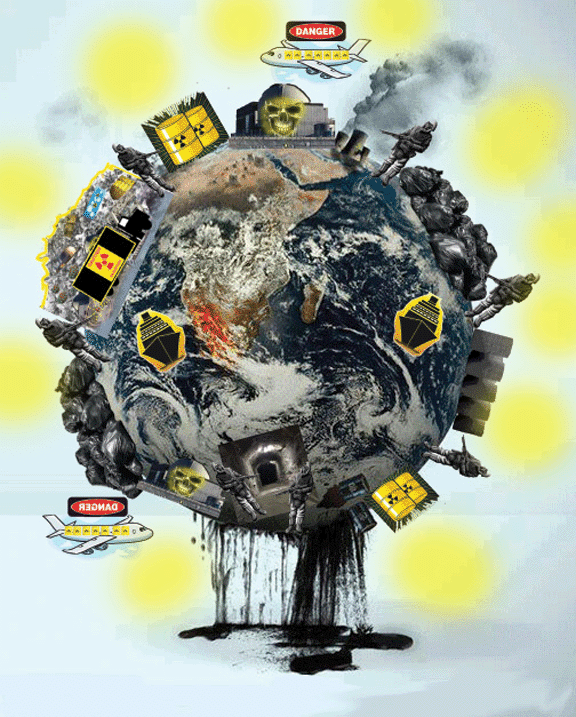 Storage of nuclear waste a ‘global crisis’ as stockpile reaches 250,000 tons, Greenpeace warns https://www.japantimes.co.jp/news/2019/01/31/world/storage-nuclear-waste-global-crisis-stockpile-reaches-250000-tons-greenpeace-warns/#.XFSxvdIzbGg
AFP-JIJI PARIS – Nuclear waste is piling up around the world even as countries struggle to dispose of spent fuel that will remain highly toxic for many thousands of years, Greenpeace detailed in a report Wednesday.
An analysis of waste storage facilities in seven countries with nuclear power revealed that several were near saturation, the anti-nuclear nongovernmental organization said.
All these nations also confronted other problems that have yet to be fully contained: fire risk, venting of radioactive gases, environmental contamination, failure of containers, terrorist attacks and escalating costs.
“More than 65 years after the start of the civil use of nuclear power, not a single country can claim that it has the solution to manage the most dangerous radioactive wastes,” Shaun Burnie, a nuclear expert at Greenpeace Germany and coordinator of the report, said in a statement.
In particular, storing waste material from nuclear power reactors deep in the ground — the most researched long-term storage technology — “has shown major flaws which exclude it for now as a credible option,” he said.
Currently, there is a global stockpile of around 250,000 tons of highly radioactive spent fuel distributed across 14 countries.
Most of this fuel remains in so-called cooling pools at reactor sites that lack secondary containment and remain vulnerable to a loss of cooling. Some lack a source of back-up power.
The partial meltdown of the Fukushima nuclear power plant in 2011 made clear that the high-heat hazard of spent fuel pools is not hypothetical.
The 100-page report, compiled by a panel of experts, dissected shortcomings in the management of voluminous waste in France, which has the second-largest nuclear reactor fleet (58), after the United States (about 100).
“There is no credible solution for long-term safe disposal of nuclear waste in France,” the report said.
French oversight bodies have already raised concerns about capacity of massive cooling pools in Normandy at the La Hague site. In response, energy giant Orana, which manages the site, said in a statement that “there is not risk of saturation of the pools in La Hague until 2030.”
In the United States, billions of dollars and decades of planning have failed to secure a geological disposal site, the report notes.
The Yucca Mountain underground facility — decades in construction — was finally canceled in 2010 by the Obama administration.
Some 70 percent of spent fuel in the United States remains in vulnerable cooling pools, often in densities several times greater than originally intended.
Nuclear waste from uranium mining is also a major environmental concern.
The world’s inventory of uranium mill tailings — sandy waste material that can seep into the local environment — was estimated at more than 2 billion tons as of 2011.
The other countries covered in the report are Belgium, Japan, Sweden, Finland and Britain.
Nevada State Officials Are Outraged that the Trump Administration Secretly Shipped Plutonium in from South Carolina
“They lied to the State of Nevada, misled a federal court, and jeopardized the safety of Nevada’s families and environment,” Governor Sisolak said. Nevada officials say they are “outraged” by the Trump administration’s “reckless decision” to secretly ship 1,100 pounds of weapons-grade plutonium to a site north of Las Vegas, against the express wishes of state representatives.
Governor Steve Sisolak called the move an “unacceptable deception” that exposed the “sham” of the state’s ongoing negotiations with the Department of Energy (DOE) over the transfer of plutonium from South Carolina. Nevada Senator Jacky Rosen called the decision “deceitful and unethical” and said it jeopardized “the health and safety of thousands of Nevadans and Americans who live in close proximity to shipment routes,” according to The New York Times.
A federal judge ordered the transfer in 2017, but the move was challenged in court when Nevada sued the federal government to block it last November. Unbeknownst to Nevada officials, the DOE had already shipped the plutonium to Nevada, according to legal filings released Wednesday. Nevada officials were not notified because the transfer was classified due to its implications for national security, the DOE said.
“Although the precise date that this occurred cannot be revealed for reasons of operational security, it can be stated that this was done before November 2018, prior to the initiation of the litigation,” said Bruce Diamond, general counsel for the DOE’s National Nuclear Security Administration, in the filing.
The plutonium is being held at the Nevada National Security Site near Yucca Mountain, in the complex’s Device Assembly Facility (DAF).
This region has a rich tradition of anti-nuclear activism: Public figures like astronomer Carl Sagan and actor Martin Sheen were among the thousands of people arrested at the height of the local protest movement in the late 1980s and early 1990s.
Decades later, there is strong bipartisan opposition in Nevada to any expansion of the site’s role as a repository for spent nuclear material. In 2009, President Obama backed off of long-term plans to develop storage capabilities at Yucca Mountain. The Trump administration signaled its intention to reverse that decision last year by including $120 million in the DOE budget to prepare for new shipments.
Nevada’s November lawsuit against the transfer is now regarded as moot by the US Justice Department, the Associated Press reported, and the plutonium may remain at the DAF for nearly a decade before another planned transfer to New Mexico.
Despite assurances from the DOE that there will be no other imminent shipments, the state’s elected officials argue the lack of transparency over the move demands new preventative measures. Governor Sisolak said the state is pursuing “any and all legal remedies” against the federal government, including contempt of court orders.
“They lied to the State of Nevada, misled a federal court, and jeopardized the safety of Nevada’s families and environment,” Sisolak said in a statement. “My administration is working with our federal delegation, and we will use the full force of every legal tool available to fight back against the federal government’s reckless disregard for the safety of our state.”
Correction: An earlier version of this article referred to the plutonium shipment as nuclear waste. It does not far under that definition according to the DOE. The article has been updated to reflect this.
Secret shipent of plutonium from South Carolina to Nevada
US secretly shipped plutonium from South Carolina to Nevada, https://www.apnews.com/bcd700b7826d41bc82af5ab316d155ca January 31, 2019
RENO, Nev. (AP) — The U.S. Department of Energy revealed on Wednesday that it secretly shipped weapons-grade plutonium from South Carolina to a nuclear security site in Nevada months ago despite the state’s protests.
The Justice Department notified a federal judge in Reno that the government trucked in the radioactive material to store at the site 70 miles (113 kilometers) north of Las Vegas before Nevada first asked a court to block the move in November.
Department lawyers said in a nine-page filing that the previously classified information about the shipment from South Carolina can be disclosed now because enough time has passed to protect national security. They didn’t specify when the one-half metric ton of plutonium was transferred.
Nevada Gov. Steve Sisolak said he’s “beyond outraged by this completely unacceptable deception.” He announced at a hastily called news conference in Carson City late Wednesday the state is now seeking another court order to block any more shipments of plutonium as it pursues “any and all legal remedies,” including contempt of court orders against the federal government.
The newly elected Democrat said he’s exploring options for the plutonium that already has arrived and is working with Nevada’s congressional delegation to fight back against the U.S. government’s “reckless disregard” for the safety of Nevadans.
Democratic Sen. Jacky Rosen called the government’s move “deceitful and unethical.” Sen. Catherine Cortez Masto, also a Nevada Democrat, said she would demand department officials come to her office on Thursday to explain how they made the “reckless decision” in such “bad faith.”
Democratic Rep. Dina Titus said the Trump administration has repeatedly tried to use Nevada as a dumping ground for nuclear waste. Trump revived a decades-old proposal to store the nation’s nuclear waste at another site outside Las Vegas, Yucca Mountain, after the project was essentially halted under the Obama administration.
Justice Department lawyers said in new court filings Wednesday that no more shipments of weapons-grade plutonium are planned from South Carolina to Nevada. They said they believe Nevada’s lawsuit aimed at blocking the shipments is now moot.
But lawyers for Nevada said late Wednesday that their bid for an emergency injunction is more critical than ever after the Energy Department misled them about the shipments. They say the government has created the “palpable suspicion” that more shipments are coming to Nevada.
Sisolak described the months-long negotiations with Energy Department officials over the plutonium leading up to the new disclosure as a “total sham.”
“They lied to the state of Nevada, misled a federal court, and jeopardized the safety of Nevada’s families and environment,” he said.
U.S. District Judge Miranda Du in Reno already is considering the state’s earlier request to block the Energy Department’s plans — announced in August — to ship a full metric ton of plutonium to Nevada from South Carolina, where a federal judge previously ordered that the plutonium be removed from a Savannah River site by 2020.
Nevada argues the department has failed to adequately study the potential dangers of moving the material that still has the potential to be used to help develop nuclear weapons to an area that is subject to flash floods and earthquakes, and that the state’s lands and groundwater may already be contaminated with radioactive materials.
In January, Du declined to immediately block the plutonium and indicated she wouldn’t rule until February. “I hope the government doesn’t ship plutonium pending a ruling by this court,” she said at the time.
Nevada and the Justice Department filed their latest briefs Wednesday at the request of the judge, who questioned whether the case should go forward. Justice Department lawyers said any additional plutonium removed from South Carolina would not go to Nevada.
Meanwhile, the states of Nevada and South Carolina are continuing to argue over where any legal challenge should be heard. Each said in briefs filed in Reno last week that theirs is the proper venue.
Nevada’s experts testified that the material likely would have to pass directly through Las Vegas on the way to the Nevada National Security Site. They fear an accident could permanently harm an area that is home to 2.2 million residents and hosts more than 40 million tourists a year.
The Energy Department’s plan approved last August called for the full ton of material to be stored at the Nevada nuclear security site and the government’s Pantex Plant in Texas, two facilities that already handle and process plutonium. The department says it would be sent by 2027 to the Los Alamos National Laboratory in New Mexico or another unnamed facility.
____
Associated Press writer Ryan Tarinelli contributed to this report from Carson City.
Dismantling process of pioneer nuclear station – it’s still dangerous
How do you dismantle a nuclear power plant? Very, very carefully. Before they can break apart this historic Army facility, they have to make sure it’s not radioactive, WP, By Michael E. Ruane, Behind the locked gates of Building 372 at Fort Belvoir in Virginia, past the door to the huge containment vessel where a sign warns of radiation, a large button on the control panel is covered in red plastic and reads: “manual scram.”
This is the emergency shutdown button, which nuclear legend says was pushed when it was time to scram.
But these days, the dark interior of the Army’s historic nuclear reactor, once called an “atomic-age miracle machine,” is a maze of rusted pipes, peeling paint and pressure gauges reading zero.
Keys in the control panel haven’t been turned in years, and switches are set to “off.”
The world’s first nuclear plant to supply energy to a power grid has been defunct for years. But the Army is preparing to break it up, check it for lingering radiation and haul it away piece by piece.
Dedicated in 1957, as the government was promoting “Atoms for Peace,” the facility was a training site and a prototype for small reactors that could produce power for bases in remote places around the world, the Army said. Built on the Potomac River’s Gunston Cove, it was called the SM-1, for stationary medium power plant No. 1.
“First nuclear power plant ever to put power on a grid, ever in the world,” said Hans B. Honerlah, a senior health physicist with the Army Corps of Engineers’ hazardous, toxic and radioactive waste branch.
The SM-1 trained hundreds of nuclear plant specialists before it was shut down in 1973. By then, the military’s need for such expensive plants had dwindled, said Charles Harmon, a former shift supervisor at the facility and an unofficial historian of the site. “The cost of the Vietnam War was making funds scarce,” Harmon said.
The plant’s uranium-235 fuel and reactor waste were removed in 1973 and ’74 and taken to a storage site in South Carolina. The 64-foot-high concrete-and-steel containment vessel that housed the smaller reactor vessel and other equipment was sealed.
But all these years later, there still is likely residual nuclear contamination of some of the internal structures, Army experts said.
[An atomic town revels in its plutonium past as tunnel collapse raises contamination concerns]
Before the site is torn down, experts will check everything for radiation and look for any impacts to the environment and historical record.
Honerlah said at Fort Belvoir earlier this month: “It’d be great to make it a museum, but it’s always going to be radioactive.
“It has to go away. It’s never going to not be radioactive. The goal . . . is to take the remaining radioactive components, remove them from the . . . facility here and take them” to a nuclear waste site, probably in western Texas………
Corps of Engineer officials said they hope to start the process next year. They said it would probably take five years to finish. “These facilities were really not built to be taken apart,” Barber said.
‘Atoms for Peace’
In 1954, the SM-1 was described by The Washington Post as a miracle machine that could provide power anywhere in the world……
Years before the nuclear plant disasters at Three Mile Island in 1979, Chernobyl in the Ukraine in 1986, and Fukushima in Japan in 2011, hopes were that nuclear power could be clean and safe. ……https://www.washingtonpost.com/history/2019/02/01/how-do-you-dismantle-nuclear-power-plant-very-very-carefully/?utm_term=.5704ad3cf0b4
Cleanup estimate for Hanford nuclear site increases by $82B
Rapidly climbing costs to USA tax-payers for nuclear waste cleanup – rose by $100 billion in one year!
America’s Chernobyl’: Inside The Most Toxic Place In The Nation | TODAY
Cost to taxpayers to clean up nuclear waste jumps $100 billion in a year https://www.nbcnews.com/news/all/cost-taxpayers-clean-nuclear-waste-jumps-100-billion-year-n963586 , 30 Jan 19, An Energy Department report shows the projected cost for long-term nuclear waste cleanup overseen by DOE jumped $100 billion in just one year. Jan. 29, 2019, By Laura Strickler, WASHINGTON — The estimated cost of cleaning up America’s nuclear waste has jumped more than $100 billion in just one year, according to a DOE report — and a watchdog warns the cost may climb still higher.
The Energy Department’s projected cost for cleanup jumped from $383.78 billion in 2017 to $493.96 billion in a financial report issued in December 2018.
A government watchdog and DOE expert said the new total may still underestimate the full cost of cleanup, which is expected to last another 50 years. “We believe the number is growing and we believe the number is understated,” said David Trimble, director of the Government Accountability Office’s Natural Resources and Environment team.
The cost was calculated by the accounting firm KPMG under contract to DOE.
Eighty percent of the increase comes from new projections of the costs of cleaning up radioactive waste and hazardous chemicals at the Hanford site in southeastern Washington.
The 586-square-mile site, home to nine former production reactors and processing facilities, produced plutonium for America’s nuclear arsenal during the Cold War.
Cleaning up Hanford has already cost taxpayers $170 billion over 30 years, but government auditors say the most challenging parts of the clean-up work are yet to be done.
Still not cleaned up are 56 million gallons of what the DOE’s inspector general has described as “hazardous and highly radioactive waste.” The rise in projected cost is due to updated estimates for building and running a waste treatment plant, including “operating costs, tank farm retrieval and closure costs” at the site, according to the report. The report also refers to changes in “technical approach or scope” and “updated estimates of projected waste volumes.”
Trimble of the GAO believes the Energy Department “does not have a coherent strategic plan on how to address its cleanup mission.”
A spokesperson for the Energy Department said in an emailed statement that the office that oversees the cleanup is “committed to making progress on the ground at Hanford, and mitigating the years of escalating liabilities at the site.”
The spokesperson said DOE expects more cost increases “and is working with regulators and stakeholders on best options to treat and dispose of radioactive waste.”
Energy Secretary Rick Perry has proposed a reclassification of the radioactive waste at Hanford to make its disposal less expensive, a suggestion opposed by environmental groups in the Pacific Northwest.
In mid-December, DOE issued a financial report with a signed letter from U.S. Energy Department Secretary Rick Perry on the fourth page. Perry’s letter lists the agency’s accomplishments and describes the agency’s environmental cleanup activities. He cited the completion of an underground project at Hanford, but does not mention the projected increase in costs to taxpayers.
“PLAGUED WITH MISMANAGEMENT”
For decades, government auditors have raised serious concerns about the lack of clear goals for the site and long term problems with the cleanup.
A 2018 report from the DOE’s inspector general rolled up 38 investigations the IG had conducted on the environmental management efforts at Hanford.
The IG concluded Hanford has been “plagued with mismanagement, poor internal controls, and fraudulent activities, resulting in monetary impacts totalling hundreds of millions of dollars by the various contractors at the site.”
Bechtel, one of the large government contractors that manages site cleanup, was part of a group of contractors that paid a $125 million settlement in 2016, the largest settlement ever obtained by the agency’s inspector general.
The U.S. had alleged Bechtel improperly used federal taxpayer dollars to fund a multi-year lobbying effort in Congress to continue the funding of its contract.
Under the final settlement agreement, Bechtel National Inc. admitted no wrongdoing.
In response to the recent Energy Department report Bechtel spokesperson Fred deSousa notes that the waste treatment plant they are building in Hanford is “the most complex project of its kind in the world.” DeSousa also told NBC in his statement that the project has gone through multiple independent reviews resulting in changes to its contract. “Today the project is bigger, more robust, and has more stringent operating and safety margins,” he said.
The new Democratic chair of the House Energy and Commerce Committee says the committee will increase its oversight of Hanford.
“It is essential that DOE better manage and oversee its contractors to ensure that taxpayers, workers and the environment are being protected” said Rep. Frank Pallone, Jr., D-N.J. “The Committee will continue to have questions for DOE as to whether cleanup efforts at Hanford and other sites are being properly managed.”
The era of nuclear decommissioning soon upon the world – bringing severe problems
 Ecologist 29th Jan 2019 Decommissioning** The nuclear energy industry faces severe problems in 2019 – and beyond. Chief among them is the ageing of the global reactor fleet. The average age of the fleet reached 30 years in mid-2018 and continues to rise. The average lifespan of the current reactor fleet will be about 40 years, according to reasonable estimates. There will likely be an average of 8‒11 permanent reactor shutdowns annually over the next few decades.
This will add up to about 200 reactor shutdowns between 2014 and 2040. Indeed, the International Energy Agency expects a “wave of retirements of ageing nuclear reactors” and an “unprecedented rate of decommissioning”. The International Atomic Energy Agency (IAEA) anticipates 320 gigawatts (GW) of retirements from 2017 to 2050 (that’s about 80 percent of the current worldwide reactor fleet). Another IAEA report estimates up to 139 GW of permanent shutdowns from 2018‒2030 and up to 186 GW of further shutdowns
from 2030-2050. The reference scenario in the 2017 edition of the WNA’sNuclear Fuel Report has 140 reactors closing by 2035. A 2017 Nuclear Energy Insider article estimates up to 200 permanent shutdowns over the next two decades.
https://theecologist.org/2019/jan/29/nuclear-decommissioning-era-approaches
Nuclear reactor at Fort Belvoir to be decommissioned
By: fox5dc.com staff , Anjali Hemphill, FOX 5 DC, 29 Jan 19, AN 29 2019 FORT BELVOIR, Va. (FOX 5 DC) – Tucked away on the Fort Belvoir army base, the SM-1 nuclear reactor was fully operational for many years, but now there’s a plan to take it all down and build over it.
Stepping into the former nuclear power plant is like a blast from the past. It’s been virtually untouched since the day it was deactivated back in the 1970s. The plan now is to tear it down and haul it away………http://www.fox5dc.com/news/local-news/nuclear-reactor-at-fort-belvoir-to-be-decommissioned
USA hoping to profit from nuclear power, by exporting waste clean-up technology
Dov Schwartz is the spokesman for the National Nuclear Security Administration. He confirmed the group is thinking about how to help other countries reduce nuclear waste. However, Schwartz did not give details.
The NNSA also declined a Reuters request for an interview with Brent Park, who is leading the effort.
What would the technology do?
The unnamed sources say the technology could involve crushing, heating or sending an electric current through nuclear waste to reduce its size.
The machinery to do so would be put in a “black box” the size of a shipping container. It would be sent to other countries with nuclear energy programs; however, it would remain owned and operated by the United States, the sources said.
The sources did not name countries to which the service would be offered. They also did not say where the waste would be stored after it is run through the equipment. But they said they were worried the processes could increase the risk of dangerous materials reaching militant groups or nations unfriendly to the United States.
Former U.S. President Jimmy Carter banned nuclear waste reprocessing in 1977. The reprocessing opens pure amounts of uranium and plutonium, both of which could be used to make nuclear bombs.
NNSA spokesperson Dov Schwartz said the plans under consideration do not involve reprocessing. But he did not say what technologies could be used.
Concerns
The government of U.S. President Donald Trump has made promoting nuclear technology abroad a high priority. The U.S. Energy Secretary, Rick Perry, visited Saudi Arabia this month for talks on a nuclear energy deal with the kingdom. And the American business Westinghouse hopes to sell nuclear power technology to countries from Saudi Arabia to India.
But a top arms control officer during the Obama administration questions the direction of the Trump government. Thomas Countryman said the U.S. should improve its ability to get rid of its own nuclear waste before helping other countries.
A nuclear expert at the Union of Concerned Scientists also expressed some doubt about the NNSA plan. Edwin Lyman said NNSA should not be focused so much on reducing the size of nuclear waste. Instead, it should be concerned about the dangers of nuclear waste that make it hard to store.
Lyman said even a small amount of nuclear waste gives off radioactivity and heat. It “remains dangerous for hundreds of thousands of years,” he said.
Activists vow to stop Holtec’s nuclear waste plan for New Mexico
‘Deadly, toxic business’: New Mexico will reject nation’s nuclear waste, activists vow, Orange County Register, 27 Jan 19
Plan to keep waste at reactor sites is working fine, they say
In Southern California, the greatest hope for removing highly radioactive nuclear waste from the quake-prone coast might be those private, temporary storage sites that need licenses from the federal government to open.
But in New Mexico — where Holtec International wants to build such a site that could store waste from San Onofre, Diablo Canyon and scores of other commercial reactors — locals vow to do everything in their power to keep the state from becoming America’s biggest nuclear waste dump.
“The rush is on by the Nuclear Regulatory Commission to grant Holtec a license before the people realize we’re being sacrificed for another government nuclear experiment,” said Noel Marquez, an artist and member of the Alliance for Environmental Strategies.
“We’re having to research, for ourselves, the long-term consequences of this deadly, toxic business. We’re being targeted for environmental injustice.”
The passionate show-of-force came Tuesday, the day before the NRC’s three-judge Atomic Safety and Licensing Board heard oral arguments from project opponents in Albuquerque. The aim is to figure out which groups have standing with the NRC to oppose the Holtec project, but legal challenges to the plan are under way in other courts as well.
Below the radar, the NRC’s plan for temporarily storing nuclear waste is actually working pretty well, said Terry Lodge, an attorney for opponents: “They are storing waste at nuclear reactor sites, relatively uneventfully and not particularly expensively,” he said.
That, to many Californians near the shuttered San Onofre and Diablo Canyon plants, is exactly the problem.
‘Entire project is illegal’
Those familiar with America’s nuclear waste wars may be experiencing Yucca Mountain deja vu.
New Mexico, like Nevada, has no commercial nuclear reactors. Many New Mexicans, like many Nevadans, don’t want to become the nation’s nuclear dump. But New Mexicans, unlike Nevadans, have a different legal argument to make.
Congress’ Nuclear Waste Policy Act of 1982 forbids permanent waste storage on the Earth’s surface, and — given the federal government’s decades-long paralysis in finding a permanent, deep geologic repository — Holtec’s temporary facility could well wind up being a permanent one, they say.
 “The entire project is illegal,” said Diane Curran, an attorney representing the group Beyond Nuclear. If New Mexicans “step up and say, ‘We’ll take it in our above-ground facility,’ I’m really afraid you’ll have it forever — a shallow graveyard for the nation’s nuclear waste.”
At a press briefing Tuesday, opponents raised the specter of cracked and damaged fuel canisters and/or rods; of dangers related to transporting canisters from all corners of the country to New Mexico by road or rail; and of the “geologic unsuitability” of the Southeastern New Mexico site, where there are underground caves, sinkholes from mining and brine that could corrode the storage containers. They also painted Holtec as an opportunistic player trying to maximize its profits and eliminate all risk.
Holtec is in some hot water with the NRC for redesigning spent fuel canisters used at San Onofre without notifying the NRC and following proper procedures…….https://www.ocregister.com/2019/01/23/deadly-toxic-business-new-mexico-will-reject-nations-nuclear-waste-activists-vow/?fbclid=IwAR0sCI-yT4Dgf6W27ejxWdySCC9Rses5q4WcXCyc4niYXLGFb2AIHg9qEws
Holtec defends plans for nuclear waste storage facility in New Mexico
 Company defends plans for nuclear waste storage facility https://www.sfchronicle.com/news/article/Holtec-defends-plans-for-nuclear-waste-storage-13558485.php, Jan. 24, 2019 ALBUQUERQUE, N.M. (AP) — A New Jersey-based company on Thursday defended plans to build a multibillion-dollar facility in the New Mexico desert to store spent fuel from commercial reactors around the United States, citing long-standing yet unmet obligations by the federal government to find a permanent solution for dealing with the tons of waste building up at the nation’s nuclear power plants.
The project proposed by Holtec International would allow for spent fuel rods to be transferred from dozens of sites around the country to a more secure temporary home in southeastern New Mexico, said Jay Silberg, an attorney representing the company.
“We believe that this is an extremely important facility for this nation,” Silberg told members of a U.S. Nuclear Regulatory Commission panel during the second day of a public meeting in Albuquerque.
It will be up to the panel to decide which environmental and nuclear watchdog groups have standing to intervene in the case and which objections they can pursue as federal regulators weigh whether to grant a license to Holtec.
Reams of documents have already been submitted to the commission, and the overall process is expected to be lengthy.
A Texas-based company also has applied for a license to expand its existing hazardous waste facility in Andrews County to include an area where spent fuel could be temporarily stored.
Opponents have raised concerns about the legality of the project, the safety of transporting the high-level waste across the country and the potential exposure and water and soil contamination if something were to go wrong along the way or at the site once the material was delivered.
Attorneys for the Sierra Club, Beyond Nuclear and other groups also are worried that risks could escalate if Holtec is allowed to reject and return damaged, leaking or contaminated casks that are transported to New Mexico.
The attorneys also focused on the proposed location, which is more than 30 miles from the nearest city but still in the heart of a congested region that’s experiencing a major oil and gas boom.
Holtec experts testified that there’s no evidence of land caving in at the site, that earthquakes are not believed to be a credible threat and that while it would not be able to repackage the waste if a container is damaged, it would be able to “take steps” to remedy problems that might arise.
Carlsbad City Councilor Jason Shirley told the panel that his community supports the project, saying it would result in more jobs and local tax revenue.
Environmentalists and nuclear watchdog groups strongly oppose Holtec’s plan for nuclear waste facility in New Mexico
Environmentalists and nuclear watchdog groups are lining up against plans to build a $2.4 billion storage facility in southeastern New Mexico for spent nuclear fuel from commercial reactors around the United States., Jan. 23, 2019 BY SUSAN MONTOYA BRYAN, Associated Press, ALBUQUERQUE, N.M. (AP) — Environmentalists and nuclear watchdog groups are lining up against plans to build a $2.4 billion storage facility in southeastern New Mexico for spent nuclear fuel from commercial reactors around the United States.
Attorneys for the groups are scheduled Wednesday to make oral arguments before a panel with the U.S. Nuclear Regulatory Commission during a hearing in Albuquerque.
New Jersey-based Holtec International has applied for a license to construct the facility about 35 miles (56 kilometers) east of Carlsbad. It would be capable of storing as much as 120,000 metric tons of high-level radioactive waste.
Opponents have concerns about the project’s legality, the safety of transporting the fuel across the country and potential environmental effects.
Federal Plan Could Reclassify Hanford Nuclear Waste — And Leave it in the Ground
Major Problems at Hanford Nuclear Waste Site – King 5 Reports
by Anna King Follow and John Notarianni Follow OPB Jan. 18, 2019 A new proposal from the Trump administration could dramatically change the way the government cleans up radioactive tank waste at the Hanford Nuclear Reservation in Washington.
In fall 2018, the Department of Energy released a proposal to downgrade the rating of some of the country’s high-level radioactive waste to a lower status. But critics say it could be bad news for places like Hanford.
The Hanford site in Washington is already “one of the most contaminated nuclear waste sites in North America,” according to the U.S. Government Accountability Office. Cleaning up the radioactive waste stored there is an ongoing process, and a federal report due out later this month estimates it will cost more than $240 billion to clean up the site.
Oregon Democratic Sen. Ron Wyden and Washington state Democrats Gov. Jay Inslee and Sens. Patty Murray and Maria Cantwell have all expressed major concerns with the federal plan.
Reporter Anna King covers Hanford and spoke to OPB “Weekend Edition” host John Notarianni about what’s at stake for waste reclassification.
John Notarianni: How much of the nuclear waste at Hanford could be subject to this reclassification?
Anna King: Congress is asking the U.S. Department of Energy things like, “What are you talking about? How much will this new plan save? And how much radioactive and chemical waste will be left at Hanford?” But so far, there have been few answers from the DOE.
Most at stake is 56 million gallons of radioactive sludge stored in aging underground tanks, not far from the Columbia River.
What’s at stake in this conversation is a proposed shift of some radioactive waste from high-level to low-level classification. What’s the difference?
The main difference between high-level and low-level radioactive waste is currently defined by the Nuclear Waste Policy Act. High-level waste is so hazardous that federal law requires it to be stored in a deep geologic repository, a la Yucca Mountain in Nevada.
That’s because it contains highly radioactive material. But that Yucca project has been on hold since the beginning of the Obama administration. Low-level waste could be buried at Hanford in shallow or near-surface disposal facilities under both DOE and NRC regulations.
Some of the tank waste will likely be classified TRU waste — or transuranic — which means it contains extremely long-lived radionuclides, and the Nuclear Waste Policy Act requires that waste to also be stored in a deep geologic repository. And that waste would have to be taken down to New Mexico to the Waste Isolation Pilot Plant, or WIPP — the only place that will take transuranic waste.
State officials and other Hanford watchdogs say they have several major concerns: There’s 56 million gallons of tank waste held in aging underground steel and concrete containers not far from the Columbia River.
Since 2002, the latest plan has been to build a massive plant to treat that waste. The idea is to bind it up in glass logs for long-term storage in a Yucca-type repository.
Sources say that if this was no longer the plan, and the waste was reclassified, that tank waste could be instead made into large blocks of grout and stored at Hanford, or hauled to another state or location and stored in a near-surface waste dump………..https://www.opb.org/news/article/hanford-nuclear-waste-federal-cleanup-plans/
Time to retire Japan’s aging nuclear reactor at Genkai
Decision looms on aging nuclear reactor at Genkai https://www3.nhk.or.jp/nhkworld/en/news/20190117_34/ The operator of a nuclear power plant in western Japan says it plans to decide early this year whether to scrap one of the plant’s reactors, or extend its life.
On Thursday, Kyushu Electric Power Company President Kazuhiro Ikebe revealed the plan during a meeting with the governor of Saga Prefecture that hosts the Genkai plant.
Ikebe said his firm is looking into technical aspects of the plan, including whether the aging reactor could meet the stricter regulations introduced after the March 2011 nuclear accident.
The No.2 reactor at Genkai will turn 40 years old in March 2021. It has been offline since January 2011.
Post-disaster guidelines limit the operation of reactors to 40 years in principle, but allow extensions of up to 20 years with approval of the nuclear regulation authority.
Governor Yoshinori Yamaguchi told Ikebe that he hopes society will reduce its dependence on nuclear energy and eventually be nuclear-free.
Yamaguchi said the utility must understand that the decision it takes will come under public scrutiny.
Kyushu Electric put Genkai’s No.3 and No.4 reactors back online last year, but decided to decommission the No.1 reactor.
If the utility wants to extend the operation of the No.2 reactor, it must file an application with the government by March next year and take additional safety measures.
1 This Month
26 September – International Day for the Total Elimination of Nuclear Weapons





PLEASE OPPOSE HR 8255 AND S.3639 – bills would accelerate satellite deployment, with no environmental review or safeguards – https://ncstd5li.quorum.us/campaign/169331/
To see nuclear-related stories in greater depth and intensity – go to https://nuclearinformation.wordpress.com
-
Archives
- September 2026 (313)
- August 2026 (330)
- July 2026 (355)
- June 2026 (287)
- May 2026 (306)
- April 2026 (356)
- March 2026 (251)
- February 2026 (267)
- January 2026 (308)
- December 2025 (358)
- November 2025 (359)
- October 2025 (375)
-
Categories
- 1
- 1 NUCLEAR ISSUES
- business and costs
- climate change
- culture and arts
- ENERGY
- environment
- health
- history
- indigenous issues
- Legal
- marketing of nuclear
- media
- opposition to nuclear
- PERSONAL STORIES
- politics
- politics international
- Religion and ethics
- safety
- secrets,lies and civil liberties
- spinbuster
- technology
- Uranium
- wastes
- weapons and war
- Women
- 2 WORLD
- ACTION
- AFRICA
- Atrocities
- AUSTRALIA
- Christina's notes
- Christina's themes
- culture and arts
- Events
- Fuk 2022
- Fuk 2023
- Fukushima 2017
- Fukushima 2018
- fukushima 2019
- Fukushima 2020
- Fukushima 2021
- general
- global warming
- Humour (God we need it)
- Nuclear
- RARE EARTHS
- Reference
- resources – print
- Resources -audiovicual
- Weekly Newsletter
- World
- World Nuclear
- YouTube
-
RSS
Entries RSS
Comments RSS

