Small size, big problems: NuScale’s troublesome small modular nuclear reactor plan
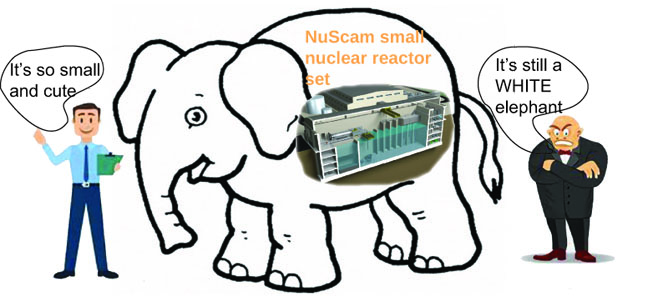
EWG, 12 July 23
- Two energy experts discuss the design risks and excessive costs of the NuScale small modular nuclear reactor.
- NuScale project distracts from the need to push clean energy sources.
Despite its small size, NuScale has outsize cost and safety problems.
NuScale is one of several companies making long-shot attempts to commercialize what are known as small modular nuclear reactors, or SMRs. Its 77-megawatt project is the furthest along in the Nuclear Regulatory Commission, or NRC, licensing approval process, but in the earliest stages, with a long way to go. But the NRC has identified serious safety concerns, and cost estimates have ballooned in recent years.
EWG has long warned about the folly of investing in nuclear power, including SMRs that are unlikely ever to get off the ground.
And in a new analysis commissioned by EWG, two nuclear experts with decades of experience note significant NuScale cost and safety drawbacks that have been raised by NRC staff.
The experts recently analyzed the November 15, 2022, pre-application readiness assessment report the NRC issued to NuScale, which details many concerns about the project’s safety. The two authors are Arjun Makhijani, Ph.D., president of the Institute for Energy and Environmental Research, which advocates for a safer environment, and M.V. Ramana, Ph.D., a professor at the School of Public Policy and Global Affairs, University of British Columbia.
Their findings further strengthen the case against more funding for NuScale – yet another nuclear boondoggle that will fleece American taxpayers.
The primary issues they identified were escalation costs and design issues, for which the company has not properly addressed the safety issues involved. These include:
Costs. The projected construction costs of the first proposed NuScale project have grown from $5.3 billion, as estimated in November 2021, to $9.3 billion, in January 2023.
Risks. The NRC and its Advisory Committee on Reactor Safeguards identified several safety risks in the design for the reactor, in particular with the steam generator.
Energy companies, states and the government should stop throwing good money after bad, wasting it on lofty “all of the above” nuclear plans that will never come to fruition.
Instead they should focus on promoting workable, clean power solutions that already exist, like wind, solar and distributed generation, and associated technologies. Taxpayer dollars should be spent only on technologies that fight the climate crisis and do not have a history of persistent, inevitable ratepayer and taxpayer bailouts. Nuclear power and carbon capture and sequestration both fail that test.
The nuclear money pit
The nuclear industry survives in part thanks to assertions of clean, cheap power, which have never materialized, and an oversize influence in Congress and state legislatures………………………………….
Experts: NuScale’s costs soaring
NuScale’s first SMR plant is intended for the Utah Associated Municipal Power Systems, or UAMPS. The goal is to provide power to electric utilities in Utah and surrounding states. The target date is 2029, though nuclear plants have typically been plagued by significant delays. Its estimated cost is over $9 billion for just six small reactors that would, in total, be less than half the size of the standard large nuclear unit.
That estimate has increased by $4 billion in less than two years.
But the government keeps throwing taxpayer dollars at NuScale, promising $1.4 billion to the UAMPS project on top of the $400 million it has already squandered.
Other than these expected costs spiraling out of control, Makhijani and Ramana in their analysis find that even though NuScale keeps changing design specifications for its unit, NuScale’s safety analyses have not evaluated the impact of these design changes.
Experts: Changes in design present dangerous power projections
NuScale has increased by 50 percent the power output of its yet-to-be-built SMR reactor design. This means there will be more heat, pressure and radioactivity, which will further stress critical components of the reactor. These factors increase the risk of a catastrophic breakdown and radiation leak.
Unlike any nuclear power plant that’s already online, NuScale would house the reactor core – the nuclear fuel – and steam generator in the same vessel. This would be a departure from the traditional design, in which the steam generator is separated from the fuel, outside the reactor vessel but inside the secondary containment.
The helical design of the steam generator has also never been used in any other commercial nuclear power plant, which makes it hard to evaluate how it would behave in the long run.
Experts: Risky reactor design
The NRC has preliminarily approved NuScale’s design, despite serious questions about the steam generator. And NuScale still hasn’t produced the necessary analysis of all the accidents that could occur. …………………………………………………………….
Experts: NRC ignored risk guidance
The Advisory Committee on Reactor Safeguards, or ACRS, warned in a letter to NRC the “design and performance of the [NuScale] steam generators have not yet been sufficiently validated.”
The 1954 Atomic Energy Act requires ACRS to review and report to the NRC commissioners and staff about safety studies and reactor facility license and license renewable applications, among other issues.
The ACRS noted that NuScale’s plan “introduces different failure modes.”…………………………………………..
Experts: A flawed energy plan
Makhijani and Ramana conclude that the NuScale project, referred to as VOYGR, has too many problems and that there is insufficient information to justify NuScale’s safety claims.
“[T]he 77-MW VOYGR . . . has not received standard design approval, much less full Commission certification. On the contrary, it has received a letter from the NRC staff with 99 ‘significant’ observations and six major challenges,” they write.
Further, they warn:
These problems need real-world analysis, design, and most important, real-world testing to be resolved. Premature wear of the steam generators and their potential failure were not analyzed properly and insufficiently tested even for the (previous) 50 MW design. The hurdles are even higher with the 77-MW version.
The NuScale project is a trainwreck waiting to happen.
It would be irresponsible for the NRC to proceed at this juncture with any further approval. The question for NRC is whether the agency wants to keep the financially unviable, unsafe nuclear industry alive or focus on public safety and legitimate options for fighting the climate crisis. https://www.ewg.org/news-insights/news/2023/07/small-size-big-problems-nuscales-troublesome-small-modular-nuclear
Wishful thinking about nuclear energy won’t get us to net zero
The climate problem is too serious to engage in unrealistic modelling exercises. Wishful thinking about nuclear energy will only thwart our ability to act meaningfully to lower emissions rapidly.
BY M.V. RAMANA AND SUSAN O’DONNELL | July 3, 2023 https://www.hilltimes.com/story/2023/07/03/wishful-thinking-about-nuclear-energy-wont-get-us-to-net-zero/391721/
On June 20, the Canada Energy Regulator (CER) released its 2023 Canada’s Energy Future report, developing scenarios for a path to net zero by 2050. These scenarios project roughly a tripling of nuclear energy generation capacity in Canada by 2050, seemingly reinforcing then-natural resources minister Seamus O’Regan’s statement in 2020 that there is “no path to net zero without nuclear.”
However, underlying both the scenarios and O’Regan’s contention is wishful thinking about the economics of nuclear energy, and how fast nuclear power can be scaled up.
The new nuclear capacity the report envisions consists of so-called small modular nuclear reactors (SMRs), which have so far not been built in Canada. Aside from refurbishing existing CANDU reactors, the CER does not think any more standard sized nuclear reactors will be built in Canada. Most of this buildup is to happen between 2035-2050, meaning that nuclear power will not help meet the government’s stated goal of decarbonizing the electricity grid by 2035.
But can SMRs be built rapidly after 2035? Only two Crown companies in the business of generating electricity for the grid have proposed to build SMRs: NB Power in New Brunswick, and Ontario Power Generation (OPG).
The reactor designs proposed for New Brunswick are cooled by molten salts and liquid sodium metal. Despite decades of development work and billions of dollars invested, major technical challenges have prevented molten salt reactors and sodium-cooled reactors from commercial viability, making it highly unlikely that the New Brunswick designs can be rapidly deployed in the time frame envisioned by the CER.
Assuming that OPG’s chosen design—the 300-megawatt BWRX-300—is the one to be deployed widely, then around 70 SMR units would need to be built and operating effectively on the grid between 2030-2050. The BWRX-300 design is yet to be approved by any safety regulator anywhere in the world.
But the report has an even more serious problem: economics. Nuclear power cannot compete economically, which is why its share of global electricity generation has declined from 17.5 per cent in 1996 to 9.2 per cent in 2022. Because SMRs lose out on economies of scale, they will produce even more expensive electricity.
The CER’s scenarios for nuclear power are based on the Electricity Supply Model, meant to calculate “the most efficient and cost-effective way to meet electricity demand in each region.” Such models are widely used in energy analysis and policymaking, but their utility depends on the validity of the assumptions used; garbage in, garbage out.
Two key parameters underlie the report’s scenarios: the capital cost of an SMR, and how that cost evolves with time. The CER’s assumptions in the two net-zero scenarios are that a SMR costs $9,262 per kilowatt in 2020, falling to $8,348 per kW by 2030, and to $6,519 per kW by 2050. Both these assumptions are ridiculously out of touch with the real world.
Consider the CAREM-25 SMR designed to feed 25 megawatts of electricity into the grid, being built in Argentina since 2014. Its original cost estimate in 2014 of US$446-million has escalated significantly since then, but even using these original costs, the project costs nearly $30,000 per kilowatt in 2022 Canadian dollars.
The NuScale design, arguably the closest to deployment in the United States, has been in development since 2007 with the build not yet begun. The January 2023 cost estimate for six NuScale SMRs with a total capacity of 462 megawatts is $9.3-billion, or over $26,000 per kilowatt in Canadian dollars.
Finally, the cost of the five-megawatt Micro Modular Reactor Project at Chalk River, Ont., was estimated by the proponent in May 2020 to be between $100- and $200-million. In 2022’s Canadian dollars, that works out to $22,000 to $44,000 per kilowatt.
In other words, the CER’s cost assumptions are wild underestimates, two-and-a-half to four times lower than the current evidence.
The second incorrect assumption is that costs will decrease with time. Both in the United States and France, the countries with the highest number of nuclear plants, the trend was the opposite: costs went up—not down—as more reactors were built. In both countries, the estimated construction cost of the most recent reactors being built—Vogtle in the United States and Flamanville-3 in France—have broken new records.
We need government organizations to do better. The climate problem is too serious for such unrealistic modelling exercises. Wishful thinking will only thwart our ability to act meaningfully to lower emissions rapidly.
M.V. Ramana is the Simons Chair in Disarmament, Global and Human Security and professor at the School of Public Policy and Global Affairs at the University of British Columbia. Susan O’Donnell is adjunct research professor and primary investigator of the CEDAR project at St. Thomas University in Fredericton, N.B.
Minireactor cost surge threatens nuclear’s next big thing

Japan Times, BY JONATHAN TIRONE, BLOOMBERG, 3 July 23
High inflation and rising interest rates are driving up the cost of a new generation of miniature atomic reactors that the nuclear industry is relying on to lift sales and help meet climate targets.
Nuclear-company executives and regulators met this week at the International Atomic Energy Agency to negotiate potential manufacturing and technology standards, a key step the industry needs to take in order to make prices competitive with other emissions-free energy sources. There are currently more than 80 unique small modular reactor, or SMR, designs under development, resulting in sprawling supply chains and caps on scaling up production.
“With higher interest rates to deal with and inflation pushing up the cost of steel, copper wire and just about everything else that goes into building an SMR, we know that even the most promising projects are having to tell their investors and buyers that prices have risen substantially,” IAEA Director General Rafael Mariano Grossi said at the meeting in Vienna. “Avoiding, or at least mitigating, cost rises and delays is now even more crucial.”
……………………. Nuclear energy costs in the U.S. currently level out to an average of $373 a megawatt hour, according to the latest estimates by BloombergNEF. That’s significantly higher than solar or onshore wind at $60 and $50 a megawatt hour, respectively.
Enter companies like NuScale Power Corp., the first U.S. SMR developer with a licensed design, and which wants to begin generating at the end of the decade. NuScale originally foresaw average generation costs of $55 a megawatt hour in 2016, which was slightly lifted to $58 five years later.
But new estimates show costs surged to almost $120 a megawatt hour this year, according to company data analyzed by the Institute for Energy Economics. Skyrocketing prices of commodities including steel, carbon fiber and copper drove the increase, according to the report. NuScale’s stock has tumbled a third a third this year.
…………………………….. The IAEA’s Grossi chided delegates that they need to work together to develop industry standards, lest they contribute to the industry’s “reputation of unfulfilled promises.”……… https://www.japantimes.co.jp/news/2023/07/03/business/mini-nuclear-reactor-cost-surge/—
Watchdog group has concerns over nuclear micro-reactor plans
Monday, June 26th 2023, By Nestor Licanto, https://www.kuam.com/story/49121972/watchdog-group-has-concerns-over-nuclear-microreactor-plans
U.S. defense department proposal to use a nuclear micro-reactor as a power backup for the planned missile defense system on Guam is now being considered by Congress.
But a local watchdog group is sounding the alarm over the danger of the largely untested technology.
Leland Bettis of the local think tank and research group, pacific center for island security has been tracking the missile defense system plans for Guam and the potential for a nuclear micro-reactor.
“That’s not been disclosed by the MDA yet but we’ve sorta been tracking this. I think what really drew our attention was over the weekend the Senate Armed Services Committee’s executive summary, their NDAA language includes this piece which asks for a briefing for the Senate about the possibility of placing microreactors in Guam. 109
Bettis acknowledges that nuclear power has proven to be safe, and can provide huge cost savings even for private commercial use. [??]
But he believes a red line is crossed if they become targets in a combat situation.
“Just imagine if these reactors are a principal source of power for some of the measures, and counter-measures that the military is operating they’re certainly gonna be a target,” Bettis said. “That means that the environmental impact is not just about how does the nuclear reactor perform in producing power but how might a micro nuclear reactor perform if it’s targeted and hit.”
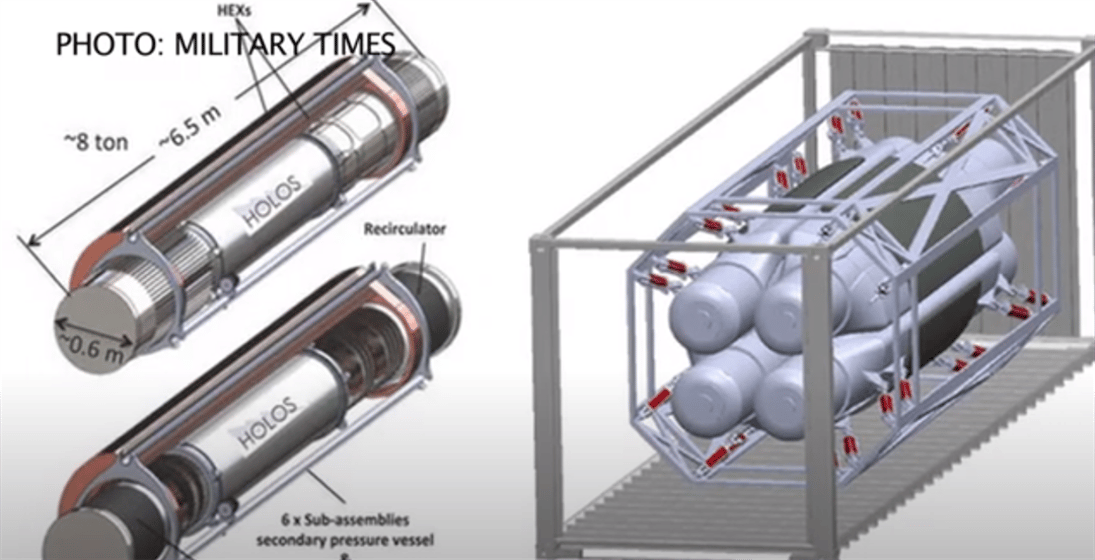
An article last year in the “Military Times” mentions Guam as a potential site for the mobile nuclear equipment.
It describes a 40-ton reactor that can fit into three to four 20-foot containers and can provide up to 5 megawatts of power.
The army has been considering the use of mobile nuclear power for years in a program called project pele, ironically named after the Hawaiian goddess of fire and volcanoes.
The benefits as a power source in remote, austere locations is clear, but there are drawbacks in battle situations.
If however that reactor is struck during conflict all the troops that are around that will be affected. So I think the concerns that they had about the use of these particular power devices for military people is magnified ten-fold when you think about the possibility that these might be placed in proximity to a civilian community.
And the military has confirmed that the planned 360-degree missile defense system could have as many as twenty different sites scatttered across the island.
Bettis says we need to know now more than ever, what’s going into each of these sites.
The people that I’ve talked to talk about a micro nuclear reactor and say if it hits you need a set-aside that’s at least a mile. That’s gonna be a very different sort of thing then if you had command and control module in your neighborhood, so I think as a community we need better transparency about what is being planned at all these locations.
Nuclear-based fantasies are holding back real climate action

SMR Education Task Force, June 22, 2023, https://crednb.ca/2023/06/22/nuclear-based-fantasies-are-holding-back-real-climate-action/—
Today a network of groups across Canada announces the launch of the SMR Education Task Force to share under-reported facts about small modular nuclear reactors (SMRs) with members of Parliament and provincial legislatures.
We begin with the latest report from Canada Energy Regulator (CER). This federal document, called Canada’s Energy Future, projects that enough new nuclear reactors (SMRs) will be operational by 2050 to more than double Canada’s existing nuclear electricity generation.
Canada currently has 19 operating power reactors, built over 58 years. The new report claims that we will build more than 50 new reactors in much less time.
This fantasy has no basis in reality. It is inconsistent with independent analyses by energy researchers not tied to the nuclear industry. One such study in the Bulletin of Atomic Scientists makes it clear that SMRs have at best a marginal role to play in a truly effective climate action plan. SMRs fail the tests of timeliness and affordability – they take too long and cost too much.
In addition to Ontario and Alberta, the CER report imagines deploying SMRs in Quebec and British Columbia. This is news to citizens in those provinces. BC ratepayers have rejected nuclear power in the past, and Quebec phased out of nuclear power in 2012. With every reactor comes long-lived radioactive waste — including the structure itself, which is a provincial responsibility to safeguard for thousands of years after shutdown.
Yesterday, the Coalition for Responsible Energy Development in New Brunswick (CRED-NB) sent a letter to Canada’s Natural Resources Minister reminding him that more than 120 civil society, public interest, faith-based and Indigenous groups across Canada have signed a statement warning that SMRs are a dirty, dangerous distraction from urgent climate action.
These groups understand that responding to the climate emergency does not require gambling on untested nuclear reactors. They know that energy efficiency measures and renewable sources cost at least 3 to 7 times less than nuclear power per tonne of carbon emissions avoided.
The groups oppose using public funds earmarked for climate action to support the nuclear industry’s eager experimentation with novel reactor designs. We are challenging the government to release the research and data that support its nuclear-based strategy.
Nuclear promoters, with long-standing allies embedded in the federal and provincial governments, are making unsubstantiated promises about SMRs in an audacious attempt to grab as much public funding as possible to keep their dying industry alive.
Worldwide, nuclear’s share of global electricity has dropped over the last 25 years from 17% to less than 10%. The International Energy Agency forecasts that more than 90% of all new electricity installations worldwide over the next 5 years will be non-hydro renewables.
The industry’s money-grab will succeed only if our public representatives remain uninformed about the facts. That is why we are pleased to announce the SMR Education Task Force and look forward in the months ahead to share information about SMRs based on independent science and research.
USSR Sprinkled More Than 2,500 Nuclear Generators Across The Countryside
Hundreds of these tiny atomic terrors are still unaccounted for in the rugged landscape of the former Soviet Union.
By Erin Marquis, 16 June 23, https://jalopnik.com/ussr-sprinkled-more-than-2-500-nuclear-generators-acros-1850501190
Ah, the USSR. It was a strange place with strange ideas. Ideas such as planting unprotected mini nuclear power sources into inhospitable and hard-to-reach areas. I mean, nothing should go wrong as long as the government always exists to maintain them, right?
Welcome to the world of Radioisotope Thermoelectric Generators or RTGs. It’s a piece of nuclear history I only recently learned about and thought I should bring this whole new horror to your attention as well. These things are just kind of rolling around famously stable Russia, and it seems like it should be a cause for concern.
RTGs are not nuclear reactors, nor are they “nuclear batteries.” Rather they work by converting the heat caused by radioactive decay into electricity. Due to the dangerous nature of the materials used however, countries like America only use RTGs in applications such as space exploration. Voyager, Cassini and New Horizons uses RTGs for power, as do the Mars rovers Perseverance and Curiosity. These probes however, use expensive plutonium-238 as their power sources and we launch them far the hell away from us.
The USSR though? Nah. It’s going to use super cheap, super radioactive Strontium-90 instead, though later, smaller RTGs used equally cheap Caesium-137 or Cerium-144. These three isotopes all have one thing in common; they’re all the products of spent nuclear fission. In other words, waste. The terrestrial Beta-M RTG is about 1.5 meters wide and 1.5 meters tall and weight about one metric ton, according to the International Atomic Energy Agency. The entire unit put out about between 1 and 1000 watts (quite the spread) and had a working life of 10 to 20 years.
Originally built by the USSR’s Navy to power lighthouses and radio navigation beacons along Russia’s expansive arctic coastline, the RTGs provided power hundreds or even thousands of miles from civilization, occasionally completely unprotected and always unsupervised. They were occasionally secured by metal frames or sheds, but sometimes these lighthouses and radio beacons were set up on little more than rough structures hastily constructed out of nearby timber with the RTG stuck outside to face the harsh arctic elements. While the USSR provided regular rolling patrols to maintain the RTGs, that came to a screeching halt in 1991 when the Soviet Union fell. After that, there was no money to maintain the hard-to-reach RTGs, and they became victims of neglect and metal thieves.
After it proved useful for the Navy, the Soviets put the RTGs into service in other rough terrains. That’s how several ended up in the mountains of the former Soviet state of Georgia. Three residents from the village of Lia, Georgia, found a canister high up in the mountains. Since this strange material gave off heat, the three used it to stay warm overnight, but they woke up vomiting and dizzy. A week later, a military hospital diagnosed the three with radiation sickness. Two of the men would make it out with the help of dozens of skin grafts and months in the hospital. But the man who slept closest to the radioisotope source and handled it the most could not be saved.
Their arrival at the hospital launched a mad scramble from the international atomic community to find the orphan source of radiation. Footage of the clean-up crew both training for retrieval and actually snaring the Strontium-90 core shows just how dangerous RTGs are:
That wasn’t the only incident involving RTGs however. In 2001, scrappers broke into a lighthouse on Kandalashka Bay and stole three radioisotope sources (all three were recovered and sent to Moscow). Three men in the mountains of Georgia were also exposed in 2002 after stumbling upon cores left out in the woods. In 2003, scrappers hurled a core into the Baltic Sea, where a team of experts retrieved it.
Amidst all the enthusiastic promotion of Small Nuclear Reactors, there’s still the admission that SMRs are simply unaffordable

The future of energy: small modular reactors (SMRs) and nuclear power, small caps, By Colin Hay June 5, 2023
‘………………………………………………………………………………………… A recent report from international energy analysts Wood Mackenzie, suggested that lower costs technological developments such as small modular reactors (SMRs) may help speed up the introduction of new nuclear power plants……………………
However, the company added that for nuclear power to flourish, governments, developers and investors must work together to establish a new nuclear ecosystem, one that makes nuclear affordable………………
According to one Wood Mackenzie report, ‘The nuclear option: Making new nuclear power viable in the energy transition’, despite policy support and market growth, cost is the biggest economic hurdle to the uptake of more nuclear power and the much-vaunted small modular reactors systems…………………..
“The nuclear industry will have to address the cost challenge with urgency if it is to participate in the huge growth opportunity that low-carbon power presents. At current levels, the cost gap is just too great for nuclear to grow rapidly,” said David Brown, a Director, Energy Transition Service at Wood Mackenzie, and lead author of the report.
Mr Brown said scaling up the SMR market will depend on how fast costs fall to a level that is competitive against other forms of low-carbon power generation.
According to Wood Mackenzie estimates, conventional nuclear power currently has a levelised cost of electricity (LCOE) of at least four times that of wind and solar……………..
CSIRO plays down SMR’s Australian potential
Australia’s leading science agency, the CSIRO, has also recently raised the cost issue with regard to the local introduction of new nuclear technology.
In a recent report, “The question of nuclear in Australia’s energy sector”, the CSIRO noted that there has been increased debate around the use of nuclear power in Australia.
………. the report suggested that at present, the numbers don’t stack up.
“… a review of the available evidence makes it clear that nuclear power does not currently provide an economically competitive solution in Australia – or that we have the relevant frameworks in place for its consideration and operation within the timeframe required,” the CSIRO report said.
……. The report noted that only two SMRs are currently in operation, located in Russia and China, and both have experienced cost blowouts and delays.
Paul Graham, a CSIRO energy economist and lead author of the Australian Energy Market Operator’s (AEMO) GenCost report, says more data needs to be provided to support the push for nuclear power in Australia.
He said that with the use of standard formula for levelised costs, plus the additional calculations specific to storage and transmission, wind and solar come in at a maximum of $83 per megawatt hour in 2030.
“In contrast, SMRs come in at $130 to $311 per megawatt hour.”…………………………………………….. m https://smallcaps.com.au/future-energy-small-modular-reactors-smrs-nuclear-power/
Panellists discuss nuclear documentary ‘Atomic Bamboozle’ and warn against return of nuclear power .
Activists show, discuss nuclear documentary ‘Atomic Bamboozle’ at Kiggins in Vancouver, Film, panelists warn against return of nuclear power,
By Scott Hewitt, Columbian staff writer, June 2, 2023, https://www.columbian.com/news/2023/jun/02/activists-show-discuss-nuclear-documentary-atomic-bamboozle-at-kiggins-in-vancouver/
Get used to the phrase “small modular nuclear reactor” and its abbreviation, SMR. A global debate about this old-made-new energy idea is already heating up, with big implications for the people and environs of the Pacific Northwest.
SMRs are either the cleaner, safer, cheaper future of nuclear power or the return of the same old bundle of hazards, dressed up in newly attractive camouflage.
“They’re going to make nuclear energy cool again,” said former Trump administration energy secretary Rick Perry (consistently mispronouncing the word “nuclear”) in a news clip featured in the new documentary film “Atomic Bamboozle.”
“Atomic Bamboozle” is the latest in a series of timely, social-issue documentaries directed by Jan Haaken, a retired Portland State University psychology professor. Last year, Haaken produced a film about the courtroom victories of local oil-train protesters called “Necessity: Climate Justice and the Thin Green Line,” which screened, along with a panel discussion, at Vancouver’s Kiggins Theatre.
The same will happen at a Wednesday screening of “Atomic Bamboozle” at Kiggins. Environmental activists featured in the film will discuss the potential resurgence of nuclear power in the Pacific Northwest through supposedly safe, small, factory-built nuclear plants.
Panelists are Cathryn Chudy and Lloyd Marbet of the Oregon Conservancy Foundation; Desiree Hellegers, English professor and director of the Collective for Social and Environmental Justice at Washington State University Vancouver; public interest attorney Dan Meek; Dr. Patricia Kullberg, former medical director of the Multnomah County Health Department; “Atomic Days” author Joshua Frank; and film director Haaken.
(Frank’s book about the decommissioned Hanford nuclear site in Eastern Washington, “Atomic Days: The Most Toxic Place in America,” is the Fort Vancouver Regional Library system’s “Revolutionary Reads” book for this year. Free copies of the book are available to all at library branches.)
Climate wedge
Although small modular nuclear reactors are still more blueprint than reality, they’ve become a wedge issue among some environmentalists who are desperate to beat climate change, said Chudy, who lives in Vancouver.
“SMRs sound pretty cool but there are very big problems that they don’t want to talk about,” Chudy said during a phone interview with The Columbian.
“Atomic Bamboozle” reviews the troubled history of Oregon’s only commercial nuclear power plant, Trojan, which operated from 1976 through 1992 near Rainier, just across the Columbia River from Kalama. Trojan’s cooling tower dominated the skyline until it was demolished in 2006, but problems plagued the plant throughout its short life, including construction flaws, unexpected cracks, steam leaks and discovery of previously unknown earthquake fault lines nearby.
“We had assurances the plant was safe. The public relations around Trojan were amazing,” said Chudy, a pediatric mental health therapist at Legacy Emanuel Medical Center in Portland.
Chudy said today’s youth are struggling as never before with existential worry about a world that grown-ups have failed to steward. Proposed SMRs represent an opportunity to choose wisely and safely now rather than punting complicated problems into an unknown future, she said.
“Kids don’t trust adults to make good decisions,” Chudy said. “We are all putting our lives in the hands of people we elect … but I don’t think we can rely on them to steer the ship in the right direction without all of us being involved.”
Unsolved problems
Both Oregon and Washington have adopted clean energy policies for the future, Chudy said, but both include a loophole for nuclear power because nuclear plants do not emit carbon pollution.
She argues that nuclear power is actually a big cause of carbon pollution and a driver of global warming from many sources other than operating the plants themselves, including uranium mining as well as construction, decommissioning and materials transportation.
Necessary economies of scale are another serious question about nuclear power, Chudy added.
SMR boosters like them because they’re small. But what they contain is standard, old-school nuclear technology that’s simply operating on a tiny scale, M.V. Ramana, professor of physics, public policy and global affairs at the University of British Columbia, said in the film.
Early experiments with nuclear power started small too, Ramana said, but grew huge in pursuit of financial efficiency. Nothing has changed about that, he argues in the film, and new forecasts show the productions costs of nuclear power climbing.
“All nuclear reactors used to be small. The only way the nuclear industry could figure out to reduce cost was to go to larger reactors,” Ramana said. “There’s no way small modular reactors are going to be economically competitive.”
Soaring projected costs have led some members to drop out of a consortium of Western cities now pursuing an SMR on the Snake River in Idaho, according to Reuters.
The risk of nuclear accidents always remains, Ramana said in the movie. But siting decisions are made by politicians and investors in state and national capitals, far removed from the action.
Call on ratepayers to fund a study for small nuclear reactors in Clark County
Nuclear power may again be on horizon for Clark County , By Lauren Ellenbecker, Columbian staff writer, June 2, 2023
Clark Public Utilities delays decision on helping fund study
“…………………..Energy Northwest invited Clark Public Utilities to participate in a feasibility study on its proposed small nuclear reactor development in Richland. The agency is considering creating four to 12 modular reactors, projected to generate 320 to 960 megawatts of power — less than its existing Columbia Generating Station, which has a capacity of 1,200 megawatts.
During a Clark Public Utilities Board of Commissioners meeting in May, Energy Northwest representatives sought $200,000 of ratepayer funds for the study, which is projected to cost $4 million. The body did not approve the request, as its three-member vote was split.
Commissioners Nancy Barnes and Jane Van Dyke both requested more time to consider Energy Northwest’s request and speak with other utilities, saying further clarity was needed.
Commissioner Jim Malinowski, who sits on Energy Northwest’s board of directors, advocated for Clark Public Utilities’ involvement. By providing funding, the utility would be “keeping the effort live” and showing there’s regional support for nuclear energy, he said.
Following the May meeting, skeptics said that discussions surrounding Energy Northwest’s project haven’t been substantive or transparent to the public, given the agency’s initial request for ratepayer funds.
“It seems this proposed financial investment is on a fast track with no obvious reason for the rush and shortchanges the public’s opportunity to ask questions and weigh meaningfully,” Cathryn Chudy of Vancouver wrote to the Clark Public Utilities commission.
Commissioners are expected to revisit Energy Northwest’s small modular reactor developments at their June 6 meeting.
Energy Northwest is meeting with Washington’s 28 public utility districts and municipalities for investments to its feasibility study, as well as reaching out to utilities in Oregon and Idaho. Eight utilities in Washington have contributed to date. https://www.columbian.com/news/2023/jun/02/nuclear-power-may-again-be-on-horizon-for-clark-county/
No, There Won’t Be Nuclear-Powered Commercial Shipping This Time Either
Clean Technica 25 May 23
Nuclear for commercial ships is so obviously flawed from a business perspective that I didn’t even bother to include it in my quadrant chart of sexy vs impractical maritime decarbonization technologies.
A while ago, I published my sexy-practical quadrant chart for maritime shipping decarbonization. Sharp-eyed readers noted an omission from it: nuclear power for commercial ships. While I make no claims to be encyclopedic, I do try to be relatively thorough, and it honestly didn’t occur to me to include it. Imagine my surprise that a private nuclear commercial shipping representative, CTO Giulio Gennaro of Core Power Energy, was on the panel with me at Stena Sphere’s technical summit in Glasgow.
My take is that all inland shipping and two-thirds of short sea shipping will just go to battery-electric eventually. There will be hybrid solutions where when the batteries are replaced, the pure battery range will increase and less fuel will be consumed. And biofuels will take care of the rest……………………………………………………………..
As an indicator of that niche going away, while there are over 900 ultra large crude carriers in service, only one — yes, that’s not a typo, only a single ship of that class — was on order earlier this year. No one is buying them because everyone knows that they have a good chance of being stranded assets. As I found out this week, smaller carriers are being ordered, but the ones most suitable for nuclear aren’t.
He made it clear that they were arguing for small molten salt nuclear reactors (which I guess would be MSR SMRs?), but no one pressed him on commercial demonstration of that technology. For context, there are two prototype, non-grid connected, tiny MSRs in operation in China the last time I checked. This technology has been around since the 1960s and was never commercialized. And as the product doesn’t exist today, it won’t exist in any volumes for a decade at least. They have a preferred technology, but I see no evidence of a specific design. They appear to be doing more promotion of the idea rather than development of a product. https://cleantechnica.com/2023/05/26/no-there-wont-be-nuclear-powered-commercial-shipping-this-time-either/
Stanford-led research finds small modular reactors will exacerbate challenges of highly radioactive nuclear waste
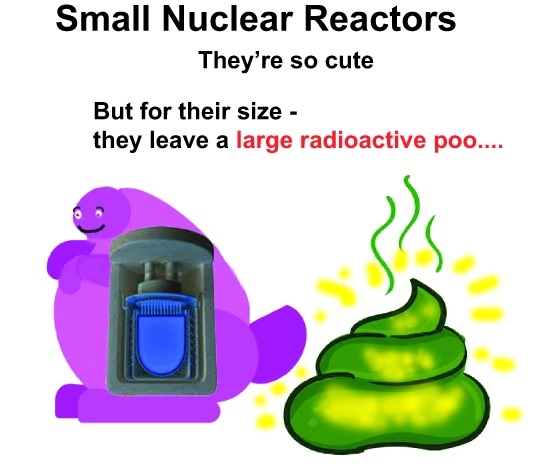
Small modular reactors, long touted as the future of nuclear energy, will actually generate more radioactive waste than conventional nuclear power plants, according to research from Stanford and the University of British Columbia.
BY MARK SHWARTZ, 30 May, News Stanford
Nuclear reactors generate reliable supplies of electricity with limited greenhouse gas emissions. But a nuclear power plant that generates 1,000 megawatts of electric power also produces radioactive waste that must be isolated from the environment for hundreds of thousands of years. Furthermore, the cost of building a large nuclear power plant can be tens of billions of dollars.
To address these challenges, the nuclear industry is developing small modular reactors that generate less than 300 megawatts of electric power and can be assembled in factories. Industry analysts say these advanced modular designs will be cheaper and produce fewer radioactive byproducts than conventional large-scale reactors.
But a study published May 31 in Proceedings of the National Academy of Sciences has reached the opposite conclusion.
“Our results show that most small modular reactor designs will actually increase the volume of nuclear waste in need of management and disposal, by factors of 2 to 30 for the reactors in our case study,” said study lead author Lindsay Krall, a former MacArthur Postdoctoral Fellow at Stanford University’s Center for International Security and Cooperation (CISAC). “These findings stand in sharp contrast to the cost and waste reduction benefits that advocates have claimed for advanced nuclear technologies.”
…………………………………. In the U.S. alone, commercial nuclear power plants have produced more than 88,000 metric tons of spent nuclear fuel, as well as substantial volumes of intermediate and low-level radioactive waste. The most highly radioactive waste, mainly spent fuel, will have to be isolated in deep-mined geologic repositories for hundreds of thousands of years. At present, the U.S. has no program to develop a geologic repository after spending decades and billions of dollars on the Yucca Mountain site in Nevada. As a result, spent nuclear fuel is currently stored in pools or in dry casks at reactor sites, accumulating at a rate of about 2,000 metric tonnes per year.
Simple metrics
Some analysts maintain that small modular reactors will significantly reduce the mass of spent nuclear fuel generated compared to much larger, conventional nuclear reactors. But that conclusion is overly optimistic, according to Krall and her colleagues.
“Simple metrics, such as estimates of the mass of spent fuel, offer little insight into the resources that will be required to store, package, and dispose of the spent fuel and other radioactive waste,” said Krall, who is now a scientist at the Swedish Nuclear Fuel and Waste Management Company. “In fact, remarkably few studies have analyzed the management and disposal of nuclear waste streams from small modular reactors.”
Dozens of small modular reactor designs have been proposed. For this study, Krall analyzed the nuclear waste streams from three types of small modular reactors being developed by Toshiba, NuScale, and Terrestrial Energy. Each company uses a different design. Results from case studies were corroborated by theoretical calculations and a broader design survey. This three-pronged approach enabled the authors to draw powerful conclusions.
“The analysis was difficult, because none of these reactors are in operation yet,” said study co-author Rodney Ewing, the Frank Stanton Professor in Nuclear Security at Stanford and co-director of CISAC. “Also, the designs of some of the reactors are proprietary, adding additional hurdles to the research.”
Neutron leakage
Energy is produced in a nuclear reactor when a neutron splits a uranium atom in the reactor core, generating additional neutrons that go on to split other uranium atoms, creating a chain reaction. But some neutrons escape from the core – a problem called neutron leakage – and strike surrounding structural materials, such as steel and concrete. These materials become radioactive when “activated” by neutrons lost from the core.
The new study found that, because of their smaller size, small modular reactors will experience more neutron leakage than conventional reactors. This increased leakage affects the amount and composition of their waste streams.
“The more neutrons that are leaked, the greater the amount of radioactivity created by the activation process of neutrons,” Ewing said. “We found that small modular reactors will generate at least nine times more neutron-activated steel than conventional power plants. These radioactive materials have to be carefully managed prior to disposal, which will be expensive.”
The study also found that the spent nuclear fuel from small modular reactors will be discharged in greater volumes per unit energy extracted and can be far more complex than the spent fuel discharged from existing power plants.
“Some small modular reactor designs call for chemically exotic fuels and coolants that can produce difficult-to-manage wastes for disposal,” said co-author Allison Macfarlane, professor and director of the School of Public Policy and Global Affairs at the University of British Columbia. “Those exotic fuels and coolants may require costly chemical treatment prior to disposal.”
“The takeaway message for the industry and investors is that the back end of the fuel cycle may include hidden costs that must be addressed,” Macfarlane said. “It’s in the best interest of the reactor designer and the regulator to understand the waste implications of these reactors.”
Radiotoxicity
The study concludes that, overall, small modular designs are inferior to conventional reactors with respect to radioactive waste generation, management requirements, and disposal options.
One problem is long-term radiation from spent nuclear fuel. The research team estimated that after 10,000 years, the radiotoxicity of plutonium in spent fuels discharged from the three study modules would be at least 50 percent higher than the plutonium in conventional spent fuel per unit energy extracted. ……..more https://news.stanford.edu/2022/05/30/small-modular-reactors-produce-high-levels-nuclear-waste/?fbclid=IwAR3hUe5R3zYb25eJ-8dJzM_vXATq4Du7Hk_XEhdeED_BTvwCqm0XLo3mE8o
A mess of different Small Nuclear Reactor Designs in UK.
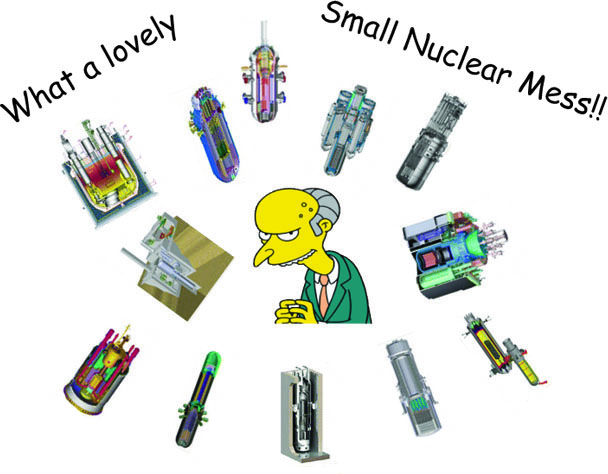
By the time SMRs might be deployable in significant numbers, realistically after 2035, it will be too late for them to contribute to reducing greenhouse gas emissions. The risk is that, as in all the previous failed nuclear revivals, the fruitless pursuit of SMRs will divert resources away from options that are cheaper, at least as effective, much less risky, and better able to contribute to energy security and environmental goals.
No2 Nuclear Power SAFE ENERGY E-JOURNAL No.97, April 2023
More designs of Small Modular Reactors (SMRs) are beginning to emerge which could rival the Rolls Royce design, so the government has decided to launch its competition to gather further evidence before any firm deals are struck. According to ONR a number of companies have, in recent months, applied to the Department for Business, Energy and Industrial Strategy (BEIS) for entry into Generic Design Assessment (GDA) process. BEIS is assessing those applications before deciding whether or not to ask ONR to start the GDA process. The plan is for the government to eventually award £1bn in co-funding to the winning SMR design. This money would help the company get through the GDA process.
At least six new SMR designs have applied to BEIS to be entered into the Generic Design Assessment (GDA) process. As well as Rolls Royce’s SMR, which has already entered the process. (1) The applicants are proposing to build a range of technologies including fast reactors and high temperature reactors which were built as prototypes in the 1950s and 1960s – but successive attempts to build demonstration plants have been short-lived failures. It is hard to see why these technologies should now succeed given their poor record.
The main claim for SMRs over their predecessors is that being smaller, they can be made in factories as modules using cheaper production line techniques, rather than one-off component fabrication methods being used at Hinkley Point C. Any savings made from factory-built modules will have to compensate for the scale economies lost. A 1,600MW reactor is likely to be much cheaper than 10 reactors of 160MW. And it will be expensive to test the claim that production line techniques will compensate for lost scale economies. By the time SMRs might be deployable in significant numbers, realistically after 2035, it will be too late for them to contribute to reducing greenhouse gas emissions. The risk is that, as in all the previous failed nuclear revivals, the fruitless pursuit of SMRs will divert resources away from options that are cheaper, at least as effective, much less risky, and better able to contribute to energy security and environmental goals. (2)
The six designs are:
- GE Hitachi (GEH) submitted an application for its BWRX-300 boiling water reactor in December.
- 2. The US firm Holtec has submitted its SMR-160 design, a 160MWe pressurised water reactor developed in collaboration with Mitsubishi Electric of Japan and Hyundai
- 3. US firm X-Energy, working with Cavendish Nuclear, wants to deploy its high-temperature gas reactor in the UK.
- 4. UK-Italian start-up Newcleo has submitted it lead-cooled fast reactor design. The company says it’s in discussions with the NDA about using Sellafield plutonium and depleted uranium. (3) The Company says it has raised £900m to further its plans which include the establishment of a first Mixed Plutonium-Uranium Oxides (MOX) production plant in France, with another plant to follow later in the UK. (4)
- 5. UK Atomics – a subsidiary of Denmark’s Copenhagen Atomics – says it has submitted a Generic Design Assessment (GDA) entry application for its small and modular thorium molten salt reactor. (5)
- 6. GMET, a Cumbrian engineering group which last year acquired established nuclear supplier TSP Engineering, said it is developing a small reactor called NuCell for production at TSP’s Workington facility. (6)
The list makes no mention of an application by NuScale, which has already expressed an interest in building at Trawsfynydd. (7) According to the Telegraph, NuScale’s reactor has received design approval from the US’s Nuclear Regulatory Commission (NRC) putting it ahead of the competition. (8) However, it was NuScale’s 50 MWe design which was approved by the NRC. That is no longer being pursued by the company. It is applying for a new approval for its 77 MWe design. Although NuScale claimed that the new design was so close to the original that the second approval would be simple, that is turning out not to be the case, as the NRC made clear in its recent letter. (9)
No mention either of the Last Energy micro reactor. The Company has signed a $19 billion deal to supply 34 x 20 MW nuclear reactors to Poland and the UK. These SMRs will be about 2.4 times the cost per MWh of the very expensive Hinkley facility. (10)
Mark Foy, Chief Executive and Chief Nuclear Inspector, Office for Nuclear Regulation, told the House of Commons Science and Technology Committee in January that he was assuming that ONR will be asked to undertake a number of GDAs for some of the SMR technologies that are currently being considered by BEIS. “Our assessment is that if BEIS determines that two or three technologies need to go through generic design assessment, that work will be done in the next four years, or thereabouts”. (11)
Prof Steve Thomas, Greenwich University, has critically assessed the current enthusiasm for Small Modular Reactors in the UK and elsewhere. He concludes:
“The risk is not so much that large numbers of SMRs will be built, they won’t be. The risk is that, as in all the previous failed nuclear revivals, the fruitless pursuit of SMRs will divert resources away from options that are cheaper, at least as effective, much less risky, and better able to contribute to energy security and environmental goals. Given the climate emergency we now face, surely it is time to finally turn our backs on this failing technology?” (12)
‘Green’ Freeports
Meanwhile, the Inverness Courier reports that the Cromarty Firth and Inverness green freeport hopes to fabricate parts for SMRs and then transport them to the construction site wherever that might be. (13) Highlands Against Nuclear Power (formerly Highlands Against Nuclear Transport) says nuclear should not be part of the Cromarty freeport vision. (14)
The Scottish NFLA convenor, Councillor Paul Leinster wrote to Scottish Government Net Zero Minister Michael Matheson asking him to reject nuclear power at Scotland’s two new Green Freeports and instead make them a hub for renewable technologies to produce power for the nation. (15) Unfortunately, the Minister replied saying he will not be opposed to a nuclear manufacturing facility in a supposed Green Freeport. (16)
Forth Green Freeport has said they have no plans for nuclear power generation at its sites – including Rosyth – after campaigners raised concerns. “The Forth Green Freeport vision for Rosyth is centred around a new freight terminal, offshore renewable manufacturing and green power generating capacity,” said the spokesperson. “The FGF will also enable the development of largescale advanced manufacturing, skills and innovation onsite, alongside a proposed new rail freight connection. This vision and the associated economic and community benefits will boost Fife and the wider region. There are no plans for nuclear power generation on FGF sites.” However, it’s possible FGF is answering the wrong question which is about manufacturing parts for SMRs, not nuclear generation. (17)
There were reports that the Ineos-run facility at Grangemouth was interested in building a Rolls Royce SMR, (18) but the Scottish Government said it would block such a move, (19) Energy Minister, Michael Matheson responded to a letter from Scottish NFLA chair, Councillor Paul Leinster, saying Scottish ministers “remain committed” to their “long-standing government policy to withhold support for any new nuclear power stations to be built in Scotland” and officials have been advised by Ineos that “Small Modular Reactors do not currently form part of their net zero road map for Grangemouth”. (20) The Scottish Tories attacked the Scottish Government for its stance describing it as anti-business. (21 https://www.no2nuclearpower.org.uk/wp/wp-content/uploads/2023/04/SafeEnergy_No97.pdf
MPs, Scientists Raise Alarm Over Climate Hype for Small Modular Reactors
The Energy Mix, May 2, 2023. Primary Author: Christopher Bonasia @CBonasia_
Several Members of Parliament and activists are warning the Canadian government that its support for nuclear energy projects could prove costly and ineffective—even as Prime Minister Justin Trudeau maintains that nuclear is “on the table” for achieving the country’s climate goals.
The federal government considers nuclear energy—including small modular reactors (SMRs) that are touted as easier to build and run than traditional nuclear plants—as key to meeting energy needs while aiming for net-zero by 2050.
………………..But on April 25, anti-nuclear activists and a cross-partisan group of MPs held a media conference on Parliament Hill, urging Ottawa to rethink its stance on nuclear and calling the energy source a dangerous distraction from climate action, reported CBC News.
Speakers in the group said Trudeau and his cabinet are getting bad advice about nuclear energy.
“The nuclear industry, led by the United States and the United Kingdom, has been lobbying and advertising heavily in Canada, trying to convince us that new SMR designs will somehow address the climate crisis,” said Prof. Susan O’Donnell, a member of the Coalition for Responsible Energy Development in New Brunswick (CRED-NB). The reality, she added, is that SMRs will produce “toxic radioactive waste” and could lead to serious accidents while turning some communities into “nuclear waste dumps”.
Moreover, there is “no guarantee these nuclear experiments will ever generate electricity safely and affordably,” O’Donnell said, since SMRs are still relatively untested.
Green Party Leader Elizabeth May called government funding for nuclear projects a “fraud.”
“It has no part in fighting the climate emergency,” May said. “In fact, it takes valuable dollars away from things that we know work, that can be implemented immediately, in favour of untested and dangerous technologies that will not be able to generate a single kilowatt of electricity for a decade or more.”
Liberal MP Jenica Atwin, New Democrat Alexandre Boulerice, and Bloc Québecois MP Mario Simard also attended the media event, the National Post reports. Atwin, who was first elected as a Green in 2019 before crossing the floor, “is the only Liberal to publicly break ranks so far, but said she has had conversations with colleagues who appear to be ‘open-minded’ to learning more about her concerns,” the Post says.
Advocacy groups like the Canadian Environmental Law Association (CELA) have also pushed back against SMRs, arguing they “pose safety, accident, and proliferation risks” akin to traditional nuclear reactors. CELA urged[pdf] the federal government to “eliminate federal funding for SMRs, and instead reallocate those investments into cost-effective, socially responsible, renewable solutions.”
The International Energy Agency (IEA) says renewables will “lead the push to replace fossil fuels” but that nuclear can help in countries where it is accepted. As of 2022, there were only three SMR projects in operation—one each in Russia, China, and India, CBC News reported.
Canada’s First SMR Passes Pre-Licencing
In Ontario, which currently produces 60% of its electricity from conventional nuclear stations, plans for one such SMR passed a regulatory checkpoint in March. Slated to be Canada’s first new nuclear reactor since 1993, the BWRX-300 is being built by Ontario Power Generation (OPG) and North Carolina-based GE Hitachi.
…………………………………………………………………….The review is not binding on the commission and does not involve the issuance of a licence, but its completion does give OPG “a head start on licencing,” said GE Hitachi spokesperson Jonathan Allen.
However, the pre-licencing review also revealed “some technical areas that need further development,” CNSC said. The commission will require OPG to supply further details on severe accident analysis and the engineered features credited for mitigation. OPG must also demonstrate that the reactor’s design meets the requirement for two separate and diverse means of reactor shutdown (or an alternative approach) and provide further information “on the protective measures for workers in the event of an out-of-core criticality accident.”
“From the list of areas needed for further development, it looks like [GE Hitachi] has some work to do,” said Allison Macfarlane, director of the University of British Columbia’s public policy school, who chaired the U.S. Nuclear Regulatory Commission (NRC) between 2012 and 2014.
BWRX-300 Raises Safety Questions
The BWRX-300 is a leading concept that GE Hitachi says is its simplest boiling water design, and could deliver 60% lower capital costs per megawatt than other SMRs.
But Edwin Lyman, director of nuclear power safety for the Union of Concerned Scientists, told The Mix he has concerns about the design. He pointed to a joint CNSC-NRC review [pdf] that identified several issues associated with reactor containment, including a potential for “reverse flow” of steam from the containment back into the reactor vessel under certain accident conditions. The review also found that the reactor’s reliance on isolation condensers may not always be effective to remove heat from the reactor during loss-of-coolant accidents.
“The consequences of a failure of isolation condensers is apparent from the fate of Fukushima Daiichi Unit 1, which experienced a core melt only hours after the system was lost,” Lyman said, citing the 2011 nuclear disaster in Ōkuma, Japan.
He added he is “extremely skeptical” that the BWRX-300 design will mature quickly enough to allow CNSC to make a meaningful determination of its safety in time for the anticipated 2028 start date. SMR designs need to undergo further testing and analysis before they can be considered safe, and yet vendors are rushing to deploy new, untested reactor designs without going through the necessary stages of technology development, including testing of full-scale prototypes, Lyman said.
“History has shown that shortcuts in this process are an invitation to disaster,” he added.
SMRs fall under the same Class 1A Nuclear Facilities Regulations as traditional reactors, so they do receive the same level of CNSC scrutiny. With its mandate to ensure the safe conduct of nuclear activities in Canada, the commission “will only issue a licence if the applicant has demonstrated the reactor can be operated safely,” the spokesperson said.
Next steps for the DNNP include a CNSC assessment, already under way, to review OPG’s licence application. This will result in a Commission Member Document that offers results and recommendations to an independent commission. Then there will also be two public hearings. The first is slated [pdf] for January 2024 and will consider the applicability of the previous environmental assessment to the BWRX-300. A separate, future hearing will determine whether to issue a construction licence for the DNNP.
“It is the independent commission who will make the decision as to whether the licensee or applicant is qualified to carry on the proposed activities and in a safe manner that protects the public and the environment,” the CNSC spokesperson said. https://www.theenergymix.com/2023/05/02/canadian-mps-raise-alarm-over-nuclear-energy-drive-for-climate-goals/
The age of small modular nuclear?

the CEO of Rolls Royce described it as “a Lego kit of parts” for building a nuclear reactor. So it’s not actually an Small Modular Reactor , but why not call it one if you can tap government funding by pretending it is?
BY AGREENERLIFEAGREENERWORLD ON By Jeremy Williams
There was something of a non-sequitur from Britain’s Chancellor Jeremy Hunt recently. “We don’t want to see high bills like this again,” he said of the country’s current energy costs. “It’s time for a clean energy reset. That is why we are fully committing to nuclear power in the UK, backing a new generation of small modular reactors.”
If I was hoping to bring down energy bills, then nuclear isn’t the first place I’d look. The cost of Hinkley Point C, Britain’s first new nuclear power plant in decades, was originally priced at £16 billion. That made it the most expensive building in the world, and that was before costs began to spiral upwards. The latest estimate is that it will cost £32 billion. So it really doesn’t make much sense for Jeremy Hunt to be promising lower bills with nuclear power.
But maybe it’s not about megaprojects like Hinkley. Maybe, as Hunt suggests, the future lies in the much-vaunted Small Modular Reactors (SMRs). A number of agencies are looking for smaller reactors that can be standardised and therefore built quickly and cheaply – cheap being relative in the world of nuclear. It ought to be cheaper to install a chain of SMRs than to build one massive and bespoke power station.
The theory is that if they are small and they are modular, then SMRs would be closer to a manufactured product than a construction project. That would mean economies of scale, and potentially prompt the kind of decline in costs that we’ve seen in solar or in battery technologies.
But SMRs have been discussed for years. How close are we to seeing them as part of a low-carbon electricity grid?
Let’s start with who is working on the idea. A recent overview of the sector from the OECD includes this map of various projects. It’s not exhaustive, but it shows the major players.

Most of the action is in the US, with other projects in China, Britain, France, Russia and a handful of others. Some of these are private enterprises, particularly the American ones. Elsewhere a lot of the work is coming from state-owned nuclear companies such as EDF in France, or Argentina’s CNEA. Anyone who has invested in nuclear power and research in the past is likely to have an SMR project on a drawing board somewhere.
Is anyone actually building them? Sort of, but only China and Russia have working SMRs so far – a demonstration plant in China, and Russia’s pioneering floating nuclear power station, the Akademik Lomonosov. I wouldn’t consider either of those to be good examples of what SMRs are supposed to be, but they’re the ones that get mentioned. Construction on further plants is underway in both countries, along with Argentina. As the OECD notes, “there are currently no SMRs licensed to operate outside of China or Russia.” Everywhere else, SMRs are in various phases of research, design and planning.
This doesn’t tell us much about how long it’s going to take to bring SMRs into the energy mix. That’s because the big obstacle in nuclear power isn’t technology, but regulation. It’s incredibly difficult and slow to bring a new nuclear technology to market, and rightly so, given its dangers. Licensing a new nuclear design in the US takes five years and costs a billion dollars – and that’s before you even apply to build anything. That’s just to confirm that the design is safe.
Things move incredibly slowly in the nuclear world. The concepts for the European Pressurised Reactor that’s being built at Hinkley Point – and which is considered a new design, were being done in the mid-nineties. So of the long list of companies with concepts for SMRs, how many of those will ever get built, and in how many decades? From a climate change perspective, speed matters. We don’t want to accelerate nuclear power at the expense of safety, but at the moment it is going to take too long to bring any of these new reactors online.
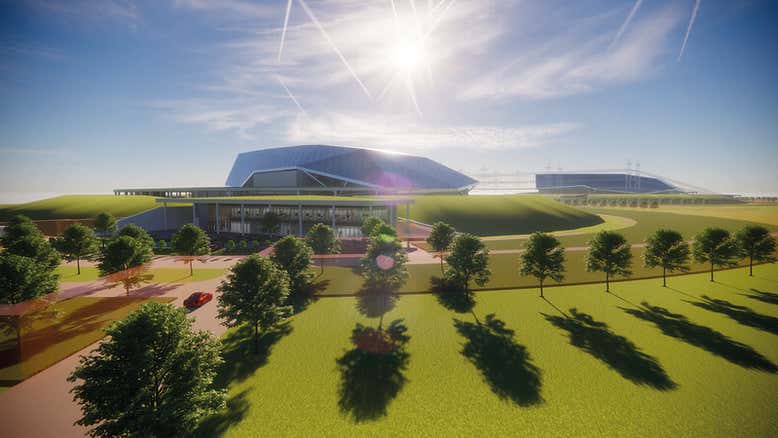
Here in the UK, there is one firm that is synonymous with SMRs, and that’s Rolls Royce. Any article on the subject in the UK will mention Rolls Royce and often illustrate the article with a glossy picture of their proposed design – as I’ve done above. What’s odd about this is that Rolls Royce’s design isn’t a small modular reactor. It’s being called that because it’s a buzzword, but it’s 470Mw in capacity. That’s smaller than Hinkley Point C at 3,300Mw, but it’s a whole lot larger than what is generally called an SMR.
Neither does it use modular reactors to achieve its larger power output. What Rolls Royce is doing is using modular construction techniques to build a traditional reactor a bit quicker. On Michael Liebriech’s Cleaning Up podcast, the CEO of Rolls Royce described it as “a Lego kit of parts” for building a nuclear reactor. So it’s not actually an SMR, but why not call it one if you can tap government funding by pretending it is?
Looking at where we are at the moment, I expect there will be a new generation of smaller nuclear power stations at some point in the future. I expect China will do it first, and that the economies of scale will happen there. If it ever reaches the UK, it will be a few years away.
A more urgent question is whether or not a new generation of nuclear power will happen in time to make a difference to climate change. That looks far less certain.
First published in The Earthbound Report.
Nuclear waste from small modular reactors – Simon Daigle comments on recent article

Simon J Daigle, B.Sc., M.Sc., M.Sc.(A) Concerned Canadian Citizen. Occupational / Industrial Hygienist, Epidemiologist. Climatologist / Air quality expert (Topospheric Ozone). 27 Apr 23
A recent article on SMRs in 2022 on potential nuclear waste risks and other proximate information on industrial and hazardous waste streams globally [References 2 to 5] below.
Nuclear waste from small modular reactors. PNAS Publication. Lindsay M. Kralla, Allison M. Macfarlaneb, and Rodney C. Ewinga. Edited by Eric J. Schelter, University of Pennsylvania, Philadelphia, PA; received June 26, 2021; accepted March 17, 2022 by Editorial Board Member Peter J. Rossky.
Simon Daigle comments:
- Development of SMRs have security issues and threats globally according to many experts including Dr Gordon Edwards (CCNR).
- SMR will produce more toxic radionuclides and waste stream analysis for potential SMR wastes streams are unknown in Canada and currently the Canadian government have no plans to complete this analysis yet or confirmed by an environmental impact assessment.
- SMR development and potential nuclear wastes generated will be extremely dangerous and toxic comparatively with current NPP SNF and other LILW [Ref. 1].
- SMR nuclear waste challenges of DGR disposal risks are unknown and are technically difficult to achieve even with safety assurances by governments globally, even more so for current nuclear wastes from NPP and other nuclear waste streams such as medical radiological waste streams.
- On a global scale, industrial and hazardous wastes are mismanaged to a point where poor countries are the favored territories to dump industry’s hazardous and industrial wastes because of poor regulatory or no regulatory legal framework to be followed by industries and corporations [Ref. 5].
- Global governments want to take on industrial and hazardous wastes for a financial benefit with no real ROI (Return on Investment) for any government or taxpayer when industrial waste companies know they can make a profit and unfortunately, the environment and population health in that country are impacted considerably without their own government helping out [Ref. 5]. This is also the case for nuclear wastes independent of point of origin and all coming from the nuclear industry’s operators, and similar industrial and hazardous waste operators on global scale.
- SMR development (and use) will have the same problems in disadvantaged poor or rich country that will accept SMR as a technology, and the result of a “free for all” dumping ground for nuclear waste that the nuclear industry chooses to dump on will inevitably happen in time. Poor countries are not equipped to deal with hazardous and industrial wastes generally to begin with and especially true for nuclear waste or any potential SMR waste streams.
- Hazardous wastes are already a problem in the province of Alberta. Alberta’s Oil Patch lands are contaminated and polluted to a point where taxpayers are on the hook for 260 billion dollars for the clean-up estimated in 2018 by one Alberta accountability office (Alberta Energy Regulator) [Ref. 2]. This figure is likely even higher in 2023. You could put a “financial” and hazardous caution tape all around Alberta for all the taxpayers in that province.
- If Alberta cannot clean the oil sands and patches, with its hazardous waste legacy coming from the oil industry because of failed financial securities, including the federal government oversight, we will also have a difficult time resolving any SMR nuclear waste issues and existing NPP nuclear waste streams and/or contaminated oil patch lands over decades or millennia as we are already having a difficult time resolving nuclear waste issues in Canada. The short-term benefit has always been profits for corporations and the Alberta taxpayer inherits the legacy waste [Ref. 2]
- International law is clearly inadequate for oil tanker spill accidents, oil platforms, oil exploration, under water gas pipelines, etc. Governments rely on corporate “citizenship” and due-diligence but we have already learned these failures over time with so much damages to the environment and to the population including maritime nuclear waste transport in international waters by nuclear merchants and inadequate insurance and financial securities. [Ref. 4].
- The impact of any nuclear waste accident or incident in open international waters by a nuclear waste operator independent of origin will be the same in the biosphere, financially and ecologically. It is highly likely to occur in time because there is no adequate emergency and contingency plan that exists with international agencies, corporations or governments including adequate financial insurance and securities [Ref. 4] to cover the damages. Very few international ocean cargo shippers accept to transport nuclear waste to any destinations because of the risks (including threats to security) with inadequate insurance and financial liabilities from any point of origin during an accident in international waters. So, who will pay the damages? No one.
- We have yet not cleared the lost nuclear bombs from WWII from the ocean floor so this makes you wonder who will take care of these nuclear wastes and other hazardous materials in time? Will it be IAEA or other international agency such as the IMO (International Maritime Organization). These hazardous and nuclear wastes, including lost nuclear warheads from WWII, in international waters are left to live on the ocean floor for archeologist to discover the “why they were lost” or “left there” to begin with in time [Ref. 3]. They are all plainly left out of sight for anyone to see. These lost nuclear warheads and similar weapons lost at sea remain a serious explosion hazard and ocean contamination is happening to this very day.
- If we can’t resolve current nuclear waste issues in Canada, and globally, we won’t be able to resolve (ever) new development of SMR technology accompanied with even more toxic nuclear wastes, as history showed us, we simply can’t.
- Similarly, we can’t even resolve our current issues for any hazardous and industrial wastes in Canada or globally, because somehow, somewhere, someone will inherit these wastes indefinitely in their backyard including all of its impacts on the biosphere and the general population. One example is clearly worrisome for Alberta with a 260 billion CDN clean up cost in 2018 in which will remain indefinitely [Ref. 2].
- Industries and governments are spreading hazardous wastes and pollution through a thin layer across the globe (air, water and soil), some thicker in concentration and toxicity in different geographic zones and all for a profit by corporations and industries. The population is always disadvantaged.
- In Feb 2023, one article proposed nuclear energy for maritime shipping and we are now looking at it to decarbonize international maritime transport, such as nuclear merchant ships, while further complicating nuclear risks and harm in international waters with nuclear pollution, risks and harm where insurance and financial securities are inadequate to this very day. [Ref. 4]. This is ridiculous to even consider given the risks and legacy waste generated but this article’s authors are from China where the government is planning to expand the nuclear industry.
- While NPP plants are decommissioning in some countries, we will se more advanced countries looking to take on nuclear waste processing and waste management and all will require land and ocean transportation.
- Air transport of nuclear materials or wastes are possible with air transport according to IATA (International Air Transport Association in Montreal) but are limited to Low Specific Activity (LSA) and Shipping Low-Level Radioactive Waste but we won’t see that happening on a large scale because of the obvious threats. IATA also provides information to irradiated individuals (from a source other than medical diagnosis or treatment) that needs to travel in order to reach a suitable treatment facility and new guidance was provided in 2011 by IATA.
- Usually, airlines do not know about radiation from within the body resulting from diagnostic procedures or may not know about contamination of an individual by radioactive material on the skin or clothes and the aviation industry monitoring these activities are inadequate. Just to add my personal experience, in 2006, I had a flight to New Baltimore (US) (within the US) to conduct an EHS audit for a company, and by curiosity, I noticed one traveller was equipped with medical equipment and I asked the flight attendant if there are any radionuclides in the equipment (with a radioactive symbol) or if the passenger had received oncology radiation treatment recently, and the answer was “I don’t know”! So I picked another seat in a different row but the other passengers were oblivious so I kept to myself the question that I even asked until the plane touchdown. Yes, people undergoing radiation treatment can be hazardous to family members at home and on flights. I won’t explain today, I will let an oncologist explain if one is brave and keen to explain.
- Self-governance by corporations is not acceptable for nuclear, hazardous and industrial wastes, and that includes the nuclear industry.
- The Canadian Government must adopt and practice better foresight, insight, hindsight, and oversight with SMRs and nuclear wastes with clear Authority, Accountability and Responsibility for Canadians and indigenous peoples, by Canadians and by indigenous peoples.
- Governments are not playing by their own rules as well for preventing the production of nuclear waste, nuclear risks or reducing harm and not even following IAEA’s ALARA principle “As Low as Reasonably Achievable”. It’s ironic and all for profit in which is a clear negative financially from the get go, even decades, for any taxpayer or any government.
1 This Month
10 March A LIVE WEBINAR THE REAL EFFECTS OF NUCLEAR POWER
What the Industry Isn’t Telling Us
1:00 PM Mountain, 2 pm Central, 3 pm Eastern. Live on the Keepers of the Water Facebook page



18 March Webinar @ 1 PM EST: An Assessment of SMR Projects: The Case of Canada
register for the zoom:
https://us02web.zoom.us/webinar/register/WN_o8BIIOUvQ2ONJR1nta65DQ#/registration


of the week – STOP SMALL MODULAR REACTORS IN CANADA
To see nuclear-related stories in greater depth and intensity – go to https://nuclearinformation.wordpress.com
-
Archives
- March 2026 (109)
- February 2026 (268)
- January 2026 (308)
- December 2025 (358)
- November 2025 (359)
- October 2025 (376)
- September 2025 (258)
- August 2025 (319)
- July 2025 (230)
- June 2025 (348)
- May 2025 (261)
- April 2025 (305)
-
Categories
- 1
- 1 NUCLEAR ISSUES
- business and costs
- climate change
- culture and arts
- ENERGY
- environment
- health
- history
- indigenous issues
- Legal
- marketing of nuclear
- media
- opposition to nuclear
- PERSONAL STORIES
- politics
- politics international
- Religion and ethics
- safety
- secrets,lies and civil liberties
- spinbuster
- technology
- Uranium
- wastes
- weapons and war
- Women
- 2 WORLD
- ACTION
- AFRICA
- Atrocities
- AUSTRALIA
- Christina's notes
- Christina's themes
- culture and arts
- Events
- Fuk 2022
- Fuk 2023
- Fukushima 2017
- Fukushima 2018
- fukushima 2019
- Fukushima 2020
- Fukushima 2021
- general
- global warming
- Humour (God we need it)
- Nuclear
- RARE EARTHS
- Reference
- resources – print
- Resources -audiovicual
- Weekly Newsletter
- World
- World Nuclear
- YouTube
-
RSS
Entries RSS
Comments RSS
 nuclear-news