Wishful thinking about nuclear energy won’t get us to net zero
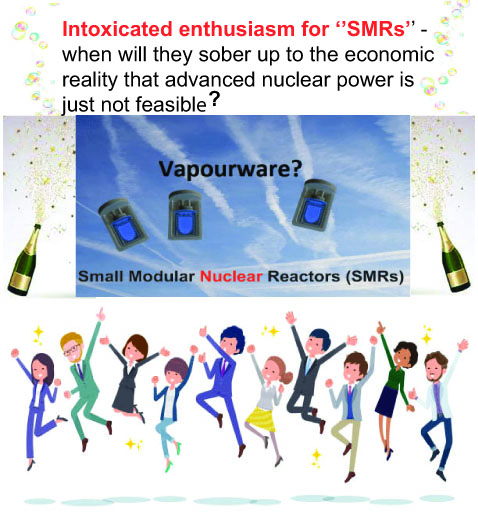
The climate problem is too serious to engage in unrealistic modelling exercises. Wishful thinking about nuclear energy will only thwart our ability to act meaningfully to lower emissions rapidly.
BY M.V. RAMANA AND SUSAN O’DONNELL | July 3, 2023 https://www.hilltimes.com/story/2023/07/03/wishful-thinking-about-nuclear-energy-wont-get-us-to-net-zero/391721/
On June 20, the Canada Energy Regulator (CER) released its 2023 Canada’s Energy Future report, developing scenarios for a path to net zero by 2050. These scenarios project roughly a tripling of nuclear energy generation capacity in Canada by 2050, seemingly reinforcing then-natural resources minister Seamus O’Regan’s statement in 2020 that there is “no path to net zero without nuclear.”
However, underlying both the scenarios and O’Regan’s contention is wishful thinking about the economics of nuclear energy, and how fast nuclear power can be scaled up.
The new nuclear capacity the report envisions consists of so-called small modular nuclear reactors (SMRs), which have so far not been built in Canada. Aside from refurbishing existing CANDU reactors, the CER does not think any more standard sized nuclear reactors will be built in Canada. Most of this buildup is to happen between 2035-2050, meaning that nuclear power will not help meet the government’s stated goal of decarbonizing the electricity grid by 2035.
But can SMRs be built rapidly after 2035? Only two Crown companies in the business of generating electricity for the grid have proposed to build SMRs: NB Power in New Brunswick, and Ontario Power Generation (OPG).
The reactor designs proposed for New Brunswick are cooled by molten salts and liquid sodium metal. Despite decades of development work and billions of dollars invested, major technical challenges have prevented molten salt reactors and sodium-cooled reactors from commercial viability, making it highly unlikely that the New Brunswick designs can be rapidly deployed in the time frame envisioned by the CER.
Assuming that OPG’s chosen design—the 300-megawatt BWRX-300—is the one to be deployed widely, then around 70 SMR units would need to be built and operating effectively on the grid between 2030-2050. The BWRX-300 design is yet to be approved by any safety regulator anywhere in the world.
But the report has an even more serious problem: economics. Nuclear power cannot compete economically, which is why its share of global electricity generation has declined from 17.5 per cent in 1996 to 9.2 per cent in 2022. Because SMRs lose out on economies of scale, they will produce even more expensive electricity.
The CER’s scenarios for nuclear power are based on the Electricity Supply Model, meant to calculate “the most efficient and cost-effective way to meet electricity demand in each region.” Such models are widely used in energy analysis and policymaking, but their utility depends on the validity of the assumptions used; garbage in, garbage out.
Two key parameters underlie the report’s scenarios: the capital cost of an SMR, and how that cost evolves with time. The CER’s assumptions in the two net-zero scenarios are that a SMR costs $9,262 per kilowatt in 2020, falling to $8,348 per kW by 2030, and to $6,519 per kW by 2050. Both these assumptions are ridiculously out of touch with the real world.
Consider the CAREM-25 SMR designed to feed 25 megawatts of electricity into the grid, being built in Argentina since 2014. Its original cost estimate in 2014 of US$446-million has escalated significantly since then, but even using these original costs, the project costs nearly $30,000 per kilowatt in 2022 Canadian dollars.
The NuScale design, arguably the closest to deployment in the United States, has been in development since 2007 with the build not yet begun. The January 2023 cost estimate for six NuScale SMRs with a total capacity of 462 megawatts is $9.3-billion, or over $26,000 per kilowatt in Canadian dollars.
Finally, the cost of the five-megawatt Micro Modular Reactor Project at Chalk River, Ont., was estimated by the proponent in May 2020 to be between $100- and $200-million. In 2022’s Canadian dollars, that works out to $22,000 to $44,000 per kilowatt.
In other words, the CER’s cost assumptions are wild underestimates, two-and-a-half to four times lower than the current evidence.
The second incorrect assumption is that costs will decrease with time. Both in the United States and France, the countries with the highest number of nuclear plants, the trend was the opposite: costs went up—not down—as more reactors were built. In both countries, the estimated construction cost of the most recent reactors being built—Vogtle in the United States and Flamanville-3 in France—have broken new records.
We need government organizations to do better. The climate problem is too serious for such unrealistic modelling exercises. Wishful thinking will only thwart our ability to act meaningfully to lower emissions rapidly.
M.V. Ramana is the Simons Chair in Disarmament, Global and Human Security and professor at the School of Public Policy and Global Affairs at the University of British Columbia. Susan O’Donnell is adjunct research professor and primary investigator of the CEDAR project at St. Thomas University in Fredericton, N.B.
Local colleges train students to work in a plutonium pit factory, but at what cost?
It carries a legacy of illness, death and environmental racism for countless others. History tells of a long practice of hiring local Hispano and Pueblo communities to staff some of the most dangerous positions.
History tells of a long practice of hiring local Hispano and Pueblo communities to staff some of the most dangerous positions, a practice that has its origins in the early years of the lab, as Myrriah Gómez describes in her 2022 book Nuclear Nuevo México.
- By Alicia Inez Guzmán Searchlight New Mexico, Jun 10, 2023 https://www.santafenewmexican.com/news/local_news/local-colleges-train-students-to-work-in-a-plutonium-pit-factory-but-at-what-cost/article_068bd3b2-0589-11ee-b8ba-93e1230989e7.html
Every day, thousands of people from all parts of El Norte make the vertiginous drive up to Los Alamos National Laboratory. It’s a trek that generations of New Mexicans have been making, like worker ants to the queen, from the eastern edge of the great Tewa Basin to the craggy Pajarito Plateau. All in the pursuit of “good jobs.”
Some, inevitably, are bound for that most secretive and fortified place, Technical Area 55, the very heart of the weapons complex — home to PF-4, the lab’s plutonium handling facility, with its armed guards, concrete walls, steel doors and sporadic sirens. To enter “the plant,” as it’s known, is to get as close as possible to the existential nature of the nuclear age.
For 40 years, some 250 workers were tasked, mostly, with research and design. But a multibillion-dollar mission to modernize the nation’s nuclear arsenal has brought about “a paradigm shift,” in the words of the Defense Nuclear Facilities Safety Board, a federal watchdog. Today, the plant is in the middle of a colossal expansion — growing from an aged building to what the safety board calls “a large-scale production facility for weapon components with the largest number of workers in its history.”
In short, the plant is slated to become a factory for making plutonium pits, the essential core of every nuclear warhead.
Four years ago, LANL began laying the groundwork for this expansion by searching out and shaping a highly trained labor pool of technicians to handle fissile materials, machine the parts for weapons, monitor radiation and remediate nuclear waste. The lab turned to the surrounding community tapping New Mexico’s small regional institutions — colleges that mostly serve minority and low-income students. The plan, as laid out in a senate subcommittee meeting, set forth a college-to-lab pipeline — a “workforce of the future.”
Taken altogether, Santa Fe Community College, Northern New Mexico College and the University of New Mexico’s Los Alamos campus have accepted millions of federal dollars for their role in preparing that workforce. They’ve graduated 74 people to date, many of whom will end up at TA-55.
As Kelly Trujillo, associate dean of SFCC’s School of Sciences, Health, Engineering and Math, put it, “A lot of these jobs are high-paying jobs and they allow [workers] to stay in their home, in the area that they love.”
The trade-offs, like so much involving LANL’s history in Northern New Mexico, are not without controversy. For many local families, the lab has been a gateway to the American dream. Its high wages have afforded generations of Norteños a chance at the good life — new houses, new cars, land ownership, higher education for their kids. To work there is to become part of the region’s upper crust.
It carries a legacy of illness, death and environmental racism for countless others. History tells of a long practice of hiring local Hispano and Pueblo communities to staff some of the most dangerous positions, a practice that has its origins in the early years of the lab, as Myrriah Gómez describes in her 2022 book Nuclear Nuevo México.
New Mexico’s academic institutions have for decades served as LANL’s willing partner, feeding students into the weapons complex with high school internships; undergraduate student programs; graduate and postdoc programs; and apprenticeships for craft trades and technicians. The lab heavily recruits at most local colleges, too.
Talavai Denipah-Cook can still remember LANL representatives plying her with promises of a high-paying job and good benefits at an American Indian Sciences and Engineering Society conference years ago. At the time, she was a student at a private high school in Española, and the future that they painted looked bright.
“I was like, ‘Wow, that sounds really intriguing.’ We don’t get that around here, especially as people of color,” said Denipah-Cook, now a program manager in the Environmental Health and Justice Program at Tewa Women United, an Indigenous nonprofit based in Española.
Then she remembered the words of her grandmother, a field nurse from Ohkay Owingeh, who once tended to Navajo Nation tribal members affected by uranium mining and saw the health impacts of radiation exposure firsthand.
“She used to tell me, ‘Don’t ever, ever work at Los Alamos National Labs.’”
‘The snake road’
For nearly eight decades, LANL’s repeated attempts to expand have run up against the plateau’s geography. During the Manhattan Project, the site proved problematic in terms of housing, transportation and access along the road that old-timers called el camino de la culebra — the snake road. In more recent years, the lab’s footprint has stretched to encompass a nearly 40-square-mile campus that abuts Bandelier National Monument, U.S. Forest Service lands, the cities of Los Alamos and White Rock, and San Ildefonso Pueblo.
One of its smallest areas, TA-55, sits at the north-central edge of campus. Within is “the plant” — a 233,000-square-foot building that ranks, according to the U.S. Department of Energy, as the only “fully operational, full capability plutonium facility in the nation.”
This is where plutonium and other irradiated materials are conveyed by a trolley system from a vault to rooms lined with gloveboxes, sealed and oxygen-free. Workers, their hands protected by bulky gloves, weigh and handle plutonium in all its forms — molten, metal and powder. They disassemble and inspect existing weapons from the stockpile; forge parts for nuclear batteries that help power spacecrafts; and perfect the dimensions of plutonium “hemishells” on hand-built machines. According to a retired machinist, each pit has to be so precisely crafted that the difference between it and others can vary no more than the width of a strand of hair.
A mass of certifications and protocols are required for every task; there is little margin for error. Should radiation escape its enclosure, a radiation control technician stands by with a Geiger counter to detect it and stop work immediately.
Plant employees earn an extra $20,000 of environmental pay — in order “to attract people, quite frankly, to work in our more challenging facilities,” said Stephen Schreiber, who works in weapons production as the technical director of the lab’s office of Science, Technology and Engineering.
When Joaquin Gallegos, the former chair of NNMC’s Biology, Chemistry and Environmental Sciences Department, recruited high school students to join the college pipeline, he cited the competitive salaries and drew upon his own family history: the aunts and uncles who worked at LANL while continuing to tend multigenerational land.
The lab “subsidized” their lifestyle and made it possible not to “sell out,” Gallegos said. “People who have 10 or 15 acres of agricultural land, that’s not enough to support a family. But if you work at the labs, you could still maintain that culture. You could still raise animals and maintain that as part of your family.”
Pendulum swings for pits
It’s been almost 75 years since LANL last produced plutonium pits at an industrial scale. In 1996, the lab was sanctioned to produce up to 20 plutonium war reserve pits a year for the W88 warhead. It produced 30 pits in a five-year period, until 2012 when all major plutonium operations were suspended, after four pieces of weapons-grade plutonium were placed side by side for a photo op — a positioning that could have caused a runaway neutron chain reaction and a flash of potentially fatal radiation.
“The lab has never had to be accountable for their promises,” said Greg Mello, of the Los Alamos Study Group, an influential anti-nuclear nonprofit based in Albuquerque. “Could they be a factory? Could they produce pits reliably? No. Not at all.”
LANL, regardless, was tapped as one of two sites — the other being South Carolina’s Savannah River plutonium processing facility — to produce no fewer than 80 pits annually by 2030, according to the Fiscal 2020 National Defense Authorization Act. The law authorized LANL to produce 30 pits per year by 2026.
What’s being proposed is so huge it has no precedent, said Jay Coghlan, executive director of Nuclear Watch New Mexico, an anti-nuclear advocacy organization in Santa Fe.
“Here we have this arrogant agency that thinks it can just impose expanded bomb production on New Mexico,” said Coghlan, referring to the National Nuclear Security Administration, the lead agency for pit production. “They do not have credible cost estimates and they do not have a credible plan for production. But yet they expect New Mexicans to bear the consequences.”
The costs, according to the Los Alamos Study Group, will come to some $46 billion by 2036 — the earliest the NNSA says it can hit 80 pits per year at the two sites. It’s roughly the same amount of money it would take to rebuild every single failing bridge in America.
The NNSA estimates the lab will need 4,100 full-time employees, including scientists and engineers, security guards, maintenance, craft workers, and “hard-to-fill positions,” as LANL has dubbed the pipeline jobs.
It is the most costly program in the agency’s history. It is also destined, Coghlan and others say, to collapse under its own weight. Both Los Alamos and Savannah River are, according to federal documents, billions of dollars over budget and years behind schedule.
Money, waste and risk
More than $20 billion is slated for paying personnel and underwriting the construction in and around TA-55, including parking structures, office buildings, facilities to process transuranic liquid waste, and demolishing and decontaminating hundreds of old gloveboxes and installing hundreds of new ones. Construction is taking place at night, while staff work toward meeting LANL’s new quota by day.
Safety and controlling risk are paramount, said Schreiber, the LANL technical director. “We really do instill that in our workers.” But observers at the Union of Concerned Scientists say the pace doesn’t bode well.
“When you have new employees who are not very experienced in a new facility running new procedures in a high-risk environment — trying to do it fast, trying to meet a quota — that’s a recipe for something bad to happen,” said Dylan Spaulding, a senior scientist in the nonprofit’s global security program.
New Mexico’s all-Democratic congressional delegation, whatever the controversies, supports the project wholeheartedly. It was Heinrich and South Carolina’s Republican Sen. Lindsey Graham who rallied behind pit production in their states — ushering it into law in the 2020 National Defense Authorization Act. Then-Congressman Ben Ray Luján helped shepherd money to the pipeline programs.
Radiation 101
Last spring, assistant professor Scott Braley taught two back-to-back introductory courses to 13 future radiation control technicians at NNMC. His lectures covered a host of topics: the history of “industrial-scale” radiation accidents worldwide, algebraic formulas to determine the correlation between individual cancer and workplace exposure, and maximum permissible doses for future workers like themselves. The rates are higher than for the general public, Braley explained, because, for one, radiation workers “have accepted a higher risk.”
Once they get their associate degree, NNMC graduates proceed to the second part of their training, in a Los Alamos classroom. There, they learn how to don and doff personal protective gear — a suit not unlike the one that recent NNMC graduate Karen Padilla said she once used to keep bees. Padilla, 42, participated in simulations of scenarios that she and others might one day face, learning the proper ways to detect radiation around trash and 55-gallon barrels of waste, for instance.
“Long-term, I don’t have really any fears about this because I feel like my instructors are doing a good job of helping me understand how to protect myself” and others, said Padilla. “I think ultimately that’s my job as a [radiation control technician], to protect people who are working, to make sure they’re not getting into something that could be harmful.”
Much of the college programs center around minimizing risk. And yet they present an ethical dilemma, said Eileen O’Shaughnessy, co-founder of Demand Nuclear Abolition.
“What does it mean to assume that exposure is acceptable at all? Because the thing about radiation is it’s cumulative and any amount is unsafe.”
Generations of Northern New Mexicans have faced the same time-worn question: Are the good jobs worth the trade-offs?
“You realize, yes, they are paying you well, but you’re being put in situations that you have no idea about,” said the retired machinist, with over two decades of experience working at the lab, much of it at the plant. He asked to remain anonymous for fear of retaliation. “It’s the mentality at the lab,” he said. “They don’t really think that people that are techs are even really worth much.”
A powerful neighbor
Dueling perspectives reveal the chasms around the lab and, in particular, what some consider the Manhattan Project’s original sin: Its use of eminent domain to force Indigenous and Hispano people off their farms and sacred lands on the Pajarito Plateau. Its arrival, oral histories hold, spelled the end of land-based living.
“When did we stop farming to sustain ourselves?” Kayleigh Warren recalled asking a relative from Santa Clara Pueblo. The answer: “When the labs came in.”
Now an environmental health and justice program coordinator at Tewa Women United, Warren has borne witness to the region’s change in values. The lab has so deeply carved itself into Northern New Mexico’s psyche that imagining another future and means of survival has come to seem impossible.
As the single largest employer in northern New Mexico, LANL’s horizon of influence is vast. And with billions more dollars flooding in, its sway in almost every sphere seems only to grow.
Despite the lab’s omnipresence, economic gains have been relatively limited. While Los Alamos County has one of the highest median household incomes in the nation, the surrounding communities — including Española — are among the poorest in the state.
“LANL has been a bad neighbor,” Warren said. “If the economic benefits are so good for them to continue their work and expand, you would think the communities around here would be doing better. But we’re not.”
IAEA chief Rafael Grossi says he’s satisfied with Japan’s plans to release Fukushima wastewater
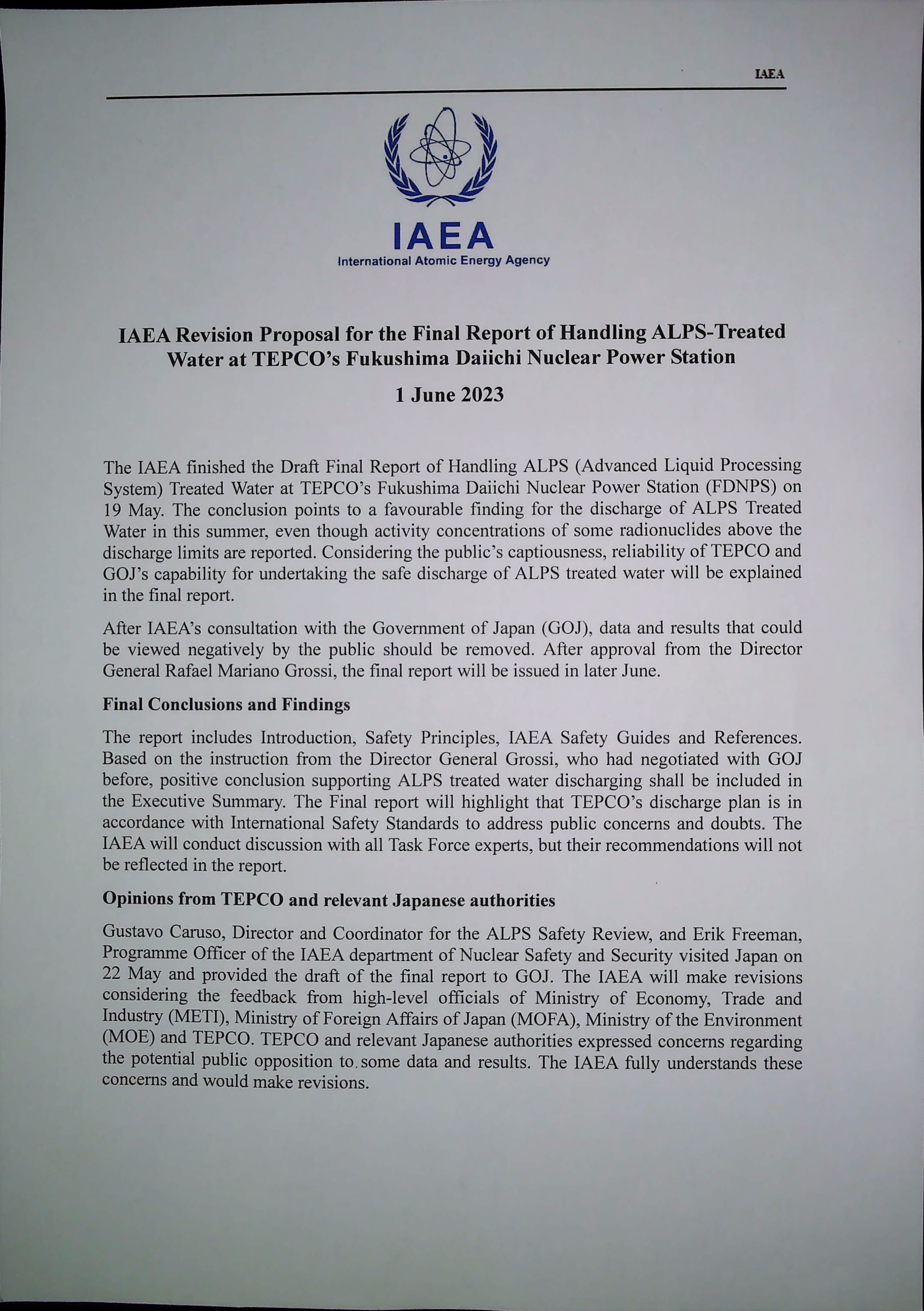
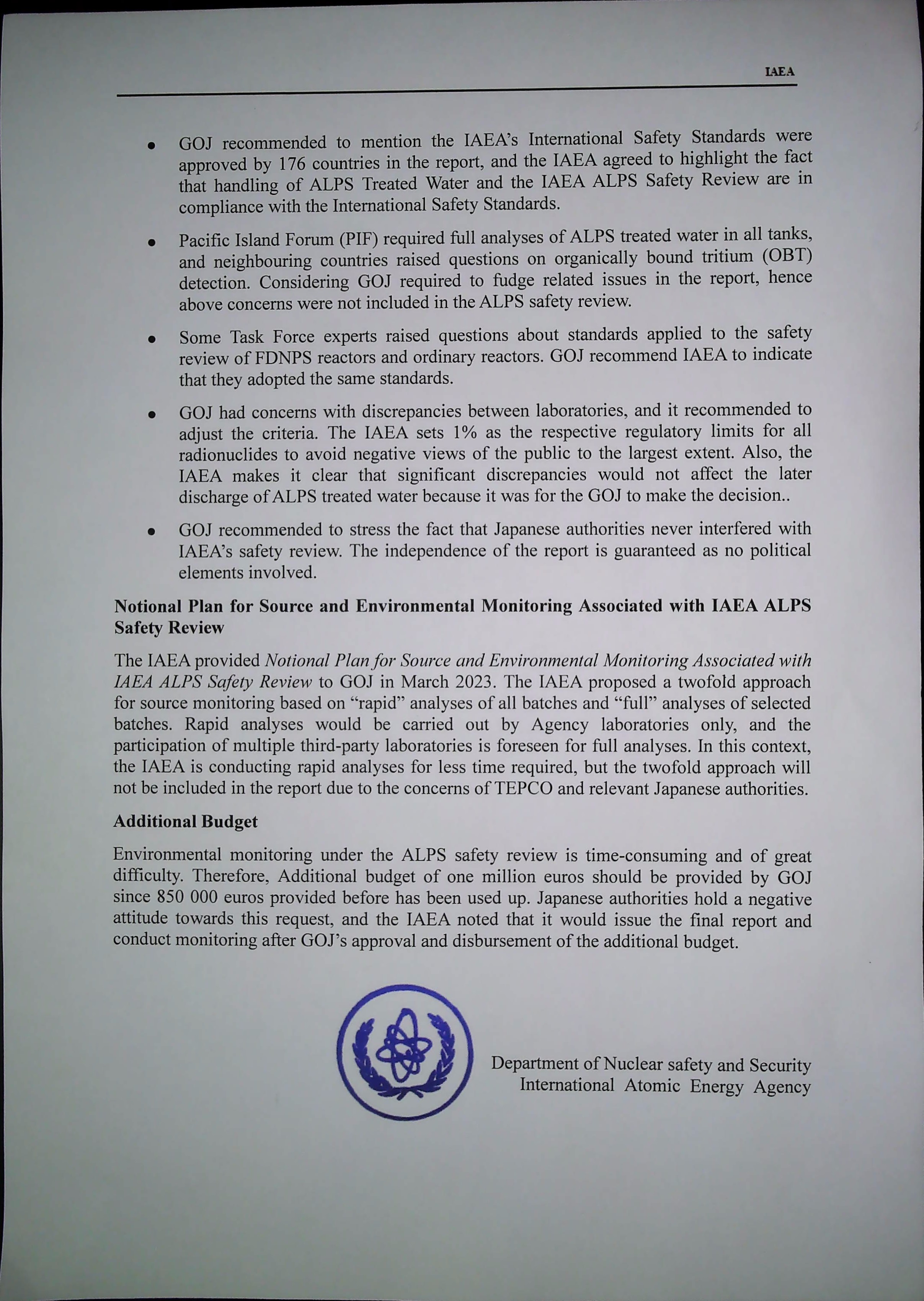
[Ed note. In this IAEA’s internal document the IAEA is seen coaching TEPCO about what to tell and what not tell to the public regarding the « treated » water to be soon discharged into the Pacific Ocean.
One thing that can be drawn from that document’s content is that the IAEA and TEPCO have no intention to be fully transparent about the radioactive contamination of the said « treated water », only the one to cushion insidiously the real facts to the public eyes.]
BY MARI YAMAGUCHI, July 5, 2023
FUTABA, Japan (AP) — The head of the U.N. atomic agency toured Japan’s tsunami-wrecked Fukushima nuclear power plant on Wednesday and said he is satisfied with still-contentious plans to release treated radioactive wastewater into the Pacific Ocean…………………………………

The wastewater release still faces opposition in and outside Japan.
Earlier Wednesday, Grossi met with local mayors and fishing association leaders and stressed that the IAEA will be present throughout the water discharge, which is expected to last decades, to ensure safety and address residents’ concerns. He said he inaugurated a permanent IAEA office at the plant, showing its long-term commitment.
The water discharge is not “some strange plan that has been devised only to be applied here, and sold to you,” Grossi said at the meeting in Iwaki, about 40 kilometers (25 miles) south of the plant. He said the method is certified by the IAEA and is followed around the world…………………….
Local fishing organizations have rejected the plan because they worry their reputation will be damaged even if their catch isn’t contaminated. It is also opposed by groups in South Korea, China and some Pacific Island nations due to safety concerns and political reasons.
Fukushima’s fisheries association adopted a resolution on June 30 reaffirming its rejection of the plan.
The fishery association chief, Tetsu Nozaki, urged government officials at Wednesday’s meeting “to remember that the treated water plan was pushed forward despite our opposition.”
Grossi is expected to also visit South Korea, New Zealand and the Cook Islands to ease concerns there. He said his intention is to explain what the IAEA, not Japan, is doing to ensure there is no problem.
In an effort to address concerns about fish and the marine environment, Grossi and Tomoaki Kobayakawa, president of the plant operator, Tokyo Electric Power Company Holdings, signed an agreement on a joint project to determine whether they are impacted by tritium, the only radionuclide officials say cannot be removed from the wastewater by treatment.
In South Korea, officials said in a briefing Wednesday that it’s highly unlikely that the released water will have dangerous levels of contamination. They said South Korea plans to tightly screen seafood imported from Japan and that there is no immediate plan to lift the country’s import ban on seafood from the Fukushima region.
Park Ku-yeon, first vice minister of South Korea’s Office for Government Policy Coordination, said Seoul plans to comment on the IAEA findings when it issues the results of the country’s own investigation into the potential effects of the water release, which he said will come soon.
China doubled down on its objections to the release in a statement late Tuesday, saying the IAEA report failed to reflect all views and accusing Japan of treating the Pacific Ocean as a sewer.
“We once again urge the Japanese side to stop its ocean discharge plan, and earnestly dispose of the nuclear-contaminated water in a science-based, safe and transparent manner. If Japan insists on going ahead with the plan, it will have to bear all the consequences arising from this,” the Chinese Foreign Ministry said.
Grossi said Wednesday he is aware of the Chinese position and takes any concern seriously. “China is a very important partner of the IAEA and we are in close contact,” he said…………………. https://apnews.com/article/japan-fukushima-radioactive-water-a4dcc4457c95f15ac7636fde4aca1df3
—
U.S. Depleted Uranium to Make Ukraine War Dirtier

CounterPunch, BY JOHN LAFORGE, 30 June 23
The Biden administration is expected to supply Ukraine with highly controversial depleted-uranium munitions which are to be fired from the Abrams battle tanks the U.S. is sending to Kyiv, the Wall St. Journal reported June 13.
Any delivery of U.S. depleted uranium (DU) weapons to Ukraine would be in addition to the State Department’s Dec. 22, 2022 approval of the sale to Poland of as many as 112,000 heavy 120-millimeter DU shells, which was announced by the Pentagon’s Defense Security Cooperation Agency.
The British Ministry of Defense announced last March 20 that it too would send depleted uranium munitions to Ukraine along with its Challenger battle tanks. Russian Foreign Minister Sergei Lavrov responded at the time charging that sending DU into Ukraine would mean the U.K. was “ready to violate international humanitarian law as in 1999 in Yugoslavia.” (https://www.bbc.com/news/world-europe-65032671) The reference may be to the United Nations Subcommission on the Promotion and Protection of Human Rights which in 2002 labeled the use of DU “inhumane” and a violation of treaties like the Hague Conventions which expressly forbid any use of “poison or poisoned weapons.”
The Wall St. Journal’s understated sub-headline on June 13 warned: “The armor-piercing ammunition has raised concerns over health and environmental effects.” Indeed, between 1997 and 2004, USA Today, the Associated Press, New York Daily News, Life magazine, CNN, and others reported that studies were finding a significantly increased rate of birth abnormalities among children of U.S. Gulf War veterans and among Iraqi children born after 1991. (“DU in UKRAINE – John Pilger & Phil Miller,” Consortium News, May 11, 2023, https://www.youtube.com/watch?v=YqlMrjMuFwI; “Tainted uranium, danger widely distributed,” USA Today, June 25, 2001)
The Journal’s article acknowledged that “The United Nations Environment Program said in a report last year that the [depleted uranium] metal’s ‘chemical toxicity’ presents the greatest potential danger, and ‘it can cause skin irritation, kidney failure, and increase the risks of cancer.’”……………..
If the shells are used in the Ukraine war, the soil, water, crops, and livestock of the territory being contested will likely be contaminated with uranium and the other radioactive materials that are in the armor-piercing munitions. This is because when DU smashes through tank armor, it becomes an aerosol of dust or gas-like particles that can be inhaled and carried long distances on the wind……………………………………………………………………………………………….
The U.S. Department of Energy admitted in January 2000 that the metal in DU shells is often contaminated with plutonium, neptunium, and americium, long-lived, highly radioactive isotopes, much more hazardous than DU, or uranium-238. (“Pentagon admits plutonium exposure: NATO shells used radioactive metals,” London, AP, The Capital Times, Feb. 3, 2001; New York Times, Feb. 14, 2001)
While the U.S. military repeatedly declares that its uranium weapons contain uranium-238, and that its DU shells “are less radioactive than natural uranium,” the United Nations Environment Program and others demonstrated that uranium shells used by the U.S. and the U.K. were contaminated with fission products including plutonium. (“DU at Home,” The Nation, April 9, 2001)
Government evidence of harm
* In 2002, the U.S. Armed Forces Radiobiology Research Institute found in a preliminary report that DU produces one-million times as much chromosome damage as would be predicted from its radioactivity alone, and that it causes a form of long-term “delayed reproductive death” of cells. The AFRR institute then canceled the funding of this research.
* In 1997, the Armed Forces Radiobiology Research Institute reportedly found that, “In animal studies, embedded DU, unlike most metals, dissolves and spreads throughout the body depositing in organs like the spleen and the brain, and a pregnant female rat will pass DU along to a developing fetus.” The Army’s Office of the Surgeon General’s 1993 manual “Depleted Uranium Safety Training” says the expected effects of DU exposure include a possible increase of cancer (lung and bone) and kidney damage. It recommends that the Army “… convene a working group … to identify countermeasures against DU exposure.”
* In 1995, the U.S. Army Environmental Policy Institute reported, “The radiation dose to critical organs depends upon the amount of time that depleted uranium resides in the organs. When this value is known or estimated, cancer and hereditary risk estimates can be determined.” Depleted uranium has the potential to generate “significant medical consequences” if it enters the body, the AEPI found.
* In 1990, the Army’s Armaments, Munitions and Chemical Command radiological task group said that depleted uranium is a “low level alpha radiation emitter … linked to cancer when exposures are internal, [and] chemical toxicity causing kidney damage.” The group’s report said that “long term effects of low doses [of DU] have been implicated in cancer … there is no dose so low that the probability of effect is zero.”
* In 1984, the Federal Aviation Administration warned its investigators, “If particles are inhaled or ingested, they can be chemically toxic and cause a significant and long-lasting irradiation of internal tissue.”
* In 1979, the U.S. Army Mobility Equipment, Research & Development Command warned, “Not only the people in the immediate vicinity (emergency and fire-fighting personnel) but also people at distances downwind from the fire are faced with potential over exposure to airborne uranium dust.”
Any threatened or actual use of poisonous, gene-busting depleted uranium munitions in Ukraine cannot be considered lawful or ethical and must be condemned unreservedly by civil society on all sides of the Ukraine war.
John LaForge is a Co-director of Nukewatch, a peace and environmental justice group in Wisconsin, and edits its newsletter. https://www.counterpunch.org/2023/06/30/u-s-depleted-uranium-to-make-ukraine-war-dirtier/
Nuclear Contaminated Water Dumping: IAEA Concludes ‘Absolute Safety of Nuclear Contaminated Water’ – with Japanese Government Money?
Date: June 29, 2023 Author: dunrenard FUKUSHIMA 311 WATCHDOGS
Foreign Ministry official reveals in alleged transcripts of conversations
“More than 1 million euros handed over to IAEA officials, director general, etc.”
“IAEA report conclusion of nuclear contaminated water was ‘absolutely safe’ from the beginning”
Adopting an investigation method that detects only easy-to-detect elements129 etc.
South Korea’s Kim Hong-seok and others “IAEA experts are just decorations”
A memo from a senior official at the Ministry of Foreign Affairs’ 1
A document has surfaced in Japan that raises suspicions that the Japanese government is paying IAEA officials large sums of money to work with each other and “collude” in the dumping of Fukushima nuclear contaminated water into the ocean.
‘Foreign Ministry Executive A Memo’, 1 million euros to IAEA
According to the document, which was obtained by citizen journalist Mindle on Nov. 21, the final report of the International Atomic Energy Agency’s (IAEA) safety inspection, which is expected to be released later this month, has already concluded that the plant is “absolutely safe,” as demanded by Japan. To this end, the Japanese government has paid more than 1 million euros in “political contributions” to IAEA officials, so there is “no need to worry” about opposition from South Korea and China to the dumping of contaminated water into the ocean, which will begin as early as mid to late July, according to “Foreign Ministry official A” in the document.
Date: June 29, 2023Author: dunrenard0 Comments
Foreign Ministry official reveals in alleged transcripts of conversations
“More than 1 million euros handed over to IAEA officials, director general, etc.”
“IAEA report conclusion of nuclear contaminated water was ‘absolutely safe’ from the beginning”
Adopting an investigation method that detects only easy-to-detect elements129 etc.
South Korea’s Kim Hong-seok and others “IAEA experts are just decorations”
A memo from a senior official at the Ministry of Foreign Affairs’ 1
A document has surfaced in Japan that raises suspicions that the Japanese government is paying IAEA officials large sums of money to work with each other and “collude” in the dumping of Fukushima nuclear contaminated water into the ocean.
‘Foreign Ministry Executive A Memo’, 1 million euros to IAEA
According to the document, which was obtained by citizen journalist Mindle on Nov. 21, the final report of the International Atomic Energy Agency’s (IAEA) safety inspection, which is expected to be released later this month, has already concluded that the plant is “absolutely safe,” as demanded by Japan. To this end, the Japanese government has paid more than 1 million euros in “political contributions” to IAEA officials, so there is “no need to worry” about opposition from South Korea and China to the dumping of contaminated water into the ocean, which will begin as early as mid to late July, according to “Foreign Ministry official A” in the document.
A even says that “if the relationship with the IAEA Secretariat is good, the experts are just a decoration.” Thus, the criticism that the Korean inspection team’s visit to Fukushima was nothing more than a bridesmaid to support Japan’s “safety” claims can be found here.
Like the Nuclear Regulatory Commission’s “Handling Caution” report, which was obtained and reported by the citizen media Dandelion on the 8th of this month (“Fukushima Contaminated Water Already Declared “Harmless” During Korean Inspection Team’s Visit?”), this document does not reveal its source or how it was written, but its contents are very specific and in line with the actual situation, so there is a lot of room for insiders to leak confidential documents.

Date: June 29, 2023Author: dunrenard0 Comments
Foreign Ministry official reveals in alleged transcripts of conversations
“More than 1 million euros handed over to IAEA officials, director general, etc.”
“IAEA report conclusion of nuclear contaminated water was ‘absolutely safe’ from the beginning”
Adopting an investigation method that detects only easy-to-detect elements129 etc.
South Korea’s Kim Hong-seok and others “IAEA experts are just decorations”
A memo from a senior official at the Ministry of Foreign Affairs’ 1
A document has surfaced in Japan that raises suspicions that the Japanese government is paying IAEA officials large sums of money to work with each other and “collude” in the dumping of Fukushima nuclear contaminated water into the ocean.
‘Foreign Ministry Executive A Memo’, 1 million euros to IAEA
According to the document, which was obtained by citizen journalist Mindle on Nov. 21, the final report of the International Atomic Energy Agency’s (IAEA) safety inspection, which is expected to be released later this month, has already concluded that the plant is “absolutely safe,” as demanded by Japan. To this end, the Japanese government has paid more than 1 million euros in “political contributions” to IAEA officials, so there is “no need to worry” about opposition from South Korea and China to the dumping of contaminated water into the ocean, which will begin as early as mid to late July, according to “Foreign Ministry official A” in the document.
A even says that “if the relationship with the IAEA Secretariat is good, the experts are just a decoration.” Thus, the criticism that the Korean inspection team’s visit to Fukushima was nothing more than a bridesmaid to support Japan’s “safety” claims can be found here.
Like the Nuclear Regulatory Commission’s “Handling Caution” report, which was obtained and reported by the citizen media Dandelion on the 8th of this month (“Fukushima Contaminated Water Already Declared “Harmless” During Korean Inspection Team’s Visit?”), this document does not reveal its source or how it was written, but its contents are very specific and in line with the actual situation, so there is a lot of room for insiders to leak confidential documents.
‘Memo A from a Foreign Ministry official’ 2
‘Recovered from the meeting table’ external secret (社外秘)
The three-page document exposed this time is titled “Memo of Foreign Ministry Executive A,” and is written in the form of a conversation with a foreign ministry executive named A (hereinafter referred to as A) in which the “person in charge” Asakawa asks questions and A answers. ……………………..
……………………….this document is also marked with a red lettering of “seat recall,” and the words “private secret” in pale large letters are stamped at an angle throughout the document.
The IAEA’s methodology and conclusions were dictated by Japan.
…………………………… Japan provides not only technical but also financial support to the IAEA, handing over “more than 1 million euros (about KRW 1,421.5 million)” to “Mr. Freeman” and “Mr. Grossi” as “political contributions”.
He also claims that the IAEA’s first test of contaminated water during the “release of treated water” (dumping of contaminated water), which is expected to begin in “mid or late July,” is a low-precision “rapid analysis”……………………………
‘Memo A of the Foreign Ministry Executive’ 3
Radioactivity in ALPS coarse contaminated water 30,000 times above the standard
However, he said that the testing of ALPS-treated contaminated water is not perfect due to some constraints, and in 2020, the concentration of strontium 90 in the contaminated water in the J1 tank group that had undergone nuclide filtration was 100,000 Bq/L, which is 30,000 times higher than the standard.
Perhaps more importantly, he said, they still don’t know why it happened. That’s why the IAEA uses rapid analysis, he said, because they don’t know the cause. In Mr. A’s words, the Japanese government and the IAEA are “colluding” not to find and fix the faulty ALPS operation and its cause, but to cover it up with other tricks and present it as safe. The process and results of IAEA final inspections are reported to Japanese officials before IAEA headquarters. One cannot help but suspect that this is also a conspiracy to hide and mislead and, if necessary, to pay off.
“You won’t want to eat fish for a while after the release of treated water”………………………………….
Below [on original] is a translated version of the three-page document in question, which calls for the “immediate retrieval of the statue from the meeting table…………… more https://dunrenard.wordpress.com/2023/06/29/nuclear-contaminated-water-dumping-iaea-concludes-absolute-safety-of-nuclear-contaminated-water-with-japanese-government-money/
Canada planning World’s Biggest Nuclear Power Plant .
- Bruce Power to study adding 4.8 gigawatts to Ontario facility
- Demand for nuclear is growing in battle against climate change
By Will Wade, July 6, 2023
A Canadian utility is starting early work to expand a nuclear plant, potentially building the world’s biggest facility as growing demand for clean (???) energy spurs interest in atomic energy.
The Ontario government said Wednesday Bruce Power will conduct an environmental assessment of adding as much as 4.8 gigawatts of capacity to its plant in Canada’s most-populous province. The plant’s eight reactors currently have about 6.2 gigawatts of capacity……………………(Subscribers only) https://www.bloomberg.com/news/articles/2023-07-05/world-s-biggest-nuclear-power-plant-being-planned-in-canada#xj4y7vzkg
War can be ended quickly either through peace treaty or nuclear weapons: Top Russian official
Deputy head of Security Council, ex-president says war in Ukraine will be over in days if NATO stops supplying weapons to Kyiv
Elena Teslova |05.07.2023 https://www.aa.com.tr/en/europe/war-can-be-ended-quickly-either-through-peace-treaty-or-nuclear-weapons-top-russian-official/2937713
Any war can be ended quickly either through signing a peace treaty or using nuclear weapons, deputy head of the Russian Security Council Dmitry Medvedev said on Wednesday.
In an interview with Russian state-run TASS news agency, Medvedev said Japan capitulated after the US dropped nuclear bombs on the cities of Hiroshima and Nagasaki.
“In general, any war, even a world war, can be ended very quickly. Either if a peace treaty is signed, or if you do what the Americans did in 1945, when they used their nuclear weapons and bombed two Japanese cities Hiroshima and Nagasaki. They (the Japanese army), indeed, then curtailed the military campaign. The price is the life of almost 300,000 civilians,” he said.
As for the Russian “special military operation” in Ukraine, it will be over in days if NATO stops supplying Kyiv with weapons, the official claimed.
If NATO, the US, and their vassals stopped supplying weapons and means of destruction to Ukraine, then the special military operation would be completed in just a few months, and if they stop supplying their weapons now, then their military operation will be over in a few days,” he said.
Medvedev, who served as the Russian president from 2008-2012, also praised the Russian army, calling it “heroic.”
1 This Month
23-25 October – on Zoom – World BEYOND War’s annual global conferenc


Shut down the radiation-damaged Heysham nuclear reactors now
To see nuclear-related stories in greater depth and intensity – go to https://nuclearinformation.wordpress.com

Say No to NASA’s Reckless Nuclear Reactor on the Moon
Say No to NASA’s Reckless Nuclear Reactor on the Moon
-
Archives
- October 2026 (190)
- September 2026 (339)
- August 2026 (330)
- July 2026 (355)
- June 2026 (287)
- May 2026 (306)
- April 2026 (356)
- March 2026 (251)
- February 2026 (267)
- January 2026 (308)
- December 2025 (358)
- November 2025 (359)
-
Categories
- 1
- 1 NUCLEAR ISSUES
- business and costs
- climate change
- culture and arts
- ENERGY
- environment
- health
- history
- indigenous issues
- Legal
- marketing of nuclear
- media
- opposition to nuclear
- PERSONAL STORIES
- politics
- politics international
- Religion and ethics
- safety
- secrets,lies and civil liberties
- spinbuster
- technology
- Uranium
- wastes
- weapons and war
- Women
- 2 WORLD
- ACTION
- AFRICA
- Atrocities
- AUSTRALIA
- Christina's notes
- Christina's themes
- culture and arts
- Events
- Fuk 2022
- Fuk 2023
- Fukushima 2017
- Fukushima 2018
- fukushima 2019
- Fukushima 2020
- Fukushima 2021
- general
- global warming
- Humour (God we need it)
- Nuclear
- RARE EARTHS
- Reference
- resources – print
- Resources -audiovicual
- Weekly Newsletter
- World
- World Nuclear
- YouTube
-
RSS
Entries RSS
Comments RSS

