Following Transatomic’s failure, small modular nuclear reactors face uncertain future

A good announcement and a bad announcement for two nuclear-energy startups, NuScale Power takes a step toward engineering; Transatomic power shuts down. Ars Technica, MEGAN GEUSS – 9/26/2018 “…………….The old light-water reactors that serve America’s grid today create nuclear waste that’s politically impossible to dispose of. Nuclear plants with traditional reactors are also extremely expensive to build and difficult to permit.
For these reasons, many nuclear hopefuls have looked to advanced nuclear technology. Several startups have popped up, promising to make either the waste problem or the expense problem go away.
This week, two advanced nuclear-technology startups have announced major news, both good and bad for the future of advanced nuclear technology………..
Transatomic is going to close down, according to MIT Technology Review. Several years ago, the startup raised millions on promises to use spent nuclear waste as reactor fuel, as well as to “generate electricity 75 times more efficiently than conventional light-water reactors,” according to MIT Technology Review. The company later retracted that “75 times” claim after a review from MIT’s Nuclear Engineering Department found issue with it.
Instead, Transatomic revised its estimates in 2016 to say that its reactor would be able to generate more than two times as much energy per ton of mined uranium than a standard reactor.
The company’s design to use spent nuclear-reactor fuel in a molten salt reactor was also called into question, causing Transatomic to state in its 2016 revision that its design “does not reduce existing stockpiles of spent nuclear fuel.”
The lost confidence made it harder for Transatomic to find funding to complete the $15 million it needed to build a prototype reactor, although it had raised about $4 million already……..
Onward to manufacturing
NuScale Power, based out of Portland, Oregon issued a press release today saying that, after 18 months of searching, it has selected manufacturing company BWX Technologies to begin engineering work that will lead to manufacturing the company’s Small Modular Reactor (SMR) design.
Phase 1 engineering and manufacturing begins today and will last until 2020, NuScale wrote, and then Phases 2 and 3—”preparing for fabrication” and “fabrication,” respectively—will continue from there……..
Small Modular Reactors don’t solve the nuclear-waste problem mentioned at the top of this article, but in theory, they might solve nuclear energy’s expense problem. Building smaller reactors that can be modularly expanded if necessary could not only keep siting, construction, and regulatory costs proportionally lower, but using the same manufacturing and construction crews to build more, smaller reactors would theoretically develop a workforce with expertise in building and installing reactors. https://arstechnica.com/science/2018/09/a-good-announcement-and-a-bad-announcement-for-two-nuclear-energy-startups/
After getting $millions in investment, Transatomic molten salt nuclear reactor project bites the dust
A nuclear startup will fold after failing to deliver reactors that run on spent fuel, MIT Technology Review, James Temple, 25 Sept 18 Transatomic Power, an MIT spinout that drew wide attention and millions in funding, is  shutting down almost two years after the firm backtracked on bold claims for its design of a molten-salt reactor.
High hopes: The company, founded in 2011, plans to announce later today that it’s winding down.
Transatomic had claimed its technology could generate electricity 75 times more efficiently than conventional light-water reactors, and run on their spent nuclear fuel. But in a white paper published in late 2016, it backed off the latter claim entirely and revised the 75 times figure to “more than twice,” a development first reported by MIT Technology Review…….
The longer timeline and reduced performance advantage made it harder to raise the necessary additional funding, which was around $15 million. “We weren’t able to scale up the company rapidly enough to build a reactor in a reasonable time frame,” Dewan says.
Transatomic had raised more than $4 million from Founders Fund, Acadia Woods Partners, and others. ……https://www.technologyreview.com/the-download/612193/nuclear-startup-to-fold-after-failing-to-deliver-reactor-that-ran-on-spent-fuel/
The next big thing: unfeasible small modular nuclear reactors
A conversation with Dr. Gordon Edwards: contemporary issues in the Canadian nuclear industry, and a look back at the achievements of the Canadian Coalition for Nuclear Responsibility (CCNR), http://www.ccnr.org/ Montreal, August 25, 2018, Nuclear waste management: an exercise in cynical thinking. DiaNuke.org, 24  Sept 18, “…….. 8. The next big thing: unfeasible small modular reactors
They want to basically clear the decks by shoving this waste off to the side so that they can use this territory, which is crown land owned by the Government of Canada, in order to develop a whole new generation of small modular reactors which are also pie-in-the-sky. They don’t have any customers at the present time. They say there’s a great deal of interest in small modular reactors. However, the interest is almost totally confined to the nuclear establishment. It’s the nuclear people who are interested in these small modular reactors, nobody else.
In fact, we’ve had bad experience with small modular reactors Canada. We had two ten-megawatt nuclear reactors designed and built. They were built around the year 2000, and each one of these reactors was supposed to be able to replace the very old NRU reactor at Chalk River, which is the largest isotope production reactor in the world. And each one of these reactors—they’re called maples, the maple reactors—each one of them would be able to take over the workload of the already-existing NRU reactor which is now shut down. They couldn’t get either one of them to work properly. They were so unsafe, and so unstable in their operation that without operating them and after having spent hundreds of millions of dollars in building them, they now are dismantling them without ever having produced any useful results.
They also had here in Canada a design called a “slowpoke district heating reactor,” and this reactor was ranging from ten megawatts to a hundred megawatts, thermal power only, no electricity, and the idea of this was it could be a reactor which could supply district heating for buildings and so on. That was also a complete failure. That was back in the last century in the 80s and 90s in Canada. They tried to give these things away for free, and they couldn’t even give them away for free. Nobody wanted them.
So the whole business of nuclear waste has really been obfuscated by the industry who are perpetually trying to convince people that they have the solution, that they know what to do, and that when they do it, it’ll be perfectly safe. All of our experience points in the opposite direction…………https://www.dianuke.org/a-conversation-with-dr-gordon-edwards-contemporary-issues-in-the-canadian-nuclear-industry-and-a-look-back-at-the-achievements-of-the-canadian-coalition-for-nuclear-responsibility-ccnr-http-
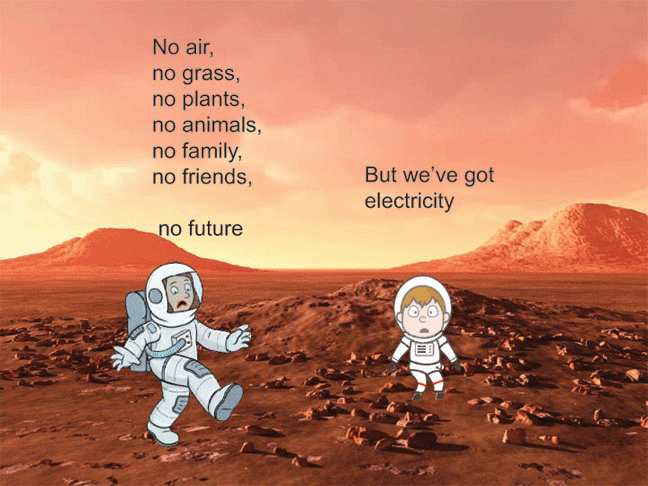
Extremely high radiation doses threaten the plan to colonise Mars
Can humans survive on Mars? Scientists fear RADIATION threatens NASA Mars missions
NASA astronauts who could one day head to Mars will be exposed to incredibly high doses of radiation – a risk that could jeopardise the safety of future Mars missions.
Here on Earth, the planet’s magnetic field and atmosphere protect humans from absorbing deadly cosmic rays and atoms speeding through space.
Mars, however, has not had a magnetic field of its own since it collapsed for unknown reasons billion of years ago.
This could expose astronauts and Martian colonisers to radiation sickness, increased risk of developing cancer, degenerative diseases and central nervous system problems.
Jordanka Semkova of the Bulgarian Academy of Sciences, who leads a team of scientists manning an orbital Liulin-MO dosimeter over Mars, said the future of all Mars missions depends on how space agencies can combat this.
She said: “One of the basic factors in planning and designing a long-duration crewed mission to Mars is consideration of the radiation risk.
“Radiation doses accumulated by astronauts in interplanetary space would be several hundreds times larger than the doses accumulated by humans over the same time period on Earth, and several times larger than the doses of astronaut and cosmonauts working on the International Space Station.
“Our results show that the journey itself would provide very significant exposure for the astronauts to radiation.”
The findings were presented this week at the European Planetary Science Congress 2018 in partnership with the European Space Agency.
The journey itself would provide very significant exposure for the astronauts to radiation
According to the results, a 12-month-long round trip to Mars and back would expose astronauts to about 60 percent of the recommended radiation dosage for their entire career.
In space, millions of atoms and particles from the Sun and from outside of the solar system barrel through space at near the speed of light.
When exposed to unprotected human bodies, the particles violently tear through DNA, causing all sorts of genetic problems to arise.
Damaged DNA molecules can trigger cancers cells to grow, impair vision and cause the heart to fall ill.
During the course of just one week on the International Space Station (ISS), astronauts are exposed to roughly the equivalent of one year of radiation on Earth.
According to the ESA, astronauts who have been going into space since the 1960s have been reporting flashes of light even when they close their eyes.
These flashes are believed to be cosmic rays passing through the eye and triggering a response in the retina……….https://www.express.co.uk/news/science/1021623/NASA-Mars-mission-can-humans-survive-radiation-space
Heavy radiation effect on astronauts to Mars – now can be measured
Astronauts Going to Mars Will Absorb Crazy Amounts of Radiation. Now We Know How Much. https://www.space.com/41887-mars-radiation-too-much-for-astronauts.html By
The second nuclear industry stillbirth – Small Modular Nuclear Reactors (SMRs)
 SMR – The Second Make-Believe Renaissance – Gordon Edwards, 18 Sept 18 SMR stands for “Small Modular Reactor(s)”. It is the latest effort by an increasingly desperate nuclear industry to create a “Nuclear Renaissance”. Nuclear Renaissance I
NASA’s on again off again commitment to plutonium powered space travel, nuclear reactors on the moon etc
 Why NASA wants to build a nuclear reactor on the Moon, techradar, By 16 Sept 18,”………“Safe, efficient and plentiful energy will be the key to future robotic and human exploration,” says Jim Reuter, NASA’s acting associate administrator for the Space Technology Mission Directorate (STMD) in Washington. “I expect the Kilopower project to be an essential part of lunar and Mars power architectures as they evolve.”
China Building a Nuclear-Powered Icebreaker
|
Why Is China Building a Nuclear-Powered Icebreaker? The melting ice of the Arctic does offer things that China wants: resources and shipping routes. And that means profits are to be had. National Interest
Wait a minute. China doesn’t have any Arctic territories. Its northern borders are Central Asia and Siberia, not the North Pole. Nonetheless, China has joined other nations, such as Russia, the United States, Norway and Canada, in positioning itself for the perceived riches of the North Pole. The nuclear icebreaker will join the recently launched Snow Dragon 2, China’s first domestically produced icebreaker, and the older Xuelong, built in Ukraine. “The ship’s nuclear power unit is huge and can be applied to a nuclear-powered aircraft carrier once updated, so it can be seen as a preparation for the aircraft carrier,” a Chinese analyst told another Chinese state-owned site. Significantly, the headline of the Chinamil.com article was “China one step closer to nuke-powered aircraft carrier with cutting-edge icebreaker,” which suggests that preparing to confront the U.S. Navy is more important than Arctic exploration……..https://nationalinterest.org/blog/buzz/why-china-building-nuclear-powered-icebreaker-31257 |
|
UK’s Department of Business, Energy and Industrial Strategy is NOT backing Small Modular Nuclear Reactors
 Global Warming Policy Foundation 10th Sept 2018 An important new briefing paper published by the Global Warming Policy Foundation reveals that the government has kicked a key nuclear programme into the long grass.
This follows an announcement last week by the Department of Business, Energy and Industrial Strategy on its small modular nuclear (SMR) competition, which outlined new funding for feasibility studies into a range of new nuclear technologies.
The report, by nuclear industry expert Andrew Dawson, shows that while this might appear to represent progress, in reality it is likely to be the end of the SMRs in the UK: “When George Osborne announced the SMR competition in 2015, it was about identifying SMR technologies that could be deployed in the near-term. But in its announcement last week, BEIS made it clear that it would only back “blue-skies” projects, some of which are not SMRs, and
none of which have any hope of breaking ground in the next few decades……
https://www.thegwpf.org/who-killed-the-small-modular-nuclear-programme/
Radiation the biggest of many hazards to space flight to Mars
These hazards are being studied using ground-based analogues, laboratories, and the ISS, which serves as a test bed to evaluate human performance and counter-measures required for the exploration of space.
The National Aeronautics and Space Administration (NASA) has listed five hazards that astronauts can encounter on Mars.
In a statement, the US space agency said that “To bring a mission to the Red Planet from fiction to fact, NASA’s Human Research Program has organized hazards astronauts will encounter on a continual basis into five classifications.”
And they are – radiation; isolation and confinement; distance from Earth; gravity (or lack thereof); and hostile or closed environments………
The first hazard of a human mission to Mars, NASA says, is also the most difficult to visualise because, space radiation is invisible to the human eye.
Radiation is not only stealthy, but considered one of the most menacing of the five hazards.
Behavioral issues among groups of people crammed in a small space over a long period of time, no matter how well trained they are, are inevitable, according to NASA……..
The third and perhaps most apparent hazard is the distance. Mars is, on average, 140 million miles from Earth.
Rather than a three-day lunar trip, astronauts would be leaving our planet for roughly three years, the statement said.
NASA noted that the variance of gravity that astronauts will encounter is the fourth hazard of a human mission.
On Mars, astronauts would need to live and work in three-eighths of Earth’s gravitational pull for up to two years, it noted……… https://www.outlookindia.com/website/story/radition-to-isolation-nasa-lists-five-hazards-of-human-spaceflight-to-mars/316392
Irrational optimism about Small Modular Nuclear Reactors (SMRs)
 “Panglossian puffery”, says David Lowry. The report ignores the security and nuclear waste problems of small modular reactors.
The Nuclear Free Local Authorities (NFLA) says this is yet another attempt to promote the benefits of SMRs despite large and quite possibly insurmountable hurdles to cross. The Government suggests the report was produced by an ‘independent’ group, yet at least half of the group have strong links to the nuclear industry, including the Nuclear Industry Association. The UK appear to be one of the few governments pursuing a strategy of promoting SMRs. Even France and Finland, the only other countries in Europe currently developing large nuclear projects, have no plans to develop such technology. Indeed France has just commissioned a whole raft of new smaller-scale solar energy projects.
the finance sector is accurate in being sceptical of new nuclear developments given the rapidly decreasing costs of renewable energy.
Rolls-Royce warned last month that it was preparing to shut down the [Small Modular Nuclear Reactor] project if the government did not make a long-term commitment to its technology.
Panglossian SMRs , NuClear News Sept 18, The government should subsidise the deployment of small modular nuclear reactors in order to speed the transition to a low carbon energy system, according to an independent review into the technology commissioned by Ministers. The Expert Finance Working Group on Small Reactors (EFWG) said in a report that government should offer subsidies for small nuclear reactors to help de-risk the technology and kickstart cost reductions. (1)
Small modular reactors (SMRs) generally have a capacity less than 600MW, with the costs ranging from £100 million to £2.3 billion, which the experts suggest could be delivered by 2030. The EFWG has recommended the government to help de-risk the small nuclear market to enable the private sector to develop and finance projects – it believes SMRs could be commercially viable propositions both in the UK and for an export market.
The report says the “Government should establish an advanced manufacturing supply chain initiative, as it did with offshore wind, to bring forward existing and new manufacturing capability in the UK and to challenge the market on the requirement for nuclear specific items, particularly Balance of Plant (BOP), thereby reducing the costs of nuclear and the perceived risks associated with it.”
Nuclear Energy Minister Richard Harrington said: “Today’s independent expert report recognises the opportunity presented by small nuclear reactors and shows the potential for how investors, industry and government can work together to make small nuclear reactors a reality. Advanced nuclear technologies provide a major opportunity to drive clean growth and could create high-skilled, well-paid jobs around the country as part of our modern Industrial Strategy.” (2) Continue reading
Nuclear reprocessing has little future in Japan, as utilities end funding
 Japanese utilities ended funding for nuclear fuel reprocessing in 2016, putting MOX program in doubt https://www.japantimes.co.jp/news/2018/09/03/national/japanese-utilities-ended-funding-nuclear-fuel-reprocessing-2016-putting-mox-plans-doubt/#.W48CsSQzbGg
4 Sept 18, Kyodo,, Utilities that operate nuclear power plants stopped funding the reprocessing of nuclear fuel in fiscal 2016, their financial reports showed Sunday, a step that may affect resource-scarce Japan’s nuclear fuel recycling policy.
The 10 utilities, including Tokyo Electric Power Company Holdings Inc. and Japan Atomic Power Co., apparently halted allocating reserve funds for reprocessing costs due to the huge expenses linked to building the reprocessing facilities, sources said.
The government, along with the power companies, has been pushing for the reuse of mixed-oxide, or MOX, fuel, which is created from plutonium and uranium extracted from spent fuel.
While Japan has not changed its policy on spent fuel reprocessing, the outlook for it has remained uncertain since the 2011 Fukushima disaster. At the same time, the government’s latest energy plan in July also stated for the first time that disposal of spent MOX fuel as waste can be considered.
If MOX fuel cannot be reprocessed, nuclear fuel can only be reused once. For the reprocessing of spent MOX fuel, the utilities had allocated about ¥230 billion in reserves as of March 2016.
Currently, only two reactors at Kansai Electric Power Co.’s Takahama power plant, one reactor at Shikoku Electric Power Co.’s Ikata plant and one reactor at Kyushu Electric Power Co.’s Genkai power plant use MOX fuel in so-called pluthermal power generation.
As Japan has decided to cut its stockpile of plutonium, the government and utilities aim to increase plants for pluthermal generation. But if spent MOX fuel is not reprocessed, it would be considered nuclear waste, raising concerns over how to deal with it.
Japan Nuclear Fuel Ltd. — in which power companies have invested — has been pursuing the construction of a spent nuclear fuel reprocessing plant in northeastern Japan as well as a MOX fuel fabrication plant, with the costs coming to about ¥16 trillion.
But a series of problems has resulted in their delay. When operational, the Rokkasho plant in Aomori Prefecture, key to Japan’s nuclear fuel cycle policy, can reprocess up to 800 tons of spent nuclear fuel per year, extracting about 8 tons of plutonium.
With this setback, if new MOX reprocessing plants are to be built, it would be hard to secure further funding.
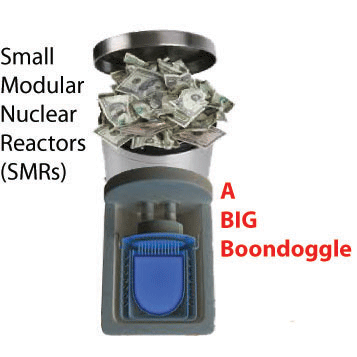
USA scales back emergency zones for Small Modular Nuclear Reactors (SMRs) to make them more affodable
 US regulators agree smaller SMR emergency zones http://www.world-nuclear-news.org/Articles/US-regulators-agree-smaller-SMR-emergency-zones, 28 August 2018
The NRC’s preliminary finding is part of a safety evaluation of a 2016 Early Site Permit application from the Tennessee Valley Authority (TVA) for the potential use of a site at Clinch River for two or more SMR modules of up to 800 MWe. This is the first SMR-related application of any type to be received by the NRC.
The US Nuclear Energy Institute (NEI) described the decision as a “potential regulatory breakthrough” that could accelerate future deployment of SMRs and advanced reactors. “The industry believes that this recognition of the enhanced safety features of small and advanced reactors could greatly simplify the licensing of these technologies and increase their cost competitiveness,” it said.
TVA’s application uses information from four SMR designs – BWXT’s mPower, Holtec International’s SMR-160, NuScale Power’s SMR, and Westinghouse’s SMR – to provide the technical basis for a requested exemption to the ten-mile EPZ requirement currently in use. The most detailed information was provided on the NuScale SMR, for which a design certification application was submitted to the NRC in January 2017. According to the application, the enhanced safety characteristics of those designs, such as smaller reactor cores, simpler systems, and built-in passive safety features, mean that off-site emergency planning requirements and plans can be scaled down to be proportionate with those reduced risks.
NRC staff found TVA’s proposed dose-based, consequence-oriented methodology to be a “reasonable technical basis” for determining EPZ size, consistent with the basis used to determine that for large light water reactors, NEI said.
The NRC also granted TVA its exemption from a ten-mile EPZ for future combined construction and operating licence applications for which the radioactive source term is bounded by the conditions established by the NRC. An SMR plant at the Clinch River site based on the NuScale SMR design would meet the conditions for a so-called site boundary-sized EPZ.
NEI Technical Advisor for Nuclear Generation David Young said current emergency planning requirements would impose an unnecessary regulatory burden on applicants and licensees, which would diminish the cost competitiveness of advanced reactors and hinder their development.
NEI Technical Advisor for Nuclear Generation David Young said current emergency planning requirements would impose an unnecessary regulatory burden on applicants and licensees, which would diminish the cost competitiveness of advanced reactors and hinder their development.
Scepticism, even among pro-nukers, about Russia’s much boasted floating nuclear power plant

The Nuclear Power Plant of the Future May Be Floating Near Russia, NYT 26 Aug 26 18 “………some environmental groups — even those open to a role for nuclear power as a substitute for traditional power plants — are skeptical.
For one, they are not convinced by Rosatom’s assurances of safety. Critics worry that during a tsunami, the 21,000-ton steel structure might not ride out the wave. In a worst-case scenario, they say, it would instead be torn from its moorings and sent barreling inland, plowing through buildings until it landed, steaming and dented and with two active reactors on board, well away from its source of coolant.
In such a case, Rosatom says, a backup power source and coolant on board would prevent the reactors from melting down, at least for the first 24 hours. “During this time we would consider what to do,” said Dmitri Alekseyenko, the deputy director for Rosatom’s floating reactor program. Regulators in the United States, however, require on-land reactors to operate for 72 hours in an emergency shutdown without external water supplies.
And the fact that the technology is well tested in Russian ships gives critics little solace, given a long history of spills and accidents involving nuclear-powered submarines and icebreakers operated by the Soviet and Russian navies.
In the 1960s and 1970s, the Soviet Union dumped reactors in the Kara Sea, in the Arctic Ocean north of Kola Bay. Russian nuclear submarines sank in 1989 and 2000, while one Russian nuclear icebreaker caught fire in 2011 and the reactor on another leaked radiation that year, according to Bellona, a Norwegian environmental group.
“The question is, would clients of Russia be comfortable with something like this being parked right at a pier in a major city?” Matthew McKinzie, director of the nuclear program at the Natural Resources Defense Council in Washington, said in a telephone interview.
A Greenpeace sailboat tailed the Akademik Lomonosov on its maiden voyage from a shipyard in St. Petersburg to Murmansk, where it will be fueled, flying a banner in English saying: “Floating Nuclear Reactor? Srsly?” ….
Following Brexit, UK will no longer be a member of Nuclear Fusion for Energy
Nucnet 23rd Aug 2018 , If the UK and the EU fail to reach an agreement on Brexit terms, the UK
will no longer be a member of the Euratom R&T programme, no longer be a
member of Fusion for Energy, and will no longer be able to collaborate on
the International Thermonuclear Experimental Reactor (Iter) project through
the EU, the government said today.
In a paper on nuclear research if there is no Brexit deal, the UK government said it is committed to continued
domestic research and other international partnerships to ensure the UK
retains its “world leading position” in this field. The paper said the
UK is on track to have bilateral nuclear cooperation agreements in place
with “key priority partners” ahead of Brexit in March 2019. This will
allow for continued, unimpeded civil nuclear trade and nuclear research
cooperation with these countries.
But the UK will no longer be a member of Fusion for Energy, the organisation responsible for providing the EU’s
contribution to the multinational Iter fusion project in France. This means
UK businesses will not be able to bid for contracts to work on the Iter
project. However, the UK government said today it would be willing to
discuss opportunities for UK researchers, companies, and institutions, to
collaborate on “this critical experiment”.
https://www.nucnet.org/all-the-news/2018/08/23/uk-will-not-be-able-to-contribute-to-iter-without-brexit-deal-says-government
1 This Month
29 Jan. Thursday 7-8 p.m. Webinar – World’s Largest Nuclear Station in Port Hope, ON?
To see nuclear-related stories in greater depth and intensity – go to https://nuclearinformation.wordpress.com/



31st January – Challenging the War Machine – a DECLASSIFIED UK SUMMIT


Website of the Week
Now until to February 10, 2026 Radioactive waste storage in France: the debate is finally open! How to participate?
-
Archives
- January 2026 (288)
- December 2025 (358)
- November 2025 (359)
- October 2025 (376)
- September 2025 (258)
- August 2025 (319)
- July 2025 (230)
- June 2025 (348)
- May 2025 (261)
- April 2025 (305)
- March 2025 (319)
- February 2025 (234)
-
Categories
- 1
- 1 NUCLEAR ISSUES
- business and costs
- climate change
- culture and arts
- ENERGY
- environment
- health
- history
- indigenous issues
- Legal
- marketing of nuclear
- media
- opposition to nuclear
- PERSONAL STORIES
- politics
- politics international
- Religion and ethics
- safety
- secrets,lies and civil liberties
- spinbuster
- technology
- Uranium
- wastes
- weapons and war
- Women
- 2 WORLD
- ACTION
- AFRICA
- Atrocities
- AUSTRALIA
- Christina's notes
- Christina's themes
- culture and arts
- Events
- Fuk 2022
- Fuk 2023
- Fukushima 2017
- Fukushima 2018
- fukushima 2019
- Fukushima 2020
- Fukushima 2021
- general
- global warming
- Humour (God we need it)
- Nuclear
- RARE EARTHS
- Reference
- resources – print
- Resources -audiovicual
- Weekly Newsletter
- World
- World Nuclear
- YouTube
-
RSS
Entries RSS
Comments RSS
 nuclear-news