Trump’s ominous creation of the U.S. Space Force – for the purposes of war
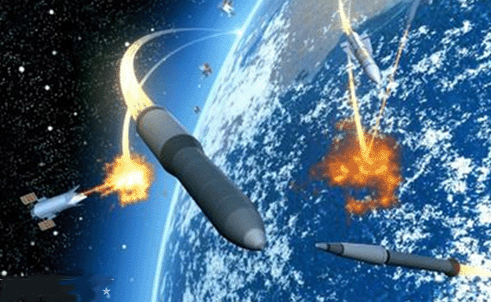
How much will it cost? The vast costs will be shouldered by taxpayers, likely by slashing funding for essential social needs. The aerospace industry has suggested defunding “entitlement programs” to pay  for “everything space.” That would likely include cutting Social Security, Medicare, and Medicaid among other social and welfare programs. In his proposed fiscal year 2021 budget, Trump is recommending $15.4 billion for the Space Force. The Space Force, if it is allowed to continue, will clearly be a multi-billion dollar annual affair.
Who will profit?
Raytheon is emerging as a major beneficiary of Space Force work. Perhaps not uncoincidentally, Mark Esper, Trump’s U.S. Secretary of Defense at the time the Space Force was announced, is a former lobbyist for the corporation. Other major contractors for the Space Force will be Northrop Grumman, Boeing and Lockheed-Martin, the world’s biggest military contractor.
Space Force is no laughing matter, May 31, 2020 by beyondnuclearinternational
What started as “a joke” his now deadly serious; and just plain deadly Continue reading
Here’s a supremely unaffordable nuclear fantasy – reactors on the moon and Mars
 NASA Wants to Go Nuclear on the Moon and Mars for Astronaut Settlement, SciTech Daily By AMERICAN CHEMICAL SOCIETY MAY 31, 2020 m It might sound like science fiction, but scientists are preparing to build colonies on the moon and, eventually, Mars. With NASA planning its next human mission to the moon in 2024, researchers are looking for options to power settlements on the lunar surface. According to a new article in Chemical & Engineering News, the weekly newsmagazine of the American Chemical Society, nuclear fission reactors have emerged as top candidates to generate electricity in space.
Time that Japan faced up to the folly of its nuclear fuel cycle dream
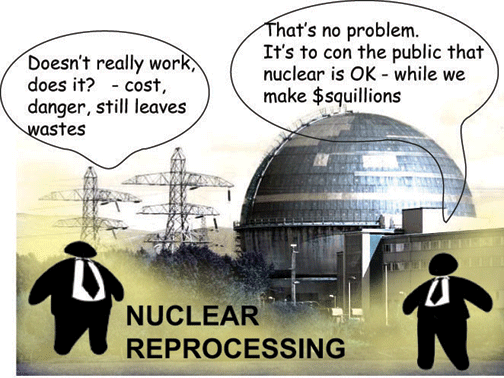
As the situation stands, plutonium will start to pile up with no prospects of it being consumed. Reducing the amount produced is also an issue that needs to be addressed.
The United States and Britain have already pulled out of a nuclear fuel cycle.
|
Editorial: Time to set a course away from Japan’s troubled nuclear fuel cycle https://mainichi.jp/english/articles/20200518/p2a/00m/0na/029000c, May 18, 2020 (Mainichi Japan) The Rokkasho Nuclear Fuel Reprocessing Facility being constructed in the northern Japan prefecture of Aomori has cleared a safety inspection by the Nuclear Regulation Authority (NRA). Spent fuel from Japan’s nuclear power plants will be reprocessed at this facility, which will play a key role in Japan’s “nuclear fuel cycle” policy. Under the policy, uranium and plutonium extracted from such fuel is to be processed for further use. Japan Nuclear Fuel Ltd., the operator of the reprocessing facility, aims to complete construction by autumn next year, but there are no immediate prospects of the facility going into operation. On top of this, due to changes in the circumstances surrounding nuclear power, the meaning of the facility’s existence is no longer clear. The first issue to consider is declining demand for the use of fuel to be reprocessed at the facility. Such fuel was originally destined to go mainly to the Monju fast-breeder reactor in the western Japan prefecture of Fukui, but a spate of problems with the sodium-cooled reactor led to a decision in 2016 to decommission it. There are no plans to construct a replacement facility. There were also plans to use reprocessed fuel at nuclear power stations to generate electricity, but there are only four reactors that can handle it, far fewer than the 16 to 18 originally planned. As the situation stands, plutonium will start to pile up with no prospects of it being consumed. Reducing the amount produced is also an issue that needs to be addressed. Japan already possesses more than 45 metric tons of surplus plutonium, and there are fears in international society that it could be converted for use in nuclear weapons. In 2018, the government pledged to reduce the amount. A realistic approach is not to reprocess the fuel in the first place. Forming the backdrop to Japan’s persistence with fuel reprocessing is the problem of how to handle the large amount of spent nuclear fuel being stored on the grounds of the reprocessing facility. If Japan gives up on its nuclear fuel cycle policy, then the spent fuel will be sent back to nuclear power plants across the country. But those facilities are already pressed for storage space, making it difficult for them to accept the spent fuel. The total cost of the reprocessing facility, including construction and maintenance costs, stands at 14 trillion yen. Some of the cost will be tacked onto electricity bills. There is a need to rethink the question of whether the public is receiving benefits commensurate with the huge investment into the facility. NRA Chairman Toyoshi Fuketa said he would check with the minister of economy, trade and industry whether operation of the reprocessing plant was in line with the nation’s energy policy. In the wake of the 2011 Great East Japan Earthquake and tsunami and the ensuing nuclear disaster, many countries across the world turned in the direction of abandoning nuclear power. There are sufficient uranium resources in the world, and the justification for reprocessing as “effective utilization of limited resources” has faded. The United States and Britain have already pulled out of a nuclear fuel cycle. Japan must avoid a situation in which it wastes time by sticking to a national policy and becomes laden with risks. The country should squarely face up to the fact that it is in a no-win situation, and search for an alternative to the nuclear fuel cycle policy. |
NuScam’s “small nuclear reactor” project runs into yet more trouble

core cooling system that NuScale plans to submit to the NRC on May 20. Instead of resolving the steam generator design issue ahead of design certification, the NRC is deferring to the plant operator Energy Northwest
to resolve the issue during the licensing process, after construction.http://www.energyintel.com/pages/eig_article.aspx?DocId=1072564
Australian politician John Barilaro gets it so wrong about small nuclear reactors
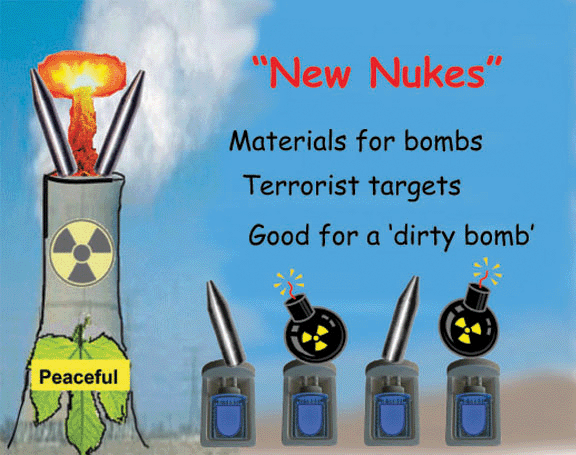
But there is as yet no sign of anything being oven-ready to come to the marketplace, let alone 15 up and running. But there remain some rather disturbing connections between small reactor projects and nuclear weapons proliferation. And Rolls-Royce does offer up one of the most glaring examples. Part of the company’s current sales pitch to the British government includes the argument that a civil small-reactor industry in the UK “would relieve the Ministry of Defence of the burden of developing and retaining skills and capability” for its weapons programme. It may be true. But it is not really Atoms for Peace, , is it?
https://electricalreview.co.uk/features-mm/13082-mystic-meg-from-down-under
Rokkasho nuclear reprocessing, a pointless effort , to postpone coping with plutonium trash

the project should not be kept alive through irresponsible collusion between the government and the power industry to avoid tackling this challenge.
Political leaders should make the tough decision as soon as possible to put the nation on a path toward a new energy future.
|
Japan should end its nonsensical effort to recycle nuclear fuel http://www.asahi.com/ajw/articles/13372798, May 14, 2020 Japanese nuclear regulators have endorsed the safety of a contentious plant to reprocess spent nuclear fuel.
The Nuclear Regulation Authority (NRA) on May 13 approved a draft report on the safety inspection of the reprocessing plant being built in Rokkasho, Aomori Prefecture, by Japan Nuclear Fuel Ltd. The report says the plant meets the new nuclear safety standards introduced after the 2011 Fukushima nuclear disaster. The NRA’s decision represents a big step forward toward bringing the long-delayed Rokkasho reprocessing plant online. Japan’s policy program to establish a nuclear fuel recycling system to recover plutonium from spent nuclear fuel to be reused in reactors, however, is already bankrupt beyond redemption. Operating the reprocessing plant simply does not make sense because of the many problems it entails with regard to nuclear proliferation, cost effectiveness, energy security and other important policy issues. Prime Minister Shinzo Abe’s administration should change its policy concerning nuclear fuel recycling. It would be irresponsible to maintain this unsustainable national policy aimlessly simply because of the NRA’s verdict that the plant meets the new safety standards. TROUBLE-PLAGUED PLANT Continue reading |
Controlled Nuclear Fusion Not Reached

Controlled Nuclear Fusion Not Reached https://ladailypost.com/letter-to-the-editor-controlled-nuclear-fusion-still-not-reached/ Carol A. ClarkMay 15, 2020 By JASON HAGLER (to Daily Post) Los Alamos This is a comment on your recent piece on nuclear fusion. It was misleading in one respect. Both in the title and in the text, it stated that this research was an important step toward the practical use of controlled nuclear fusion. In fact, we are no closer to that goal then we were 60 years ago. The article reported on an important study of plasma physics, but the study made no impact on reaching the goal of electrical energy from fusion. The reason is that fusion has to occur at millions of degrees and the temperature to produce electrical power is many orders of magnitude less. First look at the fairly rapid development of nuclear power from fission. In less than 20 years after the discovery of nuclear fission there were operating nuclear reactors. Soon after we began to have nuclear power reactors. That was primarily because fission occurs at room temperature and by controlling the chain reaction it was simple to take temperatures up enough to generate electricity. In contrast for fusion reaction you have to start with millions of degrees, sustain the reaction to a steady state, contain the extremely hot plasma, and then extract the heat at moderate temperatures. While no technical and engineering problems are insoluble these are very difficult. Containment involves what the scientists call PFM. It stands for Plasma Facing Materials. These containment materials have to stand the intense heat from the plasma. All the experiments so far have been with pulses of magnetic fields to contain the plasma so cooling the containment materials occurs naturally. To produce electric energy you need a steady state fusion reaction and cooling the containment became a severe problem which is not near a solution. So, where does a practical solution for electrical power from fusion stand? It is hardly any nearer than it was 60 years ago. Researchers have learned a great deal about plasma physics, but they are still far away from obtaining electrical energy. They have made almost no important engineering steps toward that goal. |
|
Rokkasho – Japan’s nuclear ‘pie in the sky’
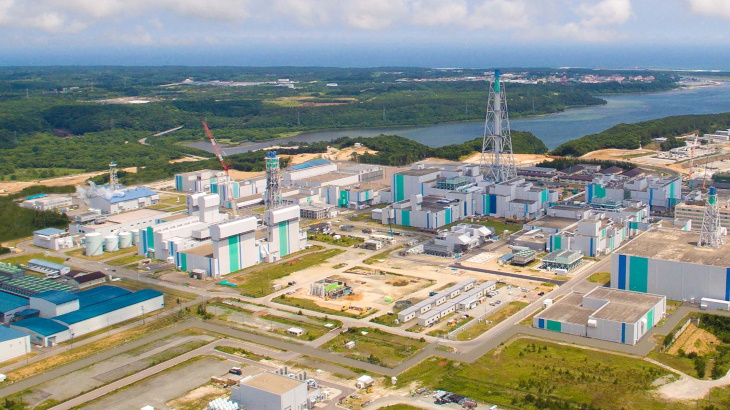 VOX POPULI: Government, nuclear industry badly in need of a reality check http://www.asahi.com/ajw/articles/13375632Vox Populi, Vox Dei is a daily column that runs on Page 1 of The Asahi Shimbun., May 15, 2020 In his 1991 book “Rokkashomura no Kiroku” (Record of Rokkasho village), journalist Satoshi Kamata documented the displacement of residents for a planned large development project in the northern village.
Kamata reproduced an essay written by an elementary school pupil, whose school was earmarked for closure because of the megaproject.
“I detest development more than I could ever say,” the youngster wrote.
The villagers were promised a rosy future, with rows of factories turning their rural community into a vibrant urban center. But none of that happened, and the school closed in 1984.
“All that talk about the factories was a lie,” the child lamented. “I truly hate being made to feel so sad and lonely.”
Instead of this development project that never materialized, the village of Rokkasho in Aomori Prefecture ended up hosting a facility for reprocessing spent nuclear fuel.
A series of delays held up the project for years, but the Nuclear Regulation Authority finally ruled the plant’s safety measures acceptable under its new standards on May 13.
The Rokkasho plant was meant to be the “nucleus” of the nation’s nuclear fuel recycling program of the future, with the purpose of minimizing nuclear waste by reusing spent fuel.
The reprocessed fuel was to be burned in fast-breeder reactors, but efforts to develop a viable fast-breeder reactor have gone nowhere. Attempts to use the reprocessed fuel in conventional nuclear reactors have also stalled.
The whole project has effectively become a proverbial pie in the sky.
But neither the government nor utilities would acknowledge this reality and review the project, apparently because they fear the issue of nuclear waste will become the focus of attention.
I wonder how long they are going to keep their heads in the sand without addressing the thorny problem of how to dispose of nuclear waste.
Here’s a riddle: What cannot be seen when your eyes are open, but can be seen when your eyes are closed? The answer is a dream.
Where the nuclear fuel recycling program is concerned, I imagine the nation’s nuclear community must be dreaming or hallucinating.
‘Small Modular Nuclear Reactor’ entrepreneurs trying to revive dangerous ‘plutonium economy’ dream.

It seems that these two SMNR entrepreneurs in New Brunswick, along with other nuclear “players” worldwide, are trying to revitalize the “plutonium economy” — a nuclear industry dream from the distant past that many believed had been laid to rest because of the failure of plutonium-fuelled breeder reactors almost everywhere, including the US, France, Britain and Japan.
The phrase “plutonium economy” refers to a world in which plutonium is the primary nuclear fuel in the future rather than natural or slightly enriched uranium. Plutonium, a derivative of uranium that does not exist in nature but is created inside every nuclear reactor fuelled with uranium, would thereby become an article of commerce.
The proposed SMNR prototype from ARC Nuclear in Saint John is the ARC-100 reactor (100 megawatts of electricity). It is a liquid sodium-cooled SMNR, based on the 1964 EBR-2 reactor – the Experimental Breeder Reactor #2 in Idaho. Its predecessor, the EBR-1 breeder reactor, had a partial meltdown in 1955, and the Fermi-1 breeder reactor near Detroit, also modelled on the EBR-2, had a partial meltdown in 1966.
Admiral Hyman Rickover, who created the US fleet of nuclear-powered submarines, tried a liquid-sodium-cooled reactor only once, in a submarine called the Sea Wolf. He vowed that he would never do it again. In 1956 he told the US Atomic Energy Commission that liquid sodium-cooled reactors are “expensive to build, complex to operate, susceptible to prolonged shutdown as a result of even minor malfunctions, and difficult and time-consuming to repair.”
The ARC-100 is designed with the capability and explicit intention of reusing or recycling irradiated CANDU fuel. In the prototype phase, the proposal is to use irradiated fuel from NB Power’s Point Lepreau Nuclear Generating Station. Lepreau is a CANDU-6 nuclear reactor.
The other newly proposed NB SMNR prototype is the Moltex “Stable Salt Reactor” (SSR) — also a “fast reactor”, cooled by molten salt, that is likewise intended to re-use or recycle irradiated CANDU fuel, again from the Lepreau reactor in the prototype phase.
The “re-use” (or “recycling”) of “spent nuclear fuel”, also called “used nuclear fuel” or “irradiated nuclear fuel,” is industry code for plutonium extraction. The idea is to transition from uranium to plutonium as a nuclear fuel, because uranium supplies will not outlast dwindling oil supplies. Breeder reactors are designed to use plutonium as a fuel and create (“breed”) even more plutonium while doing so.
It is only possible to re-use or recycle existing used nuclear fuel by somehow accessing the unused “fissile material” in the used fuel. This material is mainly plutonium. Accessing this material involves a chemical procedure called “reprocessing” which was banned in the late 1970s by the Carter administration in the US and the first Pierre Elliot Trudeau administration in Canada. South Korea and Taiwan were likewise forbidden (with pressure from the US) to use this chemical extraction process.
Why did both the US and Canada ban this recycling scheme? Two reasons: 1) it is highly dangerous and polluting to “open up” the used nuclear fuel in order to extract the desired plutonium or U-233; and 2) extracting plutonium creates a civilian traffic in highly dangerous materials (plutonium and U-233) that can be used by governments or criminals or terrorists to make powerful nuclear weapons without the need for terribly sophisticated or readily detectable infrastructure.
Argonne Laboratories in the US, and the South Korean government, have been developing (for more than 10 years now) a new wrinkle on the reprocessing operation which they call “pyroprocessing.” This effort is an attempt to overcome the existing prohibitions on reprocessing and to restart the “plutonium economy.”
Both New Brunswick projects are claiming that their proposed nuclear reactor prototypes would be successful economically. To succeed, they must build and export the reactors by the hundreds in future.
On the contrary, however, the use of plutonium fuel is, and always has been, much more expensive than the use of uranium fuel. This is especially true now, when the price of uranium is exceedingly low and showing very little sign of recovering. In Saskatchewan, Cameco has shut down some of its richest uranium mines and has laid off more than a thousand workers, while reducing the pay of those still working by 25 percent. Under these conditions, it is impossible for plutonium-fuelled reactors to compete with uranium-fuelled reactors.
And to make matters worse for the industry, it is well known that even uranium-fuelled reactors cannot compete with the alternatives such as wind and solar or even natural-gas-fired generators. It is an open question why governments are using public funds to subsidize such uneconomical, dangerous and unsustainable nuclear technologies. It’s not their money after all – it’s ours!
Dr. Gordon Edwards, a scientist and nuclear consultant, is the President of the Canadian Coalition for Nuclear Responsibility. He can be reached at: ccnr@web.ca Note from the NB Media Co-op editors: Dr. Edwards visited New Brunswick in March for a series of public talks on the development of so-called Small Modular Nuclear Reactors. The story of his talk in Saint John can be accessed here. The video of the webinar presentation scheduled for Fredericton can be accessed here.
Canada on verge of investing in plutonium
Gordon Edwards <ccnr@web.ca>\, 26 Apr 2020, It seems that the two SMNR (Small Modular  Nuclear Reactor) entrepreneurs in New Brunswick (Canada), along with other nuclear “players” worldwide, are trying to revitalize the “plutonium economy” — a nuclear industry dream from the distant past that many believed had been laid to rest because of the failure of plutonium-based breeder reactors almost everywhere – e.g. USA, France, Britain, Japan …
UK govt again to try “astronomically expensive” plutonium reprocessing nuclear reactors
Westminster relaunches plutonium reactors despite ‘disastrous’ experience, The National, 26 April, 20 By Rob Edwards This article was brought to you by The Ferret.
THE UK Government is trying to resurrect plutonium-powered reactors despite abandoning a multi-billion bid to make them work in Scotland.
Documents released by the UK Office for Nuclear Regulation (ONR) under freedom of information law reveal that fast reactors, which can burn and breed plutonium, are among “advanced nuclear technologies” being backed by UK ministers.
Two experimental fast reactors were built and tested at a cost of £4 billion over four decades at Dounreay in Caithness. But the programme was closed in 1994 as uneconomic after a series of accidents and leaks.
Now ONR has been funded by the Department for Business, Energy and Industrial Strategy (BEIS) in London to boost its capacity to regulate new designs of fast reactors, along with other advanced nuclear technologies.
Campaigners have condemned the moves to rehabilitate plutonium as a nuclear fuel as “astronomically expensive”, “disastrous” and “mind-boggling”. They point out that it can be made into nuclear bombs and is highly toxic – and the UK has 140 tonnes of it…….
ONR released 23 documents about advanced nuclear technologies in response to a freedom of information request by Dr David Lowry, a London-based research fellow at the US Institute for Resource and Security Studies. They include redacted minutes and notes of meetings from 2019 discussing fast reactors, and are being published by The Ferret.
One note of a meeting in November 2019 shows that ONR attempted to access a huge database on fast reactors maintained by the UK Government’s National Nuclear Laboratory (NNL) in Warrington, Cheshire…..
Two companies have so far won funding under this heading to help develop fast reactors that can burn plutonium. The US power company, Westinghouse, is proposing lead-cooled fast reactors, while another US company called Advanced Reactor Concepts wants to build sodium-cooled fast reactors.
In November 2019 BEIS also announced an £18 million grant to a consortium led by reactor manufacturer, Rolls Royce, to develop a “small modular reactor designed and manufactured in the UK capable of producing cost effective electricity”.
According to Dr Lowry, fast reactors would require building a plutonium fuel fabrication plant. Such plants are “astronomically expensive” and have proved “technical and financial disasters” in the past, he said.
“Any such fabrication plant would be an inevitable target for terrorists wanting to create spectacular iconic disruption of such a high profile plutonium plant, with devastating human health and environmental hazards.”
Lowry was originally told by ONR that it held no documents on advanced nuclear technologies. As well as redacting the 23 documents that have now been released, the nuclear safety regulator is withholding a further 13 documents as commercially confidential – a claim that Lowry dismissed as “fatuous nonsense”.
THE veteran nuclear critic and respected author, Walt Patterson, argued that no fast reactor programme in the world had worked since the 1950s. Even if it did, it would take “centuries” to burn the UK’s 140 tonne plutonium stockpile, and create more radioactive waste with nowhere to go, he said.
“Extraordinary – they never learn do they? I remain perpetually gobsmacked at the lobbying power of the nuclear obsessives,” he told The Ferret. “The mind continue to boggle.”
The Edinburgh-based nuclear consultant, Pete Roche, suggested that renewable energy was the cheapest and most sustainable solution to climate change. “The UK Government seems to be planning some kind of low carbon dystopia with nuclear reactors getting smaller, some of which at least will be fuelled by plutonium,” he said.
“The idea of weapons-useable plutonium fuel being transported on our roads should send shivers down the spine of security experts and emergency planners.”
Another nuclear expert and critic, Dr Ian Fairlie, described BEIS’s renewed interest in fast reactors as problematic. “Experience with them over many years in the US, Russia, France and the UK has shown them to be disastrous and a waste of taxpayers’ money,” he said.
This is not the view taken by the UK Nuclear Industry Association, which brings together nuclear companies. It wants to see the UK’s plutonium being used in reactors rather than disposed of as waste……
“The Scottish Government remains opposed to new nuclear power plants in Scotland,” a spokesperson told The Ferret. “The Scottish Government believes our long term energy needs can be met without the need for new nuclear capacity.”
The UK Department for Business, Energy and Industrial Strategy did not respond to repeated requests to comment. https://www.thenational.scot/news/18405852.westminster-relaunches-plutonium-reactors-despite-disastrous-experience/
Confusion over which American military satellites are “nuclear” and which are “nonnuclear.”
|
Space-Based Nuclear Command and Control and the ‘Non-Nuclear Strategic Attack’ Counterspace capabilities may meet dual-purpose command and control assets to create new risks. The Diplomat, By Ankit Panda, April 08, 2020 The Trump administration’s 2018 Nuclear Posture Review (NPR) drew much attention for the inclusion of language expanding the scope under which the United States might employ nuclear weapons. Specifically, the document observed that certain “extreme circumstances,” which “could include significant non-nuclear strategic attacks,” would rise to the level of meriting a nuclear response. In remarks delivered during an online video conference this week, Christopher Ford, U.S. assistant secretary at the State Department’s Bureau of International Security and Nonproliferation, discussed this language in the context of space security. Ford emphasized that for the purposes of parsing that bit of the 2018 NPR, American adversaries should understand that U.S. space-based dual-use (nuclear and nonnuclear) command and control assets qualified as what the 2017 National Security Strategy had dubbed a “vital U.S. interest.” Accordingly, Ford continues: “I need hardly point out — but I will nonetheless, for emphasis — that the U.S. National nuclear Command, Control, and Communications (NC3) architecture depends to some extent upon space-based systems.” He is clear therefore that nonnuclear attacks on this architecture would potentially rise to the level of a nuclear response: “Any harmful interference with or attacks upon such components of our space architecture at any time, even if undertaken only with non-nuclear tools, thus starts to move into ‘significant non-nuclear strategic attack’ territory, and would lead to a significant and potentially drastic escalation of a crisis or conflict.” Much of what Ford says here is not new or surprising, but his remarks offer one of the starker presentations of these ideas by a U.S. official in recent years — at least since the release of the 2018 NPR. The problem that arises is one of “entanglement,” where a crisis might escalate to the nuclear level inadvertently if an adversary — say China — is attempting to degrade U.S. conventional operations by taking aim at certain space-based assets. Though the United States openly acknowledges the role of space-based assets in nuclear command and control, there is no explicit tabulation of which American military satellites are “nuclear” and which are “nonnuclear.”….. https://thediplomat.com/2020/04/space-based-nuclear-command-and-control-and-the-non-nuclear-strategic-attack/ |
|
|
Critical comments on the claim that “Nuclear Energy Could Power The Trillion-Dollar Space Race”
 Haley Zaremba’s final comment “” good news for public health and the environment coming out of the space industry”” left me puzzled.
Just exactly how are nuclear-powered space travel, and nuclear reactors on the moon and on Mars “good news for public health and the environment”?
A second question – nuclear reactors in space as a “trillion dollar” industry. Does this mean that it will magically somehow bring in trillions of dollars to the U.S. economy, – or, more likely, just add trillions of dollars to the national debt?
A final question – as the global economy, and especially the American economy, goes into freefall, heading for the greatest Depression ever, is this article just a rather sad joke?
Nuclear Energy Could Power The Trillion-Dollar Space Race https://oilprice.com/Energy/Energy-General/Nuclear-Energy-Could-Power-The-Trillion-Dollar-Space-Race.html By Haley Zaremba – Apr 09, 2020, While the economy comes to a grinding halt here on Earth, some investors, inventors, and dreamers are looking to the stars for their next business venture. The final frontier has been touted as a potential breeding ground for untold numbers of industries in key economic sectors including mining, tourism, research and development, data collection and analysis, to name just a very few.
In fact, the commercial potential of the space economy is allegedly so great and so untapped (for now) that Bank of America Merrill Lynch projected back in 2017 that the size of the space industry is due to explode, expanding to more than eight times its current size by 2050. Valued at nearly $400 billion now, that means that the space sector would reach a total value of nearly $3 trillion over the next thirty years.
We are entering an exciting era in space where we expect more advances in the next few decades than throughout human history,” a Bank of America report stated. Goldman Sachs and Morgan Stanley, however, were far more conservative in their projections than Bank of America Merrill Lynch, but the financial corporations still predicted that the space sector will expand to be a more-than trillion dollar industry inside of 20 years.
Even the United States Chamber of Commerce has been bullish on the space sector, stating that “total private investment is growing at a striking pace,” citing research by Bryce Space and Technology. “From 2000-2005, the industry received more than $1.1 billion in investment from private equity, venture capital, acquisitions, prizes and grants, and public offerings. By the 2012-2017 period, the industry had received more than $10.2 billion.” The Chamber goes on to say that, “the increased investment reflects the new opportunities in the commercial space sector and new startup ventures that did not exist a decade ago.”
Last summer, Oilprice reported that the nuclear industry was also angling to get a piece of the modern-day space race. “In just a few short years from now, the United States will be shipping nuclear reactors to the moon and Mars,” the report said, citing statements from team members from the Kilopower project, a collaborative venture from NASA and the United States Department of Energy.
The Kilopower project is a near-term technology effort to develop preliminary concepts and technologies that could be used for an affordable fission nuclear power system to enable long-duration stays on planetary surfaces,” said NASA’s Space Technology Mission Directorate. “In layman’s terms, the focus of the Kilopower project is to use an experimental fission reactor to power crewed outposts on the moon and Mars, allowing researchers and scientists to stay and work for much longer durations of time than is currently possible,” the Oilprice article summed up.
Now, just this week, an article from Space.com reported that “space is about to go nuclear — at least if private companies get their way.” The article is referencing developments from the 23rd annual Commercial Space Transportation Conference (CST), which took place in Washington, D.C. back in January. There, “a panel of nuclear technology experts and leaders in the commercial space industry spoke about developments of the technology that could propel future spacecraft faster and more efficiently than current systems can.”
NASA is no stranger to nuclear power. The agency has already used nuclear energy to power its Mars rovers, its Cassini mission probe of Saturn and its rings, and the two Voyagers up there exploring the edges of our solar system as we speak. The nuclear energy that powered those projects, however, relied “on the passive decay of radioactive plutonium, converting heat from that process into electricity to power the spacecraft,” whereas, according to the panelists at the CST, the future of space industry electricity lies in “Nuclear Thermal Propulsion (NTP), a technology developed in the 1960s and ’70s that relies on the splitting, or fission, of hydrogen atoms.” This form of nuclear fission would need low-enriched uranium, a much less hazardous material.
“An NTP-powered spacecraft would pump hydrogen propellant through a miniature nuclear reactor core. Inside this reactor core, high energy neutrons would split uranium atoms in fission reactions; those freed neutrons would smack into other atoms and trigger more fission. The heat from these reactions would convert the hydrogen propellent into gas, which would produce thrust when forced through a nozzle,” explained Space.com.
At least there is some good news for public health and the environment coming out of the space industry on the week that Trump announced that he wants to mine the moon.
Nuclear fusion, too hot, too costly? And not ready before 2050
|
Nuclear fusion promises a clean, green energy future — but there’s a catch
ABC Radio National By Antony Funnell for Future Tense 9 Apr 20, It’s a nuclear race like no other, involving billions of dollars and hundreds of scientists from across the globe.
Their aim is as ambitious as it is monumental: to replicate the energy source that powers the solar system, effectively building a mini sun — a swirling mass of super-heated atomic plasma so hot that it can only be contained by a magnetic field. The process is called nuclear fusion. Scientists believe that if fusion technology can be successfully harnessed as a human energy source, it could help save the world from future environmental catastrophe. From vision to constructionJust outside the port city of Marseille in the south of France work is underway on a giant nuclear fusion test facility known as ITER — Latin for “the way”. Its construction is being funded by an international collaboration between 35 nations, and it’s expected to cost somewhere between $27 billion and $36 billion when completed…… Fusion versus fissionConventional nuclear reactors harness energy from a process called fission, which involves splitting the nucleus of a large atom. Nuclear fusion, on the other hand, works by forcing atoms together in order to release energy……. “The advantages of fusion are: no risk of meltdown — it’s very easy to stop it safely — no production of radioactive waste, and a very high energy density of the fuel,” ……. Early test reactors managed to produce a fusion reaction, but not one that was sustainable or energy efficient. In other words, it took more energy to produce the reaction, than the reaction itself produced…… The first plasma experiments are now expected to begin in 2025. For ITER to be considered a success, according to Professor Garrett, it must demonstrate that it can achieve an energy gain of a factor of 10. “ITER consumes 50 megawatts of power to produce this plasma at 150 million degrees, and the goal is to produce 500 megawatts of power from that plasma,” he says. “The second goal is to be able to maintain that condition for many minutes at a time, so maybe 10 minutes, up to an hour, and that’s what you would need for a steady-state power reactor.” Scale and manageabilityITER isn’t the only nuclear fusion initiative underway. In both North America and the United Kingdom there are numerous projects operating on a smaller scale………. Future focused or fantastic folly?Proponents of nuclear fusion believe it will end the world’s dependence on fossil fuels once and forever. But the catch is that no-one involved in the research believes a fully operational, commercially viable nuclear fusion reactor will be operating before at least 2050. That fact has seen some question the level of financial investment, including Sir Chris Llewellyn Smith, the director of Energy Research at Oxford University and a former director general of CERN. He once managed the UK’s fusion program, but two years ago, in an interview with the Simons Centre for Geometry and Physics, he expressed doubts about ITER and the viability of the industry in general. “I used to think that there was a reasonably good chance that fusion could compete with other low carbon sources of power, but while I would not say that it’s impossible, the situation has changed,” he said. “The cost of wind and solar power has decreased faster than anyone could have dreamed. Meanwhile ITER has gone way over budget. Fusion reactors will be intrinsically more expensive than we thought a decade ago.” He argues that ITER needs to go ahead, but that a final cost comparison with renewables should be conducted before any construction on a full-scale reactor is begun. |
|
Russia gambles on safety and cost, in extending life of fast breeder reactor
One of Russia’s fast neutron reactors granted a runtime extension https://bellona.org/news/nuclear-issues/2020-04-one-of-russias-fast-neutron-reactors-granted-a-runtime-extension
Russia’s nuclear regulator has agreed to extend the operational lifetime of 39-year-old experimental reactor as part of a wide-ranging modernization program at the Beloyarsk nuclear plan. April 8, 2020 by Charles Digges
The reactor, a BN-600, is a powerful sodium-cooled fast-breeder and its continued operation marks a step by Russia toward developing a closed nuclear fuel cycle, a subject of concern among some environmentalists and nonproliferation experts.
Fast breeder reactors form the backbone of Russia’s “proryv” or “breakthrough” program, which aims to develop reactors that do not produce nuclear waste. In simple terms, these breeders are theoretically designed to burn the spent nuclear fuel they produce, thus closing the nuclear fuel cycle and creating nearly limitless supplies of energy.
But the technology has been hard to perfect. Russia is alone among nuclear nations in actually running fast-breeders with any success. Yet they have still not been able to close the nuclear fuel cycle entirely.
Under the new order, the BN-600 reactor, which began operations in 1981, would continue to function until 2025, at which point the Beloyarsk plant’s operators say it will be evaluated for yet another extension that would see it run until 2040.
The Beloyarsk plant is the site of another fast-breeder reactor, the BN-800, which began commercial operations 2016 after several long delays. The plant also hosts two AMB supercritical water reactors, one of which ceased operations in 1983, the other in 1990.
At the moment, technicians at the plant have been isolated on site to prevent their exposure to the coronavirus, which has driven most of the world’s population indoors and shuttered much of the international economy.
But Rosenergoatom, Russia’s nuclear utility still maintains high hopes for the safety and modernization plan, of which the BN-600’s runtime extension is a part. So far, the modernization plan, which began in 2009 has included the installation of a reactor emergency protection system, an emergency dampening system using an air heat exchanger and a back-up reactor control panel.
In addition, a large amount of work has been carried out on the inspection and replacement of equipment, including the replacement of the reactor’s steam generators.
But many environmental groups, Bellona among them, consider reactor runtime extensions to be worrisome territory. As the world’s nuclear reactor fleet begins to age, runtime extensions throughout the world have become routine business.
Yet because commercial power-producing nuclear reactors have only been around for a little more than four decades, the industry can’t make safe bets on their behavior over longer periods of time than that.
In particular, data on how reactor cores – which are largely irreplaceable – age over time is extremely scarce. While certain characteristics of core aging can be simulated in test reactors, such simulations can’t take all variables into account.
Individual national regulatory bodies also set the criteria for whether or not reactors are granted runtime extensions – meaning that what Japan or France consider to be safe grounds for an extension might differ from what Russia or the United States deem safe.
But as the history of Chernobyl and Fukushima show, the fallout from nuclear disasters doesn’t respect international boundaries.
However, because nuclear reactors typically cost billions of dollars to build, there is less incentive to construct new ones to replace the old. But as Chernobyl and Fukushima also showed, such decisions could cost more than the short-term savings they provide.
1 This Month



26 September – International Day for the Total Elimination of Nuclear Weapons


PLEASE OPPOSE HR 8255 AND S.3639 – bills would accelerate satellite deployment, with no environmental review or safeguards – https://ncstd5li.quorum.us/campaign/169331/
To see nuclear-related stories in greater depth and intensity – go to https://nuclearinformation.wordpress.com
-
Archives
- September 2026 (269)
- August 2026 (330)
- July 2026 (355)
- June 2026 (287)
- May 2026 (306)
- April 2026 (356)
- March 2026 (251)
- February 2026 (267)
- January 2026 (308)
- December 2025 (358)
- November 2025 (359)
- October 2025 (375)
-
Categories
- 1
- 1 NUCLEAR ISSUES
- business and costs
- climate change
- culture and arts
- ENERGY
- environment
- health
- history
- indigenous issues
- Legal
- marketing of nuclear
- media
- opposition to nuclear
- PERSONAL STORIES
- politics
- politics international
- Religion and ethics
- safety
- secrets,lies and civil liberties
- spinbuster
- technology
- Uranium
- wastes
- weapons and war
- Women
- 2 WORLD
- ACTION
- AFRICA
- Atrocities
- AUSTRALIA
- Christina's notes
- Christina's themes
- culture and arts
- Events
- Fuk 2022
- Fuk 2023
- Fukushima 2017
- Fukushima 2018
- fukushima 2019
- Fukushima 2020
- Fukushima 2021
- general
- global warming
- Humour (God we need it)
- Nuclear
- RARE EARTHS
- Reference
- resources – print
- Resources -audiovicual
- Weekly Newsletter
- World
- World Nuclear
- YouTube
-
RSS
Entries RSS
Comments RSS

