NuScam’s (sort of) small nuclear reactors rejected by Utah Taxpayers Association

Critics of planned nuclear power project urge Utah cities to pull out before it’s too late, Utah Taxpayers Association warns it believes proposal is too costly, not transparent DeseretNews, By Amy Joi O’Donoghue@Amyjoi16 Aug 4, 2020 SALT LAKE CITY — The Utah Taxpayers Association and a former member of the U.S. Nuclear Regulatory Commission are urging cities that have signed on to a planned nuclear power plant in Idaho to get out while they can before costs become too great.
NuScale’s Small Modular Reactor is planned for construction at the Idaho National Laboratory near Idaho Falls and would provide 720 megawatts of power, or enough energy for 720,000 homes.
The Carbon Free Power Project is promoted as the next generation design for nuclear power, featuring 12 distinct modules, with the first scheduled to come online in 2029 with the 11 others following the next year.
The project is a collaborative effort involving the U.S. Department of Energy, NuScale and the Utah Associated Municipal Power Systems, a political subdivision of the state of Utah. ……
there are several off-ramps in those phases for cities to exit, one of which is coming up Sept. 14. That deadline prompted the taxpayers association to urge cities to get out now before they get trapped into paying millions for a technology it says is unproven.
“Small modular reactor power is just not cost competitive,” said Rusty Cannon, vice president of the taxpayer group, adding participating cities and districts should hold a public vote to withdraw from the project……..
Peter Bradford, a former member of the U.S. Nuclear Regulatory Commission, said enthusiasm over new developments in nuclear technology that turned out to be flawed have cost ratepayers and taxpayers in multiple states billions of dollars.
He said that of 31 projects pending before the commission in 2009, only two remain — with the rest canceled or indefinitely postponed.
“The stranded costs of nuclear plants paid off by customers in the 1990s exceeded $50 billion nationwide,” he said. “Each period of abject failure is followed by an array of new proposals.”…….
The project is backed heavily by the U.S. Department of Energy, which gave NuScale a competitive award of $226 million in 2013 to develop the technology. Two years later, the federal agency gave NuScale $16.7 million for licensing preparation……..
Cannon and Bradford also criticized the municipal power association for not being transparent enough because its briefing meetings are exempt from the Utah open meetings law and are closed……… https://www.deseret.com/utah/2020/8/4/21354171/critics-nuclear-power-project-urge-utah-cities-pull-out-nuscale-small-modular-reactor-idaho
It’s not the energy salvation for the world – nuclear fusion
 Nuclear Fusion Will Not Save Us, https://www.gizmodo.com.au/2020/08/nuclear-fusion-will-not-save-us/ Yessenia Funes, August 6, 2020 Last week, construction kicked off on the world’s largest experimental nuclear fusion reactor. It marked the start of a new era in the energy sector: The fossil fuel industry has historically dominated this arena, but renewable energy is quickly taking over. Now, nuclear scientists are hoping that the International Thermonuclear Experimental Reactor, or ITER, the experimental power plant under construction in southern France, can play a role alongside already-established technologies like solar and wind.
All the nuclear power plants that exist today rely on nuclear fission. ITER, however, will rely on nuclear fusion. The two are dramatically different, and scientists have struggled to recreate nuclear fusion — the process that makes stars shine — in a lab setting. ITER is the world’s first true attempt at this on a large scale.
“The difference between nuclear fission and nuclear fusion is the reason why we’ve developed a nuclear fission reactor in a matter of years, and still after more than six decades, we still don’t have a nuclear fusion reactor,” said Eugenio Schuster, a mechanical engineering and mechanics professor at Lehigh University who is working on ITER.
Around the world, 450 nuclear reactors were operating last year, all using nuclear fission, which involves splitting heavy atoms of elements such as uranium and plutonium. The process produces tons of highly radioactive waste, the ingredients to create nuclear weapons, potential instability that could lead to a destructive nuclear meltdown, and other concerning issues.
This process also requires uranium. In the U.S., the mining of this resource has contaminated the waters of the Navajo Nation and left countless individuals sick. President Donald Trump wants to see more uranium mining, and he doesn’t care where. The Grand Canyon? It can be mined. Bears Ears National Monument? That, too. Nuclear fission has proven destructive to both human health and the environment. There’s a reason many environmental advocates are highly opposed.
“We have a horrible legacy of uranium contamination in our communities,” said Carol Davis, the executive director of Diné C.A.R.E., an environmental organisation that supports the Navajo people. “Water was contaminated with uranium, and it’s never been cleaned, and people are using that and drinking that.”
Davis and other advocates worry nuclear power is just another false promise that creates radioactive waste while taking time and money away from developing renewable energy technologies. The United States alone has 90,000 metric tons of nuclear waste with nowhere to go. Nuclear fusion doesn’t create the same level of long-lived radioactive waste as the more popular process of nuclear fission, but it isn’t waste-free, either.
The process begins with the breaking down of lighter atoms into a state of matter called plasma. It requires more than 150 million degrees Celsius of heat to get going, though. When you’re comparing it to fission, of course, fusion is better. It can’t cause the nuclear meltdowns that we’ve seen at other sites. It doesn’t need any uranium; all it needs is lithium and water. If greenhouse gas emissions are the concern, fusion doesn’t have any evidence of contributing there. But the process does still produce some waste, and advocates are worried that their communities will be forced to deal with that waste for the greater good.
“This whole notion of endless power with little to no waste, it just sounds too good to be true. We really need to examine what are the true costs and who are the people who will be impacted,” said Leona Morgan, a Diné activist and coordinator of the Nuclear Issues Study Group, a New Mexico-based volunteer organisation against nuclear power. “It seems like we should really learn from what we have already experienced with the loss of human rights and loss of water resources from contamination.”
If scientists want communities to fully embrace nuclear energy, they need to figure out what the hell to do with this toxic trash. In the U.S., decision-makers have historically dumped this stuff near tribal or low-income rural communities. History is bound to repeat itself if leaders don’t take proper action to prevent these injustices.
“The reason we’re investing in fusion is because the promise is big,” Schuster said. “We’re going to have the benefits of renewables in terms of greenhouse gas emissions, but at the same time, we’re going to reduce the area we need to produce the same amount of energy while eliminating the risk of nuclear accidents and the generation of long-lived radioactive waste.”
That’s the thing, though. Intense attention on the climate crisis allows other ecological crises to happen alongside it. No one wants to see the world burn from rising temperatures, but disenfranchised communities don’t want to keep being sacrificed for the sake of human progress, either. Lithium extraction primarily happens in Argentina and Chile, where Indigenous advocates worry about the amount of water the mining requires, as well as the potential for contamination of their lands. Water is going to become even more valuable as we see droughts dry out lakes, rivers, and streams. Fusion simply doesn’t come without a cost.
“This whole notion of endless power with little to no waste, it just sounds too good to be true.”
Proponents of ITER note that the amount of lithium and water needed is minimal, especially compared to the extractive industries that exist today. The plant is expected to need only 550 pounds of fuel a year, half from the isotopes they need from water and half from the isotopes they need from lithium. Schuster notes that most of the water needed for this process would be returned to its source. That’s because researchers need only a specific molecule from the water. These materials won’t be the main issue with nuclear fusion, said Egemen Kolemen, an assistant professor of mechanical and aerospace engineering at Princeton University who is also working on the plant.
“The real issue is going to be the nuclear safety issues,” Kolemen said. “Even though it doesn’t have this runaway type of [reaction], there is still going to be some sort of nuclear reactions… that are going to have low levels, but still some, nuclear waste of sorts.”
The construction of ITER certainly does mark a new chapter in the world’s energy sector. It marks a moment of technological breakthrough and scientific accomplishment, but it won’t save us by itself. No new energy source can. At the heart of the climate crisis is human behaviour. If we’re to survive it — and, more importantly, solve it — we need to take a long, hard look in the mirror. Reducing emissions will require more than finding the perfect clean energy source; it will need a massive shift in human behaviour, lowering our emissions through energy efficiency and less consumption.
Then again, emissions aren’t everything. If we’re lowering our carbon footprint without protecting the health of vulnerable communities, what good is it after all? A nuclear future needs a justice and equity lens if it’s to actually be successful. Otherwise, it’ll be another damaging industry. The world already has enough of those. The construction of ITER certainly does mark a new chapter in the world’s energy sector. It marks a moment of technological breakthrough and scientific accomplishment, but it won’t save us by itself. No new energy source can. At the heart of the climate crisis is human behaviour. If we’re to survive it — and, more importantly, solve it — we need to take a long, hard look in the mirror. Reducing emissions will require more than finding the perfect clean energy source; it will need a massive shift in human behaviour, lowering our emissions through energy efficiency and less consumption.
Then again, emissions aren’t everything. If we’re lowering our carbon footprint without protecting the health of vulnerable communities, what good is it after all? A nuclear future needs a justice and equity lens if it’s to actually be successful. Otherwise, it’ll be another damaging industry. The world already has enough of those.
Utah Taxpayers – NuScam nuclear power project costly and public kept in the dark
 New Information Disclosed in Meeting Closed to Public Points to Major Budget Commitments, Delay Risks in UAMPS Power Project https://utahtaxpayers.org/new-information-disclosed-in-meeting-closed-to-public-points-to-major-budget-commitments-delay-risks-in-uamps-nuclear-power-project/
by Tax Watchdog | Aug 4, 2020 “We Need Public Hearings and We Need Public Votes”: UTA Calls for Full Transparency and Accountability Ahead of September 14th Deadline; Parallels Seen to Ohio, Illinois and South Carolina Nuclear Controversies Where Public Was Kept in the Dark.
SALT LAKE CITY – August 4, 2020 – Utah Associated Municipal Power Systems (UAMPS) and NuScale Power held an “online town hall meeting” on July 21st, but there was just one problem: due to a quirk in Utah’s open meeting laws, the town was not invited. Not only did UAMPS/NuScale fail to be transparent in terms of the meeting about their controversial small modular nuclear reactor plans, but they also failed to disclose new and troubling information that emerged during the behind-closed-doors virtual session, according to the nonprofit Utah Taxpayers Association (UTA). UTA and Peter Bradford, a former U.S. Nuclear Regulatory Commission (NRC) member, warned that potentially higher costs, project delays, and other risks could be costly for UAMPS members and ratepayers.
A total of 34 municipalities in Utah, Idaho, New Mexico and California (see full list below) are participating in the UAMPS small modular nuclear project. Ratepayers will be locked into more than $100 million in commitments by a September 14th deadline and billions of dollars of risks later on if UAMPS members do not opt out of the project. The need for openness is particularly important while the nuclear industry is currently facing major credibility problems with scandals in Ohio, Illinois, and South Carolina.
On July 21st, UAMPS and NuScale held a so-called “online town hall meeting,” which was not made open to the media under a special Utah exemption for UAMPS for open meeting requirements. A video copy of the UAMPS/NuScale event was acquired after the fact. (The timecodes shown below refer to various points in the video.)
Rusty Cannon, Vice President, Utah Taxpayers Association, said: “The UAMPS project will lock in 27 municipalities in Utah and several in surrounding states for a share of billions of dollars in costs and unclear risk in the pursuit of a cluster of small modular reactors (SMRs) touted by Oregon-based NuScale Power, which repeatedly has delayed timelines and increased costs associated with its SMRs.”
Cannon added: “This risky project with massive cost escalations is being conducted largely out of the public eye. Most recently the public was barred from a late July online ‘town hall meeting,’ the content of which has since come to light and which raises serious concerns about what has not been disclosed to the general public. The Utah Taxpayers Association urges elected officials involved with UAMPS to disclose all relevant information to the public so decisions can be made in the open and city officials can be held accountable. We are urging city councils in Utah that are subscribed to the project to vote in a public meeting before the September deadline to withdraw from the project.”
Also speaking at today’s news event was Peter Bradford, a former member of the U.S. Nuclear Regulatory Commission who served as chair of both the New York Public Service Commission and the Maine Public Utilities Commission. He has been an expert witness in many cases involving nuclear power economics, and he has taught Nuclear Power and Public Policy at the Vermont Law School as well as Energy Policy and Environmental Protection at the Yale School of the Environment.
Peter Bradford said: “There is the very real possibility of large rate increases to the customers in these communities due to inadequate safeguards in this project. It is difficult to understand the case for taking on this risk given the certainty of cheaper clean energy alternatives as clearly shown by recent purchases of firm combinations of renewables, energy efficiency plus storage elsewhere in the West. The cost of lack of transparency plus unwise and secretive deals has resulted in the nuclear energy industry becomingembroiled in multiple debacles. UAMPS members and ratepayers should take heed and avoid making the same mistakes.”
Just what is UAMPS and NuScale failing to disclose to the public?
- RAPIDLY ESCALATING CONSTRUCTION COSTS. NuScale’s website currently explains to the public: “The estimated construction cost for the first NuScale 684 MWe (net) plant is about $3 billion.” However, during the July 2020 “town hall,” UAMPS contractor Bob Squires (MPR Associates) calls the project a “roughly $5 billion nuclear power plant development project with first of a kind technology.” (3:47:24) Even worse: NuScale’s 2020 Amended Budget & Plan of Finance projects a total cost of approximately $6.1 billion.
- MAJOR MISSED DEADLINES. In 2008, NuScale explained: “With timely application for a combined construction and operating license (COL), a NuScale plant could be producing electricity by 2015-16.” In 2019, UAMPS publicly announced that the NuScale nuclear power plant would begin construction in 2023, “with the first 60 MW module becoming operational in 2026 [and] [o]ther modules would come on-line soon thereafter.” However, during the non-public July “town hall,” Glenn Neises, nuclear director, Burns & McDonnell, announced for the first time that completion is now projected for June 2030, and the first module is not expected to become operational until June 2029. (3:22:25) And things could get even worse. Warning of possible new delays, Neises said: “I’d also like to stress that this is the current schedule and expect it to change as we see changes in funding, engineering moves forward, and as licensing advances.” (3:22:25)
-
- LOW-BALLED ENERGY PRICE. Doug Hunter, UAMPS CEO, said an undisclosed Economic Competitiveness Test (ECT) determined the UAMPS project power that could be generated would cost $55/MWh in 2018 dollars. (24:30) The UAMPS/NuScale estimate contrasts sharply with other independent utility projections (PacifiCorp’s estimate of $95/MWh and Idaho Power’s estimate of $125/MWh). Doug Hunter confirms this in answering a question as to why large investor-owned utilities are not pursuing this project: “Right now they’re still relying on existing capacity, most of them, to fill in energy with renewables because that happens to be the lowest IRP.” (2:28:20)
- DEPENDENCE ON UNPREDICTABLE FEDERAL SUBSIDIES. Mason Baker, UAMPS chief legal officer, admitted during the “town hall” that project organizers are now banking on a “massive increase” in the federal government’s contribution to UAMPS, a jump from $60 million to $1.4 billion. (48:30) UAMPS now acknowledges taxpayer subsidies are necessary to achieve the $55 per MW/h price point. (53:50) In effect, U.S. taxpayers are being asked to subsidize roughly 25 percent of the UAMPS SMR project to artificially hold down energy costs. However, taxpayer subsidies of this sort are both objectionable on their merits, entirely unpredictable as to passage, and subject to being withdrawn at any time.
- The Utah Taxpayers Association also noted that no town or city of more than 100,000 has opted into the UAMPS SMR project, which has not been successful in securing investments in it by investor-owned utilities. It is not apparent that any UAMPS member so far opting into the SMR project has been able to afford to do its own independent financial evaluation of the project, and, instead, may be over relying on assurances from the promoter, NuScale. Committing a municipal government to a long-term contract of this magnitude could result in massive sunk costs and higher rates and taxes on citizens.
- The following are the UAMPS members currently subscribed to the SMR project: Utah (Beaver City, Blanding, Bountiful, Brigham City, Enterprise, Ephraim City, Fairview City, Fillmore City, Heber City Light & Power, Holden Town, Hurricane City, Hyrum City, Kanosh Town, Kaysville City, Lehi, Logan City, Monroe City, Morgan City, Mt. Pleasant City, Murray City, Oak City, Paragonah Town, Parowan, Payson City, Santa Clara City, South Utah Valley Electric Service District, Spring City, Washington City, and Weber Basin Conservancy District); Idaho (Idaho Falls Power and Salmon River Electric Cooperative, Inc.); California (Lassen Municipal Utility District and Plumas-Sierra Rural Electric Cooperative); and New Mexico (Los Alamos County). The total size of the subscriptions is 160.4 megawatts, with 133.4 megawatts going to the state of Utah.
The Utah Taxpayers Association is a non-profit 501(c)(4) organization that works to limit state and local taxes, making Utah an attractive place to live and do business. www.utahtaxpayers.org
Important note: The Utah Taxpayers Association has no position on nuclear energy. The Association’s interest in this matter is limited to the extent to which public business of interest to ratepayers/taxpayers is conducted in an open and transparent manner in order to ensure maximum accountability to the public.
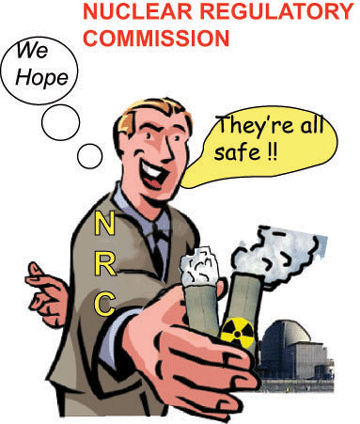
USA’s Nuclear Regulatory Commission plans to weaken safety standards for smaller nuclear reactors
 Smaller Nuclear Plants May Come With Less Stringent Safety Rules, npr, August 1, 2020
The NRC is considering whether to shrink emergency planning and evacuation zones around these newer reactors — from a 10-mile radius to, in some cases, the boundary of the plant site.
Nuclear energy critics say that would be a mistake.
“When you’re talking about a reactor that’s never been built or operated, you have to take with a big grain of salt the claims that it’s actually safer or more secure,” says Edwin Lyman at Union of Concerned Scientists.
He says the industry also wants to use weaker reactor containment shells, and in some cases they don’t want to have to keep an operator at the site.
Lyman thinks companies should build plants under current rules first. “You have to work out the kinks of these new plants,” he says. “And then over time you might be able to adjust your requirements accordingly. But you don’t do that at the get-go.”
A National Nuclear Security Administration (NNSA) official recently echoed some of Lyman’s concerns in comments sent to the NRC. The NNSA is a semi-autonomous agency within the Department of Energy.
Deputy Under Secretary Jay Tilden called the proposed rule a major departure from “the successful 42-year-old practice of using a 10-mile plume exposure emergency planning zone.” That existing regulation, he wrote, provides “the last layer of a defense-in-depth for low-probability, high-consequence accidents.” ………
As Dept of Energy officials enthuse over nuclear in space, they show their disdain for health and safety in pandemic
Here we see 9 DOE officials all close to each other – bugger social distancing. Typical nuclear enthusiasts, 7 men confident, think they’re invincible? next to them , the two token women, wearing masks – they have some grasp of the need for safety and public health measures in the pandemic.

US Ramps Up Planning for Space Nuclear Technology AIP, NASA and the Department of Energy are expanding their collaboration as part of a broader White House push to develop nuclear power systems for space applications. The initiative comes as NASA faces key decisions on what fuel sources and technology development paths to pursue.
Now, NASA, DOE, and the White House want nuclear power to play a much larger role in space exploration as plans take shape for a sustained human presence on the Moon and subsequent crewed journeys to Mars……….
The American Nuclear Society hosted a debate on the topic at its annual meeting in June. While the society has generally supported the use of space nuclear power and propulsion in the past, it has decided to develop a position statement by spring 2021 on whether to favor the use of LEU.
Among the participants was Rep. Bill Foster (D-IL), a former Fermilab physicist, who argued that proceeding with HEU ( Highly Enriched Uranium)would set a dangerous precedent. “If all of the spacefaring nations start using HEU reactors in space, then this would involve utilization of a significant amount of weapons grade material,” he remarked…….
Alan Kuperman, a policy scholar affiliated with the Nuclear Proliferation Prevention Project, pointed to U.S. efforts since the 1970s to minimize the use of HEU in civilian applications, arguing they are “based on the logic of no exceptions.”
“If we say, ‘well, we’re going to have exceptions,’ then other countries are going to say, ‘well, we want exceptions too,’ and then the whole thing falls apart,” he remarked……..https://www.aip.org/fyi/2020/us-ramps-planning-space-nuclear-technology
Problems in USA’s rush to put a nuclear reactor on the moon
 America Wants to Put a Nuclear Power Plant on the Moon
What happens to all that highly enriched uranium in space? Popular Mechanics, BY CAROLINE DELBERT, JUL 30, 2020
- The U.S. Department of Energy (DoE) is looking for technology partners to help power the moon.
- This could begin a project that later includes powering a Mars surface mission.
- The Union for Concerned Scientists doesn’t want highly enriched uranium in space.
Scientists at the U.S. Department of Energy’s (DoE) Idaho National Laboratory have a new design for a nuclear power plant they say could allow humans to more easily live on the moon. As part of a form plan, the scientists say they want to have the fission reactor, safe launch, and landing system ready by 2027
What are the challenges of generating nuclear energy on the moon?
Design Development Today reports that the Union of Concerned Scientists expressed, well, concerns:
“Edwin Lyman, director of Nuclear Power Safety at the Union of Concerned Scientists, a nonprofit, said his organization is concerned the parameters of the design and timeline make the most likely reactors those that use highly enriched uranium, which can be made into weapons. Nations have generally been attempting to reduce the amount of enriched uranium being produced for that reason.”
While the Idaho National Laboratory and the DoE broadly are pushing for “advanced” reactor technology in terms of issues like modularity and safety, the “parameters of the design and timeline” they refer to—in this case advocating for a small, reliable, space-friendly design in just 6 years—almost definitely rules out the modular reactors being developed and certified now.
To fully test and regulate these reactors—and design the special edition to send to the moon in this timeframe—is probably impossible. To rush any nuclear approval is a terrible idea, not just for safety, but also for a public that’s already shy about nuclear energy.
Technology like thorium fuel is still far from ready for the market….
USA Department of Energy enthuses about Highly Enriched Uranium in space. Not everyone agrees
As I’ve mentioned before on this site, the oh so confident macho nuclear enthusiasts don’t need to do precautions, even though USA is in the thick of the pandemic. Only the 2 token women have the brains to wear masks.
US Ramps Up Planning for Space Nuclear Technology AIP, 31 July 20, NASA and the Department of Energy are expanding their collaboration as part of a broader White House push to develop nuclear power systems for space applications. The initiative comes as NASA faces key decisions on what fuel sources and technology development paths to pursue.
Now, NASA, DOE, and the White House want nuclear power to play a much larger role in space exploration as plans take shape for a sustained human presence on the Moon and subsequent crewed journeys to Mars……….
The American Nuclear Society hosted a debate on the topic at its annual meeting in June. While the society has generally supported the use of space nuclear power and propulsion in the past, it has decided to develop a position statement by spring 2021 on whether to favor the use of LEU.
Among the participants was Rep. Bill Foster (D-IL), a former Fermilab physicist, who argued that proceeding with HEU ( Highly Enriched Uranium) would set a dangerous precedent. “If all of the spacefaring nations start using HEU reactors in space, then this would involve utilization of a significant amount of weapons grade material,” he remarked…….
Alan Kuperman, a policy scholar affiliated with the Nuclear Proliferation Prevention Project, pointed to U.S. efforts since the 1970s to minimize the use of HEU in civilian applications, arguing they are “based on the logic of no exceptions.”
“If we say, ‘well, we’re going to have exceptions,’ then other countries are going to say, ‘well, we want exceptions too,’ and then the whole thing falls apart,” he remarked……..https://www.aip.org/fyi/2020/us-ramps-planning-space-nuclear-technology
Examining NuScam’s deceptive claims about Small Nuclear Reactors
 Derek Abbott shared a link. Nuclear Fuel Cycle Watch Australia, 30 July 20
Local approval still needed, as Japan’s nuclear regulators OK fuel reprocessing plant, despite safety concerns
The regulators said on Wednesday that they had received about 760 opinions, and that many of them were about safety. The risk of radioactive materials leaking out was among the concerns.
The regulators concluded that the operator had measures in place to deal with the concerns, and said the firm’s application had been approved.
Japan Nuclear Fuel Limited wants to complete construction by September 2021, and launch operations in 2022. But the construction work, which began 27 years ago, has been delayed by problems. That has caused the cost to balloon to more than 130 billion dollars.
Plans to use the reprocessed plutonium are not moving forward as initially outlined.
The government and energy firm also still need to obtain local approval. https://www3.nhk.or.jp/nhkworld/en/news/20200729_20/
Coast Guard To Deliver Nuclear Icebreaker Plan to White House
Coast Guard To Deliver Nuclear Icebreaker Plan to White House
The plan will include options to lease new breakers or build new nuclear-powered ships as Russia and China leap ahead of US capabilities in the Arctic. WASHINGTON: The Coast Guard is on track to deliver plans for a new generation of potentially nuclear-powered icebreakers to the White House by August 10, just two months after the Trump administration issued a surprise public directive to do so…….. https://breakingdefense.com/2020/07/coast-guard-to-deliver-nuclear-icebreaker-plan-to-white-house/
Huge, costly, enormous effort, ITER nuclear fusion far from ready
|
France’s global nuclear fusion device a puzzle of huge parts, AP, By ELAINE GANLEY. 29 Jul 20,
“…….. Billed as the world’s largest science project, ITER is gigantic. The circular device, called a tokamak, has a 30-meter circumference, stands 30 meters (100 feet) high, and is made up of more than a million parts constructed in numerous countries. ………Some pieces transported to France weigh several hundred tons. Tools to put the reactor together match that size, with giant lifts that must transfer components over the walls and down into “the pit.” A key component being built by the U.S., the Central Solenoid, is the most powerful of ITER’s numerous magnets. Together, they will be strong enough to lift an aircraft carrier. The project begun in 2006 is far from over. The experimental reactor is to head for another landmark moment in five years, described as a “trial run” when scientists launch what is called “First Plasma” showing that the machine functions, including magnetic fields and other operations……
The project’s estimated cost just for the EU was about 20 billion euros ($23.5 billion), Bigot told reporters. He said a full price tag was difficult to estimate because participating countries make their own contributions. https://apnews.com/c9e1780864431c3edcd1cc2c17568c54
|
|
|
Looks as if 20 municipalities in Utah have been NuScammed for those not so small nuclear reactors
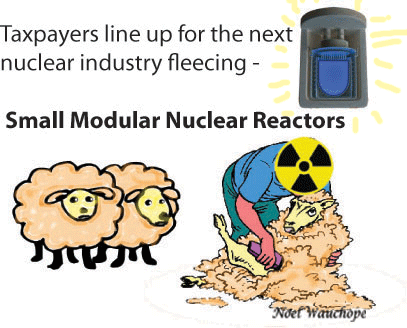
readers may wonder how UAMPS convinced some members to sign an “option” contract, which eventually converts to a “hell-or-high-water” contract, meaning that the buyer has no right, under any circumstances, to abandon the contract once construction, the Achilles heel of nuclear projects, is authorized.
|
|
Over 20 municipalities, primarily located in Utah, have signed a contract with Utah Associated Municipal Power Systems (UAMPS) to purchase entitlement shares for a first-of-a-kind nuclear power plant based on NuScale’s unproven small modular reactor (SMR) design. [and they’re not really small at all]
Ignoring the history of commercial nuclear plant construction, advocates have promoted the SMR project as a cost-effective energy resource without fully addressing the economic, contractual and litigation risks with stakeholders. Between 1953 and 2008, approximately 250 commercial nuclear reactors were ordered in the United States. During this period, ratepayers (and investors) bore the burden for well over $200 billion (in 2009 dollars) in costs for completed and abandoned nuclear plants. For example, one of the largest municipal bond defaults occurred in 1982 when the Washington Public Power Supply System defaulted on $2.25 billion in bonds for two nuclear power plant construction projects. In an effort to reduce their losses, bondholders sued a group of utilities (including several Idaho cities) that entered into contracts to pay for the plants.
Well, what about the UAMPS SMR project, including the $65 dollars per megawatt-hour (price cost of electricity) sales pitch? During a 2018 Los Alamos County Council meeting, held to consider approval of the UAMPS power sales contract, a council member asked a UAMPS lawyer, “There’s been mention of a target of $65 a megawatt-hour. How did we come up with that number?” Another council member, probing into the terms of the contract, expressed additional concern. The councilor stated, “I feel like we’re being sold a bill of goods with $65 a megawatt-hour.” With that said, readers may wonder how UAMPS convinced some members to sign an “option” contract, which eventually converts to a “hell-or-high-water” contract, meaning that the buyer has no right, under any circumstances, to abandon the contract once construction, the Achilles heel of nuclear projects, is authorized. Having a similar concern, especially given the history of nuclear plant construction, a sincere effort was made to address project risks with the UAMPS SMR project chair, including sharing concerns about transparency and proposing possible ways to minimize risks to ratepayers, including contract modifications such as price guarantees and redefining the construction period. Unfortunately, my questions and concerns fell on deaf ears. |
|


USA wants nuclear power stations on the moon and on Mars
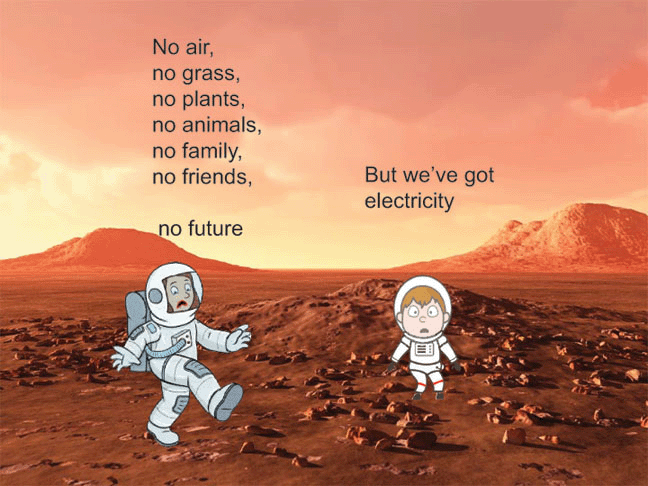
The U.S. Department of Energy put out the formal request to build what it calls a fission surface power system that could allow humans to live for long periods in harsh space environments.
The Idaho National Laboratory, a nuclear research facility in eastern Idaho, the Energy Department and NASA will evaluate the ideas for developing the reactor.
The lab has been leading the way in the U.S. on advanced reactors, some of them micro reactors and others that can operate without water for cooling. Water-cooled nuclear reactors are the vast majority of reactors on Earth.
“Small nuclear reactors can provide the power capability necessary for space exploration missions of interest to the Federal government,” the Energy Department wrote in the notice published Friday.
The Energy Department, NASA and Battelle Energy Alliance, the U.S. contractor that manages the Idaho National Laboratory, plan to hold a government-industry webcast technical meeting in August concerning expectations for the program.
The plan has two phases. The first is developing a reactor design. The second is building a test reactor, a second reactor be sent to the moon, and developing a flight system and lander that can transport the reactor to the moon. The goal is to have a reactor, flight system and lander ready to go by the end of 2026.
The reactor must be able to generate an uninterrupted electricity output of at least 10 kilowatts. The average U.S. residential home, according to the U.S. Energy Information Administration, uses about 11,000 kilowatt-hours per year. The Energy Department said it would likely take multiple linked reactors to meet power needs on the moon or Mars.
In addition, the reactor cannot weigh more than 7,700 pounds (3,500 kilograms), be able to operate in space, operate mostly autonomously, and run for at least 10 years.
“This may drive or start an international space race to build and deploy new types of reactors requiring highly enriched uranium.”
– Edwin Lyman, director of Nuclear Power Safety at the Union of Concerned Scientists
The Energy Department said the reactor is intended to support exploration in the south polar region of the moon. The agency said a specific region on the Martian surface for exploration has not yet been identified.
Edwin Lyman, director of Nuclear Power Safety at the Union of Concerned Scientists, a nonprofit, said his organization is concerned the parameters of the design and timeline make the most likely reactors those that use highly enriched uranium, which can be made into weapons. Nations have generally been attempting to reduce the amount of enriched uranium being produced for that reason.
“This may drive or start an international space race to build and deploy new types of reactors requiring highly enriched uranium,” he said.
Earlier this week, the United Arab Emirates launched an orbiter to Mars and China launched an orbiter, lander and rover. The U.S. has already landed rovers on the red planet and is planning to send another next week.
Officials say operating a nuclear reactor on the moon would be a first step to building a modified version to operate in the different conditions found on Mars.
“Idaho National Laboratory has a central role in emphasizing the United States’ global leadership in nuclear innovation, with the anticipated demonstration of advanced reactors on the INL site,” John Wagner, associate laboratory director of INL’s Nuclear Science & Technology Directorate, said in a statement. “The prospect of deploying an advanced reactor to the lunar surface is as exciting as it is challenging.”
Space archaeology, space junk and weapons, and long-lasting radioactivity
While the nuclear macho men plan more nuclear, and nuclear weapons in space, it seems that it takes a woman, Alice Gorman, to investigate the radioactive pollution on Earth and in space, due to these activities
Nuclear sites still dangerous in 24,000 years, say space archaeologists
Some nuclear tests were conducted also in outer space and nuclear fuel was employed as propellant for rockets. https://www.jpost.com/health-science/nuclear-sites-still-dangerous-in-24000-years-space-archaeologists-say-636379 By ROSSELLA TERCATIN JULY 26, 2020
Gorman said the issue presents two challenging elements: What materials can survive such a long time, and what form of language can be used to deliver the actual message?
“As for the first difficulty, we know that stones and pottery last a very long time,” she said. “But the second point raises a big archaeological question related to symbolic communication. If we look at rock art from 20,000 years ago, we can see that there are pictures of animals, but we do not know what those pictures mean. Therefore, it is possible that our current symbols to mark radioactive sites, the yellow [and] black sign, will be interpreted as an invitation to explore the area, rather than to keep away from it.”
If the UN Outer Space Treaty of 1967 prohibited nuclear weapons in space, the issue of its weaponization remains very relevant.“Recently, Russia tested an anti-satellite weapon, reawakening the debate,” Gorman told the Post.
She began to work in space archaeology following years of work focused on stone-tool analysis and the aboriginal use of bottle glass after European settlement.
Space archaeology deals with the same issues of regular archaeology, understanding material culture, human behavior and the interaction with the surrounding environment, Gorman said.
Gorman was drawn to space archaeology by the idea of exploring space junk, those many objects that cannot even be seen in the sky circling the Earth. Currently, she is working on the archaeology of the International Space Station.
The recent attempt by Israel to land a robotic unit on the moon with the Beresheet mission represents a very interesting development for space archaeologists, Gorman said.
“For many decades, the only material cultures present on the moon were the American and the Soviet one,” she said. “As new countries have started to reach the moon, this has changed, bringing more diversity to the field.”
Rolls Royce Small Modular Nuclear Reactors: not small, not modular, not cheap, and not going to happen
100% Renewables 16th July 2020, The Government has just announced a £40 million research programme into so-called advanced modular reactor technology that is highly unlikely ever to see any practical use. That is because the so-called small modular reactors (SMRs) are much too expensive for civilian use.
In an important sense it is nonsense to talk about research to develop SMRs as a ‘new’ technology simply because they already exist. They power military submarines and also US aircraft carriers. Their design is simply a smaller
version of the Pressurised Water Reactor (PWR) design that dominates the world nuclear power industry. Indeed PWRs began as small projects housed in submarines which were then developed up in scale so that they could produce electricity more cheaply.
At 450 MW for their proposed plant, the plant is not far off the same order of magnitude as conventional plant – for
example the AGR series that currently generates the bulk of British nuclear plant has units of around 600-660 MW. In fact, as Tom Burke points out, they are close to the size of Britain’s first generation of reactors, the ‘Magnox’ reactors.
Neither is the plant proposed by Rolls Royce modular in the sense that such plant can be rolled off a production line. What Rolls Royce claims is that some parts can be produced in a ‘modular’ fashion. This is not the same as producing whole units off a production line, and in fact the developers of the nuclear plant Vogtle in the USA also claim to produce parts in a ‘modular ‘fashion (although this plant is now hopelessly behind schedule with very large cost overruns).
1 This Month



26 September – International Day for the Total Elimination of Nuclear Weapons


PLEASE OPPOSE HR 8255 AND S.3639 – bills would accelerate satellite deployment, with no environmental review or safeguards – https://ncstd5li.quorum.us/campaign/169331/
To see nuclear-related stories in greater depth and intensity – go to https://nuclearinformation.wordpress.com
-
Archives
- September 2026 (257)
- August 2026 (330)
- July 2026 (355)
- June 2026 (287)
- May 2026 (306)
- April 2026 (356)
- March 2026 (251)
- February 2026 (267)
- January 2026 (308)
- December 2025 (358)
- November 2025 (359)
- October 2025 (375)
-
Categories
- 1
- 1 NUCLEAR ISSUES
- business and costs
- climate change
- culture and arts
- ENERGY
- environment
- health
- history
- indigenous issues
- Legal
- marketing of nuclear
- media
- opposition to nuclear
- PERSONAL STORIES
- politics
- politics international
- Religion and ethics
- safety
- secrets,lies and civil liberties
- spinbuster
- technology
- Uranium
- wastes
- weapons and war
- Women
- 2 WORLD
- ACTION
- AFRICA
- Atrocities
- AUSTRALIA
- Christina's notes
- Christina's themes
- culture and arts
- Events
- Fuk 2022
- Fuk 2023
- Fukushima 2017
- Fukushima 2018
- fukushima 2019
- Fukushima 2020
- Fukushima 2021
- general
- global warming
- Humour (God we need it)
- Nuclear
- RARE EARTHS
- Reference
- resources – print
- Resources -audiovicual
- Weekly Newsletter
- World
- World Nuclear
- YouTube
-
RSS
Entries RSS
Comments RSS

