Floating 10 MW nuclear reactor proposed for California.

By Efosa Udinmwen, 22 Aug 26, https://www.techradar.com/pro/floating-10-mw-nuclear-reactor-proposed-for-california-barge-mounted-smr-aims-to-power-15-000-homes
The Port of Long Beach is exploring small modular reactors that could eventually supply electricity for port operations and ships.
Bluecore Energy, a startup building compact nuclear reactors meant to operate from floating barges, is leading the proposal.
This marks a potential return of nuclear power development in California after nearly five decades under state restrictions.
A startup’s barge-based reactor plan
Bluecore has leased space at Berth 48 within the Port of Long Beach, where it intends to develop and test its floating reactor system.
The company’s initial system is rated at 10 MWe, a capacity the startup says can scale through pairing multiple units together, an approach which suits continuous port operations partly because individual reactors are designed to run for years on a single fueling cycle.
SMRs and microreactors in the military
Aleksander Olech, 15 August 2026
Small modular reactors are not a technology that will solve every problem
faced by an army during wartime. They will not replace fuel, the deployment
of forces or existing sources of energy. On the other hand, they could
become an important element in preparing the state for crisis and war.
Modern armed forces need not only soldiers, tanks and artificial
intelligence, but also a stable power supply for the systems on which
military operations depend. It is from this perspective that the military
importance of SMRs and microreactors should be developed.
Modern warfare is
not limited to strikes against selected military units. Increasingly, it
begins with an attempt to paralyse the state by depriving it of energy,
transport capabilities, communications and the ability to exercise command
rapidly. Russia has demonstrated this in its operations against Ukraine.
Attacks against energy infrastructure are not an addition to a military
operation, but part of the way in which war is conducted.
Hybrid activities
may also serve as a prelude to open conflict, while a strike against the
state’s support infrastructure may precede direct action on the
battlefield.
Defence24 15th Aug 2026, https://defence24.com/armed-forces/smrs-and-microreactors-in-the-military
Short sellers reap $2Bn profit as modular nuclear reactor stocks tumble
Unproven technology won investment from power-hungry AI
hyperscalers but has yet to deliver consistent revenues
The Financial Times, .Ramsay Hodgson in London, 19 Aug 26,
https://www.ft.com/content/a2f0e0f8-9350-4124-af77-62219e77e777
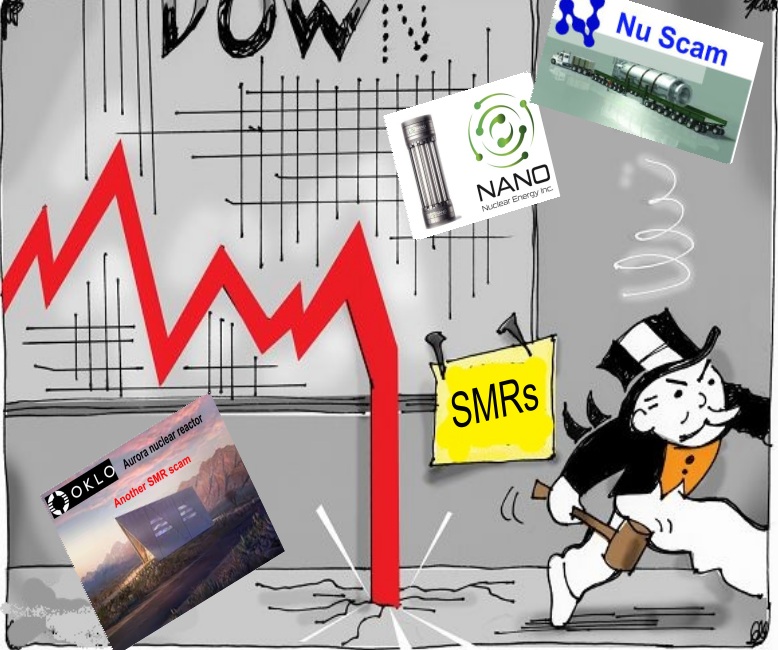
Short sellers have reaped large profits from betting against small modular nuclear reactor companies, as the collapse of the “hype cycle” that had sent their share prices soaring wipes billions off their market value.
Funds made an estimated $2.1bn shorting three stocks — US-listed NuScale Power, Nano Nuclear and Sam Altman-backed Oklo — over the past year, according to data provider S3 Partners.
The three companies, which are lossmaking and have little or no revenue, surged last year as investors raced to capitalise on growing interest in nuclear energy among AI hyperscalers looking for new sources of power. Regulatory changes and funding announcements from the Trump
administration also helped the sector.
But a total of $30.3bn has been wiped off their collective market value since their peak in October last year amid growing concerns over the lack of immediate revenue and the long build-out timelines for the technology.
“The stocks were overinflated in price, based on speculation,” said Adam Stein, director of nuclear energy innovation at the Breakthrough Institute, a climate and energy think-tank.
The sector went through a “textbook hype cycle” last year, he added. “[It is] very typical of a company that is in this early pre-consistent revenue phase.”
Small modular nuclear reactors are assembled from modules built in factories to save time and
money, and produce around 300MW or less, compared with more than 1,000MW for traditional
reactors.
Only two commercial SMRs are currently operable — in Russia and China, with more than 80 designs in various stages of development.
A key test of investor appetite towards the nuclear sector is expected in the coming weeks, when Holtec International and Westinghouse, two US-based companies with SMR divisions, are expected to list.
Short sellers have piled into bets against the companies based on a view that their shares rose to unsustainable levels, driven by a limited supply of publicly traded stocks and a focus on the potential demand from AI, rather than the time and capital expenditure required to commercialise the technology.
“On the one hand there was some support from the government, and no one wants to bet against Trump, and on the other there was this whole AI [demand] story which everyone was really bullish about [last year],” said Christian Putz, founder and chief executive of investment firm ARR
Investment Partners, who has previously shorted Oklo but has since unwound that position.
Around 18 per cent of Oklo and NuScale’s outstanding shares remain out on loan — a proxy for short selling — while almost 30 per cent of Nano’s are on loan, according to S&P Global Market Intelligence.
Meanwhile, X-energy has shed $5.8bn in market value since the surge that followed its initial public offering in April. Short sellers have earned an estimated $67mn from bets against thecompany since mid-May, according to S3 Partners. The company, which is backed by Amazon and
Ken Griffin and has yet to receive full regulatory approval to build its helium-cooled reactor, has 9 per cent of its shares out on loan.
“The sentiment has changed this year, people are far more critical,” said Putz. These companies “have almost zero revenue for the foreseeable future and, on top of that, there are very high capex [capital expenditure] requirements”.
Demand for energy in the US is set to soar over the coming decade, in part due to the rapid development of power-hungry data centres by AI hyperscalers. According to data from BloombergNEF, US data centre power demand is set to climb from 34.7 gigawatts in 2024 to 106GW by 2035.
Big Tech is increasingly turning to the emergent SMR technology to meet its future power needs. In January, Meta struck a deal with Oklo and Bill Gates-backed TerraPower, in which it agreed to make an upfront cash injection to support development of the reactor technology.
The Trump administration vocally backed the nuclear sector last year, pledging to cut red tape and invest tens of billions of dollars to build new reactors and reopen old ones to generate the to “win” the global AI race. In June, the Department of Energy announced $17.5bn of loans to help rebuild the US nuclear supply chain.
However, timelines for delivery of the unproven reactors remain uncertain. Analysts at BNP Paribas have expressed concerns over shortages of high-assay low-enriched uranium, a special type of nuclear fuel vital for SMRs. The earliest some will come online is mid-to-late 2028, if manufacturers are able to speed up delivery while also satisfying regulators, although the majority will arrive during the 2030s, said Stein at the Breakthrough Institute.
NuScale, which reported a $96.7mn loss in the first half of 2026, faces a shareholder class-action lawsuit alleging it misled investors, to which it must respond by September 8. It is building a modular light-water reactor based on a more conventional pressurised-water design.
Nano Nuclear — whose microreactors are in the development stage — has never generated any revenue and posted a $14mn operating loss in the first quarter of the year.
Oklo hopes to deliver commercial power to customers from its liquid sodium rather than water- cooled Aurora reactors. US energy secretary Chris Wright was previously a board member. It has yet to secure a full licence from the US nuclear regulator to build and operate its reactor.
“What we have seen in 2025 seems to me like an industry bubble that is already deflating,” said Siegfried Eggert, chief executive of activist short seller Grizzly Research, who has no short positions against the companies.
“I believe most knowledgeable investors understood for a while that the valuations seemed ratherextended given the timeline of this industry,” he added.
Nano Nuclear said the rise or fall in the share price of companies said little about the success of the underlying business and disputed the “hype cycle” characterisation. Oklo said the company had made “tangible progress” over the past year and expected commercial operation of its Aurora reactor to begin in 2028.
NuScale declined to comment. X-energy did not respond to a request for comment.
Nuclear power: molten salt reactors and sodium-cooled fast reactors make the radioactive waste problem WORSE

 reactors https://www.tandfonline.com/doi/full/10.1080/00963402.2018.1507791, Lindsay Krall &Allison Macfarlane, 31 Aug 18
ABSTRACT
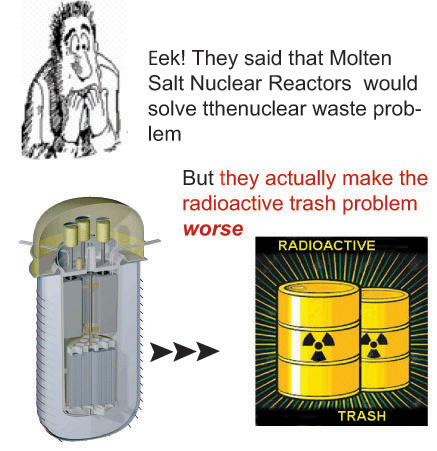
Nuclear energy-producing nations are almost universally experiencing delays in the commissioning of the geologic repositories needed for the long-term isolation of spent fuel and other high-level wastes from the human environment. Despite these problems, expert panels have repeatedly determined that geologic disposal is necessary, regardless of whether advanced reactors to support a “closed” nuclear fuel cycle become available. Still, advanced reactor developers are receiving substantial funding on the pretense that extraordinary waste management benefits can be reaped through adoption of these technologies.
Here, the authors describe why molten salt reactors and sodium-cooled fast reactors – due to the unusual chemical compositions of their fuels – will actually exacerbate spent fuel storage and disposal issues. Before these reactors are licensed, policymakers must determine the implications of metal- and salt-based fuels vis a vis the Nuclear Waste Policy Act and the Continued Storage Rule.
Canada’s Nuclea Energy Signs Agreement To Acquire Moltex Advanced Nuclear Portfolio
By David Dalton, 17 August 2026, https://www.nucnet.org/news/canada-s-nuclea-energy-signs-agreement-to-acquire-moltex-advanced-nuclear-portfolio-8-1-2026
UK-based company was placed in administration in 2025
Ontario, Canada-based Nuclea Energy has entered into a definitive agreement with Moltex Energy Ltd – currently in administration – and its joint administrators to acquire advanced nuclear technology assets across its molten salt reactor and nuclear fuel recycling portfolio.
Moltex Energy Ltd, the UK-based parent company of MoltexFlex Limited and Moltex Energy Canada Inc, was placed in administration in 2025 after its directors failed to achieve the majority shareholder consent to new investments or the sale of its assets.
Nuclea Energy is developing the Morpheus microreactor, a lead-cooled, factory-built micro-modular reactor.
The target portfolio has been developed by Moltex over more than a decade, backed by over CAD96m ($68m, €59m) in funding from private investment, Canadian public programmes and the US Department of Energy, the company said in a news release.
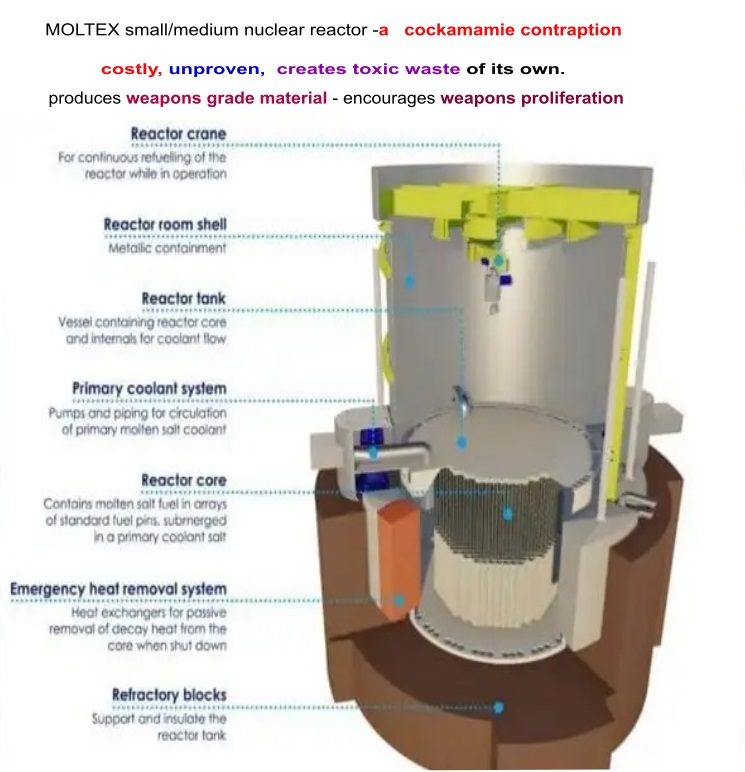
The portfolio includes technology and development materials associated principally with Moltex’s Stable Salt Reactor–Wasteburner (SSR-W), an advanced molten salt fast reactor, and its next-generation Waste To Stable Salt (WATSS) spent nuclear fuel recycling process.
It also includes an extensive patent portfolio of 80 patents across nine patent families in advanced nuclear technology – including nuclear fuel, reactor, chemistry and materials – and nine pending patents on the fuel recycling process, Nuclea said.
The Quantum Con: How Chicago’s Southside Became a Sacrificial Altar to the War Machine

Are we as Chicago residents at ease with the unprecedented horrors of quantum and AI warfare coming out of our own backyards?
Pete Hegseth’s Department of War is building America’s largest quantum computing project right here on the Southside of Chicago, to the detriment of not only our city but the world at large. Gov. JB Pritzker has lauded the venture capital project as an unprecedented opportunity to make Illinois the “Silicon Valley of quantum development.” With whose consent? On whose land? And on whose dime?
When examining the backers of the Illinois Quantum and Microelectronics Park (IQMP), it is difficult to rationalize this $9 billion project as anything but an accelerative altar to militarism. Alongside federal backing from DARPA, investors such as BlackRock, IBM, and Israeli startup Quantum Machines have all cited quantum technology as the next frontier in modern warfare. The military-industrial complex has emphatically doubled down on quantum computing technology and advanced computing in AI alike as the next crucial edges in 21st-century militarism. Indeed, AI technology in warfare is already being used extensively by the US and Israel to terrorize the SWANA region.
Even with the considerable private capital financing already allotted to this project’s troubling Big Tech-war machine alliance, Illinois taxpayers are the top funders of IQMP by far. To the sum of more than 700 million state dollars, the land and water beneath our feet have been sold out to private equity military contracts. As families across our cities starve, as rent costs go up and our unhoused neighbors are continually displaced, we must stop the flow of state and city resources from being directed to a global surveillance state hellbent on mass destruction.
On a local level, the Chicago City Council has unanimously approved the Quantum Park’s construction on three separate occasions, with Mayor Brandon Johnson contributing $5 million from the city’s already strained budget. The contrast between the typical glacial speed of approval from City Council and the suspiciously rapid approval process of this project is jarring to say the least, particularly when one considers the largely uncharted nature of the technology itself.
Southside Together’s campaign against Quantum is an unequivocal stand for people power against the cynical backdrop of Big Tech fatalism.
Southside Together, an organization focused on building people power with working-class Southside residents, collected signatures proposing a non-binding referendum concerning IQMP. The petition asked one question: “Should our local elected officials stop the construction of the IQMP and instead invest directly in community resources?” Non-binding ballot referendums are rarely challenged on the basis of their language, yet this expression of community consensus was struck from the ballot summarily. Southside residents, in particular, breaking the silence on this project have been clearly delineated as a high-priority threat by backing city officials.
Widespread awareness and community dissent could in fact function as IQMP’s death knell. If organizing on the Southside alone has already scared these Big Tech military syndicates into such frantic repression, imagine what genuine citywide resistance to quantum computing development could accomplish in turn.
As Gov. Pritzker and Mayor Johnson push this project through, they are continuing to make the people of Chicago complicit in war crimes across the globe. Do Illinois politicians want this escalation in Big Tech militarism to be their legacy? More importantly, are we as Chicago residents at ease with the unprecedented horrors of quantum and AI warfare coming out of our own backyards?
Southside Together’s campaign against Quantum is an unequivocal stand for people power against the cynical backdrop of Big Tech fatalism. Join the fight today against what quantum tech threatens to do tomorrow.
The Microreactor Miracle Meets a Morphing AI-Nuclear Future

questions about whether the country will achieve its long-term core nuclear deployment objectives. And over-relying on a boost from the micro reactor miracle offers meager dividends when deployment is paramount.
August 15, 2026, By: Kenneth Luongo, https://nationalinterest.org/blog/energy-world/the-microreactor-miracle-meets-a-morphing-ai-nuclear-future
The microreactor milestone is real, but shifting AI models, China’s challenge, and deployment delays could complicate America’s nuclear ambitions.
It was impressive that four microreactor start-up companies beat the clock and achieved reactor criticality in compliance with the Trump administration’s arbitrary July 4 Reactor Pilot Program (RPP) deadline. But these reactors are years away from deployment, and the excessive swaggering associated with this modest achievement is out of step with the quavering nuclear energy realities ricocheting off a rapidly evolving artificial intelligence (AI) system.
US Microreactor Achievements
Of the four reactors that achieved zero power, only Antares has an identified market application beyond this demonstration. Its Mark-1 reactor has been selected as a pilot technology for powering Joint Base San Antonio, Texas.
The Antares Mark-0 reactor, which is the zero-power test reactor and prototype for the commercially oriented R1 Mark1, was the first to meet the criticality deadline on June 4 at Idaho National Laboratory (INL). It uses High Assay Low-Enriched (HALEU) TRistructural isotropic (TRISO) fuel and is sodium-cooled. The projected commercial reactor can provide 100 kilowatts to 1 megawatt (MW) electric power. Beyond its work with the Department of Defense (DOD), Antares also has been working with the National Aeronautics and Space Administration (NASA) on potentially powering a Moon base.
Valar Atomics’ Ward-250 achieved criticality on June 18 in Utah and claimed it produced 10 kilowatts (kW) of thermal output. It had previously announced a criticality test at Los Alamos National Laboratory in November 2025. The Ward-250 is a TRISO-fueled high-temperature gas reactor (HTGR) that uses helium as a coolant. After the test, Valar announced a partnership with Nvidia to explore powering AI data centers and stated that its evolving commercial unit could be “deployed by the hundreds at ‘gigasites’” that could support manufacturing as well as energy production.
Deployable Energy, a year-old company, met the criticality mark on June 30 at Idaho National Laboratory (INL). The company’s founder reportedly delivered the reactor core in the bed of a Ford F-150 truck. The reactor is part of the Nuclear Energy Launch Pad initiative at INL, which is designed to carry the RPP into the future. The reactor is a water-moderated, helium-cooled design using 4.9 percent enriched fuel. It is considered a “nuclear battery” and would max out at 1 MW. It is designed to fit in a 20-foot shipping container and be dropped at any location.
Aalo Atomics Aalo-X Critical Test Reactor sneaked in under the criticality deadline at midnight on July 4 at INL. The test reactor included a full-scale core and was designed to demonstrate key components that will be used in the Aalo-X, a low-enriched uranium (LEU) fueled, sodium-cooled 10 MW reactor. The goal is to deploy groups of these reactors in 50 MW Aalo Pods to support commercial data centers. Aalo recently formed a strategic partnership with Crusoe, a vertically integrated AI infrastructure provider, to “validate nuclear power’s effectiveness with AI workloads” at INL.
The Mutating AI Data Center Model
With the microreactor milestone behind them, the Trump administration and reactor developers now face an evolving landscape for nuclear energy. AI data centers have been viewed as the top driver of America’s energy growth and ideal for pairing with nuclear energy. Projections indicate these centers could add 100 gigawatts (GW) to the US grid by 2030.
But the data center opportunity is rapidly morphing, and opposition is growing; the now-dominant American AI model is under pressure at home and abroad. That raises questions about what role new nuclear power ultimately will play as the AI arena evolves.
The assumption has been that the hyperscalers, including Apple, Amazon Web Services, Microsoft Azure, and Google Cloud Platform, will build massive data centers as fast as they can to support US AI frontier modelcomputing growth. One assessment identified the data center build time as roughly two to three years
But the frontier model concept and its computing campuses are under pressure.
Alex Karp, CEO of Palantir, has been on a recent crusade criticizing the American AI frontier model as a trap that requires businesses to provide their intellectual property (IP) to AI’s leading companies like Anthropic and OpenAI. Karp claims that these models’ architecture creates an “addiction” among users and allows the system provider to absorb proprietary corporate data that can be used to compete against their current customers in the future.
He argues that companies should build their AI systems on models they own, training them on their proprietary content and keeping their data under their control. He also advocates for an “application layer” his company has developed with NVIDIA that can protect an enterprise’s IP. If Karp’s concept catches on, and Meta seems to have taken note, it could impact the mega data center build-out, reducing the number required and downsizing their power requirements. That could be a challenge for some leading nuclear reactor companies betting on the data center boom, or it could favor dial-an-output modular reactors if the costs are competitive.
China’s Dual AI Challenge
A version of the Karp concept seems to have already been adopted by China, which, because it is already closing the quality gap with the best US AI models, now poses a double threat to US dominance.
China is giving away fast, cheap open-source AI models. These free Chinese AI platforms are popular in Africa and Latin America but are also being used by US and European companies, including Siemens, DoorDash, and Airbnb.
Of course, one goal of China is to allow companies to easily build systems on their platform in order to serve geopolitical objectives and create dependencies it can exploit in the future. The US National Institute of Standards and Technology (NIST) evaluated China’s DeepSeek AI model and found that its AI offerings advance Chinese Communist Party narratives. It concludes that China’s DeepSeek “remains a leading open weight model developer and has contributed to a rapid increase in adoption of PRC [People’s Republic of China] models globally.” It cautions that the expanding global use of these models “May pose a threat to application developers, to consumers, and to US national security.”
This approach by AI is similar to China’s Belt and Road Initiative (BRI), which has helped the country capture hundreds of infrastructure projects across over 140 countries, resulting in deep relationships and financial dependencies, particularly with emerging economy nations. And while its energy projects so far have heavily tilted toward fossil fuels, BRI’s relationships and financial model enhance China’s position as a future provider of new nuclear energy in the Global South, posing a threat to the future US export of small reactors and creating worry for the US political, commercial, and national security establishment.
Lagging Nuclear Reactor Technology and Scaling Challenges
Even if the US data center boom were to play out as planned, there are questions about when and whether new US nuclear power will be ready to power it.
So far, the hyperscalers have modestly invested in small modular reactors (SMRs), but they are unlikely to be available in time for a near-term data center boom. If the buildout is over by the early 2030s, most SMRs will still be on the sidelines.
As a hedge, these companies have banked on the resurgence of mothballed nuclear power plants like Three Mile Island in Pennsylvania and Palisades in Michigan. Both of those projects are estimated to deliver new power before the end of this decade for a combined 1.6 GW. What the hyperscalers have not done is back construction of new large reactors despite the fact that a single Westinghouse AP-100 can provide over one GW of power.
The US government wants 10 new AP-1000s under construction by 2030, but its $80 billion strategic partnership with Westinghouse and its commitment to provide $17.5 billion in loans for long lead items haven’t attracted the necessary additional investment and commitment required from the private sector.
The US government wants 10 new AP-1000s under construction by 2030, but its $80 billion strategic partnership with Westinghouse and its commitment to provide $17.5 billion in loans for long lead items haven’t attracted the necessary additional investment and commitment required from the private sector.
This reticence reflects a cost-overrun risk aversion from domestic electric utilities and Wall Street. In response, the administration is repurposing federal lands to create data center-nuclear power campuses. And it has turned to allies such as South Korea and Japan to jumpstart the process with foreign cash derived from bilateral trade and tariff deals.
But that avenue also doesn’t seem to be working. The Trump administration has been frustrated with the lack of progress on the nuclear energy component of the $350 billion South Korean commitment to invest in the United States, and with Japan, it has found that its involvement in a $40 billion nuclear power project is running aground over nuclear liability concerns.
With less than 30 months left in Trump’s term, and the prospect of a hostile House of Representatives sucking the air out of his agenda, there is an urgency in rethinking the Trump administration’s nuclear deployment policy. The dependence on a rapidly evolving AI and data center market leaves questions about whether the country will achieve its long-term core nuclear deployment objectives. And over-relying on a boost from the micro reactor miracle offers meager dividends when deployment is paramount.
About the Author: Kenneth Luongo
Kenneth N. Luongo is a recognized innovator, entrepreneur, and leader in global nuclear energy and transnational security policy. He is the president and founder of the Partnership for Global Security (PGS). He has been a TEDx presenter, written over 100 articles, including in The New York Times and Foreign Affairs, and engaged extensively with global media, governments, and audiences around the world on nuclear energy and transnational security challenges and responses. He was formerly a senior advisor to the secretary of energy and a professional staff member on Capitol Hill.
The invisible geography of Israeli power

Real power belongs to whoever is able to access, process, transfer, restrict, or legally compel the disclosure of the information.
Countries that are rapidly building their own digital systems are entering a market already structured around dependency. A government may require that citizens’ data remain within national borders while simultaneously entrusting a foreign company with managing the platform, updating the software, providing the AI model, or controlling critical layers of the system. This creates the appearance of sovereignty without its substance.
Nowhere are the consequences of this hidden geography more evident than in occupied Palestine.
Data sovereignty is the new oil – but West Asia is pumping raw material while foreign tech giants refine it.
Strategic Culture Foundation, Lorenzo Maria Pacini, August 13, 2026, https://strategic-culture.su/news/2026/08/13/the-invisible-geography-of-israeli-power/
On June 10, 2025, two executives from Microsoft France appeared before a French Senate investigative committee tasked with examining public procurement and digital sovereignty. The hearing proceeded in the usual reassuring tone until a question that completely shifted the mood: Could the company guarantee that the data of French citizens – even if hosted on servers located in France – would never be transferred to a foreign authority without the consent of the French government? Anton Carniaux, the subsidiary’s director of public and legal affairs, responded under oath with six words: “No, I cannot guarantee that.”
That statement cut through years of corporate rhetoric built around phrases such as “local cloud regions”, “reliable infrastructure”, and “data residency”. France could host the servers, French citizens could generate the data, and French institutions could pay for the service – yet ultimate authority could still reside elsewhere. The commission drew a clear conclusion. Microsoft was unable to guarantee sovereignty over the data it hosted. That exchange reveals a reality with specific consequences, including – and perhaps above all – for West Asia: the physical location of data no longer coincides with its political location.
Classical power geography teaches that sovereignty occupies territory. Oil belongs to the state beneath whose soil it lies; ports fall under the authority of the country on whose shores they stand; oil pipelines follow the borders they cross. In this tradition, power is read on the surface of the earth. Data follows a different geography.
A medical record can be created in Riyadh, stored in Bahrain, processed by an algorithm trained in the United States, and managed through a European subsidiary. Which state truly controls it? The conventional answer attributes the data to the individual, company, or government that generated it. In practice, ownership matters less than control. Real power belongs to whoever is able to access, process, transfer, restrict, or legally compel the disclosure of the information.
This principle is stated unambiguously by the U.S. Department of Justice itself. Under the CLOUD Act, providers subject to U.S. jurisdiction can be compelled to hand over data through valid legal proceedings, “regardless of where the company stores it”. Washington presents the law as a legitimate tool for obtaining electronic evidence. On a geopolitical level, it allows U.S. jurisdiction to extend through corporate control, reaching information stored far beyond U.S. territory. The new map of power is drawn not only by borders, cables, and data centers, but by registered offices, encryption keys, legal obligations, system administrators, and the states capable of compelling them to cooperate.
Across Western Asia, governments are investing heavily in cloud computing, artificial intelligence, digital identity, smart cities, and data-driven public services. Saudi Arabia aims to become a leading data economy; the United Arab Emirates, Qatar, Bahrain, Oman, and Turkey are expanding their information management and governance capabilities. Physical capacity is also concentrated in a few regional hubs: a 2025 assessment by the World Bank counted thirty-nine data centers in the UAE and thirty-three in Saudi Arabia – figures lower than the average for high-income countries (eighty-one) but significantly higher than the rest of the region.
The transition is measurable. According to the International Telecommunication Union, in 2024, 70 percent of the population of Arab states used the Internet, compared to 68 percent globally. The regional average, however, masks an 82-percentage-point gap between the least-connected and most-connected economies, while fixed broadband subscriptions remain less than half the global figure. Digital expansion is rapid and, at the same time, deeply unequal.
The provider landscape, on the other hand, is highly concentrated. According to Synergy Research Group, in the third quarter of 2025, Amazon, Microsoft, and Google accounted for 63 percent of global enterprise spending on cloud infrastructure, in a quarterly market that had grown to $107 billion from $68 billion just two years earlier. Countries that are rapidly building their own digital systems are entering a market already structured around dependency. A government may require that citizens’ data remain within national borders while simultaneously entrusting a foreign company with managing the platform, updating the software, providing the AI model, or controlling critical layers of the system. This creates the appearance of sovereignty without its substance.
Data localization answers only one question: where is the information stored? It leaves the crucial questions open. Who controls the encryption keys? Who updates the software? Who can suspend the service? Which country’s laws govern the provider? Who can compel its disclosure, and who possesses the computing power necessary to extract strategic value from it? Keeping servers within national borders does not place them under national control.
Palestine and data as a weapon
Nowhere are the consequences of this hidden geography more evident than in occupied Palestine. Modern warfare increasingly depends on the collection, cross-referencing, and interpretation of enormous amounts of information. Phone records, biometric identifiers, intercepted communications, location histories, and aerial imagery can be transformed into military intelligence through cloud computing and artificial intelligence.
The combined use of Microsoft and OpenAI products by the Israeli military in March 2024 had reached a level nearly two hundred times higher than that of the week preceding October 7, 2023. The data stored on Microsoft servers had more than doubled, exceeding 13.6 petabytes by July 2024, while server usage grew by nearly two-thirds during the first two months of the war. The Azure platform was reportedly used to compile, transcribe, and translate information obtained through mass surveillance, with some of the intelligence cross-referenced with target-acquisition systems.
In September 2025, Microsoft deactivated certain cloud and AI services provided to an Israeli military unit after an internal audit confirmed that its products were being used for mass surveillance of Palestinians; the data in question was stored in the company’s cloud facilities located in Europe. This chain of events is revealing: information collected in Palestine, processed by an Israeli military unit, hosted in Europe, and ultimately subject to a decision made by a U.S. company. The limitation of this measure is equally telling. As Hossam Nasr, a former Microsoft employee and advocate for the No Azure for Apartheid campaign, noted, the bulk of the contract with the Israeli military apparatus remained intact. Big tech companies now occupy positions once reserved almost exclusively for states: they provide capabilities used in intelligence operations, decide whether a customer retains access, investigate alleged abuse, and impose restrictions across borders.
Israel itself recognizes the strategic importance of control over the cloud. The Nimbus project, awarded to Google and Amazon Web Services, was designed to provide Israeli ministries and related public agencies with a comprehensive cloud infrastructure. The contract, worth $1.2 billion, required local infrastructure and was presented as a means of keeping government information within the country’s borders. The main providers, however, remain U.S. companies, embedded in American legal and technological systems.
Nimbus embodies the central paradox of data sovereignty: a government can demand that information remain within its territory while entrusting the storage, computing, and platform management to companies headquartered elsewhere. Israel negotiated hard to reduce this vulnerability. Most countries in West Asia lack Israel’s bargaining power, its technological integration with Washington, or its ability to exert pressure on major American corporations. Here, sovereignty is also a function of negotiating power.
The dispute over data is ultimately a struggle over three strategic rights. The first is the right to collect: governments, digital platforms, telecommunications operators, banks, and security services accumulate information on identity, movements, communications, health, consumption, and behavior. The second is the right to process: raw data acquires strategic value only if the actor possesses the chips, algorithms, cloud platforms, and qualified personnel necessary to process it. The third is the right to compel: the authority, claimed by governments and courts, to force providers to disclose, retain, remove, or restrict information.
The economic concentration behind these three rights is intensifying. UNCTAD reports that the five largest digital multinationals have increased their combined share of industry sales from 21 percent in 2017 to 48 percent in 2025, while their share of assets rose from 17 to 35 percent. Control over data and computing is accumulating faster than infrastructure is spreading. A country that controls only the first right is a supplier of digital raw materials; one that controls data collection and computing can become a digital power; an actor capable of exercising all three possesses something close to digital sovereignty.
The economic stakes are rising rapidly. UNCTAD estimates that the global artificial intelligence market will grow from $189 billion in 2023 to $4,800 billion in 2033 – a twenty-five-fold increase over a decade. Regions that supply data but lack the computing infrastructure and intellectual property necessary to process it risk retaining only a minimal portion of that value. In the 20th century, strategic value lay not only in extracting oil, but in refining it, transporting it, pricing it, and financing it. In the 21st century, the same distinction applies to data: West Asia can generate the raw material, but the decisive power lies in the “data refineries” – that is, in the cloud platforms, AI models, and computing systems that convert information into profit, intelligence, and geopolitical leverage.
Beyond digital colonialism
The solution is not technological isolation. No single West Asian state can reproduce every layer of the global technology stack on its own, and replacing dependence on U.S. suppliers with total reliance on Chinese or other platforms would merely shift the external center of gravity. The risk to avoid is that breaking free from oil dependence could turn into digital colonialism: a scenario in which companies in the region generate the data while foreign platforms own the infrastructure, extract its value, and retain control over access. What is needed is distributed technological autonomy.
On this basis, a concrete order of priorities can be established. The procurement of cloud services must be treated as a national security decision, not as routine IT business: contracts must specify who controls the encryption keys, how foreign legal requests will be handled, and whether data and applications can be migrated to another provider. Health, defense, biometric, judicial, and civil registry data require stricter protection than ordinary commercial information. Governments must invest in interoperable regional cloud capabilities, open standards, independent auditing, and the ability to maintain essential services should a foreign provider revoke access. Above all, data sovereignty must extend beyond storage to encompass the entire chain: collection, classification, computation, access, sharing, and deletion.
For over a century, the geopolitical importance of West Asia has been mapped through oil fields, pipelines, ports, straits, and military bases. Those structures remain central, but another strategic network has spread over them – one made up of databases, cloud contracts, legal jurisdictions, identity systems, AI models, and invisible authorizations. Control over data gives states and corporations the power to map societies, interpret their behaviors, anticipate their political and economic shifts, and translate that knowledge into action.
The states of Western Asia are rapidly building the digital infrastructure upon which their economies and public institutions will rest. Much of the authority governing those systems, however, remains outside the region. In the 21st century, control over a territory will increasingly depend on control over the data that reveals its people, institutions, and resources.
The question posed to the French Senate in June 2025 clearly extends far beyond France: those who cannot guarantee where their data will end up do not fully govern their own territory. And with that data, literally anything can be done.
The big catch with small modular nuclear reactors
Those advantages are also shared by renewable energy sources like solar panels and wind turbines — without the risks that come with nuclear power.
Tim Schauenberg, 08/05/2026August 5, 2026 https://www.dw.com/en/small-reactors-big-promises-what-the-nuclear-trend-can-really-deliver/a-77491854
Mini nuclear reactors are seen as a flexible energy source. Their promise: abundant energy, cheap, clean and climate-friendly with lower water use. But do the numbers add up? We look at what’s behind the SMR hype.
Many politicians and tech companies are now pushing to build new nuclear power plants to meet the world’s rapidly growing energy demands. Small reactors — known as Small Modular Reactors, or SMRs — are gaining momentum.
They could be built in less time and come online faster than conventional nuclear power plants. Originally developed to power submarines and aircraft carriers, SMRs largely work the same way as larger reactors.
They contain a nuclear reactor fueled by uranium, which releases enormous amounts of heat through nuclear fission. That heat turns water into steam, and the steam pressure drives turbines that generate electricity.
Companies and startups are working on a wide variety of SMR designs and concepts, but the underlying principle is similar across all of them.
One advantage over conventional nuclear stations is that mini reactors require a maximum of two hectares (around five acres) of land — roughly the size of two soccer fields. By comparison, conventional plants require up to 280 soccer fields, according to the industry.
Why use a modular design for mini nuclear plants?
What makes SMRs particularly attractive is their modular construction. Individual components can be mass-produced as prefabricated modules and pre-assembled off-site — much like a prefab house that simply needs to be put together once it arrives at its location.
Manufacturers promise an extremely short construction time of between one and a half to six years. Large reactors in the US can take anywhere from seven to 10 years to build.
Proponents also argue that modular units could deliver low-emission power to remote regions, where grid infrastructure is often not developed enough to handle the enormous energy output of a large conventional plant.
Those advantages are also shared by renewable energy sources like solar panels and wind turbines — without the risks that come with nuclear power.
Why less radiation can mean greater risk
The output of mini nuclear reactors is significantly lower than that of conventional nuclear power plants. Depending on the design, SMRs can deliver between 10 and around 200 megawatts of power, while a conventional plant generates between 1,000 and 1,600 MW.
To produce the same amount of energy as the roughly 400 high-capacity reactors currently operating worldwide, tens of thousands of small reactors would need to be built.
SMRs could offer some safety advantages: they contain less radioactive material than large reactors and would be distributed across multiple sites. This means that an accident or military strike resulting in a meltdown would not be as catastrophic as a worst-case scenario at a large reactor. Nevertheless, the consequences of an SMR accident could still be severe.
Germany’s Federal Office for Radiation Protection points out that despite lower radiation levels per reactor, the overall risk posed by mini reactors could be many times higher. Replacing the output of existing nuclear plants with large numbers of smaller ones would require an enormous number of reactors worldwide — and that increases the likelihood that at least one of them will eventually suffer a serious incident.
Nuclear accidents and radiation leaks are extremely rare — but the consequences can be catastrophic. The last major nuclear accident occurred in 2011 at the Fukushima power plant in Japan, following a tsunami. Parts of the region have been contaminated for generations to come, and nearly 170,000 people were forced to flee their homes.
Extreme efficiency and the dream of radioactive recycling
Part of the hype around some new mini reactors rests on the hope of extracting significantly more energy from the same amount of uranium. Some SMR models — known as “fast reactors” — could theoretically yield 60 to 70 times more energy from uranium than conventional technology, according to the International Atomic Energy Agency (IAEA).
But the technology is still in the early stages of development and has so far played only a limited role in IAEA projections. In practice, it has barely been proven in SMRs at all. Only two SMR facilities are currently in operation worldwide — one in China and one in Russia.
Work is also underway on recycling SMR fuel rods, but that process remains largely untested. Most SMR projects continue to rely on the same conventional technology used in traditional reactors.
And the problem of radioactive waste remains unsolved — for both conventional and fast reactors. The risks this poses are already visible: at the Asse facility in Lower Saxony, Germany, a temporary storage site built in the 1970s, hundreds of barrels of intermediate-level radioactive waste are now rusting and beginning to leak. Germany has yet to establish a permanent disposal site.
In fact, no permanent repository for spent fuel or highly radioactive reactor waste is currently in operation anywhere in the world. After 20 years of construction, the Onkalo facility in Finland is set to become the first when it opens in 2026.
Another problem for nuclear power is growing water scarcity. Recent heat and drought have already forced European nations to curb nuclear output due to for cooling due to low river levels.
Because SMRs are mainly just smaller, simplified versions conventional reactors, they still use water to run and for cooling. While individual units use less water than traditional plants, clustering units could increase overall use, warn experts. Researchers are investigating the use of alternative coolants like molten salts and helium gas for newer designs.
When would SMRs make a climate impact — and at what cost?
Enthusiasm for small reactors runs high in the nuclear community. But what may look promising at first glance is, in many respects, difficult or impossible to back up with solid evidence.
Calculating the costs of a technology still in development is no easy task. Nevertheless, the German Institute for Economic Research estimates that electricity from new mini nuclear plants — even accounting for economies of scale, including construction and manufacturing — will cost at least twice as much per megawatt-hour as the already very affordable electricity generated by solar or wind power. In a worst-case scenario, the cost could be nearly eight times higher.
Adding up all the announcements, plans and strategies of major nations, a few hundred SMRs could come online in China, the US, Europe and India by 2050. But according to Germany’s Federal Office for Nuclear Safety and Radiation Protection, citing figures from the nuclear industry, production would only become economically viable at a threshold of 3,000 reactors.
The international community has committed to limiting global warmingto well below 2 degrees Celsius (3.6 degrees Fahrenheit) by the end of the century. Meeting that target requires large parts of the global economy to become climate-neutral by 2050. The EU aims to reach zero emissions by then; Germany is even targeting net negative CO2 emissions by 2050.
That means climate-friendly nuclear technology would arrive too late to meaningfully limit global warming — and its advantages would be significantly diminished as a result.
What would remain: the radiation risk, and the question of what to do with the radioactive waste.
Britain races against the world to unlock energy’s holy grail

“Most British people don’t know that their Government has started a
Manhattan Project,” says Michael Cole, a plasma physicist and author of a
history of fusion energy. “It is an engineering project on the same
scale.
” I’ve come to see it for myself, but as my train slows to a halt
at what feels like a branch-line station that Richard Beeching forgot to
close, it’s hard to believe. Culham railway station is as quiet as the
Adlestrop of Edward Thomas’s melancholy poem, in which there’s nothing
but “willow-herb … and all the birds of Oxfordshire”.
But just behind
the hedges is Britain’s Los Alamos: the Centre for Fusion Energy. Spread
across a sprawling industrial park more than 160 acres, it is home to some
2,600 scientists and engineers busy trying to tame atoms. The project, some
believe, is as ambitious as Robert Oppenheimer’s in New Mexico.
“There’s enough energy potential in a glass of seawater to light up a
city,” says Mark Thomas, the chief executive of First Light Fusion.
But unlocking it requires a dramatic, violent process called nuclear fusion.
Every star, including our own sun, is a giant natural fusion reactor, and
here in the Oxfordshire countryside, they are making machines that operate
on the same principles of physics. Temperatures inside the machines have
reached 10 times hotter than the sun’s core, easily the hottest ever
recorded in the solar system.
After decades of demonstrations and
experiments, the UK has decided it’s time to commit to building the
world’s first commercial prototype fusion power plant. The programme is
known as Spherical Tokamak for Energy Production, or Step.
Telegraph 14th Aug 2026,
https://www.telegraph.co.uk/business/2026/08/14/britain-races-against-the-world-to-unlock-energy-holy-grail/
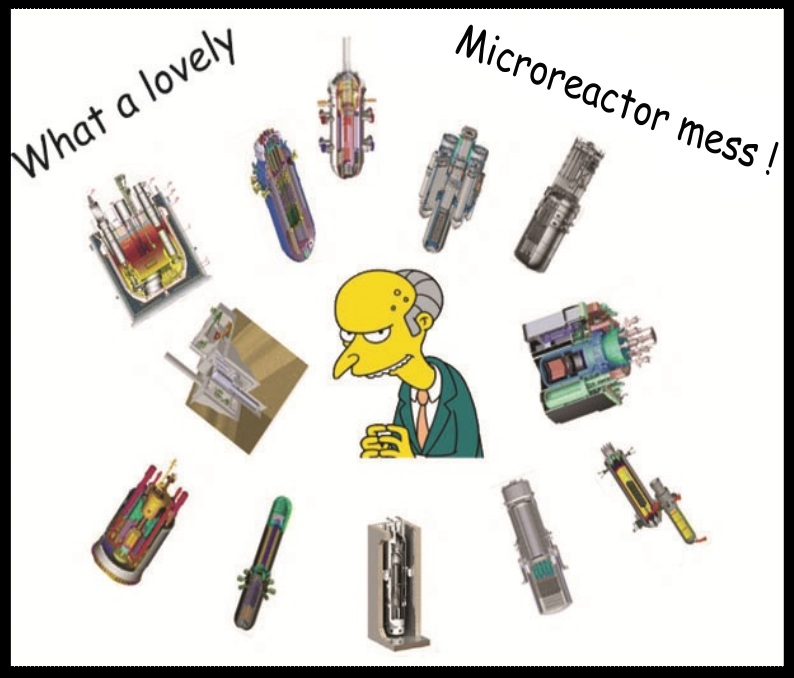
MICROREACTORS – the Next Big Little Nuclear THING!
Noel Wauchope, 15 August 2026, https://theaimn.net/microreactors-the-next-big-little-nuclear-thing/
Forget about Small Modular Nuclear Reactors – they’re not cool anymore!
What the world needs now is MICROREACTORS – so saith the global nuclear lobby. And we know they must be right, because they’ve already explained how the world needs a NUCLEAR RENAISSANCE to solve climate change, energy shortage, world peace etc…
Now there are substantial differences between microreactors and small modular nuclear reactors (SMRs) , even though at first glance microreactors might seem to be just teeny weeny versions of SMRs. Whereas an SMR produces up to 300 MWe , a microreactor produces anything from 1 MWe up to 50MWe
There are fuel differences . SMRs can use LEU – Low Enriched Uranium or the more powerful HALEU – High-Assay Low-Enriched Uranium . Microreactors can, in theory, use LEU fuel, but that could not work out to be economic. The fuel must be the more powerful HALEU – High-Assay Low-Enriched Uranium. And in fact, Most microreactor plans use the more complex TRISO Fuel (Tri-Structural Isotropic), in which the tiny kernels of HALEU are coated with multiple layers of ceramic and carbon. That makes TRISO very safe, but very expensive.
Really, the most important difference is in – Who Pays For Microreactors?
Well, you do, if you’re a tax-payer. The only economically viable way to fund microreactors is to make them military installations, government funded. SMRs are supposedly economically viable, and were touted to become a private enterprise success. That’s until the NuSCale SMR financial fiasco
The beloved ever-about -to-happen nuclear renaissance needs a new theme, and that new funding source. The old theme was ENERGY– the new theme is DEFENCE.
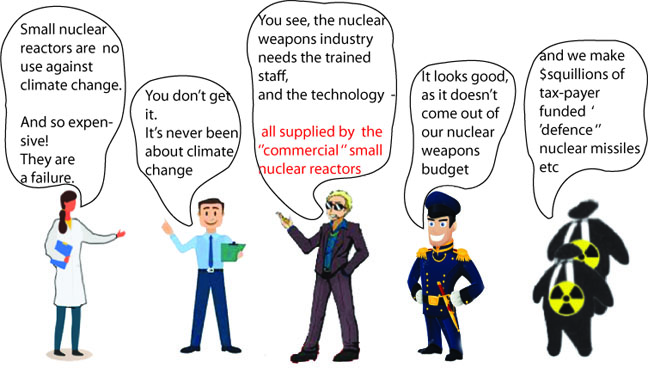
For quite a while now, it has been obvious, and indeed a boast of the nuclear lobby, that new small reactors would support the defence sector, and nuclear weaponry, by providing the trained staff that are so badly needed, as the old nuclear boffins retire,
But times have changed, and also the nuke lobby is getting desperate. With all the international political drama going on, obviously the top priority now is war. (Did I hear someone say, what about diplomacy, negotiation? Look, that’s time-consuming, takes high mental ability, and there’s no money in it) Yes, what we and the nuke industry need now is war preparation.
So the nuclear industry is regalvanised, with a spate joyous media articles, mostly – worded like this one – Antares Raises $470M to Field Military-Focused Microreactors. Optimistic statements abound:
Power up: Antares and their nuclear startup frenemies moving so fast is good news for the Pentagon, which is where that 2028 number comes into play in a few places.
In May 2025, President Trump signed a series of executive orders to accelerate the Department of Energy’s “Manhattan Project 2.0.” -notably Executive Order 14299, “Deploying Advanced Nuclear Reactor Technologies for National Security,” Then came Executive Order 14300, “Ordering the Reform of the Nuclear Regulatory Commission,”- getting rid of, or watering down public safety, radiation and environmental standards. The full import of this has been documented by Kristen Thomason in her superb article – “If you’re already afraid, just wait until you hear about Manhattan Project 2.0″

A lot of hype about microreactor energy for data farms, with Silicon Valley tech billionaires all on board, – and the craze is for so many “start-ups “
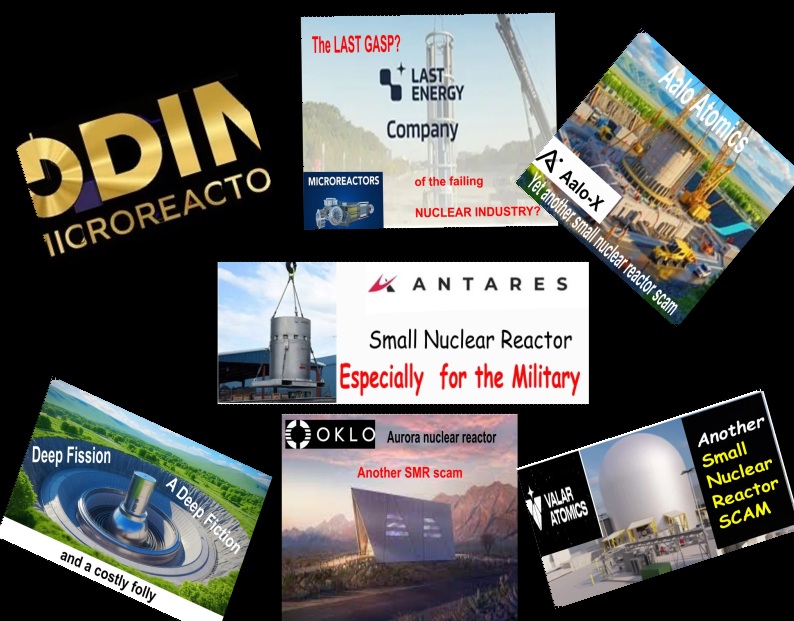
I had every intention of going through all the hazards, impediments to these microreactors ever becoming a commercial reality. But guess what ? OKLO, probably the leader of the pack, has done it for me. After the usual hypy article, glorifying their new microreactor, OKLO makes this revealing statement at the end:
As a result of a number of known and unknown risks and uncertainties, the actual results or performance of Oklo may be materially different from those expressed or implied by these forward-looking statements. The following important risk factors could affect Oklo’s future results and cause those results or other outcomes to differ materially from those expressed or implied in the forward-looking statements: risks related to the development and deployment of Oklo’s powerhouses, fuel fabrication and fuel recycling facilities, and radioisotope production activities; the risk that Oklo is pursuing an emerging market with no commercial project operating and regulatory uncertainties; risks related to acquisitions, divestitures, or joint ventures we may engage in; the need for financing to construct plants, which remain subject to market, financial, political, and legal conditions; risks related to an inability to raise additional capital to support our business and sustain our growth on favorable terms; the effects of competition; risks related to accessing high-assay low-enriched uranium, plutonium, and other fuels (including recycled fuels) at acceptable costs and under acceptable timelines; risks related to our supply chain; risks related to power purchase agreements; risks related to human capital; risks related to our intellectual property; risks related to cybersecurity and data privacy; changes in applicable laws or regulations, including tariffs; the outcome of any government and regulatory proceedings and investigations and inquiries; and the other factors set forth in our documents we have filed with the U.S. Securities and Exchange Commission (the “SEC”).
The foregoing list of factors is not exhaustive.
I was going to try and list all those factors – to throw some cold water on the microreactor parade – and that leading microreactor developer has done it for me!
As I tried to research all those factors to consider about micoreactors, I made the discovery that amongst the pro nuclear experts themselves, there are the gold nuggets of the truth. Not only has OKLO raised those contentious questions, but in a lengthy video – Nick Touran, a nuclear engineer and manager at TerraPower, unearths the sobering realities of micro nuclear reactors:
It’s long – but he spells it all out, if you can take the time:
Chapters:
00:00 Visions for microreactors 03:49 Defining microreactors 11:56 The problem of radiation shielding 18:48 Original microreactor projects 24:29 Niche applications 30:32 The problem of neutron economy 40:08 The problem of fuel 53:03 The problem of operations and maintenance 1:00:17 The problem of commercialization 1:05:42 The problem of spent fuel 1:09:27 The problem of scaling 1:12:36 The problem of licensing
Nick Touran and OKLO might be hopeful for microreactor success some time in the future. But they – pro nuclear people, are well aware of the obstacles and especially of the financial costs.
So, if they can take the microreactor hype with a grain of salt, the rest of us, who are not part of the development process, should be taking that hype with a bucketful .
The trouble with Small Modular Nuclear Reactors (SMRs) – THEY’RE NOT SMALL
7 August 2026 Noel Wauchope, https://theaimn.net/the-trouble-with-small-modular-nuclear-reactors-smrs-theyre-not-small/

The big boasts for small nuclear reactors are that they are modular and they are small.

Modular – yes. They’re a sort of LEGO or IKEA thing – parts made in one place, then shipped to another place and assembled. (That process has its problems, too – but today I’m just focussing on the small aspect.
A small modular reactor (SMR) is an emergent class of nuclear fission reactors with a rated electrical power of less than 300 megawatts (MWe) (Wikipedia) MWE (Megawatts electric) refers specifically to the amount of electrical power a system can produce. Large reactors generate over 700 MW(e). Microreactors range in capacity from 1 to 20 MWe.
So – now we have SMRs being touted as the great new source of electricity – a sort of vision of little nuclear reactors dotted in their many thousands all over the world.
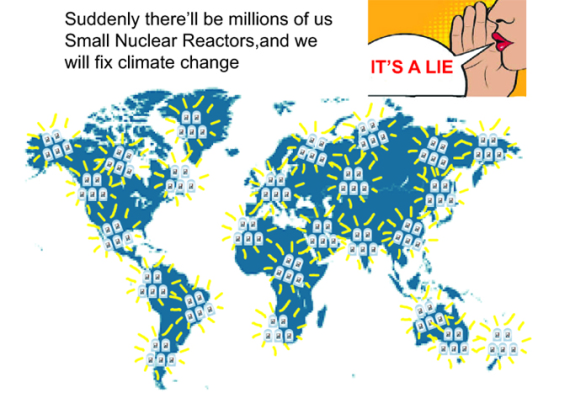
But that’s not really a practical plan. So – how about bundling a bunch of them together – so they can produce a large amount of electricity, and we can still call them a Small Modular Nuclear Power Plant?
Case study 1 – NuScale – the American experiment

The NuScale SMR is a pressurized water reactor (PWR) – a type of light-water nuclear reactor. In a PWR, water is used both as a neutron moderator and as coolant fluid for the reactor core. So it’s pretty much a small version of the “tried and tested” large nuclear reactors. This was the first SMR design to get Nuclear Regulatory Commission licensing. The Department of Energy approved $1.35 billion to the project, over 10 years subject to appropriations.
In 2015 NuScale Power and Utah Associated Municipal Power Systems (UAMPS) planned a single plant, containing 12 “modules” – i.e. 12 SMRs, which would provide 924 MWe – same as a large nuclear reactor. so – no longer small. The estimated costs kept rising, reaching $9.3 Billion by 2023. So the plan, now named VOYGR, was changed from 12 modules to six. Even at 6 modules with 462 MWe- still a large project.
In November 2023 UAMPS officially terminated the CFPP agreement. The Idaho project would have been NuScale’s first commercial deployment. The project that was supposed to demonstrate SMR viability in the US was dead. NuScale took a $100M+ write-down. The cancellation sent shockwaves through the SMR industry. Investor interest, always poor, collapsed. In a class-action lawsuit filed Nov. 15, investors say NuScale “made materially false and/or misleading statements and failed to disclose material adverse facts about the Company’s business, operations, and prospects.”
NuScale continues to push its VOYGR plan – to Romania, Poland, Kazakhstan, Ukraine, and the Philippines. The company continues to burn cash with no revenue from reactor operations. The VOYGR design remains the only NRC-certified SMR.
Case study 2 – X-Energy ‘s MWe Xe-100 plant – the British experiment.

In September 2025, X-energy and Centrica signed a Joint Development Agreement for the UK’s first advanced nuclear fleet, targeting 6 GW nationwide with Hartlepool identified as the preferred first site for a 12-unit/960 MWe Xe-100 plant.
The Xe-100 is a 200MWt (75MWe) reactor. The Xe-100 SMR is a high temperature gas-cooled (HTGR) pebble bed modular reactor. “It uses tennis ball-sized pebbles made of thousands of TRISO micro-fuel particles which consist of fissile U-235 surrounded by pyrolytic graphite, which acts as the moderator – slowing down fast neutrons so they more efficiently split the U-235 nucleus.”
So this UK plan is different from the American pioneer project, Nuscale. It is using different fuel, – a Pebble Bed Nuclear Reactor. This has been tried in the past as a large reactor, and was a failure. The Xe-100 has a new variant – TRISO (Tri-structural Isotropic particle fuel). Thousands of poppy seed-sized particles are combined into compact fuel forms. These tiny uranium kernels are encased in three layers of ceramic coating that’s needed to absorb the nasty byproducts that form during the atom-splitting process.
So, like the American NuScale project, this will be a world first.
Both projects were hugely touted as safe. And it’s true – they can’t melt down like a Chernobyl or Fukushima event. But at 462 MWe (the Utah project) and 960MWe (Hartlepool) they are both big plants, with the potential for accidents or terrorist attacks, including cyber-disruption, to release a large amount of ionising radiation to the surrounding area. Even within the nuclear hierarchy, there are anxieties about the safety of TRISO fuel. And TRISO discharges the largest volume of spent nuclear fuels waste in the industry.
The UTAH Nuscale project sank because it was becoming more and more expensive. Assisted by the government, it was still a private enterprise project, and the Utah Associated Municipal Power Systems balked at the cost.
The Hartlepool X Energy project is intended to become a successful private enterprise project, but it is strongly backed by the UK government’s Great British Energy – Nuclear with funding provided by its Future Nuclear Enabling Fund. However TRISO fuel is highly expensive to make, and with still uncertainties about its safety, it is not likely that this pioneer initiative for Hartlepool will really bring the wave of private investment that the UK government has been hoping for.
In both cases, these have been attempts to show the Western world that small modular nuclear reactors are a really big profitable thing – they will power the mighty data farms etc.
Community acceptance is the big bonus that the nuclear industry desperately needs
This is much less of a problem in totalitarian nations like Russia and China. Both countries have only one small nuclear reactor in operation, and in each case, it hasn’t been very successful. Both China and Russia are ramping up their nuclear weapons, and they don’t need to worry so much about public acceptance of the “peaceful” nuclear industry, and of community agreement on matters nuclear.
Space: the billionaires’ playground

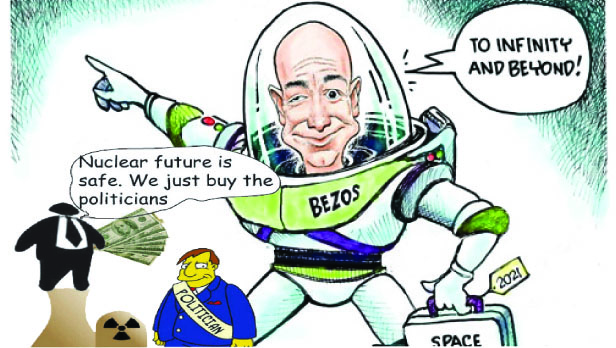


private space companies have relied on government contracts, and particularly military funding, to make themselves both rich and indispensable to state powers. Most recently, private interests have been lining up to slake themselves at a long-dormant tap that they hope will provide a new stream of wealth: the Moon.
According to Musk, humans moving to Mars isn’t just a possibility; it’s a moral imperative. But a closer look suggests Mars is really a distraction meant to dazzle us while Musk accrues ever more money and power here on Earth.
8 July 2026, Lucian Walkowicz, https://newint.org/science-and-technology/2026/space-billionaires-playground?utm_source=ni-email-whatcounts%20&utm_medium=1%20NI%20Main%20List1%20-%20enews%20-%20International%20AND%20North%20America&utm_campaign=YYYY-MM-DD%20enews%20-%207%20August%20enews
As tycoons like Elon Musk attempt to seize space for profit, the Earth is being trashed, writes astronomer Lucian Walkowicz.
For years, the wealthy have been telling us that our salvation lies in space.
‘There is a strong humanitarian argument for making life multiplanetary’, billionaire Elon Musk has said, claiming that getting to Mars will prevent human extinction, and is therefore as crucial as tackling poverty.
Meanwhile, his company’s launches from its ‘Starbase’ have trashed surrounding wildlife areas and displaced longtime residents, while the boss harps on about using its heavy-lift rockets as a high-speed, heavily polluting replacement for commercial air travel, and putting factories on the Moon.
Fellow tycoon Jeff Bezos – founder of Amazon, equally notorious for its own ‘humanitarian’ approach – has enthused about housing populations in orbital cylinders and protecting the Earth by taking polluting industries off planet. Meanwhile emissions from his companies’ own deliveries have soared.
These supposedly futuristic visions for space have been weaponized to justify a wide array of activities (both on our planet and beyond it), including expanding state surveillance and violence, dispossessing people of their homelands, cluttering low Earth orbit with garbage, plundering the Moon and polluting both our environment and the night sky.
While outwardly the likes of Musk and Bezos might advocate for our future in the stars, in reality they are greedily gorging themselves at the trough of profit while simultaneously creating the conditions that may bind humanity to Earth forever.
Bait and switch
Musk in particular has an outsized influence that exemplifies how space narratives have been wielded to justify a vast array of projects on Earth.
Before SpaceX had their rapid rate of rocket launches, before they were sending rafts of Starlink satellites into orbit, their main source of press coverage was Elon Musk’s mouth. Born to a wealthy white family in apartheid South Africa, this tycoon substitutes provocation for charisma by making exaggerated assertions and brushing aside details. Drawing on a long history of colonial rhetoric around space, he has managed to harness public attention with his futuristic plans to populate Mars with human settlements.
According to Musk, humans moving to Mars isn’t just a possibility; it’s a moral imperative. But a closer look suggests Mars is really a distraction meant to dazzle us while Musk accrues ever more money and power here on Earth.
Musk has conjured a litany of planet-killing bogeymen to justify his Mars ambitions – from rogue asteroids to the expansion of the sun several billion years from now – in order to argue that migration to Mars is a must.
As for what happens if people get to this radiation-baked, arid, oxidized hellscape? No problem, Musk will simply nuke the polar ice caps and melt them. No matter that most scientists and engineers cock an eyebrow at these supposed easy fixes, nor even that anyone with common sense knows that nuclear weapons do not make planets more hospitable.
Leveraging this allegedly visionary perspective, SpaceX has been able to harness not only the imaginations of the wider public, but of its workforce as well. The company offers a seductive opportunity for people who want to see a science fiction future come to reality. But few in the sector seem to think carefully about which of the many futures depicted in science fiction are actually on offer. Despite numerous reports over the years of gruelling and dangerous working conditions, as well as rampant racist and sexist harassment, SpaceX continues to attract workers with a glimmer of Mars in their eyes.
Meanwhile, by manufacturing urgency around this goal, Musk has also been able to justify the expansion of SpaceX’s business at breakneck speed. The ‘move fast and break things’ ethos infuses much of the tech industry, but paired with Musk’s pose as global saviour, SpaceX has been able to gain damaging momentum, outpacing regulatory structures around launches, orbital traffic and environmental protections. This drive has allowed Musk to tap a deep vein of wealth via military contracts, stuffing his coffers and elevating him to quasi-statesman status.
Greater good or greater greed
Take the Starlink satellite megaconstellation. Like Musk’s plans for Mars, Starlink – which first entered commercial service in 2021 – was framed as a necessary project, whose merit only the most selfish person could deny. Its purported goal was to provide internet to so-called ‘underserved’ communities.
But as Starlink began pumping hundreds of reflective satellites into orbit, astronomers promptly raised the alarm that they had begun to mar the night sky. Some also pointed out that Starlink’s service was both unneeded and priced out of reach for the places it was supposedly meant to help, pointing out the twisting of the word ‘underserved’ from its usual meaning of underresourced to ‘a place that does not have enough free market choices’.
Today there are nearly 9,500 Starlink satellites in space, meaning that this single project by a US company is now responsible for 65 per cent of satellites in low Earth orbit, a sea-change that has taken less than seven years. The massive increase in overall numbers has raised widespread alarm over the possibility of extremely high speed collisions and the potential for an escalating cascade of further collisions, known as the ‘Kessler syndrome’. The resulting ballistic debris would ultimately make entire regions of space around earth unusable.
Every time we take the extension of capitalism beyond Earth as a foregone conclusion, we disregard the myriad ways all Earth life has related to our skies.
Of course, there are also the impacts here on Earth: before Starlink satellites create light pollution in the night sky, the launches that put them there create pollution in our immediate environment. A single launch of one of SpaceX’s rockets, the Falcon 9, releases an amount of carbon into the atmosphere equivalent to driving a typical car 70 times around the world.
The satellites themselves also have a limited lifespan of a few years, after which they deorbit into our atmosphere, spreading metal pollution (including mercury) across the planet. Meanwhile, organizers in the Rio Grande Valley have raised the alarm for years about the environmental damage and gentrification driven by SpaceX’s presence in the area of its ‘Starbase’.
Regulatory frameworks have struggled to keep up with SpaceX’s impact: while there are US regulations around launches and their environmental impacts, few were really developed with space in mind, and none were equipped to deal with SpaceX’s high volume of launches. Under the most recent Trump administration, already inadequate regulation has become even looser. In February 2026 the FCC fast-tracked a proposal for SpaceX to launch a million new satellites as part of its plan to create orbital data centres to support an expansion of AI. Meanwhile other countries get no say in this company filling the skies.
We’d do well to question whether the profusion of AI into every aspect of human existence is making things better or simply drowning us in brain-rotting slop.
No matter, though: the people best positioned to profit from cramming a million new satellites into space claim orbital data centres will preserve our planet by eliminating their demands on its land, energy and water resources. However, that argument relies on people thinking of space as a realm that is separate from Earth, when it is Earth’s resources and environment that bear the consequences of this huge profusion in the number of launches required to transport satellites off the planet, as well as the vapourized metals from them reentering its atmosphere.
Ultimately, it doesn’t matter what Starlink’s intended purpose is, or whether anyone can afford it, because individual internet users aren’t SpaceX’s target customer – the military is. Because of wide adoption of the more secure, military-grade version of Starlink, called Starshield, militaries around the world now treat Musk as a de facto statesman who has the capacity to determine which conflicts have access to the internet at which time. For example, in April 2025, SpaceX was awarded $6 billion dollars by the US military for 28 launches that year. This was just one contract.
On top of that, SpaceX is working with the US’s National Reconnaissance Office on the development of ‘Ground Moving Target Indicator’ technology, a space-based panopticon designed to better track people’s movements on Earth.
Even more recently, some have commented that SpaceX’s relatively low launch costs open the possibility of permanent weapons installations in space. ‘Imagine a strike package of thousands of 200-pound bombs, on electric grid sites, government buildings, railway crossings, border stations and road intersections – without putting planes or military personnel at risk’, gushed writer on geopolitics Michael Hochberg in the Wall Street Journal this April.
The ideological capital gained by SpaceX via Musk’s plans ‘for Mars’ has allowed him to hoard massive wealth. Meanwhile these projects pose a grave threat to human futures both in space and on Earth by enabling state surveillance and acts of war, crowding low Earth orbit with potential debris that could one day bar our access to space entirely, and raining pollution into our atmosphere, land and water.
Space is a place
There is a tendency for people to believe that space, in all its wild expansiveness, is beyond the realm of humankind. However, we are literally in and of space. There is no crisp boundary between where Earth’s atmosphere stops and space begins, and like all borders, the ‘boundary’ of space – formally called the von Kármán line – is a collective fiction that has practical utility but not material reality.
While the few humans who have crossed the von Kármán line (whether professional astronauts or celebrities who can afford a ticket) garner the most attention, their number is miniscule compared with people whose lives are enmeshed with space while remaining on Earth. Some of these people are professionals at government agencies or private companies, but most are not space workers at all.
They include anyone who uses tools that rely on space infrastructure, like GPS, but also those who are acutely impacted due to living in the vicinity of launch sites. After all, SpaceX is merely continuing a colonial legacy: near the equator, where the rotation of the Earth provides a slightly bigger boost to launching rockets, launch sites like Brazil’s Alcântara Space Center and the European Space Agency’s Guiana Space Centre, in French Guiana, have dispossessed communities from their lands and battered the surrounding ecosystems since the 1980s and 1960s, respectively.
Moreover, the money lives on Earth. The question of how to squeeze an actual profit out of space, independent of the state, has stymied many a thirsty capitalist.
The rash of asteroid mining ventures that cropped up 15 years ago have now largely shuttered or gone dormant, as no one yet knows how to lasso and plunder an asteroid without the cost outstripping the benefit. Instead, private space companies have relied on government contracts, and particularly military funding, to make themselves both rich and indispensable to state powers. Most recently, private interests have been lining up to slake themselves at a long-dormant tap that they hope will provide a new stream of wealth: the Moon.
Lunar plunder
While many governments and companies around the world have set their sights on the Moon, the US is the driving force in radically reshaping common understandings of space that have been with humanity throughout its existence. Government contracts have been a reliable source of income for private space companies since the first military surveillance satellites. What’s new is the US’s accelerating demolition of publicly funded institutions in favour of private enterprise, enabling a modern crop of companies to act with greater autonomy.
This is particularly concerning in what it might mean for the Moon. Unlike Mars or asteroids, the Moon is essentially in Earth’s backyard: while having a sustained human presence there still presents difficult challenges, getting to its surface is a solved problem. In the past few years, the space agencies of India, China, Japan and the US have all successfully landed robotic spacecraft on the Moon, often with participation from private companies profiting off government contracts. US-based company Intuitive Machines also became the first private company to land there independently.
The combination of the Moon’s proximity and the US’s refusal to embrace international agreements, like the Moon Treaty, that provide stricter lunar protections, has opened up the possibility of private entities being able to independently plunder the Moon for ‘space resources’, ie anything that can be excavated and sold on Earth.
The Moon is a source of helium, and particularly helium-3, an element with widespread industrial applications, of which there is a shortage. The Moon also has potential reserves of water ice, which could be used to create fuel for launching rockets from the lunar surface, or used to support a human presence.
In 2020 the United States and seven other signatories released the Artemis Accords, a set of US-driven international agreements created in anticipation of its own Artemis Program. The Accords circumvent existing international channels for space diplomacy, like the UN’s Committee on the Peaceful Uses of Outer Space (COPUOS), allowing the US to essentially bully other nations into accepting a US-centric framework for lunar exploitation.
The Artemis Accords, along with a more recent chaotic splatter of space-related Executive Orders by president Donald Trump claiming to ‘ensure American space superiority’, make explicit a shift away from viewing space as the common heritage of humanity. Rather, the Artemis programme is instead being used to paint a picture of the moon as not only a place humans can go, but one where we can extract and exploit. While until now private companies have mostly benefitted from lucrative contracts to go to space, future prospects have everyone from small space start-ups to Lockheed Martin drooling over the possibility of extended plunder and occupation of the Moon.
In the context of rising fascist tides around the globe, the US’s renewed focus on human spaceflight through Artemis functions as a kind of time machine back to a future that never was.
One of fascism’s defining characteristics is a preoccupation with national decline, paired with a promise of rebirth that can only be actualized through removal of enemies. In the fascist cosmology of today, the Apollo moon landings were the beginning of a future that died on the vine, a future that projected colonial projects and control out into the infinite, with the power to consolidate social hierarchies In the first Trump administration, then-vice president and chair of the National Space Council, Mike Pence, repeatedly said that Artemis would put ‘the first woman and the next man’ on the Moon.
A woman alone on the Moon is unthinkable, so the next man is always mentioned. In this image, the Moon and Artemis astronauts are used as a stand-in for the Garden of Eden: Artemis is literally the virgin sister of Apollo, the Moon an unsullied landscape in which a man-woman pair can be placed to restore the US to a time before the imagined invasion of the administration’s internal and external enemies.
NASA press around the Artemis programme similarly often mentions the diversity of its astronaut corps, but doubling down on American individualism cannot separate Artemis from its utility as propaganda. After all, a handful of people who are not white men leaving Earth’s atmosphere cannot conceivably be a sign of liberatory progress, at least not while squads of paramilitary police kidnap hundreds of thousands of people off the streets of US cities.
Reclaiming space
Space is and has been many things to many people: while the Moon may currently be the stage for US propaganda, it has also been a companion to all life on Earth since our planet’s earliest days. The Moon remains the most visible part of space in light-polluted cities, where most people now live. It has been at the heart of human cultures for our entire existence, not just as a practical tool and biological rhythm, but also a relative, a deity, a reminder and more.
Despite aligned campaigns of both state and capital to radically reshape and control the contours of how people imagine and relate to space, the way that space functions in the fascist imagination is not the only way. Every time we take the extension of capitalism beyond the realm of Earth as a foregone conclusion, we disregard the myriad ways that not only humans but all Earth life has related to our skies. Remember: fascism is relatively new; the cosmos has seen everything.
Space’s wealthy beneficiaries tell us that if we will all just stand aside and let them plunder the heavens, a glossy future awaits humankind. However, we need look no further than the physical realities of space industries to see these stories crack: natural sanctuaries littered with debris from launch sites, an orbit filled with trash and surveillance. The damage done to our own planet in the name of a rush to prospect beyond it is its own evidence that colonialism in space has never been anything but colonialism on Earth.
Whether it’s in the form of Mars colonies, asteroid mining, space tourism, or Moon bases, their visions are nothing but a bankrupt utopia that promises to line their pockets and leave Earth in ruins.
If the most fundamental requirement for liberation is the ability to imagine that the future contains an abundance of possibilities, we must recognize these attempts to seize space for profit and war as attempts to shrink the horizon of potential human flourishing. Can we act to reclaim space for futures that include us all? Only (space)time will tell.
Pentagon Plans AI Data Centers at Military Bases Across Multiple Branches
One site is near the military’s main chemical and biological weapons testing range. Another parcel is a half-mile from civilian housing.
Jul 27, 2026, By Adam Gramegna, Military.com
At Dugway Proving Ground in Utah, on ground the Army’s own contracting documents describe as previously used for grazing, a company owned by two of the largest investment firms in the world is preparing to build a data center.
That site sits about an hour’s drive from the nearest community, on the installation where the U.S. military conducts its primary chemical and biological weapons testing. Three parcels there total roughly 3,466 acres. One of them, about 1,201 acres, is already spoken for.
It is one of at least a dozen military installations the Army and the Department of the Air Force have opened to commercial data center developers over the past year and a half. Two of those deals are real; the rest are still proposals.
Land-for-Computing
In late March, the Army conditionally selected two companies to enter exclusive negotiations to build and operate commercial hyperscale data centers on Army land.
Carlyle, the global investment firm, was picked for roughly 1,384 acres at Fort Bliss, Texas. CyrusOne, a data center operator jointly held by funds managed by KKR and BlackRock, was picked for the parcel at Dugway. Each project is estimated to cost about $2 billion, according to the Financial Times.
The companies will be responsible for financing, building, operating, maintaining and eventually decommissioning the facilities, the Army said, on what it called “underutilized but non-excess Army land at no upfront cost to taxpayers.” In exchange for the land, the service gets access to computing power.
It all runs through the Army’s Enhanced Use Lease program, driven by a Trump executive order directing agencies to open non-excess federal land to data center development. The U.S. Army Corps of Engineers is handling lease negotiations and environmental review.
“AI is a strategic asset for the Army,” Army Secretary Dan Driscoll said in the March announcement. “It is a force multiplier, supports future transformation and requirements, keeps the Army ahead of our adversaries, and generates resiliency across the force.” Driscoll told the Wall Street Journal that the Fort Bliss facility would be “the first hyper-scale data center that the Pentagon has ever done.”…………………………..
Which Bases and How Close to Housing?
Only Fort Bliss and Dugway have been awarded so far, and even those remain conditional, pending negotiation. Beyond them, federal contracting documents show the Army considering data centers at Fort Hood, Texas, and Fort Bragg, N.C.
The Department of the Air Force put out its own call in 2025 for private AI data center projects on unused land at Arnold Air Force Base, Tenn., Edwards Air Force Base, Calif., Joint Base McGuire-Dix-Lakehurst, N.J., Davis-Monthan Air Force Base, Ariz., and Robins Air Force Base, Ga.
More recently, it sought bidders for facilities at Joint Base Elmendorf-Richardson, Eielson Air Force Base and Clear Space Force Station in Alaska. Acreage varies enormously; for example, Fort Hood has 207 acres on offer. Fort Bliss has nearly seven times that.
Dugway is remote by design, although not every site is. Contracting documents show the Army weighing a parcel at Fort Hood within a half-mile of residential and commercial property, and several potential locations at Fort Bragg within one mile of civilian areas and a half-mile of civilian housing.
Proximity to the population is what has made data centers a heated topic in the civilian world. Nearly $156 billion in projects nationwide have been delayed or canceled after local opposition, according to Data Center Watch.
In Virginia, which holds the world’s highest concentration of the facilities, a state-funded study found residents’ monthly energy bills could rise by $14 to $37 by 2040………..
Two requirements attached to these projects do not apply to commercial builds off base. Proposals must include net-zero water usage and a power plan that does not draw on the local electrical grid. Bidders were also required to describe plans for “local outreach and engagement” and to assess “any risks or opposition” to the project.
The Defense Department’s own procurement documents, obtained by the trade publication Data Center Dynamics, rate the water risk for the El Paso area as “Extremely High.” Data centers consume water to cool their servers. Fort Bliss is where the Army wants its flagship…………..
Proximity to the population is what has made data centers a heated topic in the civilian world. Nearly $156 billion in projects nationwide have been delayed or canceled after local opposition, according to Data Center Watch.
In Virginia, which holds the world’s highest concentration of the facilities, a state-funded study found residents’ monthly energy bills could rise by $14 to $37 by 2040.
Army Officials Say They’re Ready
“So I think the difference between us, the Army, doing a data center, and say Meta or Google, is we’re part of the communities that are there, and we are going to engage with them on a routine and regular basis to look for solutions that work for everyone, right?” Col. John Oliver, executive officer for Deputy Army Under Secretary Dave Fitzgerald, told Defense One. “Because, yes, we understand that there’s been consternation with data centers.”
Two requirements attached to these projects do not apply to commercial builds off base. Proposals must include net-zero water usage and a power plan that does not draw on the local electrical grid. Bidders were also required to describe plans for “local outreach and engagement” and to assess “any risks or opposition” to the project.
The Defense Department’s own procurement documents, obtained by the trade publication Data Center Dynamics, rate the water risk for the El Paso area as “Extremely High.” Data centers consume water to cool their servers. Fort Bliss is where the Army wants its flagship.
Army officials want the project to be a net contributor rather than a net drain. In the spring, Fitzgerald traveled to Fort Bliss for a listening session with the commander of the 1st Armored Division, community members, El Paso Water, El Paso Electric and Carlyle. One idea on the table is having the developer drill a new well to feed the city’s desalination plant, offsetting what the data center uses.
“We are encouraging Carlyle to do that, so actually make it net-positive,” Oliver told Defense One. “We don’t know if that’s an engineering solution that we can actually get to yet, but we’re actively working toward that as a part of the process.”
Darrell M. West, a senior fellow at the Brookings Institution who studies data center development, said the approach is sound, and that communities which have accepted the facilities tend to be the ones told the full details in advance.
“People want to know up-front, you know, where the energy is coming from, how much water is being used, how much the overall cost is going to be, and what the noise levels are,” West said.
Congress Not Settled
Rep. Cory Mills, a Florida Republican, secured a provision in the House version of the fiscal 2027 defense authorization bill. This bill bars the Defense Department from leasing land for data centers unless developers agree not to install equipment containing components made in China, Russia, Iran or North Korea. The restriction covers certain printed circuit boards, advanced semiconductors and chipsets the department considers a security risk.
“Honored to pass this amendment to protect our military installations from Chinese components being used in data centers on our installations,” Mills wrote on X.
The Army objected. The measure would create a “federal land penalty,” a service official told Federal News Network, imposing rules on companies building on installations that would not apply to identical projects built anywhere else. “We want Congress to incentivize companies to build on secure federal land, rather than creating barriers that drive them away,” the official said.
Rep. John Garamendi, a California Democrat, proposed requiring the Pentagon to evaluate a data center’s energy and water consumption, noise and light pollution, and effects on security and supply chains before finalizing any deal. House Armed Services Republicans rejected it………………… https://www.military.com/pentagon-plans-ai-data-centers-at-military-bases-across-multiple-branches
1 This Month





PLEASE OPPOSE HR 8255 AND S.3639 – bills would accelerate satellite deployment, with no environmental review or safeguards – https://ncstd5li.quorum.us/campaign/169331/
To see nuclear-related stories in greater depth and intensity – go to https://nuclearinformation.wordpress.com
-
Archives
- October 2026 (10)
- September 2026 (339)
- August 2026 (330)
- July 2026 (355)
- June 2026 (287)
- May 2026 (306)
- April 2026 (356)
- March 2026 (251)
- February 2026 (267)
- January 2026 (308)
- December 2025 (358)
- November 2025 (359)
-
Categories
- 1
- 1 NUCLEAR ISSUES
- business and costs
- climate change
- culture and arts
- ENERGY
- environment
- health
- history
- indigenous issues
- Legal
- marketing of nuclear
- media
- opposition to nuclear
- PERSONAL STORIES
- politics
- politics international
- Religion and ethics
- safety
- secrets,lies and civil liberties
- spinbuster
- technology
- Uranium
- wastes
- weapons and war
- Women
- 2 WORLD
- ACTION
- AFRICA
- Atrocities
- AUSTRALIA
- Christina's notes
- Christina's themes
- culture and arts
- Events
- Fuk 2022
- Fuk 2023
- Fukushima 2017
- Fukushima 2018
- fukushima 2019
- Fukushima 2020
- Fukushima 2021
- general
- global warming
- Humour (God we need it)
- Nuclear
- RARE EARTHS
- Reference
- resources – print
- Resources -audiovicual
- Weekly Newsletter
- World
- World Nuclear
- YouTube
-
RSS
Entries RSS
Comments RSS

