New nuclear reactor types will not solve waste and safety issues

26 March 2024 https://www.modernpowersystems.com/news/newsnew-nuclear-reactor-types-will-not-solve-waste-and-safety-issues-11634478
Novel nuclear power plant designs do not resolve the technology’s fundamental challenge of hazardous nuclear waste, a 22 March report commissioned by Germany’s Federal Office for the Safety of Nuclear Waste Management (BASE) has concluded. “None of the alternative reactor types would make a final repository redundant,” the government agency said, according to a report by online news agency Clean Energy Wire.
Despite efforts by producers of Generation IV reactors to “intensively advertise” the concept’s supposed benefits, said BASE, it “could not detect any trends that would make the construction of alternative reactor types at an industrial scale likely in the next years.” On the contrary, the disadvantages and uncertainties from a security perspective would continue to outweigh the technology’s advantages, the study led by the Institute for Applied Ecology (Öko-Institut) found.
New nuclear plant designs, such as small modular reactors (SMR), would not only perpetuate the difficult long-term question of nuclear waste disposal, but also had little to offer for solving short-term climate action problems, BASE added.
The report looked at seven novel reactor types, which according to their producers are more efficient in nuclear fuel use and run more safely and reliably, are economically viable, and cause less radioactive waste. While some of these improvements seem plausible, the report said that central questions regarding safety remain unanswered with all new concepts. “In some areas, there are even disadvantages compared to today’s light water reactors,” which remain the favoured technology in six surveyed countries (USA, Russia, China, South Korea, Poland and Belgium). Alternative reactor types still required “substantial“ research and development, and it would likely still take several decades before they can be deployed at a relevant scale, the researchers added. Promises about new concepts in nuclear technology as a potential boost for climate action therefore had to be considered “not realistic,” they concluded.
While Germany closed down its three last reactors in spring 2023 after a decades-long debate, many other countries continue to rely on nuclear technology or even plan to considerably expand it in a bid to bring down their energy-related greenhouse gas emissions. At the International Atomic Energy Agency’s (IAEA) first ever nuclear energy summit in Brussels earlier March, more than two dozen states called for a revival of the technology, including France, the Netherlands, the USA and Japan. “Without the support of nuclear power, we have no chance to reach our climate targets on time,” International Energy Agency (IEA) chief Fatih Birol said in a report carried by news agency Reuters.
Nuclear power in Europe
The role of nuclear power in Europe’s emissions reduction plans has been a contentious issue for many years, with Germany and France emerging as the main opposing forces between two groups of countries aiming to rely entirely on renewable power or to also use nuclear power in a future climate neutral energy system. While Germany has achieved a substantial expansion of its renewable power capacity and now sources more than half of its electricity that way, the country still faces challenges regarding the required grid modernisation and back-up and storage capacity to complement wind turbines and solar panels. France, on the other hand, has the largest share of nuclear power production of any country but struggles to secure funding for new projects and to comply with cost and construction time plans for existing ones.
Weaponizing Reality: The Dawn of Neurowarfare

Stavroula Pabst explores the race to apply emerging neurotechnologies, such as brain-computer interfaces (BCIs), in times of both war and peace, expanding conflicts into a new domain — the brain — while perhaps forever changing humans’ relationship with machines.
Hangout, BYSTAVROULA PABST, MARCH 21, 2024
Billionaire Elon Musk’s brain-computer interface (BCI) company Neuralink made headlines earlier this year for inserting its first brain implant into a human being. Musk says such implants, which are described as “fully implantable, cosmetically invisible, and designed to let you control a computer or mobile device anywhere you go,” are slated to eventually offer “full-bandwidth data streaming” to the brain.
Brain-computer interfaces (BCIs) are quite the human achievement: as described by the University of Calgary, “A brain computer interface (BCI) is a system that determines functional intent – the desire to change, move, control, or interact with something in your environment – directly from your brain activity. In other words, BCIs allow you to control an application or a device using only your mind.”
Developers and advocates of BCIs and adjacent technologies emphasize that they can help people regain abilities lost due to aging, ailments, accidents or injuries, thus improving quality of life. A brain implant created by Swiss-based École Polytechnique Fédérale in Lausanne (EPFL), for example, has allowed a paralyzed man to walk again just by thinking. Others go further: Neuralink’s goal is to help people “surpass able-bodied human performance.”
Yet, great ethical concerns arise with such advancements, and the tech is already being used for questionable purposes. To better plan logistics and boost productivity, for example, some Chinese employers have started using “emotional surveillance technology” to monitor workers’ brainwaves which, “combined with artificial intelligence algorithms, [can] spot incidents of workplace rage, anxiety, or sadness.” The example showcases how personal the technology can become as it is normalized in daily life.
But the ethical ramifications of BCIs and other emerging neurotechnologies don’t stop at the consumer market or the workplace. Governments and militaries are already discussing — and experimenting on — the roles they could play in wartime. Indeed, many are describing the human body and brain as war’s next domain, with a 2020 NATO-backed paper on “cognitive warfare” describing the phenomenon’s objective as “mak[ing] everyone a weapon…The brain will be the battlefield of the 21st century.”
On this new “battlefield,” an era of neuroweapons, which can broadly be defined as technologies and systems that could either enhance or damage a warfighter or target’s cognitive and/or physical abilities, or otherwise attack people or critical societal infrastructure, has begun.
In this exploration of the race to apply the latest neurotechnologies to war and beyond, I investigated how the neuroweapons of tomorrow, including BCIs that may allow for brain-to-brain or brain-to-machine communication, have the capacity to expand conflicts into a new domain — the brain — while also bringing a new dimension to both hard- and soft-power struggles of the future.
In response to ongoing neurotechnology developments, some allege “neurorights” will protect peoples’ minds from possible privacy infringements and myriad ethical issues that new neurotechnologies may pose in the years to come. However, neurorights advocates’ close proximity to the very organizations advancing these neurotechnologies deserves scrutiny and potentially suggests that the “neurorights” movement is poised instead to normalize advanced neurotechnologies’ presence in daily life, perhaps forever changing humans’ relationship with machines.
The Military–Intelligence Complex’s Decades-Long Pursuit of Neurowarfare
Indeed, neuroscience’s very origins lie in war. As Dr. Wallace Mendelson explains in Psychology Today, “Just as American neurology was born in the Civil War, the roots of neuroscience are embedded in World War II.” He explains that while the bond between war and neuroscience has contributed to meaningful advances for the human condition, like the improved understanding of ailments like post-traumatic stress disorder (PTSD), it has left some worried about neuroscience’s possible military applications.
………………………………. Initiatives and research explored in this article, like the BRAIN Initiative and the United States Defense Advanced Research Projects Agency’s (DARPA) Next-Generation Nonsurgical Neurotechnology (N³), are often portrayed as altruistic strides towards improving brain health, helping people recover lost physical or mental abilities, and otherwise improving quality of life. Unfortunately, a deeper look reveals a prioritization of military might.
Enhance…
The military is intensely interested in emerging neurotechnologies. The Pentagon’s research arm DARPA directly or indirectly funds about half of invasive neural interface technology companies in the US. In fact, as Niko McCarthy and Milan Cvitkovic highlight in their 2023 writeup of DARPA’s neurotechnology efforts that DARPA has initiated at least 40 neurotechnology-related programs over the past 24 years. From the Interface describes the current state of affairs as DARPA funding “effectively driving the BCI research agenda.”
………………………………………………………………………………………………………………………………………………………….. Like many neurotechnology and adjacent initiatives, the BRAIN Initiative depicts itself as a research-forward, public effort that can improve human well-being. Yet, cash flows suggest that its priorities lie more in the military sphere: as per 2013 reporting from Scientific American, DARPA is the biggest funder of the BRAIN Initiative.
………………………………………… neurotech advancements include improving or “augmenting” the brain’s capacity to operate in myriad ways that will assist fighters on the battlefield. “Enhancements” that claim to improve soldiers’ battlefield performance are not a new phenomenon and have previously included currently illicit drugs, like cocaine. Recent developments in neuroscience have jumpstarted new possibilities, with technologies and techniques including BCIs, neuropharmocologies, and/or electric currents to stimulate the brain potentially, according to the Small Wars Journal, “improv[ing] warfighter performance by enhancing memory, concentration, motivation, and situational awareness while negating the physiological ills of decreased sleep, stress, pain, and traumatic memories.”
…………………………………….. any advancements made to boost a warfighter’s performance can often be applied towards destructive purposes. In neurowarfare, in other words, the brain is capable of being enhanced as well as attacked……………………………………………………………………………………………………………………………………………………………………………………………………………………………….. more https://unlimitedhangout.com/2024/03/investigative-reports/weaponizing-reality-the-dawn-of-neurowarfare/
BASE study: Alternative reactor concepts do not solve the repository problem

A new scientific study commissioned by the Federal Office for the Safety of Nuclear Waste Management (BASE) indicates that the market launch of alternative reactor concepts (also known as “Generation IV”) is currently not on the horizon.
“Despite some intensive advertising by manufacturers, we currently see no development that would make the construction of alternative reactor types on a large scale likely in the coming years. On the contrary: “From a safety perspective, we should expect the potential advantages of these reactor concepts to be outweighed by the disadvantages and the questions that remain unresolved,” says BASE President Christian Kühn, and emphasises that “The concepts solve neither the need to find a repository for radio-active waste nor the pressing issues of climate protection.”
The alternative reactor concepts, which include SMRs, are also often linked to the hope that they can minimise or even resolve the safety risks and disposal problems associated with nuclear power. To examine these claims, BASE commissioned the “Analysis and evaluation of the development status, the safety and the regulatory framework for so-called novel reactor concepts” study. The scientific work was carried out by the Öko-Institut, the Technical University of Berlin and the Physikerbüro Bremen.
“No alternative reactor type would make a repository superfluous”
The study analysed seven technology lines for alternative reactor concepts, which have been discussed internationally for many years, and are sometimes referred to as “fourth-generation reactors”. These include, for example, so-called lead and gas-cooled reactors, molten salt reactors and accelerator-driven systems. “Anyone who is euphoric about alternative reactor concepts today is ignoring unanswered questions and safety risks. As far as the safety of nuclear waste management is concerned, one thing is clear: no alternative reactor type makes the construction of a repository superfluous,” thus BASE President Kühn.
According to their developers, the reactors of the generation IV reactors will offer advantages over today’s nuclear power plants in terms of fuel utilisation, safety and reliability, economic efficiency and nuclear non-proliferation. Another advantage is said to be that less high-level radioactive waste is produced or that even existing waste can be disposed of with the help of these reactors.
The study compared the reactor concepts in terms of their safety, efficiency, proliferation resistance and fuel consumption.
“Individual technology lines could – with a systematic design – achieve potential advantages over today’s light water reactors regarding some of the criteria. However, none of the technology lines can be expected to have an overall advantage; in some areas, disadvantages compared to today’s light water reactors are also possible,” says Christoph Pistner of the Öko-Institut.
An analysis of six countries revealed as follows: “Even in an international context, alternative reactor concepts neither call into question the current trend towards light water reactors, nor do they represent a feasible, economical option for future energy supply,” says Christian von Hirschhausen of TU Berlin. “The study explains this on the basis of six detailed country studies (USA, Russia, China, South Korea, Poland, Belgium). Especially the United States, who are often the subject of public discussion, have not achieved any breakthroughs in the development of non-light water reactors, and have even cancelled previously announced inventions (“travelling wave reactor”).”
Findings of the study
The BASE-funded research project draws the following conclusions:
- State of development: All the concepts that are currently being discussed as belonging to the term “Generation IV” have been under development for decades, in some cases since the 1950s, and have not yet reached market maturity. There is still a considerable need for research and development. If the technical hurdles and safety issues can be resolved, further development would most likely take several decades. Against this background, we cannot assume that such reactor concepts will be used on a relevant scale by the middle of this century. In particular, individual country studies show that a system change from light water reactors to alternative reactor concepts ready for series production is not in sight.
- Waste generation: The alternative reactors would still generate high-level radioactive waste, some of which would be very different to the waste from light water reactors, for example because it would not be present as solid fuel elements but as molten salt. This would make waste treatment much more difficult, as current repository plans are generally not designed for this kind of waste. The volume of high-level radioactive waste could be reduced in conjunction with reprocessing technologies, but the volume of intermediate and low-level radioactive waste would increase significantly.
Transmutation properties: Some of the reactor concepts studied could, in theory, be used to split (transmute) individual parts of the existing high-level radioactive waste. This would involve a great deal of effort over a long period of time. However, the foreseeable effect of these measures would only make a comparatively small contribution to reducing the space requirements of a repository and to its long-term safety. This is due, in particular, to the fact that the substances with the greatest impact on safety (long-lived fission products) are difficult to transmute, and are therefore not intended for this purpose.- Regulations: The regulations of international organisations (e.g. IAEA) and national regulations (USA, Canada and the UK) examined in this study sometimes make very detailed, technology-specific provisions based on decades of operating experience with light water reactors. These regulations are, therefore, not directly applicable to the alternative reactor concepts studied. Revisions are currently underway, but due to a significantly lower level of operating experience, the time required to produce a similarly well-founded set of rules is likely to be very long.
Transmutation properties: Some of the reactor concepts studied could, in theory, be used to split (transmute) individual parts of the existing high-level radioactive waste. This would involve a great deal of effort over a long period of time. However, the foreseeable effect of these measures would only make a comparatively small contribution to reducing the space requirements of a repository and to its long-term safety. This is due, in particular, to the fact that the substances with the greatest impact on safety (long-lived fission products) are difficult to transmute, and are therefore not intended for this purpose.- Regulations: The regulations of international organisations (e.g. IAEA) and national regulations (USA, Canada and the UK) examined in this study sometimes make very detailed, technology-specific provisions based on decades of operating experience with light water reactors. These regulations are, therefore, not directly applicable to the alternative reactor concepts studied. Revisions are currently underway, but due to a significantly lower level of operating experience, the time required to produce a similarly well-founded set of rules is likely to be very long.
Conclusion: The expectation expressed both in public debate and by developers that the alternative reactor concepts can make a significant contribution to solving today’s problems in nuclear technology cannot be considered realistic in view of the current state of development of these systems and the actually proven and expected advantages and disadvantages of the individual technology lines.
The summary of the study results (in German only)
Conclusion: The expectation expressed both in public debate and by developers that the alternative reactor concepts can make a significant contribution to solving today’s problems in nuclear technology cannot be considered realistic in view of the current state of development of these systems and the actually proven and expected advantages and disadvantages of the individual technology lines
The extraordinary financial costs of ‘small’ nuclear power stations

By Alan Finkel, Cosmos, 21 Mar 24
Partial extract from an article to be posted in 360info.org
They’re being touted as the solution to kickstarting a nuclear power industry in Australia.
According to the Opposition’s Minister for Climate Change and Energy, Ted O’Brien, small modular reactors (SMR) could be built within ten-year period if it wins the next election.
However, it would likely take 20 years to commence commercial operation of any nuclear reactors in Australia from the time in-principle approval was reached. To reach that starting point and enable detailed consideration of the challenges and costs of nuclear power, the existing legislative ban on nuclear power in Australia will need to be removed.
There are other obstacles.
While there’s plenty of excitement about SMRs, the problem is there just isn’t enough data about them, mainly because there are none operating in any OECD country.
And it’s unknown when any might be. As Allison Macfarlane, former chair of the US Nuclear Regulatory commission, argues in her article,The end of Oppenheimer’s energy dream, the proposal for small modular reactors to help us in the clean energy transition is fanciful.
The SMR furthest along the US Nuclear Regulatory Commission (NRC) approval process, from the US company NuScale, cancelled its first planned installation in Utah last November when the initial cost blew out to USD$9 billion, corresponding to USD$20 billion per GW.
The only countries with working SMRs are China and Russia.
Micro and large reactors
Micro reactors are intended to generate electrical power up to 10 MW per unit. Although companies such as Rolls Royce are developing these, there do not appear to be any commercial micro modular reactors that have completed their design.
That leaves full-scale reactors, which have also been mentioned as part of a possible Australian nuclear power play.
Korean company KEPCO builds most of the nuclear reactors in Korea and has now built one at Barakah in the United Arab Emirates. This 5.6 GW plant, scheduled to open this year, has taken 16 years to complete and cost USD$24 billion (AUD$36 billion). At 5.6 GW, that is AUD$6.4 billion per GW. Given salaries and skills shortages in Australia, inflation, interest rates and our regulatory requirements, it would cost more and take longer in Australia.
The Hinkley C plant in the UK was supposed to be finished in 2017 but has been delayed again until 2031 – 23 years after approval. The estimated construction cost ballooned to AUD$89 billion. At 3.2 GW electrical power, that is AUD$28 billion per GW.
In the US, the most recent nuclear reactors to be built are the Vogtle 3 and 4built at the existing facility that is home to the Vogtle 1 and 2 reactors. Both were anticipated to be in service in 2016. Vogtle 3 began commercial operation in July 2023. Vogtle 4 is projected to commence operation in the second quarter of 2024 – 15 years after the construction contract was awarded.
Construction cost USD$34 billion (AUD$52 billion) for the combined 2.2 GW output of the two reactors, or AUD$24 billion per GW.
Construction of nuclear plants in the United States has declined dramatically over the years. Approximately 130 were built from the mid 1950s to the mid 1990s. Only four commenced operation in the 30 years from the mid 1990s to now, and at the time of writing there are no nuclear reactors under construction in the United States.
In France, only one nuclear power plant is under construction. The 1.65 GW Flamanville EPR reactor is hoped to be completed and begin to supply electricity later this year, 17 years after construction began. The most recent cost estimate was AUD$22 billion or AUD$13 billion per GW. No other nuclear power plants are planned in France.
These high costs and long delivery durations for full-scale reactors are the reasons SMRs are proposed as a way forward in Australia. However, SMRs are a new technology. There are none in operation or construction in any OECD countries, thus it is not possible to estimate the costs or delivery schedules. NuScale’s investment to date suggests that the capital cost for the first units to be delivered will be very high. ………… https://cosmosmagazine.com/technology/energy/the-extraordinary-financial-costs-of-nuclear-power/
To Mars and Back: Will NASA’s Ambitious Endeavor Be Worth It?

A mission to retrieve samples from the red planet is in the works. Some scientists wonder if it’s a wise investment.
UNDARK, BY SARAH SCOLES, 03.20.2024
……………. Mars Sample Return, or MSR, set to launch later this decade. MSR is an audacious plan to collect samples of material from the red planet and send them on a one-way trip to Earth.
……………………………..MSR is also hugely expensive, mired in revision and bureaucracy, and, in some experts’ opinions, lacking adequate scientific value. As the planned 2028 launch date approaches, those tensions are becoming more pressing. Budget uncertainties and possible cuts have put the project in limbo as politicians and scientists alike are questioning how MSR’s cost — currently estimated at $8 billion to $11 billion — and scientific benefit balance, and what it might mean for other NASA missions. “They’re competing for funding,” said Linda Billings, who has been a communication consultant for NASA’s Planetary Defense Coordination Office and its astrobiology program. “They’re competing for attention.”
MSR is attention-grabbing, impressive, and has already been appropriated about $1.7 billion for development. It’s also, if it succeeds, a political boon for NASA and the U.S. And so, the program, despite doubts and a current stall, continues, at least for the moment……………………………………………………………………………………………………………………………………………………..
LOFTY ambitions come at a steep price — and one that keeps mounting. In April 2023, NASA announced it was convening an independent review board in part to help wrangle MSR’s budget. And in September 2023, its board — which had 16 members, including Hamilton — issued its report.
The authors estimated that the mission may ultimately cost between $8 billion and $11 billion, a far cry from a 2020 independent review that estimated it closer to $4 billion.
A new report from the Office of the Inspector General largely concurs with the independent review board’s findings, stating that NASA should have more realistic estimates for MSR’s cost and timeline, and that it should revisit the mission’s specifics.
Given that inflation, the Senate last year proposed slashing the mission’s 2024 budget to $300 million, and possibly canceling it or cutting its scope. (The budget request was for $949 million, a figure the House approved.) The final budget, approved this month gives NASA the option to spend as little as the Senate-suggested $300 million and as much as $949 million on the mission. A report that accompanied the budget noted that NASA must submit its own report on the future of MSR to Congress, after its response to the independent review is complete.
At stake aren’t only taxpayer dollars, but also NASA’s other projects. ………………………..
MSR has a “near zero probability” of launching in 2028 as intended. If the agency wants to launch by 2030, the next window, it can expect to spend more than $1 billion per year between 2025 and 2027……………
ONCERNS ABOUT MSR value, though, aren’t just about money. Some scientists — including a NASA-funded researcher who studies Mars — question the mission’s scientific value……………………
Billings, the NASA consultant, questions whether the mission will benefit members of the general public, who are footing the bill. “If you’re not a Mars scientist, who cares?” she said.
According to a 2023 Pew study, the public believes NASA’s top priorities should be monitoring asteroids and other objects that might hit Earth, and studying the climate — things that aid life on Earth. Several missions NASA is delaying in favor of MSR do, in fact, deal with such terrestrial concerns.
If Billings oversaw NASA’s budget, she said she would focus on science that’s important not just to scientists but to the broader world: “There should be tangible public benefit.”
………………………..Comparing MSR to Apollo is particularly potent at this moment. The dynamics are parallel: China is also planning a sample-return mission, called Tianwen-3. Such competition from an adversary was fuel for NASA during the Cold War, when the agency went up against the Soviets in space. “That was really the reason why we sent people to the Moon,” said Lee. “It wasn’t even about science at all.”
And while science will surely come out of MSR, this mission may owe its continued existence more to political power and international competition — things that tend to resonate with Congress. That is, after all, what appropriators are generally more concerned with, compared to the ages of alien rocks.
……………………..Today, while NASA retools the mission and fashions a response to the independent review, work on MSR has largely been paused….. https://undark.org/2024/03/20/nasa-mars-sample-return/?utm_source=Undark%3A+News+%26+Updates&utm_campaign=12776643e7-RSS_EMAIL_CAMPAIGN&utm_medium=email&utm_term=0_5cee408d66-185e4e09de-%5BLIST_EMAIL_ID%5D
Space tourists and crew suffer high radiation risks – regulation is needed to protect them.
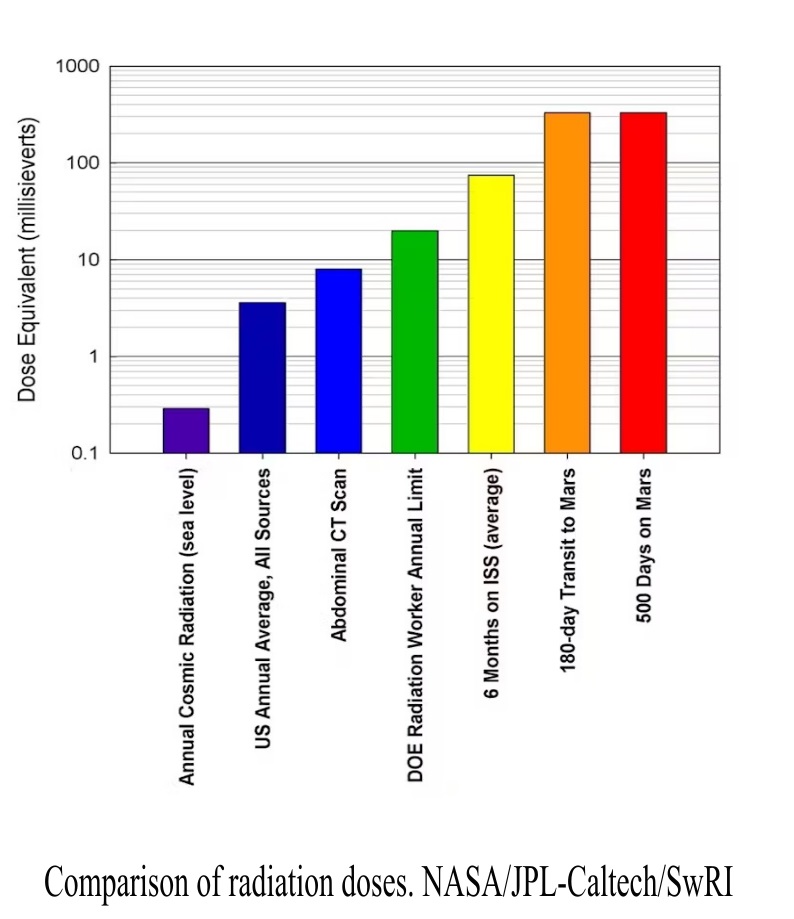
exposure to elevated levels of ionising radiation, such as those possible during space weather events, can potentially cause damage to DNA. The risk of space travel therefore ranges from a minor increase in health defects to serious health implications such as cancers.
The space tourism industry is currently not fully aware of the radiation risks, we discovered. It is instead relying on incomplete “informed consent” for non-crew participants.
The Conversation, March 19, 2024 , Chris Rees, Postgraduate Researcher of Space Risk Engineering, University of Surrey
In a decade or two, journeys into space could become as normal [really?]as transatlantic flights. In particular, the number of humans travelling into space with the help of commercial companies, such as Virgin Galactic and Blue Origin, will increase significantly.
But such travel comes with huge radiation risks. Sudden changes in space weather, such as solar flares, for example, could have significant health implications for crew and passengers. Now our recent paper, from the University of Surrey, Foot Anstey LLP Space and Satellite Team, has found that current legislation and regulation don’t do enough to protect space tourists and crew.
Changes in space weather could expose space tourists to radiation doses in excess of the recommended maximum 1 millisievert (mSv) yearly uptake for a member of the public and 20mSv yearly for those working with radiation. Research at the University of Surrey shows that during an extreme space weather event, flight participants could receive doses in excess of 100mSv.
Current legislation and regulation focusing on potential radiation exposure for space tourists is limited and largely untested. There is a heavy focus on conventional non-radiation risk and wider safety, with guidance stemming from regulation of normal commercial flights. However, these are significantly different to space tourism enterprises.
Similarly, the law around space flights and their associated risk liability is complex. Space law incorporates a mix of international law (such as international agreements, treaties and conventions), domestic legislation and guidance.
Cancer risk
Exposure to low levels of background natural radiation is part of everyday life. Most people are not aware of this exposure and the potential risks to our health. For example, an 0.08mSv effective dose from a commercial flight from the UK to the US.
However, exposure to elevated levels of ionising radiation, such as those possible during space weather events, can potentially cause damage to DNA. The risk of space travel therefore ranges from a minor increase in health defects to serious health implications such as cancers.
There has been significant risk assessment of radiation exposure on Earth; for example in the nuclear industry. This is unlike the space tourism industry, which is still in its infancy.
Previous research has focused on the potential risk assessment for astronauts from radiation exposure and long duration missions outside low-Earth orbit. But this does not consider risks for those on short trips to space as tourists. Thus, there is still significant work to be done to assess the unique risk for space tourist flights and the supporting guidance and regulation.
Any existing regulation, such as the UK Air Navigation Order and Federal Aviation Administration (FAA) space flight regulations, that is applicable to potential space flights focuses on crew, rather than paying passengers.
The space tourism industry is currently not fully aware of the radiation risks, we discovered. It is instead relying on incomplete “informed consent” for non-crew participants. The current regulation for the industry therefore places the risk burden firmly on the space tourist. We argue more legislation and regulation are needed.
Our recommendations
We made a series of recommendations in our report. But they are advisory. They are intended for the industry and regulators to consider as the space tourism sector continues to develop, particularly the FAA and the UK Civil Aviation Authority (CAA)………………………………… more https://theconversation.com/space-tourists-and-crew-suffer-high-radiation-risks-regulation-is-needed-to-protect-them-225693
US and Japan seek UN resolution calling on all nations to ban nuclear weapons in outer space
The United States and Japan are sponsoring a U.N. Security Council resolution calling on nations not to deploy or develop nuclear weapons in space
ByEDITH M. LEDERER Associated Press, March 19, 2024,
UNITED NATIONS — The United States and Japan are sponsoring a U.N. Security Council resolution calling on all nations not to deploy or develop nuclear weapons in space, the U.S. ambassador announced Monday.
Linda Thomas-Greenfield told a U.N. Security Council meeting that “any placement of nuclear weapons into orbit around the Earth would be unprecedented, dangerous, and unacceptable.”
The announcement that the U.S. and Japan had circulated a resolution follows White House confirmation last month that Russia has obtained a “troubling” anti-satellite weapon capability, although such a weapon is not operational yet.
Russian President Vladimir Putin declared later that Moscow has no intention of deploying nuclear weapons in space, claiming that the country has only developed space capabilities similar to those of the U.S.
The Outer Space Treaty ratified by about 114 countries including the United States and Russia prohibits the deployment of “nuclear weapons or any other kinds of weapons of mass destruction” in orbit or the stationing of “weapons in outer space in any other manner.”
Japan’s Foreign Minister Yoko Kamikawa, who chaired the council meeting, said that even during “the confrontational environment” of the Cold War, the rivals agreed to ensure that outer space remained peaceful. That prohibition on putting any weapons of mass destruction into orbit must be upheld today, she said.
Thomas-Greenfield said all parties to the treaty must commit to the ban on nuclear and other destructive weapons, “and we must urge all member states who are not yet party to it to accede to it without delay.”
She said the United States looks forward to engaging with the other members of the 15-nation Security Council “to forge consensus around this text.”…………………………………………………………………………………………………….
more https://abcnews.go.com/US/wireStory/us-japan-seek-resolution-calling-nations-ban-nuclear-108261129
La Hague reprocessing plant: expansion and continued operation until at least 2100

Last week, the Élysée Palace confirmed that the French reprocessing
plant at La Hague is to be expanded. Extensive investments are planned in
this context. There have already been plans since 2020 to build another
storage pool on the plant site.
At La Hague, there is still radioactive
waste from Germany, which may be returned this year. It was actually just a
side note: The Conseil de Politique Nucléaire (Nuclear Policy Council),
which was founded in 2023 and met at the Elysée Palace last Monday,
confirmed the prospect of major investments at La Hague in order to extend
the lifespan of the facilities until at least 2100.
Corresponding press
reports were confirmed by the Elysée Palace on Tuesday: The Council had
“confirmed the major guidelines of French policy on the nuclear fuel cycle,
which combines reprocessing, reuse of spent fuel and closing the cycle”,
the La Hague site would “be the subject of major investment”. No specific
timetables or amounts were mentioned in this context.
GRS 12th March 2024
There is no such thing as a “nuclear waste-eating” reactor
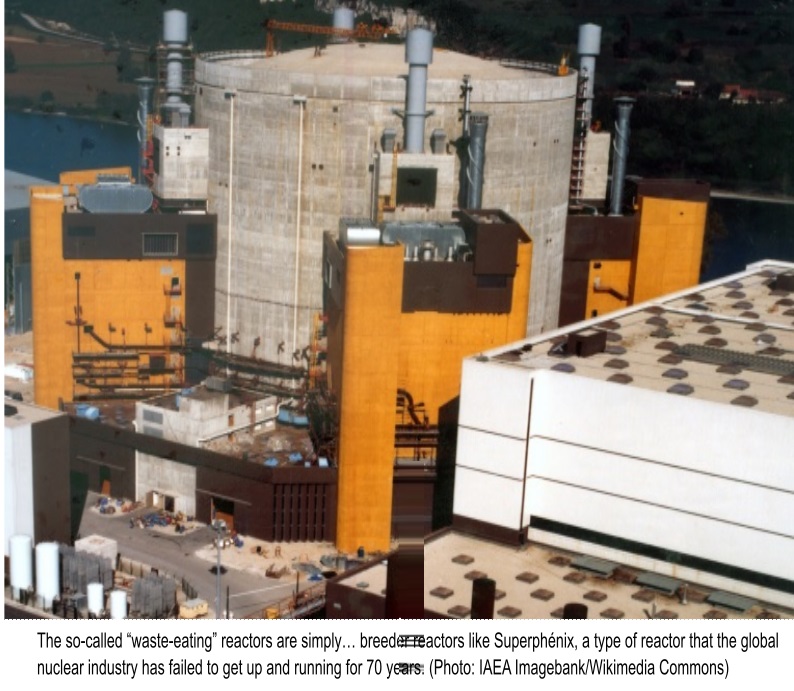
Contrary to popular belief, the French nuclear industry is by no means “triumphant”, “the best in the world” or “at the cutting edge of technology”: in fact, EDF (bankrupt), Areva (renamed Orano after filing for bankruptcy) and CEA (subsidized by public money) are constantly making fools of themselves and leaving the French with astronomical bills.
A magic reactor killed by environmentalists?
By Stéphane Lhomme by beyondnuclearinternational, https://beyondnuclearinternational.org/2024/03/17/a-magic-reactor-killed-by-environmentalists/
On the contrary, a “nuclear waste-eating reactor” does not exist
Appearing as a guest on several TV channels (BFM, Cnews, etc.), a certain Fabien Bouglé managed to fool both viewers and journalists (most of whom are totally ignorant about nuclear power) with a series of fibs, each more enormous than the last. Here are a few clarifications.
There is no such thing as a “nuclear waste-eating” reactor
The smooth-talking Bouglé left his ignorant interlocutors stunned and bewildered as he talked about “waste-eating” reactors that would have already solved the radioactive waste issue if an infamous green lobby, “betraying France to Germany” (sic!), hadn’t “prevented” the advent of such reactors.
So, like throwing a log on the fire, all you have to do is put the radioactive waste produced by today’s power plants into a “magic” reactor, and the waste will disappear.
Mr. Bouglé finally divulged his “secret”: the so-called “waste-eating” reactors are simply… breeder reactors: a type of reactor that the global nuclear industry has failed to operate for 70 years, like Superphénix in France! And, even if it did work, it would in no way eliminate radioactive waste. What’s more, less than 1% of nuclear fuel (the most radioactive waste) could theoretically have its lifespan reduced, but without disappearing and while becoming even more radioactive! In the nuclear industry, as elsewhere, miracles do not exist.
The Astrid project was not “on the way to success” and was not “taken over by Bill Gates”
Despite its pretty name, the Astrid reactor project was nothing more than a little Superphénix: a sodium-cooled breeder reactor. Look at the “progress”: 40 years after the launch of Superphénix (1240 MW), the CEA wanted to make another attempt with a reactor half as powerful (600 MW), before giving up altogether.
Japan’s Monju fast-breeder reactor was definitively shut down after countless failures, a terrible fire and sodium leaks; Germany’s Kalkar fast-breeder reactor was never commissioned; and the USA has abandoned the sector. Only Russia manages to keep its BN800 hobbling along… but it doesn’t perform any of the miracles expected of it (producing “more fissile material than it consumes”, “eating” radioactive waste and other nonsense).
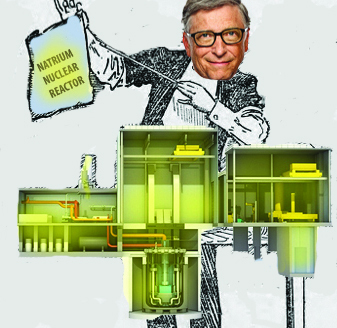
As for Bill Gates, he’s one of the dummies who, in recent years, have announced various types of miraculous reactors, always claiming to be able to produce electricity “cheaply, safely and with little waste” (blah blah blah). Beginning in 2006, Bill Gates and his company Terrapower first tried to make a “travelling wave” reactor work, then a “molten salt” one, both abandoned after wasting billions. Now Gates is dreaming of developing… a sodium-cooled fast-neutron reactor: back to Superphénix and 70 years of failure for the global nuclear industry.
France’s nuclear woes are caused by… France’s nuclear woes!
The “evil anti-nuclear environmentalists” and the so-called “traitors in the pay of Germany” denounced by Inspector Bouglé have nothing to do with the disasters of French nuclear power: EDF, Areva (now Orano) and the CEA are doing just fine on their own! For example:
- Industrial and financial disasters at the EPR sites in Finland, Flamanville and England: 15 to 20 years (instead of four and a half) to build a reactor costing 20 billion Euros instead of 3 billion, and with serious defects.
- The unprecedented scandal of the thousands of defective parts (including the famous Flamanville EPR vessel) produced by Areva in its Le Creusot plants.
- Catastrophic and ruinous flops at the Iter (fusion) and RJH reactor sites.
- Stress corrosion (up to 32 reactors out of 56 shut down at the same time in 2022)
And so on.
Contrary to popular belief, the French nuclear industry is by no means “triumphant”, “the best in the world” or “at the cutting edge of technology”: in fact, EDF (bankrupt), Areva (renamed Orano after filing for bankruptcy) and CEA (subsidized by public money) are constantly making fools of themselves and leaving the French with astronomical bills.
The Fessenheim closure is not the cause of electricity shortages in France and imports from Germany
Mr. Bouglé claims that France was an exporter to Germany before the closure of Fessenheim and that it has suddenly become an importer because of the plant’s closure in 2020. He’s talking nonsense.
In reality, there are exchanges (in both directions) between the two countries throughout the year. When the balance sheet is drawn up on December 31, France is still an importer from Germany (*), and has been for over 25 years (**), long before Fessenheim was shut down.
This phenomenon is mainly due to the absurd choice of electric heating, developed on a massive scale in France to “justify” nuclear power: as soon as it gets cold, electricity consumption is such that it far exceeds the capacity of the French nuclear fleet, even when it’s working properly!
It’s also worth noting the ridiculous claim that life was wonderful in France with 58 reactors, and that it has suddenly gone into crisis with “only” 56 reactors, which in reality is an insane number. For the record, during the stress corrosion crisis, France was saved by importing massive amounts of electricity from neighboring countries, which have only a few reactors, if any at all.
(*) Of course, we can criticize the fact that a significant proportion of Germany’s electricity is generated by coal-fired power plants (even if the share of renewables is increasing exponentially), but the fact is that it’s this “dirty” electricity that heats France every winter, and French nuclear enthusiasts don’t go so far as to refuse this electricity and stay in the cold and dark!
(**) Except, very narrowly, in 2011: following the Fukushima disaster, Germany immediately shut down 8 reactors. But by 2012, France was once again a net importer from Germany.
The joke about waste-eating reactors
Let’s start by noting that nuclear reactors continually produce insane quantities of radioactive waste of various kinds, from nuclear fuel to the tools and clothing used in power plants, which are contaminated… and can’t be “eaten”!
But let’s concentrate on the most radioactive, the spent fuel that comes out of the reactor core after use.
Spent fuel comprises four types of element: plutonium, uranium, fission products and minor actinides. Note that the vast majority of radioactivity is contained in these last two categories.
To attempt reuse this waste fuel, separation work must already be carried out in a gigantic plant such as La Hague. These operations require huge amounts of electricity and using large quantities of terribly corrosive and dangerous chemicals: a far cry from the “clean” energy that could “save the planet”.
– Plutonium
Listening to Mr. Bouglé, the uninformed viewer (and the ignorant journalist) think that all they have to do is recover this fuel and put it in the so-called “waste-eating reactor”, which will make this waste disappear… while producing electricity! Jackpot, bravo and thanks for everything. But Santa Claus doesn’t exist, and it’s all poppycock. And here’s why.
It is used by the military for their atomic weapons. Some of this plutonium can be recovered to make fuel (known as “mox”) for use in today’s power plants, which exacerbates the consequences of an accident when it occurs. Various studies show that this option reduces only slightly the amount of uranium needed from mining. But in no case is this plutonium “eaten” or “incinerated”; it is almost entirely recovered after use.
– Uranium
The uranium resulting from these separation operations, known as “reprocessed uranium”, can theoretically be reused in place of mined uranium, but in reality, this option poses a number of technical problems. EDF has been trying to use it for years in its Cruas power plant (Ardèche), after re-enrichment… in Russia (thanks Putin!). But this remains very marginal, and in no case is this uranium “eaten” or “incinerated”; it is almost entirely recovered after use.
– Fission products
There’s nothing we can do with them, except vitrify them and store them for millennia!
– Minor actinides
These are the only elements of radioactive waste that could theoretically have their lifespan reduced in breeder reactors… while becoming even more radioactive! But even if such a “feat” were to happen (provided we finally manage to operate breeder reactors properly), minor actinides would not be “eaten”, “incinerated” or “disintegrated”. In fact, they are vitrified like fission products and have to be stored for millennia.
Conclusion
Of course, there is no technology that can “eat” nuclear waste. At most, it is theoretically possible (but not in practice) to degrade a tiny fraction of it, and even then, at the cost of new radioactive and chemical contamination and very high energy consumption.
Once and for all, let’s remember that there will never be a nuclear miracle, be it with magic reactors, or by replacing uranium with thorium (the thorium sector is also that of fast-breeder reactors!), or with fusion, or by calling old projects that have never worked “4th generation” or “SMR”.
Stéphane Lhomme is Director of the Nuclear Observatory.
Musk’s SpaceX is building spy satellite network for US intelligence agency, sources say
By Joey Roulette and Marisa Taylor, March 17, 2024
WASHINGTON, March 16 (Reuters) – SpaceX is building a network of hundreds of spy satellites under a classified contract with a U.S. intelligence agency, five sources familiar with the program said, demonstrating deepening ties between billionaire entrepreneur Elon Musk’s space company and national security agencies.
The network is being built by SpaceX’s Starshield business unit under a $1.8 billion contract signed in 2021 with the National Reconnaissance Office (NRO), an intelligence agency that manages spy satellites, the sources said.
The contract signals growing trust by the intelligence establishment of a company whose owner has clashed with the Biden administration and sparked controversy, opens new tab over the use of Starlink satellite connectivity in the Ukraine war, the sources said.
The Wall Street Journal reported, opens new tab in February the existence of a $1.8 billion classified Starshield contract with an unknown intelligence agency without detailing the purposes of the program.
Reuters reporting discloses for the first time that the SpaceX contract is for a powerful new spy system with hundreds of satellites bearing Earth-imaging capabilities that can operate as a swarm in low orbits, and that the spy agency that Musk’s company is working with is the NRO.
Reuters was unable to determine when the new network of satellites would come online and could not establish what other companies are part of the program with their own contracts.
SpaceX, the world’s largest satellite operator, did not respond to several requests for comment about the contract, its role in it and details on satellite launches. The Pentagon referred a request for comment to the NRO and SpaceX.
In a statement the NRO acknowledged its mission to develop a sophisticated satellite system and its partnerships with other government agencies, companies, research institutions and nations, but declined to comment on Reuters’ findings about the extent of SpaceX’s involvement in the effort…………………………………………..
The U.S. Is Betting Big on Small Nuclear Reactors (done up with green paint)

Oil Price, By Felicity Bradstock – Mar 14, 2024,
- After decades of decline, the U.S. is significantly increasing its investment in nuclear energy to address climate change and strengthen energy security.
- The recently passed Atomic Energy Advancement Act simplifies approval processes for novel reactor designs, aiming to expedite the development of new nuclear power plants.
………. The U.S. is set to accelerate the rollout of new nuclear power plants and reactors following the passing of new legislation this month. This follows a movement away from nuclear power for several decades due to the poor political and public perception of nuclear power due to several notable nuclear disasters………………..
This month, the House approved legislation aimed at developing U.S. nuclear power capacity in the coming years, with a vote of 365 to 36. The Atomic Energy Advancement Act was widely approved by both the Democrat and Republican parties ………
……………………………..The law will see that the Nuclear Regulatory Commission (NRC) streamlines its processes for the approval of new reactor designs, and will increase hiring at the commission, reduce fees for applicants, establish financial prizes for novel types of reactors, and encourage the development of nuclear power at the sites of retiring coal plants. The legislation is expected to support the greatest development of U.S. nuclear power of this generation. ……………………………..
The Biden administration has repeatedly demonstrated its support for nuclear power by passing laws and approving funding to keep existing nuclear projects afloat. Two policies, passed in 2021 and 2022, provided the funding needed to save 22 reactors, with further investment being rolled out this year. This financing is expected to keep the existing U.S. nuclear reactor fleet online until at least 2032, by which time the government hopes greater investment will be being made into new nuclear projects. The policies also provide funding for research and development into the next generation of modular, more flexible nuclear plants
The passing of the Atomic Energy Advancement Act is expected to speed up the deployment of new nuclear energy technology, supported by previous Biden administration policies that provide greater investment to the sector. While strict safety regulations must be upheld, the government is putting pressure on the NRC to modernize and approve innovative reactor designs to allow for new nuclear energy capacity to be rolled out …. https://oilprice.com/Alternative-Energy/Nuclear-Power/The-US-Is-Betting-Big-on-Small-Nuclear-Reactors.html
What Does Amazon Want With Nuclear?
Microsoft signed a deal with Constellation to supply power to data centers in Virginiaand hired an official from the Tennessee Valley Authority to be its director of nuclear and energy innovations, while Microsoft founder Bill Gates and Sam Altman, the head of Microsoft-backed OpenAI have both invested in nuclear startups, as has Google.
The tech giant’s $650 million deal with Talen Energy has a lot to unpack.
Heat Map MATTHEW ZEITLIN•, MARCH 13, 2024
When Talen Energy, which owns a 90% interest in the Susquehanna nuclear power plant in Northeastern Pennsylvania, announced it was selling a data center site adjacent to its power plant to Amazon Web Services, it raised some eyebrows in the energy world. The surprise was not because a large tech company made a big deal with a carbon-free power provider, or even that a tech company made a deal to buy power generated by a nuclear power plant. It was because Amazon was making this deal.
Amazon is a massive buyer of renewable power — it claims to be the world’s largest and says it’s responsible for 28 gigawatts of clean energy capacity — signing contracts with new wind and solar projects all over the world.
But a divide has opened up among tech giants when it comes to energy, with Amazon on one side and Alphabet and Microsoft on the other. The difference hinges on how much it matters where and when the new carbon-free power a company buys in order to match its electricity use.
What’s odd about the Talen deal is that it fits awkwardly into either approach, especially Amazon’s. Amazon does not count nuclear towards its renewable power goals, and in any case, it’s not a “new” source of carbon-free power. Instead, it allows Amazon to siphon somewhere between 480 and 960 megawatts of capacity from the 2,500 megawatt plant.
“Amazon needs power, they’re getting it at cheap rates. They don’t even want to talk about it like a climate thing,” Mark Nelson, the founder of Radiant Energy Group, told me.
In the past decade or so, technology companies have gone on a clean-power buying spree, funding new wind and solar projects all over the world. But there has been a divergence in what is thought to be the best way to go about it.
In 2019, Amazon announced a goal to add enough renewable power to the grid to match its own emissions by 2030 (since moved up to 2025) and to reach net zero by 2040.
Google has been 100% renewable in terms of buying clean power in the same amounts that it consumes since 2017. So in 2020, it set a new goal: to “run on 24/7 carbon-free energy on every grid where we operate by 2030.” This would mean not just matching total renewable purchases with total emissions, as Amazon is seeking to do, but also trying to get every hour ofdata center operation “matched” with an hour of renewable generation on the same grid.
Microsoft has a similar goal, and as a result, both companies have shown much more interest in nuclear power of late than is typical in the technology world……
Microsoft signed a deal with Constellation to supply power to data centers in Virginiaand hired an official from the Tennessee Valley Authority to be its director of nuclear and energy innovations, while Microsoft founder Bill Gates and Sam Altman, the head of Microsoft-backed OpenAI have both invested in nuclear startups, as has Google.
Amazon’s approach — which it shares with several other large companies, including Meta — is not to match 24 hours of its operations with clean power bought locally, but rather to develop and purchase new wind and solar at the same scale of the power it consumes, especially in areas with dirty grids, thus matching the emissions from its consumption with the emissions reductions of new renewables projects. While a 24/7 matching approach may be naturally complementary with nuclear power, Amazon’s strategy doesn’t require it.
“We believe a focus on emissions is the fastest, most cost-effective and scalable way to leverage corporate clean energy procurement to help decarbonize global power grids at the fastest pace,” an Amazon spokesperson told me. “This includes procuring renewable energy in locations and countries that still rely heavily on fossil fuels to power their grids, and where energy projects can have the biggest impact on carbon reduction.”
Contracting out new renewable energy projects can have more bang for your buck in dirty grids, according to proponents of the Amazon philosophy, known as carbon matching. The hypothesis is that a renewable project in a fossil fuel-heavy grid will displace more dirty power than one that’s located near a datacenter in an already relatively clean grid like California or Washington State……………… https://heatmap.news/technology/amazon-nuclear-talen-energy—
Nuclear industry wants Canada to lift ban on reprocessing plutonium, despite proliferation risks

The CANDU Owners Group is far from neutral or independent…………… First, Canadian Nuclear Laboratories is a private company owned by a consortium of multi-national companies: AtkinsRéalis (formerly SNC Lavalin), Fluor, and Jacobs. ……...has overseas members, including utilities from China, Pakistan, India, South Korea, Argentina, and Romania. The first three countries are nuclear weapons states that either possess reprocessing plants for military purposes (India and Pakistan) or reportedly divert plutonium extracted from commercial spent fuel for military purposes (China), while South Korea and Argentina have for decades flirted with the idea of reprocessing.
Bulletin, By Gordon Edwards, Susan O’Donnell | March 11, 2024
Plutonium is “the stuff out of which atomic bombs are made.” Plutonium can also be used as a nuclear fuel. Reprocessing is any technology that extracts plutonium from used nuclear fuel. In Canada, the nuclear industry seems determined to close the nuclear fuel cycle by pushing for a policy to permit reprocessing—thereby seeking to lift a 45-year-old ban.
In 1977, Canada tacitly banned commercial reprocessing of used nuclear fuel, following the lead of the Carter administration, which explicitly opposed reprocessing because of the possibility it could lead to increased proliferation of nuclear weapons around the world.[1] That unwritten policy in Canada has held sway ever since.[2] New documents obtained through Canada’s Access to Information Act reveal that, behind closed doors, the nuclear industry has been crafting a policy framework that, if adopted, would overturn the ban and legitimize the extraction of plutonium from Canada’s used commercial nuclear fuel.
For over two years, documents show that the Canadian government has held a series of private meetings with industry representatives on this subject, keeping such activities secret from the public and from parliament. This raises questions about the extent to which nuclear promoters may be unduly influencing public policymaking on such sensitive nuclear issues as reprocessing in Canada.[3] But, given the stakes for the whole society and even the entire planet, the public must have a say about nuclear policy decisions…………………………………………………………………………………………………………………………………………………..
Before the ban. Dreams of a plutonium-fueled economy were spawned in 1943-44 by British, French, and Canadian scientists working at a secret wartime laboratory in Montreal, which was part of the Anglo-American Project to build the first atomic bombs. Canada’s first heavy-water reactors were designed by the Montreal team, in part, to produce plutonium for weapons. The team also had hopes that after the war, plutonium might become a dream fuel for the future. They envisioned a “breeder reactor” that could produce more plutonium than it uses, thereby extending nuclear fuel supplies.
For 20 years after the war, Canada sold uranium and plutonium for US bombs. Two reprocessing plants were operated at Chalk River Nuclear Laboratories in Ontario. In addition, all the pilot work on plutonium separation needed to design Britain’s Windscale reprocessing plant was carried out at Chalk River.
After the ban. Although the 1977 ban scuppered AECL’s hopes for commercial reprocessing, plutonium remained the holy grail. In the decades that followed, AECL researchers studying the geologic disposal of high-level radioactive waste clandestinely carried out reprocessing experiments at the Whiteshell Nuclear Research Establishment in Manitoba. Instead of burying used nuclear fuel bundles, the scientists anticipated burying solidified post-reprocessing waste. Meanwhile, AECL scientists at Chalk River fabricated three tonnes of mixed-oxide fuel (MOX) in glove boxes, using plutonium obtained from CANDU fuel reprocessed overseas. In 1996, Prime Minister Jean Chrétien volunteered to import weapons-grade plutonium from dismantled US and Soviet warheads to fuel CANDU reactors. Facing fierce public opposition in Canada, the project never came to pass.
But the dream of a plutonium economy remained. In 2011, a sprawling mural on three walls of the Saskatoon Airport depicted the nuclear fuel chain, from mining uranium to the reprocessing of used fuel to recover “potential energy” before disposing of the leftovers. Although the word plutonium appeared nowhere, reprocessing was presented as the inevitable final step in this vision of a virtuous nuclear fuel cycle. The mural was commissioned by Cameco, the giant Canadian multi-national corporation that helped make the central Canadian province of Saskatchewan into the “Saudi Arabia of uranium.” At the time, Cameco co-owned the largest operating nuclear power station in the world, the eight-reactor Bruce complex beside Lake Huron bordering the United States.
Despite such hopes, it became fashionable to publicly downplay reprocessing as expensive and therefore economically unlikely.[5] But the technology stayed on the books as a possibility, especially in case future generations would want to extract plutonium from used nuclear fuel for re-use before disposing of the remaining radioactive waste.
Back to the future? New Brunswick has one 660-megawatt-electric CANDU reactor at Point Lepreau on the Bay of Fundy in eastern Canada. The plant has been operating for over 40 years. In March 2018, two start-up companies—UK-based Moltex Energy and US-based ARC Clean Technology—offered to build “advanced” (fast) reactors on the same site.
The Moltex design is a 300-megawatt-electric molten salt reactor called “Stable Salt Wasteburner.” It is to be fueled with plutonium and other transuranic elements extracted from CANDU used fuel already stored on that site. Accordingly, the Moltex proposal requires a reprocessing plant in tandem with the reactor. The ARC design is a 100-megawatt-electric liquid sodium-cooled reactor, inspired by the second Experimental Breeder Reactor (EBR-2) operated by the Argonne National Laboratory in Idaho between 1964 and 1994. Although the ARC-100 does not require reprocessing at the outset, its optimal performance requires that the used fuel be recycled, likely through reprocessing.
From the beginning, Moltex claimed its proposed molten salt reactor would “recycle” CANDU used fuel and “burn” it in its molten salt reactor. Moltex claims that this would virtually eliminate the need for a deep geologic repository by turning a million-year disposal problem into a roughly 300-year storage problem. This claim has been flatly rebuffed.[6] Only later did the public learn that the Moltex technology requires reprocessing CANDU used fuel to extract plutonium using an innovative process called “pyroprocessing.” (In pyroprocessing, used fuel is converted to a metal and immersed in molten salt, then the plutonium and other transuranic elements are recovered by passing a current through the salt and collecting the desired products on electrodes.)

ARC Clean Technology maintains that its reactor design is proven by the 30-year operating experience of the EBR-2 reactor, despite differences in size and fuel enrichment.[7] The company, however, says nothing about the intimate connection between breeder reactors and plutonium, nor does it mention the chequered history of liquid sodium-cooled reactors globally—including the Fermi Unit 1 reactor’s partial meltdown near Detroit, the commercial failure of France’s Superphénix, the conversion of a German breeder reactor into an amusement park, or the dismal performance of Japan’s Monju reactor.
For either of the proposed New Brunswick reactors to operate as intended, Canada would need to lift its 45-year-old ban on commercial reprocessing of used nuclear fuel.
Testing the limits. The first sign that Canada’s reprocessing ban might be lifted came in 2019, when the federal government’s Impact Assessment Act exempted specified projects from environmental assessment. The exemption included any reprocessing plant with a production capacity of up to 100 metric tons (of used nuclear fuel) annually—just above the reprocessing capacity required for the Moltex project.[8]
Public calls to explicitly ban reprocessing started shortly after March 2021, when the federal government gave 50.5 million Canadian dollars in funding for Moltex’s project. This project clearly requires reprocessing: Without the plutonium produced by CANDU reactors to fuel its proposed molten salt reactor, the Moltex project can go nowhere.
In addition, Moltex hopes to eventually export the technology or the fuel, or both. Many Canadians are alarmed at the prospect of normalizing the use of recycled plutonium as a nuclear fuel in Canada and abroad.
In 2021, in response to a recommendation by the International Atomic Energy Agency, the Canadian government conducted public consultations to develop a modernized policy on commercial radioactive waste management and decommissioning. Over 100 citizens groups participated, and many called for an explicit ban on reprocessing.
Public attention to the issue of reprocessing grew after nine US nonproliferation experts sent an open letter to Prime Minister Justin Trudeau in May 2021. The letter expressed concern that by funding a spent fuel reprocessing and plutonium extraction project, Canada would “undermine the global nuclear weapons nonproliferation regime that Canada has done so much to strengthen.” …………………..
A second letter sent to Trudeau in July 2021 refuted “misleading claims” that Moltex posted on-line in rebuttal to the first letter. Moltex’s rebuttal claims were quickly taken down. And a third letter authored by one of the US nonproliferation experts was sent in November 2021. None of the government responses to these three letters addressed the core issue, which is the request for an independent review of the proliferation implications of Canada’s funding of reprocessing.
The federal government released its draft policy for radioactive waste management and decommissioning in March 2022, hinting that reprocessing might be permitted in the future. Public interest groups made their opposition to that suggestion very clear. A national steering group coordinated by Nuclear Waste Watch, a Canada-based network of public interest organizations, released an alternative policy proposal that explicitly banned reprocessing. The Council of Canadians, a national advocacy group, sent out an action alert that generated 7,400 letters calling for the explicit prohibition of reprocessing.
The Canadian Nuclear Safety Commission, tasked with the job of licensing Moltex’s proposed reactor, declared that a policy framework for reprocessing is necessary and that such a policy must come from the federal government.[9] Moltex’s Chief Executive Officer, Rory O’Sullivan, observed that Canada was chosen by Moltex because the country had no explicit policy on reprocessing: “Moltex would likely not have come to Canada if a reprocessing policy had been mandated at the time.”
In November 2021, Canada’s Ministry of Natural Resources—the lead federal department on nuclear issues—issued an internal memo entitled “Policy Development on Reprocessing” that refers to a series of planned meetings on reprocessing with industry representatives starting December 1, 2021.[10] The CANDU Owners Group—a nonprofit corporation assembling utilities operating CANDU reactors, Canadian Nuclear Laboratories, and nuclear suppliers—was singled out by the ministry to prepare a policy paper on reprocessing.[11]
The CANDU Owners Group is far from neutral or independent.
First, Canadian Nuclear Laboratories is a private company owned by a consortium of multi-national companies: AtkinsRéalis (formerly SNC Lavalin), Fluor, and Jacobs. The company is currently constructing a government-funded facility with hot cells at Chalk River to conduct research, including on reprocessing and plutonium extraction. Canadian Nuclear Laboratories operates under a “government-owned contractor operated” agreement with Atomic Energy of Canada Limited, the same publicly owned corporation that pushed for commercial reprocessing in the late 1970s.
The CANDU Owners Group also has overseas members, including utilities from China, Pakistan, India, South Korea, Argentina, and Romania. The first three countries are nuclear weapons states that either possess reprocessing plants for military purposes (India and Pakistan) or reportedly divert plutonium extracted from commercial spent fuel for military purposes (China), while South Korea and Argentina have for decades flirted with the idea of reprocessing.
By all evidence, the government of Canada is currently enlisting private entities that favor reprocessing to assist in the development of an industry-friendly policy on reprocessing. And the government does this without involving the public, parliament, or outside experts—all of whom have expressed a keen interest—and repeatedly asked to participate—in plutonium policy discussions. In the process, misleading information about reprocessing is being forwarded to government officials with no other voices to correct the record.[12]
In the most recent move, a dozen US nonproliferation experts wrote again to Prime Minister Trudeau on September 22, 2023, after the release of documents obtained through an access to information request. In their letter, the experts reiterated their concerns that the Canadian government is funding a project that would lead to increase the availability—and therefore potential proliferation—of weapons-usable plutonium for civilian purposes in Canada and beyond.
Democratic deficit. Despite all these developments, there has been no public discussion or parliamentary deliberation about the implications of introducing civilian reprocessing into Canada’s nuclear fuel cycle. Absence of transparency and public debate means the democratic process is being ignored. Yet, the issue is of great public importance because of the taxpayer money invested, proliferation risks involved, and the long-term societal implications of the security measures needed to safeguard nuclear weapons usable materials.
This makes one wonder why it took a group of concerned citizens and an access to information request to find out that, behind closed doors, the nuclear industry has been drafting its own policy to permit commercial reprocessing, expecting its adoption by the government of Canada against all objective criteria of democracy.
n 1976, British nuclear physicist Brian Flowers authored a Royal Commission report to the UK parliament. He wrote: “We regard the future implications of a plutonium economy as so serious that we should not wish to become committed to this course unless it is clear that the issues have been fully appreciated and weighed; in view of their nature we believe this can be assured only in the light of wide public understanding.”
The same precept should apply to nuclear policy in today’s Canada.
Notes…………………………………………………………………. https://thebulletin.org/2024/03/nuclear-industry-wants-canada-to-lift-ban-on-reprocessing-plutonium-despite-proliferation-risks/
U.S. Congress about to fund revival of nuclear waste recycling to be led by private start-ups.
Jimmy Carter Killed This Technology 50 Years Ago. Congress Is About To
Fund Its Revival. The spending bill the House just passed contains $10
million for recycling nuclear waste. The nuclear waste sitting at power
plants across the United States contains enough energy to power the country
for more than 100 years.
But recycling spent uranium fuel was banned in
1977 because President Jimmy Carter feared that nuclear reprocessing could
lead to more production of atomic weapons. In the last 47 years, China,
France, Japan, Russia and the United Kingdom have all developed the tools
to recycle nuclear waste.
The U.S., by contrast, made a plan to bury that
spent fuel underground and even built a facility — but then abandoned the
strategy without any clear alternative. The short-term spending bill passed
this week in the U.S. House to avert a government shutdown contains the
first major funding for commercializing technology to recycle nuclear
waste. The legislation earmarks $10 million for a cost-sharing program to
help private nuclear startups pay for the expensive federal licensing
process ― and for the first time explicitly makes waste-recycling
companies eligible.
Huffington Post 8th March 2024
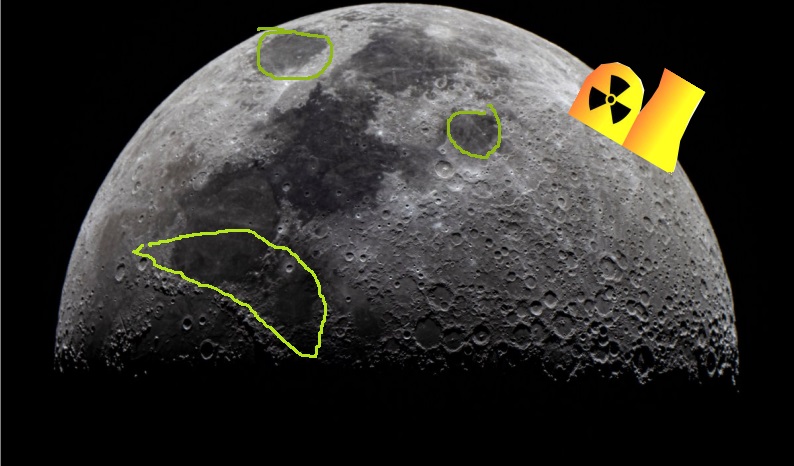
Russia and China announce plan to build shared nuclear reactor on the moon by 2035, ‘without humans’
Live Science, By Harry Baker, 8 Mar 24
The proposed nuclear reactor, which could be transported and assembled without human assistance, would provide energy to a lunar base that Russia and China have agreed to build together.
Russia’s space agency Roscosmos has announced plans to work with China to build an automated nuclear reactor on the moon by 2035. The proposed reactor will help power a proposed lunar base that the two countries will jointly operate.
Back in 2021, Roscosmos and the China National Space Administration (CNSA) revealed that they intended to build a shared base on the moon, named the International Lunar Research Station (ILRS), which they claimed at the time would be “open to all interested countries and international partners.”
However, NASA astronauts are unlikely to be allowed to visit this base due to historically frosty relations with CNSA and a more recent split with Roscosmos, which will leave the International Space Station by 2025 in response to sanctions from the U.S. over Russia’s invasion of Ukraine in February 2022.
On Tuesday (March 5), Roscosmos announced that it will eventually attempt to build a nuclear reactor alongside CNSA, which would theoretically be able to power the ILRS.
“Today we are seriously considering a project — somewhere at the turn of 2033-2035 — to deliver and install a power unit on the lunar surface together with our Chinese colleagues,” Roscosmos director general Yury Borisov told state-owned Russian news site TASS.
Borisov added that the challenging construction job would likely be carried out autonomously “without the presence of humans” and that the necessary technological solutions to pull it off are “almost ready.”
Roscosmos is also looking to use massive nuclear-powered rockets to transfer cargo to the moon to build this base, but the agency has not yet figured out how to build these spacecraft safely, Reuters reported……………………………………..
Roscosmos and CNSA, neither of which have put humans on the moon’s surface, have contrasting track records when it comes to recent lunar exploration.
Last year, Russia’s first moon mission in 47 years ended in disaster when the Luna-25 lander crashed into the lunar surface, leaving behind a 33-foot (10 meter) wide crater.
However, China has had a presence on the moon since 2013, when the Chang’e 3 mission put a lander and rover on the lunar surface. The subsequent Chang’e 4 and Chang’e 5 missions, which occurred in 2019 and 2020 respectively, also successfully landed spacecraft on the moon. The most recent mission also successfully returned lunar samples to Earth — a feat that CNSA will attempt to repeat later this year.
Last week, CNSA also announced that it will start launching giant reusable rockets over the next two years as part of the agency’s plan to put boots on the moon by 2030.
However, NASA is still on track to return humans to the lunar surface before then, despite the first crewed Artemis mission being delayed until 2026. https://www.livescience.com/space/space-exploration/russia-and-china-announce-plan-to-build-shared-nuclear-reactor-on-the-moon-by-2035-without-humans
1 This Month


PLEASE OPPOSE HR 8255 AND S.3639 – bills would accelerate satellite deployment, with no environmental review or safeguards – https://ncstd5li.quorum.us/campaign/169331/
To see nuclear-related stories in greater depth and intensity – go to https://nuclearinformation.wordpress.com
-
Archives
- September 2026 (194)
- August 2026 (330)
- July 2026 (355)
- June 2026 (287)
- May 2026 (306)
- April 2026 (356)
- March 2026 (251)
- February 2026 (267)
- January 2026 (308)
- December 2025 (358)
- November 2025 (359)
- October 2025 (375)
-
Categories
- 1
- 1 NUCLEAR ISSUES
- business and costs
- climate change
- culture and arts
- ENERGY
- environment
- health
- history
- indigenous issues
- Legal
- marketing of nuclear
- media
- opposition to nuclear
- PERSONAL STORIES
- politics
- politics international
- Religion and ethics
- safety
- secrets,lies and civil liberties
- spinbuster
- technology
- Uranium
- wastes
- weapons and war
- Women
- 2 WORLD
- ACTION
- AFRICA
- Atrocities
- AUSTRALIA
- Christina's notes
- Christina's themes
- culture and arts
- Events
- Fuk 2022
- Fuk 2023
- Fukushima 2017
- Fukushima 2018
- fukushima 2019
- Fukushima 2020
- Fukushima 2021
- general
- global warming
- Humour (God we need it)
- Nuclear
- RARE EARTHS
- Reference
- resources – print
- Resources -audiovicual
- Weekly Newsletter
- World
- World Nuclear
- YouTube
-
RSS
Entries RSS
Comments RSS
 nuclear-news