MPs flag UK’s HM Revenue & Custom’s £1.4bn active contracts with Fujitsu

accounting WEB, by Tom Herbert, 10 Feb 24
A committee of MPs has published new data showing that HMRC holds eight active contracts with Fujitsu with a combined value of £1.4bn, all of which were awarded after a High Court verdict that ruled the developer’s software was responsible for misreported losses during the Post Office scandal.
Data from the Treasury Committee shows public organisations have held more than £3.4bn worth of contracts with Fujitsu since 2019 – the year a High Court ruling determined that there were defects in the developer’s Horizon software. Just over £2bn worth of contracts were agreed before the judge’s ruling and continued into the period following 2019, while around £1.4 bn was awarded after 2019.
Fujitsu’s Horizon software is at the heart of one of the biggest miscarriages of justice in British legal history, where 900 Post Office subpostmasters were prosecuted based on faulty evidence provided by the system, and backed up by court testimonies from Fujitsu experts.
Despite the court ruling, and evidence that the company and its staff were complicit in covering up the scandal, Fujitsu continued to be listed as a preferred government supplier until 2022 when it was removed (but continued to win contracts through the regular procurement process). Following the public outcry generated by the ITV drama Mr Bates vs the Post Office, Fujitsu wrote to the government in January 2024 to confirm it would no longer tender for business.
HMRC’s active contracts
At the time of writing, HMRC holds eight active contracts with Fujitsu with a combined value of £1.39bn – the largest in terms of both value and number. Financial services watchdog the FCA maintains six contracts worth more than £9m. ………………………………………………….
Government tech programmes ‘hobbled’
While the figures may generate plenty of noise from politicians and frustration from taxpayers, they are unlikely to result in meaningful change in the near future.
There are few ‘strategic technology suppliers’ able to take on the complexity and scale of many of the projects undertaken by government departments – as underlined by the award of a £485m contract to Fujitsu for the Northern Irish Education Authority in December 2023, which received just one tender from the Japanese software house.
Critics have also pointed to a lack of technical and commercial skills in government to deal with the challenges – leaving them poorly positioned when it comes to digital transformation or re-procurement.
In a report last year, Public Accounts Committee Chair Meg Hillier said the government’s technology programmes are “hobbled by staff shortages, and a lack of support, accountability and focus from the top.
“The government talks of its ambitions for digital transformation and efficiency, while actively cutting the very roles which could help achieve them,” she added.
New Fujitsu security research center in Israel to further develop digital identity tools
Biometric, Nov 30, 2022, Ayang Macdonald
Japanese tech giant Fujitsu has announced plans to set up a research center for data and security in Israel as part of efforts to strengthen its Research and Development (R&D) strategy as well as increase its presence in the country.
The center, which will go operational from April 2023 according to the announcement, highlights Fujitsu’s objectives of meeting the data security and trust requirements of companies and businesses at a time when many people are performing more transactions online.
Fujitsu says the center, to be based in Tel Aviv, will bring together about 10 research experts from Israel, Japan and Europe and their work will be focused on improving security technology for communications networks as part of its global strategy for data and security – a key area in its global R&D strategy.
Research at the center will focus on two main areas, namely developing technology that can ensure and enhance trust for network security, and technologies which can be used for a wide range of real-life situations like autonomous driving, self-checkout, as well as public safety, including anti-attack technologies for object detection AI…………
The company is also planning to develop its IDYX (or “IDentitY eXchange”) technology, which is intended to enable secure distribution of digital identity and attribute information between companies and individuals………………………………. https://www.biometricupdate.com/202211/new-fujitsu-security-research-center-in-israel-to-further-develop-digital-identity-tools?fbclid=IwZXh0bgNhZW0CMTAAAR0JsxUA-U2OxTaWJA0wn9bVwz6ZrES6Ud3yJbBiyJ7-0pgqbW6TaOodx50_aem_AUNuP6qXKQDr6xEGOrL9tLaha_3Jq5bni6IsXT-5B63IYytKZyPOG_gwYYdcMStOmz7Fcy3mf3NxTz4PKcttQPiC
Government could still replace Fujitsu in key nuclear contract
Fujitsu’s first government contract of the year could be just a stay of execution as department says that all replacement options are still being considered.
Karl Flinders, Chief reporter and senior editor EME, 12 Apr 24 https://www.computerweekly.com/news/366580657/Government-could-still-replace-Fujitsu-in-key-nuclear-contract
Fujitsu’s controversial contract with the National Nuclear Laboratory (NNL) was renewed because there were no other suppliers that could meet the regulatory duties required, but the service could be taken in-house next year.
Following the announcement of Fujitsu’s first government contract of the year and a subsequent public backlash, the government has been quick to stress that all options to replace the supplier’s £155,000 software support contract with the NNL, including moving the service in-house, are being considered.
Reacting to criticism for awarding the contract to Fujitsu, which is under intense scrutiny over its role in the Post Office scandal, the Department for Energy Security & Net Zero outlined the reason for Fujitsu’s new deal. “NNL requires bespoke software to ensure its work remains compliant with operationally critical regulations. There are currently no other suitable suppliers and without re-awarding this contract, the NNL would be unable to fulfil its regulatory duties,” said a spokesperson.
But the department added that, “The NNL will consider all options once the contract comes to an end in March 2025, including exploring in-house solutions.
Fujitsu’s huge UK government business is under pressure following public anger at the IT giant’s role as supplier of the Horizon system at the heart of the Post Office scandal. The company has already seen a reduction in public sector contracts this year.
By April 2023, Fujitsu had signed a £25m deal with Bristol City Council, a £16m contract with the Post Office, a deal worth £13m with Northern Ireland Water, an £8m deal with the Ministry of Defence, two deals with the Department for Education totalling £3m, and a contract with Leeds City Council worth up to £100,000. This year the NNL is its sole government contract announced so far.
In another sign of possible reputational damage, earlier this month the Department for Environment, Food and Rural Affairs ended Fujitsu’s role in providing a flood warning system for the UK, two months after signing an extension of up to 12 months.
Read more about Fujitsu’s ‘hollow’ bidding pause
- Leaked comms reveal Fujitsu eyeing huge UK government bounty.
- Fujitsu staff instructed how to bid for government contracts during self-imposed ban.
- Fujitsu should stop bending rules, stop bidding and pay up, says MP.
Fujitsu’s head of Europe, Paul Patterson, promised to pause bidding for government work until after the completion of the statutory public inquiry into the Post Office scandal, following the broadcast of the ITV drama, Mr Bates vs the Post Office, at the beginning of the year.
During questioning by MPs at a business and trade select committee hearing in January, Patterson acknowledged Fujitsu’s part in the scandal, telling MPs and victims: “We were involved from the start; we did have bugs and errors in the system, and we did help the Post Office in their prosecutions of subpostmasters. For that, we are truly sorry.”
But the bidding pause, described as “hollow” by MP Kevan Jones, does not include deals with existing customers in the public sector, of which there are many. Last month, Computer Weekly revealed leaked internal communications that showed Fujitsu is still targeting about £1.3bn worth of UK government contracts over the next 12 months. Further leaked documents revealed that Fujitsu created a spreadsheet instructing staff how to get around its self-imposed ban.
Internal communications seen by Computer Weekly also revealed that Fujitsu is spending heavily on managing the current scandal fallout. It has sought external support in a project known as Holly, where it has engaged PR, ethical business experts and lawyers, at a cost of £27m so far.
The Post Office scandal was first exposed by Computer Weekly in 2009, revealing the stories of seven subpostmasters and the problems they suffered due to the accounting software (see timeline of Computer Weekly articles about the scandal below).
Not enough war on the ground, the US is taking it to space

The military industrial complex is suiting up for a new arms race, far beyond the stratosphere
STAVROULA PABST, APR 05, 2024, https://responsiblestatecraft.org/u-s-space-race/
Elon Musk’s space company SpaceX recently secured a classified contract to build an extensive network of “spy satellites” for an undisclosed U.S. intelligence agency, with one source telling Reuters that “no one can hide” under the prospective network’s reach.
While the deal suggests the space company, which currently operates over half the active satellites orbiting Earth, has warmed to U.S. national security agencies, it’s not the first Washington investment in conflict-forward space machinery. Rather, the U.S. is funding or otherwise supporting a range of defense contractors and startups working to create a new generation of space-bound weapons, surveillance systems, and adjacent technologies.
In other words, America is hell-bent on a new arms race — in space.
Space arms, then and now
Attempts to regulate weapons’ presence and use in space span decades. Responding to an intense, Cold War-era arms race between the U.S. and Soviet Union, the 1967 Outer Space Treaty established that space, while free for all countries to explore and use, was limited to peaceful endeavors. Almost 60 years later, the Outer Space Treaty’s vague language regarding military limitations in space, as space policy experts Michelle L.D. Hanlon and Greg Autry highlight, “leave more than enough room for interpretation to result in conflict.”
Stonewalling subsequent international efforts to limit the militarization of space (though the U.S. is participating in a new U.N. working group on the subject), Washington’s interest in space exploration and adjacent weapons technologies also goes back decades. Many may recall President Ronald Reagan’s 1983 Strategic Defense Initiative (SDI), which was established to develop land-, air-, and space-based missile defense systems to deter missile or nuclear weapons attacks against the U.S. Cynically referred to by critics as the “Star Wars” program, many SDI initiatives were ultimately canned due to prohibitive costs and technological limitations.
And while the Pentagon established Space Command in 1985, the Space Force, an entirely new branch of the military “focused solely on pursuing superiority in the space domain,” was launched in 2019, signaling renewed emphasis on space militarization as U.S. policy.
Weapons contractors cash in

Long-term American interest in space war tech now manifests in ambitious projects, where defense companies and startups are lining up for military contracts to create a new generation of space weaponry and adjacent tech, including space vehicles, hypersonic rockets, and extensive surveillance and communications projects.
For starters, Space Force’s Space Development Agency recently granted defense contractors L3Harris and Lockheed Martin and space company Sierra Space contracts worth $2.5 billion to build satellites for the U.S. military’s Proliferated Warfighter Space Architecture (PWSA), a constellation of hundreds of satellites, built out on tranches, that provide various warfighting capabilities, including the collection and transmission of critical wartime communications, into low-Earth orbit.
The PWSA will serve as the backbone of the Pentagon’s Joint All-Domain Command and Control project, an effort to bolster warfighting capacities and decision-making processes by facilitating “information advantage at the speed of relevance.”
Other efforts are just as sci-fi-esque. Zoning in on hypersonic weapons systems and parts, for example, RTX (formerly Raytheon) and Northrop Grumman have collaborated to secure a DARPA contract for a Hypersonic Air-breathing Weapons Concept, where scramjet-powered missiles can travel at hypersonic speeds (Mach 5 or faster) for offensive purposes.
And Aerospace startup True Anomaly, which was founded by military officers and has received funding from the U.S. Space Force to the tune of over $17 million, is developing space weapons and adjacent conflict-forward tools. An example is True Anomaly’s Jackal Autonomous Orbital Vehicle, an imaging satellite able to take on, according to True Anomaly CEO Even Rogers, “rendezvous and proximity operations missions” with “uncooperative” targets.
As True Anomaly finds fiscal success, accruing over $100 million in a December 2023 series B fundraising round from venture capitalists including Eclipse Ventures and ACME Capital, other aerospace start-ups are flooding the market with the assistance of the U.S. government, both in funding and other critical partnerships.
Take how Firehawk Aerospace — which wants to “create the rocket system of the future” to “enab[le] the next generation of aerospace and defense systems” — partnered with NASA in 2021 to test rocket engines at NASA’s Stennis Space Center in Mississippi. It recently secured Army Applications Laboratory and U.S. Air Force Small Business Innovation Research Awards to advance developments in its rocket motors and engines.
And data and satellite-focused American space tech company Capella Space, a contractor for federal agencies including the Air and Space Forces, specializes in reconnaissance and powerful surveillance tools, including geospatial intelligence and Synthetic Aperture Radar monitoring that help national security officials identify myriad security risks. In early 2023, Capella Space even formed a subsidiary, Capella Federal, to provide federal clients with additional access to Synthetic Aperture Radar imagery services.
We need diplomacy, not space superiority
The funding of expensive, futuristic space surveillance and weapons projects indicates the U.S.’s eagerness to maintain superiority, where military personnel posit such advancements are critical within the context of both a “space race” and an increasingly tumultuous geopolitical climate, if not the possibility of war in space outright.
As Space Force General Chance Saltzman declared at the recent Mitchell Institute Spacepower Security Forum: “if we do not have space, we lose.” Testifying before the Senate Armed Services Committee in late February, U.S. Space Force General Stephen N. Whiting explained that the U.S. Space Command must bolster its military capacities through increased personnel training and investments in relevant technologies so that the U.S. is “ready if deterrence fails.”
While upping its own military capacities, however, Washington is simultaneously pushing against other countries’ anti-satellite weapons testing, a capability the U.S. already has.
In any case, such pointing fingers, when coupled with ongoing space deterrence and weapons proliferation efforts, does little to advance genuine diplomacy, where states could instead discuss, on equal terms, how space should be used and shared amongst nations.
Ultimately, weapons and aerospace companies’ efforts have launched a new generation of weaponry and adjacent tech — buoyed by consistent support from a “deterrence”-focused U.S. As a result, the military industrial complex has further expanded into the domain of space, where defense companies have new opportunities to score lucrative weapons contracts and theoretically even push for more conflict.
U.S. Space Command adopts multipronged approach to prepare for ‘a conflict that has never happened’
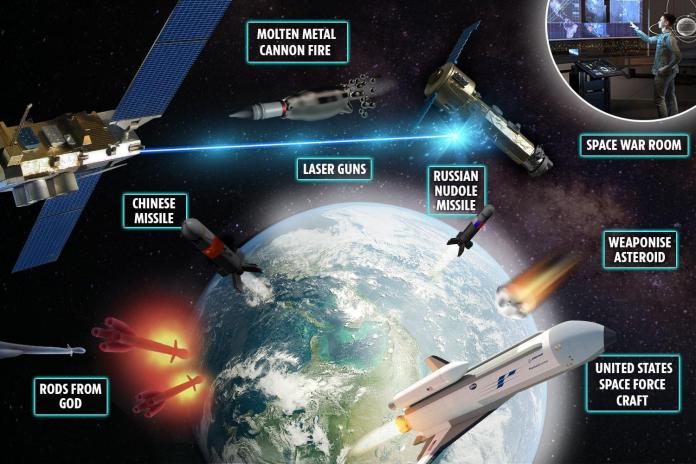
April 9, 2024, Sandra Erwin. https://spacenews.com/u-s-space-command-adopts-multipronged-approach-to-prepare-for-a-conflict-that-has-never-happened/
COLORADO SPRINGS – U.S. Space Command seeks to expand international collaboration by inviting Germany, France and New Zealand to join Operation Olympic Defender. Olympic Defender, a U.S.-led initiative to jointly strengthen defenses and deter hostility, already includes England, Australia and Canada.
“We share intelligence, we plan together and work to ensure space is safe for all,” Gen. Stephen Whiting, commander of U.S. Space Command, said April 9 at the 39th Space Symposium here. “We’re working to even improve our integration through improved command and control and planning. I’ve been proud to work alongside Germany, France and New Zealand for many years, and I look forward to their consideration of our invitation to join Operation Olympic Defender.”
Preparing for military operations with U.S. allies and partners is one of U.S. Space Command’s top priorities.
Other priorities for the Colorado-based organization are making its constellations more resilient, defending them against a growing array of threats, protecting the joint force from space-enabled attack, and conducting tests and training “that convinces us that these capabilities will work in a conflict which has never happened,” Whiting said.
Strategic Competition
As the combatant command responsible for military operations in outer space, U.S. Space Command is closely tracking military moves by China and Russia.
China is rapidly expanding space-based intelligence, reconnaissance and surveillance capabilities, and building a “range of counterspace weapons from reversible jamming all the way up to kinetic hit-to-kill direct-ascent and co-orbital” anti-satellite weapons, Whiting said.
Russia, meanwhile, “continues to invest in counterspace weapons,” Whiting said. “Russia appears more and more to be relying on asymmetric capabilities like space, cyber and nuclear.”
2027 Deadline
U.S. Space Command is focused on maximizing combat readiness by 2027.
“All of us at U.S. Space Command are laser-focused on improving all of our existing forces and capabilities, so that we can stitch them together seamlessly when called upon,” Whiting said.
U.S. Space Command also intends to draw on commercial space technology.
“Our commercial industry will deliver innovative state-of-the-art capabilities,” Whiting said. “We have to modernize our legacy systems, ensure they all work together seamlessly and deliver new capabilities by 2027 to counter the threats that we now see.”
Beyond 2027
At the same time, U.S. Space Command is eager to adopt technology that is likely to pay off in the longer term.
“It’s time to bring dynamic space operations and on-orbit logistics and infrastructure to the space domain,” Whiting said. “Sustained space maneuver will change how we operate, opening up new tactics, techniques, procedures and operating concepts, and allowing operations until the mission is complete, not until the fuel we launched with runs out.”
With an eye toward future conflict, U.S. Space Command also is expanding its reliance on modeling and simulation.
Whiting announced that Space Command’s Capability Assessment and Validation Environment, a modeling and simulation laboratory known as CAVE, has achieved minimum viable capability.
CAVE “enables us to perform analysis on warfighting, on plans, on campaigning,” Whiting said. Space Command will rely on CAVE to help plan “operations for a war that’s never happened and a war we don’t want to happen. We’ll also use it to figure out our combatant command requirements and gain insights into multi-domain joint-warfighting concepts.”
Rolls Royce taps funding for nuclear-powered space missions
Rolls-Royce has received a funding boost from the UK Space Agency to
develop nuclear-powered projects for the space sector. Some £1.2m is being
offered up to Rolls-Royce Submarines and the US-based nuclear supplier BWX
Technologies as part of a project to use fission nuclear systems for space
missions.
It comes as part of a wider £13m funding package unveiled by the
government to support 11 international space projects, ranging from
capturing high-res photos of the Moon and Mars to X-ray images of the
Earth’s Aurora. Other beneficiaries include Vertical Future, which is
developing a “robotic space arm” facility to grow plants in space, and
the University of Leicester, which is identifying potential space missions
for nuclear powered technologies.
City AM 8th April 2024 https://www.cityam.com/rolls-royce-taps-funding-for-nuclear-powered-space-missions/
Patrick Lawrence: ‘Automated Murder’: Israel’s ‘AI’ in Gaza

In the Lavender case, the data it produced were accepted and treated as if they had been generated by a human being without any actual human oversight or independent verification.

A second AI system, sadistically named “Where’s Daddy?”—and how sick is this?—was then used to track Hamas suspects to their homes. The IDF intentionally targeted suspected militants while they were with their families, using unguided missiles or “dumb” bombs. This strategy had the advantage of enabling Israel to preserve its more expensive precision-guided weapons, or “smart” bombs.
“intelligent” weapons proven effective in Gaza were major attractions when Israel marketed them last month at the Singapore Airshow, East Asia’s biggest arms bazaar.
dehumanized, grotesquely technologized future
By Patrick Lawrence and Cara Marianna / Original to ScheerPost, April 9, 2024
ZURICH—“Technological change, while it helps humanity meet the challenges nature imposes upon us, leads to a paradigm shift: It leaves us less capable, not more, of using our intellectual capacities. It diminishes our minds in the long run. We strive to improve ourselves while risking a regression to the Stone Age if our ever more complex, ever more fragile technological infrastructure collapses.”
That is Hans Köchler, an eminent Viennese scholar and president of the International Progress Organization, a globally active think tank, addressing an audience here last Thursday evening, April 4. The date is significant: The day before Köchler spoke, +972 Magazine and Local Call, independent publications in Israel–Palestine, reported that as the Israel Defense Forces press their savage invasion of the Gaza Strip, they deploy an artificial intelligence program called Lavender that so far has marked some 37,000 Palestinians as kill targets. In the early weeks of the Israeli siege, according to the Israeli sources +972 cites, “the army gave sweeping approval for officers to adopt Lavender’s kill lists, with no requirement to thoroughly check why the machine made those choices or to examine the raw intelligence data on which they were based.”
Chilling it was to hear Köchler speak a couple of news cycles after +972 published these revelations, which are based on confidential interviews with six Israeli intelligence officers who have been directly involved in the use of AI to target Palestinians for assassination. “To use technologies to solve all our problems reduces our ability to make decisions,” Köchler asserted. “We’re no longer able to think through problems. They remove us from real life.”
Köchler titled his talk “The Trivialization of Public Space,” and his topic, broadly stated, was the impact of technologies such as digital communications and AI on our brains, our conduct, and altogether our humanity. It was sobering, to put the point mildly, to recognize that Israel’s siege of Gaza, bottomlessly depraved in itself, is an in-our-faces display of the dehumanizing effects these technologies have on all who depend on them.
Let us look on in horror, and let us see our future in it.
We see in the IDF, to make this point another way, a rupture in morality, human intelligence, and responsibility when human oversight is mediated by the algorithms that run AI systems. There is a break between causality and result, action and consequence. And this is exactly what advanced technologies have in store for the rest of humanity. Artificial intelligence, as Köchler put it, is not intelligence: “It is ‘simulated intelligence’ because it has no consciousness of itself.” It isn’t capable, he meant to say, of moral decision-making or ethical accountability.
In the Lavender case, the data it produced were accepted and treated as if they had been generated by a human being without any actual human oversight or independent verification. A second AI system, sadistically named “Where’s Daddy?”—and how sick is this?—was then used to track Hamas suspects to their homes. The IDF intentionally targeted suspected militants while they were with their families, using unguided missiles or “dumb” bombs. This strategy had the advantage of enabling Israel to preserve its more expensive precision-guided weapons, or “smart” bombs.
As one of +972’s sources told the magazine:
We were not interested in killing [Hamas] operatives only when they were in a military building or engaged in a military activity… . On the contrary, the IDF bombed them in homes without hesitation, as a first option. It’s much easier to bomb a family’s home. The system is built to look for them in these situations.
Once Lavender identified a potential suspect, IDF operatives had about 20 seconds to verify that the target was a male before making the decision to strike. There was no other human analysis of the “raw intelligence data.” The information generated by Lavender was treated as if it was “an order,” sources told +972—an official order to kill. Given the strategy of targeting suspects in their homes, the IDF assigned acceptable kill ratios for its bombing campaigns: 20 to 30 civilians for each junior-level Hamas operative. For Hamas leaders with the rank of battalion or brigade commander, +972’s sources said, “the army on several occasions authorized the killing of more than 100 civilians in the assassination of a single commander.”
In other words, Israeli policy, guided and assisted by AI technology, made it inevitable that thousands of civilians, many of them women and children, would be killed.
There appears to be no record of any other military deploying AI programs such as Lavender and Where’s Daddy? But it is sheer naïveté to assume this diabolic use of advanced technologies will not spread elsewhere. Israel is already the world’s leading exporter of surveillance and digital forensic tools. Anadolu, Turkey’s state-run news agency, reported as far back as February that Israel is using Gaza as a weapons-testing site so that it can market these tools as battle-tested. Antony Lowenstein, an author Anadolu quotes, calls this the marketing of “automated murder.”
And here we find ourselves: Haaretz, the Israeli daily, reported on April 5 that “intelligent” weapons proven effective in Gaza were major attractions when Israel marketed them last month at the Singapore Airshow, East Asia’s biggest arms bazaar. …………………………………………………………………………………………………………………………………………………….
the Biden regime is culpable in inflicting these multiple wounds on humanity in one other dimension we must not miss. With its incessant attempts to suspend us in a virtual reality of its making, distant from what it is doing in our names, it leads us into the dehumanized, grotesquely technologized future Köchler describes just as surely as the Israelis do as they murder human beings wholesale with AI weapons and kill innocent children with remotely controlled sniper drones. https://scheerpost.com/2024/04/09/patrick-lawrence-automated-murder-israels-ai-in-gaza/
Israel’s ‘Where’s Daddy?’ AI system helps target suspected Hamas militants when they’re at home with their families, report says
Business Insider, Rebecca Rommen , Apr 7, 2024,
- An Israeli AI system called “Where’s Daddy?” tracks suspected Hamas militants to their homes.
- Civilians are often “collateral damage” in the following strikes, one unnamed officer told +972 Magazine and Local Call.
- The IDF has said it “makes various efforts to reduce harm to civilians to the extent feasible.”
…………………………………………………. (Subscribers only) https://www.businessinsider.com/israel-ai-system-wheres-daddy-strikes-hamas-family-homes-2024—
Non-proliferation experts urge US to not support nuclear fuel project

By Thomson Reuters, Apr 4, 2024 , By Timothy Gardner, https://wtvbam.com/2024/04/04/non-proliferation-experts-urge-us-to-not-support-nuclear-fuel-project/
WASHINGTON (Reuters) – Nuclear proliferation experts who served under four U.S. presidents told President Joe Biden and his administration on Thursday that a pilot project to recycle spent nuclear fuel would violate U.S. nuclear security policy.
SHINE Technologies and Orano signed a memorandum of understanding in February to develop a U.S. plant to recycle, or reprocess, nuclear waste. It would have a capacity of 100 tonnes a year beginning in the early 2030s.
The project would violate a policy signed by Biden in March, 2023 that says civil nuclear research and development should focus on approaches that “avoid producing and accumulating weapons-usable nuclear material,” the experts said in a letter to the president.
“If such a facility were constructed in the United States, it would legitimize the building of reprocessing plants in other countries, thereby increasing risks of proliferation and nuclear terrorism,” they said.
Many non-proliferation advocates oppose reprocessing, saying its supply chain could be a target for militants seeking to seize materials for use in a crude nuclear bomb.
France and other countries have reprocessed nuclear waste by breaking it down into uranium and plutonium and reusing it to make new reactor fuel. A U.S. supply chain would likely be far longer than in those countries, non-proliferation experts say.
Former President Gerald Ford halted reprocessing in 1976, citing proliferation concerns. Former President Ronald Reagan lifted a moratorium in 1981, but high costs have prevented plants from opening.
The White House’s national security council and the National Nuclear Security Administration did not immediately respond to requests for comment.
A SHINE spokesperson said its technology improves global safety and that “responsible recycling of spent fuel is the only known way to actually eliminate plutonium that has already been generated in fission reactors.”
An Orano USA spokesperson said: “It’s a blending of our expertise to develop a process that is sensitive and addresses non-proliferation concerns, but also gleans this viable commercial material.”
The letter was signed by 11 former U.S. officials including Thomas Countryman, who served under President Barack Obama, Robert Einhorn, who served under President Bill Clinton, Robert Galluci, who served under President George H.W. Bush, and Jessica Matthews, who served under former President Jimmy Carter.
The Biden administration believes nuclear energy to be critical in the fight against climate change. But the waste is kept in storage in pools and then thick casks at nuclear plants across the country as there is no permanent place to put it. The Advanced Research Projects Agency-Energy, or ARPA-E, said in 2022, it is funding a dozen projects to reprocess the waste, with $38 million
Russia calls out US over plans to militarize space
https://www.rt.com/russia/595548-moscow-us-militarize-space/ 7 Apr 24
Washington uses hostile rhetoric and baseless allegations to cover up its own intentions to send weapons into space, Moscow claims
The US has been seeking to dismantle legally-binding international security mechanisms and replace them with vague norms of the so-called ‘rules-based world order’, Russian Foreign Ministry spokeswoman Maria Zakharova said on Saturday.
The remarks were in response to statements from the outgoing US assistant secretary of defense for space policy, John Plumb, at a Defense Writers Group meeting on Friday. According to Zakharova, Plumb dismissed Russian-Chinese initiatives on the prevention of an arms race in space as a “political ploy,” claiming that adherence to the deal would not be verifiable.
“The US is an ardent opponent of Russian initiatives to prevent an arms race in outer space. Strong opposition to the aforementioned Russian-Chinese draft treaty has long been an integral part of American foreign policy,” Zakharova said in a Telegram post, referring to a 2008 draft agreement.
Instead, the US has been pursuing its own approach to keeping space free of weapons by promoting a “set of norms of ‘responsible’ behavior within the framework of their concept of a ‘rules-based world order,’” which is untenable both in technical and international legal terms, the spokeswoman said.
Plumb’s remarks, as well as Washington’s ongoing activities in the UN Security Council with regard to nuclear weapons in space, are part of its longstanding efforts to dismantle the system of legally-binding security treaties, she claimed.
The Russian Embassy in the US provided a similar assessment of Plumb’s remarks, suggesting they are part of a concerted campaign to divert attention away from Washington’s own pursuits. “We consider the Pentagon’s manipulations of information to be further proof of US attempts to use Russophobic slogans to justify its own plans for militarizing space,” the mission said in a statement.
Meanwhile, Washington has been promoting a resolution on the non-deployment of nuclear weapons in space. The UN Security Council is set to vote on the US- and Japan- backed document next week, which, if adopted, would reaffirm that countries must fully comply with their obligations under the 1967 Outer Space Treaty, which bans weapons of mass destruction in space.
The resolution comes amid claims in the US media early this year that Russia is seeking to deploy anti-satellite nukes, or at least mock-ups, into space. Moscow has strongly denied the claims, with Russian President Vladimir Putin describing them as “unfounded accusations.”
‘Curious Timing’: What’s Behind US Security Council Resolution Proposing Ban on Nukes in Space?

Ilya Tsukanov. 5 Apr 24 https://sputnikglobe.com/20240405/curious-timing-whats-behind-us-security-council-resolution-proposing-ban-on-nukes-in-space-1117767963.html
Russia has promised to “form a position” on a US-sponsored Security Council resolution proposing a ban nuclear weapons in space in due course. Why is Washington suddenly so interested in the idea? What kinds of things could the resolution contain? Sputnik asked one of America’s top independent military and foreign affairs observers to comment.
Matters of strategic security are one of the few areas where potential for dialogue between Russia and the US exists, Kremlin spokesman Dmitry Peskov has said.
“The main potential area for dialogue between the United States and Russia is issues related to strategic security, which includes the space issue,” the spokesman told reporters on Friday, commenting on plans by the US and Japan to put forward a resolution before the United Nations Security Council next week proposing a ban on the deployment of nuclear weapons in space.
“As for the project, we need to wait, study the document, read it and then form a position,” Peskov said.
Peskov’s comments were preceded by remarks by White House National Security Council spokesman John Kirby on Thursday outlining Washington’s expectations for Moscow as far as the as yet untabled draft resolution is concerned.
“We have heard President Putin say that Russia has no intention of deploying nuclear weapons in space,” Kirby said. “So we look forward to Russia voting in favor of this resolution. There should be no reason why not to. And if they do [sic], then I think that should open up some really legitimate questions to Mr. Putin about what his intentions really are,” Kirby added, with his comments coming off as an attempt to force Moscow’s hand on the issue.
“Our position is quite clear and transparent,” Putin said in a meeting in the Kremlin with Defense Minister Sergei Shoigu back in February, commenting on claims by US officials that Russia had obtained some kind of “troubling” new “anti-satellite weapon capability” that might become operational soon.
“We have always been and remain categorically opposed to the deployment of nuclear weapons in space. Just the opposite, we are urging everyone to adhere to all the agreements that exist in this sphere,” Putin said, adding that Western powers “know” that Russia’s space-based capabilities are in line with those possessed by other nations, including the United States.
Russia has “many times suggested to strengthen joint cooperation in the area but for some reason, in the West, this topic has not come up again,” Putin said.
“We haven’t deployed any nuclear weapons in space or any elements of them to use against satellites or to create fields where satellites can’t work efficiently,” Shoigu said during the meeting, accusing Washington of talking up a Russian space threat to pressure Congress into approving more aid to Kiev, and to try to maneuver Russia into nuclear arms control negotiations suspended amid the crisis in Ukraine.
“The US and the West…are calling for Russia’s strategic defeat, while on the other hand saying they would like to have a dialogue on strategic stability, pretending that those things aren’t connected,” Putin said, stressing that such an approach “won’t work.”
What’s in the Resolution?
The US-Japanese joint resolution reportedly urges countries to commit not to “develop nuclear weapons or any other kinds of weapons of mass destruction designed to be placed in orbit,” reaffirming the expectation that nations “fully comply” with the 1967 Outer Space Treaty prohibiting nuclear arms in space.
Further details on the draft resolution have not been publicized, but Russian Deputy Ambassador to the UN Dmitry Polyansky commented on the proposal last month, calling it “divorced from reality” and accusing the US of “yet another propaganda stunt” via a “very politicized” draft document.
Curious Timing
“It’d be interesting to know the details of this proposed treaty by the United States,” Earl Rasmussen, a veteran independent military and foreign affairs commentator and retired US Army Lieutenant Colonel with 20 years of service under his belt, told Sputnik.
“I’m often kind of cautious when they propose something, because the US is probably the one country that has reneged or withdrawn unilaterally from more treaties than any other country,” Rasmussen said.
Saying the Outer Space Treaty could use an update after nearly 60 years, Rasmussen said he found the timing of the US proposal both “interesting” and “curious,” and the undisclosed details crucial to know, because a treaty dealing with the deployment of nuclear weapons in space already exists.
“I’m just curious what the intent behind this is,” the analyst pondered, wondering whether the resolution could be meant to reign in not just the deployment of nuclear weapons in outer space, but their development as well.
“I mean if we look at the [1972 Anti-Ballistic Missile] Treaty that the US pulled out of – they were developing missile defense systems prior to doing so and then they withdrew from the treaty and deployed them,” Rasmussen said, noting that there is nothing prohibiting countries from developing, but not fielding, powerful space-based weapons at the moment.
“I also think that the US probably has concerns over EMP,” the observer said, referring to electromagnetic pulse weapons which can knock out satellite electronics. “Nuclear weapons obviously can do that, but you don’t need a nuclear weapon. The US even admits that they’re not sure that Russia is developing a nuclear weapon for outer space, but I think they’re concerned about it.”
The US military machine is “highly dependent on satellites” for its operations, Rasmussen said. “So I’m thinking they’re probably concerned as far as not really having a good defensive capability to counter some type of satellite killer or disrupter or something. So that may be behind this.”
Whatever the case may be, “there’s got to be a benefit” to Washington to field the resolution now, or they wouldn’t be proposing it, the observer stressed.
If the resolution is honestly worded, and promotes proposals beneficial to everyone, Rasmussen doesn’t see a problem Russia and other countries considering it. “But if it angles and cuts off research and tries to skew proposals to the West’s benefit, then you could see China and Russia pushing back,” he predicted.
The US has repeatedly accused Russia of developing space-based superweapons capable of tilting the global strategic balance, most recently via the creation of nuclear-powered satellite killer technology.
At the same time that it has accused Russia of militarizing space, the Pentagon has gradually ramped up its own space warfare capabilities, formally establishing Space Force as a separate branch of the US military in 2019, taking steps to ramp up its space-based military activities with new satellite constellations, and openly discussing plans to turn space into a new “warfighting domain.” Last December, Marine Corps Lt. Gen. Matthew Glavy emphasized that the US must “win the space domain” to win wars.
In 2008, Russia and China introduced the Proposed Prevention of an Arms Race in Outer Space (PAROS) Treaty – a comprehensive draft arms control agreement designed to ban the deployment of weaponry, anti-satellite systems and other advanced technology used for military purposes in space.
Moscow and Beijing have returned to the treaty again and again in negotiations with Washington and its allies, with Russian Foreign Minister Sergey Lavrov emphasizing as recently as 2021 that “generally accepted, legally binding measures which can prevent a military confrontation in outer space” can be created, with PAROS serving as a jumping off point for talks. Successive US administrations have rejected PAROS as a “diplomatic ploy” by Russian and China to somehow give the countries a “military edge” over the US.
Not content with nuclear wastes to the seas, the nuclear lobby now wants floating nuclear power – (for the environment! they say).
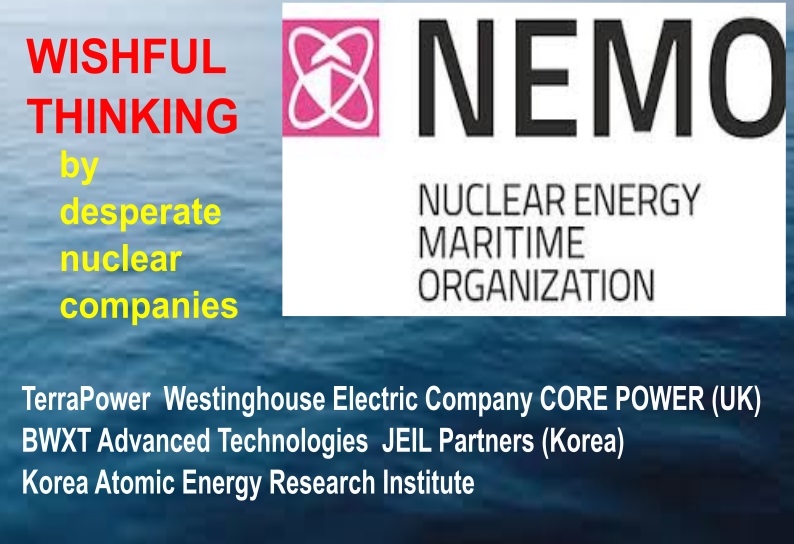
New association for maritime nuclear created
OFFSHORE ENERGY , April 3, 2024, by Naida Hakirevic Prevljak
A global group of companies with a common interest in developing nuclear energy solutions for the maritime sector have launched Nuclear Energy Maritime Organization (NEMO).
To be headquartered in London, NEMO will officially start activities in the second quarter of 2024.
By bringing together stakeholders with relevant expertise, NEMO aims to assist nuclear and maritime regulators in the development of appropriate standards and rules for the deployment, operation and decommissioning of floating nuclear power………………………………
Advanced nuclear technologies deployed at sea can reduce environmental impact, enhance social responsibility, and increase economic competitiveness. NEMO aims to provide a platform for its members to network and facilitate a functional connection between regulators to foster development and exchange best practices.
NEMO’s inaugural members are South Korean shipbuilder HD KSOE, the UK-based classification society Lloyd’s Register, American manufacturing and engineering company BWXT Advanced Technologies, American nuclear innovation company TerraPower, Japanese shipbuilder and ship repairer Onomichi Dockyard, American nuclear reactor designer and vendor Westinghouse Electric Company, Anglo-American maritime nuclear innovation company CORE POWER (UK), Fincantieri subsidiary VARD Group, French classification society Bureau Veritas, Italian classification society RINA, and Korean developer, consultant serving nuclear supply chain JEIL Partners.
……………………………………. The organization plans to hold regular events, workshops, webinars, and publications for its members and the wider public. The organization also intends to collaborate with other industry associations, government bodies, academic institutions, and civil society organizations to advance the cause of floating nuclear power.
In related news, Korean industry majors, led by shipping companies HMM and Sinokor, forged an alliance last year to develop nuclear-powered ships.
Under the agreement, the partners aim to develop and demonstrate how small modular nuclear reactors can be used to propel ships. The project will also investigate the development of relevant marine system interface and propulsion technology as well as the production of hydrogen using molten salt reactors (MSR). https://www.offshore-energy.biz/new-association-for-maritime-nuclear-created/
The $97 billion mess – spent nuclear fuel reprocessing in Japan

The reprocessing plant was initially scheduled for completion in 1997.
Including expenditures for the future decommissioning of the plant, the total budget has reached 14.7 trillion yen. (close to $97 billion)
Even if the reprocessing plant is completed, it can treat only 800 tons of spent nuclear fuel annually at full capacity, compared with 19,250 tons of spent fuel stored nationwide.
“They have invested too much money in the program to give up on it halfway,“
Another delay feared at nuclear fuel reprocessing plant in Aomori
By AKI FUKUYAMA/ Staff Writer, April 1, 2024, https://www.asahi.com/ajw/articles/15183716
Long-flustered nuclear fuel cycle officials fear there could be another delay in the project.
In a surprise to hardly anyone, the “hopeful outlook” for completion in June of a spent fuel reprocessing plant, a key component in Japan’s nuclear fuel cycle project, was pushed back in late January.
The facility is supposed to extract plutonium and uranium from used nuclear fuel. The recycled fuel can then be used to create mixed-oxide (MOX) fuel, which can run certain nuclear reactors.
But the incompletion of the plant has left Japan with 19,000 tons of spent nuclear fuel with nowhere to go.
The nuclear waste stockpile will only grow, as the administration of Prime Minister Fumio Kishida is turning to nuclear energy to cut Japan’s greenhouse gas emissions and reduce the country’s dependence on increasingly expensive fossil fuels.
Under the plan, 25 to 28 reactors will be running by 2030, more than double the current figure. Tokyo Electric Power Co. is seeking to restart reactors at its Kashiwazaki-Kariwa nuclear power plant in Niigata Prefecture this year.
31 YEARS AND COUNTING
A sign reading “village of energy” stands near Japan Nuclear Fuel Ltd.’s nuclear fuel reprocessing plant in Rokkasho, Aomori Prefecture.
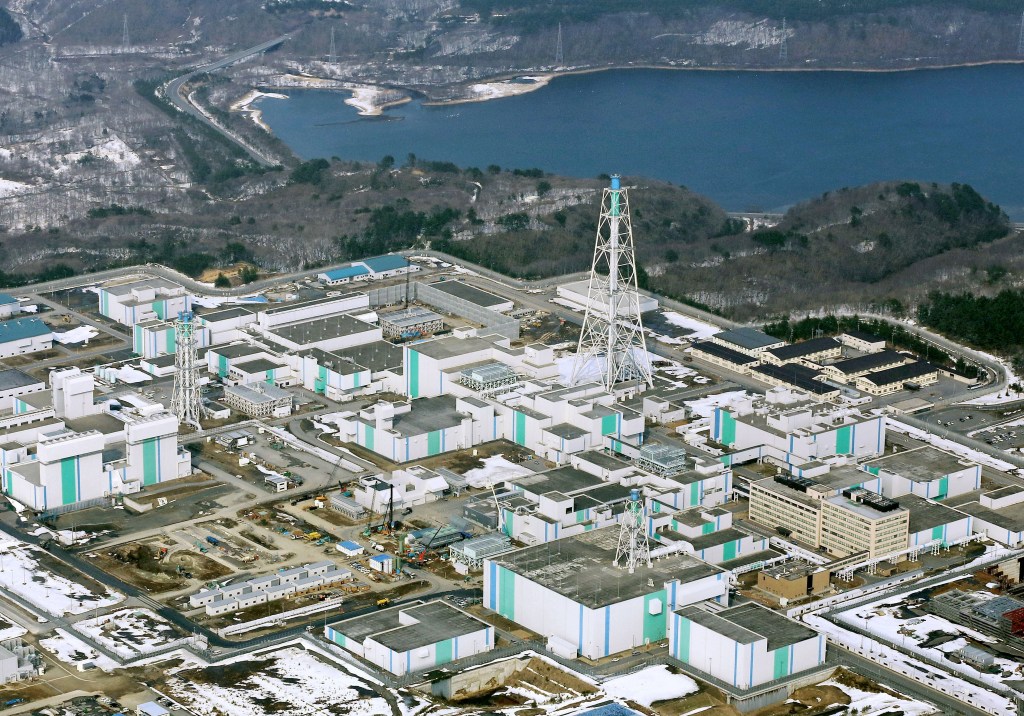
The site, which is 159 times the size of Tokyo Dome, is lined with white buildings with no windows.
Construction started 31 years ago. It was still being built in late November last year, when it was shown to reporters.
The reprocessing plant is located on the Shimokita Peninsula at the northern tip of the main Honshu island.
Crops in the area are often damaged by cold humid winds during summer, so Rokkasho village accepted the plant in 1985 for local revitalization in place of agriculture.
Employees of privately-run Japan Nuclear Fuel, which is affiliated with nine major power companies, and other industry-related personnel account for more than 10 percent of Rokkasho’s population.
After repeated readjustments to the schedule, Naohiro Masuda, president of Japan Nuclear Fuel, said in December 2022 that the plant’s completion should come as early as possible during the first half of fiscal 2024, which is April to September 2024. More specifically, he pointed to “around June 2024.”
But at a news conference on Jan. 31 this year, Masuda said it is “inappropriate to keep saying the plant will be completed in June.”
The reprocessing plant was initially scheduled for completion in 1997.
Many insiders at the plant say it will be “quite difficult” to complete the work within the first half of fiscal 2024.
If officially decided, it will be the 27th postponement of the completion.
PROLONGED SCREENING, ACCIDENTS
One of the reasons for the delay of the completion is prolonged screenings by the Nuclear Regulation Authority.
Flaws were identified one after another in the company’s documents submitted to the nuclear watchdog, and around 400 Japan Nuclear Fuel employees are working on the papers within a gymnasium at the plant site.
Mechanical problems have also hampered progress. In 2022, for example, a system to cool high-level radioactive liquid waste broke down.
Masuda visited industry minister Ken Saito on Jan. 19 to report on the situation at the plant.
Saito told Masuda about the construction, “I expect you to forge ahead at full tilt.”
Masuda stressed his company “is fully devoted to finishing construction as soon as possible,” but said safety “screening is taking so much time because we have myriad devices.”
The cost to build the reprocessing plant, including new safety measures, has ballooned to 3.1 trillion yen ($20.57 billion), compared with the initial estimate of 760 billion yen.
Including expenditures for the future decommissioning of the plant, the total budget has reached 14.7 trillion yen. (close to $97 billion)
Even if the reprocessing plant is completed, it can treat only 800 tons of spent nuclear fuel annually at full capacity, compared with 19,250 tons of spent fuel stored nationwide.
Kyushu Electric Power Co. said in January that it would tentatively suspend pluthermal power generation at the No. 3 reactor of its Genkai nuclear power plant in Saga Prefecture. The reactor uses MOX fuel.
Kyushu Electric commissioned a French company to handle used fuel, but it recently ran out of stocks of MOX fuel.
Kyushu Electric has a stockpile of plutonium in Britain, but it cannot take advantage of it because a local MOX production plant shut down.
HUGE INVESTMENT
Calls have grown over the years to abandon the nuclear fuel cycle project.
Many insiders of leading power companies doubt whether the reprocessing plant “will really be completed” at some point.
But the government has maintained the nuclear fuel cycle policy, despite the huge amounts of time and funds poured into it.
“The policy is retained just because it is driven by the state,” a utility executive said.
Hajime Matsukubo, secretary-general of nonprofit organization Citizens’ Nuclear Information Center, said the government’s huge investment explains why the fuel cycle program has yet to be abandoned.
“They have invested too much money in the program to give up on it halfway,” Matsukubo said.
Say no to small modular reactors: Stop normalizing the exploitation of nature

The Bulletin, By Erin Hurley | April 1, 2024 Erin Hurley is a fourth-year student at St. Thomas University in Fredericton, New Brunswick, where she studies Environment & Society and Journalism. She was a research assistant last year on the Plutonium Project, funded by the Social Sciences and Humanities Research Council (SSHRC), for which she explored news media discourses on proposed small modular reactors in New Brunswick. This year, she is a research assistant on the SSHRC-funded CEDAR (Contesting Energy Discourses through Action Research) Project, for which she is focusing on news media coverage of energy transitions in the province.
Among other global crises, the worsening impacts of climate change are intensifying every year. Last year was the warmest on record and, beginning in March 2023, raging wildfires filled cities across Canada with smoke for months. This year is already shaping up to be warmer than the last. This is why a lot of young people are questioning the very systems we live under. This is why many of us support a rapid and just transition in energy. But in this process, some governments are promoting an expansion of nuclear power, supposedly to solve climate change. I fear that such an expansion will result in my generation having to confront an equally terrifying set of problems resulting from the nuclear fuel chain.
This is precisely what I already see happening around me in the Canadian province of New Brunswick where I live and study. Over the last few years, the province’s government has advocated for and funded the development of what it calls small modular reactors (SMRs). Even though SMR doesn’t include the word “nuclear,” these are nuclear reactors. Ostensibly, these reactors are meant to decarbonize the Canadian economy. But in 2021, New Brunswick Energy Minister Mike Holland protested the 2030 target for phasing out coal in the province, saying new nuclear reactors would not be ready in time to meet that goal. How will the expansion of nuclear power decarbonize the economy if, meanwhile, New Brunswick is still extracting and burning fossil fuels?
The province has funded two companies—Moltex Energy and ARC Clean Technology—to develop small modular reactors. On their websites, Moltex and ARC market nuclear power as “clean,” “carbon free,” and a “clean energy solution.”
Last year, Moltex CEO Rory O’Sullivan spoke to me, my fellow students, and professors working on the Plutonium Project at St. Thomas University in Fredericton, New Brunswick, in which we explored these small modular reactors being proposed for the province to develop an understanding of the assumptions, claims, and implications of these technologies. I remember O’Sullivan as friendly and well-spoken. He emphasized that a transition away from fossil fuels is necessary and that renewable energy is a key element in this transition. Yet he told us that wind farms, for example, could not generate enough energy to sustain our society, and that battery storage was not advanced enough to help with this, and thus renewables could not be considered an effective climate solution on their own. This is why he advocates for small modular reactors—as a necessary supplement to renewables in the energy transition. But, again, he stressed that, at Moltex, they were working to reduce any potential safety risks.
This made me wonder: What about the highly radioactive waste these reactors will produce?
Even if SMRs produce less waste than past nuclear reactors (although not when weighted by how much electricity they produce), spent fuel will remain dangerously radioactive for thousands of years. While nuclear proponents have argued that a deep geological repository would be an effective storage space for the waste, there are many uncertainties surrounding this proposal, and the long-term impacts are unknown. The proposed sites for the repository are located on traditional Indigenous lands in the Wabigoon Lake Ojibway Nation-Ignace and Saugeen Ojibway Nation-South Bruce areas in Ontario. Because the safety of the proposed repository is unproven, storing radioactive waste there would jeopardize the health of the local Indigenous communities and their lands.
Moltex and ARC have advertised reprocessing as a way to recycle waste and use it to power other reactors. However, this is also incredibly dangerous, because once plutonium is separated from used nuclear fuel, it can be used much more easily in the production of atomic weapons. If separated plutonium were to fall into the wrong hands, the result would be nuclear proliferation—an increased number of nuclear weapons across the globe.
In addition to the waste and proliferation problems, small modular reactors will not be built and operating in time to be an effective climate solution. Canada’s climate targets involve decreasing greenhouse gas emissions to 40 per cent below 2005 levels by 2030 and reaching net-zero by 2050. However, ARC predicts that it will finish building its first small modular reactor by 2028 which will “replace the existing coal generation station in 2030” at Point Lepreau Nuclear Generating Station in Saint John, New Brunswick. And Moltex does not expect to have an “operational reactor” until “the early 2030s.”
This timeline will clearly not help Canada reach its decarbonization goal by 2030, and so the country will not be on track for the 2050 goal either. Given these realities, I find it hard to believe that nuclear power is in the best interest of humans, non-human species, or the planet as a whole.
Capitalist nations that prioritize economic growth above all else, such as the United States and Canada, have normalized the exploitation of nature……………………………………………….. more https://thebulletin.org/2024/04/say-no-to-small-modular-reactors-stop-normalizing-the-exploitation-of-nature/#post-heading
Is Nuclear Fusion Really The Ultimate Solution to AI’s Crazy Power Use?

By Alex Kimani – Mar 29, 2024, https://oilprice.com/Energy/Energy-General/Is-Nuclear-Fusion-Really-The-Ultimate-Solution-to-AIs-Crazy-Power-Use.html
- A Boston Consulting Group analysis has predicted that data center electricity consumption will triple by 2030.
- Past trends in technology advances suggest that AI cons are very likely to outweigh the pros as far as power demand is concerned.
- OpenAI’s Altman: nuclear fusion is the ultimate solution to the AI energy puzzle
Two weeks ago, we reported how Artificial Intelligence (AI), cryptocurrency mining and clean energy manufacturing are powering the Fourth Industrial Revolution, or simply 4R, and driving disruptive trends including the rise of data and connectivity, analytics, human-machine interaction, and improvements in robotics. Unfortunately, these secular megatrends are pushing the U.S. power grid to its limits.

According to Sreedhar Sistu, vice president of artificial intelligence at Schneider Electric (OTCPK:SBGSF), excluding China, AI represents 4.3 GW of global power demand, and could grow almost five-fold by 2028. Another analysis has predicted that demand from AI will grow exponentially, increasing at least 10x between 2023 and 2026.

AI tasks typically demand more powerful hardware than traditional computing tasks. Meanwhile, bitcoin mining shows no signs of slowing down, with mining rates hitting 565 exahashes per second (EH/s) currently, a five-fold increase from three years ago.
Bitcoin mining consumes 148.63 TWh of electricity per year and emits 82.90 Mt CO2 per year, comparable to the power consumption of Malaysia. And, data center demand is not helping matters at all. Data center storage capacity is expected to grow from 10.1 zettabytes (ZB) in 2023 to 21.0 ZB in 2027, good for a 18.5% CAGR.

A Boston Consulting Group analysis has predicted that data center electricity consumption will triple by 2030, enough electricity to power 40 million U.S. homes.
The situation is already getting out of hand: U.S. power demand has started rising for the first time ever in 15 years. “We as a country are running out of energy,” Michael Khoo, climate disinformation program director at Friends of the Earth and co-author of a report on AI and climate, has told CNN.
To be fair, AI has been touted as one of the key technologies that will help tackle climate change. The revolutionary technology is already being used to track pollution, predict weather, monitor melting ice and map deforestation. A recent report commissioned by Google and published by the Boston Consulting Group claimed AI could help mitigate up to 10% of planet-heating pollution.
Unfortunately, past trends in technology advances suggest that AI cons are very likely to outweigh the pros as far as power demand is concerned.
“Efficiency gains have never reduced the energy consumption of cryptocurrency mining. When we make certain goods and services more efficient, we see increases in demand,” Alex de Vries, a data scientist and researcher at Vrije Universiteit Amsterdam, has pointed out.
At this point, nearly everybody agrees that we are incapable of developing renewable energy plants fast enough to meet this skyrocketing power demand. So, what other recourse do we have, short of saying let’s just build more natural gas and fossil fuel power plants?
Enter nuclear fusion, long regarded by scientists as the Holy Grail of clean and almost limitless energy. Sam Altman, head of ChatGPT creator OpenAI, says nuclear fusion is the ultimate solution to the AI energy puzzle, “There’s no way to get there without a breakthrough, we need fusion,” Altman said in a January interview. Altman reiterated this view a few weeks ago when podcaster and computer scientist Lex Fridman asked him about the AI energy conundrum.
Blue Sky Thinking

Unfortunately, Altman’s proposal is likely another case of overly optimistic blue-sky thinking, and we might not be any closer to building a commercial nuclear fusion reactor than we are to harvesting energy from blackholes.
For decades, nuclear fusion has been considered the “Holy Grail” of clean energy. If we were able to harness its power it would mean endless clean and sustainable energy. It’s what powers stars, and the theory is that it could be successfully applied to nuclear reactors–without the risk of a catastrophic meltdown disaster.
Scientists have been working on a viable nuclear fusion reactor since the 1950s–ever hopeful that a breakthrough is just around the corner. Unfortunately, the running joke has become that a practical nuclear fusion power plant could be decades or even centuries away, with milestone after milestone having fallen time and again
To be fair again, there’s been some promising glimpses into the possibilities here. Last year, a nuclear fusion reactor in California produced 3.15 megajoules of energy using only 2.05 megajoules of energy input, a rare instance where a fusion experiment produced more energy than it consumed. The vast majority of fusion experiments are energy negative, taking in more energy than they generate thus making them useless as a form of electricity generation. Despite growing hopes that fusion could soon play a part in climate change mitigation by providing vast amounts of clean power for energy-hungry technologies like AI, the world is “still a way off commercial fusion and it cannot help us with the climate crisis now”, Aneeqa Khan, research fellow in nuclear fusion at Manchester University, told the Guardian just after the initial December breakthrough.
You don’t have to look very far to get a healthy dose of reality check.
For decades, 35 countries have collaborated on the largest and most ambitious scientific experiments ever conceived: the International Thermonuclear Experimental Reactor (ITER), the biggest-ever fusion power machine. ITER plans to generate plasma at temperatures 10x higher than that of the sun’s core, and generate net energy for seconds at a time. As is usually the case with many nuclear power projects, ITER is already facing massive cost overruns that puts its future viability in question. W
When the ITER project formally commenced operations in 2006, its international partners agreed to fund an estimated €5 billion (then $6.3 billion) for a 10-year plan that would have seen the reactor come online in 2016. Charles Seife, director of the Arthur L. Carter Institute of Journalism at New York University, has sued ITER for lack of transparency on cost and incessant delays. According to him, the project’s latest official cost estimate now stands at more than €20 billion ($22 billion), with the project nowhere near achieving its key objectives. To make matters worse, none of ITER’s key players, including the U.S. Department of Energy, has been able to provide concrete answers of whether the team can overcome the technical challenges or estimates of the additional delays, much less the extra expenses.
Seife notes that whereas the Notre Dame took a century to complete, it eventually was used for its intended purpose less than a generation after construction began. However, he concludes by saying that the same can hardly be said about ITER, which looks less and less like a cathedral–and more like a mausoleum.
1 This Month


PLEASE OPPOSE HR 8255 AND S.3639 – bills would accelerate satellite deployment, with no environmental review or safeguards – https://ncstd5li.quorum.us/campaign/169331/
To see nuclear-related stories in greater depth and intensity – go to https://nuclearinformation.wordpress.com
-
Archives
- September 2026 (194)
- August 2026 (330)
- July 2026 (355)
- June 2026 (287)
- May 2026 (306)
- April 2026 (356)
- March 2026 (251)
- February 2026 (267)
- January 2026 (308)
- December 2025 (358)
- November 2025 (359)
- October 2025 (375)
-
Categories
- 1
- 1 NUCLEAR ISSUES
- business and costs
- climate change
- culture and arts
- ENERGY
- environment
- health
- history
- indigenous issues
- Legal
- marketing of nuclear
- media
- opposition to nuclear
- PERSONAL STORIES
- politics
- politics international
- Religion and ethics
- safety
- secrets,lies and civil liberties
- spinbuster
- technology
- Uranium
- wastes
- weapons and war
- Women
- 2 WORLD
- ACTION
- AFRICA
- Atrocities
- AUSTRALIA
- Christina's notes
- Christina's themes
- culture and arts
- Events
- Fuk 2022
- Fuk 2023
- Fukushima 2017
- Fukushima 2018
- fukushima 2019
- Fukushima 2020
- Fukushima 2021
- general
- global warming
- Humour (God we need it)
- Nuclear
- RARE EARTHS
- Reference
- resources – print
- Resources -audiovicual
- Weekly Newsletter
- World
- World Nuclear
- YouTube
-
RSS
Entries RSS
Comments RSS
 nuclear-news