Now Keir Starmer Has to Decide If He’d Use Nukes
Becoming the British prime minister means giving top-secret orders—immediately—that could determine the fate of the world.
The Atlantic, By Brian Klaas, 5 July 24
Following a landslide victory for the Labour Party, Britain has a new leader. The moment Keir Starmer is officially made prime minister of the United Kingdom, he will be given a flurry of briefings, piles of documents, and the urgent business to run the country. Lurking among those papers is a moral land mine.
Starmer will be given a pen and four pieces of paper. On each paper, he must handwrite identical top-secret orders that—hopefully—no other human being will ever see. The previous set of orders, written by outgoing Prime Minister Rishi Sunak, will then be destroyed, unopened. These top-secret papers are called the “letters of last resort.”
Since 1969, Britain’s nuclear deterrent has operated at sea, with nuclear missiles that could be launched from at least one continuously deployed submarine. Destroying those vessels would eliminate the United Kingdom’s nuclear deterrent, so the secrecy of the patrolling submarine’s location is paramount. Once deployed, the submarine may not transmit messages, only receive them, to maintain its crucial cloak of concealment………………………. (Subscribers only) more https://www.theatlantic.com/international/archive/2024/07/british-election-nuclear-weapons/678919/
Book. Nuclear is Not the Solution. The Folly of Atomic Power in the Age of Climate Change.

New book by MV Ramana.
Nuclear power will slow our response
to climate change and increase the risk of weapons proliferation and
catastrophe. The climate crisis has propelled nuclear energy back into
fashion. Its proponents argue we already have the technology of the future
and that it only needs perfection and deployment.
Nuclear Is Not the Solution demonstrates why this sort of thinking is not only naïve but
dangerous. Even beyond the horrific implications of meltdown and the
intractable problem of waste disposal, nuclear is not practicable on such a
large scale.
Any appraisal of future energy technology depends on two
important parameters: cost and time. Nuclear fails on both counts. It is
more costly than its renewable competitors wind and solar. And, importantly
given the need for rapid transformation, it is slow. A plant takes a decade
to come online. If you include permits and fundraising, this adds another
decade.
And we should not forget the deep roots it has in the defense
industry. M. V. Ramana’s powerful book destroys any illusion that nuclear
is our answer to climate change, untangling technical arguments into simple
and sensible language.
Importantly, Nuclear Is Not the Solution also
unmasks the powerful groups with vested interests in the maintenance of the
status quo, currently working hard to greenwash a spectacularly dirty
industry. It’s why we believe that, as recommended by the Skidmore Net
Zero Review, there should be an Office for Net Zero Deployment, holding the
government to account against sustainability and Net Zero targets.
Penguin – Random House 5th July 2024
Europe is Quietly Debating a Nuclear Future Without the US

America has protected Europe with is nuclear umbrella for more than 70 years. In the era of Vladimir Putin and Donald Trump, the continent is quietly debating a different nuclear future.
Politico, By LAURA KAYALI, THORSTEN JUNGHOLT and PHILIPP FRITZ, 07/04/2024
In a castle near Stockholm, standing on a blue-curtained podium that hid the room’s gilt mirrors and sparkling chandeliers, French President Emmanuel Macron ripped open a debate that Europe had been avoiding not just for years but for decades.
Macron had chosen the time and place carefully; he was on a state visit to Sweden, one of the long-neutral European countries who decided in 2022 to join NATO in response to Russia’s full-scale invasion of Ukraine. He was sharing the stage with Sweden’s king and prime minister, and faced an audience of Swedish military cadets and officers who were recalibrating their mission and ideas about their country’s, and the continent’s, security. It was the last week of January, and Sweden’s final ratification as a NATO member was just weeks away. And he spoke in English, to make sure people outside of France and Sweden paid attention.
During the Cold War, Macron noted, “all the treaties were decided by the former USSR and USA. Everything that covered our territory was decided by the big guys in the room, not by the Europeans themselves.” Going forward, he said, looking around the audience to make sure his point was getting across, in the area of arms control, troop deployments and the entirety of Europe’s security architecture, that needs to change. “We have to be the one to decide,” Macron said.
The room of military officers was quiet. Macron hadn’t used the word “nuclear,” but he didn’t have to. A Swedish officer stood up and asked if France, as “the only EU country with an independent nuclear force,” had a “special responsibility” to protect the security of the continent’s northernmost region, the Arctic sea passage. In other words, was France prepared to use its nuclear weapons if Scandinavian countries were threatened from the north, presumably from Russia’s bases in the Arctic.?
“Definitely yes,” Macron responded without hesitation, as if he anticipated the question. “Part of our vital interest has a European dimension, which gives us a special responsibility, given precisely what we have and the deterrence capacity we have,” he added. ……………………………………………………………………………………………………….
Recently, Trump has been downplaying his threat to pull back from NATO, saying that he’ll keep the United States in NATO “100 percent.” But every time, he is still quick to add conditions on U.S. participation, including that allies keep up defense spending and “play fair.”
Both European and U.S. experts say it’s unlikely a Trump administration would decide to physically take out the nukes stationed in Europe. But nuclear deterrence depends on political credibility, and there’s an unspoken fear in Europe that Trump would be less willing to come to the aid of European allies than his predecessors. Would Putin be so confident that Trump would be willing to risk a nuclear war to save Estonia?
“The French and the British are going to have to think about their nuclear posture if Trump is elected and if he makes good on his threat to disengage from NATO,” said Daniel Fried, a former U.S. ambassador to Poland.
“It’s the first time since the 1960s that European countries have to question the American umbrella,” he added.
Macron’s ambitions for France’s nuclear deterrent haven’t exactly been a hit with his constituents, with far-right and far-left parties accusing him of selling out France’s sovereignty to the Europeans. But that hasn’t stopped him from continuing to promote the idea, mentioning it three more times in just the last few months.
Macron hasn’t provided many specifics about how exactly this arsenal would cover Europe, but has made clear that France would remain fully in charge: “It’s the President of the Republic as head of the armed forces who defines the engagement of this nuclear force in all its components and who defines France’s vital interests,” he told The Economist. “It’s not a question of changing that.” …………………………………………………………….
For its part, France has about 290 warheads, but is not a member of the NPG. In comparison, the U.S. has more than 5,000 nukes and Russia 5,580, according to a study by the Stockholm International Peace Research Institute.
At all times, London and Paris each have at least one nuclear-armed ballistic missile submarine patrolling the seas. A few days after the Russian invasion of Ukraine, Paris deployed three (out of four) submarines at the same time — an unprecedented level of alert. ……………………………………………………
It’s fair to say that quite a few European countries think that by reopening the debate over its nuclear umbrella, Europe has far more to lose than to gain. Chief among them is Germany, which has a history of saying no thank you to nuclear pushes from French presidents. …………………………………………………………………………………..
At least for now, the future of Europe’s conversation on nuclear deterrence depends on several high-stakes elections. Citizens from NATO’s three nuclear powers — the United States, the United Kingdom and France — are all going to the polls this year and NATO- and Euro-skeptics could soon be wielding power in both Paris and Washington.
That’s one reason why the topic is unlikely to be aired openly during the gathering of NATO leaders that will take place in Washington from July 9 to 11. “I do not expect European nuclear defense to be much of a topic at the summit,” one European diplomat said, “rather NATO will again affirm its deterrence and defense.”………………………….. more https://www.politico.com/news/magazine/2024/07/04/europe-us-nuclear-weapons-00166070
‘Letters of last resort’: deciding response to a nuclear attack among first of Starmer’s tasks

The handwritten instructions new PMs write for Trident submarine commanders contain instructions for what to do if Britain’s leaders are killed
Guardian Dan Sabbagh 5 July 24
ometime soon after entering Downing Street as prime minister, Keir Starmer will be briefed on the deadly capability of Britain’s nuclear deterrent – and asked to consider what instructions to give Trident submarine commanders in the unlikely event the UK is destroyed in an all-out attack and he is among the millions killed.
In the aftermath of an election victory, it is a sobering moment. Tony Blair is described as having gone “quite quiet” just over a quarter of a century ago when asked to handwrite four identical “letters of last resort” to the commanders in the event that the UK no longer in effect exists.
James Strong, a senior lecturer at Queen Mary, University of London, said the exercise acted as a counterweight to the drama of staying up all night, winning an election and visiting the monarch. “This is the moment where prime ministers say the reality of the job dawns on them, and that may be a reason why it keeps being done in this way”……………
While the previous Labour leader Jeremy Corbyn was personally opposed to Trident, Starmer has already signalled he supports it – and would if necessary fire nuclear missiles. “We have to be prepared” to unleash the deterrent’s destructive power, the new prime minister said last month, describing it as “a vital part of our defence.”
The briefing is led by Adm Tony Radakin, the head of the armed forces, accompanied by what one former Downing Street official described as “stern-faced admirals in improbably grey suits”
There are about 40 warheads on every Vanguard submarine that carries the Trident missiles, though the exact number is a secret and may be slightly higher. Each is estimated to have an explosive power of 100 kilotons, according to David Cullen of the Nuclear Information Service – theoretically powerful enough to cause serious blast damage in a 3km radius.
In a time of war, it would fall to the prime minister (or if he or she were unavailable or dead, a nominated alternative whose identity is not disclosed) to authorise a nuclear attack.
The letters to the four commanders are handwritten, not necessarily immediately but relatively promptly. There are considered to be four basic options: retaliate; do nothing; join forces with an allied nation, probably the US; and even leave the matter to the commander’s discretion. “Taking the last option really would be passing the buck,” Strong said.
Once written, the letters are sealed in an envelope, and can only be delivered physically. Soon after, they are deposited in what one former Trident commander described as a “safe within a safe” in each of the submarines. There has been a British nuclear-armed submarine at sea on patrol at all times since 1969.
Meanwhile, Sunak’s instructions to the submarine on patrol remain in force, until a new boat has gone out with one of Starmer’s letters. Once no longer needed, the old prime minister’s instructions are destroyed, and what they have said has never been publicly disclosed, to maintain an aura of uncertainty.
Navy insiders say a complex verification process exists before a letter can be opened, which requires determining whether the UK has been subject to an all-out nuclear attack. That involves listening for signals from home – which back in the 1960s could only come from Radio 4 and other longwave radio stations – but today comes from a wide variety of sources, including mobile phones, GPS and shipping radio.
It is also likely there would be world news, listened to at sea, describing a dramatic escalation of global tensions. “You might expect that the level of ‘proof’ which the commanding officer would be required to amass before opening the PM’s letter to be extremely high, and so it is,” one former navy submarine commander said. https://www.theguardian.com/world/article/2024/jul/05/letters-of-last-resort-deciding-response-to-a-nuclear-attack-among-first-of-starmers-tasks
World’s Largest Nuclear Fusion Reactor Delayed

By Matthew Norman, July 6, 2024, https://greekreporter.com/2024/07/06/largest-nuclear-fusion-reactor-delayed/
Construction on the world’s largest nuclear fusion reactor is now complete, but the site won’t be operational for at least another 15 years.
The $28 billion fusion reactor in France, known as ITER, has had its final magnetic coil installed. However, the reactor itself won’t actually fully function until 2039 at the earliest.
The International Fusion Energy Project (ITER) fusion reactor, comprised of 19 huge coils looped into several toroidal magnets, was initially set to begin its first full test in 2020, but now scientists say it will start operating in 2039.
This mean fusion power—of which ITER’s tokamak is leading—is seriously unlikely to be here on time to be a solution for the climate crisis.
“Certainly, the delay of ITER is not going in the right direction,” Pietro Barabaschi, ITER’s director general, said at a news conference on Wednesday, July 3rd. “In terms of the impact of nuclear fusion on the problems humanity faces now, we should not wait for nuclear fusion to resolve them. This is not prudent.”
ITER’s nuclear fusion reactor is the collaborative work of 35 countries, including every state in the European Union, Russia, China, India, and the US. It houses the world’s most powerful magnet, making it capable of producing a magnetic field 280,000 times as strong as the one shielding earth.
Costs and delays to the nuclear fusions reactor
The site was not cheap. It was initially touted to cost around $5 billion and begin operation in 2020, but it has now been hit by several delays, and its budget surged beyond $22 billion, with an additional $5 billion proposed to cover other costs. These delays have led to a 15-year delay already.
Researchers have been making efforts to harness the power of nuclear fusion, the process by which stars burn, for over 70 years. By fusing hydrogen atoms to produce helium under very high pressures and temperatures, stars convert matter into light and heat, bringing about an enormous amount of energy without emitting greenhouse gases or enduring radioactive waste.
However, replicating the conditions inside the hearts of stars is not easy. The most common design for fusion reactors, the tokamak, works by superheating plasma before collecting it inside a donut-shaped reactor chamber with powerful magnetic fields, as reported by Live Science.
It has been extremely difficult to keep the lively and superheated coils of plasma in the right place long enough for nuclear fusion to take place, however. Natan Yavlinsky, a Soviet scientist, designed the first tokamak in 1958, but no scientists have since been able to build a reactor capable of putting out more energy than it takes in.
A huge difficulty is handling the plasma that’s hot enough to fuse. Fusion reactors require extremely high temperatures, as they have to operate at lower pressures than those within the core of stars.
The commissioning of the Flamanville EPR, nuclear reactor is proving difficult
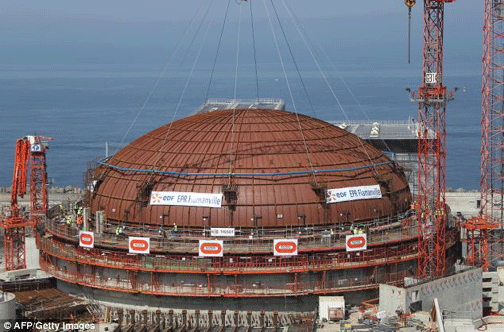
The commissioning of the Flamanville EPR, decided by the ASN on 7 May
2024, is proving difficult. This is not surprising when we remember the
many problems that this reactor has accumulated since the start of its
construction.
As Global Chance has repeatedly pointed out, there is a great
risk of seeing political imperatives take precedence over scientific rigour
and safety culture. The way in which information on commissioning is being
disseminated is worrying and does not in any way meet the conditions
stipulated by the ASN in its decision to authorise commissioning.
The next step, namely the search for criticality and the first divergence, is
crucial. Hasty implementation could prove problematic for the integrity of
the reactor and would put local populations at risk. This note is to be
updated regularly depending on the situation and the availability of
information relating to the EPR start-up operations.
Global Chance 4th July 2024
https://global-chance.org/Laborieuse-mise-en-service-de-l-EPR-de-Flamanville
Work to show UK nuclear ‘environmentally sustainable’ incomplete, 16 months after government announcement.

Stop Sizewell C executive director and company secretary Alison Downes believes labelling nuclear as green was a ploy to allow investors to justify their investment in the project.
04 JUL, 2024 BY THOMAS JOHNSON, https://www.newcivilengineer.com/latest/work-to-show-nuclear-environmentally-sustainable-incomplete-16-months-after-government-announcement-04-07-2024/
Government work to justify classifying nuclear energy generation as “environmentally sustainable” cannot be produced as it is incomplete, despite ex-chancellor Jeremy Hunt making the announcement in the 2023 Spring Budget, NCE can reveal.
NCE submitted a Freedom of Information (FOI) request to the Department of Energy Security and Net Zero (DESNZ) requesting all the documentation that was produced to back Hunt’s claim, but was refused because it is “still in the course of being completed”.
In March 2023 during the Spring Budget statement, Hunt announced the government would be consulting on listing nuclear energy as “environmentally sustainable” in a bid to increase private investment in the sector.
Hunt stated nuclear was a “critical source of cheap and reliable energy” to meeting the UK’s net zero obligations.
On the reclassification of nuclear energy, the government’s budget document stated: “Nuclear energy will also be included in the green taxonomy, subject to consultation, encouraging private investment.”
DESNZ’s reasoning for not responding to the FOI is due to the fact it has not completed the consultation as to whether it should go ahead with its plans to deem nuclear as “environmentally sustainable” which it started 16 months ago.
DESNZ stated that it “does hold information in scope of this request, however we will not be releasing this at this time as it is covered by exemption 12(4)(d) which states ‘a public authority may refuse to disclose information to the extent that the request relates to material which is still in the course of completion, to unfinished documents or to incomplete data’. Your request falls within the scope of this provision because the requested information relates to material still in the course of completion”.
It continued: “In order to apply the exemption detailed above we must also consider whether withholding such information is within the public interest. The consultation document to which the requested information relates has not been published, meaning the policy pertaining to the content of the consultation document is not finalised. For this reason, we feel it would not be in the public interest to release the information at this time.”
In its Mobilising green investment: 2023 green finance strategy document related to the consultation for nuclear to be included within the green taxonomy, it states the government intended to consult on this in autumn last year.
It further stated the consultation and getting this policy through was a priority that would be achieved by Q1 of this year.
Reaction
Stop Sizewell C executive director and company secretary Alison Downes believes labelling nuclear as green was a ploy to allow investors to justify their investment in the project.
She said: “The green taxonomy seems to be the final piece of the puzzle because the whole emphasis behind adopting the RAB model was to coax non-typical investors, like UK pension funds.
“Obviously the theory behind labelling nuclear as green would allow them to tick another environmental, social and governance (ESG) box that would enable them to justify the investment.”
Downes hypothesises that the reason behind the policy review not being completed yet could be due to the fact that Sizewell C’s recent attempt at leveraging private capital for the project in Spetember last year didn’t bring forward any atypical investors.
“If investors have an appetite for nuclear then great but if they don’t, this isn’t going to tip the balance,” she said.
“In our regular engagement with government officials they kept saying it’s coming, it’s coming, which in government speak it is ‘in due course’, which means sometime soon, maybe never.
“It was very much plugged for Q1 this year and then it didn’t happen.
“I wonder whether the fact they launched the capital raise last September where they had to get bidders to go through the pre-qualification process and it was apparent that very few were from that target market.
“Suddenly they mave have thought if we’ve got a lot on our plate, is it a priority to push this taxonomy review through?”
UK/Ireland Nuclear Free Local Authorities (NFLAs) secretary Richard Outram said it is astounding that the government was unable to come up with any justification for making the claim back in March 2023.
He said: “It is notable that even now 16 months after Jeremy Hunt claimed that nuclear is a ‘sustainable and environmentally friendly energy generation solution’ that officials in the DESNZ despite their resources, are unable to come up with the justification that underlines this claim.
“That says a lot.”
Stop Sizewell C and other anti-nuclear groups maintain that nuclear is not a environmentally energy generation solution due to the waste it creates, its contamination of the earth and other nature surrounding the power plants and the highly emission intensive methods of decommissioning old plants.
Outram continued: “The NFLAs believe that nuclear is simply too costly (Hinkley Point C’s original budget was £18bn now current real budget is £46bn and rising), too slow (Hinkley Point C was meant to be generating power to cook turkeys in time for christmmas 2017 but will now be 2031 earliest), always comes with the possibility of an accident, always cause environmental contamination, and leaves a massive and costly legacy of decommissioning redundant nuclear power plants and managing and disposing of nuclear waste (NDA current estimates £260bn).
“Events in Ukraine have also demonstrated that nuclear power plants represent a massive target and a potential ‘dirty bomb’ in the event of war with a hostile state actor and Britain’s nuclear reactors have historically been powered by uranium from Russia which is now an unreliable supplier as it is that hostile state actor.”
The NFLAs are instead calling on an energy strategy that prioritises the reduction of energy usage in the UK.
Continue readingSecond review of ARC’s Small Modular Nuclear Reactor not complete, despite layoffs

That’s after ARC Clean Technology Canada said it downsized with that review now over
Telegraph Journal, Adam Huras, Jul 04, 2024
A second design review of a New Brunswick-based company’s proposed small modular nuclear reactor is not yet complete, according to the Canadian Nuclear Safety Commission.
That’s after ARC Clean Technology Canada said it downsized with that review now over.
Brunswick News reported last month that ARC, one of two companies pursuing SMR technology in the province, had handed out layoff notices to some of its employees, citing its latest design phase coming to an end.
That’s as its CEO also departed.
But the Canadian Nuclear Safety Commission says it’s “months” away from completing its review, and may need more information from the company.
“We have received all of ARC’s major submissions as part of the vendor design review process and our experts are carefully reviewing them,” commission spokesperson Braeson Holland told Brunswick News.
“It is possible that staff will have additional questions for the vendor. In that case, additional information may be requested, and the company will be expected to provide it for the vendor design review to proceed.
“Provided that any additional information requested is submitted in a timely manner and that the company remains in compliance with its service agreement with the Canadian Nuclear Safety Commission, we anticipate that the review will be complete within several months.”
A vendor design review is an optional service that the commission provides for the assessment of a vendor’s reactor design.
The objective is to verify, at a high level, that Canadian nuclear regulatory requirements and expectations, as well as Canadian codes and standards, will be met.
The company did complete a Phase 1 review of its ARC-100 sodium-cooled fast reactor in October 2019.
An executive summary of that review, made public by the commission, noted that there were requests for additional information, as well as technical discussions through letters, emails, meetings and teleconferences, after an initial submission.
The result of that first review found that “additional work is required by ARC” to address findings raised in the review, specifically around the reactor’s management system.
It then lists a series of technical concerns, but concludes that “these issues are foreseen to be resolvable.”
A Phase 2 design review, which ARC is undergoing right now, goes into further detail, and focuses on identifying fundamental barriers to licensing for a new design in Canada, according to the commission.
That review started in February 2022, and was expected to be completed in January of this year.
It’s unclear why it has yet to be completed.
At a New Brunswick Energy and Utilities Board hearing last month into a recent power rate hike, NB Power vice president Brad Coady testified he doesn’t expect SMRs will be ready by an original target date of 2030.
The utility now believes they’ll be ready by 2032 or 2033……………….
https://tj.news/new-brunswick/second-review-of-arcs-smr-not-complete-despite-layoffs
Constellation Energy plans restart of Three Mile Island nuclear plant
Constellation Energy is in discussions with the US state of Pennsylvania
governor’s office and state legislators regarding funding for a potential
restart of a unit at the Three Mile Island power facility, Reuters has
reported. The ongoing talks have been described as “beyond preliminary”
by two sources.
The move indicates that Constellation is moving forward
with plans to bring back part of the nuclear generation site in southern
Pennsylvania, which was operational from 1974 until its closure in 2019.
The unit at Three Mile Island that may be restarted is distinct from the
facility’s unit 2, which suffered a partial meltdown in 1979 – the most
notorious nuclear accident in US history.
Power Technology 3rd July 2024 https://www.power-technology.com/news/constellation-three-mile-island-pennsylvania/
Fusion power could transform how we get our energy — and worsen problems it’s intended to solve
The Conversation Sophie Cogan, PhD Candidate, University of York July 6, 2024
Harnessing energy from nuclear fusion – the combining of nuclei, which lie within atoms – could be instrumental in the shift towards a decarbonised global energy system. As issues of climate change and energy security are becoming increasingly salient, the promise of an apparently “clean”, “abundant” and “safe” energy source, such as fusion, is ever more appealing.
In response, the fusion industry is growing rapidly and the trope that fusion is “30 years away and always will be” is beginning to lose credibility as the technology moves beyond its experimental stage.
But it’s too easy to generate hype around a seemingly ideal solution to societal challenges – and I would argue that the realisation of fusion energy may come into tension with the issues it proposes to solve.
Contextualising this hype and exploring areas where these tensions may arise is critical to ensuring the technology develops in an ethically sound way and can provide net societal benefit if it proves viable………………………………………..
benefits may mask deeper ethical questions around the development of the technology and some potentially detrimental impacts. Perhaps one of the clearest instances of such a tension arises over environmental sustainability. This applies particularly to the association with climate change mitigation and the reduction of greenhouse gas emissions.
Climate change is an issue that lends itself to the “techno-fix” approach – in other words, it can be tempting to avoid making important changes to our behaviour because we think we can depend on technology to fix everything. This is known as the “mitigation obstruction” argument.
Squaring greenhouse gas emissions with energy demand also raises questions of justice and equity. Energy demand is growing in certain regions, primarily the global south, that have contributed the least to the current climate crisis. Yet fusion programmes are overwhelmingly based in the global north. So if fusion proves viable, those with access to such a transformative technology are not necessarily those who will need it most.
Climate change is a global challenge, so any proposed solution must account for global impact. Efforts must be made to recognise the context of development and incorporate considerations of global inequity in the deployment of fusion if we are to meet the climate challenge.
Similar concerns can be found in the materials used for fusion energy. These include critical minerals, including lithium, tungsten and cobalt. Extraction and processing of these minerals emits greenhouse gases. In some cases, extraction operations are located on or near the lands of indigenous peoples. And the supply chains for these materials are embedded in geopolitical tensions, with alliances, collaboration, competition and the potential for monopolies forming.
Mercury, for example, is used in the processing of lithium for fusion reactors. Not only is the element environmentally damaging and toxic but depends largely on Chinese production……………………………….. https://theconversation.com/fusion-power-could-transform-how-we-get-our-energy-and-worsen-problems-its-intended-to-solve-233948
Australia further in the grip of the USA, with the Amazon data spy hub – paid for by Aussie tax-payers!
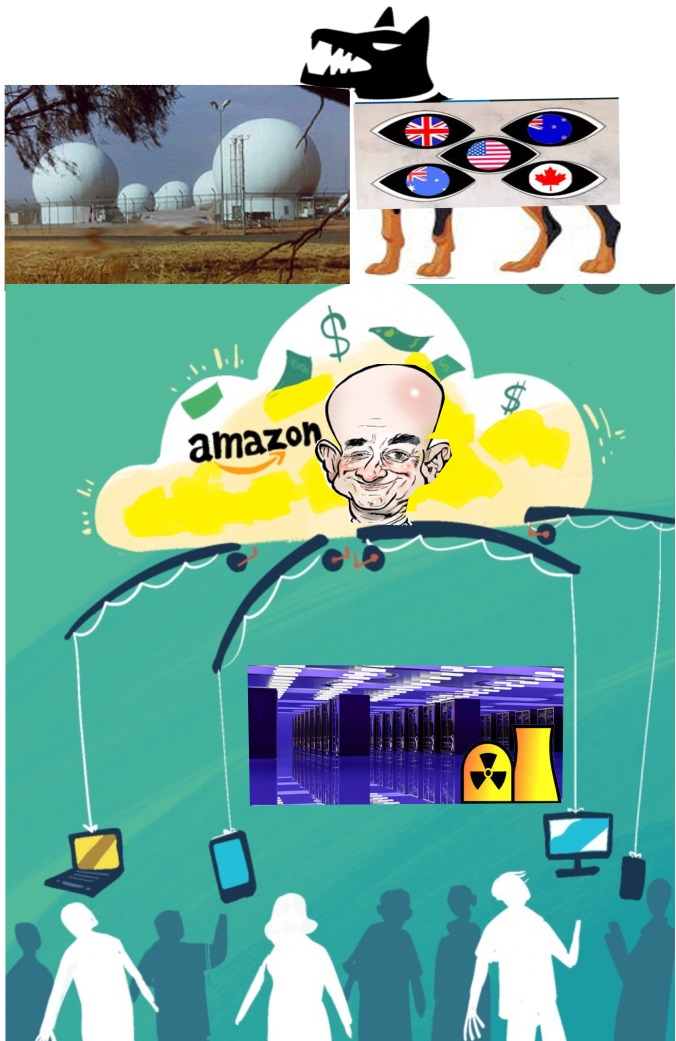
Australia’s Defence Minister Richard Marles was ecstatic as he announced the secret deal now organised for Australia to pay for Amazon to set up secret spy databanks, just as he was ecstatic about the government’s AUKUS deal for buying nuclear submarines from USA and UK.
It’s not as if the public knew about either of these decisions beforehand, (the AUKUS one being largely arranged with scandal-ridden consultancy PWC). It’s not as if these matters were discussed in Parliament. On both occasions, the government just did it.
Points that haven’t been addressed:
Australian taxpayers again foot the bill to an America private company
Amazon private staff will be running the operation – with access to the data?
The whole thing perpetrates the lie about the data being “in the cloud” – but there is no “cloud”. The data will be in gigantic steel containers, set out on a large area.
The data containers will require massive amounts of electricity. ? supplied by nuclear power
The data containers will require massive amounts of cooling water, in this dry, water-short country..
The whole set up, just like the now-being expanded Pine Gap. will form a dangerous target for terrorists, or for enemies of the USA.
Like Pine Gap, it is probable that Australian authorities will have limited access to the information. And as artificial intelligence is involved – who IS goig to be in control?
The whole set-up will be the servant of the Five Eyes, secret intelligence of five English-speaking countries, ( no trust in Europe, or any non-anglophone nation) but controlled by the USA.
The vast amount of tax-payer money going to all this means the money is not going to Australians’ health, welfare, education, environment, climate action – in other words to the common good.
As the USA Supreme Court has just made the U.S. president effectively above the law – this secret deal with Amazon and the USA puts Australia more firmly in the grip of the USA – (and God help us if Trump wins)
-
Archives
- October 2026 (112)
- September 2026 (339)
- August 2026 (330)
- July 2026 (355)
- June 2026 (287)
- May 2026 (306)
- April 2026 (356)
- March 2026 (251)
- February 2026 (267)
- January 2026 (308)
- December 2025 (358)
- November 2025 (359)
-
Categories
- 1
- 1 NUCLEAR ISSUES
- business and costs
- climate change
- culture and arts
- ENERGY
- environment
- health
- history
- indigenous issues
- Legal
- marketing of nuclear
- media
- opposition to nuclear
- PERSONAL STORIES
- politics
- politics international
- Religion and ethics
- safety
- secrets,lies and civil liberties
- spinbuster
- technology
- Uranium
- wastes
- weapons and war
- Women
- 2 WORLD
- ACTION
- AFRICA
- Atrocities
- AUSTRALIA
- Christina's notes
- Christina's themes
- culture and arts
- Events
- Fuk 2022
- Fuk 2023
- Fukushima 2017
- Fukushima 2018
- fukushima 2019
- Fukushima 2020
- Fukushima 2021
- general
- global warming
- Humour (God we need it)
- Nuclear
- RARE EARTHS
- Reference
- resources – print
- Resources -audiovicual
- Weekly Newsletter
- World
- World Nuclear
- YouTube
-
RSS
Entries RSS
Comments RSS

