An Unholy Alliance: billionaire technocrats delight in planning Artificial Intelligence to run nuclear reactors and nuclear weapons!

AI to run nuclear reactors?
AI to run weapons?
What could possibly go wrong?
Imagine! if artificial intelligence had run the Soviet Union’s missile system on September 26 1983, all-out nuclear war would have erupted. It took the imaginative thinking of Lt. Col. Stanislav Petrov to prevent that.
With AI in charge, we will not have a Stanislav Petrov to save us.
New Startup Looks To Blend AI And Nuclear Energy, Oil Price, By Haley Zaremba – Jul 15, 2023
- AI’s increasing role in the energy sector is challenged by its own high energy demands.
- Sam Altman proposes a symbiotic relationship between AI and nuclear energy to address this issue.
……The future of the global energy sector is in the hands of Artificial Intelligence. ……..
…………..But the relationship between AI and energy goes two ways. AI doesn’t just present opportunities to the energy sector; it also presents significant challenges – one of which is the huge amount of energy that AI itself needs for operational purposes. In some cases, the energy footprints of singular AI training models have equaled that of 125 New York-Beijing round-trip flights, or the lifetime carbon footprint of five cars.
Sam Altman, the founder of OpenAI – the now (in)famous firm behind ChatGPT – thinks that nuclear energy will play a key role in keeping AI’s carbon footprint in check. “The AI systems of the future will need tremendous amounts of energy and this fission and fusion can help deliver them,” Altman was recently quoted in the Wall Street Journal. Altman also expressed that he thinks that AI will have some positive implications for nuclear-system designs as well, creating a kind of symbiotic AI-nuclear relationship. This is not a new idea – for years now, researchers have been looking into the various ways that AI and machine learning can be integrated into nuclear power production for a more efficient, less expensive, and safer nuclear energy sector.
Altman is clearly serious about his hope for nuclear energy’s role in the future of the energy and technology sectors. Just this week, it was announced that Oklo, an AI-integrated startup specializing in “nuclear microreactors” will go public in 2024.
Oklo is valued at around $850 million, according to the Wall Street Journal. The company expects that its innovative microreactors will be ideal for military applications where connection to an existing power grid isn’t possible,………… Oklo has already secured $50 million in funding, $420,000 in grants from the Department of Energy (DOE), and a permit to build its first microreactor at the Idaho National Laboratory, the nation’s leading center for nuclear research. The pilot project is slated to come online by 2026 or 2027.
…………………………………Altman is the just latest in a long line of tech billionaires investing in nuclear energy. High-profile proponents of nuclear power include Elon Musk and Bill Gates……..more https://oilprice.com/Alternative-Energy/Nuclear-Power/New-Startup-Looks-To-Blend-AI-And-Nuclear-Energy.html
Rolls-Royce, mini-nuke sector left in dark as Great British Nuclear launch delayed

Proactive Investors, Josh Lamb, 13 Jul 2023
The government delayed the event over “unforeseen circumstances”
Mini nuclear reactor developers including Rolls-Royce Holdings PLC (LSE:RR.) have been left in the dark after the official launch of Great British Nuclear was delayed on Thursday.
Net zero secretary Grant Shapps had been due to unveil the new public body at London’s science museum before the event was cancelled over “unforeseen circumstances”.
Great British Nuclear, originally announced in the chancellor’s spring budget, will be an arms-length body set up to support the roll-out of small modular reactors (SMRs) in the UK……………..
Rolls-Royce and General Electric (NYSE:GE) had been among those due to attend the event, having both proposed designs for prospective use in the UK.
Rolls is currently the only company which has an SMR design currently passing through regulatory assessments though, carried out by the Office for Nuclear Regulation, Environment Agency and Natural Resources Wales.
Shapps was expected to update on the latest round of the government’s SMR competition meanwhile, which will determine which designs are granted public funding. https://www.proactiveinvestors.co.uk/companies/news/1020628/rolls-royce-mini-nuke-sector-left-in-dark-as-great-british-nuclear-launch-delayed-1020628.html
Small nuclear reactor industry in big trouble?

From STOP SMALL MODULAR REACTORS IN CANADA 12 July 23
2 Mycle Schneider, who produces the World Nuclear Industry Status Report (WNISR) says that the recent announcements by the Ontario government about new nuclear reactors at Darlington and Bruce amount to “a mixture of tech fantasy and collective denial of the state of the industry.”
He gave evidence to the Belgian Parliament on SMRs on 20 June 2023, following a first hearing on 30 May 2023. Six of ten presentations were given by technology providers, one by a former administrator of the French Alternative Energies and Atomic Energy Commission (CEA), one by an International Energy Agency representative, and one by a Dutch ex-government “expert” — a very open, balanced panel – sound familiar?
All ten presentations – including Mycle’s – are available in one volume here. Most are in English. He says they provide “useful documentation on current SMR strategies. NuScale and Rolls Royce were invited but did not show up. Maybe NuScale did not feel like coming… When it became public that the NuScale CFO has sold most of his shares, their value on the stock market plunged even further.
The videos of the hearings, including Q&A are here and here.
Small size, big problems: NuScale’s troublesome small modular nuclear reactor plan

EWG, 12 July 23
- Two energy experts discuss the design risks and excessive costs of the NuScale small modular nuclear reactor.
- NuScale project distracts from the need to push clean energy sources.
Despite its small size, NuScale has outsize cost and safety problems.
NuScale is one of several companies making long-shot attempts to commercialize what are known as small modular nuclear reactors, or SMRs. Its 77-megawatt project is the furthest along in the Nuclear Regulatory Commission, or NRC, licensing approval process, but in the earliest stages, with a long way to go. But the NRC has identified serious safety concerns, and cost estimates have ballooned in recent years.
EWG has long warned about the folly of investing in nuclear power, including SMRs that are unlikely ever to get off the ground.
And in a new analysis commissioned by EWG, two nuclear experts with decades of experience note significant NuScale cost and safety drawbacks that have been raised by NRC staff.
The experts recently analyzed the November 15, 2022, pre-application readiness assessment report the NRC issued to NuScale, which details many concerns about the project’s safety. The two authors are Arjun Makhijani, Ph.D., president of the Institute for Energy and Environmental Research, which advocates for a safer environment, and M.V. Ramana, Ph.D., a professor at the School of Public Policy and Global Affairs, University of British Columbia.
Their findings further strengthen the case against more funding for NuScale – yet another nuclear boondoggle that will fleece American taxpayers.
The primary issues they identified were escalation costs and design issues, for which the company has not properly addressed the safety issues involved. These include:
Costs. The projected construction costs of the first proposed NuScale project have grown from $5.3 billion, as estimated in November 2021, to $9.3 billion, in January 2023.
Risks. The NRC and its Advisory Committee on Reactor Safeguards identified several safety risks in the design for the reactor, in particular with the steam generator.
Energy companies, states and the government should stop throwing good money after bad, wasting it on lofty “all of the above” nuclear plans that will never come to fruition.
Instead they should focus on promoting workable, clean power solutions that already exist, like wind, solar and distributed generation, and associated technologies. Taxpayer dollars should be spent only on technologies that fight the climate crisis and do not have a history of persistent, inevitable ratepayer and taxpayer bailouts. Nuclear power and carbon capture and sequestration both fail that test.
The nuclear money pit
The nuclear industry survives in part thanks to assertions of clean, cheap power, which have never materialized, and an oversize influence in Congress and state legislatures………………………………….
Experts: NuScale’s costs soaring
NuScale’s first SMR plant is intended for the Utah Associated Municipal Power Systems, or UAMPS. The goal is to provide power to electric utilities in Utah and surrounding states. The target date is 2029, though nuclear plants have typically been plagued by significant delays. Its estimated cost is over $9 billion for just six small reactors that would, in total, be less than half the size of the standard large nuclear unit.
That estimate has increased by $4 billion in less than two years.
But the government keeps throwing taxpayer dollars at NuScale, promising $1.4 billion to the UAMPS project on top of the $400 million it has already squandered.
Other than these expected costs spiraling out of control, Makhijani and Ramana in their analysis find that even though NuScale keeps changing design specifications for its unit, NuScale’s safety analyses have not evaluated the impact of these design changes.
Experts: Changes in design present dangerous power projections
NuScale has increased by 50 percent the power output of its yet-to-be-built SMR reactor design. This means there will be more heat, pressure and radioactivity, which will further stress critical components of the reactor. These factors increase the risk of a catastrophic breakdown and radiation leak.
Unlike any nuclear power plant that’s already online, NuScale would house the reactor core – the nuclear fuel – and steam generator in the same vessel. This would be a departure from the traditional design, in which the steam generator is separated from the fuel, outside the reactor vessel but inside the secondary containment.
The helical design of the steam generator has also never been used in any other commercial nuclear power plant, which makes it hard to evaluate how it would behave in the long run.
Experts: Risky reactor design
The NRC has preliminarily approved NuScale’s design, despite serious questions about the steam generator. And NuScale still hasn’t produced the necessary analysis of all the accidents that could occur. …………………………………………………………….
Experts: NRC ignored risk guidance
The Advisory Committee on Reactor Safeguards, or ACRS, warned in a letter to NRC the “design and performance of the [NuScale] steam generators have not yet been sufficiently validated.”
The 1954 Atomic Energy Act requires ACRS to review and report to the NRC commissioners and staff about safety studies and reactor facility license and license renewable applications, among other issues.
The ACRS noted that NuScale’s plan “introduces different failure modes.”…………………………………………..
Experts: A flawed energy plan
Makhijani and Ramana conclude that the NuScale project, referred to as VOYGR, has too many problems and that there is insufficient information to justify NuScale’s safety claims.
“[T]he 77-MW VOYGR . . . has not received standard design approval, much less full Commission certification. On the contrary, it has received a letter from the NRC staff with 99 ‘significant’ observations and six major challenges,” they write.
Further, they warn:
These problems need real-world analysis, design, and most important, real-world testing to be resolved. Premature wear of the steam generators and their potential failure were not analyzed properly and insufficiently tested even for the (previous) 50 MW design. The hurdles are even higher with the 77-MW version.
The NuScale project is a trainwreck waiting to happen.
It would be irresponsible for the NRC to proceed at this juncture with any further approval. The question for NRC is whether the agency wants to keep the financially unviable, unsafe nuclear industry alive or focus on public safety and legitimate options for fighting the climate crisis. https://www.ewg.org/news-insights/news/2023/07/small-size-big-problems-nuscales-troublesome-small-modular-nuclear
Labour seeks pact to keep AI out of nuclear arms deployment
David Lammy wants UK to agree rules with other countries to regulate use of artificial intelligence in controlling nuclear weapons
Telegraph 8th July 2023
Nuclear. The Flamanville EPR impacted by the shutdown of the first reactor in China?
In China, the first EPR reactor is again shut down after the discovery of “excessive oxidation” on the reactor claddings. What effect on Flamanville (Manche)?
It looks like a new pebble in the shoe for the EPR , which already had plenty of it. Officially, however, everything is fine. Shutdown of the Taishan 1 reactor in the first quarter of this year was scheduled. This began on January 31, 2023 .
To this reloading operation, the Chinese operator, of which EDF is a 30% shareholder, added inspections. The objective announced by Taishan Nuclear, three weeks ago, is to “gather data for long-term stable operation “, without giving more details. This shutdown was normally only supposed to last a month…
What effect on Flamanville?
But, according to Le Canard enchaîné , this shutdown is linked to the discovery of “excessive oxidation” on the reactor sheaths.
Designed by EDF, the Chinese EPR of Taishan 1 has broken down due to poor workmanship on the made in France sheaths which protect the nuclear fuel. The most beautiful effect, less than a year from the start of the Flamanville EPR!
These sheaths, manufactured by Framatome , are used in particular to transmit the heat given off by the uranium to the water in the primary circuit. Taishan Nuclear would have discovered that in use, friction would tend to slightly damage these fuel sheaths. To date, no restart date has been mentioned.
The first EPR model built in the world, the Taishan 1 reactor has suffered numerous breakdowns since its commissioning in 2018. This technical shutdown could cost France dearly, while a similar problem had been observed a few years ago. on one of the reactors of the Chooz power plant, in the Ardennes (stopped for five months at the time).
If EDF and Framatone have not communicated in recent days, this umpteenth episode is problematic , while a relaunch of the expansion of the EPR is expected in France, and hoped for internationally.
These five months of shutdown of Taishan 1 are added to the counter of the long months of inactivity of the reactor since its commissioning. While EDF announces that it wants to start up the Flamanville EPR next year, this breakdown shows that the start-up of an EPR reactor is not the guarantee of reliable and abundant production.Greenpeace France
Wishful thinking about nuclear energy won’t get us to net zero
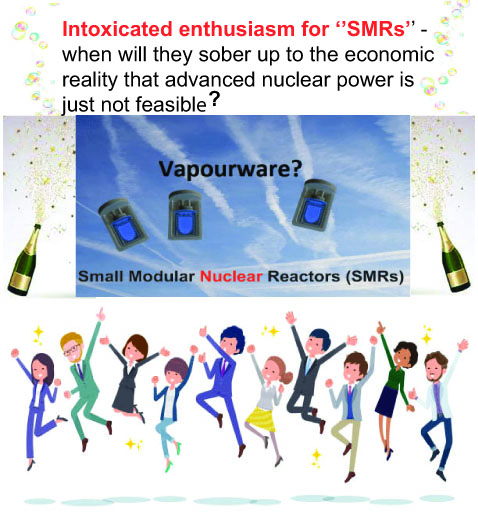
The climate problem is too serious to engage in unrealistic modelling exercises. Wishful thinking about nuclear energy will only thwart our ability to act meaningfully to lower emissions rapidly.
BY M.V. RAMANA AND SUSAN O’DONNELL | July 3, 2023 https://www.hilltimes.com/story/2023/07/03/wishful-thinking-about-nuclear-energy-wont-get-us-to-net-zero/391721/
On June 20, the Canada Energy Regulator (CER) released its 2023 Canada’s Energy Future report, developing scenarios for a path to net zero by 2050. These scenarios project roughly a tripling of nuclear energy generation capacity in Canada by 2050, seemingly reinforcing then-natural resources minister Seamus O’Regan’s statement in 2020 that there is “no path to net zero without nuclear.”
However, underlying both the scenarios and O’Regan’s contention is wishful thinking about the economics of nuclear energy, and how fast nuclear power can be scaled up.
The new nuclear capacity the report envisions consists of so-called small modular nuclear reactors (SMRs), which have so far not been built in Canada. Aside from refurbishing existing CANDU reactors, the CER does not think any more standard sized nuclear reactors will be built in Canada. Most of this buildup is to happen between 2035-2050, meaning that nuclear power will not help meet the government’s stated goal of decarbonizing the electricity grid by 2035.
But can SMRs be built rapidly after 2035? Only two Crown companies in the business of generating electricity for the grid have proposed to build SMRs: NB Power in New Brunswick, and Ontario Power Generation (OPG).
The reactor designs proposed for New Brunswick are cooled by molten salts and liquid sodium metal. Despite decades of development work and billions of dollars invested, major technical challenges have prevented molten salt reactors and sodium-cooled reactors from commercial viability, making it highly unlikely that the New Brunswick designs can be rapidly deployed in the time frame envisioned by the CER.
Assuming that OPG’s chosen design—the 300-megawatt BWRX-300—is the one to be deployed widely, then around 70 SMR units would need to be built and operating effectively on the grid between 2030-2050. The BWRX-300 design is yet to be approved by any safety regulator anywhere in the world.
But the report has an even more serious problem: economics. Nuclear power cannot compete economically, which is why its share of global electricity generation has declined from 17.5 per cent in 1996 to 9.2 per cent in 2022. Because SMRs lose out on economies of scale, they will produce even more expensive electricity.
The CER’s scenarios for nuclear power are based on the Electricity Supply Model, meant to calculate “the most efficient and cost-effective way to meet electricity demand in each region.” Such models are widely used in energy analysis and policymaking, but their utility depends on the validity of the assumptions used; garbage in, garbage out.
Two key parameters underlie the report’s scenarios: the capital cost of an SMR, and how that cost evolves with time. The CER’s assumptions in the two net-zero scenarios are that a SMR costs $9,262 per kilowatt in 2020, falling to $8,348 per kW by 2030, and to $6,519 per kW by 2050. Both these assumptions are ridiculously out of touch with the real world.
Consider the CAREM-25 SMR designed to feed 25 megawatts of electricity into the grid, being built in Argentina since 2014. Its original cost estimate in 2014 of US$446-million has escalated significantly since then, but even using these original costs, the project costs nearly $30,000 per kilowatt in 2022 Canadian dollars.
The NuScale design, arguably the closest to deployment in the United States, has been in development since 2007 with the build not yet begun. The January 2023 cost estimate for six NuScale SMRs with a total capacity of 462 megawatts is $9.3-billion, or over $26,000 per kilowatt in Canadian dollars.
Finally, the cost of the five-megawatt Micro Modular Reactor Project at Chalk River, Ont., was estimated by the proponent in May 2020 to be between $100- and $200-million. In 2022’s Canadian dollars, that works out to $22,000 to $44,000 per kilowatt.
In other words, the CER’s cost assumptions are wild underestimates, two-and-a-half to four times lower than the current evidence.
The second incorrect assumption is that costs will decrease with time. Both in the United States and France, the countries with the highest number of nuclear plants, the trend was the opposite: costs went up—not down—as more reactors were built. In both countries, the estimated construction cost of the most recent reactors being built—Vogtle in the United States and Flamanville-3 in France—have broken new records.
We need government organizations to do better. The climate problem is too serious for such unrealistic modelling exercises. Wishful thinking will only thwart our ability to act meaningfully to lower emissions rapidly.
M.V. Ramana is the Simons Chair in Disarmament, Global and Human Security and professor at the School of Public Policy and Global Affairs at the University of British Columbia. Susan O’Donnell is adjunct research professor and primary investigator of the CEDAR project at St. Thomas University in Fredericton, N.B.
Minireactor cost surge threatens nuclear’s next big thing

Japan Times, BY JONATHAN TIRONE, BLOOMBERG, 3 July 23
High inflation and rising interest rates are driving up the cost of a new generation of miniature atomic reactors that the nuclear industry is relying on to lift sales and help meet climate targets.
Nuclear-company executives and regulators met this week at the International Atomic Energy Agency to negotiate potential manufacturing and technology standards, a key step the industry needs to take in order to make prices competitive with other emissions-free energy sources. There are currently more than 80 unique small modular reactor, or SMR, designs under development, resulting in sprawling supply chains and caps on scaling up production.
“With higher interest rates to deal with and inflation pushing up the cost of steel, copper wire and just about everything else that goes into building an SMR, we know that even the most promising projects are having to tell their investors and buyers that prices have risen substantially,” IAEA Director General Rafael Mariano Grossi said at the meeting in Vienna. “Avoiding, or at least mitigating, cost rises and delays is now even more crucial.”
……………………. Nuclear energy costs in the U.S. currently level out to an average of $373 a megawatt hour, according to the latest estimates by BloombergNEF. That’s significantly higher than solar or onshore wind at $60 and $50 a megawatt hour, respectively.
Enter companies like NuScale Power Corp., the first U.S. SMR developer with a licensed design, and which wants to begin generating at the end of the decade. NuScale originally foresaw average generation costs of $55 a megawatt hour in 2016, which was slightly lifted to $58 five years later.
But new estimates show costs surged to almost $120 a megawatt hour this year, according to company data analyzed by the Institute for Energy Economics. Skyrocketing prices of commodities including steel, carbon fiber and copper drove the increase, according to the report. NuScale’s stock has tumbled a third a third this year.
…………………………….. The IAEA’s Grossi chided delegates that they need to work together to develop industry standards, lest they contribute to the industry’s “reputation of unfulfilled promises.”……… https://www.japantimes.co.jp/news/2023/07/03/business/mini-nuclear-reactor-cost-surge/—
World’s Largest Fusion Project Is in Big Trouble, New Documents Reveal
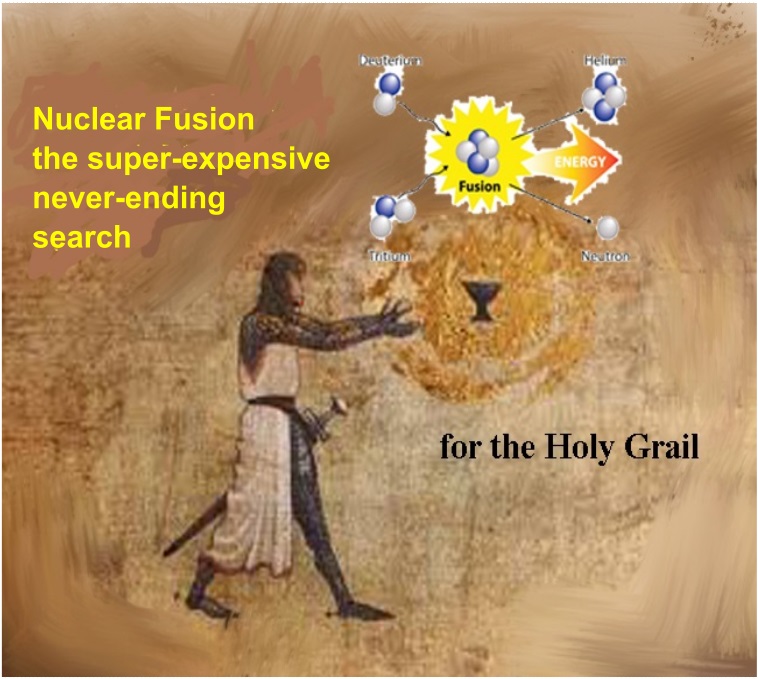
The International Thermonuclear Experimental Reactor (ITER) is already billions of dollars over budget and decades behind schedule. Not even its leaders can say how much more money and time it will take to complete
Scientific American Charles Seife on June 15, 2023
“……………………………….. ITER is on the verge of a record-setting disaster as accumulated schedule slips and budget overruns threaten to make it the most delayed—and most cost-inflated—science project in history.
………………. Since the 1950s fusion machines have grown bigger and more powerful, but none has ever gotten anywhere near what would be needed to put this panacea energy source on the electric grid. ITER is the biggest, most powerful fusion device ever devised, and its designers have intended it to be the machine that will finally show that fusion power plants can really be built.
The ITER project formally began in 2006, when its international partners agreed to fund an estimated €5 billion (then $6.3 billion), 10-year plan that would have seen ITER come online in 2016. The most recent official cost estimate stands at more than €20 billion ($22 billion), with ITER nominally turning on scarcely two years from now.
Documents recently obtained via a lawsuit, however, imply that these figures are woefully outdated: ITER is not just facing several years’ worth of additional delays but also a growing internal recognition that the project’s remaining technical challenges are poised to send budgets spiraling even further out of control and successful operation ever further into the future.
The documents, drafted a year ago for a private meeting of the ITER Council, ITER’s governing body, show that at the time, the project was bracing for a three-year delay—a doubling of internal estimates prepared just six months earlier. And in the year since those documents were written, the already grim news out of ITER has unfortunately only gotten worse.
Yet no one within the ITER Organization has been able to provide estimates of the additional delays, much less the extra expenses expected to result from them. Nor has anyone at the U.S. Department of Energy, which is in charge of the nation’s contributions to ITER, been able to do so. When contacted for this story, DOE officials did not respond to any questions by the time of publication.
The problems leading to these latest projected delays were several years in the making. The ITER Organization was extremely slow to let on that anything was wrong, however. As late as early July 2022, ITER’s website announced that the machine was expected to turn on as scheduled in December 2025. Afterward that date bore an asterisk clarifying that it would be revised. Now the date has disappeared from the website altogether.
ITER leaders seldom let slip that anything was awry either…………………………………………………………….
In response to this stonewalling, earlier this year I initiated a lawsuit under the U.S. Freedom of Information Act seeking to reveal the extent of ITER’s expected schedule and cost troubles. So far, the lawsuit has been partially successful. It has extracted partially redacted documents revealing that in November 2021 ITER’s internal estimates showed the project already facing about 17 months of delays. By the time of the June 2022 ITER Council meeting, the number had doubled to roughly 35 months of delays—enough to easily add billions of dollars to ITER’s already bloated budget. But this timeline didn’t reflect other events bound to introduce even more delays……………………………………………….
With each passing decade, this record-breaking monument to big international science looks less and less like a cathedral—and more like a mausoleum. https://www.scientificamerican.com/article/worlds-largest-fusion-project-is-in-big-trouble-new-documents-reveal/
Even the science engineering big-wigs don’t seem too enthusiastic about nuclear fusion

Nuclear fusion breakthrough: Decades of research are still needed before fusion can be used as clean energy, The Conversation June 28, 2023, Kristen Schell Assistant Professor, Mechanical and Aerospace Engineering, Carleton University. Ahmed AbdullaAssistant Professor, Mechanical and Aerospace Engineering, Carleton University
“…………………………………………….. The efficiency of a potential fusion energy power plant remains to be seen. The reported fusion net gain actually required about 300 megajoules of energy input, which was not included in the energy gain calculation. This energy input, needed to power 192 lasers, came from the electric power grid.
In other words, the experiment used as much energy as the typical Canadian household does in two days. In doing so, the fusion reaction output enough energy to light just 14 incandescent bulbs for an hour.
The same is true of nuclear fission, which is the reaction inside current nuclear power plants. The complete fission of one kilogram of Uranium-235 — the fissile component of nuclear fuel — can generate about 77 terajoules. But we cannot convert all of that energy into useful forms like heat and electric power.
Instead, we have to engineer a complex system that can control the nuclear fission chain reaction and convert the generated energy into more useful forms.
This is what nuclear power plants do — they harness the heat generated during nuclear fission reactions to make steam. This steam drives a turbine connected to an electric power generator, which produces electricity. The overall efficiency of the cycle is less than 40 per cent.
In addition, not all of the uranium in the fuel is burned. Used fuel still contains about 96 per cent of its total uranium, and about a fifth of its fissile Uranium-235 content.
Increasing the amount of uranium spent in our current fleet is possible — it’s an ongoing sphere of work — but it poses enormous engineering challenges. The huge energy potential of nuclear fuel is currently mitigated by the engineering challenges of converting that energy into a useful form.
From science to engineering
Until recently, fusion has been seen primarily as a scientific experiment, not as an engineering challenge. This is rapidly changing and regulators are now investigating how deployment might unfold in the real world.
Regardless of the efficiency of a future fusion power plant, taking energy conversions from basic science to the real world will require overcoming a multitude of challenges………………….
The science of fusion energy, as with nuclear fission, is rooted in efforts to develop nuclear weapons. Notably, several nuclear physicists who helped develop the nuclear bomb wanted to “prove that this discovery was not just a weapon.”
The early history of nuclear power was one of optimism — of declarations the technology would advance and be able to meet our need for ever-increasing amounts of energy. Eventually, fusion power would come along and electricity would become “too cheap to meter.”
Lessons learned
What have we learned over the past 70 years since the onset of nuclear power? First, we’ve learned about the potentially devastating risk of technology lock-in, which occurs when an industry becomes dependent on a specific product or system.
Today’s light-water fission reactors — reactors that use normal water as opposed to water enriched with a hydrogen isotope — are an example of this. They were not chosen because they were the most desirable, but for other reasons.
These factors include government subsidies that favoured these designs; the U.S. Navy’s interest in developing smaller-scale pressurized water reactors for submarines and surface warships; advances in uranium enrichment technology as a result of the U.S. nuclear weapons program; uncertainties regarding nuclear costs that led to the assumption that large light-water reactors are simply scaled-up versions of smaller ones; and conservatism regarding design choices given the high costs and risks associated with nuclear power development.
We have been struggling to move to other technologies ever since……………………………………………
Large infrastructure projects are extremely complex systems that rely on enormous work forces and co-ordination. They can be managed, but they usually go over-budget and fall behind schedule. Modular technologies exhibit better affordability, cost control and economies, but micro and small nuclear reactors will also be economically challenged.
……………………………………………….. Fusion reactors generate large amounts of waste, though not the same kind fission does.
………………………………………..Billions of dollars are needed to advance nuclear fission technology, and we have far more experience with fission than with fusion. An appetite for funding must be demonstrated by governments, electric utility companies and entrepreneurs……………….. https://theconversation.com/nuclear-fusion-breakthrough-decades-of-research-are-still-needed-before-fusion-can-be-used-as-clean-energy-196758
Watchdog group has concerns over nuclear micro-reactor plans
Monday, June 26th 2023, By Nestor Licanto, https://www.kuam.com/story/49121972/watchdog-group-has-concerns-over-nuclear-microreactor-plans
U.S. defense department proposal to use a nuclear micro-reactor as a power backup for the planned missile defense system on Guam is now being considered by Congress.
But a local watchdog group is sounding the alarm over the danger of the largely untested technology.
Leland Bettis of the local think tank and research group, pacific center for island security has been tracking the missile defense system plans for Guam and the potential for a nuclear micro-reactor.
“That’s not been disclosed by the MDA yet but we’ve sorta been tracking this. I think what really drew our attention was over the weekend the Senate Armed Services Committee’s executive summary, their NDAA language includes this piece which asks for a briefing for the Senate about the possibility of placing microreactors in Guam. 109
Bettis acknowledges that nuclear power has proven to be safe, and can provide huge cost savings even for private commercial use. [??]
But he believes a red line is crossed if they become targets in a combat situation.
“Just imagine if these reactors are a principal source of power for some of the measures, and counter-measures that the military is operating they’re certainly gonna be a target,” Bettis said. “That means that the environmental impact is not just about how does the nuclear reactor perform in producing power but how might a micro nuclear reactor perform if it’s targeted and hit.”
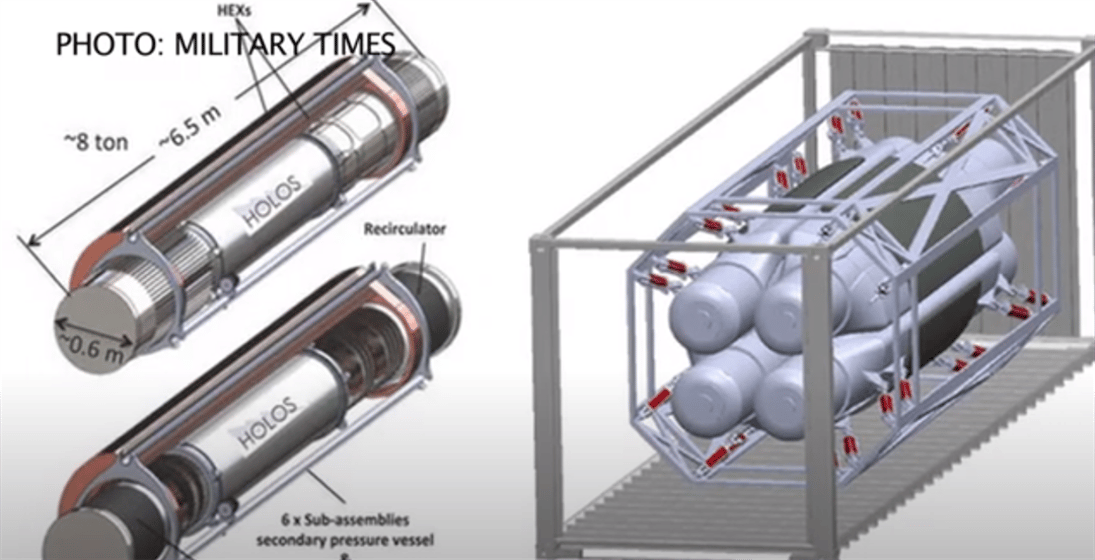
An article last year in the “Military Times” mentions Guam as a potential site for the mobile nuclear equipment.
It describes a 40-ton reactor that can fit into three to four 20-foot containers and can provide up to 5 megawatts of power.
The army has been considering the use of mobile nuclear power for years in a program called project pele, ironically named after the Hawaiian goddess of fire and volcanoes.
The benefits as a power source in remote, austere locations is clear, but there are drawbacks in battle situations.
If however that reactor is struck during conflict all the troops that are around that will be affected. So I think the concerns that they had about the use of these particular power devices for military people is magnified ten-fold when you think about the possibility that these might be placed in proximity to a civilian community.
And the military has confirmed that the planned 360-degree missile defense system could have as many as twenty different sites scatttered across the island.
Bettis says we need to know now more than ever, what’s going into each of these sites.
The people that I’ve talked to talk about a micro nuclear reactor and say if it hits you need a set-aside that’s at least a mile. That’s gonna be a very different sort of thing then if you had command and control module in your neighborhood, so I think as a community we need better transparency about what is being planned at all these locations.
Nuclear-based fantasies are holding back real climate action

SMR Education Task Force, June 22, 2023, https://crednb.ca/2023/06/22/nuclear-based-fantasies-are-holding-back-real-climate-action/—
Today a network of groups across Canada announces the launch of the SMR Education Task Force to share under-reported facts about small modular nuclear reactors (SMRs) with members of Parliament and provincial legislatures.
We begin with the latest report from Canada Energy Regulator (CER). This federal document, called Canada’s Energy Future, projects that enough new nuclear reactors (SMRs) will be operational by 2050 to more than double Canada’s existing nuclear electricity generation.
Canada currently has 19 operating power reactors, built over 58 years. The new report claims that we will build more than 50 new reactors in much less time.
This fantasy has no basis in reality. It is inconsistent with independent analyses by energy researchers not tied to the nuclear industry. One such study in the Bulletin of Atomic Scientists makes it clear that SMRs have at best a marginal role to play in a truly effective climate action plan. SMRs fail the tests of timeliness and affordability – they take too long and cost too much.
In addition to Ontario and Alberta, the CER report imagines deploying SMRs in Quebec and British Columbia. This is news to citizens in those provinces. BC ratepayers have rejected nuclear power in the past, and Quebec phased out of nuclear power in 2012. With every reactor comes long-lived radioactive waste — including the structure itself, which is a provincial responsibility to safeguard for thousands of years after shutdown.
Yesterday, the Coalition for Responsible Energy Development in New Brunswick (CRED-NB) sent a letter to Canada’s Natural Resources Minister reminding him that more than 120 civil society, public interest, faith-based and Indigenous groups across Canada have signed a statement warning that SMRs are a dirty, dangerous distraction from urgent climate action.
These groups understand that responding to the climate emergency does not require gambling on untested nuclear reactors. They know that energy efficiency measures and renewable sources cost at least 3 to 7 times less than nuclear power per tonne of carbon emissions avoided.
The groups oppose using public funds earmarked for climate action to support the nuclear industry’s eager experimentation with novel reactor designs. We are challenging the government to release the research and data that support its nuclear-based strategy.
Nuclear promoters, with long-standing allies embedded in the federal and provincial governments, are making unsubstantiated promises about SMRs in an audacious attempt to grab as much public funding as possible to keep their dying industry alive.
Worldwide, nuclear’s share of global electricity has dropped over the last 25 years from 17% to less than 10%. The International Energy Agency forecasts that more than 90% of all new electricity installations worldwide over the next 5 years will be non-hydro renewables.
The industry’s money-grab will succeed only if our public representatives remain uninformed about the facts. That is why we are pleased to announce the SMR Education Task Force and look forward in the months ahead to share information about SMRs based on independent science and research.
Nuclear Fusion: A Clean Energy Revolution Or A Radioactive Nightmare?

By Kurt Cobb – Jun 20, 2023, Oil Price
Fusion reactors, while producing energy, also produce neutron streams that can cause radiation damage, produce radioactive waste, necessitate biological shielding, and even create the potential for weapons-grade plutonium production.
Apart from the aforementioned problems, fusion reactors face issues such as tritium release, intensive coolant demands, and high operating costs, which would require the power plant to have at least a one-gigawatt capacity to balance costs.
Given the time and resources required for fusion power plant construction, the technology might not be feasible for timely carbon emission reduction, and the prospect of fusion energy might be distracting society from immediate solutions to energy scarcity and climate change.
……………………
The reality of fusion power, however, is one of huge scale and vast obstacles according to Daniel Jassby, a former research physicist at the Princeton Plasma Physics Lab. (All of what follows assumes that the remaining obstacles to producing net energy from fusion will be overcome. Addressing that issue would require a seperate and lengthy essay.)
Perhaps the most unexpected revelation Jassby offers runs entirely contrary to the clean image that fusion energy has in the public mind. It turns out that the most feasible designs for fusion reactors will generate large amounts of radioactivity and radioactive waste.
[here much detail on the operation of nuclear fusion]………………………………………………………………………..
To power the enormously energy-intensive process of fusion, a fusion plant will use a lot of energy just to run itself. That means scale will matter. In order to accommodate this so-called parasitic power drain AND produce enough excess electricity to sell to pay for the costs of constructing the plant and for its ongoing operation, fusion plants will have to have a capacity of at least one gigawatt (one billion watts). One gigawatt can supply electricity to 300,000 to 750,000 homes depending on how the calculation is done. And, even much larger capacity per plant will be desirable because it will decrease the percentage of power production devoted to sustaining the fusion reaction and servicing the plant infrastructure. In short, making fusion plants big will be the only way to make them economical. So much for my friend’s fantasy of handheld fusion power units!
In a second article, Jassby addresses the International Thermonuclear Experimental Reactor (ITER) located in France. The project is a cooperative research venture designed to study and perfect fusion. It will not produce any electricity itself, but rather set the stage for so-called demonstration plants which could be built in the second half of this century.
……………………..
just to operate its experiments, ITER will require 600 megawatts of power, a window into the parasitic power requirements of fusion reactors.
The fantasy of cheap, unlimited fusion power arriving soon with no serious side-effects prevents us as a society from grappling with near-term energy depletion and our ongoing dependence on fossil fuels in the accelerated manner required to prevent a major energy crisis. Hope that fusion energy will somehow solve our energy and climate problems is not a real plan. It is just another illusory and far-in-the-future technical fix offered to convince us that we don’t need to alter our way of life in any substantial way to address the serious problems we face. https://oilprice.com/Alternative-Energy/Nuclear-Power/Nuclear-Fusion-A-Clean-Energy-Revolution-Or-A-Radioactive-Nightmare.html
Chinese astronauts install radiation-exposure experiment outside Tiangong space station
By Andrew Jones, 21 June 23, https://www.space.com/astronauts-install-radiation-experiment-china-tiangong-space-station
China plans to conduct radiation experiments on plant seeds, microorganisms and small animals.
China is running a biological radiation exposure experiment outside its space station.
The country’s Shenzhou 16 astronauts — Jing Haipeng, Zhu Yangzhu and Gui Haichao — installed the experiment outside the Tiangong space station‘s Mengtian science module on June 10, China’s National Space Science Center (NSSC) announced in a statement.
The experiment was deployed using Mentian’s dedicated payload airlock and attached to an external payload adapter using the space station’s small robotic arm.
The experiment payload contains 13 sample box units loaded with biomaterials. These are designed to study the impact of cosmic radiation and microgravity on organisms, the origin and evolution of life and the development of space radiation mutagenic resources.
The equipment can be used for in-orbit experiments on biological samples, including plant seeds, microorganisms and small animals, according to NSSC. The temperature inside each sample container unit can be adjusted to suit the organisms it is hosting.
On-orbit medical research involving space radiation biological exposure is of great significance to supporting China’s human spaceflight program. That program is ambitious, with plans to launch long-term crewed missions in Earth orbit and send people to the surface of the moon, the Chinese-language outlet Science and Technology Daily reported.
The experiment payload was developed jointly by the NSSC and Dalian Maritime University. It is intended to operate for five years and is planned to be used for several scientific projects.
The Shenzhou 16 crew arrived at Tiangong on May 30 and will remain aboard the space station until November.
World’s Largest Fusion Project Is in Big Trouble, New Documents Reveal

The ITER project formally began in 2006, when its international partners agreed to fund an estimated €5 billion (then $6.3 billion), 10-year plan that would have seen ITER come online in 2016. The most recent official cost estimate stands at more than €20 billion ($22 billion), with ITER nominally turning on scarcely two years from now. Documents recently obtained via a lawsuit, however, imply that these figures are woefully outdated: ITER is not just facing several years’ worth of additional delays but also a growing internal recognition that the project’s remaining technical challenges are poised to send budgets spiraling even further out of control and successful operation ever further into the future.
With each passing decade, this record-breaking monument to big international science looks less and less like a cathedral—and more like a mausoleum.
The International Thermonuclear Experimental Reactor (ITER) is already billions of dollars over budget and decades behind schedule. Not even its leaders can say how much more money and time it will take to complete
By Charles Seife on June 15, 2023. https://www.scientificamerican.com/article/worlds-largest-fusion-project-is-in-big-trouble-new-documents-reveal/?fbclid=IwAR3siLk4iSD43-SE6sBStfYeTIl9YNeZ5QcLz27JgQwMd85DcYV7kUmciw8
It could be a new world record, although no one involved wants to talk about it. In the south of France, a collaboration among 35 countries has been birthing one of the largest and most ambitious scientific experiments ever conceived: the giant fusion power machine known as the International Thermonuclear Experimental Reactor (ITER).
But the only record ITER seems certain to set doesn’t involve “burning” plasma at temperatures 10 times higher than that of the sun’s core, keeping this “artificial star” ablaze and generating net energy for seconds at a time or any of fusion energy’s other spectacular and myriad prerequisites. Instead ITER is on the verge of a record-setting disaster as accumulated schedule slips and budget overruns threaten to make it the most delayed—and most cost-inflated—science project in history.
ITER is supposed to help humanity achieve the dream of a world powered not by fossil fuels but by fusion energy, the same process that makes the stars shine. Conceived in the mid-1980s, the machine, when completed, will essentially be a giant, high-tech, doughnut-shaped vessel—known as a tokamak—that will contain hydrogen raised to such high temperatures that it will become ionized, forming a plasma rather than a gas. Powerful magnetic and electric fields flowing from and through the tokamak will girdle and heat the plasma cloud so that the atoms inside will collide and fuse together, releasing immense amounts of energy. But this feat is easier said than done.
Since the 1950s fusion machines have grown bigger and more powerful, but none has ever gotten anywhere near what would be needed to put this panacea energy source on the electric grid. ITER is the biggest, most powerful fusion device ever devised, and its designers have intended it to be the machine that will finally show that fusion power plants can really be built.
The ITER project formally began in 2006, when its international partners agreed to fund an estimated €5 billion (then $6.3 billion), 10-year plan that would have seen ITER come online in 2016. The most recent official cost estimate stands at more than €20 billion ($22 billion), with ITER nominally turning on scarcely two years from now. Documents recently obtained via a lawsuit, however, imply that these figures are woefully outdated: ITER is not just facing several years’ worth of additional delays but also a growing internal recognition that the project’s remaining technical challenges are poised to send budgets spiraling even further out of control and successful operation ever further into the future.
The documents, drafted a year ago for a private meeting of the ITER Council, ITER’s governing body, show that at the time, the project was bracing for a three-year delay—a doubling of internal estimates prepared just six months earlier. And in the year since those documents were written, the already grim news out of ITER has unfortunately only gotten worse. Yet no one within the ITER Organization has been able to provide estimates of the additional delays, much less the extra expenses expected to result from them. Nor has anyone at the U.S. Department of Energy, which is in charge of the nation’s contributions to ITER, been able to do so. When contacted for this story, DOE officials did not respond to any questions by the time of publication.
The problems leading to these latest projected delays were several years in the making. The ITER Organization was extremely slow to let on that anything was wrong, however. As late as early July 2022, ITER’s website announced that the machine was expected to turn on as scheduled in December 2025. Afterward that date bore an asterisk clarifying that it would be revised. Now the date has disappeared from the website altogether. ITER leaders seldom let slip that anything was awry either. In February 2017 ITER’s then director general, the late Bernard Bigot, discussed its progress with DOE representatives. “ITER is really moving forward,” he said. “We are working day and night…. The progress is on schedule.” The timeline he presented implied that everything was on track. Construction of the ITER complex’s foundation, which incorporates an earthquake protection system with hundreds of tremor-dampening rubber- and metal-laminated plates, should have been almost complete. From there, assembly of the reactor itself was planned to begin in 2018. At the time of Bigot’s remarks, two of its major pieces—a massive magnetic coil to wrap around the doughnutlike tokamak and a large section of the vacuum vessel that makes up the tokamak’s walls—were supposed to be ready to ship within the month and by the end of the year, respectively. Instead the coil would take almost three more years to complete, as would the vessel sector. The pieces were completed in January and April 2020, respectively. In fact, a large proportion of the big components of the machine were behind schedule by a year or two years or even more. Soon ITER’s official start of assembly was bumped from 2018 to 2020.
Then, in early 2020, the COVID pandemic struck, slowing manufacturing and shipping of machine components.
Continue reading1 This Month
To see nuclear-related stories in greater depth and intensity – go to https://nuclearinformation.wordpress.com/

29 Jan. Thursday 7-8 p.m. Webinar – World’s Largest Nuclear Station in Port Hope, ON?


31st January – Challenging the War Machine – a DECLASSIFIED UK SUMMIT


Website of the Week
Now until to February 10, 2026 Radioactive waste storage in France: the debate is finally open! How to participate?
-
Archives
- January 2026 (259)
- December 2025 (358)
- November 2025 (359)
- October 2025 (376)
- September 2025 (258)
- August 2025 (319)
- July 2025 (230)
- June 2025 (348)
- May 2025 (261)
- April 2025 (305)
- March 2025 (319)
- February 2025 (234)
-
Categories
- 1
- 1 NUCLEAR ISSUES
- business and costs
- climate change
- culture and arts
- ENERGY
- environment
- health
- history
- indigenous issues
- Legal
- marketing of nuclear
- media
- opposition to nuclear
- PERSONAL STORIES
- politics
- politics international
- Religion and ethics
- safety
- secrets,lies and civil liberties
- spinbuster
- technology
- Uranium
- wastes
- weapons and war
- Women
- 2 WORLD
- ACTION
- AFRICA
- Atrocities
- AUSTRALIA
- Christina's notes
- Christina's themes
- culture and arts
- Events
- Fuk 2022
- Fuk 2023
- Fukushima 2017
- Fukushima 2018
- fukushima 2019
- Fukushima 2020
- Fukushima 2021
- general
- global warming
- Humour (God we need it)
- Nuclear
- RARE EARTHS
- Reference
- resources – print
- Resources -audiovicual
- Weekly Newsletter
- World
- World Nuclear
- YouTube
-
RSS
Entries RSS
Comments RSS
 nuclear-news