INTERNATIONAL DARK SKY ASSOCIATION vs. FCC AND SPACEX

https://cellphonetaskforce.org/astronomers-in-court-against-fcc-and-spacex/ Arthur Firstenberg, 1 May 24
On December 29, 2022, the International Dark-Sky Association (IDA) sued the U.S. Federal Communications Commission over its decision to approve SpaceX’s application for up to 30,000 more low-orbit satellites, in addition to the 12,000 already approved and in process of filling our skies. This is Case No. 22-1337 before the United States Court of Appeals for the District of Columbia Circuit, and has not yet been decided by the court.
American plasma physicist Sierra Solter implored the FCC to “please save our night sky… Please, please, don’t take away my stars. To feel that my place of comfort and calm — a starry sky — is being taken away and given to billionaires is suffocating.”
On December 18, 2023, Ms. Solter published a scientific article detailing her fear for our planet. Each of the 42,000 planned Starlink satellites, she wrote, has a design lifespan of only 5 years, after which it will be de-orbited, burned up in the atmosphere, and replaced. She calculated that this will require 23 satellites per day — each the size of an SUV or truck — to be burned up in the atmosphere forever into the future, leaving an enormous amount of toxic chemicals and metallic dust to accumulate in the air we breathe and in the ionosphere
This is already happening, she wrote, and should be stopped if we value our lives. “Since the beginning of the space industry, approximately 20,000 tons of material have been demolished during reentry… This is over 100 billion times greater than [the mass of] the Van Allen Belts.” She estimated that if 42,000 Starlink satellites are deployed and regularly demolished — let alone the 1,000,000 satellites planned by other companies and governments — “every second the space industry is adding approximately 2,000 times more conductive material than mass of the Van Allen Belts into the ionosphere.”
“Unlike meteorites, which are small and only contain trace amounts of aluminum, these wrecked spacecraft are huge and consist entirely of aluminum and other exotic, highly conductive materials,” she explained in an April 16, 2024 article in The Guardian.
Much of the metallic dust will settle into the ionosphere where, she says, it could act as a magnetic shield, reducing the magnitude of the Earth’s magnetic field in space. If that happens, the atmosphere itself could eventually be destroyed, because the Earth’s magnetic field — the magnetosphere — is what deflects the solar wind and prevents it from stripping away Earth’s atmosphere, as she told Teresa Pulterova in an interview on Space.com.
Other astronomers involved in the litigation before the FCC and now the Court of Appeals include Meredith Rawls with the Vera C. Rubin Observatory in Chile; Gary Hunt with Action Against Satellite Light Pollution in the UK; Samantha Lawler at the University of Regina in Canada; Graeme Cuffy of Port of Spain, Trinidad and Tobago; Mark Phillips, President of the Astronomical Society of Edinburgh; Roberto Trotta of the Imperial Centre for Inference and Cosmology in London; Carrie Nugent, Associate Professor of Computational Physics and Planetary Science at the Olin College of Engineering in Massachusetts; and Cameron Nelson of Tenzing Startup Consultants in Virginia.
Other issues are also mentioned in the appeal. For example, the burned up aluminum produces aluminum oxide, which destroys ozone and contributes to climate change. So does the water vapor, soot, and nitrogen oxides in rocket exhaust.
Cameron Nelson told the FCC that “Humans, not to mention all other animal and plant life, have not given our consent for SpaceX to send the signals it is proposing into our bodies and irrevocably alter us.”
The BroadBand International Legal Action Network (BBILAN) mentioned “RF/EMF radiation from linked base and earth stations” in comments sent to the FCC. Starlink earth stations, also called Gateways, are far more powerful than the Starlink dishes that people are putting on their homes. The (as of March 2024) 2.6 million Starlink dishes each send one signal up to the moving network of satellites above them. All of this traffic is coordinated in space by thousands of lasers linking the satellites to one another, and on the ground by Gateways, which relay the thousands of signals in a large geographic area to and from the satellites. This is what a Gateway with 5 antennas (“radomes”) looks like:

Some Gateways have up to 40 radomes. Each of those domes weighs 1750 kilograms. Each aims a narrow beam at moving satellites. According to FCC filings by SpaceX, each beam can have an effective radiated power of more than 1,000,000 watts, which it can aim as low as 25 degrees above the horizon. If you are a bird you do not want to fly anywhere near a Starlink Gateway. And if you are a human you do not want to live near one either. When a satellite aims its beam containing thousands of signals at a Gateway, that beam is about 10 miles in diameter by the time it reaches the Earth.
Robin is a subscriber who lives in a remote area of Idaho less than 3 miles from the Starlink Gateway in Colburn. She writes about effects on her family and her animals…………………………….Robin knows many people in her area who are similarly affected. She adds that “when we first moved here in 2019 we had A LOT of birds. We now have a silent spring, it’s like a dead zone.
At last count there were 277 Starlink Gateways in operation or under construction in the world: 181 in North America and the Caribbean, 26 in South America, 2 in Africa, 26 in Europe, and 42 in Asia and the Pacific.
The FCC maintains a webpage listing thousands of licenses that it has handed out to hundreds of companies to operate both fixed and mobile satellite earth stations in the United States. Some of these stations are far more powerful than the Starlink Gateways. SES’s earth station at Bristol, Virginia emits up to 1,900,000,000 watts of effective radiated power, and it is allowed to aim it as low as 5 degrees above the horizon. SES’s earth station at Brewster, Washington is allowed to emit almost 1,000,000 watts in the actual direction of the horizon! SES owns O3b mPOWER, which is the satellite system that had its first radomes on board the Diamond Princess cruise ship, the ship that had the famous outbreak of disease blamed on COVID-19 at the beginning of the pandemic
Five Things the “Nuclear Bros” Don’t Want You to Know About Small Modular Reactors
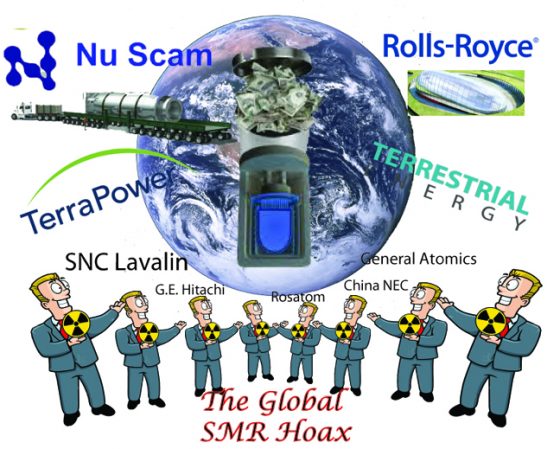
1. SMRs are not more economical than large reactors.
2. SMRs are not generally safer or more secure than large light-water reactors.
3. SMRs will not reduce the problem of what to do with radioactive waste.
4. SMRs cannot be counted on to provide reliable and resilient off-the-grid power for facilities, such as data centers, bitcoin mining, hydrogen or petrochemical production.
5. SMRs do not use fuel more efficiently than large reactors.
Ed Lyman, April 30, 2024 https://blog.ucsusa.org/edwin-lyman/five-things-the-nuclear-bros-dont-want-you-to-know-about-small-modular-reactors/
Even casual followers of energy and climate issues have probably heard about the alleged wonders of small modular nuclear reactors (SMRs). This is due in no small part to the “nuclear bros”: an active and seemingly tireless group of nuclear power advocates who dominate social media discussions on energy by promoting SMRs and other “advanced” nuclear technologies as the only real solution for the climate crisis. But as I showed in my 2013 and 2021 reports, the hype surrounding SMRs is way overblown, and my conclusions remain valid today.
Unfortunately, much of this SMR happy talk is rooted in misinformation, which always brings me back to the same question: If the nuclear bros have such a great SMR story to tell, why do they have to exaggerate so much?
What are SMRs?
SMRs are nuclear reactors that are “small” (defined as 300 megawatts of electrical power or less), can be largely assembled in a centralized facility, and would be installed in a modular fashion at power generation sites. Some proposed SMRs are so tiny (20 megawatts or less) that they are called “micro” reactors. SMRs are distinct from today’s conventional nuclear plants, which are typically around 1,000 megawatts and were largely custom-built. Some SMR designs, such as NuScale, are modified versions of operating water-cooled reactors, while others are radically different designs that use coolants other than water, such as liquid sodium, helium gas, or even molten salts.
To date, however, theoretical interest in SMRs has not translated into many actual reactor orders. The only SMR currently under construction is in China. And in the United States, only one company—TerraPower, founded by Microsoft’s Bill Gates—has applied to the Nuclear Regulatory Commission (NRC) for a permit to build a power reactor (but at 345 megawatts, it technically isn’t even an SMR).
The nuclear industry has pinned its hopes on SMRs primarily because some recent large reactor projects, including Vogtle units 3 and 4 in the state of Georgia, have taken far longer to build and cost far more than originally projected. The failure of these projects to come in on time and under budget undermines arguments that modern nuclear power plants can overcome the problems that have plagued the nuclear industry in the past.
Developers in the industry and the US Department of Energy say that SMRs can be less costly and quicker to build than large reactors and that their modular nature makes it easier to balance power supply and demand. They also argue that reactors in a variety of sizes would be useful for a range of applications beyond grid-scale electrical power, including providing process heat to industrial plants and power to data centers, cryptocurrency mining operations, petrochemical production, and even electrical vehicle charging stations.
Here are five facts about SMRs that the nuclear industry and the “nuclear bros” who push its message don’t want you, the public, to know.
Continue readingDead satellites are filling space with trash. That could affect Earth’s magnetic field
How could we possibly think that burning trash in our atmosphere 24/7 is going to be fine?
Sierra Solter, 16 Apr 24, https://www.theguardian.com/commentisfree/2024/apr/16/dead-satellite-space-earth-magnetic-field
Our ozone is pennies thick – and soon we’ll put at least an Eiffel Tower’s worth of metallic ash into the ionosphere every year.
Adead spacecraft the size of a truck ignites with plasma and pulverizes into dust and litter as it rips through the ionosphere and atmosphere. This is what happens to internet service satellites during re-entry. When the full mega-constellation of satellites is deployed in the 2030s, companies will do this every hour because satellite internet requires thousands of satellites to constantly be replaced. And it could compromise our atmosphere or even our magnetosphere.
Space entrepreneurs are betting on disposable satellites as key to a new means of wealth. There are currently nearly 10,000 active satellites and companies are working as fast as possible to get tens of thousands more into orbit – for a projected 1m in the next three to four decades.
“We could get to 100,000 satellites in 10 to 15 years,” Dr Jonathan McDowell, of the Harvard-Smithsonian Center for Astrophysics, told me. Those satellites power hyper-connected internet services and may turn some billionaires into trillionaires – at the cost of shrouding the planet with toxic trash.
The problem is that space, contrary to popular belief, isn’t really a giant, self-cleaning void. Space holds systems like the magnetosphere that keep us alive and supplied with oxygen by protecting our atmosphere. The space around our planet is a plasma cocoon that is cradling life.
It is easy to assume that the magnetosphere is too vast and robust for humanity to ever have any impact on it, but I don’t think that’s true. I’m a plasma physicist at the intersection of aerospace and physics and the author of recent research in peer-review that found that the space trash generated by dead and dying commercial satellites could compromise our ionosphere or magnetosphere, also known as our planet’s plasma environment.
After studying the problem for over a year, I have no doubt that the sheer vastness of this pollution is going to disrupt our delicate plasma environment in one way or another. Yet few people are discussing this potential crisis – in part, I suspect, because so much scientific research about space is intertwined with commercial space ventures, which have a vested interest in avoiding these questions.
Upon investigating just how much dust in the form of satellite and rocket debris the space industry has dumped into the ionosphere during re-entry, I was alarmed to find that it is currently multiple Eiffel Tower’s worth of metallic ash. I wouldn’t have even been able to calculate that at all without a scientist’s personally run website. Our ozone is mere pennies thick, and soon we will be putting at least an Eiffel Tower’s worth of metallic ash a year directly into the ionosphere. And all of that will stay there, indefinitely.
How could we possibly think that burning trash in our atmosphere 24/7 is going to be fine? Although some study is being devoted to stratospheric loading – the phenomenon of satellite and rocket chemicals saturating the atmosphere with ozone-depleting alumina – humanity might also be forcing “magnetospheric loading” on our planet, as well. No one else is currently studying the pollution of the magnetosphere except for myself.
We don’t even have a clear estimate of the mass of all regions in the magnetosphere, yet we are going to load it with the wreckage of countless giant spacecraft. These SUV-size satellites will soon be burning in the atmosphere on an hourly basis. Unlike meteorites, which are small and only contain trace amounts of aluminum, these wrecked spacecraft are huge and consist entirely of aluminum and other exotic, highly conductive materials. And highly conductive materials can create charging effects and act as a magnetic shield.
If all of these conductive materials accumulate into a huge layer of trash, it could trap or deflect all or parts of our magnetic field. The Earth is a ball magnet that we’re surrounding with fast-moving metal trash. And so far, extrapolating from open-source data, the current trash in the ionosphere shows an apparent human-made electrostatic signature. It is known that individual spacecraft can perturb their environment with plasma wakes; imagine how 100,000 or more of them and their associated trash could perturb the magnetosphere.
Even if we only induce ionospheric perturbations regionally – say, in spaceflight regions – then it could cause holes above the ozone. This in turn, could allow atmospheric stripping, which could erode our atmosphere over time and put the planet at risk of losing habitability.
Low Earth orbit is being promoted as a “destination and economy” for satellites and even low-gravity space hotels (which seem to be perpetually “coming soon” and then canceled). People like Elon Musk and Jeff Bezos repeatedly state that space is the key to human longevity. But what if it is the opposite? What if the space industry is the means to our pale blue dot’s demise? And what if all of this pollution that space entrepreneurs are creating is happening in such a multidisciplinary, inaccessible, un-studied way that we don’t even understand the risk?
Our magnetosphere keeps us alive. It should be protected as an Earth environment. Instead, we’re filling it with electronic waste so that billionaires can trade electromagnetic signals for dollars they really don’t need.
“Our technical civilization poses a real danger to itself,” Carl Sagan warned in his 1997 book Billions and Billions: Thoughts on Life and Death at the Brink of the Millennium. The magnetosphere is our first line of defense against an otherwise lethal solar system, and any pollution of it should be intensely studied and monitored. Indeed, if an asteroid the size of a Starlink satellite was headed towards Earth, it would activate planetary defense monitoring. But since it’s a human-made object impacting the atmosphere, we don’t monitor it at all.
Space companies need to stop launching satellites if they can’t provide studies that show that their pollution will not harm the stratosphere and magnetosphere. Until this pollution is studied further, we should all reconsider satellite internet.
- Sierra Solter is a plasma physicist, engineer, and inventor who studies the intersection of heliophysics and aerospace
France Increases State Funding for Advanced Nuclear R&D Project

by Jov Onsat, Rigzone Staff, Thursday, May 02, 2024
The French government has received clearance from the European Commission to provide Electricité de France (EDF) a further EUR 300 million ($321.6 million) for the front-end design phase of a project to develop small modular nuclear reactors (SMRs).
The project by Nuward, the nuclear energy-focused subsidiary of state-owned EDF, aims to come up with a design that has a power output of up to 300 megawatts electric.
The front-end design is the third phase of the five-phase project. The Commission previously approved EUR 50 million ($53.6 million) in French state aid for the second phase, which focused on gathering new knowledge for SMR design and construction.
Under the measure, the aid will take the form of a direct grant of up to EUR 300 million that will cover the R&D [research and development] project until early 2027”, the Commission said in a statement announcing clearance for the new funding from European Union competition regulations. “The measure will support Nuward in sizing the modules and components of the SMRs and validating their integration in the SMRs by means of numerical simulators and laboratory tests.
“Nuward will also carry out industrialization studies relating to the modular design and mass production of SMRs. Finally, the measure will also support Nuward in the preparation of the required safety demonstrations for the approval of the project by the national nuclear safety authorities”.
The Commission recently launched an alliance to accelerate the development of SMRs, following moves by the United Kingdom and United States to commercially scale up the advanced nuclear generation technology.
The public-private coalition aims to come up with a working model by the 2030s. “The Alliance targets a wide range of SMR stakeholders including vendors, utilities, specialized nuclear companies, financial institutions, research organizations, training centers and civil society organizations”, the Commission said in a press release February 9 announcing the initiative…………………..
Earlier the UK government announced an investment of GBP 300 million ($376 million) for the domestic production of high-assay low-enriched uranium (HALEU), challenging Russia’s status as the only commercial manufacturer of the fuel for SMRs. The UK previously funded a program by Rolls-Royce PLCs to design an SMR model, which is currently awaiting approval for deployment in Poland, as announced by the company last week—though the product is still undergoing the regulatory design assessment in the UK.
The UK will become the first country in Europe to launch a high-tech HALEU nuclear fuel program, strengthening supply for new nuclear projects and driving Putin further out of global energy markets”, the UK Department of Energy Security and Net Zero (DESNZ) said in a news release January 7 announcing the HALEU funding.
The DESNZ said GBP 10 million ($12.5 million) has also been allotted to develop sites and promote skills development for the production of other “advanced nuclear fuels”.
The International Atomic Energy Agency says HALEU is only produced in the U.S. and Russia but only the latter makes the fuel at a commercial scale. SMRs need HALEU, which contains five to 20 percent of uranium-235, beyond the five percent level that fuels most of today’s nuclear power plants, according to the United Nations nuclear watchdog.
The UK move was followed by an announcement by the US Department of Energy (DOE) offering contracts worth up to $500 million in total for HALEU production, besides funding offers for SMR design development. “Currently, HALEU is not commercially available from U.S.-based suppliers, and boosting domestic supply could spur the development and deployment of advanced reactors in the United States”, the DOE noted in a media statement January 9 announcing the funding offer.
Last year the U.S. Nuclear Regulator Commission issued the country’s first certification for an SMR design, that of NuScale Power Corp. https://www.rigzone.com/news/france_increases_state_funding_for_advanced_nuclear_rd_project-02-may-2024-176607-article/
Rolls-Royce scales back plans to build nuclear factories in UK
Rolls-Royce has scaled back plans to build two new factories for its small modular reactor (SMR) programme in the UK, following delays to a government design competition.
The FTSE 100 company had originally proposed one factory to make heavy pressure vessels for its SMRs and another to make the building blocks of the reactors.
It had drawn up a final shortlist of locations for the pressure vessels factory, including the International Advanced Manufacturing Park on the outskirts of Sunderland, Teesworks in Redcar and the Gateway industrial park in Deeside, Wales.
But on Friday Rolls confirmed it no longer intends to proceed with that plan because there is no longer time to build the factory and make the first pressure vessels for the early 2030s, when it hopes to complete its first SMRs.
It is still proceeding with work to build the second factory, however.
The company had been waiting for the outcome of an ongoing SMR design competition in the UK – first announced by the Government in 2015 – before it made a decision on the pressure vessel plant.
But that competition has been repeatedly delayed, with the arms length body Great British Nuclear only formally created last summer and winners not due to be announced until this June at the earliest.
Instead the engineering giant will now buy its heavy pressure vessels from a third party supplier.
The large, metal components sit at the heart of nuclear reactors and must be able to withstand extremely high temperatures and pressures. They are only made by a select group of companies, partly due to the need for specialist welding techniques.
Among their number is now Sheffield Forgemasters, which was nationalised by the Ministry of Defence in 2021.
Earlier this month, Sheffield became the sole UK company to gain the qualifications needed to make SMR reactor vessel components.
Despite having shelved its plans for a heavy pressure vessel factory, Rolls is still pressing ahead with plans to build its second factory, which will build the modular units that make up its SMRs.
It is understood that sites shortlisted for the pressure vessel factory will also be contenders for the second plant but no decisions have been made.
On Friday, a spokesman for Rolls-Royce SMR confirmed the company had now “prioritised work on our modules assembly and test facility”, adding: “Our efforts are focused on identifying the best site to support our deployment at pace.”
The company has also not ruled out reviving its plan for a heavy pressure vessel factory at some point in the future, so long as it manages to build up a healthy pipeline of orders.
A Government spokesman said: “Our world leading SMR competition aims to be the fastest of its kind, helping secure billions in investment for the UK, meaning cleaner, cheaper and more secure energy in the long-term.”
Rolls-Royce scales back plans to build nuclear factories in UK

Curtailing comes after repeated delays to an ongoing government design competition
Rolls-Royce has scaled back plans to build two new factories for its small
modular reactor (SMR) programme in the UK, following delays to a government
design competition. The FTSE 100 company had originally proposed one
factory to make heavy pressure vessels for its SMRs and another to make the
building blocks of the reactors.
It had drawn up a final shortlist of
locations for the pressure vessels factory, including the International
Advanced Manufacturing Park on the outskirts of Sunderland, Teesworks in
Redcar and the Gateway industrial park in Deeside, Wales.
But on Friday Rolls confirmed it no longer intends to proceed with that plan because
there is no longer time to build the factory and make the first pressure
vessels for the early 2030s, when it hopes to complete its first SMRs.
It is still proceeding with work to build the second factory, however. The
company had been waiting for the outcome of an ongoing SMR design
competition in the UK – first announced by the Government in 2015 –
before it made a decision on the pressure vessel plant.
But that competition has been repeatedly delayed, with the arms-length body Great
British Nuclear only formally created last summer and winners not due to be
announced until this June at the earliest. Instead the engineering giant
will now buy its heavy pressure vessels from a third party supplier. The
large, metal components sit at the heart of nuclear reactors and must be
able to withstand extremely high temperatures and pressures. They are only
made by a select group of companies, partly due to the need for specialist
welding techniques.
Rolls is still pressing ahead with plans to build its
second factory, which will build the modular units that make up its SMRs.
It is understood that sites shortlisted for the pressure vessel factory
will also be contenders for the second plant but no decisions have been
made.
Telegraph 27th April 2024
https://www.telegraph.co.uk/business/2024/04/27/rolls-royce-plans-build-smr-water-vessel-factory-uk
The former rail chief now minding the (construction) gap at Sizewell.
The former rail chief now minding the (construction) gap at Sizewell. Rob
Holden, chairman of the Suffolk nuclear plant, says the increasing time
between the start of construction at Hinkley Point and spades in the ground
at Sizewell is a worry.
The delays and swelling cost of building Hinkley
Point C, Britain’s first new nuclear power plant in more than two
decades, may not necessarily be a bad omen for its sister station.
According to Rob Holden, the non-executive chairman of Sizewell C, “good
projects start well and get better, bad projects start badly and get worse.
While Sizewell is a replication, technically, of Hinkley, it is a very
different project.”
Thus far Hinkley Point is running up to £28 billion
over budget and is six years past its initial deadline. That has spurred
speculation that Sizewell could be beset by the same troubles. Holden, who
has led the Sizewell C board since the end of 2022, disagrees. The power
plant, which is due to be built on the Suffolk coast, has an “as-built
design”, which should mean far fewer changes than its predecessor to the
west and less time and money lost. Its developers know the quantities of
kit needed and have already been making efforts to procure it.
Nevertheless, for Holden, a widening gap between the start of construction
at Hinkley Point and spades in the ground at Sizewell is a worry. The
project is owned 50-50 by EDF and the government, but they are hoping to
bring in private investment. A final investment decision is slated for
before the end of the year. “What I do know now is that we can’t afford
to allow the time gap to be more than what it currently is between the two
projects, otherwise we will lose the replication benefits.”
Times 26th April 2024
New Nuclear Energy: Assessing the National Security Risks
https://blogs.gwu.edu/elliott-iistp/research-2/ 26 Apr 24
IISTP Research Professor Sharon Squassoni publishes a comprehensive report assessing the risks of nuclear energy and nuclear weapons.
Read the complete report: “New Nuclear Energy: Assessing the National Security Risks“.
GWU REPORT: NATIONAL SECURITY RISKS GROW WITH NEW NUCLEAR ENERGY
Drone strikes against Ukraine’s nuclear reactors highlight risks
WASHINGTON, DC – April 23, 2024 – Proliferation of nuclear weapons, nuclear terrorism, sabotage, coercion and military operations – these risks associated with nuclear energy can all be expected to grow as countries seek to implement their new nuclear energy objectives, according to a new report published today by George Washington University’s (GWU) Sharon Squassoni. The aim of 22 countries to triple nuclear energy capacity by 2050, announced on the margins of COP-28, was adopted with little thought to the national security implications. The promotion of small modular reactors (SMRs)– specifically tailored to developing countries – will heighten, not diminish risks.
The report by GW professor Sharon Squassoni, “New Nuclear Energy: Assessing the National Security Risks,” comes as drone strikes against Ukrainian nuclear power plants highlight nuclear reactor vulnerabilities. Other national security risks will accompany significant nuclear growth as renewed interest in nuclear energy to reduce greenhouse gas emissions sparks programs across the globe. Squassoni, a professor at GWU’s Elliott School of International Affairs, now researches risk reduction from nuclear energy and nuclear weapons after serving in the State Department, Arms Control and Disarmament Agency and the Congressional Research Service.
Proliferation and nuclear terrorism are the top two national security risks, but sabotage, coercion and military operations pose other risks. An attempt to reduce dependence on foreign suppliers – a national security risk itself — using nuclear energy could worsen the risk of proliferation by motivating fuel cycle independence. SMRs are still in development, with few restrictions on designs. Reactors fueled with highly enriched uranium or plutonium will increase risks of proliferation and terrorism because those materials are weapons-usable. Reactors designed to include lifetime cores will build up plutonium over time. Fast reactor designs that require reprocessing, especially continuous recycling of fuel, could ultimately confer latent nuclear weapons capabilities to many more states. In sum, the kinds of reactors now under consideration do nothing to reduce known risks, and some pose heightened risks. There appears to be no attempt to forge agreement among suppliers or governments to restrict reactor choices that pose greater proliferation risks.
If the mass production of small modular reactors lowers barriers to entry into nuclear energy, there will be many more states deploying nuclear power reactors, including those with significant governance challenges. Russian and Chinese programs to promote nuclear energy target many of those states. Cooperation among key states essential to minimize the safety, security and proliferation risks of nuclear energy is at an all-time low. The call to triple nuclear energy coincides with the disintegration of cooperation, the unraveling of norms and the loss of credibility of international institutions that are crucial to the safe and secure operation of nuclear power.
Problems delay OL3 reactor restart by 6 days
Olkiluoto 3 was taken offline at the beginning of last month for annual maintenance.
The outage of Olkiluoto 3, Finland’s newest nuclear reactor which is
currently offline for maintenance, is being extended by six days due to
technical problems, operator Teollisuuden Voima (TVO) announced on Sunday.
The facility was shut down for its first round of annual maintenance on 2
March, according to the firm, which added that around 1,100 professionals
were involved in the effort. The firm’s other two reactors, Olkiluoto 1 and
2, were generating electricity at normal levels of approximately 1,780MW,
the company said. Maintenance on OL3 is now scheduled to be completed on 4
May.
The reactor was put into service just over a year ago, following
construction delays of 14 years. The scheduled break was originally due to
end on 8 April.
YLE News 21st April 2024
Russia, US clash at UN over nuclear weapons in space

By Michelle Nichols, April 25, 2024
UNITED NATIONS, April 24 (Reuters) – Russia on Wednesday vetoed a U.S.-drafted United Nations Security Council resolution that called on countries to prevent an arms race in outer space, a move that prompted the United States to question if Moscow was hiding something.
The vote came after Washington accused Moscow of developing a anti-satellite nuclear weapon to put in space, an allegation that Russia has denied. Russian President Vladimir Putin has said that Moscow was against putting nuclear weapons in space.
“Today’s veto begs the question: Why? Why if you are following the rules would you not support a resolution that reaffirms them? What could you possibly be hiding?” U.S. Ambassador to the U.N. Linda Thomas-Greenfield told the council after the vote. “It’s baffling and it’s a shame.”
Russia’s U.N. Ambassador Vassily Nebenzia accused Washington of trying to tarnish Moscow and said Russia would shortly begin negotiations with council members on its own draft resolution aimed at keeping space peaceful.
“We want a ban on the placement of weapons of any kind in outer space, not just (weapons of mass destruction). But you don’t want that … Let me ask you that very same question: Why?” Nebenzia asked Thomas-Greenfield in the council.
The draft resolution was put to a vote by the U.S. and Japan after nearly six weeks of negotiations. It received 13 votes in favor, while China abstained and Russia cast a veto.
The U.N. text would have affirmed an obligation to comply with the Outer Space Treaty and called on states “to contribute actively to the objective of the peaceful use of outer space and of the prevention of an arms race in outer space.”
The 1967 Outer Space Treaty bars signatories – including Russia and the United States – from placing “in orbit around the Earth any objects carrying nuclear weapons or any other kinds of weapons of mass destruction.
Before the council voted on the U.S. draft text, Russia and China had proposed it be amended to include a call on all states “to prevent for all time the placement of weapons in outer space and the threat or use of force in outer space, from space against Earth and from Earth against objects in outer space.”
The council voted on the proposed amendment, but it failed to pass. It received seven votes in favor, seven against and one abstention……………………………………. https://www.miragenews.com/indian-nuclear-sites-impact-south-tibetan-1222069/
Where are France’s nuclear reactors and what is planned for more?
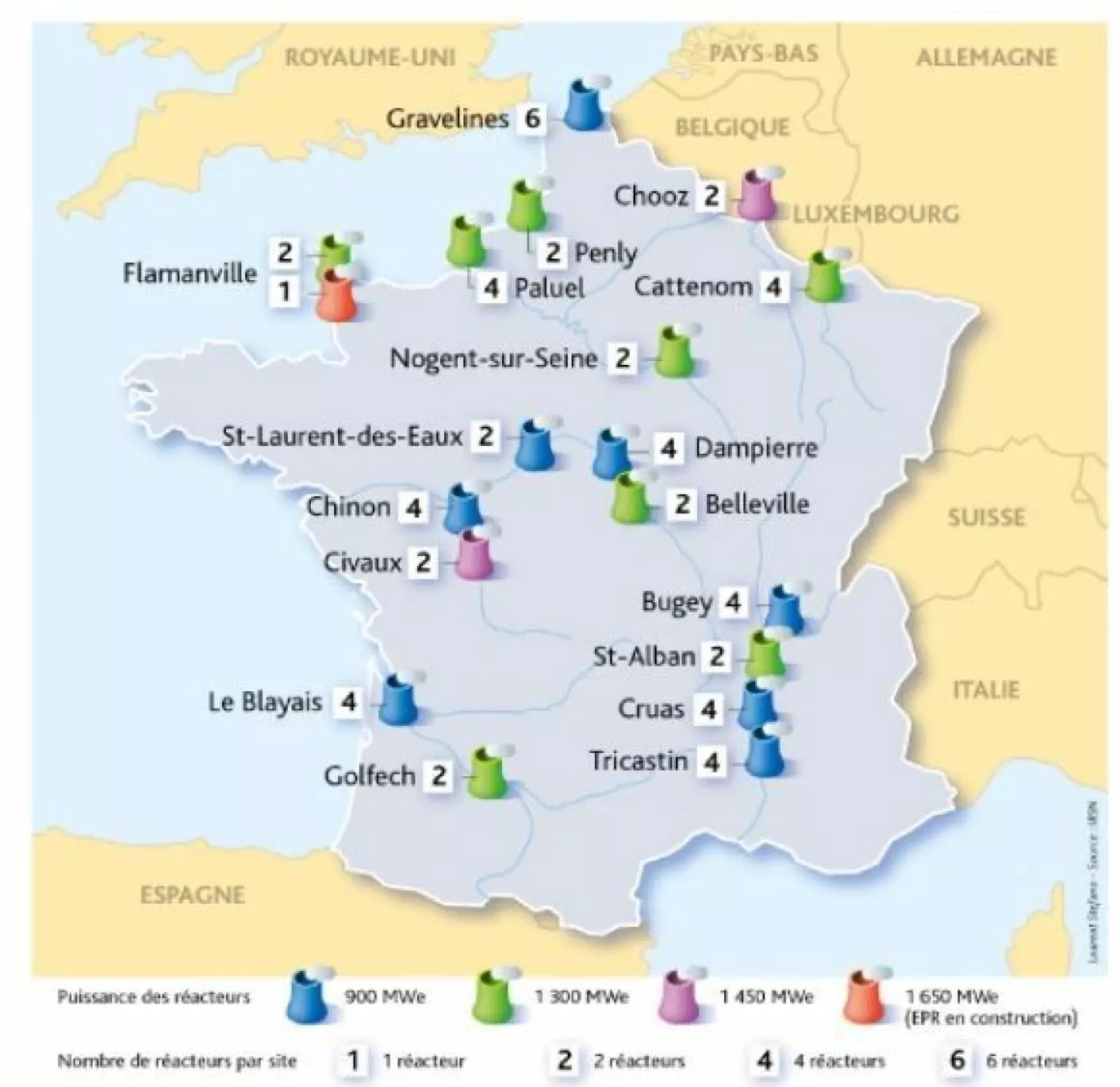
the six new sites will by no means triple French production, particularly since the older plants will increasingly be closed for repair and maintenance.
President Macron wants to triple atomic energy production by 2050
Richard Henshell, Saturday 20 April 2024
France is the third biggest producer of nuclear energy in the world and hopes to triple production by 2050. We look at where the country’s nuclear sites are and at President Macron’s plans for more.
Nuclear power represents up to 70% of the electricity produced in France at 282 Terawatt-hours (TWh), behind only China (395TWh) and the US (772TWh) and far ahead of the UK (42TWh).
However, many of its plants are approaching the end of their life-cycle. The majority of France’s 56 reactors date from the 1980s, and only two have been built since the year 2000.
In order to meet the requirements of the 2015 Paris Climate Accords, President Macron announced his plans to reinvest in France’s ageing nuclear plants during last year’s COP28 climate meeting in Dubai.
“Nuclear energy is back,” said Mr Macron (in English), adding that it was time to recognise the “essential role that nuclear energy can play in efforts to reach zero carbon dioxide emissions on a global level”.
“We will triple our capacity to produce nuclear energy between 2020 and 2050,” he said.
France’s 56 reactors are shared between 19 sites. Another reactor is scheduled to power up at Flamanville this summer, bringing the total to 57 reactors.
There are also plans to construct six new reactors at three existing plants:
- Two at Penly (Seine-Maritime) for 2035
- Two at Gravelines (Nord) for 2038
- Two at Le Bugey (Ain) for 2042
Construction is scheduled to start in summer 2024 on first of these new reactors in Penly, which like the others, will use the powerful new EPR-2 design. The estimated total cost for the six reactors is around €67.4 billion.
However, the six new sites will by no means triple French production, particularly since the older plants will increasingly be closed for repair and maintenance.
Indeed, in December 2021, the discovery of cracks in the emergency cooling systems of France’s four newest reactors led to them being shut down for over a year
Regardless, Mr Macron announced in February 2022 that France’s older plants could conceivably operate far into the future – beyond their 60th year or until they are no longer capable of producing electricity, or no longer safe.
Potential for small and micro modular reactors to electrify developing regions
Nature Energy (2024)
Abstract
While small-scale nuclear power is typically thought of for niche markets, recent work has suggested that it could help address the massive gaps in energy access in developing countries. However, nuclear energy has safety, governance and economic considerations that affect its deployment. Here we present a global analysis of regions suitable for nuclear reactor deployment based on physical siting criteria, security, governance and economic competitiveness. We use high-resolution population and satellite night-time light data to identify areas in need of electricity. We show that, technically, reactors in the 1–50 MWe range could serve 70.9% of this population. However, economics alone would make microreactors uncompetitive compared with renewables and energy storage for 87% of this population. Grid extensions and small modular nuclear reactors (with more competitive economics) could electrify these populations, but governance issues could limit deployment for all but 20% of this population. Together, governance and economics eliminate 95% of the potential market for microreactors.…………………………………………………………………more https://www.nature.com/articles/s41560-024-01512-y
Stuxnet – how a simple USB stick sabotaged Iran’s nuclear plan in a ‘world-first’ showdown

‘There is an acceptance you cannot guarantee your cyber security – someone motivated enough can probably get into your system.
Tensions between Iran and Israel are near a boiling point after the firing of hundreds of rockets into Israel and its latest military response.
But the conflict has brewed for years, including sabotage of Iran’s nuclear programme with the help of one spy and a single USB stick.
That same device contained the infamous Stuxnet worm.
It infiltrated the Iranian nuclear programme in 2010, marking the first time a country attacked the critical infrastructure of another state.
A cyber expert has shared how Stuxnet damaged an Iranian nuclear plant and if the UK is safe from similar malicious attacks.
Dr Gareth Mott, research fellow at the RUSI Royal United Services Institute think-tank in London, said that before 2010 similar attacks might have happened, but in the shadows.
However, with Stuxnet, researchers found ‘the code of the malware was way more advanced.’
He told Metro.co.uk: ‘They had years to develop it. It was no small-scale criminal developing it.’
Who was behind Stuxnet?
Signs point to Israel and the US to be responsible for the sophisticated worm.
He said: ‘Israel views Iran as a nemesis. In their view, Iran was developing uranium for nuclear weapons. Iran said it was for civilian systems.’
What Iran was doing was ‘not clandestine’.
The International Atomic Energy Agency (IAEA) monitors its programme and it is alerted ‘when the pod is opened.’
However, it is ‘hypothetically possible to abuse it,’ he said.
As an ally of Israel, the US got involved in the plan to target Iran’s nuclear facilities.
The development of Stuxnet began in 2005 years before it was smuggled into Natanz nuclear plant by a spy.
How Stuxnext caused a shutdown
Iranian nuclear sites, just like facilities in the UK, are carefully protected against attacks.
It means they are not connected to the Internet to avoid intrusions.
In the uranium enrichment facility, the radioactive chemical element spins around quickly in centrifuges to enrich it.
Dr Mott said: ‘The system is not connected to the Internet, it is air gapped. It is disconnected from the Internet. It is one of the best systems.’
But it has one weakness – USB ports.
He explains: ‘But you can put a USB drive in. You have to have a port to do any updates. That means an attack, if you can get malware on a USB drive and into the critical system, maybe you can disrupt it.’
When the top-secret tool was ready in 2009, Israelis and Americans wanted to use it.
But it did not work as intended so experts designing the worm went back to base and ‘worked what was wrong, in laboratory conditions.’
The US was hesitant and told their partners to wait, but the ‘Israelis went ahead and used it anyways,’ the expert said.
Uranium has to be spun around in a ‘very controlled manner,’ but the malware made the system ‘too quickly and slow down and too quickly again,’ he explained.
‘The system started to wobble and began to collapse.’
It also ‘tricked’ the control panel which would normally spot if the centrifuges were spinning at a risky speed and fix it, making it look like ‘things were fine, but it wasn’t’, Dr Mott said.
As a result of the worm, the Iranian uranium enrichment programme was ‘broken,’ he said.
It is thought to have been set back by several years, tech publication Dark Reading estimated.
Stuxnet highlights how something as innocent as a USB port compromise national security.
In the UK, a senior IT worker at the Sellafield nuclear plant was fired after she had downloaded sensitive data onto a USB stick and dropped it in a car park.
Stuxnet’s existence was revealed after it was found on thousands of infected computers across the world despite, on paper, the Iranian system had no internet connection.
‘Somehow it got released. Maybe one of the scientists took it home to research it.’
Cyber researchers saw it was ‘very advanced’ after ‘years in the making and a lot of money.’
Stuxnet was significant because at the time no country in the world had declared it had a cyber weapon.
‘In 2013 UK did it, and we now have an offensive [cyber] arsenal,’ the expert said.
‘We have always conducted espionage, but we are now doing it with cyber tools.’
Following Stuxnet, Iran grew its cyber offensive capabilities, making it a ‘regionally significant power but internationally it is not,’ he said.
However, in the cyber and Internet space ‘they punch above their weight,’ with hackers and researchers embedded in the cyber command of Iran’s Revolutionary Guards.
Israel has its own cyber force, Unit 8200, which is the country’s version of UK’s GCHQ and the American NSA.
Cyber attacks from Iran to Israel have ‘stepped up since October 7’ when Hamas launched its deadly attack in Israel, followed by destruction of Gaza in Palestine by the Israeli army, with more than 30,000 people killed and 70,000 injured in the unlawfully blockaded strip of land, according to the UN.
Last weekend, Israeli authorities said they have seen ‘no rise in cyber incidents, but researchers have observed cyber attacks have doubled or tripled,’ Dr Mott said.
He suspects they are ‘low-level attacks which Israel will respond to to ‘disrupt Iran.’
Continue readingNuke authorities approve loading fuel at Niigata nuclear plant
THE ASAHI SHIMBUN, April 15, 2024 https://www.asahi.com/ajw/articles/15229991
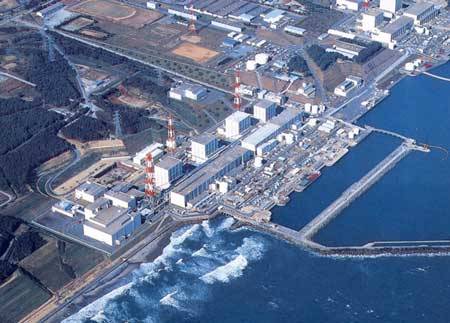
KASHIWAZAKI, Niigata Prefecture–The Nuclear Regulation Authority gave the go-ahead on April 15 to loading nuclear fuel into a reactor at the long-idled Kashiwazaki-Kariwa nuclear power plant here.
The approval is an important step toward restarting the plant, which has remained offline for more than a decade.
Plant operator Tokyo Electric Power Co. will start loading 872 fuel assemblies into the plant’s No. 7 reactor at around 4 p.m. The loading process is expected to take a couple of weeks to complete.
The reactor will then undergo a series of safety inspections before regulatory approval for a restart is granted.
In 2017, the reactor passed new safety regulatory standards mandated following the 2011 nuclear disaster at TEPCO’s Fukushima No. 1 nuclear power plant.
However, regulators suspended the restart process in 2021 due to deficiencies in the plant’s anti-terrorism measures. The NRA eventually approved the plant’s upgraded security measures in December last year.
Despite progress toward restarting the reactor, the governor of Niigata Prefecture has not yet granted his consent. Local communities remain divided, with ongoing debate and concerns regarding the plant.
1 This Month


PLEASE OPPOSE HR 8255 AND S.3639 – bills would accelerate satellite deployment, with no environmental review or safeguards – https://ncstd5li.quorum.us/campaign/169331/
To see nuclear-related stories in greater depth and intensity – go to https://nuclearinformation.wordpress.com
-
Archives
- September 2026 (194)
- August 2026 (330)
- July 2026 (355)
- June 2026 (287)
- May 2026 (306)
- April 2026 (356)
- March 2026 (251)
- February 2026 (267)
- January 2026 (308)
- December 2025 (358)
- November 2025 (359)
- October 2025 (375)
-
Categories
- 1
- 1 NUCLEAR ISSUES
- business and costs
- climate change
- culture and arts
- ENERGY
- environment
- health
- history
- indigenous issues
- Legal
- marketing of nuclear
- media
- opposition to nuclear
- PERSONAL STORIES
- politics
- politics international
- Religion and ethics
- safety
- secrets,lies and civil liberties
- spinbuster
- technology
- Uranium
- wastes
- weapons and war
- Women
- 2 WORLD
- ACTION
- AFRICA
- Atrocities
- AUSTRALIA
- Christina's notes
- Christina's themes
- culture and arts
- Events
- Fuk 2022
- Fuk 2023
- Fukushima 2017
- Fukushima 2018
- fukushima 2019
- Fukushima 2020
- Fukushima 2021
- general
- global warming
- Humour (God we need it)
- Nuclear
- RARE EARTHS
- Reference
- resources – print
- Resources -audiovicual
- Weekly Newsletter
- World
- World Nuclear
- YouTube
-
RSS
Entries RSS
Comments RSS
 nuclear-news