Japan gets first shipment of highly radioactive MOX fuel
 FIRST MOX NUCLEAR SHIPMENT SINCE FUKUSHIMA ARRIVES IN JAPAN http://au.news.yahoo.com/latest/a/-/latest/17766227/first-mox-nuclear-shipment-since-fukushima-arrives-in-japan/ TAKAHAMA, Japan (AFP) 26 June 13, – The first reprocessed nuclear shipment since the disaster at Fukushima arrived under armed guard near the Takahama nuclear plant in Japan on Thursday, an AFP journalist at the scenereported.
The vessel had travelled for around two months with its cargo of MOX fuel — a blend of uranium and plutonium — after being reprocessed in France. The shipment will now be stored because Japan has no working reactors able to use it.
Savannah River Mixed Oxide Nuclear Fuel (MOX) a costly failure
Von Hippel last May joined three other scientists in advocating the burial alternative in a scientific journal article about Britain’s plutonium stocks. One co-author was Rodney Ewing, who Obama has since appointed to head a federal nuclear waste panel, and another was Allison MacFarlane, now chair of the Nuclear Regulatory Commission. The MOX plant, if it is completed, needs an NRC license……
Administration officials say the main purpose of their “strategic reassessment” is to reexamine the burial alternative. A DOE report in 2002 concluded it would cost hundreds of millions of dollars less than building the MOX plant.
Energy Department Nuclear Nonproliferation Program Plagued By Problems, HUFFINGTON POST , 24 June 13 A multibillion-dollar U.S.-led effort to stem the threat of a terrorist nuclear blast is slowly unraveling because of huge cost overruns at a federal installation in South Carolina and stubborn resistance in Moscow to fulfilling the program’s chief goal, according to U.S. officials and independent experts.
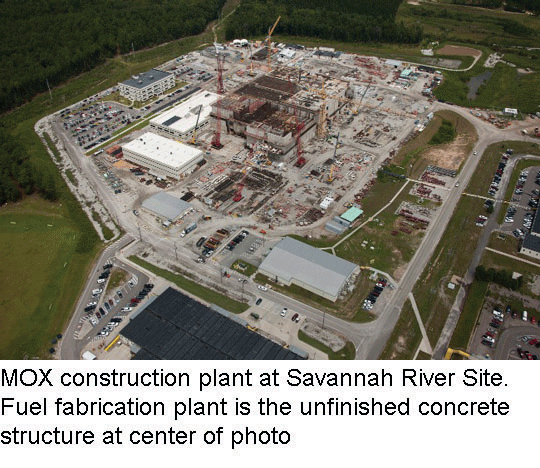
The 13-year old Energy Department program, authorized in agreements with Moscow spanning three presidents, is meant to transform excess plutonium taken from retired U.S. and Russian nuclear weapons into fuel for nuclear plants, so that it can’t be stolen and misused.
But that ambitious goal has been blocked by a tangle of technical, diplomatic and financial problems. The Obama administration is now considering cancelling the project, an idea that has provoked furious opposition from some Republican lawmakers who say it is vital to U.S. national security.
Its potential demise has provoked cheers from some leading arms control and nonproliferation experts, however. They say that as a result of little-noticed revisions to the underlying pact with Moscow on the plutonium’s disposal, the deal might actually wind up promoting Russia’s production of as much or more plutonium as it was supposed to eliminate. To keep its end of the bargain, the U.S. has spent more than a decade and $3.7 billion building a problem-plagued factory for making the plutonium-laced reactor fuel, located at the government’s Savannah River complex south of Aiken. Its construction and related costs have recently hit more than $680 million a year, but Congress is now considering a White House plan to shrink that spending substantially. Continue reading
Savannah River MOX project should be shut down
the MOX plant has “become from my point of view a pretty meaningless program” that should now be killed.
“The irony of this whole project is that it basically started with a good goal, of eliminating weapons grade material with the idea that it won’t be available for weapons purposes,” “But then it sort of evolved into this program that provides a fairly significant subsidy to the plutonium economy. So in the end, we will end up with more plutonium.”
How a Massive Nuclear Nonproliferation Effort Led to More Proliferation, The Atlantic, More than a decade of negotiations with Russia produced a clear winner, and it was not the United States. DOUGLAS BIRCH AND R. JEFFREY SMITHJUN 24 2013 SAVANNAH RIVER SITE, South Carolina – A half-finished monolith of raw concrete and rebar rises suddenly from slash pine forests as the public tour bus crests a hill at this heavily-secured site south of rural Aiken……..
Dark clouds hover over this ambitious federal project, 17 years in the making and at least six more from completion–if, indeed, it is ever completed. It lies at the center of one of the United States’ most troubled, technically complex, costly, and controversial efforts to secure nuclear explosive materials left stranded by the end of the Cold War.
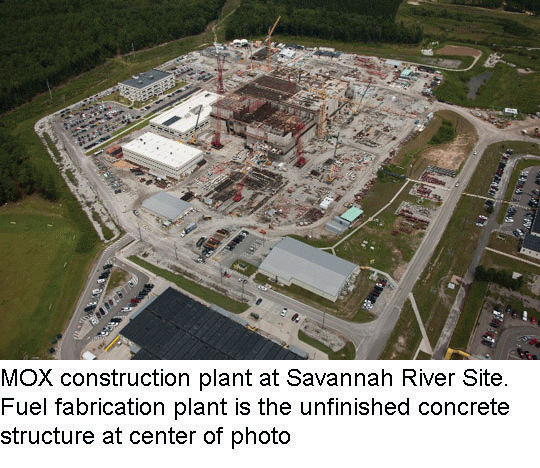
This plant – and another just like it in Russia — is meant to transform one of these materials, plutonium, into commercial reactor fuel that can be burned to provide electricity for homes, schools and factories, essentially turning nuclear “swords into ploughshares.” The aim of the so-called Mixed Oxide, or MOX, plant is to ensure the material never winds up in the hands of terrorists.
In the right hands, only nine pounds of plutonium — an amount about the size of a baseball — could make a bomb as powerful as the one the U.S. dropped on Hiroshima. The world’s military and civilian nuclear programs have produced about 500 metric tons of pure plutonium, an amount that could fuel tens of thousands of nuclear weapons yet fit into a backyard shed. Countries with nuclear programs continue to add roughly two tons to this inventory every year.
Washington has been spending hundreds of millions of dollars annually to help secure or remove plutonium and weapons-grade uranium in dozens of countries. But the U.S.-Russia plutonium disposition program, which includes the Savannah River plant, is the U.S. government’s single most expensive nonproliferation project now, according to Michelle Cann, senior budget analyst with a nonprofit group called Partnership for Global Security. Continue reading
The development of MOX nuclear fuel, and the Global Nuclear Energy Partnership
an industrial-scale facility in America capable of turning plutonium into reactor fuel — a key step on the path to a revived breeder program.
The MOX plant was “the plutonium nose under the tent”
Ernest Moniz…his June 2000 deal, approved by the two country’s presidents, called for both sides to use the  plutonium mostly as a reactor fuel, as Moscow sought.
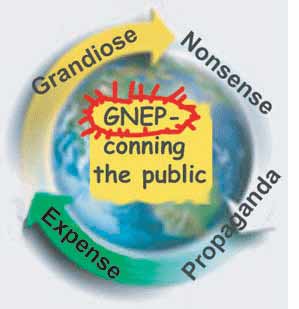 The George W. Bush administration subsequently embraced a plan to promote breeder reactors and the recycling of plutonium, not just domestically, but by other nuclear states including Russia, in a controversial program known as the Global Nuclear Energy Partnership. . Formal papers ordering the start of the MOX plant construction were signed in August 2007 by a former chief of the Bush-Cheney energy policy transition team, according to an internal Energy Department document.
How a Massive Nuclear Nonproliferation Effort Led to More Proliferation, The Atlantic, DOUGLAS BIRCH AND R. JEFFREY SMITHJUN 24 2013 SAVANNAH RIVER SITE, South Carolina “,……….Breeder reactors, in a kind of Atomic Age alchemy, can manufacture more plutonium than they consume, inspiring dreams of almost limitless energy. By generating fast-moving neutrons that transform the uranium mixed into their fuel into additional plutonium, they hold the promise of a significant energy reward: One gram of plutonium can produce more energy than a ton of oil. At one time or another, breeders have been pursued by every major nuclear nation. Continue reading
Problems in nuclear pyroprocessing
 South Korea’s Nuclear Blues The Diplomat, By Sebastian Sarmiento-Saher June 19, 2013“…..Assuming that South Korea does gain approval to conduct pyroprocessing, it may take years to do so in a way that is both technically and economically viable. The Diplomat spoke with Olli Heinonen, a Senior Fellow at Harvard’s Belfer Center for Science and International Affairs, who said that “[t]he product to the ROK pyroprocessing scheme is a uranium/transuranium/zirconium fuel, which is not suitable to fuel ROK’s LWR [Light Water Reactor] or CANDU [Canada Deuterium Uranium] reactors. Thus ROK is developing a prototype Sodium Fast Reactor (SFR), which is planned to be operational around 2028. A commercial scale SFR is envisioned to be available by the mid of the Century.”
In addition to a long wait time, pyroprocessing results in other fissile materials like Neptunium that can be used for nuclear bombs and must be safeguarded. Neptunium must be separated out, but as Dr. Heinonen added, “[i]t is fairly easy and straight forward for the IAEA to monitor and confirm that this does not take place.” This will mean that additional safeguarding efforts would need to be implemented – all of which will ultimately depend on South Korea’s willingness to abide by them.
Finally, how proliferation resistant is pyroprocessing in terms of achieving pure plutonium metal needed for nuclear weapons and timing? Dr. Heinonen gave his take: “The fact that plutonium is not fully separated from other elements gives to the ROK officials basis to argue that this difference makes pyroprocessing more proliferation resistant than traditional reprocessing.”
“In order to have pure plutonium separated, additional process steps are required either at the pyroprocessing plant or at a separate installation, which would be found by the IAEA. If such process steps are made it would take 1-3 weeks to turn the material to plutonium metal. However, before that the process steps need to be developed and constructed, but the bottom line is that by having the envisioned uranium/plutonium metal, a proliferator is substantially closer to pure plutonium metal.” ….. http://thediplomat.com/pacific-money/2013/06/19/south-koreas-nuclear-blues/
Nuclear industry fleeces taxpayers again – Small Modular Nuclear Reactors
Golden Fleece Award Goes to Department of Energy for Federal Spending on Small Modular Reactors http://www.taxpayer.net/library/article/golden-fleece-award-goes-to-department-of-energy-for-federal-spending-on-sm $100 Million in “Mini Nuke” Corporate Welfare Already Doled Out, Another Half Billion Dollars Or More in the Pipeline for Major Corporations that Could Pay for Own R&D, Licensing
WASHINGTON, D.C. – The federal government is in the process of wasting more than half a billion dollars to pay large, profitable companies for what should be their own expenses for research & development (R&D) and licensing related to “small modular reactors” (SMRs), which would be about a third of the size or less of today’s large nuclear reactors. In response, the nonpartisan group Taxpayers for Common Sense today handed out its latest “Golden Fleece Award” to the Department of Energy for the dollars being wasted on SMRs.

Titled “Taxpayer Subsidies for Small Modular Reactors,” a related TCS background report is available online here……
In making the Golden Fleece Award, Taxpayers for Common Sense highlighted the following issues: Continue reading
Safety and insurance problems for Small Modular Nuclear Reactors (SMRs)
Although significantly smaller than traditional reactors, SMRs will still require significant insurance in the event of an accident. New nuclear reactors are currently covered by the Price-Anderson Act for accidents valued at over $12.6 billion. Price-Anderson may fall dramatically short in the case of SMRs
Taxpayer Subsidies for Small Modular Reactors Taxpayers for Common Sense February 27, 2013 Download: Golden Fleece: Taxpayer Subsidies for Small Nuclear Reactors (pdf)
“……..Current Applicants Seeking Federal Subsidies
Five small modular reactor projects have applied for support from DOE to date, but none of the five different reactor designs have been licensed by the NRC. NRC and DOE aim to award the first design certification license by 2018 and final construction/operating license by the early 2020s. Currently, all five projects are in the pre-application phase with NRC working towards initial design certification.
All but one SMR project would develop an integral pressurized light water reactor (iPWR) while the other would develop a fast neutron reactor (FNR)…… Continue reading
South Korea and USA planning nuclear pyroprocessing
 Meanwhile, South Korea and the U.S. are set to sign a pact that will allow the two nations to step up their joint research on pyroprocessing technology, said a senior official at Seoul’s foreign ministry.
 If adopted, the pact would enable the International Atomic Energy Agency to guarantee the safety of pyroprocessing technology.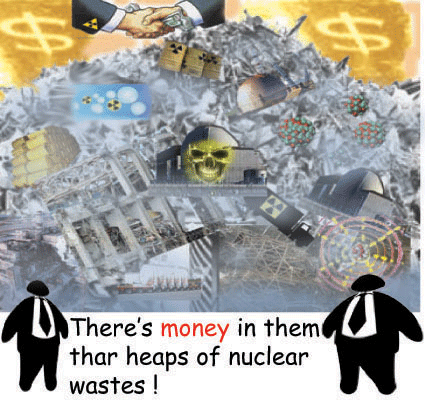
Britain’s rather horrible plutonium and Mixed Oxide Fuel (MOX) dilemma
 “……….The Government wants to try and turn plutonium into a fuel which can be used
Safecast’s revolution in radiation data collection
Safecast’s software and devices are all open source, and anyone can use the data. Franken says it’s being used by researchers around the world and even by the government in some Japanese cities.
you can tie specific medical symptoms to radiation levels.”
In Japan, Citizen Radiation-Tracking Project Goes Big Time, PRI’s The World, BY CATHERINE WINTER ⋅ MAY 21, 2013 ⋅ON A SUNNY SPRING MORNING JUST OUTSIDE TOKYO, JOE MOROSS HOOKS A RADIATION DETECTOR OUTSIDE THE BACK WINDOW OF A LITTLE RED CAR. HE LOOKS AT A MAP OF THE AREA ON HIS LAPTOP COMPUTER, TRYING TO FIND A ROUTE HE HASN’T DRIVEN BEFORE, SO HE CAN TAKE NEW RADIATION READINGS.
“We want to cover every street so people who look at our maps can drill down and zoom in and find out what the measurement is right in front of their house,” Moross says.
Moross is taking measurements for Safecast. Since the nuclear accident at Fukushima Daichi two years ago, volunteers like him have been driving around Japan, testing radiation and adding their readings to online maps.

When The World last checked in on Safecast, in May of 2011, the group had just formed and had posted a handful of radiation measurements.
Now, Safecast volunteers have taken close to 10 million separate readings……. Continue reading
Super expensive nuclear fusion project cancelled

MIT to cut nuclear fusion program, Boston Business Journal, 20 May 13, A program that explores nuclear fusion at the Massachusetts Institute of Technologyis shutting down, after its U.S. funding was cut….. it will leave only two fusion experiments in the U.S. – one at Princeton University, the other at General Atomics, a San Diego firm, according to the Globe. Nuclear fusion is seen as a potential clean alternative to nuclear fission, which is used in today’s nuclear reactors. http://www.bizjournals.com/boston/blog/mass_roundup/2013/05/mit-to-cut-nuclear-fusion-program.html
Japan’s Monju nuclear reprocessing plant not safe to restart
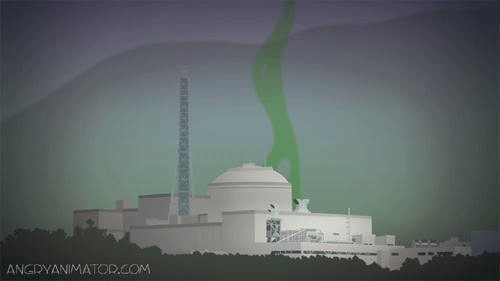
 AUDIO Japan’s nuclear safety record criticised by regulator http://www.radioaustralia.net.au/international/radio/program/connect-asia/japans-nuclear-safety-record-criticised-by-regulator/1132464 17 May 2013, Japan’s nuclear watchdog has refused to give the go-ahead to commission an experimental fast-breeder reactor due to safety concerns. The Monju reactor in the Fukui prefecture has been closed for almost two decades after a leak and a fire in 1995.
The head of the Nuclear Regulation Authority has blasted Monju’s operator for its lack of a safety culture, saying it deserved severe action.
The decision comes as dealing with Japan’s stockpile of nuclear waste becomes more urgent. Reporter: Karon Snowdon Speakers: Professor Andrew O’Neil, Director of the Griffith University Asia Institute; Hajime Matsukubo, International relations director of Tokyo’s Citizens Nuclear Information Centre
The Japan Nuclear Crowd Map reveals local radiation levels
ECS researchers at Southampton University develop new tool to provide radiation monitoring in Japan http://www.ecs.soton.ac.uk/news/4237 17 May 13, People living in Japan after the Fukushima nuclear disaster can find out the radiation level in their area thanks a new tool designed by a team of researchers from the ECS research group Agents, Interaction and Complexity Group (AIC). Continue reading
Good news- radiation type scanners replaced by safe “millimetre wave” airport scanners
 The reporting here didn’t show much knowledge about radiation, more’s the pity. Because this is a good news item. The new “millimetre wave” scanners, (at left) using sound waves, do not pose the radiation danger that did exist in using the “backscatter” method of airport scanning.
A pity that the mainstream media does not seem to bother informig itself, or the public, about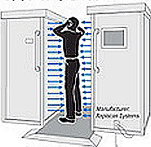 the differences between types of radiation. A great pity, because ionising radiation [as in ‘backscatter’ – at right) is a proven cause of cell damage – leading to mutations, cancer, other diseases, birth deformities, and inherited genetic instability. Christina Macpherson
 Video New Airport Scanners Reduce Radiation Risk, TSA Says KTLA by Micah Ohlman. 17 May 13 “…..The TSA says that the new millimeter-wave scanners can not only catch the bad guys better, but the radiation emitted is well below safety standards.
So what can you expect? Ticket holders still have to “assume the position” like the old backscatter machines.
But the new machines don’t use X-ray, but rather radio-frequency waves that are considered safer….”
The danger of Rokkasho Nuclear Reprocessing Plant
 Concern in US as Japanese nuclear reprocessing plant completed http://www.abc.net.au/am/content/2013/s3760280.htm Mark Willacy reported, May 16, 2013 TONY EASTLEY: It’s taken more than 20 years and $20 billion to build, and in a few months time Japan’s state-of-the-art nuclear reprocessing plant will be ready for operation.
The Rokkasho plant in far northern Japan will be capable of turning used nuclear fuel into eight tonnes of plutonium a year, although the Japanese say this weapons-grade plutonium will be used for power generation only.
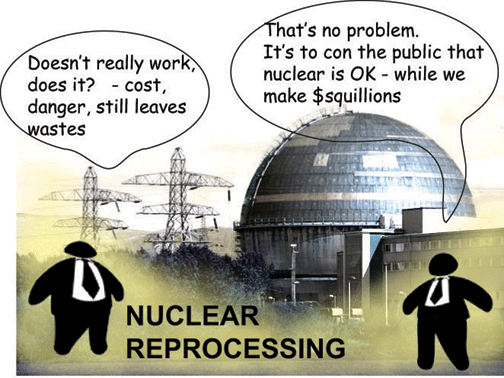
That hasn’t soothed American concerns though. It’s worried about the security of the plutonium stockpiles and the risk that the new plant could stoke a nuclear race in the region.
North Asia correspondent Mark Willacy was given an exclusive look inside the Rokkasho nuclear complex. MARK WILLACY: In the spring sunshine, Keiko Kikukawa tends to her daffodils. The winter snow has finally melted up here in Japan’s far north and her fields are beginning to burst with colour.
When Keiko Kikukawa isn’t selling her flowers, she’s campaigning to uproot what she sees at the biggest pest in this district – the Rokkasho nuclear complex a few kilometres down the road.
“First of all, Rokkasho village has become a dump for radioactive waste from around Japan,” she tells me. “If there was an accident it’d be catastrophic,” she says.
Keiko Kikukawa is talking about the sprawling Rokkasho nuclear re-processing plant.
Its operator, Japan Nuclear Fuel Limited, has spent two decades and $28 billion building the facility……Japan has 17,000 tonnes of spent nuclear fuel sitting in pools across the country. If Rokkasho is given the green light to begin operation, it can turn this fuel into eight tonnes of plutonium every year.
The problem is, this eight tonnes of plutonium will be weapons-grade – meaning it could theoretically be used to make nuclear bombs…..
1 This Month
26 September – International Day for the Total Elimination of Nuclear Weapons





PLEASE OPPOSE HR 8255 AND S.3639 – bills would accelerate satellite deployment, with no environmental review or safeguards – https://ncstd5li.quorum.us/campaign/169331/
To see nuclear-related stories in greater depth and intensity – go to https://nuclearinformation.wordpress.com
-
Archives
- September 2026 (305)
- August 2026 (330)
- July 2026 (355)
- June 2026 (287)
- May 2026 (306)
- April 2026 (356)
- March 2026 (251)
- February 2026 (267)
- January 2026 (308)
- December 2025 (358)
- November 2025 (359)
- October 2025 (375)
-
Categories
- 1
- 1 NUCLEAR ISSUES
- business and costs
- climate change
- culture and arts
- ENERGY
- environment
- health
- history
- indigenous issues
- Legal
- marketing of nuclear
- media
- opposition to nuclear
- PERSONAL STORIES
- politics
- politics international
- Religion and ethics
- safety
- secrets,lies and civil liberties
- spinbuster
- technology
- Uranium
- wastes
- weapons and war
- Women
- 2 WORLD
- ACTION
- AFRICA
- Atrocities
- AUSTRALIA
- Christina's notes
- Christina's themes
- culture and arts
- Events
- Fuk 2022
- Fuk 2023
- Fukushima 2017
- Fukushima 2018
- fukushima 2019
- Fukushima 2020
- Fukushima 2021
- general
- global warming
- Humour (God we need it)
- Nuclear
- RARE EARTHS
- Reference
- resources – print
- Resources -audiovicual
- Weekly Newsletter
- World
- World Nuclear
- YouTube
-
RSS
Entries RSS
Comments RSS

