Over ¥1 trillion cost for International Linear Collider,planned for Japan
Dangers in removing Fukushima’s spent nuclear fuel rods
 Japanese gamble Armageddon in Last Ditch Fukushima Effort, Whiteout Press, August 20, 2013. Fukushima, Japan Japan gambles the world “……….For the past two years, there have been varying and sporadic reports, some official and some unofficial, describing how the Fukushima nuclear meltdown is anything but under control. In fact, millions of gallons of radioactive wastewater continue to spill out into the Pacific to this day. And while the reactors and their safety mechanisms continue to break down, the world comes closer and closer to global Armageddon.
To stop the complete and total meltdown of Japan’s nuclear reactors, authorities have proposed a dangerous plan. The biggest problem is Fukushima’s Reactor Number 4. The reactor’s cooling pool for spent nuclear rods is located on the top floor of the TEPCO building. And that building was heavily damaged by the 2011 quake. Due to its instability, authorities say they must move the 400 tons of spent fuel rods right away.
Spent fuel rod transfers occur on a fairly regular basis, but always under the most secure and controlled setting due to the potential nuclear catastrophe that would happen if just one spent rod is mishandled. In the case of Fukushima’s Reactor 4, officials will attempt to remove 1,300 spent fuel rods from a structurally unsafe building in a highly contaminated environment.
The problems and dangers
One nuclear fallout expert, Christina Consolo, spoke to RT News to answer the outlet’s questions regarding the situation in Fukushima. She detailed a list of potential problems authorities might encounter when they attempt to move the spent rods. Those potentially catastrophic hurdles include (from RT News):
- The racks inside the pool that contain this fuel were damaged by the explosion in the early days of the accident.
- Zirconium cladding which encased the rods burned when water levels dropped, but to what extent the rods have been damaged is not known, and probably won’t be until removal is attempted.
- Saltwater cooling has caused corrosion of the pool walls, and probably the fuel rods and racks.
- The building is sinking.
- The cranes that normally lift the fuel were destroyed.
- Computer-guided removal will not be possible; everything will have to be done manually.
- TEPCO cannot attempt this process without humans, which will manage this enormous task while being bombarded with radiation during the extraction and casking.
- The process of removing each rod will have to be repeated over 1,300 times without incident.
- Moving damaged nuclear fuel under such complex conditions could result in a criticality if the rods come into close proximity to one another, which would then set off a chain reaction that cannot be stopped.
What is most likely to go wrong?
When asked what the biggest potential dangers are in removing the damaged spent fuel rods, Christina Consolo replied, “The most serious complication would be anything that leads to a nuclear chain reaction. And as outlined above, there are many different ways this could occur. In a fuel pool containing damaged rods and racks, it could potentially start up on its own at anytime. TEPCO has been incredibly lucky that this hasn’t happened so far.”
She also expressed concern for the human workers that will have to submerse themselves into a highly radioactive environment and then perform extremely precise movements. Not only might their senses and thinking be affected, but their protective gear will make the entire operation somewhat clumsy.
“My second biggest concern would be the physical and mental fitness of the workers that will be in such close proximity to exposed fuel during this extraction process,” Consolo told RT News, “They will be the ones guiding this operation and will need to be in the highest state of alertness to have any chance at all of executing this plan manually and successfully. Many of their senses, most importantly eyesight, will be hindered by the apparatus that will need to be worn during their exposure to prevent immediate death from lifting compromised fuel rods out of the pool.” http://www.whiteoutpress.com/articles/q32013/japanese-gamble-armageddon-in-last-ditch-fukushima-effort/
Shortage of funds holds up depleted uranium deconversion plant
Funds shortage delays uranium plant Alburquerque by Nick Pappas / Journal Ast. Business Editor 18 aug 13, International Isotopes Inc.’s construction of a first-of-its-kind depleted uranium deconversion plant just west of Hobbs will be delayed because of a shortage of funding for the $125 million project, the company acknowledged Friday…… The Idaho Falls company announced the selection of a 640-acre building site 15 miles west of Hobbs in March 2009 and submitted its license application to the U.S. Nuclear Regulatory Commission the following January. The NRC issued a 40-year construction and operating license last October.
Originally, International Isotopes officials said they hoped to complete construction of the facility in Lea County by the end of 2012.
But the need for additional funding – a mix of equity and debt financing – has extended that timeline…… http://www.abqjournal.com/248776/biz/funds-shortage-delays-uranium-plant.html
A giant wall of ice – will it stop Fukushima radiation leak?
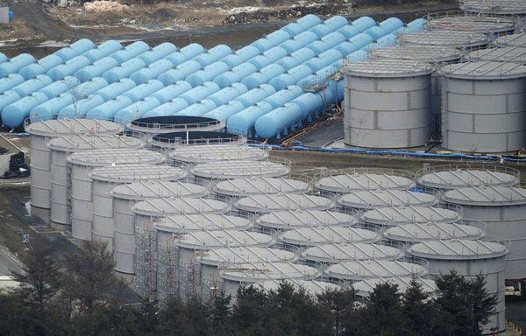 Can a giant ice wall stop Fukushima radiation from leaking into the sea? Grist, By Lisa Hymas Aug 9, 2013 “……..So now Tokyo Electric Power Company, or TEPCO, which owns the plant, has a plan to build an underground wall of frozen earth to stop the radioactive water leakage. NPR explains:
[T]o understand, you need to know the geography of Fukushima. There are three melted down reactors, and they’re all right on the coast. To the west, you have mountains. To the east, you have ocean. And so what’s happening is groundwater flows downhill. It flows down through the ruins of the plant and then flows out to the sea. …
So now, TEPCO has proposed literally creating a wall of ice around the plant. And what they’re talking about is not a wall above ground, but freezing the ground around the plant to stop water from flowing in. …
So the basic idea is that they run piping into the ground and they put coolant in the piping and that freezes the earth around the pipes, and it all sort of gradually forms together into a wall. This is something that civil engineers see sometimes, but it’s not that common. And certainly, the way they’re talking about using it in Fukushima is unprecedented. This wall will be nearly a mile around according to TEPCO. It would require more than 2 million cubic feet of soil to be frozen. But if it worked, then it may be the only way to keep water from flowing into the plant and contaminated water from flowing out.
The New York Times points out another challenge: “the wall will need to be consistently cooled using electricity at a plant vulnerable to power failures. The original disaster was brought on by an earthquake and tsunami that knocked out electricity.”…..
[The wall is] expected to cost between $300 million and $400 million. http://grist.org/news/can-an-ice-wall-stop-fukushima-radiation-from-leaking-into-the-sea/?utm_source=syndication&utm_medium=rss&utm_campaign=feed
Small Modular Reactors (SMRs) won’t save moribund nuclear ndustry
 Report: Nuclear industry shouldn’t rely on SMRs Malia SpencerReporter-Pittsburgh Business Times 9 Aug 13 A report this week from the nonprofit Institute for Energy and Environmental Research asserts that relying on the development of small modular reactors “is unlikely to breathe new life into the increasingly moribund U.S. nuclear power industry.”….
The reasons for the critical findings? According to the report, SMRs will likely need tens of billions of
purchase orders or government subsidies, will create new reliability vulnerabilities, and will raise concerns about safety and proliferation.
Westinghouse was cited in the report along with Pennsylvania as one of the companies and states that could see “major implications” if SMRs fail to take off……
http://www.bizjournals.com/pittsburgh/blog/energy/2013/08/report-nuclear-industry-shouldnt.html
Nuclear fusion faces financial and scientific gloom
 Fusion Energy Quest Faces Boundaries of Budget, Science Tim Folger For National Geographic July 26, 2013 Part of our weekly “In Focus” series—stepping back, looking closer.
A large banner hangs from the front of the stadium-size building that houses the world’s most powerful array of lasers: “Bringing Star Power To Earth.”
For the past four years, physicists at the National Ignition Facility, or NIF, in Livermore, California, have been trying to harness nuclear fusion, the same reaction that powers the sun and the stars. Supporters of the $3.5 billion facility believe that a successful outcome to the experiments could help usher in an era of nearly limitless energy. But the ambitious fusion research program at NIF now faces an uncertain future, both politically and scientifically………. Continue reading
300,000 tons of radioactive water at Fukushima, and still growing
 As of May 7, the Japan Times reported that TEPCO had installed 290 huge storage talks at Fukushima to hold more than 78 million gallons (290,000 tons) of radioactive water, with another 25 million gallons still uncollected. Fukushima is generating an estimated 100,000-plus gallons (400 tons) of radioactive water every day
TEPCO estimates that groundwater is entering the complex at a rate of at least 54,000 gallons per day.
Fukushima 2013: “Remaining Radioactive Mass”, “Dangerous Leaking Radioactive Water”, All Four Reactors are “Getting Worse” By William Boardman Global Research, July 11, 2013 The first thing to know about the danger from the radioactive mass remaining on site in the three reactors that melted down at Fukushima is that nobody knows how much radioactive material there is, nobody knows how much uranium and plutonium it contains, and nobody knows how to make it safe — so no one knows how great the continuing danger is.
In order to prevent nuclear material from being diverted to use in weapons, the International Atomic Energy Agency of the U.N. requires each country to report regularly on the volume of nuclear materials in its nuclear power plants. At Fukushima, this is currently impossible with the cores of the three reactors that melted down.
Diversion of this material to weapons use is not a problem at the moment, since the level of radioactivity is high enough to kill anyone who comes close to it, which is why it hasn’t been moved. On the other hand, it is necessary to move it in order to measure it, and even if it was movable now, the technology to measure it does not yet exist. Continue reading
Insane nuclear weapons: nuclear torpedo, and nuking the moon!
 Project A119, conceived before the Apollo landings, was ostensibly created for “science.” There’s no real science purpose to nuking the moon, though, so it’s kind of obvious what it was really about. Also, they intended to blow up the nuke on the Moon’s horizon, for maximum visibility from Earth.
For science.
The Five Most Insane Nuclear Delivery Systems Jaolpnik MICHAEL BALLABAN, 14 July 13 “……The Nuclear Torpedo Quick! Doomsday is upon us! The only way to save our cities is to get rid of all the enemy subs! Both the East and the West made nuclear torpedoes that survived in service into at least the 1970s. That’s not such a bad idea if you really want to sink something, but nukes aren’t something you just want to be using all willy-nilly. As torpedoes had the nasty habit of sometimes escaping from their tubes, this necessitated a two-step process for their use.
The Nuclear Torpedo Declassified U.S. Nuclear Test Film #46
First, the torpedo would be fired, and then a second button would be pushed to detonate it. This meant you would need a wire to connect the original sub and the newly-fired torpedo.
Nothing wrong with that, right? Just get a really long wire. And then you realize how a “really long wire” is still too short for you to get away.
The American Mark 45 torpedo had a really long wire, but even at its longest it was only eight miles in length. Even if you sunk somebody, with an 11 kiloton warhead on board, you were bound to go down to the bottom with them. http://jalopnik.com/the-five-most-insane-nuclear-delivery-systems-768180979
Project A119 Continue reading
Confusion and secrecy surround China’s proposed uranium processing plant in Jiangmen,

 Experts call for more details on Guangdong uranium plant, South China Morning Post, Olga Wong and Minnie Chan Concern over sketchy nature of details and possible radiation risks from proposed nuclear development in Guangdong.
Nuclear experts and green activists have called for more information from the Guangdong government after limited details were released about its proposal for a uranium processing plant in Jiangmen, about 100 kilometres from Hong Kong.
An announcement by the Jiangmen City Development and Reform Bureau said the 230-hectare plant would carry out uranium conversion, enrichment and fuel fabrication.
But the three-page statement, issued last Thursday, did not make it clear whether the plant, in the Longwan industrial district of Zhishanzhen, would perform spent fuel reprocessing – recycling of old fuel rods that could emit high doses of radiation – or what measures would be used to avoid radiation leaks…… Continue reading
Uranium Processing Facility in Tennessee getting even further behind schedule
Oak Ridge uranium project even more behind schedule than it used to be http://www.abqjournal.com/main/219488/blogs/nm-science/oak-ridge-uranium-project-even-more-behind-schedule-than-it-used-to-be.html By John Fleck / Journal Staff Writer on Wed, Jul 10, 2013
[T]he Department of Energy’s Stockpile Stewardship and Management Plan states that the First Phase of the Uranium Processing Facility project will be completed in 2025, which indicated a rather significant delay from previous reports that — just a couple of years ago — had the entire project completed before then. The First Phase is focused on moving the operations now housed in the 9212 uranium processing complex at the Y-12 nuclear weapons plant in Oak Ridge. Phases Two and Three, incorporating the work now done in Y-12′s 9215 building and 9204-2E (Beta-2E), would not be completed until around 2038.
The National Nuclear Security Administration, in a response to earlier questions about the plan, this week confirmed the schedule in the Stockpile Stewardship report as being the most up-to-date assessment of the work plan for the multibillion-dollar project.
Nuclear waste experts reject Mixed Oxide (MOX) fuel program
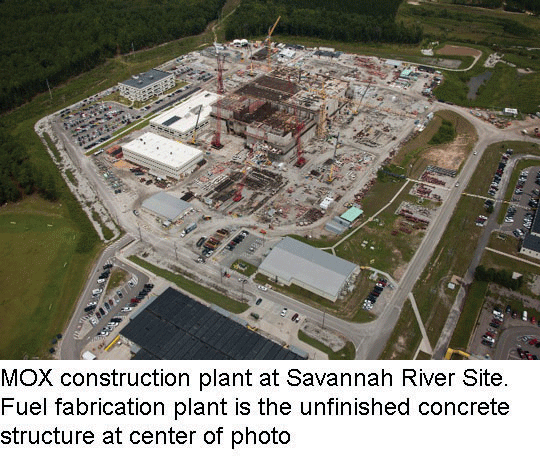 Nuclear waste: DC has ignored a cheaper way to dispose of plutonium — until now Sentinel.com, Douglas Birch & R. Jeffrey Smith The Center for Public Integrity, 7 July 13, “………Frank von Hippel, a White House science official in the early 1990’s who chaired a working group on Russia’s weapons plutonium, said he initially supported the MOX plant because the threat was high and MOX was the only solution Russia would support. But Russia’s decision since then to burn its new MOX fuel in reactors that can actually produce more plutonium was the last straw for von Hippel. As a result, he said, the MOX plant “[has] become from my point of view a pretty meaningless program” — one that’s cost billions of dollars so far.
Last May, von Hippel joined three other prominent scientists in a commentary published in Nature, entitled, “Time to Bury Plutonium,” in which they criticized Britain’s draft plans to dispose of its huge stockpile of surplus reactor plutonium by building a new MOX plant of its own. The four authors wrote that MOX programs worldwide have been plagued by extravagant expenses, technology breakdowns and design flaws.
In France, Areva’s recycling of plutonium from spent fuel for MOX adds about $750 million each year to the cost of electricity, according to a French study in 2000 cited by their article. Britain closed its Sellafield MOX plant in 2011, they pointed out, after it operated at just 1 percent of capacity for a decade.
The authors urged the country to “give plutonium immobilization another look … Although the technique has not been demonstrated at full scale, there is substantial literature on how to do it. Immobilization should be easier and cheaper than MOX production.” Von Hippel separately said that according to his calculations, it could be as much as seven times cheaper. Continue reading
The failure of the South Carolina Mixed Oxide (MOX) nuclear fuel plant
Nuclear waste: DC has ignored a cheaper way to dispose of plutonium — until now Sentinel.com, Douglas Birch & R. Jeffrey Smith The Center for Public Integrity, 7 July 13, “………..Unrealized ambitions
Although the White House has not allocated any additional funding for the South Carolina plant after 2014, the Energy Department claims it remains in contention as a solution to the plutonium disposal problem. But already it’s clear that the original U.S. goal for the program — reducing the world’s supply of nuclear explosive material by 68 tons – will not be realized.
Washington compromised repeatedly with Russia to pursue a program that even for some of its initial supporters has long since ceased to be a top nonproliferation priority. Meanwhile, the price of the MOX fuel factory soared far beyond the Energy department’s estimates, making it one of many, multi-billion dollar, Energy Department programs accused of being poorly run.
“MOX is just a sample of a larger problem,” says Gene Aloise, a senior federal auditor who tracked nonproliferation projects for the Government Accountability Office from 1994 to 2012.
The result is that Washington has spent at least $3.7 billion on a plant to manufacture reactor fuel no U.S. utility is eager to buy, after rejecting alternatives that likely would have been cheaper.
“The government’s plutonium plan is a pluperfect disaster,” Sen. Edward Markey, a newly-elected Massachusetts Democrat, told the Center for Public Integrity in a statement. “And all to produce $2 billion worth of reactor fuel at a cost of tens of billions of taxpayer dollars and damage to our global non-proliferation efforts.” Markey was the ranking member of the House Natural Resources Committee, has long been active on nuclear safety issues, and in 1986 chaired hearings on the Chernobyl disaster.
The factory’s fate might be decided next year, as the administration prefers, after another $320 million is spent on its construction. Or Congress might decide to take swifter and more decisive action in budget legislation this summer……..And after twenty years of negotiations, promises and plans, and billions in spending, the U.S. appears no closer — in its principal plutonium disposal efforts — to the goal of making the world safer from a nuclear disaster.http://www.tucsonsentinel.com/nationworld/report/070513_nuclear_waste/nuclear-waste-dc-has-ignored-cheaper-way-dispose-plutonium-until-now/
Secret promises to USA, by Japan, to burn plutonium
 Mainichi: Japan’s secret promise with U.S. to burn plutonium — “It is abnormal for sure” — “Expected to stir up controversy” http://enenews.com/mainichi-japan-secretly-promised-to-burn-plutonium-it-is-abnormal-for-sure-expected-to-stir-up-controversy
Title: Japan made secret promise with U.S. to restart pluthermal nuclear program
 Source: Mainichi
Date: June 25, 2013
A Japanese prime ministerial envoy secretly promised to the United States that Japan would resume its controversial “pluthermal” program, using light-water reactors to burn plutonium, according to documents obtained by the Mainichi.
The secret promise was made by Hiroshi Ogushi, then parliamentary secretary of the Cabinet Office, to Daniel Poneman, deputy secretary of the U.S. Department of Energy, during Ogushi’s visit to the United States on behalf of then Prime Minister Yoshihiko Noda in September last year.
[…] The fact that a Japanese official promised to the U.S. to implement such a controversial project without a prior explanation to the Japanese public is expected to stir up controversy. […]
“It is abnormal for sure,” said one official with the Agency for Natural Resources and Energy. […]
See also: Plutonium-burning reactors to restart in Japan? — Gov’t forcing companies to use MOX fuel — Official: “We have no other choice”
The exploding costs of the Savannah River MOX plant
The explosive costs of disposing of nuclear weapons WP,By Walter Pincus, July 3 Costs can explode like fireworks when it comes to nuclear weapons disposal.
For example, it could cost more money and take longer to get rid of just 37.5 tons of excess, weapons-grade plutonium than it did for the Manhattan Project to produce the atomic bombs that ended World War II. Four weapons — the Trinity plutonium implosion device tested in the New Mexico desert; the Little Boy uranium bomb dropped on Hiroshima; the Fat Man plutonium bomb that hit Nagasaki, and an unused uranium bomb — were produced within six years in current dollars of some $24.1 billion, according to Stephen I. Schwartz’s book, “Atomic Audit.”
In comparison, it will cost more than $24.2 billion and take until 2036 for the United States to get rid of those 37.5 tons of plutonium, according to a Government Accountability Office estimate. It appears in the Senate Armed Services report on the fiscal 2014 defense authorization bill.
Costs have skyrocketed for the Mixed Oxide Fuel Fabrication Facility at the Savannah River plant in South Carolina. The facility is designed to blend the surplus plutonium with uranium oxide to make mixed oxide (MOX) that can be used as fuel in some U.S. commercial reactors. That would make the plutonium unusable for future nuclear weapons.
When the National Nuclear Security Administration (NNSA) originated this MOX program in 2002, design and construction were to cost $1 billion.
By 2005, the estimate was $3.5 billion. When project construction began in 2007, it was three years behind schedule with a $4.8 billion price tag.
According to NNSA’s fiscal 2014 budget request, construction will hit $7.78 billion.
The annual cost to run the facility has also exploded. NNSA estimated in 2002 that it would cost $100.5 million a year to operate the MOX plant. Annual operating costs are now expected to be $543 million. The planned 2017 completion date has slipped another two years, according to a recent Congressional Research Service report.
Here’s another ticking time bomb. A federal facilities agreement in 2002 with South Carolina called for Washington to pay up to $100 million a year to the state if the plant did not produce 1 ton of MOX fuel annually, starting in 2009. That was to compensate the state for the storage of excess plutonium.
Sen. Lindsay Graham (R-S.C.), a main project booster, has used amendments to delay the fines until 2016, according to a study by the Center for Public Integrity.
The cost prompted the Obama administration to propose slowing construction while it reviews the MOX program, including assessing other ways to get rid of the plutonium……… http://www.washingtonpost.com/world/national-security/the-explosive-cost-of-disposing-of-nuclear-weapons/2013/07/03/64f896e0-e287-11e2-80eb-3145e2994a55_story.html
Integral Fast Nuclear Reactor’s serious problems
Another Take on Pandora’s Promise EARTH ISLAND JOURNAL BY GAR SMITH – JUNE 28, 2013“…….Problems with the IFR Looking beyond the ballyhoo, there are significant concerns about IFRs that Pandora’s Promise fails to address. To date, no breeder reactor has been commercially viable. Arjun Makhijani, president of the Maryland-based Institute for Energy and Environmental Research, shares David McKay’s concern about the 250-plus metric tons of excess plutonium moldering away in storage sites around the world. Makhijani, however, believes the idea that “sodium cooled-fast neutron reactors [could] be built to denature the plutonium reveals a technological optimism that is disconnected from the facts.” While some IFRs “have indeed operated well,” Makhijani notes, “roughly $100 billion have been spent worldwide to try and commercialize these reactors – to no avail.”
Fueled by a uranium-plutonium alloy, IFRs can produce (“breed”) more plutonium than they burn. But this plutonium can be used to produce nuclear weapons, which poses serious diversion and proliferation risks. Also, IFRs are cooled by molten sodium, not water. Sodium can explode when it comes in contact with water and, when exposed to air, sodium ignites and burns furiously. Sodium-cooled reactors are prone to coolant leaks. Fast reactor accidents have occurred in France, Japan, Scotland, at the Fermi 1 reactor in Michigan, and twice at a Simi Valley reactor site in southern California.
Several competing nuclear power designs are cited in Pandora’s Promise, but they receive little screen time. There is a brief mention of Liquid Fluoride Thorium reactors, a Traveling Wave Reactor (Bill Gates’ pet project), and the government’s support for “mini-nukes” that could be installed underground and fired up to power urban skyscrapers. How practical and safe are they? Pandora’s Promise provides few answers. There is no in-depth analysis of the pros and cons of any of these alternatives….. . http://www.earthisland.org/journal/index.php/elist/eListRead/another_take_on_pandoras_promise
1 This Month
26 September – International Day for the Total Elimination of Nuclear Weapons





PLEASE OPPOSE HR 8255 AND S.3639 – bills would accelerate satellite deployment, with no environmental review or safeguards – https://ncstd5li.quorum.us/campaign/169331/
To see nuclear-related stories in greater depth and intensity – go to https://nuclearinformation.wordpress.com
-
Archives
- September 2026 (305)
- August 2026 (330)
- July 2026 (355)
- June 2026 (287)
- May 2026 (306)
- April 2026 (356)
- March 2026 (251)
- February 2026 (267)
- January 2026 (308)
- December 2025 (358)
- November 2025 (359)
- October 2025 (375)
-
Categories
- 1
- 1 NUCLEAR ISSUES
- business and costs
- climate change
- culture and arts
- ENERGY
- environment
- health
- history
- indigenous issues
- Legal
- marketing of nuclear
- media
- opposition to nuclear
- PERSONAL STORIES
- politics
- politics international
- Religion and ethics
- safety
- secrets,lies and civil liberties
- spinbuster
- technology
- Uranium
- wastes
- weapons and war
- Women
- 2 WORLD
- ACTION
- AFRICA
- Atrocities
- AUSTRALIA
- Christina's notes
- Christina's themes
- culture and arts
- Events
- Fuk 2022
- Fuk 2023
- Fukushima 2017
- Fukushima 2018
- fukushima 2019
- Fukushima 2020
- Fukushima 2021
- general
- global warming
- Humour (God we need it)
- Nuclear
- RARE EARTHS
- Reference
- resources – print
- Resources -audiovicual
- Weekly Newsletter
- World
- World Nuclear
- YouTube
-
RSS
Entries RSS
Comments RSS

