Japan’s Nuclear Regulation Authority wants Monju reprocessing plant to stay shut
NRA wants Monju to remain shut downhttp://www.japantimes.co.jp/news/2013/05/14/national/nra-wants-monju-to-remain-shut-down/#.UZQmBqJwpLt Lapses seen in JAEA checks of key reactor components KYODO, STAFF REPORT MAY 14, 2013 The Japan Atomic Energy Agency committed grave safety errors in managing the troubled Monju prototype fast-breeder reactor in Fukui Prefecture, and top officials at the Nuclear Regulation Authority said Monday they plan to make sure it stays closed.
The closure order to the government-linked JAEA will effectively dash any hope of trying to restart the reactor by year’s end, dealing another setback to Japan’s long-stalled plan to set up a nuclear fuel recycling system.
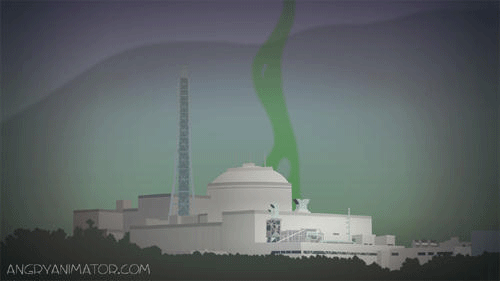
In September, the now-defunct Nuclear and Industrial Safety Agency carried out surprise inspections and determined that JAEA failed to regularly check key components of the experimental 280,000-kw reactor, as required by internal rules. Continue reading
Rokkasho nuclear reprocessing plant could lead to nuclear weapons for Japan
 Is Japan Developing a Nuclear Weapons Program? By Peter Symonds Global Research, May 07, 2013 Huge reprocessing plant could be used to stockpile plutonium for the future manufacture of nuclear weapons.The Wall Street Journal published an article on May 1 entitled “Japan’s nuclear plan unsettles US.” It indicated concerns in Washington that the opening of a huge reprocessing plant could be used to stockpile plutonium for the future manufacture of nuclear weapons.
The Rokkasho reprocessing facility in northern Honshu can produce nine tonnes of weapons-grade plutonium annually, or enough to construct up to 2,000 bombs. Continue reading
Getting ready for nuclear disasters – radiation-proof vehicles
Japan Launches Radiation-proof Vehicles To Deal With Nuclear Disasters http://www.rttnews.com/2109025/japan-launches-radiation-proof-vehicles-to-deal-with-nuclear-disasters.aspx?type=gn&utm_source=google&utm_campaign=sitemap 5/3/2013 Japan’s National Police Agency has launched radiation-proof vehicles at its headquarters in Tokyo and the nuke accident-hit Fukushima prefecture to better prepare for nuclear-related trouble.
The vehicles have lead on their bodies and windows, air-pressurized, and can monitor atmospheric radiation levels. The 10.5-meter-long vehicle weighing 21 tons costs more than $1.5 million, Japanese media reported on Friday citing the Agency.
It said the vehicles would be mobilized in the event of terror attacks on nuclear facilities or nuclear accidents.
Since the September, 2001 terror strikes on the United States, Japan has been deploying police units at 22 of its nuclear facilities. Police stepped up their alert for possible attacks on nuke facilities after the Fukushima nuclear disaster that contaminated food and water after radiation leak from the tsunami-crippled nuclear power plant of the Tokyo Electrical Power Company.
The Agency said one of the vehicles would be used at the Fukushima plant, while one in Tokyo would be put on standby for use in emergencies across Japan.
9 tons of plutonium yearly from Japan’s Rokkasho nuclear reprocessing plant
Tokyo’s ability to both enrich uranium and reprocess spent reactor
fuel has allowed it to amass roughly nine tons of weapons-usable
plutonium on its soil. Activating the Rokkasho plant would produce
that much each year, said officials and industry experts.
Japan’s Nuclear Plan Unsettles U.S, WSJ, By JAY SOLOMON and MIHO INADA
2 May 13, TOKYO—Japan is preparing to start up a massive nuclear-fuel
reprocessing plant over the objections of the Obama administration,
which fears the move may stoke a broader race for nuclear technologies
and even weapons in North Asia and the Middle East.
The Rokkasho reprocessing facility, based in Japan’s northern Aomori
prefecture, is capable of producing nine tons of weapons-usable
plutonium annually, said Japanese officials and nuclear-industry
experts, enough to build as many as 2,000 bombs, although Japanese
officials say their program is civilian…… Continue reading
Serious obstacles to any development of Small Modular Nuclear Reactors
 The Next Nuclear Reactor May Arrive Hauled by a Truck NYT By MATTHEW L. WALD April 24, 2013 WASHINGTON “…….The Obama administration, with nuclear power aims that have received less attention than its alternative energy initiatives, began a five-year program to develop reactors in 2012, planning to spend $452 million.
The budget outlook for the final three years is uncertain, but the incoming energy secretary, Ernest J. Moniz, speaking at his confirmation hearing on April 9, said of small modular reactors: “I think that it’s a very promising direction that we need to pursue. It’s where the most innovation is going on in nuclear energy.”
But new approaches to nuclear power have been forecast far more often than they have been realized, and some worry that small modular reactors could fall into that category. Joyce L. Connery, an Energy Department nuclear expert assigned to the National Security Council, remarked at a nuclear power conference in March, “I hope that soon we populate the world with S.M.R.’s as much as we populate the world with conferences about S.M.R.’s.”
The economics may still be challenging even if the price tag is smaller, she said. …. the environment for nuclear energy is not so great right now,” she told a gathering of several hundred experts organized by the Nuclear Regulatory Commission. Cheap natural gas in North America and global political fallout from the 2011 Fukushima nuclear accident in Japan are not helping, experts say.
And the regulatory structure is not so great for small reactors. Regulatory commission rules for control-room staff levels, emergency planning zones and security are all predicated on large, aboveground reactors. A small one built mostly underground might logically have smaller requirements, but a potential buyer would be reluctant to build one under the current regulatory regime, experts say.
Also, small reactors still face serious scrutiny for safety. David Lochbaum, a nuclear engineer at the Union of Concerned Scientists, said that the nice thing about reactors that existed only on paper was that the worst damage risk is paper cuts; their weaknesses do not become evident until the design or construction is further along…..
They’re untested, they’re just as expensive – small nuclear reactors
Nuclear energy: Flexible fission, Ft.com, By Sylvia Pfeifer 14 Feb 13, At the Baltic Shipyard in St Petersburg squats the hull of the Akademik Lomonosov. It is no ordinary ship. Once it is finished in three years’ time, it will be Russia’s first floating nuclear power plant.Two reactors, similar to those used in Russia’s nuclear-powered ice breakers, will each provide 35 megawatts of power. The floating power plant is one of several planned by the Kremlin to be anchored near towns or industrial sites……
Critics are wary, warning that floating atomic power stations would make an ideal terrorist target and be vulnerable to stormy weather and earthquakes. Others point out that even if smaller reactors had less fuel and were partly buried underground, there would be an increasing number of small facilities dotted across emerging markets, sometimes in places that lack the infrastructure to cope with emergencies….
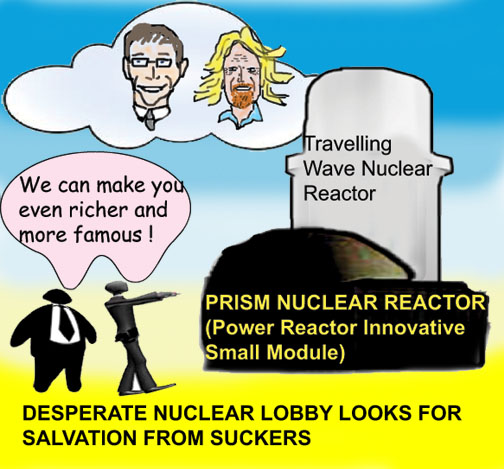
multiple challenges remain.
There are questions over whether the regulatory regime and siting criteria should be relaxed for these reactors? There are also suggestions the plants could be run with fewer staff, helping to cut the costs even further.
Dame Sue Ion, a nuclear fuel expert and fellow at the UK’s Royal Academy of Engineering, says the first small modular reactors will, realistically, be sited on existing nuclear-licensed sites.
“It may be that the physical characteristics make it safer but you would still have to have all the safety arrangements and emergency planning in place,” she adds.
“You still have the same safety, proliferation and accident concerns,” says Doug Parr, chief scientist and policy director at campaign group Greenpeace UK. “You need capacity and supportive infrastructure to respond if there is an emergency.”
Then there is the issue of public acceptance. “To expect the general public to just accept them because they are small is pushing the point. It does not seem obvious to me,” Kevin Hesketh, senior fellow at Britain’s National Nuclear Laboratory, told an industry conference last month…….. “Licensing and public acceptance – both have to be addressed. ..
The biggest challenge facing the model is simply that no one has done it. Nuclear also has a bad record on cost. At the same time, competition from renewables, which are becoming cheaper, is growing.
Dominic Holt, associate director, nuclear advisory, at KPMG, says “none of the positives have been tested yet”. Claims of cost and programme certainty are still unproven. Analysis of a range of available data show that the “levelised cost” – per MW/hour – of SMRs is still similar to that of a large reactor…
Precious groundwater now threatened by fracking for uranium, too
When it comes to fracking for yellowcake, even more pressing than shaky economics is the obvious potential for environmental contamination. The process is not only extremely water intensive, as is typical of fracking, but it’s also happening at a shallow depth. Unlike the Eagle Ford’s oil and gas reserves, which are miles underground, the in situ uranium mining is taking place at the same level as local groundwater supplies.

Fracking for Yellowcake: The Next Frontier? http://www.huffingtonpost.com/jeffrey-rubin/fracking-for-yellowcake-t_b_2612418.html Jeffrey Rubin 02/04/2013 It works for oil and natural gas, so why not frack for uranium too? After all, America relies on foreign uranium just like it depends on foreign oil.
In the U.S. these days, it seems like you can sell almost anything if you spin it as part of the pursuit of energy independence. Enter Uranium Energy Corp. A junior mining company with Canadian roots, UEC is developing the newest uranium mine in the U.S. And it’s counting on fracking to do it.
Texans, in general, are no strangers to fracking. UEC is operating in the heart of fracking country, south Texas’s Eagle Ford basin, one of the most prolific shale plays in the country. Instead of oil and gas, though, UEC (recently profiled by Forbes Magazine) is fracking for yellowcake.
The technology is basically the same. It involves injecting a mixture of highly pressurized water and sand into an underground formation in order to break open fissures in the rock that allow the energy riches within to be extracted. In this case, it’s a slurry of uranium ore that’s then dried and processed into powdery yellowcake, an intermediate product that eventually becomes fuel for nuclear reactors.
Of course, the very idea of fracking for yellowcake begs the question–just because you can do something, should you? The world isn’t exactly running short of uranium. Prices tell you that much. Uranium prices have plunged from more than $90 a ton before the last recession to just more than $40 a ton following the Fukushima disaster. Friendly countries like Canada and Australia are able to ramp up supply, as can less friendly countries like Kazakhstan. Yellowcake is also exported by Niger (part of the reason, according to some, that nuclear-powered France is taking such an interest in neighbouring Mali right now.)
What’s more, the emergence of cheap natural gas from shale plays is making nuclear energy less attractive to U.S. power utilities. Many are considering shuttering some high cost nuclear stations and switching to cheaper natural gas, just as they’ve been doing with a number of coal plants in recent years.
When it comes to fracking for yellowcake, even more pressing than shaky economics is the obvious potential for environmental contamination. The process is not only extremely water intensive, as is typical of fracking, but it’s also happening at a shallow depth. Unlike the Eagle Ford’s oil and gas reserves, which are miles underground, the in situ uranium mining is taking place at the same level as local groundwater supplies.
According to the International Energy Agency, the amount of fresh water used for global energy production will double over the next twenty-five years. Whether it’s Alberta’s oil sands that run on water from the Athabasca River or the countless gallons used to frack underground stores of oil, gas and now even uranium, it’s easy to see why.
Thorium – an irrelevant distraction from the gloomy facts about nuclear power
— time. It is going to take many decades to get the thorium fuel cycle happening. The global nuclear industry has the twin goals of prolonging the life of currently operating nuclear reactors, and of building new ones. Their rationale for this is often that, eventually, the energy solution will be nuclear fusion. So in the meantime, the world needs nuclear power — or so they argue.
The thorium advocates usually promote thorium reactors as a solution to both climate change and energy needs. But in reality, thorium nuclear energy is irrelevant to both.
Again, the first reason is time. Although there are current designs that could be established in 10 to 15 years, the most favoured design – the Liquid Fluoride Thorium Reactor (LFTR) – is estimated to have, for a significant deployment, a lead time of 40 to 70 years.
Don’t believe thorium nuclear reactor hype, Independent Austtralia 28 Jan 13, Thorium reactors are the latest big thing in nuclear spin. Noel Wauchope says: don’t believe the hype.

The explanation becomes clearer, when you consider that the nuclear industry has sunk $billions into new (uranium or plutonium fuelled) large nuclear technologies, as well as into lobbying governments and media. Would big corporations like Hitachi, EDF Westinghouse, Toshiba, Areva, Rosatom be willing, or indeed able, to withdraw from the giant international operations that they already have underway? Would they, could they, tolerate a mass uptake of the new thorium nuclear reactors — which is what would be needed, to make the thorium market economical?…. Continue reading
Uranium mining: In situ leaching not the same as fracking
A spokesperson for Uranium Energy disputes the similarities to fracking that is made in the article.
“By contrast, ‘in-situ recovery’ is the process of injected-solution mining that reverses the natural process of deposited uranium in sandstones. On-site groundwater fortified with oxygen is introduced into the ground through a pattern of injection wells. The solution dissolves uranium from the sandstone host rock, and the uranium-bearing solution is brought back to surface through vacuum-suction production wells, where the uranium is concentrated on resin beads for trucking to a nearby processing plant where it is concentrated further and dried into yellowcake.”
Opponents of in situ uranium extraction start throwing around the F word MINING.com Editor | January 25, 2013 A US company is extracting underground uranium reserves in Texas using in situ methods, but opponents are comparing it to another process that is drawing high-profile protests.
Forbes reports that Texas-based Uranium Energy Corp (UEC) uses the in situ method for extracting underground uranium by pumping oxygenated water into porous rock layers via deep-drilled wells.
Forbes notes the process is raising concerns among some in Texas who compare the process to hydraulic fracturing, which has some celebrity opponents.”By design it’s much worse than fracking,” says Houston attorney Jim Blackburn, who is interviewed by Forbes.
“This is intentional contamination of a water aquifer liberating not only uranium but other elements that were bound up with the sand. We know this process will contaminate groundwater; that’s the whole point of it.” Continue reading
EPA permits fracking for uranium to go ahead in USA
 Goliad skeptics have been fighting UEC’s plans for five years. At Goliad the uranium ore is located just 400 feet deep within the same rock as a groundwater reservoir that ranchers tap for drinking water, both for themselves and their livestock. Water, not oil, is the region’s long-term liquid gold. “We are running out of water; I don’t want mine ruined,” said one rancher who asked not to be named. “When you’re out of water, you’re out of everything.”….
A 2009 study of Texas in situ mines by the U.S. Geological Survey … found no instance in which there wasn’t more selenium and uranium in the water than before mining.
 Energy’s Latest Battleground: Fracking For Uranium This story appears in the February 11, 2013 issue of Forbes. No tour of Uranium Energy Corp.’s processing plant in Hobson, Tex. is complete until CEO Amir Adnani pries the top off a big black steel drum and invites you to peer inside. There, filled nearly to the brim, is an orange-yellow powder that UEC mined out of the South Texas countryside. It’s uranium oxide, U3O8, otherwise known as yellowcake. This is the stuff that atomic bombs and nuclear reactor fuel are made from. The 55-gallon drum weighs about 1,000 pounds and fetches about $50,000 at market. But when Adnani looks in, he says, he sees more than just money. He sees America’s future.
“The U.S. is more reliant upon foreign sources of uranium than on foreign sources of oil,” says Adnani,……
Adnani insists that he can close the yellowcake gap through a technology that is similar to the hydraulic fracturing, or fracking, that has created the South Texas energy boom. Fracking for uranium isn’t vastly different from fracking for natural gas. UEC bores under ranchland into layers of highly porous rock that not only contain uranium ore but also hold precious groundwater. Then it injects oxygenated water down into the sand to dissolve out the uranium. The resulting solution is slurped out with pumps, then processed and dried at the company’s Hobson plant. Continue reading
USA government quietly rejects nuclear reprocessing
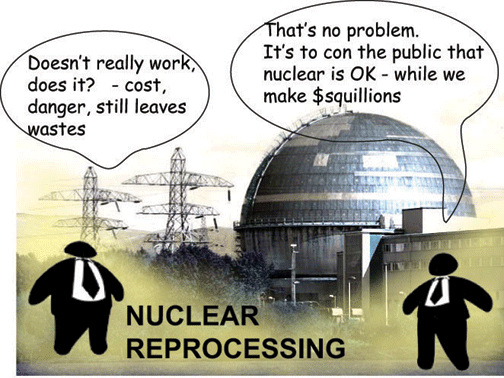
Steve Skutnik January 17, 2013 There is a hallowed tradition in Washington known as the “Friday Document Dump,” in which news and announcements the government wishes to bury are strategically timed for Friday afternoons, when such announcements tend to fall through the cracks of the typical news cycle (i.e., assuming reporters are even present to cover the event, the strategic timing tends to ensure it will miss the weekend papers, thus effectively “burying” the story by the time the new week rolls around).
Thieves fall out – The rest of the nuclear lobby accused of blocking the thorium lobby!
China blazes trail for ‘clean’ nuclear power, TODAY online by Ambrose
Evans-Pritchard Jan 09, 2013“……Major players in the nuclear
industry have had a vested interest in blocking thorium. They have
sunk huge costs in the old technology, and they have bent the ear of
cash-strapped ministers. The hesitance of governments is
understandable, but the costs are going to hit whatever they do.
China’s dash for thorium is now changing the game…..”
Japanese government’s nuclear reprocessing plans likely to be colossal waste of money
But the continued operation of the Monju reactor is uncertain due to
frequent malfunctions. The Japanese government has admitted that it
may not be put into commercial use until 2050, prompting criticism
that the Rokashomura facility was a colossal waste of money.
Japan Could Reprocess Nuclear Fuel from Korea
http://www.energytribune.com/69930/japan-could-reprocess-nuclear-fuel-from-korea-2
January 07, 2013 From Chosun Ilbo The Japanese government is
considering reprocessing spent nuclear fuel rods from Korea, Vietnam
and other Asian countries, the Tokyo Shimbun reported Sunday. Japan is
the only country in the world that has no nuclear weapons but the
facilities to reprocess spent nuclear fuel rods capable of producing
weapons-grade plutonium.
An advisory council to the Democratic Party of Japan in a report last
May said reprocessing spent nuclear fuel rods would “strengthen”
Japan’s diplomacy, security and the country’s economy as well as
“contribute to the peaceful use of atomic energy.”
The report suggests using the Rokashomura nuclear reprocessing plant
in Aomori Prefecture, which will become obsolete if Japan scraps all
its own nuclear power plants in the 2030s. Continue reading
Nuclear weapons proliferation risk from Thorium reactors
just 1.6 tonnes of thorium metal would be enough to produce 8kg of uranium-233 which is the minimum amount required for a nuclear weapon.
”Small-scale chemical reprocessing of irradiated thorium can create an isotope of uranium – uranium-233 – that could be used in nuclear weapons. If nothing else, this raises a serious proliferation concern.”
Thorium: Proliferation warnings on nuclear ‘wonder-fuel’ , Phys Org, December 5, 2012Thorium is being touted as an ideal fuel for a new generation of nuclear power plants, but in a piece in this week’s Nature, researchers suggest it may not be as benign as portrayed.
The element thorium, which many regard as a potential nuclear “wonder-fuel”, could be a greater proliferation threat than previously thought, scientists have warned. Continue reading
Let’s bust the nuclear spin about Thorium
THORIUM REACTORS? http://fairewinds.org/demystifying, 8 Dec 12 by Peggy Conte
The latest nuclear power industry proposals focus on smaller reactors and the possibility of thorium fueled reactors. As the nuclear industry explores other fission products, Fairewinds Energy Education has been peppered with hundreds of questions regarding the feasibility and safety of thorium reactors that the nuclear industry is touting as a newer safer form of nuclear power.
The Liquid Fluoride Thorium Reactor (LFTR) is being sold as a “market based environmental solution” and advertised by the nuclear industry as cheaper than coal. Molten Salt Reactors (MSR) use a molten salt mixture as the primary coolant, and sometimes the molten salt is even mixed directly with thorium in the reactor fuel.
Since Fairewinds has received so many questions regarding Thorium Reactors, let’s look at the facts about Thorium: Continue reading
1 This Month
26 September – International Day for the Total Elimination of Nuclear Weapons





PLEASE OPPOSE HR 8255 AND S.3639 – bills would accelerate satellite deployment, with no environmental review or safeguards – https://ncstd5li.quorum.us/campaign/169331/
To see nuclear-related stories in greater depth and intensity – go to https://nuclearinformation.wordpress.com
-
Archives
- September 2026 (305)
- August 2026 (330)
- July 2026 (355)
- June 2026 (287)
- May 2026 (306)
- April 2026 (356)
- March 2026 (251)
- February 2026 (267)
- January 2026 (308)
- December 2025 (358)
- November 2025 (359)
- October 2025 (375)
-
Categories
- 1
- 1 NUCLEAR ISSUES
- business and costs
- climate change
- culture and arts
- ENERGY
- environment
- health
- history
- indigenous issues
- Legal
- marketing of nuclear
- media
- opposition to nuclear
- PERSONAL STORIES
- politics
- politics international
- Religion and ethics
- safety
- secrets,lies and civil liberties
- spinbuster
- technology
- Uranium
- wastes
- weapons and war
- Women
- 2 WORLD
- ACTION
- AFRICA
- Atrocities
- AUSTRALIA
- Christina's notes
- Christina's themes
- culture and arts
- Events
- Fuk 2022
- Fuk 2023
- Fukushima 2017
- Fukushima 2018
- fukushima 2019
- Fukushima 2020
- Fukushima 2021
- general
- global warming
- Humour (God we need it)
- Nuclear
- RARE EARTHS
- Reference
- resources – print
- Resources -audiovicual
- Weekly Newsletter
- World
- World Nuclear
- YouTube
-
RSS
Entries RSS
Comments RSS

