PRISM – Power Reactor Innovative Small Module new nuclear magic gimmick
The plutonium stockpile poses enormous problems for the government. Not only is it highly radioactive and an immense potential danger to health, it is also a target for terrorist attacks and for anyone interested in stealing nuclear weapons-grade material.
The NDA’s report to DECC is understood to conclude that the Prism fast reactor is as credible as the two other options based on Mox fuel, even though GE-Hitachi has not yet built a commercial-scale plant for burning plutonium waste. DECC, however, has refused to release the report under a Freedom of Information request
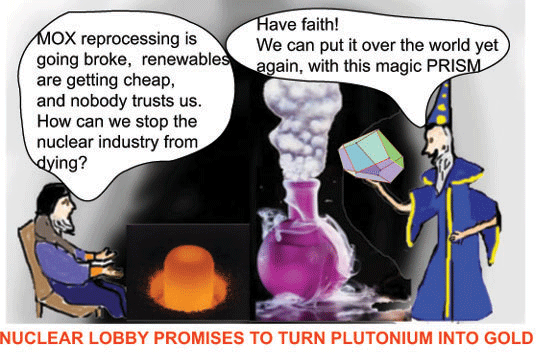
It is understood that the NDA has been impressed by proposals from GE-Hitachi to build a pair of its Prism fast reactors on the Sellafield site,
Revealed: UK Government’s radical plan to ‘burn up’ UK’s mountain of plutonium http://www.independent.co.uk/news/science/revealed-uk-governments-radical-plan-to-burn-up-uks-mountain-of-plutonium-8967535.html 28 Nove 13 A radical plan to dispose of Britain’s huge store of civil plutonium – the biggest in the world – by “burning” it in a new type of fast reactor is now officially one of three “credible options” being considered by the Government, The Independent understands. However, further delays have hit attempts to make a final decision on what to do with the growing plutonium stockpile which has been a recurring headache for successive governments over the past three decades.
The stock of plutonium, one of the most dangerous radioactive substances and the element of nuclear bombs, has already exceeded 100 tonnes and is likely to grow to as much as 140 tonnes by 2020, bolstered by a recent decision to include foreign plutonium from imported nuclear waste.
Ministers had pledged to resolve the plutonium problem in a public consultation but are sitting on a secret report by the Nuclear Decommissioning Authority (NDA) which is believed to confirm that there are now three “credible options” for dealing with the plutonium stored at the Sellafield nuclear reprocessing plant in Cumbria. Continue reading
What is really going on in the high risk operation at Fukushima Nuclear reactor No 4?
 Why TEPCO is Risking the Removal of Fukushima Fuel Rods. The Dangers of Uncontrolled Global Nuclear Radiation, Global Research, 24 Nov 13 By Yoichi Shimatsu After repeated delays since the summer of 2011, the Tokyo Electric Power Company has launched a high-risk operation to empty the spent-fuel pool atop Reactor 4 at the Dai-ichi (No.1) Fukushima Nuclear Power Plant.
The urgency attached to this particular site, as compared with reactors damaged in meltdowns, arises from several factors:
– over 400 tons of nuclear material in the pool could reignite
– the fire-damaged tank is tilting badly and may topple over sooner than later
– collapse of the structure could trigger a chain reaction and nuclear blast, and
– consequent radioactive releases would heavily contaminate much of the world.
The potential for disaster at the Unit 4 SFP is probably of a higher magnitude than suspected due to the presence of fresh fuel rods, which were delivered during the technical upgrade of Reactor 4 under completion at the time of the March 11, 2011 earthquake and tsunami. The details of that reactor overhaul by GE and Hitachi have yet to be disclosed by TEPCO and the Economy Ministry and continue to be treated as a national-security matter. Here, the few clues from whistleblowers will be pieced together to decipher the nature of the clandestine activity at Fukushima No.1. Continue reading
MOX nuclear fuel – the secret and so dangerous ingredient in the Fukushima No 4 nuclear cooling pond
The un-irradiated rods inside the Unit 4 spent-fuel pool are, in all probability, made of a new type of MOX fuel containing highly enriched plutonium.
 Why TEPCO is Risking the Removal of Fukushima Fuel Rods. The Dangers of Uncontrolled Global Nuclear Radiation, Global Research, 24 Nov 13 By Yoichi Shimatsu
“…….Mystery of MOX super-fuel A Mainichi Shimbun editorial mentions in passing that the Reactor 4 pool contains 202 fresh fuel assemblies.(3) The presence of new fuel rods was confirmed in the TEPCO press release, which described the first assembly lifted into the transfer cask as an “un-irradiated fuel rod.” Why were new  rods being stored inside a spent-fuel pool, which is designed to hold expended rods? What threat of criticality do these fresh rods pose if the steel frame collapses or if crane operators drop one by accident onto other assemblies, as opposed to a spent rod?
Against the official silence and disinformation, a few whistleblowers have come forward with clues to answer these questions. Former GE nuclear worker Kei Sugaoka disclosed in a video interview that a joint team from Hitachi and General Electric was inside Reactor 4 at the time of the March 11, 2011 earthquake. By that fateful afternoon, the GE contractors were finishing the job of installing a new shroud, the heat-resistant metal shield lining the reactor interior.(4)
TEPCO inadvertently admitted to the presence of foreign contractors at Fukushima No.1 up until March 12, 2012, when the management ordered their evacuation in event of a massive explosion during the rapid meltdown of Reactor 2. So far, leaks indicate the presence of the GE team and of a Israeli nuclear security team with Magna BSP, a company based in Dimona.(5)
Another break came in April 2012, when a Japanese humor magazine published a brief interview of a Fukushima worker who disclosed that radioactive pieces of a broken shroud were left inside a device-storage pool at rooftop level behind the Reactor 4 spent-fuel pool.(6) This undoubtedly is the used shroud removed by the GE-H workers in February-March 2011.
A curious point here is that the previous shroud had been in use for only 15 months. Why would TEPCO and the Japanese government expend an enormous sum on a new lining when the existing one was still good for many years of service?
Obviously, the installation of a new shroud was not a mere replacement of a worn predecessor. It was an upgrade. The refit of Reactor 4 was, therefore, similar to the 2010 conversion of Reactor 3 to pluthermal or MOX fuel. The same model of GE Mark 1 reactor was being revamped to burn MOX fuel (mixed oxide of uranium and plutonium).
The un-irradiated rods inside the Unit 4 spent-fuel pool are, in all probability, made of a new type of MOX fuel containing highly enriched plutonium. If the frame collapses, triggering fire or explosion inside the spent-fuel pool, the plutonium would pulse powerful neutron bursts that may well possibly ignite distant nuclear power plants, starting with the Fukushima No.2 plant, 10 kilometers to the south…..
The upgrade of the Reactor 4 shroud may well have involved the test-fitting of some MOX rods, which abandoned on the floor next to the reactor when the tsunami reached shore. In other words, in early March 2011 crane operators completely filled space inside the spent-fuel pool with new MOX rods and then simply left casks of assemblies on the roof and lowered more into the basement. That is the simplest explanation for the damage to the structural integrity of the reactor building. GE is not about to disclose its role in this disaster………. http://www.globalresearch.ca/why-tepco-is-risking-the-removal-of-fukushima-fuel-rods-the-dangers-of-uncontrolled-global-nuclear-radiation/5359188…..http://www.globalresearch.ca/why-tepco-is-risking-the-removal-of-fukushima-fuel-rods-the-dangers-of-uncontrolled-global-nuclear-radiation/535918
So far so good – first batch of nuclear fuel rods moved from Fukushima reactor 4
First batch of fuel from Fukushima reactor 4 pool now in different storage site, Japan Times, KYODO NOV 22, 2013 Tokyo Electric Power Co. said Friday that it has finished transferring the first batch of fuel rod assemblies from the Fukushima No. 1 plants reactor 4 spent fuel pool to another building with more stable storage conditions.
“All of the fuel assemblies have been placed in the storage rack (inside the common pool), meaning the first fuel transfer work effectively ended,” Tepco official Noriyuki Imaizumi told a press conference.
Common Pool Fukushima Daiichi Unloading Unit 4 Fuel Unloading
After reviewing the work flow that started Monday, the utility will move on to retrieve the next batch of fuel assemblies from the spent fuel pool of the damaged reactor 4 building.
The pool contains over 1,000 fuel assemblies and the process is expected to continue through the end of next year. To get used to the operation, workers commenced with the removal of unused fuel assemblies, but they will also have to take out spent fuel, which is more difficult to handle because it is highly radioactive and emits heat as radioactive elements in the fuel decay.
The process starts with the transfer of fuel assemblies inside the water-filled spent fuel pool one by one into a transport container also placed inside the pool.
Once the container is filled with 22 fuel assemblies, workers lower it by crane from the fifth floor of the building where the pool is located so that it can be taken to the common pool about 100 meters away…… http://www.japantimes.co.jp/news/2013/11/22/national/first-batch-of-fuel-from-fukushima-reactor-4-pool-now-in-different-storage-site/#.UpJtYdJwo7o
NASA abandoning New Nuclear Generator plan for Deep Space Exploration
NASA Halts Work on its New Nuclear Generator for Deep Space Exploration
Universe Today by DAVID DICKINSON on NOVEMBER 21, 2013 “……. The announcement comes from Jim Green, NASA’s Planetary Science Division Director. The statement outlines some key changes in NASA’s radioisotope program, and will have implications for the future exploration of the outer solar system……
Pandora’s misleading spin about Integral Fast Nuclear Reactors (IFRs)
 Other Department of Energy studies showed that pyroprocessing, by generating large quantities of low-level nuclear waste and contaminated uranium, greatly increases the volume of nuclear waste requiring disposal, contradicting “Pandora’s Promise’s” claim it would reduce the amount of waste.
Scientist: Film hypes the promise of advanced nuclear technology By Edwin Lyman, CNN November 7, 2013 In his zeal to promote nuclear power, filmmaker Robert Stone inserted numerous half-truths and less-than-half-truths in his new documentary “Pandora’s Promise,” One of Stone’s more misleading allegations was that scientists at a U.S. research facility, the Argonne National Laboratory, were on the verge of developing a breakthrough technology that could solve nuclear power’s numerous problems when the Clinton administration and its allies in Congress shut the program in 1994 for purely political reasons.
Like the story of Pandora itself, the tale of the integral fast reactor (IFR) — or at least the version presented in the movie — is more myth than reality. In the final assessment, the concept’s drawbacks greatly outweighed its advantages. The government had sound reasons to stanch the flow of taxpayer dollars to a costly, flawed project that also was undermining U.S. efforts to reduce the risks of nuclear terrorism and proliferation around the world…….
What did “Pandora’s Promise” leave out? First, it does not clearly explain what a “fast reactor” is and how it differs from the water-cooled reactors in use today. Most operating reactors use a type of fuel called “low-enriched” uranium, which cannot be used directly to make a nuclear weapon and poses a low security risk. The spent fuel from these water-cooled reactors contains weapon-usable plutonium as a byproduct, but it is very hard to make into a bomb because it is mixed with uranium and highly radioactive fission products.
Fast reactors, on the other hand, are far more dangerous because they typically require fuels made from plutonium or “highly enriched” uranium that can be used to make nuclear weapons.
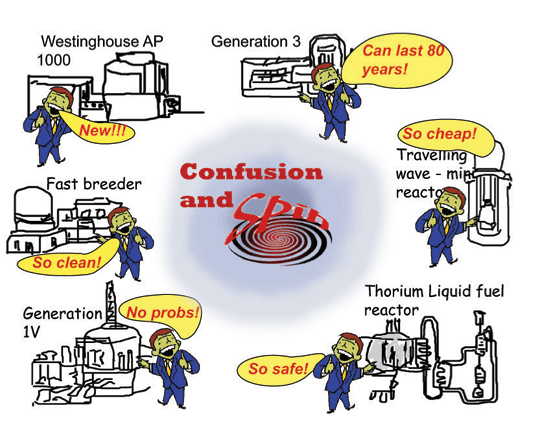
In fact, fast reactors can be operated as “breeders” that produce more plutonium than they consume. To produce the large quantities of plutonium needed to fuel fast reactors, spent fuel from conventional reactors has to be reprocessed — chemically processed to separate plutonium from the other constituents. Facilities that produce plutonium fuel must have strong protections against diversion and theft. All too often, however, security at such facilities is inadequate.
In the IFR concept, which was never actually realized in practice, reactor-spent fuel would be reprocessed using a technology called pyroprocessing, and the extracted plutonium would be fabricated into new fuel. IFR advocates have long asserted that pyroprocessing is not a proliferation risk because the plutonium it separates is not completely purified.
But a 2008 U.S. Department of Energy review — which confirmed many previous studies — concluded that pyroprocessing and similar technologies would “greatly reduce barriers to theft, misuse or further processing, even without separation of pure plutonium.” Continue reading
Computer worm Stuxnet ‘badly infected’ Russian nuclear power plant
 Stuxnet infected Russian nuclear plant By Darren Pauli on Nov 8, 2013 Jumped airgap, Kaspersky boss says. http://www.scmagazine.com.au/News/363578,stuxnet-infected-russian-nuclear-plant.aspx Stuxnet had ‘badly infected’ the internal network of a Russian nuclear plant after the sophisticated malware caused chaos in Iran’s nuclear facilities in
  Natanz.
The malware, widely considered to have been developed by the US Government as a means to disrupt Iran’s nuclear enrichment plans, had crossed a physically separated ‘air-gapped’ network in the Russian plant after it was carried across on a USB device.
Eugene Kaspersky, the charismatic boss of the Russian antivirus company bearing his name, said a staffer at the unnamed nuclear plant informed him of the infection. “[The staffer said] their nuclear plant network which was disconnected from the internet … was badly infected by Stuxnet,” Kaspersky said.
“So unfortunately these people who were responsible for offensive technologies, they recognise cyber weapons as an opportunity.” But USB devices were used to ferry malware cross a far greater air-gap: Russian astronauts had carried a virus on removable media to the International Space Station infecting machines there, Kaspersky said.
In a presentation given at the Canberra Press Club designed to give mainstream journalists a broad overview of the state of information security, the chief executive offered his view of the state of online crime and state-sponsored espionage. “All the data is stolen,” Kaspersky said. “At least twice.”
He said sophisticated malware like Gauss, Flame and Red October were rare and would require around $10 million to build.
Such malware had infected Saudi Aramco knocking it offline for two weeks, Kaspersky noted. Half of all malware was written in Chinese, according to Kaspersky. About a third was written in Spanish or Portuguese, followed by Russian-coded malware that was less prevalent but the most sophisticated in the world, he said.
He said Chinese malware appeared to ‘not care’ about operational security because researchers regularly found personal photos and social networking accounts on servers used in attack campaigns.
On Integral Fast Reactor and France “Pandora’s Promise” gets it wrong
Nuclear energy film overstates positives, underplays negatives By Ralph Cavanagh and Tom Cochran, CNN November 6, 2013 – “………The still-unrealized Integral Fast Reactor is the real star of the film, along with the nation of France, whose nuclear generation program is extolled as “one of the most inspiring stories ever” (“the trains are electric powered, they have clean air, and they have the cheapest electricity in Europe”). Nuclear power debates are the only places where you will ever see those at the conservative edge of the political spectrum argue that the United States should reorganize its economy to be more like France.
The Clinton administration killed the Integral Fast Reactor in 1994 because of concern over the potential diversion of the plutonium fuel by terrorists and non-nuclear weapon states of concern. Yet the film’s closing argument is that a “fourth-generation” reactor modeled on the Integral Fast Reactor will sweep the globe, burning waste created by the first three generations and “solving” the nagging problem of long-term disposal of nuclear waste. The film fails to mention that this would take hundreds to thousands of plutonium-fueled reactors operating over hundreds of years, resulting most likely in an increase in the releases of radioactivity to the environment as a consequence of operations by the Integral Fast Reactor’s fuel processing and fabricating facilities.
The film invokes Bill Gates as one of many forward-thinking new investors in nuclear innovation, but surely even Gates would recoil from the Integral Fast Reactor’s poor economic outlook compared to conventional reactors and the financial risks associated with building just one Integral Fast Reactor, let alone a global fleet of them. The film fails to acknowledge that the flagship fast reactor development efforts in the United States, France, Germany, Japan and Italy all failed, and that fast reactors were abandoned by both the U.S. and Soviet navies, hardly a strong selling point for resurrecting the Integral Fast Reactor program………..http://edition.cnn.com/2013/11/06/opinion/pandora-nuclear-energy-opinion-cavanagh-cochran/
Nuclear fusion a far away dream, but will it be safe, anyway?
“the first wall”: any nuclear fusion facilities must be fitted with an internal container made up by a “first wall” that faces the space where the reaction takes place.
This wall will be exposed to neutronic radiation. It won’t take long for it to become radioactive and begin to erode. In time, it will have to be replaced by another wall if the fusion reactor is to remain in operation.
Where will the discarded containers end up? These “first walls” will be loaded with radioactivity. As fusion technology develops, this can become a problem.
 Nuclear Fusion: Is it as Safe as We Think? Dmitri Prieto http://www.havanatimes.org/?p=99809 4 Nov 13
HAVANA TIMES — It seems to me that we are not sufficiently aware of the risks surrounding a new, emerging technology. Producing energy through the fusion of light nuclei (such as deuterium and tritium, which are heavy, radioactive isotopes of hydrogen) is the dream of many physicists and technologists.
This is the process which takes place inside the sun, the stars and hydrogen bombs. The aim is to “domesticate” the thermonuclear reaction so that, on the one hand, it does not produce an explosion (like the 50-megaton hydrogen bomb detonated by the Soviets in the Arctic in 1961), and, on the other, the process stabilizes at a temperature in which the atomic nuclei can fuse and generate energy.
No fusion thermonuclear plant yet exists. Existing complexes are fission plants. I am referring to those that work on uranium and plutonium (like the Chernobyl and Fukushima nuclear power plants). Continue reading
Russia trying out 2 small floating nuclear reactors
Nuclear ahoy! Russia installs reactors on floating power station Smart Planet, By Mark Halper | October 4, 2013 “…..Over the last week, it has lowered two small reactors onto a ship berthed in St. Petersburg, which will eventually serve as a floating nuclear power station, World Nuclear News reported.…..The floating plant is due off the coast of the Chukotka Peninsula in northeast Russia in 2016, in a part of the Arctic Ocean known as the East Siberian Sea. The Chutkotka Peninsula has a mining industry….http://www.smartplanet.com/blog/bulletin/nuclear-ahoy-russia-installs-reactors-on-floating-power-station/31301
Wall of ice planned, to go underneath Fukushima nuclear plant
 Japan to build $470M ice wall to prevent nuclear leaks http://www.cbsnews.com/8301-202_162-57601127/japan-to-build-$470m-ice-wall-to-prevent-nuclear-leaks/ 4 Sept 13, The Japanese government announced Tuesday that it will spend $470 million on a subterranean ice wall and other steps in a desperate bid to stop leaks of radioactive water from the crippled Fukushima nuclear plant after repeated failures by the plant’s operator.
The decision is widely seen as an attempt to show that the nuclear accident won’t be a safety concern just days before the International Olympic Committee chooses among Tokyo, Istanbul and Madrid as the host of the 2020 Olympics.

The Fukushima Dai-ichi plant has been leaking hundreds of tons of contaminated underground water into the sea since shortly after a massive 2011 earthquake and tsunami damaged the complex. Several leaks from tanks storing radioactive water in recent weeks have heightened the sense of crisis that the plant’s owner, Tokyo Electric Power Co., isn’t able to contain the problem. Continue reading
Nuclear fusion going nowhere
Is Europe’s Nuclear Fusion ‘Experiment’ Melting Down?, Zero Hedge, Tyler Durden on 09/03/2013 “…….Fusion nuclear energy has been described as both the ‘Hail Mary pass’ and ‘Holy Grail’ of renewable energy sources. Fusion, the process that powers the sun by fusing together light atoms at extremely high temperatures, offers almost unlimited potential. The fuel is practically inexhaustible, the production process emits no greenhouse gasses and it is inherently safe from many of the safety concerns that have tarnished the reputation of fission nuclear energy. Finally, unlike most renewable energy sources under development, fusion nuclear energy could serve as a base load power source, providing huge amounts of energy around the clock relatively efficiently.
Despite the demonstrated potential, fusion has always been a technology perpetually on the horizon,only 30 years away from commercialization. Like fission technology, fusion was developed for military use over 60 years ago, however, commercial utilization has eluded it.
Depleted uranium, radiation, and fracking

 Wrecking the Earth: Fracking has grave radiation risks few talk about Rt.com Christopher Busby 28 Aug 13, Environmentalists point to various dangerous consequences of using fracking technology, but none can be compared to the issue of radiation exposure and radioactive contamination of the development areas it poses…….. The key to fracking
Uranium is the key element to fracking, or hydraulic fracturing, to use its proper name. In the real-world version of Phineas Fogg’s “Eighty Days Around the World,” burning the ship’s masts and furniture to make steam, governments are now encouraging the oil and gas merchants to blast their way deep into the Earth to squeeze the last ounce of oil and gas from that poor creature. But there will be a terrible revenge. Locked up in the strata into which they pump the pressurized process water, to fracture and thus create the huge surface area sponge which will yield up its cargo of gas and oil, is a monstrous amount of natural uranium and its deadly daughter Radium-226. And vast amounts of the radioactive alpha emitting gas Radon-222, and its own daughters Bismuth 214, Lead-210 and the alpha emitter Polonium-210. Remember Polonium-210? That was the material used when a few millionths of a gram poisoned ex-Russian agent Alexander Litvinenko. Continue reading
Small Modular Nuclear reactors (SMRs) promoted by hoax film “Pandora’s Promise”
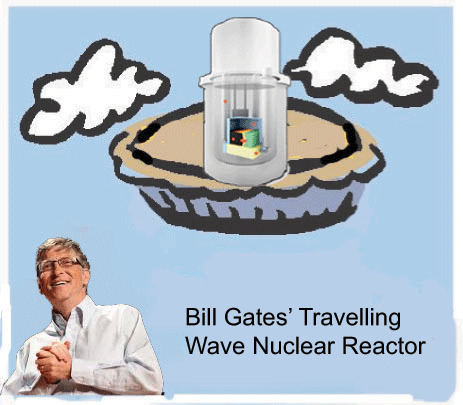 the most obvious deal killer is economic. Even by current calculations, any new reactor design would have difficulty competing with renewable energy sources, especially solar panels that can be installed on rooftops, thus avoiding transmission costs.
 The SMR’s primary customer, the Tennessee Valley Authority, has now pushed back to 2015 the target date for submitting its construction permit application. Even if wildly successful, the SMR could not meaningfully affect climate change for another 20 years—this in the midst of a crisis Hansen and so many others see as critical and immediate. The SMR blueprint hinges on technologies that have already failed. Continue reading
UV rays, ozone layer, and geo-engineering
Don’t Believe UV Radiation Levels are “Off the Charts”? http://www.zengardner.com/dont-believe-uv-radiation-levels-are-off-the-charts/#sthash.YbDkFkJB.dpuf Zengardner.com , August 23rd, 2013. Massive UV Levels Are Not So Easy To Hide. (Even if the disinfo agents lie about the facts) Dane Wigington geoengineeringwatch.org
Yes
https://www2.ucar.edu/atmosnews/news/942/stratospheric-injections-counter-global-warming-could-damage-ozone-layer
How many lies have we been told by the government, its agencies, main stream media, and paid dis-information trolls. Who do we believe? Do we believe them when they tell us all their readings on UV radiation show everything is fine? Even when we can feel with our own skin and senses the sun is too hot?
- Increasing UV radiation from ozone layer depletion
http://www.opednews.com/articles/opedne_linda_sc_080421_dangerous_ozone_depl.htm
http://www.ncbi.nlm.nih.gov/pubmed/15092929
http://www.ncbi.nlm.nih.gov/pubmed/16440613
http://content.usatoday.com/communities/ondeadline/post/2011/10/nature-reports-largest-ozone-hole-ever-in-northern-hemisphere/1
http://www.arctic.noaa.gov/essay_weatherhead.html
http://news.nationalpost.com/2011/10/02/unprecedented-ozone-hole-opens-over-canadian-arctic/
http://theextinctionprotocol.wordpress.com/2011/10/03/hole-in-ozone-over-northern-hemisphere-largest-ever-seen-in-2011/
- Do the “liars” lie about other things as well? What about nuclear fallout? Even after Fukushima blows and continues to spew radiation to this day, and is still getting worse? Do we believe government agencies, dis-information people and all their phony statements and impressive graphs of totally fictitious data telling us everything is “normal”? How about the Gulf of Mexico oil spill, lots of charts, graphs, and phony data there, more than anyone could even begin to digest. “Data” saying everything is “safe” from too many sources to list, yet marine life and people continue to die in the gulf day in and day out in spite of everything being “fine”. What about the Exxon Valdez? How about the lead that used to be put in gasoline? That was fine till it wasn’t. DDT, that was completely safe we were told. ”Agent Orange”? Vaccines? Cell Phones? Smart Meters? Safe, safe, safe, no need to worry. The cancers and diseases being caused “are not related” many dis-information people and agencies say.
- How about geoengineering? Is it really going on? Well, “it can’t be because the government says it isn’t so”. They would never lie to us, would they? Even NASA says the chemical covered skies from global geoengineering are “safe and normal”. They have even set up special courses to teach our kids such despicable lies.
- If UV radiation had gone “off the charts”, what might it do to our aquatic friends? Lets start with global plankton populations, the foundation for life on earth. Even NASA says high UV radiation would be really bad for these microscopic organisms.
http://www.gma.org/surfing/human/ozonephyto.html
http://www.eco-action.org/dt/ozone.html
1 This Month
26 September – International Day for the Total Elimination of Nuclear Weapons





PLEASE OPPOSE HR 8255 AND S.3639 – bills would accelerate satellite deployment, with no environmental review or safeguards – https://ncstd5li.quorum.us/campaign/169331/
To see nuclear-related stories in greater depth and intensity – go to https://nuclearinformation.wordpress.com
-
Archives
- September 2026 (305)
- August 2026 (330)
- July 2026 (355)
- June 2026 (287)
- May 2026 (306)
- April 2026 (356)
- March 2026 (251)
- February 2026 (267)
- January 2026 (308)
- December 2025 (358)
- November 2025 (359)
- October 2025 (375)
-
Categories
- 1
- 1 NUCLEAR ISSUES
- business and costs
- climate change
- culture and arts
- ENERGY
- environment
- health
- history
- indigenous issues
- Legal
- marketing of nuclear
- media
- opposition to nuclear
- PERSONAL STORIES
- politics
- politics international
- Religion and ethics
- safety
- secrets,lies and civil liberties
- spinbuster
- technology
- Uranium
- wastes
- weapons and war
- Women
- 2 WORLD
- ACTION
- AFRICA
- Atrocities
- AUSTRALIA
- Christina's notes
- Christina's themes
- culture and arts
- Events
- Fuk 2022
- Fuk 2023
- Fukushima 2017
- Fukushima 2018
- fukushima 2019
- Fukushima 2020
- Fukushima 2021
- general
- global warming
- Humour (God we need it)
- Nuclear
- RARE EARTHS
- Reference
- resources – print
- Resources -audiovicual
- Weekly Newsletter
- World
- World Nuclear
- YouTube
-
RSS
Entries RSS
Comments RSS

