 WHAT I DIDN’T READ IN THE TTIP READING ROOM , War On Want, 7 February 2016 Katja Kipping was one of the first German MPs to gain access to the new TTIP reading room opened in Berlin this week, and she has written up a report of her experience. We thought it was well worth translating from the original, ‘The Opposite of Transparency’.
TTIP, the EU-US free trade deal, has secrecy written all over it. Those responsible for it live in dread of any public scrutiny. If it was up to me, I would give everyone who’s interested the chance to make up their own minds on the text of the agreement in its current form. Sigmar Gabriel, Minister for Economic Affairs and a top cheerleader for TTIP, has now set up a reading room in his ministry where since the beginning of February German MPs can each spend two hours looking at those texts on which consensus has already been reached.
A political friend of mine asked me the day before whether she could come with me into the reading room. I had to say no. After a long, tough struggle with the government, at least MPs are able to read the text, but they are the only ones. We are not even allowed to take security-cleared specialists with us into the reading room. As for members of the public, who will ultimately have to bear the brunt of TTIP, they are to have no access whatsoever to the secret text. Not what transparency looks like in my book!
Access ‘granted’
Even the registration procedure for the reading room speaks volumes. Once I’d registered, I was sent the instructions on how to use the room. The first thing that I noticed was that the terms and conditions had already been the subject of negotiations between the European Commission and the USA. Get your head round that: TTIP isn’t even signed yet, and already individual countries have lost the right to decide who gets to read the texts, and on what terms.
The following extract from the rulebook for MPs who, like me, want to use the reading room reveals the attitude towards democracy that lurks behind TTIP: “You recognise and accept that in being granted access to the TTIP texts you are being extended an exceptional degree of trust.”
Now I’d always thought that elected MPs have a right to information. Yet the TTIP negotiators (and who gave them their legitimacy?) reckon they are GRANTING us access out of the goodness of their hearts. Access as a sign of exceptional trust. Whoever wrote that – did they really think that we MPs would feel flattered? To me it smacks more of totalitarianism. ‘Granting access’ and ‘extending trust’ is not the language you use if you really believe in democracy. ………
I read nothing to alleviate my concern that the US side wishes to make life more difficult for public and community enterprises and to secure better terms for transnational corporations in the battle for public tenders. I also read nothing to calm my fears that EU negotiators are prepared to sacrifice our social and environmental standards for the prospect of winning lucrative contracts for big European firms.
I read nothing that would lead me to reconsider my previous criticism that consumer protection plays no part in TTIP other than to proclaim free market competition to be the highest form of consumer protection that exists………
It is revealing in itself that the Ministry for Economic Affairs is prepared to go to such lengths in order to keep the text of TTIP under wraps. And they have every reason for doing so. Anyone who was going into these negotiations to enhance environmental protection, consumer protection and labour standards would have nothing to fear from transparency. Anyone who’s engaged in selling out democracy, on the other hand, is obviously going to want to avoid public scrutiny. If Sigmar Gabriel and the negotiators are really so convinced of the benefits of TTIP, why don’t they just make the text available to everyone online? http://www.waronwant.org/media/what-i-didn%E2%80%99t-read-ttip-reading-room
February 12, 2016
Posted by Christina Macpherson |
2 WORLD, civil liberties, EUROPE, secrets,lies and civil liberties, USA |
Leave a comment
Julian Assange arbitrarily detained by Sweden and the UK, UN expert panel finds United Nations Human Rights Office GENEVA (5 February 2016) – WikiLeaks founder Julian Assange has been arbitrarily detained by Sweden and the United Kingdom since his arrest in London on 7 December 2010, as a result of the legal action against him by both Governments, the United Nations Working Group on Arbitrary Detention said today.
In a public statement, the expert panel called on the Swedish and British authorities to end Mr. Assange’s deprivation of liberty, respect his physical integrity and freedom of movement, and afford him the right to compensation (Check the statement: http://www.ohchr.org/EN/NewsEvents/Pages/DisplayNews.aspx?NewsID=17012&LangID=E)
Mr. Assange, detained first in prison then under house arrest, took refuge in Ecuador’s London embassy in 2012 after losing his appeal to the UK’s Supreme Court against extradition to Sweden, where a judicial investigation was initiated against him in connection with allegations of sexual misconduct. However, he was not formally charged.
“The Working Group on Arbitrary Detention considers that the various forms of deprivation of liberty to which Julian Assange has been subjected constitute a form of arbitrary detention,” said Seong-Phil Hong, who currently heads the expert panel.
– See more at: http://www.ohchr.org/EN/NewsEvents/Pages/DisplayNews.aspx?NewsID=17013&LangID=E#sthash.oPdlDR4g.dpuf
“The Working Group maintains that the arbitrary detention of Mr. Assange should be brought to an end, that his physical integrity and freedom of movement be respected, and that he should be entitled to an enforceable right to compensation,” Mr. Hong added.In its official Opinion, the Working Group considered that Mr. Assange had been subjected to different forms of deprivation of liberty: initial detention in Wandsworth Prison in London, followed by house arrest and then confinement at the Ecuadorean Embassy.
The experts also found that the detention was arbitrary because Mr. Assange was held in isolation at Wandsworth Prison, and because a lack of diligence by the Swedish Prosecutor’s Office in its investigations resulted in his lengthy loss of liberty.
The Working Group established that this detention violates Articles 9 and 10 of the Universal Declaration on Human Rights, and Articles 7, 9(1), 9(3), 9(4), 10 and 14 of the International Covenant on Civil and Political Rights.
Check the Working Group’s Opinion on Julian Assange’s case (No. 54/2015), adopted in December: http://www.ohchr.org/Documents/Issues/Detention/A.HRC.WGAD.2015.docx
NOTE TO EDITORS:
The Opinions of the Working Group on Arbitrary Detention are legally-binding to the extent that they are based on binding international human rights law, such as the International Covenant on Civil and Political Rights (ICCPR). The WGAD has a mandate to investigate allegations of individuals being deprived of their liberty in an arbitrary way or inconsistently with international human rights standards, and to recommend remedies such as release from detention and compensation, when appropriate.
The binding nature of its opinions derives from the collaboration by States in the procedure, the adversarial nature of is findings and also by the authority given to the WGAD by the UN Human Rights Council. The Opinions of the WGAD are also considered as authoritative by prominent international and regional judicial institutions, including the European Court of Human Rights.
……… http://www.ohchr.org/EN/NewsEvents/Pages/DisplayNews.aspx?NewsID=17013&LangID=E#sthash.oPdlDR4g.dpuf http://www.ohchr.org/EN/NewsEvents/Pages/DisplayNews.aspx?NewsID=17013&LangID=E
February 12, 2016
Posted by Christina Macpherson |
civil liberties, Sweden, UK |
Leave a comment

 The Not-So-Peaceful Atom Bob Rowen accidentally took on corporate nuclear power in the 1970s. Four decades later he remembers what it was like to be Humboldt County’s most infamous whistleblower. North Coast Journal, BY JAPHET WEEKS, 20 MARCH 2008
 On a summer day in 1969,Bob Rowen, a nuclear control technician at the Humboldt Bay nuclear power plant, realized that for his employer, Pacific Gas and Electric, the bottom line was everything — it was even more important than the community’s safety.
It wasn’t the first time Rowen, a burly former Marine, had witnessed safety violations at the plant, but it was the first time he had the gumption to record the violation in a logbook, which would eventually be reviewed by the nuclear industry’s then government watchdog the Atomic Energy Commission (AEC).
As for PG&E management, they were getting pretty fed up. Rowen was proving to be a real pain in the ass. Continue reading →
February 10, 2016
Posted by Christina Macpherson |
civil liberties, history, secrets,lies and civil liberties, USA |
Leave a comment
 No release in sight despite UN panel decision. Julian Assange: ‘sweet’ victory soured by British and Swedish rejection Founding WikiLeaks founder is being arbitrarily detained at Ecuador embassy, Guardian, Esther Addley,Owen Bowcott,David Crouch in Gothenberg, andJessica Elgot A UN panel may have found that Julian Assange is subject to “arbitrary detention” and called for him to be allowed to walk free, but the WikiLeaks founder remains exactly where he has been for the past 44 months – inside Ecuador’s London embassy and locked in a three-nation war of words.
Britain and Sweden immediately rejected the UN report, which declared that Assange had been “arbitrarily detained” since his arrest in 2010 and during his lengthy stay in the embassy, where he sought asylum in June 2012. The British foreign secretary, Philip Hammond, described the findings as “ridiculous” and the Australian as a “fugitive from justice”.
However, the panel’s findings, leaked on Thursday and published in full on Friday morning, were a welcome victory for Assange, and a moment he intended to savour fully. At 4.01pm he emerged on to the balcony of the west Londonembassy to greet a crowd of several hundred supporters and journalists, pausing first, just briefly, to glance at the sky he has rarely seen for more than three years.
“How sweet it is,” said Assange, holding aloft a copy of the UN report while supporters shouted: “We love you, Julian!” It had been, he said, “a victory of historical importance”, and a decision reached after a process to which both Britain and Sweden had made submissions. “They lost. UK lost; Sweden lost.”
The Swedish government, however, has insisted the report changes nothing, and that it cannot interfere in an independent prosecutor’s ongoing attempt to extradite Assange for questioning over an allegation of rape dating from 2010, which he denies.
Meanwhile, for Ecuador – the Australian’s (mostly) willing host – the findings meant it was time for the two countries to allow Assange to walk free, and to compensate both him and them for the lengthy period he has been holed up in one of its few rooms……
After exhausting all his legal options in the UK and Sweden some time ago, there is no question that the report represents a boost for Assange’s legal team.
Reaching their conclusion by a three-to-one majority after a fifth member recused herself, the panel called on the Swedish and British authorities to end Assange’s “deprivation of liberty”, respect his physical integrity and freedom of movement, and offer him compensation.
Assange, they found, had been unable “to access the full-intended benefit” of the asylum status granted by Ecuador, and “the continuing and disproportionate denial to him of such access … had become cumulatively harsh and disproportionate”.
In particular, the panel offered an excoriating critique of Sweden’s prosecution process, which they said had been in a state of “indefinite procrastination”. With Quito and Stockholm still unable to agree on arrangements to allow Swedish prosecutors access to the London embassy, Assange has yet to be interviewed over the alleged offences. Britain said on Thursday it was “deeply frustrated” by the deadlock.
But for all Assange’s jubilation, he remains in the embassy, the extradition warrant still stands, and Britain and Sweden remain adamant that the report changes nothing.
Assange also remains fearful of a potential future extradition to the US, where a secret grand jury has been looking into whether to prosecute him over WikiLeak’s publishing activities……..
the former chair of the UN working group, Mads Andenas, defended its finding, saying: “There is no doubt that the normal course of action for the Swedish authorities would have been to interview Assange in London. The extradition request was disproportionate…….http://www.theguardian.com/media/2016/feb/05/julian-assange-sweet-victory-soured-by-british-and-swedish-rejection
February 8, 2016
Posted by Christina Macpherson |
civil liberties, Sweden, UK |
Leave a comment

 Russian green group labelled ‘foreign agent’ in crackdown on NGOs http://www.theguardian.com/environment/2016/jan/14/russian-green-group-labelled-foreign-agent-in-crackdown-on-ngos
Dauria, that has led ecological campaigns for 20 years, joins nearly 100 environmental and human rights groups hit by law preventing them from receiving funding from abroad, Guardian, Alex Luhn An ecological centre in Russia’s far east has become the latest environmental group to be declared a “foreign agent” amid a wider crackdown on NGOs.
The justice ministry ruled that Dauria, which has led environmental campaigns in Chita and the surrounding Zabaikalsky region for nearly two decades, was a foreign agent under a law that prohibits NGOs that allegedly engage in political activities from receiving grants from abroad. The label, which has all the connotations of the word “spy” in Russian, requires groups to undergo audits and declare this status on all their materials or face large fines.
The accusations stemmed from a joint programme between Dauria, Russian mining giant Polyus Gold and the UK-based Charities Aid Foundation. Dauria was in charge of selecting students for educational activities, while funding for the programme came from abroad.
Dauria head Natalya Kovalyonok, who is also a public chamber member, told local publication Zabaikalsky Rabochy that a hotline she ran for voters to report violations during elections had been deemed to be political activity, even though it did not agitate for any specific candidate.
“Obviously it was unbecoming for the region not to have its own foreign agent, and they really had to find one,”Kovalyonok said.
“Dauria is a conscientious organisation working to protect the earth, and declaring it a foreign agent is a result of … individual groups in the government trying to strengthen their position by cracking down on made-up threats,” Igor Shkradyuk of the Biodiversity Conservation Centre, who has frequently worked in the Zabaikalsky region, told the Guardian.
A growing number of environmental and human rights groups have been declared foreign agents in what Mikhail Fedotov, head of the presidential human rights council, has called a “witch hunt”. Nearly 100 organisations have been added to the foreign agent list, forcing many to cease activities, and the number of NGOs in Russia has reportedly decreased by a third since the law came into effect in 2012.
Last year, president Vladimir Putin signed a law banning “undesirable” foreign organisations that allegedly threaten national security.
Most recently, the Nizhny Novgorod-based Dront Ecological Centre was declared a foreign agent and fined 300,000 roubles (£2,700). Prior to that, the well-respected Sakhalin Environmental Watch was forced to return $159,000 (£110,000) it had received from Leonardo DiCaprio’s foundation after it wasdeclared a foreign agent in September. In recent weeks, the group has been fighting to contain an oil leak from a tanker that ran aground on a shoal off of Sakhalin island.
The environmental groups Bellona Murmansk, Ecodefense, and Planet of Hopes have also been added to the foreign agent list.
January 15, 2016
Posted by Christina Macpherson |
civil liberties, Russia |
Leave a comment
Then there is the horrifying reality that these experiments were taking place in the shadow of Nazi Germany; some of the scientists involved in the radiation experiments were the very men whose earlier experimental designs had tormented prisoners of concentration camps. Welsome describes Operation Paperclip, conducted under the auspices of the U.S. government. Paperclip imported Nazi scientists and supported their work, helping to confer, in the words of scientist Joseph G. Hamilton, “a little of the Buchenwald touch” on American medicine.
This valuable work represents an elegy to lost ideals, lost health, and lost trust. One can only hope it will serve as a cautionary tale.
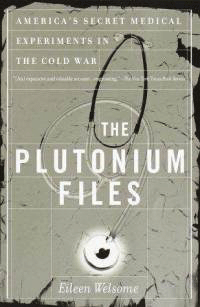 The Plutonium Files: America’s secret medical experiments in the Cold War N Engl J Med 1999; 341:1941-1942 December 16, 1999 Harriet A. Washington
The Plutonium Files: America’s secret medical experiments in the Cold WarBy Eileen Welsome. 580 pp. New York, Dial Press, 1999. $26.95. ISBN: 0-385-31402-7
Amid the embarrassments of Monicamania and of multiple public mea culpas, the past few years have not been exemplary ones for American journalism. This fact makes the triumph of The Plutonium Files all the sweeter, because this superlative book is a reminder of the purpose of investigative journalism.
This richly detailed, subtly nuanced history of government-engineered radiation experiments on unwitting Americans is based on the Pulitzer-prize–winning series Eileen Welsome wrote for the Albuquerque Tribune. Welsome’s tenacious and resourceful detective work has unveiled the saga of a sordid, tragic, yet fascinating chapter in the history of American medical science. The book succeeds on many levels. It is a gripping exposé of governmental exploitation and of medicine’s moral failures in an era in which blind trust defined the normal relationship between physicians and patients.
Between April 1945, scant months before the bombing of Hiroshima, and July 1947, the scientists of the Manhattan Project followed the construction of the atomic bomb with a chilling second act: medical experimentation on hundreds of unsuspecting Americans. Continue reading →
January 4, 2016
Posted by Christina Macpherson |
civil liberties, radiation, Reference, resources - print, secrets,lies and civil liberties, weapons and war |
4 Comments

 The Taboo Of Radiation Exposure In Japan: The Social Effects Of Fukushima, Activist Post, By Erin O’Flaherty, 11 Dec 15 “…..why is society reacting in such a way? [keeping quiet about radiation effects] In order to attempt to answer this question, let us break society into two groups: the government/nuclear power companies, and the ordinary Japanese people.
The level of intensity with which the former group have tried to diminish the seriousness of the incident and divert blame from themselves – by appealing to public well-being (avoiding panic), ‘radiophobia’, and the supposed harmlessness of radiation – leads to the obvious conclusion that they are acting to protect their own interests. Companies such as TEPCO (Tokyo Electric Power Company) wish to continue running so they can continue making money. It appears the government also wants to continue the use of nuclear power. This may be to do with nuclear power’s close relationship to war and military power, due to its association with nuclear weapons. It is no secret that the current government are in favour of restoring Japan’s military status, as evidenced by the recent changes to Article 9, which essentially render it meaningless.[24]
The down-playing of the catastrophe of Fukushima is crucial not only for economic reasons (the issue of the continuing operation of the remaining 54 nuclear power plants); it is also vital for the implementation of the state’s military plans for the future.[25]
In order to keep these plans, it is necessary to make everything feel normal, meaning there will be no questioning of nuclear power or of the government’s policies towards it. Information about radiation exposure would breed more empathy with the victims of Fukushima among the public, thus bringing the issue to a more personal level. This empathy could potentially cause a much larger number of people to become angry at the government and wish for the nuclear power companies to be held responsible. It is to avoid this situation that radiation exposure is intentionally not discussed in mainstream Japanese media……..
In order to break past the social stigmas and question the government and nuclear power companies’ actions, people need to start speaking out. But this is an extremely risky and frightening thing to do, especially in light of the treatment journalists may face if they discuss radiation exposure. At the end of the day, people need to make a living, put food on the table and protect their families. Thus, it is much easier to keep your head down and look the other way.
As we have seen, the social effects of the Fukushima nuclear incident are many, including displacement, poverty, depression, anxiety and social discrimination. These effects are all compounded by the media treatment of the incident: lack of information breeds fear and encourages discrimination, victims’ fears are dismissed as irrational, and the actions of the government and nuclear power companies are not questioned because it is made to appear as if everything is fine. The reason for such a reaction can be understood as the government and nuclear power companies protecting their own interests, both economically and militarily. Traditional conceptions of impurity combined with a general by-stander effect within Japanese society, also encourage discrimination and allow the status-quo to be maintained. In this way, we can see that the social effects on Fukushima victims are complex and interwoven, and that their lives have been changed, perhaps irreversibly; “Their lives will be divided into two parts: before and after Fukushima.”[27] References: …… http://www.activistpost.com/2015/12/the-taboo-of-radiation-exposure-in-japan-the-social-effects-of-fukushima.html
December 12, 2015
Posted by Christina Macpherson |
civil liberties, Japan, media |
7 Comments
 LA’s Nuclear Secret: Camp Cover-Up Nov. 10, 2015. The popular 2,800-acre Southern California camp sits just over the hill from the Santa Susana Field Lab
Tens of thousands of children who attended a popular camp in the hills northwest of Los Angeles over the last 65 years may have been exposed to radioactive waste and toxic chemicals from a former nuclear and rocket testing facility right next door, the Santa Susana Field Lab, according to documents and scientific studies obtained by the NBC4 I-Team. http://www.nbclosangeles.com/news/local/I-Team-LAs-Nuclear-Secret-Camp-Cover-Up-344006382.html
LA’s Nuclear Secret: Part 2 Sept. 23, 2015. The Santa Susana Field Laboratory, tucked in the hills between the San Fernando and Simi valleys, might be putting the health of thousands of Los Angeles and Ventura County residents at risk http://www.nbclosangeles.com/investigations/LA-Nuclear-Secret-Part-2-328640391.html
LA’s Nuclear Secret: Part 1 Sept. 22, 2015. Tucked away in the hills above the San Fernando and Simi valleys was a 2,800-acre laboratory with a mission that was a mystery to the thousands of people who lived in its shadow
The U.S. government secretly allowed radiation from a damaged reactor to be released into air over the San Fernando and Simi valleys in the wake of a major nuclear meltdown in Southern California more than 50 years ago — fallout that nearby residents contend continues to cause serious health consequences and, in some cases, death. http://www.nbclosangeles.com/investigations/LA-Nuclear-Secret-327896591.html
November 16, 2015
Posted by Christina Macpherson |
civil liberties, secrets,lies and civil liberties, USA |
Leave a comment
 Published by Arclight2011
9 November 2015
Oped source;
http://www.europeannewweekly.wordpress.com
With some 18,000 subscribers Dana has been touted as a “leader” of the anti nuclear movement but as Fukushima 311 Watchdogs on Facebook gets some 11,000 subscribers, the Campaign for Nuclear Disarmament in the UK has some 30,000 members and this does not include a recent surge in membership from Scotland, Wales and England due to the promotion of no nuclear by The extremely popular Jeremy Corbin. I also do not include the tens of thousands Taiwanese activists, Indian activists, Japanese activists etc etc who visit many of the more moderate anti nuclear web pages and social media formats.
Dana remembered
Dana Durnsford occupies a small part of the nuclear debate. When his You Tube channel began streaming his show and saying that the west coast of Canada was a dead zone, to say the least I was a bit concerned! I was on the Rainbow Warriors on Facebook and we crowd sourced an investigation with some Canadian colleagues (including First Nations) to find out what the situation was. We quickly discovered over a couple of days that the coast was still the same as it was in previous years. This was testimony from witnesses that I have grown to trust so I was distrustful as to Danas Claims but decided to see what evidence he could supply.
Over the coming months he sought Funding for a boat and camera equipment but no radiation detectors of any sort. Further videos of people showing a thriving environment on You Tube made me doubt further the veracity of his claims. Also, his aggressive stance and lack of multiple sources for news weakened my interest and I quickly moved on.
A right to speak
My general attitude to Dana was that he was providing a service to those that thought that the effects from Fukushima were dire. Of course there are many viewpoints to the ultimate effects from the Fukushima Daichi nuclear disaster in march 2011.
My view was that there is room for debate on this issue. I also thought that the debatably entertaining way that Dana discusses nuclear matters might encourage people to learn more on the nuclear issue so the show had a more serious educational aspect to it (even though some of the science and posits might be questioned).
Sentenced to what?
So, to the issue of what might happen to Dana? The use of harassment is a thorny issue on social media. In the UK Chris Spivey was recently charged for a similar style of blogging. Leaving aside the issues on free speech for the moment I will quickly describe his present situation. 
Chris has a short suspended prison sentence hanging over him and is under instruction to not have on his website any information related to the court case (Lee Rigby) nor can he discuss this news publicly. Chris has continued his blogging as normal, still using an aggressive style but with some sensible caution. So Dana should take heart. My co host Jimmy Hagan contacted Chris Spivey for a statement and he said that if it is a first offence a prison sentence is unlikely and a suspended sentence with blogging restrictions would apply.
Of course the Pro nuclear media is trying to milk this for everything it is worth but we need to bear in mind that Dana`s views only represent a small fraction of the worlds anti nuclear campaigners. In the diverse world-wide web there is room for many opinions and views.
What learning can we all take from this?
There is an important point to be had here for bloggers more generally and that is the need for caution considering that harassment cases are an effective tool for corporate and government interests and we as bloggers should be mindful to avoid such pitfalls. We should be prepared to adapt to this sort of pressure on our freedom of speech. The main points we have to raise do not include personal attacks but science based evidence and personal testimonials and independent science research where science research is being suppressed.
How can you help Dana?
By following this link;
http://fukushimaemergencywhatcanwedo.blogspot.ie/2015/11/dana-durnford-arrested-and-charged-with.html
November 9, 2015
Posted by arclight2011part2 |
Arclight's Vision, civil liberties, UK |
26 Comments
Prime Minister Narendra Modi’s government has turned the spotlight on foreign charities since he took office last year, accusing some of trying to hamper projects on social and environmental grounds.
Last year, Modi government withdrew permission to Greenpeace to receive foreign funding, saying the money was used to block industrial projects.
Under the latest order issued by authorities in the southern Indian state of Tamil Nadu where Greenpeace is registered, the government said it had found the organisation had violated the provisions of law by engaging in fraudulent dealings.
Greenpeace denied any wrongdoing and said the closure was a “clumsy tactic” to silence dissent. “This is an extension of the deep intolerance for differing viewpoints that sections of this government seem to harbour,” Vinuta Gopal, the interim executive director of Greenpeace, said in a statement on Friday.
A government official confirmed the closure order had been issued on Wednesday but did not elaborate.
Greenpeace India has campaigned against coal mines in forests, genetically modified crops, nuclear power and toxic waste management.
In recent months the federal government has toughened rules governing charities and cancelled the registration of nearly 9000 groups for failing to declare details of overseas donations.
November 7, 2015
Posted by Christina Macpherson |
civil liberties, India |
Leave a comment
After the elections in TANZANIA last Sunday, 25. Oct. 2015, the situation is not very good.
Among other things, we were informed that the LHRC – Legal and Human Rights Center, one of our partner NGOs in Tanzania and host of the 2013 Uranium Conference – has been raided by police, and – according to a newspaper article, staff has been arrested. http://www.thecitizen.co.tz/News/Police-raid-observers–office–arrest-staff/-/1840340/2935620/-/3i6896z/-/index.html
Earlier this week, offices of CHADEMA, the oppostion party, have obviously been raided by police
November 2, 2015
Posted by Christina Macpherson |
AFRICA, civil liberties |
Leave a comment
 Two decades of legal harassment dissolve Bellona Murmansk as a Russian NGO – but it will continue its work, Bellona, October 12, 2015 by Charles Digges Twenty years ago this month, Bellona’s still nascent offices in Murmansk were raided by the FSB, the successor organization to the Soviet KGB, setting in motion a legal Rube Goldberg machine that led to treason allegations against the Bellona’s Alexander Nikitin, and charges against the Bellona itself.
In those two decades, Nikitin beat his espionage wrap, and Bellona Murmansk became a vital force in attracting international funding for dismantling Russia’s nuclear naval legacy and spearheading renewable energy efforts on Russia’s Kola Peninsula.
But, the group again faces a vague future after it was declared in March to be a “foreign agent” by Russia’s Justice Ministry, showing that official spy-mania directed against non-profit groups demanding transparency on nuclear and environmental issues is again on an upswing.
On Monday, it surfaced that the group would be forced to stop operating as an NGO, and group chairman Andrei Zolotkov confirmed that Bellona Murmansk was “at a cross roads” and that its eventual liquidation as a non-profit had been announced as early as April.
Bellona Executive Director Nils Bøhmer confirmed Monday that as of Monday Bellona Murmansk is no longer a Russian non-profit, but would still continue its present functions under different auspices. Continue reading →
October 26, 2015
Posted by Christina Macpherson |
civil liberties, Russia |
Leave a comment
 Wikileaks release of TPP deal text stokes ‘freedom of expression’ fears, Guardian, Sam Thielman , 9 Oct 15 Intellectual property rights chapter appears to give Trans-Pacific Partnership countries’ countries greater power to stop information from going public Wikileaks has released what it claims is the full intellectual property chapter ofthe Trans-Pacific Partnership (TPP), the controversial agreement between 12 countries that was signed off on Monday.
TPP was negotiated in secret and details have yet to be published. But critics including Democrat presidential hopefuls Hillary Clinton and Bernie Sanders,unions and privacy activists have lined up to attack what they have seen of it. Wikileaks’ latest disclosures are unlikely to reassure them.
One chapter appears to give the signatory countries (referred to as “parties”) greater power to stop embarrassing information going public. The treaty would give signatories the ability to curtail legal proceedings if the theft of information is “detrimental to a party’s economic interests, international relations, or national defense or national security” – in other words, presumably, if a trial would cause the information to spread.
A drafter’s note says that every participating country’s individual laws about whistleblowing would still apply.
“The text of the TPP’s intellectual property chapter confirms advocates warnings that this deal poses a grave threat to global freedom of expression and basic access to things like medicine and information,” said Evan Greer, campaign director of internet activist group Fight for the Future. “But the sad part is that no one should be surprised by this. It should have been obvious to anyone observing the process, where appointed government bureaucrats and monopolistic companies were given more access to the text than elected officials and journalists, that this would be the result.”
Among the provisions in the chapter (which may or may not be the most recent version) are rules that say that each country in the agreement has the authority to compel anyone accused of violating intellectual property law to provide “relevant information […] that the infringer or alleged infringer possesses or controls” as provided for in that country’s own laws.
The rules also state that every country has the authority to immediately give the name and address of anyone importing detained goods to whoever owns the intellectual property…….
TPP is now facing a rough ride through Congress where President Obama’s opponents on the right argue the agreement does not do enough for business while opponents on the left argue it does too much.
October 10, 2015
Posted by Christina Macpherson |
civil liberties |
Leave a comment
A Russian antinuclear activist asks for asylum in France Mediapart , October 2, 2015, by Amélie Poinssot and Michel de Pracontal, As the head of the NGO
Planet of Hope [Planeta Nadezhd], Nadejda Koutepova has fought for fifteen years for the victims of radioactive contamination in the Urals, near the Maiak factory which, in 1957, gave the world its first nuclear catastrophe. In July, she was forced by circumstances to dissolve the NGO and leave Russia. This Friday, October 2nd, as Francois Hollande receives Vladimir Putin in Paris, she is asking for asylum in France.
Nadejda Koutepova’s story goes from the Soviet past to the Russia of today. She has been fighting unrelentingly for the last fifteen years to get recognition of the nuclear disaster which began in the Urals in 1949. She found herself under attack in 2012 when the Kremlin began clamping down on NGOs, in particular ones concerned with the military and the environment. Threatened with prosecution, she finally left her country in July.
With her departure, one of the most polluted regions of the world is losing its strongest advocate. The Ozersk region (south of Ekaterinburg in the Urals) has been widely irradiated, since the post-war period, and the contamination is still going on thanks to the continuing operations at Maiak. The name is less well-known than Chernobyl and Fukushima, but the gravity of the disaster is comparable, especially if one considers that it has been ongoing for close to sixty years and nothing has been done to resolve the contamination.
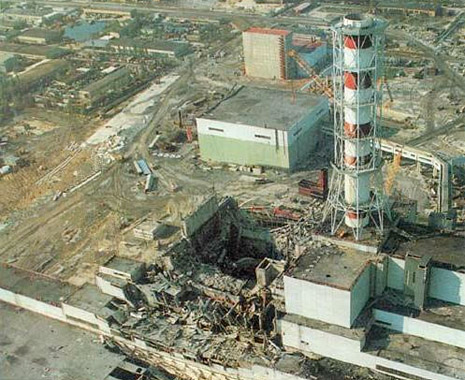
It was in 1946, at the dawn of the Cold War, that construction began on the nuclear complex. It was to produce the plutonium necessary for a Soviet atom bomb. It was built by forced labor under Stalin, close to the closed city of Ozersk, between Chelyabinsk and Ekaterinburg (Sverdlovsk in the Soviet period). Such closed cities near military-industrial complexes were fairly common in the Soviet Union. They didn’t appear on maps, and permits were required to enter them. In total, there were ten closed cities devoted to nuclear weapons. The first uranium-graphite reactor was opened in Maiak in 1948, and the first bomb was detonated in 1949.
Between 1949 and 1957, very large quantities of highly radioactive liquid waste were dumped into the Techa, a 240 kilometer-long river that flowed past dozens of villages. Today, the Techa is the most radioactively contaminated body of water in the world, and nearby Lake Karachai is considered one of the most polluted places on the planet.
In 1957, an explosion in a container of highly radioactive waste caused a new massive contamination along a plume that was 300 kilometers long and 30-50 kilometers wide. In Russian it is referred to as VOURS–Vostochono-Ouralski Radioactivni Sled, the Eastern Ural Radioactive Plume. This explosion was covered up for twenty years before it was revealed by the biologist Jaurès Medvedev (twin brother of the dissident historian Roy Medvedev). Medvedev, in exile in the UK, published the first article in 1976, followed by the book Nuclear Disaster in the Urals in 1988. Taking a name from the closest town on the map (Maiak still didn’t officially exist), the disaster was then designated as the Kychtym nuclear disaster.
Lake Karachai was close to Maiak and was used as a dump for masses of radioactive liquids. In the spring of 1967 it ran dry and the wind carried off radioactive sediment as far as 75 kilometers, causing large-scale contamination, notably of Cesium 137.
In addition to these three massive emissions, the Maiak complex released radioactive wastes continuously in lesser quantities. Meanwhile, the contamination problems were never resolved. According to the relevant estimates given by the IAEA (International Atomic Energy Agency), the wastes dumped into the Techa in the early period, essentially between 1949 and 1951, amounted to 100 PBq (10E15 becquerels). According to Patrick Boyer of the IRSN (France’s Institut de radioprotection et de sûreté nucléaire ), that is about four times as much as what Fukushima has released into the Pacific Ocean.
The releases of Strontium 90 and Cesium 137 during the 1949-51 period also contaminated the Techa floodplain, an area of 240 square kilometers where 80 square kilometers were above the Chernobyl zone limit of 3.7x10E10 Bq/km km2.
Starting in 1956, while Maiak continued to grow, storage areas were built out of natural ponds or by building dams on the Techa. Military production of plutonium ended in 1987. At the time there were seven military reactors on the site. Afterwards, Maiak was put to use for both military and civilian purposes, for producing radioactive materials, and for reprocessing of nuclear fuel.
In spite of the waste reservoirs, liquid contamination never stopped. The main dam leaked, as did creeks flowing out of the canals built to channel the water, and contaminants leached out of the soil. “These are long-term mechanisms, very long,” explains Patrick Boyer to Mediapart. “The situation is stabilized in the sense that the releases are much less than they were in the 1950s, but the leaks continue, and the Techa is going to remain very contaminated for decades. Additionally, the lakes used as reservoirs of nuclear waste contain a considerable level of radioactivity, which constitutes a risk.”
Contamination in the Maiak complex and the surrounding area has had effects on workers and the rural population. According to a Norwegian report, in 1949, workers received a dose corresponding to 1,000 times the maximum allowed dose for nuclear workers today. The villagers along the Techa were also exposed to high levels of radiation which led to high mortality rates and chromosomal abnormalities. Even though the practices of the Cold War no longer occur, radioactive effluents still flow out. The IAEA document mentioned above notes that releases of strontium in the Techa doubled in the 2001-2004 period.
In fact, the population of the region remains exposed to a level of radioactivity which should, according to a 2011 report by CRIIRAD (Comité de recherche et d’information indépendantes sur la radioactivité), require evacuation. This was precisely one of the struggles that Nadejda Koutepova fought, but Russian authorities paid no attention. The pressures that led to her departure from Russia are symptomatic of the opacity that surrounds the Maiak site. Since 2011, scientific data on the site has no longer been available.
The following is an interview with Nadejda Koutepova that was conducted on October 2, 2015 just as Vladimir Putin was welcomed at the
Élysée by Francois Hollande to discuss the wars in Ukraine and Syria…..
October 9, 2015
Posted by Christina Macpherson |
civil liberties, environment, Reference, secrets,lies and civil liberties |
Leave a comment
Our NGO came under increasing pressure over the years. In 2004, a law was passed to make it illegal to do sociological research in the Ozersk region, under the pretext that it threatened national security.
Starting in 2008, we were ordered to pay tax on our “profits.” We refused because we are financed by donations and we are non-profit. Next they tried to intimidate us. I was watched and harassed. But we won the game in court.
In 2012, a law enacted by the Duma put controls on NGOs that received donations from abroad. They were considered as “foreign agents.” So we organized a public meeting to explain that we are not foreign agents because in our activities we consult the local population. We work only for Russians.
But in April of this year, the authorities put us on their list of foreign agents. They accused us of two things: receiving financing from the United States, and “political activities.” This latter accusation concerns two interviews that I gave, one to an ecology magazine in which I discussed Article 42 of the constitution that grants the right to compensation when one is the victim of an environmental disaster. I criticized the way the courts were circumventing Article 42. The other interview was with the nuclear information website Bellona. I spoke of the deaths of children of liquidators and I also criticized the Russian courts.
In May, the pressure continued. The court in Ozersk ordered us to pay 900,000 rubles (4,000 euro) for not having registered with the authorities as foreign agents. All of a sudden, Rossia 24, one of the leading national media networks, broadcast an “assassin report” about us. My face was there at the top of the news, my views were misrepresented, and I was accused of industrial espionage. Journalists came and filmed my house. The question is this: how did they get the permits to enter Ozersk, which is still a closed city?
After this, my supporters encouraged me to leave Russia. Since then, I have been added to a list of persons declared “undesirable” by the Duma. This indicates that I could be imprisoned. At the end of June, a new report was broadcast on television. We decided to dissolve the NGO. On July 7, with my children I left for Paris as discretely as possible.
How do you explain the reaction by the media and the Russian authorities?
October 9, 2015
Posted by Christina Macpherson |
civil liberties, Russia |
Leave a comment














 nuclear-news