Gun toting nuclear plant operator disappears
Nuclear plant operator accused in carjacking vanishes By Clifford
Tribune
January 10, 2013
“……..Prosecutors seek to hold trial in absentiaAuthorities
wondered why a well-paid nuclear plant operator might steal a
12-year-old car at gunpoint. But an even more pressing question arose
when Buhrman disappeared after posting bond. A GPS device that had
been attached to his leg was found Sept. 28 in his deserted Coal City
house, its strap sliced in half, authorities said. Continue reading
Alcoholism among nuclear submarine staff led to murder
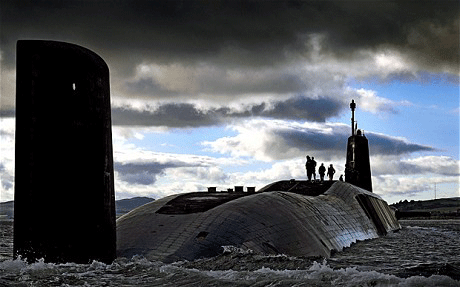 Police alarm at ‘routine’ binge-drinking on nuclear submarine where
murdered shot officer, Telegraph, 9 Jan 13
Police investigating a naval rating who shot dead an officer onboard a
submarine found the 20 pints he consumed beforehand was not unsual and
“significant” numbers of the crew used to get “drunk out of their
minds”. Continue reading
“Unusual event” – fire emergency at Texas nuclear plant
ABC 13: Fire erupts at U.S. nuclear plant in Texas, emergency declared http://enenews.com/abc-13-fire-erupts-at-u-s-nuclear-power-plant-in-texas-emergency-declared
January 9th, 2013
Title: Fire closes part of nuclear plant; no one injured
Source: Victoria Advocate
Author: Caty Hirst
Date: January 8, 2013
[…] “The good news is no one was injured,” said South Texas Project spokesman Buddy Eller. […]
The fire, in Unit 2 of STP Generating Station near Bay City, was declared an “unusual event,” the lowest level of emergency classification, according to a company news release. […]
The cause of the fire is under investigation […]
See also: Fire strikes South Texas Project nuclear power plant transformer -AP
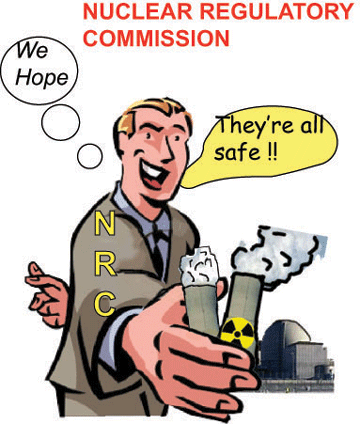
Nuclear Regulatory Commission gives slaps on the wrist for safety violations
 Hurricane Sandy blew through, spinning houses off foundations,
blowing holes in barrier islands and wrecking lives. In the midst of
this mayhem, Oyster Creek sounded a modest alarm.
there is the impression, built up year after empirical year, that
the N.R.C. is a tiger denuded of claws. Even the agency’s internal
monitors found it was notoriously cautious about actions that might
cost plants time and money.
“I get the feeling we’re
regulating with our fingers crossed.”
At a Nuclear Plant, Hurricane Brings More Worry, NYT By MICHAEL POWELL
January 7, 2013“……Rising waters in Barnegat Bay threatened to
submerge the pumps the plant uses to pull in water to cool its reactor
and spent-fuel pools. Had workers with Exelon Corporation, which owns
Oyster Creek, been forced to turn off the water-intake pumps, they
might have had to dip fire hoses into the floodwaters to refill the
ever-hot pool. The plant issued an alert, the second lowest on the
four-stage scale established by the Nuclear Regulatory Commission.
At the same time, 39 of 42 warning sirens, which are perched on poles
for miles around the plant and intended to warn local residents in
event of a nuclear emergency, lost power. Continue reading
Syria’s uranium stockpile a cause for anxiety
Fears raised over Syria uranium stockpile, Ft.com. 8 Jan 13, By James Blitz in London Nuclear experts in the US and Middle East have raised concerns about the security of up to 50 tonnes of unenriched uranium in Syria amid fears that civil war could put the stockpile at risk.
Since the start of the uprising against Bashar al-Assad two years ago, western governments have been heavily focused on the fate of Syria’s chemical weapons and worries that those stocks might be taken over by militant group
But government officials and nuclear experts have also expressed fears to the Financial Times about what may be a significant stockpile of uranium inside Syria.
Concerns go back to the Assad regime’s attempt to build a nuclear reactor at Al-Kibar in the east of the country. yria, with assistance from North Korea, was thought to be close to completing the reactor when the facility was destroyed by Israeli jets in September 2007.
Very little is known about Syria’s nuclear programme and the country has always denied that it ever had one. Syria has also given very little information to the International Atomic Energy Agency, the nuclear watchdog, about its work……
An IAEA inspection team visited the destroyed Al-Kibar site in May 2008 and only found traces of uranium. This merely added to the mystery of where the 50 tonnes of uranium, if it exists, might be. Such a stockpile would be enough, according to experts, to provide weapons grade fuel for five atomic devices….. http://www.ft.com/intl/cms/s/0/a450b660-5998-11e2-88a1-00144feab49a.html#axzz2HX2YULqD
Everybody near Sizewell nuclear site will get anti-radiation pills
Suffolk: Whole town to get anti-radiation pills as part of N-plant
safety plan, EEADT24 By David Green, January 7, 2013 THE entire
population of a Suffolk town will be issued with “standby” supplies of
anti-radiation pills if proposals put out to public consultation today
are approved.

People living and working in Leiston, as well as schools, would also
be given annual calendars setting out the procedures for use in the
event of a major release of radioactivity from the Sizewell nuclear
site. Continue reading
No evacuation plans for India’s dangerous Tarapur nuclear facility
 Nuclear troubles When life is cheaper than nuclear power, Jan 7, 2013, By Dilnaz Boga | Place: Mumbai | Agency: DNA
“……All nuclear-spent fuel from India is being brought to BARC, Tarapur, for reprocessing and later, cooling, storing and  intermediate burial-storage, amounting to high concentration of nuclear activity material in Tarapur. Tandel explains that NPCIL has no evacuation routes for the villagers in case of emergency, or even any medical facilities, food or a shelter plan. Also, residents of Palghar and Dahanu are also at high risk. “Hence, we are opposing the expansion of the facility and the port that Jindal is going to build here,” says Tandel.
Every fortnight, the authorities take samples of soil and water for testing from the villages in the plant’s vicinity, but the results are never shared with the inhabitants…. “Labourers and contractuals are appointed from the roadside. There is no proper health procedure. They die on the roadside after their contracts are through…. Scientist Dr V Pugazhenthi, who had conducted a survey in Chinchani village, 8km from the plant two years ago, said cases of neuroblastoma can be attributed to radiation. “Even 40km away from the plant cases of unexplained anaemia, Down’s Syndrome, tumours, high rate of abortions and miscarriages and multiple myeloma are seen.” http://www.dnaindia.com/mumbai/report_when-life-is-cheaper-than-nuclear-power_1786292
Inadequate emergency plan for UK’s Sizewell nuclear power station
Sizewell nuclear incident plan post Fukushima ‘inadequate’, BBC News,
7 Jan 13, Sizewell C could be built next to the existing A and B
nuclear power stations
Changes to Suffolk’s emergency plan for Sizewell nuclear power station
after the Fukushima disaster in Japan have been called “totally
inadequate”.
Suffolk Resilience Forum, made up of local councils and groups, is
reviewing incident plans for nearby residents.
An inner emergency zone is to be extended from 1.5 miles (2.4km) to
2.3 miles (4km) with an outer precautionary area of 9 miles (15km).
Shut Down Sizewell campaigners said the danger zone should be 18 miles
(30km)……..
Charles Barnett, from the Shut Down Sizewell Campaign, welcomed the
review but called the 1.5 mile (4km) radius of danger “totally
inadequate”.
He said: “The precaution zone should be 18 miles (30km) so that
hundreds of thousands of people would be made aware of the dangers.
“Fukushima has demonstrated that nuclear power stations should be
closed down as the only safe precaution and we are working towards
that….. Consultation and information documents have been circulated
and views are invited from the public up to the closing date of 8
April for publication of a detailed plan in June.
http://www.bbc.co.uk/news/uk-england-suffolk-20937668
Radiation violations by California’ s Caltrans’ Transportation Laboratory
The Public Eye: Caltrans cited for radiation violations with test
meters, Sacramento Bee, By Charles Piller, Jan. 6, 2013 Caltrans’
Transportation Laboratory, which houses the agency’s radiation-based
testing equipment, was cited by the California Department of Public
Health in October for numerous radiation handling and training
violations. Many of the transgressions, according to documents
released to The Bee late last month, had gone on for years and
involved devices used to test concrete in the foundations of some
freeway structures. The test meters, called gamma-gamma loggers, also
were implicated in problems reported by The Bee last year in which a
former state technician falsified data. Continue reading
Nuclear speak about nuclear weapons accidents
When two nukes crashed, he got the call, Orange County Register, 31
Dec 12, First of two parts: After two nuclear bombs fell out of a
plane in 1961, the U.S. turned to Jack ReVelle. Read Part 2. By
KEITH SHARON In the U.S. military’s
euphemistic lexicon of nuclear warfare, there are four terms no one
wants to hear. A “dull sword” is a minor incident involving a nuclear
weapon. A “bent spear” is a breach in the handling of a nuclear
weapon.
An “empty quiver” is a nuclear weapon that has been stolen or lost.
And then there is a “broken arrow,” a nuclear weapon that has somehow
gone awry. According to the book “Broken Arrow: The Declassified
History of U.S. Nuclear Weapons Accidents,” published in 2008, the
United States government has publicly acknowledged 36 broken arrows in
history.
Only one of those involved the potential detonation of two megaton
nuclear bombs on U.S. soil. Only one of those could have wiped out
half the state of North Carolina and, in the process, triggered a
nuclear war.
That broken arrow involved a guy named Jack ReVelle…..
http://www.ocregister.com/articles/revelle-381835-nuclear-bombs.html
Japan’s Monju nuclear reprocessing plant on an earthquake fault
 Japan Experts: Active fault runs underneath MOX fuel plant — Warnings of massive quake http://enenews.com/japan-experts-active-fault-runs-underneath-mox-fuel-plant-warnings-of-massive-quake
Title: Quake risk at Japan atomic recycling plant: experts
Source: AFP
Author: Kyoko Hasegawa
Date: December 19, 2012
Japan’s only reprocessing plant for spent nuclear fuel could sit on an active seismic fault vulnerable to a massive earthquake, experts warned Wednesday.
If regulators agree they will have to order its closure and Japan would be without any recycling capacity of its own, a government official told AFP on condition of anonymity. […]
Yasutaka Ikeda, assistant professor of geomorphology at Tokyo University, said a nearly 100-kilometre (60-mile) fault runs under the Rokkasho reprocessing plant in northern Japan.
“Even though experts’ opinions are divided on whether this fault is active or not, I think the possibility of it being an active fault is extremely high, given the evidence,” Ikeda told AFP.
“This fault could cause an 8-magnitude earthquake, so any nuclear-related facilities in the region are in danger,” he said, referring to the Shimokita Peninsula where the Rokkasho plant is located.
Mitsuhisa Watanabe, professor of geomorphology at Tokyo University, separately told Wednesday’s Tokyo Shimbun that part of an active fault runs directly under the Rokkasho plant, warning it is likely to move when the bigger fault moves. […]
Under government guidelines atomic installations cannot be sited on a fault if it is still classed as active. […]
Rokkasho Reprocessing Plant – Wikipedia:
At the same site there will also be:
A high level nuclear waste monitoring facility
A MOX fuel fabrication plant
A uranium enrichment plant
At last, Nuclear Regulatory Commission is asking hard questions, about San Onofre nuclear plant
“Edison’s design errors have led to the multi-hundred million-dollar
failure of brand new equipment which has in turn endangered the lives
and livelihoods of millions of people in Southern California,”
the NRC is asking hard questions
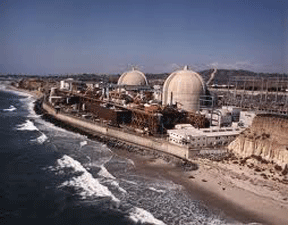 Feds do not consider San Onofre nuclear powerplant safe
http://rt.com/usa/news/san-plant-power-tubes-959/
27 December, 2012 Federal regulators have expressed
significant concern about the safety of the San Onofre nuclear power
plant, asking for more analysis on its damaged steam generators and
requesting the plant to be able to run safely at full capacity.
The power plant has been inactive since January, when a radiation leak
led to the discovery of significant damage on many of its generator
tubes. Many worried that the dangerous conditions at the plant could
lead to California’s own Fukushima-like meltdown.
Southern California
Edison, which runs the plant, has since asked for permission to
restart one of its twin reactors, Unit 2, at 70 percent power, Continue reading
An overview of the Fukushima nuclear plant situation
 Two high school girls that were affected by the disaster are launching a peace discussion forum devoted to expanding the dialogue about nuclear power and weapons. One of the young women said, “My parents’ and grandparents’ generations may be to blame for allowing the nuclear power plants, but both adults and children are responsible for thinking together about the problem.”
 Japan Continues Struggle with Aftermath from the Fukushima Nuclear Disaster http://blog.cleanenergy.org/2012/12/26/japan-continues-fukushima-struggle/
December 26th, 2012 › As 2012 draws to a close, evaluating the ongoing effects of the March 2011 Fukushima Daiichi nuclear disaster on the people of Japan is a difficult and depressing task. After having fled their homes due to the tsunami and resulting triple nuclear meltdown, 21 months later an estimated160,000 citizens still have not returned home.
Reports of illness in humans and livestock continue to underscore the far reaching and difficult to predict impacts that a nuclear accident can cause. In July, 36% of Japanese children screened were found to have abnormal thyroid growths. This fall, an illness dubbed the “Fukushima syndrome” was reported to be killing cattle near the Fukushima prefecture. Mutations are already observed inbutterflies and other insects, whose shorter life cycles allow genetic disruptions to display more quickly than in mammals or humans.

Fukushima type accident risk at Indian Point and Oconee nuclear plants
 Engineers warn: Two US nuclear plants may cause new Fukushima
http://rt.com/usa/news/two-nuclear-nrc-facilities-604/
21 December, 2012, Nuclear engineers have warned the
Senate of the threats facing two US nuclear power facilities, which
could result in enormous explosions or a Fukushima-like meltdown if
natural phenomena or weather conditions cause the facilities to fail.
Senator Joe Lieberman is the current chairman of the Senate Committee
on Homeland Security & Government Affairs, but will retire in 2013.
Two nuclear engineers have asked him to spend his last days in
Congress investigating the threats posed by two nuclear power
facilities. Continue reading
What would be the consequences of a flooded nuclear power plant?
What would be the consequences were a nuclear power plant to flood?
In the case of a natural disaster like a hurricane, the direct impact on a single nuclear power station would likely be exacerbated by a cascade of indirect effects: a range of emergencies and failures unfolding throughout the surrounding area. As during Sandy, transportation would be radically curtailed with roads, bridges, tunnels, trains, and airports shut, as well as some roads blocked by floodwaters, felled trees, and large-scale debris. There could also be widespread power and water outages, fuel shortages, and downed communication lines..
Nuclear power plant flood risk: Sandy was just a warm-up Remapping Debate, By Heather Rogers Dec. 20, 2012 — As Hurricane Sandy approached the East Coast late last October, more than a dozen nuclear power plants from North Carolina stretching up to New England were in its wide-ranging path. On Oct. 29, the night that the eye of the storm made landfall near Atlantic City, New Jersey, five nuclear plants were forced to either reduce power or make emergency shutdowns.
“These facilities need to be hardened more because if they were faced with a Category 2 or a Category 3 [hurricane], it makes me concerned about whether or not they’d be able to safely shut down.” — Michael J. Reilly, National Center for Disaster Preparedness at Columbia University Continue reading
1 This Month




PLEASE OPPOSE HR 8255 AND S.3639 – bills would accelerate satellite deployment, with no environmental review or safeguards – https://ncstd5li.quorum.us/campaign/169331/
To see nuclear-related stories in greater depth and intensity – go to https://nuclearinformation.wordpress.com
-
Archives
- September 2026 (330)
- August 2026 (330)
- July 2026 (355)
- June 2026 (287)
- May 2026 (306)
- April 2026 (356)
- March 2026 (251)
- February 2026 (267)
- January 2026 (308)
- December 2025 (358)
- November 2025 (359)
- October 2025 (375)
-
Categories
- 1
- 1 NUCLEAR ISSUES
- business and costs
- climate change
- culture and arts
- ENERGY
- environment
- health
- history
- indigenous issues
- Legal
- marketing of nuclear
- media
- opposition to nuclear
- PERSONAL STORIES
- politics
- politics international
- Religion and ethics
- safety
- secrets,lies and civil liberties
- spinbuster
- technology
- Uranium
- wastes
- weapons and war
- Women
- 2 WORLD
- ACTION
- AFRICA
- Atrocities
- AUSTRALIA
- Christina's notes
- Christina's themes
- culture and arts
- Events
- Fuk 2022
- Fuk 2023
- Fukushima 2017
- Fukushima 2018
- fukushima 2019
- Fukushima 2020
- Fukushima 2021
- general
- global warming
- Humour (God we need it)
- Nuclear
- RARE EARTHS
- Reference
- resources – print
- Resources -audiovicual
- Weekly Newsletter
- World
- World Nuclear
- YouTube
-
RSS
Entries RSS
Comments RSS

