Trouble with nuclear fuel rods in Japan’s Kashiwazaki-Kariwa plant
Kyodo: Level 1 incident at Japan nuclear plant — Deformed fuel rods stuck together in pool http://enenews.com/kyodo-level-1-incident-at-japan-nuclear-plant-deformed-fuel-rods-stuck-together-in-pool
December 19th, 2012
Regulators confirm ‘level 1’ incident (on 7 level scale) at TEPCO nuclear plant in west Japan. Deformed fuel rods stuck together in pool
18 Dec 12
Title: Regulators confirm level 1 incident at Kashiwazaki-Kariwa plant
Source: Kyodo
Date: Dec. 19, 2012
Japan’s nuclear regulatory authority said Wednesday that recently confirmed trouble with fuel rods stored in a spent nuclear fuel pool at Tokyo Electric Power Co.’s Kashiwazaki-Kariwa plant is a level 1 incident on a 7-point international scale.
A pair of fuel rods was touching as a result of deformation in the bundle of fuel rods, leading the Nuclear Regulation Authority to determine that the fuel had likely been loaded to the reactor core “in an abnormal situation.” The NRA’s assessment of the incident is provisional. […]
also: Nuclear fuel rods touching — “Serious fuel failure accident” risked at Japan plant
South Korea’s nuclear power bungles
 A Year Of Nuclear Bungles, New Matilda, By Jim Green, 19 Dec 12,“……In South Korea, five engineers were charged with covering up a potentially dangerous power failure at the Kori-I reactor in May. The accident occurred because of a failure to follow safety procedures. The manager of the reactor decided to conceal the incident and to delete records, despite a legal obligation to notify the Nuclear Safety and Security Commission.
In early November, the South Korean government shut down two reactors at Yeonggwang to replace thousands of parts that had been supplied with forged quality and safety warranties. Plant owner Korea Hydro and Nuclear Power (KHNP) has acknowledged possible bribery and collusion by KHNP officials as well as corruption by firms supplying reactor parts. In late November there were further revelations and the current total stands at 8601 reactor parts, 10 firms and six reactors. Inadequate and compromised regulation has been a key contributor to the problems in South Korea’s nuclear industry — just as it was a key factor behind the Fukushima disaster in Japan.
South Korea wants to develop uranium enrichment technology (a direct route to nuclear weapons material) in violation of its commitments under the 1992 Joint Declaration on the Denuclearization of the Korean Peninsula……. http://newmatilda.com/2012/12/19/year-nuclear-bungles
Fukushima nuclear situation still critical, with “makeshift” cooling system
 Fukushima plant situation ‘volatile,’ a year after cold shutdown declared, Asahi Shimbun December 18, 2012 By NAOYA KON/ Staff Writer Workers are nowhere close to determining the state of melted fuel at the Fukushima No. 1 nuclear plant, a year after the government declared the damaged reactors were in a “cold shutdown” state.
Storage tanks at the site are nearing capacity for radioactive water. A makeshift system is still being used to cool the nuclear fuel. And leaks of contaminated water and quake-induced collapses of plant facilities remain a threat. Continue reading
Sweden: 2 aging nuclear reactors shutdown after failing safety tests
 Backup power problems put two Swedish reactors on ice – and cast an unpleasant light on age, Bellona, 18 Dec 12 Safety concerns over backup diesel power generators have forced the closure of two of the three reactors in operation at Sweden’s Oskarshamn nuclear power plant after safety tests revealed problems with one of the generators, which failed to start within specified time parameters. Charles Digges, 17/12-2012
Diesel generators are a critical failsafe against loss of coolant during a catastrophic reactor accident, as bitterly illustrated by Fukushima, where a tsunami knocked out back-up and diesel generators, resulting in a triple meltdown.
The shutdown of the reactors comes as unwelcome news to OKG, the utility that runs the plant as Sweden marshals its energy resources with the onset of the Scandinavian country’s coldest months yet to come.
Bellona general manager and nuclear physicist Nils Bøhmer said the discoveries “show that Sweden’s ageing nuclear industry is coming to a point where it can no longer reliably supply power.”….. http://www.bellona.org/articles/articles_2012/oskar_1_2
Mitsubishi faulted by nuclear watchdog, over San Onofre equipment tests
Nuclear watchdog faults Mitsubishi over San Onofre equipment tests
LA Times, December 17, 2012 Federal regulators found flaws in the process followed by Mitsubishi Heavy Industries in building and testing mock-up replacement parts for the troubled San Onofre nuclear plant.
The plant has been out of service for more than 10 months because of excessive wear on tubes carrying radioactive water, one of which leaked a small amount of radioactive steam in January, prompting the plant’s shutdown.
The tubes are part of the four massive replacement steam generator assemblies manufactured by Mitsubishi for plant operator Southern California Edison.
The replacement project cost Edison and San Diego Gas & Electric, which co-owns the plant, a combined $771 million, a cost passed on to ratepayers. A warranty on the equipment is capped at $137 million. Continue reading
Japan admits to errors in radiation data for every nuclear power plant in the country
Japan’s ‘nuclear radiation projection’ had errors http://zeenews.india.com/news/world/japans-nuclear-radiation-projection-had-errors_816717.html, December 14, 2012, Washington: The Nuclear Regulation Authority of Japan said a thorough review of its mistake-plagued projections for the spread of radiation, in a case of possible meltdown like the Fukushima crisis, turned up errors in the data for every atomic power plant in the country. Continue reading
USA’s inadequate radiation detection in overseas megaports
NUCLEAR SMUGGLING MONITORS CUT BACK Program intended to detect potential threats aimed at U.S. WND, by F. MICHAEL MALOOF WASHINGTON 14 Dec 12– The federal government is dramatically cutting back on funds to install nuclear and radiation detection equipment in overseas megaports to scan the contents of shipping containers destined for the United States, according to a report from Joseph Farah’s G2 Bulletin. Continue reading
Tsuruga nuclear plant not safe to restart: how many others are the same?
EDITORIAL: Why flirt with disaster? Decommission Tsuruga nuclear reactor Asahi Shimbun December 12, 2012 Breaking away from the “safety myth” that surrounded nuclear energy, the Nuclear Regulation Authority (NRA) has changed the way Japan judges the safety of nuclear power plants.
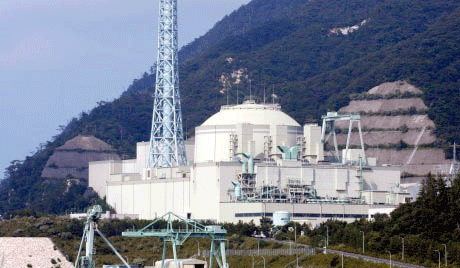
The new industry watchdog said Dec. 10 there is a high possibility that a fault line running directly beneath a reactor at Japan Atomic Power Co.’s Tsuruga nuclear plant in Fukui Prefecture is active. “Under the current circumstances, there is no way we can carry out the
safety assessments (that are required) for a restart (of the reactor),” NRA Chairman Shunichi Tanaka said.
This signals a major turning point in the nation’s nuclear regulation administration. Continue reading
South Korea’s and Japan’s nuclear operators – not to be trusted
Now, South Korea wants to develop uranium enrichment technology in violation of its commitments under the 1992 Joint Declaration on the Denuclearization of the Korean Peninsula.
South Korea has no legitimate need for enrichment technology (there is ample global enrichment capacity) and there are serious proliferation concerns as enrichment provides a direct route to nuclear weapons material in the form of highly-enriched uranium…..
Japan’s plutonium program demonstrably fans regional proliferation tensions.
How can we trust nuclear, if we can’t trust its operators? The Punch, by Jim Green 13 DEC “……Widespread safety breaches and proliferation concerns in North Asia are recent manifestations of the problem. In May, fiveengineers were charged with covering up a potentially dangerous power failure at South Korea’s Kori-I reactor which led to a rapid rise in the reactor core temperature. The accident occurred because of a failure to follow safety procedures. A manager decided to conceal theincident and to delete records, despite a legal obligation to notify the Nuclear Safety and Security Commission.
In October, authorities temporarily shut down two reactors at separateSouth Korean nuclear plants after system malfunctions. Continue reading
UK navy man tried to sell nuclear secrets to Russia
Nuclear submariner tried to pass secrets to Russians to ‘hurt’ Royal Navy A disillusioned Royal Navy submariner betrayed his country by trying to pass nuclear sub secrets to Russian agents because he wanted to “hurt” the Navy. Telegraph UK, By Tom Whitehead, 12 Dec 2012
Petty Officer Edward Devenney was jailed for eight years yesterday for breaching the official secrets act after being caught in an elaborate MI5 sting operation. Continue reading
Sweden’s nuclear waste pools found to have cracks
Cracks found in Swedish nuclear waste pools The Local, 12 Dec 12 The Swedish Radiation Safety Authority (Strålsäkerhetsmyndigheten) has asked nuclear waste contractors at the Oskarshamn nuclear plant to review their security requirements after cracks were found in the pools where nuclear waste is temporarily stored on site. Continue reading
USA’s nuclear industry making big, costly, effort to prepare for nuclear disasters
 Nuclear industry plans rescue wagon for disasters, Canadian Business By AP | December 09, 2012 “…….The FLEX program is supposed to help nuclear plants handle the biggest disasters. The equipment is meant to assist in the most critical tasks during a crisis: keeping nuclear fuel cool, keeping radioactive barriers intact and making sure old stores of used nuclear fuel don’t overheat. If a cooling system fails and nuclear fuel gets too hot, the heat and pressure can rupture a reactor or even cause explosions that send radiation into the environment.
Utility companies must tell federal regulators early next year what equipment they are buying as part of the effort. Those supplies could include portable pumps, generators, batteries and chargers, compressors, hoses, tools and temporary flood barriers, according to
industry plans filed with the NRC. Plant operators started buying some of this supplemental equipment to comply with disaster rules stemming from the Sept. 11, 2001, terrorist attacks. The cost for individual plants is not yet clear……
http://www.canadianbusiness.com/article/109526–nuclear-industry-plans-rescue-wagon-for-disasters
Nuclear smuggling raises risks of a “dirty bomb”
“Real buyers are rare in nuclear smuggling cases, and raise real risks,” “They suggest someone is actively seeking to buy material for a clandestine bomb.”
 an attack with a dirty bomb — explosives packed with radioactive material — would be easier for a terrorist to pull off. And terrorist groups, including al-Qaida, have sought the material to do so. A study by the National Defense University found that the economic impact from a dirty bomb attack of a sufficient scale on a city center could exceed that of the September 11, 2011, attacks on New York and Washington……
 Georgia details nuclear black market probes Army Times By Desmond Butler – The Associated Press Dec 9, 2012 “…….. Despite years of effort and hundreds of millions of dollars spent in the fight against the illicit sale of nuclear contraband, the black market remains active in the countries around the former Soviet Union. The radioactive materials, mostly left over from the Cold War, include nuclear bomb-grade uranium and plutonium, and dirty-bomb isotopes like cesium and iridium.
The extent of the black market is unknown, but a steady stream of attempted sales of radioactive materials in recent years suggests smugglers have sometimes crossed borders undetected. Continue reading
Idaho National Laboratory – problems with nuclear safety
Feds identify weaknesses with nuclear safety team KOMO News.com By Associated Press : Dec 9, 2012 IDAHO FALLS, Idaho – U.S. Department of Energy inspectors have found a handful of weaknesses in the Idaho National Laboratory team responsible for protecting special nuclear material at the eastern Idaho research facility.
Agency officials identified the shortcomings in a Nov. 30 report that looked at INL’s Tactical Response Force, singling out problems with equipment, coordination and communication. The report suggested those weaknesses could contribute to confusion or even public injury if
nuclear material used in research was ever stolen from the site……
http://www.komonews.com/news/local/Feds-identify-weaknesses-with-nuclear-safety-team-182740501.html
Public kept in the dark about Europe’s nuclear safety
Still A Way To Go For Nuclear Transparency In Europe, Says The EESC By: Eurasia Review December 9, 2012 European countries have yet to make public all essential information about nuclear safety and to involve the public in decision-making about nuclear energy, said the European Economic and Social Committee.
The conclusion came at the end of a two-day conference convened to assess the implementation of the Aarhus Convention in the field of nuclear safety…..
http://www.eurasiareview.com/09122012-still-a-way-to-go-for-nuclear-transparency-in-europe-says-the-eesc/
1 This Month




PLEASE OPPOSE HR 8255 AND S.3639 – bills would accelerate satellite deployment, with no environmental review or safeguards – https://ncstd5li.quorum.us/campaign/169331/
To see nuclear-related stories in greater depth and intensity – go to https://nuclearinformation.wordpress.com
-
Archives
- September 2026 (330)
- August 2026 (330)
- July 2026 (355)
- June 2026 (287)
- May 2026 (306)
- April 2026 (356)
- March 2026 (251)
- February 2026 (267)
- January 2026 (308)
- December 2025 (358)
- November 2025 (359)
- October 2025 (375)
-
Categories
- 1
- 1 NUCLEAR ISSUES
- business and costs
- climate change
- culture and arts
- ENERGY
- environment
- health
- history
- indigenous issues
- Legal
- marketing of nuclear
- media
- opposition to nuclear
- PERSONAL STORIES
- politics
- politics international
- Religion and ethics
- safety
- secrets,lies and civil liberties
- spinbuster
- technology
- Uranium
- wastes
- weapons and war
- Women
- 2 WORLD
- ACTION
- AFRICA
- Atrocities
- AUSTRALIA
- Christina's notes
- Christina's themes
- culture and arts
- Events
- Fuk 2022
- Fuk 2023
- Fukushima 2017
- Fukushima 2018
- fukushima 2019
- Fukushima 2020
- Fukushima 2021
- general
- global warming
- Humour (God we need it)
- Nuclear
- RARE EARTHS
- Reference
- resources – print
- Resources -audiovicual
- Weekly Newsletter
- World
- World Nuclear
- YouTube
-
RSS
Entries RSS
Comments RSS

