Japan’s only two operating nuclear reactors to be shut for maintenance in 2013
 Japan faces nuclear shutdown for 2nd time since Fukushima — Expert: They’re trying to protect their nation from diseases, death http://enenews.com/reuters-japan-faces-nuclear-shutdown-for-2nd-time-since-fukushima-expert-trying-to-protect-their-nation-from-diseases-and-death-audio

January 24th, 2013
Title: Japan faces nuclear shutdown for second time since Fukushima
Source: Reuters
Author: Aaron Sheldrick
Date: Jan 24, 2013
Japan may face a total nuclear shutdown in the summer for the second time since the March 2011 Fukushima disaster as the country’s two operating reactors close for maintenance and tough new safety checks keep the rest of the fleet offline. […]
The only two of Japan’s 50 nuclear plants operating are both at Kansai Electric Power’s Ohi plant in western Japan, and must be for shut for maintenance [in mid-September 2013] 13 months after resuming commercial operations, according to Japanese law. […]
Title: Japan Contemplates Complete Nuclear Shutdown
Source: Voice of Russia American Edition
Date: Jan 24, 2013
Full broadcast here
New Nuclear Waste Confidence Decision” (NWCD) designed to let nuclear power continue?
the fact that their best scenario now projects a repository to be ready by about 2050 is a story in itself.
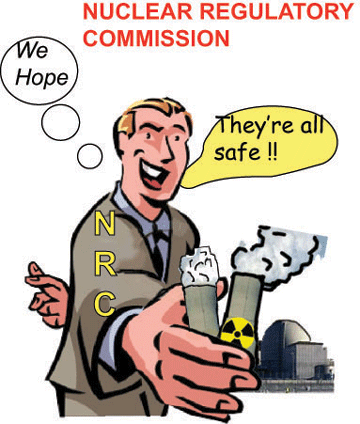 Seventy Years of Nuclear Fission, Thousands of Centuries of Nuclear Waste ,25 January 2013 By Gregg Levine, Truthout “…….Confidence Game
Two months after the Appeals Court found fault with the NRC’s imaginary waste mitigation scenario, the agency announced it would suspend the issuing of new reactor operating licenses, license renewals and construction licenses until the agency could craft a new plan for dealing with the nation’s growing spent nuclear fuel crisis. In drafting its new nuclear “Waste Confidence Decision” (NWCD) – the methodology used to assess the hazards of nuclear waste storage – the Commission said it would evaluate all possible options for resolving the issue.
At first, the NRC said this could include both generic and site-specific actions (remember, the court criticized the NRC’s generic appraisals of pool safety), but as the prescribed process now progresses, it appears any new rule will be designed to give the agency, and so, the industry, as much wiggle room as possible. Continue reading
Explosion at Iran’s Fordo uranium enrichment site. Is this report true?
 So far, I have not been able to find corroborating information on this. Please check out the comments below this item – some good points to alert us to the possibility that this is a hoax. And note the video below the blogs – reminder of the effect of the radio program “War of the Worlds” – which panicked people many decades ago. – C.M.
Report: Explosion Destroys Key Iran Nuclear Site http://www.tabletmag.com/scroll/122646/report-explosion-destroys-key-iran-nuclear-site A source is reporting much of the underground Fordo site has been hit By Adam Chandler|January 25, 2013 A few major sites that linked to WND story have removed it. I take that as a pretty good indication that this story cannot be confirmed.
According to World News Daily, a massive explosion is said to have destroyed most of Iran’s nuclear facility at Fordo.
An explosion deep within Iran’s Fordow nuclear facility has destroyed much of the installation and trapped about 240 personnel deep underground, according to a former intelligence officer of the Islamic regime.
The previously secret nuclear site has become a center for Iran’s nuclear activity because of the 2,700 centrifuges enriching uranium to the 20-percent level. A further enrichment to weapons grade would take only weeks, experts say.
The explosion is said to have taken place on Monday. The nuclear site is a high profile target given that it’s completely underground and recently reached nuclear capacity. Just earlier today, it was reported that the Iran could quadruple enrichment at the Fordo site.
While I am extremely skeptical of this report’s veracity until I hear more, this is potentially a massive development. More to come.
Safety fears: UK’s secret uranium enrichment plant closed for 2013
 Secret UK uranium enrichment plant closed over safety
  fears regulators report steel corrosion at Aldermaston plant, which helps enrich uranium for nuclear warheads, Guardian UK , Rob Edwards, 24 Jan 13, A top-secret plant at Aldermaston that helps to enrich uranium for Britain’s nuclear warheads and fuel for the Royal Navy‘s submarines has been shut down because corrosion has been discovered in its “structural steelwork”, the Guardian can reveal.
The closure has been endorsed by safety regulators who feared the building did not conform to the appropriate standards. The nuclear safety watchdog demands such critical buildings are capable of withstanding “extreme weather and seismic events”, and the plant at Aldermaston failed this test.
They have set a deadline of the end of the year for the problems to be fixed.
Although the closed plant has not been officially named for national security reasons, the Guardian understands it is known as A45. It enriches uranium components for Trident nuclear warheads, and has recently been helping to make the uranium fuel for the Astute generation of nuclear-powered submarines.
The Ministry of Defence (MoD) insisted it had contingency plans to cover the loss of the enrichment plant, but a prolonged closure could force the government to buy in materials from the US to ensure there is no disruption to Britain’s nuclear weapons programme.
The government’s safety watchdog, the Office for Nuclear Regulation(ONR), has taken legal enforcement action against AWE, the private consortium that runs the nuclear weapons complex at Aldermaston in Berkshire for the MoD, ordering that the corroded steel be repaired. Continue reading
Narrow escape – nuclear satellite mishap in 1982
Thirty Years Ago, Everyone Thought A Nuclear Satellite Was Going To Fall From Space And Spread Destruction http://www.businessinsider.com/flashback-how-a-tumbling-nuclear-russian-satellite-held-the-world-in-fear-for-a-month-2013-1#ixzz2J0sLfzPZ Dina Spector | Jan. 24, 2013 Thirty years ago, the world was held hostage by a nuclear-powered Soviet spy satellite tumbling out of control in an orbit close to Earth.
The spiraling spacecraft, named Cosmos 1402, was launched into low-Earth orbit on Aug. 20, 1982.
What made Cosmos particularly scary is that it carried a nuclear reactor with about 100 pounds of enriched uranium. The reactor was used to power a radar system for tracking ships.
To compare, it takes as little as 35 pounds of uranium to make a nuclear bomb. Once the satellite completed its mission, the plan was to boost the 1,000-pound reactor section, including the fuel core, into higher orbit, where it would linger at a safe distance from Earth for many hundreds of years.
But that failed. Continue reading
A little shark could beat a nuclear submarine
This Tiny Shark Can Take Out Nuclear Submarines Jennifer Welsh | Jan. 23, 2013,
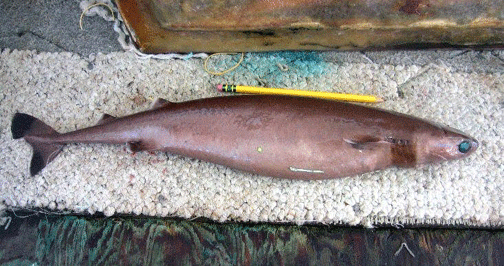
The Cookiecutter shark (Isistius brasiliensis).
The cat-sized shark in the picture to the right doesn’t look that intimidating, but it has the power to take down an entire nuclear submarine. The fish’s strange bite can get at the softer areas of the submarines, National Geographic’s Ed Yong reports: The fearless cookie-cutters have even disabled the most dangerous ocean creature of all—the nuclear submarine. They attacked exposed soft areas including electrical cables and rubber sonar domes. In several cases, the attacks effectively blinded the subs, forcing them back to base for repairs. They later returned, fitted with fibreglass coverings.
The attacks happened in the 1970s and the problem seems to have been taken care of, though in several cases the sharks did enough damage to the vessel’s sonar equpiment that the oils inside that transmit sound would leak out of the ship and break the equipment — the subs could no longer see what was around them, according to the ReefQuest Centre for Shark Research.
Nuclear subs obviously aren’t all that tasty, but they seem to bite just about anything — even research equipment in the ocean. The distinctive bites have been found in all kinds of fish and other sharks, and even a human has been attacked by the little guys.
See the rest of Yong’s blog post for more fascinating facts about the cookiecutter shark and the analysis of a new paper out in Pacific Science this month, detailing cookiecutter bites on a great white shark. Here are some more images:……
Read more: http://www.businessinsider.com/this-tiny-shark-can-take-out-nuclear-submarines-2013-1#ixzz2IuvjPEFc
USA’s Dept of Energy’s plan for radioactive scrap metal into consumer goods
 the DOE wants to deregulate and actually sell 14,000 tons of radioactive scrap metal (both volumetrically and topically contaminated) from the nuclear war system — uranium enrichment, plutonium extraction, etc. — and “recycle” the waste to the commercial clean scrap metal industry. From there, according to the watchdog group Nuclear Information and Resource Service, the radioactive stuff “could be turned into anything from your next pants zipper to baby toys.”
The DOE has never officially acknowledged — in spite of the National Academy of Sciences’ 2006 findings — that the same radiation dose does far more harm to women than to men. The drastically increased vulnerability of fetuses and infants is well known, but the whole population is nevertheless treated as the same big, young, Caucasian male (“reference man”) in most radiation risk assessments.
You can tell the DOE to continue to keep its radioactive metal out of the commercial metal supply, commerce, and our personal items. You can demand a full environmental impact statement. Comment deadline is Feb. 9, 2013. Email to: scrap_PEAcomments@hq.doe.gov (with an underscore after “scrap_”). Snail mail to: Jane Summerson / DOE NNSA / PO Box 5400, Bldg. 401K. AFB East / Albuquerque, New Mexico 87185
 The Energy Department’s Crazy Plan for Radioactive Scrap Nuclear Weapons Waste in Your Water Bottle, Hip Replacement, Baby’s Toys, Jungle Gym? http://www.counterpunch.org/2013/01/23/nuclear-weapons-waste-in-your-water-bottle-hip-replacement-babys-toys-jungle-gym/ by JOHN LaFORGE
Even the deregulation-happy Wall St. Journal sounded shocked: “The Department of Energy is proposing to allow the sale of tons of scrap metal from government nuclear sites — an attempt to reduce waste that critics say could lead to radiation-tainted belt buckles, surgical implants and other consumer products.” Continue reading
Nuclear anxiety: Arab countries, and villagers living near Iran’s Bushehr nuclear power plant
 Bushehr Nuclear Power Plant: Contamination Risks Worry Iranian Villagers, Arab Neighbors By Yeganeh Torbati
DUBAI, Jan 23 (Reuters) – For the Iranian government, the Bushehr nuclear power plant is proof to a world worried about Tehran’s intentions that its atomic programme is aimed only at securing a modern, clean energy source for its people.
But for villagers living next to the facility, as well as Arab capitals nearby, the plant poses a potential danger that is less geopolitical and more immediate: the risk of contamination.
“We are extremely worried about our health and the health of our families,” residents of the coastal villages of Heleylah and Bandargah wrote in a statement published on a blog in 2010.
“According to international standards, the distance between a nuclear power plant and the nearest residence must be at least one kilometre … but the distance between the village of Heleylah and this power plant is just six metres!”
Thousands of people live in the two villages 18 km (11 miles) south of the Gulf city of Bushehr, many of them making their living as service workers at the plant.
Residents living near Iran’s nuclear-related sites told Reuters in interviews by phone and over the Internet that the government stifles debate on the pros and cons of the programme and where its sites should be located, and has not addressed their questions about what would happen in an emergency.
Iran’s Arab neighbours are also nervous. Kuwait, Bahrain, Saudi Arabia, Qatar, Iraq and the United Arab Emirates all occupy coastline across from Bushehr, and the plant is closer to five Arab Gulf capitals than it is to Tehran…… http://www.huffingtonpost.com/2013/01/23/bushehr-nuclear-power-plant-contamination-iran_n_2533383.html
USA knew about nuclear meltdown risks long before Fukushima
U.S. Warned About Multiple Nuclear Meltdowns Years Before Fukushima, Think Progress,By Jeff Spross Jan 23, 2013 Four years before the accident at Japan’s Fukushima Daiichi plant, the U.S. Nuclear Regulatory Commission was warned about the possibility of a plant suffering simultaneous meltdowns due to a natural disaster. [NYTimes]
NRC knew years ago of the flood danger to nuclear reactors
An Early Nuclear Warning: Was It for Naught? NYT, By MATTHEW L. WALD January 22, 2013, The accident at Japan’s Fukushima Daiichi plant in 2011 alerted the American nuclear industry and its regulators to the possibility that operators at plants with more than one reactor might have to deal with more than one meltdown at a time in a flood, earthquake or other catastrophe. Officials are now working to assure that they could master that situation.
But documents uncovered by a group that is critical of nuclear safety show that a high-level safety analyst at the Nuclear Regulatory Commission posed the possibility to his superiors in July 2007, about four years before the earthquake and tsunami that led to three simultaneous meltdowns at Fukushima Daiichi. The documents also show that in August 2008, the commission staff formally acknowledged the issue.
But until Japan’s disaster, progress in the American nuclear industry was glacial. Dave Lochbaum, a nuclear expert at the Union of Concerned Scientists, which uncovered the documents, compares them to records located after the crash of the space shuttle Columbia in which engineers voiced concern that debris falling during a launch could damage an orbiter.
Action to prepare for a dual meltdown was not a case of “forewarned is forearmed,’’ he said, but more like “forewarned is forestalled.’’
The warning, which now seems prophetic, predicted “common cause failures,’’ meaning single events that disable different pieces of equipment that are supposedly independent and nearly invulnerable to failing simultaneously on their own. The risk analyst, Richard Sherry, wrote that flooding or earthquakes could disrupt both normal grid power and emergency backup power……http://green.blogs.nytimes.com/2013/01/22/an-early-nuclear-warning-was-it-for-naught/
Missouri’s West Lake Landfill Superfund Site- a radioactive time bomb
 “Our community can no longer tolerate delays—we’re sitting on a ticking toxic time bomb,”
Community, Environmentalists, Teamsters Tell EPA: Stop Nuclear Fires At Republic Landfill In Missouri, Daily Markets, ST. LOUIS, Jan. 18, 2013 /PRNewswire-USNewswire/ — Last night, more than 300 people from the Missouri Coalition for the Environment, Missouri Jobs with Justice, and the Teamsters Union attended a public meeting held by the Environmental Protection Agency (EPA). There, community leaders spoke out against the increasingly dangerous and volatile situation at West Lake Landfill Superfund Site in Bridgeton, Mo. The landfill is operated by Republic Services [NYSE: RSG], the nation’s second-largest trash company.
The site, located in the Missouri River floodplain, is home to radioactive wastes dumped there in 1973 following secret uranium processing in downtown St. Louis. In late October 2012, residents around the landfill began complaining of foul odors and burning eyes—and the Pattonville Fire Department expressed alarm at rising underground temperatures and the danger that the developing underground landfill fire could migrate toward the buried nuclear waste sites. Continue reading
Flooding danger if uranium mine goes ahead in Virginia
Flooding near proposed uranium mining site worries some, VUI says there’s no concern Keep the Ban, January 16, 2013 A road closes near Coles Hill that runs through the Virginia Uranium Incorporated but getting home isn’t the only concern for one nearby farmer. PITTSYLVANIA CO., Va.—
Today’s heavy rain is bringing more attention to the proposed uranium mining site in Pittsylvania County.
A road on the Coles Hill site is flooded.
Opponents say the mining would contaminate streams and rivers……. “you can see what two and three inches of rain is doing it’s flooding the roads down here,” Motley said.
Motley believes the proposed mine could contaminate the water, which runs into a nearby water source.
“Any residue has the potential of washing down this way and going directly into the Banister River,” Motley said….. The Virginia Department of Transportation will keep the road closed until water levels are again below the road.
Nuclear Regulatory Commission rushing report so as to relicense reactors?
After the Court of Appeals decision, NRC chair Allison Macfarlane decided that the NRC would produce a full environmental impact statement in response to the ruling, as opposed to a less rigorous environmental assessment.
Watchdogs say NRC rushing nuclear waste report Rutland Herald, By DAVID McCUMBER Hearst Newspapers | January 13,2013 WASHINGTON — The Nuclear Regulatory Commission is rushing a court-ordered evaluation of the risks of storing spent nuclear fuel at the country’s nuclear plants, according to two dozen watchdog groups.
In detailed public comments solicited by the NRC, the groups together contended that the agency’s two-year timeline for an environmental impact statement on the spent-fuel risks is inadequate.
The NRC “would be well-advised to slow it down, quite apart from anybody’s position on nuclear power … They just don’t have the data,” Continue reading
South Texas nuclear reactors – fire on Jan 8, relicensing hearing on Jan 15
Fire at South Texas Project Nuclear Reactor Site – Just Before Re-licensing Hearing, Herald Online, January 11, 2013 By Sustainable Energy & Economic Development Coalition AUSTIN, TEXAS, JAN. 11, 2013 — /PRNewswire-USNewswire/ –– A fire that shot 50 foot flames into the air erupted January 8th in the main transformer at the South Texas Project site near Bay City, Texas, about 90 miles southwest of Houston. Reactor 2, which was out of commission for five winter months in 2011-2012, has not been operating since the fire.
The fire occurred just one week prior to a hearing on re-licensing the two South Texas Project reactors, which will be held January 15th from 2-5 pm and 7-10 pm at the Bay City Civic Center, 201 Seventh St…… “Any nuclear reactor is at risk from fires, explosions, hurricanes, tornadoes, floods, earthquakes, lack of cooling water and terrorist attacks, as well as accidents due to human error and mechanical failure,” said Karen Hadden, Director of the Sustainable Energy and Economic Development (SEED) Coalition.
“This is like a used car deal – made fourteen years in advance. Why not wait until 2025 to see what shape the reactors are in before even considering re-licensing? The reactors, now 24 and 25 years old, are licensed to run 40 years – until 2027 and 2028. It’s time to plan for their replacement, not court disaster by giving aging reactors twenty additional years.”
The NRC Event report and hearing information are online at www.NukeFreeTexas.org.
Incident at Hanford nuclear site meeting
Paper: Engineer files police report after incident at nuclear site — Says she was grabbed, physically prevented from leaving meeting http://enenews.com/paper-engineer-files-police-report-after-incident-at-nuclear-facility-says-she-was-grabbed-physically-prevented-from-leaving-meeting
January 9th, 2013
Title: DOE engineer files police report alleging incident at meeting
Source: Tri-City Herald
Author: By Annette Cary
Date: January 9, 2013
A Department of Energy engineer has filed a police report alleging she was physically prevented from leaving a Hanford meeting in December.
[…] The confrontation reportedly happened between two DOE employees and involved a disagreement about how much money should be paid to Bechtel National, which is building the Hanford vitrification plant.
The woman reported that as she tried to leave the meeting someone grabbed her arm to keep her from walking out, said Capt. Mike Cobb of the Richland police. […]
“The Department of Energy will not tolerate harassment, intimidation or other inappropriate behavior from its employees,” DOE said in a statement when asked about the police report. “Any and all allegations will be investigated promptly and thoroughly.” […]
See also: Battle over Bechtel clean-up at Hanford escalating after police reports filed -Enformable
1 This Month




PLEASE OPPOSE HR 8255 AND S.3639 – bills would accelerate satellite deployment, with no environmental review or safeguards – https://ncstd5li.quorum.us/campaign/169331/
To see nuclear-related stories in greater depth and intensity – go to https://nuclearinformation.wordpress.com
-
Archives
- September 2026 (330)
- August 2026 (330)
- July 2026 (355)
- June 2026 (287)
- May 2026 (306)
- April 2026 (356)
- March 2026 (251)
- February 2026 (267)
- January 2026 (308)
- December 2025 (358)
- November 2025 (359)
- October 2025 (375)
-
Categories
- 1
- 1 NUCLEAR ISSUES
- business and costs
- climate change
- culture and arts
- ENERGY
- environment
- health
- history
- indigenous issues
- Legal
- marketing of nuclear
- media
- opposition to nuclear
- PERSONAL STORIES
- politics
- politics international
- Religion and ethics
- safety
- secrets,lies and civil liberties
- spinbuster
- technology
- Uranium
- wastes
- weapons and war
- Women
- 2 WORLD
- ACTION
- AFRICA
- Atrocities
- AUSTRALIA
- Christina's notes
- Christina's themes
- culture and arts
- Events
- Fuk 2022
- Fuk 2023
- Fukushima 2017
- Fukushima 2018
- fukushima 2019
- Fukushima 2020
- Fukushima 2021
- general
- global warming
- Humour (God we need it)
- Nuclear
- RARE EARTHS
- Reference
- resources – print
- Resources -audiovicual
- Weekly Newsletter
- World
- World Nuclear
- YouTube
-
RSS
Entries RSS
Comments RSS

