Nuclear costs of the Iran War
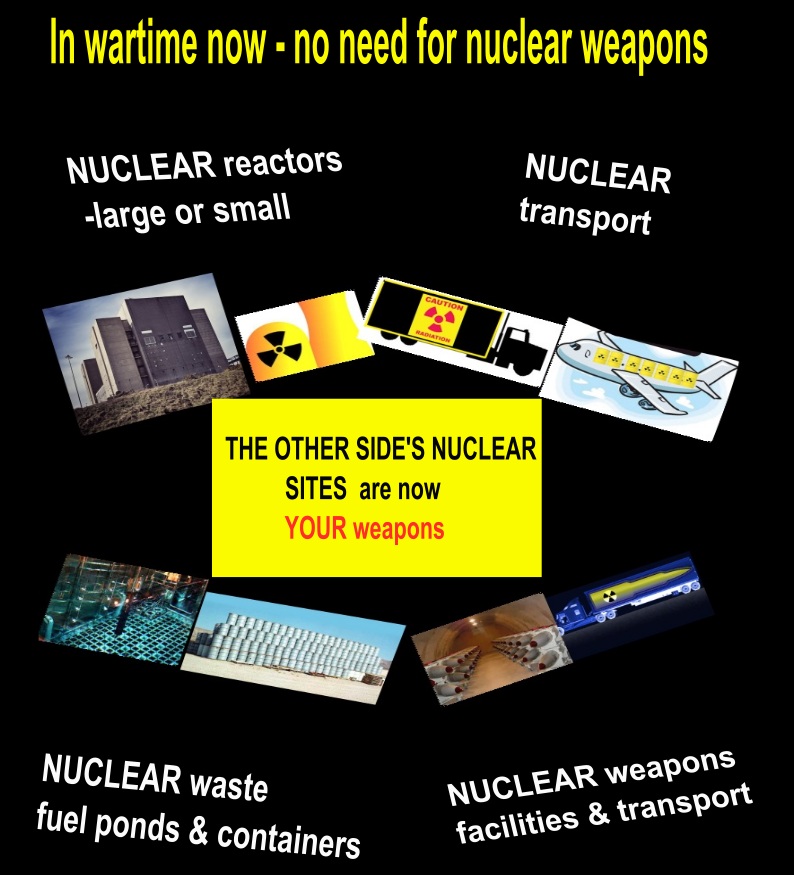
To create a nuclear disaster, it’s not necessary to directly hit the containment building. Damaging on-site and off-site power necessary for cooling can also have severe repercussions.
even reactors in stand-by modes pose radioactive risks in a war zone.

In spite of all this, Director General of the IAEA Grossi promotes rules of the road to help nuclear energy continue operating in warzones. It is a stark reminder that the IAEA’s major mission is to promote nuclear energy, despite the emerging lessons from two “nuclearized” wars.
by beyondnuclearinternational, https://beyondnuclearinternational.org/2026/04/11/nuclear-costs-of-the-iran-war/
Trump’s recent threats to end civilization in Iran gave many a nuclear weapons expert the jitters, writes Sharon Squassoni
President Donald J. Trump’s recent threats to end civilization in Iran gave many a nuclear weapons expert the jitters. For them, existential threats mean only one thing: use of nuclear weapons. Thankfully, Trump’s April 7, 2026 threats were empty and possibly just a ruse to create a dramatic background for the temporary ceasefire in Iran.
To be clear, the use of nuclear weapons in combat would serve no earthly strategic or tactical purpose, but threats to use them can be potent: even a latent capability in the hands of Iran was regarded as too threatening for the United States to tolerate any longer, which reportedly drove the U.S. and Israeli military actions.
It’s hard to tell who’s winning or losing in this conflict, but already it’s clear that disruption of energy sources (Iran’s blocking the Straits of Hormuz and the U.S. and Israel striking Iran’s oil infrastructure) focuses attention like no other infrastructure attack. A sudden cutoff that shrinks supplies and distorts prices echoes in economies across the globe.
This is one reason the world was hesitant to impose sanctions on Iran’s oil some twenty years ago when Iran’s clandestine nuclear program was first unveiled. Today, the Iran war has underscored just how dependent the world continues to be on foreign sources of oil.
Would nuclear energy be any different?
Since 2022, there has been a push in Europe and elsewhere to deploy nuclear reactors to reduce dependencies on Russian oil and gas, triggered by Russia’s invasion of Ukraine. But such a response is almost laughable to anyone paying attention to what has transpired in Ukraine in the last four years.
Russia hesitated not at all to hold the Chernobyl and Zaporizhzhia nuclear power plants hostage, in addition to firing upon them. The only thing that has saved Ukraine from a major nuclear meltdown is the fact that Russia wants to save Ukraine for itself, rather than destroy it utterly.
For those who still believe in international laws, there are rules to prevent attacks on nuclear plants — specifically the Protocol I Additional to the Geneva Conventions, a key document in international humanitarian law adopted in 1979 — that 175 countries follow.
Unfortunately, Russia withdrew in 2019 and the US has never ratified Protocol I (along with Israel, India, Pakistan, Turkey and Iran). The Protocol protects “works and installations containing dangerous forces,” prohibiting attacks on nuclear power plants that generate civilian electricity, among other things. It concedes that some nuclear power plants that regularly support military purposes may be attacked.
For those paying attention to nuclear development trends, this should be worrisome because both China and the United States have programs to develop nuclear reactors for specific military uses. Not content to learn from past experience, the United States plans to deploy a military microreactor by July 4th of this year. Leaving aside questions of cost, safety and peacetime security, such deployments will widen the base of deadly targets in war. Civilians won’t care whether international law deems these “legitimate” targets of attack.
Attacks on nuclear facilities themselves are not new. The United States, Russia, Israel, Iran and Iraq have all, at times, targeted nuclear research and power reactors under various stages of construction and operation in the past. Sometimes these attacks tried to slow nuclear weapons proliferation programs and sometimes, as in the Iran-Iraq war, they were targeted for less specific purposes.
After the June 2025 attacks on uranium enrichment-related facilities by the United States, touted as “obliterating” Iran’s nuclear program, International Atomic Energy Agency Director General Rafael Grossi warned that a strike on the Bushehr power plant could cause a regional catastrophe.
Recently, Iran’s Foreign Minister Abbas Araghchi has claimed that the Bushehr plant, which generates close to 1000 Megawatts of electricity, has been struck four times since February this year. The closest hit has been 75 meters from the plant on April 4, killing a security guard and damaging a building. Russia, which has 128 Rosatom personnel at the plant, is considering further evacuations, which sounds eerily similar to what happened to the Zaporizhzhia plant in March 2022.
To create a nuclear disaster, it’s not necessary to directly hit the containment building. Damaging on-site and off-site power necessary for cooling can also have severe repercussions. In the case of Zaporizhzhia, operators shut down reactors to minimize some of the risks. But even reactors in stand-by modes pose radioactive risks in a war zone.
The Bushehr power plant is still operating and has spent nuclear fuel on-site in spent fuel pools. Who can forget the video footage of the Fukushima Daiichi nuclear power plant in 2011 when crews attempted to spray seawater from helicopters on spent fuel pools damaged by the earthquake and tsunami that devastated Japan? More than a decade later, the site is still undergoing remediation.
In spite of all this, Director General of the IAEA Grossi promotes rules of the road to help nuclear energy continue operating in warzones. It is a stark reminder that the IAEA’s major mission is to promote nuclear energy, despite the emerging lessons from two “nuclearized” wars.
In fact, learning the wrong lessons from this conflict could carry the seeds of unimaginable future disruption. A world that fears reliance on foreign energy could rely even more on nuclear energy for not just electricity, but transportation and data processing, the new currency of power. The greater the reliance, the keener officials will be to keep it up and running. More and more widely distributed nuclear targets will not be protected by Protocol I of the Geneva Convention, or by the International Atomic Energy Agency. There is no International Nuclear Red Cross or Emergency Management Agency.
Many Americans find it hard to contemplate attacks on U.S. soil, with good reason. This is why the 9/11 attacks affected the population so deeply. Those attacks sparked significant improvements in security at nuclear power plants that are now being unraveled by a push to deploy nuclear reactors in the United States as quickly as possible.
In fact, learning the wrong lessons from this conflict could carry the seeds of unimaginable future disruption. A world that fears reliance on foreign energy could rely even more on nuclear energy for not just electricity, but transportation and data processing, the new currency of power. The greater the reliance, the keener officials will be to keep it up and running. More and more widely distributed nuclear targets will not be protected by Protocol I of the Geneva Convention, or by the International Atomic Energy Agency. There is no International Nuclear Red Cross or Emergency Management Agency.
Many Americans find it hard to contemplate attacks on U.S. soil, with good reason. This is why the 9/11 attacks affected the population so deeply. Those attacks sparked significant improvements in security at nuclear power plants that are now being unraveled by a push to deploy nuclear reactors in the United States as quickly as possible.
The Nuclear Regulatory Commission recently voted to discontinue force-on-force commando drills designed to reveal weaknesses in site vulnerabilities. A victim of the DOGE process, the NRC has been stripped of its independence and will now overhaul the entire licensing process, even as the Trump administration seeks to end-run the NRC by deploying new reactors on government sites owned by the Departments of Energy and Defense.
If anything, the Iran war demonstrates Gulliver’s dilemma. Both Ukraine and Iran have used drones successfully to compensate for conventional force inferiority. Are we truly prepared to counter cheaper and more plentiful attacks that are more difficult to detect and defend against?
Iran’s nuclear program was feared for its potential to provide the basis for nuclear weapons. Now it is generating fear for its potential to provoke a more imminent regional catastrophe, whether intended or accidental. These security risks, perhaps not widely appreciated now, will only grow in a more nuclearized future.
1 Comment »
Leave a Reply
1 This Month
23-25 October – on Zoom – World BEYOND War’s annual global conferenc


Shut down the radiation-damaged Heysham nuclear reactors now
To see nuclear-related stories in greater depth and intensity – go to https://nuclearinformation.wordpress.com

Say No to NASA’s Reckless Nuclear Reactor on the Moon
Say No to NASA’s Reckless Nuclear Reactor on the Moon

Please sign the petition here: https://www.change.org/p/stop-japan-s…
-
Archives
- October 2026 (190)
- September 2026 (339)
- August 2026 (330)
- July 2026 (355)
- June 2026 (287)
- May 2026 (306)
- April 2026 (356)
- March 2026 (251)
- February 2026 (267)
- January 2026 (308)
- December 2025 (358)
- November 2025 (359)
-
Categories
- 1
- 1 NUCLEAR ISSUES
- business and costs
- climate change
- culture and arts
- ENERGY
- environment
- health
- history
- indigenous issues
- Legal
- marketing of nuclear
- media
- opposition to nuclear
- PERSONAL STORIES
- politics
- politics international
- Religion and ethics
- safety
- secrets,lies and civil liberties
- spinbuster
- technology
- Uranium
- wastes
- weapons and war
- Women
- 2 WORLD
- ACTION
- AFRICA
- Atrocities
- AUSTRALIA
- Christina's notes
- Christina's themes
- culture and arts
- Events
- Fuk 2022
- Fuk 2023
- Fukushima 2017
- Fukushima 2018
- fukushima 2019
- Fukushima 2020
- Fukushima 2021
- general
- global warming
- Humour (God we need it)
- Nuclear
- RARE EARTHS
- Reference
- resources – print
- Resources -audiovicual
- Weekly Newsletter
- World
- World Nuclear
- YouTube
-
RSS
Entries RSS
Comments RSS


[…] Full reading at nuclear-news 2186 ♥ […]
Pingback by Risks and Consequences of Nuclear Facilities in Conflict Zones - KillBait Archive | April 15, 2026 |