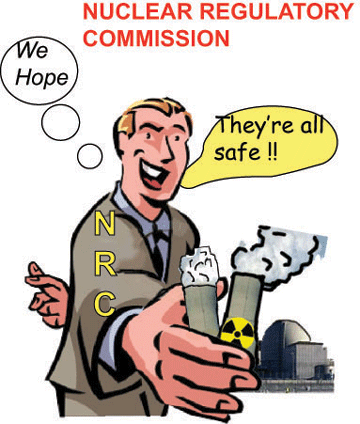
 Study: US NRC Relied On Faulty Analysis To Justify Refusal To Adopt Catastrophic Nuclear Waste Fire Safety Measures, Clean Technica, June 11th, 2017 by James Ayre , A new study from Princeton University and the Union of Concerned Scientists has revealed that the US Nuclear Regulatory Commission (NRC) relies on faulty analysis to “justify its refusal to adopt a critical measure for protecting Americans from the occurrence of a catastrophic nuclear-waste fire at any one of dozens of reactor sites around the country.”
While the nuclear fallout from such an incident could contaminate an area twice the size of New Jersey, force the relocation of around 8 million people, and cause trillions of dollars in damages, the NRC apparently sees no issue with the current lack of safeguards — and is content with using faulty justifications for cover. I wonder why?
Frank von Hippel, a co-author of the new paper and a senior research physicist at Princeton’s Program on Science and Global Security (SGS), commented: “The NRC has been pressured by the nuclear industry, directly and through Congress, to low-ball the potential consequences of a fire because of concerns that increased costs could result in shutting down more nuclear power plants. Unfortunately, if there is no public outcry about this dangerous situation, the NRC will continue to bend to the industry’s wishes.”
Catastrophic nuclear fires like those mentioned above could be triggered at many of the nuclear power plants in the US through a variety of mechanisms, whether by large earthquakes or terrorism. The thing about this, though, is that simple regulatory measures could greatly reduce the likelihood and extent of such events — the problem is simply that they drive up costs and are thus unwanted by those in the industry and associated with it.
Since there are a number of nuclear energy proponents that comment on this site from time to time, I’ll use this opportunity to note that my main objection with nuclear is simply that there’s no way to separate it from human nature/stupidity. ……
Something that should be realized here is that while such an event would lead to total damages of around $2 trillion, according to the researchers, the nuclear industry itself would only be liable to cover around $13.6 billion, owing to the Price Anderson Act of 1957. In other words, as with the banking crisis, US tax payers would again be on the hook.
The authors of the new work note that states that provide nuclear subsidies can probably force the hands of some operators, requiring them to enact the suggested changes by threatening to withhold funding.
Co-author Edwin Lyman, a senior scientist at the Union of Concerned Scientists, concludes that: “In far too many instances, the NRC has used flawed analysis to justify inaction, leaving millions of Americans at risk of a radiological release that could contaminate their homes and destroy their livelihoods. It is time for the NRC to employ sound science and common-sense policy judgments in its decision-making process.”
The new research is detailed in a paper published in the journal Science. https://cleantechnica.com/2017/06/11/study-us-nrc-relied-faulty-analysis-justify-refusal-adopt-catastrophic-nuclear-waste-fire-safety-measures/
June 12, 2017
Posted by Christina Macpherson |
safety, USA |
Leave a comment

 Takahama’s problematic restart http://www.japantimes.co.jp/opinion/2016/02/10/editorials/takahamas-problematic-restart/#.WTy9t5KGPGh, FEB 10, 2016
 The No. 3 reactor of Kansai Electric Power Co.’s Takahama nuclear power plant in Fukui Prefecture, which was restarted in late January, is expected to start commercial operations in late February. Its No. 4 reactor is also set to be restarted around the same time. Although the Takahama Municipal Government and Fukui Prefecture gave their consent to the restart, there are serious concerns, including those expressed by nearby municipalities and their residents.
Following the restart of the No. 1 and No. 2 reactors at Kyushu Electric Power Co.’s Sendai nuclear power plant in Kagoshima Prefecture, Takahama unit 3 is the third reactor to come back online under the safety regulations introduced by the Nuclear Regulation Authority following the shutdown of the nation’s nuclear plants in the wake of the March 2011 disaster at Tokyo Electric Power Co.’s Fukushima No. 1 plant. But it is the first to run on mixed oxide (MOX) fuel, which contains not only uranium but also plutonium extracted from spent nuclear fuel. The No. 4 reactor at Takahama will also use MOX fuel.
Japan has accumulated 48 tons of plutonium — enough to make an estimated 6,000 nuclear bombs — as a result of the government’s nuclear fuel cycle policy, which aims to reprocess spent fuel to extract uranium and plutonium to be used again as fuel. The Takahama restart may help the government show its resolve to cut its plutonium stockpile to address U.S. concerns over nuclear proliferation. But the restart will pose a problem in the not-too-distant future. The spent fuel storage facilities for reactors 3 and 4 are expected to become filled in seven or eight years after they are reactivated. Spent uranium fuel from nuclear power plants is to be sent to a fuel reprocessing facility in Rokkasho, Aomori Prefecture, still on a trial run, but the plant cannot reprocess used MOX fuel — meaning that there will be no place to store overflowing spent fuel from the Takahama reactors. Although Kansai Electric aims to choose a site for a medium-term storage facility outside Fukui by around 2020, no prefectures seem willing to host it.
In the wake of the 2011 Fukushima disaster, local governments within 30 km of a nuclear power plant are now required to devise plans to evacuate their residents in the event of a major accident. In the case of Takahama, nearly 180,000 residents in 12 municipalities in Fukui, Kyoto and Shiga prefectures live in the 30-km zone. Part of the city of Maizuru, Kyoto Prefecture, is within 5 km of the Takahama plant. Despite this, Kansai Electric stuck to the position that to restart the reactors it only needs consent from the host town of Takahama and Fukui Prefecture, and it ignored calls from Kyoto and Shiga prefectures and many other municipalities within the 30-km zone that it should also gain their consent. The same situation happened when Kyushu Electric Power Co. pushed to restart the Sendai reactors. The power companies should address the concerns harbored by municipalities and residents that do not host plants but lie close enough to be affected by a nuclear disaster.
Despite the requirement for compiling evacuation plans, no evacuation drills with local residents have been carried out in the municipalities around Takahama and many residents have received no instructions on where they should evacuate to in the event of a severe accident. Maizuru, for example, won’t release a new evacuation plan for its residents until March. While there are plans to evacuate some Fukui residents to Hyogo, Kyoto and Tokushima prefectures, many municipalities are not ready to receive them. In addition, evacuations may not proceed as planned in extreme weather conditions such as heavy snow or when roads are congested. The Fukushima disaster also exposed the evacuation difficulties faced by inpatients at hospitals and elderly people in nursing care facilities. And as there are few access roads to the Takahama facility, the evacuation of plant workers and dispatch of emergency teams may be hindered. The Takahama facility is among 14 nuclear power plants concentrated by Wakasa Bay in Fukui Prefecture. If a major disaster hits the plants simultaneously, the area will be highly vulnerable.
In December, the Fukui District Court quashed an injunction issued by the same court in April against restarting the Takahama reactors, paving the way for Kansai Electric to put them back online. Although the ruling upheld the NRA’s new safety standards for restarting reactors as rational and endorsed the authority’s decision that the Takahama reactors met the standards, both Kansai Electric and the NRA should not forget that the ruling also stated that the NRA’s decision does not rule out the possibility of a severe accident and that high-level efforts for safety must be constantly maintained because there is no such thing as absolute safety. Since it is believed that controlling a reactor that burns MOX fuel is more difficult than one that uses uranium, Kansai Electric cannot be too cautious in operating the Takahama plant.
June 12, 2017
Posted by Christina Macpherson |
Japan, safety |
Leave a comment
 If a nuclear bomb goes off, this is the most important thing you can do to survive, DAVE MOSHER, JUN 12, 2017 “………A terrorist-caused nuclear detonation is one of 15 disasters scenarios that the federal government continues to plan for with state and city governments — just in case.
“National planning scenario number-one is a 10-kiloton nuclear detonation in a modern US city,” Brooke Buddemeier, a health physicist and radiation expert at Lawrence Livermore National Laboratory (LLNL), told Business Insider. “A 10-kiloton nuclear detonation is equivalent to 5,000 Oklahoma City bombings. Though we call it ‘low-yield,’ it’s a pretty darn big explosion.”
Buddemeier could not estimate the likelihood of such a terrorist attack, stating “it’s one of these things that changes with time.”
However, it’s not an unfounded concern with fissile nuclear material and kiloton-class weapons proliferating in stockpiles…….https://www.businessinsider.com.au/how-survive-nuclear-attack-fallout-radiation-2017-6?r=US&IR=T
June 12, 2017
Posted by Christina Macpherson |
safety, USA |
Leave a comment
Dozens of new cracks discovered at Belgian nuclear reactors https://www.rt.com/news/391826-belgium-nuclear-reactor-cracks/ 11 Jun, 2017 The latest ultrasonic inspections have detected a substantial number of new micro cracks in nuclear reactors at the Tihange and Doel power plants in Belgium since the last study conducted three years ago, Belgian and German media report.
At least 70 additional cracks were uncovered at the Tihange 2 nuclear reactor during an ultrasonic inspection in April of this year, Belga news agency reports. Some 300 new flaws have also allegedly been discovered at the Doel 3 reactor tank during a check last November, according to tagesschau.de.
Belgian Interior Minister, Jan Jambon, confirmed the micro fissures at Tihange 2 following a parliamentary inquiry posed by Green Group leader Jean-Marc Nollet, DW reports. The reported new cracks at Doel 3 have not yet been confirmed.
The cracks do not pose any danger to operations at the nuclear plants, says operator Engie-Electrabel, which carried out the inspections under instructions from the Belgian Atomic Regulatory Authority (FANC).
The operator said the new flaws were discovered due to a “different positioning of the ultrasound device.” Engie-Electrabel maintains that as long as cracks do not expand, they do not pose a danger to the reactor’s operations.
Branding Engie-Electrabel “irresponsible,” environmentalist group, Nucléaire Stop, has criticized the operator for still running Tihange 2 reactor despite a 2.22 percent increase in faults.
In February 2015, FANC said 3,149 cracks had been found at Tihange, while 13,047 were discovered at Doel. The operator must now submit additional analyzes of the situation by September.
Tihange lies only 60 kilometers (about 37 miles) from the German border, while Doel is 150 kilometers away, near Antwerp. Germans living in the area close to this border have been exerting pressure on the government to force Belgium to shut down the aging reactors.
June 12, 2017
Posted by Christina Macpherson |
EUROPE, incidents |
Leave a comment
Toxic cargo of nuclear waste leaves Scotland for US under armed guard https://www.sundaypost.com/fp/toxic-cargo-of-nuclear-waste-leaves-for-us/ Jim Lawson, 04 June 2017 AN American military plane carrying a deadly cargo of radioactive waste has taken off from Scotland for the second time.
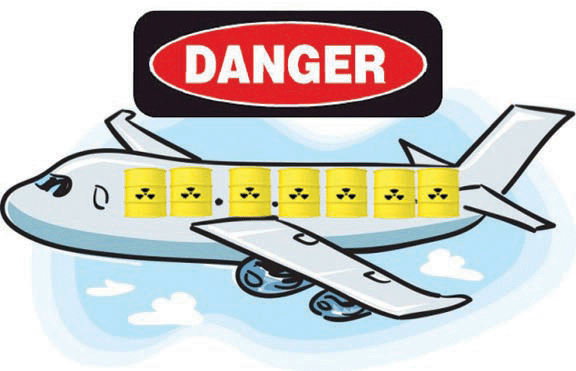
Dozens of armed police stood guard yesterday as highly-enriched uranium was loaded on to a giant American Air Force transport jet at Wick John O’Groats Airport. The secretive operation – signed off by David Cameron and Barack Obama last year – aims to clear a backlog of nuclear waste stored at Dounreay power station in Caithness.
But critics have blasted the high-security flights as unsafe and “morally reprehensible”.
Independent nuclear consultant John Large said: “This is pretty toxic stuff. It is weapons grade material. It is quite active. It’s ticking away and it does not turn itself off. “In the States, you cannot overfly with this type of material. The plane will put down on the east coast and the shipment will continue under armed escort by rail or by road.”
He said the risks in transporting nuclear waste by aircraft included “in the event of a crash, the fuel being engulfed in fire, the packages breaking down and the fuel igniting”.
Yesterday’s operation got underway at 10am, with the US C-17 Globemaster arriving in the early afternoon to pick up its dangerous cargo. Armed police guarded two trucks carrying the uranium – a critical component in nuclear weapons – in re-inforced steel flasks as they travelled the 32 miles from Dounreay to Wick airport. Roads around the airport were closed and sealed off as the deadly waste was delivered at 2pm.
Its cargo on board, the giant jet lumbered along the runway and took off at 4.25pm for the short hop across the Moray Firth to RAF Lossiemouth, where it topped up with fuel under armed RAF guard.
The runway at Wick is 1,712 feet too short for a fully fuelled Globemaster to get airborne.
It then took off for South Carolina, where the uranium will be transported to a nuclear facility in Tennessee.
A further 10 transatlantic flights – each costing around £1 million – are expected, but bosses remain secretive over the details. A spokesman for Dounreay, which is currently being decommissioned, said: “We can confirm nuclear materials are being removed from the site ahead of its closure.
“Compliance with the regulations includes protecting any information about the routes, times, dates and location”.
A police spokesman said: “We are supporting a partner agency’s operation and cannot comment further.” And a spokesman for Wick John O’Groats airport said it didn’t comment on “specific aircraft movements”.
June 5, 2017
Posted by Christina Macpherson |
safety, UK, USA, wastes |
3 Comments
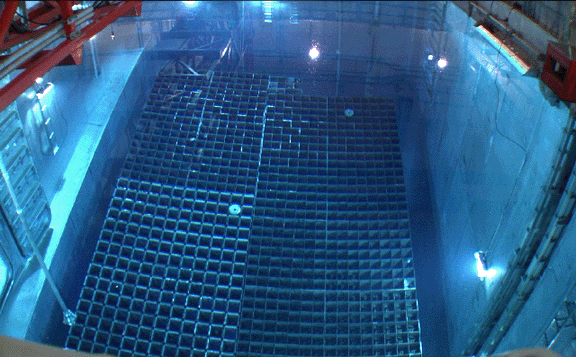
Facing South 2nd June 2017, As the United States continues to grapple with long-term storage of highly radioactive spent fuel from the nation’s nuclear power plants, science watchdogs are warning of serious flaws with the current storage method, which involves densely packing the combustible spent fuel assemblies under at least 20 feet of water in pools located at individual plants while awaiting creation of a permanent repository.
https://www.facingsouth.org/2017/06/nuclear-regulators-flawed-analysis-leaves-millions-risk-radioactive-fires
June 5, 2017
Posted by Christina Macpherson |
safety, USA, wastes |
Leave a comment
Lawfare 2nd June 2017 The two-dozen experts in attendance at the inaugural meeting of the Working Group on Climate, Nuclear and Security Affairs, hosted by the Center for Climate and Security, sought to examine the intersection of three threats that have long been viewed as separate—climate change, nuclear proliferation, and international conflict. In doing so, they confronted the unpleasant prospect that those threats not only had intensified over time, but also had become increasingly entwined and difficult to keep in check.
Collectively these experts had garnered at least two centuries’ worth of national security experience. They came from defense, homeland security, journalism, think tank, academic, and NGO backgrounds, and all of them had spent years working on nuclear or climate issues, or both. Over the course of two days, it became clear that examining nuclear and climate issues together through the lens of new security issues—such as technological advances, unprecedented migration, continually evolving terrorist threats and an emboldened Russia—reveals the world order faces a deeply
destabilizing toxic brew of risk.
The nuclear threat is not new. What has changed is the nature of the nuclear threat in the face of monumental security stressors and a rapidly increasing global average temperature that threatens to reach 3.5 degrees Centigrade (6.3 degrees Fahrenheit)or more if we continue on our current trajectory in spewing carbon. As the world heats up, emerging security trends—including unprecedented migration, cyber threats, proliferation of non-state actors, and global pandemics—compound the stresses on systems of governance. When countries turn to nuclear energy in an effort to reduce consumption of fossil fuels, concerns about nuclear weapons proliferation and nuclear disasters such as Chernobyl increase. https://www.lawfareblog.com/nuclear-energy-climate-change-and-security-threats
June 5, 2017
Posted by Christina Macpherson |
2 WORLD, climate change, safety |
Leave a comment
IAEA-database of nuclear and radiological incidents http://www.laka.org/docu/ines/ Here you find the full list of nuclear and radiation incidents which are reported since 1990 by national nuclear regulatory agencies to the International Atomic Energy Agency.

The list gives an impression of the spread, diversity and frequency of incidents and accidents with nuclear power plants, reprocessing plants, fuel enrichment plants, nuclear laboratories, irradiation facilities and with radioactive transports. It is not a complete list of all nuclear incidents; different national regulators have different regimes as to which incidents to report to the IAEA and which not.
The Vienna-based IAEA only releases reports from the previous twelve months to the public. After twelve months, reports are hidden from the IAEA-website. This makes it impossible for neighbors, non-governmental organizations and journalists to monitor the occurrence of nuclear incidents throughout the years. The risks of a certain nuclear power station can only be assessed by the frequency and the gravity of incidents occurring throughout the years. By releasing the full IAEA-list with all reported incidents from 1990, Laka, an Amsterdam based research group on nuclear energy, makes this safety-relevant accessible for the public.
To provide overview of incidents and accidents, Laka also put all reports also in an on-line map.
To get a notice of a incident report as its added, follow @ines_events on Twitter or through the RSS-feed (only nuclear power stations)
June 3, 2017
Posted by Christina Macpherson |
2 WORLD, incidents |
1 Comment
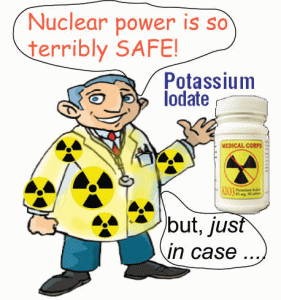 Amherstburg residents will be given iodide pills to protect against potential nuclear emergency
Potassium iodide pills are salt tablets that prevent the body from absorbing potentially radioactive poisoning CBC News Jun 02, 2017 To reduce the risk of radiation poisoning during an “unlikely” nuclear disaster in Michigan, health officials are distributing protective pills to residents on Amherst Point and Boblo Island.
The two communities fall within the primary zone of Fermi 2 nuclear power plant located near the shores of Lake Erie, just south of Amherst and Boblo. New regulations from the Canadian Nuclear Safety Commission require the distribution of potassium iodide pills, which are salt tablets that prevent the body from absorbing potentially radioactive iodine.
Even though the regulations don’t apply to U.S. facilities, officials from the Windsor-Essex County Health Unit are distributing the pills anyway.
“We still want our community to be prepared,” said Jyllian Mackie, the health unit’s public health emergency preparedness coordinator.
Primary zone precaution
Primary zone residents are those living within a 16.1 km radius. The rest of Windsor and Essex County sit in the secondary zone, which means the pills are available to residents for purchase.
A package of pills, good for about two days, for a family of five costs $20, according to Mackie.
Because human bodies absorb radioactive iodine, the pills are used to get into the thyroid and block the poisonous iodine.
Mackie added the risk of a nuclear emergency at Fermi 2 has not changed, but the regulations have, but that didn’t do much to calm the concerns of Amherstburg residents…… http://www.cbc.ca/news/canada/windsor/amherstburg-residents-will-be-given-iodide-pills-to-protect-against-potential-nuclear-emergency-1.4142478
June 3, 2017
Posted by Christina Macpherson |
Canada, safety |
Leave a comment
Questions for the US Nuclear Regulatory Commission confirmation hearings, Bulletin of the Atomic Scientists, William J. Kinsella, 2 June 17 Throughout the first four months of the Trump presidency, a troubling scenario seemed possible at the US Nuclear Regulatory Commission (NRC)—the organization entrusted with ensuring the safety of the nation’s civilian nuclear energy infrastructure. Two of the commission’s five seats were vacant when the new administration took over, and one commissioner’s term was set to expire on June 30. Much of the commission’s work requires a three-member quorum, so the prospect of disruption loomed large.
The administration addressed the situation on May 22 by nominating Chairman Kristine Svinicki for reappointment and naming two additional nominees to fill the vacant seats. The nominees now face a confirmation process involving the Senate’s Environment and Public Works Committee, followed by a full Senate vote.
What questions should senators ask the NRC nominees? All three are nuclear insiders, familiar with the commission’s mission and broad scope of activities as well as current and emerging challenges facing the agency. If the senators engage directly and substantively with the nominees about these matters, there can be an opportunity to explore the underlying philosophies and commitments they would bring to their work as commissioners.
Five broad principles of good regulation, summarized on the NRC’s website, provide some guidance, but the conversation needs to go much deeper. There are questions all three nominees should answer, and questions specific to each nominee.
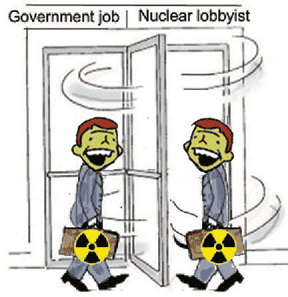 Regulatory independence and transparency. Considering the entanglements surrounding so many of the administration’s appointments to date, any potential financial and political ties to the nuclear industry are an obvious area of concern. Senators should question each nominee directly about such possibilities.
More subtle institutional influences can be harder to evaluate. The commission’s purpose is to ensure the safety of nuclear technologies, rather than to promote them or protect their economic viability. But faced with competition from renewable energy and cheap natural gas, the US nuclear industry is struggling to survive. The industry claims that “regulatory burdens” are part of the problem, and has been pushing aggressively for regulatory changes.
The industry’s advocacy and lobbying group, the Nuclear Energy Institute, has praised all three nominees, and their backgrounds suggest considerable sympathy with the industry’s position. Critical public interest groups regard at least two of them as “nuclear industry picks.”
In the current anti-regulatory political climate, senators will have a range of opinions about how to strike the right regulatory balance. The confirmation process should expose where each nominee stands in this regard, and may reveal where some senators stand as well. All the nominees will likely assert their unequivocal commitment to safety, but in practice, nuclear safety is always a negotiated process, accomplished by addressing particular problems and challenges.
Challenging times for nuclear safety. I have written elsewhere about some of thepressing challenges facing the NRC. Nuclear plant safety issues include the industry’s increasing reliance on aging facilities, efforts to extend reactor lifetimes to as much as 80 years, oversee decades-long plant decommissioning projects, and prepare for the possibility of regulating a proposed new generation of reactors.
Nuclear waste issues are perennially contentious, and have been flash points for conflict surrounding a number of previous NRC appointments. After years on hold, the Yucca Mountain nuclear waste repository project is back on the political agenda. Although the project remains controversial, and key steps in the licensing decision process remain to be completed, all three nominees appear to support it.
Senators should ask the nominees whether they see themselves as neutral referees in the Yucca Mountain process, or as advocates for moving the project forward. Related issues involve the storage and transportation of nuclear wastes, proposed new interim storage sites, and managing the wastes accumulating at operating and closed nuclear power plants across the nation…..
Two more broad issues deserve mention. Despite the Commission’s efforts to promote a strong safety culture, critics continue to raise questions about trust, accountability, and whistleblower protection at the agency and across the nuclear industry. Finally,cybersecurity has been a growing concern for some time, and is sure to remain one in the escalating threat environment.
Meet the nominees…… http://thebulletin.org/questions-us-nuclear-regulatory-commission-confirmation-hearings10808
June 3, 2017
Posted by Christina Macpherson |
safety, USA |
Leave a comment
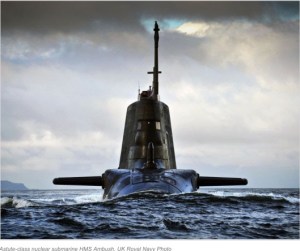 ‘vulnerable to catastrophic hack’ Thinktank sceptical about MoD assurances, saying cyber-attack could lead even to ‘exchange of nuclear warheads’, Guardian, Ewen MacAskill, 1 June 17, The UK’s Trident submarine fleet is vulnerable to a “catastrophic” cyber-attack that could render Britain’s nuclear weapons useless, according to a report by a London-based thinktank.
The 38-page report, Hacking UK Trident: A Growing Threat, warns that a successful cyber-attack could “neutralise operations, lead to loss of life, defeat or perhaps even the catastrophic exchange of nuclear warheads (directly or indirectly)”.
The Ministry of Defence has repeatedly said the operating systems of Britain’s nuclear submarines cannot be penetrated while at sea because they are not connected to the internet at that point.
But the report’s authors, the British American Security Information Council (Basic), expressed scepticism.
“Submarines on patrol are clearly air-gapped, not being connected to the internet or other networks, except when receiving (very simple) data from outside. As a consequence, it has sometimes been claimed by officials that Trident is safe from hacking. But this is patently false and complacent,” they say in the report.
Even if it were true that a submarine at sea could not be attacked digitally, the report points out that the vessels are only at sea part of the time and are vulnerable to the introduction of malware at other points, such as during maintenance while docked at the Faslane naval base in Scotland.
The report says: “Trident’s sensitive cyber systems are not connected to the internet or any other civilian network. Nevertheless, the vessel, missiles, warheads and all the various support systems rely on networked computers, devices and software, and each of these have to be designed and programmed. All of them incorporate unique data and must be regularly upgraded, reconfigured and patched.”
The UK has four nuclear missile-carrying submarines, which are in the process of being replaced. Their replacements are scheduled to go into service in the early 2030s.
The report comes after the cyber-attack last month that disrupted the NHS, which uses the same Windows software as the Trident submarines. There was speculation too that the US used cyberwarfare to destroy a North Korean missile test. A Trident test-firing of a missile last year off the coast of Florida also went awry, with no official explanation given…….
Abaimov said: “There are numerous cyber vulnerabilities in the Trident system at each stage of operation, from design to decommissioning. An effective approach to reducing the risk would involve a massive and inevitably expensive operation to strengthen the resilience of subcontractors, maintenance systems, components design and even software updates. If the UK is to continue deploying nuclear weapon systems this is an essential and urgent task in the era of cyberwarfare.”
The report’s authors estimate that the capital costs for the UK government to improve cybersecurity for the Trident programme would run to several billions of pounds over the next 15 years.
The report is to be published on the Basic website.https://www.theguardian.com/uk-news/2017/jun/01/uks-trident-nuclear-submarines-vulnerable-to-catastrophic-hack-cyber-attack
June 2, 2017
Posted by Christina Macpherson |
safety, UK, weapons and war |
Leave a comment
Belarus nuclear plant: A disaster waiting to happen https://euobserver.com/opinion/138079 By SIJBREN DE JONG, THE HAGUE, 31. MAY, Just over 30 years after the Chernobyl nuclear disaster, which saw Belarus lose a quarter of its territory due to nuclear contamination, the former Soviet republic is set to see its first nuclear power station enter operation in one and a half year’s time from now.
The location in the Belarusian town of Astravets – a mere 50 kilometres from Lithuania’s capital Vilnius – is understandably giving its neighbour the jitters. To make matters worse, the construction of the plant has been mired by a series of mishaps and incidents, sparking major concerns over the safety of the installation.
With Belarusian authorities not budging and full inspections remaining elusive, the Lithuanian government has resorted to taking active steps to protect the country against the plant.
Playing the silent game In August last year, news emerged that a crane had dropped the 330 tonne heavy reactor from a height of 4 metres during a test lift. If dropping a nuclear reactor was not bad enough in itself, the Belarusian authorities’ attempts to deny or otherwise keep silent on the matter for weeks on end sparked eerie memories of how the Soviets handled the Chernobyl disaster of 1986.
“We never get any information, or we hear something only a month after it happened”, says Darius Degutis, Lithuania’s ambassador at large for the issues related to the Astravets Nuclear Power Plant.
Russian state-owned company Rosatom, the nuclear plant’s main contractor, is complicit in playing the “silent game” by first denying that the accident caused any damage to the reactor shell, only to change its story afterwards by offering to replace the shell. Adding to the concerns was another incident in February 2017, whereby the second reactor hit a power pillar during transport.
The incident could have caused significant tension and deformation, thus impacting on the safety of the reactor vessel. However, rather than properly investigating the impact, the vessel was hoisted into position on 1 April of this year.
Move along, nothing to see here In order for the international community to be fully informed about the safety standards employed in the plant’s construction, the Lithuanian government has pressed for the International Atomic Energy Agency’s (IAEA) Site and External Events Design (SEED) mission to be invited for a full-scope review.
A full-scope review consists of a six-step assessment, involving reviews and inspections on site selection, environmental impact, design safety and numerous other aspects. A major problem thus far is that the Belarusian authorities limited the scope of the IAEA’s mission only to an assessment of the plant design’s safety.
This means that major verification steps pertaining to the choice of location, local geology and the plant’s environmental impact were skipped.
According to Degutis, the location at Astravets is “known to have been seismically active in the past and no proper international assessment of the site’s location was ever carried out”.
Other failures relate to the measuring of the population density around the site. In doing so, Belarusian officials only assessed population density on the Belarusian side of the border, thus not taking into account that this density on the Lithuanian side is far higher and a third of the country’s population would be at risk in case of a meltdown.
By limiting the scope of the IAEA’s mission, the nuclear watchdog cannot comment on these kinds of issues. To make matters worse, the Belarusian government declared that it would itself perform the plant’s risk and safety assessment.
Given how the numerous incidents at the plant have been handled so far, it is questionable as to whether the Belarusian authorities can be trusted with performing these stress tests in full accordance with European specifications.
Acquiescence is not an option After having attempted for several years to get the IAEA’s SEED mission full access to the site, the Lithuanian authorities have started to resort to different measures to guard themselves against the plant.
In April of this year, the Lithuanian parliament adopted a law that forbids the purchase of electricity generated from a third country power plant that is constructed or operates in violation of international environmental and nuclear safety requirements.
Earlier this month, Lithuania, Estonia and Latvia also agreed to link their power systems to other EU members and, in that way, disconnect from the Soviet-era electricity network.
Given that Belarus repeatedly signalled its intention to sell part of the electricity produced at Astravets in other European countries, the Baltic States have effectively deprived the plant from access to European electricity markets.
Although such actions qualify as last-resort measures, both decisions are entirely defensible when viewed in light of the continuous mishaps witnessed at Astravets. With the memories of Chernobyl still looming large, Europe should not turn a blind eye to this developing nuclear threat and firmly support Lithuania in its quest for full access to the site.
The Crude World monthly column on Eurasian (energy) security and power politics in Europe’s eastern neighbourhood is written by Sijbren de Jong, a strategic analyst with The Hague Centre for Strategic Studies (HCSS), specialised in Eurasian (energy) security and the EU’s relations with Russia and the former Soviet Union
June 2, 2017
Posted by Christina Macpherson |
Belarus, safety |
Leave a comment

 Study Questions U.S. Nuclear Safety http://www.plenglish.com/index.php?o=rn&id=13484&SEO=study-questions-u.s.-nuclear-safety Washington, May 29 (Prensa Latina) The regulatory agency of nuclear energy in the United States underestimates the risk of a catastrophe, a study by the University of Princeton revealed on Monday.
‘The Nuclear Regulatory Commission (NRC) used faulty data to estimate potentially ruinous risks of a nuclear-waste fire – one which could occur at any one of dozens of sites across the country,’ the report concluded.
Its main author, Frank von Hippel, cofounder of the Science and Global Security Program at the Woodrow Wilson School of Public and International Affairs, noted the economic and political manipulations of that stance by the regulatory agency.
‘The NRC has been pressured by the nuclear industry, directly and through Congress, to low-ball the potential consequences of a fire because of concerns that increased costs could result in shutting down more nuclear power plants,’ Von Hippel charged.
The expert considered that that NRC inaction leaves the public at high risk from fires in spent-nuclear-fuel cooling pools at reactor sites.
Washington, May 29 (Prensa Latina) The regulatory agency of nuclear energy in the United States underestimates the risk of a catastrophe, a study by the University of Princeton revealed on Monday.
‘The Nuclear Regulatory Commission (NRC) used faulty data to estimate potentially ruinous risks of a nuclear-waste fire – one which could occur at any one of dozens of sites across the country,’ the report concluded.
Its main author, Frank von Hippel, cofounder of the Science and Global Security Program at the Woodrow Wilson School of Public and International Affairs, noted the economic and political manipulations of that stance by the regulatory agency.
‘The NRC has been pressured by the nuclear industry, directly and through Congress, to low-ball the potential consequences of a fire because of concerns that increased costs could result in shutting down more nuclear power plants,’ Von Hippel charged.
The expert considered that that NRC inaction leaves the public at high risk from fires in spent-nuclear-fuel cooling pools at reactor sites.
‘The pools – water-filled basins that store and cool used radioactive fuel rods – are so densely packed with nuclear waste that a fire could release enough radioactive material to contaminate an area twice the size of New Jersey,’ adds the report.
‘On average, radioactivity from such an accident could force approximately 8 million people to relocate and result in $2 trillion in damages,’ he noted.
According to the scientist, those catastrophic consequences might be unleashed by a big earthquake or a terrorist attack.
That potential disaster might be prevented largely with regulatory measures that the NRC refuses to implement, he noted.
‘The agency excluded the possibility of an act of terrorism as well as the potential for damage from a fire beyond 50 miles of a plant,’ the scientist noted.
June 2, 2017
Posted by Christina Macpherson |
safety, USA |
Leave a comment
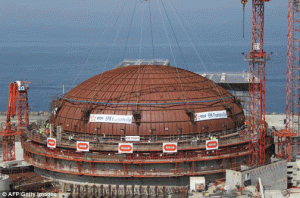 French nuclear regulator delays Flamanville ruling to autumn
ASN again delays ruling on safety of Flamanville reactor
* Postpones ruling to “autumn” from “end of summer”
* Will issue provisional ruling in July, then seek input (Adds new ASN statement)
Reuters, By Geert De Clercq PARIS, May 30 French nuclear regulator ASN said on Tuesday it will “probably” issue a final ruling in the autumn on whether the reactor that utility EDF is building in Flamanville is safe for use, in the latest delay in the process.
The ASN said in 2015 it had discovered excessive carbon concentrations in the cover and bottom of the Flamanville reactor vessel, which can weaken the mechanical resilience of the steel and its ability to resist the spreading of cracks.
Since then, Areva, which designed the EPR reactor, EDF and the ASN have been testing whether weak spots could jeopardise the safety of the reactor.
The regulator’s green light about the reactor vessel is crucial for EDF and Areva, as European Union antitrust authorities have made it a precondition for their approval of EDF’s planned takeover of Areva’s reactor unit.
The ASN has repeatedly postponed deadlines for ruling on the safety of reactor vessel.
And in what will be another delay, an ASN spokesman said in an email that the regulator now expected a “firm position probably in (the) autumn”……
Earlier on Tuesday, the ASN said it expected to receive technical reports about the reactor vessel by the end of next month. It will analyse these and then draft a provisional ruling on Flamanville, which will be made public in early to mid-July. It will then invite feedback on this ruling from the public, civil society, local authorities and the companies involved.
With the Flamanville reactor vessel welded in place in 2013 and covered by thousands of tonnes of concrete since then, taking out the vessel would delay the reactor startup by several years and cost billions of euros.
EDF has repeatedly said it is confident the ASN will find the vessel fit for operation……
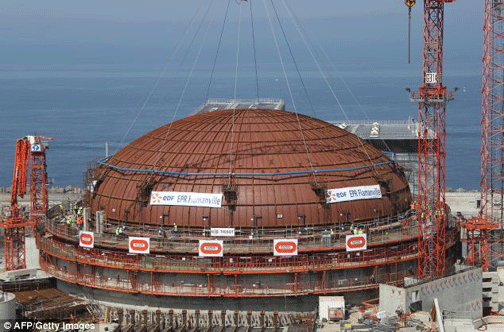
The Flamanville reactor is years behind schedule and billions over budget, but EDF CEO Jean-Bernard Levy said this month EDF plans to load fuel in the reactor before end-2018. Construction in Flamanville started in 2007 and the plant was supposed to go online in 2012, but EDF has announced new delays and cost overruns every few years. The company said in 2015 the reactor would cost 10.5 billion euros ($12 billion), up from an initial budget of 3 billion. ($1 = 0.8948 euros) (Editing by Mark Potter/Alexander Smith) http://www.reuters.com/article/edf-flamanville-asn-idUSL8N1IW4N6
May 31, 2017
Posted by Christina Macpherson |
France, safety |
1 Comment
 US nuclear lab’s future up in the air after recent fire http://abcnews.go.com/Technology/wireStory/us-nuclear-labs-future-air-recent-fire-47681951 By THE ASSOCIATED PRESS SANTA FE, N.M. — May 27, 2017 A recent fire has put a national laboratory’s ability to operate safely into question.
The Defense Nuclear Facilities Safety Board announced Friday that it will hold a hearing next month to discuss the future of the Los Alamos National Laboratory, the Santa Fe New Mexican reported (http://bit.ly/2qmP0CY). The board is an independent panel that advises the U.S. Department of Energy and the president.
A fire broke mid-April at the lab’s PF-4 plutonium building where the plutonium cores of nuclear weapons are produced. Lab officials said that the fire was put out quickly and only caused minor injuries.
According to the report, the board is unsure if the lab is fit to continue to operate and handle increasing quantities of plutonium in coming years after a series of problems with management in the maintenance and cleanup of the dangerous materials.
The Department of Energy has announced plans to increase manufacturing of the plutonium pits at Los Alamos over the next decades. President Donald Trump’s budget proposal will also increase funding for weapons work in the next fiscal year.
The moves make local nuclear watchdog groups uneasy.
“Fattening up our already bloated nuclear weapons stockpile is not going to improve our national security,” said Jay Coghlan, the director of Nuclear Watch New Mexico, in a news release issued Friday. “New Mexicans desperately need better funded schools and health care, not expanded plutonium pit production that will cause more pollution and threaten our scarce water resources.”
The board will have the chance to get the opinion of a number of experts on the matter at its June 7 hearing. Information from: The Santa Fe New Mexican, http://www.sfnewmexican.com
May 29, 2017
Posted by Christina Macpherson |
safety, USA |
Leave a comment