Japan Today 28th May 2017 A meeting on a global partnership to prevent nuclear terrorism will be held in Tokyo this week. Around 200 delegates from 88 countries and five international organizations are set to participate in the annual plenary of the Global Initiative to Combat Nuclear Terrorism, which was launched in 2006 jointly by the United States and Russia, the Foreign Ministry said.
The participants, including those from nuclear powers Israel, India and Pakistan, are expected to exchange views on how to bolster measures to prevent weapons of mass destruction and related materials from falling into the hands of terrorists. North Korea is not part of the initiative.
After the end of the two-day senior-official-level gathering through June 2, a joint statement by co-chairs the United States and Russia is likely to be released, a foreign ministry official said. Japan, which will host the 2020 Olympic Games in Tokyo, has actively engaged in discussions on the technical aspects of nuclear forensics and on improving security in the transport of nuclear materials.more https://japantoday.com/category/national/meeting-on-preventing-nuclear-terrorism-to-be-held-in-tokyo-next-week
May 29, 2017
Posted by Christina Macpherson |
Japan, safety |
Leave a comment

 STV 24th May 2017 British armed forces are guarding 12 sites in Scotland following the increased terrorism threat, the First Minister has announced. The deployment comes as part of the first phase of Operation Temperer, which is
being rolled out across the country by the UK Government.
The operation was called after the independent Joint Terrorism Analysis Centre raised the nation’s threat level to “critical”, meaning a terror attack can be expected imminently. Soldiers have replaced armed officers from the
Ministry of Defence’s (MOD) police force and the Civil Nuclear Constabulary across the UK. The three civil nuclear sites now under guard from members of the armed forces are Dounreay, Hunterston and Torness.
https://stv.tv/news/politics/1389463-army-guarding-scottish-sites-after-manchester-bombing/
May 27, 2017
Posted by Christina Macpherson |
safety, UK |
Leave a comment
 Decommissioning continues as normal at Dounreay under heightened response rate, John O’Groat Journal, 26 May 17, DOUNREAY said decommissioning work is continuing as normal as the UK terror threat level has been raised to critical.
Prime Minister Theresa May announced on Tuesday night the threat level was raised from severe to critical, the highest possible level after the Manchester Arena bombing on Monday night.
Critical level means an attack is expected imminently in the UK.
A spokeswoman at Dounreay has announced the site is operating at a heightened response rate but work continues as normal.
She said: “Security at Dounreay and other sites owned by the Nuclear Decommissioning Authority is kept under continuous review.
“The site is continuing to operate at a “heightened” response state and decommissioning work is continuing as normal….http://www.johnogroat-journal.co.uk/News/Decommissioning-continues-as-normal-at-Dounreay-under-heightened-response-rate-24052017.htm
May 27, 2017
Posted by Christina Macpherson |
decommission reactor, safety, UK |
Leave a comment
 Military replaces nuclear police at Sizewell in Operation Temperer response to Manchester terrorist bombing East Anglian Daily Times , 24 May 2017
Armed soldiers are at Sizewell nuclear power stations in Suffolk as part of the security response to Monday’s terrorist bombing in Manchester. The military presence is part of the Government’s Operation Temperer providing up to 3,800 troops to support police in their security operations, following the attack at Manchester Arena, which left 22 people dead.
A spokesman for EDF Energy, which operates Sizewell, moved to reassure people that the threat level was unchanged on site, where there is always an armed presence. The soldiers are replacing armed officers from the Civil Nuclear Constabulary (CNC), who had been redeployed as part of Operation Temperer.
The CNC said it had provided a number authorised firearms officers to support colleagues in Home Office forces.
“Our civil nuclear sites remain fully protected and the CNC will continue to carry out their core role of protecting nuclear sites and materials, while also being part of the strategic reserve supporting communities across the country,” a spokesman added.
Prime Minister Theresa May announced on Tuesday the terrorism threat was “critical” – the highest alert level – meaning an attack may be imminent. Home Secretary Amber Rudd said 984 military personnel were being deployed in support of the police……http://www.eadt.co.uk/news/armed-soldiers-at-sizewell-as-part-of-operation-temperer-response-to-manchester-terrorist-bombing-1-5033142
May 26, 2017
Posted by Christina Macpherson |
safety, UK |
2 Comments
 ‘Coding error’ caused false nuclear alert to reach public, BY BILL GALLO JR. , bgallo@njadvancemedia.comFor NJ.com 25 May 17 LOWER ALLOWAYS CREEK TWP.— Authorities say a “coding error” is to blame for an inaccurate emergency alert broadcast Tuesday night that said there was a problem at one of Salem County’s nuclear power plants.
The alert was sent out during a regularly scheduled drill to test the readiness of emergency officials in case of an actual emergency at PSEG Nuclear’s Artificial Island generating complex in Lower Alloways Creek Township.
“At 8:45 p.m., a training message was created in order to test an electronic communications system,” New Jersey State Police said in a statement issued Wednesday afternoon.
“The message was intended for a small group of emergency management personnel who were participating in the exercise. As a result of a coding error, the message was publicly broadcast. The coding error has since been identified and corrected.”…….http://www.nj.com/salem/index.ssf/2017/05/coding_error_caused_false_nuclear_alert_to_reach_p.html
May 26, 2017
Posted by Christina Macpherson |
incidents, USA |
Leave a comment
Amherstburg Wants Nuclear Response Plan Update, Blackburn News, BY MARK BROWNMAY 25, 2017 The town of Amherstburg is hoping to get provincial cooperation as it updates its nuclear response plan. The town has delegated the responsibility of updating the plan to deputy fire chief Lee Tome, who has been lobbying the province to put some cash behind a plan update, as well as draft guidelines similar to those already in place at the Bruce Nuclear Generating Station in Tiverton. These guidelines would be set in the event of a nuclear incident at the nearby Fermi II nuclear power plant in Michigan.
Amherstburg Mayor Aldo DiCarlo says the town has pretty much been on its own as far as coming up with an emergency response plan.
“We obviously do not have that kind of control, as it’s in the United States,” says DiCarlo. “So when you read the provincial guidelines, they’re very specific to the nuclear plant in the province, and we don’t have that.”
The current plan places responsibility for a response to a nuclear accident at Fermi on the shoulders of the town. The updated plan would reduce the primary emergency zone from the current 23km to the standard 16km that is the U.S. standard, as well as provide for distribution of the K-I pill, a potassium iodide tablet taken to reduce or prevent the effects of radioactivity. A report on the updated plan was presented to Amherstburg town council on Tuesday night.
DiCarlo, though, has a hard time understanding why the province has not recognized the unusual situation Amherstburg is in.
“As I understand it, we are the only one in Canada with exposure from another country, so we are very unique,” says DiCarlo. ….. http://blackburnnews.com/windsor/windsor-news/2017/05/25/amherstburg-wants-nuclear-response-plan-update/
May 26, 2017
Posted by Christina Macpherson |
Canada, safety |
Leave a comment
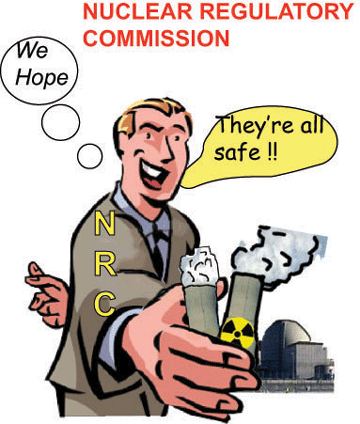
 US nuclear regulators greatly underestimate potential for nuclear disaster Nuclear spent fuel fire could force millions of people to relocate https://www.eurekalert.org/pub_releases/2017-05/puww-unr052317.php PRINCETON UNIVERSITY, WOODROW WILSON SCHOOL OF PUBLIC AND INTERNATIONAL AFFAIRS, 25 May 17, PRINCETON, N.J.–The U.S. Nuclear Regulatory Commission (NRC) relied on faulty analysis to justify its refusal to adopt a critical measure for protecting Americans from the occurrence of a catastrophic nuclear-waste fire at any one of dozens of reactor sites around the country, according to an article in the May 26 issue of Sciencemagazine. Fallout from such a fire could be considerably larger than the radioactive emissions from the 2011 Fukushima accident in Japan.
Published by researchers from Princeton University and the Union of Concerned Scientists, the article argues that NRC inaction leaves the public at high risk from fires in spent-nuclear-fuel cooling pools at reactor sites. The pools — water-filled basins that store and cool used radioactive fuel rods — are so densely packed with nuclear waste that a fire could release enough radioactive material to contaminate an area twice the size of New Jersey. On average, radioactivity from such an accident could force approximately 8 million people to relocate and result in $2 trillion in damages.
These catastrophic consequences, which could be triggered by a large earthquake or a terrorist attack, could be largely avoided by regulatory measures that the NRC refuses to implement. Using a biased regulatory analysis, the agency excluded the possibility of an act of terrorism as well as the potential for damage from a fire beyond 50 miles of a plant. Failing to account for these and other factors led the NRC to significantly underestimate the destruction such a disaster could cause.
“The NRC has been pressured by the nuclear industry, directly and through Congress, to low-ball the potential consequences of a fire because of concerns that increased costs could result in shutting down more nuclear power plants,” said paper co-author Frank von Hippel, a senior research physicist at Princeton’s Program on Science and Global Security (SGS), based at the Woodrow Wilson School of Public and International Affairs. “Unfortunately, if there is no public outcry about this dangerous situation, the NRC will continue to bend to the industry’s wishes.”
Von Hippel’s co-authors are Michael Schoeppner, a former postdoctoral researcher at Princeton’s SGS, and Edwin Lyman, a senior scientist at the Union of Concerned Scientists.
Spent-fuel pools were brought into the spotlight following the March 2011 nuclear disaster in Fukushima, Japan. A 9.0-magnitude earthquake caused a tsunami that struck the Fukushima Daiichi nuclear power plant, disabling the electrical systems necessary for cooling the reactor cores. This led to core meltdowns at three of the six reactors at the facility, hydrogen explosions, and a release of radioactive material.
“The Fukushima accident could have been a hundred times worse had there been a loss of the water covering the spent fuel in pools associated with each reactor,” von Hippel said. “That almost happened at Fukushima in Unit 4.”
In the aftermath of the Fukushima disaster, the NRC considered proposals for new safety requirements at U.S. plants. One was a measure prohibiting plant owners from densely packing spent-fuel pools, requiring them to expedite transfer of all spent fuel that has cooled in pools for at least five years to dry storage casks, which are inherently safer. Densely packed pools are highly vulnerable to catching fire and releasing huge amounts of radioactive material into the atmosphere.
The NRC analysis found that a fire in a spent-fuel pool at an average nuclear reactor site would cause $125 billion in damages, while expedited transfer of spent fuel to dry casks could reduce radioactive releases from pool fires by 99 percent. However, the agency decided the possibility of such a fire is so unlikely that it could not ustify requiring plant owners to pay the estimated cost of $50 million per pool.
The NRC cost-benefit analysis assumed there would be no consequences from radioactive contamination beyond 50 miles from a fire. It also assumed that all contaminated areas could be effectively cleaned up within a year. Both of these assumptions are inconsistent with experience after the Chernobyl and Fukushima accidents.
In two previous articles, von Hippel and Schoeppner released figures that correct for these and other errors and omissions. They found that millions of residents in surrounding communities would have to relocate for years, resulting in total damages of $2 trillion — nearly 20 times the NRC’s result. Considering the nuclear industry is only legally liable for $13.6 billion, thanks to the Price Anderson Act of 1957, U.S. taxpayers would have to cover the remaining costs.
The authors point out that if the NRC does not take action to reduce this danger, Congress has the authority to fix the problem. Moreover, the authors suggest that states that provide subsidies to uneconomical nuclear reactors within their borders could also play a constructive role by making those subsidies available only for plants that agreed to carry out expedited transfer of spent fuel.
“In far too many instances, the NRC has used flawed analysis to justify inaction, leaving millions of Americans at risk of a radiological release that could contaminate their homes and destroy their livelihoods,” said Lyman. “It is time for the NRC to employ sound science and common-sense policy judgments in its decision-making process.”
The paper, “Nuclear safety regulation in the post-Fukushima era,” was published May 26 in Science. For more information, see von Hippel and Schoeppner’s previous papers, “Reducing the Danger from Fires in Spent Fuel Pools” and “Economic Losses From a Fire in a Dense-Packed U.S. Spent Fuel Pool,” which were published in Science & Global Security in 2016 and 2017 respectively. The Science article builds upon the findings of a Congressionally-mandated review by the National Academy of Sciences, on which von Hippel served.
May 26, 2017
Posted by Christina Macpherson |
safety, USA |
Leave a comment
 The truth about the Hanford tunnel collapse https://www.chinadialogue.net/article/show/single/en/9796-The-truth-about-the-Hanford-tunnel-collapse?mc_cid=0377d1b344&mc_eid=da6e209b80 West coast radioactive leak highlights US crumbling nuclear facilities, writes Jan McGirk 17.05.2017 On May 9th, emergency sirens went off at the Hanford Nuclear Reservation in Washington State, long considered the most toxic nuclear waste storage site in the United States. It’s where highly radioactive equipment from early nuclear weapon manufacturing was dumped along with the reactor fuel and core debris retrieved from the Three Mile Island meltdown in 1979.
Technicians reportedly noticed an unusually elevated level, roughly comparable to an x-ray exposure, while monitoring radiation at the decommissioned Plutonium Uranium Extraction (PUREX) Plant. This safety check, done before workers were due to start scheduled maintenance work, was fortuitous.
The cause of the small radiation spike was startling: a 20-foot section of the roof had caved in on an old storage tunnel adjacent to the PUREX plant. Inside were eight railway cars loaded with contaminated equipment from the 1950s.
Soil from a thick berm built over the tunnel fell directly into the hole and helped tamp down any radioactive dust. But managers could not determine exactly when the damage occurred. Aerial photos from March 2017 showed no sign of any impending collapse, but analysts worried that the hole might have been there for four days before anyone noticed.
Initially, nearly 5,000 Hanford employees were ordered to shelter in place and avoid eating and drinking, while a no-fly zone was temporarily declared over the facility. Since then, federal and state officials have repeatedly stated that no airborne release of radiation has been detected, although not all their monitoring data has been released to the public yet. Emergency crews in protective gear filled in the breach with 54 truckloads of clean sand and soil. An enormous plastic tarp, weighted with concrete blocks, will reinforce the roof repair until a more permanent fix is devised. “We could have an additional collapse of that tunnel,” cautioned Doug Shoop, manager at the Department of Energy Richland Operations Office. This was quite a close call.
Public information
Breaking news about the damaged tunnel in Washington state was carried widely on US television, radio, newspapers, and online, but was not particularly prominent amid all the political turmoil being reported out of Washington DC.
Official government websites have been posting occasional updates, mostly underwhelming. This may be an attempt to minimise panic over an invisible but potent hazard. To focus on the perils of nuclear decay might reclassify it as a dirty power source and eliminate subsidies.
Former Texas Governor Rick Perry, who once proposed to eliminate the US Department of Energy, now heads it for the oil-friendly Trump administration. “I am pleased to announce that our dedicated and talented team of experts at the Department of Energy’s Hanford site have completed filling in the hole discovered at the PUREX tunnel,” Perry said in a statement.
“This was accomplished swiftly and safely to help prevent any further complications. Our next step is to identify and implement longer-term measures to further reduce risks…Thankfully, the system worked as it should and all are safe. The safety of our workforce, the communities and tribal nations that surround our sites, and the environment is my highest priority.”
A legacy of waste
The Department of Energy is under increasing pressure to shift spent fuel away from reactor sites, especially since there already are 14 permanently shut American nuclear generating stations.
Out of the more than 70,000 metric tonnes heavy metal (MTHW) of spent fuel stored in the US, nearly 10% continues to be stored at permanently shut sites. For now, the bulk goes to Hanford.
Twice the size of Singapore, the enormous Hanford site is remote enough to be out of the public eye. The safe storage of ageing radioactive materials in its decaying tunnels is increasingly problematical. Radiation eventually will weaken the structures irreparably, and these improvised tunnels were never meant to be more than a stopgap solution.
Half a century has already passed. But these hot tunnels are only part of the picture. Out of a total of 177 storage tanks at Hanford, at least 67 tanks are leaking radioactive waste. Nearly 475 million gallons of contaminated water has been discharged to the soil. Some contaminants have even trickled into groundwater beneath the Hanford site. More than 80 square miles of groundwater is now dirtier than government groundwater protection standards allow.
One popular idea is to convert the millions of gallons of radioactive sludge into glass logs through a technique called vitrification. These logs are eventually destined for permanent storage deep underneath Yucca Mountain in Nevada. However, a proposed $17 billion vitrification plant for Hanford is fraught with safety concerns ranging from corrosion to explosion.
Meanwhile, the vast Yucca Mountain geological repository for nuclear waste appears to be a slow-starter. Former Nevada Senator Harry Reid, who served as Senate majority leader, blocked it for years. The Government Accountability Office admitted that the closure of Yucca Mountain was for political, not technical or safety reasons. What’s more, a recent GAO report now advises against vitrification, preferring to bind the waste in a cement-like mixture instead. It’s back to the drawing board once again.
Avoidable disaster
Although some 56 million gallons of radioactive sludge is stored here, alarmingly close to the Columbia River, the US$40 billion Hanford cleanup operation has been repeatedly delayed and is not expected to get underway until 2022, finishing in 2060.
For now, management is trying to prevent a catastrophe through manic maintenance. Postponing the inevitable will increase the cleaning charges by several magnitudes. Had things run on schedule, that pesky hole might just have been noticed in time. Meanwhile, hundreds of whistleblowers have come forward over the years to warn of slack safety standards and corner-cutting at Hanford. They have faced many obstacles.
If a future facility could be developed by a new independent organisation with direct access to the Nuclear Waste Fund, which is not subject to political and financial control like the Department of Energy is, there may be a way forward that doesn’t lead to catastrophe. Federal, state and tribal officials need to pursue it urgently.
May 24, 2017
Posted by Christina Macpherson |
safety, USA |
Leave a comment
TVA’s Nuclear Allegators http://allthingsnuclear.org/dlochbaum/tvas-nuclear-allegators [good graphs] DAVE LOCHBAUM, DIRECTOR, NUCLEAR SAFETY PROJECT | MAY 23, 2017, The Nuclear Regulatory Commission (NRC) receives reports about potential safety problems from plant workers, the public, members of the news media, and elected officials. The NRC calls these potential safety problems allegations, making the sources allegators. In the five years between 2012 and 2016, the NRC received 450 to 600 allegations each year. The majority of the allegations involve the nuclear power reactors licensed by the NRC.
While the allegations received by the NRC about nuclear power reactors cover a wide range of issues, nearly half involve chilled work environments where workers don’t feel free to raise concerns and discrimination by management for having raised concerns.
In 2016, the NRC received more allegations about conditions at the Watts Bar nuclear plant in Tennessee than about any other facility in America. Watts Bar’s 31 allegations exceeded the allegations from the second highest site (the Sequoyah nuclear plant, also in Tennessee, at 17) and third highest site (the Palo Verde nuclear plant in Arizona, at 12) combined. The Browns Ferry nuclear plant in Alabama and the Pilgrim nuclear plant in Massachusetts tied for fourth place with 10 allegations each. In other words, Watts Bar tops the list with a very comfortable margin.
In 2016, the NRC received double-digit numbers of allegations about five nuclear plants. Watts Bar, Sequoyah and Browns Ferry are owned and operated by the Tennessee Valley Authority (TVA). Why did three TVA nuclear plants place among the top five sources of allegations to the NRC?
Because TVA only operates three nuclear plants.
The NRC received zero allegations about ten nuclear plants during 2016. In the five year period between 2012 and 2016, the NRC only received a total of three allegations each about the Clinton nuclear plant in Illinois and the Three Mile Island Unit 1 reactor in Pennsylvania (the unit that didn’t melt down). By comparison, the NRC received 110 allegations about Watts Bar, 55 allegations about Sequoyah, and 58 allegations about Browns Ferry.
TVA President Bill Johnson told Chattanooga Time Free Press Business Editor Dave Flessner that TVA is working on its safety culture problems and “there should be no public concern about the safety of our nuclear plants.” The NRC received 30 of the 31 allegations last year from workers at Watts Bar, all 17 allegations last year from workers at Sequoyah, and all 10 allegations last year from workers at Browns Ferry.
So President Johnson is somewhat right— the public has no concerns about the safety of TVA’s nuclear plants. But when so many TVA nuclear plant workers have so many nuclear safety concerns, the public has every reason to be very, very concerned.
Nuclear plant workers are somewhat like canaries in coal mines. Each is likely to be the first to sense danger. And when nuclear canaries morph into nuclear
May 24, 2017
Posted by Christina Macpherson |
safety, USA |
Leave a comment
South Korean nuclear power plant accident would heavily taint western Japan: simulation http://www.japantimes.co.jp/news/2017/05/21/national/science-health/nuclear-accident-south-korean-plant-leave-western-japan-massively-contaminated-study/#.WSJ_W5KGPGg
KYODO A nuclear accident at a power plant in South Korea could cause wider radiation contamination in western Japan than on its home soil, a study by a South Korean scientist has shown.
If a cooling system fails at the spent-fuel storage pools at the Kori power plant’s No. 3 reactor in Busan, massive amounts of cesium-137 would be released that could potentially reach western Japan, according to a simulation by Jungmin Kang of the Natural Resources Defense Council, a U.S. think tank.
In the worst-case scenario, up to 67,000 sq. km of Japanese soil would be contaminated and 28.3 million people would be forced to evacuate, the study said, though the fallout’s spread would depend on the season.
As for South Korea, an accident at the plant could taint more than half of the nation by contaminating up to 54,000 sq. km, it said.
A total of 818 tons of spent nuclear fuel were stored in pools at the site as of the end of 2015, Kang said. He said an accident could be triggered not only by natural disasters but by terrorism or a missile from North Korea.
May 22, 2017
Posted by Christina Macpherson |
Japan, safety, South Korea |
Leave a comment
Possible leak found at Washington nuclear site, NewsFix, MAY 21, 2017, BY CNN WIRE, WASHINGTON — Authorities at Washington state’s Hanford nuclear waste site are investigating a possible leak after discovering radioactive material on a worker’s clothing. The discovery follows an incident two weeks earlier in which a site tunnel collapsed, sparking fears of radiation exposure.
Washington River Protection Solutions, a contractor working at the site, on Thursday detected high readings of radiation on a robotic device known as a crawler that workers were pulling out of a nuclear waste tank. Contamination was also discovered on the clothing of one of the workers.
“Established decontamination procedures were followed, which involves removing the contaminated clothing. Further surveying the worker showed no contamination remained. No other workers were affected, and all members of the crew were cleared for normal duty,” said WRPS spokesman Peter Bengtson.
The Double-Shell Tank AZ-101 contains 800,000 gallons of nuclear waste, according to the Washington Department of Ecology, which oversees the Hanford site. The nuclear plant is located in the south-central part of Washington state, about 45 miles from Yakima.
Using leak-detection instruments, WRPS said it did not find liquid escaping the tank. However, workers are preparing a plan to conduct a visual inspection by video.
State officials are also urging the US Department of Energy to investigate the incident and determine the safety of the site…….http://cw39.com/2017/05/21/possible-leak-found-at-washington-nuclear-site/
May 22, 2017
Posted by Christina Macpherson |
incidents, USA |
Leave a comment
Temporary cover in place over breached Hanford radioactive waste tunnel, BY ANNETTE CARY, acary@tricityherald.com 21 May 17, Heavy plastic was pulled over the top of a Hanford waste storage tunnel on Saturday, helping keep the radioactive contents of the tunnel contained while a more permanent fix is planned.
A 360-foot-long tunnel at the nuclear reservation’s PUREX processing plant was discovered to be partially collapsed on May 9.
“Since this event began, our focus has been on protecting our workers, the public and the environment,” said Doug Shoop, manager of the DOE Richland Operations Office. “Installing this cover will provide additional protection as we evaluate other actions to further ensure the safe storage of the waste.”
The approximately 20-by-20-foot breach in the top of tunnel already had been filled with 53 truckloads of sand and soil to prevent any radioactive contamination exposed in the tunnel from becoming airborne……..
It is planned to keep rain from soaking into the eight feet of soil above the tunnel, which would add more weight to the roof. It also should help keep radioactive particles out of the atmosphere should more of the tunnel collapse.
It will be held in place by almost 150 concrete ecology blocks, each weighing 3,800 pounds, and cables from the ecology blocks criss-crossing across the berm.
Blocks had been placed along the plastic on the western side of the tunnel as it was rolled out on Friday. By 5 p.m. Saturday, a crane had placed ecology blocks along a third of the eastern side, with sandbags serving as temporary weights.
Work was expected to continue through Saturday night to place the rest of the blocks. The cable lacings are planned to be added on Monday…….
Next week DOE and CH2M will work with the state Department of Ecology, a Hanford regulator, on additional actions to ensure the safe storage of the waste until a decision is made on permanent disposal of the waste.
Department of Ecology officials have said filling the tunnel with grout is being considered.
The tunnel, built of creosoted timbers, was filled with eight flatbed rail cars in the early 1960s. They hold large pieces of equipment contaminated with radioactive waste from work in PUREX. The plant was used to chemically process irradiated uranium fuel to remove plutonium for the nation’s nuclear weapons program during the Cold War. Annette Cary: 509-582-1533, @HanfordNews http://www.tri-cityherald.com/news/local/hanford/article151783367.html
May 22, 2017
Posted by Christina Macpherson |
safety, USA |
Leave a comment

 Ontario’s proposed plan for nuclear plant emergencies ripped, THE CANADIAN PRESS, MAY 18, 2017 TORONTO – Ontario’s proposed plan for how to respond in the unlikely event of a nuclear emergency falls short, environmental groups say. The province recently released an update to its emergency planning for potential large-scale accidents at the Pickering, Darlington, Bruce Power, Chalk River and FERMI 2 nuclear sites. It deals with co-ordinating responses and public communication, zones and evacuation procedures, preventing food and water contamination, and limiting exposure to radiation.
The environmental groups, including Greenpeace and the Canadian Environmental Law Association, say the proposal isn’t based on a large enough incident, and needs to plan for an accident on the scale of the 2011 nuclear disaster in Fukushima, Japan.
“Given we’re seeing nuclear accidents at the international level about once a decade, we need to prepare for such events,” said Shawn-Patrick Stensil with Greenpeace.
“These proposals do a disservice to Ontarians. They make no proposals to tangibly strengthen public safety and ignore key lessons from Fukushima. It’s unacceptable.”
Community Safety Minister Marie-France Lalonde said the plan “definitely” covers a Fukushima-scale accident………
Environmental advocates have for years been urging a wider distribution of those potassium iodide, or KI, pills. Radioactive iodine is released in the event of a nuclear accident, and the potassium iodide pills can help protect against thyroid cancer.
The pills are currently distributed to households and businesses within a 10-kilometre radius of the nuclear sites, but the environmentalists want that to be 50 kilometres. People outside the 10-kilometre radius can currently request the pills.
The groups also say the government has no comprehensive plan to address potential contamination of the Great Lakes, which are a source of drinking water for millions……..
The plan is posted for public comment until July 14 on the province’s regulatory and environmental registries. Lalonde said experts will be reviewing all the comments to decide what changes need to be made. http://www.torontosun.com/2017/05/18/ontarios-proposed-plan-for-nuclear-plant-emergencies-ripped
May 19, 2017
Posted by Christina Macpherson |
Canada, safety |
Leave a comment
 Cleanup at Idaho Nuclear Landfill on Hold After Pit Collapse https://www.usnews.com/news/best-states/idaho/articles/2017-05-18/cleanup-at-idaho-nuclear-landfill-on-hold-after-pit-collapse
Officials are trying to determine what caused the side of a pit at a nuclear waste landfill in Idaho to collapse. May 18, 2017, By REBECCA BOONE, Associated Press BOISE, Idaho (AP) — Some cleanup efforts at a nuclear waste landfill in Idaho were placed on hold while workers try to figure out what caused a collapse in a dig area that sent an excavator into a pit.
The excavator was digging up transuranic waste — which is waste contaminated with highly radioactive elements.
No radiation was released during the May 11 incident, and no one was injured, said Erik Simpson with Fluor Idaho, a contractor hired to clean up the site at the Idaho National Laboratory.
The excavator was digging at the 97-acre (392,545-sq. meter) Subsurface Disposal Area near Idaho Falls when the side of the pit collapsed.
Simpson said the excavator slid partway into the 21-foot (6 -meter) deep pit. The operator remained in his protective cab for about 90 minutes.
May 19, 2017
Posted by Christina Macpherson |
incidents, USA |
Leave a comment
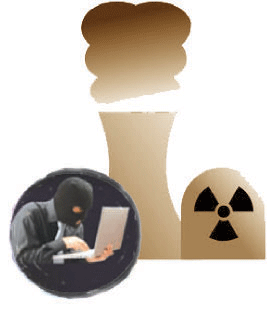
 David Lowry’s Blog 15th May 2017 The cyber security attack on Friday has highlighted the vulnerability of UK national infrastructure to malicious cyber threats. So far it is the impact on the NHS that has hit the headlines.
But it could be far worse: what if it were our nuclear power plants that were disrupted? Next week- from 22 to 24 May – the Vienna –based World Institute for Nuclear Security (WINS) , headed by the former head of security at Sellafield, Dr Roger Howsley, is participating in the 2nd Annual Industrial Control Cyber Security Nuclear Summit, in Warrington, organised by Cyber Senate entitled with an important presentation entitled“Transformation, Preparedness and Developing Cyber Security Assurance”.
It is instructive to listen to the words of Russian cyber security expert, Eugene Kasperksy, founder and ceo of the Moscow-based Kasperksy Labs, warns governments engaged in cyber warfare that “everything you do – it’s a boomerang: it will get back to you.”
Four years ago he warned that Russian nuclear power plant infected by Stuxnet malware programme – widely believed to have been created by the US and Israel – had infected a Russian nuclear power plant.
Speaking at the Canberra Press Club 2013 in Australia’s capital city. Kasperksy recounted a story from “the Stuxnet time” when a friend of his working in an unnamed nuclear power plant reported that the plant’s computers were “badly infected by Stuxnet”. Kaspersky criticized government departments responsible for engineering cyber-attacks, The Stuxnet virus was first discovered in June 2010 and was found to specifically target industrial control systems manufactured by Siemens. The initial target of the virus is widely thought to have been the centrifuges used in Iran’s uranium enrichment programme. Although the goal of the virus was extremely specific, its method of proliferation was indiscriminate and the code has since been found on computers across the world…… http://drdavidlowry.blogspot.co.uk/2017/05/cyber-threats-you-aint-seen-nothin-yet.html
May 17, 2017
Posted by Christina Macpherson |
safety, UK |
Leave a comment