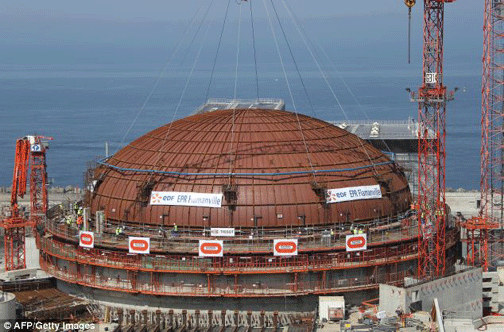
France Info 22nd June 2017 [Machine Translation] Defects on the pressure vessel of the EPR of Flamanville: “EDF and Areva were not transparent,” denounces Greenpeace. Greenpeace believes that EDF and Areva have not sufficiently communicated on the defects of the pressure vessel of the EPR of Flamanville.
“The origin of the anomalies and the history of the design” have not been made\ public, denounces the association in particular. The NGO is based on a report to which it has had access and which is due to be published onThursday by the High Committee for Transparency and Information on Nuclear Safety (HCTISN) on anomalies in the Flamanville EPR tank ( Handle). The HCTISN is an expert committee on nuclear safety. It decided in June 2015 totake the matter of the anomalies on the tank of the EPR of Flamanville.
According to Greenpeace, the report states that EDF and Areva “did not explain to the public the origin of the anomalies and the history of the design and manufacture of the EPR reactor vessel.” The report also notes that “no alternative technical scenario has been made public, in the event of the rejection of the tank and its lid by the Nuclear Safety Agency
(ASN)”.
“Since the beginning of the case, EDF and Areva have put the ASN before the fait accompli: they refuse to communicate a plan B to force it to accept that the EPR starts with pieces veined,” explains Yannick Rousselet, in charge of Campaign for Greenpeace France. “The rejection of the tank by the ASN would trigger a ‘domino effect’ by questioning the
feasibility of all EPR projects sold by EDF and AREVA in the UK, China and inland, says Yannick Rousselet. Industrialists put an intolerable pressure on the ASN, making the future of the nuclear sector on its shoulders.” http://www.francetvinfo.fr/sante/environnement-et-sante/defauts-sur-la-cuve-de-lepr-de-flamanville-edf-et-areva-nont-pas-ete-transparents-denonce-greenpeace_2248675.html
June 24, 2017
Posted by Christina Macpherson |
France, safety |
Leave a comment
Report says LANL safety problems endanger U.S. arsenal https://www.abqjournal.com/1021327/reports-slam-lanl-for-criticality-violations.html, By Associated Press, June 21st, 2017 SANTA FE, N.M. — A new report by the Center for Public Integrity highlights a history of safety and reliability problems involving plutonium work at Los Alamos National Laboratory – particularly in the area of “criticality,” the prevention of spontaneous nuclear chain reactions – as the lab is under orders to ramp up production of the plutonium “pits” that serve as triggers for nuclear bombs.
The CPI, a nonprofit investigative news group, reported that Los Alamos last year violated nuclear industry rules for guarding against criticality accidents three times more often than the U.S. Energy Department’s 23 other nuclear installations combined.
 CPI’s article, which has gained national attention this week, highlights a previously unreported 2011 incident in which LANL technicians placed eight rods of plutonium side by side for a photograph to celebrate the crafting of the rods. But placing the rods so close together could have led to a criticality accident and violates “Physics 101 for nuclear scientists,” the report says.
Between 2005 and 2016, the lab’s lapses in criticality safety have been criticized in more than 40 reports by government oversight agencies, teams of nuclear safety experts and the lab’s own staff, the CPI found……
LANL is currently the only place in the country that plutonium pits can be made, and new pits are part of a hugely expensive plan to improve the nation’s nuclear weapons in coming years.
Los Alamos is under orders to make as many as 80 pits a year by 2027. The United States hasn’t made any new ones since 2011, when LANL completed the last of 29 plutonium cores for Navy submarine missiles. The most ever made at Los Alamos in a year is 11.
As the Journal first reported last week, an NNSA official said at a recent public hearing in Santa Fe that moving plutonium work away from LANL to some other site within the nation’s nuclear weapons complex is among the options now under consideration in an ongoing study.
June 23, 2017
Posted by Christina Macpherson |
safety, USA |
Leave a comment

 A near-disaster at a federal nuclear weapons laboratory takes a hidden toll on America’s arsenal, Repeated safety lapses hobble Los Alamos National Laboratory’s work on the cores of U.S. nuclear warheads, Center For Public Integrity , by Patrick Malone, June 19, 2017
Key findings
- Technicians at Los Alamos National Laboratory placed rods of plutonium so closely together on a table in 2011 that they nearly caused a runaway nuclear chain reaction, which would likely have killed all those nearby and spread cancer-causing plutonium particles.
- The accident led to an exodus of key engineers from Los Alamos who had warned the lab to take better precautions, and this led in turn to a nearly four-year shutdown of key plutonium operations at Los Alamos.
- A similar incident in Japan in 1999 provoked a burst of radiation that caused two agonizing deaths, a mass evacuation and an order that 310,000 seek shelter. Three workers have died from such radiation bursts at Los Alamos in the past.
- Los Alamos’s handling of plutonium — a key component of all U.S. nuclear weapons — has been criticized in more than 40 official government reports stretching over a decade, but the lab has repeatedly struggled to meet federal safety requirements.
- Officials in Washington proposed to fine the lab more than a half-million dollars for its record of poor nuclear safety dating back a decade, but in the end chose not to do so, exemplifying what critics say is a climate of impunity for nuclear weapons contractors.
by Patrick Malone Technicians at the government’s Los Alamos National Laboratory settled on what seemed like a surefire way to win praise from their bosses in August 2011: In a hi-tech testing and manufacturing building pivotal to sustaining America’s nuclear arsenal, they gathered eight rods painstakingly crafted out of plutonium, and positioned them side-by-side on a table to photograph how nice they looked.
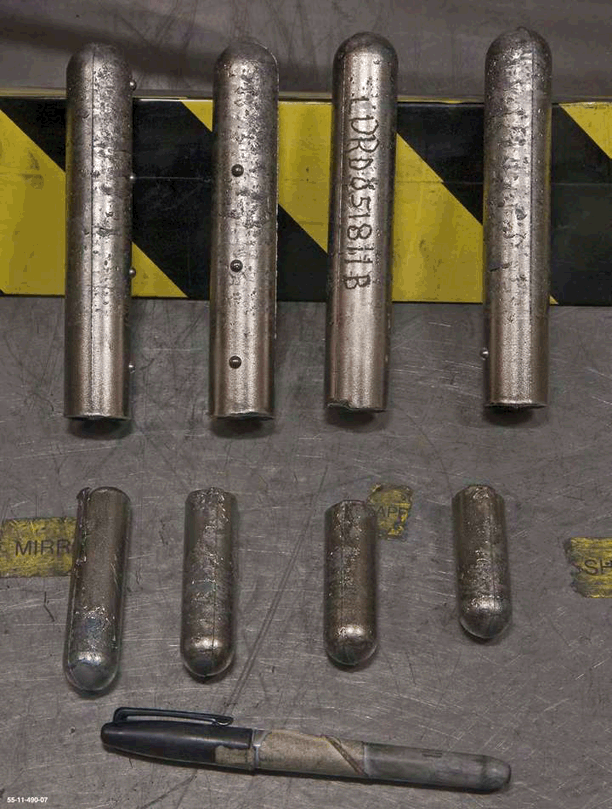
Eight rods of plutonium within inches — had a few more rods been placed nearby it would have triggered a disaster. Los Alamos National Laboratory/U.S. Department of Energy
At many jobs, this would be innocent bragging. But plutonium is the unstable, radioactive, man-made fuel of a nuclear explosion, and it isn’t amenable to showboating. When too much is put in one place, it becomes “critical” and begins to fission uncontrollably, spontaneously sparking a nuclear chain reaction, which releases energy and generates a deadly burst of radiation.
The resulting blue glow — known as Cherenkov radiation — has accidentally and abruptly flashed at least 60 times since the dawn of the nuclear age, signaling an instantaneous nuclear charge and causing a total of 21 agonizing deaths. So keeping bits of plutonium far apart is one of the bedrock rules that those working on the nuclear arsenal are supposed to follow to prevent workplace accidents. It’s Physics 101 for nuclear scientists, but has sometimes been ignored at Los Alamos……
Workplace safety, many of the reports say, has frequently taken a back seat to profit-seeking at the Los Alamos, New Mexico, lab — which is run by a group of three private firms and the University of California — as managers there chase lucrative government bonuses tied to accomplishing specific goals for producing and recycling the plutonium parts of nuclear weapons.
And these safety challenges aren’t confined to Los Alamos. The Center’s probe revealed a frightening series of glaring worker safety risks, previously unpublicized accidents, and dangerously lax management practices. The investigation further revealed that the penalties imposed by the government on the private firms that make America’s nuclear weapons were typically just pinpricks, and that instead the firms annually were awarded large profits in the same years that major safety lapses occurred. Some were awarded new contracts despite repeated, avoidable accidents, including some that exposed workers to radiation….
George Anastas, a past president of the Health Physics Society who analyzed dozens of internal government reports about criticality problems at Los Alamos for the Center, said he wonders if “the work at Los Alamos [can] be done somewhere else? Because it appears the safety culture, the safety leadership, has gone to hell in a handbasket.”
Anastas said the reports, spanning more than a decade, describe “a series of accidents waiting to happen.” The lab, he said, is “dodging so many bullets that it’s scary as hell.”https://apps.publicintegrity.org/nuclear-negligence/near-disaster/
June 21, 2017
Posted by Christina Macpherson |
Reference, safety, USA |
Leave a comment
Le Parisien 19th June 2017 A drone flew over a nuclear power plant located in the commune of Avoine, a
few kilometers from Chinon, Sunday evening in the early evening. An
investigation is underway. The Chinon nuclear power plant was overflown
by a drone on Sunday night. At around 8:20 pm, a small flying object was
observed by a station employee. Thirty minutes later, the specialized
gendarmes go to the scene, view the video surveillance images and confirm
the employee’s testimony. A research device was launched by the soldier. No
results so far. A complaint must be filed by the plant manager. The inquiry
is conducted by the Chinon Research Brigade. http://www.leparisien.fr/faits-divers/indre-et-loire-un-drone-survole-la-centrale-nucleaire-de-chinon-19-06-2017-7066137.php
June 21, 2017
Posted by Christina Macpherson |
France, incidents |
Leave a comment
Reuters 19th June 2017, A fire that broke out on the roof of a nuclear reactor at the Bugey plant
in central-eastern France has been extinguished, operator EDF said on
Monday, citing fire brigade officials. The fire began at the plant’s
nuclear reactor number 5, some 35 kilometers from the city of Lyon, nuclear
regulator ASN said earlier in a statement. EDF said in a separate statement
there were no injuries or fatalities, while safety body IRSN said on
Twitter that sensors had not picked up any increase in radiation. http://www.reuters.com/article/us-france-power-nuclearpower-idUSKBN19A2AH
June 21, 2017
Posted by Christina Macpherson |
France, incidents |
Leave a comment
Palo Verde nuclear plant still ran after backup equipment exploded, Ryan Randazzo , The Republic | azcentral.com June 13, 2017 For 57 days last year and early this year, one of the nuclear reactors at the Palo Verde Nuclear Generating Station west of Phoenix kept running after an explosion knocked a backup generator out of service.
Experts at the Nuclear Regulatory Commission disagreed strongly over whether the plant should have been allowed to keep running during the repairs, according to documents leaked to the Union of Concerned Scientists, a watchdog group.
The NRC usually allows a nuclear plant 10 days to make such repairs. In this case, the agency granted the plant’s operator, Arizona Public Service Co., two extensions. NRC officials said the decision came after a careful review of the risks.
But not everyone at the agency agreed with the decision. NRC employees filed three dissents that were given to The Arizona Republic by the scientist watchdog group. The NRC subsequently released one of the documents, a petition asking for the time extensions to be revoked.
“The NRC’s action is inconsistent with the NRC mission, NRC vision, NRC safety objectives, NRC regulatory effectiveness strategies, NRC openness strategies and the principles of good regulation,” said Roy Mathew, a longtime agency employee, in his Jan. 23 petition to his employer……
Among Mathew’s concerns were that if the nuclear plant lost power from the grid and had a similar failure in its other diesel generator, it would not have been able to cool nuclear fuel in a timely manner. If the fuel can’t be cooled, it can lead to radiation releases……
David Lochbaum, director of the nuclear safety project at the Union of Concerned Scientists, questioned whether the FLEX equipment could have restored power soon enough to prevent the fuel from overheating……. http://www.azcentral.com/story/money/business/energy/2017/06/13/palo-verde-nuclear-plant-reactor-still-ran-after-backup-generator-exploded/385951001/
June 21, 2017
Posted by Christina Macpherson |
incidents, USA |
Leave a comment
 Official says more Hanford nuke mishaps likely, By NICHOLAS K. GERANIOS Associated Press, RICHLAND, Wash. 18 June 17, — Future accidental radiation releases at the largest U.S. site of waste from nuclear weapons production are likely following back-to-back emergency evacuations of workers in May and June because aging infrastructure is breaking down, the top Energy Department official at the site told The Associated Press.
Adding to the likelihood of more nuclear mishaps at the sprawling Hanford Nuclear Reservation is inadequate government funding to quickly clean up the millions of gallons of toxic nuclear waste at the site, said Doug Shoop, who runs the department’s operations office at Hanford.
Hanford has an annual budget of $2.3 billion for cleanup but Shoop said it will cost at least $100 billion to clean up the highly toxic radioactive and chemical wastes on the 580-square mile (1,502 square kilometer) site which produced up to 70 percent of the plutonium for the U.S. nuclear arsenal since it was established in World War II.
“The infrastructure is not going to last long enough for the cleanup,” Shoop said in an interview this week. “It will be another 50 years before it is all demolished.”
Shoop made the comments after hundreds of Hanford workers were evacuated May 9 when the roof of a 1950s rail tunnel storing a lethal mix of waste from plutonium production collapsed. Tests show no radiation was released.
Then, on June 8, demolition work at a 1940s plutonium plant sent 350 workers seeking cover inside. Radiation was emitted but not deemed at a level harmful to people.
More money would lead to a faster cleanup, Shoop said. But President Donald Trump’s proposed budget for next year includes a $120 million cut for Hanford.
The official deadline for cleaning up Hanford is 2060, but Shoop said so much infrastructure at the site is deteriorating that “some facilities are not going to withstand that time.”
The site’s cleanup began in 1989 and critics have accused regulators of allowing the U.S. government to delay cleanup deadlines by decades, putting lives and the environment at risk.
“Every year that we don’t have an earthquake … has been just luck,” said Gerry Pollet, a Washington state legislator who represents a liberal Seattle district, about 200 miles (320 kilometers) from Hanford.
Shoop said about half of the site is free of pollution. And parts of Hanford make up the new Manhattan Project National Historical Park, where visitors can learn about the development of the atomic bomb.
But Hanford’s most dangerous contaminated waste has not been cleaned up, and the two recent evacuation incidents illustrated problems that could become more frequent in the future……..http://hosted.ap.org/dynamic/stories/U/US_HANFORD_NUCLEAR_WASTE_WAOL-?SITE=WHIZ&SECTION=HOME&TEMPLATE=DEFAULT
|
June 19, 2017
Posted by Christina Macpherson |
safety, USA |
Leave a comment
 Capital 15th June 2017, [Machine Translation] Documents from the Institute of Radiation Protection
and Nuclear Safety (IRSN) show that the EPR pressure vessel does not pass a strength test. It would therefore not be in compliance with the regulations, contrary to what is being said.
Areva and EDF play a major part of their economic future this month. First session today: As the Echos recall, the High Committee for Transparency and Information on Nuclear Safety meets to discuss the safety of the EPR nuclear reactor vessel built by Areva on behalf of a group of companies, EDF in Flamanville.
At the end of June, it will be up to the Permanent Expert Group on Nuclear Pressure Equipment (GPESPN) to assess its working. It will examine the findings of another body: the Institute of Radiation Protection and Nuclear Safety (IRSN), the
technical expert of the Nuclear Safety Authority (ASN).
A technical note published by IRSN last April, but until now completely unnoticed, shows that the pressure vessel does not comply with the regulation of nuclear equipment under pressure. And poses a major safety problem. Hidden in the
middle of a mass of documents put online, it is dated September 2015 and signed by Gérard Gary, a nuclear physicist, research director emeritus ex-CNRS attached to the laboratory of solid mechanics of the Ecole
http://www.capital.fr/entreprises-marches/epr-de-flamanville-cette-note-d-expert-qui-pointe-le-danger-de-la-cuve-1232494
June 19, 2017
Posted by Christina Macpherson |
France, safety |
Leave a comment
 Reuters 14th June 2017, Tokyo Electric Power Co will work with local government to review the
safety of its Kashiwazaki-Kariwa nuclear plant, which could mean a later
restart date than planned originally, the company’s incoming CEO said.
The Kashiwazaki-Kariwa plant, the world’s biggest nuclear power plant, has been
completely offline since 2012 while its safety procedures are reviewed.
Ryuichi Yoneyama, the governor of Niigata prefecture in north west Japan
where the plant is located, has said he will not discuss the restart until
the review is completed. This includes a review of the plant’s safety,
evacuation plans, plus the impact on health of the radiation released from
Fukushima, which could take until 2020 at the earliest. https://www.reuters.com/article/us-japan-tepco-idUSKBN1952HU
June 16, 2017
Posted by Christina Macpherson |
Japan, safety |
Leave a comment
Cuts to police who guard nuclear weapons could be ‘catastrophic’ http://news.sky.com/story/cuts-to-police-who-guard-nuclear-weapons-could-be-catastrophic-10916066 It is claimed national security could be compromised as fewer firearms officers would be available for an emergency. Further cuts planned for the police force which guards the UK’s nuclear arsenal could be “catastrophic”, according to a leading police officer.
The Ministry of Defence Police (MDP) guards the country’s Trident nuclear deterrent, among other responsibilities.
The force is already understaffed with about 2,300 officers, according to the Defence Police Federation (DPF).
DPF chairman Eamon Keating will use a speech later to warn that plans to “reset” its strength to below that level will “harm national security”.
The MDP’s officers are all trained to use firearms and Mr Keating says cutting numbers means fewer available to help in a national emergency as part of Operation Temperer.
Temperer kicked in after the Manchester terror attack, when the threat risk was deemed critical. In that case, the military were deployed to help police.
“After a decade of budget and personnel cuts, it beggars belief the MoD would demand a further £12.5m from the police force entrusted with guarding Trident,” Mr Keating will tell the DPF’s annual conference.
“This ‘reset’ is an ill-considered decision that prioritises cost over security, and makes no sense given the financial value of the assets we protect,” Mr Keating will say.
Just a year ago the MDP had 2,600 officers – that was already a third down on previous levels after budget cuts in 2010.
The federation will also demand more detail on Conservative manifesto plans for an “Infrastructure Policing Force” by merging the MDP, the Civil Nuclear Constabulary and British Transport Police.
Mr Keating will add: “The Government must urgently rethink this catastrophic decision that further undermines police officers hamstrung by fitness tests inappropriate to the job they do, and a pension age different to the Home Office and Armed Forces.”
A Ministry of Defence spokesman said: “We are confident that the strength of our force keeps our people, sites and equipment safe.
“It also enables us to play our part in protecting the public, as we did when we supported the armed police response to the tragic events in Manchester last month.”
June 16, 2017
Posted by Christina Macpherson |
safety, UK |
Leave a comment
UCS, DAVE LOCHBAUM, DIRECTOR, NUCLEAR SAFETY PROJECT | JUNE 14, 2017, As described in a recent All Things Nuclear commentary, one of two emergency diesel generators (EDGs) for the Unit 3 reactor at the Palo Verde Nuclear Generation Station in Arizona was severely damaged during a test run on December 15, 2016. The operating license issued by the Nuclear Regulatory Commission (NRC) allowed the reactor to continue running for up to 10 days with one EDG out of service. Because the extensive damage required far longer than 10 days to repair, the owner asked the NRC for permission to continue operating Unit 3 for up to 62 days with only one EDG available. The NRC approved that request……..http://allthingsnuclear.org/dlochbaum/back-story-on-palo-verde
June 16, 2017
Posted by Christina Macpherson |
safety, USA |
Leave a comment
Smoke detected at crippled Chernobyl power plant – Ukraine nuclear watchdog, Rt.com 13 Jun, 2017 Ukraine’s nuclear regulatory body reported smoke at one of the rooms at Unit 3 in Chernobyl, adding that it was briefly “liquidated” by the state emergency personnel and the radiological situation at the site has not changed following the incident.
“At 15:57 pm we’ve received information from Chernobyl nuclear power plant about smoke in room 509 of Power Unit Three. At 16:00 the smoke was liquidated by the State Emergency Service staff,” a statement issued by the State Nuclear Regulatory Inspectorate of Ukraine reads.
“The radiological situation in the third power unit and the station’s territory has not changed,” it added.
No further details were immediately available……..https://www.rt.com/news/392114-smoke-chernobyl-nuclear-plant/
June 14, 2017
Posted by Christina Macpherson |
incidents, Ukraine |
Leave a comment
 Expert to speak on nuclear transporting https://www.niagarathisweek.com/news-story/7369046-expert-to-speak-on-nuclear-transporting/ Niagara District Council of Women welcome Gordon Edwards to Lincoln town hall Jun 13, 2017 by Luke Edwards Grimsby Lincoln News A U.S. judge has ruled the Department of Energy can proceed with its plan to import 6,000 gallons of liquid nuclear waste from Canada. The proposed route goes through Niagara.
LINCOLN — As shipments of highly radioactive nuclear waste begin making their way through the Niagara region, a local group is bringing in an expert to address what they say are some unanswered questions.
The Niagara District Council of Women will be welcoming Gordon Edwards to a meeting this Friday at Lincoln town hall. Edwards is a nuclear critic and president of the Canadian Coalition for Nuclear Responsibility, a non-profit group that focuses on military and civilian uses of nuclear, as well as non-nuclear alternatives.
Earlier this year a U.S. judge approved a plan to have nuclear waste transported from a research facility in Chalk River, Ont. through Niagara and across the Peace Bridge to Buffalo. The U.S. Department of Energy plans to import nearly 23,000 litres, or 6,000 gallons, of the waste.
According to the NDCW, many unanswered questions remain, including the nature of the liquid radioactive material, historical precedence for such transportation, possible alternatives and concerns over leakage or other dangers.
The meeting is expected to run from 9 a.m. to noon at town hall, 4800 South Service Rd. in Beamsville. For more information on the meeting, contact Gracia Janes at 905-468-2841, Ann Porter Bonilla at 905-973-1621 or Susan Pruyn at 905-892-5206.
June 14, 2017
Posted by Christina Macpherson |
safety, USA |
Leave a comment
Union of Concerned Scientists DAVE LOCHBAUM, DIRECTOR, NUCLEAR SAFETY PROJECT | JUNE 13, 2017, The Oyster Creek Nuclear Generating Station near Forked River, New Jersey is the oldest nuclear power plant operating in the United States. It began operating in 1969 around the time Neil Armstrong and Buzz Aldrin were hiking the lunar landscape.
Oyster Creek has a boiling water reactor (BWR) with a Mark I containment design, similar to the Unit 1 reactor at Fukushima Daiichi. Water entering the reactor vessel is heated to the boiling point by the energy released by the nuclear chain reaction within the core (see Figure 1). The steam flows through pipes from the reactor vessel to the turbines. The steam spins the turbines connected to the generator that produces electricity distributed by the offsite power grid. Steam discharged from the turbines flows into the condenser where it is cooled by water drawn from the Atlantic Ocean, or Barnegat Bay. The steam vapor is converted back into liquid form. Condensate and feedwater pumps supply the water collected in the condenser to the reactor vessel to repeat the cycle………
Bad Vibrations
In the early morning hours of November 20, 2016, the operators at Oyster Creek were conducting the quarterly test of the turbine control system. With the reactor at 95 percent power, the operator depressed a test pushbutton at 3:26 am per the procedure. The plant’s response was unexpected. The positions of the control valves and bypass valves began opening and closing small amounts causing the reactor pressure to fluctuate. Workers in the turbine building notified the control room operators that the linkages to the valves were vibrating. The operators began reducing the reactor power level in an attempt to stop the vibrations and pressure fluctuations.
The reactor automatically shut down at 3:42 pm from 92 percent power on high neutron flux in the reactor. Workers later found the linkage for control valve #2 had broken due to the vibrations and the linkage for control valve #4 had vibrated loose. The linkages are “mechanical arms” that enable the turbine control system to reposition the valves. The broken and loosened linkages impaired the ability of the control system to properly reposition the valves.
These mechanical malfunctions prevented the EHC system from properly controlling reactor pressure during the test and subsequent power reduction. The pressure inside the reactor vessel increased. In a BWR, reactor pressure increases collapse and shrink steam bubbles. Displacing steam void spaces with water increases the reactor power level. When atoms split to release energy, they also release neutrons. The neutrons can interact with other atoms to causing them to split. Water is much better than steam bubbles at slower down the neutrons to the range where the neutrons best interact with atoms. Put another way, the steam bubbles permit high energy neutrons to speed away from the fuel and get captured by non-fuel parts within the reactor vessel while the water better confines the neutrons to the fuel region.
The EHC system’s problem allowed the pressure inside the reactor vessel to increase. The higher pressure collapsed steam bubbles, increasing the reactor power level. As the reactor power level increased, more neutrons scurried about as more and more atoms split. The neutron monitoring system detected the increasing inventory of neutrons and initiated the automatic shut down of the reactor to avoid excessive power and fuel damage.
Workers attributed the vibrations to a design flaw. A component in the EHC system is specifically designed to dampen vibrations in the tubing providing hydraulic fluid to the linkages governing valve positions. But under certain conditions, depressing the test pushbutton creates a pressure pulse on that component. Instead of dampening the pressure piles, the component reacts in a way that causes the hydraulic system pressure to oscillate, creating the vibrations that damaged the linkages.
The component and damaged linkages were replaced. In addition, the test procedure was revised to avoid performing that specific portion of the test when the reactor is operating. In the future, that part of the turbine valve test will be performed during an outage.
Vibrations Re-Visited
It was not the first time that Oyster Creek was shut down due to problems performing this test. It wasn’t even the first time this decade…..http://allthingsnuclear.org/dlochbaum/oyster-creek-bad-vibrations
June 14, 2017
Posted by Christina Macpherson |
safety, USA |
Leave a comment
Cornish Times 12th June 2017People in Saltash and Torpoint are being given important safety information on what to do in the event of a nuclear emergency at Devonport Dockyard. Homes and business that fall within the official public information zone are being sent a booklet which provides information about radiation, together with instructions to follow in the event of an accident. The booklets, which are updated once every three years to comply with Radiation
(Emergency Preparedness and Public Information) Regulations, tell thepublic what to do in ‘the very unlikely event’ that this happens. http://www.cornish-times.co.uk/article.cfm?id=110309
June 14, 2017
Posted by Christina Macpherson |
safety, UK |
Leave a comment