Little chance that USA will get India to really change its Nuclear Liability Act
 Insuring nuclear power The Financial Express | January 12, 2015 Given the relatively low level of political capital it has in the Rajya Sabha, and the backdrop of the Bhopal gas tragedy and recent tragedies such as the Fukushima disaster in 2011, it seems unlikely the government is going to go out of its way to try and amend the Civil Liability of Nuclear Damage Act in a hurry—the Act has once again come to the forefront with US President Barack Obama coming to the Republic Day function.
 Since no US firm is going to build nuclear plants in India until Section 17(b) of the Act allows the Nuclear Power Corporation of India Limited (NPCIL) to take action against them in case of a nuclear accident, revoking this has been on the US agenda for a long time. Apart from the political sensitivity around such an action, as finance minister Arun Jaitley acknowledged at a seminar on the Act earlier this week, both the BJP and the Congress had passed the Act—so changing an integral part of the Act doesn’t look as if it is on the cards…….http://www.financialexpress.com/article/economy/editorial-insuring-nuclear-power/28748/
North Korea’s nuclear deal offer to USA

 North Korea Offers U.S. Deal to Halt Nuclear Test, NYT By CHOE SANG-HUNJAN. 10, 2015 SEOUL, South Korea — North Korea said Saturday that it had told the United States that it would impose a temporary moratorium on nuclear tests if Washington canceled its joint annual military exercises with South Korea to help promote dialogue on the divided Korean Peninsula.
The North proposed its “crucial step” in a message it delivered to the United States on Friday through an unspecified channel, the North’s official Korean Central News Agency said. In the past, North Korea has relayed messages to Washington through its United Nations mission in New York.
Until now, the United States has dismissed North Korea’s routine demand for an end to its joint military exercises with South Korea. The North has called them a rehearsal for an invasion while the United States and South Korea have insisted that their annual war games are defensive in nature.
But the North’s latest proposal included a new incentive for Washington, offering to temporarily suspend nuclear tests in return for a suspension of the joint military exercises this year.
The North’s overture followed the New Year’s Day speech of its leader, Kim Jong-un, in which he said he was ready to meet with President Park Geun-hye of South Korea if “the mood was right.” Mr. Kim said the two Koreas should mark their 70th anniversary of liberation from Japanese colonial rule this year with great strides toward inter-Korean reconciliation. North Korea has since significantly toned down its habitually harsh language when referring to South Korea…….
The United States on Saturday rebuffed the North Korean proposal……..http://www.nytimes.com/2015/01/11/world/asia/north-korea-offers-us-deal-to-halt-nuclear-test-.html?_r=0
USA and Russia should not ignore Mikhail Gorbachev’s warning on the nuclear war danger of the Ukraine crisis

 Gorbachev issues new warning of nuclear war over Ukraine http://www.dw.de/gorbachev-issues-new-warning-of-nuclear-war-over-ukraine/a-18182899 9 Jan 15 Former Soviet leader Mikhail Gorbachev has warned that the crisis in Ukraine could lead to a major war, or even a nuclear war. In an interview with a German magazine, he criticized both Russia and the West. In an interview with the German weekly news magazine Spiegel, 83-year-old former Soviet leader Mikhail Gorbachev said the crisis in Ukraine could lead to large-scale war in Europe or even a nuclear war. “We won’t survive if someone loses their nerves in the current tension.”
The Nobel Peace Prize laureate decried the “loss of trust” between Russia and the West as “catastrophic,” and said ties must be “defrosted.” Gorbachev accused the West and NATO of destroying the structure of European security by expanding its alliance. “No head of the Kremlin can ignore such a thing,” he said, adding that the US was unfortunately starting to establish a “mega empire.”
The man seen as a key player in the reunification of former East and West Germany in 1990 also accused Germany of interfering in Ukraine’s crisis, saying, “The new Germany wants its hands in every pie. There seems to be a lot of people who want to be involved in a new division of Europe. “Germany has already tried to expand its influence of power towards the East – in the Second World War. Does it really need another lesson?”
He said Western attempts to disempower Russian President Vladimir Putin and destabilize Russia were “very stupid and extremely dangerous.” He defended the Russian annexation of the Crimean Peninsula last year, but criticized the Russian leader’s authoritarian style of leadership. He said Russia needed free elections and “the participation of the people in free elections.
“It is simply not acceptable when someone such as the anti-corruption blogger and politician Alexei Navalny is under house arrest for speaking out.”
Recent warnings Gorbachev has warned of a nuclear war on a number of occasions in recent months. In an article for the Russian daily Rossiyskaya Gazeta, published on December 11, he warned: “The situation in Europe and the world is extremely alarming … the result of the events that took place in the last months is a catastrophic loss of trust in international relation,” which could lead to war. He urged Russia and the US as well as Russia and the EU to hold talks “without preconditions” and without fear of “losing face.”
“We must think of the future,” the former leader said.
Ukraine talks On Monday, January 12, the foreign ministers of Germany, France, Russia and Ukraine are set to meet in Berlin to launch another attempt to break the deadlock in the Ukraine conflict.
The ministers are expected to discuss the possibility of a summit of the four countries’ leaders in Kazakhstan, which Ukraine had suggested take place on January 15.
Regarding the fragile four-month-old ceasefire between Ukrainian forces and pro-Russian separatists, which has been broken on a number of occasions, German Foreign Minister Frank-Walter S
The nuclear dangers in Ukraine energy wars: don’t miss the full article!
What’s profitable for the nuclear industry in the US and Japan is toxic for the EU, particularly its more environmental and anti-nuclear member-nations including Germany and Austria, which will have no choice but to accept this legal precedent for continent-wide fracking and a revival of nuclear power.

|
Ukraine Energy Wars Are Leading To A Fukushima-Chernobyl Debacle In Europe
|
|
By Yoichi Shimatsu. Rense1-5-15
|
| full article at http://www.rense.com/general96/ukraineenenerg.html |
| Clashes over energy in Ukraine between the West and Russia could prompt another Chernobyl-type accident or a catastrophe on the order of a Fukushima that will complete the nuclear devastation of the Northern Hemisphere. As news media fixate on conflicts over pipelines that supply Europe with Russian gas, another energy war is erupting over control of Ukraine’s nuclear-power industry, which generates half that nation’s electricity.Prime Minister Arseniy Yatsenuk’s campaign for “energy independence” from Russian-sourced natural gas and nuclear fuel is not a study in cost control, economic security or even national sovereignty. His corporate-giveaway policies are actually a concession to Western energy interests in return for their influence over the EU, which can provide loans to avert an imminent default on Kiev’s debt to the IMF and World Bank. With an annual budget shortfall of $15 billion and a currency collapse, Ukraine is staggering under external sovereign debt estimated at between $140 and $200 billion.
The IMF and World Bank have halted further transfers of loan tranches to Kiev, which is now unable to make payments on its gas imports from Russia. Kiev policymakers are therefore desperately looking to expand their nuclear industry. Unfortunately two recent accidents at its largest nuclear-power plant highlight the serious risks to a nation still grappling with the long-term effects of the 1986 Chernobyl meltdown. ………. |

Australian uranium miner Paladin will have to comply with Canada’s new tax transparency laws
Canada transparency laws force ASX companies to disclose tax bills, The Age December 26, 2014 Georgia Wilkins Business reporter Two Australian mining companies will be forced to disclose how much tax they pay in every country around the world by new transparency laws introduced in Canada.
Paladin Energy and OceanaGold, both dual-listed in Australia and Canada, will have to comply with new Canadian laws requiring all oil, gas and mining companies to report payments they make to governments overseas, including taxes, royalties, bonuses, regulatory charges and licence fees.
The Australian government is being pushed to introduce similar rules.
The legislation aims to tackle corruption and tax avoidance in poor countries, as well as payments to indigenous groups. It follows mounting global pressure by transparency organisations and the Organisation for Economic Co-operation and Development to introduce a country-by-country reporting regime.
The new rules are expected to come into force by June 2015 after passing through the Canadian parliament on December 16.
Claire Spoors, a spokeswoman for advocacy group Publish What You Pay, said the Abbott government should consider introducing similar laws in line with Canada’s.
“Australia, as a mining giant, could make a real difference in helping resource-rich but poor countries prosper by ensuring there is greater transparency,” she said.
“Well-managed and properly accounted-for resource revenues can be invested in health, education and putting countries on sustainable development pathways.”……….
the Abbott government has signalled it could water down transparency laws introduced under Labor. The tax disclosure laws would mean that from July, companies with $100 million or more in turnover would have their tax information disclosed on the Australian Taxation Office website.
Finance Minister Mathias Cormann told Fairfax Media the government would review the laws following complaints by private business owners that they could be kidnapped and held for ransom when people realised how wealthy they were from their published tax information.
Senator Cormann said the laws showed a “ham-fisted, ill-thought-out approach trying to crack a nut with a sledgehammer”.
But advocates say greater transparency will boost confidence in the broader community that large companies are paying their fair share of tax.
Australia has endorsed the OECD’s reporting regime, which is not due to be introduced until 2018.
It has also signed up to the OECD’s common reporting standard for governments sharing tax information, after criticism that it delayed the process by consulting big business.
OceanaGold has operations in New Zealand, the Philippines and Australia. Paladin Energy has projects in Namibia, Malawi, Niger, Canada and Australia. : http://www.smh.com.au/business/mining-and-resources/canada-transparency-laws-force-asx-companies-to-disclose-tax-bills-20141224-12akhd.html#ixzz3OBT5BW5V
For world peace, a nuclear arms control agreement between USA and Russia is vital

 A Vital Nuclear Agreement, at Risk, NYT, By THE EDITORIAL BOARD JAN. 1, 2015There’s much more to the deeply troubled Russian-American relationship than Ukraine. Under the radar, tensions have also been brewing over compliance with a number of arms control treaties that for decades have been vital to keeping the peace between the two nuclear powers and setting an example for other countries.
Washington accuses Moscow of violating at least five of these agreements. A failure to resolve the impasse could have extremely dangerous consequences for the post-Cold War order, since even 20 years after the fall of the Soviet Union, the two sides together possess more than 10,000 nuclear weapons, more than 90 percent of what exists in the world.
The most serious dispute centers on the 1987 Intermediate-range Nuclear Forces Treaty, which bans both sides from deploying ground-launched ballistic and cruise missiles with a range of between 300 and 3,400 miles that carry nuclear or conventional warheads. These were among the weapons America once stationed in Europe to demonstrate a commitment to its allies and deter the Soviets from aggression.
Under the treaty, signed by President Ronald Reagan and the Soviet leader, Mikhail Gorbachev, America destroyed 846 missiles and the Soviets, 1,846 missiles. Both sides had come to see the systems as unacceptably risky to their own forces…………….
Despite the dispute, it would be a huge mistake for the United States to withdraw from the I.N.F. treaty, as some congressmen have demanded. That would remove all restraints on Russia and seriously weaken a system of treaties that has been remarkably effective over decades at curbing the spread of destructive weapons.
It would also be a mistake for either side to reintroduce the banned weapons onto their own territory or elsewhere. Russia’s foreign minister, Sergey Lavrov, recently asserted Moscow’s right to put nuclear missiles in Crimea, while Brian McKeon, a senior Pentagon official, told Congress this month that one response to Russia’s treaty violation could be to deploy American ground missiles in Europe. New deployments would reverse a trend in which the two countries have substantially reduced their huge arsenals in recent years.
The Obama administration should continue pursuing a diplomatic solution to the treaty dispute and resist the growing pressure in Congress for quick retaliation, which could make the situation worse. And it should explore other forms of pressure, like economic punishment and deployment of new defenses against cruise missiles.
So far, there is no evidence that Russia has deployed its new missiles, which would be a serious escalation. The United States and its allies should make efforts to bring Russia back into compliance with the treaty, and Russia needs to know that defiance will come at a cost.http://www.nytimes.com/2015/01/02/opinion/a-vital-nuclear-agreement-at-risk.html?_
Tentative agreement between Iran and USA
 Iran and US tentatively agree on formula to reduce nuclear programme http://www.theguardian.com/world/2015/jan/02/iran-us-tentative-deal-nuclear-programme-uranium-russia Washington hopes Tehran will ship enriched uranium to Russia to reduce its weapon-making ability, diplomats say Iran and the United States have tentatively agreed on a formula that Washington hopes will reduce Tehran’s ability to make nuclear arms by committing it to ship to Russia much of the material needed for such weapons, diplomats say.
In another sign of progress, two diplomats told Associated Press that negotiators at the December round of nuclear talks drew up for the first time a catalogue outlining areas of potential accord and differing approaches to remaining disputes.The diplomats said differences still dominate ahead of the next round of Iran six-power talks on 15 January in Geneva. But they suggested that even agreement to create a to-do list would have been difficult previously because of wide gaps between the sides.
Iran denies it wants nuclear arms, but it is negotiating with the US, Russia, China, Britain, France and Germany on cuts to its atomic programme in the hope of ending crippling sanctions. The talks have been extended twice due to stubborn disagreements.
The main conflict is over uranium enrichment, which can create both reactor fuel and the fissile core of nuclear arms.In seeking to reduce Iran’s bomb-making ability, the US has proposed that Tehran export much of its stockpile of enriched uranium – something the Islamic Republic has long said it would not do.
The diplomats said both sides in the talks are still arguing about how much of an enriched uranium stockpile to leave Iran. . It now has enough for several bombs, and Washington wants substantial cuts below that level.
But the diplomats said the newly created catalogue lists shipping out much of the material as tentatively agreed upon.The diplomats, who are familiar with the talks, spoke to the AP recently and demanded anonymity because they are not authorised to comment on the closed negotiations.
Issues that still need agreement, they said, include the size of Iran’s future enrichment output. The US insists that it be cut in half, leaving Tehran with about 4,500 centrifuges used to enrich uranium, or fewer if it replaces them with advanced models. Tehran is ready for a reduction of only about 20%, according to the diplomats.
Two other unresolved issues are Iran’s Fordo underground enrichment site and the nearly built Arak nuclear reactor. The US and its five allies in the talks want to repurpose Fordo to a non-enrichment function because it is believed impervious to a military attack from the air. The six also seek to re-engineer Arak from a model that produces enough plutonium for several nuclear weapons a year to a less proliferation-prone model.
Negotiators hope to reach a rough deal by March and a final agreement by 30 June.
A diplomatic deal with Iran would be the most globally significant step forward
A nuclear deal with Iran would mean a less volatile world, Julian Borger Guardian, 1 jan 15 There will be no greater diplomatic prize in 2015 than a comprehensive nuclear deal with Iran. In its global significance, it would dwarf the US detente with Cuba, and not just because there are seven times more Iranians than Cubans. This deal will not be about cash machines in the Caribbean, but about nuclear proliferation in the most volatile region on Earth.
An agreement was supposed to have been reached by 24 November, but Iran and the west were too far apart to make the final leap. After nine months of bargaining, the intricate, multidimensional negotiation boiled down to two main obstacles: Iran’s long-term capacity to enrich uranium, and the speed and scale of sanctions relief.
Iran wants international recognition of its right not just to enrich, but to do so on an industrial scale. It wants to maintain its existing infrastructure of 10,000 centrifuges in operation and another 9,000 on standby, and it wants to be able to scale that capacity up many times.
The US and its allies say Tehran has no need for so much enriched uranium. Its one existing reactor is Russian-built, as are its planned reactors, so all of them come with Russian-supplied fuel as part of the contract. The fear is that industrial enrichment capacity would allow Iran to make a bomb’s-worth of weapons-grade uranium very quickly, if it decided it needed one – faster than the international community could react.
However, the west is currently not offering large-scale, immediate sanctions relief in return for such curbs on Iran’s activity. President Barack Obama can only temporarily suspend US congressional sanctions, and western states are prepared to reverse only some elements of UN security council sanctions. The best the west can offer upfront is a lifting of the EU oil embargo.
These gaps remain substantial, but none of the parties involved can walk away from the table. A collapse of talks would lead to a slide back to the edge of conflict between Iran and Israel; the latter has vowed to launch military strikes rather than allow the former to build a bomb. It could also trigger a wave of proliferation across the region and beyond as other countries hedge their bets.
Did America’s CIA orchestrate the coup in Ukraine?
Oliver Stone Says Ukrainian Coup Was Directed by CIA http://sputniknews.com/art_living/20141231/1016415810.html US film maker claims he is currently engaged in production of a documentary about Ukrainian president Viktor Yanukovych. WASHINGTON, December 31 (Sputnik) – US filmmaker Oliver Stone is currently engaged in production of a documentary about Ukrainian president Viktor Yanukovych, who fled the country following the February coup, according to the post on his Facebook page published Tuesday.
“[I] Interviewed Viktor Yanukovych 4 hours in Moscow for new English language documentary produced by Ukrainians. He [Yanukovych] was the legitimate President of Ukraine until he suddenly wasn’t on February 22 of this year. Details to follow in the documentary,” Stone said.
According to the renowned filmmaker, in the aftermath of the coup, “the West has maintained the dominant narrative of ‘Russia in Crimea’ whereas the true narrative is ‘USA in Ukraine.’ The truth is not being aired in the West. It’s a surreal perversion of history that’s going on once again, as in Bush pre-Iraq ‘WMD’ [Weapons of Mass Destruction] campaign.”
Stone also said that the shooters, who killed killed 14 police officers, wounded some 85, and killed 45 protesting civilians during the clashes in Kiev, were outside “third party agitators.”
“Many witnesses, including Yanukovych and police officials, believe these foreign elements were introduced by pro-Western factions with CIA fingerprints on it,” he stated.
Stone concluded by expressing hope that the truth about the Ukrainian coup would come out in the West soon “in time to stop further insanity.”
Former Ukrainian president Viktor Yanukovych was ousted late February following mass rallies in Kiev, triggered by the president’s refusal to sign a European Union association agreement. Yanukovych fled the country for Russia, while the protests led to the violent unrest in Ukraine, that dramatically escalated in mid-April, when Kiev launched a military operation against independence supporters in the Donetsk and Luhansk regions.
Lists of nuclear facilities exchanged between India and Pakistan
India, Pakistan exchange list of nuclear facilities Times of India
PTI | Jan 1, 2015 NEW DELHI: India and Pakistan on Thursday exchanged the list of their nuclear installations under a bilateral agreement that bars them from attacking each other’s atomic facilities.
This is the 24th consecutive exchange of such list between the two countries, the first one having taken place on January 1, 1992. ……http://timesofindia.indiatimes.com/india/India-Pakistan-exchange-list-of-nuclear-facilities/articleshow/45714569.cms
Problems in Czech Republic’s Temelin NPP because of inappropriate USA nuclear fuel
Use of US nuclear fuel at Czech Republic’s Temelin NPP causes problems — experts Tass December 31, Europe advises its counterparts in other countries not to replace the nuclear fuel specifically designed for this type of reactors with unauthorized substitutes, the company ALTA said PRAGUE, December 31. /TASS/. Attempts to use nuclear fuel from the US manufacturer Westinghouse inside reactors of the Czech Republic’s Soviet-designed Temelin nuclear power plant in the past repeatedly caused many unexpected situations and problems, the provider of Russian fuel assemblies for Czech NPPs, ALTA, told TASS.
“In particular, such incidents occurred at Hungary’s Paks NPP and the Czech Republic’s Temelin,” the company said. “Europe still remembers that and advises its counterparts in other countries not to repeat their mistakes by replacing the nuclear fuel specifically designed for this type of reactors with unauthorized substitutes.”
In May 2007, the Czech Republic made a decision to remove Westinghouse fuel assemblies from the NPP Temelin’s reactors ahead of schedule because in the process of operation they had become strongly deformed, thus causing disruptions to the power plant’s operation. The worst incident occurred at Temelin in January 2007, when problems with fuel caused an emergency shutdown of the entire first unit. The reactor was restarted only three months later. In 2010, the Czech Republic’s largest nuclear power plant Temelin had to resume the use of Russia-manufactured fuel…….http://itar-tass.com/en/world/770181
Time to strengthen, not break down the Intermediate-Range Nuclear Forces Treaty,
Stop the nuclear treaty breakdown before it escalates WP, By Editorial Board December 28 THE OBAMA administration has been careful to say that some matters of bilateral interest with Russia can remain on the table despite the confrontation over Russia’s seizure of Crimea and subversion in eastern Ukraine. One such area still under discussion has been the claim made this year by the United States that Russia violated the 1987 Intermediate-Range Nuclear Forces treaty, which eliminated an entire class of nuclear weapons and delivery vehicles in Europe. Russia claims the United States also has violated the treaty. Yet this conversation is going nowhere. The treaty is valuable to both nations, and Russia, in particular, ought not to slow-walk resolution of a nettlesome disagreement.
The treaty, which entered into force in 1988, required the elimination of all the approximately 800 U.S. and 1,800 Soviet ground-launched missileswith maximum ranges between 500 and 5,500 kilometers, as well as their launchers and associated support equipment. It was a Cold War landmark that reversed a dangerous period in the late 1970s and early 1980s when both sides were deploying nuclear-armed missiles in Europe aimed at each other. The missiles were eliminated by 1991. The treaty barred possession, production or flight tests of such weapons………http://www.washingtonpost.com/opinions/stop-the-nuclear-treaty-breakdown-before-it-escalates/2014/12/28/c08ef924-820c-11e4-81fd-8c4814dfa9d7_story.html
Unfair and not sensible – USA hawks Try to Sabotage Nuclear Deal
US Iran Hawks Try to Sabotage Nuclear Deal Iran hawks in Washington don’t want a nuclear agreement; they want Tehran to surrender its sovereignty and national rights. The National Interest Muhammad Sahimi December 24, 2014 As the prospects of a comprehensive nuclear agreement between Iran and the P5+1—the five permanent members of the United Nations Security Council plus Germany—brightens, Washington’s hawks seem to have gone into panic mode. They do not seem to want any agreement unless Iran says “uncle,” gives up its sovereignty and national rights within the Nuclear Non-Proliferation Treaty (NPT), and completely dismantles its nuclear infrastructure. They’re asking Iran to capitulate, not to negotiate. That’s an unrealistic goal—and in their dogged pursuit of it, they have overlooked serious steps Tehran’s taken that demonstrate a desire for compromise.
We see this unfortunate dynamic in an article this month by Mark Dubowitz, Executive Director of the Foundation for Defense of Democracies, published in the National Interest. Dubowitz’s main premise is that it was the economic sanctions imposed by the United States and its allies that brought Iran to the negotiation table, and only more economic sanctions will induce it to surrender. The premise is false. While the sanctions did play a role, they were not the most important reason, or even one of the primary ones. Iran is negotiating because that is what it has wanted—contrary to Dubowitz’s assertion that “Iran does not appear to be ready to compromise.”
President Hassan Rouhani, Foreign Minister Mohammad Javad Zarif, and their diplomatic team have always been interested in a compromise. …………….
What has the United States given in return for these major concessions by Iran? Very little. It has released a small amount of Iran’s own money, frozen in foreign banks as the result of the illegal sanctions. The U.S. has also lifted its (also illegal!) ban on the export of petrochemical products and a few other minor items. As President Obama stated, 95 percent of all the sanctions are still in place………….
The reality is that the Geneva Accord and its Joint Plan of Action permit Iran to continue its research on more advanced centrifuges. Iran’s obligation, which it has lived by, is not installing such centrifuges. After this was pointed out, Albright retreated, declaring that the test was in violation of the “spirit” of the Accord. Who is moving whose goalposts, again?
Washington’s hawks risk missing another chance at a sensible nuclear agreement or détente with Iran, one that would dramatically change the dynamics of the turbulent Middle East for the better. Instead, they seem to think they can drive a proud nation to surrender. They’ve been wrong before—and their latest salvo suggests they don’t realize they may be wrong again.
Muhammad Sahimi, Professor of Chemical Engineering & Materials Science and the NIOC Chair in Petroleum Engineering at the University of Southern California, is the editor and publisher of the website, Iran News and Middle East Reports, and has been analyzing Iran’s political developments and its nuclear program for two decades.
Iran meeting its commitments to nuclear deal with Western powers
Iran honoring nuclear deal with Western powers, IAEA report shows Jerusalem Post, 19 Dec 14, Iran has continued to meet commitments under an interim nuclear agreement with six world powers, a confidential UN agency report showed, though Tehran temporarily halted conversion work that makes higher-grade uranium less suitable for bombs.
The monthly update by the International Atomic Energy Agency (IAEA), seen by Reuters, said Iran was not enriching uranium above a fissile concentration of 5 percent, far below the 90 percent level needed for atomic arms. It also said Iran had not made “any further advances” to its activities at two enrichment facilities and an unfinished heavy water reactor.
Under last year’s accord between Iran and the United States, France, Germany, Russia, China and Britain, the Islamic Republic halted its most sensitive nuclear activity and took other steps in exchange for some easing of economic sanctions…………http://www.jpost.com/Middle-East/Iran-honoring-nuclear-deal-with-Western-powers-IAEA-report-shows-385206
Iran’s President committed to achieving nuclear deal, despite opposition from hawks
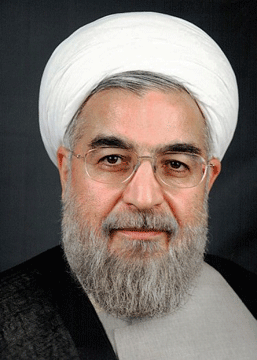 Iran’s President Pledges to Face Down Forces Opposing a Nuclear Deal, NYT, By THOMAS ERDBRINK DEC. 15, 2014 TEHRAN — Risking his political standing, Iran’s president stressed on Monday that he was determined to cinch a nuclear deal and prepared to take on the conservative forces who would prefer not to see an agreement with the West, even if that means continued economic sanctions on Iran.
“Some people may not like to see the sanctions lifted,” the president, Hassan Rouhani, said as Iranian negotiators and their United States counterparts resumed talks in Geneva. “Their numbers are few, and they want to muddy the waters.”
A deadline for those talks was extended by seven months after the parties failed to conclude a deal in November. Mr. Rouhani is continuing to maintain that a deal will be concluded. His foreign minister, Mohammad Javad Zarif, said last month that an agreement could be reached in a matter of “weeks.”
Both men have tied their political future to the deal, analysts say. Despite the setbacks in the talks, Mr. Rouhani stays on message on what he says isIran’s bright future……..http://www.nytimes.com/2014/12/16/world/middleeast/irans-president-pledges-to-face-down-forces-opposing-a-nuclear-deal.html?_r=0
1 This Month




PLEASE OPPOSE HR 8255 AND S.3639 – bills would accelerate satellite deployment, with no environmental review or safeguards – https://ncstd5li.quorum.us/campaign/169331/
To see nuclear-related stories in greater depth and intensity – go to https://nuclearinformation.wordpress.com
-
Archives
- September 2026 (339)
- August 2026 (330)
- July 2026 (355)
- June 2026 (287)
- May 2026 (306)
- April 2026 (356)
- March 2026 (251)
- February 2026 (267)
- January 2026 (308)
- December 2025 (358)
- November 2025 (359)
- October 2025 (375)
-
Categories
- 1
- 1 NUCLEAR ISSUES
- business and costs
- climate change
- culture and arts
- ENERGY
- environment
- health
- history
- indigenous issues
- Legal
- marketing of nuclear
- media
- opposition to nuclear
- PERSONAL STORIES
- politics
- politics international
- Religion and ethics
- safety
- secrets,lies and civil liberties
- spinbuster
- technology
- Uranium
- wastes
- weapons and war
- Women
- 2 WORLD
- ACTION
- AFRICA
- Atrocities
- AUSTRALIA
- Christina's notes
- Christina's themes
- culture and arts
- Events
- Fuk 2022
- Fuk 2023
- Fukushima 2017
- Fukushima 2018
- fukushima 2019
- Fukushima 2020
- Fukushima 2021
- general
- global warming
- Humour (God we need it)
- Nuclear
- RARE EARTHS
- Reference
- resources – print
- Resources -audiovicual
- Weekly Newsletter
- World
- World Nuclear
- YouTube
-
RSS
Entries RSS
Comments RSS

