Chinese government not happy with North Korea’s nuclear weapons program

 CHINA-NORTH KOREA NUCLEAR STANDOFF Eurasia Review By Debalina Ghoshal Even though North Korea and China have traditionally shared strong ties, their “key divergence” lies in Pyongyang’s nuclear program. China is an important ally for North Korea, but despite this, China has not reacted positively to North Korea’s nuclear ambitions. China is keen on the denuclearization of Northeast Asia, and hence views North Korea’s nuclear ambitions as an obstacle to achieving this goal. North Korea, on the other hand, views its nuclear program as a “treasure sword” with which it can counter threats from the United States and its ally of South Korea.
The United States and South Korea have realized the importance of Beijing in any matter pertaining to the denuclearization of North East Asia. This was also echoed by US Secretary of State John Kerry when he opined that given its extensive trade relations with North Korea, China has “greater potential” to influence North Korea’s behavior [its nuclear ambitions that is] more than any other power……….http://www.eurasiareview.com/12122014-china-north-korea-nuclear-standoff-oped/
Iran and other countries look forward to business boom when nuclear deal is achieved
 Anticipating Nuclear Deal and End to Sanctions, Iran Awaits a Business Boom, NYT By THOMAS ERDBRINK DEC. 12, 2014 “……….it is almost an article of faith in business circles that the latest extension is only the postponement of an inevitable thaw between Iran and the rest of the world…………
“The world needs this deal, we need this deal,” Ms. Moghimi said. “It will happen.”
Both moderates and conservatives have expressed concerns about the unchecked rise in expectations, among the public as well as elite business classes, that a deal will be cinched. They have been warning that the enthusiasm could turn to bitter disappointment if the negotiations, set to resume in Geneva next week, should fail, possibly touching off unrest or what some clerics call “another sedition,” a reference to the revolt that followed disputed presidential elections in 2009…….
The wave of optimism began with the election of a moderate president, Hassan Rouhani, who promised to mend Iran’s ties with the world. Mr. Rouhani continues to encourage that thinking, saying just last week that the “nuclear issue would be brought to its destination.” His foreign minister and chief nuclear negotiator, Mohammad Javad Zarif, promised after the most recent extension that a nuclear deal can happen “within weeks.”
The heightened expectations are not solely to be found among Iranians. The flow of foreign delegations to Iran continues at a steady pace, bringing eager businessmen who in conferences laud Iran’s unique geographical position, its stability and largely untapped market of middle-class consumers………http://www.nytimes.com/2014/12/13/world/middleeast/anticipating-nuclear-deal-and-end-to-sanctions-iran-awaits-a-business-boom.html
Iran has made major concessions towards a nuclear deal with the West
 Failed Nuclear Talks Are Not Iran’s Fault, Iran News & Middle East ReportMuhammad Sahimi .25 Nov 14Nov. 24, the deadline for reaching a comprehensive agreement between Iran and P5+1 — the five permanent members of the United Nations Security Council plus Germany — came and went without the agreement.
What happened? Iran made major concessions. It was excessive demands by the U.S. and its allies that prevented the comprehensive agreement from materializing.
The original Geneva interim agreement expired last July, but both sides agreed to extend the deadline for reaching a comprehensive agreement to Nov. 24. Now, a new deadline of June 30, 2015 has been set. Both sides said that much progress was made, but some difficult issues have remained unresolved.
The agreement would have created an entirely new dynamic for the war-torn Middle East. It would have ushered in a new era of cooperation between two old nemeses, Iran and the United States, to defeat their common enemy, the Islamic State.
Given the historic significance of the agreement, why is it that a breakthrough was not achieved?
Iran’s Major Concessions
Several complex issues that had seemed unresolvable have actually been hammered out, but only because Iran was willing to negotiate with a spirit of compromise, of give and take.
Abbas Araghchi, Iran’s deputy foreign minister and a principal negotiator, has emphasized repeatedly and emphatically, “Iran would not agree to close any of its nuclear facility.” Iran has agreed to convert the site to a nuclear research facility, representing a major concession.
A second concession involved the IR-40 heavy water nuclear reactor, under construction in Arak, 155 miles southwest of Tehran. When completed, it will replace Tehran Research Reactor, an almost 50-year-old reactor that produces medical isotopes for close to 1 million Iranian patients every year.
The West had demanded that Iran convert the IR-40 to a light-water reactor, due to the concerns that if the reactor, when it comes online, will produce plutonium that can be used to make nuclear weapons. But, Iran refused to go along because, first and foremost, all the work on the reactor has been done by the Iranian experts and thus the reactor is a source of national pride. Iran has already spent billions of dollars to design and begin constructing the reactor, but the West was not willing to share the cost of the reactor conversion to a light-water one.
On its own initiative, Iran has agreed to modify the design of the reactor so that it will produce much smaller amounts of plutonium. Iran also agreed not to build any reprocessing facility for separating the plutonium from the rest of the nuclear waste. This was again a major concession.
The fourth major concession made by Iran is related to the issue of inspection of Iran’s nuclear facilities by the IAEA. Although Iran had lived up to its obligations under its original Safeguards Agreement with the agency signed in 1974, the IAEA under its Director-General Yukiya Amano, who has completely politicized the agency that has contributed to the complexities of reaching the comprehensive agreement, has been insisting that Iran implement the provisions of the Additional Protocol of the SG Agreement, which Iran signed in 2003 and, without ratification by its parliament, implemented voluntarily until February 2006.
Iran set aside the Additional Protocol after the European Union reneged on its promises made to Iran in the Sa’dabad Declaration of October 2003 and the Paris Agreement of November 2004. Iran and the IAEA reached an agreement in November 2013, according to which Iran allows much more frequent and intrusive inspection of its nuclear facilities, way beyond its legal obligations under its SG Agreement. Since then, the IAEA has repeatedly confirmed that Iran has lived up to its obligations.
The U.S. Excessive Demands
Three of the remaining issues concern the number of centrifuges that Iran gets to keep over the duration of the agreement, the duration of the comprehensive agreement and the mechanism by which the crippling economic sanctions imposed on Iran by the U.S. and its allies would be lifted.
In fact, agreeing to limit the number of its centrifuges for the duration of the agreement is yet another significant, but unacknowledged, concession by Iran, a signatory of the Nuclear Non-Proliferation Treaty. Iran’s SG Agreement with the IAEA
The issue of the number of centrifuges, NoC, is also mostly superficial. ………http://www.huffingtonpost.com/muhammad-sahimi/iran-nuclear-talks-fail_b_6219646.html?utm_hp_ref=worldPosted: 11/25/2014
The importance of a nuclear deal with Iran, and how it might work out
The Diplomatic Effort, and What a Final Agreement Might Look Like, NYT By DAVID E. SANGERNOV. 21, 2014 VIENNA — Everything about the nuclear negotiations with Iran, now approaching a crucial moment, is complex: the international politics, the implications for the Middle East, and the science of how to prevent a nuclear energy project from turning into a nuclear weapons program. Here are answers to questions about the lead up to the diplomatic effort and what a comprehensive agreement might look like……….
Q. What are the possible outcomes from negotiations?
A. One possibility is no deal at all, a complete collapse of negotiations that have been going on now for more than a year. But that would not be in anyone’s interest. Congress would most likely impose new sanctions and if the current temporary agreement, reached last year to give some time and space for these negotiations, is allowed to expire, Iran could resume producing a type of fuel that could be rapidly converted for weapons use.
So the most likely outcome is either a final agreement, some kind of muddled agreement in principle with the details to be worked out later or another extension in the talks.
Q. What has to happen in order to reach an agreement?
A. For any agreement to work, there needs to be three deals: One between the West and Iran, one between Mr. Obama and a skeptical Congress and one between the Iranian negotiators and Ayatollah Khamenei. The dynamics of the last two are murky. Mr. Obama wants to suspend sanctions bit by bit, as the Iranians deliver on their part of the deal, meaning Congress might not vote on this for years. That angers many Republicans, and even some Democrats, who say they want a vote. An even bigger mystery: Who makes the final decision in Iran? Presumably, it’s Ayatollah Khamenei’s call, but the Iranian Revolutionary Guard Corps, the elite of Iran’s military, will most likely have a big voice, too.
Q. What is the calculation for Iran?
A. The Iranians have a fundamental choice to make: Is the nuclear program worth it? Most ordinary Iranians tell pollsters that they support a civilian nuclear program in Iran, and very much want the West to show the kind of respect to the country that it shows to other nations with nuclear technology. And they say Iran has no interest in nuclear weapons, just what Ayatollah Khamenei has said, including a fatwa or legal opinion declaring that the country should never possess them. Iran has a young population, and it yearns for Western travel, Western education and Western respect. An end to sanctions would be a sign of a new era.
But inside the Iranian military, and among the clerics, Iran’s nuclear program is both an insurance policy and a symbol of the nation’s identity as a revolutionary state in a long struggle with the United States and its allies. Iranian leaders have periodically observed that since North Korea tested its nuclear devices, no one has dared push it to the brink. And it did not escape their notice that a decade after Libya gave up its entire nuclear program, its leader, Col. Muammar el-Qaddafi, was ousted an then killed by a combination of a national uprising and a European, Arab and American bombing campaign.
In the end, these negotiations are not only about nuclear capability, but also national pride and mutual reassurance. Iran does not want to be treated as an outlier, but rather as a great regional power. The international community needs the confidence that if the Iranians raced for a bomb, it would have plenty of notice and time to react. http://www.nytimes.com/2014/11/22/world/middleeast/iran-nuclear-difficulties-in-reaching-agreement.html?_r=0
Vital need for nuclear deal with Iran – otherwise Iran will link up with Russia
Failure to reach a nuclear deal will drive Iran into Russia’s arms, Ft.com November 20, 2014 Ariane TabatabaiIt is vital a comprehensive deal on Iran’s nuclear programme is reached, writes Ariane Tabatabai
This isolation has left Tehran no option but to turn to Moscow. And, as relations between the US and Russia have deteriorated, the Middle Eastern state has the scope to become an evermore decisive and divisive factor.
Failure to reach a comprehensive deal on Iran’s nuclear programme, and to lay the path for more normal economic and political relations with the world, would propel Tehran into Moscow’s arms. It would foster an even more powerful Russian-Iranian axis. This would be worrying for opponents of a deal on Capitol Hill, most of whom also do not want Russian influence to grow. By blocking the way to a deal, they could facilitate and accelerate what they want to prevent.
The writer is an associate with the Harvard Kennedy School’s Belfer Center for Science and International Affairs http://www.ft.com/cms/s/0/af14ed0c-6e57-11e4-afe5-00144feabdc0.html#axzz3Jm01599t
India being dudded by Westinghouse, GE and Areva on nuclear power program?
Globally, nuclear power is set to face increasing challenges due to its inability to compete with other energy sources in pricing. Another factor is how to manage the rising volumes of spent nuclear fuel in the absence of permanent disposal facilities. ……. nuclear power is in no position to lead the world out of the fossil fuel age.
 False promise of nuclear power, THE HINDU, BRAHMA CHELLANEY 19
Nov 14
“…….Westinghouse, GE and Areva also wish to shift the primary liability for any accident to the Indian taxpayer so that they have no downside risk but only profits to reap. If a Fukushima-type catastrophe were to strike India, it would seriously damage the Indian economy. A recent Osaka City University study has put Japan’s Fukushima-disaster bill at a whopping $105 billion.
To Dr. Singh’s discomfiture, three factors put a break on his reactor-import plans — the exorbitant price of French- and U.S.-origin reactors, the accident-liability issue, and grass-roots opposition to the planned multi-reactor complexes. Continue reading
Nuclear catastrophe could result from isolating Russia from the West
For U.S. and Russia, Isolation Can Lead to Nuclear Catastrophe NYT, NOVEMBER 15, 2014, Siegfried S. Hecker is a research professor and senior fellow in the department of management science and engineering at Stanford University. He was director of the Los Alamos National Laboratory from 1986 to 1997, and is completing a book with Russian colleagues on U.S.-Russian nuclear cooperation.
Moscow’s announcement that no new joint Russian – U.S. projects to secure nuclear materials in Russia are “envisioned” in 2015 came as no surprise. Over the past 10 years the Russian government has systematically terminated most cooperative threat reduction projects initiated after the collapse of the Soviet Union. Nuclear cooperation was born of necessity because the political chaos and economic hardship endangered Soviet nuclear assets, those in Russia and other former Soviet states……..
Cooperative threat reduction was highly successful. Nothing really terrible happened in the Russian nuclear complex since the Soviet collapse. Threat reduction was not only cooperative, but it was highly collaborative. Hundreds of Russian and American nuclear weapons scientists and engineers worked hand in hand in each other’s facilities to vastly improve Russian practices and technologies to help them better secure and safeguard their enormous stocks of weapons-grade nuclear materials. They collaborated on how to ensure the safety and security of nuclear weapons in transport, storage and disassembly. They collaborated on how to strengthen nonproliferation and export control regimes and to prevent nuclear terrorism………
Moscow is willing to collaborate in science and nuclear energy technologies, but is terminating bilateral security cooperation. Washington wants to continue the latter, but in response to the Ukraine crisis, is isolating Russia from broader scientific and nuclear energy cooperation. The combined actions will diminish safety and security, as well as threaten nuclear cooperation in other key areas of common interest, such as countering nuclear terrorism and preventing nuclear proliferation.
My Russian colleagues and I believe that in nuclear matters, collaboration is essential, whereas isolation can lead to catastrophes. It is important for both Moscow and Washington to heed this message.http://www.nytimes.com/roomfordebate/2014/11/14/standing-up-to-aggression-or-ensuring-nuclear-security/for-us-and-russia-isolation-can-lead-to-nuclear-catastrophe
Russia’s nuclear czar, Sergei Kirienko plans wind down of nuclear security co-operation
After Two Decades Of Cooperation, Russia May Pull The Plug On Nuclear Security Contracts With The US, Business Insider 15 Nov 14 PIERRE BIENAIMÉ In the years following the dissolution of the Soviet Union in 1991, Russia’s former American rival has spent billions helping Moscow secure a sprawling network of nuclear infrastructure, in the interest of lowering the odds that weaponised uranium might fall in the hands of extremists or rogue states.

Now Russia may be planning to wind down those joint efforts, the New York Times reported. Sergey V. Kirienko, the head of Russia’s state nuclear company, told US Energy Secretary that no new contracts aimed at nuclear security for 2015 were envisioned “under current circumstances” — a concise reference to the ratcheting tensions between Russia and the West since its annexation of Crimea in March………http://www.businessinsider.com.au/russia-may-stop-cooperating-with-the-us-2014-11/
USA pressure forces Auzstralia’s climate denialist PM to make one tiny concession on Climate Change, at the G20
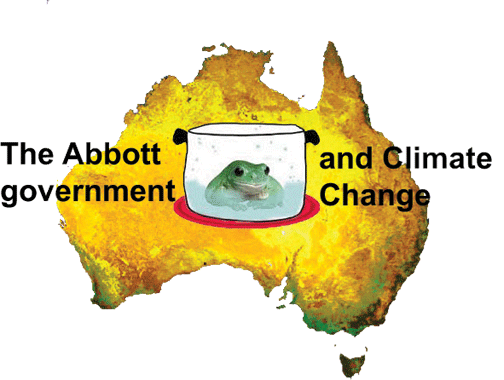 G20: Australia makes token concession on climate change after US lobbying Lenore Taylor, Guardian Australia political editor theguardian.com, Sunday 2 November 2014
Government resists calls for climate change to be listed as a major agenda item, but agrees to include in final communique Australia has reluctantly conceded that climate change can be included in a single brief paragraph of the G20 leaders’ communique after heavy lobbying by the US and European nations.
The government had resisted any discussion of climate at the Brisbane meeting on the grounds that the G20 is primarily an economic forum, but other nations argued leaders’ agreements at meetings like the G20 are crucial to build momentum towards a successful international deal at the United Nations conference on climate change in Paris next year.
The final wording of the leaders’ statement after the meeting is still being finalised but it is believed to simply recommit to addressing climate change through UN processes.
The outcome – and Australia’s resistance – have been attacked by the leading climate economist Lord Nicholas Stern, who has written for Guardian Australia that the latest “synthesis” report by the Intergovernmental Panel on Climate Change (IPCC) should be “high on the agenda” for the G20 meeting.
“The G20 is the most effective forum for the discussion of the growth story of the future, the transition to the low-carbon economy. Yet the local politics of a country of less than 25 million is being allowed to prevent essential strategic discussions of an issue that is of fundamental importance to the prosperity and well-being of the world’s population of 7 billion people,” he writes.
Australia has agreed the G20 should discuss climate-related issues as part of its deliberations on energy efficiency, but this also appears to be wrapped up in a general commitment that countries consider taking action in the future on some of a long list of areas where energy efficiency improvements might be made……
In a special “message” about the G20 release on Sunday, Tony Abbott also did not mention climate change……..
US president Barack Obama’s international adviser, Caroline Atkinson, has insisted publicly that leaders around the table at the G20 will raise climate change. http://www.theguardian.com/world/2014/nov/02/g20-australia-makes-token-concession-on-climate-change-after-us-lobbying
Thorium – no prospects as an energy source, but China might use it for weapons
 NUCLEAR OPTIONS: WHAT EXPLAINS U.S.-CHINA COOPERATION ON THORIUM? Georgetown Public Policy Review MATTHEW STRABONE NOVEMBER 6, 2014
South Africa’s Cabinet not informed on nuclear agreements signed with France and Russia

 Cabinet still not briefed over nuclear agreements — Radebe, Business Day Live BY PAUL VECCHIATTO, 07 NOVEMBER 2014, THE Cabinet, the government’s highest decision-making body, has not been briefed on the nuclear framework agreements signed with France and the Russian Federation……..Business Day, Sunday Times and the Council for the Advancement of the South African Constitution will together make an application under the Promotion of Access to Information Act (PAIA) requesting evidence of a record of decision to forge ahead with nuclear power plants.
The application will also request information on the protocols and processes followed prior to the signing of the agreements as well as for documentation on any affordability study into the commissioning of nuclear power plants.
An earlier PAIA application by the Sunday Times to the Presidency, Parliament and the Department of Energy for access to the framework agreement SA signed with Russia two months ago, was refused this week by the Department of Energy. The department said the release of the agreements would compromise the delicate negotiations that SA was holding with other countries.
The department said the agreements contained sensitive scientific and commercial information.
The Sunday Times now has 60 days to lodge an appeal on its first application with the department in order to change its decision.
The opaqueness of the decision to build nuclear reactors has caused consternation among observers, the suspicion being that the government has already struck a secret deal with the Russian Federation.
It is believed that the Cabinet has not made a formal decision to procure nuclear power stations, yet Department of Energy officials have insisted on several occasions “that a procurement will take place”.
Director of the council, Lawson Naidoo, said clarity was needed on the decision-making process to establish whether proper governance was followed. “I don’t understand how an international agreement can be signed (by the minister) without the approval of Cabinet. How does a minister get the authority to sign without the approval of Cabinet?”…….http://www.bdlive.co.za/business/energy/2014/11/07/cabinet-still-not-briefed-over-nuclear-agreements–radebe
Sound reasons for co-operation and a nuclear deal with Iran
 7 reasons not to worry about Iran’s enrichment capacity, ALMONITOR 5 Nov 14 Iran and the five permanent members of the UN Security Council plus Germany are aiming to end the standoff over Iran’s nuclear program by Nov. 24. Iranian and US officials have confirmed that progress was made in the extremely complicated nuclear talks in mid-October in Vienna. …………The following are seven reasons not to be too overly concerned about Iran’s breakout capability:
- Under the current International Atomic Energy Agency (IAEA) rules and regulations, the maximum level of transparency for nuclear activities would be secured by the implementation of its three arrangements: the Safeguard Agreement, Subsidiary Arrangement Code 3.1 and the Additional Protocol. The world powers negotiating with Iran have a clear understanding that Iran is ready to commit to all three arrangements in a final comprehensive agreement.
- Iran would be cooperative in capping its level of enrichment at 5% for the duration of the final agreement to assure non-diversion toward weaponization. The fissile uranium in nuclear weapons contains enrichment to 85% or more.
- To ensure that Iran’s enrichment activities do not lead to a bomb, Tehran would be willing to synchronize the number of centrifuges or their productivity to its practical needs and convert the product to oxide for a number of years. Iran’s major practical need is to provide fuel for the Bushehr plant in 2021, when its fuel-supply contract with Russia terminates. Practically, out of the current 22,000 centrifuges, Iran would need around 9,000 to 10,000 to provide enough fuel annually for the four fuel elements (out of a total 54 fuel elements) for Bushehr that Russia is contractually required to supply.
- Regarding the heavy water facility at Arak, Iran would be cooperative in placing greater monitoring measures and modifying the reactor to reduce the annual enriched plutonium production capacity of 8-10 kilograms (18-22 pounds) to less than 0.8 kilograms (1.7 pounds). Furthermore, the 0.8kg of material will be 78% fissile, which is too low for the production of nuclear weapons, and the timeline for redesigning and building the reactor will require another five to six years.
- Secularizing the supreme leader’s fatwa banning the production and stockpiling of nuclear and all other weapons of mass destruction would be a strong objective guarantee. Once the fatwa is secularized and operationalized, violation would be a criminal matter for the courts to pursue and punishable by law. Iran’s history makes it hard to dismiss the fatwa. After all, despite an estimated 100,000 deaths from Iraqi use of chemical weapons against Iran, it was a fatwa issued by the late Ayatollah Ruhollah Khomeini that kept Tehran from retaliating during the Iran-Iraq war.
- Iran has paid a high price for its nuclear program, having endured a barrage of draconian multilateral and unilateral sanctions to date. The sanctions imposed against Iran are far beyond those imposed on North Korea, which does possess nuclear weapons. The fact is that Iran has already paid the price for making a bomb, but neither wants nor has one, a clear indicator of its steadfastness on nonproliferation and the peaceful use of nuclear technology.
- If anyone were going to have made the decision to build nuclear weapons, it would have been former President Mahmoud Ahmadinejad. Yet, during his eight years in the presidency, the IAEA found no evidence of an Iranian nuclear program geared toward weaponization, and his administration sought to normalize bilateral relations with the United States more than all his predecessors.
I am confident that Iran, the United States and the world powers genuinely seek to reach a deal and that there is no reason to extend the deadline beyond late November. The best strategy is to pursue a broad engagement with Iran to ensure that the decision to pursue a nuclear breakout will never come about. Iran and the United States are already tacitly and indirectly cooperating in the fight against the Islamic State (IS). A nuclear agreement would be a great boost to mutual trust and provide greater options for dealing not only with IS and the Syrian regime but also Afghanistan and Iraq — where both Washington and Tehran support the new governments in Kabul and Baghdad. Rather than focusing onenrichment capacity, Washington should weigh its capacity for relations with Iran. http://www.al-monitor.com/pulse/originals/2014/11/iran-nuclear-enrichment-uranium-iaea-fatwa-sanctions.html?utm_source=Al-Monitor+Newsletter+%5BEnglish%5D&utm_campaign=a39e197e64-November_5_2014&utm_medium=email&utm_term=0_28264b27a0-a39e197e64-93115393##ixzz3IKFLTdR3
Urgent need now for a nuclear deal with Iran
The time for a nuclear deal with Iran is now The Guardian, Thursday 6 November 2014 We urge the the EU3+3 countries (the UK, Germany and France and the US, China and Russia) and Iran to reach agreement on a comprehensive nuclear deal by the 24 November deadline. Postponing the final tough decisions ahead is likely to provide more opportunities for those opposing the diplomatic track to spoil this process. This is especially so when creative technical solutions have been formulated and a deal is within reach – a deal that will peacefully and effectively address proliferation concerns of the EU3+3 over Iran’s nuclear programme, while respecting Iranian legitimate aspirations and sovereignty.The interim nuclear deal signed in November 2013 provided the most robust assurances for the EU3+3 to date by placing rigorous monitoring over Iran’s nuclear programme while capping and rolling back its enriched uranium output. To reach this stage of negotiations, Europeans have invested extensive resources by carrying the economic costs of an unprecedented sanctions regime against Iran as well as the regional consequences of pursuing isolation of Tehran. Europe must seize this moment to encourage the negotiating parties to address the outstanding areas through reasonable compromises while steering clear of issues that are not essential to a good deal. Europeans should also work with the US administration in reassuring sceptical regional allies of the long-term strategic benefits entailed in a final nuclear deal.
The cost of failed negotiations should also be borne in mind. …….http://www.theguardian.com/world/2014/nov/05/time-for-nuclear-deal-with-iran-now
Russia will not attend 2016 nuclear security summit
Russia told U.S. it will not attend 2016 nuclear security summit WASHINGTON/MOSCOW Wed Nov 5, 2014 (Reuters) – Russia has told the United States that it will not attend a 2016 nuclear security summit, the State Department said on Wednesday, in the latest sign of frosty ties between Washington and Moscow.
Explaining why it would stay away, Moscow said it doubted the value of the summit, which is to be held in Chicago in 2016, and believed the views of states which disagreed with the event’s organizers would be ignored.
Instead, Russia would focus on a similar conference to be held also in 2016 by the United Nations nuclear body, the International Atomic Energy Agency (IAEA), the Russian Foreign Ministry said.
The bi-annual summit aims to improve nuclear security around the world and, in the past, has involved more than 50 countries including China, France, Germany and Britain……….http://www.reuters.com/article/2014/11/05/us-nuclear-security-usa-russia-idUSKBN0IP24K20141105
Russia fails to show up at nuclear security meeting
Russia boycotts nuclear meeting By GEORGE JAHN and DEB RIECHMANN 3 Nov 14
VIENNA (AP) — Russia has failed to show up at meeting planning the 2016 Nuclear Security Summit, U.S and European officials said Monday, in a potentially serious blow to efforts by President Barack Obama to cement his legacy as leaving the world safer from nuclear terrorism than when he took office.
The officials said it was not immediately clear whether Russia’s absence meant that Moscow meant to boycott the summit itself or if it was a temporary show of displeasure over Washington’s harsh condemnation of Moscow’s role in Ukraine unrest and its lead in orchestrating Western sanctions and other punitive measures in response.
But even if short-term,, Russia’s no-show is significant. Only three or four planning meetings are scheduled before the spring of 2016, when the summit is tentatively set to open. With Russia a key global player — and one of the world’s five formally recognized nuclear powers — its input is crucial to setting an agenda.
The U.S. president initiated a string of summits in 2010 aimed at preventing terrorists from getting their hands on weapons-grade nuclear material. Since then, the number of countries that have enough material to build a nuclear weapon has fallen from 39 to 25. http://abcnews.go.com/International/wireStory/apnewsbreak-russia-boycotts-nuclear-meeting-26666344
1 This Month




PLEASE OPPOSE HR 8255 AND S.3639 – bills would accelerate satellite deployment, with no environmental review or safeguards – https://ncstd5li.quorum.us/campaign/169331/
To see nuclear-related stories in greater depth and intensity – go to https://nuclearinformation.wordpress.com
-
Archives
- September 2026 (339)
- August 2026 (330)
- July 2026 (355)
- June 2026 (287)
- May 2026 (306)
- April 2026 (356)
- March 2026 (251)
- February 2026 (267)
- January 2026 (308)
- December 2025 (358)
- November 2025 (359)
- October 2025 (375)
-
Categories
- 1
- 1 NUCLEAR ISSUES
- business and costs
- climate change
- culture and arts
- ENERGY
- environment
- health
- history
- indigenous issues
- Legal
- marketing of nuclear
- media
- opposition to nuclear
- PERSONAL STORIES
- politics
- politics international
- Religion and ethics
- safety
- secrets,lies and civil liberties
- spinbuster
- technology
- Uranium
- wastes
- weapons and war
- Women
- 2 WORLD
- ACTION
- AFRICA
- Atrocities
- AUSTRALIA
- Christina's notes
- Christina's themes
- culture and arts
- Events
- Fuk 2022
- Fuk 2023
- Fukushima 2017
- Fukushima 2018
- fukushima 2019
- Fukushima 2020
- Fukushima 2021
- general
- global warming
- Humour (God we need it)
- Nuclear
- RARE EARTHS
- Reference
- resources – print
- Resources -audiovicual
- Weekly Newsletter
- World
- World Nuclear
- YouTube
-
RSS
Entries RSS
Comments RSS

