Danger for India in weakening Liability law, and no benefit to India in USA nuclear deal
The most baffling feature of the current agreement is that it holds no tangible benefits for India. The United States has offered to sell two reactor designs — both of which are expensive and untested.
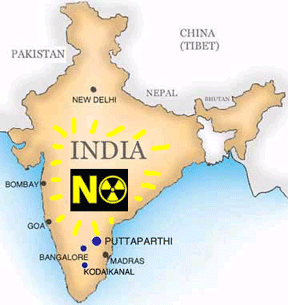 Last week, the residents of Mithi Virdi wrote an open letter to Mr. Obama and Mr. Modi reminding them that the “gram panchayats of four most-affected villages … [have] passed a resolution declaring the entire … region as [a] nuclear free zone.” The leaders of the “world’s largest democracies” face a clear choice. They can channel billions of dollars into nuclear corporations by sacrificing safety and economic prudence. Or they can heed the democratic voices from Mithi Virdi and cancel these unnecessary deals.
 Nuclear deal no cause for celebration THE HINDU, SUVRAT RAJUM. V. RAMANA 31 Jan 15 Any understanding between Narendra Modi and Barack Obama on circumventing the Indian nuclear liability law to protect American reactor suppliers should be a matter of concern
At their recent meeting, Prime Minister Narendra Modi and President Barack Obama discussed methods of circumventing the Indian nuclear liability law to protect American reactor suppliers from the consequences of accidents caused by design defects. Although public details are scarce, if they have indeed reached an understanding on the issue, then this is not a cause for celebration; it should be a matter of deep concern.
The importance of supplier liability is illustrated by the Fukushima nuclear disaster in 2011. When the reactors were hit by the tsunami that year, the weakness of the General Electric (GE) Mark I design was cruelly exposed. The reactors’ inadequate containment was unable to prevent the spread of radioactivity when the cooling systems failed and pressure built up inside the reactors. Although this design defect was first noted about 40 years ago, just as the Fukushima reactors were commissioned, the industry resisted regulatory changes that could have ameliorated the disaster.
Framework of impunity
The Japan Center for Economic Research estimated that the cost of cleanup at Fukushima may reach $200 billion. A 2013 expert study “Accounting for long-term doses in worldwide health effects of the Fukushima Daiichi nuclear accident” published in the journal Energy and Environmental Science estimated that the disaster may lead to about a thousand excess deaths due to cancer. However, it is unlikely that GE will ever be held accountable for its poor design choice. Under Japanese law, the supplier is indemnified from liability for an accident. This is the framework of impunity under which nuclear suppliers like to operate.
Legal indemnity for suppliers creates a “moral hazard”— encouraging suppliers to take excessive risks since they don’t have to pay for the consequences. The case of GE not strengthening the Mark I containment is not an exception. Continue reading
Diplomatic incident, as Russian nuclear bomber planes fly off west coast of Ireland
Russian nuclear bomber planes fly off west coast of Ireland as British Typhoon fighters scrambled, Irish Independent Brian O’Reilly and Philip Ryan 30/01/2015 RUSSIAN bomber planes capable of carrying nuclear weapons flew past the west coast of Ireland on Wednesday – forcing Britain to scramble Typhoon fighter jets in response. A diplomatic incident was sparked when Russian Tu-95 ‘Bear’ bomber planes flew past the west coast of Ireland and into the English Channel before turning and going back the same way.
It was reported that the heavily armed aircraft were flying without their transponders – meaning they were invisible to commercial airlines.
Britain scrambled its fighter jets in response – as Ireland is considered to be within its ‘area of interest’ for defence.
The Russian Embassy in Ireland issued a robust defence of the country’s decision to fly bomber jets near Irish airspace.
However the Department of Defence said while the Russian aircraft did not enter Irish sovereign airspace at any time, such non-notified and non-controlled flight activity is not acceptable.
“The Irish authorities will discuss with their UK counterparts how best to seek to resolve this through the International Civil Aviation Organisation,” it said……http://www.independent.ie/irish-news/russian-nuclear-bomber-planes-fly-off-west-coast-of-ireland-as-british-typhoon-fighters-scrambled-30949988.html
Many a slip twixt the much touted USA-India deal and commercial reality
Hurdles Remain in Nuclear Deal, Indian Express By B B Singh 30th January 2015 For almost two weeks prior to president Barack Obama’s visit to India, the negotiators from both the countries had been burning the midnight oil to operationalise Indo-US nuclear cooperation but hurdles seem to be emerging one after another. The first and the most talked about hurdle arose from Section 17 (b) of the Civil Liability for Nuclear Damage Act 2010, giving the right of recourse to the operator of the nuclear installation if nuclear incident resulted as a consequence of an act of the supplier or his employee which includes supply of equipment or material with patent or latent defects or sub-standard services.
This provision was introduced to ensure that the suppliers took utmost care since they would be liable even for “latent” defects that may exhibit their appearance in their equipment later on after extended exposure to nuclear related stresses. This problem seems to have been solved by India’s proposal for an insurance cover of `1500 crore out of which 50 per cent would be government contribution and the remaining from a pool of insurance companies which are public sector units.
Oddly, it would mean victims compensating victims.
The next conflict has arisen in respect of Section 46 of the Act which provides that its provisions shall be in addition to and not in derogation of any other law for the time being in force. It further provides that nothing contained in this Act shall exempt the operator from any proceeding which might, apart from this Act, be instituted against such operator or the suppliers directly or through the operator. The victims of nuclear incidents are thus entitled to file tort suits for unlimited damages and even criminal proceedings against the operator as well as suppliers. ………….
The story does not end here. There is still some more to come. Under the Hyde Act, the US president is further required to submit to an appropriate Congressional committee any significant changes in the nuclear activities of India including construction of nuclear facilities, production of nuclear weapons or changes in nature and amount of fissile material produced and the purpose and operational status of any unsafeguarded new nuclear facility.
Still further under the Hyde Act, the US president shall have to inform the Congress an estimate of the amount of uranium mined and milled in India and amount of such uranium that has likely been used or allocated for weapons; the rate of production of nuclear devices and the material used therein. Some procedure will have to be worked out in the administrative arrangements to achieve this objective and procure such information on India’s non-civilian nuclear activities for information to the US Congress. In view of these requirements, the Indian negotiators are likely to face still tougher uphill tasks ahead.http://www.newindianexpress.com/columns/Hurdles-Remain-in-Nuclear-Deal/2015/01/30/article2643619.ece
If it ever becomes a reality, USA-India nuclear deal a very bad one for Indian public
Financially, solar and wind energy are already becoming more attractive than nuclear. Electricity from these renewable sources cost Rs 8 and Rs 4.5 per unit respectively,according to a report by solar think-tank Bridge to India. Renewables are quicker to erect and are not as politically contentious as nuclear. In contrast, the Mithi Virdi project has run into serious opposition from local residents and farmers. If it is ever built, electricity from the Westinghouse reactors will cost Rs 12 per unit.
 The ‘breakthrough’ in Indo-US nuclear deal will bleed Indians every which way, Scroll In, The taxpayer will be made to pay to cover US companies’ untested technologies and the expensive electricity they generate. Nityanand Jayaraman, 29 Jan 15
India-USA nuclear deal very ‘up in the air’: no document signed
no specific document was signed
India is already generating more power from wind turbines alone than from nuclear power and has announced a solar target of 100 gigawatt by 2022. So it is perfectly coherent that the joint US-India declaration contains one paragraph on nuclear cooperation and eight on clean energy.
 Breakthrough in US-India civil nuclear deal ‘more symbolism than reality’, DW 29 Jan 15 The US and India announced a “breakthrough” in resolving a liability spat that has stalled the implementation of a civil nuclear deal. But Mycle Schneider tells DW this is more about geopolitics than industrial reality.
“…….Mycle Schneider, an independent international consultant on energy and nuclear policy, says in a DW interview that there is no real market for foreign nuclear companies in India, unless they bring their own funding, adding that the recent announcement is more about presenting both countries as equal partners than it is about the vision of a future blooming Indian nuclear export industry.
DW: What exactly does the new nuclear deal entail?
Mycle Schneider: Very little has so far been published about it. First of all, it is unclear whether there is even a “new nuclear deal.” Usually, when heads of state meet, the occasion is used to sign agreements. However, on this issue, the US-India joint statement only says President Obama and Prime Minister Modi welcomed the “understandings reached” on the issues of civil nuclear liability and “administrative arrangements for civil nuclear cooperation.”
Apparently, no specific document was signed. ………
Unlike all other aspirants for nuclear technology aid, India is not required anymore to put its entire fuel chain, facilities and materials, under comprehensive international control or so-called Full-Scope Safeguards. India has merely promised to separate its nuclear weapons related activities from the power sector……….
India law created liabilities for suppliers in the event of a nuclear accident. Are they not liable anymore?
The 2010 Civil Liability for Nuclear Damage Act has been voted by both houses of the Indian parliament. It remains in place as long as it has not been invalidated by a new vote. In that respect, absolutely nothing has changed from the situation prior to President Obama’s visit to India.
Considering the fact that the Act has not only been attacked by the nuclear industry side, but also from civil society representatives because it caps the liability of the nuclear operators to a ridiculously small sum of 240 million USD, reopening the parliamentary debate over this fragile compromise seems unlikely at this point. It also seems unlikely that the establishment of an insurance fund would fundamentally change the liability situation of nuclear suppliers.
What do India and the US expect to gain from this civil nuclear deal?
This is a typical example of announcement politics. Both governments are presenting the outcome of the US-India summit as a great success. But it is more an issue of symbolism and geopolitics than of industrial reality. The promise to continue to work together towards India’s “phased entry” into the Nuclear Suppliers Group as into three other international control regimes is more about presenting both countries as equal partners than it is about the vision of a future blooming Indian nuclear export industry.
Do you expect the Indian market to now become more appealing for US nuclear companies?
In reality, there is no real market for foreign nuclear companies in India, unless they bring their own funding. Under free market conditions it is not possible anymore to build a nuclear power plant anywhere in the world.
So if new reactors are built in India or elsewhere, the projects are highly subsidized, either by the government—the taxpayer—or the ratepayer. The Indian nuclear industry has painted a rosy picture of the nuclear future for decades and has delivered very little in comparison.
It is actually amazing to what extent overstretched projections of “hundreds of billions investment” are still being held up. Disconnected from reality, they are an effect of what Princeton University researcher M.V. Ramana has appropriately described as “The Power of Promise.”
India is already generating more power from wind turbines alone than from nuclear power and has announced a solar target of 100 gigawatt by 2022. So it is perfectly coherent that the joint US-India declaration contains one paragraph on nuclear cooperation and eight on clean energy.
Mycle Schneider is an independent international energy and nuclear policy consultant, based in Paris. He is the convening lead author of the annual World Nuclear Industry Status Report and a member of the Princeton University-based International Panel on Fissile Materials (IPFM). Schneider is a founding member and the spokesperson of the International Energy Advisory Council (IEAC).
The interview was conducted by Gabriel Domínguez. http://www.dw.de/breakthrough-in-us-india-civil-nuclear-deal-more-symbolism-than-reality/a-18221115
A negotiated settlement is the only solution for the Ukraine crisis
Doug Bandow is a senior fellow at the Cato Institute.
USA persuades India to weaken its nuclear liability law – double standards here
Under pressure from GE and Westinghouse, the two American nuclear vendors hoping to sell billions of dollars worth of reactors to India, the Obama administration has demanded that Section 17(b) and Section 46 of the Indian liability law be deleted or amended.
Double standards? The irony is that American nuclear suppliers operate under a domestic liability regime that allows operators to sue them for recovery of damages in the event of an accident. That is how Metropolitan Edison, the operator of the Three Mile Island nuclear plant, sued Babcock Wilcox after the infamous 1979 accident.
 Why India should say no to US demand to dilute its nuclear liability law The Modi government should resist pressure from Barack Obama, who landed in New Delhi on Sunday morning, to change key provisions to favour foreign supplier of reactors. Siddharth Varadarajan Scroll.in 26 Jan 15
With the issue of nuclear liability emerging as an obstacle in the relationship between India and the US, the Modi government is under pressure to dilute the law in favour of foreign reactor suppliers. Without this, we are told, it will not be possible to operationalise the US-India nuclear agreement and provide the country with the electricity its people need.
In the event of a major nuclear accident in India, one which damages lives and property, what does the law say about how liability is to be apportioned? Continue reading
Details remain vague on nuclear deal between Obam and Narendra Modi
Thirty years after an infamous chemical leak killed thousands at Union Carbide’s factory in Bhopal, the threat of tough Indian compensation laws has frustrated US hopes of an export boom in the energy sector – despite an agreement by former US president George W Bush to share civil nuclear technology in 2005.
After pressure from US diplomats, the Indian government was thought to have agreed a state-backed insurance scheme that would cap the exposure of nuclear suppliers and open the door to billions of dollars of new contracts. India will also allow closer tracking of spent fuel to limit the risk of it falling into terrorist hands.
“Today we achieved a breakthrough understanding on two issues that were holding up our civil nuclear cooperation,” Obama said on Sunday………
Details of the deal remain vague, however, and officials stressed they were still working out the finer arrangements of the scheme, which is designed to avoid the need to change Indian law……….
The two governments also said they had struck deals to share defence technology and improve dialogue in future, with a security hotline between Obama and Modi……….
“Nuclear liability remains the cinder in the eye of the relationship right now,” Rick Rossow, of the Centre for Strategic and International Studies (CSIS), said in Washington last week. “Nuclear cooperation was the high-water mark for our bilateral history and the fact that India’s nuclear liability law precludes American involvement, it stings.”
US suggestions of full legal indemnity for suppliers were knocked by the Indian government, which is wary of trying to overturn a 2010 nuclear liability law in parliament……. http://www.theguardian.com/world/2015/jan/25/obama-modi-limit-us-liability-nuclear-disaster
US Republicans out to destroy nuclear talks with Iran
 Iran Sanctions Supporters Don’t Want To Improve Nuclear Talks. They Want To Destroy Them.
 Then things started to fall apart.………
the story had shifted as Kerry boxed the Republicans into admitting their possible true intentions — and all Boehner was left with was a promise for a Netanyahu address at the time of the annual American Israel Public Affairs Committee conference in early March, by which point the administration has said it hoped to already have a framework for the deal.
Meanwhile, Netanyahu got his own rebuke as the White House revealed that it would not meet with him during that March trip. “We do not see heads of state or candidates in close proximity to their elections, so as to avoid the appearance of influencing a democratic election in a foreign country,” said National Security Council spokeswoman Bernadette Meehan.
Ryan Grim and Ali Watkins contributed reporting.
This article has been updated to include comments from M http://www.huffingtonpost.com/2015/01/22/kerry-israel-boehner-_n_6527826.html
Mossad breaks ranks with Israel’s PM Netanyahu, warning against Republican inspired sanctions against Iran
 Mossad says Netanyahu is wrong about Iran nuclear sanctions, The Times 23 Jan 15 Israel’s intelligence agency, Mossad, has broken ranks with Binyamin Netanyahu, the prime minister, to warn that Republican-inspired sanctions on Iran would wreck nuclear talks.
John Kerry, the secretary of state, said that a senior Mossad official had told him that passing a new sanctions bill would be “like throwing a grenade into the process” of talks towards a deal with Iran on its nuclear programme. The same warning was delivered to a congressional delegation that visited Israel last week – ……(subscribers only) http://www.thetimes.co.uk/tto/news/world/middleeast/article4331537.ece
Russia pulls out of US nuclear security alliance

 Russia ends US nuclear security alliance Accord worked to keep stockpiles secure By Bryan Bender BOSTON GLOBE STAFF JANUARY 19, 2015 WASHINGTON — The private diplomatic meetings took place over two days in mid-December in a hotel overlooking Moscow’s Red Square.
But unlike in previous such gatherings, the sense of camaraderie, even brotherhood, was overshadowed by an uncomfortable chill, according to participants.
In the previously undisclosed discussions, the Russians informed the Americans that they were refusing any more US help protecting their largest stockpiles of weapons-grade uranium and plutonium from being stolen or sold on the black market. The declaration effectively ended one of the most successful areas of cooperation between the former Cold War adversaries.
“I think it greatly increases the risk of catastrophic terrorism,” said Sam Nunn, the former Democratic senator from Georgia and an architect of the “cooperative threat reduction” programs of the 1990s.
Official word came in a terse, three-page agreement signed on Dec. 16. A copy was obtained by the Globe, and a description of the Moscow meeting was provided by three people who attended the session or were briefed on it. They declined to be identified for security reasons.
Russia’s change of heart was not unexpected. The Globe reported in August that US officials were concerned about the future of the programs, because of increased diplomatic hostilities between the United States and Russia. The New York Times reported in November that it appeared likely many of the programs would end……..
Now security upgrades have been cancelled at some of Russia’s seven “closed nuclear cities,” which contain among the largest stockpiles of highly enriched uranium and plutonium, according to the official “record of meeting” signed by the sides in December.
The Russians also told the Americans that joint security work at 18 civilian facilities housing weapons material would cease, effective Jan. 1. Another project at two facilities to convert highly enriched uranium into a less dangerous form also has been stopped.
Lack of US funding and expertise also jeopardizes planned construction of high-tech surveillance systems at 13 buildings that store nuclear material, as well as a project to deploy radiation detectors at Russian ports, airports, and border crossings to catch potential nuclear smugglers.
A limited amount of cooperation will continue in other countries that have highly enriched uranium that originated in Russia. The two sides also will continue working on ways to secure industrial sources of radioactive material, which could be used to make a “dirty bomb.’’ The Russian decision will not affect inspections that both sides regularly conduct of each other’s active nuclear arsenals as part of arms control treaties……….
Some warn that the distrust on both sides could bleed into other areas, including arms control treaties.
“It’s important for the US and Russia to have nuclear security, but it is also important for us to believe we have nuclear security,” said Matthew Bunn, a weapons proliferation specialist at the Belfer Center for Science and International Affairs at Harvard University. “That’s hard to do just by saying so.”
US government officials, for their part, insist they are trying to make the best of it.
“We are encouraged that they statedmultiple times that they intend to finish this work,” said David Huizenga, who runs the nonproliferation programs at the National Nuclear Security Administration, an arm of the Department of Energy. Huizenga led the US delegation to Moscow last month.
But he said US officials still hope that the Russians will change their mind and restart a partnership that by most accounts has significantly strengthened global security.
“[It will be] harder to resurrect if we don’t actually engage in any meaningful way,” Huizenga said.
Bryan Bender can be reached at bender@globe.com. Follow him on Twitter @GlobeBender. http://www.bostonglobe.com/news/nation/2015/01/19/after-two-decades-russia-nuclear-security-cooperation-becomes-casualty-deteriorating-relations/5nh8NbtjitUE8UqVWFIooL/story.html
Nuclear meeting between USA and North Korea

 North Korea, US have nuclear meeting, SBS News, 18 jan 15
 The meeting was set to get a feel for each other’s positions amid a years-long standoff over the North’s nuclear weapons buildup. Leon Sigal, director of the Northeast Asia Cooperative Security Project at the Social Science Research Council, a US-based nonprofit, told reporters that the meeting will cover the North’s nuclear missile programs.
He said “it’s two ways of taking each other’s temperature.”
The US and North Korea have no formal diplomatic ties, but former US officials occasionally meet the North’s diplomats in a bid to settle the impasse over Pyongyang’s pursuit of a long-range nuclear-armed missile that could hit the US mainland. North Korea’s team was led by Ri Yong Ho, the chief negotiator for six-party denuclearisation talks……http://www.sbs.com.au/news/article/2015/01/18/north-korea-us-have-nuclear-meeting
The Convention on Supplementary Compensation, or CSC, for nuclear damage, will come into force on April 15: Japan signed
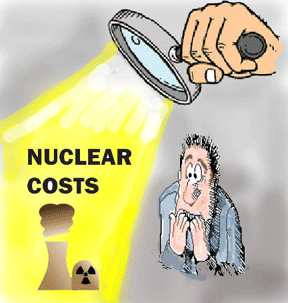 Nuclear-Accident Fund Opens as Japan Signs After 17 Years, Bloomberg, By Jonathan Tirone Jan 16, 2015 Japan signed on to a global nuclear-compensation treaty in Vienna that will create a fund to help victims of accidents like the one that devastated Fukushima Dai-Ichi in 2011.
The Convention on Supplementary Compensation, or CSC, for nuclear damage, will come into force on April 15. The decision taken by Japan, with the world’s third-biggest installed nuclear capacity, ended a 17-year wait for the treaty to become legally binding……….
The convention will allow countries and companies to offset liability in the event of a nuclear accident. The U.S., with the world’s largest installed nuclear-power base, has championed the convention but struggled to get other leading atomic powers on board. Argentina, Morocco, Romania and theUnited Arab Emirates are the only other signatories………
Countries have struggled to reassure populations about the safety of nuclear power after a 2011 tsunami caused three Japanese reactors to melt down and forced 160,000 people to evacuate their homes. At a meeting next month in the Austrian capital, nations will consider a Swiss-led European initiative forcing nuclear operators to mitigate against accidents.
While the new compensation fund is intended to encourage nuclear trade between companies located in countries adhering to the pact, it won’t come without costs for U.S. manufacturers. Nuclear suppliers will be on the hook to pay at least $70 million in compensation in the event of an accident, according to the U.S. Department of Energy, which asked industry for comments last month.
“Initial great expectations for the CSC have been tempered by the long road to its entry into force,” James Glasgow, a partner at Washington-based Pillsbury Winthrop Shaw LLP, wrote last month in an article sent via e-mail. There are still “doubts that the CSC will gain sufficient members to constitute a global regime.”
To contact the reporter on this story: Jonathan Tirone in Vienna at jtirone@bloomberg.net
To contact the editors responsible for this story: Alan Crawford at acrawford6@bloomberg.net Ben Sills, Leon Mangasarian http://www.bloomberg.com/news/2015-01-16/nuclear-accident-fund-opens-as-japan-signs-after-17-years.html
Iran can build 2 nuclear reactors: not in violation of Joint Plan of Action
 State Dept: Iran’s New Nuclear Reactors Don’t Violate Joint Plan of Action by TheTower.org Staff | 01.15.15 Iran’s announced construction of two light-water reactors does not violate the Joint Plan of Action (JPOA) signed between Iran and the P5+1 nations in November 2013, a State Department official told the Washington Free Beacon today.
“We are aware of the announcement and are reviewing the details,” said the official, who was not authorized to speak on record. However, “in general, the construction of light water nuclear reactors is not prohibited by U.N. Security Council resolutions, nor does it violate the JPOA,” the official said. …
“We have been clear in saying that the purpose of the negotiations with Iran is to ensure that Iran’s nuclear program remains exclusively for civilian, peaceful purposes,” the official said. “The talks that we have been engaged in for months involve a specific set of issues relative to closing off all possible pathways to Iran acquiring a nuclear bomb. That remains our focus.”………http://www.thetower.org/1502-state-dept-irans-new-nuclear-reactors-dont-violate-joint-plan-of-action/
Rouhani’s and Obama’s difficult path to a nuclear compromise
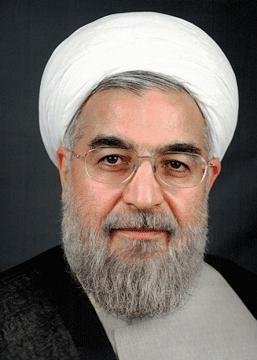 Saving the Nuclear Deal With Iran, NYT, By THE EDITORIAL BOARD JAN. 10, 2015 Twice recently, Iran’s president, Hassan Rouhani, has acted boldly in support of his biggest political gamble, pursuit of a nuclear agreement with the major powers. In a speech last Sunday on Iran’s troubled economy, he argued that Iran will never enjoy sustained growth if it is isolated from the rest of the world. Three weeks earlier, he made clear that he would confront Iran’s hard-liners in his efforts to clinch a deal in which Iran would agree never to produce a nuclear weapon in return for the lifting of crippling international sanctions.
But Mr. Rouhani is not the only leader trying to keep a potential agreement from being savaged by domestic opponents. President Obama has a similar problem in Congress, where Senators Robert Menendez, a Democrat from New Jersey, and Mark Kirk, a Republican from Illinois, are expected to introduce legislation that could torpedo any deal by imposing new sanctions on Iran, including tighter controls on its battered oil industry.
Negotiators for Iran and the major powers — the United States, Britain, France, China, Russia and Germany — resume their talks next week in Geneva. While they have made significant progress, they remain at odds over how large a nuclear program — geared for energy production and medical uses — Iran will be permitted to have.
Mr. Rouhani has shown his seriousness by openly challenging the Iranian hard-liners who are hostile to a deal and by appealing for support from intellectuals, academics, businesspeople and others who are open, even eager, for one. To rally political support, he has also hinted that he might bypass established power centers and submit the issue to a popularreferendum. “Our ideals are not bound to centrifuges,” Mr. Rouhani said in reference to the nuclear program.
Mr. Rouhani’s path to compromise is not easy. ……..http://www.nytimes.com/2015/01/11/opinion/sunday/saving-the-nuclear-deal-with-iran.html
1 This Month




PLEASE OPPOSE HR 8255 AND S.3639 – bills would accelerate satellite deployment, with no environmental review or safeguards – https://ncstd5li.quorum.us/campaign/169331/
To see nuclear-related stories in greater depth and intensity – go to https://nuclearinformation.wordpress.com
-
Archives
- September 2026 (339)
- August 2026 (330)
- July 2026 (355)
- June 2026 (287)
- May 2026 (306)
- April 2026 (356)
- March 2026 (251)
- February 2026 (267)
- January 2026 (308)
- December 2025 (358)
- November 2025 (359)
- October 2025 (375)
-
Categories
- 1
- 1 NUCLEAR ISSUES
- business and costs
- climate change
- culture and arts
- ENERGY
- environment
- health
- history
- indigenous issues
- Legal
- marketing of nuclear
- media
- opposition to nuclear
- PERSONAL STORIES
- politics
- politics international
- Religion and ethics
- safety
- secrets,lies and civil liberties
- spinbuster
- technology
- Uranium
- wastes
- weapons and war
- Women
- 2 WORLD
- ACTION
- AFRICA
- Atrocities
- AUSTRALIA
- Christina's notes
- Christina's themes
- culture and arts
- Events
- Fuk 2022
- Fuk 2023
- Fukushima 2017
- Fukushima 2018
- fukushima 2019
- Fukushima 2020
- Fukushima 2021
- general
- global warming
- Humour (God we need it)
- Nuclear
- RARE EARTHS
- Reference
- resources – print
- Resources -audiovicual
- Weekly Newsletter
- World
- World Nuclear
- YouTube
-
RSS
Entries RSS
Comments RSS

