UN nuclear watchdog IAEA recognizes ‘State of Palestine’
|
UN nuclear watchdog IAEA recognizes ‘State of Palestine’, June 19, 2019 By World Israel News Staff The International Atomic Energy Agency, the U.N.’s nuclear watchdog, took an additional step Tuesday in recognizing the Palestinian Authority (PA) as a state, according to the PA news agency WAFA.
“Palestine and the International Atomic Energy Agency (IAEA) signed today a safeguards agreement at its Vienna headquarters,” said the news agency on Tuesday. “The signing of this agreement follows the accession of the State of Palestine as a State party to the Treaty on the Non-Proliferation of Nuclear Weapons at the beginning of 2015,” WAFA added. A permanent Palestinian “observer to the United Nations and the international organizations in Vienna, Salah Abdul Shafi, signed the agreement on behalf of the State of Palestine along with IAEA director-general, Yukiya Amano,” WAFA reports. “Abdul Shafi said that the signing of this agreement is further proof that the State of Palestine shoulders its international responsibilities as an active member of the international community,” said the PA news agency. Israelis condemn move……. https://worldisraelnews.com/un-nuclear-watchdog-iaea-recognizes-state-of-palestine/ |
|
Iran to further scale back compliance with nuclear deal
|
Iran to further scale back compliance with nuclear deal, CNBC 17 June 19,
KEY POINTS Iran will announce further moves on Monday to scale back compliance with an international nuclear pact that the United States abandoned last year, according to the semi-official Tasnim news agency.
https://www.cnbc.com/2019/06/16/iran-to-scale-back-nuclear-deal-commitments.html |
|
U.S. military intelligence agency increases accusations against Russia about nuclear testing
U.S. military intelligence steps up accusation against Russia over nuclear testing, WP, By Paul Sonne, 14 June 19 The U.S. military intelligence agency stepped up its accusations against Russia over low-yield nuclear testing on Thursday, saying that the country has conducted nuclear weapons tests that resulted in nuclear yield.
The new statement from the Defense Intelligence Agency amounted to a more direct accusation against Russia, compared to hedged comments about Russian nuclear testing that DIA Director Lt. Gen. Robert P. Ashley Jr. made in a speech in Washington in late May.
“The U.S. Government, including the Intelligence Community, has assessed that Russia has conducted nuclear weapons tests that have created nuclear yield,” the DIA statement released Thursday said. The agency didn’t give any details about the alleged tests or release any evidence backing the accusation.
Previously, the agency’s director said that Russia “probably” was not adhering to the “zero-yield” standard the United States applies for nuclear testing. He suggested that Russia was probably conducting tests with explosions above a subcritical yield as part of its development of a suite of more-sophisticated nuclear weapons.
Russia has vehemently rejected Washington’s accusations, with Russian Foreign Minister Sergei Lavrov describing them as delusional.
“We consider claims that Russia may be conducting very low-yield nuclear tests as a crude provocation,” Russia’s Foreign Ministry said in a statement after the DIA first aired the allegations. “This accusation is absolutely groundless and is no more than another attempt to smear Russia’s image.”
DIA’s latest accusation came a day after Under Secretary of State for Arms Control and International Security Andrea L. Thompson met with Russian Deputy Foreign Minister Sergei Ryabkov in Prague to discuss arms control.
The meeting didn’t result in any significant decisions. After the meeting, Thompson said in a message on Twitter that she raised a range of issues on which the United States would like to engage in a more constructive dialogue with Russia. …… https://www.washingtonpost.com/world/national-security/us-military-intelligence-steps-up-accusation-against-russia-over-nuclear-testing/2019/06/13/2dadf2e2-8e26-11e9-b162-8f6f41ec3c04_story.html?utm_term=.9b2400d2dfbe
Japanese PM Shinzo Abe says Iran has ‘no intentions’ to make or use nuclear weapons
Japanese PM Shinzo Abe said Iran’s Supreme Leader made the comment during a meeting in Tehran.Iran’s Supreme Leader Ayatollah Ali Khamenei has assured Japanese Prime Minister Shinzo Abe that Iran has no intention to make, hold or use nuclear weapons, while saying that the country will not negotiate with the United States.
Abe met Khamenei – Iran’s top decision-maker – on Thursday during a trip to Iran in an attempt to ease tensions between the Islamic republic and the US.
Following the meeting, which Iranian President Hassan Rouhani appeared to have also attended, Abe told reporters that Khamenei had told him that Iran “will not and should not make, hold or use nuclear weapons, and that it has no such intentions”.
Shortly after, Iranian state news agency FARS confirmed the comment, but added that Khamenei had said Iran will not negotiate with the US and did not consider President Donald Trump “worthy” of a message from Tehran.
“I do not see Trump as worthy of any message exchange, and I do not have any reply for him now or in the future,” Khamenei was quoted as saying.
The supreme leader also reportedly said that he does not believe Trump’s offer of honest negotiations and that he thinks the US president’s promise not to seek regime change in Iran is a lie.
The comments likely came as a blow to Abe, who told reporters at a joint press conference with Rouhani on Wednesday, that helping to ease tension in the region was “the one single thought that brought me to Iran”.
Abe is completing a two-day visit to Iran, becoming the first sitting Japanese premier to visit the country since its 1979 Islamic Revolution. ………. https://www.aljazeera.com/news/2019/06/iran-intentions-nuclear-weapons-abe-190613064055043.html
The clean-up of the Chernobyl nuclear wreck- the costs and international effort
|
Viewpoint: Chernobyl and a very modern safety culture, WNN, 10 June 2019
The HBO/Sky mini-series Chernobyl is a stark reminder of the immensity of the accident that destroyed unit 4 in 1986. It vividly recalls the pain and suffering of those people, in particular, who tried to address the consequences of the accident in the first few days and weeks. But Chernobyl also clearly highlights how a culture of secrecy and obedience contributed to the accident and hampered efforts to deal with its aftermath. Soviet authorities knew about precursors to the Chernobyl accident but did not share this vital information with operators, who were ordered to run the fatal test without sufficient knowledge about unstable core conditions. A key reminder, if one was needed, is that an effective nuclear safety culture requires well-informed and empowered operators and transparency as well as competent, independent oversight. While Soviet authorities eventually managed to get unit 4 into a relatively stable state by using hundreds of thousands of ‘liquidators’ to cover the reactor with what became known as the ‘object shelter’, the site remains a radiological and technical challenge to this day. If one good thing came out of the Chernobyl disaster, it was the unprecedented international cooperation and solidarity to tackle the consequences of the accident and the cooperation on nuclear safety issues in general. The international community, including the EBRD, has engaged with Ukraine on the various challenges posed by the Chernobyl site since the mid-1990s. One of the first tasks was to finance safety and security upgrades at the sister unit, immediately adjacent to the shelter, which almost unbelievably continued producing electricity until the year 2000. Permanent closure of units 1 to 3 was a clear demand by the international community and, when achieved, it was the first major improvement at the site. In 1997, the EBRD agreed to set up a Donor Fund to finance the Shelter Implementation Plan – a strategy to transform unit 4 and the shelter into an environmentally safe condition. This task came to be supported by 45 donor governments and the EBRD, even though at the time the exact scope, schedule and cost were tentative. The first phase consisted of studies to determine the radiological situation in various parts of the object, the structural stability of the shelter (which had been built quickly using remote technologies as far as feasible), and the possibility of criticality in the destroyed core. What slowly emerged was the outline for a strategy including the construction of a New Safe Confinement (NSC) to enclose unit 4, including the old shelter. A possible collapse of the shelter was the biggest risk to the success of the programme and it could have jeopardised finding a sustainable solution for decades. A priority, therefore, was the design and implementation of measures to stabilise the shelter to minimise that risk. Before the sliding of the NSC, the most visible feature in recent years was a gigantic yellow steel structure to stabilise the western wall of the shelter and to take off most of the weight of its roof. That was one of a dozen measures implemented inside and outside of the shelter, and carried out under extremely difficult radiological conditions, which helped extend the lifetime of the old structure. In parallel, the design for the NSC took shape. One of the requirements was to assemble this structure of more than 100 meters high and 250 meters wide, away from the shelter and to slide it into place once completed. This was necessary to keep radiation exposure to workers to a minimum. A consortium of French companies, Vinci and Bouygues, accomplished this feat. By the end of 2016, the arch-shaped steel structure, complete with a sophisticated crane system, ventilation ducts and cabling for monitoring and control systems, was slid into position over unit 4. The completion of the structure’s sealing and commissioning of all systems was achieved in April 2019. This successful operational test is a game changer for Chernobyl. Now, with the NSC in place and with a design life of 100 years, the conditions have been created to take the next steps……. Thanks to this international effort, Chernobyl is now in a much better shape than it has been for the last 33 years. But it remains a challenging place. Used fuel from units 1 to 3 is stored in a Soviet-era wet storage facility that needs to be decommissioned. Transport of fuel assemblies to a new dry interim storage facility, also funded through an EBRD-managed Donor Fund and EBRD’s own resources, is expected to start before the end of this year. Ukraine will have to decommission Chernobyl units 1 to 3, operate the NSC and waste management facilities (most of which have been funded by international donors), develop an integrated waste management strategy and manage the exclusion zone, large parts of which will not be released for general use for decades to come……. Future work in Chernobyl would greatly benefit from continued international cooperation due to the scale of the task, and including a number of unique challenges. Today, Ukraine would of course no longer be the recipient of technical assistance in dire need of international solidarity that it was when the country emerged from the Soviet Union with the worst nuclear legacy in the history of mankind. Future cooperation will need to be a partnership, the foundation of which has been successfully created by Ukraine and the international community by solving key technical challenges in Chernobyl. The European Bank for Reconstruction and Development is an international financial institution founded in 1991. As a multilateral developmental investment bank, the EBRD uses investment as a tool to build market economies. Read more about the EBRD’s work at Chernobyl. http://world-nuclear-news.org/Articles/Viewpoint-Chernobyl-and-a-very-modern-safety-cultu |
|
Living with a nuclear North Korea: how to move beyond the impasse
Demanding complete denuclearization has long been a diplomatic dead-end. Markus Bell and Geoffrey Fattig ,June 13th, 2019
Three months after the breakdown of the Hanoi Summit, North Korean leader Kim Jong Un has tested the waters of acquiescence by conducting two rounds of missile tests. In the past, a new round of United Nations sanctions would have followed such launches, escalating rhetoric and mutual condemnation.This had been the pattern, at least until President Trump veered off script by contradicting his National Security Advisor, John Bolton on the issue of whether the missile launches violated existing UN sanctions. During a recent visit to Japan, a presidential tweet dismissed the launches as small weapons that “disturbed some of my people…but not me.”Apart from the rather surreal aspect of witnessing an American President side with the leader of North Korea over his own advisors, it could be argued that Trump is actually the realist in the room, while the hawkish Bolton and Secretary of State, Mike Pompeo are the ones living in a fantasyland.
By clinging to the notion that North Korea can be made to denuclearize through either increased pressure or sanctions relief, they are ensuring the continuation of a long-running policy failure that has allowed the North Korean regime to further the country’s nuclear program while precluding openings for addressing the egregious human rights situation inside the country.
The prevailing belief among Korea watchers, that Kim cannot be induced or coerced into denuclearizing, means that a nuclear North Korea is essentially a fait accompli— a reality to which all the sanctions, summits and handshakes in the world will not change.
TRADING A NUCLEAR NORTH KOREA FOR HUMAN SECURITY IN EAST ASIA
And it is this point that we recently argued: that the international community’s focus needs to shift from traditional security concerns (the nuclear program) to non-traditional (humanitarian concerns) as an avenue to engage in dialogue on improving living conditions for North Koreans.
Since we published our thoughts others have followed suit in agreeing that it is time to shift strategy toward managing North Korea’s ascent into the nuclear club rather than fruitlessly trying to prevent it.
Insisting on complete denuclearization is a recipe for a continued stalemate in future negotiations. And given Kim’s implied threat to restart nuclear tests next year if a deal with the U.S. cannot be struck, tensions could again rise.
A return to the saber rattling of 2017 would wipe away the trust built through the inter-Korean reconciliation efforts of South Korea’s Moon Jae-in administration that began during the PyeongChang 2018 Olympic Winter Games.
This would be especially unfortunate, considering that the current security situation on the Korean peninsula represents the best of a bad set of options.
he past 18 months of relative silence from Pyongyang serves as a blueprint for how to manage socializing North Korea into the international community. In refraining from nuclear tests, North Korea has satisfied one of the conditions of the “Three Nos” proposal outlined by Siegfried Hecker, which remains the most realistic path forward for breaking the impasse.
In the interim, this route leads to an agreement – tacit or otherwise – allowing North Korea to maintain its current arsenal in return for a commitment to freeze its nuclear program and not proliferate weapons technology.
While such an outcome is hardly ideal, it is in keeping with the cold reality of the situation. A nuclear North Korea, socialized to international norms, also raises the possibility that the country will begin to act like a ‘normal state,’ bound to its various international obligations.
Such thinking is in line with Alexander Wendt’s “norm adoption,” whereby states accept established international standards of behavior as they experience the benefits of being integrated into the global community.
THE BENEFITS OF A ‘NORMAL’ NORTH KOREA
What kind of benefits might we see from a ‘normal’ North Korean state? Improvements in human rights are top of the wish list, including, for example, adherence to the International Commission on Intervention and State Sovereignty’s Responsibility to Protect (R2P), which compels member states to prevent crimes against humanity in their territory.
In essence, a resolution of the nuclear issue would provide a fresh opening to engage the regime on human rights, and the subsequent opportunity to improve the lives of average North Koreans. ……..
FACING REALITY
A nuclear North Korea is now a reality, and negotiations that demand the country dismantle its nuclear program are unlikely to succeed.
Although the addition of one more state into the nuclear club is problematic, many of the arguments for denying North Korean ascendance into this group are insufficient, and a rigid adherence to this position by the international community could conceivably result in a second Korean War.
Acknowledging this reality and engaging with the country’s leadership offers an alternate path forward, and one that has the potential for bettering the lives of the people of North Korea. https://www.nknews.org/2019/06/living-with-a-nuclear-north-korea-how-to-move-beyond-the-impasse/
Trump is more interested in helping nuclear companies to sell to Saudi Arabia, than in the well-being of Americans
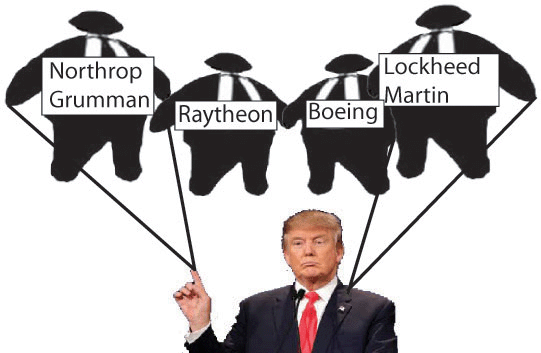
 WASHINGTON ,WATCH: IS TRUMP HELPING THE SAUDIS GO NUCLEAR? https://www.jpost.com/Opinion/Washington-Watch-Is-Trump-helping-the-Saudis-go-nuclear-592310,BY DOUGLAS BLOOMFIELD, JUNE 12, 2019
US President Donald Trump recently took another step toward bringing Saudi Arabia into the nuclear club. While Israeli-Saudi ties have warmed in recent years, helping the desert kingdom go nuclear – with its ongoing support for the most extreme Islamic radicals in the world – can hardly be good for the Jewish state.
Secret negotiations with the US Energy Department over many months have led Washington to “transfer highly sensitive US nuclear technology, a potential violation of federal law,” to Saudi Arabia, according to House Oversight Committee sources cited by The Washington Post.
Sen. Tim Kaine (D-Virginia) revealed last week that at least two transfers were approved since the assassination of Washington Post journalist Jamal Khashoggi.
The Saudis say they want to begin building their own nuclear power plants with their own enriched uranium, even though it could be purchased elsewhere more cheaply. That raises suspicions that their real goal isn’t producing electricity. By enriching their own uranium, they could begin diverting it to highly enriched weapons grade, especially if they bar international inspectors, as they’ve insisted.
Given its record of obeisance to Saudi demands for top technology and weapons, it is unlikely the Trump administration would object, but instead continue helping to conceal the kingdom’s plans. Crown Prince Muhammad bin Salman, the de facto ruler, has said that the kingdom would build nuclear weapons if the Iranians did. He may have taken encouragement from a speech in the UAE last month by Trump’s national security adviser, John Bolton.
The Iranians are threatening to leave the nuclear pact with the major powers – the Joint Comprehensive Plan of Action (JCPOA) – in the wake of the Trump administration’s unilateral exit last year and imposition of sanctions to tighten the economic screws on Tehran.
That should give MBS the rationale he seeks to develop his version of the bomb.
When he turns to Trump for help, he will remind the president that if America won’t sell it to him, there are others who will. Trump is a sucker for that pitch.
North Korea would be a good place to go shopping, since they tried helping Syria build nukes until the Israeli Air Force stopped the plan, something it had done earlier in Iraq. Then there’s Pakistan, which is believed to have built its own nuclear weapons stockpile with Saudi financial help.
THERE MIGHT BE some resistance on Capitol Hill, where Saudi support is low and sinking, but Trump has shown himself more responsive to the wishes of the Saudis than the US Congress.
All US administrations – Republican and Democratic – have indulged the Saudi appetite for top technology and weapons. They’ve been driven by pressure from industry and its friends in the Pentagon to sell, sell, sell – and an inexplicable attitude that we need the Saudis far more than they need us. Trump has just raised this to a new level.
Trump’s latest selling spree includes 120,000 conversion kits to produce smart bombs. It is part of an $8.1 billion package that Trump labeled “emergency” to bypass Congressional review.
Most alarming is the Trump administration’s approval for the transfer of highly sensitive weapons technology and equipment to Saudi Arabia so the kingdom can produce electronic guidance systems for Paveway precision-guided bombs, according to congressional sources cited by The New York Times.
Saudi Arabia is the Pentagon’s favorite cash cow. Arms sales are a lucrative business for the US Defense Department, which charges commissions and other fees, and gets economies of scale for its own purchases while selling off old inventory to help pay for replacements. Military attachés around the world are top salesmen for defense contractors as they lay the groundwork for post-uniform careers. Then there are the former – and possibly future – defense industry executives at the highest levels of the Pentagon, starting with the Secretary of Defense.
Sen. Chris Murphy (D-Connecticut) said the administration “has effectively given a blank check to the Saudis – turning a blind eye to the brutal murder of Jamal Khashoggi and allowing their ballistic missile program to expand.”
The United States is not allowed to sell ballistic missiles, so the Saudis have turned to China. CNN reported last week that American intelligence believes Beijing is helping enhance the kingdom’s strategic missile program. In the 1980s, it secretly bought Chinese DF-3 missiles and based them within range of Israel. It bought more advanced missiles in 2007 with the approval of then-president George W. Bush. Unconfirmed published reports suggest they also bought other missiles from Pakistan, which produces a version of the North Korean Nodong missile.
With Trump looking for business that will create jobs he can claim credit for – and with John Bolton rattling sabers and B-52s, and calling for regime change in Iran – can Saudi Arabia be knocking on an open door to the nuclear club?
TV Drama “Chernobyl” shows chilling reality of contemporary politics and its “war on truth”
Mazin says he intended Chernobyl as a comment on contemporary politics, and specifically on what he calls the “war on truth”. The subtext is relatively obvious: knowledge painstakingly acquired by scientists is discarded when it is politically inconvenient.
the topicality of Chernobyl derives from the inescapable fact that the bureaucracy’s inhuman behaviour is so familiar to us. The fatuous speeches about socialist morality shown in Chernobyl are just that country’s equivalent of our paeans to free markets and free people.
it is easy to recognise the system we have today: a managerial society run by bosses and bureaucrats who lie and kill to maintain their social dominance, and who threaten the whole world as long as they remain in power. The system of class domination and exploitation portrayed in Chernobyl lives on in free-market form today.
The Horrifying True Scale of the Chernobyl Disaster
Chernobyl: an anti-capitalist nuclear horror story https://redflag.org.au/node/6814, Daniel Taylor
Germany’s foreign minister has arrived in Tehran in hopes of saving nuclear agreement
 German minister lands in Iran in bid to save nuclear pact, Sabine Siebold, TEHRAN (Reuters) 9 June 19, – Germany’s foreign minister has arrived in Tehran to hold talks with President Hassan Rouhani on Monday, as part of a concerted European effort to preserve Iran’s nuclear pact with world powers and defuse rising U.S.-Iranian tensions.A cautious thaw in relations between Tehran and Washington set in in 2015 when Iran struck a deal with six big powers limiting its nuclear activity. But tensions with the United States have mounted again since President Donald Trump withdrew Washington from the accord in 2018 and reimposed sweeping sanctions. German minister lands in Iran in bid to save nuclear pact, Sabine Siebold, TEHRAN (Reuters) 9 June 19, – Germany’s foreign minister has arrived in Tehran to hold talks with President Hassan Rouhani on Monday, as part of a concerted European effort to preserve Iran’s nuclear pact with world powers and defuse rising U.S.-Iranian tensions.A cautious thaw in relations between Tehran and Washington set in in 2015 when Iran struck a deal with six big powers limiting its nuclear activity. But tensions with the United States have mounted again since President Donald Trump withdrew Washington from the accord in 2018 and reimposed sweeping sanctions.
West European signatories, including Germany, want to try to keep the nuclear accord alive although they share the Trump administration’s disquiet about Iran’s ballistic missile program and its role in conflicts around in the Middle East. Germany, France and Britain maintain that the nuclear pact remains the best way to limit Iran’s enrichment of uranium, a potential pathway to the development of nuclear weapons……. https://www.reuters.com/article/us-usa-iran-germany/german-minister-to-meet-irans-rouhani-in-bid-to-save-nuclear-pact-idUSKCN1TA0JW |
|
A ‘P5+4’ summit could break the nuclear deadlock
A ‘P5+4’ summit could break the nuclear deadlock, The Strategist B1, 7 Jun 2019, |Ramesh Thakur In April, US President Donald Trump directed White House officials to identify pathways to new arms control agreements with Russia and China. If he’s looking for a big and bold new idea, here’s one: a ‘P5+4’ nuclear summit of the leaders of the nine countries that have the bomb.
The five permanent members of the UN Security Council (the ‘P5’) are the only countries recognised by the Nuclear Non-proliferation Treaty (NPT) as lawful possessors of nuclear weapons: China, France, Russia, the UK and the US. The ‘+4’ are the non-NPT nuclear-armed countries—India, Israel and Pakistan—and North Korea, the world’s only NPT defector state.
The existing architecture of nuclear arms control has served us well but is now crumbling. It was weakened first by the US exit from the Anti-Ballistic Missile Treaty in 2002 and then the indefinite delay of the entry into force of the Comprehensive Test-Ban Treaty. More recently, the deterioration has accelerated with the Trump administration’s abandonmentof the nuclear deal with Iran, the US and Russian suspensions of the Intermediate-Range Nuclear Forces Treaty, and the failure thus far to discuss extending New START beyond its expiry date of 2021.
There is a related problem. The NPT-centric architecture cannot accommodate the reality of four non-NPT possessor states. The architecture deficit is exacerbated by the fact that the agenda of nuclear arms control, non-proliferation and disarmament has stalled. The Korean denuclearisation-cum-peace-process has run out of steam. Last month’s meeting of the preparatory committee for the 2020 NPT review conference could not reach agreement on a common statement………..
Nuclear arms control satisfies all the key criteria for a summit. Like pandemics, climate change and biodiversity, nuclear threats spill across national boundaries and defy unilateral solutions. A summit of the nine political leaders, but only them, that is appropriately structured and has been adequately prepared can focus them to do what they alone can do—make tough choices from among competing interests and priorities. Cabinet ministers have single portfolio responsibilities. Heads of state and government have to oversee the entire agenda. With broad, overarching responsibilities, leaders can weigh priorities and balance interests across competing goals, sectors, and national and international objectives. ………
The first thing a nuclear summit should do is reaffirm the famous 1987 declaration by US President Ronald Reagan and Soviet leader Mikhail Gorbachev: ‘a nuclear war cannot be won and must never be fought’. If all nine leaders sign such a statement, it can be adopted as a resolution also by the UN Security Council and General Assembly. That would reverse the recent trend to normalise the discourse of possible nuclear-weapon use and, by hardening the normative boundary between nuclear and other weapons, perhaps also help to stop mission creep with respect to the roles and functions of nuclear weapons………
A summit-level agreement on a few important items would be a powerful stimulus to restarting stalled talks on other outstanding items like bringing the Comprehensive Nuclear-Test-Ban Treaty into force and commencing negotiations on a fissile materials cut-off treaty. Even a modestly successful summit would tell the world that the nine powers take seriously their responsibility for preserving nuclear peace………https://www.aspistrategist.org.au/a-p54-summit-could-break-the-nuclear-deadlock/
Putin warns New START nuclear arms treaty at risk
Russia: Putin warns New START nuclear arms treaty at risk, Aljazeera, 7 June 19,
Russian president accuses US of shunning talks on extending the nuclear arms reduction treaty, which expires in 2021. President Vladimir Putin has said Russia was prepared to drop a nuclear weapons agreement treaty with the United States and warned of “global catastrophe” if Washington keeps dismantling a global arms control regime.
Speaking at an economic forum in St Petersburg, Putin said Washington showed no genuine interest in conducting talks on extending the New START treaty which caps the number of nuclear warheads well below Cold War limits.
“If no one feels like extending the agreement – New START – well, we won’t do it then,” Putin said.
“We have said a hundred times that we are ready [to extend it], but no one is holding any talks with us. The negotiations process hasn’t been arranged at all.”
The treaty was signed by US President Barack Obama and his Russian counterpart Dmitry Medvedev in Prague in 2010.
The accord, which expires in 2021, limits each country to no more than 1,550 deployed nuclear warheads and 700 deployed missiles and bombers.
Together with another agreement known as the Intermediate-Range Nuclear Forces (INF) treaty, New START is considered a centrepiece of superpower arms control.
The US pulled out of the INF in February, accusing Russia of violating its terms. Moscow, which has denied any breaches, followed suit,
Nuclear arms race
Putin said the potential implications of letting the New START treaty expire would be huge, suggesting its demise could fuel a nuclear arms race.
“If we don’t keep this ‘fiery dragon’ under control, if we let it out of the bottle – God forbid – this could lead to global catastrophe,” Putin said.
“There won’t be any instruments at all limiting an arms race, for example, the deployment of weapons in space.”
“This means that nuclear weapons will be hanging over every one of us all the time.”
Putin said he was puzzled by the absence of a global discussion…….https://www.aljazeera.com/news/2019/06/russia-putin-warns-start-nuclear-arms-treaty-risk-190606163914989.html
Donald Trump, guided by John Bolton, could wreck the Comprehensive Test Ban Treaty (CTBT)
 Think of what the world would be like if Russia, the United States, China, India and Pakistan were testing nuclear weapons. They are not because of the Comprehensive Test Ban Treaty (CTBT) which is responsible for shutting down nuclear testing by major and regional powers for more than two decades. Walking away from the CTBT would be extraordinarily dumb and dangerous, but the Trump administration has taken a step in this direction.
The CTBT was negotiated in 1996, but it isn’t solidly in place. While Russia has signed and ratified it, Senate Republicans rejected it in 1999. China, like the United States, has signed but not ratified.
How long this can this situation last? The answer is in doubt now that the Director of the Defense Intelligence Agency, Lt. Gen. Robert P. Ashley, Jr., has declared at a public forum that the “United States believes that Russia probably is not adhering to its nuclear testing moratorium.” The Treaty sets a “zero yield” obligation: states aren’t supposed to test even with the slightest yields. The State Department defines this as any explosion “that produce a self-sustaining, supercritical chain reaction.” In other words, you can conduct experiments, but the experiments should not produce any seismic activity.
Now let’s consider details.
It’s unknown whether John Bolton had any involvement with the DIA intelligence assessment, but another reason for investigation is the National Security Adviser’s record of “fixing” intelligence to make the case for a second war against Saddam Hussein, a war predicated on weapons of mass destruction that did not exist. Bolton is on record opposing U.S. ratification and entry into force of the CTBT. Is he once again “fixing the facts” to suit his policy preferences? Is the Defense Intelligence Agency once again guilty of reaching conclusions beyond available evidence, and misrepresenting the evidence it has? Or is there strong evidence of Russian violations of the CTBT’s prohibition on testing?
Japan’s Olympic torch relay to start in Fukushima – even children are invited to carry it
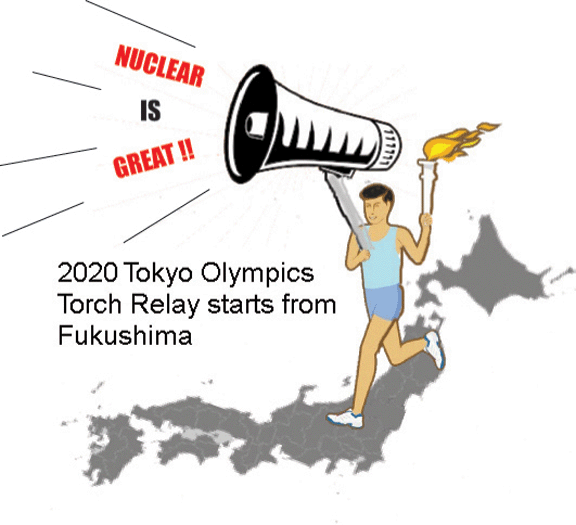
Tokyo 2020 reveals Olympic Torch route will begin in Fukushima, Inside the Games, By Matthew Smith, 1 June 2019
The Tokyo 2020 Organising Committee has revealed the Olympic Torch Relay route, which will take in many of Japan’s most historic and famous sites – and also areas touched by tragedy.
The Flame will be taken all over Japan inside 121 days, culminating in the Olympic Games next summer.
It will begin the final leg of its journey on March 26, 2020 from the J-Village National Training Centre in Fukushima, the training facility of the Japan football team.
The Flame will travel to all 47 prefectures of Japan, with the Organising Committee claiming around 98 per cent of Japan’s population live within one hour’s travel of the proposed route.
The route will take in World Heritage Sites such as Mount Fuji and Itsukushima Shrine, but will also visit areas affected by recent disasters.
Fukushima has been chosen as a start point after the Tohoku region was struck by an earthquake and tsunami in 2011, which also caused a nuclear incident at the Fukushima Daiichi Nuclear Power Plant.
As well as revealing the route, Tokyo 2020 also unveiled the Torchbearer uniforms and how members of the public could apply to take part in the Relay.
The uniform features the Relay emblem on the front and the Olympic symbol on the back.
The most notable design feature is a diagonal red stripe, echoing the sash used in place of batons in Ekiden, Japan’s historic long-distance relays…….
“In Japan, these Games are being referred to as ‘the Recovery Games’ and so the Olympic Flame will start its journey from an area affected by recent natural disasters……
Games organisers say the Olympic Torch Relay will feature around 10,000 Torchbearers including men, women and children of a wide range of nationalities and ages. People from all over the world are encouraged to apply and can do so here……..https://www.insidethegames.biz/articles/1079973/tokyo-2020-reveals-olympic-torch-route-will-begin-in-fukushima
The IEA supports nuclear power, BUT realises that its future prospects are poor
 The Week in Energy, Ft.com, 2 June 19, ”………..The IEA this week published a report titled “Nuclear Power in a Clean Energy System”, its first on the industry for more than 20 years, because it is so concerned about the wave of nuclear plant closures across the developed world. The Week in Energy, Ft.com, 2 June 19, ”………..The IEA this week published a report titled “Nuclear Power in a Clean Energy System”, its first on the industry for more than 20 years, because it is so concerned about the wave of nuclear plant closures across the developed world.
………(The IAEA) acknowledges that the outlook is “highly uncertain”. The Chernobyl disaster of 1986, now being vividly recreated in a television drama series from HBO, put a brake on investment in new reactors in western countries for two decades, and then just as there was talk of a “nuclear renaissance” emerging in the 21st century, the Fukushima disaster of 2011 dealt another blow to public confidence. The IEA argues that the most important reason for the collapse of investor appetite for new nuclear plants in Europe and the US, however, has been the industry’s failure to deliver projects on time and on budget. At a time when the costs of renewable energy have been plunging, the cost of nuclear power has been soaring. The estimated cost of the EPR reactor that French utility EDF is building at Flamanville in Normandy, for example, has soared from €3bn to €11bn. François de Rugy, France’s environment minister, said this week that the start date for the reactor was still uncertain. Such stories are the rule rather than the exception for new nuclear plants built in Europe and the US over the past 15 years.
As a result, investing in new nuclear plants is very difficult for the private sector. Of 54 under construction worldwide today, 47 are being built by state-owned companies, and six of the seven in the private sector have price regulation in place to give them some certainty about their revenues. But beyond that, even keeping existing plants running is becoming increasingly difficult …..
The IEA suggests a range of policy measures for supporting nuclear power, including operating lifetime extensions from regulators, electricity market designs that reward nuclear plants for their advantages including high levels of availability, and payments that put nuclear on an even footing with renewable sources as low-carbon power. In practice, the blunt realities of energy politics have meant that moves to help nuclear power have not always played out in the best possible ways for curbing emissions. In the US, New York, Illinois and most recently New Jersey have put measures in place to support their nuclear plants. A similar plan is being debated in Pennsylvania, and although it has come too late for Three Mile Island, it could save the state’s other nuclear plants.
There have been vigorous arguments over all of these initiatives, but the most controversial of all has been the plan now moving through the legislature in Ohio, which links support for nuclear power to help for coal-fired plants and an attack on policies favouring renewables and energy efficiency. The state’s House of Representatives this week approved a bill that would create new payments for Ohio’s two nuclear plants, while cutting support for energy efficiency and scrapping the state’s mandated standard requiring 12.5 per cent of its generation to come from renewable sources by 2027. The legislation now goes to the state’s Senate. The plan has won bipartisan support, but it has been a particularly critical issue for Ohio’s Republicans.
A senior adviser to President Donald Trump’s re-election campaign has been urging state lawmakers to back the plan, because of the thousands of jobs that would be lost if the nuclear plants closed. “The message is that if we have these plants shut down we can’t get Trump re-elected,” a source told Politico.
In another example of how the changing energy landscape of the US has shaken up old enmities and alliances, the campaign against the bill has united environmentalists and the oil and gas industry. Neil Waggoner of the Sierra Club, the environmental group, described the legislation as “a farce” and “an absolute embarrassment for Ohio”. The American Petroleum Industry warned that customers would “pay the price” for the bill, and urged the state Senate to “protect Ohio taxpayers and reject this legislative bailout”.
|
|
Hiroshima and Nagasaki protest U.S. subcritical nuclear test
The United States conducted a subcritical nuclear test in Nevada on Feb. 13, according to a May 24 announcement by the U.S. Lawrence Livermore National Laboratory.
Yuzaki called the test “extremely regrettable.”
He said, “It destroys the hopes of Hiroshima residents who strongly wish the abolition of nuclear weapons.”
Trump arrived in Japan as state guest on May 25. He will wind up his visit on May 28.
Nagasaki Governor Hodo Nakamura, along with prefectural assembly chairman Mitsuyuki Segawa, also denounced the subcritical nuclear test.
They sent protest letters to U.S. Ambassador William Hagerty on May 26.
1 This Month
26 September – International Day for the Total Elimination of Nuclear Weapons





PLEASE OPPOSE HR 8255 AND S.3639 – bills would accelerate satellite deployment, with no environmental review or safeguards – https://ncstd5li.quorum.us/campaign/169331/
To see nuclear-related stories in greater depth and intensity – go to https://nuclearinformation.wordpress.com
-
Archives
- September 2026 (291)
- August 2026 (330)
- July 2026 (355)
- June 2026 (287)
- May 2026 (306)
- April 2026 (356)
- March 2026 (251)
- February 2026 (267)
- January 2026 (308)
- December 2025 (358)
- November 2025 (359)
- October 2025 (375)
-
Categories
- 1
- 1 NUCLEAR ISSUES
- business and costs
- climate change
- culture and arts
- ENERGY
- environment
- health
- history
- indigenous issues
- Legal
- marketing of nuclear
- media
- opposition to nuclear
- PERSONAL STORIES
- politics
- politics international
- Religion and ethics
- safety
- secrets,lies and civil liberties
- spinbuster
- technology
- Uranium
- wastes
- weapons and war
- Women
- 2 WORLD
- ACTION
- AFRICA
- Atrocities
- AUSTRALIA
- Christina's notes
- Christina's themes
- culture and arts
- Events
- Fuk 2022
- Fuk 2023
- Fukushima 2017
- Fukushima 2018
- fukushima 2019
- Fukushima 2020
- Fukushima 2021
- general
- global warming
- Humour (God we need it)
- Nuclear
- RARE EARTHS
- Reference
- resources – print
- Resources -audiovicual
- Weekly Newsletter
- World
- World Nuclear
- YouTube
-
RSS
Entries RSS
Comments RSS

