The Guardian view of the Osaka G20 summit: bad as he is, Trump is not the only problem, Editorial, Guardian 268 June 19 The climate crisis underlines the need for effective global economic leadership. The US president makes this harder, but so do China and several others.Ever since the G20 of leading global economies was founded, its summits have mostly been convergent occasions, marked by attempts to find common ground and remembered for nothing more unseemly than a bit of jostling among the heads of government to be on the front row of the group photograph. Japan’s prime minister Shinzō Abe clearly takes this traditional view about the G20 summi twhich he will host in Osaka on Friday and Saturday. “We want to make it a meeting that focuses on where we can agree and cooperate rather than highlighting differences,” he said recently.
But there is a balloon-puncturing problem with Mr Abe’s approach, and it answers to the name of Donald Trump. If there is one issue on which this year’s summit clearly ought to be showing global leadership, it is the climate crisis. The subject is indeed on the Osaka agenda but, in spite of efforts by countries including France, there is no prospect of serious or effective action. That is no surprise from a group of nations which almost tripled the subsidies they gave to coal-fired power plants between 2013 and 2017, with China, India and Japan itself leading the way. But it is Mr Trump’s decision to walk away from climate accords and to back fossil fuels that creates the wider permission for these other terrible derelictions.
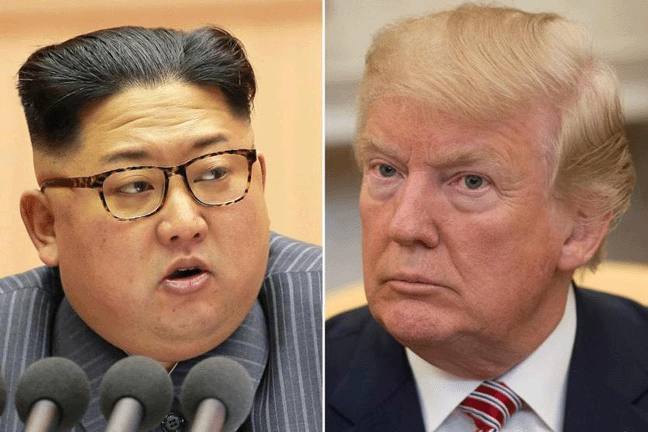
Mr Trump’s disruptions do not end there. The US president uses these gatherings not to build alliances to solve common problems but to knock his adversaries – and sometimes his supposed allies – off their stride. He is not looking for general agreement, which he thinks is for wimps. He is looking for American advantage over friend and foe. That’s the reason why the summit is already overshadowed by the increasingly serious trade war between the United States and China (Mr Trump will have an all-smiles bilateral with Xi Jinping on Saturday). And it is certainly the reason why Mr Trump has used the run-up to Osaka to have a pop at his hosts, whom he claimed would respond to an attack on the US by watching it “on a Sony television”, attacking India for raising tariffs and then, inventing false figures, berating Germany as a “security freeloader”.
Since Mr Trump’s Friday schedule involves one-on-ones with Mr Abe, India’s Narendra Modi and Germany’s Angela Merkel, it seems these mind games are part of a deliberate strategy of disruption. This is not a novel conclusion. Mr Trump used the same approach before his recent visit to Britain, when he praised Boris Johnson and attacked Sadiq Khan and the Duchess of Sussex. If Mr Johnson becomes prime minister and Britain were to back off from supporting European opposition to the White House’s Iran strategy, Mr Trump would count this a job well done.
Mr Trump’s bullying is also selective. Among the world leaders whom Mr Trump has not attacked in advance – but with whom he will also be meeting in Osaka bilaterals – are Vladimir Putin of Russia, whose country systematically interfered in the 2016 US election, and Mohammed bin Salman of Saudi Arabia, who has just been accused by the United Nations of orchestrating the murder and dismemberment of the opposition journalist Jamal Khashoggi……… https://www.theguardian.com/commentisfree/2019/jun/27/the-guardian-view-of-the-osaka-g20-summit-bad-as-he-is-trump-is-not-the-only-problem
|
|
|
June 29, 2019
Posted by Christina Macpherson |
climate change, Japan, politics international |
Leave a comment
Iran Is About To Exceed Uranium Limits. Is The Nuclear Deal Dying? NPR, 26, 2019 , Heard on All Things Considered, GEOFF BRUMFIEL
Iran is on the verge of crossing a key line included in the nuclear deal it reached with the U.S. and other powers in 2015. As soon as Thursday, it’s expected to announce that its uranium stockpiles have exceeded limits set by the deal.
“I think it’s a major bridge for them to go across,” says David Albright, president of the Institute for Science and International Security, which monitors Iran’s nuclear program. Albright and other experts believe that breaching the limit could spell the beginning of the end for the nuclear agreement, which the U.S. exited in May 2018.
The nuclear deal is full of numbers and figures, but its purpose is simple: to slow down Iran’s nuclear program. Before the deal, Iran was within a few weeks of getting enough highly enriched uranium for a nuclear bomb if it chose to. The deal pushed that timeline back from weeks to about a year.
Under the multilateral Joint Comprehensive Plan of Action, Iran was forced to get rid of lots of low-enriched uranium. Low-enriched uranium is kept at levels far below the 90% level considered suitable for building nuclear weapons. But large quantities of low-enriched uranium can be refined to bomb-grade relatively quickly. So the deal capped Iran’s stockpile of low-enriched material to just 300 kilograms, or 661 lbs.
But that was then. Last year, President Trump pulled out of the deal. Without the economic benefits Iran was promised in exchange for limiting its nuclear program, it has begun going back on the agreement. In May, it announced it would begin accumulating more low-enriched uranium. ……..
European companies had hoped to do business with Iran. But in the face of U.S. sanctions, “We’ve seen those companies have to step back and say, ‘We can’t afford to lose the U.S. market,’ ” Hinderstein says.
Iran is now stepping across one line in the deal at a time, in an effort to pressure European nations to provide promised economic relief. European negotiators are racing to complete a package of humanitarian aid by early July, says Aniseh Bassiri Tabrizi with Great Britain’s Royal United Services Institute.
“They are working towards that end goal, to showcase to the Iranians that they are actually working in practical terms to address some of these issues,” Tabrizi says.
If that aid — which includes things like medical supplies — can be delivered without U.S. objection, then it may open the possibility of more economic benefits flowing to Iran. But Tabrizi says it remains to be seen whether it will be enough.
“Iran has made it clear that it needs also to be able to continue to export its oil, to see the incentive of remaining a party of the nuclear deal,” she says.
For now, Hinderstein says, Iran is still about a year away from getting material together for a bomb — should it decide to do so. “We still have some time to work with,” she says.
But with each line that Iran crosses, the timeline shrinks, and the nuclear deal fades further. https://www.npr.org/2019/06/26/736008919/iran-is-about-to-exceed-uranium-limits-is-the-nuclear-deal-dying
June 27, 2019
Posted by Christina Macpherson |
Iran, politics international |
Leave a comment
Iran says it will never build a nuclear weapon, Minister says Islam forbids such a move as country prepares to breach nuclear deal, Guardian Patrick Wintour Diplomatic editor, 26 June 2019
Iran will never pursue a nuclear weapon, its foreign minister has claimed, saying Islam prevented the country from doing so.
Iran has previously said it is ideologically opposed to acquiring nuclear weapons and seeks nuclear power only for civilian purposes. But in the current unpredictable climate it is possible Donald Trump could pick up Javad Zarif’s remarks as a signal to talk.
The White House is pursuing a twin-track strategy of seeking talks while trying to throttle the Iranian economy through sanctions that block trade with Europe and oil sales, and freeze the assets of political and diplomatic leaders.
Iran has said it will breach the uranium enrichment limits set out in the 2015 nuclear deal on Thursday, but that does not imply the country is on the path to building a nuclear weapon…….
The US president again threatened Iran with “obliteration” in a Twitter tirade in which he also accused the country’s leaders of killing 2,000 Americans. …..
The angry tweets came after Iran said the US’s decision to impose sanctionson its supreme leader and other top officials was “idiotic” and had permanently closed the path to diplomacy between Tehran and Washington.
Trump imposed fresh sanctions on Monday against the supreme leader, Ayatollah Ali Khamenei, and military chiefs, in an unprecedented step designed to increase pressure on Iran after Tehran’s downing of an unmanned American drone. Khamenei is Iran’s utmost authority, who has the last say on all state matters.
Washington said it would also impose sanctions this week on Zarif, who negotiated the 2015 nuclear deal with the US and other major powers and has spearheaded Iranian diplomacy since.
Iran’s president, Hassan Rouhani, described the White House as “afflicted by a mental disability” and said the sanctions against Khamenei were “outrageous and idiotic”, especially as the 80-year-old cleric has no overseas assets and no plans to ever travel to the US.
Tehran said the US had spent weeks demanding that Iran match America’s diplomacy with its own diplomacy, rather than military responses, but was now trying to immobilise its chief diplomat.
“Imposing useless sanctions on Iran’s supreme leader and the commander of Iran’s diplomacy is the permanent closure of the path of diplomacy,” the foreign ministry spokesman Abbas Mousavi said in a tweet on Tuesday. “Trump’s desperate administration is destroying the established international mechanisms for maintaining world peace and security.”…….. https://www.theguardian.com/world/2019/jun/25/iran-says-us-sanctions-on-supreme-leader-means-permanent-closure-of-diplomacy
June 27, 2019
Posted by Christina Macpherson |
Iran, politics international, weapons and war |
Leave a comment
The US and North Korea are in talks to hold a third nuclear summit, according to South Korea’s president, Insider,26 June19
- Officials from North Korea and the United States are holding “informal” talks about a third nuclear summit in the future, South Korea’s president Moon Jae-in said Wednesday, the Wall Street Journal reported.
-
- The Trump administration has held two summits with North Korea in the past year, the first in Singapore in June 2018 and another in Hanoi this past February, neither of which were able to produce a concrete de-nuclearization deal.
- Trump is scheduled to travel to Seoul, South Korea on Saturday after he attends the G-20 summit in Japan, which could present an opportunity for American and North Korean officials to set plans for a third summit.
- Under the Trump administration, the US has pursued far friendlier relations with North Korea than other nations, with Trump even going as far as to frequently praise North Korea’s dictator Kim Jong-un……. . https://www.insider.com/us-north-korea-are-in-talks-for-third-nuclear-summit-2019-6
June 27, 2019
Posted by Christina Macpherson |
North Korea, politics international, USA |
Leave a comment
 Trump’s new Iran sanctions have put airstrikes on hold — but nuclear risks remain
History suggests these dark scenarios cannot be dismissed. Even more critical, available measures to reduce these dangers must not be ignored. June 25, 2019, NBC News THINK, By Bennett Ramberg, Former policy analyst at the U.S. State Department’s Bureau of Politico-Military Affairs
Trump’s new Iran sanctions have put airstrikes on hold — but nuclear risks remain
History suggests these dark scenarios cannot be dismissed. Even more critical, available measures to reduce these dangers must not be ignored. June 25, 2019, NBC News THINK, By Bennett Ramberg, Former policy analyst at the U.S. State Department’s Bureau of Politico-Military Affairs
The Middle East presents a dangerous nexus of nuclear reactors and violence. It remains the only region where foreign powers have attacked their enemies’ nuclear plants. On Monday, President Donald Trump signed an executive order putting in place what he called “hard-hitting” new sanctions on Iran. Should continuing tensions between Tehran and Washington boil over into intense hostilities, one ominous nuclear policy question cannot be ignored: Will the presence of reactors in an enlarged conflict zone open a Pandora’s box to the first radioactive war in history?
Trump’s national security adviser, John Bolton, wrote in a 2015 New York Times opinion piece that Washington needed to aim for “breaking key links in [Iran’s] nuclear fuel cycle” through military action. (And envisioned Israel playing a role.) That military option became moot when the Obama administration signed the Iran deal. Now that Trump has withdrawn from the agreement, however, military action is again an option — as well as serious consequences should any action go forward.
Consider, for example, if the current tensions escalate to the point that Tehran crosses Washington’s red line, as it has threatened, and expands nuclear materials production, openly breaking the deal struck with the Obama administration and its allies. Would the United States decide the time had come to eliminate Iran’s nuclear enrichment and related facilities?
In the powder keg of the Middle East, would Iran’s mullahs or their Hezbollah proxy then seek to make good on longstanding threats to launch reprisal rockets at Israel’s Dimona weapons reactor, releasing radioactive elements? And would such an attack propel Israel to respond in kind by striking Iran’s much larger Bushehr nuclear power plant?
History suggests these dark scenarios cannot be dismissed. Even more critical, available measures to reduce these dangers must not be ignored……..
Today’s Middle East nuclear reactor profile has become more complex, though. Iran now operates one Russian-designed 1,000-megawatt nuclear power plant at Bushehr and is building two others. In 2020, a new power reactor is scheduled to go online in the United Arab Emirates, where three others are under construction. Saudi Arabia, Jordan and Egypt also now plan power reactors. …..
If a nuclear plant is hit, the results could be radiation hazards never seen in warfare. Several factors complicate risk projections…….
Acknowledging that mutually assured radioactive contamination would result from nuclear reactor attacks should be sobering enough to prompt all across the Middle East to heed the terrible lessons of Chernobyl: Releases of large inventories of radiation into the environment only sow grief that will last generations, benefiting no one. now https://www.nbcnews.com/think/opinion/trump-s-new-iran-sanctions-have-put-air-strikes-hold-ncna1021056
June 25, 2019
Posted by Christina Macpherson |
MIDDLE EAST, politics international, safety, USA |
Leave a comment
|
Israel will do ‘everything’ to stop Iran going nuclear: Netanyahu https://news.yahoo.com/israel-everything-stop-iran-going-nuclear-netanyahu-161040494.html, 24 June 19 Jerusalem (AFP) – Israel’s Prime Minister Benjamin Netanyahu said Monday his country will do “everything” to prevent arch-rival Iran from obtaining nuclear weapons, during a visit by a senior Russian security official. “Israel will not allow Iran, which calls for our destruction, to entrench on our border; we will do everything to prevent it from attaining nuclear weapons,” Netanyahu said.
He was speaking alongside Nikolai Patrushev, the head of Moscow’s powerful security council, whose visit followed weeks of simmering tensions between Tehran and Washington in the Gulf.
Israel has carried out repeated strikes to prevent Iranian forces becoming embedded in neighbouring Syria, where both Iran and Moscow back the government of President Bashar al-Assad.The Israeli government has vowed never to let Iran obtain a nuclear weapon, believing Israel would be the target.
Iran insists its nuclear programme is entirely for civilian purposes.
Netanyahu has long campaigned against a 2015 nuclear agreement between Iran and world powers, from which the Trump administration unilaterally withdrew last year.
Patrushev did not directly mention the Islamic republic in his comments to the press.“We pay great attention to Israel’s security,” he said.
“To resolve this issue in practice, it is necessary to bring peace and stability to the region, including on Syrian territory.”
Their meeting came a day after Netanyahu hosted US National Security Advisor John Bolton, who shares the Israeli premier’s tough stance on Iran.
Bolton is set to meet Patrushev on Tuesday along with their Israeli counterpart Meir Ben-Shabbat.
Tensions between Washington and Iran have flared after Iranian forces shot down a US drone Thursday, the latest in a series of incidents including attacks on tankers in sensitive Gulf waters that have raised fears of an unintended slide towards conflict.
Trump has tweeted that Washington would place “major additional sanctions on Iran on Monday”.
Russia on Monday denounced the new sanctions as “illegal”. Its President Vladimir Putin has warned of “disaster” if the US were to use force against Tehran.
|
|
June 25, 2019
Posted by Christina Macpherson |
Iran, Israel, politics international |
Leave a comment
 Trump warns Iran of ’obliteration like you’ve never seen before’ https://www.politico.com/story/2019/06/23/trump-obliteration-iran-nuclear-weapons-pursuit-1376744, By MARTIN MATISHAK, 06/23/2019
President Donald Trump warned the United States may launch a devastating military attack on Iran unless it comes to the negotiating table and drops its bid to develop nuclear weapons.
“I’m not looking for war, and if there is, it’ll be obliteration like you’ve never seen before. But I’m not looking to do that. But you can’t have a nuclear weapon. You want to talk? Good. Otherwise you can have a bad economy for the next three years,” Trump said during an interview with NBC’s “Meet The Press” airing Sunday.
The president said he’d be willing to sit down with Iranian officials without preconditions.
The comments, made during an interview taped Friday, came the same day Trump confirmed on Twitter that he called off a retaliatory strike on Iran at the last minute Thursday night. He said he decided that the potential cost of human lives was “not proportionate to shooting down an unmanned drone.”
Iran’s Revolutionary Guard said Thursday it had shot down an American drone, claiming it had entered Iranian airspace, a claim disputed by the U.S., which has maintained the drone was over international waters. Both countries have since produced what they say is evidence supporting their respective positions.
Trump said the U.S. had a “modest but pretty, pretty heavy attack schedule,” but planes were not in the air when he called off the attack.
The commander in chief said the response now should be increased sanctions on Iran’s economy.
“We’re increasing the sanctions now,” adding the country’s economy has already been “shattered.”
Trump said he believes Iranian officials want to negotiate and that any deal would have to be about nuclear weapons. He also claimed that Iran had violated the nuclear agreement struck by the Obama administration and other world powers. International inspectors have repeatedly declared that Iran has complied with the 2015 deal.
“They cannot have a nuclear weapon,” he said. “They cannot have a nuclear weapon. They’d use it. And they’re not going to have a nuclear weapon.”
Trump also disputed that he sent a message to Iranian leaders through a third country, saying he did not want conflict, dubbing it “fake news.”
However, he also declined to send a message during the interview to Iranian Supreme Leader Ayatollah Ali Khamenei.
“Wouldn’t be much different than that message,” Trump said.
June 24, 2019
Posted by Christina Macpherson |
Iran, politics international, USA |
1 Comment
 North Korea says Trump sent Kim Jong Un an ‘excellent’ letter amid stalled nuclear diplomacy, abc news, June 23, 2019,
By Associated Press, SEOUL, South Korea — President Donald Trump sent North Korean leader Kim Jong Un an “excellent” letter, the North’s state-run news agency reported Sunday, quoting Kim as saying he would “seriously contemplate it.”
The White House confirmed that Trump had sent a letter to Kim.
“Correspondence between the two leaders has been ongoing,” Press Secretary Sarah Sanders said in a statement.
It comes after nuclear talks between the U.S. and North Korea broke down after the failed summit between Kim and Trump in February in Vietnam.
The U.S. is demanding that North Korea abandon its nuclear weapons entirely before international sanctions are lifted. North Korea is seeking a step-by-step approach in which moves toward denuclearization are matched by concessions from the U.S., notably a relaxation of the sanctions.
Kim “said with satisfaction that the letter is of excellent content,” Pyongyang’s Korean Central News Agency reported.
“Appreciating the political judging faculty and extraordinary courage of President Trump, Kim Jong Un said that he would seriously contemplate the interesting content,” the agency said, without elaborating.
South Korea’s presidential office said it sees the exchange of letters between Kim and Trump as a positive development for keeping the momentum for dialogue alive……….
Nuclear negotiations have been at a standstill, but Trump recently told reporters he received a “beautiful” letter from Kim, without revealing what was written. In an interview with TIME magazine last week, Trump said he also received a “birthday letter” from Kim that was delivered by hand a day before. ……..
June 24, 2019
Posted by Christina Macpherson |
North Korea, politics international, USA |
Leave a comment
UN chief says essential to avoid escalation in the Gulf https://www.cbc.ca/news/world/iran-nuclear-deal-sanctions-europe-1.5186743 Thomson Reuters · Jun 23, 2019
UN Secretary-General Antonio Guterres attends the Lisboa+21 conference in Lisbon, Portugal on Sunday. (Rafael Marchante/Reuters)
United Nations chief Antonio Guterres warned on Sunday that it is essential to avoid “any form of escalation” in the Gulf as tensions continue to rise following the shooting down of an unmanned U.S. drone this week by Iran.
“The world cannot afford a major confrontation the Gulf,” Guterres said on the sidelines of the World Conference of Ministers Responsible for Youth in Lisbon. “Everybody must keep nerves of steel.”
On Thursday, an Iranian missile destroyed a U.S. Global Hawk surveillance drone, an incident that Washington said happened in international airspace. Trump later said he had called off a military strike to retaliate because it could have killed 150 people.
Tehran repeated on Saturday that the drone was shot down over its territory and said it would respond firmly to any U.S. threat.
CBC EXPLAIN Tensions between the U.S. and Iran are intensifying. What might come next?
Guterres’ comments come a day after U.S. President Donald Trump said he would impose new sanctions on Iran.
“It’s absolutely essential to avoid any form of escalation,” Guterres added.
June 24, 2019
Posted by Christina Macpherson |
MIDDLE EAST, politics international |
Leave a comment
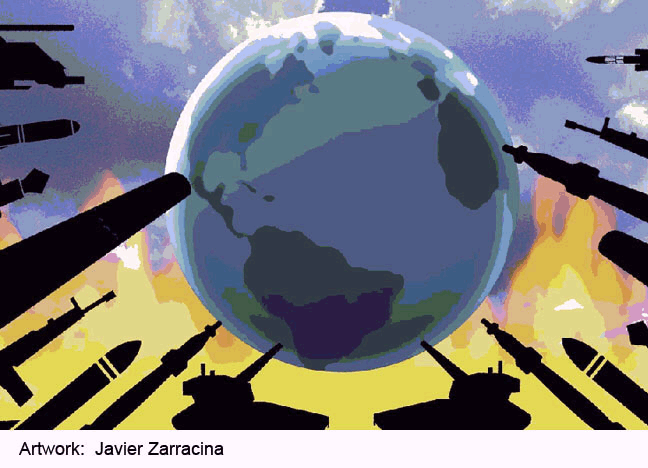
 Washington’s mindset sliding back to ‘limited nuclear war’ says Russian Foreign Ministry, https://tass.com/politics/1065118 23 June 19.
Statements by the US officials are clearly designed to justify expanding the Pentagon’s arsenal of nuclear weapons to support the projection of military force around the world,” the diplomat said
MOSCOW, In its approaches to the use of nuclear weapons, the United States is returning to the concept of “limited nuclear war” and for this they could be planning to abandon the Comprehensive Nuclear-Test-Ban Treaty (CTBT), Deputy Director of the Information and Press Department of the Russian Foreign Ministry Artem Kozhin said on Saturday in a statement.
“It causes great concern to reiterate that the United States is going 60 years back in its approaches to nuclear planning, when the ‘limited nuclear war’ between superpowers seemed acceptable to them and seemed to give a chance to win,” Kozhin said. “This, apparently, is connected to the growing signs of Washington’s desire to renounce its obligations under the Comprehensive Nuclear-Test-Ban Treaty,” the diplomat said.
The United States is ready to make low-yield nuclear warheads a means of blackmailing states for global projection of US military power, Kozhin said. “Statements by the US officials are clearly designed to justify expanding the Pentagon’s arsenal of nuclear weapons to support the projection of military force around the world,” the diplomat said. With such actions, the United States reduces the threshold for the use of nuclear weapons, the statement said.
June 24, 2019
Posted by Christina Macpherson |
politics international, USA, weapons and war |
Leave a comment
 ‘Alarm bells’: Saudi Arabia’s nuclear ambitions cast shadow over the region
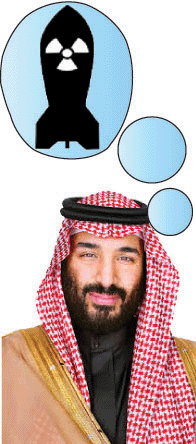
Analysts fear Riyadh is seeking to develop the technical capabilities that would allow it to quickly pursue nuclear weapons, Middle Eastern Eye, By Maysam Behravesh,23 June 2019 “……. Saudi Crown Prince Mohammad bin Salman, continues to receive extraordinary support from US President Donald Trump’s administration. …..Saudi Arabia’s nuclear and missile programmes are bound to have significant regional implications.
Earlier this month, Tim Kaine, Democratic senator from Virginia, revealed that the Trump administration had approved the transfer of nuclear know-how to Saudi Arabia seven times, including twice after the murder of Saudi critic Jamal Khashoggi in early October 2018.
One of the transfers was authorised on 18 October, only 16 days after Khashoggi, a Washington Post columnist, was brutally eliminated inside the Saudi consulate in Istanbul, according to the US senator.
“The Trump administration is seeking to negotiate a nuclear cooperation agreement that would allow Saudi Arabia to use US technology for energy purposes, but not nuclear weapons,” Nicholas L Miller, professor of government at Dartmouth College, told Middle East Eye. ……
Trump’s ‘secret’ approval
In late March, the Reuters news agency disclosed the Trump administration’s “secret” approval of licences for six US firms to sell atomic power technology to Riyadh.
Simultaneously, the Saudis are seeking to develop a ballistic missile programme of their own, apparently with Chinese assistance.
In November 2018, satellite imagery taken by the US company Planet Labs showed what appeared to be rocket engine tests for ballistic missiles capable of carrying nuclear weapons at a military base near the town of al-Dawadmi, about 230km west of Riyadh.
Several months later, in an exclusive report published on 5 June, CNN cited US intelligence sources as claiming that Riyadh had significantly advanced the missile programme with the help of China.
nterestingly, the discovery infuriated Democratic lawmakers as the White House had “deliberately” refrained from sharing its knowledge of the high-stakes development with key members of Congress until they found out about it “outside of regular US government channels”.
“Saudi Arabia’s development of ballistic missiles goes against long-standing US policy of opposing missile proliferation in the region,” said Miller.
“But the Trump administration has so far been relatively quiet about its response.
“There seems to be a pattern in this administration of looking the other way at provocative Saudi behaviour due to the laser-like focus on Iran.”
‘Reckless leadership in Riyadh’
Combined with bin Salman’s warnings that the kingdom would pursue atomic weapons if its chief nemesis Iran did, these concurrent and mostly clandestine missile and nuclear activities are sounding alarm bells in certain capitals in the region, not least Tehran.
“A nuclear Saudi Arabia means nuclear proliferation in the most unstable and volatile region of the world,” Ali Bakeer, a Turkey-based political analyst told MEE. “Given the reckless leadership in Riyadh, this is an alarming development for small states in the Gulf in particular, which might either seek a nuclear umbrella from great powers or consider constructing parallel deterrence capabilities of their own if they could afford it.”……….https://www.middleeasteye.net/news/alarm-bells-saudi-arabias-nuclear-ambitions-cast-shadow-over-region
June 24, 2019
Posted by Christina Macpherson |
politics international, Saudi Arabia, USA |
Leave a comment
Dear Trump (and the US Media): Iran Doesn’t Have a Nuclear Weapons Program, Common Dreams, by Juan Cole, 23 June 19 “…….Trump is now citing Iran’s non-existent bomb-making as the reason for his breach of the treaty and not mentioning any of the things the hawks mind.
Iran isn’t making a bomb and gave up 80% of its civilian nuclear enrichment program in the JCPOA.
In fact, there have been no US intelligence assessments that Iran had decided to try to make a bomb since Tehran admitted in early 2003 that it had an enrichment program (it was supposed to report the program to the UN under the terms of the Non-Proliferation Treaty, which Iran had signed).
Uranium comes in nature in two isotopes, U-238 (very common and relatively inert) and U-235 (rarer and much more volatile). In order to use uranium to fuel a nuclear reactor, it has to be enriched to roughly 3.5% of U-235. If it is enriched to 95% U-235, it can be made to blow up in a thermonuclear explosion, as the US did at Hiroshima and Nagasaki in 1945.
Iran knows how to enrich uranium, but has never enriched to levels above what is considered “Low Enriched Uranium.” The cut-off is above 20% U-235. It has a medical reactor that uses 19.5% enriched uranium.
Although the US CIA has not assessed that Iran has during the past decade and a half had a nuclear weapons program, its civilian enrichment capacities were potentially dual use, so that there was always a chance Tehran might decide to militarize.
I can’t get anybody to believe me on this, but Iran is a Shiite theocracy led by an Ayatollah, and Ali Khamenei has given several fatwas (fatwas or considered legal rulings can be oral) in which he has forbidden the making, stockpiling or use of nuclear weapons. Khamenei rules according to Islamic law, which disallows the deliberate infliction of mass casualties on civilian noncombatants in war. Nuclear weapons obviously target the populations of whole cities and so the ayatollahs consider them tools of Satan.
On the other hand, having the world know that you could whip up a nuclear bomb in short order is a form of deterrence against invasion. Japan has that capability. Iran probably had that capability before 2015.
The 2015 agreement attempted to forestall any move by Iran to develop a nuclear weapons enrichment program (again, it has never done so and says it never would).
Still, for the suspicious, the JCPOA took away the option of quick militarization with four steps:
1. Regular UN inspections of sites for signatures of high-enriched uranium or for plutonium
2. Reduction of number of centrifuges to 6,000, which would take a year to make bomb-grade uranium even if they were turned to that purpose
3. The bricking in and abandonment of a proposed heavy water nuclear reactor at Arak. Heavy water reactors can accumulate fissile material for a bomb faster and easier than light water reactors, so Obama and the UN teamp insisted on this step for Iran.
4. The stockpiles of low-enriched-Uranium (LEU) built up for the medical reactor (and which had come to much exceed the actual needs of that reactor) were cast in a form that prevented further enrichment, and much of it was exported.
Under these circumstances, there is no way Iran can make a bomb without everybody knowing it is trying. It would have to kick out the UN inspectors, build thousands more centrifuges under the gaze of US satellites, etc., etc.
So if what Trump wanted was no Iranian nuke, he had that when he was sworn into office in 2017. By breaching the treaty and refusing to reward Iran’s good behavior by ceasing sanctions, Trump put the US on a war footing with Iran.
He has stopped Iran from selling its oil, a form of blockade that probably amounts to an act of war. He is also stopping European concerns from investing in Iran.
It is frustrating that Trump is dancing on the brink of a war for a purpose that had already been attained. This is why it is bad to elect people to high office who have mental health problems. https://www.commondreams.org/views/2019/06/23/dear-trump-and-us-media-iran-doesnt-have-nuclear-weapons-program
June 24, 2019
Posted by Christina Macpherson |
Iran, politics international, weapons and war |
Leave a comment
Xi heads to North Korea as fate of US nuclear deal still up in the air, Analysis by Joshua Berlinger, CNN, June 19, 2019 Hong Kong (CNN )More than
15 months after Kim Jong Un traveled to Beijing and invited the Chinese President to visit Pyongyang, Xi Jinping is finally heading to the North Korean capital for a two-day state visit this week.
June 20, 2019
Posted by Christina Macpherson |
China, North Korea, politics international |
Leave a comment