The Obstacles to Peace in Europe Are Not What We Think
by Thierry Meyssan, Voltaire Network | Paris (France) | 26 May 2026, The Obstacles to Peace in Europe Are Not What We Think, by Thierry Meyssan
The compromise reached between Presidents Donald Trump and Vladimir Putin on August 15 has still not materialized in Ukraine. The obstacles are not those the United States anticipated. Ukraine is not cooperating, while Germany and the United Kingdom want war.
President Donald Trump acknowledged to his counterpart Xi Jinping that he was his equal. Since World War II, every American president has considered himself superior to others because he was the most powerful and the richest.
Conversely, from a Chinese perspective, Xi Jinping considers himself the equal not only of Donald Trump, but of each of his counterparts. A Chinese person does not believe that having greater resources makes you superior.
This concept of a hierarchy between nations is purely Western. Therefore, the evolution of the US president should not be interpreted without considering the cultural context of the observer.
The following week, Russian President Vladimir Putin, in turn, visited Beijing. Western commentators asserted that the Russian was being held hostage by the Chinese. Again, this demonstrates a complete misunderstanding of their relationship. It is not the product of their respective interests, but of their shared history. From the sacking of the Summer Palace to the Nazi attempt to exterminate the Slavs, each has experienced how Westerners behave. They have concluded that they can only resist them by remaining united. It is therefore absurd to consider replicating what Richard Nixon and Henry Kissinger did in 1972: decoupling the two states.
At the Anchorage summit on August 15, 2025, Donald Trump and Vladimir Putin discussed doing business between their two countries and making peace in Ukraine. Despite several attempts, Washington failed because it wanted to sell weapons to the Europeans first. Today, it seems much more difficult, and the Europeans are beginning to manufacture their own.
President Trump has therefore begun withdrawing troops from Europe and abandoning the war that the Pentagon planned to extend to Transnistria and Bosnia and Herzegovina. He announced that he would withdraw at least 5,000 troops from Germany. Vladimir Putin, for his part, decreed that he would grant Russian citizenship to any adult Transnistrian who requested it. Finally, Donald Trump withdrew his support for the European Union High Commissioner who was administering Bosnia and Herzegovina in violation of the Dayton Agreement (1995). Simultaneously, his former Secretary of National Security, General Michael Flynn, is organizing US investments in the Serb-held area of Bosnia and Herzegovina.
These events suggest that the United States favors a peace in Ukraine that recognizes all of Novorossiya as Russian. This is historically and culturally justified, but it will only be possible by holding a referendum on self-determination. For the moment, Russian forces have no intention of liberating Odessa. The peace treaty could, however, acknowledge this.
Here again, contrary to what we believe, the difficulties do not lie where we perceive them.
The three main ones are now:
1) recognition of the Nazi ideology of the current government in Kyiv and the denazification of Ukraine;
2) recognition of the undemocratic nature of German reunification and the independence of East Germany;
3) recognition of the UK’s anti-Russian obsession and the dismantling of the European Defence Union before it is definitively formed.
Ukraine
Even though Western powers persist in believing that the Russian intervention in Ukraine is an attempt at annexation and the beginning of Russia’s westward expansion, Moscow never invaded its neighbor, but rather implemented Resolution 2202, which it had guaranteed before the Security Council.
To claim that Russia invaded Ukraine is as absurd as saying that France invaded Rwanda. We know that it intervened to end a genocide (for which it was partly responsible), in accordance with a Security Council resolution.
The current Ukrainian government is illegitimate. President Volodymyr Zelensky’s term expired long ago. Every three months, he extends martial law, which serves no other purpose than to prevent new elections. However, his latest decree on this matter extends martial law from May 2nd to August 4th. It would be possible to organize an election campaign and a vote during that time. However, the electoral lists will need to be cleaned up, as they still include soldiers killed in action and civilians who fled. No one knows their exact number, but they could represent between one and two-thirds of registered voters.
The Verkhovna Rada (parliament) is equally problematic. Only a third of the members participate. The laws it passes are therefore of dubious legitimacy. For example, it voted to destroy one hundred million books—on the grounds that they were signed by Russian authors or printed in Russia, without distinguishing between contemporary authors and literary classics. Similarly, this parliament banned the country’s main church and all opposition parties. Moreover, there is a CIA office within the Rada itself that drafts all the laws. The members present simply ratify them.
Russia’s primary demand is the denazification of Ukraine. This is what President Putin declared when launching his special military operation. From a Russian perspective, this is non-negotiable. Indeed, what defines the identity of the Russian Federation is not the memory of Catherine the Great, but that of the Soviet struggle against Nazism. This ideology aimed to annihilate the entire Slavic population (but neither the Jewish nor the Roma population), as explained in Mein Kampf. Even if we in the West are unaware of it, the Second World War was not waged to carry out the Holocaust, but to murder the Slavic population.
The Verkhovna Rada (parliament) is equally problematic. Only a third of the members participate. The laws it passes are therefore of dubious legitimacy. For example, it voted to destroy one hundred million books—on the grounds that they were signed by Russian authors or printed in Russia, without distinguishing between contemporary authors and literary classics. Similarly, this parliament banned the country’s main church and all opposition parties. Moreover, there is a CIA office within the Rada itself that drafts all the laws. The members present simply ratify them.
Yet, the illegitimate administration of the unelected president Zelensky refuses any denazification measures. There are currently numerous monuments glorifying the Nazis and their collaborators, the “fundamental nationalists.” The history of Ukraine was entirely rewritten by them, with the help of British MI6 and the American CIA, after the Second World War. This propaganda aims to make people believe that the “Banderists” fought the Nazis, which is absolutely false. No: the Banderites were Nazis.
Convinced that there will never be denazification, the “fundamental nationalists” are planning the construction of a Pantheon in their honor. General Kyrylo Budanov, head of the presidential administration, organized the repatriation of the remains of perpetrators of crimes against humanity, buried around the world during the Cold War, on March 28. Rob Jetten and Luc Frieden, the Dutch and Luxembourgish prime ministers, have already agreed to the transfer of the bodies of the fascist Yevhen Konovalets and the Nazi Andriy Melnyk.
Germany
In our minds, Germany is a democratic state that successfully reunified in 1990. However, as Dmitry Medvedev, Vice Chairman of the Security Council of the Russian Federation, recently stated, reunification is merely an illusion. West Germans never consulted East Germans. Under international law, reunification is invalid.
The 2025 federal elections produced different and opposing results in the former West and East Germany. West Germans voted for the CDU or SPD, while East Germans voted for the AfD. This is the sole reason why the first two parties are classified as “democratic” and the third as “far-right.”
Yet, Chancellor Friedrich Merz (a Christian Democrat) has pursued a widespread crackdown on all those who challenge his authority, labeling them “conspiracy theorists.” Relying on the Munich Office for the Protection of the Constitution (a branch of the federal body which housed many of the Reich police officials after the war), he banned several media outlets and imprisoned journalists.
Simultaneously, Germany is gradually rebuilding its army with financial assistance from the United Kingdom, just as its predecessor, Chancellor Adolf Hitler, rebuilt the German army with the help of the Governor of the Bank of England, Lord Montagu Norman. He has reinstated conscription for men and requires every volunteer to notify Berlin before going on holiday abroad.
Germany is also rebuilding its military-industrial complex, this time with European funds.
It is preparing for a war like the one in Ukraine, even though a war against Russia would be of a completely different nature. Regardless, the entire German industry is now producing Ukrainian drones and selling them in the Gulf against Iran. Following this logic, Berlin wants to bring Ukraine into the European Union, even though it does not meet the accession criteria set by the treaties: it would simply be a matter of creating a new status, that of “associate member,” and the trick would be done. Having ignored the negative results of the 2005 French and Dutch referendums, this would be just another decision made against the will of the people.
Friedrich Merz, grandson of a Nazi dignitary, cannot imagine his country not being allied with the Ukrainian “fundamental nationalists,” nor holding accountable those who sabotaged the Nord Stream gas pipeline and caused the collapse of German industry.
The United Kingdom
Since the 19th century, the United Kingdom has perceived Russia as its sole rival, not only in Europe, but in the world. Lord Curzon, Viceroy of India, conceived the “Great Game,” the colonization of Central Asia, in order to neutralize the Russian Empire. Today, British strategy remains unchanged.
London continues to portray Moscow as an obscurantist power. It is no longer a matter of fabricating the Zinoviev telegram (which allowed the Soviets to be accused of wanting to interfere in the UK elections), but of making people believe that the Kremlin’s occupant is a madman who has a passenger plane shot down in Ukraine and poisoned Sergei and Yulia Skripal or Alexei Navalny.
Its latest invention is the attack on European airports by unidentified drones. Regardless of the truth, London is using this to convince the North Sea states to join its Joint Expeditionary Force, which it has just transformed into a military alliance, the “Northern Marines,” under its command. It hopes to bring all the member states of the European Union and Turkey into the alliance.
This is why the hereditary Lords—and there are still some—are doing everything they can to keep Keir Starmer in Downing Street. The Prime Minister is, in fact, a Labour member who is, in secret, an agent of big business: unbeknownst to his own party and the media, he attended meetings of the Rockefeller Trilateral Commission. Also unbeknownst to everyone, he appointed Peter Mandelson—an accomplice of the criminal Jeffrey Epstein—as Her Majesty’s ambassador to Washington.
The important thing is to maintain the illusion that the United Kingdom has no dealings with either the State of Israel or Hamas; to continue concealing the fact that Israeli chiefs of staff have been secretly visiting Whitehall throughout the Gaza genocide, in which the British army actively participated. It is better to claim, like Christian Turner, Peter Mendelson’s successor, that only one state has a “special relationship” with Washington: Israel.
The Nuclear Lie at the Center of U.S. Foreign Policy
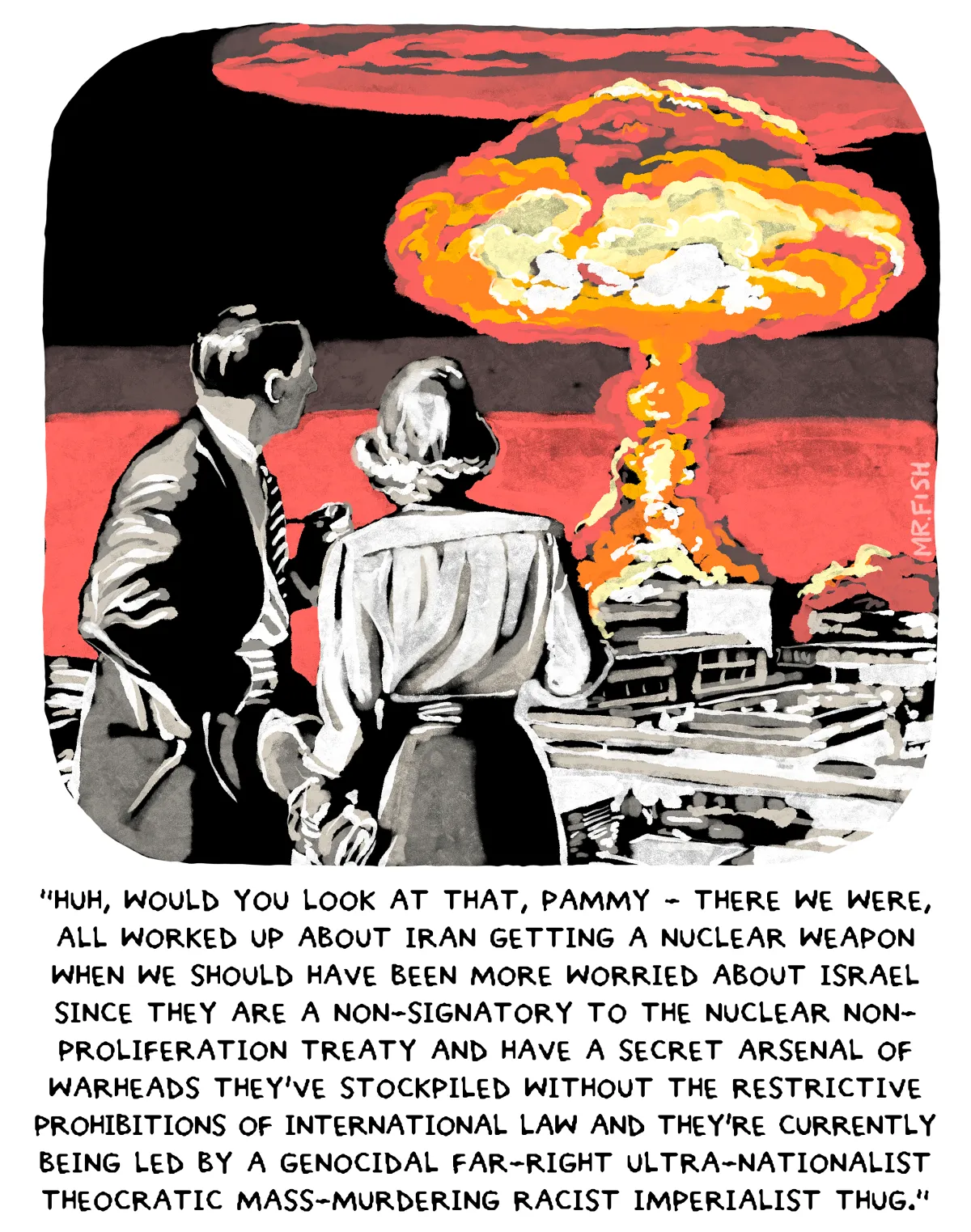
May 19, 2026, Joshua Scheer, https://scheerpost.com/2026/05/19/the-nuclear-lie-at-the-center-of-u-s-foreign-policy/
“One country is sanctioned, threatened, bombed, and demonized over the fear of nuclear weapons. The other already has them — and the world is expected to look away.”
Mr. Fish’s cartoon stuck in my head because it cuts straight through the insanity of the entire conversation. One country already has nuclear weapons and the world is told not to talk about it, while another country that still doesn’t have them is treated like an immediate threat to civilization. The more I sat with the image, the more I started digging into the history underneath it — and the hypocrisy only got harder to ignore.
For decades we’ve been told to panic about the country that doesn’t have nuclear weapons while pretending not to notice the country that actually does. Iran gets sanctions, assassinations, bombings, and endless media hysteria over what it might someday build. Israel sits on an undeclared nuclear arsenal outside the Nuclear Non-Proliferation Treaty and the political/media class acts like everyone is supposed to politely shut the hell up about it.
Mr. Fish’s cartoon cuts through that theater with a sledgehammer.
Israel has never officially acknowledged its nuclear weapons program, yet experts and watchdog groups estimate it possesses roughly 90 nuclear warheads and maintains one of the most secretive nuclear infrastructures on Earth. Unlike Iran, Israel is not a signatory to the Nuclear Non-Proliferation Treaty, and international inspectors have never had full access to the Dimona facility believed to anchor its nuclear program.
The roots of Israel’s nuclear program stretch back decades. The Israel Atomic Energy Commission was established in 1952, and its first chairman, Ernst David Bergmann, openly argued that nuclear weapons would ensure “that we shall never again be led as lambs to the slaughter,” according to the Jewish Virtual Library. As with so much of Israel’s national security doctrine, the trauma and memory of the Holocaust were invoked as a central justification for building and maintaining the program.
Documents show that as far back as 1968, the CIA had already informed President Lyndon B. Johnson that Israel either possessed nuclear weapons or was on the verge of developing them. But instead of confronting the issue publicly, Washington chose silence. President Richard Nixon later struck a secret understanding with Israeli Prime Minister Golda Meir: Israel would neither officially acknowledge nor test its nuclear arsenal, and in return, the U.S. would back off demands for inspections and oversight. From that point on, one of the world’s worst-kept secrets became official policy — don’t ask, don’t tell.
They weren’t guessing. Even reporting from the 1970s pointed to what U.S. intelligence already knew. As The New York Times later revealed, the CIA disclosed in a 1974 assessment that Israel had already developed nuclear weapons — partly using uranium obtained “by clandestine means.”
Meanwhile, Iran — despite years of sanctions, assassinations, cyberwarfare, and bombing campaigns — remains under constant international scrutiny precisely because it is formally inside the nonproliferation framework. Even members of the U.S. Congress have begun openly questioning the contradiction, warning that America’s policy of “official ambiguity” around Israel’s arsenal makes any coherent nonproliferation policy nearly impossible.
That’s the uncomfortable truth sitting underneath the mushroom cloud in Mr. Fish’s illustration: the issue has never simply been nuclear weapons. It has always been about who is allowed to have power, who is allowed to threaten annihilation, and whose violence is treated as “security” instead of extremism.
The cartoon’s suburban couple staring calmly into apocalypse captures the moral numbness at the center of the debate. Entire populations have been conditioned to panic over hypothetical weapons programs while accepting real arsenals, real occupations, and real mass death as background noise. The danger isn’t only the bomb — it’s the normalization of permanent double standards enforced through military dominance and political silence.
The Council on Foreign Relations directly undercuts the claim that Iran is an imminent nuclear threat. CFR writes that “many foreign policy experts warn that a nuclear-armed Iran would destabilize the Middle East and nearby regions,” and argues that Israel viewed Iran’s potential possession of nuclear weapons as a “major, perhaps existential, threat” — a fear used to justify Israel’s June 2025 attacks on Iranian nuclear and military facilities, followed by the joint U.S.-Israeli strikes in February 2026.
But even CFR acknowledges a critical fact often buried beneath the war rhetoric: Iran does not currently possess a nuclear weapon. The organization notes that while Iran has the scientific knowledge and infrastructure to potentially build one fast, there is no confirmed evidence that its leadership has decided to do so.
Adding to that reality, the claim that Iran posed an imminent nuclear threat sharply conflicts with decades of U.S. intelligence assessments. The 2007 U.S. National Intelligence Estimate concluded that Iran halted its structured nuclear weapons program in 2003. Successive American intelligence officials — including former CIA Director William Burns — have repeatedly stated that Iran had not made the decision to build a nuclear bomb. International Atomic Energy Agency (IAEA) inspectors, including former chief Mohamed ElBaradei, likewise reported finding no evidence of an active Iranian nuclear weapons program.
Even Trump’s own Director of National Intelligence, Tulsi Gabbard, recently contradicted the administration’s escalation narrative. In Senate testimony, Gabbard stated that Iran had not rebuilt a nuclear weapons program after the 2025 strikes — directly undercutting claims used to justify continued confrontation and military escalation.
She months later changed of position came after Donald Trump publicly claimed she was “wrong” and insisted U.S. intelligence showed Iran had amassed a “tremendous amount of material” and could build a nuclear weapon “within months.” Of course what has been stated here over and over again Iran doesn’t have a nuclear weapon.
The lie, of course, is that Israel is not treated as a legitimate nuclear and existential threat while Iran — which still does not possess a nuclear weapon — is framed as the ultimate danger. This, of course, is the same logic that has fueled decades of endless war: the claim that Iran could build a weapon someday is treated as justification for permanent aggression today. Yet Iran still does not possess a nuclear weapon — and one reason may be obvious: countries like North Korea learned that once you do obtain one, you become untouchable, while nations without them remain at the mercy of the empire’s next target.
Within the last week, members of Congress have started asking the same question — because who can’t see what’s right in front of our faces anymore? As lawmakers pressed the State Department for transparency over Israel’s undeclared nuclear arsenal, the hypocrisy at the center of U.S. foreign policy became increasingly difficult to ignore.
In a letter sent to Secretary of State Marco Rubio, Democratic lawmakers pointed directly to the U.S.-Israel war on Iran as evidence that greater clarity is urgently needed.
“Congress has a constitutional responsibility to be fully informed about the nuclear balance in the Middle East, the risk of escalation by any party to this conflict, and the administration’s planning and contingencies for such scenarios,” the letter, signed by 30 members of Congress, stated. “We do not believe we have received that information.”
The lawmakers also warned that maintaining “official ambiguity” around one state’s nuclear capabilities while threatening war over another’s makes genuine nonproliferation impossible in the Middle East.
“A policy of official ambiguity about the nuclear capabilities of one party to this conflict makes coherent nonproliferation policy in the Middle East impossible,” the letter stated, “for Iran, for Saudi Arabia, and for every other state in the region making decisions based on their perceptions of the capabilities of their neighbours.”
“This initiative is taking place against the backdrop of the US-Israeli war of aggression against Iran,” said Josh Ruebner of the Institute for Middle East Understanding Policy Project. “One of Trump’s goals for ending this war involves negotiations to lift sanctions against Iran in exchange for an Iranian commitment not to develop nuclear weapons.”
“Members of Congress are right to question why Israel’s development of nuclear weapons gets a free pass while we’re trying to prevent Iran from acquiring them,” Ruebner added.
Of course, throughout the 1970s and ever since, Israeli officials have maintained the same carefully worded line: “Israel will not be the first country to introduce nuclear weapons to the Middle East.” It’s a statement built on ambiguity — one that allowed everyone to pretend not to see what was already obvious.
But now, as the world edges closer to what increasingly feels like a third world war and the Doomsday Clock sits nearer to midnight than ever before, the real question is no longer whether these weapons exist. The question is when — and under what leadership — they could be used.
That fear becomes even more dangerous under a U.S. president whose mental fitness has become a serious public concern, and who has repeatedly used apocalyptic rhetoric about “’blown off the face of the earth’” Because if Israel is treated as an undeclared nuclear power beyond accountability, the United States remains the ultimate nuclear superpower — the empire standing behind it with the largest arsenal on Earth.
Remember how all of this started — with an Mr. Fish cartoon forcing us to stare directly at the hypocrisy and madness surrounding nuclear weapons, war, and empire. Thanks for making people think. And here’s his work: The Independent Ink Archive
As support for Israel declines in the U.S., the ‘Special Relationship 2.0’ is starting to take shape.
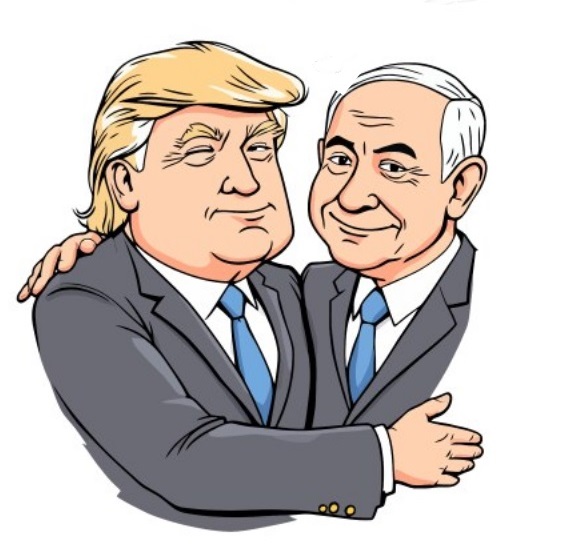
This can be presented as an investment in American jobs in partnership with Israel rather than as taxpayer assistance to a foreign government.
Benjamin Netanyahu and his allies in Congress have begun calling for an end to U.S. aid to Israel, but this won’t end the “special relationship” between the two countries. In fact, recent signs suggest it may only deepen U.S. military ties to Israel.
By Mitchell Plitnick Mondoweiss, May 17, 2026
This month, Israel and the United States are expected to begin negotiations on a new memorandum of understanding (MOU) that would outline the United States’ plans to support Israel after the current MOU expires in 2028. Chances are this will look like a very different conversation than in the past.
In recent months, there’s been a lot of noise around the idea of ending U.S. military aid to Israel. It’s an idea that has long been pursued by Palestine solidarity activists and, in the past, has also been floated by the Israeli right and their fellow travelers, who thought the aid wasn’t worth restricting Israel’s “freedom to act.” But surprisingly, the current proposal to end the annual grant of Foreign Military Financing (FMF) to Israel—which makes up most, though not all, of the annual aid package—comes from none other than Israeli Prime Minister Benjamin Netanyahu and is championed in Washington by South Carolina Republican Senator Lindsey Graham, the biggest hawk in the Senate.
What explains this?
Back in January, the Institute for Middle East Understanding’s Policy Project published a timely and detailed backgrounder on what is actually going on here.
What emerges is a plan to continue aid to Israel in a different form. Instead of sending money to Israel, which they have to spend with American corporations, Congress would appropriate money for joint development and production projects instead. This can be presented as an investment in American jobs in partnership with Israel rather than as taxpayer assistance to a foreign government.
The time to make such a move is now. Israel’s popularity has plummeted, and the once-certain annual military aid package is now up for debate. While the current Congress is still inclined to fund an unimpeded tidal wave of weapons and money to Israel, growing opposition in both parties makes even the near future of such aid uncertain………………………………………………………………………………………………………………………………………………………………………………………………………………………………………………………….. https://mondoweiss.net/2026/05/as-support-for-israel-declines-in-the-u-s-the-special-relationship-2-0-is-starting-to-take-shape/
The CIA’s Cuba Ultimatum: Regime Change With a Diplomatic Smile
create the crisis, punish the population, scare off investment, then demand political surrender from the government you have spent decades trying to brea. – — force Cuba to bend to Washington’s will.
SCHEERPOST, May 19, 2026.
The CIA did not sneak into Havana this time. It landed in broad daylight.
Peter Kornbluh reports in The Nation that CIA Director John Ratcliffe led a high-level U.S. delegation to Cuba on May 14, delivering what amounted to a blunt Trump administration ultimatum: Washington is willing to “engage” on economic and security issues, but only if Cuba makes “fundamental changes.”
The message is hard to miss. After decades of sabotage, sanctions, assassination plots, covert operations and economic strangulation, the U.S. is now packaging regime-change pressure as diplomacy. Cuba is facing severe fuel shortages, blackouts and growing hardship — conditions Washington’s policy has helped intensify — while Trump officials tighten sanctions, target foreign investors and float military threats.
This is not diplomacy. It is submission politics.
Kornbluh’s piece lays out the old imperial script in its newest form: create the crisis, punish the population, scare off investment, then demand political surrender from the government you have spent decades trying to break. The CIA’s public trip to Havana may look different from Bay of Pigs secrecy or Operation Mongoose sabotage, but the goal remains painfully familiar — force Cuba to bend to Washington’s will.
The danger now is that economic warfare is being paired with open military signaling. Reports of increased U.S. intelligence flights near Cuba, threats involving aircraft carriers, possible indictments of Cuban leaders and leaked claims about Cuban drones all point toward a familiar pretext-building machine.
Once again, the United States claims to be defending freedom while tightening the noose around an island it has never forgiven for refusing to obey.
The CIA has spent decades trying to overthrow the Cuban government through covert operations, assassination plots, sabotage, and economic warfare — from the Bay of Pigs to Operation Mongoose and countless regime-change schemes. But now Washington isn’t even pretending anymore. CIA Director John Ratcliffe’s very public trip to Havana marks a dangerous new phase in the long U.S. campaign to force Cuba into submission politically and economically.
According to reports, Ratcliffe delivered what was essentially a “do or die” ultimatum from the Trump administration: either Cuba accepts Washington’s demands for change, or the window for diplomacy closes. He reportedly pointed to what happened in Venezuela after Maduro refused to bend to Trump’s threats, making clear the White House is prepared to “enforce its red lines” if Cuba refuses to capitulate.
The timing says everything. Ratcliffe arrived just one day after Cuba publicly admitted the country has effectively run out of fuel. “We have absolutely no fuel oil, and absolutely no diesel,” Cuba’s energy minister said on state television. That crisis didn’t happen in a vacuum. Cutting off Cuba’s access to fuel, electricity, and basic economic survival has become central to Trump’s pressure campaign against the island.
As one analyst put it, previous administrations tried to lure Cuba with carrots. Trump’s strategy is to beat Cuba with a stick until it collapses. And with U.S. military activity escalating around the region, it’s becoming harder to ignore the possibility that Washington is preparing for something even more dangerous if Cuba refuses to surrender to its imperial demands.
Read The CIA Goes to Cuba from Peter Kornbluh at The Nation
Trump Sends CIA Chief — Not Diplomats — To Deliver Cuba Threat
……………………………………………………………………………………………………………… https://scheerpost.com/2026/05/19/the-cias-cuba-ultimatum-regime-change-with-a-diplomatic-smile/
The American epoch of oil is collapsing. What comes next could be ugly
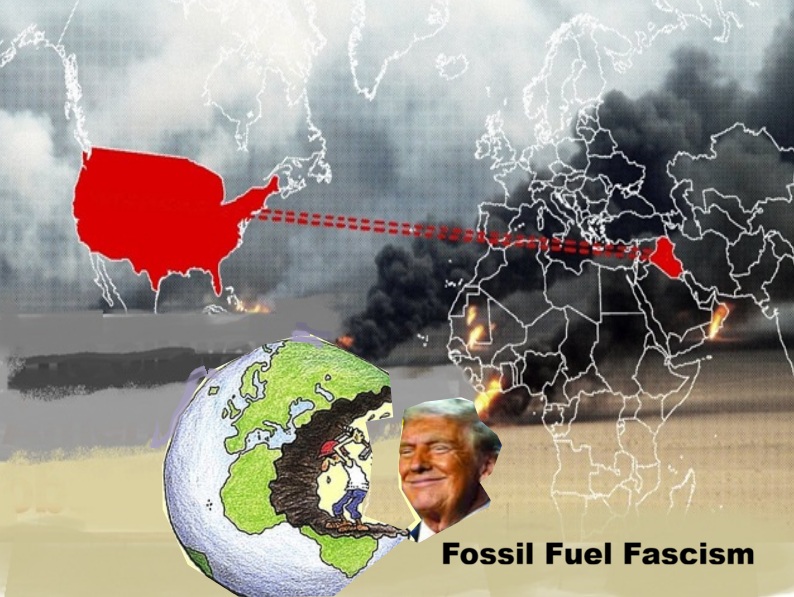
democracies across the planet are now threatened by what might be called fossil fuel fascism – an extremist political movement that breaks laws, spreads lies and threatens violence in an increasingly desperate attempt to maintain markets for oil, gas and coal that would otherwise be replaced by cheaper renewables.
In the short term, the biggest windfall from the Iran conflict has gone to companies, executives and shareholders in the US petroleum industry
China is dominating the energy transition with astonishing result, while fossil fuel fascists in the US try to turn back the clock.
Guardian, Jonathan Watts, 17 May, 2026
“Farewell,” the flag-waving Chinese children chanted to Donald Trump as he strolled along the red carpet back to Air Force One at the end of his summit with Xi Jinping in Beijing.
The US leader claimed he was leaving with a cluster of “fantastic” trade deals to sell US oil, jets and soya beans to China. That has not been confirmed by his smiling host, but one thing was crystal clear from the two days of meetings: the global balance of power is shifting, from the declining petrostate in the west to the rising electrostate in the east.
Trump flew home to chaos – war with Iran, surging gas prices, spectacular unpopularity, friction with former allies and a 20th-century policy of “energy dominance” that seeks to turn back the clock, use tariffs and military threats to open markets, and enrich his supporters in the fossil fuel industry. The long dominant superpower increasingly appears a malignant force as it pushes the world towards ever greater turbulence.
Xi, meanwhile, presides over a country that has invested more than any other in renewable energy, which has helped to buffer its economy from the gas price shocks caused by the conflict in the Middle East, while opening up huge new export markets for solar panels, wind turbines, smart grids and electric vehicles. While the Chinese president’s Communist party still faces criticism for its suppression of dissent, its soft power deficit no longer seems so great when its main global rival is killing protesters at home and bombing schoolchildren overseas.
“Future historians may well see the Iran war as the moment the US unwittingly ceded leadership to China”
Why is this happening now? Tempting as it is to blame these global shifts on a single malignant narcissist in the White House, a more useful – and maybe even hopeful – analysis needs to take into account the tectonic changes that are shaking not just the foundations of politics, but the very nature of human power, as the world shifts from molecules to electrons.
History has proven that when the dominant form of energy changes, there is often a shift in the global pecking order. We are now in the midst of one such transition as the epoch of petrol, predominantly produced in the United States, Russia and Gulf states, starts to give way to an era of renewables, overwhelmingly manufactured in China. But the outcome remains contested, and the process could be ugly. The new energy order is winning the economic and technological battle – wind turbines and solar panels were already producing record-cheap electricity even before the Iran war pushed up the costs of gas and oil-fired power plants. But the old petro-interests still have political, military and financial might on their side, and they are using that to try to turn back the energy clock.
As a result, democracies across the planet are now threatened by what might be called fossil fuel fascism – an extremist political movement that breaks laws, spreads lies and threatens violence in an increasingly desperate attempt to maintain markets for oil, gas and coal that would otherwise be replaced by cheaper renewables.
Of course, there are multiple other, overlapping reasons for the war against Iran: its nuclear program, Trump’s need for a distraction from the Epstein files, and his willingness to adopt positions favourable to Israel’s Benjamin Netanyahu, Russia’s Vladimir Putin and Saudi Arabia’s crown prince, Mohammed bin Salman, to name a few.
But the wider context is that the Earth is becoming a more hostile environment for humanity. This is driving up tensions, exposing economic limits that have been ignored for centuries and redefining geopolitical realities.
Who is actually winning? In the short term, the biggest windfall from the Iran conflict has gone to companies, executives and shareholders in the US petroleum industry – a major source of campaign funding for Trump – that was struggling with low prices and a production glut at the start of the year, but is now enjoying a spectacular revenue surge while rival suppliers in the Gulf are choked by threats in the strait of Hormuz. Along with Russian and Saudi Arabian petro-companies, US energy suppliers look set to cash in for months to come, even as consumers pay more at the pumps.
At the same time, the war is forcing countries across the world to explore ways to increase their energy independence. In the next few years, that will happen by increasing domestic production of oil, gas and coal. By one reckoning, this has increased the likely 2030 output of fossil fuels by a fifth – an alarming setback for global efforts to reduce greenhouse gas emissions, and a victory for the petroleum industry and the far-right political groups it funds.
But that will not be the final reckoning of this war, which has reinforced the argument for both renewable energy and a concurrent shift in geopolitical alignments. With major oil and gas producers now led by ever more erratic and menacing authoritarian leaders, other countries are looking for alternative ways to generate power. Electric cars, for example, have never been more in demand.
The prime beneficiary is China, which suddenly appears a relative oasis of pragmatic, internationally minded diplomacy and energy independence. Beijing’s bet on renewable power and EVs over the past two decades is paying enormous dividends. Not only has this made it less reliant on fuel imports, it now has a wind, solar and battery export industry that looks set to dominate global markets for many decades to come.
Future historians may well see the Iran war as the moment the US unwittingly ceded leadership to China. If so, it would not be the first time that a change in the world’s energy matrix led to a reordering of the political hierarchy of nations. When humankind taps new power supplies, new empires rise and old ones fall. Realignments tend to be violent.
How empires fall
One of the cornerstones of geostrategic thinking since the start of the Industrial Revolution, 250 years ago, is that the country tha
“Oil has meant mastery through the years,” wrote Daniel Yergin in his Pulitzer prize-winning book about the decisive role of energy in world politics, The Prize: The Epic Quest for Oil, Money, and Power. Yergin argues oil was a primary reason why Germany invaded the Soviet Union during the second world war, and motivated Japan to attack the US at Pearl Harbor. It was why the US launched Desert Storm to thwart Iraq’s seizure of Kuwait, which would have given Saddam Hussein control over the planet’s most abundant oil supplies. It explained former US president Barack Obama’s comment that energy was “priority number one” for his administration. Earlier this year, it was a primary justification by Trump and other US officials for invading Venezuela, which has the world’s biggest untapped reserves, and it is now a key factor in the war on Iran, which has the fourth highest supply.
“We have entered the age of clean energy. Those who lead this transition will lead the global economy of the future” – António Guterres
Not for nothing has the old joke been revived that the “US is a very fortunate country because everywhere it goes to bring freedom it finds oil.”
But what is different today is the realisation that oil – once considered “black gold” – and other fossil fuels are now a toxic threat to the stability of the climate and the political world order. Now that cheaper, cleaner alternatives are available, the demand for these industrial fuels has to be artificially inflated, propped up by political lobbying, hefty subsidies, disinformation campaigns and military force.
The most spectacular example of an energy transition completely upturning the world order was in the mid-19th century, when the coal-powered gunships of the Royal Navy shredded the fragile coastal defences of southern China to impose a market for the British empire’s most lucrative and unethical commodity: opium. Up to that point, Beijing had been the capital of the world’s biggest economy for most of the previous 2,000 years but its historic advantage in manpower and culture was being lost to fossil-fuelled engines and the spirit-sapping drug trade. The Daoguang Emperor was so deeply in denial about the changes reshaping the world that his actions stirred rebellion among his own people. His forces were crushed by the superior firepower of an industrialised adversary, ushering in an era of western dominance that became known in China as the “century of humiliation”.
Britain’s empire also came to end – albeit it more limply – when its primary source of fuel – coal – was superseded by oil in the early-to-mid-20th century. Back then, the UK had no petroleum supplies of its own which meant it was at a disadvantage to the US. The power shift was confirmed in 1956 when Britain, France and Israel invaded Egypt to try to secure the Suez canal – a vital route for fossil fuels from the Middle East. The US refused to help this imperial adventure by the old world, thereby confirming Washington as the dominant superpower outside the Soviet bloc. Since then, it has steadily expanded its primacy in the age of oil.
That era – and that supremacy – are both now winding down, as the pendulum swings again, this time towards renewables and back to Asia. In the past decade, clean energy investment worldwide has risen tenfold to more than $2tn a year. Last year, it was more than double that of fossil fuels, and for the first time renewables overtook coal as the world’s top electricity source. “We have entered the age of clean energy,” the United Nations secretary-general, António Guterres, observed in February. “Those who lead this transition will lead the global economy of the future.”
China looks to the future …
The government in Beijing has turned the greatest crisis facing humanity – climate breakdown – into an opportunity to finally lay to rest the “humiliation” of the opium war. For most of the past 30 years, it has been catching up with the west by copying its dirty, coal-driven model of industrialisation, which notoriously made it the world’s biggest carbon emitter. Now, though, it is leapfrogging its rivals on clean energy with astonishing results. For the past two years, China’s carbon emissions have been flat or falling, raising hopes of a historical turning point in the curve of global emissions……………………………………………………………………………………………………………………………………………………………………….
… while the US goes backwards
While the rest of the world looks for an exit ramp off the exhaust-fumed highway on to a cleaner, electrified, 21st-century freeway, Trump has pulled a U-turn and is accelerating back towards 20th-century smoke stacks without so much as a glance in the rearview mirror.
On the same day he was sworn in for his second term in the White House, Trump signed an executive order withdrawing the US from the 2015 Paris Agreement, as he did in his first term.
But this time he has also announced that he will quit the entire UN Framework Convention on Climate Change, the Cop process that was put in place at the 1992 Earth Summit. In February his administration repealed the 2009 “endangerment finding”, the core US government determination that greenhouse gases threaten public health that has been the legal basis for almost all federal climate regulation over the past 17 years. Without it, power plants, factories and carmakers will have a freer pass to pollute the air and heat the atmosphere.
“The US state has essentially been captured by a business group that puts its own interests above those of the nation?
Trump has filled the Department of Energy and the Environmental Protection Agency with dozens of former oil industry employees. He has declared a “national energy emergency”, which was a cue for businesses to mine, drill and frack like never before. ………………………………………………………………………………………………………………………….
Meanwhile, his government has accelerated the phaseout of tax credits for renewable projects, which has had a chilling effect on the sector with $22bn in clean energy projects cancelled and wind power investment down to its lowest level in a decade. “My goal is to not let any windmill be built. They’re losers,” Trump told oil executives in January………………………………………………………………………………………………………………………..
Oil in command
The US state has essentially been captured by a business group that puts its own interests above those of the nation.
During the last presidential election, Trump invited 20 oil executives, including the heads of Chevron, Exxon and Occidental, to his club in Mar-a-Lago, Florida, saying he would scrap barriers to drilling, resume gas exports and reverse car pollution controls if they helped to bankroll his race for office. Mike Sommers, president and CEO of the American Petroleum Institute, said Trump’s legislative agenda “includes almost all of our priorities”.
Big oil poured a record $450m into the campaigns of Trump and Republicans in 2024 according to the watchdog group Climate Power. Then after Trump won, the industry gave another $19m to his inauguration fund. And even though Trump is forbidden by the constitution from running for a third term, fossil fuel money continues to pour into his Pac, including $25m from oil pipeline company Energy Transfer Partners and its CEO, Kelcy Warren.
And these are only the publicly disclosed funds. Nobody knows how much secretive “dark money” is flowing through other channels, ……………………………………………………………………………………………………………………………..
“The championing of fossil fuels depends on a big lie – that the US and the planet can return to an era powered by climate-destabilising fuels”
,………………………………………………………………………………………………………………………………………………………………………………………. huge sums of money are now being channelled from the US to support far-right groups in Europe, who are campaigning on anti-net zero platforms.
The championing of fossil fuels depends on a big lie – that the US and the planet can return to an era powered by climate-destabilising fuels. It’s a lie that relies on threatening or downsizing scientific academies, truth-seeking news media and unfiltered online debate.
The US president has repeatedly called the climate crisis a “hoax”, “scam” or “bullshit”, ushering in what has been called a period of “climate hushing” (or “green hushing”). Essentially, this is a campaign to stifle public debate so that people are less aware of the dangers posed by fossil fuels and the benefits of cheaper renewable alternatives. His administration has announced plans to close down or slash budgets for the world’s leading science institutions. Meanwhile the president’s billionaire backers are helping to choke the climate debate in the media. After Elon Musk bought Twitter, now X, scientists report the social media algorithm is suppressing their voices and encouraging misinformation about the climate. Earlier this year, the Washington Post, owned by Jeff Bezos, slashed the size of the paper’s award-winning climate reporting team.
The Trump administration’s obsession with fossil fuels will dwarf the economic and human toll of the Iran war. The world’s hottest 10 years ever recorded have all occurred in the past decade. Extreme weather is increasingly out of control, pushing up food prices, prompting migration and sparking conflict. Many scientists fear the planet is heating faster than expected, pushing oceans, the Amazon, coral reefs, the Arctic and Antarctic ever closer to the point of no return. And worse is to come, with an El Niño expected to supercharge global temperatures in the coming year.
Throughout the world, a huge majority of people want their governments to take stronger action on the climate crisis. So fossil ambitions run up against popular opinion, which means its proponents have to rely on force to maintain control – with more oppression at home and more war overseas, an ever more extreme and violent response to ever more extreme and destructive weather.
All of this makes China suddenly seem a more appealing and serious alternative. This was not previously the case. Beijing used to project the opposite of soft power. Its political system is repressive. It continues to lock up journalists, artists and dissidents. But today there is a narrowing gap in its human rights record compared with the US, while its energy policy is increasingly aimed at halting climate breakdown rather than making it worse.
China, of course, is also building up its military and investing in energy-sucking artificial intelligence – though at much lower levels than the US. This is not to say its intentions are any more benign. But think of it, from the perspective of Europe, Africa or Latin America: do you choose China, which is becoming a modern electrostate that engages in multilateral decision making, and can supply you with more energy autonomy? Or do you pick the US, which appears to be trying to turn the clock back to the 20th century when it comes to fossil fuel domination, and the 19th century when it comes to imperial gunship diplomacy?
………………………………………………………………………………………………………………………………………………………………………………….. at least the Trump administration has clearly delineated the battle lines on the future of the planet.
On one side are the vast majority of the world’s people, all of nature, 99.9% of climate scientists and the fastest-growing, greatest-job-creating chunk of the global economy: the clean energy sector.
On the other is Trump and the primary producers and users of fossil fuels, who need enormous taxpayer subsidies to stay profitable and ever greater violence to quell public unease and global opposition………………………………………………………………
Will this fossil fuel fascism, that billionaire-backed campaign to crush a green transition by any means necessary, hold back the tide of clean energy autonomy? It cannot be ruled out………………………………………………………….
But the climate will not be bending to the will of even the best funded, most heavily militarised and artificially idealised US administration nor the King Canute at its centre.
Most people realise this. …………………………………………………………………………….
The fightback is under way in the courts, at elections and on the streets. The most populous and fast-growing state economy of California already gets two-thirds of its electricity from renewables and has pledged to continue expanding wind and solar………………………………………………………………….
Despite the deep pockets of the backers of fossil fuel fascism, their resistance will be futile. The movement could become more deranged and violent in its efforts to turn back the clock, suppress dissent and thwart China’s rise. But ultimately, the planet will have the final say. https://www.theguardian.com/us-news/ng-interactive/2026/may/17/america-china-energy-oil-renewables
Will there be global war over Taiwan? – Sociology matters
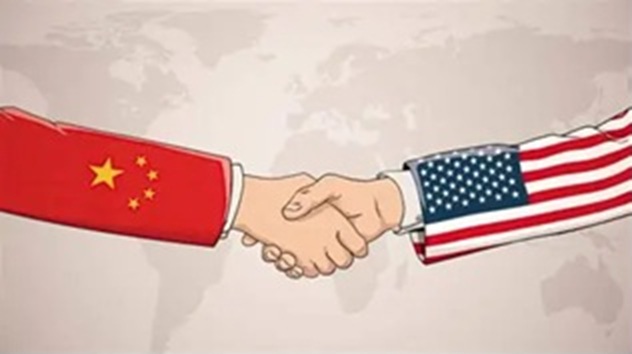
19 May 2026 Noel Wauchope, https://theaimn.net/will-there-be-global-war-over-taiwan/
Will there be global war over Taiwan? Ask a sociologist.
Having never actually studied sociology, I am indeed prepared to be shot down in flames, for my audacity in pronouncing opinions on sociology. But that thought has never stopped me, as I believe that anyone and everyone can have opinions, and should be taken seriously.
Britannica says:
“Sociology, a social science that studies human societies, their interactions, and the processes that preserve and change them… the processes that preserve and change human societies.”
What prompted me to consider this, is the news coverage of Donald Trump’s visit to China, and his interaction (accompanied by business moguls) with President Xi Jinping. Was this the first part of a process that might preserve and change the global society? The general theme of most articles is that not much was achieved in this meeting, and particular concerns were not resolved. The main concern was about Taiwan. Will the USA come to the defence of Taiwan if China were to take it over? There was the need to open up the Strait of Hormuz There were trade concerns, particularly about China’s near monopoly of the rare earths market, about USA’s plan to to sell Taiwan $US14 billion more in weapons, and China’s to send weapons to Iran.
Other touchy topics like climate change and human rights were avoided.
It all looks as if there wasn’t any process, and it all came out with the same stalemate, and the same ambiguity about Taiwan. So we’re back into the old dilemma – will there be global war over Taiwan? But there was an interaction. Whatever we all think of Donald Trump, or of Xi Jinping, they had a courteous and cordial meeting, and Trump is the first American President to visit Beijing twice.
So, I’m thinking that this is the start of something new. Not because these powerful men might have altruistic ideas and plans, but because of another consideration. This was highlighted in an insightful article by ABC journalist Bang Xiao, who wrote:
“This week in Beijing, both Donald Trump and Xi Jinping quietly admitted something the rest of the world has been slow to grasp. Neither of them can afford the collision… Two structurally interdependent superpowers who have decided, for now, to manage their rivalry rather than let it manage them.“
It’s some kind of a comfort to realise that financial realities might now be prioritised over glorious ideals of national pride, the heroism of war, patriotic sacrifices and all those noble ideals which, with modern warfare, are becoming ecocidal. Neither the USA nor China can now afford a global war. Xi Jinping referred to the “Thucydides Trap.” In the 5th century, Greek historian Thucydides described this situation where a rising power challenges an established one, usually leading to a prolonged war.
The significant thing here is that China is no longer seen as a “rising power” – and this really is all about sociology. SL Kanthan writes that: “The Thucydides Trap is no more,” and gives a powerful explanation of China’s debts and its slowing economy. There have been recent articles on China’s current economic decline, but this is not really a new development, but more of a steady decline over years. China’s GDP growth has been decelerating – “the slowing empire, the tired dragon.”
The sociological facts come in here. There’s been quite a dramatic fall in China’s birth rate. With a dwindling population, and with the median age rising, it’s a poor forecast for China’s working-age proportion of the population. The fall in what was a booming real estate industry has resulted in a rapid decline in construction and related industries and the loss of employment opportunities. This job loss has been exacerbated by the loss of jobs for college graduates, with robots now taking over much of their work. China has severe and seemingly intractable debt problems. Finally, China’s military is in some trouble, and not ready for war.
With all the chest-thumping and the rush for new weaponry amongst the military-industrial complex, there’s a lack of concern for sociological realities such as those now affecting China. And China is not the only country affected by population change, economic problems, public and private debt – all factors that dampen enthusiasm for war. I sometimes ponder on what was the greatest scientific achievement of our age. Was it the atomic bomb, rockets, the digital revolution, medical breakthroughs?
I’m thinking that the most influential one might be effective contraception. That is certainly a huge factor in China’s slowdown, and its leadership’s reluctance about war, and its readiness to co-operate, while still competing with the West. The economic realities on both sides are there, on a background of sociological changes that make war look financially unappealing. And we all know that Trump, despite his bombast, is more interested in money than in anything else.
128 years of US exploitation, degradation of Cuba continues on steroids – Walt Zlotow
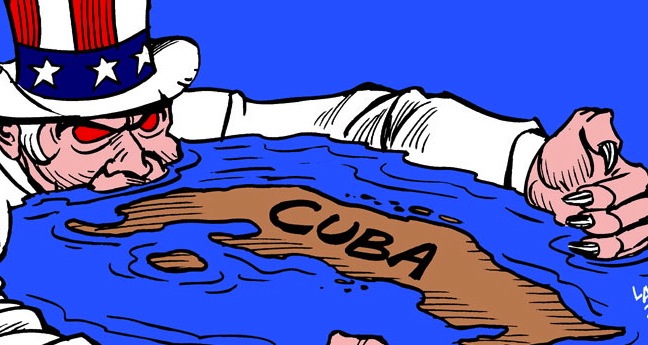
Walt Zlotow West Suburban Peace Coalition Glen Ellyn IL, 16 May 2026, https://theaimn.net/128-years-of-us-exploitation-degradation-of-cuba-continues-on-steroids/
One must go back to 1898 for the last time the US was not exploiting Cuba and its people to benefit rapacious US capitalism and organized crime. That year the US cooked up fairy tale about Spain blowing up the US Maine, sent to Havana Harbor to intimidate Cuba’s Spanish ruler. The Maine did blow up but from an accidental internal explosion, not a Spanish mine. Those 261 sailors could not to die in vain so President McKinley and his war party blamed Spain in order to declare war, kick Spain out of the Americas and take over Cuba for US exploitation.
But nothing in the previous 126 years compares to the diabolical cruelty, including death, the US has inflicted upon Cuba by President Trump and his bloodthirsty Secretary of State Marco Rubio.
This is not exaggeration. Need a lifesaving operation in Cuba under the Trump, Rubio oil blockade? Faggedaboudit. Much medical care is unavailable in oil starved Cuba when the lights go dark. Food and life sustaining supplies are becoming scares as farmers and merchants cannot get their wares to the people with a transport system largely shut down. Nearly a fifth of Cubans have fled the Trump, Rubio regime change operation.
Trump glories in their death and destruction he’s unleased. “THERE WILL BE NO MORE OIL OR MONEY GOING TO CUBA – ZERO! I strongly suggest they make a deal, BEFORE IT IS TOO LATE.” Trump is simply expanding in more grotesque terms US policy to degrade Cuba into submission going back to 1960. A secret State Department memo back then under Eisenhower promoted overthrowing Castro thru “a line of action, while adroit and inconspicuous as possible, denies money and supplies to Cuba to bring about hunger, desperation and overthrow of the Castro government.” Trump simply dropped the “adroit and inconspicuous” fig leaf.
Ironically, the first US embargo in Cuba was good for the Cuban people. In April, 1958, Eisenhower imposed an arms embargo on the Batista regime. The US had been supporting Batista’s murderous rule for 25 years to insure his support of US economic control, both legal and criminal that enriched US capitalists and Mafia enterprises to the detriment of the Cuban people. Eisenhower didn’t have an epiphany to help the Cuban people. He simply saw the inevitable triumph of Castro’s revolution and sought to curry favor with its eventual rulers.
Twenty months later Castro prevailed, Batista fled and Cuba finally ended 62 years of US cruelty and exploitation. Not quite. Within year the US imposed Cuban embargo 2.0 designed not to facilitate the inevitable revolution but to destroy it. Sixty-six years on, with the entire world community except Israel voting year after year in the UN for the US to stop, America’s endless lust to crush the Cuban revolution continues apace. And under the depraved Trump, Rubio oil embargo, it has become a monumental war crime against the 11 million sorrowful Cuban souls.
After Offering ‘No Tangible Concessions’ in Iran Peace Talks, Trump Issues Latest Violent Threat
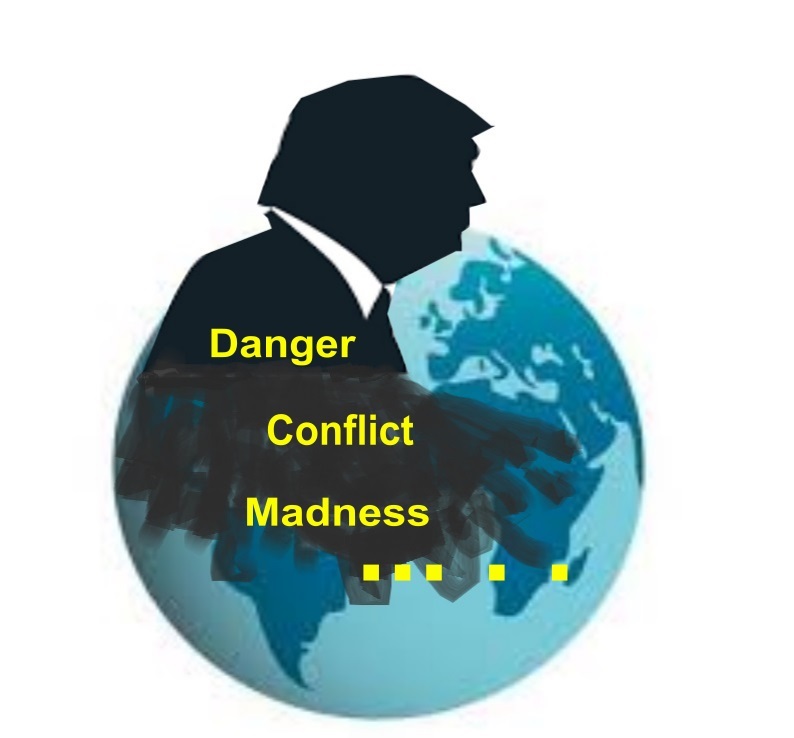
“The only realistic path to a diplomatic breakthrough would require Washington to engage more directly with the structure and substance of the Iranian proposal itself,” said a national security expert.
Julia Conley, May 17, 2026, https://www.commondreams.org/news/trump-iran-nuclear-talks
With the economic impact of the war on Iran linked to President Donald Trump’s plummeting approval rating, the president issued his latest threat to destroy the Middle Eastern country Sunday as he demanded negotiators “get moving, FAST” to end the conflict the US and Israel began by choice in February.
“For Iran, the Clock is Ticking,” said the president in a Truth Social post, adding that if a peace deal is not reached soon, “there won’t be anything left of them. TIME IS OF THE ESSENCE!”
Trump rejected Iran’s latest peace proposal last week; the country has reportedly offered significant concessions on its uranium enrichment, but seeks to have separate nuclear talks after achieving peace and reaching a deal to reopen the Strait of Hormuz, which the Iranians effectively closed in retaliation for the US-Israeli attacks.
Since launching the conflict, Trump has demanded the dismantling of Iran’s missile arsenal as well as its nuclear program, which Iran has said is not for military purposes, and has called for the country to cut ties with its regional allies.
Iran’s Mehr news agency said Sunday that Trump had offered “no tangible concessions” in his response to the Iranians’ latest proposal.
“The United States,” said the news outlet, “wants to obtain concessions that it failed to obtain during the war, which will lead to an impasse in the negotiations.”
Trump told Fox News in Beijing over the weekend that the Iranians are “crazy, and you know what? Because of that, they cannot have a nuclear weapon,” explaining why he viewed it as “unacceptable” for nuclear talks to take place separately after a peace deal is brokered.
Trump reportedly spoke to Israeli Prime Minister Benjamin Netanyahu Sunday about the possibility of renewing strikes on Iran, which would break a ceasefire that was reached more than a month ago.
Danny Citrinowicz, a senior researcher at the Institute for National Security Studies, said Sunday that “the only realistic path to a diplomatic breakthrough would require Washington to engage more directly with the structure and substance of the Iranian proposal itself.”
“Iran’s priorities remain consistent: ending what it views as economic siege conditions, reopening maritime access and reducing pressure in the Gulf, negotiating an end to the broader conflict, and only afterward addressing the nuclear issue,” said Citrinowicz. “At the present moment, it is difficult to see the Iranian leadership agreeing to any framework that does not meaningfully engage with those core demands
As with Trump’s earlier threats of violence, including one in April in which he declared that Iran’s entire civilization would die, “never to be brought back again,” Iranian officials said the president’s latest comments—which followed his posting of an image of himself on a military ship accompanied by the words, “It was the calm before the storm”—would not be tolerated.
A spokesperson for Iran’s armed forces, Abolfazl Shakarchi, told Mehr that “repeating any folly to compensate for America’s disgrace in the Third Imposed War against Iran will result in nothing but receiving more crushing and severe blows.”
Reporting for Al Jazeera, correspondent Almigdad Alruhaid said that the “kind of language” displayed by Trump on Sunday “is not acceptable here in Tehran. They are projecting defiance rather than [giving] an immediate response to this kind of rhetoric.”
“Behind all of this rhetoric, there is awareness that the diplomatic window right now is narrowing,” said Alruhid.
Meanwhile, US Sen. Lindsey Graham (R-SC) urged Trump to “hurt them more” in order to force a deal, calling on the president to go through with bombing Iran’s energy infrastructure as he’s threatened to in recent months.
“The reason why Trump didn’t do this during the war—despite threatening it—was because he realized Tehran would retaliate and take out the energy infrastructure in the [Gulf Cooperation Council] states,” said Trita Parsi, executive vice president at the Quincy Institute for Responsible Statecraft. “This would lead to a far worse oil crisis—one rooted in production problems, not just a bottleneck in the Persian Gulf.”
“The global economy would be thrown into a deep recession. Fuel shortages would lead to food shortages worldwide. Trump’s presidency would be destroyed,” he said. “None of this matters to Lindsey. He’ll burn the entire planet as long as he gets his war. Trump’s biggest mistake has been to listen to Lindsey and his allies.”
Latvia prime minister resigns over “straying” Ukraine drones
Comment: There’s a lot more to the story than a Baltic chihuahua’s inept defense system. Ukraine has been hitting targets so far from itself that there is no way they could reach their objective, UNLESS, the munitions were flown over (or from?) NATO-controlled airspace.
The Straits Times, Thu, 14 May 2026 , https://www.sott.net/article/506352-Latvia-prime-minister-resigns-over-straying-Ukraine-drones
Latvia’s Prime Minister Evika Silina resigned on May 14 after a key party in her coalition withdrew support in a row over Ukrainian drones that strayed into the Baltic nation.
The drones were on an attack mission across the border in Russia, and Ukraine said they crashed into Latvian territory on May 7 after being electronically diverted by the Russian military.
One caused a fire at a disused oil storage site in eastern Latvia.
Ms Silina on May 10 sacked her Defence Minister Andris Spruds over the affair.
She said Latvia’s anti-drone systems had not been deployed quickly enough to counter the drone intrusions.
Mr Spruds’s sacking prompted nine of his allies, fellow members of the left-wing Progressive party, to quit Ms Silina’s ruling coalition, alleging she had made him a scapegoat.
Mr Spruds formally resigned on May 11 and Ms Salina proposed a military officer as his replacement but the Progressive party rejected him.
Their withdrawal left her government with just 41 seats in the 100-seat Parliament and opposition parties said they would call a vote of confidence just five months out from legislative elections.
In a further blow on May 14, Mr Armands Krauze, Minister for Agriculture, from the Union of Greens and Farmers, was briefly detained as part of ongoing enquiries by anti-corruption body KNAB into state aid to firms in the forestry sector.
Ms Silina, from the Unity party, had been prime minister since September 2023.
Announcing her resignation, she told a press conference: “The most important thing for me is the well-being of Latvians and the security of our country.”
She added: “We are fully aware of the times we are all living in. The brutal war waged by Russia in Ukraine has changed the security situation throughout Europe.”
President Edgars Rinkevics has said he will meet party leaders on May 15 for talks on a new government.
Several Russian and Ukrainian drones have crashed in Latvia, Lithuania and Estonia since Russia launched its invasion of Ukraine in 2022.
A Ukrainian drone fell in Latvia on March 25.
Ukraine has stepped up attacks on Russian ports and energy facilities in the region in recent months.
The drone intrusions have not caused victims but they have exposed weaknesses in the Latvia’s air defence system.
Following talks with Mr Rinkevics at a summit in Bucharest on May 13, Ukraine’s President Volodymyr Zelensky said he would send experts to Latvia to help with their air defences.
Ukraine would also work with Latvia “to build a multi-layered air defence system against different types of threats”, he said.
Mr Rinkevics said a “long-term” air defence accord would be prepared.
Comment: There’s a lot more to the story than a Baltic chihuahua’s inept defense system. Ukraine has been hitting targets so far from itself that there is no way they could reach their objective, UNLESS, the munitions were flown over (or from?) NATO-controlled airspace.
How 🇱🇻 Latvia and 🇪🇪 Estonia organized the passage of Ukrainian strike drones to the borders of Russia through their airspace
❗️The facts have been established that official closure (restriction) of the airspace over the eastern part of the Latvian and Estonian Republics was organized for the unimpeded flight of Ukrainian UAVs to strike Russia.
🇱🇻In Latvia, the “Aeronautical Information Supplement (AIP SUP 005/2026)” about the establishment of a temporary flight restriction zone EVR444 EVENTIDE has been published. The airspace is closed from 19.02.2026 to 31.12.2026 on the initiative of the Ministry of Defense of Latvia. The boundaries of the zone are from the surface of the earth (GND) to the FL195 flight level (about 5950 meters). The restrictions are in effect daily from 18:00 to 05:00, and in the summer – from 17:00 to 04:00 according to UTC.
🇪🇪In Estonia, a similar notice (AIP SUP 04/2026) about the establishment of the EER2615 zone has been published. According to the document, the closure of the airspace is in effect from 28.03.2026 to 31.12.2026 around the clock (H24 mode) at altitudes from 500 feet above ground level (AGL) to the FL095 flight level.
It is also worth noting that the Estonian side has closed access to previously published notifications on airspace restrictions, which indicates a desire to hide its involvement in providing airspace for the flights of Ukrainian UAVs.
✨According to our experts, these actions are part of a systematic strengthening of airspace control on the eastern border of NATO. The Latvian documents directly confirm that this is a continuation of restrictions along the borders with the Russian Federation and Belarus🇧🇾.
The zone is a long line along the State border of Latvia with Estonia, Russia, Belarus and Lithuania. It includes an internal side buffer of 5 nautical miles and a vertical top buffer of 1000 feet. It works as a single mass without gaps between military and border sections. Flights are prohibited for any non-participating aircraft.
assive attacks on the seaports of the Leningrad region in February and March of this year became possible with the direct participation of Latvia and Estonia
▪️One of the Ukrainian drones, by the way, hit right into the oil refinery in Rezekne – this is 40 km from Russia, when the UAVs attacked the Leningrad region, but in the end, four tanks of the oil depot in Latvia burned.
Due to the direct involvement of the governments of these countries in the military activity of Ukraine against Russia, the negative consequences for the population of the Baltic states will only increase.
Russia has been warning for weeks now that Ukrainian drone attacks had been using Baltic airspace to hit targets in Russia’s northern regions, directly involving European states in the fight directly against Russia. This reportedly crossed redlines in Moscow that other Russian voices claim has led them to decide to take action against military factories in the West, even risking an Article 5 trigger.
The Defense Minister of Latvia resigned after two Ukrainian drones coming from Russia struck oil storage facilities.
The Defense Minister of Ukraine stated that the drones were intentionally diverted from their targets by Russian electronic warfare systems and redirected toward Latvia instead of targets inside Russia.
The Aging Empire versus Slowing Empire: Trump-Xi Meeting.
What matters is that Chinese and American officials understand the long-term trends.
For the US, the Chinese dragon is not an existential threat anymore. For China, cooperation with the US is essential to boost the economic growth and avoid devastating wars.
The Thucydides Trap is no more
SL Kanthan, May 14, 2026, https://slkanthan.substack.com/p/the-aging-empire-versus-slowing-empire?utm_source=post-email-title&publication_id=844398&post_id=197610098&utm_campaign=email-post-title&isFreemail=true&r=1ise1&triedRedirect=true&utm_medium=email Excellent graphs on original.
A decade ago, Harvard professor Graham Allison warned that the US and China will likely fall into the “Thucydides Trap” — a term named after the war between the rising Athens and the ruling power, Sparta in 400 BC. Of course, anyone who knows a bit about history doesn’t need a grand theory to understand geopolitics’ law of the jungle.
However, Allison’s prediction is no longer true, and the reason is simple: China is no longer an inexorably rising power.
By the way, Xi Jinping actually mentioned Thucydides Trap during the high-stakes summit with Trump in Beijing today.
This article will show some of the ways that China is declining rapidly and becoming “Japanified” to some extent. The silver lining in this decline is that the US-China war is no longer imminent or inevitable.
From another point of view, if the declining empire and the slowing empire cannot militarily defeat one another and, in fact, need each other economically to prosper, the strategic calculations change dramatically.
What happened to Japan?
If you remember, Japan was a serious threat to the US in the late 1970s and 1980s. Then — ignoring the reasons such as the Plaza Accord — the Japanese real estate and stock market bubble crashed. Astonishingly, Japan’s GDP today is 25% smaller than it was in 1995! Even population today is a bit smaller than it was 30 years ago. Many Japanese stopped marrying, having kids and even dating or having sex. Japan lost its edge in technologies — remember how Japanese electronics dominated the market.
Economy has numerous second-order effects.
China — No longer the roaring Dragon
While China is not an exact replica of the 1990s Japan, many symptoms are similar.
For example, China’s GDP growth has decelerated steadily and dramatically —from 14% in 2007 to 4.5% this year — the slowest since 1990. (And IMF says that if the Iran war continues, China’s GDP growth will be around 3.9%).
Look at China’s GDP in US dollars over the last five years. Not impressive — the GDP grew merely 7% during this period.
How bad is it? Consider that from 2006-2010, China’s GDP grew a whopping 120%. This is the slowing empire, the tired dragon.
The number of marriages and new born babies have fallen by about 60% since Xi Jinping came to power (it’s not his fault though). And the median age is increasingly steadily — from 30 in 2001 when China joined the WTO to become the world’s factory to 41 today.
In a recent survey, nearly half of all young Chinese women (aged 18-24) say that they do not want to have ANY children.
China’s population has now decreased four years in a row. Worse, the Chinese youth population (aged 20–40) has fallen by a whopping 60 million over the last decade. This is the demographic group that determines the vitality of a nation — in terms of productivity, consumption, innovation etc.
At the same time, China’s real estate is where it was 20 years ago. Although Beijing prudently started deflating the real estate bubble in 2020, the damage to the economy is real and painful. The average Chinese household has 70% of its wealth invested in homes.
Real estate construction also supports numerous other industries such as construction, steel, cement, home appliances and more. Thus, tens of millions of jobs are threatened by the anemic property sector.
Unique to the Chinese system, the local governments are primarily funded by sale of land. So, you can imagine the consequences — more debt, cuts to spending on infrastructure, schools, hospitals etc., which cause more unemployment, slower economic growth and bigger burden on the governments. It’s a vicious cycle.
Young Chinese are not willing to do work in factories, construction sites, and mines anymore. These were the jobs that once made China great. Now, robots are taking over factories, and millions of new college grads are unemployed.
There has also been a social phenomenon called “lying flat” or “tang ping,” when young people simply give up on the rat race — the infamous 996 lifestyle. (9am to 9pm, 6 days a week). Now, the Chinese government is trying to blame evil foreign forces for this societal malaise.
Another indicator of China’s to demographic challenges and economic slowdowns is consumption. Look at the annual auto sales in China. The number of cars bought by Chinese consumers has been stuck in a narrow range for a decade.
While the US government is drowning in debt, China is no different. Capitalists and communists are addicted to debt alike. The total debt-to-GDP ratio in China — including government, corporations and households — is about 400%. There are also a lot of hidden debts, whose true size is unknown. Chinese banks are helping zombie companies stay alive in order to protect jobs as well as the banks’ balance sheets (by not revealing the true stats about non-performing loans).
The Chinese government now spends 125 yuan for every 100 yuan it gets in revenue.
Finally, China’s military also has a lot of problems with corruption and lack of meritocracy. Xi Jinping has recently fired a surprising number of PLA generals; and two former defense ministers just got death/life sentences. Perhaps the performance of Chinese weapons such as radars and air defense systems in Venezuela and Iran played a role in these purge
n terms of military, Japan is trying to drop pacifism from its constitution under the new PM Takaichi. And Japan is selling warships to Australia, and carrying out drills in the Philippines. All of these will not happen without the blessing and encouragement from the US.
Conclusion
China is doing reasonably well today and is not quite fully “Japanified” yet.
China’s manufacturing and exports are still robust — with $1 trillion of trade surplus last year. However, just like “China shock” sucked manufacturing jobs away from the US, now lower-wage countries such as Vietnam, Mexico and India will steal labor-intensive jobs in China.
What matters is that Chinese and American officials understand the long-term trends.
For the US, the Chinese dragon is not an existential threat anymore. For China, cooperation with the US is essential to boost the economic growth and avoid devastating wars.
That’s why President Trump has brought in a whole bunch of top CEOs to Beijing. For them, the #1 ask is that China open up more. For Xi Jinping, the biggest priorities are the three T’s: Tariffs, Taiwan and Technology (like Nvidia chips). The negotiations won’t be easy, but both sides will be happy to make incremental progress.
In summary, the aging empire and slowing empire will find cooperation to be a strategic imperative, while competing gently in some areas. There is no reason to fall into the Thucydides Trap, and that’s good news for the US, China and the world.
US President Donald Trump, Chinese President Xi Jinping end unipolar age in Beijing
By Bang Xiao, 16 May 26, https://www.abc.net.au/news/2026-05-16/us-donald-trump-china-xi-jinping-end-unipolar-age-beijing/106687004
For nearly a decade, the world has braced for a collision.
The dominant United States and a rising China, locked in escalating strategic competition, were said to be hurtling towards a Thucydides Trap that history suggested would be almost impossible to avoid.
This week in Beijing, both Donald Trump and Xi Jinping quietly admitted something the rest of the world has been slow to grasp. Neither of them can afford the collision.
The summit produced no breakthrough trade deal, no joint statement, no big announcement on Taiwan. And yet what it delivered may turn out to be more consequential than any of those things. The public outline of a new global order.
One in which the US and China are not enemies, not rivals, and not partners in the warm Western sense. They are something newer and harder to name. Two structurally interdependent superpowers who have decided, for now, to manage their rivalry rather than let it manage them.
At the state banquet on Thursday night, Xi put the new compact in language no Chinese leader has previously offered an American counterpart in such direct terms.
“The China-US relationship is the most important bilateral relationship in the world,” he said.
“We must make it work and never mess it up.”
Beijing gave the framework a name: a “constructive China-US relationship of strategic stability”.
Xi spelled it out in four phrases. Positive stability with cooperation as the mainstay. Sound stability with moderate competition. Constant stability with manageable differences. Enduring stability with promises of peace.
Trump endorsed it. Beijing says the framework will guide bilateral relations for the next three years and beyond.
Read carefully, that is not a thaw. It is the architecture of a new bipolar order.
What was striking about Beijing this week was not just the warmth of the welcome that Xi has staged, it was the unprecedented openness. Cameras were granted access to Zhongnanhai, China’s most secretive political compound, in numbers nearly no foreign press has ever enjoyed.
Xi gave Trump a tour of trees four centuries old, told him the seeds of Chinese roses were on their way home as a gift, and walked beside him into rooms that almost no foreign leader has ever entered.
The only other one to have stood there, it should be said, is Vladimir Putin.
Xi framed the access in personal terms. He told Trump in front of the cameras that he had “chosen this place especially to reciprocate the hospitality extended to me in 2017 at Mar-a-Lago”. It was a private courtesy returned.
Trump went further. He called the relationship “the G2” — the world’s two most important countries.
At the banquet he called Xi “my friend” and described the visit as one of “the most consequential relationships in world history”. He traced the connection between the two peoples back 250 years.
“It’s a special world,” he said, “with the two of us united and together.”
That is the speech of a US president acknowledging a shared story. Nothing in it reads like he will contain a rival.
At the Zhongnanhai tea on Friday, Trump matched Xi’s warmth. He said the two had known each other “almost 12 years” and had “settled problems other people wouldn’t have been able to settle”.
The first test is already in front of them. It is the Strait of Hormuz.
Both leaders publicly agreed this week that the strait should be reopened. Xi indicated he would press Tehran behind the scenes.
What is on the calendar is September 24. That is when Xi will arrive in Washington for the reciprocal state visit Trump confirmed before his departure from China.
It is also, effectively, the deadline for the two most powerful men in the world.
If the Middle East war is not resolved by then, Xi will land in Washington without the commitment he made this week. The G2 will face its first practical test having failed it.
Both sides bet on a wider grey
There was no joint statement issued from Beijing this week. But what Trump delivered at Zhongnanhai, with Xi standing beside him, read like one.
For more than a decade, the US-China relationship has been described in black and white. Rivals or partners. Containment or appeasement. Decoupling or engagement. Democracy or authoritarianism.
This week, both leaders quietly retired the narrative. What they care about most sits in the grey area in between: trade, energy, Iran, supply chains, agriculture and Chinese international students.
The bet is that the grey will keep expanding. If it does, the Cold War tactics of the past decade will lose their grip. Less chip-export brinkmanship. Fewer tariff retaliations. Quieter security frictions. None of it is guaranteed.
The grey holds only if both sides keep their nerve.
The bet rests on a structural reality. Both superpowers are slowing.
China’s growth has decelerated from the highs of the 2000s, weighed down by demographics, a property correction and US tech restrictions.
America’s productivity is real, but its consumer is exhausted, its public debt unprecedented, and its industrial base in semiconductors and rare earths dangerously exposed.
In a slowing world, the cost of confrontation rises. Xi’s “Chinese Dream” of a high-tech, sustainable economy needs continued access to American capital and innovation. Trump’s “Make America Great Again” needs access to the largest consumer market on Earth.
The closure of the Strait of Hormuz has tightened the screws further. With Iranian oil crippled, Beijing needs the energy flow uninterrupted, and Trump has the leverage. Both leaders know it.
Xi made the convergence explicit at the banquet, in a single line that will be re-read for months: “Achieving the great rejuvenation of the Chinese nation and making America great again can go hand in hand.”
It was the first time the leader of the Chinese Communist Party has publicly endorsed an American political slogan. Trump raised his glass.
After nearly a decade of trade wars and chip-export controls, both sides have arrived at the same conclusion. Neither can win.
And the worst case scenario is already playing out. Both leaders are increasingly distrusted by the rest of the world. That makes the bilateral alignment more valuable to each of them, not less.
A decade ago, Beijing was the rising party seeking acknowledgement. This week, Xi sat across from Trump as a co-equal. Trump accepted the framing.
The unipolar moment ended somewhere between the 2008 financial crisis and Donald Trump’s second inauguration. This week in Beijing was the formal recognition of it.
Where the grey ends
There remains one structural risk: Taiwan.
Xi was unusually pointed on the issue during the bilateral, warning Trump that mishandling Taiwan would push the relationship “into an extremely dangerous situation” of “collision and conflict”.
Beijing chose to release these comments while Trump was still in the country. The framework of strategic stability does not extend to what China considers its red line.
The toasts themselves contained no mention of Taiwan. The hard line was for the bilateral, the soft line for the cameras.
Trump, asked about Taiwan at the Temple of Heaven, deflected with “China is beautiful” and changed the subject. That is not endorsement. But nor is it the unconditional defence Taipei would want to hear.
The new bipolar order, then, is not a stable equilibrium. It is a managed one. It depends on each side resisting the temptation to test the other on the one issue where both have publicly committed to no compromise.
For Australia and other middle powers, the implications run deep. The strategic competition framework that Canberra used to align with Washington has been quietly retired in favour of something messier and more transactional.
The two superpowers have now stood side by side and called themselves partners, friends, co-stewards of the giant ship of human history.
America and China are no longer enemies-in-waiting. They are two slowing giants who have agreed, in Beijing this week, that they need each other more than they once admitted.
The rest of the world has been preparing for a cold war. It has been handed a partnership of necessity between two superpowers who have both reached the limits of confrontation.
That is the order we now live in. And the rest of us will have to adjust.
Trump‑Xi summit: Cautious Progress On Trade, Ties And Some ‘Win‑Wins’.
But importantly, Xi and Trump agreed to establish a Board of Trade and Board of Investment – intended to create a pathway forward to more trade in the months to come.
May 16, 2026 , Yan Bennett for the Conversation, https://scheerpost.com/2026/05/16/trump-xi-summit-cautious-progress-on-trade-ties-and-some-win-wins/
President Donald Trump departed China on May 15, 2026, after a two-day summit with Chinese leader Xi Jinping that was scrutinized from every angle for clues on where the relationship is heading.
Trump hailed the trip as “incredible,” while Xi remarked that it marked a “new bilateral relationship.” Other observers were a little less enthusiastic, noting that no major breakthroughs were evident at the highly anticipated meeting of the world’s two most powerful political leaders.
The Conversation turned to Yan Bennett, an expert in U.S.-China relations and author of “American Policy Discourses on China,” to provide her three big takeaways from the summit.
Taiwan: Tough(ish) talk but status quo in place
No one really expected there to be movement on Taiwan – which mainland China lays claims over – although it is clear that Beijing would like the United States to make a firmer stance against the island moving toward a declaration of independence, or for the U.S. to expressly demand reunification.
So what we got was Beijing reiterating that Taiwan remained a priority and a core interest. Xi did this on the first day of the summit, noting that the Taiwan “question” remained “the most important issue in China-U.S. relations,” and that any mishandling of it could lead to “clashes and even conflicts.”
But this was aimed at two things. First, Xi has a domestic audience he needs to address, and Taiwan has long been important to Chinese rhetoric. The Chinese Communist Party has around 100 million members, many of whom would have expected Xi to talk tough on Taiwan – and it was those people he was largely talking to.
But he was also signaling to the U.S. that it shouldn’t support Taiwanese independence. And that won’t ruffle any feathers in Washington. Indeed, the 2025 National Security Strategy stressed that the U.S. opposed unilateral action on Taiwan from “either party” – a signal to Beijing that it opposed Taiwan declaring independence.
Trump did mention arms deals to Taiwan. But the U.S.’s declaratory policy since the Reagan administration is that it doesn’t allow Beijing to enter discussions about what weapons Washington sells to Taiwan. And that hasn’t changed at all, nor has the U.S.’s treaty commitment to Taiwan since 1979 that requires the U.S. to provide Taiwan with defensive weapons to maintain a sufficient self-defense capability.
Rhetoric aside, everyone is happy with the status quo on Taiwan – it is in no one’s interest for it to change.
But talk of Taiwan has been muddied a little by Xi’s determination to modernize the People’s Liberation Army. The Chinese president has laid out a series of benchmarks including that the PLA should be capable of invading Taiwan by 2027. This has been misinterpreted in the U.S. under the so-called “Davidson window” – a concept that has it that China is intent on invading by that time.
In reality, China is nowhere near able to do so. It doesn’t have a “blue water navy” able to operate without port assistance, and the island is incredibly difficult to invade – it only has two places where you can land, and only at certain times of the year. It is also very mountainous. Taiwan is also slowly building its defenses – and learning a lot from Ukraine’s war with Russia – with the intention of becoming “indigestable” to China.
Xi’s modernization timeline also states that the PLA should be a “world class military” – taken to be a peer to the U.S. – by 2049. But the fact that it spends more on internal security than it does on defense indicates where the CCP’s true interests lay – in domestic security rather than external capabilities.
Trade: Tamped down expectations
The big picture is that the U.S. and China have been trying to restabilize what was until fairly recently a very good relationship in terms of economic ties.
Both sides have clear priorities to that extent. China wants to regain the American market it had in the 1990s and early 2000s – and certainly reverse the trend since 2018’s trade war.
Trump since his first administration has made it clear that he sees Chinese control over supply chains and the trade imbalance as a national security issue. Washington also wants to address unfair trade practices, such as the requirement that American companies hand over blueprints, trade secrets, customer lists, marketing plans and more to operate.
So what was achieved in the summit? On the surface, very little. There was some movement on sales of U.S. beef to China. And Trump announced that Beijing would buy 200 aircraft from Boeing – lower than the 500 that had been earlier touted in media reports. And several Chinese companies agreed to buy Nvidia microchips – a continuation of a process that began in late 2025.
That doesn’t seem much, and it was telling that Trump himself wasn’t being very “Trumpian” on what could be achieved during the summit. He wasn’t promising the moon.
A lot of focus will be on technology. China is about 18 months behind the U.S. in microchip development. Some have questioned whether U.S. companies should be selling chips to China, amid fears that China could steal the intellectual property and be able to use higher-technology chips for defense reasons. The U.S. position is it can’t allow Huawei – China’s telecom giant – to take over the whole Chinese market, so it will only allow the sale of what it considers appropriate-level Nvidia chips.
Military matters: Washington wants to talk
During the Cold War, the Soviet Union and the U.S. always kept the military lines of communications open to avert a catastrophic incident. This hasn’t been the case with Beijing and Washington. We saw that in 2001 when a U.S. aircraft collided with a Chinese jet; and again over the “Chinese spy balloon incident” in 2023.
Washington is seeking to open up a line of communication on military matters, and that is probably why U.S. Secretary of Defense Pete Hegseth was there in Beijing. Indeed, it is highly unusual for a defense secretary to be at such a summit.
Not that Trump believes he needs China’s help on military matters. He made that clear when asked about possible Beijing assistance prior to the summit.
In fact, little news came out of the summit on Iran. China has criticized the U.S. over the war, but has also quietly been telling Tehran to stop bombing Gulf countries.
Despite some commentary suggesting that Beijing benefits from the U.S. being bogged down in the Middle East, what Xi will want is a resolution before the economic fallout bites in China.
China’s stockpile of Iranian oil will only last a few more weeks and then oil price rises will hit China like a brick.
Trump overseeing decline of US world dominance…and that’s good

Walt Zlotow West Suburban Peace Coalition Glen Ellyn IL, 16 May 26
The global economic consequences of Trump’s failed war on Iran have yet to be fully realized. But even if Trump surrenders to Iran’s sensible demands today, they will degrade the world economy for months to come.
Trump is utterly trapped because he cannot win with either his current blockade or renewed bombing campaign. All US bases in the Gulf States are damaged or destroyed. Gulf States oil infrastructure is degraded. Should Trump renew bombing, Iran will completely destroy them, finish off US bases, and resume degrading Israeli infrastructure as well.
The Gulf States will never again put their full security in US military might. It has proven a complete failure in winning a war against their imagined enemy Iran. America’s Asian allies Japan the Philippians, Taiwan and others now realize the limits of US power and credibility. European NATO countries are coming to the same conclusion as Trump has largely left them on their own to continue their futile effort to push Russia out of Ukraine.
As horrendous as the Iran war’s consequences are, the decline of US world dominance is an outcome we should welcome. China has passed up the US both economically and politically, in part because they have used investment, not intimidation, economic sanctions and yes, bombings to exert their power on the world stage. Outside of Israel, most countries are moving toward multi power polarity as evidenced by BRICS and the Shanghai Cooperation Organization rather than rely on, even prostrate themselves before US military might.
There is a long way to go before America fully realizes the folly of its quest to rule the world using violence. We’re still bombing countries posting no threat to the US whatsoever. Trump has bombed Somalia over 60 times this year tho most Americans couldn’t find it on a map, much less fear its non existent threat. We killed over a hundred to depose and kidnap Venezuelan President Maduro. We’ve killing Cubans with our grotesque economic sanctions, including cutting off most their oil imports. We’re still providing intelligence and military aid for Ukraine to continue its war with Russia. Of course, worst of all we have not given up on destroying Iran and may resume the futile bombing at any moment.
But US world dominance is inexorably eroding due to its refusal to pivot from war to peace to resolve international disputes. If somehow, some way America accepts this reality of a new world order without US dominance, we can thank, in part, President Trump for making that shift with his launching a war too far against Iran.
‘He asked if I would defend them’: Trump shares key details of Xi meeting
Michael Koziol, 16 May, 26, https://www.smh.com.au/world/north-america/he-asked-if-i-would-defend-them-trump-shares-key-details-of-xi-meeting-20260516-p5zxnw.html
Washington: Xi Jinping asked directly whether the US would defend Taiwan in a war, Donald Trump said, as he divulged key details of his conversations with the Chinese president while flying home from the high-stakes meeting in Beijing.
The two men also spoke “in great detail” about US arms sales to Taiwan, which China would like to stop, and which Trump has not committed to continuing. He said he would make that decision soon, after speaking with the leader of Taiwan.
“President Xi and I talked a lot about Taiwan … he’s against very much what they’re doing,” Trump said aboard Air Force One.
“He does not want to see a fight for independence because that would be a very strong confrontation … I didn’t make a comment on it, I heard him out. I have a lot of respect for him.”
Asked by a reporter whether he would defend Taiwan, Trump said he would not answer – maintaining the long-standing US position of strategic ambiguity. He said he gave the same response to Xi.
“He asked me if I would defend them. I said, ‘I don’t talk about that’. There’s only one person that knows that. You know who it is? Me.”
In December, the Trump administration approved a record $US11.1 billion ($15.5 billion) arms package for the self-governing democracy (over which China claims sovereignty). But the president has delayed approval of another package worth up to $US14 billion.
Trump indicated he did not feel bound by the so-called “six assurances” given to Taiwan in 1982 under then president Ronald Reagan, one of which was that the US would not consult China about arms sales to Taiwan.
“1982 is a long way, that’s a big, far distance away,” he told reporters on the plane. “[Xi] brought that up, he talked about that to me – so what am I gonna do, say, ‘I don’t want to talk to you about it because I have an agreement that was signed in 1982?’
“I made no commitment either way. I’ll make a determination over the next fairly short period of time. I have to speak to the person – you know who he is – that is running Taiwan.”
Trump said he and Xi also discussed lifting US sanctions on Chinese oil companies that buy oil from Iran, and would decide in the next few days.
The US president’s account of his conversations with his counterpart were far more detailed than the summary given by the Chinese foreign minister, Wang Yi, when answering questions from state-affiliated news agencies.
Wang said the two men spent nine hours together across their several encounters, which included the bilateral meeting, a banquet dinner, a visit to the Temple of Heaven and tea/lunch at Xi’s Zhongnanhai compound.
He emphasised the centrality of the Taiwan question, repeating Xi’s message that “if handled poorly, the two countries will clash, pushing the entire Sino-US relationship into a very dangerous situation”.
Wang added that China hoped the US would take “concrete actions” to safeguard the relationship, which the Chinese are now framing as being one of “constructive strategic stability”.
On Iran, Trump said he did not seek Xi’s assistance in pressuring Tehran to reopen the Strait of Hormuz – but that he believed China would lean on its partner regardless, as Beijing also wanted the passage open and free.
“I’m not asking for any favours, ’cos when you ask for favours you need to do favours in return. We don’t need favours,” Trump said.
He also lashed out at journalists on Air Force One, accusing The New York Times’ veteran correspondent David Sanger of treason after he asserted Trump had failed to achieve the political changes he sought in Iran.
“I had a total military victory. But the fake news, guys like you, write incorrectly. You’re a fake guy,” Trump said to Sanger.
“You should know better, David. You know better. Your editors tell you what to write, and you write it, and you should be ashamed of yourself. I actually think it’s treason.”
He also clashed with a BBC journalist who asked about the missile strike on an Iranian girls’ school at the beginning of the war, which reportedly killed about 175 people.
The US has not taken responsibility despite a New York Times report saying a preliminary investigation confirmed it was an American missile. Trump said it remained under investigation.
Meanwhile, the US State Department announced Israel and Lebanon would extend their ceasefire by a further 45 days following two days of talks in Washington.
Israel is not at war with Lebanon but struck targets associated with the Iran-backed Hezbollah terrorist group in the country, including the capital Beirut, during the war against Iran.
It has continued its strikes leading up to this week’s talks, despite the ceasefire that began on April 16. Lebanon’s Health Ministry said 22 people were killed in attacks on Wednesday, including eight children.
The Washington talks represent the first high-level diplomatic relations between Israel and Lebanon for more than 30 years. State Department spokesman Tommy Piggott said political negotiations would resume in early June and a security discussion would be added on May 29.
While the Beijing summit did not produce many immediate tangible outcomes, Trump said China agreed to buy 200 aircraft from American manufacturer Boeing – less than the 500 the firm initially hoped for – and up to 750 “if they do a good job”
This summit was just “the beginning”, he said, noting he and Xi could meet as many as four times this year. Trump has invited Xi to the White House on September 24 – during the United Nations General Assembly’s high-level week – and Beijing confirmed the Chinese leader would visit the US in the northern autumn.
The two leaders could also meet at the Asia-Pacific Economic Cooperation forum in China in November, and the G20 world leaders’ summit December, hosted at the Trump National Doral resort in Miami.
with Lisa Visentin, Reuters
This Is The REAL Reason For Trump’s Visit To China.
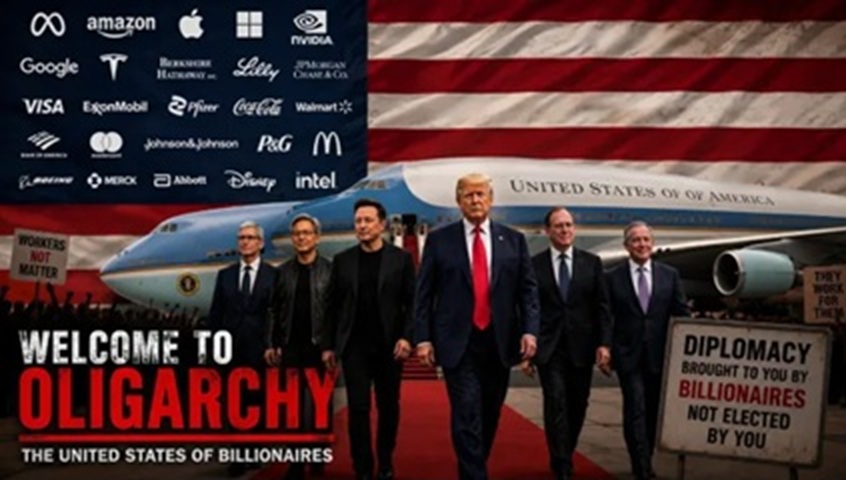
May 14, 2026, Joshua Scheer, https://scheerpost.com/2026/05/14/this-is-the-real-reason-for-trumps-visit-to-china/
Donald Trump didn’t arrive in Beijing as the leader of a confident superpower. He arrived like a salesman carrying a collapsing empire on his back — flanked not by diplomats or peace negotiators, but by Silicon Valley monopolists, Wall Street vultures, and billionaire oligarchs desperate to keep their fortunes alive. Elon Musk. Jensen Huang. Larry Fink. Tim Cook. Blackstone. Goldman Sachs. The entire spectacle looked less like diplomacy and more like a corporate hostage negotiation staged on behalf of an American ruling class suddenly realizing it may have lost the economic war it started.
In this blistering breakdown, Ben Norton argues that Trump’s China summit exposes a geopolitical reality Washington refuses to admit publicly: the U.S. trade war backfired, China adapted, and America’s corporate elite now need Beijing far more than Beijing needs them. As the war on Iran drives inflation higher, supply chains fracture, and rare earth shortages threaten both Silicon Valley and the Pentagon, Trump’s anti-China rhetoric is quietly giving way to panic, flattery, and desperation. The result is an extraordinary image of imperial decline — an American president openly traveling with oligarchs to plead for access to the very economic system Washington spent years trying to cripple.
The best line of all from Ben may be this: “Nothing screams ‘we are an oligarchy’ more than taking oligarchs instead of diplomats to a diplomatic mission.”
And he’s right. We are living in an oligarchy — one where billionaires ride on Air Force One while working people are left paying for inflation, war, tariffs, and economic collapse. The masks are gone. Corporate CEOs now sit beside presidents like unelected cabinet members, openly shaping foreign policy, trade policy, and even war itself.
As the country barrels toward another election in 2028, the deeper crisis is that most major candidates, regardless of party branding, still end up bowing before the same billionaire donor class. The slogans change. The marketing changes. But the power structure remains untouched.
1 This Month


Shut down the radiation-damaged Heysham nuclear reactors now
To see nuclear-related stories in greater depth and intensity – go to https://nuclearinformation.wordpress.com

Say No to NASA’s Reckless Nuclear Reactor on the Moon
Say No to NASA’s Reckless Nuclear Reactor on the Moon
-
Archives
- October 2026 (247)
- September 2026 (339)
- August 2026 (330)
- July 2026 (355)
- June 2026 (287)
- May 2026 (306)
- April 2026 (356)
- March 2026 (251)
- February 2026 (267)
- January 2026 (308)
- December 2025 (358)
- November 2025 (359)
-
Categories
- 1
- 1 NUCLEAR ISSUES
- business and costs
- climate change
- culture and arts
- ENERGY
- environment
- health
- history
- indigenous issues
- Legal
- marketing of nuclear
- media
- opposition to nuclear
- PERSONAL STORIES
- politics
- politics international
- Religion and ethics
- safety
- secrets,lies and civil liberties
- spinbuster
- technology
- Uranium
- wastes
- weapons and war
- Women
- 2 WORLD
- ACTION
- AFRICA
- Atrocities
- AUSTRALIA
- Christina's notes
- Christina's themes
- culture and arts
- Events
- Fuk 2022
- Fuk 2023
- Fukushima 2017
- Fukushima 2018
- fukushima 2019
- Fukushima 2020
- Fukushima 2021
- general
- global warming
- Humour (God we need it)
- Nuclear
- RARE EARTHS
- Reference
- resources – print
- Resources -audiovicual
- Weekly Newsletter
- World
- World Nuclear
- YouTube
-
RSS
Entries RSS
Comments RSS

