Israeli nuclear arsenal condemned by world’s govts in overwhelming UN vote
https://morningstaronline.co.uk/article/f/global-majority-leads-way-nuclear-disarmament-time-reflect-reality-here, Sameena Rahman,November 9, 2022,
In an overwhelming vote, the United Nations General Assembly declared last week that apartheid Israel must immediately cease operations of all its nuclear weapons, get rid of the ones that exist, and place all its nuclear sites under the supervision of the International Atomic Energy Agency.
These stipulations against Israel were outlined in a resolution submitted by Egypt on behalf of the UN-member countries that are also a part of the Arab League, including the Palestinian Authority, Bahrain, Jordan, Saudi Arabia and United Arab Emirates.
The resolution was approved by 152 countries — 79% of UN member states — with five votes against, unsurprisingly the United States and Israel, and also Canada, Micronesia and Palau. Some 24 abstentions were composed of European Union members, NATO allies and India.
Resolution calling for an end to Israel’s illegal nuclear stockpile
The resolution, titled “The risk of nuclear proliferation in the Middle East,” highlighted the risks of unsafeguarded nuclear facilities in the Middle East and demanded that Israel follow the principles of universal adherence to the Treaty on the Non-Proliferation of Nuclear Weapons, adopted in the region in 1995. Since then, Israel has been the only entity in the region that has repeatedly refused to sign the treaty and has spent the last few decades hypocritically denying the existence of its nuclear weapons.
A recent United Kingdom Parliamentary report states “that Israel possesses a nuclear weapons capability, outside of the framework of the NPT,” after specific details were revealed by whistleblower Mordechai Vanunu in 1988. Israel is believed to have at least 90 nuclear warheads, according to the report, and continues to produce weapons-grade plutonium.
Israel, hiding behind its imperial backer, the United States, continues its stockpiling of nuclear weapons in an extensive threat to the geopolitical stability in the Middle East. Documents from the early 1960’s, revealed in 2014, show that Washington played a key role in building Israel’s nuclear arsenal in secret while publicly denying any knowledge and adopting a line of ambiguity on nuclear power and weapons. Numerous reports since then established that the United States knew of and supported Israel’s nuclear capabilities in gross violation of international law and while punishing countries like Iran and North Korea for having or developing defensive weapons.
U.S. and Israel’s hypocritically label Iran as a nuclear threat
In the last few decades, the United States and Israel consistently labeled Iran as a nuclear threat to peace and stability in the Middle East despite Israel itself invading all bordering countries. Of note, Iran has no nuclear weapons, and signed on to the NPT as well as the Joint Comprehensive Plan of Action, which the United States pulled out of. Meanwhile, Israel remained in flagrant violation of international law.
Israel violated international law on numerous occasions by blatantly attacking Iran’s nuclear power plants used to generate energy, plunging the many areas of the country already suffocated by sanctions into darkness. In April last year, senior Israeli officials hinted at Mossad’s culpability for an attack on Iran’s key nuclear site Natanz, a heinous act of nuclear terrorism. Israel has also carried out the targeted assassination of Iranian nuclear scientist Mohsen Fakhrizadh and other Iranian scientists. Israel also admitted to attacking what it called “suspected” nuclear reactors in other neighboring countries, like Syria in Operation Outside the Box.
Nasser Kanaani, spokesperson for the Iranian Foreign ministry, said in a social media post, “The advanced nuclear military program of the apartheid regime of Israel and the regime’s continued reluctance to put its nuclear facilities under comprehensive safeguards and not to join the non-proliferation treaty is a serious threat to international security and the non-proliferation regime.”
Environmental fallout in Palestinian Occupied Territory
Israel’s criminal behavior is also significantly harming Palestinians in the West Bank. In 2021, Palestinian Prime Minister Mohammad Shtayyeh accused Israel of storing lethal radioactive waste in the West Bank and sickening Palestinians living in the area. He also linked high cancer rates in Hebron to the nearby Israeli Negev nuclear reactor, Dimona. Palestine currently suffers from major climate issues due to Israel’s seven-decade long occupation and the fallout from Israel’s military proliferation.
U.S. corporate media silence
While the UN and the international community have repeatedly pointed to and labeled Israel as a major threat to geopolitical stability in the Middle East, there has been a critical lack of coverage by the western mainstream corporate media. It is clear that the fog of fear of the United States and Israel is lifting in the international community as governments are more empowered to label Israel for what it is: an apartheid state and a gross violator of human rights in Palestine and elsewhere. The recent vote is an important recognition that Israel is the major threat to peace and stability in the Middle East.
Tale Of Two Broken Accords: Oslo And Minsk
Ukraine’s President Zelensky was elected on a platform promising to implement Minsk and end the death toll. Then the neo-Nazis enabled by the U.S. and NATO got to him. I suspect he was threatened with assasination unless he signed on to his country serving as the killing grounds for proxy war to weaken Russia.
https://went2thebridge.org/2022/11/07/tale-of-two-broken-accords-oslo-and-minsk/—
Many people understand that war is hell. That’s why they clamor for negotiated settlements that move belligerents back from the battlefield and set them on a path to reconciliation.
The Oslo Accords established a two-state solution to Israel’s violent occupation of Palestinian homelands and at the time was hailed as a major achievement.
Then came facts on the ground for the last several decades.
It would by now be virtually impossible to create a State of Palestine that was not hopelessly Balkanized into tiny, unconnected territories. At the time of Oslo, many expressed doubt and believed that only a truly democratic one-state solution could work. (Full disclosure: I’m in that camp.)
The insanely belligerent and corrupt Israeli PM Netanyahu has won the recent elections and stands poised to bring even more violence and suffering to the long-occupied Palestinians. And Israel is a nuclear weapons nation. With lots of nuclear threats and innuendoes being thrown around these days, it’s important to keep that in mind.
So we can expect to see a continuation of Israel’s attacks on Palestinians in blockaded Gaza
The Minsk II agreement established a game plan for resolving civil war in Ukraine.
Tens of thousands of civilians and combatants had been killed by missile strikes and more hands-on violence from militias operating freely in the Donbas border region with Russia following a 2014 CIA-sponsored coup in Kyiv. Years later, Ukraine’s President Zelensky was elected on a platform promising to implement Minsk and end the death toll. Then the neo-Nazis enabled by the U.S. and NATO got to him. I suspect he was threatened with assasination unless he signed on to his country serving as the killing grounds for proxy war to weaken Russia.
One wonders why nations sign on to accords and then immediately show no intention of fulfilling them?
It could be a stalling tactic to temporarily reduce international pressure to de-escalate.
Or it could be a case where those who signed on are ousted either by coup or elections, and succeeded by those with a lust for war.
Or maybe diplomatic efforts like accords are doomed in the face of the profit motive provided by modern industrialized killing?
Workers hold the key to stopping wars no matter what the motives of those waging them.
An international general strike would make wars literally impossible.
I pray we are seeing signs of this developing, especially in Europe where the economic impact of the war on Russia via Ukraine has been most intense. Certainly we are seeing signs of alarm from rulers enacting laws that actually criminalize gathering
France’s Macron and UK’s Sunak agree on nuclear energy cooperation
https://www.reuters.com/business/energy/frances-macron-uks-sunak-agree-nuclear-energy-cooperation-2022-11-07/ PARIS, Nov 7 (Reuters) – French President Emmanuel Macron and Britain’s Prime Minister Rishi Sunak on Monday pledged “ambitious cooperation” in the field of nuclear energy to cope with the impact on energy supplies of Russia’s invasion of Ukraine.
Reporting by Michel Rose; Writing by Benoit Van Overstraeten; Editing by Andrew Heavens
The two leaders met on the sidelines of climate talks in Egypt, their first meeting since Sunak became prime minister.
The French presidential palace also said Macron and Sunak wanted better coordination on migration.
Europe can’t cut economic ties with Russia unless it cuts nuclear power use as well

Uranium addiction . https://beyondnuclearinternational.org/2022/11/06/uranium-addiction/ By Hannes Czerulla, 6 Nov 22
The new edition of the Uranium Atlas makes it clear that Europe will not be able to detach itself economically from Russia as long as the states continue to use electricity from nuclear power. After all, both Germany and other European states obtain a large part of the uranium needed for this purpose from mines in Russia and Kazakhstan.
The recently updated version of the Uranium Atlas (in German), is published by the Bund für Umwelt und Naturschutz Deutschland (BUND) together with the Nuclear Free Future Foundation, the Rosa Luxemburg Foundation, Greenpeace and “.ausgestrahlt”. According to the report, around 40 per cent of European uranium imports come from Russia and Kazakhstan. Thus, in addition to fossil energy imports, European countries are significantly dependent on Russia.
If Europe really wants to become independent of Russia in the energy sector, “it must also stop its cooperation with Russia in the nuclear sector as soon as possible,” emphasised Uwe Witt, Senior Advisor for Climate Protection and Structural Change at the Rosa Luxemburg Foundation.
The Uranium Atlas highlights the regions of the world where uranium is mined, utilised or disposed of. The history of the uranium industry is mostly marked by exploitation and environmental destruction. In Africa, for example, foreign companies still control the mining of radioactive ore and leave behind contaminated land and a population with impaired health. In Canada and the USA, too, indigenous inhabitants are suffering from the uranium-related contamination of entire regions. Meanwhile, Central Europe is struggling with the legacy of uranium mining.
Nuclear power does not bring security of supplies
At the centre of the Russian uranium industry is the state-owned corporation Rosatom. Founded in 2007 by Russian President Vladimir Putin, it reports directly to the Kremlin and holds stakes in uranium mines mainly in Kazakhstan, but also in Canada and the USA. With an annual output of 7,122 tonnes of uranium, the company produces 15 percent of the global total and is the second-largest uranium producer in the world.
Angela Wolff, nuclear and energy policy officer at BUND, explains: “In the production of enriched uranium, which is needed for the operation of nuclear power plants, the dependency is even greater: more than a third of the global demand comes from the Russian state corporation.”
Eastern Europe in particular is also specifically dependent on Russian fuel elements because reactors in the Czech Republic, Hungary, Bulgaria, Slovakia – and Finland – can only be operated with these hexagonal fuel rods. In total, there are 18 reactors of this type in the EU.
Russia ignores environmental problems
Rosatom is silent about the details of uranium mining in Russia’s three remaining mines. The 225-page annual report contains only production and key figures on uranium mining. No details were mentioned and certainly no problems.
Uranium expert Paul Robinson reports in the Uranium Atlas: “In some houses in the vicinity of uranium mines in Krasnokamensk, radon concentrations of up to 28,000 becquerels per cubic metre have been measured; this value is 190 times above the limit at which, for example in the USA, emergency measures are prescribed by law.”
Closed mines need to be cleaned up in Russia. Environmental protection organisations that wanted to secure them are harassed by the state. The nuclear physicist Oleg Bodrov, for example, had to resign from the leadership of the organisation Green World in 2017 because he had campaigned for the decommissioning of all nuclear power plants in Russia and the cessation of uranium mining.
Import ban for Russia is not enough
While Rosatom is planning to build a total of 35 new nuclear power plants abroad – among others in Belarus, Bulgaria, China, Finland and Hungary – the EU Commission is being forced to act, explained Armin Simon of the anti-nuclear organisation .ausgestrahlt. The EU Commission has justified the inclusion of nuclear power and fossil gas in the EU taxonomy with supply security aspects, Simon said. “This justification has turned out to be false for all to see. Contrary to what is claimed, nuclear power does not contribute to security of supply.”
An import ban on nuclear fuel from Russia, as already demanded by the EU Parliament, falls short, he said. “The EU Commission must revise its position on this. Otherwise, the EU Parliament must pull the emergency brake,” Simon demanded.
BUND points out that despite the precarious situation, CDU/CSU politicians are calling for lifetime extensions for German nuclear power plants. For example, Bavaria’s Prime Minister “Markus Söder is conducting a grotesque sham debate,” said Olaf Bandt, Chairman of BUND. “His calls for nuclear power are a political and moral indictment in light of the nuclear threats from nuclear power plants in the war zone [in Ukraine] and Putin’s nuclear bomb threats.” (Editor’s note: Since this article was originally published, the German government did decide to extend the operating life of two of its remaining three reactors, but only until next April.)
Critics as enemies of the state
In the authors’ view, obtaining the uranium needed in Europe from states other than Russia is not an alternative. The conditions under which the fuel is mined are precarious everywhere. In China, anyone who criticises uranium mining is considered an enemy of the state.
The activist and Nuclear Free Future Award winner Sun Xiaodi is mentioned as an example. He had run a warehouse at one of China’s largest mines and raised questions about health hazards and radiation exposure from 1988 onwards. After giving an interview to a French journalist in 2005, he was placed under house arrest. In 2009, Sun Xiaodi was sentenced to two years in a penal camp for inciting public opinion, according to reports by the medical organisation IPPNW.
Africa does not benefit from mining
Read more: Europe can’t cut economic ties with Russia unless it cuts nuclear power use as wellNowadays, active mines in Africa are found in Niger, Namibia and South Africa. Although Niger is the world’s eighth-largest uranium producer in terms of total historical mining, the population has not benefited from the boom since the 1960s. Today, the country is one of the poorest in the world. At the same time, about 152,000 tonnes of uranium with a current market price of about 40 billion US dollars were exported.
What has been left behind – mainly by the French nuclear company Areva – is radiating waste. In the areas surrounding the mines, the radiation levels in the water are in some cases ten to a hundred times higher than recommended by the World Health Organisation (WHO). Roads have been built out of radiated rock debris. In the mining town of Arlit on the southern edge of the Sahara, 35 million tonnes of radioactive waste are lying around in the open. The background radiation there is 200 times higher. Nevertheless, three new mines are planned.
Under South Africa’s apartheid system, it was standard practice for decades that workers with suspicious symptoms of illness were given a last month’s pay and dismissed. There, uranium is only a by-product of gold mining. However, this was enough to make South Africa the most important uranium producer in Africa.
“Nuclear power contributes nothing to solving the climate crisis.”
The authors of the Uranium Atlas also warn against viewing nuclear power as a “climate saviour”, as is currently repeatedly suggested by interest groups and politicians. “Climate protection is currently the central argument for making nuclear power respectable again,” the Uranium Atlas states.
In its brochure “Nuclear Power and the Paris Agreement”, the International Atomic Energy Agency (IAEA) claims that nuclear power is also needed to achieve the goals of the Paris Climate Agreement. With this justification, the EU Commission also wants to classify nuclear energy as sustainable in the EU taxonomy (in German). (Editor’s note. Since the original publication of this article, this has now become a reality.)
From the authors’ point of view, however, these demands neglect the health and environmental dangers of uranium mining, the possibility of a catastrophe of unimaginable proportions and the still unresolved question of final storage. Horst Hamm, project manager of the Uranium Atlases, therefore declared: “Nuclear power contributes nothing to solving the climate crisis.” Moreover, the construction of new nuclear power plants is too expensive and too slow to make a difference to climate protection in the future, he said.
“Not even existing nuclear power plants are still able to compete with renewable energies, as the example of the USA in the Uranium Atlas shows,” Hamm added. Six US reactors are being shut down there ahead of schedule, and more are to follow. (Editor’s note: there are now moves afoot to subsidize and keep open reactors that planned to close and even to reopen at least one.) The nuclear industry had already been highly subsidised in the past decades and, from a purely economic point of view, was not viable.
New construction projects: Bottomless pit
Worldwide, one in eight new nuclear power plants was abandoned before it went into operation. The reason was often delays in completion and rising costs during construction. Examples include Chile, Indonesia, Jordan, Lithuania, South Africa, Thailand and Vietnam.
However, there are also reactors in Europe whose commissioning has been delayed by years and whose costs continue to rise: The construction of the first European pressurised water reactor (EPR) in Olkiluoto, Finland, started in 2005 and was supposed to be finished in 2009. Now, in the course of 2022, with a delay of 13 years, regular generation of electricity is to begin there. (Editor’s note: In October, cracks in all four feedwater pumps of Finland’s Olkiluoto 3 were found and startup is now delayed until at least late December 2022.)
The new reactor in Flamanville, France has been under construction since 2007 and should have been operational in 2012. Due to technical and industrial problems, it will now be commissioned in 2023 at the earliest. With projected costs of 19 billion Euros, the power plant is expected to be six times as expensive as planned. The costs of the Finnish EPR have risen from an estimated 3 billion Euros to almost 11 billion Euros.
Renewables cheaper than nuclear power
When calculating the costs of nuclear power, items such as the removal of damage from uranium mining as well as the dismantling and final storage of contaminated waste must also be priced in. The latter, however, are difficult to quantify. According to the Uranium Atlas, the nuclear industry has “neither determined the true price of its business nor adequately illuminated its economic situation”. Instead, state subsidies have been paid again and again due to the interconnections with the construction of nuclear bombs and the maintenance of nuclear-powered submarines and warships.
According to calculations made by the Fraunhofer Institute for Solar Energy Systems in 2021, generating electricity with the help of nuclear fission is more expensive than almost any other method. Only energy from gas and hard coal costs even more per kilowatt-hour. The researchers calculated a price of 13.5 Euro cents for a kilowatt-hour of nuclear electricity. A kilowatt-hour from hard coal costs 15.5 cents and from gas 20.2 cents.
In contrast, energy production from renewable resources is in part significantly cheaper. The price of a kilowatt-hour from offshore wind turbines is only 9.7 cents, onshore 6.1 cents, and photovoltaic plants on open land in southern Germany produce the kilowatt-hour for 3.6 cents. In sunnier countries like oil-rich Saudi Arabia, it is even cheaper. There, a 600-megawatt solar project has been connected to the grid that generates the kilowatt-hour for 1.04 US cents.
The authors see the future of sustainable energy generation not in nuclear power, but in renewables like wind and solar. “Renewable energies are now cheaper than coal, gas or nuclear power plants, even if you don’t count their follow-up costs,” said Heinz Smital, nuclear campaigner for Greenpeace. Even old and depreciated plants often cannot keep up.
Last April marked the 36th anniversary of the April 26, 1986 Chernobyl reactor disaster. Nevertheless, nuclear energy is once again being presented as the solution in Europe (in German) today. In light of this, BUND calls on the federal government to stand by its refusal to extend the operating lives of nuclear power plants and to complete the phase-out of nuclear power.
The U.S. President’s Dismissal Of Diplomacy Undermines His Own Party, Prolongs The Destruction Of Ukraine And Threatens Nuclear War.

a proxy war between the U.S. and Russia in which Ukraine is being devastated, ironically in the name of saving Ukraine.
U.S. security absolutely does not depend on NATO enlarging to Ukraine and Georgia.
Russia doesn’t want a heavily armed NATO military on its border, just as the U.S. would not accept a Chinese-backed heavily armed Mexican military on the U.S.-Mexico border.
BIDEN’S FOREIGN POLICY SINKING HIS PARTY AND UKRAINE
https://popularresistance.org/bidens-foreign-policy-sinking-his-party-and-ukraine/ By Jeffrey D. Sachs, Consortium News., November 3, 2022, Educate!
President Joe Biden is undermining his party’s congressional prospects through a deeply flawed foreign policy.
Biden believes that America’s global reputation is at stake in the Ukraine War and has consistently rejected a diplomatic off-ramp. The Ukraine War, combined with the administration’s disruptions of economic relations with China, is aggravating the stagflation that will likely deliver one or both houses of Congress to the Republicans.
Far worse, Biden’s dismissal of diplomacy prolongs the destruction of Ukraine and threatens nuclear war.
Biden inherited an economy beset by deep disruptions to global supply chains caused by the pandemic and by former President Donald Trump’s erratic trade policies. Yet instead of trying to calm the waters and repair the disruptions, Biden escalated the U.S. conflicts with both Russia and China.
Biden attacked Republican House Minority Leader Kevin McCarthy for expressing doubts on another large financial package Ukraine, declaring:
“They [House Republicans] said that if they win, they’re not likely to fund — to help — continue to fund Ukraine, the Ukrainian war against the Russians. These guys don’t get it. It’s a lot bigger than Ukraine — it’s Eastern Europe. It’s NATO. It’s real, serious, serious consequential outcomes. They have no sense of American foreign policy.”
Similarly, when a group of progressive congressional Democrats urged negotiations to end the Ukraine War, they were excoriated by Democrats following the White House line and forced to recant their call for diplomacy.
Stoked a Proxy War
Biden believes that American credibility depends on NATO expanding to Ukraine, and if necessary, defeating Russia in the Ukraine war to accomplish that. Biden has repeatedly refused to engage in diplomacy with Russia on the NATO enlargement issue.
This has been a grave mistake. It stoked a proxy war between the U.S. and Russia in which Ukraine is being devastated, ironically in the name of saving Ukraine.
The whole issue of NATO enlargement is based on a U.S. lie dating back to the 1990s. The U.S. and Germany promised Soviet leader MikhailGorbachev that NATO would move “not one inch eastward” if Gorbachev would disband the Soviet Warsaw Pact military alliance and accept German reunification. Conveniently — and with typical cynicism — the U.S. reneged on the deal.
In 2021, Biden could have headed off the Ukraine War without sacrificing any single vital interest of the U.S. or Ukraine. U.S. security absolutely does not depend on NATO enlarging to Ukraine and Georgia.
In fact, NATO enlargement deeper into the Black Sea region undermines U.S. security by putting the U.S. into a direct confrontation with Russia (and a further violation of the promises made three decades earlier). Nor does Ukraine’s security depend on NATO enlargement, a point that President Volodymyr Zelensky acknowledged on numerous occasions.
Russian President Vladimir Putin has warned the U.S. repeatedly since 2008 to keep NATO out of Ukraine, a region of vital security interests for Russia. Biden has equally, resolutely insisted on NATO enlargement. Putin made one last diplomatic try at the end of 2021 to stop NATO enlargement. Biden completely rebuffed him. This was dangerous foreign policy.
As much as many American politicians don’t want to hear it, Putin’s warning about NATO enlargement was both real and apt. Russia doesn’t want a heavily armed NATO military on its border, just as the U.S. would not accept a Chinese-backed heavily armed Mexican military on the U.S.-Mexico border.
The last thing the U.S. and Europe need is a long war with Russia. Yet that’s just where Biden’s insistence on NATO enlargement to Ukraine has brought about.
The U.S. and Ukraine should accept three absolutely reasonable terms to end the war: Ukraine’s military neutrality; Russia’s de facto hold on Crimea, home to its Black Sea naval fleet since 1783; and a negotiated autonomy for the ethnic-Russian regions, as was called for in the Minsk Agreements but which Ukraine failed to implement.
Instead of this kind of sensible outcome, the Biden administration has repeatedly told Ukraine to fight on. It poured cold water on the negotiations in March, when Ukrainians were contemplating a negotiated end to the war but instead walked away from the negotiating table.
Ukraine is suffering grievously as a result, with its cities and infrastructure reduced to rubble, and tens of thousands of Ukrainian soldiers dying in the ensuing battles. For all of NATO’s vaunted weaponry, Russia has recently destroyed up to half of Ukraine’s energy infrastructure.
Sanctions Boomeranged
In the meantime, the U.S.-led trade and financial sanctions against Russia have boomeranged.
With the cutoff of Russian energy flows, Europe is in a deep economic crisis, with adverse spillovers to the U.S. economy.
The destruction of the Nord Stream pipeline further deepened Europe’s crisis. According to Russia, this was done by U.K. operatives, but almost certainly with U.S. participation. Let us recall that in February, Biden said that if Russia invades Ukraine, “We will bring an end to it [Nord Stream].” “I promise you,” said Biden, “we will be able to do it.”
Biden’s flawed foreign policy has also brought about what generations of foreign policy strategists including Henry Kissinger and Zbigniew Brzezinski warned against: driving Russia and China into a firm embrace. He has done that by dramatically escalating the cold war with China at precisely the same time as he is pursuing the hot war with Russia.
From the start of his presidency, Biden starkly curtailed diplomatic contacts with China, stirred up new controversies regarding America’s long-standing One China policy, repeatedly called for greater arms sales to Taiwan, and implemented a global export ban on high-tech to China. Both parties have rallied to this destabilizing anti-China policy, but the cost is further destabilization of the world, and also the U.S. economy.
In sum, Biden inherited a difficult economic hand — the pandemic, excess Fed liquidity created in 2020, large budget deficits in 2020, and pre-existing global tensions. Yet he has greatly exacerbated the economic and geopolitical crises rather than solved them.
We need a change of foreign policy. After the elections, there will be an important time for reassessment. Americans and the world need economic recovery, diplomacy, and peace.
Jeffrey D. Sachs is a university professor and director of the Center for Sustainable Development at Columbia University, where he directed The Earth Institute from 2002 until 2016. He is also president of the U.N. Sustainable Development Solutions Network and a commissioner of the U.N. Broadband Commission for Development. He has been adviser to three United Nations secretaries-general, and currently serves as an SDG Advocate under Secretary-General Antonio Guterres. Sachs is the author, most recently, of A New Foreign Policy: Beyond American Exceptionalism (2020). Other books include: Building the New American Economy: Smart, Fair, and Sustainable (2017) and The Age of Sustainable Development, (2015) with Ban Ki-moon.
Australia’s ongoing nuclear submarine debacle – ‘A tangle of overlapping interests’

https://undueinfluence.substack.com/p/a-tangle-of-overlapping-interests?utm_source=post-email-title&publication_id=297295&post_id=82059669&isFreemail=true&utm_medium=email Michelle Fahy 5 Nov 22
The federal government’s secret hiring from 2015 of numerous former US Navy officials to advise on Australia’s submarine procurement was exposed by The Washington Post a fortnight ago. “Some of the retired admirals have worked for the Australian government while simultaneously consulting for US shipbuilders and the US Navy, including on classified programs,” the Post said. The US officials benefited financially from “a tangle of overlapping interests”. The Post revealed that one former US admiral had been consulting to Australia while also occupying a full time position as chairman of the board of Huntington Ingalls Industries, a US company that builds US nuclear-powered submarines. That arrangement was abandoned in April this year due to conflict of interest concerns.
Australian defence experts Mike Scrafton and Richard Tanter have outlined the implications of these revelations in John Menadue’s public policy journal, Pearls and Irritations.
Mike Scrafton said, “What remains unclear now is the extent to which the abandonment of the French submarine and the decision to pursue a nuclear powered version was influenced by the Americans. The dramatic shift to the AUKUS project casts the role of the ex-US officials in a different light.”
Red flags have been a feature of Australia’s submarine procurement process since the original deal with France’s Naval Group in 2016. Concerns there included the government’s selection of Naval Group despite it being under investigation for corruption in three earlier shipbuilding contracts, with a fourth investigation added after Australia handed Naval Group the deal. Neither this alarming fact, nor other questionable aspects of the deal, triggered a rethink to find a more suitable contractor. The Washington Post revelations now raise even more questions about the backroom dealings in this disastrous extended procurement process.
B52’s mark the demise of Australia as a self-reliant nation

Australia has become a base for the possible use of US nuclear weapons against China………………..
And all this has happened without the Parliament being consulted
https://johnmenadue.com/b52s-mark-the-demise-of-australia-as-a-self-reliant-nation/
By Bruce Haigh, Nov 5, 2022
News that the US plans to base six B52’s at RAAF, Tindal, will likely change the dynamic, in what has admittedly been a half-hearted attempt by Australia, at improving relations with China.
The Foreign Minister, Penny Wong, got off to a good start, but the momentum was slowed by Prime Minister Albanese’s remarks that China constituted a threat, his rushed attendance at an anti-China NATO Summit meeting, the QUAD meeting and the Abe funeral. Abe like his grand farther Kishi was very anti-Chinese.
Albanese’s remarks echo those of Biden, who has chosen on a number of occasions to say that the US would ‘defend’ Taiwan. These guarantees have each time been denied by White House spokes persons but have been reiterated often enough by Biden to indicate where he stands on the question of the ‘reintegration’ of Taiwan with China.
Biden in his confusing way did nothing to stop the ill-conceived Pelosi visit to Taiwan. Biden has refused, indeed prevented, diplomatic negotiations toward ending the war in the Ukraine. He sees the war, mistakenly and naively, as an opportunity to break Russia. Albanese has gone along with this, recently sending 70 Australian soldiers to the UK to train Ukrainian troops. His thinking, and that of Biden, appear in lockstep over the major foreign policy and defence issues confronting Asia and Europe, mainly created and fanned by the US.
An almost frenzied pace is building in the US for confrontation of China. Why? John Menadue, Richard Tanter, Mike Scrafton and Jeffrey Sachs have all recently written in Pearls & Irritations on this unfolding madness.
The basing of B52’s in the Northern Territory changes the nature of Australia’s defence relationship with the USA and our diplomatic relationship with China. Australia has become a base for the possible use of US nuclear weapons against China. Tentative and overly cautious moves to re-establish a sound and workable relationship with China will have been set back, if not put on ice. Moves that Morrison was a party to, or patsy to, have proceeded apace without the brakes being applied by Marles or Albanese. The horse has bolted. And all this has happened without the Parliament being consulted. So much for Australian democracy. All this talk about Western Democracies standing up to totalitarian regimes is so much cant.
China is unlikely to regard Australia as having acted in good faith and nor is the region and the Pacific. Overnight the US and Australia changed the nature of the game with no prior warning and no special briefings. It is a unilateral and hostile upping of the anti.
It is also unlikely that Australia will be advised if the aircraft are carrying nuclear weapons on planned patrols. The line that can be expected is that for operational and security reasons information relating to carriage of nuclear weapons is classified and can neither be confirmed or denied.
No doubt the Chinese are seriously thinking of writing Australia off as being incapable of independent decision making- a vassal state, a follower, lacking the capacity and courage to shape its regional destiny. The chances of Xi Jinping meeting with Albanese at the G20 have receded, if not evaporated.
Perhaps it is symbolic that the ubiquitous B52 marks the demise of Australia as a self-reliant nation.
The B52 is the symbol of US foreign policy failure in Asia. Not satisfied with the terms of the Paris peace settlement, Nixon and Kissinger decided to bomb the Accord, as it was termed, out of existence. Over a ten-day period beginning on 18 December 1972, B52’s bombed Hanoi and surrounding areas. It was a disaster anywhere from 15 to 30 aircraft were shot down, depending on whether you believe the Americans or Vietnamese. The US was forced back to the negotiating table and agreed to the original terms.
B52’s bombed Laos and Cambodia during the same undeclared war with a greater tonnage of bombs than the US used over Europe in WWII. Fields are still being cleared of unexploded armaments and men, women and children are still being maimed.
The basing of the B52’s blind sides the Defence Review called by Albanese and Marles and gives a great deal of weight to AUKUS, details of which are yet to be put to the Australian Parliament. It is unconscionable that AUKUS is bandied about as a joint defence arrangement when little is known about it.
It is presumed that all that is currently taking place and has taken place between the US and Australia, such as the embedding of US personnel in the ADF, base upgrades and proposed and past purchases of defence equipment, such as the Mark II Abrams tank, were all done under AUKUS, except that the UK seems to have been notably absent. So, is it AUUS? Or against the wishes of the Japanese people will it become JAPAUUS? Or AUJAPUS? OR AUJAPUKUS?
Whatever the Monty Python outcome, it needs to go before the Australian Parliament. It has been a big mistake for Prime Minister, Albanese, to take on and run with Morrison’s dirty and deceitful deal. Australia needs to be aware of the immediate and long-term consequences of the US military and industrial China folly of which once again we have been railroaded into. No debate, no consideration and no brains.
Australia’s $multibillion submarine madness and the phoney China threat
According to the Australian Strategic Policy Institute, the cost of eight would be $171 billion after inflation. More recent estimates are over $200 billion.


https://johnmenadue.com/australian-submarine-madness/ By Brian Toohey, Nov 4, 2022
Nobody knows what military threats to Australia from China or anyone else will exist in 2050. In these circumstances, it is folly to commit to spending over $200 billion on acquiring eight US designed nuclear attack submarines to deploy in support of the US on the China coast.
This is particularly extravagant when modern conventionally powered submarines are much cheaper and far harder to detect. Nuclear submarines are noisy because they rely on a reactor to power a steam engine with cooling pumps, turbines, reduction gears and steam in the pipes. They also expel hot water that can be detected, as can the wake on the surface when travelling at high speeds.
Modern battery powered submarines, which Australia perversely has no plans to get, maintain near silent operation with what’s called air independent propulsion (AIP) supplied by a hydrogen fuel cell in Singapore’s German submarines, a Sterling engine favoured by the Swedes or in the case of the latest Japanese submarines, by advanced batteries with long endurance.
These submarines have the great advantage of making the crew far safer than noisy nuclear ones while leaving funds over for much needed improvements in Australian’s health, education, and social security systems as well as for tackling climate change.
Yet the Albanese government has a 350 strong task force in Defence planning the big changes needed to build nuclear powered submarines in Adelaide. In contrast, a prize-winning essay published in the US Naval Institute’s magazine Proceedings in June 2018 said the US Navy would do well to consider acquiring “some quiet, inexpensive and highly capable diesel-electric submarines. It said, “The ability of AIP was demonstrated in 2005, when HMS Gotland, a Swedish AIP submarine, ‘sank’ many U.S nuclear fast-attack subs, destroyers, frigates, cruisers, and even the USS Ronald Reagan aircraft carrier in joint exercises”. However, the Australian Navy somehow sees a great advantage in getting US nuclear attack subs such as the Virginia Class that were sunk in the exercise.
One of the US’s most highly regarded defence analysts, Winslow Wheeler, recently pointed out that these subs have been available only 15 times in 33 years for their six-monthly deployments. This suggests fewer than two of Australia’s eight nuclear submarines would be operationally available, on average, each year. According to the Australian Strategic Policy Institute, the cost of eight would be $171 billion after inflation. More recent estimates are over $200 billion.
Australia could build ten of the latest German submarines operated by Singapore for about $10 billion. They also have an outstanding maintenance record, as well as being well suited to the shallow waters in Australia’s region. A similar figure could apply to the latest Swedish ones, but they may not be so readily available. Japan’s new Taigei class would cost roughly the same to buy, but more to operate its bigger crew. The Japanese government would be reluctant to build it in other than in its own shipyards.
These figures suggest that the job of defending Australia could be performed for a reasonable cost, particularly if greater use were made of modern, low-cost, drones. The trend for low-cost drones to become more useful is only likely to grow by 2050 when Australia might be getting its first operational nuclear submarine.
At some stage, a reality check needs to apply to the barrage of claims about increased Chinese aggression or the China threat. The last major war involving China was in Korea in 1950. China argues its rapid arms build-up reflects how it’s surrounded by potential enemies, including the US, which has been in many more aggressive wars and spends much more on its military.
The Pentagon 2021 annual report to Congress on China acknowledged it had withdrawn six land claims to settle border disputes with neighbours. Contrary to the common assumption that it is ready to invade Taiwan, the Pentagon said “There is no indication it is significantly expanding its force of tank landing ships and landing craft – suggesting a traditional large-scale direct beach assault operation requiring extensive lift remains aspirational”.
China could settle some of the extreme territorial sea claims that were originally made by the Communist Party’s political opponent, the Nationalist Party, before 1949. Taiwan also makes these claims. Although abrasive, nobody has been killed. By 2050 the US, with Australia tagging along, may have extended its well-established history of killing people by engaging in international aggression in violation of the rules. Alternatively, in 2050 China could engage in its first major war since 1950 by attempting to invade Australia, except no one no one has suggested any plausible motive.
Although Australian nuclear submarines will not be available, many Australian pundits see a need to go to Taiwan’s aid if secret intelligence analysis says China is about to attack it. Following the illegal invasion of Iraq in 2003 based on concocted intelligence, the Challis chair of international law at Sydney University, Ben Saul, said it’s important to ask if a war over Taiwan would be legal. He wrote in the Lowy Institute’s The Interpreter, “The conventional legal answer favours China. Only a state has the right to use military force in self-defence against an armed attack by another state – and to ask other states to help it to defend itself.”
The Australian Foreign Affairs department says Taiwan is not a state. Saul adds, “In a world with a plurality of different political systems, states are not permitted to use force simply to protect democracy or ‘freedom’ abroad. The US backed Taiwan even when it was a military dictatorship until the 1990s; its defence has never really been about freedom.”
When it comes to a nuclear industry project – Europe puts no sanctions on Russia
Despite conflict, Russia sends France giant magnet for nuclear fusion project, Euractiv 4 Nov 22
Russia on Tuesday (1 November) dispatched one of six giant magnets needed for the ITER nuclear fusion programme in France, one of the last international scientific projects Moscow participates in despite the Ukraine conflict.
The ship carrying the Russian-made magnet – or “poloidal field coil” – departed Saint Petersburg on Tuesday under grey skies.
On board, the massive nine-metre-wide coil, which weighs 200 tonnes had been tightly wrapped to withstand a two-week trip to Marseille, southern France.
The ring-shaped magnet built under Russian atomic agency Rosatom’s supervision will make up the top part of the world’s largest “tokamak”.
The tokamak is a magnetic fusion device built in France following the same principle that powers our sun and stars.
The Russian piece was meant to leave in May but sanctions forbidding Russian ships docking in Europe delayed the departure.
Still, the “current situation did not change the fact that we will fullfil our obligations”, Rosatom representative for international projects Viacheslav Perchukov said.
Geopolitical tensions “practically did not affect the realisation of this project”, Perchukov said.
“Without (the Russian coil), the tokamak will not work,” senior ITER centre scientist Leonid Khimchenko told AFP……………………more https://www.euractiv.com/section/energy/news/despite-conflict-russia-sends-france-giant-magnet-for-nuclear-fusion-project/
USA’s deliberate ambiguity on use of nuclear weapons really means “don’t mess with us or we’ll nuke you”

Basically, the United States is holding the world hostage to its nuclear arsenal, saying that we reserve the right to use nuclear weapons any time we determine under any circumstances so that we have a broader definition of deterrence, meaning that we are deterring. But what are we deterring? You see, with a sole purpose declaration, we’re deterring a nuclear attack against us.
But the current nuclear strategy is to deter something that is ambiguous in nature, meaning we haven’t precisely spelled it out. We’re leaving the world guessing. And what we’re saying is, don’t mess with us, or else we’ll nuke you.
We can never use these weapons, but why are we building them as if they are a viable tool? This is why disarmament is so much better, so much more logical, and ultimately has a more humanitarian basis and national security basis than the continued pursuit of a so-called nuclear deterrent. Disarmament is the only thing that will save mankind. Continuing to pursue a nuclear deterrent could very well be the end of mankind
US Holds World Hostage to Its Nukes, Ex-American Intel Officer Says
Sputnik International, 29.10.2022
Earlier this week, Pentagon released nuclear posture, which suggests that the US doesn’t rule out use of the nuclear arsenal against non-nuclear threats – which contradicts previous pledges by the Biden administration.
Scott Ritter, a military analyst and former US Marine Corps intelligence officer, explained Sputnik why Washington adopted new nuclear policies and what do they mean for regular Americans.
Sputnik: Why are Russia and Сhina to be blamed for the Biden’s administration failure to reduce nuclear weapons?
Scott Ritter: We have to look for somebody to blame. We can’t blame ourselves. That’s normally what happens. But we are solely to blame. President Biden ran on a platform that said that he would be seeking what’s called the single-use policy for nuclear deterrence. And what that means is its a single-purpose policy. And the single purpose would be that the sole purpose of the US nuclear weapons arsenal is deterrence. And that’s it; that we would never use nuclear weapons under any circumstance other than to respond to somebody using nuclear weapons against us; that we are here to deter a nuclear attack on the United States.
He’s broken that promise. The strategy that he has propagated recently is a strategy that continues the past practice of having deliberate ambiguity about the conditions and circumstances under which America could use nuclear weapons, up to and including a pre-emptive nuclear attack by the United States in response to a non-nuclear incident.
Basically, the United States is holding the world hostage to its nuclear arsenal, saying that we reserve the right to use nuclear weapons any time we determine under any circumstances so that we have a broader definition of deterrence, meaning that we are deterring. But what are we deterring? You see, with a sole purpose declaration, we’re deterring a nuclear attack against us. But the current nuclear strategy is to deter something that is ambiguous in nature, meaning we haven’t precisely spelled it out. We’re leaving the world guessing. And what we’re saying is, don’t mess with us, or else we’ll nuke you.
This has nothing to do with China and Russia. China and Russia have nuclear weapons arsenals. Which would be covered under the sole purpose doctrine. But this is about blackmailing the world. But we can’t tell the world that we’re blackmailing it. We have to blame it on China and Russia. But there’s no linkage whatsoever between the nuclear posture, as published by the Biden administration, and the nuclear arsenals of China and Russia. If that was it, then we’d have a bold purpose doctrine.
Sputnik: What’s the reason for the West to escalate the nuclear rhetoric?
Scott Ritter: That’s a separate question, separate from the issue of the nuclear posture in the National Security Strategy. We have a current situation right now where Ukraine is losing this conflict. The West is recognizing that ultimately Ukraine will lose this conflict and that there’s nothing they can do to forestall this defeat. And so what they’ve done is they have created in terms of an information warfare, propaganda driven exercise, the threat of a Russian nuclear strike against Ukraine. It makes no sense. I think Vladimir Putin addressed this in his presentation to the Valdai conference, that it makes no sense whatsoever to talk about a Russian nuclear weapon used in Ukraine. There’s no reason for this. It’s not part of their doctrine. It isn’t going to happen.
But this isn’t about reality. This is about shaping perception. And so that’s where this nuclear crisis is coming from today – talks of a dirty bomb, talks of a Russian pre-emptive nuclear strike, President Zelensky begging NATO to carry out their own pre-emptive nuclear strikes against Russia, NATO holding an annual exercise that trains the use of the very weapons President Zelensky asked NATO to use against Russia. NATO should have cancelled that exercise or at least postponed it to a later date, but they didn’t. Russia has now responded with its own strategic nuclear exercise. Again, an annual exercise, this one testing not tactical nuclear weapons, but strategic nuclear weapons.
And people are trying to make a linkage between all of this. There isn’t. But this is where the heightened rhetoric and the heightened threat and the heightened crisis comes from. This is independent from the publication of the National Security Strategy. The National Security Strategy isn’t designed to do anything different than what past national security strategies have done, which is to put the world on notice that the United States has a nuclear weapons arsenal, that it will use any time it determines, whether or not the threat is nuclear in nature. We’re holding the world hostage, but we’ve been holding the world hostage for decades.
Sputnik: In the 2022 NPR, the Pentagon refuses to back away from the possibility of using nuclear weapons in response to “significant non-nuclear strategic attacks” – what were the reasons to obliterate main agreements in the sphere of strategic security?
Scott Ritter: This is not a new position by the Pentagon. This is actually a posture that emerged during the presidency of George W. Bush. That was the first time that this notion that we would use nuclear weapons against a non-nuclear threat emerged.
The Obama administration talked about walking away from that, but it’s very difficult for presidents to disentangle their desires from the pressures of the establishment. And when we’re dealing with nuclear weapons and the issue of nuclear deterrence, the establishment is extraordinarily powerful because they can always say that you’re weakening. You can tell a president that you’re weakening America, you’re putting American lives at risk…………………………………………………………………………
We can never use these weapons, but why are we building them as if they are a viable tool? This is why disarmament is so much better, so much more logical, and ultimately has a more humanitarian basis and national security basis than the continued pursuit of a so-called nuclear deterrent. Disarmament is the only thing that will save mankind. Continuing to pursue a nuclear deterrent could very well be the end of mankind. https://sputniknews.com/20221029/us-holds-world-hostage-to-its-nukes-ex-american-intel-officer-says-1102824182.html
USA’s new nuclear policies: first strike OK, “usable”weapons, nukes for Europe, for any purpose USA likes, and against non-nuclear nations.

Brandon’s “Usable Nukes” Are the Fast-Track to Jopocalypse MIKE WHITNEY • OCTOBER 31, 2022
“The Biden administration’s Nuclear Posture Review is, at heart, a terrifying document. It not only keeps the world on a path of increasing nuclear risk, in many ways it increases that risk. Citing rising threats from Russia and China, it argues that the only viable U.S. response is to rebuild the entire U.S. nuclear arsenal, maintain an array of dangerous Cold War-era nuclear policies, and threaten the first use of nuclear weapons in a variety of scenarios.” Stephen Young, Union of Concerned Scientists
Maybe you’re one of the millions of people who think the US would never use its nuclear weapons unless the threat of a nuclear attack was imminent.
Well, you’d be wrong, because according to the recently-released Nuclear Posture Review, the bar for using nukes has been significantly lowered. The new standard reads like this: (nukes can be used) “in extreme circumstances to defend the vital interests of the United States or its allies and partners.”
“Defend the vital interests of the United States or its allies”??
That’s a pretty broad net, isn’t it? That could include anything from a serious threat to national security to an ordinary economic competitor. And that loosy-goosy definition appears to be just what the authors were looking for. The hardliners wanted to fundamentally change US nuclear doctrine so the conditions under which nukes could be used was greatly expanded. The obvious objective of this dramatic policy-shift is to eliminate any obstacle to the free and unfettered use of nuclear weapons. Which is precisely what the neocons have always wanted; a green light to Armageddon. Now they got what they wanted. Here are a few of the changes in policy that suggest that a full-blown nuclear war is no longer a remote possibility, but an increasingly likely prospect.
1– First-Strike Use: Biden refuses to rule out first-strike use of US nuclear weapons …in reversal of his campaign promise. This is from The Daily Mail:
“… on the campaign trail, Biden had vowed to switch to a ‘sole purpose’ doctrine, which maintains that the US would only use nuclear weapons to respond to another nation’s nuclear attack….
President Joe Biden is abandoning a campaign vow to alter longstanding US nuclear doctrine, and will instead embrace existing policy that reserves America’s right to use nukes in a first-strike scenario, according to multiple reports.” (Daily Mail)
2– Nuclear Escalation: The Biden team has accelerated the deployment of modernized U.S. B61 tactical nuclear weapons to NATO bases in Europe. (The B61-12 carries a lower yield nuclear warhead than earlier versions but is more accurate and can penetrate below ground.) This is from Reuters:
Russia said on Saturday that the accelerated deployment of modernised U.S. B61 tactical nuclear weapons at NATO bases in Europe would lower the “nuclear threshold” and that Russia would take the move into account in its military planning.
Amid the Ukraine crisis, Politico reported on Oct. 26 that the United States told a closed NATO meeting this month that it would accelerate the deployment of a modernised version of the B61, the B61-12, with the new weapons arriving at European bases in December, several months earlier than planned.
“We cannot ignore the plans to modernize nuclear weapons, those free-fall bombs that are in Europe,” Russian Deputy Foreign Minister Alexander Grushko told state RIA news agency. (Reuters)
3– ‘Tactical’ means ‘Usable’: Biden’s new regime of low-yield nukes (which can still blow up a city the size of New York.) are called “tactical” weapons because they are designed for use on the battlefield, which is to say, Biden no longer limits the use of nukes for national defense but also supports their use in conventional wars. (like Ukraine?) This is from Aljazeera:
“Tactical nuclear warheads were created to give military commanders more flexibility on the battlefield. In the mid-1950s, as more powerful thermonuclear bombs were being built and tested, military planners thought smaller weapons with a shorter range would be more useful in ‘tactical’ situations,” according to Al Jazeera’s defence analyst Alex Gatopoulos. (Aljazeera)
4– Fasttrack to Nuclear War: Biden’s New Euro-Nukes have lowered the threshold for nuclear war. This is from MSN:
Russia said on Saturday that the accelerated deployment of modernized US B61 tactical nuclear weapons at NATO bases in Europe would lower the “nuclear threshold” and that Russia would take the move into account in its military planning…
“The United States is modernizing them, increasing their accuracy and reducing the power of the nuclear charge, that is, they turn these weapons into ‘battlefield weapons’, thereby reducing the nuclear threshold,” Grushko said….
Russia’s ambassador to Washington, Anatoly Antonov, said on Saturday on Telegram that the new B61 bombs had a “strategic significance” as Russia’s tactical nuclear weapons were in storage, yet these U.S. bombs would be just a short flight from Russia’s borders.
“We cannot ignore the plans to modernize nuclear weapons, those free-fall bombs that are in Europe,” Russian Deputy Foreign Minister Alexander Grushko told state RIA news agency. (MSM)
5– Increasing the Reasons for using Nukes: The Nuclear Posture Review abandons Biden’s promise to ensure that US nuclear weapons would be used for the “sole purpose” of deterring or responding to a nuclear attack. Instead, the NPR states that the US will consider the use of nuclear weapons “in extreme circumstances to defend the vital interests of the United States or its allies and partners.”
Sole purpose could significantly reduce the risk of unintended escalation and increase the credibility of more flexible and realistic nonnuclear response options in a range of importance contingencies.” (Federation of American Scientists)
6– More Escalation: The US now reserves the right to use its nukes against non-nuclear weapon countries. This is from an article at Bloomberg News:
The Pentagon’s new National Defense Strategy rejected limits on using nuclear weapons long championed by arms control advocates and in the past by President Joe Biden.
Citing burgeoning threats from China and Russia, the Defense Department said in the document released Thursday that “by the 2030s the United States will, for the first time in its history face two major nuclear powers as strategic competitors and potential adversaries.” In response, the US will “maintain a very high bar for nuclear employment” without ruling out using the weapons in retaliation to a non-nuclear strategic threat to the homeland, US forces abroad or allies.” (“Pentagon’s Strategy Won’t Rule Out Nuclear Use Against Non-Nuclear Threats”, Bloomberg)………………………………………………………………………….
The White House, the Pentagon and the entire US foreign policy establishment now march in lockstep behind the most fanatically-lethal defense policy in the nation’s 246-year history. The National Defense Strategy, the Nuclear Posture Review and the National Security Strategy all embrace the same reckless warmongering policy that will inevitably lead to mass annihilation and civilizational collapse. The doves and critical thinkers have all been removed from the foreign policy apparatus while the madmen and warhawks drag the world inexorably towards catastrophe. God help us. https://www.unz.com/mwhitney/brandons-usable-nukes-are-the-fast-track-to-jopocalypse/
Loosening the Nuclear Knot – ARMS CONTROL TODAY
Arms Control Association
November 2022 By Daryl G. Kimball
Over the long, dangerous course of the nuclear age, the easing of tensions and resolution of crises between the nuclear-armed states have relied not only on good luck and self-restraint, but on effective, leader-to-leader dialogue.
For example, a key turning point in the 1962 Cuban missile crisis was the decision by President John F. Kennedy to listen to advisers recommending a diplomatic course of action and back-channel talks. This allowed the two sides, as Soviet leader Nikita Khrushchev described it, to “take measures to untie that knot” and thus avoid “the catastrophe of thermonuclear war.”
…….. the risk of nuclear war is probably higher than at any point since 1962. The invasion has also led to the suspension of the U.S.-Russian strategic stability dialogue and talks designed to maintain limits on their strategic nuclear arsenals.
…………………. senior U.S. officials say that, despite intensified military competition with China, it is vital to engage in talks with leaders in Beijing on improved crisis communication, forms of mutual restraint, and arms limitations. Unfortunately, Chinese officials have rebuffed U.S. overtures for bilateral strategic risk reduction talks.
To loosen the knot of war, the Biden administration needs to explore other pathways for dialogue. One option surely under consideration but not yet deployed in this crisis is the multilateral P5 process, which involves all five nations recognized as nuclear-weapon states under the nuclear Nonproliferation Treaty (NPT) (China, France, Russia, the United Kingdom, and the United States).
The group has met annually since 2009 to explore confidence-building measures in relation to their nuclear forces. The United States holds the rotating chair, but has not yet convened a meeting. To date, the P5 process has been underutilized and has underperformed. But in this time of heightened nuclear danger, the Biden administration must try to use it to ease nuclear tensions with China and Russia.
Leaders in Beijing continue to tout the process. Last month, Li Song, Chinese ambassador for disarmament affairs, told a UN meeting that the five NPT nuclear-weapon states “should further enhance communication on such issues as strategic stability and reduction of nuclear risks.” With Russia continuing to issue veiled nuclear threats, it is in the vital interest of all five states to pursue joint steps and joint statements designed to lower the temperature.
For instance, the group might consider updating and implementing the 1973 U.S.-Soviet Agreement on the Prevention of Nuclear War, which pledges the two states “to refrain from the threat or use of force against the other party” and “avoid military confrontations, and as to exclude the outbreak of nuclear war.” The agreement requires that “if at any time there is the risk of a nuclear conflict,” each side “shall immediately enter into urgent consultations with each other and make every effort to avert this risk.”
The United States might also propose that the P5 process be augmented to allow for sustained discussions on specific arms control proposals relevant to all five states. Since the recent collapse of the Intermediate-Range Nuclear Forces Treaty, Russia and the United States have expressed interest in negotiating a new arrangement to limit or ban certain types of these weapons. At their February 2022 summit, Putin and Chinese President Xi Jinping called for talks with the United States to curtail possible deployments of missiles that had been limited by the treaty. The Biden administration should test their seriousness by advancing proposals for mutual restraints on these types of ballistic and cruise missile systems by all three states through the P5 process.
As they stared into the nuclear abyss 60 years ago, Kennedy and Khrushchev turned to diplomacy to reach the compromises necessary to preserve their nations’ survival. Today’s leaders must be even more creative and persistent in the pursuit of risk reduction and disarmament if we are to avoid arms racing and the possibility of nuclear catastrophe. https://www.armscontrol.org/act/2022-11/focus/loosening-nuclear-knot
World Nuclear Industry Status Report delivers all the empirical data we need to know about nuclear power’s decline
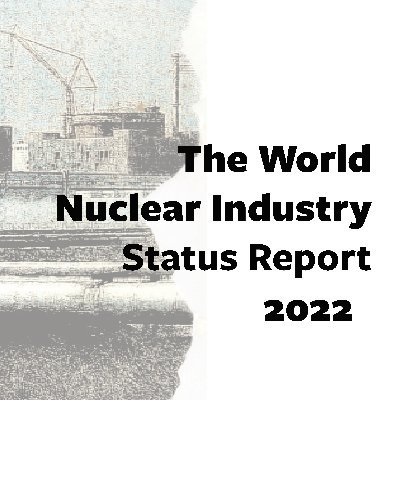
The Annual Goldmine https://beyondnuclearinternational.org/2022/10/31/the-annual-goldmine/ By Linda Pentz Gunter 31 Oct 22
The annual goldmine of empirical data on nuclear power that is the World Nuclear Industry Status Report (WNISR) was duly rolled out on October 5th, this year in Berlin. The 2022 edition is available for download here and is an indispensable reference source, updated each year.
While delivering an in-depth overview, as its title suggests, of the status of nuclear power worldwide, the report also provides sections focused on particular areas of the technology or on certain countries or regions of the world.
As its principal author, Mycle Schneider, pointed out during the rollout, the report’s authors are big fans of empirical data. Indeed, many of the findings in the report are taken from the nuclear industry itself. Facts and physics are pretty much immutable when it comes to nuclear power, and neither favor the industry very well. No amount of nuclear industry aspirational rhetoric can hide the truth about a waning and outdated technology.
The over-riding finding of the 2022 edition of the report is that nuclear power’s share of global commercial gross electricity generation in 2021 dropped to below 10 percent for the first time ever, sinking to its lowest in four decades.
As in past years, if you take China out of the picture — a country with 21 new reactors under construction as of mid-2022 — the decline of nuclear power worldwide is even more dramatic.
At close to 400 pages, the WNISR is a tome, but it is packed full of essential detail on every important topic related to nuclear power and its declining place in the world. Whether you are interested in new builds or closure, decommissioning or small modular reactors, or a specific country, there is something in the report that will flesh out the details.
And this year, there is an important chapter late in the report — Nuclear Power and War — dealing with the fate of nuclear power plants caught up in the Russian invasion of Ukraine and the warfare that is exploding around them.
We have of course been talking, writing and warning about the perils of reactors in a war zone since the time a Russian invasion was first intimated late in 2021. But the WNISR helpfully lays out all the possible causes and consequences of a nuclear disaster in Ukraine. It answers the many questions we have about the robustness, or not, of reactors, fuel pools and radioactive waste casks to withstand and survive a bombardment or even a prolonged power outage.
As former IAEA director of nuclear safety, Aybars Gurpinar, told Bloomberg when addressing the risks to reactors in Ukraine: “Even if structures are extremely well designed, you cannot expect them to withstand a military-style attack. They are not designed for this.”
The WNISR concludes, on page 259: “Nuclear power plants are immediately vulnerable in war situations. This is directly due to the constant and permanent need for cooling. Extensive failure of the necessary electrical power or destruction of the cooling systems would lead to overheating of the reactor core. It is relatively unimportant whether this damage is intentional, unintentional, or of indeterminate cause and motivation.
“On the other hand, with increasing duration, the specific stress on the personnel and poorer maintenance worsens the operating conditions which also increases the probability of triggering serious accidents.”
In addition to covering the most obviously disastrous impacts, such as loss of coolant leading to fires and meltdowns, the report also explores some of the other essentials that could be lost during war but that are less often discussed.
These include lack of access to the plant due to the destruction of roadways; absence of diesel fuel supplies for backup generators; the continued presence of a fire department with necessary equipment and access; the availability of a skilled operating personnel and the consequences of staff working under duress or takeover; and the necessity of continued maintenance, repairs and inspections.
These add to the already long list of technical things that could go wrong at a reactor under war conditions. This makes it particularly important to focus on the prevention of such a disaster, rather than speculating about who is at fault.
Speculation is not to be found in the WNISR. Accordingly, the authors chose to point out in conclusion that the reports coming in about who is firing on what and why are not necessarily reliable. All they, and we, can assess, is what the damage might be and what the consequences of that damage could lead to.
“In a war situation, it is particularly difficult to verify whether certain reports cover indisputable facts, are exaggerated, or false,” the WNISR authors write. “The warring parties, as well as organizations and individuals interacting with them, have an interest in a representation that is not necessarily objective.”
Wars will happen and the fog of war will mask and confuse what is actually going on. But the one abiding problem is the nuclear power plants being there in the first place. And that’s the one thing we do have the power to change.
Linda Pentz Gunter is the international specialist at Beyond Nuclear and writes for and curates Beyond Nuclear International.
Biden lost temper with Zelenskyy in June phone call when Ukrainian leader asked for more aid
Biden had barely finished telling Zelenskyy he’d just greenlighted another $1 billion in military assistance when the Ukrainian president started listing all the additional help he needed.
NBC News, Oct. 31, 2022, By Carol E. Lee, Courtney Kube and Dan De Luce
It’s become routine since Russia invaded Ukraine: President Joe Biden and Ukrainian President Volodymyr Zelenskyy speak by phone whenever the U.S. announces a new package of military assistance for Kyiv.
But a phone call between the two leaders in June played out differently from previous ones, according to four people familiar with the call. Biden had barely finished telling Zelenskyy he’d just greenlighted another $1 billion in U.S. military assistance for Ukraine when Zelenskyy started listing all the additional help he needed and wasn’t getting. Biden lost his temper, the people familiar with the call said. The American people were being quite generous, and his administration and the U.S. military were working hard to help Ukraine, he said, raising his voice, and Zelenskyy could show a little more gratitude.
Administration officials said Biden and Zelenskyy’s relationship has only improved since the June phone call, after which Zelenskyy made a statement praising the U.S. for its generous assistance. But the clash reflects Biden’s early awareness that both congressional and public support for sending billions of dollars to Ukraine could begin to fade. That moment has arrived just as the president prepares to ask Congress to greenlight even more money for Ukraine.
Biden now faces resistance from some Republicans and Democrats that wasn’t present when Congress approved previous Ukraine funds. The White House has discussed asking Congress for billions of dollars during the lame-duck legislative session after the midterm elections.
The White House hasn’t specified an amount publicly. Lawmakers and Ukraine lobbyists hope for $40 billion to $60 billion, and some officials familiar with the discussions expect the number to be roughly $50 billion.
A source familiar with the conversation said that Biden was direct with Zelenskyy about handling the issues in the appropriate military channels but that the exchange wasn’t heated or angry.
A spokesperson for the National Security Council declined to comment on the story.
A spokesperson for Zelenskyy didn’t respond to a request for comment.
Top U.S. officials warn there are no signs the war is ending any time soon.
Before the June 15 phone call, the president’s frustrations with Zelenskyy had been building for weeks, three people familiar with the call said. Biden and some of his top aides felt that the administration was doing as much as it could as quickly as it could but that Zelenskyy continued to focus publicly on only what wasn’t being done.
From Zelenskyy’s perspective — as well as that of some Eastern European governments and U.S. lawmakers from both parties — there has been repeated frustration that the Biden White House moves too slowly on weapons requests, initially hesitating to approve certain capabilities Ukraine requested most urgently, only to relent weeks or months later under pressure, according to two sources familiar with the Ukraine government’s view, congressional aides and two European officials……………………………………..
The proportion of Americans who are extremely or very concerned about Ukraine’s losing the war has dropped by 17 percentage points since May, from 55% to 38%, according to a Pew Research Center survey conducted last month. And the proportion of Americans who say they’re not too concerned or not at all concerned about Russia’s winning was up from 16% to 26%, according to the survey.
The potential change in political will in the U.S. for continuing to send aid to Ukraine could upend how both the White House and Zelenskyy have approached the issue so far.
Since Russia invaded Ukraine in February, the Biden administration has been criticized for moving too cautiously. Now the president faces potential pushback from some Republican lawmakers and progressive Democrats that he’s providing too much aid.
The shifting dynamics on Capitol Hill also could force Zelenskyy’s team to rethink how it engages with Washington, as it has often tried to leverage its support in Congress to get more out of the White House. https://www.nbcnews.com/politics/national-security/biden-lost-temper-zelenskyy-phone-call-ukraine-aid-rcna54592
—
Poland, South Korea sign outline accords on nuclear power project
Aljazeera 31 Oct 22
South Korea and Poland to assess the viability of building four 1,400-megawatt nuclear reactors in Patnow.
Seoul and Warsaw have signed outline agreements to develop nuclear power in Poland, according to ministries from both countries, as Poland strives to phase out coal and lower its carbon emissions and South Korea seeks to revive its nuclear industry.
Poland’s ZE PAK and PGE and Korea Hydro & Nuclear Power (KHNP) will assess the viability of building four 1,400-megawatt nuclear reactors in Patnow, central Poland, using South Korean technology, the South Korean Ministry of Trade, Industry and Energy said on Monday in a joint statement with the Polish Ministry of State Assets.
The companies, with government backing, intend to prepare a preliminary development plan for the plant by the end of this year, they said in a statement.
Since the election this year of President Yoon Suk-yeol, who pledged to revive the country’s nuclear power industry, South Korea has stepped up efforts to win nuclear power plant export orders……………………
Monday’s agreements follow an announcement on Friday when Warsaw said US firm Westinghouse Electric Co will build the country’s first nuclear power plant in northern Poland. https://www.aljazeera.com/news/2022/10/31/poland-south-korea-sign-outline-accords-on-nuclear-power-project
1 This Month



26 September – International Day for the Total Elimination of Nuclear Weapons


PLEASE OPPOSE HR 8255 AND S.3639 – bills would accelerate satellite deployment, with no environmental review or safeguards – https://ncstd5li.quorum.us/campaign/169331/
To see nuclear-related stories in greater depth and intensity – go to https://nuclearinformation.wordpress.com
-
Archives
- September 2026 (245)
- August 2026 (330)
- July 2026 (355)
- June 2026 (287)
- May 2026 (306)
- April 2026 (356)
- March 2026 (251)
- February 2026 (267)
- January 2026 (308)
- December 2025 (358)
- November 2025 (359)
- October 2025 (375)
-
Categories
- 1
- 1 NUCLEAR ISSUES
- business and costs
- climate change
- culture and arts
- ENERGY
- environment
- health
- history
- indigenous issues
- Legal
- marketing of nuclear
- media
- opposition to nuclear
- PERSONAL STORIES
- politics
- politics international
- Religion and ethics
- safety
- secrets,lies and civil liberties
- spinbuster
- technology
- Uranium
- wastes
- weapons and war
- Women
- 2 WORLD
- ACTION
- AFRICA
- Atrocities
- AUSTRALIA
- Christina's notes
- Christina's themes
- culture and arts
- Events
- Fuk 2022
- Fuk 2023
- Fukushima 2017
- Fukushima 2018
- fukushima 2019
- Fukushima 2020
- Fukushima 2021
- general
- global warming
- Humour (God we need it)
- Nuclear
- RARE EARTHS
- Reference
- resources – print
- Resources -audiovicual
- Weekly Newsletter
- World
- World Nuclear
- YouTube
-
RSS
Entries RSS
Comments RSS
 nuclear-news