DAP party blasts Malaysia’s dangerous nuclear power plans

 DAP blasts BN’s nuclear power plans, calls it a threat to health, safety, The Malaysian Insider By LOOI SUE-CHERN 8 August 2014 Barisan Nasional (BN) is putting profit ahead of the interest of the people if it goes ahead with plans to build two nuclear power reactors in the country, said the DAP.
Party secretary-general Lim Guan Eng (pic) said BN would be gambling with the people’s health and safety if it goes ahead with the plans. Lim disagreed with Minister in the Prime Minister’s Department Datuk Seri Mah Siew Keong, who had said that Malaysia cannot continue on an energy status quo and nuclear energy was a serious option for energy resources sustainability.
“Mah is wrong because Malaysia will be able to shift to a sustainable energy paradigm without relying on nuclear power plants,” Lim said in a statement today.
The Penang chief minister said Putrajaya would be able to achieve energy sustainability by wiping out corruption, investing in renewable energy projects, diversifying its domestic economies and reducing reliance on hydrocarbon resources.
“Lest Mah forgets the risks of nuclear energy, more than 150,000 evacuees are still unable to return home after the Fukushima nuclear disaster in 2011, following the huge earthquake and tsunami.
“Japan is still dealing with contaminated groundwater around the Fukushima nuclear power plants everyday,” Lim said.
He also said it is “irresponsible” of BN to decide to proceed with the proposed two nuclear power plants, when there are serious concerns about safety and the environment.
Lim said BN could not even ensure uninterrupted water supply, which would be a key component to cool and clean nuclear power reactors.
Apart from that, Malaysia still enjoys a high energy reserve margin of over 30%.
“Both the Pakatan Rakyat Penang government and DAP have adopted a firm and uncompromising stand against nuclear reactors due to their unsustainable costs, huge environmental and humanitarian risks.”The Penang state government had written to the then Energy, Green Technology and Water Minister Tan Sri Peter Chin on March 21, 2011 to object against the building of any nuclear power plant in Malaysia,” he said, adding that Penang will also ban such facilities………. http://www.themalaysianinsider.com/malaysia/article/dap-blasts-bns-nuclear-power-plans-calls-it-a-threat-to-health-safety#sthash.UMEY14oX.dpuf
USA’s Nuclear – I mean – Environmental Protection Agency
 Officially “Safe” RadiationBy William Boardman OpEd News 8/3/2014 More Radiation Exposure Won’t Hurt You, Says U.S. EPA
“Protection Standards for Nuclear Power Operations” means what?
The Environmental Protection Agency (EPA) of the United States is a full blown oxymoron when it comes to protecting U.S. residents from the danger of increased exposure to ionizing radiation. That’s the kind of radiation that comes from natural sources like Uranium and the sun, as well as unnatural sources like Uranium mines, nuclear weapons, and nuclear power plants (even when they haven’t melted down like Fukushima). The EPA is presently considering allowing everyone in the U.S. to be exposed to higher levels of ionizing radiation.
In 1977, the EPA established levels of radiation exposure “considered safe” for people by federal rule (in bureaucratese, “the regulation at 40 CFR part 190“). In the language of the rule, the 1977 safety standards were: “The standards [that] specify the levels below which normal operations of the uranium fuel cycle are determined to be environmentally acceptable.” In common parlance, this became the level “considered safe,” even though that’s very different from “environmentally acceptable.” “Acceptable by whom? The environment has no vote.
The phrase “considered safe” is key to the issue, since there is no “actually safe” level of radiation exposure. The planet was once naturally radioactive and lifeless. Life emerged only after Earth’s radiation levels decayed to the point where life became possible, in spite of a continuing level of natural “background radiation.” The reality is that there is no “safe” level of radiation exposure.
Is the EPA actually immersed in a protection racket?
The studied ambiguity of the proposal’s title — “Environmental Radiation Protection Standards for Nuclear Power Operations” — goes to the heart of the issue: who or what is really being protected, nuclear power operations?
Quite aware that it is perceived by some as placing the desires of the nuclear power industry above the safety needs of the population, the EPA begins its proposal for changing radiation limits with this defensive and apparently contradictory passage:
This Advance Notice of Proposed Rulemaking is being published to inform stakeholders, including federal and state entities, the nuclear industry, the public and any interested groups, that the Agency is reviewing the existing standards to determine how the regulation at 40 CFR part 190 should be updated and soliciting input on changes (if any) that should be made.
This action is not meant to be construed as an advocacy position either for or against nuclear power.
EPA wants to ensure that environmental protection standards are adequate for the foreseeable future for nuclear fuel cycle facilities. As far as the EPA is concerned, the uranium fuel cycle does not include Uranium mining, despite the serious environmental danger that process entails. Once the environmental and human degradation from Uranium mining has been done, the EPA begins regulating environmental protection from nuclear fuel cycle facilities, beginning with milling and ending with storage or reprocessing facilities for nuclear waste.
According to the agency itself, “EPA’s mission is to protect human health and the
environment. EPA sets limits on the amount of radiation that can be released into the environment.”
Radiation exposure is chronic, cumulative, and unhealthy
Given the pre-existing radiation load on the environment from natural sources, it’s not clear that there is any amount of radiation that can be released into the environment with safety. The EPA pretty much evades that question, since the straight forward answer for human health is: no amount. Besides, the semi-captured protection agency is just as much engaged in protecting economic health for certain industries as it is in protecting human health. This leads it to making formulations that manage to acknowledge human reality without actually supporting it:………
Lower radiation levels provide more environmental protection
Environmental organizations like the Nuclear Information and Resource Service (NIRS) are urging the EPA to lower radiation release standards, to “protect more, not less.” According to NIRS, regulation of nuclear power has a sorry history:……..
In 2005, the National Academy of Sciences addressed “safe” levels of radiation and concluded that there are none in any scientifically meaningful sense.
Humans are exposed to a basic, damaging level of ionizing radiation from multiple sources from gestation till death. This natural background radiation is at a relatively low level, but the risk from radiation is cumulative. Every additional exposure above background radiation adds to the risk. Some of these risks, like radiation treatment to ward off cancer, are widely accepted as reasonable trade-offs. The reasonableness of greater exposure from the nuclear fuel cycle and the uncontrolled growth of nuclear waste is not such an obviously beneficial trade-off. http://www.opednews.com/articles/Officially-Safe-Radiatio-by-William-Boardman-Cancer_Environment_People_Radiation-140803-863.html
Japan returning to a new age of fascism with Shinzo Abe’s policies?
The most important question is no longer whether each of Abe’s policies is good or bad, but rather whether we are going to condone the prime minister’s basic attitude that negates the common sense of a modern state and will lead to turning Japan into a barbaric nation.
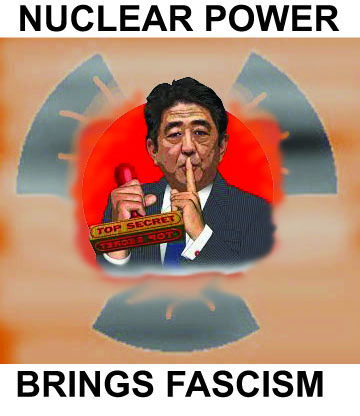
 Abe undermining rule of law, Japan Times, BY JIRO YAMAGUCHI JUL 31, 2014 A recent series of events has demonstrated the deterioration of Japan as a nation. At the root of the problem appears to be a bottomless nihilism on the part of those in power characterized by their thinking that the powers that be can ignore the rules and norms of society and polity.
On July 1, the Abe administration made a Cabinet decision to pave the way for Japan engaging in collective self-defense. This is an act that alters the foundation of Japan’s national security policies developed over the past 60 years, and an outrageous move that way oversteps the power of a single Cabinet.
How vague and sloppy the decision itself is was illustrated by the Budget Committee debates in both chambers of the Diet held two weeks later……..
The new conditions for the use of force overseas set under the LDP-New Komeito agreement will never serve as an effective brake on Japan’s military actions overseas.
Questions and answers in the Diet showed that the text of the Cabinet decision allows different people to interpret it in their own way.
If so, the norms set by the Cabinet over Japan engaging in collective self-defense will be meaningless. In the first place, Abe does not have the idea that government leaders must exercise their power in accordance with rules that are set down in words…….
If the content of norms and rules of a nation can be freely changed by those who interpret them, the nation is no longer under the rule of law; it’s under the rule of man.
Meanwhile, the Nuclear Regulation Authority screened Kyushu Electric Power Co.’s Sendai Nuclear Power Plant in Kagoshima Prefecture in accordance with the NRA’s plant design standards updated in the wake of the 2011 Fukushima nuclear disaster and announced that the Sendai plant has cleared the screening. Thus the NRA has paved the way for restarting the idled plant.
At the same time, NRA Chairman Shunichi Tanaka said NRA cannot determine whether the plant is safe to restart. The NRA chief insists its screening standards are not safety standards.
Yet, the Abe administration, which had repeatedly said it would reactivate nuclear power plants that have cleared “the safety standards,” is expected to push for a quick restart of the Sendai plant. The government says that NRA screening has confirmed the safety of the Sendai plant.
As with the issue of the exercise of the right to collective self-defense, each of the people involved in the nuclear power policy is allowed to interpret the rules in his or her own way.
All these events demonstrate that people in power in this country — in particular Abe — do not recognize that they are bound by rules. They defiantly argue that even if certain things are prohibited under rules, they can do them simply by first changing the interpretation of the rules. Or, if they cannot win a game, they think that it’s because the rules and the referee are wrong. They then think that if the referee is replaced, things will be all right.
The most important question is no longer whether each of Abe’s policies is good or bad, but rather whether we are going to condone the prime minister’s basic attitude that negates the common sense of a modern state and will lead to turning Japan into a barbaric nation.
Jiro Yamaguchi is a professor of political science at Hosei University. http://www.japantimes.co.jp/opinion/2014/07/31/commentary/world-commentary/abe-undermining-rule-law/#.U9xbVuNdUnk
Japan’s Prime Minister Abe pinning his political future on nuclear power restart
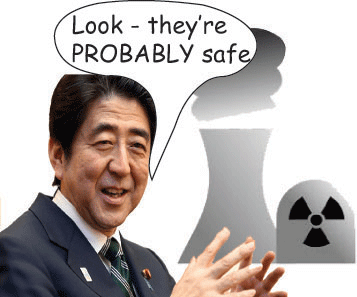 Flicking the switch Restarting nuclear plants is unpopular but crucial for Shinzo Abe The Economist Aug 2nd 2014 | SATSUMASENDAI|”……. The pro-nuclear government of Shinzo Abe, the prime minister, hopes a restart at the Sendai plant can open the way for a dozen or more reactors to resume operations……..The cost of closure to the local economy means that officials who favour nuclear power overwhelmingly outnumber opponents in the local assemblies that will vote in the autumn. Yet on the national stage, Mr Abe may still pay a price. His popularity has recently flagged. Last month his Liberal Democratic Party lost a gubernatorial election in Shiga prefecture, partly due to rising anti-nuclear sentiment. Some three-fifths of people are against the Sendai restart, according to a recent nationwide poll of public opinion.
Back in Kyushu, the possibility of an imminent restart was driven home this week when the prefecture handed out iodine tablets to households near the plant to protect against thyroid cancer in case of an accident. Other plans are incomplete, most notably on basic evacuation routes in case of a nuclear emergency. The plant is likely to restart without an earthquake-proof off-site emergency centre, though these were mandated after the Fukushima disaster. Japan lies in one of the world’s most seismically active areas, but insufficient discussion has been held about the risks posed by a surrounding group of five calderas and by Sakurajima, an active volcano only 50 kilometres (31 miles) away from the Sendai plant.
The central government has to date relied on the NRA and on Kagoshima officials to make the case for the restart. Yet the governor, Yuichiro Ito, now says the authorities in Tokyo must convince the public of the plant’s safety. In 2012, before two reactors at Oi in Fukui prefecture were switched back on for a while, the governor there ensured that the then prime minister, Yoshihiko Noda, reassured the public over the plant’s safety. Mr Abe may have to dip deep into his political capital if reactors across the country are to be fired up. http://www.economist.com/news/asia/21610329-restarting-nuclear-plants-unpopular-crucial-shinzo-abe-flicking-switch
Scotland’s tax-payers to pay for new nuclear power?

 Row over contract to help nuclear firms, Herald Scotland, Daniel Sanderson Wednesday 23 July 2014
The body is to invest hundreds of thousands of pounds of public cash in a project aimed at helping Scottish firms move into the nuclear power industry.
As part of its Nuclear Supply Chain Phase II initiative, Scottish Enterprise has advertised for expert companies to come forward to assist Scottish firms to win business in the sector. In a document provided to firms interested in winning the three-year contract, worth up to a third of a million pounds excluding VAT, it says that as well as extensive opportunities for businesses to play a role in decommissioning old plants, there is also “considerable commitment to nuclear new-build” in the UK and overseas that could be exploited.
The contract has been offered despite Scottish Energy Minister Fergus Ewing saying last year that support for nuclear was “misguided” after the UK Government announced it planned to build another plant in England. Mr Ewing added that economic powerhouses, including France and Germany, were scaling back or eliminating their reliance on the power source and that investment should instead be diverted to renewable energy sources.
While Scottish Enterprise said it believed the “vast majority” of new activity would involve the decommissioning of old plants, environmentalists have hit out at the agency, accusing it of wasting public money by “chasing the nuclear dream”.
Meanwhile, opposition MSPs have accused the SNP of “hypocrisy” after details of the project emerged. Murdo Fraser, energy spokesman for the Scottish Conservatives, said: “The Scottish Government continually argues that nuclear power is declining, yet is now looking for a firm to deliver a programme designed to help businesses take advantage of nuclear power opportunities.”
Dr Richard Dixon, director of Friends Of The Earth Scotland, said he believed the Scottish Enterprise project was “a waste of time”, and said the cash would be far better spent on creating jobs in green energy. He said: “Scotland is a world leader in renewable energy but has no useful expertise in new nuclear. Scottish Enterprise should concentrate on playing to our strengths in renewables and not be distracted by the nuclear white elephant.”……..http://www.heraldscotland.com/news/home-news/row-over-contract-to-help-nuclear-firms.24830973
Criticism of nuclear power in Japan in a month’s public debate before nuclear restart is final
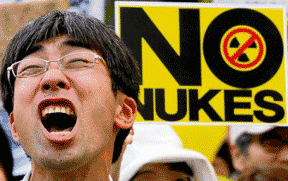 Regulator greenlights reactor restarts in nuclear-weary Japan Rt July 16, 2014 Japan’s nuclear watchdog has given a preliminary safety approval for restarting two nuclear reactors at the Sendai plant. A month is given for opposition groups to make their case against the move before a final decision is taken.
The reactors at Sendai power plant in Kagoshima Prefecture are two of 19 which Japanese electric utilities seek to restart and have applied for permission from the Nuclear Regulation Authority (NRA)………
The regulator is bound to see criticism over the one-month public debate period. Even as it was prepared to release the report on Wednesday, a small groups of protesters shouting “Shame on you!” at the public meeting, with one demonstrator accusing the watchdog officials of being puppets of the nuclear industry.
Greenpeace criticized the approval, charging that NRA is “ignoring unresolved safety issues and rising public opposition.”
The Sendai plant has “no effective evacuation plan for the populations in the region, in particular for the elderly, children and those in hospital, no functioning emergency-response center protected against radiation,” the group said in a statement.
The regulator deflected the criticism from the environmental group, saying that evacuation plans are the responsibility of local governments rather than the NRA.
A petition against the planned restart of the Sendai reactors scored 30,000 signatures of residents in Ichikikushikino, a coastal town 5km from the facility. And a local assembly adopted a resolution calling for Sendai to be decommissioned rather than restarted.
In another example of opposition to Abe’s nuclear policies, a candidate backed by his Liberal Democratic Party lost Sunday election to anti-nuclear candidate for the position of Shiga prefecture governor. http://rt.com/news/173224-nuclear-reactor-restart-japan/
Egypt planning nuclear power launch (is that safe?)
Nuclear plant tender to launch by year’s end; winning country to finance project: El-Osery, Daily News Egypt Sara Aggour / July 20, 2014 Egypt is to launch a global tender for its first Dabaa nuclear plant by the end of 2014, said Ibrahim El-Osery, the Ministry of Electricity’s adviser for nuclear energy
Speaking to the Daily News Egypt, El-Osery said the plant will be located in the Matruh governorate, with Egypt paying for the implementation expenses after operations start.
“One of the tender’s conditions is that whoever wins will take the responsibility of financing the project till its implementation,” said El-Osery……..http://www.dailynewsegypt.com/2014/07/20/nuclear-plant-tender-launch-years-end-winning-country-finance-project-el-osery/
6 issues for America’s EPA on radiation safety limits

 EPA Wants My Opinion? Well, Here It Is, Enformable Joieau Website Joy Thompson 18 July 14,
 The Environmental Protection Agency – the overseers of the suspiciously on-again/off-again RadNet monitoring system in the wake of the 2011 mass meltdown/blow-outs at Japan’s Fukushima Daiichi power station – has helpfully extended the public comment period on its proposed “update” to 40CFR.190, “Environmental Radiation Protection Standards for Nuclear Power Operations.”
Citizens now have until August 4th to submit their comments on exposure limits, dose calculations, new fuel cycle technologies and related topics.
Advance Notice of Proposed Rulemaking (ANPR).
The EPA is seeking public comment and information that they may or may not use for planned updates to the old rules for Environmental Radiation Protection issued in 1977, ostensibly to make them easier to understand and implement. Given how often the public is treated to professions of ignorance from the nuclear industry (such as, “we don’t know how to measure beta radiation levels!” when caught disseminating blatantly false data), this could be a good thing. The Nuclear Regulatory Commission [NRC] is responsible for implementing and enforcing the standards established by the EPA, and we have watched with some jaded dismay as NRC has steadily abdicated its responsibilities, entrusting them to the utilities it’s supposed to be regulating. Utilities now enjoy little to no oversight or auditing of their monitoring or records, and requirements for public notification and protection (like evacuation of nearby residents if releases reach certain levels) have been demonstrated pointless because they are routinely ignoredPerhaps if EPA can tweak its rules so that even the NRC can understand them, we could expect much better compliance all around……..
To help interested people who may be confused by the technical gobbledygook that frames the issues in the EPA’s documents, I am listing the issues here, offering an abbreviated look at EPA reasoning in presenting these issues for comment, and supplying my own responses to the questions EPA is posing to the public………
Issue 1: Consideration of a Risk Limit to protect individuals. Should the Agency express its limits for the purpose of this regulation in terms of radiation risk or radiation dose?
My Response to Issue 1:
Because both national and international radiation protection guidelines developed by non-governmental radiation experts such as the ICRP and the National Council on Radiation Protection and Measurements recommend that radiation exposure standards be established in terms of dose to members of the public, the EPA should continue to base its limits on effective dose to members of the public.
Issue 2: Updated Dose Methodology (dosimetry). How should the Agency update the radiation dosimetry methodology incorporated in the standard?
Current limits on exposures to the public during normal operation are 25mr [millirems] whole body, 75mr to the thyroid, and 25mr to any other organ, over a year’s time. There are no effective limits on accident releases, and anyone who followed the disaster at Fukushima in 2011 will understand why. If releases during an accident/event are calculated to deliver a set level of exposure [dose] to any member of the public over the duration of the event, the requirement for evacuation kicks in.
In the end, and given the past record of deception by the industry and its regulators concerning public exposures to radiation, it probably doesn’t matter which methodology is used to calculate and/or estimate doses to the public during a serious accident, so long as requirements for evacuation of the public when a certain set dose level is reached remain in place. That dose level should remain equivalent to the one(s) now in place.
My Response to Issue 2:
If using a more sophisticated method of calculating and estimating doses/harm to the public will make the task of radiation protection easier, there is no reason not to do so. If EPA decides to go to ICRP’s more recent methodology it should use the ICRP methodology that exists at present [60] and not the one ICRP might eventually quantify. Utilities should not be exempted from requirements for evacuation plans and notifications, nor should the allowable doses to the public be raised.
Issue 3: Radionuclide Release Limits. The Agency has established individual limits for release of specific radionuclides of concern. Based on a concept known as collective dose, these standards limit the total discharge of these radionuclides to the environment. The Agency is seeking input on: Should the Agency retain the radionuclide release limits in an updated rule and, if so, what should the Agency use as the basis for any release limits?
The original EPA release limits (Final Environmental Statement, 1976) were based on the assumption that spent fuel reprocessing would be the one area of the total fuel cycle that would release the most radionuclides to the environment. In 2014 we know from long experience with serious accidents, meltdowns and exploding reactor plants that the generation facilities themselves have proven to be the worst offenders. We do not reprocess commercial spent fuel in this country, and haven’t done so since the 1970s. The government reprocessing facilities that do exist are notoriously filthy, as are fabrication facilities working with plutonium to make MOX fuels. Still, in overall environmental contamination, power plants suffering nasty oopses are right up there for consideration. And power plants suffering nasty oopses are not subject to radionuclide release limits because there is no way to stop those releases.
Now, however, we are looking at decommissioning aged and aging nuclear facilities, doing something with the accumulated tonnage of spent fuel waste, and applying release limitations to any/all new technologies that will come with future nuclear energy development (if that happens). Nuclear pollution from these activities must also be considered.
My Response to Issue 3:
EPA should continue to use the existing standards of limiting environmental burden as a guide, calculate and apply equivalent radionuclide standards for individual facilities at any stage of the nuclear fuel cycle. This need not be based on estimated doses to the wider public or to individual members of the public. It does need to be recalculated as necessary whenever weapon/accident releases occur to release very large amounts of radionuclides to the biosphere, with an eye to maintaining a biosphere-wide environmental burden limit for all dangerous long-lived isotopes.
If such an effort ends up reducing the allowable radionuclide releases from any type of nuclear facility at any point along the fuel cycle to a level that cannot be reasonably applied, then those facilities should be closed and decommissioned. Humanity should not be asked to tolerate the nuclear pollution of our planet to the point where everyone’s health and longevity are materially compromised. If that means the end of the nuclear industry itself, then that’s what it means.
Issue 4: Water Resource Protection. How should a revised rule protect water resources?
Ground and surface water are necessary resources for organic life forms and entire ecosystems. EPA says it wishes to prevent water contamination rather than have to clean it up after it’s polluted. This is great. Existing standards don’t impose water-specific standards because nuclear plants do not release what they consider to be significant radionuclides to water sources during normal operation, and any such releases have had far less impact on public health than airborne releases. There are some fluid effluent limits for specific radionuclides.
As the industry’s facilities have aged, however, water pollution issues have come to the fore. Tritium contamination of groundwater, aquifers, rivers and lakes has become more problematic. Unfortunately, there are no technologies in existence that can effectively remove tritium from water. EPA wishes to establish off-site water standards commensurate with the Clean Water Act, which has specific limitations on concentration of carcinogens.
My Response to Issue 4:
The basis of any new EPA ground and/or surface water standards should be the limits specified in the Clean Water Act, diminished by the concentration of pollutants that may already be present in the water source. The dirtier the ground/surface water already is, the less any nuclear facility will be allowed to release. If the allowance goes to zero, the facility must be closed and decommissioned.
Issue 5: Spent Nuclear Fuel and High-Level Radioactive Waste Storage. How, if at all, should a revised rule explicitly address storage of spent nuclear fuel and high-level radioactive waste?……..
. The failure over the past 40 years to develop medium and long term spent fuel storage has turned operating nuclear plants into de facto storage facilities they were never designed to be. Government/industry agencies, commissions, industry think tanks and international bodies can recommend the development of medium and long term storage facilities all they like. Fact is if nobody’s building them, they flat don’t exist and recommendations accomplish exactly zip.
If it ever looks like such facilities may at long last come to be, then the EPA may have a regulatory role in limiting the amount of radioactive substances those facilities can be allowed to release in any form to the environment. …….
My Response to Issue 5:
The same limitations on releases to air and water from nuclear operations should be applied to on-site storage of spent fuel. There should also be a limitation on how much spent fuel can be stored in a single pool, as well as a time limit on how long it can stay there before being dry-casked. The industry should be forced to dry-cask all spent fuel in their pools that has been stored for 2 years or more. Any dry cask storage facilities on-site should have an area radiation limit to protect workers, and should not contribute at all to off-site radiation levels.
Issue 6: New Nuclear Technologies – What new technologies and practices have developed since 40CFR.190 was issued, and how should any revised rule address these advances and changes?……
My Response to Issue 6:
Reality is that there is no pressing need for the EPA to develop separate or differing limits for possible future nuclear technologies that are entirely unlikely to be deployed. If any of them ever are deployed, the existing (or revised) standards should be applicable to any new nuclear technologies. All applications involving nuclear fission should have to abide by the EPA protective regulations throughout the fuel cycle to limit harm to the general public, nuclear workers and the environment.
EPA should definitely develop and apply specific rules for MOX fuels as those are fabricated and used in power reactors. Plutonium is a dangerous radionuclide, as are other high energy alpha and beta emitters that occur during production, enrichment and fuel fabrication. Limits on levels and releases of these elements should be strict, and dutifully enforced.
Comments should be identified by Docket ID No. EPA-HQ-OAR-2013-0689. Comments may be submitted in the following ways:
• www.regulations.gov: follow the on-line instructions.
• Email: a-and-r-docket@epa.gov
• Fax: (202) 566-9744
• Mail: EPA Docket Center, Environmental Radiation Protection Standards for Nuclear Power Operations – Advance Notice of Proposed Rulemaking Docket, Docket ID No. EPA-HQ-OAR-2013-0689, 1200 Pennsylvania Ave. NW., Washington, DC 20460. Please include two copies.
• Hand Delivery: In person or by courier, deliver to: EPA Docket Center, EPA West, Room 3334, 1301 Constitution Ave. NW., Washington, DC 20004. During Docket’s normal hours of operation. Please include two copies. http://enformable.com/2014/07/epa-wants-opinion-well/
Japan’s legal void. Nobody has authority to order restart of nuclear reactors
 Decider Hard to Find in Japan Nuclear Restarts http://blogs.wsj.com/japanrealtime/2014/07/15/decider-hard-to-find-in-japan-nuclear-restarts/ Back in Japan’s feudal days, commoners would protest from time to time over burdens such as heavy taxes or forced labor. Samurai overlords might grant relief but would typically kill the protest ringleader.
To avoid that consequence, the commoners developed the idea of the “umbrella covenant”: Those who joined the protest signed their names in a circle resembling an open umbrella, making it hard to tell who signed first.
The situation over Japan’s nuclear restarts brings to mind that history, taught in Japanese grade schools, because it’s hard to tell who is the ringleader in bringing the nation’s 48 nuclear reactors back online.
As we reported today, the Nuclear Regulation Authority is set to say Wednesday that two Kyushu Electric Power Co. reactors in Satsuma-Sendai, Kagoshima prefecture, have complied with tougher post-Fukushima safety regulations.
The regulator says it is merely checking compliance with regulations, not verifying the complete safety of the reactors. Members of Prime Minister Shinzo Abe’s cabinet say they defer to the regulator when it comes to verifying safety. Leaders in Satsuma-Sendai say the city needs the central government’s approval before agreeing to restarts.
“The decision is too big. They are afraid of being responsible,” said Miwa Kiwaki, a volunteer helping a civil group in the Fukushima prefecture that has been petitioning the central government for criminal prosecution of those responsible for the Fukushima accident.
“The problem is nobody in Japan has any legal authority to enforce nuclear-power operations. Mr. Abe has to do something about the legal void if he thinks nuclear power is necessary,” said Junji Annen, a professor at Chuo University and the head of a government panel that discusses electricity prices.
Industrial electricity users say they hope for action soon to bring down power prices, which have risen because the nation is importing fuel to replace nuclear power. “A number of companies have already closed down, gone bankrupt, or decided to go overseas and cut staff,” 11 associations of manufacturers said in a joint statement in late May.
Japan’s very shaky nuclear ‘renaissance’
Abe’s nuclear renaissance ignores stiff opposition BY JEFF KINGSTON SPECIAL TO THE JAPAN TIMES 28 June 14 “……On April 11, 2014, Abe’s Cabinet approved a new national energy strategy that embraces nuclear power. This is not surprising given that Abe has vigorously promoted bringing idled reactors back online and is pitchman-in-chief for exports of nuclear technology and equipment. The new plan also opens the door to new reactor construction.
Abe’s nuclear renaissance has become complicated, however, following the revelation in May 2014 that the government and the Tokyo Electric Power Co. had been hiding the fact that almost all workers and managers at the Fukushima No. 1 nuclear plant bolted the scene and abandoned their posts on the morning of March 15, 2011, as the crisis seemed to be spiraling out of control. Instead of remaining on the plant site as ordered, most workers fled to the Fukushima No. 2 nuclear plant 10 km to the south. While such actions are understandable, the mass exodus raises the question of whether nuclear reactors can be operated safely if those responsible for conducting emergency operations cannot be relied on to carry out their duties.
Doubts about the Nuclear Regulatory Authority’s safety reviews are also gathering as the shambolic decommissioning operations at Fukushima undermine its credibility. Why did the NRA allow Tepco to cut corners and compromise safety, leading to extensive radioactive contamination of groundwater now seeping into the ocean? Reports of problems with malfunctioning decontamination equipment, leaky storage tanks for contaminated water and worker error are emblematic of the endless bungling. Why is Tepco, an exceptionally incompetent institution, being entrusted with such a crucial task?
The NRA’s failure to adequately monitor the cleanup raises questions about whether it has the capacity to oversee strict enforcement of new safety guidelines and institutionalize a culture of safety.
“We are not assuming that an accident the operator cannot control will take place,” NRA Chairman Tanaka explains, justifying reliance on the nuclear plant operator to manage a nuclear accident. In light of revelations, however, that is not a reassuring assumption………
The evacuation preparedness problem won’t go away and an improvised exodus means mayhem. It is therefore alarming that none of the clusters of towns in any of the designated evacuation zones around the nation’s nuclear plants has conducted a live evacuation drill.
The NRA is reviewing applications to restart 19 nuclear reactors.
The safety screenings involve confirming that they meet new stricter safety standards, but Niigata Gov. Hirohiko Izumida warns that this doesn’t mean they are safe to operate. He points out that local authorities are not able to cope with cascading simultaneous disasters as occurred in 2011, a risk the new guidelines do not address.
Perhaps this explains why a recent Asahi poll finds continued high public opposition to nuclear energy: 77 percent of respondents favor phasing out nuclear energy, while only 14 percent oppose such a policy.http://www.japantimes.co.jp/opinion/2014/06/28/commentary/abes-nuclear-renaissance-ignores-stiff-opposition/#.U7HUBpRdUnk
India’s frantic efforts to deal with problem of insuring nuclear power (the uninsurable)
‘Government working on providing insurance cover to nuclear plants‘ Economic Times Jun 28, 2014, HYDERABAD: The government is working with a group of experts and officials of Nuclear Power Corporation of India,Finance Ministry and insurance companies to work out the modalities of providing insurance cover to existing and new nuclear power plants, a senior official said here today.
R K Sinha, Secretary, Department of Atomic Energy and Chairman of Atomic Energy Commission told this to reporters after flagging off the world’s second largest gamma ray telescope to Ladakh, where it will be installed. According to him, government is working towards forming a nuclear insurance pool to cover the nuclear facilities, involving state-owned General Insurance Company and New India Insurance.
“We are on the way to find a solution (to liability law concerns). We will be putting in place a mechanism to cover the risk through insurance (for nuclear plants),” Sinha, told media persons, he said.
In order to address the liability issue that has held up deals with various countries, the central government earlier said it decided to form a Nuclear Insurance Pool that will have a number of stakeholders to meet the requirement of huge financial cover in case of a mishap.
Under the Liability Law, compensation of up to Rs 1,500 crore will have to be paid in case of a mishap involving a nuclear plant. At present, India has 20 nuclear plants and their number is expected to grow as the industry expands.
The Department of Atomic Energy has been pursuing the issue of bringing the nuclear plants under insurance cover, with the Ministry of Finance, NPCIL and insurance companies, he added…….http://articles.economictimes.indiatimes.com/2014-06-28/news/50929523_1_insurance-cover-nuclear-plants-nuclear-insurance-pool
Should China be designing, owning, and running Britain’s nuclear power stations?
MPs’ concerns mount over deals with China to run British nuclear power stations, THE INDEPENDENT 24 June 14, MARK LEFTLY Monday 23 June 2014 The Government has been accused in Parliament of “accepting money tainted with blood”, after agreeing a deal that will allow Chinese firms to design, own and run British nuclear power stations.
The Chinese premier Li Keqiang struck the bargain as part of a three-day trade visit to the UK last week, which also included an £11.8bn contract for BP to supply gas to China National Offshore Corporation over 20 years. The state-owned China Development Bank wants to fund new nuclear plants directly, as well as the no-less-controversial £42.7bn London-to-the North High Speed Two rail link.
But campaigners are furious the Government has been wooing China without demanding improvements to the country’s notoriously poor human rights record. Mr Li’s Government was accused of placing “arbitrary curbs on expression, association, assembly, and religion” by Human Rights Watch in a recent report.
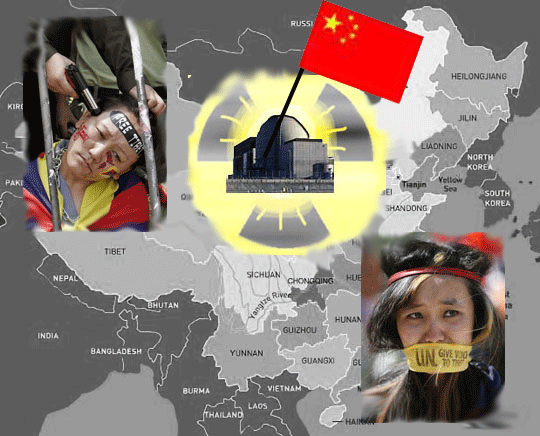
Paul Flynn, the anti-nuclear power Labour MP for Newport West, motioned in the House of Commons last week for the Coalition to cancel any proposed nuclear agreements with China. “This House… believes, in light of appalling human rights violations, that accepting money from the Chinese State Investment Bank to invest in UK new nuclear is accepting money tainted with blood,” said the motion.
This echoes concerns of union leaders, who said last year that giving the Chinese access to UK power plants meant they had the power to “turn the lights on and off” and so put national security at risk. …..http://www.independent.co.uk/news/business/comment/mps-
Anxiety in China, over its not so safe rush to nuclear power
Losers aplenty in China’s race for nuclear power THE AUSTRALIAN JUNE 21, 2014 Scott Murdoch China
 Correspondent Beijing IN China’s far eastern region of Rongsheng, the government is rolling out one of the most ambitious nuclear power developments in the world.
China has commissioned at least three power plants in the Shandong province as it attempts to reduce its reliance on fossil fuels. However, the details of the projects remain tightly controlled, with hundreds of residents, farmers and business owners left to question their future amid concerns over the safety of nuclear technology.
A journalist, photographer and news assistant from The Weekend Australian were recently detained by police while researching the Shidaowan project. The company behind the development, the China Huaneng power company, refused to answer questions. French nuclear regulators this week warned China needs to step up its level of supervision, control and interaction with the rest of the world as it invests more in nuclear generation. There are 20 nuclear reactors in operation in China and a further 28 under construction.
It has been mooted that Shidaowan will come online by 2017, more than three years behind schedule, after the 2011 Fukushima disaster in Japan halted nuclear development around the world.
Under the government’s plans, next-generation CAP1400 reactors are being developed in Shandong. The program has been approved by the National Development and Reform Commission, the peak economic planning agency in China.
It is forecast that nuclear power generation will almost triple, from 15.69 gigawatts to at least 58GW, by 2020, as China aims to reduce its reliance on coal-fired power generation.
However, in the small villages around the new power plant in Rongsheng, the human and environmental costs of the development are already clear.
Villages have been razed, with dozens of residents forced from their homes in the early stages of the plant’s construction.
The project has brought work, with labourers housed in cramped conditions. But residents are concerned about the use of world-first technology. Some have been told they will be moved and placed in high-rise accommodation, leaving behind their friends, family, traditions and culture………
“The villagers have had land by the seaside for generations, we could grow our own food, we could fish, and not only feed our family but we could make some money from that.
“But now the land has been seized and if something goes wrong then the seas will be completely damaged and our villages could be wiped out.”………
Former nuclear power engineer Du Minghai said while China was rolling out the most ambitious nuclear program in the world, it had to ensure it strengthened safeguards to prevent environmental, social and health problems.
“In terms of the plant design, equipment manufacturing and maintenance management, China still has gaps compared with the world’s most advanced levels,” he said.
“We should introduce and insist that foreign-management methods are put in place, and make sure that we don’t localise the management systems of the plants.
“Some people are saying that China is using the highest standards and building the most advanced nuclear units, but to some extent I think this is just political language being used to make sure politicians support their projects.”
Additional reporting: Wang Yuanyuan http://www.theaustralian.com.au/news/world/losers-aplenty-in-chinas-race-for-nuclear-power/story-e6frg6so-1226961728367#
Nuclear power to wind down in France, as renewable energy winds up
 France to Dim Its Reliance on Nuclear Power Government to Raise Profile of Renewables in National Energy Mix at Expense of the Atom By G, WSJ, ERALDINE AMIEL June 18, 2014 PARIS—France, one of the world’s biggest proponents and exporters of nuclear power, is losing its appetite for the atom at home.
French energy and environment minister Ségolène Royal on Wednesday presented a bill to boost renewable sources in the national energy mix and limit nuclear power production at current levels.
“We must diversify our energy sources and the share of nuclear will have to drop,” Ms. Royal told a news conference………
The new bill would cut nuclear’s share of France’s energy mix to 50% by 2025 from 75% now, while the share of renewables should increase to 40% from around 15% by 2030. The move confirms Mr. Hollande’s pledge during the presidential campaign of 2012.
France is the world’s second-largest generator of nuclear power, after the U.S., with 58 reactors dotted around the country. They are all owned and operated by state-controlled power giant Electricité de France SA, EDF.FR +0.11% which operates 15 more reactors in the U.K…….
The government is betting that this latest energy legislation that offers credit lines, subsidies and tax rebates will help create around 100,000 jobs over the next three years in the renewable and energy-saving industries, while cutting customers’ electricity bills and helping curb carbon emissions……..
According to energy experts, the increased use of renewable energy as proposed by the new bill would ultimately lead to the closure of 23-25 reactors out of 59 by 2025…….http://online.wsj.com/articles/france-to-dim-its-reliance-on-nuclear-power-1403113287
Australian government’s plan for nuclear waste dump on Aboriginal land is scrapped!
 Natalie Wasley, Beyond Nuclear Initiative, 19 June 14 Some fantastic news today- the Commonwealth Government has committed not to pursue plans for a national radioactive waste dump at Muckaty, 120km north of Tennant Creek in the Northern Territory!
Lawyers from Maurice Blackburn Social Justice Practice have just announced the exciting development in Melbourne and a delegation of Muckaty Traditional Owners travelled to Alice Springs for a press conference that has just concluded.
The announcement comes mid-way through the Federal Court trial examining the process under which the nomination of Muckaty was made by the Northern Land Council and accepted by the Commonwealth Government in 2007.
Two weeks of the trial were completed with hearings in Melbourne, Tennant Creek and on country at Muckaty outstation. The Northern Land Council and Commonwealth Government have agreed to settle with the Applicants by committing not to act on the proposal or nomination, so the hearings scheduled for Darwin (June 23-July 4) have been cancelled.
A blog of the court proceedings is online at www.beyondnuclearinitiative.com/blog and photos posted atwww.beyondnuclearinitiative.com/photos
This campaign has followed the successful campaign by the Kupi Piti Kungka Tjuta to stop a nuclear dump in SA and been built from the ground up in Tennant Creek with help from supporters across the NT. Over the last 7 years, the community has marched in Tennant Creek every year, hosted trade union delegations, written songs and poems, made films and toured photo exhibitions. People have travelled tirelessly around the country to build awareness and support, having conversations over cups of tea in regional areas and walking the corridors of Canberra Parliament House to lobby Ministers.
The community used the May 25 rally and media attention on the federal court proceedings to reiterate they would continue campaigning until the dump was stopped- including blocking the road if needed.
So the deadly news is now public – please tell everyone that together we dumped the Muckaty plan! Traditional Owners and the broader community in Tennant Creek are very excited and relieved and looking forward to a big celebration in the coming few weeks.
We will then set about collating photos, footage and other materials from the campaign, so stay tuned for the call out to copy and/or send these to the Arid Lands Environment Centre for archiving.
There is a lot more to say but we are still all a bit shocked and processing the news so will send more updates and reflections in the coming week.
Media release from today is attached.
I was asked to finish this note with a huge thanks to everyone who has been part of this campaign and supported the Muckaty mob to be heard- every action, letter, conversation, trip to Tennant, fundraising gig and movie night has helped bring about this victory!!
Muckaty will be nuclear free!
1 This Month
23-25 October – on Zoom – World BEYOND War’s annual global conferenc


Shut down the radiation-damaged Heysham nuclear reactors now
To see nuclear-related stories in greater depth and intensity – go to https://nuclearinformation.wordpress.com

Say No to NASA’s Reckless Nuclear Reactor on the Moon
Say No to NASA’s Reckless Nuclear Reactor on the Moon
-
Archives
- October 2026 (170)
- September 2026 (339)
- August 2026 (330)
- July 2026 (355)
- June 2026 (287)
- May 2026 (306)
- April 2026 (356)
- March 2026 (251)
- February 2026 (267)
- January 2026 (308)
- December 2025 (358)
- November 2025 (359)
-
Categories
- 1
- 1 NUCLEAR ISSUES
- business and costs
- climate change
- culture and arts
- ENERGY
- environment
- health
- history
- indigenous issues
- Legal
- marketing of nuclear
- media
- opposition to nuclear
- PERSONAL STORIES
- politics
- politics international
- Religion and ethics
- safety
- secrets,lies and civil liberties
- spinbuster
- technology
- Uranium
- wastes
- weapons and war
- Women
- 2 WORLD
- ACTION
- AFRICA
- Atrocities
- AUSTRALIA
- Christina's notes
- Christina's themes
- culture and arts
- Events
- Fuk 2022
- Fuk 2023
- Fukushima 2017
- Fukushima 2018
- fukushima 2019
- Fukushima 2020
- Fukushima 2021
- general
- global warming
- Humour (God we need it)
- Nuclear
- RARE EARTHS
- Reference
- resources – print
- Resources -audiovicual
- Weekly Newsletter
- World
- World Nuclear
- YouTube
-
RSS
Entries RSS
Comments RSS

