Canada Initiates Process to List Major [Nuclear] Projects under the Building Canada Act
Listing these projects under the Act would streamline and consolidate key federal permits and authorizations, subject to a document outlining the conditions under which the project may proceed. National interest listing of the project would provide confidence that key federal permits and authorizations for the project will be granted, shifting Canada’s regulatory focus from ‘whether’ the project should proceed to ‘how’ it will proceed.
Government of Canada, From: One Canadian Economy 25 June 26
News release
Yellowknife, Northwest Territories, June 24, 2026 – The world is changing rapidly. In response, a confident Canada is choosing to build. Canada’s government is building major projects – new ports, mines, highways, and energy infrastructure – that will transform our economy and unlock billions of dollars in new investment for Canadian workers and businesses. Key to those efforts is the Major Projects Office (MPO) and the Building Canada Act (the Act), which are helping streamline federal approval and financing processes to get major projects built faster, while respecting Indigenous rights and safeguarding the environment.
Today, the Honourable Tim Hodgson, Minister of Energy and Natural Resources; the Honourable Steven MacKinnon, Minister of Transport and Leader of the Government in the House of Commons; and the Honourable Rebecca Alty, Minister of Crown-Indigenous Relations, announced a significant milestone for the government’s plan to build Canada strong. Ministers announced that the government is initiating the process toward potential listing of three major projects – the Mackenzie Valley Highway Project, the Grays Bay Road and Port Project, and the Nuclear Waste Management Organization’s (NWMO)’s Deep Geological Repository (DGR) – as projects of national interest under the Act.
In March 2026, the Grays Bay Road and Port project and the Mackenzie Valley Highway project were referred to the MPO and today, the Government is referring the DGR to the MPO as well. Located in northwestern Ontario, near Wabigoon Lake Ojibway Nation and the Township of Ignace area, the DGR project is a world-recognized best practice solution for safe, long-term storage of all used nuclear fuel from Canada’s existing nuclear reactor fleet, as recognized under the federal government’s new Nuclear Energy Strategy.
Listing these projects under the Act would streamline and consolidate key federal permits and authorizations, subject to a document outlining the conditions under which the project may proceed. National interest listing of the project would provide confidence that key federal permits and authorizations for the project will be granted, shifting Canada’s regulatory focus from ‘whether’ the project should proceed to ‘how’ it will proceed. In the case of the Mackenzie Valley Highway and the Grays Bay Road and Port projects, this will be contingent on both projects successfully completing treaty-based impact assessment and regulatory processes.
The support of Indigenous communities for these projects is critical. To determine if these projects are of national interest and should be listed under the Act, consultations will be held with impacted Indigenous rights holders and communities, provinces and territories. Consultations for each project will begin over the coming weeks, with the aim of supporting a listing decision by the Government in relation to the projects in fall 2026. Canada is committed to upholding its duty to consult with Indigenous Peoples throughout the process. This commitment is guided by section 35 of the Constitution Act, 1982, while recognizing the United Nations Declaration on the Rights of Indigenous Peoples Act, and Modern Treaties and Self-Government Agreements…………………………………………………………………………………………………………………………………………………………………………………………………………………………………………………………….. https://www.canada.ca/en/one-canadian-economy/news/2026/06/canada-initiates-process-to-list-major-projects-under-the-building-canada-act0.html
Congress Is Preparing to Surrender American Sovereignty on the Eve of America’s 250th Anniversary
June 24, 2026, Dennis Kucinich and Elizabeth Kucinich, https://scheerpost.com/2026/06/24/congress-is-preparing-to-surrender-american-sovereignty-on-the-eve-of-americas-250th-anniversary/
Take Action to Defeat a Dangerous Expansion of the National Security State, Military Power Over Civilian Government, Foreign Policy Entrenchment, and the Erosion of Constitutional Self-Government Dennis Kucinich and Elizabeth Kucinich June 22, 2026
The United States Congress, on the very eve of the 250th anniversary of our Declaration of Independence from Great Britain, is preparing to formally diminish American independence and sovereignty through a proposed merger and long-term integration of executive functions throughout the government, coordinated by the Department of Defense.
Treacherous provisions in the 2027 National Defense Authorization Act (NDAA) mandate that the U.S. State Department, the U.S. Commerce Department, and the heads of other relevant federal departments and agencies cooperate with their Israeli counterparts for the purpose of consolidating U.S. and Israeli military activities in order to align efforts and avoid duplication.
The greatest threat to American sovereignty rarely arrives wearing the uniform of a foreign army. It often arrives through the complacency, expediency, or poor judgment of elected officials who fail to recognize the long-term consequences of the powers they surrender.
Whether motivated by political convenience, misplaced loyalty, or simple inattention, such actions can erode constitutional self-government just as surely as deliberate acts of betrayal.
No foreign nation, regardless of whether it is Israel, Britain, Canada, France, or Japan, should be integrated into permanent executive, military, technological, intelligence, and research structures in a manner that diminishes American sovereignty and democratic accountability.
The Pentagon’s Defense Intelligence Agency (DIA) recently identified Israel as a counterintelligence threat.
Under ordinary circumstances, such a finding would prompt heightened scrutiny, caution, and congressional oversight. Instead, Congress has continued advancing provisions in the 2027 National Defense Authorization Act (NDAA) that would deepen military, technological, and strategic integration between the United States and Israel.
The legislation specifies Israel–U.S. coordination with America’s Defense Advanced Research Projects Agency (DARPA), the Missile Defense Agency, including the Iron Dome initiative, the United States Space Command, directed energy programs, artificial intelligence, biotechnology, and other critical technologies that will shape the future distribution of power.
Of all the areas mentioned, artificial intelligence and biotechnology may have the greatest long-term implications. These technologies will shape privacy, surveillance, predictive policing, digital identity systems, biosecurity, human enhancement technologies, and information control.
The Founders could never have imagined artificial intelligence, autonomous systems, or biotechnology directed by algorithms. Yet they understood a timeless truth: power must remain accountable to the people. The danger of our age is not merely that authority may concentrate in governments, corporations, or military institutions. It is that decisions of profound consequence may increasingly be delegated to technological systems that operate beyond the understanding and oversight of those whom the Constitution entrusts with governing.
The highly structured Israel–U.S. merger is included in the $1.5 trillion NDAA, in Section 219 (formerly Section 224) in the House version and Section 1217 in the Senate version. It puts in place policies that will bind future administrations.
Democracy depends on elected officials being able to alter policy. Permanent structures can make that increasingly difficult. Democracies function because citizens can change policy through elections. When military, intelligence, and technological institutions become permanently integrated across governments and bureaucracies, decision-making can drift beyond the reach of voters.
The issue is not cooperation with perceived allies. The issue is whether future Americans retain the practical ability to change course through democratic means. The democratic question, regardless of the technology involved, is simple: Who governs these technologies, and for what purpose?
Will decisions remain accountable to elected representatives and the American people, or will authority increasingly reside within security agencies, military institutions, and specialized technical bureaucracies beyond meaningful democratic oversight?
The U.S.–Israel military–executive merger provisions in the NDAA advance military influence across civilian government and create precisely the conditions the Constitution was designed to prevent.
Our Declaration of Independence condemned King George III for having rendered the military independent of and superior to the civil power and for having combined with others to subject us to a jurisdiction foreign to our Constitution and unacknowledged by our laws.
The concern is not just military and executive integration with any foreign nation. It is the gradual expansion of military institutions into civilian domains including technology, biotechnology, commerce, communications, and artificial intelligence — and the effect on our Republic and our freedom.
As national security priorities become embedded throughout government, civilian decision-making becomes subordinate to military logic. Policies that should be determined through democratic debate become the province of security institutions, technical experts, and permanent bureaucracies.
The Founders repeatedly warned against permanent alliances because they understood the motivations of leaders of other countries may be inconsistent with American ideals or interests. The Founders structured the government of the United States so that future administrations would not be locked into foreign alliances that became vexatious.
If cooperation evolves into integration, future administrations will have less freedom to pursue independent diplomatic, military, technological, and economic policies. Decisions made in the name of efficiency today may limit the choices available to Americans tomorrow.
Congress is constitutionally responsible for oversight of the executive branch.
A key question is whether the military and executive merger provisions in the 2027 NDAA create new arrangements that are sufficiently transparent and reviewable by Congress. If significant military, intelligence, technological, or strategic decisions become embedded within joint frameworks, legislators may find themselves attempting to oversee systems that have acquired their own institutional momentum.
Ironclad collaborative provisions uniting Israel and the United States in the 2027 NDAA are being advanced on the basis of current political relationships and short-term strategic considerations rather than a careful assessment of their long-term institutional consequences. Congress has devoted remarkably little attention to how such an arrangement could affect American sovereignty, constitutional accountability, civilian control of the government of the United States, and the ability of future generations to alter policy through democratic means.
The question before Congress is not whether Israel is a friend today. The question is whether the permanent integration of military, technological, intelligence, research, and governmental functions with any foreign nation serves the long-term interests of the United States.
The Declaration of Independence and our constitutional system have been entrusted to our care. Alliances between nations may change. Governments change. Political leaders come and go, friendships change. Yet the structures established by law can endure for generations.
The Constitution was designed to preserve the sovereignty of the American Republic through democratic accountability, separation of powers, and civilian control of government. Any arrangement that permanently embeds foreign influence within executive, military, intelligence, technological, or research institutions will not stand once it receives the highest degree of constitutional scrutiny.
Congress has already struggled to reclaim its constitutionally based war powers. The military establishment has steadily accumulated influence across multiple domains of public policy. These provisions move further in that direction by embedding foreign military and security priorities throughout the machinery of government.
Members of Congress swear an oath to support and defend the Constitution of the United States. That oath is a sacred trust and does not abide treachery. Any measure that diminishes American sovereignty, weakens constitutional self-government, or places the powers of this Republic in alignment with a foreign authority violates both the spirit of that oath and the duty owed to every American citizen.
As America approaches its 250th year, Congress is poised to bind future generations through strategic commitments made to a foreign power today. These provisions reflect a profound failure of constitutional judgment. They elevate short-term political and military considerations above the enduring duty to preserve the sovereignty, independence, and freedom of action of the United States.
The Founders warned repeatedly against arrangements that would entangle future generations in obligations they neither chose nor approved. Yet Congress now stands on the threshold of embracing precisely such an arrangement, limiting the freedom of future American leaders to chart an independent course in diplomacy, technology, security, and national defense.
Whether driven by political expediency, misplaced loyalties, institutional inertia, or a failure to grasp the long-term consequences of their actions, the result is the same: a diminished capacity for self-government and a dangerous departure from the constitutional principles that have safeguarded American independence for two and a half centuries.
On the eve of America’s 250th year, every citizen must decide whether independence is merely a memory to celebrate or a responsibility to defend.
TAKE ACTION
The merger is timed to be voted on the week of June 29, just before the Fourth of July.
Let us truly celebrate our independence by staying independent. Please help spread the word and forward this article.
Find your member of Congress: House | Senate
It is urgent that you call your congressional representative today at 202‑224‑3121 and tell them to strip Section 219 (House) or Section 1217 (Senate) from the 2027 NDAA.
Congressmen Tom Massie (R‑KY) and Ro Khanna (D‑CA) will offer an amendment in the House to remove Section 219. Please tell your U.S. Representative: Support the Massie–Khanna Amendment to the NDAA.
Optional telephone script for the House of Representatives:
My name is ______ and I am a constituent. I am calling to urge Representative ______ to support the Massie–Khanna Amendment and to remove Section 219 from the NDAA. Congress should defend American sovereignty, uphold the Constitution, and reject any measure that integrates the executive and military functions of the United States with those of a foreign government. Please pass my message to the Representative. Thank you.
Please now circulate this article to your friends and network and ask them to take urgent action.
Israel’s Suicidal Rupture with the U.S.
The failure by the U.S. to continue to subjugate its interests to those of Israel, even at the cost of economic suicide, is, in the eyes of entitled Zionists, unforgiveable. Israel expects the Zionist billionaire class and the Israel lobby in the U.S., as in the past, to bend to its will.
June 23, 2026, Chris Hedges , ScheerPost, https://scheerpost.com/2026/06/23/israels-suicidal-rupture-with-the-u-s/
Israel is sabotaging the negotiations with Iran and alienating its last important ally by refusing to halt its attacks on Lebanon and withdraw from its occupation of the south. It is determined to reignite a regional conflagration that could see Iran perpetually close the Strait of Hormuz and plunge the global economy into a global depression. And it continues its genocide in Gaza.
Israel is contaminated by racism and genocidal violence. It is blinded by a repugnant moral superiority. It is corrupted by a class of Zionist billionaires in the U.S. who use their wealth to bend foreign policy to serve Israeli interests. It is equipped with a nuclear arsenal Israeli officials have repeatedly threatened to use.
It is a menace to the region. It is a menace to itself. And it is a menace to us.
The first round of a quadrilateral meeting between the United States, Iran and Pakistani and Qatari mediators in Switzerland on Sunday — where the Iranian delegation refused to take part in a planned handshake and joint photo with its U.S. counterparts — focused on the U.S. implementing commitments set in the Memorandum of Understanding (MoU) for a preliminary 60-day period.
But the closure of the Strait of Hormuz — following Israeli attacks on Lebanon — disrupted the talks. The closure sent Trump into another one of his habitual tantrums, when he reportedly told “Fox News” correspondent Trey Yingst he had informed Iranian negotiators if the Strait of Hormuz remains closed, “[Y]ou won’t even make it back to your fucking country.”
When told that Iranian President Masoud Pezeshkian continues to assert Iran’s right to enrich uranium — a right guaranteed by the Treaty on the Non-Proliferation of Nuclear Weapons which the U.S. co-founded — Trump reportedly said “[President Pezeshkian] better watch his mouth. He better shape up or we’ll take over the rest of the country.”
“Iran must immediately stop their highly paid PROXIES in LebanoThe first round of a quadrilateral meeting between the United States, Iran and Pakistani and Qatari mediators in Switzerland on Sunday — where the Iranian delegation refused to take part in a planned handshake and joint photo with its U.S. counterparts — focused on the U.S. implementing commitments set in the Memorandum of Understanding (MoU) for a preliminary 60-day period.
But the closure of the Strait of Hormuz — following Israeli attacks on Lebanon — disrupted the talks. The closure sent Trump into another one of his habitual tantrums, when he reportedly told “Fox News” correspondent Trey Yingst he had informed Iranian negotiators if the Strait of Hormuz remains closed, “[Y]ou won’t even make it back to your fucking country.”
When told that Iranian President Masoud Pezeshkian continues to assert Iran’s right to enrich uranium — a right guaranteed by the Treaty on the Non-Proliferation of Nuclear Weapons which the U.S. co-founded — Trump reportedly said “[President Pezeshkian] better watch his mouth. He better shape up or we’ll take over the rest of the country.”
“Iran must immediately stop their highly paid PROXIES in Lebanon from causing trouble,” Trump added in a post on Truth Social, referring to Hezbollah. “If they don’t, we’ll hit Iran very hard again, just like we did last week, only harder!!!”
Trump’s threats prompted the Iranian delegation to depart the Swiss venue, while Ghalibaf dismissed Trump’s tirades in a post on X. “Don’t they ever stop to think that if their threats had worked, they wouldn’t have reached today’s desperation? We give the Americans’ threats no weight whatsoever,” he said.
The meeting concluded with “agreeing on a 60-day roadmap toward a final agreement and establishing mechanisms to advance technical negotiations” under the MoU, according to IRNA News Agency.
Israel’s vision of a “Greater Israel,” designed to ensure Israel’s military dominance throughout the Middle East, depends on harnessing the wealth and military power of the U.S.
Over two-thirds of the major arms and munitions Israel imports — without which it could not carry out its genocide of the Palestinians, turn southern Lebanon into a moonscape and bomb Iran, Syria and Qatar — are manufactured and provided by the U.S. And because the Israel lobby, for decades, has owned Congress, because its Zionists allies police and control the media, because it is able to siphon tens of billions of U.S. taxpayer dollars to sustain its military adventurism, Israel is blind to its own limitations. It is willing to inflict harm on its allies, including the U.S., in service to itself.
And that is what it now intends to do. Even the obtuse administration of Donald Trump — which has spent over $34 billion on the war with Iran and which WarCosts estimates at over $214 billion when wider economic costs are factored in — has figured this out.
Israel is apoplectic about the MoU, which was signed virtually on Wednesday, that leaves the disposition of Iranian stockpiled enriched nuclear materials to later negotiations, lifts the U.S. naval blockade, releases frozen Iranian assets and issues waivers to allow Iranian oil sales.
The MoU declares an “immediate and permanent termination of military operations on all fronts.” It proposes a 60-day negotiation period before reaching a final deal, a $300 billion Reconstruction and Development Fund, the withdrawal of U.S. forces from Iran’s periphery and the termination of all international and unilateral sanctions.
The rhetoric unleashed by Israeli politicians and pundits about Trump and those in his administration over the MoU — reportedly arranged without Israeli participation — is venomous. No one in the Trump administration is immune. Trump’s hapless special envoys and unapologetic Zionist assets, Steve Witkoff and his son-in-law Jared Kushner, were castigated as “two little Jews” by Yinon Magal, a former Knesset member-turned-pundit who is close to Benjamin Netanyahu. Trump is a “loser.” Vice President JD Vance is “scum.” “Israel Hayom” — the Israeli newspaper owned by billionaire Miriam Adelson, one of Trump’s biggest financial donors — in an op-ed accused Trump of betraying Israel.
“If I was in the cabinet of the Israeli government, I might not be attacking the only powerful ally that I have anywhere left in the entire world,” Vance retorted.
It is more than ironic that Israel would push Trump — who gives the word bribery a bad name — into opposing Israel. But Israel has overplayed its hand. The Arab and Muslim world and the Global South detests Washington for its backing of the genocide and betrayal of the Palestinians. Israel and its Zionist supporters goaded the U.S. into made-for-Israel wars in Iraq, Libya, Syria and then, another war with Iran. The alliance and military debacles have turned Israel and the U.S. into pariah states.
Now, Israel is turning on the only ally it has left.
The failure by the U.S. to continue to subjugate its interests to those of Israel, even at the cost of economic suicide, is, in the eyes of entitled Zionists, unforgiveable. Israel expects the Zionist billionaire class and the Israel lobby in the U.S., as in the past, to bend to its will.
The Obama White House signed a Memorandum of Understanding in 2016 with Israel pledging $3.8 billion per year in military aid from 2019-2028. Congress authorized an additional $17.9 billion in military aid to Israel to sustain the genocide.
Between 1946 and 2024, the U.S. is estimated to have provided Israel with over $300 billion in military and economic assistance, adjusted for inflation.
The cost of the U.S. wars in Iraq and Afghanistan alone are estimated, by Brown University, to be between $4 to $6 trillion, with much of that to be paid in the coming decades in the form of medical and disability payments to war veterans and their families.
This time the price is too high.
The defeat of Israel and the U.S. in the war on Iran has dealt a mortal blow to the project of “Greater Israel” and the Abraham Accords. It has crippled the Trump presidency, driving up inflation, plunging Trump’s approval rating to dismal levels, paralyzing the economies of Gulf allies and threatening Republican control of the House and the Senate in the November elections.
Israel has no intention of catering to Trump. It could not care less what happens to him, his administration or the effects of the looming economic catastrophe. But Trump, who always has been and always will be out for Trump alone, is not going to sacrifice himself for someone else’s benefit or airy ideals.
Israeli leaders are so out of touch with reality they are threatening to go to war with Iran without the U.S. Avigdor Lieberman, the former defense minister and current leader of the far-right Yisrael Beiteinu party, has called for Israel to build a ballistic missile force and said that if he was in charge, he would direct the Mossad to overthrow the Iranian government.
Israel has no intention of leaving southern Lebanon, the Golan Heights — and other areas of Syria it began occupying following the overthrow of Assad — Gaza — where it occupies 70 percent of the land — or halting its savage ethnic cleansing in the West Bank. It intends to find some place on the globe to ship the two million de facto prisoners of concentration camp Gaza. Palestinians in Gaza are still being slaughtered — over 1,000 have been killed by Israel since the supposed ceasefire went into effect last October — and huddle in overcrowded tent cities without adequate food, clean water or medical care.
These goals may be achievable in the short term, but in the long term they signal the demise of the Zionist state. Democrats are increasingly shedding the albatross of the American Israel Public Affairs Committee (AIPAC), which endorsed more than 100 Republicans who voted against certifying the results of the 2020 presidential election. “America First” Republicans and the right wing are retreating into their traditional antisemitism.
The genocide ripped the veil off Israel and exposed its dark and murderous visage to the global community. The war on Iran, which Netanyahu sold as an easy win, exposed Israel’s cynical manipulation of the U.S. to the Trump White House.
Israelis, intoxicated by the fantasy of being the chosen people, do not have friends. They do not have allies. They have those they use and those they slaughter.
“No more insane aid with no conditions, but a condition attached to every dollar and every missile,” the Israeli journalist Gideon Levy writes.
Behave or pay the price. You can no longer do as you please: assassinate, abuse, violate national sovereignty and international law with impunity. In such an atmosphere, Israel will no longer be able to continue to thumb its nose at the international community, for which there is no more unifying issue than opposition to the occupation.
Whether it wants to or not, Israel will have to take this into consideration. The first cracks have already appeared, and how: a deal made with Iran while entirely disregarding Israel, which for years disregarded the United States and the entire world. This is only the beginning: A world that was horrified by what Israel did in the Gaza Strip will want a reckoning. A genocidal state can no longer be the darling of the Western world. A state whose citizens carry out pogroms daily, with the cooperation of its military, will not be a part of the family of nations. The dream is starting to come true. It will be a nightmare.
The game is up. The Israeli domination of the U.S. political system is coming to an end. Israel’s inability to read U.S. and global opinion — or its own population, where over 90 percent believe Israel lost its war against Iran — along with its stubborn belief that its old levers of power can still work, illustrate a leadership that has rendered itself deaf, dumb and blind. It can and will do a lot of damage. It can and will inflict more death and suffering. But it is cannibalizing itself.
Republican, Democratic criticism of Trump’s Iran peace initiative promotes renewed war not peace

Walt Zlotow West Suburban Peace Coalition Glen Ellyn IL 20 June 26
Not one of America’s 535 Congresspersons is sensible enough to applaud Trump’s surrender on Iran’s sensible terms in his lost war on Iran.
The Memorandum of Understanding signed June 19 is hanging by a thread due to Israel’s continued grisly bombing of Lebanon. This violates an Iranian red line that cancelled the first day of negotiations in the new 60 day ceasefire to resolve remaining issues to officially end hostilities. The peace process appears stillborn.
But congressional critics totally ignore Israeli perfidy in Lebanon blowing up the peace process. They’re laser focused on lambasting Trump’s refusing to complete his Iran war aims of regime change, ending Iranian nuclear enrichment, destroying Iranian offensive missile stocks and maintaining life suffocating economic sanctions.
Their hair is on fire Trump is going to release stolen Iranian billions and pay billions in reparations for the damage his thousands of bombs inflicted. They’re astonished, indeed horrified he’s pledged to respect the Iranian regime going forward.
To hear these congresspersons masquerading as sensible public servants, Trump has certified America’s war loss, something they view infinitely worse than ending a war America had no chance of winning against a peaceful country, with no nuclear weapons program, posing no threat to America whatsoever.
Republicans and Democrats both demand Iran requires regime change and subservience to US dominance. They differ only on strategy and tactics. Democrats prefer endless economic sanctions warfare, retaining Iran’s stolen billions, choking off their oil sales thru banking restrictions combined with political intimidation and isolation.
Republicans prefer outright war. They were all in for Trump’s aerial assault to decapitate and collapse the Iranian leadership to achieve his multiple war objectives. Now they are apoplectic Trump has surrendered to avert the worldwide economic collapse his blunder will inevitably cause. Without stating explicitly, their withering criticism implies Tramp should complete his promise to totally destroy Iran.
Not one of these 535 congressional fools will be honest enough to admit Trump is doing the right thing surrendering to bring peace to the region and economic survival to the world. Not one of them will admit the obvious truth that Israel conned Trump to commit political and military suicide in attacking a thoroughly prepared Iran. Not one will confess that Israel is blowing up the peace process which will prevent reopening the Strait of Hormuz risking further worldwide economic catastrophe. Not one will demand Trump cut off all military aid to Israel till Israel pulls out of Lebanon, pulls out of Gaza, stops slaughtering Palestinians in the West Bank and honestly negotiates a Palestinian state.
All they see is an imaginary, nuclear ready Iran they demonize while ignoring a massively nuclear armed, endlessly waring Israel they idolize.
In the Middle East Trump appears to have learned a hard lesson. Congress has not.
Memory politics – a tragic military strategy in Ukraine

23 June 2026 Noel Wauchope, https://theaimn.net/memory-politics-a-tragic-military-strategy-in-ukraine/
I came across the views of Marta Havryshko in a YouTube video on June 15th, in a lengthy audio essay.
What struck me about this speech, was that it comes from a Jewish Ukrainian woman, who is describing her own observations, living in Ukraine today. I also found the title of her speech very interesting – The tragedy of Memory Politics in Ukraine, Israel & the West. That’s because I cannot help noticing that in the prevailing commentaries on Ukraine, the commentators seem to have forgotten the complexity in Ukraine’s recent modern history.
Marta Havryshko is aware of this complex history. She has been living through the most recent part of it. She sees it from a Jewish perspective, and she is no fan of Putin’s Russia. But – she also brings her awareness of history to current affairs in Ukraine, and she is no fan of Volodymyr Zelensky either.
I tried to transcribe the entire 95 minutes of her speech. It is too long for an article, but I will include excerpts here, to illustrate her themes. She discusses Ukraine’s troubled history of anti-semitism, and the Nazi period in Ukraine. She focusses on Zelensky and the current accepted views on Ukraine’s history – the apparent forgetting of the facts in that history, as Ukrainian extreme nationalism now flourishes.
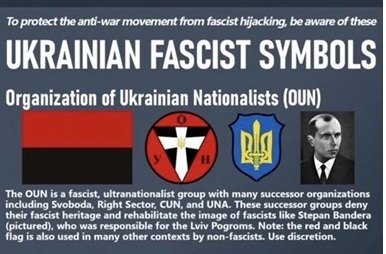
Marta describes her childhood, and education in Ukraine. She learned at school the history of Soviet Russia’s oppression of Ukrainians, and of the heroic freedom fighters who resisted the Russians:
“I was was raised on this nationalistic myth about glorious fighters, members of the Ukraine underground movement the Ukrainian Insurgent Army (UPA) and the organisation of Ukraine nationalists. We learned all these patriotic songs. Our family gatherings involved histories about Soviet repressions and actually, the house that my parents built was on the territory on the land that was seized by Soviets in 1939. Some of my family were involved on the ground in the Ukrainian nationalist movement and they were oppressed. Some of them were booted in prison and some of them were sent to Siberia. So I was raised in this highly nationalistic environment.
When I became a student at Lviv National University actually I met almost the same atmosphere. Lviv is a very nationalistic city with the biggest monument to Stepan Bandera (leader of the UPA). My home was close to Bandera street, and many streets had these partisan names.”

Marta explains how the memories of wartime events have now become confused, enmeshed into present day views and anti-Russian fervour.
“After 2014 this very western Ukraine nationalistic historical myth started to move eastward. After 2022 it became really the national myth promoted on the very national level. That’s why for example under President Zelensky we nowadays have streets named Bandera and Shukhevych (another UPA leader) in Kirik, home town of our president Zelensky.
This myth is cultivated in Ukraine in war time. Another dimension of this very troubling development in is that Nazi apologism is flourishing because many members of the Ukraine nationalists on the ground during the second world war were members of auxiliary police under German occupation and some of them occupied chief positions, so they were not just ordinary rank and file policemen – they were chiefs of police. Vasyl Levkovych, for example, is a very glorious figure in this nationalist pantheon. Those people nowadays are celebrated as freedom fighters and their direct participation in the holocaust is obscured, is marginalised and silenced and even denied.
At the holocaust memorial I was really shocked. I saw these fancy souvenir magazines with Daddy Bandera socks and Daddy Bandera bags. In one day I spent almost three hours in the city center and I saw an amount of different hate symbols like SS bolts, like black sun like Nazi eagles, like swastikas. I never saw in my life. in Western Europe, this concentration of these Nazi hate symbols. and the amount of different hate symbols – SS bolts, black sun, Nazi eagle, different combinations of swastikas. In Ukraine it’s so normalised – why? Because it’s a part of military culture nowadays. Those symbols are adopted primarily by military actors and by soldiers. The trust in Ukraine military is so high in Ukraine society – approximately more than 90% of Ukrainians nowadays trust Ukraine military. That’s why they just accept this.
Ukraine military nowadays is full of different far right groups. They are sponsored and they are celebrated as freedom fighters. In the Ukraine military we have overt Nazi apologists. For example we have the Niga named after the Nachtigall Battalion formed by the Germans and this battalion participated in the Nazi Barbarossa plan against Russia in 1941. From the documents of some participants of this unit we know that they participated in anti-Jewish pogroms.
Especially after 2022 so many neo-Nazis and far right groups neo-Nazis and far right groups were empowered and they openly promote their agenda. They openly celebrate Nazi units. Why? Because their ideology is.” Those guys are lesser evil because they fought our eternal enemy, meaning Russia. And they compare themselves with Nazis.So it’s not only Putin who compares them with Nazis, but that they themselves compare themselves with Nazis, and it’s ridiculous, it’s just crazy.”

Marta explains “memory politics” as a strategy, a weapon of war:
Those who are against military mobilisation are not a minority any more, Those who want to have peace with Russia, those who want to build a relationship with Russia on good terms, who don’t want to be engaged in eternal war with Russia, they are “bad Ukrainians” – you need to view Russia as the eternal enemy. For our children, this means only permanent war. With the anti-Russian project and narrative we will be in constant war with the superior angry and very powerful aggressor., in constant destruction.
We don’t want to spend our lives, sacrificing our life for what? – for our political elites. Ukraine is now a colonial client of the West, The West is deciding what money will go where, what laws will be adopted. In our fight against the Russian imperial state we are becoming a colony of Western imperialism. No-one is talking about this, because it’s a “good” empire.
We still have enormous casualties, and those casualties are hidden.
Memory politics is the main issue. They make movies etc about Russian atrocities but never about Ukrainian atrocities. Ukraine killed Ukrainian students in occupied Donbass, in Spring 2022. It was painful to see how many people denied it, and then justified it, blaming those students for “collaboration with Russia,” some were trying to present this as collateral damage.
The state is pouring so much money into commemorating this war. It’s about producing, inflicting emotions. First of all it’s always in both Ukrainian and English language, It’s for Western audiences, to inflict emotion, to inflict empathy, to present Ukraine as poor victim, to present a black and white picture when Ukraine is of course presented as the forces of good, and Russia as the forces of evil. Nothing of course about what happened to the people of Donbass in 2014, 2015, 2016 – always about guilt of Russia, bad Russia, crazy Putin, imperialism in Russian blood, and angels Ukraine.
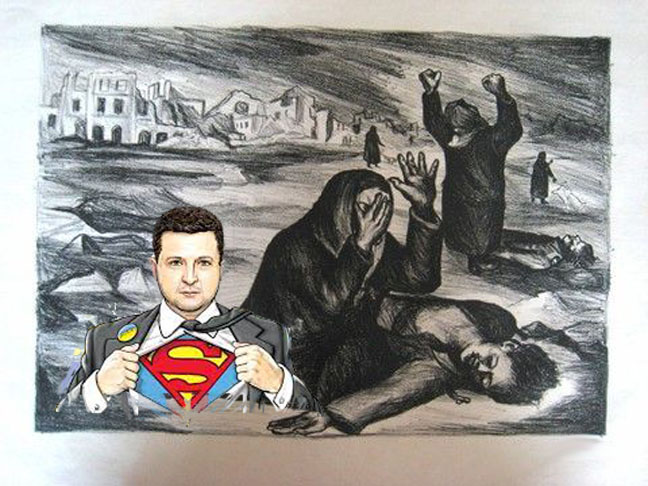
So memory politics is a part of Ukraine war propaganda. Many intellectuals are engaged in this propaganda, and many receive grants from abroad. And it supports the Western agenda: Many many Western people – who discovered Ukraine only in February 2022 – see Ukraine as this angel, who was unjustifiably attacked, and is bleeding, and needs support to continue resistance. Nobody is asking those people kidnapped in the vans. Nobody asking those women, their sisters, their mothers, their wives – “Do they want to fight, to be sent to the meat-grinder against their will?” This myth of resilience, of this nation, who would rather die than live under Russian occupation. But this myth is produced by Zelensky propaganda. I must admit they’re doing a very good job in this, because Zelensky is very good at entertainment – it’s his profession.
This Is Why Trump Was Necessary
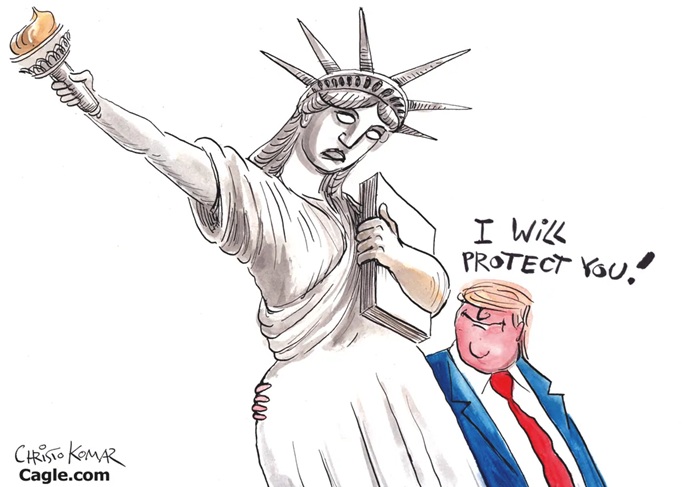
it is entirely conceivable that Israel, just like South Africa, will be globally ostracised and abandoned.
Trump was necessary. Necessary to strip away the niceties and reveal the true face of empire, to reveal its naked impunity, to showcase the war crimes in all their immoral bloodlust.
Nate Bear, Jun 19, 2026, https://www.donotpanic.news/p/this-is-why-trump-was-necessary
Iran has forced the US into one of the biggest strategic defeats in its short, violent and bloody history.
The memorandum of understanding with Iran, signed (symbolically or not), at Versailles yesterday, signalled, as I wrote earlier this week, that we’re witnessing the collapse of American hard power.
After it was signed, Trump made some extraordinary comments that wouldn’t have looked out of place in the handbook of anti-imperial critique, including that it’s not fair to tell Iran it can’t have missiles if all it’s neighbours have them and that it’s “common sense” that the country should be able to enrich uranium for energy. Trump also admitted oil reserves were running out and the world was approaching a depression, which slays the idea (an idea I never bought), that the US attack was a genius move to control the world’s oil and gas.
Iran has suffered some serious damage to its infrastructure as well as burying over 3,000 civilians, but it has checkmated the US strategically. And Trump has had to accept that. Iran’s ability to hit key regional infrastructure from deeply-buried missile cities, along with its ability to control the Strait, won the day. The US also appears to be reluctantly accepting some other realities. A few hours after the MoU was signed, after it was put to him that Israel wasn’t happy with the tentative deal, JD Vance said that Israel “is a country of nine million people that can’t just kill its way out of every national security problem.”
They read the polls, they see the way the wind is blowing, and they’re moving with it.
Israel of course is still a vital strategic outpost for empire, and it will not be abandoned yet. But there is absolutely a future in which the value of Israel to empire becomes less useful than the economic value empire can gain from a wider peace in the region, even if that peace runs counter to Israeli interests. And if Israel, not Iran or the resistance, comes to be seen as the main obstacle to this future, a position Trump and Vance appear to be moving towards, it is entirely conceivable that Israel, just like South Africa, will be globally ostracised and abandoned.
If this were to happen, the range of outcomes is extremely broad. Tensions between orthodox and secular Jews are already high in Israel, and you could reasonably argue that under conditions of global abandonment, civil war would break out. Before or after such a war, you might get a government run by Ben-Gvir and Jewish end-times fanatics who decide to fight the world and trigger a nuclear holocaust. Or the fanatics might lose, and you get a government which enters into international negotiations towards one state with equal rights for all. A former prime minister of Israel has, after all, just labelled Israeli actions in the West Bank ethnic cleansing.
I think we’re a long way from Israel ever giving up its colonial privileges. Civil war is a lot more likely than the negotiated end of the state, but we’re certainly a big step closer than we’ve ever been to whatever comes next for the genocidal colonial outpost.
Maybe this all seems too optimistic to you. And I hate to blow my own trumpet. But I was among the minority who predicted the start of the war before it started, who said Iran wouldn’t lose, that there’d be no regime change and no US victory via an air war was possible. When the ceasefire was announced I was among even fewer who said it would hold because the US was out of real options, while the consensus anti-imperial opinion said it was a ruse to buy time for a land invasion or other escalation.
And now, despite the calling off of talks in Geneva over the next stage of the process, my prediction, for what it’s worth, is that this won’t mean a return to war, and that in fact it will further the process of US-Israel estrangement, with Trump and Vance likely to see it as further confirmation that Israel, not Iran, is the impediment to peace.
Which is all to say, Trump was a necessary evil.
Of course we’ll never know if a Democrat as president would have launched an attack on Iran, but it would have come eventually. And given that an attack on Iran was inevitable, it was the best case scenario that it happened under Trump, an ideologically drifting narcissist without any real loyalties or attachments. A man motivated to protect his own personal financial interests above anything else (a number of which sit within the range of Iranian missiles). A man who was always going to be outmanoeuvred by a country led, literally, by men and women with PhDs, by philosophers, mystics and engineers. There were reports that in the process of negotiations, Iran drafted in the country’s top psychologists to craft messages to appeal to Trump’s ego and vainglorious personality. It appears to have worked.
From only ever acting retaliatorily, from closing the Strait of Hormuz to striking American bases and the oil and gas infrastructure of US proxies, to employing psychologists to sweet talk a narcissist, Iran bossed the process from day one.
And Israel knows it.
Its attacks on Lebanon are a final attempt to derail the process and regain some leverage over the negotiations. I don’t think it’ll work. We’re too far down the track. The Strait opens, the oil and gas starts flowing, or, with oil reserves at critical levels, we’re looking at a global depression. And Trump now appears motivated to avoid that, not least to protect his own wealth, above and beyond the objections of Israel. I don’t believe, as many still do, that the MoU, Trump’s comments and Vance’s criticisms of Israel, are all part of some drawn out psy-op before another attack on Iran.
This isn’t to give Trump any credit. It’s just to say empire isn’t omnipotent or strategically untouchable. You can, with the right war strategy, alongside favourable geography and propitious timing, force it to make concessions it doesn’t want to make.
Trump was necessary. Necessary to strip away the niceties and reveal the true face of empire, to reveal its naked impunity, to showcase the war crimes in all their immoral bloodlust. Yes, from Vietnam to Iraq to the so-called War on Terror, what Trump has shown us is nothing new, but through careful stage-management and competent administration, the myth of benign American empire has managed to endure. I’m not sure that myth will survive Trump. He’s also been necessary to reveal the limits of empire, to show it can be beaten, to expose its vulnerabilities, to detail its weaknesses.
Iran should have tied Gaza more closely to the MoU, as it has with Lebanon, but it has delivered a valuable blueprint in how to fight empire.
Trump has also been necessary to expose the plastic progressives, the liberal anti-Trump imperialists who, in their opposition to Trump’s deal with Iran, can only look like warmongering imperial psychopaths. From all those sharing memes on social media about surrender, from the Democrats and CNN talking heads decrying the deal, to Jimmy Fallon dragging Trump for giving Iran back the money the US stole, there is no articulation of an alternative to endlessly bombing Iran. There’s no anger from liberals over dead Iranians, or at the imperial state, at Zionism or the embedded death machinery that made this violence possible. No, they’re just embarrassed for empire. And they don’t want to recognise the limits of that empire.
With Israel still bombing Lebanon and oil reserves at critical thresholds, however, this is all far from over.
Iran has sketched out two futures for the US and it now has a decision to make: stand behind the deal which Trump has loudly proclaimed as necessary to save the world, and force Israel to stand down, or let Israel dictate the process, return to war and drag the world into an economic depression. Anything is still possible, of course, but I judge the latter extremely unlikely.
And Trump, in his egotism, venality and conceited self-interest, might just be the man for the moment.
What I do know is that those Iranian psychologists have some more work to do.
Switzerland heading towards referendum on construction of new nuclear plants
Euro News, By Gavin Blackburn, 18/06/2026
“…… Switzerland’s parliament approved a divisive government plan to build new nuclear power stations on Thursday, overturning a 2018 ban and putting the country on course for a referendum.
The lower house of parliament joined the upper chamber in backing a government proposal to reverse the ban put in place following a referendum won by anti-nuclear campaigners in 2017.
… Both houses say authorisation for new nuclear plants can only be granted if the financing is secured.
A broad coalition of groups “will launch a referendum,” the Green Party said in a statement.
Greens president Lisa Mazzone said the parliament vote “sabotages the rapid development of renewable energies, climate protection and our energy sovereignty.”
The collection of signatures for a referendum would begin this month, the party said.
To trigger a referendum under Switzerland’s direct democracy system, 50,000 valid signatures must be collected within 100 days of publication of a new law, a hurdle the coalition is expected to clear.
………….The Swiss approved the gradual phase-out of nuclear power in the 2017 referendum, banning the construction of new power plants.
That law was the result of a long process initiated after the 2011 Fukushima nuclear accident in Japan, which was triggered by a tsunami.
Switzerland continues to operate four nuclear reactors whose construction dates back to the 20th century.
Beznau 1, commissioned in 1969, is the oldest functioning nuclear reactor in Europe. It will cease operations in 2033, while Beznau 2, connected to the grid since 1971, will close a year earlier, in 2032.
Gosgen and Leibstadt began operating in 1979 and 1984, respectively. https://www.euronews.com/my-europe/2026/06/18/switzerland-heading-towards-referendum-on-construction-of-new-nuclear-plants
A flurry of nuclear developments in Sweden—state aid, SMR selections, legislation
Nuclear Newswire 18th June 2026
Within the span of two weeks, three Swedish companies—Blykalla, Studsvik, and Nordic Baseload Power—submitted applications to their country’s government for state aid for their respective new nuclear builds. Applications are handled by Sweden’s Ministry of Finance.
n early June, SMR developer Blykalla submitted its application to the Swedish government, followed by engineering services firm Studsvik on June 12. And on June 16, energy company Nordic Baseload Power became the latest to apply for financial support. Overall, the Swedish government has received four applications for state aid since last year.
In its efforts to spur nuclear power growth, the Swedish government last summer allowed companies to apply for financial aid in the form of government loans or two-way contracts. Under two-way contracts, the power plant operator and government agree on a deal that ensures a “minimum level of compensation protection by central government and setting an overcompensation cap for the company.” State aid is limited, however, for new nuclear power installed capacity of up to 5,000 MW.
Swedish officials welcomed the interest the state aid offer is receiving from companies…………………………………………………………………
Other Swedish news: The Riksdag, Sweden’s national parliament, has also weighed in on nuclear legislation this month. On June 11, lawmakers approved permitting legislation that streamlines the framework for extracting and processing uranium and other nuclear materials.
“A key aspect of the legislation is that the extraction and processing of uranium will now be treated in a manner consistent with other metals and minerals within Sweden’s overall permitting framework,” according to an announcement from District Metals, a Canada-based company with Swedish operations that welcomed the legislation.
“The amendments remove the requirement for a separate admissibility assessment under the Environmental Code and eliminate the requirement for municipal council consent for uranium extraction and processing projects, commonly referred to as the municipal veto,” the company stated.
In addition to the uranium regulatory legislation, the Riksdag also approved amendments that lifted bans on nuclear facilities in certain coastal areas and archipelagos. According to the Riksdag, these bans will be lifted on July 15. https://www.ans.org/news/2026-06-18/article-8133/new-sweden-developments/
Rachel Gilmour MP accuses Hinkley Point C of “bullying”
By Alex Parnham-Cope, 17 June 26, https://www.bridgwatermercury.co.uk/news/26203304.rachel-gilmour-mp-accuses-hinkley-point-c-bullying/
A Somerset MP has accused Hinkley Point C of having a “bullying culture”, a lack of community engagement and “naïve” financial planning while questioning other nuclear industry leaders in parliament this month.
Tiverton and Minehead MP Rachel Gilmour made the comments as part of the Public Accounts Committee’s oral evidence session with industry leaders and government officials bosses on June 8.
The Liberal Democrat representative has since reshared video on social media of her comments in the committee earlier this week, June 15, and said that she’s met with EDF Europe’s chief executive and the nuclear regulator to raise her concerns.
In the oral evidence session, Rachel Gilmour MP claimed she was “inundated with whistleblowers and people who have great concerns about the bullying culture at Hinkley C, to such an extent that I had a meeting with Simone Rossi, the chief executive of EDF Europe, and the ONR [Office for Nuclear Regulation].”
She added: “The ONR felt that the situation was so bad that they had to put in extra scrutiny. I was joined by Whistleblowers UK in that.”
Senate wants to force US to share sensitive intel with Israel

A measure in a must-pass bill would dramatically increase Israeli access to American secrets
Paul R. Pillar, Responsible Statecraft, Jun 10, 2026
Buried deep inside a 192-page intelligence authorization bill is Section 622, titled “United States-Israel Intelligence Sharing Enhancement.” It would require the president, acting through the director of national intelligence and as necessary the secretary of defense, to “expand and enhance intelligence sharing with the Government of Israel” on a list of subjects that encompasses almost every topic of intelligence interest in the Middle East.
The bill, put forward by Sen. Tom Cotton (R-Ark.), the chairman of the Senate Intelligence Committee, would prohibit any suspension, reduction, or limitation of such sharing “except on the basis of a specific and identifiable national security concern determined by the President.” Any such exception would require a report to Congress within fifteen days detailing not only the reason for the change but also the categories of information involved. The same report would require an assessment of the anticipated impact on regional security and various other matters.
This proposal is one of several recent moves by those in Washington who carry the Israeli government’s water to keep the United States tied to Israel despite plummeting support for the country among the American public. The most salient form of U.S. support to Israel has been more than $300 billion in economic and especially military assistance. Israeli Prime Minister Benjamin Netanyahu has tried to get ahead of the declining public support and avoid embarrassing losses by suggesting it would be fine with him to phase out the military aid.
Israel’s strategy and that of its U.S. supporters is now to rely on ties with, and support from, the United States that are not as salient as the military aid with its prominent price tag. The strategy includes forms of military integration that are less visible than congressionally appropriated grant aid and therefore less publicly accountable. Section 224 of a defense authorization bill currently in the House of Representatives embodies this form of integration.
The mandating of intelligence sharing carries this strategy further by moving it into the shadowy world of relations between intelligence agencies. That world is even farther removed from public visibility and accountability than the defense integration, and even less likely to stimulate thoughts about American taxpayers’ money going to a foreign country. So far, Section 622 of the intelligence bill has received less attention than Section 224 of the defense bill.
The notion of legislating an intelligence liaison relationship in this way, with any foreign country, is bizarre……………………………………………………………………………………………………………………………………………………………………………….
The current ill-advised war with Iran demonstrates the sharp divergence of U.S. and Israeli interests. After being the principal influence on President Donald Trump’s decision to launch the war, Netanyahu’s government has been sabotaging efforts to end it.
It currently is doing so mainly with relentless attacks in Lebanon that have killed thousands and displaced over a million people. The divergence of objectives was reflected in an expletive-laden phone call last week between Trump and Netanyahu that was mainly about those attacks.
Attacks that sabotage diplomacy are among the Israeli operations that might use shared U.S. intelligence. The United States also will be blamed for aiding other violent Israeli operations because of the “enhanced” intelligence sharing, even if it were no longer paying for Israeli arms.
The supposed escape clause in Section 622 of the intelligence bill would in practice be so cumbersome as to be useless. The required report to Congress would dump the issue on Capitol Hill, where the Israel lobby would quickly depict it as a question of being for or against the security of Israel. The mandated intelligence sharing in the bill thus would tie the president’s hands and prevent any administration from using management of the intelligence liaison relationship as leverage to deter destructive conduct by Israel. https://responsiblestatecraft.org/us-intelligence-israel/
Most Israelis oppose Netanyahu’s re-election as Trump says PM ‘may quit politics’
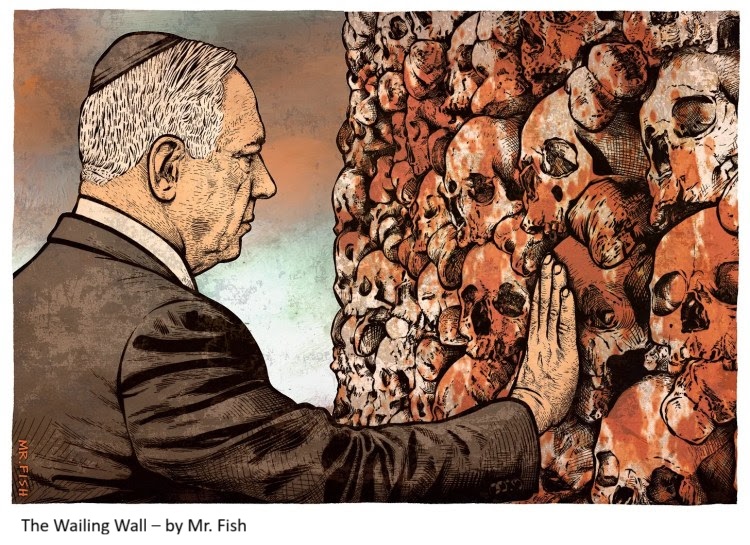
Trump continues to call the premier a ‘wartime prime minister’ as Netanyahu faces ongoing internal opposition and a long-delayed corruption trial
News Desk, JUN 10, 2026, https://thecradle.co/articles/most-israelis-oppose-netanyahus-re-election-as-trump-says-pm-may-quit-politics
A poll published by an Israeli research center on 9 June has revealed that most Israelis do not want Prime Minister Benjamin Netanyahu to run in the upcoming election.
The poll was released by the Viterbi Center for Public Opinion and Policy Research at the Israel Democracy Institute, based in occupied Jerusalem.
It was conducted between 31 May and 5 June.
According to the results, 61 percent of Israelis believe Netanyahu should not run in the elections. Thirty-five percent were in favor of the premier running.
The number of Israeli Jews who are opposed to his running stood at 57 percent, while 39.5 percent of Jewish Israelis believe he should run.
Among the Palestinians with Israeli citizenship living in the territories ethnically cleansed during the 1948 Nakba, 83 percent are against Netanyahu running in the election, according to the poll.
Eleven percent of Palestinians with Israeli citizenship support his candidacy, the poll added. A recent poll revealed a significant deterioration in the global reputation of Netanyahu and Israel.
The survey was published amid growing uncertainty over Netanyahu’s political future following comments by US President Donald Trump, who claimed the premier may want to step back from politics.
Trump told ABC News on Tuesday that he was unsure “if Bibi even wants to continue.”
“I don’t know, he’s had an amazing career. Does he want to continue? Because, you know, he’s a wartime prime minister. We will very shortly win the war one way or the other, and you know he’s a wartime prime minister,” Trump added.
Likud has since responded, saying that Netanyahu will run in the upcoming election.
Netanyahu is mired in a years-long criminal trial over corruption and other scandals. The trial has seen near-constant delays.
The prime minister has also failed to resolve the Haredi draft crisis plaguing Israel, with ultra-Orthodox Jews (Haredim) still avoiding conscription and opposition parties criticizing the ruling coalition for placing secular reservists at the forefront of the conflict.
Israeli army leadership has warned of a collapse in the reserve forces, and troops are taking heavy losses in battles against Hezbollah in south Lebanon.
Since Netanyahu’s government came to power in late 2022, illegal West Bank settlements and annexation plans have expanded dramatically, and a genocide in Gaza has taken place.
Tel Aviv has also continued to wage brutal wars on multiple fronts, including Lebanon and Iran.
The draft crisis and other long-standing issues between Netanyahu and the opposition have prompted former premiers Naftali Bennet and Yair Lapid to merge parties in a bid to challenge the prime minister politically.
ROSATOM report
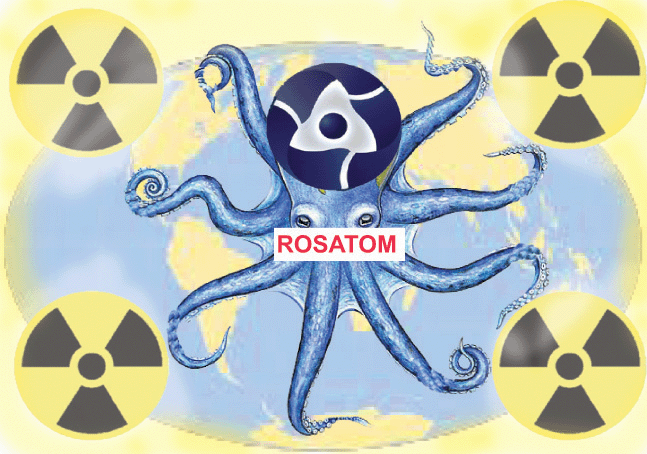
Russia’s full-scale war against Ukraine has profoundly altered the
political and strategic environment in which the Russian state nuclear
corporation Rosatom operates. Not only has the war intensified scrutiny of
the corporation’s role in nuclear safety, energy security, and
international governance, but it has also highlighted the extent to which
Rosatom functions today at the intersection of technology, state policy,
and geopolitical influence.
In this report, we at Bellona continue to
analyze Rosatom during wartime. We argue that Rosatom can no longer be
understood solely through the traditional framework of a civilian nuclear
operator or global technology supplier. Rather, it has increasingly emerged
as a multifunctional state instrument—combining industrial, strategic,
and political roles both within Russia and internationally.
Several broader
conclusions emerge from the report: Rosatom’s wartime role has deepened
institutionally and politically, reinforcing its function not only as a
nuclear corporation, but as a strategic component of Russian state policy;
The occupation of the Zaporizhzhia NPP represents a challenge to
established assumptions in nuclear governance, exposing gaps in
international mechanisms designed to respond to conflict involving nuclear
infrastructure; Despite sanctions pressure and geopolitical disruption,
Rosatom has maintained significant external reach, particularly through
long-term projects in the Global South and through forms of nuclear
diplomacy that remain politically resilient.
Bellona 11th June 2026, https://network.bellona.org/content/uploads/sites/4/2026/06/ROSATOM_report_2026_ENG.pdf
Chas Freeman: The Greater Israel Project Is Collapsing Under the Weight of Endless War
the greatest threat to the Greater Israel project may not be Iran, Hezbollah, or any external adversary. It may be the political consequences of the project itself.
JSCHEERPOST, June 7, 2026 ScheerPost Staff
For decades, the dream of a “Greater Israel” has been treated by its advocates as an inevitable project of regional dominance, sustained by military superiority and unwavering support from Washington. But according to former U.S. Ambassador Chas Freeman, that project may now be colliding with the limits of power itself. In a wide-ranging conversation with political scientist Glenn Diesen, Freeman argues that Israel’s wars in Gaza, Lebanon, Syria and Iran have not strengthened its strategic position but instead accelerated its diplomatic isolation, strained its military capacity and eroded the international support on which its ambitions depend.
Freeman’s assessment is stark: what was once presented as a vision of security has produced growing insecurity across the region, while leaving Israel increasingly at odds with allies, neighbors and much of the world. From the collapse of diplomacy to the widening regional fallout of war, he contends that the greatest threat facing the project of expansion may no longer be external resistance alone, but the political and moral consequences of its own actions. Whether one agrees with his conclusions or not, Freeman offers a sobering warning that the Middle East is entering a new phase—one in which old assumptions about power, alliances and American influence are rapidly unraveling.
Chas Freeman: The Greater Israel Project Is Collapsing
Decades of Expansion Have Reached a Breaking Point
For generations, advocates of a “Greater Israel” envisioned a regional order secured through overwhelming military power, territorial expansion, and unwavering American support. Today, according to former U.S. Ambassador Chas Freeman, that vision is colliding with reality.
In a wide-ranging discussion with political scientist Glenn Diesen, Freeman argued that Israel’s military campaigns across Gaza, Lebanon, Syria and Iran have not delivered lasting security. Instead, they have accelerated Israel’s diplomatic isolation, exhausted military resources, and triggered a regional backlash that is reshaping the Middle East.
His conclusion was striking: the greatest threat to the Greater Israel project may not be Iran, Hezbollah, or any external adversary. It may be the political consequences of the project itself.
A Project Losing International Support
Freeman argues that what was once quietly tolerated by Western governments is becoming increasingly difficult to defend.
The devastation in Gaza, the continued expansion of settlements in the occupied territories, military operations in Lebanon and Syria, and the widening regional conflict have dramatically altered global perceptions.
“Israel is at odds with the entire world,” Freeman observed, pointing to growing criticism across Europe, increasing public opposition in the United States, and mounting international scrutiny of Israeli policies.
For decades, Israel relied heavily on diplomatic cover from Washington and its Western allies. Freeman believes that support is eroding faster than many policymakers realize.
The result is a paradox: at the very moment Israel seeks greater regional dominance, it finds itself increasingly isolated.
Security Through Dominance Creates Insecurity for Everyone Else
One of the most important insights from the interview was Freeman’s discussion of what he described as Israel’s pursuit of “absolute security.”
The logic is simple but dangerous.
If one state seeks complete military dominance over all potential rivals, neighboring states inevitably become less secure. Those neighbors then seek new alliances, new military capabilities, and new forms of resistance.
The result is not peace but perpetual conflict.
Freeman echoed a principle often associated with Henry Kissinger: one nation’s quest for total security often creates total insecurity for everyone around it.
This dynamic helps explain why Israeli military operations have increasingly produced regional resistance rather than regional acceptance.
The Iran War Changed the Strategic Landscape…………………………………….
A New Regional Order Is Emerging
Perhaps the most overlooked portion of Freeman’s analysis concerns the changing geopolitical landscape beyond Israel itself.
He described an emerging regional architecture involving countries such as Saudi Arabia, Turkey, Egypt, Pakistan, and Iran……………………………………………………………..
Netanyahu Is Not the Cause—He Is the Symptom
One of Freeman’s most provocative observations concerned Israeli Prime Minister Benjamin Netanyahu.
Many critics view Netanyahu as the central architect of Israel’s current trajectory. Freeman disagrees.
Netanyahu, he argued, is not the cause of the crisis but its most visible expression.
The deeper issue is the broad political consensus that has developed around militarized solutions and territorial expansion.
Even if Netanyahu leaves power, many of the underlying assumptions driving Israeli policy would remain.
Removing one leader does not automatically change the direction of a state.
The Failure of Diplomacy
Throughout the discussion, Freeman repeatedly returned to one theme: diplomacy has been abandoned.
Israel, he noted, has relied overwhelmingly on military solutions while offering few meaningful political initiatives capable of resolving regional conflicts.
At the same time, Washington’s credibility as a mediator has steadily deteriorated…………………………………….
A Moment of Reckoning
The interview ultimately posed a larger question than the future of Israel alone.
Can any state maintain security indefinitely through military force while ignoring political reconciliation?
Freeman’s answer is clear.
History suggests otherwise……………………………………………
Whether one agrees with his conclusions or not, his warning deserves attention: the future of the Middle East may be determined less by battlefield victories than by the willingness—or inability—of regional powers to replace domination with diplomacy.
If that transformation does not occur, the conflicts now engulfing Gaza, Lebanon, Iran, and the wider region may prove not to be the culmination of a long struggle, but merely the beginning of a far larger one.
Chas Freeman’s substack: https://substack.com/@chasfreeman662157 Books by Prof. Glenn Diesen: https://www.amazon.com/stores/author/… Follow Prof. Glenn Diesen: Substack: https://glenndiesen.substack.com/ X/Twitter: https://x.com/Glenn_Diesen Patreon: / glenndiesen
Trump’s Sedition Act for Israel
“you can’t be an American if you don’t love Israel.”
By Dr. Paul Craig Roberts, Global Research, May 25, 2026, https://www.globalresearch.ca/trump-sedition-act-israel/5927389
At all times and places it has been difficult to speak freely.
Even the founding fathers had their Sedition Act of 1798 that criminalized statements against the US government. Shortly afterward President Thomas Jefferson got most of it repealed.
President Abraham Lincoln during his 1861-1865 invasion of the Confederate States of America had a de facto sedition act. Lincoln used executive orders, military directives, martial law, and the suspension of habeas corpus to shut down free speech. At one time Lincoln had 300 Northern newspaper editors in prison.
In 1918, Congress passed a new Sedition Act that applied when the US government was at war. The law prohibited speech and opinion that put the US government and its war effort in a bad light. The bad light was that US President Woodrow Wilson promised Germany no territorial loss and no reparations in exchange for an armistice, and betrayed the promise. The result was the Treaty of Versailles that as British economist John Maynard Keynes correctly predicted led to World War II.
President Donald Trump has declared his own Sedition Act issued not by Congress, increasingly an irrelevant government institution, but by Trump’s personal defense lawyer currently serving as US Attorney General. Trump’s Sedition Act is unique. It protects from criticism not the US government, but a foreign one — Israel. The May 19 press release of the US Department of Justice (sic) says:
“President Trump has made clear that this administration will not tolerate antisemitism, and the Department of justice is committed to implementing that directive.” (See this)
Understand that the US Department of Justice is now the protector of Israel, as is the US military and US taxpayers, and antisemitism means any criticism of Israel. For example, Israel’s genocide of Palestine and its people, Israel’s interference in tenure decisions of US universities, the hiring and contracting policies of state governments such as Texas and Florida, Israel’s funding of the primary defeat of US Republican Representative Thomas Massie, Israel’s assassinations of foreign leaders, Israel’s suspected assassination of Charlie Kirk, suspicion that Epstein was a Mossad agent collecting blackmail information against Americans in a position to influence US foreign party in the Middle East, and on and on. Every thought, question, statement of fact that can be interpreted as hostile to Israel has become anti-semitism and will not be tolerated by the US Department of Justice (sic).
Clearly, the Trump regime, essentially a Zionist regime, has no intention of permitting any correct information to be aired. If you challenge or taunt the Regime, you are shut down like Colbert, Thomas Massie, Marjorie Taylor Greene, and so many others.
The Washington Post published an article on May 21 about President Trump’s efforts to silence late night TV hosts. Apparently, Trump succeeded in intimidating CBS to cancel Stephen Colbert. NBC’s Seth Meyers and ABC’s Jimmy Kimmel believe they are on the hit list. See this.
A discredited media unable to hold Trump to account has replaced a former biased media.
During my professional lifetime the print and TV media had a liberal bias, coming down hard on conservatives and Republicans and lightly, if at all, on the leftwing and Democrats. The liberal media was more or less at the beck and call of the CIA, but the New York Times did finally decide to publish the leaked Pentagon Papers, an act that contributed to the end of the Vietnam War.
During the 1980s and I think the 1990s the New York Times asked me twice a year for an op-ed article addressing a specified subject. If memory serves, two was the annual limit for outside contributors, although perhaps not for liberal-left ones. As I had been a presidential appointee in the Reagan administration, a trustee of the Committee on the Present Danger, a Wall Street Journal editor and columnist, and a contributing editor of National Review, the liberal media regarded me as a conservative instead of a person who thought for himself.
The Washington Post was also friendly in a limited way. The Post’s editorial page editor was pleased to occasionally have me on her page and once took me to lunch with some of her colleagues. When at the end of the 20th century I could no longer stomach the corruption and backstabbing of the Washington snake pit and departed to the beach in Florida, the Washington Post sent a star reporter and camera team to my Florida home for a full-fledged interview and expressed regret that an honest voice had forsaken the nation’s capital. The fact that the Washington Post thought that I was honest did not mean that the Post thought I was correct.
In those days large newspapers like the Times and Post comfortably existed on advertising revenues so varied that no advertiser could, very often, influence the newspaper. Media had a liberal bias, but that was their own decision. It wasn’t imposed on them. Unlike today, there was enough belief left in the media in debate in place of silencing critics, resulting in occasional presentation of alternative explanations to the official narratives.
In the 21st century the media for whatever reasons has become censorious, demonizing those in opposition to official narratives. The result has been to discredit the media as a source of information.
Today we don’t have, as existed in my 25 years in Washington, a media even partially open to different explanations.
With the traditional TV and print media discredited, and the lack of transparency of most of the Internet media, to whom do we turn for credible explanations? My own attempts to deliver truth are compromised by invalid accusations against me by Zionist organizations, the political left, and liberals who still believe that more government is the answer. The assaults on me are intended to limit my readership, and the assaults have had a partial success. I suspect that I am now read more abroad than in the United States.
Perhaps I have failed in my approach to insouciant Americans who, despite the high stakes, are unaware of the demands on them of our time. If so, my failure is small compared to that of the media, which by destroying its own credibility, has destroyed the media’s checkmate on the rise of a Caesar.
America now has a president who goes to war at the request of his most important campaign contributors without authorization of the US Congress as long as the request is in Israel’s behalf. The legal advisor to the US Department of State, Reed Rubinstein, has penned a justification for Trump’s military attack on Iran which states the United States initiated its military campaign against Iran (Operation Epic Fury) “at the request of and in the collective self-defense of its Israeli ally”. Note that the State Department defines aggression as self-defense. Clearly Under President Trump, the United States of America now commits its resources and lives of its military personnel to the achievement of the Zionist agenda of Greater Israel. Americans are now taxed and die for Israel’s domination of the Middle East. If you dissent, you are punished as an “anti-semite.”
Until the 21std century, I cannot imagine the American media allowing this to happen. The digital revolution by putting the power of money over the media in a few hands has cancelled even a biased free press. In its place there is a propaganda ministry.
President Trump’s anti-semitism policy cancels the First Amendment if it is used by Americans for criticism of Israeli government policies, such as the genocide in Palestine.
When the Israel Lobby can cancel the First Amendment, you know that the United States is no longer a sovereign country.
A country at Israel’s beck and call is America today, thanks to Donald Trump. Yet, a significant percentage of Trump’s supporters conflates MAGA with MIGA. American patriotism now requires patriotism to Israel. As the latest mantra goes, “you can’t be an American if you don’t love Israel.” You have to hand it to the Zionists. They have even stolen our patriotism.
Fusing the US Military and the IDF

A bill’s provision to integrate the U.S. and Israeli militaries will go to a U.S. House vote after an effort to stop it failed Thursday. Passage will make it nearly impossible to end the U.S.-Israel special relationship, writes Alan MacLeod.
Alan MacLeod for MintPress News, June 6, 2026, https://scheerpost.com/2026/06/06/fusing-the-us-military-and-the-idf/
Amid widespread and growing public opposition to the Israeli genocide of Gaza and South Lebanon, a controversial new bill seeks to formally integrate the U.S. and Israeli militaries like never before, making it difficult to tell where one ends and the other begins.
Section 224 of the 2027 National Defense Authorization Act (NDAA) proposes to join the two forces together at the hip, laying the groundwork for extensive cooperation into “seemingly every manner of U.S.-Israeli military-industrial complex cooperation,” according to the Institute for Responsible Statecraft.
This includes the research, development and production of modern, hi-tech arms, artificial intelligence, biotechnology, drones, directed energy, cyber and autonomous weapons systems. It would compel the United States to integrate Israeli arms and technologies into its defense supply chain, and fuse the countries’ data-capturing and storage facilities together, meaning that Israel could have access to essentially all the U.S. military’s data.
The bill also requires the creation of a new position within the Department of Defense: an executive agent whose role is to coordinate cooperation and integration between the two parties.
In essence, then, it would dramatically change the relationship between the two states, from one where Washington supplies Tel Aviv with money, weapons, and diplomatic support, to a situation where the two are fundamentally intertwined.
It would also make the relationship far less transparent, as aid to Israel currently requires an annual public debate and vote. However, by moving it away from the political realm into that of defense acquisition, oversight and accountability mechanisms will be removed, and the public will have little right to know the details going forward.
Judging by its sponsors, Section 224 has strong support on Capitol Hill. It was put forward by Mike Rogers (R-AL), chairman of the House Armed Services Committee, and Adam Smith (D-WA), the panel’s highest-ranking Democrat.
[On Thursday Rep. Ro Khanna’s effort to revoke the provision from the massive military funding bill failed, paving the way for the NDAA to advance to a full House vote.]
The news that a new bill could essentially fuse together the U.S. and Israeli militaries has been met with pushback online, but provoked little comment in Washington, D.C.
One lawmaker who has spoken up is Kentucky Congressman Thomas Massie, who has promised to offer an amendment to strip Section 224 from the bill on the House floor. “We are a sovereign country,” he said on Saturday.
Massie, a strong critic of U.S. support for Israel, recently lost his primary to challenger Ed Gallrein, after AIPAC and other Israel Lobby groups flooded the race with tens of millions of dollars, making it the most expensive contest in American history.
Massie at a speaking event in Las Vegas in 2024. (Gage Skidmore/ Flickr/ Wikimedia Commons/CC BY-SA 2.0)
Analysts have noted that, if passed, the bill will “extraordinarily” expand Israeli influence in domestic American politics, giving Tel Aviv the opportunity to pull powerful political levers through the tried and tested method of offering jobs.
As the Institute for Responsible Statecraft warns, by expanding or starting new arms production facilities like they already have in Mississippi and Arkansas, the Israeli government could use the influence of bringing jobs to districts to buy the support of American members of Congress.
The U.S. already provides Israel with enormous amounts of military aid, having sent hundreds of billions of dollars worth of weapons since 1948.
Since 2008, it is required by law to protect Israel’s “qualitative military edge,” by supplying it with advanced weaponry.
Section 224, however, would transform and deepen this relationship, making it all-but-impossible to democratically break the U.S.-Israel special relationship.
That alliance is under increased scrutiny, as support for Israel is collapsing across the United States. A new poll published by Israel’s Institute for National Security Studies found that 60 percent of Americans (including 75 percent of respondents under 30 years old) hold a negative view of the country. When asked, a large plurality says that Israel holds too much sway over American politics and politicians.
A 2025 study found that half of American voters believe Israel is carrying out a genocide against its neighbors in West Asia.
The International Criminal Court has issued arrest warrants for Israeli prime minister Benjamin Netanyahu and former defense minister Yoav Gallant, among others, on charges of crimes against humanity.
The United States, however, has refused to accept the ICC’s actions, attempted to shut down proceedings, and imposed sanctions on the court. ICC Prosecutor Karim Khan stated that Senior U.S. Senator Lindsey Graham – one of Netanyahu’s closest allies in Washington – told him that his court is only “for African thugs like [Russian president Vladimir] Putin. It is not for democracies like Israel and the United States of America.”
The response from the governments of Israel and the United States to the increasing opposition to the genocide has been to crack down on dissent and to censor social media.
As Jonathan Greenblatt, CEO of pro-Israel pressure group, the Anti-Defamation League stated, “We really have a TikTok problem, a Gen Z problem.” The Trump administration forced through the sale of TikTok to the family of Larry Ellison, a passionately pro-Israel tech billionaire who is the largest private funder of the Israeli Defense Forces (IDF).
Ellison, no doubt, will support Section 224. Yet the effective merger between the U.S. military and the IDF will have profound consequences for the future of America, and should provoke stiff opposition nationwide. Whether it passes will depend largely on the nature and scale of that opposition.
Alan MacLeod is senior staff writer for MintPress News. He completed his PhD in 2017 and has since authored two acclaimed books: Bad News From Venezuela: Twenty Years of Fake News and Misreporting and Propaganda in the Information Age: Still Manufacturing Consent, as well as a number of academic articles. He has also contributed to FAIR.org, The Guardian, Salon, The Grayzone, Jacobin Magazine and Common Dreams.
1 This Month
15 October. Joint Appeal for Nuclear Abolition Day -presentation to the UN on October 15 will be live on UNWebTV
Endorse the Nuclear Abolition Day Appeal
23-25 October – on Zoom – World BEYOND War’s annual global conference

To see nuclear-related stories in greater depth and intensity – go to https://nuclearinformation.wordpress.com
-
Archives
- October 2026 (139)
- September 2026 (339)
- August 2026 (330)
- July 2026 (355)
- June 2026 (287)
- May 2026 (306)
- April 2026 (356)
- March 2026 (251)
- February 2026 (267)
- January 2026 (308)
- December 2025 (358)
- November 2025 (359)
-
Categories
- 1
- 1 NUCLEAR ISSUES
- business and costs
- climate change
- culture and arts
- ENERGY
- environment
- health
- history
- indigenous issues
- Legal
- marketing of nuclear
- media
- opposition to nuclear
- PERSONAL STORIES
- politics
- politics international
- Religion and ethics
- safety
- secrets,lies and civil liberties
- spinbuster
- technology
- Uranium
- wastes
- weapons and war
- Women
- 2 WORLD
- ACTION
- AFRICA
- Atrocities
- AUSTRALIA
- Christina's notes
- Christina's themes
- culture and arts
- Events
- Fuk 2022
- Fuk 2023
- Fukushima 2017
- Fukushima 2018
- fukushima 2019
- Fukushima 2020
- Fukushima 2021
- general
- global warming
- Humour (God we need it)
- Nuclear
- RARE EARTHS
- Reference
- resources – print
- Resources -audiovicual
- Weekly Newsletter
- World
- World Nuclear
- YouTube
-
RSS
Entries RSS
Comments RSS