Ukraine’s Maidan Regime, Army, and People Are Not on the Same Page
Gordonhahn August 31, 2026
The recent two-day delay by Ukraine in extending state of martial law was largely the result of the need to adopt a reform of the Kiev’s brutal forced mobilization of men to fight in the beleaguered Ukrainian armed forces.
On April 27th the Rada passed an extension of martial law and military mobilization until August 2nd on the basis of the standard three-month term, and Zelenskiy signed the law the next day. But without redressing the population’s increasing alienation from the war effort and the regime as a result of coerced mobilization of men to fight at the front, some deputies were unprepared to pass the martial law resolution.
The violent recruitment process has included the killing and maiming of captured draft evaders, mass resistance against the mobilizers’ attempts to seize evaders, and even the use of firearms by both mobilizers and evaders resisting capture.
This has raised a firestorm of criticism, resentment, and anger teetering on the edge of open revolt among the public, forcing Ukrainian leader Volodomyr Zelenskiy, the government, and the Verkhovna Rada deputies to at least feign an attempt to right the situation. Even the police are now hated by the public for failing to protect citizens against the mobilizers’ violent methods and often siding with the latter. Many are asking why can not the Rada deputies, government ministers, their sons, the 120,000 police, and 100,000 mobilization center press gangs be subjected to the draft…………(Subscribers only) https://gordonhahn.substack.com/p/ukraines-maidan-regime-army-and-people
Experts: How Putin’s nuclear sub could decimate Britain
Daily Mail, By FRED KELLY, FEATURE WRITER, 28 August 2026
It weighs over 10,000 tons, it is 135 metres long, and it carries half a dozen two-megaton ‘Domesday’ torpedoes capable of triggering a radioactive tsunami large enough to ‘plunge Britain to the depths of the ocean’. No wonder the world held its breath last week as Russia’s latest nuclear-armed submarine departed Severodvinsk Port to begin trials in the White Sea, 140 miles from the Finnish border.
Named after Russian explorer Yerofey Khabarov, the Khabarovsk will now undergo rigorous testing before being considered fit for active service.
The 100-strong crew as well as a team of onshore engineers will stress-test everything from mooring protocols to propulsion, steering and diving capabilities, as well as the integration of sonar and onboard computing systems. The vessel is eventually expected to travel east to join Russia’s Pacific Fleet, which itself launched a series of missile tests last week from the disputed archipelago of islands north of Japan – triggering a major diplomatic incident.
So what would the Khabarovsk role be in a future conflict? Why is Russia spending a rumoured billion dollars on this vessel when its navy already boasts at least 60 active submarines?
And it is not the only one, it is just one of a mooted trio of new nuclear-armed subs that could be unleashed on the West.
While the design of the Khabarovsk is based on Russia’s Borei-A class nuclear ballistic missile submarines that are a cornerstone of Moscow’s nuclear deterrent, it is, in fact, a bespoke ‘special purpose’ vessel in a class of its own.
Khabarovsk is the first submarine designed with a widened bow to accommodate six Poseidon nuclear torpedoes, each measuring 20 metres in length, two metres in diameter and weighing 110 tonnes each. The only other submarine capable of launching these ‘Domesday’ weapons is the RFS Belgorod, which can carry three Poseidon torpedoes, half the number of the Khabarovsk.
Russia’s ‘Unstoppable’ Torpedo Threatens Britain
Unlike traditional surface-to-air missiles which risk being intercepted in the sky, Poseidon warheads travel underwater at speeds of roughly 70 knots, 1000 metres below the waves. And thanks to an onboard nuclear reactor that propels them, they have an essentially unlimited range. They aren’t just missiles but autonomous, manoeuvrable vessels in their own right.
The idea for Poseidon torpedoes was first conceived by Soviet engineers as far back as the 1950s, though the plans were scrapped as the technology did not exist to fit the weapons with their own propulsion system.
Unlike traditional weapons, the torpedoes are designed to self-detonate before reaching their target. It is not the blast itself that is the danger, but the subsequent tsunami of radioactive water triggered by the two-megaton bombs – more than one hundred times the strength of the Little Boy bomb dropped on Hiroshima.
And while countless thousands would no doubt be drowned in the initial surge or killed by collapsing buildings, the after-effects of the radioactive flooding would render any land within two hundred miles uninhabitable for generations and result in the deaths of millions.
No surprise then that the Kremlin believes Poseidon torpedoes are the future of its nuclear deterrent. Indeed, Dr Richard Connolly, a military expert on Russia and associate fellow at the Royal United Services Institute, describes Poseidon as a ‘boutique capability’ that has been designed only for the ‘very worst of scenarios’…………………………………………………………………………………………………………………….https://www.dailymail.com/vertical-galleries/article-16087311/Experts-Putins-nuclear-sub-decimate-Britain.html
Provoked: How Decades of American Policy Set the Stage for Catastrophe in Ukraine
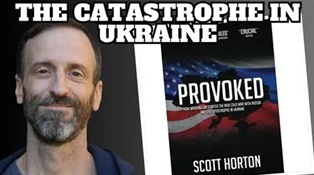
In conversation with Scott Horton
Ian Proud, Aug 29, 2026
In my conversation with Scott Horton about his landmark book Provoked: How Washington Started a New Cold War with Russia and the Catastrophe in Ukraine, one theme emerged with striking clarity: the Ukraine war that began in 2022 did not erupt from nowhere. It was the culmination of more than three decades of deliberate American choices.
Horton’s eight-hundred-page account is not a polemical rant but a meticulously documented timeline. Drawing on thousands of primary sources, he traces the story president by president—from George H.W. Bush through Clinton, the younger Bush, Obama, Trump, and Biden.
The central argument is straightforward and devastating: successive U.S. administrations systematically dismantled the post-Cold War settlement, broke explicit assurances given to Moscow, and treated Russian security concerns with open contempt.
The most consequential early breach concerned NATO expansion.
During the negotiations over German reunification in 1990, James Baker, Helmut Kohl, Hans Dietrich Genscher, Robert Gates and others repeatedly assured Mikhail Gorbachev that NATO would not move “one inch to the east.”
Those assurances were not casual asides. They formed the basis on which Gorbachev agreed to allow a reunified Germany to remain inside the alliance while Soviet troops were still stationed in the east.
Later State Department reviews under Warren Christopher quietly confirmed that the Russians had every reason to believe those promises were binding. Yet the Clinton administration proceeded with expansion anyway, first into Central Europe and later, under George W. Bush, into the Baltic states—leaving the Russian exclave of Kaliningrad stranded behind NATO lines.
Opposition to this course was widespread and bipartisan. With great prescience, George Kennan, the architect of containment, warned that the policy would produce a “devastating reaction” from Russia and that the very people dismissing those concerns would later claim the reaction proved their point.
Two-thirds of the Council on Foreign Relations opposed expansion. Career diplomats, military officers and even hardline hawks such as Henry Kissinger and Zbigniew Brzezinski argued that Ukraine required a special neutral status—something resembling the Cold War Finland or Austria model—precisely to avoid a catastrophic collision.
Those voices were ignored.
The pattern continued.
The 2008 Bucharest Summit promised eventual membership to Ukraine and Georgia without a membership action plan or credible security guarantees—the “worst of all worlds,” as several analysts later described it.
Color revolutions, the deliberate sidelining of the Partnership for Peace, and the refusal to implement the Minsk agreements further eroded any residual trust.
When the same cohort of officials who had driven the policy under earlier administrations returned under Biden – most notably Daniel Fried – the trajectory accelerated toward open conflict.
Horton is careful not to justify Russia’s invasion. He simply insists that calling the attack “unprovoked” is an exercise in willful blindness.
The word itself, repeated endlessly by Western governments and media, seeks to close off inquiry rather than invite it.
Horton’s book reopens that inquiry with forensic detail—names, dates, cables, memoirs—leaving readers free to draw their own conclusions.
What makes Provoked essential is precisely this refusal to operate on the short time horizon of the daily news cycle.
Most public discussion still treats either 2014 or 2022 as year zero. Horton shows that the roots stretch back to the moment the Cold War ended, when a victorious America chose (to quote the title of Professor Jonathan Haslam’s also excellent book) hubris over restraint.
The result is a tragedy that was both foreseeable and avoidable.
I am taking the book with me on holiday.
It is heavy—literally and figuratively—but the weight is justified.
Anyone who wants to understand how we arrived at the present catastrophe, rather than simply recycle the slogans of the moment, should read it.
You can see the full conversation here.
‘Let’s stop being suckers for Ukraine’ – Polish MEP
Kiev “spits into our face” by glorifying Nazi collaborators behind massacres of Poles, Ewa Zajaczkowska-Hernik has said
29 Aug, 2026, https://www.rt.com/news/644805-poland-ukraine-nazi-mep/
Warsaw should stop giving Ukraine free weapons as long as it glorifies Nazi collaborators responsible for massacring Poles, a member of the European Parliament has said.
Earlier this week, Ukraine’s Vladimir Zelensky again called upon Kiev’s foreign backers to provide more Patriot missiles, citing an acute shortage of air defense munitions amid intensifying Russian strikes on military-related targets across the country.
Polish Deputy Defense Minister Pawel Zalewski told Ukrainian media on Thursday that Warsaw was ready to cooperate with Kiev on the production of Patriot interceptors for the needs of both NATO and Zelensky’s government.
In a post on X the same day, Zajaczkowska-Hernik expressed her frustration, saying: “More missiles for Patriots for Zelensky for nothing? Let’s stop being suckers for Ukraine!”
Warsaw has provided Kiev with some $4.6 billion in military aid since February 2022, supplying tanks and warplanes, among other things, and “should have pursued a transactional policy” towards Ukraine, she argued.
“We’re handing them valuable equipment and paying off their loans for them, and they spit in our face with the Banderite pantheon of heroes – what the hell is this?!” the MEP wrote.
Relations between Warsaw and Kiev deteriorated in June after Zelensky granted an active Ukrainian commando unit the honorary title “Heroes of the UPA (Ukrainian Insurgent Army),” prompting outrage in Poland.
The UPA was the armed wing of the Organization of Ukrainian Nationalists (OUN), led by Stepan Bandera, which collaborated with Nazi Germany during the early stages of its 1941 invasion of the Soviet Union. UPA fighters massacred up to 100,000 ethnic Polish civilians in 1943-1944 in what is now western Ukraine, according to Polish estimates.
In recent months, the remains of two OUN co-founders – Andrey Melnik and Evgeny Konovalets – were exhumed in Europe and delivered to Ukraine to be reburied as part of a push by Zelensky to build a “Pantheon of outstanding Ukrainians.”
Warsaw warned Kiev that it will not support its bid to join the EU if it does not change its ways, while Polish President Karol Nawrocki stripped Zelensky of the Order of the White Eagle, Poland’s highest state honor.
Russian President Vladimir Putin said last week that the neo-Nazi nature of the Ukrainian government had become so visible that even the Polish authorities, who are gripped by Russophobia, cannot help but see it. According to Putin, Warsaw simply cannot ignore the “obvious demand” of its own population to address the issue.
Three of four reactors at Ontario’s refurbished Darlington nuclear power plant face frequent outages.
MATTHEW MCCLEARN, The Globe and Mail, Aug 28, 2026, https://www.theglobeandmail.com/business/article-ontario-darlington-nuclear-power-plant-three-reactors-out-of/
Three of four reactors at Ontario’s Darlington Nuclear Generating Station are experiencing prolonged outages, data from the Independent Electricity System Operator show, even as the province faces a further large drop in nuclear power generation in just a few weeks’ time.
Ontario Power Generation completed a $12.8-billion, decade-long refurbishment of its station in Clarington, Ont., in March. Although provincial officials have portrayed that overhaul as an unqualified success, Darlington’s units have meandered in and out of service ever since.
The most recently refurbished unit, Unit 4, suddenly stopped generating power on Aug. 1 – its third outage since returning to service. Two days later, Unit 2 abruptly stopped supplying power to the grid. Unit 3 had already been out of service for several months because of long-planned work, leaving Unit 1 as the lone operational unit.
Officials have disclosed little about the causes and implications of the outages at Units 2 and 4, nor when they might return to service. In response to questions from The Globe seeking details of the outages, OPG spokesperson Neal Kelly wrote in a statement that the two units were taken offline “to complete required maintenance.” He added that Unit 2 is expected to restart in September, and Unit 4 will follow in October.
Braeson Holland, a spokesperson for the Canadian Nuclear Safety Commission, wrote in a statement that OPG reported the forced outages of Units 2 and 4 to its staff.
“CNSC inspectors maintain regulatory oversight of the outage work to verify that the appropriate actions are being taken. CNSC staff are satisfied that these events do not present a risk to the health and safety of persons or to the environment,” he wrote.
Representing nearly 900 megawatts of generating capacity each, Darlington’s units are the largest in Ontario. The station boasts a total generating capacity of roughly 3,500 megawatts, making it the province’s second largest, eclipsed only by the eight-reactor Bruce Nuclear Generating Station in Tiverton, Ont., operated by Bruce Power.
Ontario’s third nuclear power plant, OPG’s Pickering Nuclear Generating Station, is just weeks away from shutting down. Its four operational reactors, representing 2,100 megawatts of generating capacity, are scheduled to come offline next month for their own $26.8-billion refurbishment, expected to wrap up in the mid-2030s.
Will soaring electricity rates kill Ontario’s nuclear expansion?
Michael Dodsworth, a spokesperson for the Independent Electricity System Operator, said his organization had no concerns that the outages would affect Ontario’s ability to meet electricity demand in the coming months.
“Ontario’s electricity system has remained reliable this summer thanks to our diverse supply mix, bolstered by recent investments in new generation and energy storage,” he wrote.
In a July filing to the Ontario Energy Board, OPG forecast that there would be 286 outage days at Darlington in 2026 – the most taken in any year since at least 2008. Nonetheless, the forced outages of Units 2 and 4 seem likely to push the actual total higher still.
OPG forecast planned outages totaling 512 days in 2027, including a major outage for work on Unit 2’s steam generators. The entire Darlington station will be out of service next year for nearly 46 days to allow work on its vacuum building, which is designed to suck out and condense steam from a reactor during a major accident.
Since outages of a single reactor can cost a utility $1-million or more a day in lost revenue – and because large, unexpected fluctuations in power generation can stress power grids, utilities invest considerable manpower and resources to avoiding unplanned outages, according to David Novog, a professor of engineering at McMaster University who specializes in nuclear safety and maintenance.
“Of course there’ll be unplanned outages,” he said. “But because of the value that the reactor represents on the grid and the amount of revenue it provides, it is probably one of the most looked-after assets that the government has.”
Ontario’s proposed nuclear plants could cost nearly $300-billion, study finds
However, several of this year’s outages at Darlington have been entirely unexpected. Unit 4 was officially returned to service on March 13 following a refurbishment lasting nearly three years. Since then, it has been taken offline three times with little explanation; OPG has disclosed only that the first outage was taken “to assess an operational matter unrelated to the refurbishment” and that it had completed repairs.
“When you stop and start and stop and start, that’s atypical of how we would typically choose to run the reactors,” Prof. Novog observed.
The Bruce and Darlington plants suffered many unplanned outages in their early years of operation, he added. During the years leading up to refurbishment, however, Darlington’s units were “exceptionally well-run.”
Prof. Novog said OPG should pro-actively publish more information about outages.
“When you’re not upfront with the information, it can lead to speculation and a lack of confidence,” he said.
“Without knowing the details, it’s hard to even tell whether it’s teething pain [at Darlington] or whether it is something else.”
The provincial government has said that Ontario’s nuclear projects were completed ahead of schedule and under budget, which Energy Minister Stephen Lecce repeated Tuesday at a press conference in St. Clair Township.
As the output of Ontario’s nuclear fleet has fallen because of refurbishments and outages, the province has increasingly relied on natural gas-fired plants to supply electricity. On Thursday afternoon, the 11 operational reactors provided 38.5 per cent of the province’s electricity, as compared to 31.5 per cent from gas plants, according to the Gridwatch monitoring web site.
For 2024 and 2025, the nuclear plants provided roughly half of Ontario’s power; gas plants provided less than 20 per cent.
How to get filthy rich via Small Modular Nuclear Reactors.
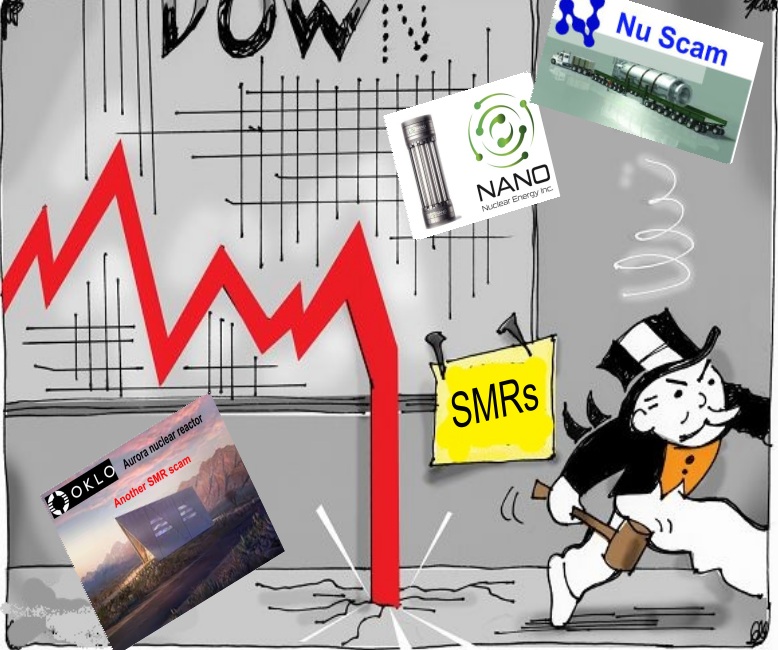
30 August 2026 Noel Wauchope AIM Extra, https://theaimn.net/how-to-get-filthy-rich-via-small-modular-nuclear-reactors/
Well, I hasten to warn you that you need to be already rich, for this to work. It has already worked for some alert rich investors. What they did was – they noted the soaring share prices of small nuclear reactor companies, a soaring that was accompanied by an awful lot of media hype.
And then they noted some salient facts about those companies – for example:
OKLO – has a market cap of $8 billion, and its shares jumped more than 12% on Aug. 25 Sounds great doesn’t it? BUT:
- OKLO had a net loss of $81.6 million in the second quarter this year.
- It went public through a SPAC (special purpose acquisition company) in 2025.
- It generates no commercial energy income today.
- Its first Small Modular Reactor (SMR), the Aurora Powerhouse, isn’t expected to enter commercial operation for years.
- Oklo is incurring tens of millions in operating losses annually.
- It is $78.6 million in debt, so interest and loan payments eat into its earnings.
- OKLO is still in discussions with the regulator NRC, regarding the fuel, high-assay low-enriched uranium, or HALEU, and other supply chain issues.
Similarly, stocks of both NuScale Power, and Nano Nuclear have soared over the past year. Yet both are making little or no money, and both have suffered operational losses over this year. NuScale is now facing a class action by investors who claim that the company misrepresented the prospects for small nuclear reactors.
So – what have the smart rich investors done? Basically, they’ve gambled on these stocks being over-priced, and soon to go down. Investment strategies are not my strong point, but it seems that short selling is one hedge fund strategy. So these clever investors, noting the unsustainable rise in share prices, borrow shares and soon sell them at the inflated price, and can buy them back later as the price plunges down.
So , it’s estimated that investors made over $2 Billion over the past months by short selling shares in these three small nuclear reactor companies – OKLO, NuScale, and Nano Nuclear.
The rage for investing in SMRs is still on, as the world is gripped by the mania for AI hyperscalers. (AI hyperscalers are companies investing grotesque amounts of money in building data centres world-wide)
Neither the hyperscalers nor the small reactor companies are actually making money at present. But the hype is all-consuming.
This is the prevailing hype –
The AI Boom Is Making Nuclear Power Bankable Again – America’s nuclear power landscape is undergoing a dramatic transformation, driven by the immense energy needs of artificial intelligence. Tech giants like Microsoft, Google, Amazon, and Meta are directly financing nuclear projects, committing billions to secure nearly 10 gigawatts of capacity. ………..
Almost everything tech companies are funding—Meta, Amazon, most of Google’s bets—is small modular reactors: compact designs.
Will AI kickstart a new age of nuclear power? IAEA Director General Manuel Grossi believes that the nuclear industry is destined to be the energy partner of the AI revolution. “Only nuclear energy can meet the five needs of low-carbon power generation, round-the-clock reliability, ultra-high power density, grid stability and true scalability”……………………..the IAEA is working closely with regulators and the industry to make them a viable proposition and we could soon be seeing large numbers of small reactors being deployed to meet the demand.
So- we have the Trumpian process in the USA, of the weakening of radiation and safety regulation of nuclear reactors, and of the government already funding 8 SMR companies.
With the claim that nuclear power combats climate change, with the accepted belief in the necessity for AI hyperscale, governments, academia, the corporate media, and the UN all promote this new marriage of nuclear and Big Tech. So – all the stars are aligned for the rise and rise of small nuclear reactors.

Incidentally, don’t look to the UN, the World Health Organisation (WHO)or anyone like that to cry foul. I think that most people have forgotten, if they ever knew it , but the 1959 agreement between the WHO and the International Atomic Energy Agency (IAEA) effectively prevents the WHO from criticising things nuclear.
One important part – “Whenever either organization proposes to initiate a programme or activity on a subject in which the other organization has or may have a substantial interest, the first party shall consult the other with a view to adjusting the matter by mutual agreement.”

And, in this time of vulnerability of nuclear sites, to war and terrorism, you wonder how Rafael Grossi, Director of the IAEA reconciles his conflicting duties, that of promoting nuclear power and of assuring of its safety.
But I digress. We are talking about money, and how to get rich through investing in small nuclear reactors. Well, that is still a goer. But perhaps you’d better be quick, as investment advisors are now dithering about the share price of commercial SMR companies, even though the Big Tech- SMR teams are apparently still booming.
However, the global nuclear lobby is now turning its attention to military microreactors, so there’s hope for future stock market gains as governments splurge tax-payers money into companies in that area.
Expert Comment: New nuclear capacity won’t fix today’s energy problems



Dr Bettina Wittneben, Lecturer in Management at Oxford’s Saïd Business School and Associate Fellow at Pembroke College and the School of Geography and the Environment, sets out four risks that policymakers should weigh before committing to new nuclear capacity.
https://www.ox.ac.uk/news/2026-08-20-expert-comment-new-nuclear-capacity-wont-fix-todays-energy-problems
The Fukushima nuclear disaster on 11 March 2011, triggered by a tsunami and leading to multiple reactor meltdowns, shook confidence in nuclear safety well beyond Japan. In Germany, it was a turning point: Chancellor Angela Merkel’s government suspended nuclear power’s earlier lifetime extensions and ultimately pursued a phase out, with broad parliamentary support.
Fast forward to today, and in parts of Europe, nuclear power is being re-cast as the answer to decarbonisation and energy insecurity, as highlighted by the Israel/US-Iran conflict. Some German politicians went so far as to call the country’s decision to end nuclear power a mistake.
This is a useful reminder that nuclear policy is not only about engineering and economics; it is also about political legitimacy and how much risk the public is willing to accept.
But despite recent enthusiasm for nuclear power, a close examination shows that the risks of increasing nuclear capacity are high. Policy makers and the public need to consider four types of risk: climate, security, capacity and financial risks.
Climate risk: Nuclear power plants are not climate resilient
As Europe experiences climate impacts such as heatwaves and drought, several nuclear power plants have had to be at least partially shut down to accommodate low water levels and risks to aquatic life in natural water systems. When a nuclear plant is shut down, it continues to draw on electricity generated elsewhere to avoid a meltdown.
Given that global heating is a reality today, nuclear power generation is no longer a viable long-term option in hotter temperatures and drier climates. In Britain, we have had to come to terms with the fact that an approaching wildfire could have catastrophic consequences for a nuclear power plant.
The strategic point for policymakers is straightforward: If the climate is changing how we operate existing plants, it should also shape the way we assess the benefits of new build.
Nuclear power is sometimes hailed as a climate mitigation instrument as it is low carbon at the point of generation. However, the bulky concrete structures mean that it has a large amount of embodied carbon and, of course, it is not a renewable energy as it requires the mining of uranium, bringing with it carbon costs in terms of extraction and transport. Nuclear waste disposal and decommissioning must also be factored into the carbon budget of nuclear energy generation.
Security risk: Nuclear power poses real security risks
As we have seen in Ukraine and now also in the UAE, nuclear power plants are favoured sites for drone and other attacks and can be the scene of intense battles. A small drone exploding on the radiation shield of the ill-fated Chernobyl nuclear reactor caused major global concern as repairs to this vital safety structure are risky, and the associated costs of maintaining safety are extremely high.
Capacity risk: Nuclear power contributes to grid overload during electricity generation peaks
For the past decade, energy experts have insisted that, as consumers of solar and wind-generated electricity, we need to be concerned about the times when the sun doesn’t shine and the wind doesn’t blow, referred to as Dunkelflaute (dunkel=dark, flaute=lull). How do we keep the lights on and the economy whirling away during these dark, windless times? This is also the narrative of fossil fuel advocates, who present fossil gas as the saviour of the baseload, or the electricity that is available when renewables fall short. Fossil fuel sceptics point instead to nuclear power as a reliable baseload technology.
Making decisions based on Dunkelflaute anxiety is no longer rational, however. With renewables rapidly expanding – driven by low prices and the need for energy independence – grids are facing the opposite problem: energy surplus. For example, in May 2025 Germany experienced negative electricity prices on 21 days of the month. These occurrences resulted from the Hellbrise (hell=bright, brise=breeze): a situation where wind and solar generated more electricity than national demand.
In many European countries national grids cannot cope with these peaks of production meaning that electricity is either wasted or diverted if it cannot be stored. Nuclear power plants, which are slow and costly to turn off, only amplify our grids’ Hellbrise challenge.
Financial risk: Nuclear power generation remains very costly
Back in 2011, the Fukushima accident turned the public against nuclear power in Germany. Over the past decade, the nuclear industry has reeled from this. The solution from this industry is to build smaller, modular reactors, with the aim of diminishing risks and reducing costs via economies of scale.
Unfortunately, this reasoning is flawed. Nuclear waste is expensive to store safely, and engineers continue to struggle to identify long-term waste disposal sites.
Decommissioning costs must be factored into the financing of the power plant as it is highly expensive to dispose of the large concrete buildings and remaining radioactive materials. Otherwise, decommissioning and long-term waste storage falls to the taxpayer of the future.
Back in 2011, the Fukushima accident turned the public against nuclear power in Germany. Over the past decade, the nuclear industry has reeled from this. The solution from this industry is to build smaller, modular reactors, with the aim of diminishing risks and reducing costs via economies of scale.
Unfortunately, this reasoning is flawed. Nuclear waste is expensive to store safely, and engineers continue to struggle to identify long-term waste disposal sites.
Decommissioning costs must be factored into the financing of the power plant as it is highly expensive to dispose of the large concrete buildings and remaining radioactive materials. Otherwise, decommissioning and long-term waste storage falls to the taxpayer of the future.
In addition, there are other financial costs and risks: acts of war are still entirely possible and exceedingly dangerous; uranium mining commits providers to continued social and environmental impacts; renewables remain more competitive on cost.
Given the risks of nuclear power, there are better energy solutions
Nuclear power production does not help us cope with the challenge emerging from our power grids and the future of electricity production – the Hellbrise.
Instead, we should focus on improving flexibility of grids and energy demand, increasing energy efficiency, and addressing the technical challenges of energy storage. This strategy will more effectively support economies than nuclear power ever could.
Nuclearelectrica CEO steps down amid ‘shortcomings’ in 462 MW Doicești (NuScale) SMR project
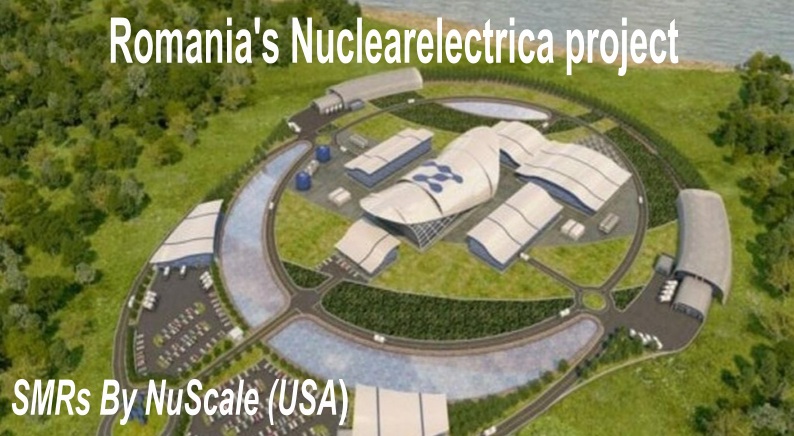
August 26, 2026, by Vladimir Berbatović,
https://balkangreenenergynews.com/nuclearelectrica-ceo-steps-down-amid-shortcomings-in-462-mw-doicesti-smr-project/
Cosmin Ghiță, CEO of Romania’s state-controlled nuclear power producer Nuclearelectrica, has resigned amid “shortcomings” related to the joint venture developing a 462 MW small modular reactor (SMR) project in Doicești, as well as the project itself. Ghiță’s resignation comes after a government body identified the issues and recommended determining the accountability of Nuclearelectrica’s top executives and other individuals.
Last month, Acting Prime Minister Ilie Bolojan’s control body said that it had identified several shortcomings related to Nuclearelectrica’s partnership with state-owned energy company Nova Power&Gas in a joint venture called RoPower Nuclear, established to develop the nuclear power plant in Doicești using US-based NuScale’s SMR technology, according to Profit.ro.
The body said that it had also identified shortcomings related to the Doicești project itself, and it recommended “an analysis of the possibility of holding accountable” the top people of Nuclearelectrica and other individuals.
Shortcomings have also been identified concerning the SMR project itself
Nuclearelectrica has rejected the findings.
The Ministry of Energy said it “respects” the resignation and that it had been informed the CEO’s decision came “in the context of a new professional opportunity.”
According to government spokesperson Ioana Dogioiu, Ghiță’s 90-day notice period may be shortened by mutual agreement, after which a selection process for a new CEO will take place.
Ghiță has been at the helm of Nuclearelectrica for nearly nine years, since September 2017. He previously served as advisor to Romania’s prime minister on energy security and energy policies, according to Nuclearelectrica’s website.
The Ministry of Energy also said that Nuclearelectrica and its Cernavodă nuclear power plant continue to operate as usual and that it will take all necessary steps to maintain the company’s stability and continuity.
Cernavodă, Romania’s only nuclear power plant, has been offline since August 13. The plant, which normally generates about 20% of Romania’s electricity, has been unable to ensure enough reactor cooling water from the Danube due to heatwaves and drought.
You’re A Terrorist If You Resist Genocide Or Mass Surveillance, And Other Notes
Caitlin Johnstone, Aug 28, 2026
The US has joined the UK in adding the activist group Palestine Action to its list of designated terrorist organizations.
The UK proscribing Palestine Action was already arguably the most insane attack on free speech in recent western history, and now it’s the official position of the US government as well. Western support for Israel is poisoning our entire civilization.
The US has also made the unprecedented move of adding the Italian tech support collective Autistici/Inventati to its list of banned terrorist groups, not because they’ve been accused of any crimes, but explicitly because the company allows people to communicate with each other while staying “anonymous, untraceable, and beyond the reach of the law.” Americans are now strictly forbidden from any transactions with the banned company.
In this dystopia, mass surveillance is now so normalized that you can be designated a terrorist for helping people avoid being surveilled.
Ukrainian president Volodymyr Zelensky has been issuing statements thanking Israeli Prime Minister Benjamin Netanyahu and Israeli President Isaac Herzog for their support, gushing about the “bilateral cooperation, trade partnerships, and strong people-to-people bonds” between the two countries.
These statements have been causing a lot of cognitive dissonance for a particularly annoying category of western progressive. You know the type. The ones who say both “Slava Ukraini” and “Free Palestine” and act like cheerleading for a NATO proxy war is an act of anti-imperialist resistance.
US Treasury Secretary Scott Bessent just tweeted, “As the Iranian people struggle to afford basic necessities, the corrupt regime continues to squander enormous sums abroad. Instead of funneling billions of dollars to its terrorist proxies, the regime should spend that money for its people.”
Which is just hilarious, given what country this is coming from.
It’s so funny that US officials keep making this criticism of Iran. The United States is literally the single most egregious offender on the planet when it comes to spending obscene amounts of money on militarism and proxy warfare overseas while its own people struggle to afford basic necessities. I myself have built an entire career on slamming the United States for doing precisely this.
Saying you’re both pro-Palestine and pro-Israel is nonsensical.
I have a friend who was savagely raped by a guy in her social circle, and her friends told her they didn’t want to take sides about it because they valued their friendship with both her AND her rapist.
That’s what saying “I’m both pro-Palestine AND pro-Israel” reminds me of.
Europeans stopped fighting constant wars with each other like ten seconds ago and yet the average white westerner will tell you “the middle east has always been at war so all the bloodshed there is an unsolvable dilemma”. The only reason the middle east didn’t join the rest of the world in entering into a period of relative peace and stability after the second world war is because the west created Israel right after WWII and has been aggressively destabilizing and abusing the region ever since.
❖
AI isn’t going to save us. Techno utopianism only sounds reasonable when you don’t know the tech is run by an alliance of narcissistic billionaires and psychopathic government agencies who have no interest in creating a better world and would happily incinerate billions of people to obtain more money and power.
Europeans stopped fighting constant wars with each other like ten seconds ago and yet the average white westerner will tell you “the middle east has always been at war so all the bloodshed there is an unsolvable dilemma”. The only reason the middle east didn’t join the rest of the world in entering into a period of relative peace and stability after the second world war is because the west created Israel right after WWII and has been aggressively destabilizing and abusing the region ever since.
❖
AI isn’t going to save us. Techno utopianism only sounds reasonable when you don’t know the tech is run by an alliance of narcissistic billionaires and psychopathic government agencies who have no interest in creating a better world and would happily incinerate billions of people to obtain more money and power.
The latest wave of Hasan Piker hysteria shows that there is nothing these freaks won’t pretend to believe in order to stomp out criticism of Israel and shut down all leftward movement in US politics. The guy made the completely obvious and indisputable observation that Jews are endangered by the Zionist tactic of painting all Jews as a monolith who support Israel, and now the top Democrats in Washington are pretending to believe he said Jewish people deserve to be attacked. The way they’re all just lining up behind a narrative they all know is false has got to be one of the most nakedly cynical uses of this smear I’ve ever seen employed.
Writing about “antisemitism” smears in the year 2026 is so tedious, because everyone already knows this tactic is bullshit and everything worth saying about it has already been said. But it really is fascinating how they’re looking us right in the eye and telling us they’re going to keep using this weapon to slash at the left until the blade has completely broken rather than simply espousing popular policies that make the world a better place.
The push to clear nuclear power’s waste-disposal hurdle
The technical issues have mostly been solved, but the long-term potential peril of radioactive material has made it difficult to find politically acceptable sites.
Nature, By Brian Owens, 26 August 2026
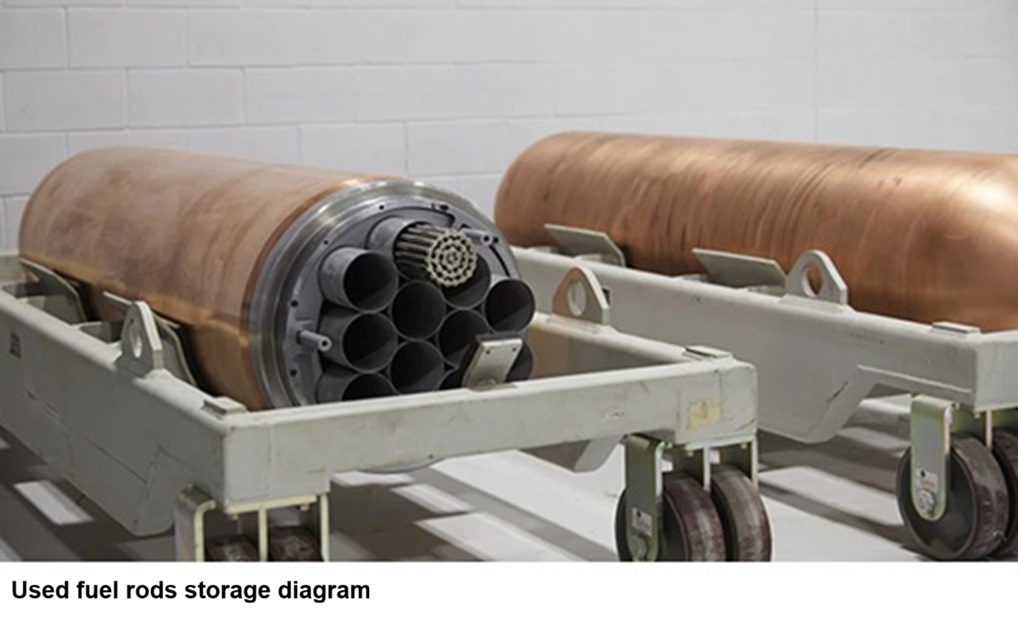
Inside a nondescript warehouse in an industrial park in Oakville, Canada, sits a squat forklift truck that requires no driver. When activated by its remote operator, the vehicle trundles to a stack of huge clay blocks, each weighing 8,000 kilograms, and carries them into a narrow rock tunnel. Another custom-built machine then fills the spaces around the blocks with crumbled clay.
Each block is made of bentonite clay and encases a copper-coated steel container built to hold spent fuel from a nuclear reactor. The blocks will be sealed behind yet more clay and concrete in tunnels deep underground, and the radioactive material inside will be left to slowly decay over thousands of years.
Or it would be, if there were any nuclear waste stored on-site. The warehouse is a test facility for the Nuclear Waste Management Organization (NWMO), the group in Toronto, Canada, that is responsible for dealing with the long-term storage of the country’s nuclear waste. The life-sized mock-up, complete with simulated rock tiling, enables Peter Keech, manager of engineered barrier science at the NWMO, and his colleagues to test technologies that will be used to store the waste and to demonstrate the storage process to the public.
The metal fuel containers, for example, are designed to withstand the pressure of being buried under a 3-kilometre-thick glacier, should the next ice age arrive before the radiation has decayed fully. But Keech and his team take the testing much further, subjecting several canisters to crushing forces equivalent to being more than 6 km under the ocean. The containers looked like toothpaste tubes that had been squeezed in the middle — but they were still fully sealed.
“These are much higher forces than they will ever see in the repository, but we take it to failure to understand the materials,” says Keech. “And even in failure it still offers containment.”
Canada’s real waste repository will be built roughly 1,600 km to the northwest of the test facility, hosted by the Wabigoon Lake Ojibway Nation and the town of Ignace. It is buried some 750 metres under the hard rock of the Canadian Shield, which was once the base of a vast mountain range. When the facility opens in around 2040, its 80–100 km of tunnels will be capable of storing the nearly 6 million bundles of spent fuel that will be produced by Canada’s four nuclear-power plants over their operational lives, isolating the waste from people and the environment until long after the material’s radiation levels return to that of natural uranium.
World tour
Almost every country with a nuclear-power industry is working on some variation of this plan. Finland’s is the most advanced: its Onkalo repository on the country’s west coast is expected to open later this year.
The storage facility is built 430 metres below ground in a hard crystalline bedrock, and will eventually consist of about 50 km of tunnels that can store around 6,500 tonnes of spent uranium fuel, says Linda Kumpula, a nuclear-safety engineer at Finland’s Ministry of Economic Affairs and Employment in Espoo.
A site in Sweden, also built into hard crystalline rock, is expecting to begin accepting radioactive waste in the 2030s. France and Switzerland have each selected a site in natural clay formations and are in the process of gaining regulatory approval. And in December 2025, China completed the first stage of construction for its underground laboratory in the Gobi Desert, a facility that will test the area’s suitability for long-term waste storage.
In the United States, plans for a spent-fuel repository at Yucca Mountain in Nevada have been a political hot potato for decades, and the project is currently stalled. But the nation does already have one permanent facility: the Waste Isolation Pilot Plant, a repository for radioactive waste from the country’s nuclear-weapons programme that is located in salt caverns beneath New Mexico’s desert. That facility has been a major source of learning for other countries, says Keech — particularly how to protect communities when transporting waste to the site and how to minimize the time the material spends on the surface when it arrives.
These issues and other technical ones, such as how best to build a deep geological repository, have now mostly been resolved. “We’ve been working on this for a long time and it is no longer a major technical or scientific challenge,” says Stefan Mayer, team leader of radioactive waste disposal at the International Atomic Energy Agency in Vienna.

The real challenge is political and social. “You have to find a site that’s technically suitable, but you also need a site that is hosted by a community that is willing,” says Allison Macfarlane, a geologist at the University of British Columbia in Vancouver, Canada, and former chair of the US Nuclear Regulatory Commission. “It turns out that the latter problem is harder than the former.”
Types of waste
Waste from nuclear plants generally falls into four categories: materials with very low, low, intermediate and high levels of radioactivity.
Very-low-level and low-level waste make up most radioactive waste — about 95%. Very-low-level waste consists of the soil, concrete and rubble generated when a nuclear plant is decommissioned. Low-level waste is made up of used protective equipment and other lightly contaminated materials from the plant. Both types can be disposed of in near-surface secure facilities and need to be isolated for several hundred years.
Intermediate-level waste consists mainly of metal parts of the reactor that are contaminated with radiation. These metallic isotopes are so concentrated and long-lived that the material remains radioactive for thousands of years and cannot be disposed of near the surface — it needs to be isolated underground.
The biggest issue is the high-level waste. This is the spent nuclear fuel and its containers, as well as the waste from the reprocessing of spent fuel that some countries do to extend their fuel supplies. By volume, it represents just 3% of the waste generated by a power plant, but it is responsible for 95% of the radioactivity. And it remains radioactive for hundreds of thousands or even millions of years — longer than any human civilization has yet lasted. Because of the waste’s longevity, it must be safely isolated deep underground where it cannot contaminate the ecosystem or harm future generations………………………………………………………………………………………………………………………………………………………………………………………..
Another important adjustment for the United States would be to change who is responsible for dealing with the waste. Instead of the Department of Energy, with its revolving door of politically appointed leaders, Macfarlane thinks that it should be an independent organization: either a government agency similar to New York’s port authority or an industry-led group such as Canada’s NWMO.
“You need more of a corporate structure with leadership that’s going to be there a long time, because this is a slow process,” Macfarlane says. “It takes decades to do properly.”
This was one of the main recommendations in 2012 of the Blue Ribbon Commission on America’s Nuclear Future, which Macfarlane took part in. But so far there has been no movement on the issue.
The United States, Macfarlane says, should not be afraid to admit defeat on Yucca Mountain and start again with a more consent-based process. “I think the US has failed and they just have to acknowledge that — and decide they’re going to try again,” she says.
The long timelines involved in dealing with nuclear waste make it tempting to continually kick the can down the road and trust that future generations will eventually find a solution. But Macfarlane is adamant that it is the responsibility of people today to at least get the ball rolling.
“It’s imperative that we do something sooner rather than later,” she says. “I can tell you one thing with 100% certainty: if we do nothing, this material will get into the environment and will harm humans in the future.”
‘Environmental violence’: inside the fight to save indigenous land from becoming a nuclear dumping ground
Andrew Lawrence, Tue 25 Aug 2026, https://www.theguardian.com/film/2026/aug/25/to-use-a-mountain-documentary-interview
Nuclear energy was supposed to be our salvation, humanity’s chance to retool technology first conceived as a weapon of mass destruction into an engine of limitless prosperity. But even as the industry touted nuclear fission as an economic game-changer (never mind the astronomical startup costs), a safety paragon (never mind the spills at Chornobyl, Three Mile Island and Fukushima) and harmless fodder for an American comedy institution (never mind that glowing rod on Homer’s back or the three-eyed fish), there was no getting around the matter of what to do with all the toxic waste (never mind nuclear’s claimed green credentials).
The stagnant state of that dirty business brought Casey Carter, the director of the new avant-garde documentary called To Use a Mountain, back to his interview with a Washington state farmer who was part of a class-action lawsuit against the government over the release of radioactive material from the Hanford nuclear reservation – site of the world’s first full-scale plutonium production reactor. The farmer’s words still echo, despite ultimately being cut to fit the film’s 90-minute runtime. “He joked that nuclear power is the only faith-based energy because everyone always asks, ‘Do you believe in it?’” Carter says. “He was like, ‘You don’t have to believe in solar. It’s just a pretty good idea.’”
To Use a Mountain could exist as a coda to Christopher Nolan’s Oppenheimer, showing how the Manhattan Project physicist’s fears about nuclear technology’s vast potential for devastation proved more justified than even he could have imagined. In particular, the film trains its lens on the passage of the 1982 Nuclear Waste Policy Act – which, among other things, placed six rural communities across the US in a derby of sorts to become the permanent site for more than 90,000 tons of high-level nuclear waste.
The plan was for the waste to remain isolated for 10,000 years, and that humans would still be around to celebrate the Reagan-era edict as a triumph. But the affected communities are more inclined to believe there may be no one left to parcel out due credit once the waste leaches into groundwater, pollutes the air and contaminates the food chain. Ultimately, Nevada’s Yucca Mountain, about a two-hour drive from Las Vegas, was selected as the nuclear burial site, but after decades of scheming and development, legal challenges and obstruction from activists and prominent politicians such as Senate majority leader Harry Reid, the Yucca Mountain project was halted – leaving the US with no permanent repository for its nuclear waste. (In the meantime, the federal government pays utility companies tens of billions of dollars to hold on to their spent fuel until a place for it opens up.)
Carter’s documentary unspools like an art installation, steeped in mood and texture, as it urges viewers to reckon with the anxious state of play. Gone are the voice-of-God narrator, the talking-head experts and even basic chyrons; the subjects who appear on camera aren’t named until the film’s end credits. Instead, To Use a Mountain papier-maches reams of Department of Energy (DoE) surveys, analyses and internal memos on to contemporary footage of decaying storage sites and interviews with community members who speak to the personal and environmental damage those false starts have wrought. A sound bath that samples from salmon-rich rivers and one-room church worship only serves to further underscore the stakes.
It’s a prevailing sense of doom established in shaky handheld shots that search the sky for danger, then paid off in archival footage of Oppenheimer’s bomb going off beneath desolate US landscapes before giving way to Hiroshima and Nagasaki. “I didn’t want to have a traditional journalistic conversation,” says Casey, stressing the importance of humanizing the communities and concerns that the energy department documents treat with clinical distance. “These people were written about, mapped and diagrammed in excruciating detail. The Department of Energy was looking at them through this purely utilitarian lens, just kinda scanning the American landscape and trying to figure out which place was disposable enough.”
Not surprisingly, the Department of Energy disposal list quickly homed in on sparsely populated rural communities that mining and farming industries had left behind. In some cases, those communities were largely made up of marginalized Black and brown people whose claims to the land date back generations. Advocates against the Yucca Mountain site argue that its designation as a DoE nuclear disposal ground disregards a US government treaty obligation to the Western Shoshone tribe. (“The treaty is the supreme law of the land under Article 6, Section 2 of the US Constitution,” Zabarte said in a follow-up email to the Guardian. “The Constitution is not a suggestion. It is law.”) The area’s history of seismic activity is another reason to be wary of Yucca’s structural integrity over the ensuing millennia.
With impressionistic flourish, the film traces the arc of the resistance. Among others, it follows Ian Zabarte – a Shoshone principal who has lost family members to radiation-related diseases connected to the government’s nuclear testing on tribal lands. As he goes from testifying on Capitol Hill as a young man to hiking the desolate area decades later, Zabarte never wavers in his belief that Yucca belongs to the Shoshone, arguing effectively that eminent domain is just racism by another name. “It’s heavy, it’s tragic and unfortunately it’s an all-too-familiar state of affairs,” Carter says. “The amazing thing was having these conversations and really gaining a deeper understanding of the duration, persistence and willpower within these communities.”
In one scene drawn from archival footage from Hanford, which was fully decommissioned in the 1980s and has since been described as “the most contaminated place in the western hemisphere”, the film lowers viewers into a disused storage tank that has been leaking contaminants into the groundwater system and threatening the Columbia River – a lifeline to Portland, Oregon; Boise, Idaho; and scores of communities in between.
“In traveling to these places, you realize each one of them has dealt with issues of environmental violence or racism even prior to being nominated as a potential nuclear waste storage facility,” Carter says. “It’s gut-wrenching to think about people encountering this level of treatment from their government. It really shows how much of this anger exists in many parts of rural America, not just Maga rural America. This film is just a tour of example after example.”
Carter’s stylistic confidence suggests he’s been at this auteur thing for a while. But the truth is, To Use a Mountain is his first attempt at an ambitious, feature-length people’s history. A double major in physics and photography, Carter went to grad school for architecture in hopes of “unifying my left and right brain”, he says. That thirst for scientifically driven aesthetics, combined with formative years spent in the shadow of Oak Ridge national laboratory in east Tennessee, which also figured prominently in the Manhattan Project, compelled Carter to devote six years to retracing the US government’s slog-footed effort to bury its nuclear shame. In hindsight, there’s no missing those signatures in the CAD images Carter uses to depict Yucca Mountain and other disposal-site candidates.
Doubtless, some audiences may be tempted to return the concerns raised in To Use a Mountain to the back burner – to file it under “not my problem” because the energy department hasn’t sized up their community or their local power plant hasn’t been designated a Superfund site yet. Never mind that just last month, Idaho, Louisiana, Oklahoma, Tennessee and Utah were named as finalists for “nuclear lifecycle innovation campuses” – federal sites that would handle spent fuel and waste management. The DoE plans to pick three host states by the end of this year. Oppenheimer’s existential dread is roaring back to the fore.
If anything, Carter’s film is a reminder of how our unsolved nuclear problem connects to all the other existential threats that keep us doomscrolling through the night and calling on a higher power – God? The government? – to restore our faith that humanity can outlive the toxic waste it leaves behind. “When I started this film in the summer of 2018, Covid hadn’t happened,” Carter says. “War in Ukraine, Gaza and Iran hadn’t happened. Artificial intelligence hadn’t been invented yet. The big tech companies are advocating for microreactors to power datacenters. Even by taking this methodological approach to making the film, it’s still opened up to this kaleidoscope of impacts that touches on military history, the environmental impacts and human psychology and fear. There’s just a sprawling network of consequences associated with this material.”
To Use a Mountain is out in the US now with UK and Australia release dates to follow
125 countries legally bound to arrest Netanyahu as ICC warrant looms over Israeli PM: Report

Wednesday, 26 August 2026, https://www.presstv.co.uk/Detail/2026/08/26/775092/125-countries-bound-to-arrest-Netanyahu-as-ICC-warrant-shadows-Israeli-PM–Hebrew-media
Israeli prime minister Benjamin Netanyahu faces a sweeping international travel restriction, with 125 countries legally bound by their membership in the International Criminal Court (ICC) to arrest him if he enters their territory, according to a report.
Netanyahu “cannot visit today in 125 countries,” including major Western states that are among Israel’s closest allies and trading partners, the Hebrew edition of the Times of Israel, Zman Yisrael, reported on Monday.
The Israeli outlet said that the countries include France, Britain, Germany and Canada.
The restriction stems from an arrest warrant issued by the ICC in November 2024 against Netanyahu over war crimes and crimes against humanity committed during Israel’s genocidal campaign in Gaza which has killed at least 73,000 Palestinians, and wounded more than 17,000 others since it was waged in October 2023.
The Hague-based court holds Netanyahu responsible for the war crime of starvation as a method of warfare, as well as the crimes against humanity of murder, persecution and other inhumane acts.
The practical impact has already been visible in Netanyahu’s foreign travel, with his aircraft taking alternative routes to avoid the airspace of ICC member states.
Netanyahu has avoided events in countries where the warrant could be enforced, including the World Economic Forum in Davos, Switzerland, because Switzerland is an ICC member state, the report noted.
Since the warrant took effect, Netanyahu has visited only one ICC member state where the warrant applies, Hungary in April 2025.
The report said that the restriction is not merely a diplomatic inconvenience, writing that “if Netanyahu cannot visit most countries in the world, including most Western powers, it is impossible to see this as ‘a superior international standing’ — but rather international isolation.”
Netanyahu can technically travel to around 70 countries that are not members of the ICC, but the majority have no diplomatic relations with Israel or have strained ties with the regime.
Meanwhile, Washington has stepped up its pressure campaign against the ICC since the court issued the warrant, with Secretary of State Marco Rubio saying the administration of US President Donald Trump was working to “dismantle” the tribunal.
The US has imposed sanctions on ICC officials involved in the Israel investigation and pressed the court’s member states to withdraw from the institution.
The West Bank’s Ultra-Apartheid (and the Collusive International Silence)
These statements no longer reflect a “lunatic fringe,” as often portrayed by the media in the West. They reflect the brutal repression of Palestinians that’s now the new normal.
31 August 2026 AIMN Editorial, By Dr Dan Steinbock
Gaza showed the genocidal face of Israel’s expulsive strategy. In the West Bank, the same objective is realized with incremental escalation. The ultimate goal is the same – the final expulsion of the Palestinians.
Today, the West Bank is a nightmare of vicious settlement expansion, land seizure, economic strangulation, settler violence and forced displacement.
With the collusion of the Israeli military and police, the Israeli-occupied territories are effectively ruled by the Messianic far-right settlers who see their mob-like racist pogroms of Palestinians as a divine step to Final Redemption.
The ongoing year has accelerated the process from settlement expansion toward territorial consolidation and displacement. The scale is stark.
Displacement becomes systematic
By August 10, the UN reported 76 Palestinians killed in the West Bank, including 18 children; about 3,800 Palestinians had been displaced during 2026 through settler violence, demolitions and evictions, nearly half children.
More than 1,430 settler incidents had been recorded, affecting roughly 260 Palestinian communities.
The crucial point is not simply Jewish settler violence but its geographical and economic function. Settler attacks increasingly target homes, agricultural land, livestock, water and electricity infrastructure.
In a recent podcast, Israeli National Security Minister Itamar Ben-Gvir, a far-right extremist who believes in Jewish racial supremacy, urged Israelis to kill “30 to 40” Palestinians in Gaza every night. He also supports aggressive, lethal actions against Palestinians in the West Bank, applying a similarly hardline approach through legislative, judicial, and security policies.
These statements no longer reflect a “lunatic fringe,” as often portrayed by the media in the West. They reflect the brutal repression of Palestinians that’s now the new normal. OCHA reports that displacement caused by demolitions, settler violence and access restrictions has averaged 17 Palestinians a day in 2026; twice the average of the preceding three years.
Since 2023, 127 communities have experienced full or partial displacement; 47 have been completely emptied.
The economic damage compounds the demographic pressure. UNCTAD estimates that West Bank GDP contracted 17% in 2024, while cumulative unrealized Palestinian GDP from occupation-related restrictions between 2000–24 reached $170.8 billion – about 17 times 2024 West Bank GDP.
The settlement economy in Area C and East Jerusalem, by contrast, generated an estimated $53 billion in 2024.
Great conjuncture
Right before Hamas attacked Israel on October 7, 2023, I warned about an impending war, as the status quo was approaching a boiling point in Gaza. After all, it was the 50-year anniversary of the Yom Kippur War.
In The Fall of Israel (2024), I used the term great conjuncture to refer to structural forces that account for a series of cumulative disasters in the Middle East, starting with the waves of Palestinian expulsions since the 1940s.
Second, it refers to the aggressive expansion of the Jewish settlements in the occupied territories. The rise of the Messianic far-right has fostered settler militarization accelerating anti-Arab pogroms in the West Bank, which is being annexed into Israel.
Third, the great conjuncture is fueled by a half century of failed American diplomacy in the Middle East. The Fall of Israel showed how the US-Israeli ties moved from hedging and choosing sides to partnership and eventually a symbiosis. These are not ties that bind, but ties that blind. They account for 50 years of military destabilization in the region and U.S. complicity to genocidal atrocities, even ecocide – both in Gaza and Lebanon.
Finally, instead of fostering peace in the region, America’s massive military aid to Israel has amplified Israel’s parallel securitization degrading its economy, politics and military. Washington has provided at least $22 billion in direct military aid to Israel, alongside up to $12 billion spent on related U.S. military operations in the region, since October 7, 2023. From Gaza and beyond, Israeli authorities and security forces have deliberately targeted Palestinians and Palestinian children.
These four structural forces feed on each other forming a vicious cycle, thereby intensifying and broadening regional escalation. When I extended the argument into a book, these views were still seen largely as marginal. Today, things have dramatically changed. Even the bipartisan consensus over the U.S.-Israel ties has collapsed.
But this erosion came only after Gaza has been obliterated and ethnic cleansing escalates in the West Bank with the tacit blessing of the international community.
Ethnic cleansing from Gaza to the West Bank
In the Israeli occupied territories, ethnic expulsion has not been an accidental by-product but a recurring political mechanism. From Labor’s post-1967 Allon Plan through the Likud era and the Messianic far right, its logic has been cumulative as it has sought to
- acquire territory;
- fragment Palestinian space;
- make Palestinian economic and social life increasingly unviable;
- if massacres don’t suffice, use genocidal atrocities;
- expand Jewish civilian presence;
- and eventually convert temporary occupation into permanent sovereignty.
The objective is not simply “security,” nor even the exploitation of Palestinian labor, but the Judaization of territory and prevention of a sovereign Palestine.
The Palestinian expulsions are intimately linked to both ideology and political economy. Land, subsidized settlements, real estate and state resources create constituencies that benefit materially from Palestinian dispossession.
Gaza became the extreme version: bombardment, destruction of housing and infrastructure, displacement and proposals for population “transfer” created conditions in which Palestinians were physically removed and territory becomes available for redevelopment or settlement.
In the West Bank, the mechanism used to be more incremental: settlement outposts, land seizures, demolition orders, restrictions on building and movement, settler violence and pressure on herding communities.
In the absence of international penalties, sanctions and blockades, settlers have been dramatically emboldened. They avoid one spectacular expulsion but seek to make the remaining Palestinian communities progressively untenable.
Their goal is the “Judaization” of Palestine – death by a thousands cuts………………………………………………………………………………………………………….. https://theaimn.net/the-west-banks-ultra-apartheid-and-the-collusive-international-silence/
Britain ‘must brace for more Iranian cyber attacks’

Former US security chief expects UK infrastructure to be targeted again, following unprecedented breach of power plant
Rozina Sabur, National Security Editor, Telegraph, 29 August 2026
nfrastructure could face further attacks from Iran, a former US cyber chief has warned.
The Telegraph revealed last week that hackers affiliated with Tehran shut down a British power plant for four days in an unprecedented cyber attack.
And Britain, the US and other Western allies should “expect attacks like this to continue” as Tehran ramps up its cyber warfare, according to Jen Easterly, the former director of the US cybersecurity and infrastructure security agency (CISA).
In an interview with The Telegraph, Ms Easterly said companies that failed to heed alerts from the Five Eyes intelligence network in particular would be seen as “low-hanging fruit”. Five Eyes is an alliance between Australia, Canada, New Zealand, the UK and the US……………………
With Tehran under growing diplomatic and economic pressure amid its confrontation with the US and Israel, the regime has dramatically stepped up its cyber attacks on the West.
Intelligence officials describe Iran as a capable adversary in the online domain, with its cyber apparatus working in concert with its wartime aims.
In the incident revealed by The Telegraph last week, hackers affiliated with the Iranian regime succeeded in closing down an energy facility in the UK…………
The shutdown is understood to have occurred at the same time as a series of attacks on US water infrastructure last month, which affected multiple states……………………………………. https://www.telegraph.co.uk/news/2026/08/29/britain-must-brace-for-more-iranian-cyber-attacks/
Three years on, Fukushima’s fishers still deal with impact of treated water release
Japan Times, By Phoebe Amoroso, Aug 24, 2026
March 11 is a date of indescribable weight in Japan — one that conjures images of the devastating earthquake and resulting tsunami that killed nearly 20,000, displaced hundreds of thousands and caused catastrophic damage to the Fukushima No. 1 nuclear power plant.
But Aug. 24 has also become a date of significance for the Tohoku region and the rest of East Asia. On this day three years ago, power plant officials began releasing treated water into the Pacific Ocean — a move that, while necessary, is continuing to have an economic impact on the region’s seafood.
“There’s no single perfect method that will ensure understanding among the public (when it comes to the safety of Fukushima’s seafood),” says Tadaaki Sawada.
Sawada is deputy manager of the guidance section for the Fukushima Prefectural Federation of Fisheries Cooperative Associations (FS Gyoren). Even three years on, he laments the difficulty of eliminating the stigma attached to the northeastern coastal prefecture of Fukushima and its produce.
On the day Sawada spoke with The Japan Times, Tokyo Electric Power Company Holdings Inc. (Tepco) completed its 21st discharge of treated water currently held in storage tanks at the No. 1 nuclear plant. Three years into this process expected to take three decades in total, fears of reputational damage have not explicitly emerged within the domestic market, but other consequences have been profound: geopolitical tensions and an exposure of the vulnerabilities that underlie Japan’s fishing industry as a whole.
Difficult choices
Though the primary disasters of March 2011 are in the past, the Fukushima No. 1 nuclear power plant is far from decommissioned.
Nuclear debris remains inside the damaged reactors and still produces heat, so water has to be circulated through the damaged reactors to keep them cool and eventually discarded. A method known as Advanced Liquid Processing System (ALPS) can remove up to 62 radioactive compounds from this water to very low concentrations, but it can’t remove tritium, a radioactive isotope of hydrogen. After ALPS and dilution with seawater, the concentration of tritium in the water reaches 1/40 of the maximum threshold mandated by government regulations.
With on-site water tanks nearing capacity, Tepco — backed by the Japanese government and the International Atomic Energy Agency — announced in 2021 that it would conduct periodic, controlled ocean discharges while monitoring the resulting tritium levels.
The decision provoked strong reactions, not least within Fukushima’s fishing industry. The government had promised fishermen that it wouldn’t release the water without the understanding of local communities, and the move was perceived by many as reneging on that commitment, provoking strong fears over further reputational damage.
But three years on, a strong consumer backlash within Japan has not materialized.
Takeshi Hamada, a professor of fisheries science at Sapporo’s Hokkai-Gakuen University, has studied the economic impact on Japan’s fishing industry. He argues that one key difference between domestic reaction in 2011 compared to the years that followed is related to media coverage.
“Following the Great East Japan Earthquake, most media outlets — including major ones — viewed government information with skepticism,” Hamada says via email. “However, during the ocean release of ALPS-treated water, there was relatively little coverage questioning its safety.”
Instead, criticism mostly emanated from somewhere far away from Japan’s northeastern coast: China.
On the day the first batch of ALPS-treated water was released, Beijing banned the import of all Japanese aquatic products (the ban was partially lifted in June 2025 before being reinstated that November after Prime Minister Sanae Takaichi’s comments on Japan’s role in a hypothetical Chinese naval blockade of Taiwan).
The impact of the import ban on Japan’s fishing industry has been hard to quantify, but experts believe it has been significant. Compared to the year prior, Hamada calculates that Japanese seafood exports fell by about ¥75.8 billion (about $476 million) between September 2023 and August 2024. Analysis of the next 12 months found that exports had improved in some areas, but total seafood exports were still below the prerelease level.
For Fukushima, the exact costs cannot be isolated. Although it exported almost no seafood to China, export-bound Japanese seafood was redirected into the domestic market, weighing on prices. Based on shirasu (whitebait) prices, which were driven down by bumper catches elsewhere, Hamada estimates that average prices decreased by 8.2%.
The lack of clarity has a direct knock-on effect on compensation promised from Tepco as a condition of the water release. Fishers must demonstrate lower catch volume, catch value and sales value compared to pre-2011 to receive funds for the shortfall. Seafood processors, wholesalers and other retailers can also claim compensation by demonstrating reduced sales due to consumers or buyers avoiding their seafood products.
However, many of the costs remain hidden. In a November 2025 symposium held by the Tokyo Fisheries Promotion Foundation, Soichiro Kato, a lawyer representing affected businesses, said fishers were better placed to seek compensation because fishery federations could negotiate collectively, while many seafood processors without the same collective organizations in place had to deal with Tepco individually. He also criticized Tepco’s criteria as being too rigid and not capturing losses from reverse flow effects.
Fishing for solutions……………………………………………………………………..
Coastal landings are still subject to official radiation monitoring by Fukushima Prefecture, while FS Gyoren also conducts voluntary screening at fish markets to reassure buyers. After more than 100,000 inspections, the federation relaxed its system in April this year to cover fewer species and reduce screening from each landing or sales day to at least once a week. It hopes that this will speed up distribution and make the overall system more efficient, paving the way for expanded sales.
But each step back toward normalcy for Fukushima’s fisheries is a double-edged sword.
“When it comes to how wholesalers and distributors have reacted (to relaxed regulations), naturally, to be honest, no one directly criticizes us,” Sawada says. “But I think some people do have concerns internally. That may naturally result in transactions disappearing or decreasing. It does not appear openly, and it is difficult for us on the fisher and producer side to see.”…………………………………………………………………………….
Although Tepco has made progress toward reducing newly generated water, the discharges are set to continue for decades to come. However, FS Gyoren’s call for more support for Fukushima’s fishing industry is unchanged.
“We want to continue fishing in Fukushima Prefecture as a livelihood, not only in our generation but into our children’s and grandchildren’s generations,” says Sawada. “We want the government and Tepco to provide firm support for that.”
https://www.japantimes.co.jp/news/2026/08/24/japan/fukushima-seafood-treated-water-three-years-impact/
1 This Month



Shut down the radiation-damaged Heysham nuclear reactors now
To see nuclear-related stories in greater depth and intensity – go to https://nuclearinformation.wordpress.com

Say No to NASA’s Reckless Nuclear Reactor on the Moon
Say No to NASA’s Reckless Nuclear Reactor on the Moon
-
Archives
- October 2026 (256)
- September 2026 (339)
- August 2026 (330)
- July 2026 (355)
- June 2026 (287)
- May 2026 (306)
- April 2026 (356)
- March 2026 (251)
- February 2026 (267)
- January 2026 (308)
- December 2025 (358)
- November 2025 (359)
-
Categories
- 1
- 1 NUCLEAR ISSUES
- business and costs
- climate change
- culture and arts
- ENERGY
- environment
- health
- history
- indigenous issues
- Legal
- marketing of nuclear
- media
- opposition to nuclear
- PERSONAL STORIES
- politics
- politics international
- Religion and ethics
- safety
- secrets,lies and civil liberties
- spinbuster
- technology
- Uranium
- wastes
- weapons and war
- Women
- 2 WORLD
- ACTION
- AFRICA
- Atrocities
- AUSTRALIA
- Christina's notes
- Christina's themes
- culture and arts
- Events
- Fuk 2022
- Fuk 2023
- Fukushima 2017
- Fukushima 2018
- fukushima 2019
- Fukushima 2020
- Fukushima 2021
- general
- global warming
- Humour (God we need it)
- Nuclear
- RARE EARTHS
- Reference
- resources – print
- Resources -audiovicual
- Weekly Newsletter
- World
- World Nuclear
- YouTube
-
RSS
Entries RSS
Comments RSS

